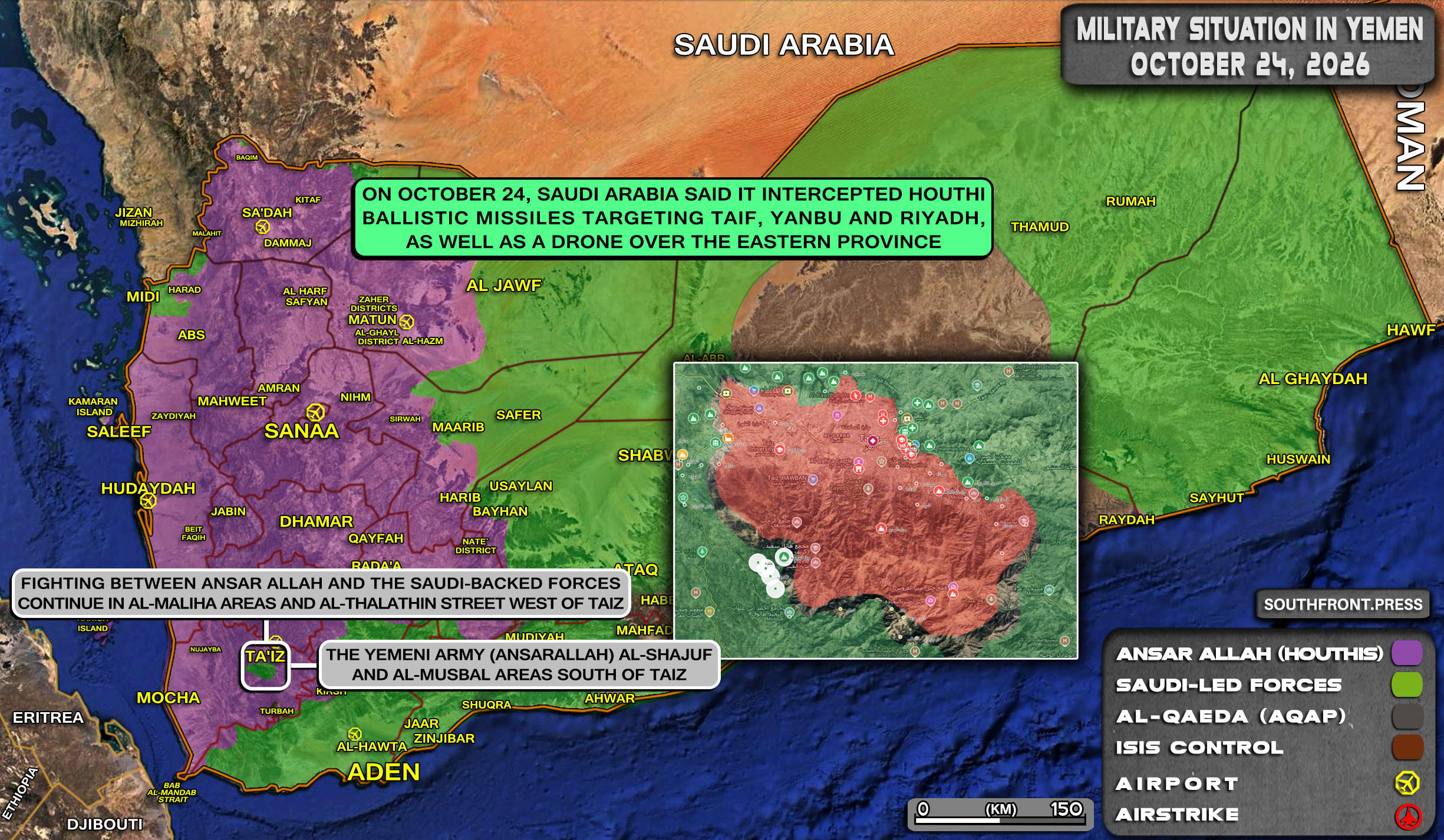
The Yemeni army (AnsarAllah) Al-Shajuf and Al-Musbal areas south of Taiz;
Fighting between Ansar Allah and the Saudi-backed forces continue in Al-Maliha areas and Al-Thalathin Street west of Taiz;
On October 24, Saudi Arabia said it intercepted Houthi ballistic missiles targeting Taif, Yanbu and Riyadh, as well as a drone over the Eastern Province.
The speaker of the Yemeni House of Representatives has denounced the European Parliament’s push to blacklist the Ansarullah resistance movement, saying the step is rooted in hypocrisy and double standards.
In a statement on Saturday, Yahya Ali Ahmed al-Raee emphasized that the legislature’s stance on Yemen is nothing more than a political cover for the war crimes being perpetrated by Saudi Arabia and its forces against the Yemeni nation.
“The European Parliament’s latest resolution is a clear sign of double standards and hypocrisy. It is an attempt to distort the position of the Sana’a-based Yemeni government, and blatantly ignores its repeated guarantees and commitment to international maritime security,” he noted.
Raee stated that the European Parliament should have designated Israel as the source of terrorism, given the genocidal crimes it is committing in the Gaza Strip.
The senior Yemeni official noted that the legislative body of the European Union has turned a blind eye to the crimes of genocide, murder, siege, and starvation that the Yemeni people have been enduring for more than 12 years as a result of vicious Saudi assaults and blockade.
He also called on the European Parliament to dispatch a parliamentary delegation to Yemen and document the firsthand crimes and aggression that Saudi Arabia is committing against the Yemeni people.
On Thursday, the European Parliament called on the Council of the European Union to designate Yemen’s Ansarullah resistance movement as a terrorist organization, including its political and military wings, leadership, and military and security apparatus.
In a resolution, the lawmakers also called for dismantling the group’s funding channels and freezing its funds, economic resources, and assets belonging to entities facilitating its activities.
The resolution strongly condemned retaliatory Yemeni missile and drone attacks on Saudi Arabia, as well as attacks targeting energy infrastructure and commercial shipping in the Red Sea and the Bab al-Mandeb Strait.
The Sana’a administration announced a naval blockade against Saudi Arabia on July 20, in retaliation for “an unjust and oppressive siege” on Yemen that has continued for almost 12 years.
The Yemeni military has reported multiple successful operations targeting ships associated with Saudi Arabia in the Red Sea.
In March 2015, Saudi Arabia and its allies enacted a blockade on Yemen and initiated a large-scale war on the Arab country, with support from the United States and various Western nations in terms of military, political, and logistical resources.
The war has resulted in the deaths of tens of thousands of Yemenis. Nevertheless, Saudi Arabia has not succeeded in achieving its goal of restoring a puppet government that aligns with its interests.
Saudi airstrikes pounded Yemen’s Hodeidah province and the capital, Sanaa, on Saturday, killing at least 17 civilians as the US-backed bombing campaign continues to have a devastating impact on Yemeni civilians. One strike on Saturday hit housing units for workers at a cement factory in the Sanaa Governorate, killing eight civilians, including four children and […]
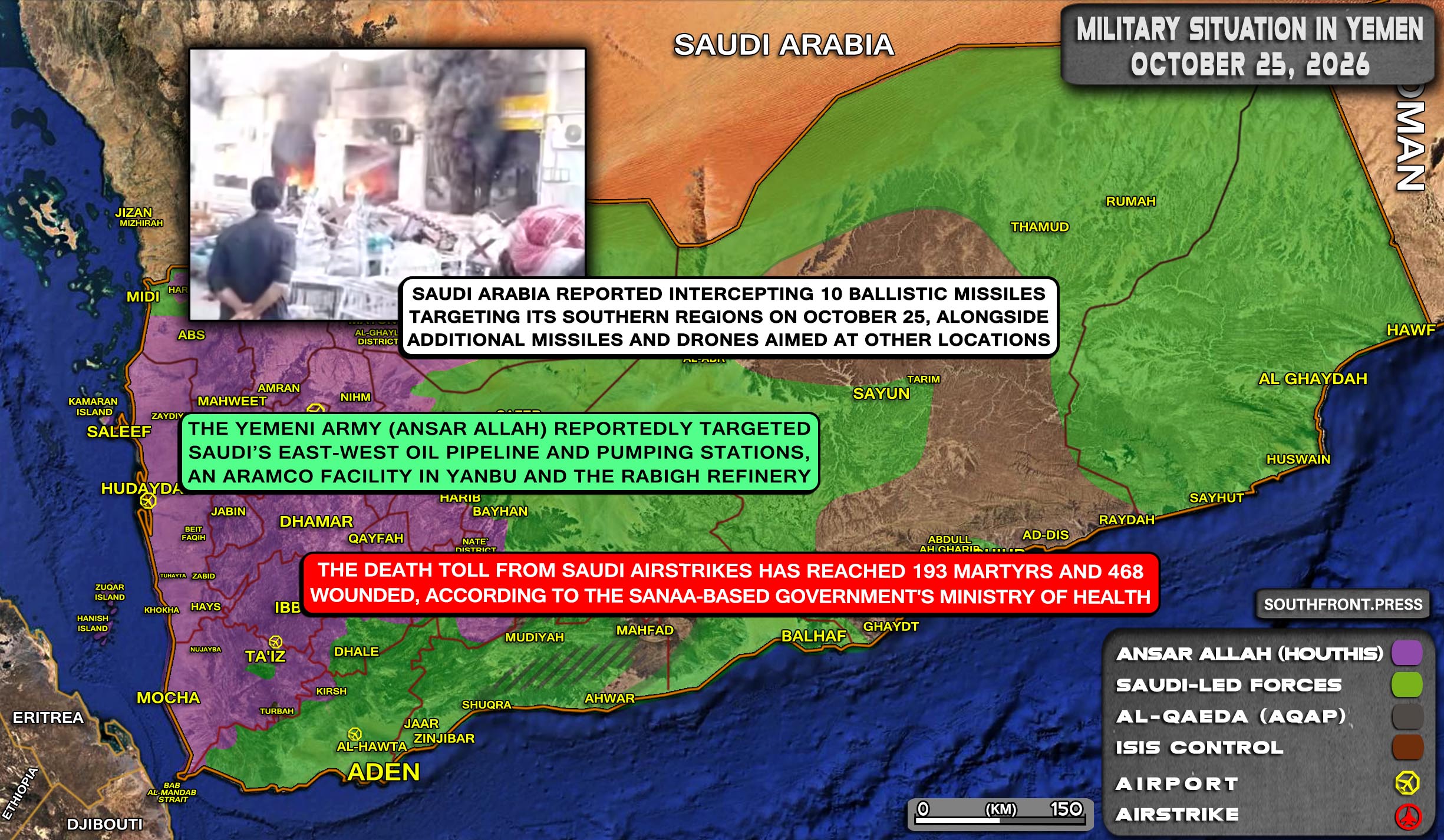
The death toll from Saudi airstrikes has reached 193 martyrs and 468 wounded, according to the Sanaa-based government’s Ministry of Health;
The Yemeni army (Ansar Allah) reportedly targeted Saudi’s East-West oil pipeline and pumping stations, an Aramco facility in Yanbu and the Rabigh refinery;
Saudi Arabia reported intercepting 10 ballistic missiles targeting its southern regions on October 25, alongside additional missiles and drones aimed at other locations.
British Prime Minister Andy Burnham has found a novel way of solving Britain’s cost-of-living crisis. By bombing Yemen.
Yes, you read that correctly. This week, Burnham authorized the deployment of British Typhoon fighter jets to Saudi Arabia for its war with Yemen.
Downing Street assured the British public that the deployment was for “defensive” operations only. The BBC and other British media outlets indulged this fantasy by repeating over and over that the Royal Air Force was being deployed for “defensive actions”. The RAF would not be engaging in attacking Yemen, it was claimed, and the British fighter jets were being sent to “protect” Saudi Arabia from “escalating” Houthi aggression.
Britain’s Minister of Defense Wes Streeting (a former health minister, please note) framed the RAF mission as necessary to counter instability in the Middle East and soaring energy prices. As if Britain was not the cause of instability and higher fuel costs by backing Trump’s aggression on Iran.
The Guardianreported: “The [British] military intervention [in Yemen] was partly justified because instability in the Middle East was driving up energy prices and affecting the cost of living.”
This logic is as absurd as it is gross deception.
Recall that Burnham was ushered into Downing Street in July to replace the hapless Keir Starmer as Labour prime minister. Burnham, formerly the Mayor of Manchester and posing with his working-class credentials, made a big public pitch that he would prioritize easing the cost-of-living crisis ravaging Britain.
However, since entering office, his most notable forays have been in foreign policy. For example, he has received the Ukrainian dictator Vladimir Zelensky in Downing Street with promises of more military aid in addition to the $20 billion that Britain has already provided (the second largest source of aid in Europe after Germany). Burnham has pledged to provide Ukraine with British blueprints for manufacturing cruise missiles.
Last month, Burnham announced that Britain was deploying an RAF in-air refuelling plane to “help” Saudi Arabia’s air strikes on Yemen. To allay public concerns about that move, Downing Street and the British media assured that the deployment was “defensive only” and for a limited period.
Ironically, Burnham made that announcement while travelling to address the United Nations General Assembly in New York, where he hailed Britain for offering world leadership for peace and security.
Now, again this week, the RAF deployment is extended to sending Typhoon fighter jets to Saudi Arabia. London is also providing a RAF A400M transport plane for troops and up to 100 military advisers.
This sounds like classic mission creep. Downing Street is aware of the exposure to public criticism. The prime minister’s office denied Britain was being dragged into the conflict. It said: “Our support for Saudi Arabia is considered, proportionate and focused on helping them defend themselves from relentless Houthi attacks.”
The British government and media are distorting the conflict between Saudi Arabia and Yemen as one of “aggression” by the Yemeni forces of Ansar Allah, referred to as “the Iran-backed Houthis”. That description makes the Yemenis sound like crazy terrorists who are being directed by Iran.
Here’s the BBC’s creative reporting: “The UK will deploy RAF Typhoon jets to defend Saudi Arabia in response to escalating Houthi missile and drone attacks, the government has said.”
The BBC goes on: “The defensive mission will help defend Saudi cities and infrastructure – a move authorised by Prime Minister Andy Burnham – against aerial attacks by the Iran-backed group… Since September, Saudi Arabia has been struggling to defend its skies from Houthi attacks after a ceasefire of sorts in Yemen broke down.”
This is reality inversion by the British state-owned media outlet.
The ceasefire in Yemen was violated in mid-July when Saudi Arabia launched air strikes on the international airport in Sanaa, the Yemeni capital, to target a delegation attending the state funeral of Iran’s Ayatollah Khamenei, who was murdered in a U.S.-Israeli air strike on his family home in Tehran on February 28.
That ceasefire was called in 2022 to end a seven-year war of aggression by Saudi Arabia against Yemen. The war began in 2015 to reinstate a Saudi puppet regime that the Ansar Allah-led Yemenis ousted in 2014. The Saudis bombed Yemen relentlessly for seven years with support of the United States, Britain, and France. An estimated 20,000 Yemenis were killed in air strikes, and around 300,000 died from a humanitarian blockade that the Western-backed Saudi coalition imposed on the country.
Britain’s military minister Wes Streeting referred to recent Yemeni strikes on Saudi Arabia as “despicable”. He mentioned a ballistic missile attack on October 10 on King Khalid international airport in the Saudi capital, Riyadh. At least 13 people were killed in the strike, and over 300 were injured.
The Ansar Allah-led Yemeni Armed Forces have also hit several other Saudi airports and key oil industry installations. The number of Saudi civilians killed in these attacks is relatively small, around 20, whereas Saudi warplanes have killed hundreds of Yemeni civilians since it broke the ceasefire in July. This week, eight Yemeni fishermen were killed in Saudi strikes. What Yemen is doing to Saudi Arabia is self-defense, not aggression.
London and its media propaganda are making out that Britain is “defending” Saudi Arabia. The reality is London is assisting Saudi aggression and war crimes.
Significantly, Streeting flew to Washington, DC, last week, where he met the war secretary, Pete Hegseth. Their agenda was about how to respond to “Houthi escalation.” Obviously, the junior partner got the memo: send warplanes to Yemen; we’re too busy with Iran.
Meanwhile, in Britain, an unprecedented social crisis is unfolding from poverty and a crippling cost of living. Charities report that four million families are having to go without adequate food or home heating because of soaring bills. Oxfam estimates that 13.5 million Britons, or a fifth of the population, are suffering from poverty. More than six million people rely on food charities for a modicum of sustenance.
It tells you everything about a state whose government does nothing about its own people’s dire needs but finds the resources to send warplanes to distant countries to bomb other poor people.
Andy Burnham is just another puppet who is assigned to put on a show in Downing Street for public appeasement. The imperial deep state has its hand up his rear. That’s mission creep in Downing Street.
Yemen’s Houthis (Ansar Allah) announced on October 24 that they had launched seven military operations targeting airports, oil facilities and military installations across Saudi Arabia, including in Riyadh, Yanbu and Dammam.
In a statement, Brig. Gen. Yahya Saree, the group’s military spokesman, said the operations involved ballistic missiles and drones and were launched in response to what he described as an intensifying Saudi air campaign against Yemen.
Saree said the first operation targeted King Khalid International Airport in Riyadh in two stages, claiming both strikes achieved accurate hits. The second targeted Saudi Aramco facilities in the Red Sea port city of Yanbu, while the third struck the Rabigh oil refinery, he added.
The fourth operation targeted crude oil pumping stations and the East-West oil pipeline, which transports crude from Saudi Arabia’s eastern oil-producing regions toward the Red Sea coast. Saree claimed that the operation achieved its objectives.
The remaining operations targeted King Fahd International Airport in Dammam, Najran Airport and the Khamis Mushait air base in southwestern Saudi Arabia. Saree said the strike on King Fahd airport disrupted air traffic, while the other attacks achieved direct hits.
Saudi authorities have reported an attack on King Fahd International Airport in Dammam that caused material damage and casualties, but have not confirmed the reported strikes on facilities in Riyadh and Yanbu.
Meanwhile, the Saudi-led coalition fighting in Yemen reported several interceptions during the day. Coalition spokesman Maj. Gen. Turki al-Maliki said air defenses intercepted and destroyed a ballistic missile heading toward Riyadh and a drone over the Eastern Province.
The coalition later announced that two ballistic missiles launched toward Taif and Yanbu had also been intercepted and destroyed.
Saudi civil defense authorities issued brief warnings of potential aerial threats in several areas, including Mecca, Jeddah, Taif and Yanbu, before announcing that the danger had passed.
A day earlier, the coalition also reported intercepting ballistic missiles aimed at Riyadh and Khamis Mushait, as well as two drones directed toward southern Saudi Arabia.
Saree accused Saudi Arabia of carrying out 100 airstrikes against what he described as civilian sites in Sanaa and other areas of Yemen over the preceding 24 hours, leaving dozens dead and wounded. He put the cumulative number of Saudi airstrikes and missile attacks since the latest escalation began at 3,123.
The spokesman said the operations against Saudi targets would continue until the attacks on Yemen stopped and the blockade was lifted.
“Our operations are continuing toward the Saudi depth, imposing the equation of blockade for blockade and escalation for escalation,” Saree said.
He added that the movement would continue targeting Saudi-backed military concentrations until the campaign against Yemen ended.
In an earlier statement, Saree said the Houthis had targeted Saudi-backed troop concentrations at al-Nasr camp and a naval base in Aden, alleging that Saudi officers were supervising the recruitment and preparation of forces for operations against Yemen’s armed forces. He named Saudi Brig. Gen. Badr Salah al-Harbi as leading the effort.
“We again urge those who have been misled not to respond to the Saudi enemy, which uses its tainted money to drive them into death traps to fight their own people,” Saree said, warning Yemeni fighters against joining forces aligned with Riyadh.
Three explosions were heard in Aden earlier. The extent of any damage or casualties was not immediately clear, however.
All in all, the Houthis continue to escalate strikes against Saudi Arabia and its allies while maintaining the upper hand on all fronts in Yemen. Despite all recent setbacks, however, the kingdom does not appear to be ready yet to take a step back.
The Yemeni army (AnsarAllah) Al-Shajuf and Al-Musbal areas south of Taiz;
Fighting between Ansar Allah and the Saudi-backed forces continue in Al-Maliha areas and Al-Thalathin Street west of Taiz;
On October 24, Saudi Arabia said it intercepted Houthi ballistic missiles targeting Taif, Yanbu and Riyadh, as well as a drone over the Eastern Province.
British Prime Minister Andy Burnham has found a novel way of solving Britain’s cost-of-living crisis. By bombing Yemen.
Yes, you read that correctly. This week, Burnham authorized the deployment of British Typhoon fighter jets to Saudi Arabia for its war with Yemen.
Downing Street assured the British public that the deployment was for “defensive” operations only. The BBC and other British media outlets indulged this fantasy by repeating over and over that the Royal Air Force was being deployed for “defensive actions”. The RAF would not be engaging in attacking Yemen, it was claimed, and the British fighter jets were being sent to “protect” Saudi Arabia from “escalating” Houthi aggression.
Britain’s Minister of Defense Wes Streeting (a former health minister, please note) framed the RAF mission as necessary to counter instability in the Middle East and soaring energy prices. As if Britain was not the cause of instability and higher fuel costs by backing Trump’s aggression on Iran.
The Guardian reported: “The [British] military intervention [in Yemen] was partly justified because instability in the Middle East was driving up energy prices and affecting the cost of living.”
This logic is as absurd as it is gross deception.
Recall that Burnham was ushered into Downing Street in July to replace the hapless Keir Starmer as Labour prime minister. Burnham, formerly the Mayor of Manchester and posing with his working-class credentials, made a big public pitch that he would prioritize easing the cost-of-living crisis ravaging Britain.
However, since entering office, his most notable forays have been in foreign policy. For example, he has received the Ukrainian dictator Vladimir Zelensky in Downing Street with promises of more military aid in addition to the $20 billion that Britain has already provided (the second largest source of aid in Europe after Germany). Burnham has pledged to provide Ukraine with British blueprints for manufacturing cruise missiles.
Last month, Burnham announced that Britain was deploying an RAF in-air refuelling plane to “help” Saudi Arabia’s air strikes on Yemen. To allay public concerns about that move, Downing Street and the British media assured that the deployment was “defensive only” and for a limited period.
Ironically, Burnham made that announcement while travelling to address the United Nations General Assembly in New York, where he hailed Britain for offering world leadership for peace and security.
Now, again this week, the RAF deployment is extended to sending Typhoon fighter jets to Saudi Arabia. London is also providing a RAF A400M transport plane for troops and up to 100 military advisers.
This sounds like classic mission creep. Downing Street is aware of the exposure to public criticism. The prime minister’s office denied Britain was being dragged into the conflict. It said: “Our support for Saudi Arabia is considered, proportionate and focused on helping them defend themselves from relentless Houthi attacks.”
The British government and media are distorting the conflict between Saudi Arabia and Yemen as one of “aggression” by the Yemeni forces of Ansar Allah, referred to as “the Iran-backed Houthis”. That description makes the Yemenis sound like crazy terrorists who are being directed by Iran.
Here’s the BBC’s creative reporting: “The UK will deploy RAF Typhoon jets to defend Saudi Arabia in response to escalating Houthi missile and drone attacks, the government has said.”
The BBC goes on: “The defensive mission will help defend Saudi cities and infrastructure – a move authorised by Prime Minister Andy Burnham – against aerial attacks by the Iran-backed group… Since September, Saudi Arabia has been struggling to defend its skies from Houthi attacks after a ceasefire of sorts in Yemen broke down.”
This is reality inversion by the British state-owned media outlet.
The ceasefire in Yemen was violated in mid-July when Saudi Arabia launched air strikes on the international airport in Sanaa, the Yemeni capital, to target a delegation attending the state funeral of Iran’s Ayatollah Khamenei, who was murdered in a U.S.-Israeli air strike on his family home in Tehran on February 28.
That ceasefire was called in 2022 to end a seven-year war of aggression by Saudi Arabia against Yemen. The war began in 2015 to reinstate a Saudi puppet regime that the Ansar Allah-led Yemenis ousted in 2014. The Saudis bombed Yemen relentlessly for seven years with support of the United States, Britain, and France. An estimated 20,000 Yemenis were killed in air strikes, and around 300,000 died from a humanitarian blockade that the Western-backed Saudi coalition imposed on the country.
Britain’s military minister Wes Streeting referred to recent Yemeni strikes on Saudi Arabia as “despicable”. He mentioned a ballistic missile attack on October 10 on King Khalid international airport in the Saudi capital, Riyadh. At least 13 people were killed in the strike, and over 300 were injured.
The Ansar Allah-led Yemeni Armed Forces have also hit several other Saudi airports and key oil industry installations. The number of Saudi civilians killed in these attacks is relatively small, around 20, whereas Saudi warplanes have killed hundreds of Yemeni civilians since it broke the ceasefire in July. This week, eight Yemeni fishermen were killed in Saudi strikes. What Yemen is doing to Saudi Arabia is self-defense, not aggression.
London and its media propaganda are making out that Britain is “defending” Saudi Arabia. The reality is London is assisting Saudi aggression and war crimes.
Significantly, Streeting flew to Washington, DC, last week, where he met the war secretary, Pete Hegseth. Their agenda was about how to respond to “Houthi escalation.” Obviously, the junior partner got the memo: send warplanes to Yemen; we’re too busy with Iran.
Meanwhile, in Britain, an unprecedented social crisis is unfolding from poverty and a crippling cost of living. Charities report that four million families are having to go without adequate food or home heating because of soaring bills. Oxfam estimates that 13.5 million Britons, or a fifth of the population, are suffering from poverty. More than six million people rely on food charities for a modicum of sustenance.
It tells you everything about a state whose government does nothing about its own people’s dire needs but finds the resources to send warplanes to distant countries to bomb other poor people.
Andy Burnham is just another puppet who is assigned to put on a show in Downing Street for public appeasement. The imperial deep state has its hand up his rear. That’s mission creep in Downing Street.
Amidst widespread confusion about the Saudi-Yemen War, British journalist Sami Hamdi has weighed in on the debate. Unfortunately, his stance and analysis not only miss the mark, but are replete with factual errors, undemonstrable assumptions, and an incorrect timeline of how events transpired.
Until recently, the war in Yemen has long been ignored by the corporate media in the West. Despite the conflict being over a decade old, most references to it highlighted a humanitarian crisis and presented a narrative that a Saudi-Iranian proxy war was raging on. “The Houthis” have been labeled as terrorists, and many have found it rather difficult to understand what is truly going on inside the country.
Therefore, the goal of this article is to push back against Sami Hamdi’s portrayal of events inside the country and provide key context that will help a wider audience understand this issue in greater depth. It is not an attack on Hamdi himself, or an attempt to discredit him as a journalist; instead, it is a criticism of his narrative on this issue and a correction of false information he has presented.
The “Both Sides” Argument
Note: Sami Hamdi refuses to call Ansarallah by the actual adopted name of their movement and instead uses the label “Houthis”, which is considered derogatory and tribalistic by their supporters inside Yemen. To be clear, “the Houthis” is used interchangeably with Ansarallah.
The crux of Hamdi’s argument rests upon the narrative that both sides in the war are in the wrong, presenting his analysis as coming from a somewhat neutral stance. He also draws a moral equivalency between the ills of “the Houthis”, Saudi Arabia, and the United Arab Emirates. In this regard, he has argued that “the Saudis and the Houthis agree that Yemenis should not have the right to choose their leader”, going a step further to even posit that “the Saudis and Houthis believe that Yemen should not belong to Yemenis”.
To begin with, Ansarallah are a Yemeni movement composed entirely of Yemenis, publicly arguing that their war effort is to return Yemen to its people. Therefore, the concept that they don’t believe that Yemen should belong to Yemenis themselves makes little sense. The argument he employs additionally tries to separate Ansarallah from the Yemeni people, framing the issue as if they are a kind of foreign occupier.
In order to justify this claim, Hamdi argues that “the Houthis” imposed themselves on the country and do not even represent any authentic will of the Yemeni people. This not only attempts to relegate the Houthi family themselves, but also the millions of followers of the Ansarallah movement and its supporters, which represent a large portion of the nation’s populace.
A moral equivalency argument also does not work here. Ansarallah is an indigenous Yemeni movement that runs a government out of the nation’s Capital City and rules over the majority of the nation’s population. Saudi Arabia is a foreign country that has imposed a blockade on Yemen’s people for over a decade. The land, naval, and aerial siege manufactured a man-made famine that wiped out hundreds of thousands of people, while collectively punishing over 26 million others and depriving them of basic necessities.
Despite warnings from the United Nations and footage streaming out of the country, clearly showing the impacts on civilians, with children being disproportionately impacted, the Saudis continued their blockade.
The lower estimates for how many Yemeni civilians have been killed by Saudi airstrikes are around 9,000, while the higher figures often presented by the Ansarallah-led government are closer to 20,000. These attacks have included strikes on mosques, hospitals, schools, funerals and weddings.
The Royal Saudi Air Force (RSAF) would conduct routine massacres, such as bombing a packed school bus on August 9, 2018, killing 51 civilians, including at least 40 children. In October of 2016, a funeral was held for the father of Yemen’s Interior Minister, which drew a number of officials from the Ansarallah movement. The Saudi air force bombed the funeral before launching a double-tap strike that targeted the first responders – 155 were killed and 525 others were injured; the vast majority of whom were civilians.
Riyadh systematically destroyed Yemen’s energy and fuel infrastructure, in addition to its transportation sector. It bombed Yemeni airports at least 227 times, struck countless food storage facilities, and indiscriminately bombarded commercial and public facilities. Nothing was off limits. This was also a war of choice, not of necessity. It asserted itself over Yemen and its decision-making since 2011, in an attempt to dictate who would rule the country, still refusing to lift its blockade after more than a decade of suffering inside the country.
Ansarallah are, factually speaking, a Yemeni movement; Saudi Arabia is a foreign country. As for Iran’s support for them, the Iranians are not responsible for launching a direct attack, imposing a blockade, carrying out civilian massacres, or dictating the post-revolutionary process like Saudi Arabia. No political Party or armed group inside Yemen is without any foreign backers or support from abroad.
Factually Inaccurate Framing Of History
Hamdi sets the stage for his analysis of the Saudi-Yemen War by falsely claiming “the Houthis had just lost their sixth attempt to take over Yemen”. In his narrative, the Ansarallah movement is a rebel faction attempting to impose a tribalistic theocracy on the entire country through a series of wars. According to this logic, the only reason they were not able to achieve this in the past was because of their weakness and because they were blockaded in the northern Sa’ada Province by the Yemeni State.
The six conflicts, taking place between 2004 and 2010, were never in any way attempts to take over Yemen, the Ansarallah movement was not fighting with this as a justification for their armed action against the State, nor does any authoritative source argue this. Either Hamdi is mistaken and should retract this claim, or he is deliberately spreading false information to bolster his narrative.
The movement that calls itself Ansarallah today began forming in the 1990s and was led by a Zaydi Shia scholar, Hussein al-Houthi.
In 1992, members of the Houthi family in the northern Sa’ada Province founded Al-Shabab al-Mu’minoun (The Believing Youth) movement. Their goal was to revive the Zaydi sect of Shia Islam, which they believed was being slowly lost, compromised and directly threatened. To achieve their goals of reviving their religious teachings, they began starting summer schools and cultural clubs.
Hussein al-Houthi, the movement’s founding leader, would go on to participate in Yemeni politics in the mid-1990s, getting elected to parliament on behalf of the al-Haqq Party. He offered scathing critiques of State corruption and mismanagement, while condemning Saudi Arabia, Israel and the United States. As a leader of the movement, his platform was built upon anti-imperialism and pan-Islamic unity, teaching that this strategy was the most effective means of defeating the US and Israel.
This kind of anti-imperialist rhetoric was initially tolerated by Yemeni President Ali Abdullah Saleh, who was himself of a Zaydi-Shia background. President Saleh had initially sided with Iraq’s Saddam Hussein during his invasion of Kuwait in 1990. In retaliation for Saleh’s stance in support of the Iraqi President during the Gulf War, Saudi Arabia expelled around a million Yemeni workers and Yemen grew increasingly isolated.
Then came the US’s so-called ‘War on Terror’ in the early 2000s, when President Saleh decided to switch sides and back the United States, also growing closer to Saudi Arabia. Hussein al-Houthi was causing immense embarrassment to the nation’s dictator. The Believing Youth movement would chant anti-US and anti-Israel slogans in their mosques, while advocating against Washington’s wars in the Muslim World.
In 2004, President Saleh decided to launch a military raid, aimed at arresting Hussein al-Houthi, but it was resisted by members of the movement. The conflict ended with the killing of the Zaydi leader. Although Saleh believed this would be the end of the movement, they had transformed Hussein al-Houthi into a martyr, and his forces achieved the very opposite of crushing the movement. Not a single one of the battles between the rebels in Sa’ada and the Yemeni Army was about who would rule Yemen; they were localized and had nothing to do with an attempt to impose their rule over the entire country.
In fact, President Saleh made a number of requests that the United States intervene in order to help crush the rebels, attempting to argue that they were receiving support from Iran. The US assessed that there was no such evidence that they were being armed by the Iranians, therefore treating the issue as a local problem. Instead, the Americans discovered that the weapons being used against Saleh’s forces were primarily coming from his own army.
The Ansarallah movement never aimed to take over Yemen through these conflicts; it was simply not even on the cards for them to think further than the north at that point. There are no public statements from them that indicate that any of these wars were fought over a divine right of the Houthi family to rule Yemen; this notion is simply false.
“The Houthi” Takeover and the “Internationally Recognized Government”
When Hamdi was recently interviewed on ‘The Thinking Muslim’ program, he made a number of assertions about the Ansarallah takeover of Yemen’s Capital, Sana’a – misrepresenting the series of events that led to this outcome.
He begins the timeline with the overthrow of longtime Dictator Ali Abdullah Saleh, then claims that the Yemenis “get together and decide to host a national dialogue”.
“So a national dialogue begins under the auspices of the United Nations. Everybody engages with it and the Qataris insist that the Houthis should also take part in it as well.” Hamdi continues:
“They come to an agreement that the country will be ruled through democratic elections; there will be an interim government; a southerner will be put as President (Abdrabbuh Mansour Hadi) in order to ease the southern separatist tendencies. There will be an election where this President will run on his own, so he will have a democratic mandate; then there will be widespread elections, and Yemenis will choose who should rule over them.”
This timeline is totally incorrect. In 2011, the Yemeni people initiated an uprising against President Ali Abdullah Saleh, which ended when the Gulf Cooperation Council (GCC) drafted an arrangement whereby the dictator would step down and make way for a new leadership in 2012.
The Yemeni national dialogue, as described by Hamdi, did not take place during this period. Instead, the Saudis and their GCC allies decided that the Yemeni Dictator’s Vice President would be installed in power as part of the agreement to allow for a transition of power. An election was held, in which then Vice President Abdrabbuh Mansour Hadi was the only candidate on the ballot. The election was widely rejected by a range of Yemeni political parties.
Then came the 2013-2014 National Dialogue Conference (NDC) period, which was brokered by the Saudis and their GCC allies. It was endorsed and supervised by the United Nations on the ground, but it was not a UN initiative as Hamdi’s framing suggests.
President Hadi would be granted a two-year mandate to rule as the interim President. This mandate was then extended by a year, which did not come about by any democratic consensus of the Yemeni people.
Although his timeline is incorrect, it is true that Ansarallah participated in the National Dialogue, yet he leaves out key details as to why they decided to take measures into their own hands. In March of 2013, the dialogue began. By November, a member of the Ansarallah delegation had already been assassinated. On January 21, 2014, another member of their delegation was also assassinated, prompting Ansarallah to withdraw from the process and take over the Capital, alongside allied forces. President Hadi then resigned, before escaping and rescinding his announcement.
Another claim that Sami Hamdi makes is that Ansarallah simply toppled the “Internationally Recognized Government” of Yemen in Sana’a, with the process occurring as follows:
“They literally walk into the city and say: ‘This national dialogue that you guys have, this idea Yemenis decide who should rule, is Haram (A sin), we do not accept it. Abdul Malik al-Houthi, a descendant of the Prophet Mohammed, is the only one entitled to rule in this country’.”
Simply put, this is utter nonsense. There are no such statements that exist to suggest that this was their reasoning; Ansarallah have never publicly argued this position and did not use this reasoning to justify their takeover of the Capital at the time.
He then goes on to offer another invention:
“The Americans, Obama, who is negotiating his nuclear deal with the Iranians, doesn’t want to provoke Tehran; he doesn’t react to the Houthis taking Sana’a; instead, John Kerry comes out and says these Houthis can be reliable allies against Al-Qaeda.”
No such statement exists from John Kerry, who was US Secretary of State in 2015 when Ansarallah took over. In fact, the US reaction was the very opposite of what Hamdi describes. The takeover happened in February, which triggered fierce US condemnation and statements in support of the exiled President Hadi.
Within a month, the Obama administration had already greenlit the Saudi war against Yemen, with the goal of regime change, providing weapons and logistical support to the Saudi-led coalition. Washington also decided to permit the inhumane blockade on Yemen, deploying its own naval armada to help enforce that blockade. In April of 2015, the U.S. also backed United Nations Security Council (UNSC) Resolution 2216 that demanded Ansarallah withdraw from the territories they had captured. It wasn’t until 2016 that John Kerry would actually initiate his ‘Yemen Peace Plan’, which ultimately failed.
To address another of Hamdi’s points, he directly states that the US did not want to take a firm stance against the Houthis because it was negotiating its nuclear deal with Iran. This is also false; the American stance was not only anti-Ansarallah, but it also endorsed and supported Saudi military action. The Iran Nuclear Deal was signed in July of 2015; in April of that year, John Kerry said the following:
“There are obviously supplies that have been coming from Iran. There are a number of flights every single week that have been flying in and we trace those flights and we know those… The United States is not going to stand by while the region is destabilized.”
There is no evidence to support the claim that the US didn’t act because it sought to appease Iran. The opposite is true; they openly threatened the Iranians and took a firm stance, including military action.
When it comes to what is referred to as the “internationally recognized government” of Yemen, between 2015 and 2022, this was the deposed President Abdrabbuh Mansour Hadi, who fled to Riyadh, in Saudi Arabia. He long outstayed his mandate, in an election designed by the GCC States and in which he was the only candidate.
Then in 2022, the Saudis decided to remove Hadi and establish a Yemeni Presidential Leadership Council (PLC). The PLC was formed in the Ritz-Carlton Hotel in Riyadh, and all its leaders were both selected by the Saudis and live there too. It has no “democratic mandate,” and nobody even knows where the deposed leader Hadi is today. Not exactly a sovereign government.
“The Houthis” Alleged Tribalistic-Theological Belief in Running Yemen
Sami Hamdi elaborates on his point about Ansarallah not wanting Yemeni self-determination in a number of interviews, then going on to argue that “the Houthis” believe that their current leader Abdul-Malik al-Houthi is divinely ordained to rule over Yemen. This argument demonstrates a lack of any depth or understanding of the dynamics inside the country, and fails to take into consideration the track record of the movement, which has never promoted such a platform.
The current leader of Ansarallah and his predecessor, who ran the Zaydi revivalist movement that laid the foundations for what exists today, never advocated that they are divinely ordained to run Yemen. There is no statement that indicates this is the movement’s platform or assertions by its leadership that they have such intentions. Neither Hussein al-Houthi nor the current leader, Abdul Malik al-Houthi, have mentioned the concept as a goal.
However, the argument about the divine right to rule as descendants of the Prophet Mohammed’s family is a real belief. Yemen’s northern tribes have also experienced rivalries because of this concept within Zaydi Shiism. Amongst the tribes, there are those who are considered Qahtani and those who are Adnani. Qahtanis are those tribes who descend from the local population of the country, while Adnanis are those who originate from the north (modern-day Saudi Arabia). The Houthis are Adnani.
One major hurdle that Ansarallah has had to tackle in ruling the country is tribalism, which they have managed to find great success in combating and have gone to great lengths to mend ties with historically opposing tribes. In fact, the Ansarallah movement has managed to dismantle some of the traditional tribal power structures – such as parts of the Hashid and Bakil confederations – to achieve peace amongst tribes.
In 2019, Ansarallah released a document entitled the “National Vision for the Modern Yemeni State,” in which they advocated a democratic approach. They also allow for a parliament and government, composed of multiple parties, to run the nation’s affairs out of the Capital City, Sana’a.
It is true that the Zaydi faith teaches that only descendants of the Ahlul Bayt (Prophet Mohammed’s family) have the right to rule; it is also true that Abdul Malik al-Houthi remains the Ansarallah leader. Yet, arguing that this is what the movement is openly advocating inside the country is off the mark. It removes potential for elements of growth and what the Ansarallah public platform actually is, in addition to ignoring facts on the ground from the overall equation.
Their public platform in Yemen is not sectarian; it is actually advocating pan-Islamic Unity, and it has even taken up the banner of endorsing a democratic system publicly, arguing that the nation cannot be run by foreign influences. Its government is in many ways more representative and certainly more democratic than the surrounding hereditary monarchies surrounding it.
It is important to note that it would be totally inaccurate to describe the Ansarallah-led government in Sana’a as fully democratic; that is not what is being argued. There are advisors from the Ansarallah movement who are present at each level of the government and advocating the overthrow of the system is evidently not tolerated. However, it is a nation under siege, one whose infrastructure has been crippled by over a decade of war and has no access to the outside world, beyond support and recognition provided by their allies in Tehran. Like Hamas in Gaza, they have never been given a chance to properly govern.
If the argument is that Ansarallah has no right to govern based upon their current predicament, then the leaderships in Syria, Egypt, Saudi Arabia and across the region should also be considered non-States and illegitimate. The criteria here simply makes no sense, especially given that the people whom the Ansarallah movement rules over have not revolted against them. Bear in mind here that the population they currently govern has for long been roughly a 50-50 split between Sunni and Shia. With the takeover of Taiz City, the Shia will actually be a minority.
One of the main reasons why “the Houthis” is viewed as a derogatory term, as opposed to using Ansarallah to describe a much broader movement that does not just consist of one family, is that the term is deliberately designed to encourage tribalism and sectarianism. In addition to this, it is simply no longer an accurate term to call them “the Houthis” or describe them as “rebels” either.
Another assertion made by Hamdi is that “they (Ansarallah) have shifted dramatically to the Twelver Shia sect”. Not only is this claim baseless, but if it were to be true, then it would completely defeat his argument regarding their alleged belief in a divine right to rule. This is because Twelver Shias do not share the Zaydi belief that only descendants of the Prophet Mohammed have the exclusive right to rule.
Ansarallah are known to be adherents to the Jaroudi School of thought, which is widely regarded as the strictest Zaydi branch. While other Zaydi schools of thought were accused of shifting their positions in order to appease the Republicans in North Yemen – after the fall of the Mutawakkilite Kingdom in 1970 – this school of thought resisted. In fact, the reason why Ansarallah exists today is because of a movement to revive the Zaydi sect.
This is also a conspiracy theory often promoted by Saudi-backed opponents of Ansarallah, who find it difficult to make extreme religious rulings against Zaydi Shiism. This is because the Zaydi branch of Shiism is much closer to Sunni Islam than Twelver Shiism (the sect that currently runs Iran). By claiming that they are no longer even Zaydis, it makes discriminatory sectarian arguments appear more logical. Above all, it lays the foundation for the argument that “the Houthis” are a proxy of the Islamic Republic of Iran and that they have no real agency beyond a greedy family desire to rule.
As a point of history, Hussein al-Houthi was vocally critical of the Twelver Shia doctrine and offered various critiques of the Islamic Republic. This clearly didn’t come out of a place of animosity toward Iran, but from theological disagreements, which is demonstrated through the public admiration of the Islamic Revolution in Iran and its stances against both Zionism and US imperialism.
If Sami Hamdi were making the argument that it is his personal belief that Ansarallah are lying in their public platform, then that would be a different matter. Yet, that is not what he is out there arguing; he jumbles up the timeline of events, attaches positions to the Ansarallah movement that are not those that it advocates, while seemingly inventing things that simply never happened. At best, it is a complete misunderstanding of reality; at worst, it is a completely dishonest approach.
It appears from his narrative that Sami Hamdi shares the Muslim Brotherhood perspective on Yemen. The Party connected to the Muslim Brotherhood there is called al-Islah and it is aligned with Saudi Arabia. Its leadership is also based in Riyadh. In addition to this, the Party that once had enormous influence and a large youth base inside the country, especially in the Taiz area, has since lost much of its support. It has become a hollowed-out shell of the former Party it was and is now working as an agent of Saudi Arabia, while having previously sought to only align itself strategically with them.
From a pro-Muslim Brotherhood perspective, al-Islah has failed and Saudi Arabia is in large part responsible for this. If Sami Hamdi’s intentions are to argue this stance, then his position makes perfect sense here. Because there is no longer any hope for the Muslim Brotherhood to take over and it has lost its ability to operate independently of its Saudi backers.
Preempting Potential Death Toll Arguments
Unlike the statistics for victims of targeted Saudi airstrikes, there is no comprehensive breakdown of civilian casualties caused by all sides on the ground in Yemen; claims from rights groups that are partisan to either side have published a range of claims, none of which have been independently substantiated.
Independent inquiries conducted by United Nations experts and leading international Rights Groups accuse all sides on the ground of inflicting civilian casualties and a litany of human rights abuses. The most comprehensive investigation was a 41-page report published by the UN Human Rights Council that documented acts of violence between 2014 and 2018.
If we look strictly to the international Human Rights Groups and the United Nations, their conclusions appear to maintain that thousands of civilians have been killed by all sides throughout a large number of battles, and tens of thousands of others were injured. However, all agree that when it comes to the category of who committed the most direct civilian deaths, it is the Saudi-led coalition – and this is not including those who died as a result of the blockade.
As an example of the kinds of unreliable figures produced in order to influence public opinion and claim that Ansarallah are responsible for the most civilian deaths, take the example of ‘The Yemeni Network for Rights and Freedoms’. Although presenting itself as if it is an independent rights group, it works in favor of the Saudi-backed Presidential Leadership Council (PLC)’s narratives and publishes reports that exclusively list alleged crimes committed by “the Houthis” but provide no figures on crimes committed by the Saudi-backed forces.
It also refuses to disclose its funders publicly, claims to be based out of Sana’a in Yemen on its website – which it isn’t – and has praised Saudi Arabia as the “sole guardian of the international resolutions that stipulate the protection of civilians in Yemen”.
In every warzone on earth, especially when fighting takes place in urban areas, it is a guarantee that all sides will inevitably end up killing civilians. However, the war of choice, launched by Saudi Arabia and its allies, cannot automatically be compared to the moral standing of the various factions inside Yemen itself.
Riyadh is in a league of its own when it comes to civilian deaths in Yemen. Nearly 400,000 civilians are estimated to have died due to the war, with most of these deaths being attributed to the results of the Saudi-imposed blockade, which continues to be imposed on the country. It deliberately manufactured a famine. Due to the blockade, between April 2015 and October 2018 alone, 85,000 children under the age of 5 died due to starvation and preventable illnesses, according to Save the Children.
If we want to look at the Saudi-backed forces on the ground, they have openly accepted the help of Al-Qaeda against Ansarallah, a fact that even shocked BBC journalist Nawal Al-Maghafi in 2016, when she was covering a battle taking place in the Taiz province.
The UAE was also exposed for having recruited a large number of former Al-Qaeda fighters into its own “counter-terrorism” and “security forces” that it backed inside Yemen; the Southern Transitional Council (STC) being the biggest faction it supported. The main officer core of the Southern Giants Brigades militia, which fights on the side of the Saudi-backed PLC, is composed of former Al-Qaeda and Daesh fighters.
It suffices to say that the moral equivalency argument doesn’t work; it rings a very similar tone to the arguments employed against Hamas in Gaza: “Israel did bad things but”. Interestingly, when we look at the corporate media coverage of the conflict in Yemen, there is more than one similarity to the reporting on Palestine. For example, we hear about claims from a “Houthi-run Yemeni Health Ministry”, just as we hear about a “Hamas-run Gaza Health Ministry”.
History also always begins whenever those the media favor start the clock, like when Riyadh’s King Khalid Airport was attacked with a ballistic missile, ignoring hundreds of strikes on Yemeni Airports. Or that Saudi Arabia began its attack on Yemen on March 26, 2015, by committing a civilian massacre at Sana’a International Airport, or that it broke the Yemen ceasefire by bombing that same airport earlier this July.
Conclusion
Intentions aside, Sami Hamdi’s argument works to achieve the same goal as those who argue that there is a moral equivalency between Hamas and Israel. Through this lens, both are guilty and neither side should be considered different from the other; instead, the focus is diverted away from culpability. Both sides are bad; history can be twisted in any way we choose; therefore, there is no stance that can be taken on the issue.
Using his logic, it should not come into consideration that Israel is openly backing Saudi Arabia’s war effort, even providing it with direct targeting data. Meaning that US-manufactured fighter jets are being used by Saudi pilots who pull the trigger on targets chosen by the same Israeli military that chooses targets across Gaza.
In the case of Yemen, Hamdi’s obfuscation shrouds the issue in ambiguity, presenting the war as too complex for the average person to understand. “The Houthis” are an evil foreign Iranian proxy that believes in a Zaydi concept of a divine right to rule, while simultaneously being Twelver Shia’s (who don’t believe this).
Just as Israeli propagandists have historically sought to depict the Palestine issue as too complex to understand, only to inject misleading propaganda into their “both sides” arguments, the Yemen propaganda works upon the same premise. The timeline is always inaccurate, there are countless unsubstantiated claims, and then there is always an accusation that if you identify an aggressor, you don’t care about the blood of the innocents.
The Ansarallah-led Yemeni Armed Forces are the only Arab government that fought Israel in response to the Gaza genocide. They sacrificed ongoing negotiations that could have helped them achieve economic relief in 2023 by deciding to open fire on Israel and to impose a blockade on Israeli Ports. Various Palestinian resistance factions, their fighters and leadership, openly praised and thanked Ansarallah for what they did. Meanwhile, the rest of the Arab governments were either complicit in the Gaza genocide or simply watched on, only offering occasional condemnatory statements.
While Sami Hamdi argues about the Yemeni people, not specifically articulating which Yemenis or Parties he is talking about, there are actually two sides that are fighting in Yemen:
One is backed by Israel and the United States. The other is fighting against Israel and has directly engaged both in battle. It is Saudi Arabia versus Ansarallah in this war. If Riyadh were to win, that means that Israel and the United States would win. These are the broader implications of what is going on and would mean that no Arab government supporting Palestine would be left standing.
Arguing a critique of Ansarallah does not justify Saudi Arabia’s attack on Yemen with US-Israeli backing. Iraqi President Saddam Hussein was not exactly an angel; he stood accused of killing hundreds of thousands of his own people. Just because the former Iraqi leader committed crimes did not justify the US invasion and toppling of his government.
The same argument that Sami Hamdi uses in Yemen was deployed to explain away the invasion of Iraq in 2003. It is a regime change war argument. People are able to acknowledge that Saddam Hussein committed various crimes, but still opposed the foreign war and understood that it was waged against Iraq, not just the Iraqi Ba’ath Party. In the early 2000s, there were also people who claimed that those discussing Israel’s role in promoting regime change, and the broader regional repercussions, believed that “Iraqi blood is cheap”.
Whether someone decides to support the Ansarallah as a movement, believing they should be the rulers of Yemen when the foreign-imposed war is over, is another question entirely. This question is also for the Yemeni people to answer internally and should not be dictated by Saudi Arabia or any outside power.
– Robert Inlakesh is a journalist, writer, and documentary filmmaker. He focuses on the Middle East, specializing in Palestine.
Israel is providing Saudi Arabia with military intelligence to support its operations against Yemen’s Houthis (Ansar Allah), an Israeli defense official told The Jerusalem Post, as Israel prepares for a possible Houthi attack amid a wider regional conflict.
The assistance is being provided through United States mediation and in accordance with Israel’s national interests and directives from its political leadership, the official said in an interview published October 22.
Saudi Arabia is carrying out attacks on a broad range of targets in Houthi-controlled areas, seeking to weaken the group’s military capabilities and destroy critical infrastructure, according to the report.
“Two main points need to be made about this. First, it serves Israel’s interests quite well because it wears down the military strength of an Israeli enemy that is preparing and planning to harm us in the future. In addition, we are monitoring and observing methods of operation and tactics, and learning a great deal from what is happening there, including about weapons that are not necessarily manufactured by the Houthis,” the official said.
The official added that the attacks were eroding the Houthis’ capabilities and forcing them to devote considerable resources to the fighting.
“The Houthis are accustomed to building up their forces, not employing them on this scale. They are a serious enemy, well structured for the long term, but this presents them with a significant challenge. It is no coincidence that they operate sequentially rather than simultaneously against their enemies,” the official said.
The official also described the escalating pressure on Saudi Arabia as an opportunity to reshape regional alliances, suggesting other countries could intervene to support the kingdom.
“The question here is who will intervene on Saudi Arabia’s behalf. There is apprehension among countries, but we assess that there will be intervention. Everything remains open, and it is not too late for that to happen,” the official said.
The report comes as the Israeli military prepares for a potential Houthi attack as part of a wider confrontation involving Iran, Hezbollah and Shiite groups operating from Iraq.
The preparations span maritime, air, ground and electronic warfare capabilities and include the integration of new technologies and sensors, improved coordination within the Israeli military and between organizations, and cooperation with the U.S. military, according to the official.
The U.S. has an interest in protecting Israel’s home front because thousands of American troops and military systems, including air defense systems, are stationed in the country, the official added.
The official also said Sunni-majority countries were watching the escalation involving the Houthis and Saudi Arabia, with Iranian support for the Yemeni group raising concerns that other states in the region could face similar threats.
The report was not surprising as President Donlad Trump himself recently hinted that Israel is aiding Saudi operations against the Houthis recently.
Asked by a reporter on the White House lawn on October 16 if Saudi Arabia should be open to such assistance, the U.S. president said, “I do, I think they will. Israel’s been very helpful to Saudi Arabia, and yeah they certainly would do that, yeah.”
Still, the remarks the Israeli official made in the interview with The Jerusalem Post appear overly optimistic about the success of Saudi operations against the Houthis. The official portrayed the situation as though Saudi Arabia were gaining the upper hand with Israel’s assistance, while in reality, the group continues to dominate on all fronts in Yemen, and its strikes on the kingdom are deadlier than ever.
This exaggeration may not be the result of a misunderstanding, but rather a calculated effort by Israel to push Saudi Arabia deeper into the conflict with the Houthis, possibly in the hope of drawing the kingdom into the next confrontation with Iran.
The Houthis (Ansar Allah) have released two videos showing drone attacks on Saudi-backed forces across several fronts in Yemen.
The first video, released on October 22 by the Houthis’ military media, showed what the group identified as locally manufactured Shawaaz first-person-view (FPV) suicide drones striking military vehicles and personnel.
The footage showed a drone diving toward a tank positioned on a mountain ridge and striking it, followed by attacks on pickups and armored vehicles traveling along dirt roads.
Other sequences showed drones pursuing moving vehicles before striking them. One armored vehicle exploded on a dirt track. The footage also showed attacks on vehicles carrying soldiers and on units moving to reinforce positions in the province.
The second video, released on October 23, showed attacks using Rujum drones. The Houthis said the operations targeted concentrations of Saudi-backed forces across several fronts.
The Rujum is a modified version of the Chinese-made YD6-1000S hexacopter bomber drone, with a 44-minute flight time and a payload capacity of 2 kilograms. It has been adapted to deploy munitions such as 60 mm mortar rounds.
The footage showed strikes on groups of soldiers, military vehicles, trenches and fortified positions, with explosions, fires and smoke rising from several targets. Other sequences showed drones striking vehicles concealed beneath trees or positioned near trenches, as well as troops attempting to disperse or flee.
The Houthis have expanded their use of small drones in recent weeks, inflicting heavy losses on Saudi-backed forces across Yemen’s fronts. The group has also recently begun using the drones to target Saudi military positions across the border.
Trita Parsi is the co-founder and Executive Vice President of the Quincy Institute for Responsible Statecraft. Follow his excellent Substack: https://tritaparsi.substack.com/
Saudi airstrikes and missile attacks in Yemen have killed at least 155 civilians and wounded 455 since Riyadh reignited the war by bombing the Sanaa International Airport on July 13, according to the Health Ministry within the Ansar Allah-led Yemeni government. The vast majority of the civilian casualties were inflicted in September and October, following […]
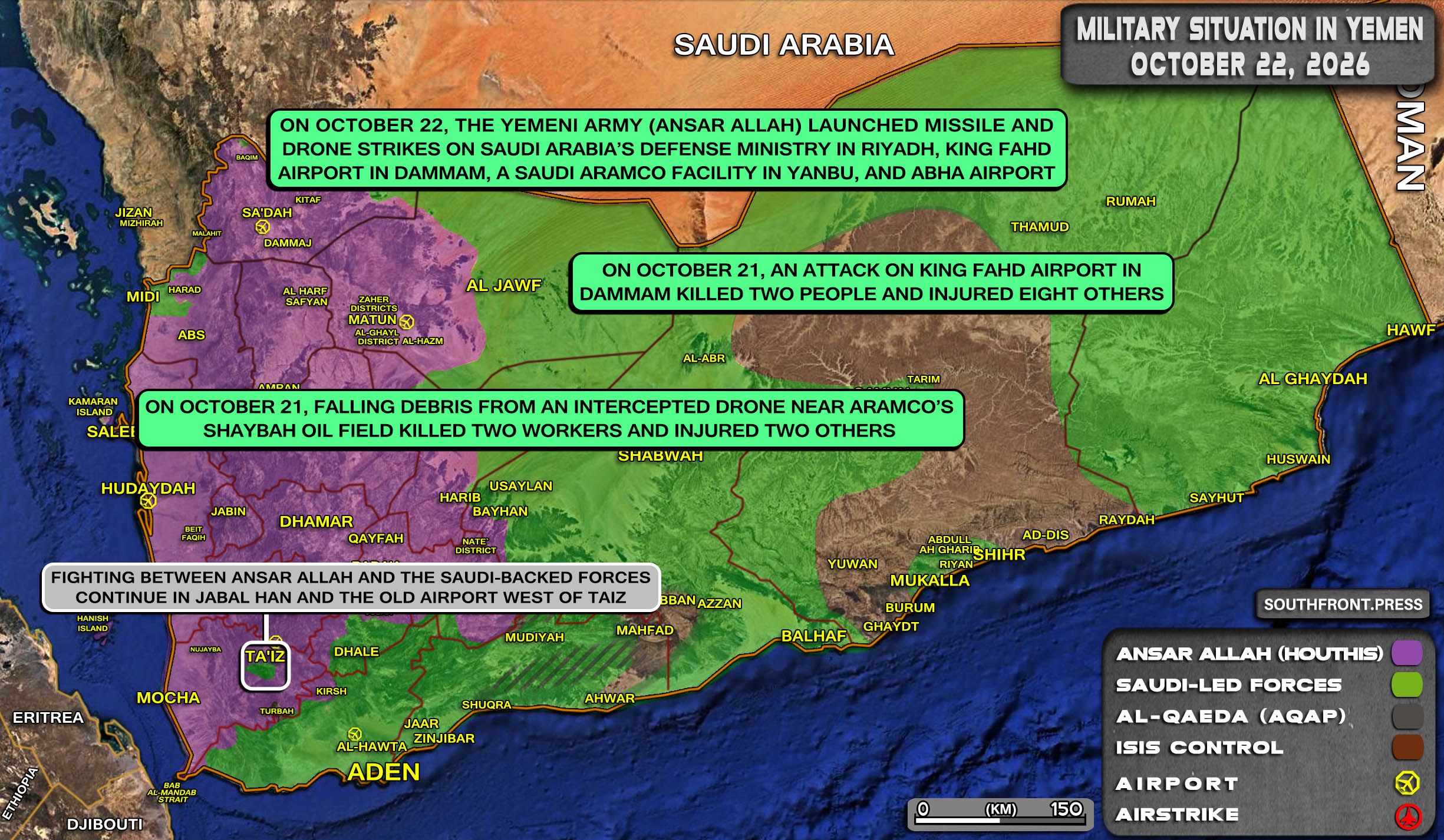
On October 22, the Yemeni army (Ansar Allah) launched missile and drone strikes on Saudi Arabia’s Defense Ministry in Riyadh, King Fahd Airport in Dammam, a Saudi Aramco facility in Yanbu, and Abha Airport;
On October 21, an attack on King Fahd Airport in Dammam killed two people and injured eight others;
Fighting between Ansar Allah and the Saudi-backed forces continue in Jabal Han and the Old Airport west of Taiz;
On October 21, falling debris from an intercepted drone near Aramco’s Shaybah oil field killed two workers and injured two others.
Fighting intensified across Yemen over the past week, as the Houthis (Ansar Allah) escalated their missile and drone strikes on Saudi Arabia.
On October 16, two missiles hit Aden International Airport’s perimeter. The Houthis said they targeted a nearby military facility housing a Saudi-led coalition command center and weapons depot. No casualties were reported.
Two days later, October 18, the Houthis shot down a Saudi AH-6i light attack helicopter near Najran. Footage released by the group’s military media showed a missile striking the helicopter before it fell. The crash killed both crew members. The Houthis also downed a Turkish-made Karayel combat drone in Yemen.
On October 19, a ballistic missile hit the Al-Alam training camp in Shabwa province as recruits assembled. The strike killed 73 people and wounded more than 200. The dead were all new recruits. The Houthis claimed the attack. A missile strike also targeted Marib.
The next day, October 20, Houthi military media released footage of an operation on Jabal Han, a mountain overlooking Taiz’s western approaches, and said the group’s forces had stormed the summit and ridgeline, driving out Saudi-backed forces. Fighting also continued around Al-Dhabab, the Old Airport and Madarat, while clashes south of the city extended into Al-Misrakh and Sabr al-Madawim. The mountain overlooks the Al-Dhabab road, a key supply route into Taiz.
On October 21, the Houthis fired a ballistic missile at the Saudi-led coalition’s operations room at Badr Camp in Aden. An explosion was heard and smoke reported near the airport. Three drones also targeted Al-Rayyan Airport in Mukalla.
In addition, the group’s military media released footage from operations east of Raghwan in Marib showing wreckage of Turkish-made STM Kargu loitering munitions. The footage showed at least two of the systems. This was evidence of growing involvement by Ankara in the war.
The same day, Saudi authorities said debris from a drone intercepted over the Shaybah oilfield killed two foreign workers, one Filipino and one Nepali, and injured two others, a Pakistani and an Indian. A separate attack on King Fahd International Airport in Dammam killed two people and injured eight; the second death was announced the following day. The airport sustained material damage, prompting flight diversions.
All in all, the Houthis maintain the upper hand on the battlefield, in Taiz, near Bab al-Mandab and on other fronts. The group’s air defenses also remain a credible threat. Meanwhile, strikes on Saudi-backed forces and the kingdom itself are becoming more lethal. Despite all of these factors, Riyadh appears to be determined to go on with the war, with reports indicating it is close to securing more support not just from Turkey, but also from Egypt and Syria.
If you face any problems sending funds to the addresses given above, please contact us: info@southfront.press and southfront@list.ru. Also be aware that many email services such as Hotmail, Yahoo etc. may block correspondence from info@southfront.press and some others put it in spam.
If you want to support SouthFront but have no opportunity to do it via cryptocurrency, please contact us: info@southfront.press and southfront@list.ru.
SouthFront: Analysis and Intelligence
NOW hosted at southfront.press
Previously, SouthFront: Analysis and Intelligence was at southfront.org.
The .org domain name had been blocked by the US (NATO) (https://southfront.press/southfront-org-blocked-by-u-s-controlled-global-internet-supervisor/) globally, outlawed and without any explanation
Back before that, from 2013 to 2015, SouthFront: Analysis and Intelligence was at southfront.com
Yemen’s Houthis (Ansar Allah) announced on October 22 that they had launched ballistic missiles and drones against four targets in Saudi Arabia, including the Defense Ministry headquarters in Riyadh, two international airports and a facility belonging to state oil company Saudi Aramco.
Brig. Gen. Yahya Saree, the group’s military spokesman, said in a statement that the operations were conducted over the previous 48 hours and scored direct hits on all four targets.
The targets were the Saudi Defense Ministry in Riyadh, King Fahd International Airport in Dammam, an Aramco facility in the Red Sea port city of Yanbu and Abha International Airport in southwestern Saudi Arabia.
Saree said the attack on King Fahd International Airport disrupted air traffic, while the strike on the Aramco facility in Yanbu started a fire. He did not provide details about the weapons used against each target or the extent of the reported damage.
The statement came as Saudi Arabia reported deadly incidents involving intercepted drones and an attack on King Fahd International Airport that caused casualties and disrupted flights.
The Saudi Civil Aviation Authority said an attack on the Dammam airport late Wednesday killed one Saudi resident and injured eight people, damaging airport facilities and prompting flight diversions. Reuters later reported that two people, including an Indian national, had been killed and eight others injured.
In a separate incident, Saudi Arabia’s Energy Ministry said falling debris from a drone intercepted near Saudi Aramco’s Shaybah oil field killed two foreign residents and injured two others on October 21. The dead were Filipino and Nepali nationals, while the injured were Pakistani and Indian nationals.
The ministry said the interception sparked a fire in a contractor’s vehicle outside the facility’s perimeter but did not affect oil-field operations. Shaybah is in eastern Saudi Arabia and is separate from the Yanbu facility named in Saree’s statement.
Saudi military officials also reported several drone interceptions in recent days. The Saudi-led coalition said on October 21 that it had intercepted and destroyed four drones launched toward the kingdom. The next day, the coalition reported additional interceptions over Riyadh and Medina.
Separately, Reuters reported on October 22 that Saudi Aramco had instructed employees to evacuate its headquarters in Dhahran and work remotely as the fighting intensified. The reason for the order was unclear.
Saree accused Saudi Arabia of carrying out more than 2,900 airstrikes and missile attacks against civilian sites in Yemen over the previous 100 days, claiming that more than 562 people had been killed or wounded, most of them women and children. The figures were not independently verified.
He also warned Riyadh against carrying out threats to target Yemeni tribes, saying the consequences would be “catastrophic and unexpected.” He said the Houthis would resort to major options they had previously been reluctant to use if Saudi Arabia followed through on the threats.
“The Yemeni armed forces will continue their operations deep inside Saudi Arabia in defense of our country and our people,” Saree said, stressing that the operations would continue until the attacks on Yemen stopped and the blockade was lifted.
The Houthis escalated their strikes on Saudi Arabia in recent weeks as they maintained the upper hand on all fronts in Yemen, namely in Taiz and Bab al-Mandab in the southwest of the country. Meanwhile, the kingdom, despite all recent setbacks, appears to be determined to go on with its campaign against the group. In addition to its allies in the Mecca defense pact, Pakistan and Turkey, Riyadh is working on securing support from Egypt and Syria.

 Login