Israelis will go to the polls on Tuesday in what many describe as the most consequential election in years. It's the first vote since the Oct. 7 Hamas attack and Israel's war in Gaza. Prime Minister Netanyahu has been campaigning that he'll keep Israel safe. But the opposition says Netanyahu failed to prevent the 2023 attack and is blocking an investigation into it. Nick Schifrin reports.
Israel’s military chief resisted the prime minister, who then pressed in recent days for a separate action, short of an overt strike, according to an official and a person briefed on the matter.
Israeli TV says top military commander likely to lose job if Netanyahu forms next government, which PM denies as 'fake news'; the two also reportedly clash over Hebron operation
Ahead of Israel’s Oct. 27 national vote, President Donald Trump issued a sweeping endorsement of Prime Minister Benjamin Netanyahu’s re-election bid, calling him a "great warrior," an "even greater partner for peace" and an ally in the confrontation with Iran.
The backing could give Israel’s longest-serving prime minister a boost ahead of the country’s first national vote since the Hamas-led Oct. 7, 2023, massacre. The election is widely viewed in Israel as a referendum on whether to grant Netanyahu another term to pursue his war objectives, including disarming Hamas and Hezbollah and countering the nuclear threat from the Islamic Republic.
In response, Netanyahu thanked Trump for his "extraordinary endorsement." "Together we will never let Iran’s regime get nuclear weapons," he said.
Addressing the endorsement, Doron Spielman, international spokesman for the Israeli Prime Minister’s Office, told Fox News Digital that no personal or professional bond in the history of U.S.-Israel relations compares with the current partnership.
"Israel and the U.S. have stood together as the two countries bearing the torch for the West, and that is a direct result of the incredible relationship between President Trump and Netanyahu," he said.
He reiterated Netanyahu’s long-standing foreign-policy priority and central campaign promise: ensuring that Iran does not acquire atomic bombs under his watch.
"Israel prefers to do this with the U.S., which has been our greatest ally and friend, and who has already entered the front with us twice. But already at the time of Operation Rising Lion, Israel showed that it was willing to act alone. Israel acted for over a week before the U.S. joined," he said, in reference to the June 2025 military mission against Iran.
Israel’s longest-serving prime minister, with roughly 20 years in office, Netanyahu began his diplomatic career in 1982 as deputy chief of mission at Israel’s embassy in Washington, D.C. He served as Israel’s ambassador to the United Nations from 1984 to 1988 before entering politics with Likud. He became the party’s chairman in 1993 and was first elected premier in 1996.
After losing the 1999 election, Netanyahu returned to government in 2002 as foreign minister and later served as finance minister. He returned to the premiership in 2009, serving until 2021 and again from late 2022. He is widely credited with liberalizing Israel’s economy and helping transform the country into a global high-tech hub.
Netanyahu’s current political allies include Itamar Ben-Gvir’s Otzma Yehudit, Bezalel Smotrich’s Religious Zionism-Zehut, and the ultra-Orthodox parties Shas and United Torah Judaism. The newcomer Amcha Yisrael, led by Ofer Winter, could also join the bloc, although Winter is currently feuding with Likud over concerns that his party, which is hovering near the electoral threshold, could split the right-wing vote and potentially "waste" tens of thousands of ballots.
According to most Hebrew-language media polls, neither Netanyahu’s bloc nor the opposition led by Gadi Eisenkot currently has a clear path to securing the 61 Knesset seats needed to form a government.
If no candidate can assemble a governing coalition, Israel could head to another election, repeating the cycle of political instability that saw the country hold four national votes between April 2019 and March 2021.
Dan Diker, president of the Jerusalem Center for Security and Foreign Affairs, told Fox News Digital that any incoming government will face the same formidable security challenges as the current one, with few prospects for quick victories.
"The major challenge in this election will be what Netanyahu discussed in terms of adjusting the national security concept to prioritize prevention. That means taking very serious, assertive and aggressive military counterterrorism and nonmilitary actions against our enemies," Diker said.
The Israeli left, center and even far-right believe Netanyahu has failed to meet the expectations associated with his image as "Mr. Security," according to professor Tamar Hermann, a senior researcher at the Israel Democracy Institute.
"He promised to topple the Iranian regime, he promised to dismantle Hamas, he promised to crush Hezbollah. None of it was achieved," Hermann told Fox News Digital. "He gave a green light to not punishing vigilantes in the settlements who act against Palestinians. He also gave too much to the ultra-Orthodox parties, giving up on the idea of universal conscription."
Hermann said that Netanyahu’s current term has been his least successful, beginning with the judicial reform push, which triggered mass protests in 2023, and followed by the Palestinian terror attacks on Oct. 7. Netanyahu subsequently faced public anger over his handling of the hostage crisis, although, in coordination with Trump and his envoys, he ultimately secured the return of all the captives.
"In the eyes of some, his legacy will be that he inflicted a huge disaster upon Israel in terms of what happened to civilians on Oct. 7 and the deterioration of Israel’s international image," she said.
Michael Oren, a former Israeli ambassador to the United States, framed the upcoming election in terms of legacy and how Netanyahu will be remembered 50 years from now.
"There are two types of leaders: leaders in history and leaders of history," he told Fox News Digital. "There are leaders who go into office and perform as best they can, and there are leaders who go into office and see themselves as transformative, as having a historical role like Abraham Lincoln, Roosevelt or Churchill. Benjamin Netanyahu belongs to this category."
Oren said Netanyahu sees his mission as saving Israel from existential threats, foremost among them Iran, a goal he has yet to achieve.
"He is willing to endure virtually limitless criticism and condemnation around the world, as well as mass demonstrations against him, to fulfill this one role," he said. "To understand that is to understand Benjamin Netanyahu: He is a leader of history."
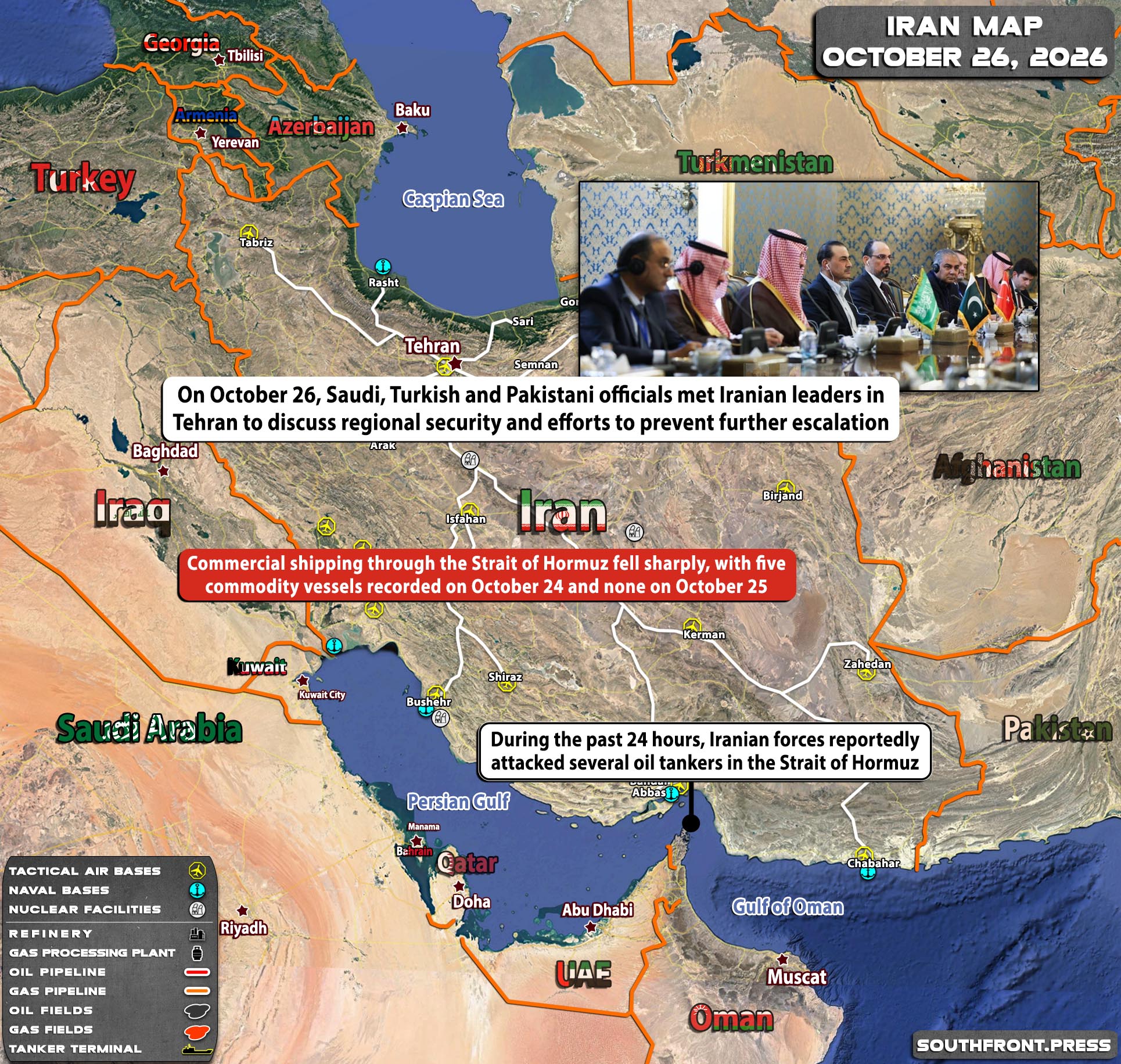
On October 26, Saudi, Turkish and Pakistani officials met Iranian leaders in Tehran to discuss regional security and efforts to prevent further escalation;
Commercial shipping through the Strait of Hormuz fell sharply, with five commodity vessels recorded on October 24 and none on October 25;
During the past 24 hours, Iranian forces reportedly attacked several oil tankers in the Strait of Hormuz.
Senior officials from Saudi Arabia, Pakistan, and Turkey, the three countries that form the new Mecca defense pact, visited Tehran on Monday and met with Iranian officials amid threats of another US-Israeli attack on Iran. The meeting was seen as an effort to avoid another escalation in the US war against Iran, and the Saudi […]
North Korea has the fourth-largest number of active armed forces in the world.
Alain Nogues/Corbis via Getty Images
China, India, and the US have the largest active armed forces in the world.
The International Institute for Strategic Studies compiled data about the world's militaries.
The world's top armies spend hundreds of billions of dollars on defense each year.
The US military may lead the world in budget size and in the ambitions of its warfare technology, but there is one measure by which it is outsized by other nations.
Using data from the International Institute for Strategic Studies' 2026 Military Balance report, Business Insider ranked the top 25 countries by the size of their active armed forces during 2025 and listed their defense budgets that same year.
Active-duty force size is a tally of a country's uniformed troops: airmen, soldiers, sailors, special operators, and Marines.
Armies, in particular, depend on size to gain and occupy ground during armed conflicts.
Militaries can also be a tool of domestic repression. North Korea, for example, is one of the world's most repressive states, led by a dictator who has repeatedly threatened neighboring South Korea — and it also has one of the world's largest militaries.
The number of active-duty military personnel is far from the only factor that matters when comparing military power between countries, but it reflects latent power.
"Numbers have value, but there's a lot more to military capability," Mark Cancian, a senior advisor at the Center for Strategic and International Studies, a Washington, DC-based foreign policy and national security think tank, told Business Insider.
IISS, a London-headquartered think tank, counts active armed forces, reservists, and paramilitaries as separate categories in its analysis, showing a fuller picture of each nation's manpower.
Some countries have significantly more reservists than others — Vietnam has the largest number in the world, estimated at 5 million — but the quality and longevity of their expertise can vary between systems.
"When you look at some countries' reserve numbers, you're often looking at people who haven't trained in 10 or 20 years," Cancian said. "It gives you a big number, but their military value is questionable."
Even when accounting for all of a military's manpower, personnel is only one of the factors that can qualify a nation's military strength, which also includes equipment and readiness.
There's also the role of technologies in global warfare, the size and sophistication of air forces and naval fleets, amphibious capabilities for landing assault forces, command-and-control systems, and nuclear forces, all of which shape military power.
Still, comparing global manpower offers insight into how countries prioritize military power.
See how the world's largest militaries stack up in terms of active troop numbers.
Iran-backed terror group reportedly receives fresh cash from Tehran, rebuilds drone and explosives capabilities; claims right to ‘resistance’ against Israel
Russia and Iran are expanding their nuclear cooperation as both countries face Western sanctions and international isolation. Their partnership includes the construction of nuclear power plants, fuel supplies, and broader technological cooperation.
A review of “Crossing the Red Line: Biden, His Advisors, and Israel’s War in Gaza.” The President deferred again and again to Israel’s narrative and sold weapons that were used in war crimes.
Israeli regime’s airspace – the airspace over the occupied territories – is widely regarded as among the most heavily defended in the world.
Yet the scale of its protection cannot be explained by Israeli military technology alone. Russia, China and even the United States do not benefit from an equivalent network of allied support dedicated to intercepting threats before they reach their territory.
Israel’s own defenses are indeed formidable. Arrow 3 is designed to intercept ballistic missiles outside the atmosphere, while Arrow 2 targets ballistic missile threats within it. David’s Sling is built to counter medium-range threats, and Iron Dome intercepts rockets and other short-range projectiles.
These systems are backed by fighter jets and an extensive radar network, creating multiple layers of protection against incoming attacks.
But Israel’s air defense shield extends well beyond its own arsenal. From October 2023 through Iran’s retaliatory missile and drone operations in 2024, 2025 and 2026, a group of allied states has played an active role in protecting the regime.
They have provided interceptors, radar capabilities, fighter aircraft, military bases and personnel, helping the Tel Aviv regime detect, track and counter incoming threats.
What emerges is not simply a domestic air-defense network, but a wider umbrella sustained by the resources and involvement of powerful allies – from the US to Europe to Arab countries.
This ironclad commitment of regional and extra-regional countries to Israel’s protection has come at a considerable cost.
The price goes well beyond dollars and shekels. It includes depleted weapons stockpiles that could take years to replenish, damaged radars and military bases, soldiers killed or wounded, and governments facing domestic political backlash for a costly partnership that much of their own public fiercely opposes and protests against.
The burden, however, is not shared equally. The United States has shouldered the largest financial and military inventory costs. The Persian Gulf monarchies and Jordan have faced intense operational demands and direct security risks. European states have incurred more limited but still significant costs, particularly in munitions and the political fallout from a war that has driven up energy prices and compounded the cost-of-living pressures facing their populations.
The Israeli bill
The Israeli regime’s direct costs are the easiest to track because they fall on its own treasury. In April 2024, after Iran launched a large number of drones and missiles at the occupied territories, Brig. Gen. Reem Aminoach, an economic adviser to a former Israeli military chief of staff, estimated in an interview with Ynet that defending against the attack that night had cost 4-5 billion shekels, or roughly $1.1–$1.35 billion at the exchange rate at the time.
Haaretz later put the total cost of defending against the same retaliatory attack at around $1.5 billion. That was just one night. Many more retaliatory strikes have hit the occupied territories since then.
The cost structure follows a clear logic. Iran uses inexpensive drones and mass-produced missiles, while Israel relies on some of the world’s most expensive interceptors to defend against them.
This disparity lies at the heart of the war’s financial burden. Israel’s broader budget picture adds another dimension. Sustained, high-intensity defensive operations have forced the regime to spend far more than it did previously.
With a net budget of about 60 billion shekels in 2023, the Israeli military could not sustain repeated nights of interceptions without substantial increases in funding and continued US support.
Israel has been able to sustain this costly imbalance largely because of extensive financial backing from American taxpayers. Much of its interceptor production is funded or co-developed through US programs, and the Arrow missile defense system is produced with American participation.
US Congress has also repeatedly approved emergency supplemental funding for Israeli missile defense. These ties mean that Israel’s financial burden and America’s are deeply interconnected and difficult to separate, which explains the public anger in the US.
The American inventory crisis
No country has spent more on Israel’s defense than the United States, and no factor is more consequential than the state of its interceptor stockpiles. Washington may be willing to spend the tens of billions of dollars required to protect their genocidal ally, but willingness alone cannot resolve the US military’s primary challenge: replenishing its dwindling missile interceptors.
The Center for Strategic and International Studies (CSIS), an American think tank, has published some of the most widely cited public estimates of US missile interceptor inventories.
Its analysis, updated following the 40-day war against Iran, found that American Patriot and THAAD inventories had declined dramatically.
According to CSIS estimates, the US inventory of Patriot interceptors fell from approximately 2,330 before the war began on February 27, 2026, to between 759 and 827 by July 27, 2026, marking a decline of roughly two-thirds.
The THAAD inventory also dropped sharply, falling from an estimated 452 interceptors before the war to between 239 and 257 by July 27, representing a decline of approximately 43 to 47 percent.
Estimates of remaining American Interceptor inventory (Source: CSIS)
Many military experts believe CSIS’s estimates are overly optimistic. Some, for instance, argue that the United States may have fired as many as 290 of its roughly 360 THAAD interceptors during the early phase of the war. That would amount to more than 80 percent of its pre-war stockpile.
Whatever the exact figures, Washington’s decision to prioritize Israel’s defense has left the US military dangerously underprepared and more vulnerable to another round of war if it breaks out.
The cost of replenishing stockpiles
The US Army’s FY2027 figures put the unit cost of a PAC-3 MSE interceptor at roughly $5 million and that of a THAAD interceptor at nearly $12 million.
Based on these figures, replacing the Patriot and THAAD interceptors expended would cost an estimated $10 billion. The Congressional Budget Office has offered a higher estimate, putting the cost of replacing the depleted interceptors at approximately $13.1 billion.
Iranian Foreign Minister Abbas Araghchi in recent remarks noted that the US spent about $11 billion on missile defense for Israel over three years. In a post on X, quoting a tweet of a former Obama administration official, he said US forces had fired 609 interceptors in defense of the Israeli regime between October 2023 and June 2026, including SM-2, SM-3, SM-6, Patriot, and THAAD missiles.
The naval picture
The US Navy’s missile interceptor inventories are also under severe strain. The SM-3 and SM-6 are among the principal naval weapons used to counter ballistic missiles and other high-speed threats.
Public estimates vary widely, with some reports placing combined naval inventories in the low hundreds. A figure of 150–200 for the two interceptor types combined is plausible as a rough order of magnitude, but no precise public count is available.
The broader concern is that naval interceptors are expensive and slow to manufacture, while the Navy must preserve sufficient stocks to address other potential threats, including those posed by China and Russia. Every interceptor expended in the defense of Israel is therefore one fewer available for other contingencies until it can be replaced.
Not all US and allied defenses against Iran relied on ground-based or naval interceptors. Fighter jets also engaged Iranian drones using air-to-air missiles, including the AIM-9X and AIM-120. The AIM-9X reportedly costs several hundred thousand dollars per missile, while the AIM-120 AMRAAM costs more than $1 million.
Using such expensive weapons to destroy drones that cost only thousands of dollars compounds the economic imbalance, even when the immediate tactical objective is achieved.
The trade-off
By the final phase of the 40-day imposed war, following the initial ceasefire, it had become clear that US commanders were holding back dedicated SM-3 and THAAD interceptors rather than expending them to protect American bases in Jordan and elsewhere.
Footage of nighttime defensive missile launches appeared to show almost exclusively Patriot interceptors, with only one exception. The implication was stark: stocks had dwindled to the point where US commanders could no longer afford to use these missiles freely.
The apparent logic was to preserve the remaining interceptors for a larger war, prioritizing the future defense of Israel over the immediate protection of American service members.
That decision carried its own cost. Aircraft on the ground were hit, and US personnel were killed in some of the retaliatory attacks. This matters because it illustrates the full price of managing depleted stockpiles. A shortage of interceptors weakened the US military’s defensive capacity across multiple theaters, leaving American personnel exposed to attacks that more robust defenses might have helped repel – all in the effort to protect the Israeli regime.
Cost, however, is only part of the problem. Production capacity is the more consequential constraint in a prolonged campaign.
Patriot and THAAD interceptors are manufactured in limited quantities, and expanding output takes time.
CSIS estimates that restoring Patriot and THAAD inventories to their pre-war levels will take at least three years. Interceptors ordered in fiscal year 2027 are not expected to arrive until 2029, leaving a prolonged gap between expenditure and replenishment.
The China and Asia-Pacific dimension
The most serious long-term cost to the United States may emerge far from the West Asia region. As US interceptor stocks are depleted in the region, the Pacific is left more exposed.
The Indo-Pacific is where Washington faces its most formidable strategic competitor. Taiwan’s defense depends in part on US air and missile defenses, while Pentagon war plans for a potential war with China assume that American forces can withstand and respond to large-scale missile attacks.
If SM-3, SM-6, and Patriot inventories fall to a fraction of their previous levels, the margin for absorbing such an attack narrows considerably. A few hundred interceptors would be insufficient to sustain even several days of high-intensity combat in East Asia.
The extent to which US military capabilities in the South China Sea and across East Asia have been weakened cannot yet be quantified.
Nevertheless, the underlying concern is widely recognized among defense analysts: a shortage of interceptors in one theater affects the military’s ability to respond in every theater, and the Pacific is particularly difficult to reinforce quickly.
Persian Gulf states and early-warning network
The Persian Gulf monarchies and Jordan contributed to Israel’s defense in a different but equally consequential way.
Their role was not primarily to supply interceptors, but to provide sensors, airspace access, military bases, and the political authorization needed to put these assets to use.
Missile defense depends on early warning. A THAAD battery cannot intercept a missile it has not detected, and detection depends on radars capable of identifying and tracking threats at sufficient range and speed. The AN/TPY-2 radar used by THAAD is a large, transportable system. The US Missile Defense Agency’s 2025 budget puts the cost of each unit at approximately half a billion dollars.
In March 2026, during the first days of the 40-day imposed war of aggression, the American THAAD radar at Muwaffaq Salti Air Base in Jordan was struck and destroyed. Imagery showed craters around the site, suggesting that multiple strikes may have been involved.
Buildings housing similar radar systems were also hit at two locations in the United Arab Emirates. Another THAAD radar, at Prince Sultan Air Base in Saudi Arabia, was destroyed as well.
Iran also targeted and struck the AN/FPS-132 early-warning radar in Qatar, which was used to track Iranian missile launches.
Taken together, these incidents point to a broader pattern of Iranian retaliatory attacks on US-aligned early-warning radars and THAAD sites across the region.
This interpretation is consistent with the available satellite imagery, which indicates that the campaign extended beyond individual military installations to the sensor network underpinning regional missile defense that has been at the service of the US and the Israeli regime.
Such radars are expensive and exceptionally difficult to replace. Their value lies not only in the hardware itself, but also in their integration with interceptor batteries and the data links connecting them to other sensors.
Destroying a single radar can compromise an entire interceptor network’s ability to detect and track threats approaching from a particular direction. Replacing these systems can take months or even years, and rebuilding them does not necessarily restore the coverage they previously provided.
Radar losses therefore carry a strategic cost as well as a financial one. Once a radar is destroyed, the states that depend on it must decide whether to rebuild it at an exposed location, relocate it, or accept a gap in their defensive coverage.
By providing Israel and the United States with tracking data on Iranian projectiles, Arab monarchies exposed themselves to Iranian retaliation and risked becoming direct targets in a war they had helped shape.
These losses also raised questions about Saudi Arabia’s vulnerability as the wider regional confrontation extended to other fronts.
Yemen is a prominent example. Damage to radar and air defense assets across the Persian Gulf may have further complicated Saudi Arabia’s position in its prolonged war against Yemen.
Although the Ansarullah-led Yemeni military possesses independent capabilities, and Saudi Arabia’s difficulties in Yemen stem from numerous military, political, and strategic factors, the decision to contribute to Israel’s defense added another layer of risk for the Persian Gulf monarchies.
Their involvement exposed critical military infrastructure to retaliation and potentially weakened their ability to respond to threats beyond the immediate confrontation with Iran.
Jordan’s exposed position
Jordan’s case is perhaps the most striking because of its small military and fragile economy. The country hosts US occupation forces, including a THAAD battery at Muwaffaq Salti Air Base, and lies along the flight paths of missiles and drones traveling between Iran and the Israeli-occupied territories.
During Iran’s 2024 retaliatory strikes, Jordan’s air force was reported to have intercepted many of Iranian drones and missiles crossing its airspace. The Jordanian government defended these actions as necessary to protect its territory and citizens – a lame justification.
For a country with limited military resources, however, the cost was significant: every interceptor fired and every fighter jet scrambled placed additional demands on an already constrained defense budget.
The political cost was even greater. Jordan has a large population of Palestinian origin, and public opinion is strongly sympathetic to Palestinians in Gaza and the occupied West Bank as well as the Axis of Resistance.
Jordan’s decision to intercept Iranian projectiles launched in retaliation for Israeli strikes proved controversial domestically, with Jordanians slamming their government for helping protect the Israeli regime.
Jordan made this choice despite facing its own concerns about Israel’s regional ambitions. Members of Israel’s ruling regime have openly advocated annexing the occupied West Bank, while some have promoted proposals that would displace Palestinians into Jordan.
This context makes Amman’s involvement in regional missile defense particularly sensitive. The country faces the dual risk of Iranian retaliation against US military assets on its soil and growing domestic anger over its role in protecting Israel.
Jordan’s economic vulnerabilities compound these pressures. Public debt, energy costs, and the burden of hosting refugees already strain its finances. Against this backdrop, even a relatively modest additional military expenditure can have significant consequences.
Jordan’s experience illustrates how participation in regional missile defense can impose not only military and financial costs, but also serious domestic political risks.
Royal Jordanian Air Force F-16s were used numerous times to intercept drones launched at Israel
Europe’s price
European states paid in a different currency. Most did not expend large numbers of interceptors against Iranian drones, but their involvement carried costs across three main areas: munitions, military operations, and the economic shock of the war imposed on Iran.
France deployed air assets to the region to intercept drones and missiles over the Eastern Mediterranean and the Levant. Some reports suggested that French stocks of air-to-air missiles, including the MICA, came under strain.
Such shortages would be significant, given France’s other military commitments. Its air force and weapons inventories are already stretched across support for Ukraine, operations in the Sahel, and the maintenance of its own strategic deterrent. Each additional deployment reduces the resources available for other missions.
Britain used its bases in Cyprus, including RAF Akrotiri, as well as its military presence in the Persian Gulf, to support operations against Iran. Reports indicated that RAF aircraft intercepted drones and missiles. The British armed forces are considerably smaller than they were at the height of the country’s military power, and sustained operations of this kind consume substantial flying hours, spare parts, and personnel capacity.
Europe’s greatest burden, however, has been economic and political. Closure of the Strait of Hormuz and the collapse of Persian Gulf energy exports drove up oil, gas, and diesel prices.
Europe’s dependence on imported energy meant that the shock quickly fed into household bills, transport costs, and food prices. Many European governments were already grappling with public dissatisfaction over the cost of living before the 40-day war. The war intensified those pressures as is evident now with protests raging across European countries.
European governments that committed military resources to Israel’s defense and offensive operations now face a difficult question: will their own citizens view that commitment as a principled security measure or as complicity in policies that have contributed to worsening economic conditions?
There is no straightforward answer, but the issue has become part of Europe’s domestic political debate. The costs of defending Israel have reached far beyond the battlefield, affecting budgets, energy security, and public confidence in government policy.
Defending the indefensible
The costs of protecting Israel have been substantial, although they have fallen unevenly across the countries involved.
The United States has spent billions of dollars and depleted significant portions of its advanced interceptor stockpiles, with replenishment expected to take years. The Persian Gulf states and Jordan have suffered damage to radar and air defense assets while assuming additional security risks.
European countries have borne the costs of munitions and military operations, alongside an energy shock that has intensified public anger over the cost of living.
Yet the financial figures tell only part of the story. The more fundamental question is whether the policies driving these expenditures serve the interests of the governments and populations bearing the costs.
The costs are real and continue to mount: public expenditure, depleted interceptor stockpiles, damaged radars and military bases, and the heightened risk of retaliation against countries drawn into a war beyond their borders. Meanwhile, rising fuel, food, and housing costs have placed additional pressure on ordinary households, deepening public frustration with government decisions.
Israel’s regional military campaign has drawn its partners further into a confrontation whose consequences extend well beyond the immediate battlefield. For these governments, the challenge is no longer simply how to sustain their support for Israel, but how to justify its mounting costs to their own populations.
The question is how much more they are willing to spend, how much additional risk they are prepared to accept, and how long their citizens will continue to support a policy whose burdens are becoming increasingly difficult to ignore.
Meeting marks first high-level contact between Iranian officials and their Saudi, Pakistani and Turkish counterparts since regional conflict spilled over to desert kingdom and Yemen
Iranians reportedly fear the U.S. and Israel could resume their war against the Islamic regime after the U.S. midterm elections next month and Israel’s election on Tuesday, which could determine Prime Minister Benjamin Netanyahu’s political future. The Associated Press reported Monday that residents in Tehran described a growing anxiety within the capital, with some saying…
The law allows a Knesset to extend its four-year term and postpone elections, but only with a supermajority of 80 MKs and under 'special circumstances'
Former Israeli Prime Minister Naftali Bennett is seeking a political comeback with an ambitious vision for the Middle East: expanding the Abraham Accords, building economic partnerships with Arab nations and rebuilding Israel's strained international relationships, particularly with the United States.
For Bennett, whose American parents moved to Israel from San Francisco, the U.S. connection is both personal and political. The 54-year-old former technology entrepreneur, a familiar face on American television, believes his business background could help him work with President Donald Trump to advance regional diplomacy.
"Naftali Bennett is the right leader to strengthen Israel’s global standing, including among the American people, thanks to his proven track record of working with world leaders and bringing people together, both as prime minister and as a successful businessman," Bennett’s campaign told Fox News Digital.
"We are confident that our great friend in the White House, President Trump, and Israel’s allies around the world will welcome the opportunity to work with Bennett and the new government he intends to form. Together, we will revive the Negev Forum and expand the Abraham Accords, strengthening regional security and stability. That is why so many leaders across the Middle East and beyond who share a vision of a more secure, prosperous and stable region are eager to see Bennett lead Israel’s next government."
"He was a businessman, not a career politician, same as me," Bennett told The Times of Israel in June, referring to Trump. "His worldview is, let's get stuff done. Let's look at results, not process. And that's precisely my view."
Bennett said he would aggressively pursue regional agreements through economic cooperation, seeking to build on the U.S.-brokered Abraham Accords. But while his ambitions overlap with Trump's regional agenda, the president endorsed Prime Minister Benjamin Netanyahu for re-election on Oct. 18.
Bennett also faces an unusual political challenge at home. His joint Beyachad, or Together, party with former Prime Minister Yair Lapid is polling behind both Netanyahu's Likud and former military chief Gadi Eisenkot's Yashar party.
A Channel 12 poll published Oct. 23 projected 23 Knesset seats for Eisenkot, 21 for Netanyahu and 15 for Bennett and Lapid.
Yet Bennett knows better than most Israeli politicians that leading the largest party is not necessary to become prime minister. In 2021, he took office despite his Yamina party winning just seven of the Knesset's 120 seats, demonstrating the power of coalition negotiations in Israel's parliamentary system.
Born in Haifa to American immigrants, Bennett served in Israel's elite Sayeret Matkal and Maglan military units before co-founding cybersecurity company Cyota, which was sold for $145 million in 2005.
He entered politics as Netanyahu's chief of staff, later led the Yesha Council representing West Bank settlements and served as economy, education and defense minister.
A religious Zionist and longtime opponent of Palestinian statehood, Bennett stunned Israel's political establishment in 2021 when he formed a coalition spanning right-wing, centrist, left-wing and Arab parties, ending Netanyahu's 12 consecutive years in power.
The coalition collapsed in 2022, leaving many former supporters accusing him of betraying his electoral promises.
Einat Halevy Levin, a strategic advisor who has known Bennett for years, described a politician who has spent his time outside office preparing for a second opportunity.
"In 2021, he wasn't prepared. He hadn't built a governing party; he had built another election campaign," Halevy Levin told Fox News Digital.
She said she met Bennett at his home in November 2023, following the Oct. 7 Hamas attack, when he had decided to return to politics.
This time, according to Halevy Levin, Bennett spent years building a political organization, carefully screening candidates and developing the infrastructure needed to govern.
"I've known him since he was economy minister. He was always daring and full of creative ideas, but was more inclined to stick to his own views," she said. "He has undergone a transformation."
Bennett's regional ambitions reflect an approach to diplomacy shaped by his business experience, according to Halevy Levin.
She recalled attending a meeting with a senior official from a neighboring country who appeared astonished by Bennett's detailed knowledge of its economy and priorities.
"He wasn't looking at the country through a military lens," she said, describing Bennett's focus on identifying shared economic interests rather than approaching every regional relationship primarily as a security challenge.
In an interview with Israel's Channel 13 on Sunday, two days before the election, Bennett pointed to his meetings as prime minister with Egyptian President Abdel Fattah el-Sisi, Jordan's King Abdullah II and UAE President Mohammed bin Zayed as examples of the diplomacy he hopes to revive.
He argued that Israel needs to present a new vision of a Middle Eastern renaissance and identified extremist settler violence in the West Bank as a major source of damage to its international standing.
"We need to eliminate Jewish terrorism in Judea and Samaria, and I say this precisely as a supporter of the settlement movement," Bennett said. "They do not represent the overwhelming majority of settlers, but right now this is the problem causing us the greatest damage internationally."
Bennett said he would direct Israel's senior police, military and intelligence officials to produce a plan within three days to crack down on extremist violence.
His foreign policy, however, remains firmly on the Israeli right.
On Iran, Bennett has promoted his "Octopus Doctrine," advocating direct action against Tehran rather than focusing exclusively on Iranian-backed groups.
"If Hezbollah fires at us, we strike Iran," he declared at an Aug. 19 policy conference.
On Gaza, Bennett opposes Palestinian statehood and supports maintaining Israeli security control until Hamas is disarmed. He has also proposed excluding Qatar and Turkey from Gaza's future arrangements while involving Egypt.
Those positions raise questions about how significantly his government would depart from Netanyahu's policies.
Danny Citrinowicz, a senior researcher at Israel's Institute for National Security Studies and former head of the Iran branch in Israeli military intelligence, argued that restoring Israel's diplomatic standing requires more than a change in leadership.
"If Bennett thinks he can support annexing E1 (an area east of Jerusalem where planned Israeli settlement construction could further fragment the West Bank), oppose a Palestinian state, continue the occupation of Gaza and simultaneously meet with Sisi and Abdullah and attract investment to Israel, he simply doesn't understand the depth of the international crisis," Citrinowicz said.
Citrinowicz argued that without a fundamental change in Israeli policy toward the Palestinians, replacing Netanyahu would not be sufficient to restore the country's international standing.
His warning comes amid changing American public attitudes toward Israel. A February 2026 Gallup survey found 36% of Americans sympathized more with Israelis, compared with 41% who sympathized more with Palestinians, a statistically insignificant five-point difference but a significant shift from the long-standing pro-Israel advantage.
A comeback built on lessons from 2021
Beyond foreign policy, Bennett is promising a sweeping domestic overhaul.
In an Oct. 25 manifesto, he pledged to redirect 30 billion shekels in government benefits toward families who work and serve in the military, reduce food prices by 30%, establish a state commission of inquiry into Oct. 7 and introduce an eight-year term limit for prime ministers.
His alliance with Lapid gives him an established political organization, but he faces competition from Eisenkot and continuing attacks from Netanyahu, who has warned that a future opposition coalition could depend on left-wing and Arab parties.
With Israel's fragmented parliamentary system requiring at least 61 seats to govern, coalition negotiations could prove as consequential as the election results themselves.
Bennett has already demonstrated that political reality once.
Now, four years after his first government collapsed, he is seeking to convince Israelis that the unconventional politician who became prime minister with seven seats has returned better prepared — and with a vision that could reshape Israel's place in the Middle East.
Senior officials from Saudi Arabia, Turkey and Pakistan were in Tehran on October 26 for planned talks with Iranian leaders, as regional powers seek to contain escalating tensions and avert a possible resumption of the war involving Iran, the United States and Israel.
The delegations include Saudi Defense Minister Prince Khalid bin Salman, Pakistani army chief Field Marshal Asim Munir and Turkish intelligence chief Ibrahim Kalin. They are expected to meet Iranian security chief Mohsen Rezaei and other senior officials to discuss regional security, according to Iranian authorities.
Iranian Foreign Ministry spokesperson Esmaeil Baghaei said the discussions would address Israel’s policies, developments in the Palestinian territories and Lebanon, and the consequences of U.S. and Israeli military action against Iran.
He added that the agenda had not been finalized but would “undoubtedly address the most pressing threats to regional security.”
Saudi Arabia confirmed that its defense minister was leading a delegation to Tehran. Deputy Minister for Public Diplomacy Rayed Krimly said the visit was intended to promote dialogue, reduce tensions and support mediation efforts led by Qatar and Pakistan.
The talks follow a visit to Tehran last week by Munir, during which the idea of bringing the four countries together was proposed, according to Iranian officials.
Qatar also sent mediators to the Islamic Republic a day earlier as diplomatic efforts intensified to prevent renewed fighting.
Previous mediation by Pakistan and Qatar helped produce an interim agreement in June intended to reopen the Strait of Hormuz to shipping, end the U.S. blockade of Iranian ports and begin negotiations on a broader settlement, including Iran’s nuclear program.
The agreement quickly unraveled as fighting resumed around Hormuz, leaving Washington and Tehran without a lasting settlement.
The planned meeting also brings Iran into high-level contact with all three countries that signed the Mecca Joint Defence Agreement in August. The pact between Saudi Arabia, Pakistan and Turkey treats an armed attack against one member as an attack against all, making the diplomatic engagement with Tehran particularly significant as tensions spread across the region.
Saudi Arabia has also been facing escalating missile and drone attacks by Yemen’s Iran-aligned Houthis, also known as Ansar Allah.
Meanwhile, Washington and Tehran have exchanged increasingly sharp warnings over the possibility of renewed military operations.
The talks are intended to explore regional security arrangements and support diplomatic efforts to prevent another regional escalation. However, the latest available reports have not established that the planned meeting will conclude or produce an agreement.
Officials from the so-called Mecca Defense Alliance have gathered for a snap meeting in Tehran as they look to settle conflicts in the Middle East that have left the region reeling and are impacting global flows of oil and other cargo.
Chess legend and Putin critic says Russia’s propaganda machine is backing the PM, predicts a new government without him, urges Israel to side with Ukraine against a shared enemy
Saudi Arabia, Turkey and Pakistan made a rare joint visit to Tehran amid reports that the U.S. and Israel were drawing up plans to renew their attacks on Iran.
Mohsen Rezaei, the head of Iran’s Supreme National Security Council, in July. He will meet with a delegation from countries in the Mecca Pact to discuss conflict in the region, according to an Iranian official.

 Login