A court in Tomsk fined Tomsk radio host and IT manager Alexander Lunev 570,000 rubles for donating to the Navalny-founded Anti-Corruption Foundation.
The court convicted Lunev of financing extremist activity after he donated 7,000 rubles to the Anti-Corruption Foundation five years ago, when Russian authorities had already designated the foundation “extremist.”
Lunev pleaded guilty, saying he “hadn’t looked into the status” of the Anti-Corruption Foundation before sending the money. “Five years ago, I transferred seven thousand rubles to people I shouldn’t have sent that money to, people I shouldn’t have trusted in any way. That act eventually landed me in the cage where I am today,” he said in his final statement.
Lunev was released from custody after the verdict.
Alexander Lunev became known after buying a derelict water tower from the city administration in 2012 and turning it into a home. He moved into the tower in 2020 and relocated to the Czech Republic two years later. Lunev was detained and then arrested in August during a short trip to Russia.
Russian authorities declared the Anti-Corruption Foundation and other organizations linked to opposition politician Alexey Navalny “extremist” in June 2021.
By April 2026, Russian authorities had opened at least 225 criminal cases over donations to the Anti-Corruption Foundation, according to an estimate by the independent Russian news outlet Mediazona.
At Meduza, we are committed to transparency about our use of artificial intelligence in the newsroom. The story you’re reading was written by one of our living, breathing journalists and translated from Russian using an AI model configured to follow our strict editorial standards. This translation process is the result of extensive testing and refinements to ensure our English-language coverage is timely and accurate. A Meduza editor reviews every draft before publication.
If you find any errors in this translation, please contact us at reports@meduza.io.
Estonian Prime Minister Kristen Michal told Delfi that he intends to keep speaking openly about the threat Russia poses.
Reuters reported that Pentagon officials urged the Baltic states, including Estonia, to avoid overly sharp statements toward Moscow. Michal told reporters he had received no such requests directly from the U.S.
“I’m not going to hold back. Putin is a dictator who kills women and children. And he will keep doing so until he is forced to change course,” Michal said. Currying favor with dictators, he said, leads only to humiliation and ultimately does nothing to protect freedom.
Estonia is doing its part to defend NATO’s eastern flank, allocating almost 7% of its GDP to the alliance’s needs, he said. A willingness to “call a wolf a wolf, rather than a forest dog” is also necessary for ensuring security. Michal added that Estonia’s firm stance and clear statements “give Russia no peace.”
Reuters earlier reported, citing sources, that Pentagon officials had approached Lithuania, Latvia, and Estonia with a request to tone down their rhetoric toward Moscow.
Elbridge Colby, head of the Pentagon’s policy directorate, cited the phrase “cornered like a rat” as an example of inappropriate rhetoric. Michal used it to describe Putin in late September while discussing a rise in sabotage incidents.
At Meduza, we are committed to transparency about our use of artificial intelligence in the newsroom. The story you’re reading was written by one of our living, breathing journalists and translated from Russian using an AI model configured to follow our strict editorial standards. This translation process is the result of extensive testing and refinements to ensure our English-language coverage is timely and accurate. A Meduza editor reviews every draft before publication.
If you find any errors in this translation, please contact us at reports@meduza.io.
Russia’s Justice Ministry has added the independent publishing house Vidim Books and the Platform for Dialogue with Russian Democratic Forces at the Parliamentary Assembly of the Council of Europe to its registry of “undesirable” organizations.
In total, the ministry added 11 organizations to the registry. According to the document, Russia’s Prosecutor General’s Office declared most of them “undesirable” on October 20, though the move was not made public at the time.
Russia’s law on “undesirable” organizations has been in effect since 2015. Since then, the Prosecutor General’s Office has granted that status to any foreign or international nongovernmental organization whose activities it deems a threat to “the foundations of the constitutional order, Russia’s defense capability, or its security.” Participation in and cooperation with undesirable organizations carries liability up to and including criminal prosecution.
The Prosecutor General’s Office regularly uses that status to target independent media outlets as well as associations of opposition figures and activists critical of the Russian authorities.
At Meduza, we are committed to transparency about our use of artificial intelligence in the newsroom. The story you’re reading was written by one of our living, breathing journalists and translated from Russian using an AI model configured to follow our strict editorial standards. This translation process is the result of extensive testing and refinements to ensure our English-language coverage is timely and accurate. A Meduza editor reviews every draft before publication.
If you find any errors in this translation, please contact us at reports@meduza.io.
European countries fear they could be shut out of talks to end Russia’s war with Ukraine, but they cannot agree among themselves on how to secure a seat at the negotiating table, or who should represent their interests and how, the Financial Times reported.
That anxiety has grown since Washington eased sanctions on Moscow and accused Kyiv of being unwilling to end the conflict. European countries worry that, ahead of talks among the United States, Russia, and Ukraine in Abu Dhabi, Washington and Moscow could reach a deal without them on issues that affect European interests, including security guarantees for Russia and restrictions on NATO.
Driven by these concerns, Finnish President Alexander Stubb and Norwegian Prime Minister Jonas Gahr Støre spoke by phone with Vladimir Putin on October 27. The call drew criticism from other European countries because the Finnish and Norwegian leaders had not secured their allies’ support beforehand.
According to the newspaper’s sources — European diplomats and officials — these uncoordinated attempts at contact, and the backlash they triggered, highlight the dilemma facing Europe: how best to convey its interests to Putin and Trump.
“Before we can talk about choosing a representative [for Europe at the talks] we need a chair at the table. Putin doesn’t want to include us, he wants to talk to Trump and so to put [Ukrainian President Volodymyr] Zelensky in a corner,” one senior European diplomat said.
The United States is still involving Europeans in the negotiating process to some extent, the Financial Times reported. Washington and Kyiv have been considering the so-called European troika — the United Kingdom, France, and Germany — as the most likely representatives of Europe at the upcoming talks, but diplomats say that option risks provoking objections from other European countries.
Pentagon officials recently asked several NATO countries to tone down their statements about the Russian threat. The countries that received these requests include the Baltic states — Latvia, Lithuania, and Estonia — among others, Reuters reported.
Moscow says there is no need for European involvement. Russian presidential aide Yuri Ushakov, for example, commented on the possible participation of European representatives in the new round of talks:
If they buy plane tickets, fly to Abu Dhabi, and hang around there somewhere, then from time to time the same Ukrainians, or even the same Americans, might report something to them, consult with them, maybe take some points of view into account — in other words, the process there could become more complicated.
What’s happening in Oleshky, where the war has caused a humanitarian catastrophe
Minesweeping of routes for the humanitarian mission has been completed.
A humanitarian mission, led by the human rights ombudsmen of Russia and Ukraine, has departed for the city.
The evacuation of residents and distribution of humanitarian aid have begun.
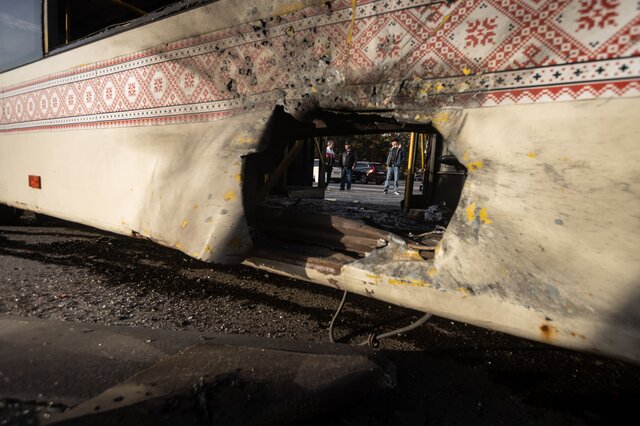
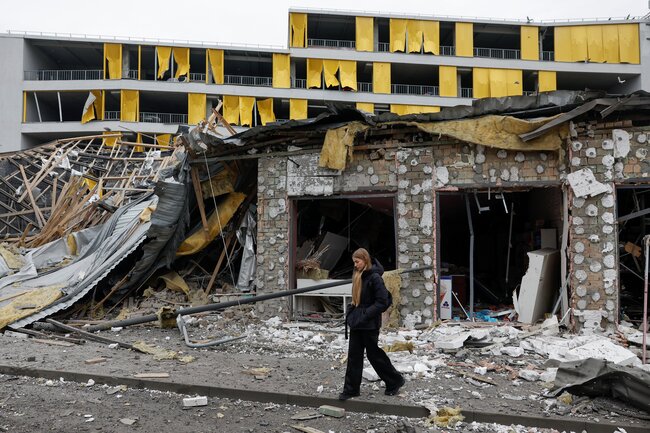
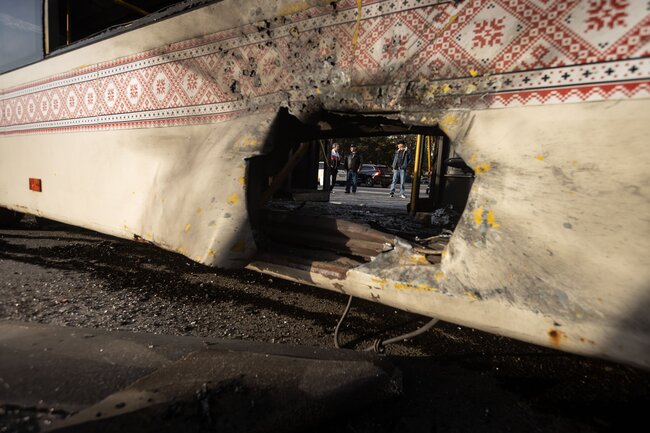
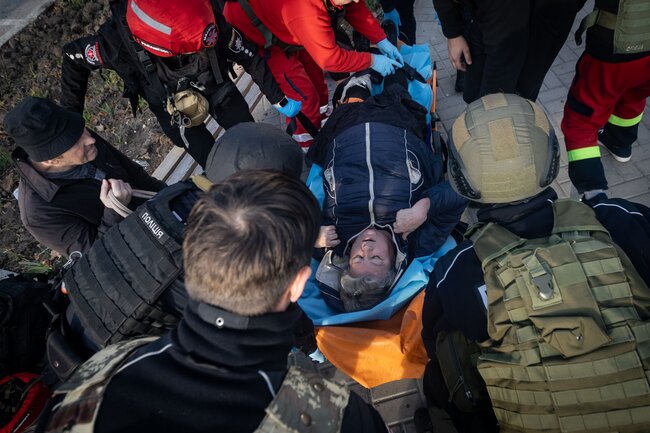
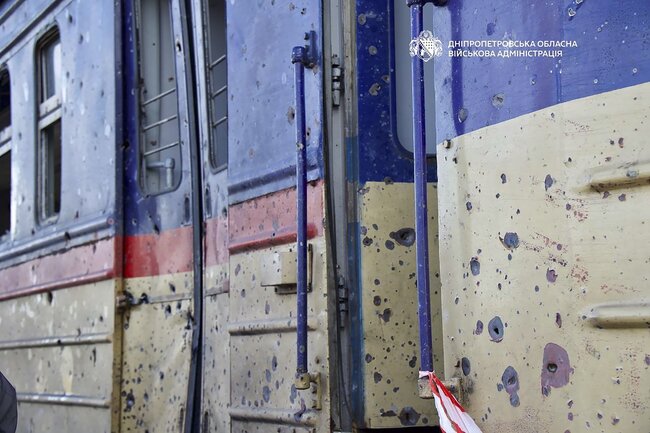
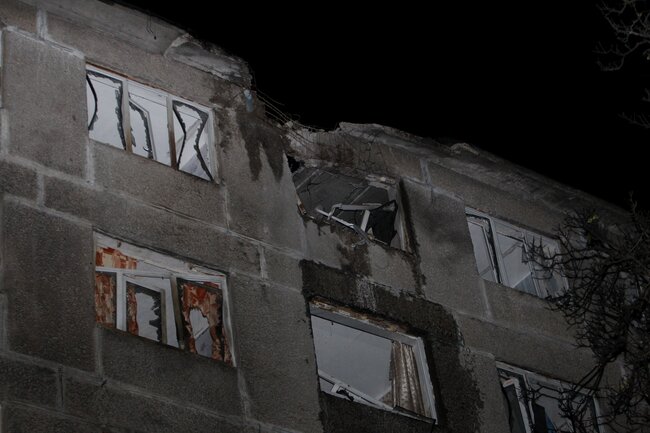
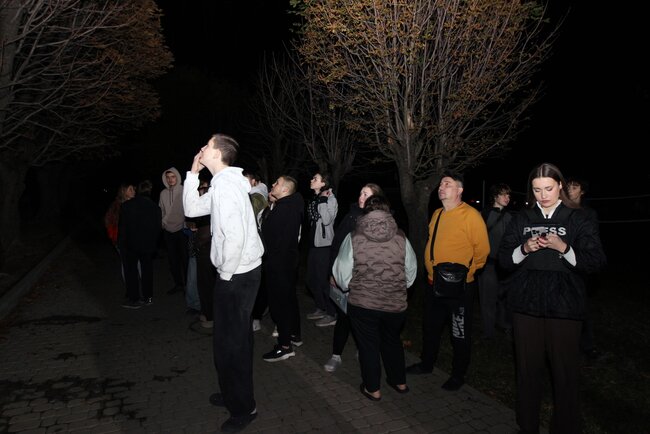
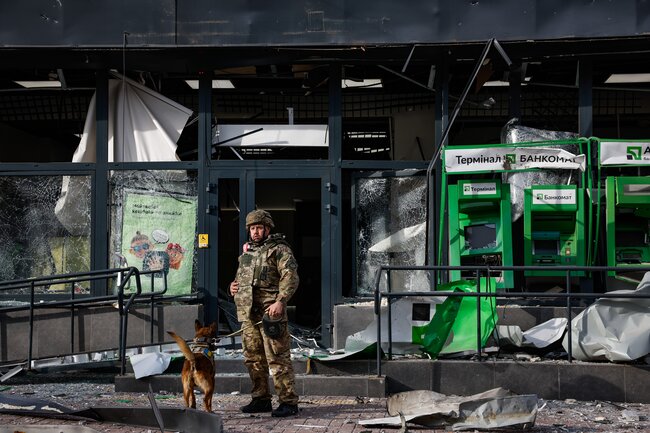
The war in photographs. The aftermath of Russian attacks in Ukraine’s regions.
A Kyiv resident stands outside the damaged building that housed her pastry shop. Kyiv, October 30.Zaporizhzhia. City authorities reported that a Russian drone hit a trolleybus on the afternoon of October 29An injured Zaporizhzhia resident was taken to the hospital in serious conditionA Russian drone struck a railway station in Dnipro on October 29. The photo shows a damaged train. The attack killed 15 people, while 11 people remain hospitalized.A Russian attack damaged a dormitory at a vocational school in Dnipro on October 29. Two teenage girls, ages 15 and 16, were injuredDnipro residents outside the damaged dormitoryA Russian strike damaged shops, residential buildings, and cars in Chernihiv on October 29. Two 15-year-old girls were killed, and more than 30 people were injured
At Meduza, we are committed to transparency about our use of artificial intelligence in the newsroom. The story you’re reading was written by one of our living, breathing journalists and translated from Russian using an AI model configured to follow our strict editorial standards. This translation process is the result of extensive testing and refinements to ensure our English-language coverage is timely and accurate. A Meduza editor reviews every draft before publication.
If you find any errors in this translation, please contact us at reports@meduza.io.
A North Korean hacking group known as TraderTraitor, or Lazarus Group, may be behind the theft of more than $6 billion from the Binance cryptocurrency exchange, according to analytics firms TRM Labs and Chainalysis, the BBC reported.
The independent Russian investigative outlet Agentstvo notes that the group may have ties to Russia. A UN Security Council panel of experts said in a report published in March 2024 that Lazarus Group is “very active in the Russian Federation” and retains access to Russian systems. In 2025, cybersecurity researchers found that Lazarus had routed internet traffic through servers in the Russian village of Khasan, on the border with North Korea.
A preliminary review by Binance found that the attackers gained access to its system by hacking the laptop of one of its engineers. The exchange also discovered “additional points of breach.”
Binance announced that about half of the stolen funds have been frozen, but a significant portion remains in the hackers’ hands. The exchange has pledged to reimburse customers for their losses and has set aside $6.34 billion of its own funds for that purpose, and it announced that it has already begun returning the assets.
Experts consider the Binance attack the largest cryptocurrency theft in history. The previous record belonged to the Bybit exchange hack in February 2025, when hackers stole about $1.5 billion. TraderTraitor was also blamed for the Bybit hack.
At Meduza, we are committed to transparency about our use of artificial intelligence in the newsroom. The story you’re reading was written by one of our living, breathing journalists and translated from Russian using an AI model configured to follow our strict editorial standards. This translation process is the result of extensive testing and refinements to ensure our English-language coverage is timely and accurate. A Meduza editor reviews every draft before publication.
If you find any errors in this translation, please contact us at reports@meduza.io.
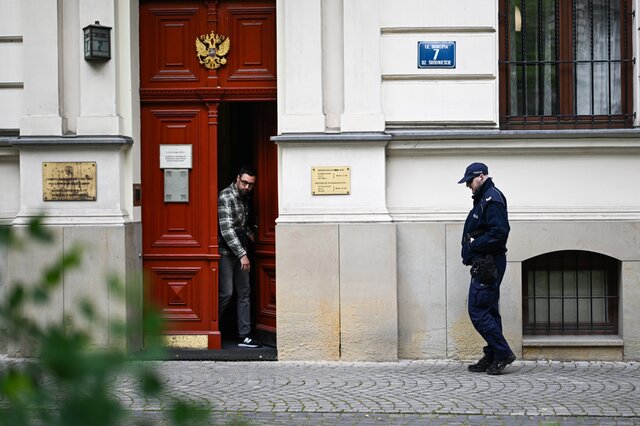
Police detained a 55-year-old Russian man in the city of Świdnica, in Poland’s Lower Silesian Voivodeship, after he photographed trains and railway infrastructure, the newspaper Rzeczpospolita reported.
The detention came during a police operation to secure a soccer match. After the game ended, officers patrolling the city noticed a parked car near a railroad crossing. The man inside tried to flee when he spotted the police.
After stopping him, police found professional photography equipment and files showing he had photographed trains and critical railway and transportation infrastructure, not only in Poland.
He has been charged with espionage, and a court ordered him held in custody for three months. Under Polish law, the offense carries a minimum sentence of five years in prison. His name has not been released.
Poland’s special services coordinator Tomasz Siemoniak called the detention of the Russian man an “exceptional case.” He explained that Russia is conducting subversive activity in Europe, which requires preliminary reconnaissance and documentation. However, he said, Russian intelligence services have so far avoided sending Russian citizens “to the front lines,” preferring to use local agents who are paid for their work.
At Meduza, we are committed to transparency about our use of artificial intelligence in the newsroom. The story you’re reading was written by one of our living, breathing journalists and translated from Russian using an AI model configured to follow our strict editorial standards. This translation process is the result of extensive testing and refinements to ensure our English-language coverage is timely and accurate. A Meduza editor reviews every draft before publication.
If you find any errors in this translation, please contact us at reports@meduza.io.
The Court of Arbitration for Sport (CAS) has ordered the International Ice Hockey Federation (IIHF) to admit Russian national hockey teams to five international championships in the 2026/2027 season, the court said in a press release.
CAS granted one of the appeals filed by the Russian Ice Hockey Federation. The ruling applies to tournaments in 2027: the men’s and women’s world hockey championships, the under-18 boys’ and girls’ championships, and the world junior championship.
The IIHF said in a statement that it was disappointed by the CAS ruling, which allows the Russian Ice Hockey Federation to immediately register its team for all the championships.
The IIHF disagrees with this aspect of the ruling and maintains that its decisions were necessary to protect the safety and security of all participants and safeguard the integrity of its competitions.
The federation also said it would urgently assess what steps were needed to comply with the ruling, how long that would take, and what organizational implications would follow.
The next major tournament under IIHF auspices is the world junior championship, which will begin in Canada on December 26. The list of participants has already been finalized, and Russia is not among them.
Russian and Belarusian athletes have been barred from international team sports competitions since 2022. Restrictions on Russian athletes only began to ease gradually in 2026.
At Meduza, we are committed to transparency about our use of artificial intelligence in the newsroom. The story you’re reading was written by one of our living, breathing journalists and translated from Russian using an AI model configured to follow our strict editorial standards. This translation process is the result of extensive testing and refinements to ensure our English-language coverage is timely and accurate. A Meduza editor reviews every draft before publication.
If you find any errors in this translation, please contact us at reports@meduza.io.
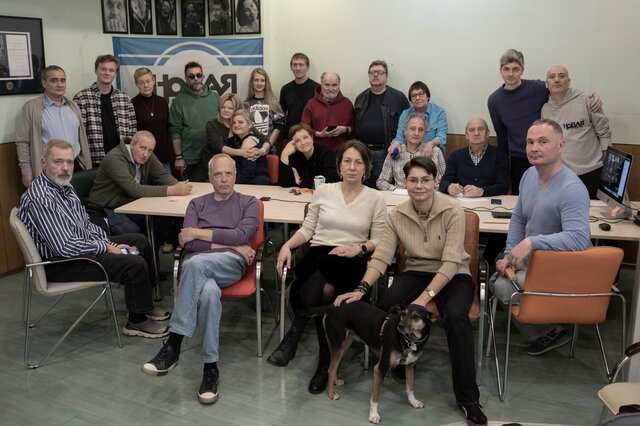
For more than 30 years, Novaya Gazeta operated under constant pressure. Its journalists were threatened, attacked, and murdered; the newspaper was stripped of its media registration, and Russia’s Justice Ministry designated it a “foreign agent.” In October 2026, Novaya Gazeta was ordered to vacate its office in central Moscow and lost the ability to collect donations. Shortly afterward, its editors announced that the newspaper was shutting down.
Meduza is collecting reactions to Novaya Gazeta’s closure.
This is all unbearably painful, and there aren’t enough words for it — all we can do is sympathize and offer support however we can. Novaya Gazeta represents several epochs of our time.
This morning calls for all of us to cry. I’ve spent several days writing about the markers that tell you how high the floodwaters have risen. Now another one — not just a marker, but a milestone, a big bright lighthouse — has been swept away by a murky wave. Thank you, dear colleagues. Thank you for everything. There was never anyone better than you, there’s no one better now, and there’s no guarantee there ever will be.
This is a statement, not a request for help, since there’s hardly anything that can be done. The Russian authorities have killed Novaya Gazeta, a newspaper with a brilliant history, a newspaper that raised a whole generation of the country’s best journalists — and for some of them, the profession cost them their lives.
A newspaper that stood upright right to the very end — I think that’s exactly the problem.
It’s very hard to explain to anyone who never worked in the Novaya Gazeta newsroom why this place matters so much to Russian journalism, why so many journalists — even those who never worked there — considered it home. Here are three episodes where the newsroom appears. Watch them. This will never happen again.
Now for the sad part. A symbolic coincidence of dates, for me personally: exactly 20 years ago, on November 1, 2006, I was hired onto Novaya Gazeta’s staff. And on November 9, 2026, my newspaper will no longer exist. It was stripped of its life. Stripped by a junta that treats the country as its own fiefdom.
Today Novaya Gazeta announced its closure. A 33-year history has come to an end. For me, Novaya Gazeta was an experience of living through freedom together in an unfree country. The less freedom remained in Russia, the more we sought it out at home, at 3 Potapovsky Lane. My first piece for Novaya Gazeta was published in March 2014. It was about Ukrainian cadets in Sevastopol who sang their anthem at the entrance to the naval academy as their home was collapsing around them. My last piece ran in the paper on February 25, 2022, in both Russian and Ukrainian. I didn’t know what to call it, so I titled it “Come and See.”
Novaya Gazeta Europe issued a statement today: “We are confident that the values of the newspaper founded by Mikhail Gorbachev will still be of use to the homeland. For now, its readers remain the keepers of those values. Take care of yourselves, because one day, everything will be ‘Novaya’ all over again.”
For us, Novaya Gazeta’s journalists have been and remain examples of incredible courage and self-sacrifice in the name of democratic values. The authorities destroyed Novaya Gazeta because they could not tolerate people inside Russia who kept writing about what mattered even amid censorship and repression.
We know that Igor Domnikov, Yuri Shchekochikhin, Anna Politkovskaya, Stas Markelov, Anastasia Baburova, Natalya Estemirova, and other journalists who suffered for their work remain forever in history as examples of resilience for us and for future journalists. We know that the stories they told and the results of their investigations cannot be hidden by censorship or by beatings that leave people half-dead. We know that their unwavering commitment to their principles has inspired entire generations of Russians to remain themselves in difficult times.
Thank you, Novaya, for your work! It wasn’t in vain!
Russian authorities have designated the paper a foreign agent and are evicting it from its premises, while banks have cut off its donations. Staff members have faced numerous instances of repression… When I was jailed in the Bolotnaya Square case, the paper wrote about me. Novaya ran a report from the press conference held after my arrest: “Beria’s Shadow in the Investigative Committee.” Novaya repeatedly gave me a platform to publish. I’m very sad that this outlet’s history is coming to an end. It’s yet another defeat for civil society and a victory for Putin’s nomenklatura.
The closure of Novaya Gazeta is a gut punch. I don’t want to believe it, but I’ll have to.
Novaya is a team of brave journalists and people. For many of us, they’re a point of reference. As long as they were allowed to work in Russia, there seemed to be hope for honesty and objectivity — and hope that Muratov would come up with something, would shield them, a man who commands respect not only because he’s a Nobel laureate but because he’s done a great deal to help sick children, and that’s still something our country respects and values regardless of one’s political views. But no one is all-powerful.
The newsroom writes — and in private conversations people say the same — that they didn’t shut down, they were killed. And indeed, for the sake of journalism, free speech, and our society, people from Novaya have sacrificed their lives, more than once. As I understand it, a criminal case is now looming on the horizon, along with labels like extremism and designation as undesirable. And a Russian prison is something you wouldn’t wish on every enemy, let alone your own people — especially over politics, over words.
Someday the time will come when Novaya Gazeta returns — both to the media and to its office on Chistye Prudy.
I don’t know what to say here. Unfortunately, I don’t believe that the darkest night comes right before dawn. If anything, I know there’s no bottom.
But that a newspaper renting office space in Moscow managed to hold out — and hold out with such dignity! — through 4.5 years of Russia’s criminal full-scale war against Ukraine is a feat and a miracle. Well, that miracle has ended. But I think my colleagues’ journalistic feat will continue in one form or another.
Novaya Gazeta has died. Any death is a tragedy. But I think there’s an error in that formulation. It’s not Novaya Gazeta that died. What died is a country in which an independent, free media outlet opposing the war could exist. Today, such a country and such a newspaper are two mutually exclusive realities. They cannot exist in the same space, under the same jurisdiction, under the same pseudo-constitution.
So the so-called death of Novaya Gazeta — as cruel as that sounds — is merely bringing what’s happening to its logical conclusion. Strength to its contributors. Strength to Dmitry Muratov. Strength to survive and to preserve themselves individually in this nightmare.
And thank you, Novaya Gazeta, for hosting Artdocfest on its website for so many years. For the honor of being named person of the year. For putting the poster of my film Rodnye “Close Relations” on its cover just a couple of days before the full-scale war began. That will never die. And it will definitely come back someday — even if not in our lifetime…
Dear Novaya newsroom, dear Dima, and every journalist, producer, engineer, archivist!! Dear readers and viewers of Novaya Gazeta!! Russian history is impossible to imagine without you — you are the most important part of these past three decades. And I’m certain you’ll find a way to keep working for all of us after a short break. We’re waiting for you!! And the darkness will lift, I believe it!
Honestly, I don’t believe Novaya Gazeta has closed for good, and I have no doubt this is temporary. There’s just one thing I want to say: I’ve worked at many newsrooms, and I’ve heard about all the rest from colleagues, and I can say with confidence that there has never been, is not, and is unlikely ever to be a newsroom better — more humane, both toward Russians in general and toward its own staff — than Novaya Gazeta, or an editor-in-chief better (more dignified and more magnificent) than Dmitry Muratov.
For me, Novaya is the people I’ve spent many years alongside. Here’s one story that matters a lot to me. In 2012, we tried to stop the “Scoundrels’ Law,” which banned Americans from adopting Russian orphans. Many of the children were seriously ill, and the law was literally killing them.
Novaya Gazeta collected more than 100,000 signatures calling for the law’s repeal at the time. I invited Dmitry Muratov to a meeting of my Duma committee — the Committee on Constitutional Legislation and State-Building — to present the petition. We wanted to bring it to a plenary session, but the committee rejected the proposal. Ilya Ponomaryov, Valery Zubov, and I then used Novaya’s petition as the basis for a bill in the State Duma to repeal this barbaric law. We understood there was no chance of it passing, but we felt obligated to do everything we could to protect children whom the authorities had turned into hostages of political revenge.
Fourteen years have passed. Today, that same government is destroying Novaya Gazeta itself. I’m proud that we were together then and remain together now. Dear friends at Novaya, thank you for your work. I’m certain this isn’t the end of the story.
The day after the birthday of Novaya Gazeta’s creator [Dmitry Muratov], it closed, stopping exactly at the line beyond which the threat of persecution becomes a guarantee.
Everything that’s been happening for years now has long been a “shameful page in the history of Russian media” (and of the country, for that matter), but even by the standards of today’s dark twenties, this particular installment of the clusterfuck lands with a lot of pain. An outlet that led many good journalists to choose this profession in the first place, one that is essentially our national treasure and a source of pride, has finally been crushed.
None of this is surprising, and honestly, it’s a huge achievement that they held out for so many years — they kept going no matter what. But now they’re out of strength, and another source inside the country has been killed off, one that let people know what was really happening there, rather than relying only on the bulletins of our dear ruling party’s official bodies.
The first photo shows my very first press card. I came to Novaya Gazeta at 18 and spent eight years at that newsroom on Potapovsky Lane. As of today, the paper no longer exists — Russian authorities finished it off. In truth, this had been planned for a long time. The slow killing went on for years, it’s just that in recent years, real journalism in Russia has become flatly impermissible.
Novaya and I are the same age: as I grew up, it documented what modern Russia was becoming, pointing to its ugly, terrifying flaws. Journalists who were killed, journalists who suffered attacks. All of it so that Russia’s history would be written even a little more honestly, and so the names of those responsible for evil would be named.
My eight years at Novaya were difficult — it was where I came of age as a journalist. It was real higher education, given that journalism school offered none. Watching something sacred to you be killed is hard and painful.
A few months ago, I took part in a discussion (how tiresome these have become!) about whether Russia should still be considered an authoritarian state or has already become a totalitarian one. No, it shouldn’t, my learned opponent argued. And as proof, he pointed to the existence of Novaya Gazeta: in a totalitarian state, he said, a media outlet like that couldn’t exist.
Indeed, in recent years Novaya Gazeta had looked like a strange aberration. Now everything has fallen into place. I hope we won’t have to debate this question anymore. The paper is closed, and the question is closed. And I’ll say it again. People who, while in Russia (rather than in a safe remove), behave with courage and dignity deserve enormous respect.
Thank you to them.
At Meduza, we are committed to transparency about our use of artificial intelligence in the newsroom. The story you’re reading was written by one of our living, breathing journalists and translated from Russian using an AI model configured to follow our strict editorial standards. This translation process is the result of extensive testing and refinements to ensure our English-language coverage is timely and accurate. A Meduza editor reviews every draft before publication.
If you find any errors in this translation, please contact us at reports@meduza.io.
Novaya Gazeta has announced it is shutting down. We never thought we would have to write these words — and yet that’s the reality. The story of the most important independent news outlet in modern Russia has come to an end.
Novaya was a unique newspaper from its founding to its final day. No other newsroom has a record like this: an extraordinary body of investigative reporting and exceptional journalism, an impressive array of awards — including Dmitry Muratov’s Nobel Peace Prize — and a list of journalists who were murdered.
By every measure, it was the best media outlet in Russian history. In a testament to that distinction, Novaya Gazeta was the only major independent outlet that kept operating inside the country after 2022, in defiance of wartime censorship, dictatorship, and even the instinct for self-preservation.
We admire your loyalty to the profession. We thank you for everything. And we promise to continue your work for as long as we can. We also know that you are unbreakable and never give up. You’ll find a way, as you have so many times before.
That is why we refuse to say goodbye to you. Novaya Gazeta will not disappear.
Thank you.
At Meduza, we are committed to transparency about our use of artificial intelligence in the newsroom. The story you’re reading was written by one of our living, breathing journalists and translated from Russian using an AI model configured to follow our strict editorial standards. This translation process is the result of extensive testing and refinements to ensure our English-language coverage is timely and accurate. A Meduza editor reviews every draft before publication.
If you find any errors in this translation, please contact us at reports@meduza.io.
A special commission has concluded that repairing and modernizing the heavy nuclear-powered missile cruiser Pyotr Veliky is not practical, said Vladimir Maltsev, head of the All-Russian Movement in Support of the Navy.
“The cruiser cannot be restored. The ship has a certain degree of wear,” he said. Maltsev stressed that this is a preliminary conclusion, and a final decision has not yet been announced.
A source in the naval sector told the Russian state news agency TASS as early as 2023 about plans to retire the Pyotr Veliky from service. According to the source, the idea of decommissioning it emerged because of the prolonged repair of the cruiser Admiral Nakhimov.
A source who spoke to the Russian state news agency RIA Novosti claimed the same year that there were no plans to decommission the Pyotr Veliky or remove it from the Navy’s active service.
The Pyotr Veliky is the flagship of Russia’s Northern Fleet and the only active nuclear-powered cruiser of the Project 1144 Orlan class. Aside from aircraft carriers, it ranks among the largest warships in the world and is one of the most powerful surface ships in the Russian navy.
Four such ships were built under the project between 1977 and 1996. The Admiral Ushakov and Admiral Lazarev have already been decommissioned, while the heavy nuclear-powered cruiser Admiral Nakhimovwent to sea this year for the first time after 28 years of repairs. Plans called for returning it to the Navy by the end of the year.
The Sevmash shipyard in Severodvinsk, which handles the cruisers’ modernization, can take on only one ship of the series at a time. Repairs on the Pyotr Veliky were initially planned to begin after work on the Admiral Nakhimov was completed in 2018. However, the repairs dragged on, and the cost doubled over that time, exceeding 200 billion rubles.
At Meduza, we are committed to transparency about our use of artificial intelligence in the newsroom. The story you’re reading was written by one of our living, breathing journalists and translated from Russian using an AI model configured to follow our strict editorial standards. This translation process is the result of extensive testing and refinements to ensure our English-language coverage is timely and accurate. A Meduza editor reviews every draft before publication.
If you find any errors in this translation, please contact us at reports@meduza.io.
The evacuation of residents has begun in the occupied city of Oleshky in the Kherson region, Russian Ombudsperson Yana Lantratova and Davyd Arakhamia, head of the Servant of the People faction in Ukraine’s parliament, the Verkhovna Rada, said.
“We are in Oleshky. Here, people who want to leave for Russian territory are gathering, and over there are people who want to leave for Ukrainian territory. Everyone will be given that opportunity; people are gradually boarding a bus,” Lantratova said on her Telegram channel, posting a video from the city that was soon deleted.
Arakhamia said the Ukrainian delegation arrived safely in Oleshky and that the evacuation and distribution of humanitarian aid have begun. Ukrainian Ombudsperson Dmytro Lubinets posted a video from Oleshky confirming he is in the city.
“The truce has been in effect for 80 hours and continues. I’m currently on the ground talking with local residents to find out what they need and understand what kind of assistance is needed most urgently,” Lubinets said.
Ukrainian Prime Minister Serhii Koretskyi, addressing parliament, said that 527 residents of Oleshky wanted to relocate to Ukraine. The Russian side has not yet released figures on how many people want to relocate to Russia.
Russia and Ukraine halted hostilities in Oleshky for a humanitarian mission reportedly brokered by U.S. first lady Melania Trump. The truce took effect on the morning of October 27 and will remain in force until late in the evening on November 1.
At Meduza, we are committed to transparency about our use of artificial intelligence in the newsroom. The story you’re reading was written by one of our living, breathing journalists and translated from Russian using an AI model configured to follow our strict editorial standards. This translation process is the result of extensive testing and refinements to ensure our English-language coverage is timely and accurate. A Meduza editor reviews every draft before publication.
If you find any errors in this translation, please contact us at reports@meduza.io.
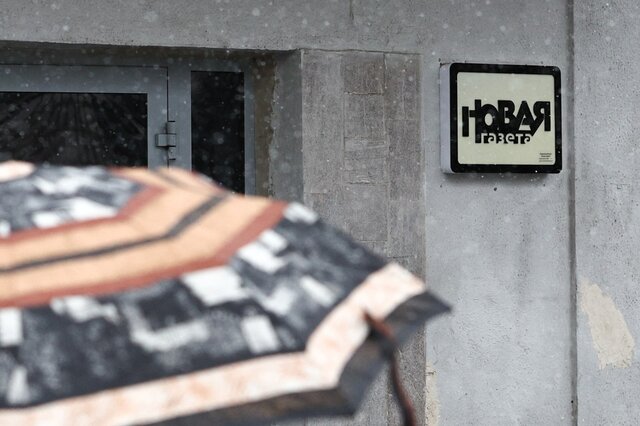
A sign at the entrance to the editorial office of Novaya Gazeta, an independent Russian newspaper, in Potapovsky Lane in Moscow
Novaya Gazeta, the best-known independent news outlet still operating inside Russia, has announced that it is closing. The day before, it became known that the editorial staff was being evicted from its office in Potapovsky Lane in central Moscow, where journalists had worked for 29 years. As a result, the Anna Politkovskaya museum, located in her former office, will also close. After the start of Russia’s full-scale invasion of Ukraine, Russian authorities blocked the outlet’s websites and stripped the newspaper of its registration, and in September 2026 designated Novaya a foreign agent. According to The Economist, the newspaper’s editorial staff held a meeting on October 26 at which the decision was made to close the outlet. On the morning of October 30, Novaya officially announced that it was ceasing operations. Meduza is publishing a translation of the Novaya Gazeta editorial staff’s statement.
They killed us.
On November 9, we will turn off the lights in the home where we have lived for 30 years, shut down our servers, and leave. The newspaper no longer exists. Russian authorities and Russian security services forced the editorial staff to stop working.
More than 30 years of living alongside the country and its citizens will end for us out on the street, without means of subsistence, under the constant threat of repression.
Our years were happy: filled with creativity and hope, readers, friends, texts, films. At times, those years were desperately bitter.
Bitter, because it was during the rule of this regime — not during the lawless 1990s — that our colleagues were killed for political reasons, for carrying out their professional and civic duty: Igor Domnikov, Yuri Shchekochikhin, Anna Politkovskaya, Stas Markelov, Anastasia Baburova, and Natalia Estemirova.
At the same time as the eviction notice, our donation system, which allowed us to receive contributions from our readers, was shut off. In other words, we were stripped of funds. Entirely.
This is a coordinated action. The banks’ excuses — that they are simply following internal corporate rules — will convince no one. The state’s repressive apparatus, officers of Russia’s Federal Security Service who have embedded themselves inside every organization, set these rules instead. They consider the country their own property.
After military action began, Russian authorities stripped us, like all other journalists, of the ability to talk about the most important and tragic events of our time. They passed laws that brought censorship back into the country, and that censorship then spread to nearly every sphere of human life.
Authorities blocked all of our online resources. The state seized our printing house, and security service officers and censors entrenched elsewhere refused to let us publish the newspaper. Many of our staff were forced to leave the country.
The state then stripped us of our media registration, taking away our right to earn a living through our own work.
Attackers assaulted editor-in-chief and Nobel Peace Prize laureate Dmitry Muratov, who nearly lost his eyesight as a result. No criminal case was opened, even though the perpetrators are known.
Then Russian authorities began designating our journalists as foreign agents, starting with the editor-in-chief.
Then Russian authorities brought administrative cases against the editorial leadership.
In Chechnya, our columnist Elena Milashina was abducted and beaten half to death.
Our executive editor Oleg Roldugin was taken hostage, accused of having worked as a journalist. His trial is coming soon.
Authorities searched Novaya Gazeta’s editorial office for hours and also searched the editor-in-chief’s apartment.
In September of this year, Russian authorities designated the entire editorial staff as foreign agents, placing more than 100 journalists and contributors on the registry.
For nearly five years of the war, we managed to keep working, surrounded on all sides by the security services.
And now, that’s it. We have ended up in a “kill zone.”
This is not just our private story. It is the story of a country and a society being finished off the same way.
The FSB, the Justice Ministry, the prosecutor’s office, and others who have privatized the state and usurped power are doing this. This is not Soviet resentment. Behind that label, a military dictatorship has nearly been built.
They say they are defending the constitutional order. No, this is an anti-constitutional order. The Constitution has been raped, beaten, and thrown into prison for an enormous term with its mouth taped shut, just like thousands of the country’s citizens who simply followed its articles, and tens of thousands of other citizens who were forced to become refugees, leaving their homes and heading into the unknown.
Stop saying that this isn’t Stalin’s 1937, and that the repression has some sort of “digital character.” This is state repression. And people, not numbers, are dying in cells. Period.
Human life has lost its meaning and been devalued.
The word “Constitution” provokes sarcasm and laughter. From everyone. Even from judges. Especially from judges. No one believes that it is the country’s basic law, the one the president swore an oath on. Notice that official propaganda has long since stopped calling the president the guarantor of the Constitution.
Human rights and freedoms have been eliminated in the country, and defending them has been equated with a crime. Elections and elected bodies of government have been de facto eliminated. Public institutions have been eliminated. Freedom of conscience and human dignity have been trampled. Private life has been turned inside out by dirty hands.
Doesn’t Article 29 of the Constitution — “censorship is prohibited” — sound like mockery today? The courts have been destroyed along with law and justice. Having convictions is now treason.
But treason is when the state betrays its own Constitution. This treason is an ongoing crime, unfolding right now before the eyes of the world.
The killing of Novaya Gazeta is further proof of that.
All these years, we wrote about exactly this, for as long as we could. That is exactly why we were killed.
Thank you to everyone who heard us.
The Editorial Staff
P.S.
The final issue will be published.
At Meduza, we are committed to transparency about our use of artificial intelligence in the newsroom. The story you’re reading was written by one of our living, breathing journalists and translated from Russian using an AI model configured to follow our strict editorial standards. This translation process is the result of extensive testing and refinements to ensure our English-language coverage is timely and accurate. A Meduza editor reviews every draft before publication.
If you find any errors in this translation, please contact us at reports@meduza.io.
Russia’s Defense Ministry has drafted an order that would postpone service members’ December pay to January for the first time in at least 18 years, the independent Russian news outlet Verstka reported.
Under current rules, service members are paid for the previous month between the 10th and 20th of each month, and for December, by December 25. The Defense Ministry wants to push the December payments back to January 11–21 of the following year.
If adopted, the changes could take effect as early as this year.
Service members of the Joint Group of Forces fighting in Ukraine would be exempt, continuing to be paid under the old schedule before the New Year. Contract soldiers would also be treated differently: in December, they are supposed to receive a bonus along with their pay.
Russian service members have received their December pay before the end of the calendar year since at least 2008, according to official records Verstka reviewed. The outlet said the practice was likely also observed during the Soviet era.
Authorities in Stavropol Krai decided to postpone until 2027 the payments to the families of those killed and wounded in the war, it was reported the day before. The payments are normally supposed to arrive within five business days of a claim’s approval, but authorities can delay payment if the regional Labor Ministry’s account lacks funds.
Regions have also been cutting payments to the families of the deceased one after another in recent months. In the Ulyanovsk region, the payments were cut by a factor of 20, while in the Saratov region, they were cut by a factor of 10.
At Meduza, we are committed to transparency about our use of artificial intelligence in the newsroom. The story you’re reading was written by one of our living, breathing journalists and translated from Russian using an AI model configured to follow our strict editorial standards. This translation process is the result of extensive testing and refinements to ensure our English-language coverage is timely and accurate. A Meduza editor reviews every draft before publication.
If you find any errors in this translation, please contact us at reports@meduza.io.
Pentagon officials urged several NATO member countries to tone down their rhetoric about the Russian threat during bilateral meetings, according to Reuters sources.
The requests went to Lithuania, Latvia, and Estonia, among others, the agency’s sources said. It is unclear whether other countries received similar requests.
Elbridge Colby, head of the Pentagon’s policy directorate, was one of the officials who conveyed the requests. He cited public statements by Europeans describing Russia as “cornered like a rat” as an example of inappropriate rhetoric.
It is unclear which statement he meant, but in late September, Estonian Prime Minister Kristen Michal called Putin a “rat in a corner” and suggested that Russia is resorting to sabotage in Europe because it is increasingly bogged down in the war with Ukraine, Reuters said.
At another recent meeting, the Pentagon urged the Estonian delegation to be “measured” in its public statements, according to a source. It was not specified whether Pentagon officials objected to any particular statement.
Colby also recently told a representative of one of the Baltic countries that there should be no “poking” at Russia, according to another source.
The Baltic countries that border Russia have long worried about the Russian threat, particularly because of drones that regularly cross into their territory. European countries also accuse Russia of a series of sabotage acts. One of the most recent incidents occurred in Germany, where a drone carrying explosives was found at Leipzig Airport near a Ukrainian cargo plane.
Putin, for his part, claims Moscow does not want war with Europe and has no plans to attack NATO countries, but says it is prepared for one.
At Meduza, we are committed to transparency about our use of artificial intelligence in the newsroom. The story you’re reading was written by one of our living, breathing journalists and translated from Russian using an AI model configured to follow our strict editorial standards. This translation process is the result of extensive testing and refinements to ensure our English-language coverage is timely and accurate. A Meduza editor reviews every draft before publication.
If you find any errors in this translation, please contact us at reports@meduza.io.
Moscow Mayor Sergei Sobyanin said 862 Ukrainian drones flew toward the Moscow region starting on the evening of October 29, with most shot down at “distant approaches.”
Sobyanin said 170 of the drones were shot down as they approached Moscow but did not disclose the aftermath of the attack.
Ukrainian monitoring channels and Astra, an independent Telegram channel, reported that drones struck the Novokuibyshevsk oil refinery in the Samara region. Regional authorities did not confirm the attack.
Samara Governor Vyacheslav Fedorishchev said on the morning of October 30 that Ukrainian forces are attacking the region, but gave no further details.
The Novokuibyshevsk refinery, a Rosneft subsidiary, has repeatedly come under attack from Ukrainian drones, forcing it to halt operations. The plant produces several dozen types of petroleum products and has an annual capacity of about 8.8 million tons of oil (about 9.7 million short tons).
Sobyanin had reported a day earlier that 613 drones flew toward the Moscow region from the evening of October 28 to the morning of October 29, and that 231 of them were shot down as they approached the Russian capital.
At Meduza, we are committed to transparency about our use of artificial intelligence in the newsroom. The story you’re reading was written by one of our living, breathing journalists and translated from Russian using an AI model configured to follow our strict editorial standards. This translation process is the result of extensive testing and refinements to ensure our English-language coverage is timely and accurate. A Meduza editor reviews every draft before publication.
If you find any errors in this translation, please contact us at reports@meduza.io.
Ukrainian ombudsman Dmytro Lubinets and Russia’s human rights commissioner Yana Lantratova have traveled to the occupied city of Oleshky in the Kherson region. They are accompanying a convoy of humanitarian aid and plan to organize the evacuation of residents who want to leave the city.
Lubinets is the first Ukrainian official of this rank to visit Russian-occupied territories.
To reach Oleshky, the Ukrainian delegation first traveled to Gomel in Belarus, then flew to Anapa in Russia, and from there continued overland to the occupied city. Residents of Oleshky will be returned to Ukraine from the occupied territory along the same route.
Oleshky cannot be reached through the front line or the mined river, the ombudsman’s office explained.
Russia and Ukraine have agreed to halt fighting in Oleshky for the humanitarian mission from October 27–November 1, inclusive. U.S. First Lady Melania Trump reportedly helped broker the agreement.
Journalists from the right-wing channel Newsmax are accompanying the humanitarian mission to Oleshky “as neutral observers,” Melania Trump’s press office said.
At Meduza, we are committed to transparency about our use of artificial intelligence in the newsroom. The story you’re reading was written by one of our living, breathing journalists and translated from Russian using an AI model configured to follow our strict editorial standards. This translation process is the result of extensive testing and refinements to ensure our English-language coverage is timely and accurate. A Meduza editor reviews every draft before publication.
If you find any errors in this translation, please contact us at reports@meduza.io.
Novaya Gazeta will be evicted from its office on Potapovsky Lane in central Moscow, where it has been based for 29 years, the news outlet Ekho reported. Ekho cited a letter to readers from editor-in-chief Sergey Sokolov and journalist Irina Gordiyenko.
“They’re simply throwing us out, giving us barely any time to pack up. The Anna Politkovskaya museum is closing, and portraits of our friends who were killed are being taken down from the walls,” Sokolov and Gordiyenko wrote.
Sources close to the newspaper told Ekho that staff members must leave the office by November 9. They have yet to find a new space.
Novaya Gazeta stopped publishing its print edition in 2022, after Russia launched its full-scale invasion of Ukraine. Russia’s Basmanny Court revoked its media license that same year.
In September 2026, Novaya Gazeta was designated a “foreign agent.”
At Meduza, we are committed to transparency about our use of artificial intelligence in the newsroom. The story you’re reading was written by one of our living, breathing journalists and translated from Russian using an AI model configured to follow our strict editorial standards. This translation process is the result of extensive testing and refinements to ensure our English-language coverage is timely and accurate. A Meduza editor reviews every draft before publication.
If you find any errors in this translation, please contact us at reports@meduza.io.
Routes for a humanitarian mission in Oleshky, in Ukraine’s Kherson region, have been cleared of mines. Russian and Ukrainian human rights commissioners Yana Lantratova and Dmytro Lubinets said the humanitarian convoy is ready to depart.
The convoy will head to the central district hospital, the commissioners said. Residents who have decided to leave the city will have until 2 p.m. on Friday, October 30, to do so.
Distribution of humanitarian aid to those remaining in the city will begin after 2:30 p.m. on October 30.
“Delegations from Ukraine, the Russian Federation, and the United States of America have now gathered to coordinate the next steps in the humanitarian mission. Journalists from the three countries are also present,” Lubinets said.
Russia and Ukraine halted fighting in Oleshky for the humanitarian mission under a deal brokered by U.S. first lady Melania Trump. The ceasefire took effect on the morning of October 27 and will remain in place until late on the evening of November 1.
At Meduza, we are committed to transparency about our use of artificial intelligence in the newsroom. The story you’re reading was written by one of our living, breathing journalists and translated from Russian using an AI model configured to follow our strict editorial standards. This translation process is the result of extensive testing and refinements to ensure our English-language coverage is timely and accurate. A Meduza editor reviews every draft before publication.
If you find any errors in this translation, please contact us at reports@meduza.io.
The Russian consulate in Krakow, Poland, on May 12, 2025. In summer 2025, Polish Foreign Minister Radoslaw Sikorski revoked the consulate’s permission to operate following reports of Russian intelligence services’ involvement in an arson attack on a Warsaw shopping center.
A company that charges Russians abroad to find available appointments at Russian consulates has ties to people in Roman Abramovich’s circle, Verstka reported.
Konsul Prime operates as an official partner under an agreement with Russia’s Foreign Ministry, offering help with paperwork and priority access to appointments.
The company always has appointments available, even though people usually wait weeks to book one. Konsul Prime began operating in late 2022. Russian emigrants say in group chats and online forums that getting a consular appointment has become even harder since the service launched.
Konsul Prime’s main legal entity, Tsentr Servis LLC, was established in December 2022 by Yefim Malkin. Malkin began working with Abramovich in the 1990s at Sibneft, according to Verstka. He was later linked to Millhouse entities that managed assets belonging to Abramovich and his partner, Yevgeny Shvidler.
In September 2022, Mikhail Livergand, another Abramovich associate who had previously worked in investment and real estate and served as Malkin’s assistant, took ownership of Konsul Prime. In August of that year, Livergand founded Tsentr Servis Digital, which owns the rights to Konsul Prime’s software platform.
Meduza found that Konsul Prime’s clients in Belgium, the Netherlands, Germany, France, and Switzerland sign contracts with legal entities registered in the United Arab Emirates: Docs Management L.L.C. and Konsul Prime DMCC. That information comes from the company’s privacy policy.
The owner of Docs Management L.L.C. is unknown, but Comfort Care Travel L.L.C. is registered at the same address in Dubai. It is the Dubai representative office of Malkin’s Russian company, Tekhnologii Meditsinskogo Turizma.
Konsul Prime DMCC is owned by Tsentr Servis, according to Tsentr Servis’ financial statements.
Since July 2023, Darya Zhurova, 53, has held 49% stakes in both Tsentr Servis and Tsentr Servis Digital, becoming another co-founder of both companies, according to Verstka. Livergand retained controlling stakes in both companies. Zhurova is the first co-owner with no ties to Abramovich, Verstka’s journalists wrote, suggesting that she may be a nominee owner.
Tsentr Servis founded most of Konsul Prime’s legal entities abroad, Verstka reported. Another company responsible for Konsul Prime’s branches, Konsul Tsentr, operates on behalf of Russia’s Foreign Ministry. Since 2024, Livergand and Zhurova’s Tsentr Servis has owned 90% of Konsul Tsentr, with just 10% belonging to an administrative office under the ministry.
In February 2026, Russia’s Unified State Register of Legal Entities stopped disclosing information about the founders of Konsul Prime’s Russian legal entities. But even the information still publicly available makes clear that Konsul Prime is not a state company at all, nor is it even formally dependent on the state. It has more ties to Roman Abramovich than to Russia’s Foreign Ministry. Yet the service still presents itself as the ministry’s sole partner, collects Russians’ data, and charges for exclusive access to consular services.
Tsentr Servis Digital’s business is currently valued at 1.17 billion rubles, according to its financial statements, which Meduza reviewed.
At Meduza, we are committed to transparency about our use of artificial intelligence in the newsroom. The story you’re reading was written by one of our living, breathing journalists and translated from Russian using an AI model configured to follow our strict editorial standards. This translation process is the result of extensive testing and refinements to ensure our English-language coverage is timely and accurate. A Meduza editor reviews every draft before publication.
If you find any errors in this translation, please contact us at reports@meduza.io.
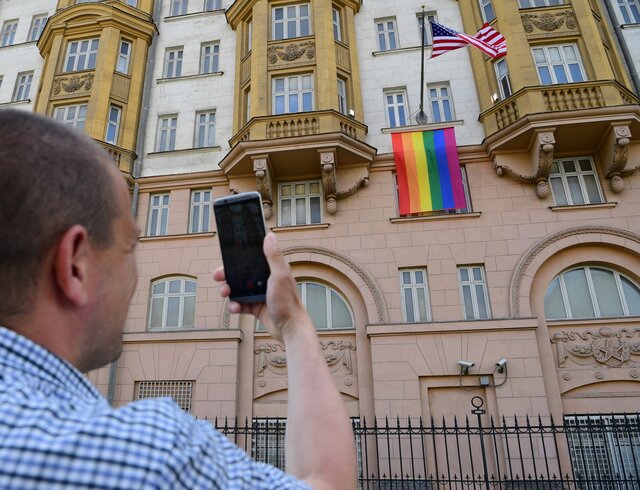
A rainbow flag on the U.S. Embassy building in Russia, June 2020
Nearly three years ago, Russia’s Supreme Court banned the nonexistent “international LGBT movement” as extremist. Since then, “LGBT extremism” has become grounds for at least 14 criminal investigations and hundreds of citations for administrative offenses. Because the system often doesn’t look into the context in which a rainbow flag appears on social media, even homophobes end up being targeted. Mediazona has compiled cases in which opponents of same-sex relationships have been punished for “promoting” them.
In 2013, Russia passed a law banning the promotion of “nontraditional sexual relationships” to minors.
In December 2022, the authorities extended the ban on “gay propaganda” to people of all ages. They also amended the Code of Administrative Offenses to prohibit “promotion of pedophilia” and the distribution of information “capable of making minors want to change their sex.”
In November 2023, the Supreme Court outlawed the “international LGBT public movement” by declaring it an “extremist organization.”
Vera Makeyeva, a retiree from Kurgan who welcomed Russia’s ban on the “LGBT movement,” was fined under that ban six months later — 1,500 rubles for old reposts of homophobic content featuring a rainbow flag. “It’s my own fault. I hadn’t cleaned up my photo albums in 13 years. Some people were interested enough to go through them,” Makeyeva told Mediazona.
Pyatigorsk resident Pyotr Voronin was jailed for one day for an image showing the presidents of Ukraine and France alongside a swastika and a rainbow flag (both are considered extremist symbols in Russia). Voronin had intended to mock Ukraine and France — and was outraged that “the FSB’s AI decided I was spreading propaganda.” “I asked [in court], ‘So maybe I should officially apologize to Zelensky?’ Basically, the AI that reads our messages online is a complete idiot, and we mean nothing to it,” Voronin concluded.
Vladimir Sugakov, a retiree from the Kemerovo region, was fined 100,000 rubles for “LGBT propaganda” in homophobic posts. Among the posts that caught law enforcement’s attention was a slideshow of photographs from Pride events set to Sergei Trofimov’s song “Petushki” (“Little Roosters,” Russian prison slang for gay men). Sugakov said the video criticized the LGBTQ community, but the police and the court didn’t bother to look into it. He decided against appealing the fine, saying he wasn’t an “idiot” who would “take on the system.”
In Moscow, a video titled “Nazi Initiation” led to a 100,000-ruble fine. In it, a young man shaves his head, puts on clothes popular with neo-Nazi skinheads, and has sex with two similar-looking men. The video ends with an image of a swastika and the message “Join our ranks!!!” The Moscow resident who posted the video said he had done so “as a joke.” The court saw “LGBT propaganda” rather than humor.
Father Grigory (Grzegorz Zwoliński), a Polish Catholic priest who lived in Kirov, had long criticized Archbishop Paolo Pezzi, who heads the Catholic Archdiocese of Moscow, for supporting the LGBTQ community. Father Grigory added a rainbow flag to one of his posts about Pezzi “to draw attention.” He was fined 1,000 rubles for it. The fine, in turn, led to the revocation of his Russian residence permit and a ban on re-entry. After 24 years in Russia, the priest returned to Poland, where he now writes that the “rainbow church” took revenge on him.
At Meduza, we are committed to transparency about our use of artificial intelligence in the newsroom. The story you’re reading was written by one of our living, breathing journalists and translated from Russian using an AI model configured to follow our strict editorial standards. This translation process is the result of extensive testing and refinements to ensure our English-language coverage is timely and accurate. A Meduza editor reviews every draft before publication.
If you find any errors in this translation, please contact us at reports@meduza.io.

 Login