
❌

Reading view

Discovery Sanctions Recommended in "Are You a Jew? … Are You a Zionist?" Case

The factual allegations, from a Sept. 2025 decision in the case by Judge Susan Illston (N.D. Cal.) (the case is Radice v. Jerusalem Boxing Club, LLC consolidated with the federal government's U.S. v. Harara):

The Jerusalem Coffee House [which Harara owns] is a business establishment open to the general public. The coffee house is located on the premises of the East Bay Community Space, "which regularly hosts events that are open to the general public for exhibition or entertainment …."

According to the complaint, on June 10, 2024, Michael Radice—who is Jewish—went to the East Bay Community Space "for the purpose of viewing the establishment for a fundraising event for his organization." Radice was wearing a dark blue baseball cap with a light blue Star of David and white Hebrew lettering. As he approached the community space from the side where the coffee house is located, a man sitting at a table in front of the coffee house asked, "Are you a Jew?" Radice answered in the affirmative. The man then asked, "Are you a Zionist?" Radice declined to respond.

The complaint alleges that "[t]he man then began shouting numerous accusations at Mr. Radice, including that he was complicit in Israel's military actions in the Gaza Strip following the October 7, 2023 Hamas attacks and guilty of 'killing children.'" As Radice began to walk away, the man stood up and asked, "Where are you going?" The complaint alleges, "Mr. Radice saw another man, whom he later learned was Harara, walk out of the coffee house and speak to the man, and the two went inside." …

On August 3, 2024, Radice returned to the East Bay Community Space to attend the fundraiser for his organization. Before doing so, "he entered the coffee shop to purchase a cookie, which he hoped would be seen as a sign of goodwill." He was not wearing the baseball cap he had worn previously. Behind the counter were Harara, the man Radice had previously encountered, and a third employee. Before Radice could place his order, the man from the prior encounter stated, "You're the guy with the hat. You're the Jew. You're the Zionist. We don't want you in our coffee shop. Get out."

And now from Judge Thomas Hixson's Report and Recommendation yesterday:

There is no dispute that Defendant Abdulrahim Harara violated at least six discovery orders. Motion at 4-7 ("Harara has flouted at least six discovery orders," and enumerating the violations); Opp. at 7 ("But the question on this motion is not whether any order was violated; it is whether the record as a whole shows the kind of deliberate, deceptive obstruction that makes a fair trial impossible and justifies ending the case without one.")….

The real issue is what remedy the Court should impose for the serial violations of its discovery orders. The impact of Harara's conduct basically falls into three buckets: documents were produced late that should have been produced earlier; some document productions are incomplete; and there has been a wholesale failure to produce email. But having reviewed the voluminous evidence submitted in support of Radice's motion for sanctions, the Court thinks truth is available to the parties, and they should go ahead and have a trial on the existing record.

Harara's biggest failure in discovery is the nonproduction of email, and he does not have a good excuse. In many cases the total failure to produce email would justify terminating sanctions or at least adverse inference instructions.

But the Court is skeptical that this is such a case. The relevant events are alleged in-person refusals to serve Radice and another individual because they are Jewish. In other words, the relevant events did not occur by email. Before email existed, public accommodation discrimination claims like this were tried the old fashioned way: The participants in the alleged events testified, and the trier of fact decided who to believe. That option is still available here.

Email is still relevant, of course, because it could contain statements about what happened, or have evidence of the defendant's allegedly prejudicial intent. But here a lot of that type of evidence was produced in the form of Harara's text messages and social media feeds and other electronic records. These include a statement that seems to be by Harara that seems to say he throws pennies on the ground when Jews walk by; the coffee shop menu and outdoor signage with inverted red triangles, which Radice alleges is a symbol used by Hamas to mark Israeli targets in propaganda videos; the apparent introduction on the one year anniversary of the October 7 attack of a juice item named for a mastermind of the attack; a video of Harara telling a Jewish customer to leave because he had "a violent hat," referring to the Star of David on the hat; and a repost by Harara to his X account bearing the "Bay Area" screen name of a November 2, 2024 post calling that same Jewish customer "a genocidal, bottom dwelling Zionist scum" who "should be kicked out of every public establishment not just Palestinian owned ones!" There are also text messages that replicate the kind of thing a plaintiff would dream of finding in a defendant's emails—and certainly at trial Radice and the United States will argue these texts are strong evidence of liability.

Radice is certainly of the view that he has uncovered good evidence, even if it was produced later than it should have been, and even though it does not include email. See Motion at 15 ("The 6134 Bates-labeled pages and 2474 native files that Harara produced on or after August 7 include inflammatory documents that Harara willfully withheld until after discovery closed."); id. ("For example, a January 3, 2025 JCH Instagram post shows JCH advertising for sale a t-shirt featuring the Jerusalem Coffee House name ringed by flags with the emblem of Hamas, a designated terrorist organization dedicated to violence against Jews and Israelis."); id. ("His Instagram direct-messages contain both antisemitic tropes and antisemitic slurs.").

With all this evidence, can it really be said that Harara's failings in discovery have prejudiced Plaintiffs to such an extent that a meaningful and fair trial is no longer possible? That adverse inferences are needed because there is not enough evidence for the trier of fact to reliably draw conclusions about what happened?

No. These cases are about whether a coffee shop committed discrimination, and Harara has produced enough documents that Radice and the United States have what they need to go to trial. Even with the nonproduction of email, it is not true that discovery failed or that truth cannot be ascertained. The public policy in favor of deciding cases on the merits applies here.

Accordingly, the Court RECOMMENDS that the district judge DENY the request for terminating sanctions because there's just no need or basis for it. The Court DENIES the request for adverse inferences because it is essentially a request for a directed verdict. Each side should put on their case at trial, and truth should be determined in the normal way. There is no reason for the Court to stack the deck.

But that doesn't mean Harara escapes sanctions. He needs to pay for what he did. His serial violations of Court orders significantly drove up Radice's cost of litigating [the case]. Radice requests $166,500.50 against all Defendants. The entity Defendants have been in default during the period of time when Harara violated the Court orders, so are not the cause of Radice's increased legal expenses, and therefore will not be sanctioned.

Plaintiff's counsel's rates are reasonable. However, both the Benesch and ADL attorneys seek fees for work that preceded the violations of the Court orders, a problem that requires deducting about a third of the Benesch time and about a fifth of the ADL's time. That brings the total down to $118,000. In addition, even though Harara violated multiple discovery orders, it is also true that Plaintiff's counsel litigated [the case] with excessive ferocity. At times it seemed they were not just litigating a discrimination case but were out to destroy Harara. As a result their fees were excessive. The Court estimates that about half of the fees Radice incurred during the time when Harara was violating the discovery orders was due to the violations and the other half was for work that would have needed to be done anyway or that should not have been done at all because it was excessive. Accordingly, the Court SANCTIONS Harara in the amount of $59,000 and ORDERS him to pay that amount to Radice within 30 days.

In his opposition, Harara proposes some remedial measures. However, the Court will not adopt any of them. The proposal to remedy the lack of email production presupposes that Harara will have a lawyer to represent him. Opp. at 16 ("The full inbox Mr. Harara exported on September 3, 2026 will be reviewed by counsel, consistent with the Court's ruling that counsel rather than Mr. Harara conduct that review. That counsel will be either counsel Mr. Harara retains or volunteer limited-scope counsel appointed through the Court's Federal Pro Bono Project under General Order 25, to which Mr. Harara respectfully requests referral. Since his counsel withdrew, Mr. Harara has contacted lawyers and legal organizations and has not found a lawyer who will take his case."). However, Harara's inability to work cooperatively with two sets of counsel means this is an unrealistic proposal. And if no lawyer represents him, Harara's proposal contains no particular deadline by which emails would be produced. Opp. at 16 ("If counsel has not been retained or appointed within 30 days of the Court's order, Mr. Harara will file a status report every 14 days thereafter. In all events, the production under this paragraph will be complete within 90 days of the Court's order; if it is not, Mr. Harara will show cause why not, and the Court may then impose such further measures as it finds appropriate after notice and an opportunity to be heard.").

Harara's proposal to serve further interrogatory responses is highly unlikely to achieve anything. And there is no need for a further deposition of him; Plaintiffs' counsel can cross-examine him at trial….

The post Discovery Sanctions Recommended in "Are You a Jew? … Are You a Zionist?" Case appeared first on Reason Magazine.

  •  

10-Year "Harassment"/"Stalking" Sentence for Repeatedly Criticizing Police Detective Violated First Amendment, Amicus Brief Argues

I was delighted to sign on to this brief in State v. McMenamy (Mo. Ct. App.) just filed by the ACLU of Missouri Foundation and the Wash. U (St. Louis) First Amendment Clinic, on behalf the ACLU of Missouri and Profs. Jane Bambauer and Lyrissa Lidsky and me. The Introduction:

The First Amendment and article I, § 8 of the Missouri Constitution broadly protect the right to speak to the public about other people. This is true even when the speech "is intended to trouble or annoy, or to make another timid or fearful." United States v. Sryniawski, 48 F.4th 583, 587 (8th Cir. 2022). And it is true even when speech uses "social pressure and the 'threat' of social ostracism … to embarrass others or coerce them into action." NAACP v. Claiborne Hardware Co., 458 U.S. 886, 910 (1982). While individuals who are the subjects of unwanted speech may be able to limit some speech directed to them, they cannot limit offensive speech about them directed to others. Organization for a Better Austin v. Keefe, 402 U.S. 415, 419 (1971).

Contrary to this established law, Matthew McMenamy was convicted and sentenced to 10 years in prison for openly and vigorously criticizing a local police detective he believed had engaged in misconduct. Mr. McMenamy used his public social media accounts and publicly distributed flyers to attempt to draw the community's attention to the detective's actions. He expressed his hope that his revelations would result in the officer's removal.

While Mr. McMenamy's speech was certainly concerning to the detective, the circuit court did not make any finding that either the flyers or any one of the dozens of social media posts submitted as evidence fell within any category of unprotected speech, such as true threats. Nor could the circuit court have done so, as none of Mr. McMenamy's speech was outside the bounds of the First Amendment's protection. His convictions for harassment and stalking violate the First Amendment and should be reversed.

The opening paragraph of the section on the facts (for the full discussion of the facts, read the brief):

In August 2023, Matthew McMenamy began posting on social media about what he viewed as misconduct and racism by a local police detective, who years before had been involved in Mr. McMenamy's involuntary commitment. See State's Exs. 60A–M. Mr. McMenamy sought to publicize one of the detective's public Facebook posts, where the detective wrote: "If black lives matter then why are they shooting and killing each other at an alarming rate." State's Ex. 60B ("Let's make this racist post go viral … #BLM #RacistCop ….); State's Ex. 60A ("The people want answers. Is [detective] a racist? Does he feel that people of color do not matter because of an idea that they murder each other at an alarming rate?"). Many of Mr. McMenamy's posts were aimed at sharing with the public his concerns about the detective's fitness for his position. For example, Mr. McMenamy posted he was "in talks with a billboard company to put [detective's] racist quotes up next to a picture of him in uniform" because "[s]omeone like that shouldn't be a detective, an election [sic] official, or let alone anything near public service." Tr. 736:10–21, State's Ex. 60K. Mr. McMenamy's posts also described his feelings about his prior involuntary commitment and thoughts about hurting his parents before getting help. See State's Ex. 60E (Mr. McMenamy's post that he "had a bad day last Sunday … I still need time to heal but … I am going to counseling and I will be looking for support groups").

And the opening material in the legal argument (again, read the brief for much more):

All of Mr. McMenamy's social media posts and his distribution of flyers were protected by the First Amendment. Harassment and stalking laws may, in some circumstances, be constitutionally applied to protect unwilling listeners from unwanted, one-to-one speech directed to that listener. The government's power to protect an unwilling listener from speech about them directed to the public, on the other hand, is sharply limited, even when that speech is annoying, offensive, or alarming. Unless such speech falls within one of the narrow, historically recognized categories of speech that the U.S. Supreme Court has held may be regulated without violating the First Amendment, such as "true threats," it is presumptively protected.

Here, Mr. McMenamy spoke to the public, and his speech did not fall within any unprotected category. This Court should reverse Mr. McMenamy's convictions. Even if this Court does not find that all Mr. McMenamy's speech is protected from criminal prosecution by the First Amendment, he is at least entitled to a new trial. The circuit court allowed the State to present evidence of more than four months' worth of social media posts to the jury and then instructed the jury it could find Mr. McMenamy guilty based on unidentified "alarming content" in these posts. This means a juror could have convicted Mr. McMenamy based on speech protected by the First Amendment.

[I.] The State's prosecution of Mr. McMenamy for harassment and stalking based on unwanted speech about individuals directed to the public violates the First Amendment.

Speech directed to the public at large is presumptively protected unless it falls into one of the narrow, historic exceptions to the First Amendment. This is because even if some listeners are likely to be offended, others may be willing listeners who find the speech valuable. For this reason, while harassment and stalking statutes may, in some instances, be constitutionally applied to repeated unwanted communications to an individual, they cannot be constitutionally applied to communications to the public about an individual.

[A.] Stalking and harassment statutes were originally intended to limit unwanted communications directed to a specificperson.

For decades, laws have "restricted certain kinds of unwanted speech said to a particular person." For example, state and federal criminal harassment statutes were enacted to prohibit unwanted telephone calls to a particular person. Similarly, the federal government and some states have banned certain unwanted mailings into the home. These laws reflect an intention to protect individuals from repeated, unwanted communications to them, particularly in the home.

More recently, states enacted stalking laws to proscribe behaviors such as physically following, surveilling, or engaging in repeated unwanted personal contacts with a particular person. Courts have relied on stalking laws or restraining order laws to ban repeated or annoying letters, phone calls, or personal contact from a particular person. While some of these laws have been struck down in some states, "they have generally been upheld by lower courts; and the U.S. Supreme Court has upheld the federal ban on repeated unwanted mailings."

These laws share something in common: In the vast majority of their applications, they restrict unwanted speech to a person, not unwanted speech about a person. It is in this context—where the laws are being applied to "one-to-one speech"—that they "have generally been upheld against First Amendment challenge." Id.

As the internet has made it easier for communications to reach the public, maintaining this distinction between constitutionally permissible punishment of certain one-to-one speech and constitutionally impermissible punishment of one-to-many speech is critical. Social media is "the modern public square." However, the increased exposure for "upsetting" or "frightening" online speech can bring with it an increased risk of overcriminalization. Online communication "lack[s] many normal contextual clues," including tone of voice and expression. "The ubiquity of this speech raises the possibility of highly discretionary enforcement." Thus, in the context of online speech, courts must exercise particular caution to ensure the state's application of harassment and stalking laws does not exceed the laws' original intention or permissible constitutional boundaries.

[B.] The First Amendment grants broad protection to speech directed to the public at large, even when the subjects of that speech may be alarmed or offended.

The U.S. Supreme Court has consistently recognized a distinction between speech directed to the public at large and interpersonal speech for First Amendment purposes. Even when the content of the speech is subjectively offensive or alarming, the U.S. Supreme Court has typically protected public statements about a person—absent a showing of a narrow and well-established First Amendment exception, such as true threats, fighting words, or defamation.

As now-Justice Alito stated: "There is no categorical 'harassment exception' to the First Amendment's free speech clause." Saxe v. State Coll. Area Sch. Dist. (3d Cir. 2001); [citing other cases]. Many courts have endorsed this very point, quoting Saxe, in the context of criminal harassment laws and the closely related harassment restraining order laws. [Citing still more cases].

Unlike prohibitions on speech said to a particular unwilling listener, restrictions on speech to the public deprive a speaker of the opportunity to communicate with willing listeners. Denying access to potentially interested audiences undermines the use of speech to influence opinion and conduct and, as a result, hinders the robustness of public debate—particularly when the restricted speech concerns a matter of political, social, or other concern to the community. One's interest in being free from public criticism is insufficient to overcome protection for speech….

Accordingly, public statements about a person that coerce, annoy, alarm, offend, or embarrass are generally protected by the First Amendment. {The State may have some power to restrict narrowly defined categories of speech that reveals private information about a person that is "almost never relevant to any discussion on either public or private topics" (e.g., nude photos, Social Security numbers). No such speech is at issue here.} In Organization for a Better Austin v. Keefe (1971), a local civil rights organization believed a local real estate broker's practices were improper. After the broker refused to sign an agreement not to solicit property in the organization's community, the organization distributed leaflets critical of the broker's supposedly racist real estate practices at a local shopping center, on the doors of his neighbors, and to people going to and from his church. Some leaflets accused him of being a "panic peddler" that employed tactics to scare white homeowners into selling their properties; others encouraged recipients to call his home phone number to express their disapproval. The U.S. Supreme Court concluded that the organization's "inten[t] to exercise a coercive impact … does not remove [speech] from the reach of the First Amendment. Petitioners plainly intended to influence respondent's conduct by their activities; this is not fundamentally different from the function of a newspaper." The U.S. Supreme Court explained, "so long as the means are peaceful, the communication need not meet standards of acceptability," particularly where the target of the speech "is not attempting to stop the flow of information into his own household, but to the public."

While speech that is intended to solicit violence against particular people may be punishable, speech to the public that harshly criticizes its target or that attempts to persuade through social pressure does not lose its protection even if some listeners may react with threats or violence. In NAACP v. Claiborne Hardware Co. (1982), organizers of a boycott of stores owned by white merchants read aloud and published the names of Black residents who weren't following the boycott to place pressure on them. As in Keefe, the U.S. Supreme Court held the disclosures constitutionally protected, noting the First Amendment extended beyond abstract discussions to protect "offensive" and "coercive" speech intended to influence action. This was true even though some of the people who chose not to comply with the boycott were beaten, had their property damaged, or had shots fired into their homes. The U.S. Supreme Court explained that speech designed to persuade "through social pressure and the 'threat' of social ostracism … does not lose its protected character … simply because it may embarrass others or coerce them into action." …

For a couple of articles of mine on the subject, see One-to-One Speech, One-to-Many Speech, Criminal Harassment Laws, and "Cyberstalking" and Overbroad Injunctions Against Speech (Especially in Libel and Harassment Cases.

The brief was signed by Kristin M. Mulvey, Jonathan D. Schmid, Gillian R. Wilcox, Jason A. Orr (ACLU Missouri) and Lisa S. Hoppenjans, Benjamin J. Wilson, and students Lindsey Bennett. Megan McConnell (Wash. U. First Amendment Clinic).

The post 10-Year "Harassment"/"Stalking" Sentence for Repeatedly Criticizing Police Detective Violated First Amendment, Amicus Brief Argues appeared first on Reason Magazine.

  •  

Law Banning Employer Requirements That Employees Listen to Employer's Religious or Political Speech Likely Violates Employer's First Amendment Rights

From Calif. Chamber of Commerce v. Bonta, decided today by Judge Richard Tallman, joined by Judges Richard Paez and Mark Bennett:

California Senate Bill (SB) 399 prohibits an employer from subjecting, or threatening to subject, an employee to adverse action if the employee chooses not to attend an employer-sponsored meeting or receive communications from the employer, "the purpose of which is to communicate the employer's opinion about religious or political matters."

The court concluded that the law restricts speech and not just employers' disciplining employees:

It is true that SB 399 facially forbids only the act of "subject[ing], or threaten[ing] to subject, an employee" to discipline for declining to attend certain meetings. But the law only applies to employers who engage in expressive activity at those meetings: namely, "communicat[ing their] opinion. It does not, for example, prohibit taking adverse action against employees who decline to attend a meeting, the sole purpose of which was for employees to fill out their annual tax paperwork. It prohibits adverse action only when the meeting's purpose was for the employer to engage in expressive activity. Thus, the First Amendment applies.

Our conclusion accords with the Eleventh Circuit's recent decision in Honeyfund.com, Inc. v. Governor (11th Cir. 2024). In Honeyfund.com, employers challenged Florida's Individual Freedom Act [part of the Florida Stop W.O.K.E. Act -EV], which forbade subjecting "any individual, as a condition of employment," to "training, instruction, or any other required activity" endorsing certain ideas [related to race, sex, or national origin -EV]. As California does here, Florida defended the law as "a ban on conduct because only the meetings are being restricted," not the underlying speech.

Our sister circuit rejected Florida's conduct-not-speech defense because the only way to know if the law had been violated was to examine the message conveyed at the meeting. Because "the conduct regulated depend[ed] on—and [could not] be separated from—the ideas communicated," Florida's law was "functionally a regulation of speech" implicating the First Amendment.

So too here. If an employer disciplines an employee for failing to attend an employer-sponsored meeting, the only way to know if SB 399 was violated is to "examine the content of the message that is conveyed" at the meeting. We must ask: did the employer express an opinion on political or religious matters?

So "the disfavored 'conduct'"—subjecting absentee employees to disciplinary action—"cannot be identified apart from the disfavored speech"—the employer's opinion on political or religious matters. Further, that California's law (unlike Florida's law) is viewpoint-neutral does not make it content-neutral. Because employers are forbidden from taking adverse action only if they communicate certain messages at the underlying meeting, the law inevitably singles out employers based on their expressive activity….

The court then concluded the law was content-based ("because it applies only when the employer has discussed certain topics: politics and religion") and speaker-based (limited to speech by employers), and was therefore unconstitutional unless it was narrowly to a compelling interest. And it held that the law likely couldn't be justified by an interest in protecting a "captive audience":

In tension here are "the First Amendment rights of speakers" and "the privacy rights of those who may be unwilling … auditors." The State may protect the unwilling auditor's privacy "by enacting reasonable time, place, and manner regulations applicable to all speech irrespective of content." As discussed above, that is not what California did here: SB 399 singles out political and religious speech for regulation. Thus, California, "acting as censor, undert[ook] selectively to shield the public from some kinds of speech on the ground that they are more offensive than others." The Supreme Court has said that "[s]uch selective restrictions have been upheld only when the speaker intrudes on the privacy of the home, or the degree of captivity makes it impractical for the unwilling … auditor to avoid exposure." In such circumstances, California's ability to limit "discourse solely to protect others from hearing it is … dependent upon a showing that substantial privacy interests are being invaded in an essentially intolerable manner."

California fails to identify a single case where a content-based restriction has been upheld because employees were deemed a captive audience or had their substantial privacy interests invaded in an essentially intolerable manner. Instead, the State points to cases upholding speech limitations on public transit, at healthcare facilities, and on school premises, which referred to commuters, patients, and students as captive audiences. California contends that employees are equally captive because they are economically dependent on their employer and risk losing their job, with its pay and benefits, should they refuse to listen to their employer's speech. Thus, California argues that employees need as much protection from unwanted speech at work as commuters on public transit, patients at healthcare facilities, and students at public schools.

California's argument goes too far. Both the Supreme Court and our Court have referred to "captive audiences" only when the government acts as a proprietor or in the context of content-neutral time, place, and manner restrictions. Neither court has relied on a "captive audience" theory to identify a compelling interest sufficient to uphold content-based restrictions on nongovernmental speech in a nongovernmental setting. Nor, as far as we can tell, have any of our sister circuits, with the Eleventh Circuit directly rejecting such a theory. Honeyfund.com. A brief review of the key cases on which California relies demonstrates the point.

The first is Lehman v. City of Shaker Heights (1974), in which the City of Shaker Heights sold advertising space on its public transit vehicles but refused to accept paid political advertising…. A four-Justice plurality … conclud[ed] that the city, operating "in a proprietary capacity," had decided to limit the kinds of advertisements displayed based on several prudential factors. One of those factors was "the risk of imposing upon a captive audience"—commuters. To the plurality, the commuters' "captivity" was merely a prudential consideration in the city's decision to not allow certain advertising on its property.

In his solo concurrence in the judgment, Justice Douglas also described commuters as a "captive audience." That was relevant to his analysis because he believed that the commuters' right "to be free from forced intrusion on their privacy preclude[d] the city from transforming its vehicles of public transportation into forums for the dissemination of ideas upon this captive audience." To Justice Douglas, the commuters' "captivity" limited the city's ability to turn its transit vehicles into a First Amendment forum.

The Supreme Court has since characterized Lehman as recognizing the government's ability to "bar from its facilities certain speech that would disrupt the legitimate governmental purpose for which the property has been dedicated." Our precedents consider an audience's "captivity" in the same manner as Lehman: as a prudential factor for a government, acting as proprietor, to consider when deciding what speech to allow in a nonpublic forum.

The Supreme Court has also considered an audience's degree of captivity when deciding if content-neutral time, place, and manner restrictions on speech in traditionally public forums are reasonable. The two examples California cites involved such restrictions imposed on public ways near healthcare facilities, in which patients are "held 'captive' by medical circumstance."

In short, these cases reveal that an audience's degree of "captivity" is relevant when the government, acting as a proprietor, excludes certain kinds of speech from nonpublic forums or when evaluating the reasonableness of content-neutral time, place, and manner restrictions imposed by the government acting as a regulator. No federal appellate court, including the Supreme Court, has relied on a "captive audience" theory to identify a compelling interest sufficient to support a content-based restriction on nongovernmental speech in a nongovernmental forum.

Considering the dearth of support for California's position and that the "captive audience" theory has been applied to support content-based speech restrictions only in nonpublic government forums, we conclude that the industry groups are likely to succeed on the merits of their First Amendment claim.

The plain, if at times disquieting, truth is that in our pluralistic society, … we are inescapably captive audiences for many purposes. Much that we encounter offends our esthetic, if not our political and moral, sensibilities. Nevertheless, the Constitution does not permit government to decide which types of otherwise protected speech are sufficiently offensive to require protection for the unwilling listener or viewer.

The logic of the decision would also apply to similar laws in Connecticut, Delaware, Illinois, Maine, Maryland, Minnesota, New Jersey, New York, Oregon, Rhode Island, Vermont, Washington, Wisconsin, and the Virgin Islands, many of which were enacted within the last several years. (Of course, the Ninth Circuit decision binding precedent is only binding in, of these states, Oregon and Washington; in others it is only potentially persuasive precedent.)

I expect the decision to be quite controversial, and there will probably be an en banc rehearing petition. Note, though, that the panel consisted of two Clinton-appointed Senior Judges and a Trump-appointed judge; this makes it hard to predict how the en banc court (currently split 16-13 between Democrat and Republican appointees) would vote.

Lonnie D. Giamela (Fisher & Phillips LLP) and Todd A. Lyon (Fisher & Phillips LLP) represent plaintiffs.

The post Law Banning Employer Requirements That Employees Listen to Employer's Religious or Political Speech Likely Violates Employer's First Amendment Rights appeared first on Reason Magazine.

  •  

Even "Trumpy Judges" and "Woke Judges" Might Know More Law Than You Do

I appreciate that many people are skeptical about judges. Indeed, it's good that people take with a grain of salt the statements of government officials, including judges. Judges are human, and humans make mistakes and have prejudices and blind spots.

At the same time, judges are generally quite well-trained lawyers, and know a good deal about what they're writing about. Conventional wisdom holds that federal judges generally are particularly well-qualified (of course, with exceptions, as is true for all institutions). Federal judges also generally employ quite well-qualified law clerks, who do much of the  research and initial opinion drafting.

This means that, for all the risk of error and ideological bias, judges generally (though not always) know what they're talking about in their legal analysis. They tend to particularly know more than non-lawyers, but also often more than lawyers who aren't specialists in the particular field. You might assume that some judge is "woke" or "Trumpy" or what have you, but there's a pretty good chance that the judge's legal analysis is still correct.

This post was prompted by a comment I saw on the Eric Coomer (of Dominion Voting) Loses Libel Lawsuit over The Deep Rig post, though this is just one example of a broader trend. The comment quotes an excerpt from the post's excerpt of the judge's opinion:

In short, if the law did not require "clear and convincing evidence" that the defendant subjectively doubted or disbelieved the published statements, it is likely that Byrne's motion for summary judgment would have been denied, and a jury would have had the opportunity to weigh in on this matter. However, under the law as it currently stands, Coomer's evidence is insufficient to meet these standards and summary judgment for Byrne is therefore required….

The comment then says, "Trumpy judge who apparently didn't bother to read Sullivan, which states" (emphasis added by commenter),

The constitutional guarantees require, we think, a federal rule that prohibits a public official from recovering damages for a defamatory falsehood relating to his official conduct unless he proves that the statement was made with "actual malice" — that is, with knowledge that it was false or with reckless disregard of whether it was false or not.

And the comment continues, "Seems like this is ripe for appeal. This Trumpy judge seems to think the current precedent requires that the defendant 'subjectively doubted or disbelieved the published statements,' when Sullivan has a looser standard."

The trouble with the commenter's analysis is that Sullivan was of course not the last word on the subject—as the judge knew. Indeed, if one searches for "subjective" in the judge's opinion, one sees a longish passage citing authority supporting the judge's analysis:

Actual malice requires proof that the defendant published the challenged statement with knowledge of its falsity or with reckless disregard for whether it was false. See id. [Coomer v. Donald J. Trump for President, Inc., 552 P.3d 562, 581 (Colo. App. 2024)]; New York Times Co. v. Sullivan, 376 U.S. 254, 279-80 (1964); St. Amant v. Thompson, 390 U.S. 727, 731 (1968). The test for actual malice is a subjective one. Thus, the issue is not whether "a reasonably prudent [person] would have published, or would have investigated before publishing," but rather whether the defendant "in fact entertained serious doubts as to the truth of [the] publication, or was highly aware of its probable falsity[.]" Coomer, 552 P.3d at 591; Diversified Mgmt., Inc. v. The Denver Post, Inc., 653 P.2d 1103. 1105-10 (Colo. 1982) (en banc); Michel v. NYP Holdings, Inc., 816 F.3d 686, 703 (11th Cir. 2016) ("[W]e ask whether the defendant, instead of acting in good faith, actually entertained serious doubts as to the veracity of the published account, or was highly aware that the account was probably false."); Dershowitz v. Cable News Network, Inc., 153 F.4th 1189, 1193 (11th Cir. 2025) ("[A]ll that matters are the speakers' subjective beliefs about the truth of their own statements.").

St. Amant, cited by the court, indeed states,

[The precedents] are clear that reckless conduct is not measured by whether a reasonably prudent man would have published, or would have investigated before publishing. There must be sufficient evidence to permit the conclusion that the defendant in fact entertained serious doubts as to the truth of his publication. Publishing with such doubts shows reckless disregard for truth or falsity and demonstrates actual malice.

Gertz v. Robert Welch, Inc. (1974) expressly quotes this passage as the Court having "equated reckless disregard of the truth with subjective awareness of probable falsity." The judge in the Coomer / Deep Rig case, whether you view him as "Trumpy" or not, knew the law here, and the commenter (who had elsewhere said he wasn't a lawyer) didn't seem to.

So, again, definitely view judges' work skeptically, and feel free to criticize it. But don't assume that just because you know one precedent in the field you know the law better than the judge. Don't assume that just because you think the judge has some ideological bias, that ideological bias has led the judge into legal error. And if you have some skepticism about the judge's analysis, check the sources that the judge cites in the full opinion; my posts usually just excerpt the opinion, and often don't include citations, but they generally link to the full opinion so readers can consult it directly.

The post Even "Trumpy Judges" and "Woke Judges" Might Know More Law Than You Do appeared first on Reason Magazine.

  •  

The Law and Democrats Allegedly Recruiting Second "Dan Sullivan" to Run in Alaska Senate Race

Election law expert and UCLA Prof. Rick Hasen (Election Law Blog) has a post about this; an excerpt:

Today's New York Times story, if true, strikes me as a political bombshell: despite public denials of a connection, people associated with Democratic U.S. Senate candidate in Alaska Mary Peltola and Democratic Party officials recruited the second "Dan Sullivan" to run against the incumbent Republican U.S. Senator from Alaska, Dan S. Sullivan. The hope would be to siphon votes away from Sullivan. (As a political play, I'm skeptical that this would work, given Alaska's ranked choice voting approach would allow ranking both Dan Sullivans as 1 and 2, thereby not helping Peltola.)

But what, if any, are the legal implications of the story (if true)?

To begin with, I don't think it has any bearing at all on the current litigation in which the U.S. Department of Justice seeks to delay certification of the race if Dan S. Sullivan narrowly loses on grounds of purported voter confusion. The lawsuit is not going anywhere for any number of reasons, but even assuming DOJ's theory that it can sue to block certification, it is irrelevant as to why voters might face confusion over the two Dan Sullivans. (This has not stopped DOJ from now supporting DSCC intervention so that it can get discovery over a potential "conspiracy"). [Disclosure: I will soon be filing a motion to file an amicus brief on my own behalf supporting the State of Alaska in this case.]

Second, if there is any evidence that anyone lied under oath about the cooperation between Democrats and Dan J. Sullivan, that could be grounds for a perjury prosecution. So far I'm not aware of any such allegation in the case.

Third, this leaves the question whether this could be prosecuted as some kind of conspiracy against voters.

To begin with, it is regular practice for people to support candidates for bad motives: Republicans boosting Greens and Democrats boosting Libertarians. It turns out that Elon Musk alone may have bankrolled left-leaning Cornel West's quest to get on the 2024 presidential eiection ballot. The effort in Alaska is just an extreme version of that. From the Times's story: "Ballot-stacking tactics are common in politics and generally considered legal — and have been employed by both parties in Alaska. But this operation, which has not been reported before, reveals the lengths to which Democrats went to seek advantage in a Senate race that could determine control of the chamber." …

This is a case about someone running for office with impure motives who is lucky enough to have a name that could confuse some voters. The solution to this problem is counterspeech (as in: "Don't vote for J.! Vote for the real Senator Daniel S. Sullivan".)

I don't see how the government could criminalize his running for office for having impure motives. And if it could do so, then it could be a crime every time that the Republican Party backs a Green Party candidate, or Democrats support a MAGA candidate in a primary in the hopes that the candidate would be weaker against a Democrat in the general election. This stuff happens all the time….

Read the whole post for more.

The post The Law and Democrats Allegedly Recruiting Second "Dan Sullivan" to Run in Alaska Senate Race appeared first on Reason Magazine.

  •  

"Plaintiff Appears to Be a Well-Educated Individual with Time on His Hands,"

From Judge David Leibowitz (S.D. Fla.) in Evans v. Fitzgerald, "declin[ing] to revisit [the] order declaring [plaintiff] a vexatious litigant." Alas, like other formerly unique human skills, I expect this one too will fall victim to competition from AI.

The post "Plaintiff Appears to Be a Well-Educated Individual with Time on His Hands," appeared first on Reason Magazine.

  •  

Eric Coomer (of Dominion Voting) Loses Libel Lawsuit over The Deep Rig

From Judge Tom Barber (M.D. Fla.) Tuesday in Coomer v. Byrne:

This highly contentious defamation action arises from The Deep Rig, a documentary film concerning alleged fraud in the 2020 presidential election[, which was financed by defendant Patrick Byrne, who also appeared in the film].…. Plaintiff Eric Coomer formerly served as director of product strategy and security for Dominion Voting Systems, a supplier of election hardware and software with its United States headquarters in Colorado. Among other things, the film included statements by non-party Joseph Oltmann claiming that he infiltrated a conference call involving members of Antifa and heard comments from a speaker identified by another anonymous participant on the call as "Eric" and "the Dominion guy."

According to Oltmann, the speaker stated on the call in substance that President Donald J. Trump would not win the election because he had "made sure of it." Oltmann clams he later determined through research and by recognizing Coomer's voice that the speaker had been Coomer. Oltmann further stated that he concluded there was a "high probability" Coomer affected the election. Coomer denies participating in any such call or manipulating the results of the 2020 Presidential election and alleges that Oltmann's story presented in the film was false and defamatory.

Coomer sued, and the court earlier held that he had adequately "alleged sufficient facts to avoid dismissal" and to proceed to discovery. But then Byrne sought summary judgment, arguing that, after discovery, Coomer hadn't introduced evidence to support his claim. And the court concluded that Coomer had indeed not uncovered enough evidence to prove "actual malice" by clear and convincing evidence:

[U]nder Colorado law, where the alleged defamatory statement relates to a matter of public concern, a defamation plaintiff must prove actual malice on the part of the defendant, and must do so by clear and convincing evidence, even if the plaintiff is not a public figure. Coomer has expressly conceded that the statements at issue concern matters of public concern, [and] that Colorado's actual malice standard applies ….

Coomer himself asserts that Byrne believed the 2020 election was rigged immediately after the election. Byrne testified that he believed Oltmann's story and remains highly confident that the gist of Oltmann's story was true. Although the actual malice standard focuses on Byrne's subjective state of mind and beliefs, Byrne's statements as to those beliefs are not necessarily dispositive and Coomer may seek to establish Byrne's subjective lack of belief in the story through circumstantial evidence. The relevant question, then, is whether the evidence Coomer points to is sufficient to support a jury finding, under the clear and convincing evidence standard, that Byrne in fact subjectively disbelieved or had serious doubts about Oltmann's story.

Coomer points to circumstantial evidence that includes the improbable nature of Oltmann's allegations, the lack of independent investigation by Bryne and the lack of corroboration for Oltmann's story, published reports and opinions rebutting claims of election fraud, and Coomer's denials and other suits for defamation filed prior to the publication of the film. It would be reasonable to conclude from a totality of the evidence that, had Byrne acted reasonably, he would have concluded that Oltmann's story was probably false and that Coomer probably did not attempt to tamper with or "rig" the 2020 Presidential election. However, the question for the jury at trial would not be whether Byrne reasonably should have reached that conclusion. It would be whether he did in fact reach that conclusion or at least harbored serious doubts about Oltmann's story or was highly aware it was probably false….

[R]egardless of whether a finding of actual malice might be supportable under the preponderance standard, the evidence is insufficient to support the same conclusion under the much higher clear and convincing standard. Byrne's lack of skepticism, failure to investigate, and disregard for government reports and conclusions by others debunking claims of fraud the 2020 election are equally consistent with negligence and a belief that there was essentially a coverup going on, in line with the grand conspiracy theory portrayed in the film.

Coomer points out that Byrne did not include Oltmann's story in his own book of the same title, but Byrne explained that he wanted to present an argument based on publicly available information, which, unlike a single witness's account of an unrecorded phone call, would be taken seriously as supporting a nationwide investigation. Any inference from the totality of this evidence to a conclusion that Byrne actually disbelieved or seriously doubted Oltmann's story would be weak at best and insufficient to support a finding of actual malice by clear and convincing evidence….

Allowing a jury to infer from evidence that a reasonable person would have doubted Oltmann's story to a conclusion that it is not only possible, but highly probable and free from serious or substantial doubt that Byrne, did, in fact, have serious doubts about it would require the Court to ignore not only the standards just discussed but human nature as well.

The world has always had people with zealously held beliefs who are quite vocal and eager to share their views with anyone who will listen. These people are frequently labeled, pejoratively, as extremists, fanatics, "kooks," "crazies," conspiracy theorists, and the like. They typically have a lot to say on their subjects of interest, and modern technology has given them a powerful microphone to convey their thoughts well beyond the limits of their own communities or personal echo-chambers.

They may make statements that reasonable people consider to be wrong, and sometimes their statements are, in fact, objectively and demonstrably wrong. But those with zealously held beliefs hold firm even when overwhelming objective evidence may be to the contrary. This is because they genuinely and sincerely believe what they say with every fiber of their being, even when objective evidence may suggest otherwise. Many are highly intelligent and sophisticated people, but they never seriously doubt the truth of their statements and remain steadfast in their beliefs no matter what. While these speakers sometimes espouse beliefs and make statements many might consider to be extreme, offensive, irresponsible, and factually wrong, their beliefs are, nonetheless, sincerely held and those speakers believe everything they say is completely true.

Even aside from extreme examples, people in general are hardly paragons of reason and often do not reach or maintain their beliefs by dispassionate assessments of the evidence. They believe what they do, especially on important political, moral and religious issues, as a result of unconscious biases, predispositions, prior emotional, philosophical, and political commitments and intuitions, as well as a disinclination to exert the effort or risk the emotional discomfort involved in exposing themselves to contrary evidence and viewpoints.

As John Kenneth Galbraith observed, "[f]aced with the choice between changing one's mind and proving that there is no need to do so, almost everyone gets busy on the proof." Operating within an echo chamber while believing oneself to be well-informed and reasonable has become increasingly easy to do in the age of slanted news sources and targeted media constantly telling their constituencies what they want to hear.

Of course, people with sincerely or even zealously held beliefs may make statements that are both untrue and inflict serious harm on others. Under the actual malice standard, unless it can be proven that the speaker subjectively believed his or her statements to be untrue, the law imposes no liability. That is a policy choice that might deserve reexamination by the appropriate decision makers—the United States Supreme Court and the Colorado courts. As [this] Court noted in the Trump Media & Tech. Group Corp. v. WP Co. LLC (M.D. Fla. 2026) case, the actual malice standard has been criticized by courts and commentators on a number of grounds, with which [this] Court largely agrees.

In short, if the law did not require "clear and convincing evidence" that the defendant subjectively doubted or disbelieved the published statements, it is likely that Byrne's motion for summary judgment would have been denied, and a jury would have had the opportunity to weigh in on this matter. However, under the law as it currently stands, Coomer's evidence is insufficient to meet these standards and summary judgment for Byrne is therefore required….

Peter Ticktin and David Lawrence Perry II (The Ticktin Law Group) represent Byrne.

The post Eric Coomer (of Dominion Voting) Loses Libel Lawsuit over <i>The Deep Rig</i> appeared first on Reason Magazine.

  •  

Cancellation, Defamation, Bankruptcy, Discharge

From Judge Paula Xinis (D. Md.) yesterday in Shuma v. Whibley:

Appellant Shane Shuma ("Shuma") and Appellee-Debtor Erin Whibley ("Whibley") were students at Dickinson College during the 2020–21 school year. Shuma made an ill-advised YouTube video satirically opining on the "reasons why the Holocaust was a good thing." The video spread through campus, and an uproar followed. School administrators publicly condemned it, the matter was widely reported in the student newspaper, and students spoke out against Shuma.

In one of Whibley's classes, a lively discussion ensued about Shuma. One student disclosed that she overheard Shuma at a club event saying things that were "absolutely unacceptable to, to say to anyone" and that "there were some threats involved," and she expressed her frustration that his behavior continued "after reporting on Shuma and knowing people who have reported on him in terms of Title IX behavior or just Title IX in general." Another student echoed that she had heard from multiple people that Shuma had written articles in the student newspaper that expressed "racist sentiment." A third student described that Shuma had written an article arguing that "white privilege is not real … is not a thing."

After this conversation, Whibley initiated an online petition to advocate for Shuma's expulsion. The petition described Shuma as the subject of "multiple Title IX issues," and that he had written "racially charged [newspaper] articles." She also described Shuma as a "serial offender." The petition garnered 811 signatures in the first few days, and ultimately over half the Dickenson student body signed it.

Shortly after the posting, Whibley learned that Shuma had no such Title IX complaints filed against him. Within days, Whibley corrected the online petition to eliminate to the claim about Title IX. She further explained in the modified petition that "Shuma has not been in violation of any Title IX statutes," and that she did "not wish to slander [Shuma]," but simply share what she heard from other students.

Shuma sued Whibley for defamation in Pennsylvania state court. After settlement negotiations broke down, Whibley declined to defend the case, and default judgment was entered against her. The state court next concluded that Shuma was entitled to no damages, but upon Shuma's urging, scheduled a damages trial for October 31, 2023.

Days before the trial was set to begin, however, Whibley filed for bankruptcy in the District of Maryland, which triggered an automatic stay of the Pennsylvania case. Shuma next initiated an adversarial proceeding in the bankruptcy case in which he averred that any debt Whibley incurs as part of the Pennsylvania defamation action was not dischargeable in bankruptcy [i.e., couldn't be cancelled the way bankruptcy cancelled most other debts -EV] because her conduct had been willful and malicious. The adversarial proceeding advanced to trial solely on whether Whibley defamed Shuma with the intent to injure him, thus rendering the debt nondischargeable….

Bankruptcy Judge Lori Simpson ruled in Whibley's favor, and the district court affirmed:

Section 523(a) of the Bankruptcy Act enumerates certain exceptions to the dischargeability of debts in bankruptcy. Relevant here, subsection 523(a)(6) states that any debt arising from "willful and malicious injury by the debtor to another entity" is not dischargeable. Importantly, a debt stemming from "a deliberate or intentional injury" is not dischargeable; but a debt can be discharged when arising from "a deliberate or intentional act that leads to injury." …

[T]he Court discerns no error, let alone clear error, in the Bankruptcy Court's factual finding that Whibley did not possess the requisite intent to injure Shuma. The Bankruptcy Court credited Whibley's testimony explaining why she relied on her classmates' reports about Shuma, and next when she learned of their inaccuracy, corrected the public record. The Bankruptcy Court likewise was permitted to credit Whibley's explanation that her prior experiences with sexual assault made her more disposed to believing the reports of Shuma's misconduct, even though such belief ultimately was misplaced.

Last, the Court discerns no error in the Bankruptcy Court's conclusion that Whibley's timely correction of the petition further corroborates a lack of intent to injure Shuma by defaming him. Shuma may feel that Whibley's corrective statement did not go far enough, but mere disagreement with the Bankruptcy Court does not render clearly erroneous the Bankruptcy Court's factual findings regarding Whibley's lack of intent….

The weight of the evidence demonstrates that Whibley posted the petition not to harm Shuma but to protect the student body from Shuma's opprobrium. Whibley plausibly pointed to legitimate reasons why she believed her statements to be true at the time and promptly corrected the petition when she learned she was wrong. Shuma otherwise adduced no meaningful evidence to suggest that Whibley possessed the requisite intent sufficient to meet his burden. All of which supports the Bankruptcy Court's conclusion that the debt remains dischargeable in bankruptcy.

It's not clear to me exactly what "protect the student body from Shuma's opprobrium" means, but here are the passages of the bankruptcy judge's opinion that the court cites there:

In the parlance of Dickinson students, Title IX is a euphemism for sexual assault. All evidence before the Court establishes, and Defendant does not dispute, that the classmate's statements were not true. Perhaps because of Defendant's naiveté, biases and prejudices or because the classroom context lent the discussion an air of credibility, the Defendant did not dismiss her classmate's comments as idle gossip or seek to investigate further. She simply believed them.

The following day Defendant drafted and published an online position on change.org seeking to pressure the Dickinson administration into expelling Plaintiff from the college. In addition to rebuking Plaintiff for his statements in the video, Defendant stated in the petition that Plaintiff has also been reported multiple times for Title IX issues and had written racially charged articles in the Dickinstonian, the college newspaper.

The phrase racially charged in one sense appears to be a code word for racist. That said, it is nebulous to the point of meaningless and appears to reflect the sensitivities and suspicions of the speaker more than the content described.

However, Defendant's statement that Plaintiff had been reported multiple times for sexual assault was an objectively false statement of fact. After calling for Plaintiff's expulsion, the Defendant concluded her statements with a call to action saying, "We can longer accept a slap on the wrist as an acceptable punishment for this serial offender."

On February 24, 2021, the local ABC affiliate, WHTM, published an article about the video and the response by the Dickinson community. The article does not mention Defendant's petition, but includes an anonymous statement by a group of students rebuking Plaintiff for the video. The anonymous statement also stated that Plaintiff authored numerous inflammatory columns in the college newspaper.

The anonymous statement further alleges that the video was not the first time Plaintiff had made such statements, but it was merely the first time such comments were caught on film. Neither the ABC article nor the anonymous statement contained therein make any mention of any sexual assault allegations against Plaintiff….

Instead, reviewing the petition and amended petition in their entirety together with the evidence of the general climate at Dickinson in reaction to the video, it appears that Defendant and others held the opinion that Plaintiff was someone who repeatedly stoked racial tensions and that the video was merely the most egregious and inexcusable in a series of such offenses. The bulk of the original petition conveys that Defendant believed that Plaintiff repeatedly expressed thoughts and opinions that should not be allowed to be expressed at Dickinson.

The statement in the original petition regarding Title IX reads as an unrelated aside. The upshot of the original petition is that Defendant wants Plaintiff removed from Dickinson because she believes that he is a bigot and that she does not feel safe with Plaintiff on campus. Nowhere else in the original petition does Defendant label Plaintiff a racist, misogynist or the like. In fact, Defendant states that the reason she does not feel safe with Plaintiff on campus is not because she is a female, but because she is a Jewish student….

The Bankruptcy Judge's opinion is labeled "Virtual Judge's Ruling," but I take it that means a judge who is present remotely, not actually a virtual judge.

Justin Philip Fasano (McNamee Hosea, P.A.) represents Whibley.

The post Cancellation, Defamation, Bankruptcy, Discharge appeared first on Reason Magazine.

  •  

Foundation for Individual Rights and Expression Cases (2025-26) and Their Ideological Valence

FIRE has billed itself as a nonpartisan organization that fights speech restrictions that are seen as left-wing, right-wing, and no-wing. Some have, however, argued that FIRE mostly fights left-wing restrictions (and thus mostly protects right-wing speakers), and goes after only a few right-wing restrictions as supposed "tokens" to hide its true nature.

To test that, I used Westlaw to find all 2025 and 2026 court opinions that mention FIRE as a lawyer for a party, and tried to classify them. Note that I'm not including cases where there has been no court decision yet or cases where the last court decision was before 2025. I'm also not including the many cases where FIRE has filed amicus (friend-of-the-court) briefs: This is partly to keep the list manageable, but chiefly because amicus briefs, while potentially valuable (I file plenty myself), don't represent the same level of commitment of resources as representing a party would.

Here is the list of the 23 cases that I found that meet my criteria, listed in reverse chronological order by the date of the most recent decision in the case that I could find. For each restriction, I've tried to indicate whether it's a restriction that basically comes from the right, from the left, or from neither direction; sometimes, as you can see, it's difficult to figure that out. I may have missed some cases, but I think this should be a pretty complete and at least representative list:

Case Challenged restriction Restriction coming from …
Meeks v. Lawrence (M.D. Tenn.) Firing of government employee for post critical of Charlie Kirk after his assassination Right
Streever v. Mullin (D.D.C.) ICE warning and investigation for critical letter sent to ICE official Right
Mastriano v. Gregory (W.D. Okla.) Libel lawsuit over allegations of errors in Ph.D. thesis Right (plaintiff is conservative legislator)
Stanford Daily Publishing Corporation v. Rubio (N.D. Cal.) Deportation of noncitizens for anti-Israel views Right
Pernell v. Florida Board of Governors of State University (11th Cir.) Florida's Individual Freedom Act ("Stop WOKE Act"), which bars university instructors from promoting or endorsing eight listed concepts about race and sex (viewpoint-based restriction; vagueness). Right
Spectrum WT v. Wendler (5th Cir.) Ban on drag shows on campus Right
Nazarene v. Dehmer (D.N.J.) Ban on board members discussing board business in public None; defending apparently conservative school board member
Reges v. Cauce (9th Cir.) Retaliation against professor for criticism of land acknowledgments on class syllabus Left
Robinson v. Damphousse (W.D. Tex.) Professor's off-campus pro-Palestinian talk Right
Rosado v. Bondi (N.D. Ill.) Government's alleged jawboning of Facebook and Apple to remove ICE-monitoring content Right
Coble v. Ballentine (N.C. Ct. App.) Harassment restraining order barring critic from speaking about former mayoral candidate Right? (speaker was apparently criticizing right-wing candidate from the left)
Kershnar v. Kolison (W.D.N.Y.) University's firing of philosophy professor for podcast comments on adult-child sex Neither
NetChoice, LLC v. Bonta (9th Cir.) California Age-Appropriate Design Code Act aimed at social media speech to children Neither
Hogarth v. Hayes (E.D.N.C.) Bans on ballot selfies Neither
B. A. v. Tri County Area Schools (6th Cir.) School banning "Let's Go Brandon" slogan as vulgar Left?; defending conservative speech
I.P. v. Tullahoma City Schools (E.D. Tenn.) High school student posting memes with images of principal Neither
Donnelly v. Des Moines Register (S.D. Iowa) Trump supporters' consumer fraud lawsuit over election poll Right
Fellowship of Christian University Students v. Eltife (W.D. Tex.) Law requiring public universities to ban expressive activity at night and at the end of the semester Right, though representing conservativish organization
Volokh v. James (2d Cir.) Law requiring social media platforms to post "hateful conduct" policies Left
Phillips v. Collin County Comm. College Dist. (E.D. Tex.) Firing of college professor for public statements about COVID policies Right
Jensen v. Brown (9th Cir.) Discipline of professor for conceerns about change to math curriculum Left?
Students Engaged in Advancing Texas v. Paxton (W.D. Tex.) Texas SCOPE Act restricting minors' use of social media Neither
Palsgaard v. Christian (E.D. Cal.) College requiring pro-DEI teaching Left


One can't expect complete partisan balance, of course, since much depends on where most of the speech restrictions are coming from in 2025-26; which litigants already have lawyers of their own; which cases happened to be decided during the relevant time; and so on. But I think it's fair to say here that FIRE is challenging restrictions coming from all parts of the ideological spectrum.

To be sure, some people argue that the real reason FIRE is going after right-wing speech restrictions and thus protecting left-wing speakers is just to give it political credibility for its real mission, which is protecting right-wing speakers. Based on my knowledge of the people at FIRE, I doubt that this is so: I think they really do want to protect speakers with a wide range of ideological views.

But in any event, one reason people have long protected speakers they disagree with is precisely to build protection for the people they agree with. To quote the noted liberal Justice Hugo Black (in a statement also adopted by Justice Powell's majority opinion in Healy v. James (1972)),

I do not believe that it can be too often repeated that the freedoms of speech, press, petition and assembly guaranteed by the First Amendment must be accorded to the ideas we hate or sooner or later they will be denied to the ideas we cherish.

Even if an organization defends speakers it disagrees with simply because it wants that to lead to more protection for speakers they agree with—again, I don't think that's FIRE's motivation, but even say that it were—that strikes me as a perfectly worthy mission for a pro-free-speech organization.

Note that I was once engaged on a consulting project for FIRE (several years ago now); I have gotten honoraria from them for various talks, and will likely be getting more in the future; I am being represented by them in Volokh v. James; I have been represented by them in First Amendment Coalition v. Chiu; I have represented them in amicus briefs in various other cases; and I am friendly with various people there. If this leads you distrust my analysis, you can certainly go through the cases yourself and tally your own results. I was not asked by anyone to put up this post, and I didn't discuss this post with them before putting it up.

The post Foundation for Individual Rights and Expression Cases (2025-26) and Their Ideological Valence appeared first on Reason Magazine.

  •  

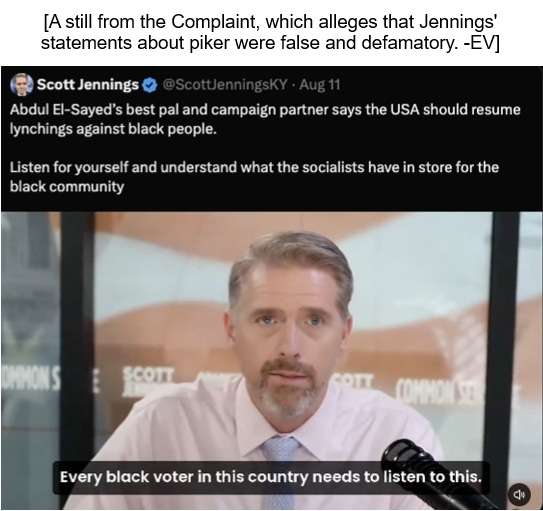
Hasan Piker Sues Scott Jennings

From the complaint in Piker v. Jennings; of course, this is just Piker's side of the story—I expect we'll get Jennings' in a forthcoming motion to dismiss:

On August 11, 2026, Scott Jennings falsely told a nationwide podcast audience that Hasan Piker was "out there calling for Black voters to be lynched." He falsely told his listeners that Mr. Piker had a "plan of returning our country to lynchings." And then he falsely told his social media followers that Mr. Piker "says the USA should resume lynchings against black people."

All of Mr. Jennings' accusations are false. Mr. Piker has never advocated the lynching of Black Americans, or anyone else. He has never called for a return to lynchings. And he has never proposed anything remotely resembling the supposed plan that Mr. Jennings falsely attributed to him.

Mr. Jennings did not merely mischaracterize something Mr. Piker said. He took a false, fabricated, and manipulated video of Mr. Piker, added a made-up quotation that Mr. Piker never uttered, and then made accusations that went beyond even what the manipulated footage purported to show. Mr. Jennings presented those accusations as fact, telling his viewers to "[l]isten for yourself" about Mr. Piker, knowing that he was playing a falsified video of Mr. Piker for those viewers, and completely disregarding the truth of Mr. Piker's actual words.

The underlying footage came from a broadcast nearly two years earlier on Twitch, an online streaming service owned by Amazon. On October 29, 2024, Mr. Piker was reacting to a debate between two Black political commentators, one liberal and one conservative. When the conservative commentator blamed "woke DAs" for policies supposedly harming Black Americans, Mr. Piker mocked him by sarcastically portraying that comment as nostalgia for an era before the civil rights movement. Laughing, Mr. Piker said:

He said, "We need more Klansmen, okay? Can we go back to a better time when lynchings were happening? This is what I like as a Black man. Also, there's no real racism in America." My man said, "woke DAs," dude. What are you saying?

Mr. Piker was plainly ridiculing the commentator's position. He was not endorsing it. The debate video remained visible behind him. Mr. Piker introduced the remarks with "He said," laughed as he delivered them, and concluded by questioning the commentator's argument. His viewers understood the sarcasm. Some laughed along. Others expressly described his comments as hyperbole. Still others predicted that someone would eventually remove the context and circulate the resulting footage as though Mr. Piker had been speaking sincerely.

That is precisely what happened. In August 2026, a 42-second video began circulating on social media that combined fragments of three separate Twitch broadcasts. The portions taken from Mr. Piker's October 2024 stream had been cropped, shortened, and rearranged. The underlying debate was removed from view. So was the contemporaneous audience commentary.

The words "He said," which identified the object of Mr. Piker's ridicule, were omitted. Mr. Piker's laughter and subsequent explanation were also removed. The resulting video portrayed sarcastic criticism of another as though it were an expression of Mr. Piker's own beliefs.

On August 11, 2026, Mr. Jennings broadcast that false video on The Scott Jennings Show, misrepresenting the manipulated video as authentic. But Mr. Jennings did not stop at repeating someone else's misleading edit. He added his own caption to the video, presented as a direct quotation from Mr. Piker:

PIKER: "LET'S GO BACK TO A BETTER TIME WHEN LYNCHINGS WERE HAPPENING" …

Mr. Piker never said those words. The original broadcast does not contain that statement. Neither does the manipulated video that Mr. Jennings chose to air. Mr. Jennings converted a sarcastic question, expressly attributed to and directed toward someone else, into a patently false first-person statement of Mr. Piker's own supposed beliefs, and then relayed that false statement to his viewers.

Mr. Jennings then went even further. After warning Black listeners to pay particular attention, Mr. Jennings accused Mr. Piker of "calling for Black voters to be lynched" and referred to "the Piker plan of returning our country to lynchings." Later that day, Mr. Jennings published the same false accusation on social media, telling his followers that Mr. Piker believed the United States "should resume lynchings against black people."

These were not expressions of disagreement with Mr. Piker's politics. Nor were they rhetorical characterizations of an admittedly controversial commentator. They were factual assertions about what Mr. Piker had said and advocated in his work. Each statement was demonstrably false.

The distinction matters. Mr. Jennings was free to criticize Mr. Piker, to condemn his political positions, or to argue that his commentary was offensive. Mr. Jennings was also free to play Mr. Piker's actual words, and provide his own commentary on what Mr. Piker actually said. Mr. Jennings was not free to do what he did: knowingly attribute to Mr. Piker statements that Mr. Piker never made, and then present those invented statements as evidence that Mr. Piker supports the racially motivated murder of Black Americans….

The post Hasan Piker Sues Scott Jennings appeared first on Reason Magazine.

  •  

Alibaba and the Forty Lobbyists, and the First Amendment

From a long opinion yesterday by Judge Eumi Lee (N.D. Cal.) in Alibaba Group Holding Ltd. v. U.S. Dep't of Defense:

On February 13, 2026, the United States Department of Defense ("Department") publicly designated Alibaba Group Holding Limited as a "Chinese military company" ("CMC"). On June 30, 2026, 10 U.S.C. § 4663 went into effect, barring the Department from contracting with any company who retained the same lobbyist as a CMC. Alibaba asserts that Section 4663 has caused lobbyists to withdraw from representing Alibaba for fear of losing other clients.

The court issued a preliminary injunction, concluding § 4663 likely violates the Free Speech Clause and the Petition Clause:

Alibaba is an e-commerce and cloud-computing company that provides products, technology, infrastructure, and services to consumers and businesses for civilian and commercial use. Alibaba provides U.S. companies and businesses with a platform to sell their products to consumers in China. Additionally, it provides commercial cloud services to companies, including U.S. companies, operating in China and other countries. Alibaba has developed open-source AI models, including Qwen, with a focus on "commercial applications that make it more efficient and secure for businesses to sell goods to consumers in China." Alibaba is publicly listed on both the New York Stock Exchange and Hong Kong Stock Exchange.

"Prior to being designated [a CMC], Alibaba had retained over two dozen lobbyists and multiple lobbying firms to represent its interests before Congress and the Executive Branch" [including] … "… the Executive Office of the President, the Federal Communication Commission [("FCC")], the Federal Trade Commission, the Consumer Products Safety Commission, the Department of the Treasury, and [other entities]" …. "They presented Alibaba's views on legislation, rules, regulations, executive orders, and other government policies of commercial interest to the company. Specifically, they advocated regarding export expansion, small business export promotion, technology policy, access to U.S. capital markets, e-commerce-related issues, consumer-protection laws, and intellectual property." …

The Court finds that First Amendment scrutiny applies because Section 4663 regulates speech. By restricting Alibaba's ability to retain lobbyists, Section 4663 functionally restricts its political speech. "Discussion of public issues" is "pure speech" that is at "the core of the protection afforded by the First Amendment[.]" The First Amendment also protects "[t]he right to petition," that is, "the right of the people to inform their representatives in government of their desires with respect to the passage or enforcement of laws[.]"Lobbying government officials is therefore an activity fully protected by the First Amendment. FTC v. Super. Ct. Trial Laws. Ass'n (1990) ("It is, of course, clear that the association's efforts to … lobby District officials to enact favorable legislation … were activities that were fully protected by the First Amendment.")….

Here, Section 4663 appears to be directed at defense contractors, but its consequences are on Alibaba's speech. "[A] government official cannot do indirectly what she is barred from doing directly" by "coerc[ing] a private party to punish or suppress disfavored speech on her behalf." NRA v. Vullo (2024)…. Section 4663's impact falls on the relationship between Alibaba and the third parties crucial to its speech rights. Thus, the Court finds that Section 4663 burdens Alibaba's speech….

Defendants observe that Alibaba is not completely banned from appearing before the federal government—it could hire more in-house lobbyists or find a firm that is willing to forgo defense contractor clients…. [But] Alibaba is unlikely to find a lobbyist willing to forgo any clients who might want to contract with the Department. {The statute applies to defense contractors who contract with "entities"—in other words, lobbying firms—who also contract with CMCs. Defense contractors would not risk their ability to enter into a contract with the federal government when there are plenty of capable lobbying firms available. The lobbying firm then must choose. One or more of its lobbyists can choose to represent Alibaba, but then the entire lobbying firm must forgo representing defense contractors. The only rational choice for a lobbying firm is to stop representing Alibaba.}

[Alibaba also] represents that it cannot hire the number of experienced in-house lobbyists needed to address the federal government for all its interests…. The reduction to Alibaba's speech is sufficient to demonstrate a colorable First Amendment claim….

The court then concluded that the law was subject to strict scrutiny:

"Content-based regulations are subject to the most exacting scrutiny because 'the government has no power to restrict expression because of its message, its ideas, its subject matter, or its content.'" In examining a statute, courts must also examine "restrictions distinguishing among different speakers, allowing speech by some but not others." "Speech restrictions based on the identity of the speaker are all too often simply a means to control content." Thus, identity-based regulations may "demand strict scrutiny when they reflect the Government's preference for the substance of what the favored speakers have to say (or aversion to what the disfavored speakers have to say)." …

{Section 4663 is not a content-based restriction…. Section 4663 operates based solely on whether a CMC is involved. What the CMC (or non-CMC) plans to say does not affect whether Section 4663 applies.} [But] Section 4663 is a speaker-based restriction on speech—it is only applicable if a CMC seeks to retain a lobbyist. As a speaker-based restriction on political speech, Section 4663 is subject to strict scrutiny.

Defendants assert that Section 4663 should be considered under intermediate scrutiny, because Alibaba's "differential treatment" is justified by its "special characteristic[ ]," namely the potential involvement of a foreign adversary. Defendants again rely on TikTok, where the Supreme Court applied intermediate scrutiny despite finding that the divestiture statute was a speaker-based restriction, because the differential treatment was due to a content-neutral reason, namely TikTok's susceptibility to foreign control.

While Section 4663 also involves a foreign adversary, TikTok is distinguishable because political speech was not at issue. Id. ("emphasiz[ing] the inherent narrowness" of its holding and observing that "[a] law targeting any other speaker would by necessity entail a distinct inquiry and separate considerations"). Here, Defendants provide no authority to suggest that differential treatment with respect to political speech may be considered under intermediate scrutiny. Citizens United v. FEC (2010) states the opposite: "Laws that burden political speech are 'subject to strict scrutiny,'" and "the First Amendment generally prohibits the suppression of political speech based on the speaker's identity." The Court thus applies strict scrutiny in determining whether Section 4663 violates the First Amendment.

{The Court recognizes that this is a close question. But for the context of political speech—specifically the ability and right to petition the government—Defendants' argument that intermediate scrutiny should apply would likely prevail, because Section 4663 is otherwise a content-neutral statute. As in TikTok, Section 4663 singles out a particular group of speakers, but not because of the content of their speech. Instead, the treatment is based on a particular characteristic of the speaker, i.e., their status as a CMC.} …

And the court held that the law failed strict scrutiny, because it was not narrowly tailored to the government interests in "(1) … prevent[ing] CMCs 'from accessing sensitive military information through their relationships with lobbyists,' and (2) … ensur[ing] that CMCs 'cannot subtly influence any of [the Department's] decisions related to national security by influencing a lobbyist'":

[T]he government cannot impose a restriction on speech based solely on "mere conjecture." Rather, it must "point to record evidence or legislative findings demonstrating the need to address a special problem."

Here, Defendants fail to meet their burden. Defendants provide only one exhibit in support of their opposition: the joint explanatory statement submitted as part of the legislative record for the Act. The statement provides an overview of Section 4663 and then "direct[s] the Comptroller General of the United States to submit a report to the congressional defense committees, not later than one year after the enactment of this Act, on the national security risks posed by consulting firms who simultaneously contract with the Department of Defense and the Chinese government or its proxies or affiliates."

Of note, the Comptroller General is directed to study consulting firms, not lobbyists. The statement does not express any findings by the Comptroller General or Congress about the risks posed by lobbyists retained by CMCs. At the preliminary injunction hearing, Defendants were unable to confirm whether a report by the Comptroller General had been submitted to Congress by December 23, 2025, one year after the Act's enactment; nor did Defendants provide a copy of the report. Other than the statement, Defendants do not provide any evidence of the national security risks or other compelling government interests….

[Moreover, d]efendants do not offer any evidence demonstrating that alternative [and less speech-restrictive] means were contemplated, much less rejected for being insufficient…. Meanwhile, Alibaba submits evidence that less alternative restrictions may exist. With respect to CMCs, Nebraska has required lobbyists representing entities on the 1260H List to file an acknowledgment that they are representing a foreign adversary. The Supreme Court "has upheld registration and disclosure requirements on lobbyists" as a "less restrictive alternative to more comprehensive regulations of speech." Defendants present no reason why a disclosure requirement, like Nebraska's, would be inadequate for the federal government.

Instead, Defendants summarily conclude that Alibaba's proposed disclosure requirement would not suffice because "there would still be access and the potential for influence." This speculation is insufficient to support a restriction on the First Amendment….

Carter G. Phillips, Christopher A. Eiswerth, Jennifer J. Clark, and Sheila Anil Gogate Armbrust (Sidley Austin LLP) represent Alibaba.

The post Alibaba and the Forty Lobbyists, and the First Amendment appeared first on Reason Magazine.

  •  

Two Brief Discovery-Related Orders in Trump v. BBC

From Magistrate Judge Enjolique A. Lett (S.D. Fla.):

[1.] Defendant served its Notice of Subpoena Duces Tecum to non-party Mar-a-Lago Club, LLC ("MAL") seeking two discrete categories of documentation: (1) documents sufficient to identify the total number of applications for MAL membership from January 6, 2020, through January 6, 2026, and (2) documents sufficient to identify the total cost of membership and initiation fees for a new MAL applicant from January 6, 2020, through January 6, 2026. Defendant contends it needs this information for discovery purposes to generally contest Plaintiff's allegation of damages of "not less than $10,000,000,000."

The scope of discovery is broad, allowing each party to "obtain discovery regarding any nonprivileged matter that is relevant to any party's claim or defense and proportional to the needs of the case…." Notably here, non-party MAL has neither moved to quash the subpoena nor raised any burdensome objections. In fact, the only issue before the Court is Plaintiff's contention that the subpoena seeks discovery outside the permissible scope of the amended pleadings.

The Court disagrees. The Amended Complaint alleges Defendant's defamatory actions "injured President Trump in his profession, occupation, and trade," "damaged President Trump in his occupation," and "damaged his professional reputation." As Chief Executive of the United States, it is publicly known that President Trump often carries out his presidential duties in MAL. See, e.g. President Donald Trump meets with Ukrainian President Volodymyr Zelensky at Mar-a-Lago.

Moreover, the scope of discovery is broader than the scope of admissibility. See Fed. R. Civ. P. 26(b)(1) ("[i]nformation within this scope of discovery need not be admissible in evidence to be discoverable"). Plaintiff's argument that President Trump is not synonymous with and does not affect the financial success or failure of MAL may be well taken as it relates to the admissibility of the sought-after evidence, but at this stage in the proceedings, given MAL's relationship with the profession and professional persona of President Trump, Defendant's subpoena is a permissible basis of inquiry.

[2.] There can be no dispute that all parties, even some non-parties, must participate in the discovery process. This is especially true of a plaintiff who initiates the lawsuit and seeks affirmative relief.

Unsurprisingly therefore, Plaintiff does not dispute that he must sit for a deposition; the only point of contention is the timing of said deposition. Despite scheduling the deposition for October 16, 2026, President Trump unilaterally cancelled the deposition and did not offer alternative dates within the discovery period notwithstanding the quickly approaching December 18, 2026, discovery deadline. In light of this, the time for the deposition to occur is now….

President Trump shall sit for his deposition on or before December 11, 2026. Failure to do so may result in sanctions, including dismissal of the lawsuit. It is the Court's understanding that another extension of the discovery deadline may be sought. In the event Judge Kuntz grants such a request, the parties may agree to a mutually convenient date to conduct President Trump's deposition within the extended discovery period.

Charles David Tobin, Maxwell S. Mishkin, Maya Devi Gandhi, Richard W. Miller, Sasha (Alexandra) Dudding, and Yanni Chen (Ballard Spahr LLP) represent the BBC.

The post Two Brief Discovery-Related Orders in <i>Trump v. BBC</i> appeared first on Reason Magazine.

  •  

Free Speech Unmuted: Flock Cameras and the Fourth Amendment, with Orin Kerr

Do you have a right to privacy on public roads? Hoover fellow and Stanford legal scholar Orin Kerr joins me in this episode to discuss Flock cameras, the networked license plate readers fueling debate over police surveillance. We discuss how the Fourth Amendment applies to tracking people's movements; whether police should need a warrant to search camera databases; how to balance investigative benefits with the potential for abuse; and what we still don't know about these tools' effectiveness in protecting public safety.

Jane Bambauer, my regular cohost, couldn't join us this episode, but will be back as usual in the next one. And also check out our past episodes:

Also check out our past episodes:

The post Free Speech Unmuted: Flock Cameras and the Fourth Amendment, with Orin Kerr appeared first on Reason Magazine.

  •  

W. Va. Law Restricting Disclosing Home Addresses and Phone Numbers of Judges and Police Struck Down, but …

From today's opinion in Jackson v. Thomson Reuters Am. Corp., by Fourth Circuit Judge Paul Niemeyer, joined by Judges Steven Agee and Pamela Harris; the law covers :

West Virginia's Daniel's Law …, which is designed "to enhance the safety and security" of judicial and law enforcement officials, prohibits the disclosure by any person or entity of the home addresses or unpublished telephone numbers of … {"any active, formerly active, or retired judicial officer, prosecutor, … public defender, … or law-enforcement officer"} if a reasonable person would believe that such a disclosure would create a risk of harassment or harm. The law authorizes protected persons to bring a civil action for damages….

As distinct from the Daniel's Laws in other States, … West Virginia's version does not require that the Covered Person, upon discovering an improper disclosure, notify the person or entity that disseminated the information and request that the person or entity delete the information before liability arises. In addition, for liability to arise under West Virginia's version, the person or entity need not know that they have disclosed a Covered Person's information. The only limiting principle of § 5A-8-24(e) liability is that the information must have been disclosed "under circumstances in which a reasonable person would believe that providing such information would expose another to harassment or risk of harm to life or property." …

For generations now, home addresses and telephone numbers have been disseminated to the public, initially through Whitepages and Yellow Pages and now through "people search" services on the Internet. The public has thus long had the facility to look up the name of a person and obtain that person's address and telephone number. Sharing that information has been the gateway to communication and the exchange of ideas or messages that have long been protected by the First Amendment. In the digital age, such information may now be shared with greater efficiency, but the tradition continues with the understanding that it is protected speech.

In a similar vein, it has long been custom and practice to record for public examination the names and addresses of persons buying, selling, and financing real property. And it has been the tradition to share publicly information about taxes, appraisals, liens, and voting.

To be sure, while the dissemination of such information is protected speech necessary to the exchange of ideas, it can also contribute to abuse and the pursuit of harmful and, indeed, malicious ends, as exemplified by the murder of Daniel Anderl. To address such abuse, governments have enacted laws like Daniel's Law in an effort to restrict the dissemination of home addresses and unpublished telephone numbers of specified public officials who serve in roles important to society. And the parties here agree that those governments have a compelling interest in enhancing the safety and security of such officials. The task, therefore, is to draw an appropriate line between protecting the dissemination of such information while, at the same time, excepting from dissemination the same information when it creates a potential for harm of specified public officials.

Because of the high value that our Constitution and longstanding practices place on the free dissemination of information and the exercise of free speech, we draw the line with the greatest caution, requiring that governments regulate speech about the home addresses and telephone numbers of designated public officials in a manner that is the least restrictive of speech.

In this case, West Virginia was fully justified in attempting to regulate such speech in light of the compelling government interest in enhancing the safety and security of certain public officials, but its efforts reached more broadly then necessary to accomplish the task; it did not employ the least restrictive means of doing so. For that reason and only that reason, we agree with the district court that West Virginia could have regulated more narrowly to accomplish its purpose and thereby be less restrictive of what is otherwise protected speech. Thus, we agree that the provision of West Virginia's Daniel's Law at issue here … violates the First and Fourteenth Amendments.

The court concluded that the law is a speech restriction, not just a restriction on "data":

[Jackson argues] that speech must be communicative such that it "convey a particularized message" with "the likelihood … that the message would be understood by those who" received it. Since Daniel's Law regulates disclosures of "pure facts" that lack a particularized message, he argues, the law is not subject to any First Amendment analysis….

[But] the Supreme Court has clearly held that the scope of "speech" regulated by the First Amendment is broader and includes data, reasoning that facts are "the beginning point for much of the speech that is most essential to advance human knowledge and to conduct human affairs." Sorrell v. IMS Health Inc (2011). Indeed, the Court has noted more specifically that statutes like West Virginia's Daniel's Law, which address only the disclosure of information, involve the regulation of speech protected by the First Amendment, observing, "If the acts of 'disclosing' and 'publishing' information do not constitute speech, it is hard to imagine what does fall within that category …." Bartnicki v. Vopper (2001).

The court then concluded that the law was content-based:

West Virginia's Daniel's Law …, on its face, distinguish[es] between different disclosures based on communicative content alone. It restricts disclosure of certain kinds of information (home addresses and unlisted telephone numbers), and it does so for certain individuals (judicial and law enforcement officers and their families)….

This means, for example, that a disclosure that a grocery store clerk lives at 100 Main Street is permitted, while a disclosure that a police officer lives at 100 Main Street is prohibited. The only difference between the two disclosures is the communicative content, or what the disclosures mean. In the hypothetical, the latter disclosure is prohibited because it identifies 100 Main Street as being the home address of the police officer, while the earlier disclosure is permitted because it identifies 100 Main Street as belonging to the grocery store clerk.

The court held that the law wasn't limited to "commercial speech" (which generally refers to commercial advertising), a category of speech that is entitled to lower protection:

While a speaker's economic motivation for speech may be a relevant factor in determining whether speech is commercial, economic motivation alone is insufficient to justify a categorization of that speech as commercial. Furthermore, because, even under Jackson's argument, only some of the regulated speech would be commercial, that fact does not render the law subject to the intermediate scrutiny of commercial speech. When a statute "applies with equal force to both commercial and noncommercial messages" with "no exception for noncommercial speech," the fact that some of the regulated speech is commercial does not justify an application of intermediate scrutiny….

And the court held that the law, as a content-based speech restriction, had to pass strict scrutiny, which is to say that (among other things) it had to be the "least restrictive means" of serving a "compelling government interest"; and the court held that the law failed such scrutiny:

[T]he parties agree, as do we, that the law's purpose of enhancing the safety of judicial and law enforcement officials is a compelling government interest …. [But] West Virginia's Daniel's Law does not employ the least restrictive means of serving the law's purpose.

Section 5A-8-24(e) imposes liability on a data broker immediately upon its disclosure of addresses and telephone numbers, regardless of whether the data broker had knowledge that the information related to Covered Persons. Whenever an entity such as a data broker collects names and addresses of all persons in a particular town using public land records and then publishes that information in some form of a directory, it undoubtedly violates the law because that directory includes, albeit unknowingly, information about, for instance, a police officer or public defender…. When a restriction on speech creates liability without a knowledge requirement, speakers are understandably incentivized to engage in self-censorship to avoid inadvertently incurring liability. See Counterman v. Colorado (2023) (noting that "prohibitions on speech have the potential to chill, or deter, speech outside their boundaries")….

Jackson argues, however, that the law is much more limited because it imposes liability only if "a reasonable person would believe that providing such information would expose another to harassment or risk of harm to life or property."

That provision, however, is hardly limiting, … because every disclosure of a person's name and address on the Internet exposes that person to harassment or a risk of harm…. [Indeed, in his complaints, Jackson] alleged that the mere disclosure of home addresses and unpublished telephone numbers "exposed [him] and his peers to harassment and/or risk of harm to life or property." And to support that unremarkable proposition, he quoted the FTC's report on "Data Brokers," which highlights the "potential risks to consumers from data brokers' collection and use of consumer data," including the fact that "people search products can be used to facilitate harassment, or even stalking, and may expose domestic violence victims, law enforcement officers, prosecutors, public officials, or other individuals to retaliation or other harm." Indeed, Jackson added that the FTC's report explains why the defendants' disclosures are "so dangerous." Thus, the argued "limitation" in § 5A-8-24(e) is actually not limiting but universal, as it is inevitable that every disclosure of personal information on the Internet poses an additional risk of harassment or harm to the person whose information is disclosed.

Additionally, States other than West Virginia that have enacted Daniel's Laws have uniformly required that, before liability attaches to a disclosure of home addresses and unpublished telephone numbers, Covered Persons give notice of their request that the data broker (or any other disclosing party) remove the information. Only on the failure to comply does liability attach. But West Virginia's Daniel's Law alone does not require notification as a precondition of liability. Thus, this aspect of the law fails to provide the least restrictive means of furthering the law's compelling interest.

While we hasten to note that requiring notice prior to imposing liability is one method for narrowing the law, it is not the only way. But it is the way that Congress and virtually every other State has chosen to narrow their laws and render them less speech-restrictive.

At bottom, we agree with the district court's conclusion:

[D]ue to its lack of a notice requirement, [§ 5A-8-24(e)] of West Virginia's Daniel's Law is far more restrictive then its comparators [in other States] and is definitively not the least restrictive means of achieving its compelling interest. Section [5A-8-24(e)] of West Virginia's Daniel's Law therefore fails strict scrutiny even as other more narrowly tailored federal and state statutes aiming at the same compelling interest pass constitutional muster….

The paragraph endorsing the district court's conclusion strongly suggests that the panel endorsed laws limited to situations where a covered person first demands that covered material be removed. But it's not clear whether the panel would endorse broad versions of such laws, which apply even when the address or phone number is relevant to a matter of public concern (see Kratovil v. City of New Brunswick (N.J. 2025), which upheld such a broad law), or whether it would insist that there be an exception for such public-concern situations (as there is in the federal version of Daniel's Law).

Samir I. Deger-Sen (Latham & Watkins LLP) argued on behalf of the defendants.

The post W. Va. Law Restricting Disclosing Home Addresses and Phone Numbers of Judges and Police Struck Down, but … appeared first on Reason Magazine.

  •  

The Occasional Left-Right Sotomayor-Gorsuch Alliance on Liberty-Related Cert. Opinions

The Supreme Court is asked to review several thousand cases each year. It agrees to review fewer than 1% of them. It takes four votes of the nine to decide to review a case. (The grant of review is generally called a "grant of certiorari" or just a "cert. grant.")

Sometimes Justices write opinions dissenting from a denial of cert., arguing that the Court should have taken the case. And sometimes they write opinions respecting the denial of cert., explaining why it made sense to deny review in this case but noting that the Court ought to consider the question in future cases.

Such opinions are often solo opinions, and are sometimes signed by two or three Justices from the liberal or conservative wings of the Court. But it turns out that Justices Sotomayor and Gorsuch have also jointly filed nine such opinions, eight just for themselves and one for themselves plus Justice Kagan. All of them, it seems to me, at least suggest that the Court ought to move the law in a somewhat more government-restrictive direction (loosely speaking); most of them specifically point to somewhat broader constitutional rights protections. Prompted by two such opinions earlier this month, I thought I'd note the cases and the issues they involved.

  1. O'Donnell v. City of Chicago, Illinois (Oct. 19, 2026): "whether, and under what circumstances, exercises of the State's police power are immune to takings claims," specifically as to uncompensated forfeiture of vehicles for drivers' "fail[ure] to pay" parking tickets.
  2. Herrera-Salazar v. United States (Oct. 13, 2026): whether a defendant's being punished under criminal immigration statutes "for being found in the United States a second time," when a supervised release condition barred him from "leav[ing] the Eastern District of Oklahoma" was proper as a matter of substantive federal criminal law, and whether it violated the Double Jeopardy Clause.
  3. Gonzalez v. United States (2025): "whether and to what extent the Fourth Amendment" forbids warrantless arrests for misdemeanors that took place outside the presence of the arresting officer.
  4. Baker v. City of McKinney (2024): "whether the Takings Clause requires compensation when the government damages private property pursuant to its police power" in a stand-off with a fugitive.
  5. ACLU v. U.S. (2021): whether there is a "right of public access" (even if limited) to opinions of the Foreign Intelligence Surveillance Court.
  6. Longoria v. U.S. (2021): whether and when the government may decline to ask the court for a sentencing reduction under a guideline encouraging defendants to timely notify prosecutors of their intent to plead guilty.
  7. Bovat v. Vermont (2020): whether game wardens' "initial visit and search" of Bovat's property (which involved "linger[ing]" for fifteen minutes and "peering" through a garage window to spot evidence) violated the Fourth Amendment (Justice Kagan also joined the opinion).
  8. Hester v. U.S. (2019): whether "a jury [must] find all the facts needed to justify a restitution order" under the Sixth Amendment.
  9. Stuart v. Alabama (2018): whether the government violated the Sixth Amendment by "deny[ing] Ms. Stuart the chance to confront the witness who supplied a foundational piece of evidence in her conviction" (a blood-alcohol test on which another witness relied).

Thanks to my research assistant, Robert Muñiz, for preparing the list.

The post The Occasional Left-Right Sotomayor-Gorsuch Alliance on Liberty-Related Cert. Opinions appeared first on Reason Magazine.

  •  

Harassment Restraining Order Based Largely on Speech Critical of Zoo Veterinarian,

From E.B. v. J.R., decided Aug. 20 by Massachusetts Appeals Court Justices Sabita Singh, Rachel Hershfang, and Chauncey Wood:

The defendant appeals from harassment prevention orders issued pursuant to G. L. c. 258E (258E orders), by a judge of the District Court, requiring the defendant, among other things, to stay away from a city zoo where she had regularly protested the treatment of animals in its care. The plaintiff, a veterinarian who worked at the zoo, sought and obtained an ex parte 258E order against the defendant, which was later extended following a hearing after notice….

When reviewing whether the evidence was sufficient to support the issuance [or extension] of a 258E order, we consider [consistently with the statutory requirements] whether, "by a preponderance of the evidence, together with all permissible inferences," the judge could have found "that the defendant had committed '[three] or more acts of willful and malicious conduct aimed at a specific person committed with the intent to cause fear, intimidation, abuse or damage to property and that [did] in fact cause fear, intimidation, abuse or damage to property.'" …

Where the harassing acts consist of speech, each act must be the type of speech that is not protected by the First Amendment to the United States Constitution, i.e., generally either "true threats" or "fighting words." True threats include "direct threats of imminent physical harm" and "words or actions that—taking into account the context in which they arise—cause the victim to fear such [imminent physical] harm now or in the future and evince intent on the part of the speaker or actor to cause such fear." Fighting words are limited to personal insults that are inherently likely to incite a violent reaction….

The plaintiff's affidavit described the following four alleged incidents of harassment.

First, in July 2024, while the plaintiff was working at the zoo, the defendant began "yelling and screaming" at the plaintiff that she "should lose [her] job and right to be a veterinarian[,] … that [she] was abusing [her] power[,] and that [she was] abusing and killing the animals."

Second, in September 2024, while the plaintiff was working at the zoo, the defendant began "telling other [zoo] visitors falsehoods about the elephants being beaten." The plaintiff told the visitors that the allegations were not true, but the defendant "immediately yelled at [her] over [her] explanation to the visitors and got within inches of [her] face to continue yelling" at her. About forty-five minutes later, the defendant reapproached the plaintiff and got "in [her] face yelling at [her] about how [she was] a bad veterinarian and [her] cruelty towards animals." The plaintiff alleged that she "felt like [the defendant] was trying to intimidate [her] to quit [her] job." The defendant was "in [her] face videotaping" the plaintiff, so the plaintiff called 911. While the plaintiff was on the phone, the defendant "chased after [the plaintiff]."

Third, also in September 2024, the defendant "formally fil[ed] a written complaint to the [veterinary licensing] Board" that "was all lies and falsehoods."

Fourth, in November 2024, a television news crew was at the zoo reporting on the elephants when the defendant disrupted an interview and began to "yell and scream at [the plaintiff] that [she was] not a licensed veterinarian and that she [did] not have a license to practice in [Massachusetts], and that [she was] abusing and murdering elephants." The defendant also "threaten[ed] [the plaintiff's] career."

Of the four incidents alleged, only the second arguably constituted harassing conduct—getting within inches of the plaintiff's face while yelling and chasing after the plaintiff. The remaining alleged conduct constituted protected speech, not rising to the level of fighting words or true threats…. [T]hreats containing ideas or advocacy causing fear of economic loss or unfavorable publicity are not "true threats" …. As a result, the judge erred in finding that the incidents described by the plaintiff amounted to three requisite acts of harassment pursuant to G. L. c. 258E….

The court also concluded the court violated plaintiff's due process rights:

[At the motion hearing, t]he plaintiff's attorney recited the procedural background and the judge began to review the plaintiff's affidavit. The plaintiff's lawyer then started to relate that the defendant had been charged with violating the ex parte order, when the defendant stated, "I object to that, Your Honor." The judge admonished the defendant, "No, no. First of all, … you're going to understand what the rules are; okay? … The rules are, you're not to interrupt at any time." The judge then explained, "You don't, in a civil case, have the opportunity to say you object…. It doesn't work that way…. That's in a criminal case."

The judge then turned to the plaintiff and asked her about the Federal trial in which the plaintiff had testified the previous year. [This appears to me to be Rowley v. City of New Bedford (D. Mass. 2024). -EV] The plaintiff explained that the defendant had filed a lawsuit against the city for violation of the Endangered Species Act and that the suit was resolved in favor of the city. The plaintiff's counsel offered to provide the judge with a copy of the decision.

When the judge asked whether the defendant had a copy, the defendant replied, "Yes, ma'am, I do. Yes, Your Honor," and added, "I object to it being relevant." The judge responded, "What did I say about objections?" and "I decide whether something is relevant[,] right?" The defendant then stated that she disagreed that the Federal court decision was relevant to the plaintiff's request for a 258E order. The judge replied, "You can disagree all you want, but—and you can voice that, I don't want you [to] think you can't voice it…. But you can't say you object."

The judge then said that she had reviewed the defendant's motion to vacate and asked why she should not extend the 258E order. Just as the defendant began to explain that the plaintiff's claims did not meet the legal standard, the judge cut off the defendant and asked a series of questions, pointedly asking why the plaintiff would accuse the defendant if the allegations were not true. When the defendant attempted to explain the context and her theory that it was in retaliation for the Federal lawsuit, the judge again cut off the defendant, telling her to "[s]top talking," and that she (the judge) did not need to know about the elephants at the zoo or the plaintiff's background as a veterinarian.

The judge then invited the plaintiff's counsel to cross-examine the defendant. The cross-examination centered around the Federal lawsuit (concerning the elephants) and the plaintiff's status and licensure as a veterinarian. The plaintiff's counsel then presented the testimony of the plaintiff, who affirmed the truth of her affidavit. The plaintiff expressed how the "entire situation [was] causing [her] immense stress."

At the conclusion of counsel's direct examination, the judge asked the plaintiff, "[Y]ou are concerned for your safety because of the actions of [the defendant] physically, verbally, and on social media; is that right? … And there have been several instances where she has intimidated you; is that right?" After the plaintiff answered in the affirmative, the judge stated, "I have no doubts that you're a competent veterinarian or [the zoo] wouldn't have hired you," and "don't you for one minute second guess your training. Nobody in this room is a veterinarian and knows anything about what you do, okay? … You got your degree. You worked hard for it. Move on with that." …

[T]he judge appeared to shift the burdens by accepting the plaintiff's affidavit and then challenging the defendant to disprove the allegations contained within it. The defendant had no burden to testify or present evidence. Furthermore, due process required that she be heard on her legal argument that the plaintiff's claims did not meet the elements for a 258E order.

Instead, the defendant was repeatedly shut down when attempting to make her valid legal points, incorrectly told that she had no right to make objections, and subjected to questioning pointedly challenging her veracity while assuming the veracity of the plaintiff. Then, the plaintiff's counsel was invited to cross-examine the defendant. The plaintiff, who had the burden, testified after the defendant and was not cross-examined at all. The record reflects that the defendant did not have a meaningful opportunity to be heard. Collectively, these irregularities raise troubling due process concerns….

For more on such unconstitutional speech-based injunctions in harassment cases, see this article.

The post Harassment Restraining Order Based Largely on Speech Critical of Zoo Veterinarian, appeared first on Reason Magazine.

  •  
❌