❌

Reading view

Supreme Court Clerks Who Become Law Professors (2012-2026)

Yesterday, I wrote about the lateral hiring market. Here, I want to focus on the entry-level hiring market. Since 2012, the number of entry-level hires has dipped to the low 60s and spiked to the mid 140s. Professor Sarah Lawsky has carefully tracked these numbers over the years through a series of detailed hiring spreadsheets: 2012, 2013, 2014, 2015, 2016, 2017, 2018, 2019, 2020, 2021, 2022, 2023, 2024, 2025, and 2026.

Lawsky tracks how many entry-level hires completed Supreme Court clerkships. (This category does not record already hired law professors who are subsequently hired for Supreme Court clerkships.) I thought it might be worthwhile to dig into the numbers a bit more. Moreover, to continue my prior post on laterals, I wanted to track how often former SCOTUS clerks moved to other institutions. You can see the details in this spreadsheet, which tracks hires of SCOTUS clerks between 2012 and 2026. Please let me know if I am missing any names or made any errors.

How many academics has each Justice "fed"? Counting is actually a bit tricky, so I had to make some judgment calls. If a senior associate Justice hired a clerk, who was then assigned to an active member of the Court, I counted the hiring Justice. (Still, I found at least one law school bio that listed the active justice before the senior justice, a faux pas in my mind.) Likewise, for the clerks hired during the final terms of Justice Scalia or Ginsburg's tenure, and who were then reassigned, I counted them as Scalia and Ginsburg clerks. What about the clerks who were hired by Scalia or Ginsburg for a future term after their passing? In that case, I chose the active Justice that made the decision to re-hire them. With all those caveats out of the way, here is the list.

  1. Justice Ginsburg (12 Clerks): Elizabeth Porter, Kate Andrias, Miriam Seifter, Robert Yablon, John Rappaport, Daphna Renan, Pamela Bookman, Hajin Kim, Payvand Ahdout, Rachel Bayefsky, Marco Basile, and Jack Boeglin.
  2. Justice Breyer (8 Clerks): Jennifer Nou, Rebecca Stone, Natalie Ram, Tejas Narechania, Andrew Crespo, Farah Peterson, Brian Richardson, and Thomas Schmidt.
  3. Justice Kennedy (7 Clerks): Chris Walker, Lisa Manheim, James Stern, Richard Re, Justin Walker, Daniel Epps, and Leah Litman.
  4. Justice Thomas (7 Clerks): Marah Stith McLeod, Jennifer Mascott, Robert Leider, Haley Proctor, Steven Lindsay, Brian Lipshutz, and Brittney Lane Kubisch.
  5. Justice Stevens (6 Clerks): Jean Galbraith, David Pozen, Jessica Bulman-Pozen, Sam Erman, Merritt McAlister, and Travis Crum.
  6. Justice Sotomayor (6 Clerks): Aaron Tang, Michael Pollack, Nikolas Bowie, Kevin Arlyck, Bridget Fahey, and Kamaile Turcan.
  7. Justice Souter (5 Clerks): Erin Delaney, David Han, Ann Lipton, Matthew Tokson, Mark Jia.
  8. Chief Justice Roberts (4 Clerks): William Baude, Paul Crane, Matthew A. Shapiro, and Ryan Snyder.
  9. Justice Alito (4 Clerks): Steven Menashi, J. Joel Alicea, Sherif Girgis, and Garrett West.
  10. Justice Scalia (3 Clerks): Aditya Bamzai, Ian Samuel, and Katherine Mims Crocker.
  11. Justice Kagan (3 Clerks): Daniel Hemel, Andrew Crespo, and Benjamin Eidelson.
  12. Justice Gorsuch (2 Clerks): Lael Weinberger and Micah Quigley.

I have several observations.

First, during this time period, I suppose it makes sense that Justices Ginsburg and Breyer, both academics, hired so many law clerks who went onto become academics. But I was struck that Justice Kagan only hired three future academics. Perhaps her focus is not on the curious type that wants to write articles? Then again, as I've noted before, Professor Kagan didn't publish very much. She was a skilled administrator. To paraphrase John Kerry, "I was for originalism before I was against it." Who would have predicted that Justice Sotomayor would have twice as many academic clerks as Justice Kagan? Likewise, Justice Scalia, a former academic, only had three clerks hired into academia--only one of whom is conservative. Then again, I suspect ideological bias blocked many potential Scalia clerks from even considering the academy during this period. Justice Thomas has jumped ahead in the standings, but as I'll explain below, most of those placements are over the past three years.

Second, there are relatively few law professors who clerked on the Supreme Court. The percentage of entry-level hires with Supreme Court clerkships fluctuates. In 2012, there were seven clerks hired out of 140 reported hires: about 5%. In 2018, there were eight clerks hired out of 77 reported hires: nearly 10%. In 2026, there were four clerks hired out of 146 reported hires: about 3%. The hiring market has been fairly variable in recent years. Still, the persistent myth that you have to clerk on the Supreme Court to teach constitutional law should be retired. Very few ConLaw professors have actually clerked on the Supreme Court.

Third, the total number of hired clerks fluctuates each year, though it averages to about 5. I would wager that 100% of the clerks who apply for the entry-level market find a job somewhere. The Supreme Court pumps out about 36 clerks each year. Let's assume that around 13% of those clerks become law professors. Presumably, about 87% of Supreme Court law clerks do not go into academia, and find employment in the public or private sectors. Despite what one may think, the clerks who work to develop the law are not particularly interested in teaching it.

Fourth, the ideological imbalance of these clerks is stark, although it has corrected somewhat in recent years. Between 2012 and 2015, out of 25 entry-level hires, I count only four professors who were right-of-center: Chris Walker (Ohio State), James Stern (William and Mary), Will Baude (Chicago), and Justice Walker (Louisville). Between 2016 and 2019, there were also four right-of-center hires out of twenty total hires: Aditya Bamzai (Virginia), Steven Menashi (George Mason), Jennifer Mascott (George Mason), Robert Leider (George Mason). The rate has increased substantially from 2020 to the present with nine right-of-center hires out of twenty total hires: J. Joel Alicea (Catholic), Sherif Girgis (Notre Dame), Haley Proctor (Notre Dame), Garrett West (Alito), Steven Lindsay (Catholic), Lael Weinberger (George Mason), Brian Lipshutz (Florida), Micah Quigley (Notre Dame), and Brittney Lane Kubisch (Pepperdine).

Fifth, even as the rate of hiring has increased, left-of-center professors are still being recruited by higher-ranked institutions. Starting in 2012, there have been entry level hires of SCOTUS clerks at Harvard (5), Columbia (3), Virginia (3), Chicago (4), and more. Curiously, Yale has had zero progressive SCOTUS clerk hires, but it did hire Garrett West after he finished clerking for Justice Alito. By contrast, the bulk of the conservative hires have been at right-of-center law schools. George Mason, my alma matter, hired four SCOTUS clerks (two of whom are now federal circuit court judges). Notre Dame has hired four conservative SCOTUS clerks. Catholic has hired two.

Sixth, several schools recruited SCOTUS clerks as laterals. Jean Galbraith spent two years at Rutgers-Camden before moving to Penn in 2014. Michigan recruited Chris Walker from Ohio State, Harvard recruited Richard Re from UVA (previously at UCLA), and Harvard recruited Sherif Girgis from Notre Dame. The professor who moved around the most in the shortest span is Katherine Mims Crocker who started at William & Mary in 2019, moved to Texas A&M in 2024, and then to Cornell in 2026.

Eight, this post only considered law professors hired on the entry-level market between 2012 and 2026. I did not consider several professors who started clerkships after their first appointment. Justice Gorsuch has hired several of these academics: Stephanie Barclay (BYU, then Notre Dame, then Georgetown); Mark Storslee (Penn State, then Emory, then UNC); Christian Burset, (Notre Dame then Penn); and Tyler Lindley (BYU). Rev. Patrick Reidy began a clerkship with Justice Kavanaugh after he was appointed at Notre Dame. Professor Kerrel Murray at Columbia later clerked for Justice Jackson.

It might be useful to expand this post further back from 2012 to see earlier trends. Another time.

The post Supreme Court Clerks Who Become Law Professors (2012-2026) appeared first on Reason Magazine.

  •  

Some Reflections On The Lateral Hiring Market (Updated)

Update: After I published this post, Dean Erwin Chemerinsky sent me a gracious note pointing out some people I had missed in my counts. I've updated the post in red so it is clear what changed.

Every year, professors move from lower-ranked institutions to higher-ranked institutions. But for the lateral market to sustain itself, schools have to continue to play the game: recruit laterals, hoping they improve the school's standing before they move onto greener pastures.

One way to measure this market is to analyze the track record of a new school that built its faculty from scratch. Over the past quarter century, the American Bar Association has granted provisional accreditation to about 20 law schools. Only three of those institutions have cracked the top 100 U.S. News rankings. Last year, FIU was at #77 and Drexel was at #82. U.C. Irvine, founded in 2007, is the outlier. The new state school has hovered between #20 and #40 over the past decade. A lot of the credit should go to Founding Dean Erwin Chemerinsky. But even after Chemerinsky departed for Berkeley in 2017, the rankings have stayed fairly consistent.

Starting from a blank slate, Irvine was able to build a faculty from the ground up, using both entry-level hires as well as laterals. I thought it might be worthwhile to analyze lateral hires and departures from Irvine over the past two decades. Here, I owe a debt to Brian Leiter and Dan Filler, who have charted these moves since 2006. Many of the posts on the Faculty Lounge, Concurring Opinions, and Leiter Reports can now be found on the Internet Archive.

I include the raw results below the jump. Here, I will offer some broader observations about the lateral hiring market. I don't think these patterns are limited to Irvine, but that institution is a useful measuring stick because it started so recently. All of my counts here are tentative. Please let me know if there are any errors.

By my count, between 2008 and 2026, at Irvine there were a total of about 50 lateral hires (including two deans).

Between 2008 and 2026, seventeen of these fifty lateral hires later departed. Here, I will note the year they were hired and the year they departed.

  1. Erwin Chemerinsky (Hired in 2008, lateraled to Berkeley in 2017)
  2. Catherine Fisk (Hired in 2008, lateraled to Berkeley in 2017)
  3. Trina Jones to Duke (Hired in 2008, lateraled back to Duke in 2011)
  4. Jennifer Chacon (Hired in 2009, lateraled to UCLA in 2018)
  5. Christopher Tomlins (Hired in 2009, lateraled to Berkeley in 2018)
  6. Olufunmilayo Arewa (Hired in 2009, lateraled to Temple University in 2014)
  7. Rick Hasen (Hired in 2011, lateraled to UCLA in 2022)
  8. Douglas NeJaime (Hired in 2013, lateraled to UCLA in 2015)
  9. Michele B. Goodwin (Hired in 2014, lateraled to Georgetown in 2023)
  10. Gregory Shaffer (Hired in 2014, lateraled to Georgetown in 2023)
  11. Sarah Lawsky (Hired in 2010, lateraled to Northwestern in 2016)
  12. Alexandra Natapoff (Hired in 2017, lateraled to Harvard in 2020)
  13. David S. Law (Hired in 2019, lateraled to Virginia in 2020)
  14. Rachel Moran (Hired in 2019, lateraled to Texas A&M in 2023)
  15. Aziza Ahmed (Hired in 2021, lateraled to Boston University in 2022)
  16. Jamelia Morgan (Hired in 2021, lateraled to Northwestern in 2022)
  17. Courtney Cahill (Hired in 2022, lateraled to USC in 2026).

In most of these moves, the professor transferred to a higher-ranked school. The average duration of a lateral hire who departed was about six years.

I exclude in this count three professors (L. Song Richardson, Mario Barnes, and Rachel Moran) who departed for administrative positions, but then returned to Irvine. I also exclude Katie Porter who left teaching to serve in the House, but then returned to the faculty. Those aren't exactly laterals in the traditional sense of the term.

At least four of the lateral hires seem to have taken emeritus status: Bryant Garth, Kaaryn Gustafson, Robert Solomon, and Grace Tonner. As best as I can tell, twenty-one recruited laterals are still teaching in a full-time status at Irvine: Christopher Leslie, Tony Reese, Mario Barnes, Katherine Porter, Sameer Ashar, Kenneth W. Simons, Victor Fleischer, Ji Li, Austen Parrish (Dean), Veena Dubal, Kevin Haeberle, Ari Waldman, Robert S. Chang, Andrew Gold, Trevor G. Reed, Charles Tyler, Carrie Menkel-Meadow, Ann Southworth, Carrie Hempel, Beatrice Tice, and Chris Whytock.

If my math is right, out of a total of fifty laterals hires, twenty-nine remained and seventeen departed. The departure rate of hired laterals is about 34%. Or, you might say the retention rate is 66%, but that number is harder to rely on because some professors took emeritus status or retired, so were not really on the move.

Moreover, based on my count, there are three professors that Irvine hired on the entry-level market who lateraled out of Irvine: Seth Davis (Berkeley), Jonathan Glater (Berkeley), and Leah Litman (Michigan). If you factor in these departures, the retention rate is even lower.

In an ideal world, the number of lateral hires should far exceed the number of lateral departures. Schools that recruit scholars should be able to retain them. But the world is far from ideal. Professors who lateral to one school will often be recruited elsewhere. Indeed, I think it is a positive that a school recruits and develops scholars who go onto other institutions. More realistically, the number of lateral hires should roughly match the number of lateral departures to keep the faculty at parity: for every lateral that departs another lateral should be hired. At least at Irvine, the number of lateral hires that remained is fairly close to the number of lateral hires that depart. I don't know how Irvine's retention rate compares to other schools. This is something I might compute in the future.

Still, with all of those caveats, to keep a law school's reputation at parity, the rate of lateral departures needs to approximate the rate of lateral hires. If more scholars depart, and cannot be replaced, a school's standing might drop. Indeed, the public might wonder why so many scholars are heading for the door. One might reply that new scholars can be recruited through entry-level hiring. The entry-level market can be unpredictable, and junior scholars can take many years to develop. And again, those entry-level hires who make a name for themselves are likely to be recruited by a higher-ranked institution. It's hard to keep home-grown talent, unless the school either pays up, or the professor has some personal reason to stay.

Another premise is that laterals are expensive. It often takes a lot of money to persuade a professor to move their family from a place they built a strong reputation. Very often professors will sign a retention bonus to promise they will stay at a new law school for a few years. But once those contractual terms lapse, the professor can move up to another school that will pay a greater sum. This happens all the time.

I welcome comments, feedback, and corrections.

***


Lateral Hires Lateral Departures
2008
  1. Erwin Chemerinsky from Duke (to be dean)
  2. Catherine Fisk from Duke
  3. Dan Burk from Minnesota
  4. Grace Tonner from Michigan
  5. Carrie Menkel-Meadow from Georgetown
  6. Ann Southworth from Case Western
  7. Carrie Hempel from USC
  8. Beatrice Trice from Toronto
  9. Trina Jones from Duke
  10. Rachel Moran from Berkeley
2009
  1. Christopher Leslie from Chicago-Kent
  2. R. Anthony Reese from Texas
  3. Jennifer Chacon from UC Davis
  4. Christopher Tomlins from American Bar Foundation
  5. Mario Barnes from University of Miami
2010
  1. Sarah Lawsky from George Washington
1. Rachel Moran to UCLA to become Dean
2011
  1. Katherine Porter (Iowa)
  2. Robert Solomon (Yale)
  3. Olufunmilayo Arewa (Northwestern)
  4. Sameer Ashar (CUNY)
  5. Rick Hasen (Loyola – LA)
  1. Trina Jones to Duke
2012
  1. Bryant Garth (legal profession, civil procedure) from Southwestern Law School to the University of California, Irvine.
  2. Chris Whytock (from University of Utah)
2013
  1. Douglas NeJaime (family law, law & sexuality, legal ethics) from Loyola Law School, Los Angeles to the University of California, Irvine.
  2. Benjamin van Rooij (Chinese law and regulation, comparative law) from the University of Amsterdam to the University of California, Irvine.
2014
  1. Kaaryn Gustafson (law & inequality, poverty law, criminal procedure) from the University of Connecticut to the University of California, Irvine.
  2. Michele B. Goodwin (law & technology, bioethics, constitutional law) from the University of Minnesota, Twin Cities to the University of California, Irvine.
  3. *Gregory Shaffer (international law, international trade) from the University of Minnesota, Twin Cities to the University of California, Irvine.
  1. *L. Song Richardson (criminal law & procedure) from the University of Iowa to the University of California, Irvine.
  2. *Christopher Tomlins (legal history) from University of California, Irvine to the University of California, Berkeley.
2015
  1. *Kenneth Simons (torts, criminal law, law & philosophy) from Boston University to the University of California, Irvine.
  1. *Douglas NeJaime (family law, law & sexuality, constitutional law) from the University of California, Irvine to the University of California, Los Angeles.
2016
  1. *Sarah Lawsky (tax, law & philosophy) from the University of California, Irvine to Northwestern University.
2017
  1. *Alexandra Natapoff (criminal law & procedure) from Loyola Law School, Los Angeles to University of California, Irvine.
  1. *Erwin Chemerinsky (constitutional law, civil procedure) from the University of California, Irvine to the University of California, Berkeley (to become Dean).
  2. *Catherine Fisk (labor & employment law, intellectual property, legal history, civil rights) from the University of California, Irvine to the University of California, Berkeley.
2018
  1. *Victor Fleischer (tax, corporate law) from the University of San Diego to the University of California, Irvine.
  2. *Dalié Jiménez (bankruptcy, consumer law) from the University of Connecticut to the University of California, Irvine.
  3. *Joshua Blank (tax) from a professor of practice position at New York University to the University of California, Irvine.
  1. *Olufunmilayo Arewa (intellectual property, international trade, entrepreneurship, law & technology) from the University of California, Irvine to Temple University.
  2. *Mario Barnes (constitutional law, criminal law, national security law, race & the law) from the University of California, Irvine to the University of Washington (to become Dean).
  3. *Jennifer Chacon (immimgration law, constitutional law, criminal law & procedure) from the University of California, Irvine to the University of California, Los Angeles.
  4. *Seth Davis (administrative law, federal courts, federal Indian law, fiduciary law) from the University of California, Irvine to the University of California, Berkeley.
2019
  1. *Mehrsa Baradaran (banking law, bankruptcy) from the University of Georgia to the University of California, Irvine.
  2. *David S. Law (comparative constitutional law, law & social science) from Washington University, St. Louis to the University of California, Irvine.
  3. *Ji Li (Chinese law and politics) from Rutgers University to the University of California, Irvine.
  4. *Rachel Moran (education law, civil rights, race & the law) from the University of California, Los Angeles to the University of California, Irvine.
  1. *Leah Litman (constitutional law, federal courts) from the University of California, Irvine to the University of Michigan, Ann Arbor (untenured lateral).
2020
  1. *Jonathan Glater (higher education law) from the University of California, Irvine to the University of California, Los Angeles.
  2. *David S. Law (comparative constitutional law, law & social science) from the University of California, Irvine to the University of Virginia (effective fall 2021).
  3. *Alexandra Natapoff (criminal law & procedure) from the University of California, Irvine to Harvard University.
2021
  1. *Aziza Ahmed (health law, constitutional law, gender/race & law) from Northeastern University to the University of California, Irvine.
  2. *Jamelia Morgan (criminal law, Critical Race Theory, disability law) from the University of Connecticut to the University of California, Irvine (untenured lateral).
  1. *David S. Law (comparative constitutional law, law & social science) from the University of California, Irvine to the University of Virginia.
  2. *L. Song Richardson (criminal law & procedure, law & social science) from the University of California, Irvine (where she is Dean) to Colorado College (to become President of the College).
2022
  1. *Mario Barnes (constitutional law, criminal law, national security law, race & the law) from the University of Washington, Seattle (where he is Dean) back to the University of California, Irvine (effective January 2022).
  2. *Courtney Cahill (constitutional law, law & sexuality) from Florida State University to the University of California, Irvine
  3. *Austen Parrish (transnational law, international law) from Indiana University, Bloomington (where he is currently Dean) to the University of California, Irvine (to become Dean).
  1. *Richard Hasen (election law, voting rights) from the University of California, Irvine to the University of California, Los Angeles.
  2. *Jamelia Morgan (criminal law, disability law) from the University of California, Irvine to Northwestern University.
  3. *Aziza Ahmed (health law, constitutional law, law & gender, law & race) from the University of California, Irvine to Boston University.
2023
  1. *Veena Dubal (employment law, Critical Race Theory) from the University of California College of Law, San Francisco to the University of California, Irvine.
  2. *Kevin Haeberle (securities regulation, corporate) from the College of William & Mary to the University of California, Irvine.*
  3. Ari Ezra Waldman (law & technology, privacy) from Northeastern University to the University of California, Irvine.
  1. *Michele Goodwin (health law, constitutional law) from the University of California, Irvine to Georgetown University.
  2. *Rachel Moran (education law, civil rights, race & the law) from the University of California, Irvine to Texas A&M University.
  3. *Gregory Shaffer (international law, international trade) from the University of California, Irvine to Georgetown University.
2024
  1. *Robert Chang (Critical Race Theory; race, ethnicity & law) from Seattle University to the University of California, Irvine.
  2. *Andrew Gold (corporate, torts, private law theory) from Brooklyn Law School to the University of California, Irvine.
  3. *L. Song Richardson (criminal law & procedure; law & social science) from Colorado College (where she is President) back to the University of California, Irvine.
2025
  1. *Trevor Reed (Federal Indian law, intellectual property) from Arizona State University to the University of California, Irvine.
  2. *Charles Tyler (federal courts, constitutional law, civil procedure) from George Washington University to the University of California, Irvine (effective January 2025).
2026
  1. *Courtney Cahill (constitutional law, anti-discrimination law, family law) from the University of California, Irvine to the University of Southern California.
  2. *Alejandro Camacho (environmental law, natural resources law) from the University of California, Irvine to the University of California, Los Angeles (effective January 2026).

The post Some Reflections On The Lateral Hiring Market (Updated) appeared first on Reason Magazine.

  •  

Farewell to Weil

Today the law firm of Weil Gotshal announced that it would wind down. I don't have any connections to the firm, though I did have one vignette to share that I wrote for another project. It concerns Greg Coleman, the first Texas Solicitor General.

In 2001, Coleman returned to Weil Gotshal to head his firm's Supreme Court practice. In 2006, Coleman took on a case that would change the face of constitutional law. He represented a municipal utility district from Northwest Austin, which challenged the constitutionality of Section 5 of the Voting Rights Act, known as the "preclearance requirement." This case had the potential to revolutionize voting rights, and bring our country closer to a colorblind Constitution. Unfortunately, Coleman's firm did not see things that way. As Senator Cruz recalled, "his partners at the firm lost their freaking minds." Coleman, who was dedicated to his client and the Constitution, left that firm and joined what would become Yetter Coleman LLP. In 2009, Coleman would argue two landmark Supreme Court cases that would set the stage for future constitutional restorations.

Farewell to Weil.

The post Farewell to Weil appeared first on Reason Magazine.

  •  

The Bigger Problem With Judge Ada Brown's Woke Tirade: She Said The Quiet Part Out Loud About "White Saviors"

For some time, I've heard rumors about unusual behavior from Judge Ada Brown in the Northern District of Texas. I was hesitant to write about the situation, because my information was incomplete and some of it was revealed in confidence. Now, the accusations are public, in part, because Judge Brown personally disclosed items to the press and others.

At the outset, let me praise the other members of the Northern District of Texas, and in particular, Chief Judge Reed O'Connor. They have picked up all of the cases that Judge Brown has not decided. These are very busy judges, and they have quietly assumed even more responsibilities to ensure the business of the court continues. Judge O'Connor has been routinely maligned by the press but he is a gracious and thoughtful member of his court who never seeks the spotlight. Indeed, it seems that Judge Brown has attacked Judge O'Connor, who has bent over backwards to help her. No good deed goes unpunished.

Moreover, I need to praise the leadership of Chief Judge Jennifer Walker Elrod. She has given Judge Brown every possible benefit of the doubt and made the process as transparent as possible. I need to contrast Chief Judge Elrod's performance with that of Chief Judge Moore in the Federal Circuit. Judge Newman has been subjected to a stealth impeachment through arbitrary one-year suspensions, and only after nearly two years was the case reassigned to another circuit. Judge Brown has been given shorter suspensions after she refused to decide cases. She has had every opportunity to make her case.

Now, onto the substance. There seems to be something seriously wrong with Judge Brown. Her behavior in court that has been reported in the press is extremely troubling. Her refusal to decide cases seems to be an abdication of her responsibility as a federal judge. And her unwillingness to participate in any disciplinary proceedings suggests something is amiss. I will hold off on opining on these issues in more depth, as I suspect more facts will come out.

Here, I want to focus on Judge Brown's behavior in court that gave rise to an ethics complaint earlier this year. Jacqueline Thomsen of Bloomberg Law, who has her finger on the pulse of the Fifth Circuit, offers the stunning details. Here is a summary:

A lawyer's misconduct complaint against US District Judge Ada Brown stemmed from a hearing during which she repeatedly directed racial insults at him, according to documents reviewed by Bloomberg Law.

Attorney Ezra Young, who has represented a Black woman professor suing over a tenure denial, filed a complaint against Brown following the April 2026 hearing in Dallas, he confirmed in an interview with Bloomberg Law. Young's complaint and the judge's formal response were among the documents that Brown circulated in an Oct. 17 email to lawyers, judges, and members of the media.

Throughout the hearing, the judge, a Black woman with Native American ancestry, accused Young of mistreating Black attorneys, took "judicial notice" of her own background in making findings against Young, and repeatedly referred to Young, who is Latino, as being White. Brown called the hearing months after she revoked Young's ability to practice in her courtroom to weigh whether the lawyer should face sanctions.

"I think what's happening here, quite candidly, is you are very intimidated for some reason, Mr. Young, with Black excellence, in light of your White mediocrity. Yeah. Right?," Brown said, according to the transcript. "You should write that down. I mean, you — I'm — you look like a White man, right?"

"I'm not White, Your Honor," Young replied, adding that he's Latino.

"Well, you are White-presenting; is that fair to say?" Brown said, according to the transcript. Young said that he's "fair-skinned," and Brown said that Young had "White privilege" when he argued his client didn't receive key evidence in the case.

"You're the White savior, come to save all the stupid Black lawyers in Texas who need your help, from New York," Brown later said, according to the transcript. . . .

During the April 24, 2026 hearing, Brown accused Young of "racial bullying" toward Black attorneys in the case.

Brown also said that Young was acting like a "Chad," a term Young wasn't familiar with. The judge said it was the male version of a "Karen." "It's someone who calls the manager when they don't get their way. They stomp their foot when the rules are supposed to apply to them, right?" Brown said, according to the transcript. . . .

During the April hearing, Brown took issue with an article headline describing the case when it went before the Supreme Court of Texas. The article quoted a brief filed by Young that referenced another law professor apparently comparing what happened in the tenure denial to a "lynching."

The judge accused Young of making up that quote to "get a headline."

"And so when I read a headline — a sensationalized, very racialized headline that says, 'it's like I've been lynched,' and it's literally got no connection to this case, I have to ask you, Mr. Social Media, Main Character Chad, White Hero, Savior, Loves to Help Black People Be An Ally, where the lynching in this case came from?" Brown said, according to the transcript.

She also apparently gave Young a copy of a 1920 newspaper article that described a lynching. "So we don't find lynching jokes funny down here, sir," Brown said, according to the transcript.

The implication of Young's defense is that a Latino person cannot be racist against African Americans. That claim is wrong on its face, even under the misguided intersectionality pyramid. The bigger problem is that Young, a lifelong liberal, is unaccustomed to being called a racist.

Toward the end of the hearing, Young said that Brown seemed to be "using vicious stereotypes about White people, when I've repeatedly disclosed to this Court I am Latino."

He said that it appeared that Brown "is trying to tar and feather me for anti-Black animus, that has never been raised by anyone but this Court," according to the transcript.

"This Black woman?" Brown replied.

"No, Your Honor. This Court," Young responded.

Young later said he was "concerned that this Court has made light of my actual work as a civil rights lawyer." Brown asked Young what he has done for Black people, as she viewed his actions in the case toward Black attorneys as "abuse."

Young said he has gone "out of my way" to support the work of Black professors and others. When he described his interest in representing the plaintiff in the case, Brown cut him off.

"Can I pause and just tell you, I appreciate, on behalf of Black people, your White saviordom," Brown said.

"Your Honor, again, I'm not White," Young replied.

This is Ezra Young.

I'll let other people decide how "White presenting" Young is. Young has taught a class titled "Critical Race Theory, and Transgender People and the Law" at Cornell Law School. Young's scholarship "explores the rights of trans persons and is situated in the nascent field of critical trans theory." Young served as board secretary of the African American Policy Forum and was a founding board member of the National Trans Bar Association. Young's post doctoral studies focused on trans rights, Critical Race Theory, and intersectionality and were supervised by Kimberlé Crenshaw. Young is Admitted to practice in the Chickasaw Nation. In what universe can Judge Brown possibly claim Young is some sort of "white savior" who is hostile to black litigants?

Some people may be shocked at what Judge Ada Brown said in court, but the truth is that she is parroting standard dogma from Anti-Racists and Critical Racial Theorists. The charges may be completely absurd for someone like Ezra Young, but imagine the black plaintiff was represented by a white lawyer. Would that person be a "White Savior"? Think of the most famous white lawyer in American literature. Could even Atticus Finch from To Kill a Mockingbird be derided as a "White Savior"? Yes.

Welcome to the world of academia.

In 2015, Law Professor Osamudia R. James wrote an essay in the New York Times, titled Now We Can Finally Say Goodbye to the White Savior Myth of Atticus. Here is an excerpt:

Like many Americans, I read Harper Lee's "To Kill a Mockingbird" as a high school student. In a curriculum devoid of explicit discussion about the impact of implicit and structural racism on both blacks and whites, the book stood out from the whitewashed reading list as one that directly engaged with the topic of race. It did so, however, in a matter quite conventional: Atticus Finch was the white savior, a good white liberal whose ethics and values compelled him to defend a black man who had been falsely accused of rape – and all this during a time when many whites would just as soon have lynched the accused without trial. Harper Lee won a Pulitzer Prize for tackling racial inequality, no surprise given how America likes its stories about race: centered on innocent white protagonists benevolently exercising power, with black characters relegated to the margins even in stories about their own oppression.

The anxiety and debate surrounding 'Watchman,' lets us re-examine white liberalism in literature and how it shapes our responses to racial injustice in real life.
Atticus Finch presented an enduring model to which many white liberals still cling. But besides being a fictional character, Atticus Finch is a myth. And a dangerous myth because he keeps good white liberals from reconsidering the fact that they live in white neighborhoods; from challenging administrators about the racial segregation of their children's schools or white supremacy advanced in the curriculum; or from acknowledging how they benefit from a system that keeps people of color laboring in their homes but excluded from their social and professional spaces. Like Finch, it is sufficient that they simply "do their best to love everybody."

Randall Kennedy used similar terms in an ABA Journal interview:

Though Watchman isn't Harper Lee's best work, Kennedy says, it "does reveal more starkly the complexity of Atticus Finch, her most admired character. Go Set a Watchman demands that its readers i and the mesmerizing performance of Gregory Peck in the film adaptation of To Kill a Mockingbird."

I searched the Westlaw Law Review database for "White Savior" /p Atticus and there were many such articles. Here is a sampling:

Add to that the concern that Atticus exemplifies a problematic white savior trope.31 The figure of a local lawyer, embedded in the local culture but nevertheless rising to the occasion of representing an unpopular defendant, is not only problematic but unsupported by the legal history, which was driven by those historic social movements.32 In her thoughtful piece examining this trope, Cynthia Bond notes, "[To Kill a Mockingbird] focuses on the radical individual as hero, essentially invisibilizing social movements that existed both during the 1930s, when the novel takes place, and the 1960s, when it was published." Sarah Gerwig-Moore, To Outgrow A Mockingbird: Confronting Our History-As Well As Our Fictions-About Indigent Defense in the Deep South, 54 Ga. L. Rev. 1297, 1302 (2020).

This "white savior" motif has become common in popular depictions of the civil rights struggles of the 1960s,94 and Atticus may be the prototypical white savior.95 The problem with idealizing the white savior is that it simply reinforces white empowerment, the same sort of white empowerment that resulted in the oppression which is now being resisted. The white savior motif deprives African-Americans of agency. The white savior motif has been recognized by critics who have characterized Atticus as a Christ figure, a man of exemplary virtue who sacrifices himself in order to save others, and there is support in the novel for this view of Atticus. Judy M. Cornett, Atticus Finch: Christian or Civic Hero? A Response to Professor Mcmillian, 77 Tenn. L. Rev. 723, 734 (2010)

Thus, as mere cinema, TKAM has great power for many viewers, including me. I too feel the power of the film's aesthetic and the pull of the idealized father figure, while simultaneously knowing that the film clings to the White Savior Frankian father. I don't teach the film so much despite of my own deep ambivalence about it, but rather because of it.55 But my main motivation in teaching TKAM is that many students respond to it as a film about the importance of social justice lawyering. Even students that do not see themselves pursuing public interest law frequently see Atticus as a model of selflessness and socially conscious legal practice. While I don't endorse the white savior heroism that lurks at the core of TKAM, I do want to encourage students to think about law as a social practice that impactslives. Cynthia D. Bond, To Kill A Lawyer-Hero: Atticus Finch in the Law School Classroom, 45 Rutgers L. Rec. 191, 204 (2018)

After considering this commentary, I began to wonder: What if a person of color had been included among my interviewees in "Does Popular Culture Influence Lawyers, Judges, and Juries?" Might that person have had a different opinion of Atticus and a different "greatest all-time movie" about lawyers?9 Harvard law professor Randall Kennedy describes the book as one about "the nobility of the white savior."10 Fighting words, perhaps, for the fans of To Kill a Mockingbird, but a valuable and different perspective for sure. Ronald M. Sandgrund, Esq., InQ., Can We Talk? Bias, Diversity, and Inclusiveness in the Colorado Legal Community, Colo. Law., February 2016, at 49, 59

The Atticus Finch Lee remade is indisputably an icon of American fiction, though even the Mockingbird character has his flaws. He can be criticized for his too-perfect principles and all-encompassing tolerance.224 With these qualities, he can be criticized for too passively accepting the status quo of segregation.225 Moreover the novel can fairly be taken to task as a "'white savior' story, except that Atticus Finch fails at saving Tom Robinson."226 Yet, many of these very weaknesses are traceable to the transformation Atticus undergoes between Watchman and Mockingbird. By definition, the Atticus who is a leader of the local White Citizens' Council chapter did not possess an all-encompassing tolerance. Mary Ellen Maatman, The Mockingbird's Brief, 47 Cumb. L. Rev. 85, 115 (2017)

To Kill a Mockingbird is an early example of what has come to be known as the white savior genre.96 Atticus Finch provides soothing confirmation that not all whites in the South are afflicted with "Maycomb's usual disease." For that he has been placed on a pedestal by To Kill a Mockingbird admirers who regard his platitudes with almost scriptural reverence.97 His exalted status rests in no small measure on a cultural myopia that undermines productive discussion of racial issues. It perpetuates the demeaning and false notion that blacks were submissive and passive in the face of the relentless cruelties of the Jim Crow South. They were not. Albert M. Pearson, Charles Hamilton Houston: Mockingbird with Talons, 61 How. L.J. 319, 333 (2018)

The film adaptation of real-life attorney Bryan Stevenson's memoir Just Mercy63 brings the issue of race-disparate mass incarceration and wrongful conviction to the screen. In doing so, it invokes uber white-savior lawyer Atticus Finch of To Kill a Mockingbird, the best known (albeit fictional) attorney in Maycomb, Alabama, which Harper Lee based on Monroeville, now home to Stevenson's Equal Justice Initiative.64 As Stevenson stresses in his memoir, Atticus' place in the civil rights hero pantheon is belied by the persistence of race-based discrimination in Monroeville's legal system:
Sentimentality about [author Harper] Lee's story grew even as the harder truths of [To Kill a Mockingbird] took no root. The story of an innocent black man bravely defended by a white lawyer in the 1930s fascinated millions of readers, despite its uncomfortable exploration of false accusations of rape involving a white woman …. Today, dozens of legal organizations hand out awards in the fictional lawyer's name to celebrate the model of advocacy described in Lee's novel. What is often overlooked is that the black man falsely accused in the story was not successfully defended by Atticus ….65 Cynthia D. Bond, Representations of Law and Race Revisited: An Updated Survey of Recent American Film, 30 U. Den. Sports & Ent. L.J. 51, 67 (2025).

Many lawyers and judges harbor the "anti-racist" views that Judge Brown spewed, but have the mental faculties to keep it private.

If Judge Brown leaves, or is removed from the bench, she would be right at home in virtually any faculty lounge. She could get another kind of lifetime tenure with ease!

The post The Bigger Problem With Judge Ada Brown's Woke Tirade: She Said The Quiet Part Out Loud About "White Saviors" appeared first on Reason Magazine.

  •  

1,000,000 Miles on United

A few moments ago, I crossed the 1,000,000 mile threshold on United Airlines. There was nothing particularly special about this flight. (I'm en route from Denver to Birmingham for a talk tomorrow at the University of Alabama.) The flight attendant gave me a brief congratulation (shortly after I initially published the post.) It was just like any other flight. If my math is right, a million miles is roughly two round trips from the Earth to the moon.

I started accruing United miles around 2012 when I moved to Houston. United and Continental had just finished the merger. For the first eight years or so, I sought to earn as many miles, as that was the key to status. Longtime readers will recall that I took mileage runs to Singapore, Hong Kong, and Sydney to make status at the end of the year. All of these tickets were purchased at low rates. The goal was to fly as far as possible while spending the least amount of money. By 2016, I had already accrued nearly 300,000 lifetime miles. But shortly before the pandemic, United switched the format. Now, to make status, you had to spend money, not fly miles. It made more sense to take a very expensive trip to San Francisco than to take a very cheap trip to Singapore. As a result, my pace of collecting miles dropped precipitously. I barely flew in 2020 through 2022. I ramped up in 2023. In 2024, I reached about 750,000 miles. And it took another two years to complete the goal.

Hitting the one million mile mark provides me with lifetime gold status. That status, alas, is basically meaningless. There are very few benefits with gold status that are not provided by the United Club credit card. In the past, United would let you gift your status to a companion--for me that is 1K--but United will only allow you to gift gold status.

Going forward, United had substantially increased the cost of making status. For 2026, I could earn 1K status with 60 segments and about 22,000 PQP. For 2027, segments no longer matter and I will need to hit 32,000 PQP. Unless something significant changes in my spending, I won't be able to meet that threshold. I could become a free agent, and take flights on whichever airline provides the best deal, but living in Houston severely limits my options. So I will likely stay tied to United, albeit without 1K status.

At this point, even 1K status is less desirable than it once was. I rarely receive complimentary upgrades. And even when I use plus points, the upgrades are still rare on busy routes. I can't remember the last time I was upgraded on a flight to DCA or EWR. (I was upgraded on the flight to Birmingham.) United, and the other airlines, would much rather sell an upgrade than provide it to a loyal flyer. The value proposition just isn't what it used to be.

On the plus side, United now has Starlink on most of the flights, which makes the skies far more productive.

The post 1,000,000 Miles on United appeared first on Reason Magazine.

  •  

Woodward: Justice Breyer Was "'Forced Out' To Make Way For Someone Younger" and Justice Kagan Was Not Happy

The New York Times published more excerpts from Bob Woodward's new book. It seems that Woodward has material from Justices Breyer and Kagan:

Mr. Woodward also writes about encounters with more recent justices. He reports that his wife, Elsa Walsh, a former journalist for The Post and The New Yorker, sat next to former Justice Stephen G. Breyer at a dinner and he told her that he was "forced out" to make way for someone younger on the court.

He also recalls running into Justice Elena Kagan at a Washington party in 2023. Justice Kagan expressed admiration for "The Brethren" and Mr. Woodward noted that the main point was how the ideological center of the court in that era dominated. "Yes, I prefer it that way," Justice Kagan said. "That's exactly what it should be."

When he asked her if she was happy on the court, Justice Kagan said no, she was not, given the situation.

I don't think Justice Breyer gets to complain to a reporter's wife about being pushed out. It was his choice. No one forced him to step aside for Justice Jackson. But he folded. By contrast, Justices Thomas and Alito resisted all of the pressure.

As for Justice Kagan, does she really want the Court to be governed by the "ideological center"? Would the center of the Court have been Merrick Garland? I don't doubt that she is unhappy.

The post Woodward: Justice Breyer Was "'Forced Out' To Make Way For Someone Younger" and Justice Kagan Was Not Happy appeared first on Reason Magazine.

  •  

The Wall Street Journal Praises The Old Gray Lady

I am pleased that my interview with the New York Times continues to resonate. James Freeman features the piece in the Wall Street Journal's "Best of the Web" column. It begins:

This column sometimes notes the shortcomings of the New York Times so it seems only fair to credit the Gray Lady when she gets it right. With refreshing humility and openness to constructive criticism, a Times editor considers the manner in which the newspaper addresses a speaker's point of view.

And it ends:

Kudos to Patrick Healy. Let's hope that people across the media industry will take Josh Blackman's criticism to heart.

Let's hope so!

After reading about Bob Woodward's new book this morning, I've reflected about the relationship between journalists and sources. I take very seriously my connections to reporters, though I never pretend they are friends who owe me anything. The bond is transactional, sometimes counterproductive, but often fruitful. Some of these relationships have developed over the course of nearly two decades.

Most reporters do not finish their career where they started. More often than not, they start at smaller outlets, and if they're successful, move up the ranks. I always take care to respond to journalists at smaller outlets, in part, knowing that that is a relationship I can foster over time. Indeed, one reporter who started out at the Houston Chronicle moved onto the Wall Street Journal. Other reporters who started out in print moved into TV. And os on.

You never know when a relationship with a reporter will come in handy. Over the years, I've had pieces of information that I could provide to just the right person at just the right time, only because of the relationship I've built.  Anecdotally, I've noticed that the reporters who are best at fairly reaching out to both sides are the ones most likely to move up in the world. I hope the reporters at the Times can now set the tone for media balance, and it trickles down.

The post The Wall Street Journal Praises The Old Gray Lady appeared first on Reason Magazine.

  •  

Bob Woodward Reveals He Spoke With Justices Stewart, Powell, White, Blackmun, and Rehnquist for "The Brethren"

Bob Woodward is publishing a new book, titled "Secrets," that reveals many of the reporter's sources. The Washington Post has published an in-depth profile.

Of special interest are the sources Woodward relied on with Scott Armstrong for The Brethren (1979).

In the memoir, Woodward clears up another decades-long mystery: Which Supreme Court justices talked to him for the 1979 bestseller "The Brethren"? The exposé of the inner workings of the nation's highest court under Chief Justice Warren Burger electrified Washington.

When the book was published, Woodward and his co-author, Scott Armstrong, disclosed that they had interviewed five of the nine justices on the court, as well as 170 former law clerks, but on the condition that they not be named. Given the court's reputation for maintaining a Sphinxlike silence, "The Brethren" ignited a guessing game in Washington and in legal circles around the country, as well as criticism over the book's heavy reliance on anonymous sources.

"Our use of unnamed sources was a huge point of controversy for the book, but in my 55 years of reporting experience, people rarely shared secrets on the record, particularly at the time something is going on," Woodward writes in his memoir.

Nearly a half-century later, Woodward finally names the five justices who granted interviews: Potter Stewart, Lewis Powell, Byron White, Harry Blackmun and William Rehnquist (all are now deceased). Woodward's memoir explains how he and Armstrong painstakingly cultivated the justices and their former clerks as sources. The authors kept long memos about the interviews, which Woodward draws on to quote the justices at length in his new book.

It is curious that Woodward's sources were all the conservatives on the Court. (During the late 1970s, even after Roe v. Wade, Blackmun was still considered a conservative.) Woodward apparently did not talk with Justices Brennan, Marshall, or Stevens. Indeed, throughout the entire WaPo piece, nearly every one of Woodward's sources were conservatives. (I'll go through more of them below). I wonder what Chief Justice Burger would think if he knew that the other three Nixon appointees were the sources of the leaks.

Yet, even if Brennan did not talk directly to Woodward, one of Brennan's clerks leaked the critical document about the Watergate Tape Case. Steven Goldberg clerked for Brennan during the 1974-75 Term. Goldberg's co-clerk was Judge Marsha Berzon.

Woodward also tells the story of how got his hands on an internal Supreme Court document that was a cornerstone of "The Brethren": a confidential 75-page case history chronicling the justices' tense deliberations in U.S. v. Nixon. In an 8-0 decision, the court ruled in the 1974 landmark case that Nixon had to turn over his secret tape recordings in response to a federal subpoena and that, most importantly, the president is not above the law.

In "Secrets," Woodward writes that he learned about the existence of the case history from Steven P. Goldberg, a former Supreme Court law clerk who died in 2010. But Goldberg was adamant: He couldn't possibly give Woodward a copy.

Woodward wheedled and coaxed and pleaded. Despite Goldberg's repeated protestations, Woodward talked the clerk into letting him pay a visit to his home late that night.

Goldberg still refused to cough up the document, however, so Woodward suggested a compromise: How about you read it aloud while I take notes?

"My plan was to wear him out until I either had enough of it down or he eventually gave it to me," Woodward recalls.

With a sigh, Goldberg started reading from a comfortable living room chair. Woodward smiled and took notes — but he did so very, very slowly and kept asking Goldberg to pause.

After a while, Goldberg fell deeply asleep. Woodward contemplated grabbing the case history from his lap and bolting out the front door, but "that seemed a little too far, even for me," he recalls.

Instead, he walked over to Goldberg, gave him a slight nudge and informed him that he would take the document and bring it back first thing in the morning.

Goldberg stirred with a look of "absolute exhaustion" on his face, according to the memoir. But the former clerk mumbled okay — and that was good enough for Woodward.

"Not wanting to disturb him more, I gently took it. I did not want to run out the door but I moved swiftly," he writes. "If I was on a security camera, I wanted to be behaving properly, with whatever might be left of my dignity."

Woodward scampered home to read the whole thing. The case history proved invaluable, a "raw and unforgiving" and "Holy Grail" account of the court's inner workings.

Before returning it to Goldberg the next day, he stopped at The Post's newsroom to make a photocopy.

One wonders if Justice Brennan tacitly or expressly authorized this leak, so long as the document was not provided. While the Chief Justice would often warn that leakers would have their careers ruined, Goldberg did not suffer at all. He would become a law professor at Georgetown, advocating for a strict separation of church and state. Goldberg died in 2010.

I doubt Josh Gerstein had to take notes while someone read him the Dobbs opinion aloud.

There's more. Boyden Gray, a prominent conservative lawyer, was a regular source for Woodward:

One such leaker was C. Boyden Gray, who served as White House counsel to George H.W. Bush during Bush's presidency and vice presidency. Woodward describes Gray, who died in 2023, as "one of my lifelong secret sources." He also lived just a block and a half away from Woodward in Georgetown, which made passing sensitive documents much easier.

One Friday in February 1987, as the Iran-contra scandal was unfolding, Gray walked over to Woodward's house bearing a gift: a three-page memo labeled "top secret" regarding an Israeli official involved in the sale of U.S. arms to Iran. According to Woodward, the document contradicted the Reagan administration's public assertions about the scope of its contacts with Iran, and even he wondered at first why Gray had given it to him. He said Gray later explained that "he knew the memo would get out" eventually and "he wanted to get ahead of it."

Woodward also reveals that President Nixon's lawyers leaked information about their client.

As Nixon's defense counsel, Buzhardt listened to hundreds of hours of conversations that the president had secretly taped in the White House but resisted turning over to prosecutors until he was finally ordered to do so by the Supreme Court. In public, Buzhardt vigorously defended Nixon and was seen as "the operational man in charge of the Watergate cover-up," according to Woodward. In private, however, his assessment of Nixon was caustic.

"He flat out lies," Buzhardt told Woodward during one of 17 interviews that took place in 1974 and 1975. "He still to this day thinks that he was not involved in the cover-up."
During the height of Watergate, Garment regularly met Woodward for interviews at a Chinese restaurant in downtown Washington and once brought along a briefcase filled with what the lawyer called "the really incriminating tapes." In the memoir Woodward doesn't say whether he was able to listen to them, but he writes that Garment called the recordings "infantile" and "sick." Through them, he added, Nixon was "letting America into the toilet of his mind."

Of all the leaks, these bother me especially. Lawyers have a duty of confidentiality. If they no longer could ethically represent a client, their recourse was to withdraw. It is unconscionable for lawyers to defend their client in court while undermining their client in the press. You wonder why Trump relies on lawyers he can trust. Because those he cannot trust are likely to attack him in the media. Not much has changed.

I've pre-ordered the book, which will be released in November. I am curious about details concerning his SCOTUS chats.

The post Bob Woodward Reveals He Spoke With Justices Stewart, Powell, White, Blackmun, and Rehnquist for "The Brethren" appeared first on Reason Magazine.

  •  

Why Would Trump Make A Deal With A Judge Who Ruled Illegal Aliens Have A Right To "Locomotion" In The United States?

Today the en banc Fifth Circuit ruled that illegal aliens do not have a constitutional right to a bond hearing pending deportation. The vote was ostensibly 10-7, although the vote is better characterized as to 9-8. Judge Richman only concurred in judgment. As I've said many times before, the en banc Fifth Circuit is effectively split on a razors-edge.

Guess which judge wrote the lead dissent finding that illegal aliens have the right to roam freely "to whatsoever place" their "own inclination may direct; without imprisonment or restraint"? I'll give you a hint: it's the same judge that President Trump made a deal with to pick his own replacement.

Let's start with Judge Ho's concurrence:

A nation ceases to be a nation if it can't protect its borders. Congress has chosen to police our borders by detaining illegal aliens found in our country pending their removal proceedings. See 8 U.S.C. § 1225(b)(2)(A).

According to our dissenting colleagues, however, illegal aliens have not only a de facto constitutional right to remain in our country unlawfully, but an incentive to make this their home. That's because, to quote the principal dissent, once an alien has "acquired a domicil or residence" in America, it no longer matters that they are breaking the law to be here—their detention becomes an offense to "'liberty' . . . at its core," and an affront to freedom "at its most basic," namely, "freedom from physical restraint." Post, at 101, 102, 115 (Southwick, J., dissenting). So they must have "the power of locomotion" and the right to roam freely "to whatsoever place one's own inclination may direct." Id. at 102, 103 (quoting 1 William Blackstone, Commentaries on the Laws of England 130 (1769)).

Judge Southwick's dissent was joined by Judges Stewart, Graves, Higginson, Douglas, and Ramirez--all of the Democrat-appointed judges on the court. Judge Richman concurred in the judgment. Judge Haynes did not join the dissent. She did a bit more than her usual practice on the en banc court of saying nothing--a topic for a future post--and actually wrote a full paragraph.

Why would the Trump Administration actually trust Judge Southwick to pick a replacement who would even be marginally conservative?

Does Todd Butler agree with Judge Southwick that denying a bond hearing to illegal aliens is an affront to freedom "at its most basic"? Does Butler agree with Judge Southwick that illegal aliens have the right to roam freely "to whatsoever place" their "own inclination may direct; without imprisonment or restraint"? Would Butler compare, as Judge Oldham noted, "modern-day immigration detention to the Tower of London, where English monarchs would 'secretly hurry[a man] to gaol, where his sufferings are unknown and forgotten,' and where clandestine detention was worse than 'open despotism.'"

Would Butler possibly agree with this passage from Judge Ho:

Americans like to boast that we live in a country where no one is above the law, not even the President. But if that is so, then there's no denying that these habeas petitions, far from affirming American liberty, are profoundly un-American—because they send the message that the only people who are above the law in our country are the ones who violated our laws to get in.

Consider a world where Judge Butler was on the court. Imagine that Senior Judge Southwick was on the original three-judge panel (he was in fact on the three-judge panel). Remember, Judge Richman only concurred in judgment, as she disagreed with the majority's habeas ruling. With this divide, the whole court would have split 9-9 on the constitutional question. And that is the cost of allowing Judge Southwick to stay on the court and giving Judge Butler another vote. As I noted before, "I would prefer Judge Southwick to have one vote rather than two votes."

For people who actually care about the en banc Fifth Circuit, and not just maximizing the number of total Trump circuit court appointments, the Butler nomination is an unforced error. Let Judge Southwick keep extolling the constitutional rights of illegal aliens from his chambers in Austin. He's choosing Texas, I can tell. At some point, adverse possession kicks in, right?

And for those keeping track at home, Mississippi has three circuit judges for about three million people and Texas has nine circuit judges for more than thirty million people. The math just doesn't math. Hillary Clinton said the Supreme Court should be expanded to thirteen so that there could be one Supreme Court Justice for each circuit. (Because of course the Federal Circuit needs its own circuit justice.) If that's the case, then make Texas its own circuit to justify yet another Supreme Court justice. That math does math!

The post Why Would Trump Make A Deal With A Judge Who Ruled Illegal Aliens Have A Right To "Locomotion" In The United States? appeared first on Reason Magazine.

  •  

NY Health Commissioner Says "Mother Nature" Is Punishing Amish Children With Measles Outbreak

Way back in May 2024, I wrote about Miller v. McDonald. Amish parents challenged New York's vaccine mandate on Free Exercise Clause grounds. In December 2025, the Supreme Court GVR'd the case in light of Mahmoud. Unsurprisingly, the New York courts thought Mahmoud changed nothing. The case is now back before the Supreme Court. A cert petition was filed on September 28.

The New York Times covered the case in an article titled, "Amish Families Pushed to Undo a Vaccine Law. Then Measles Arrived." The undercurrent of the article is that Amish children deserve to become sick because their parents did not vaccinate them. The New York Health commissioner made this point expressly:

In a petition filed on Sept. 28, the Amish asked the U.S. Supreme Court to force New York to grant religious exemptions to immunization rules, as most states do. A previous ruling gave the Amish reason to think they might have a chance at prevailing.

But then a wave of measles cases began sweeping through Amish communities. Gov. Kathy Hochul declared a statewide health emergency this month after more than 100 people fell ill with measles.

"Perhaps Mother Nature, by delivering a measles outbreak in New York's Amish community coincident with this case returning to the Supreme Court, is her not-so-subtle hint," said Dr. Howard Zucker, who was state health commissioner when New York eliminated religious exemptions.

If only the Amish people chose the state over their religion, and took the hint, they wouldn't have so many sick children! I am appalled by Zucker's arrogance and hostility to religion. He is stating that "Mother Nature" is sending a signal to the Amish that adhering to their religion is making children sick. In effect, nature is punishing the Amish for not submitting to Kathy Hochul.

Chief Justice Burger described this unique community in the Supreme Court's unanimous Wisconsin v. Yoder decision:

The history of the Amish sect was given in some detail, beginning with the Swiss Anabaptists of the 16th century, who rejected institutionalized churches and sought to return to the early, simple, Christian life deemphasizing material success, rejecting the competitive spirit, and seeking to insulate themselves from the modern world. As a result of their common heritage, Old Order Amish communities today are characterized by a fundamental belief that salvation requires life in a church community separate and apart from the world and worldly influence. This concept of life aloof from the world and its values is central to their faith.

A related feature of Old Order Amish communities is their devotion to a life in harmony with nature and the soil, as exemplified by the simple life of the early Christian era that continued in America during much of our early national life. Amish beliefs require members of the community to make their living by farming or closely related activities. Broadly speaking, the Old Order Amish religion pervades and determines the entire mode of life of its adherents. Their conduct is regulated in great detail by the Ordnung, or rules, of the church community.

It is especially awful for Zucker to weaponize "Mother Nature" (capital letters) against a people whose life is devoted to "harmony with nature."

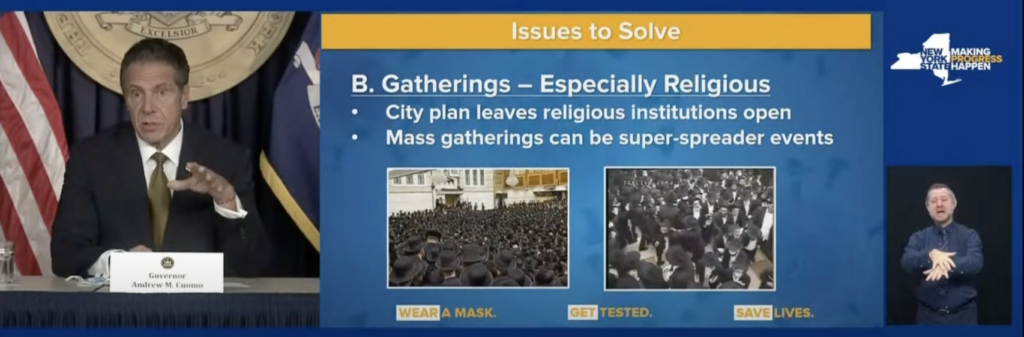
This is not the first time New York has accused insular religious communities of spreading diseases. In October 2020, then-Governor Andrew Cuomo shared a photograph of religious Jews congregating in close quarters as evidence they were spreading the disease. He said, "I'm going to say to the orthodox community tomorrow if you don't agree then we will have to close down your religious institutions." The only problem was that the photograph was from the 2006 funeral of Hassidic rabbi Moshe Teitelbaum. And the photo wasn't even from New York City. It was taken in the Orange County village of Kiryas Joel. This charge really isn't new. Jews were blamed for the spreading of the Bubonic Plague, among other pandemics.


The Times gestures at the religious reasons why the Amish oppose the vaccines:

But many Amish families regard vaccine mandates — and government intrusion in their schools — as a greater threat to the health of their community than measles. Their religion calls for adherents to live together in tightknit religious communities apart from the modern world and its influences.

"Our almighty God wants us to fully put our faith and trust in him, which is in conflict to put our trust in vaccines," Ezra Wengerd, an Amish leader who represents the 26 families that send their children to the three schools, told a judge in 2022.

The Amish have been practicing their faith for more than three centuries and have principled reasons to oppose vaccines. Indeed, the Amish have a far stronger case to object to vaccines than many people who made up their beliefs during the pandemic. Shame on the New York government for singling out this tradition in such hostile terms.

Zucker and others do not seem to know or care what it means to place faith in a higher power. Instead, Zucker thinks Mother Nature is seeking retribution against the Amish children.

Yet, perhaps we should be grateful. This sort of statement should feature prominently in future briefing. Indeed, Zucker demonstrates the sort of hostility we've seen in past victories for religious liberty. In the leadup to Fulton v. City of Philadelphia, a government official said that "things have changed since 100 yearsago," and "it would be great if we followed the teachings of Pope Francis, the voice of the Catholic Church." And in Masterpiece Cakeshop, a commissioner said "Freedom of religion and religion has been used to justify all kinds of discrimination throughout history, whether it be slavery, whether it be the holocaust." These statements are prima facie evidence of religious hostility.

So thank you Mr. Zucker. You've made the odds of your state losing far greater.

People sometimes ask me whether I would ever want to live in New York again. The answer is 1000% no. This state consistently exhibits so much hostility towards people of faith. Here in Texas, some people object to posting the Ten Commandments on the wall of classrooms as some evidence of hatred. But no piece of paper can compare to the overt disdain towards traditional religions that people like Zucker and Cuomo demonstrate. So long as religious people get vaccinated and attend services on Zoom, they are in good standing with the government. But as soon as any person of faith deigns to disagree with elite opinions, then Gaia will seek vengeance.

These people are living in an episode of Captain Planet. (I cringe that as a child I absorbed this Turnerfied propaganda.)

The post NY Health Commissioner Says "Mother Nature" Is Punishing Amish Children With Measles Outbreak appeared first on Reason Magazine.

  •  

What Happens to Representative Ilhan Omar's Congressional Seat if the United States Files Suit to Denaturalize Her?

[This post was co-authored with Professor Seth Barrett Tillman.]

There have been many news reports suggesting that the United States Department of Justice may pursue denaturalization proceedings against Representative Ilhan Omar. These proceedings can take the form of a civil suit under 8 U.S.C. § 1451. The United States may also bring a criminal indictment under 18 U.S.C. § 1425. While the criminal statute has a ten-year statute of limitations, the civil statute does not have any statute of limitation. Moreover, the civil statute requires a lower burden of proof: "clear, convincing, and unequivocal evidence which does not leave the issue in doubt." The civil proceeding also does not afford the defendant a jury trial. USCIS and Congress.gov have published detailed analyses of how denaturalization operates.

Here, we do not opine on the merits of a potential civil or criminal denaturalization proceeding against Omar, or what sorts of procedures and defenses she would have access to. Instead, we intend to explain what would happen to her congressional seat in light of denaturalization proceedings.

We start with the relevant constitutional text. Article I, Section 5, Clause 1 provides that "Each House shall be the Judge of the Elections, Returns and Qualifications of its own Members . . . ." (emphasis added) And Article I, Section 2, Clause 2 provides that "No Person shall be a Representative who shall not have attained to the Age of twenty five Years, and been seven Years a Citizen of the United States, and who shall not, when elected, be an Inhabitant of that State in which he shall be chosen."

Since the beginning of the Republic, there have been challenges as to whether a member-elect has the requisite years of citizenship. Professor Derek Muller's entry in The Heritage Guide to the Constitution (3d) on the Judge of Elections Clause explains two historically noteworthy challenges to qualifications:

In the decades after the Founding, both houses of Congress routinely judged the elections, returns, and qualifications of their members. One early and contested instance arose in 1793. The Pennsylvania legislature elected Albert Gallatin to the [United States] Senate. Gallatin, a member of the [Jeffersonian] Democratic-Republican party, was a rival of Alexander Hamilton, a prominent Federalist. Doubts arose about Gallatin's eligibility for the Senate. He was born in Switzerland and had resided in the United States for thirteen years. But it was unclear whether Gallatin had been a U.S. citizen for the requisite nine years. Two Senate committees dominated by Federalists found against Gallatin, and he was barred from the seat. . . .

A[] notorious contest during Reconstruction came from the election of Hiram Revels [in 1870], the first black Senator. Opponents first charged that his election was improper because the governor of Mississippi who signed his certificate of election was only the provisional governor and therefore not authorized to certify the legislature's selection of Revels. Challengers also claimed that Revels was not "nine years a citizen" because he was not a citizen under the Supreme Court's decision in Dred Scott until the ratification of the Fourteenth Amendment in 1868 [and so Revels was only a citizen between 1868 and 1870]. Defenders noted that Revels had previously resided in Ohio, where he had voted in that state and must have been a citizen. In the end, the Senate seated him over the objection of a few Democrats.

For the sake of argument, let us assume that the United States initiates civil denaturalization proceedings before the new Congress meets in January 2027. This procedure would certainly take some time, and it may not even reach a final judgment (up to the resolution of certiorari) during the duration of Omar's (likely) elected two-year term. Still, absent a final judgment, we sketch out several possible issues.

First, could the House of Representatives determine that Omar lacks the qualifications to be a member of Congress (i.e., a citizen for seven years) in the absence of some judicial finding by a federal district court? The answer is "yes." The House of Representatives is a coordinate branch of government that can make its own determinations of fact when seating a member. The Constitution empowers the House to determine if a member-elect is a citizen and for how long he has been a citizen. There is no need to wait for a federal court to rule on the matter. No such prior judicial proceedings occurred in the case of Albert Gallatin. That question and its answer, we think, should not be controversial.

Second, could the House of Representatives judge Omar's qualifications in the middle of her elected term? Or, can those qualifications only be judged at the time when she is seated? We think it is reasonable to suggest, based on the text, that qualifications should only be determined at the outset of the new Congress, or when a member is first admitted and allowed to take her oath, but we admit there is no definitive answer here. The alternative view is that a member must have the requisite qualifications over the entire course of her elected term, and her house always retains the ability to adjudicate those qualifications if an objection is raised by another member. In these circumstances, a member could simply raise an objection to Omar's qualifications and seek a roll call vote. If determinations about qualifications continuously require a mere majority, as they do at the start of a two-year congressional term, then a mere majority might effectively "expel" Omar. On the other hand, it might be argued that where a mid-session disqualification vote has the effect of expulsion, then a two-thirds vote is required. We are not aware of any congressional precedents that provide clear analogues or guidance on this point. 

Third, what happens at noon on January 3 when the new Congress meets? At that juncture, a member could raise an objection to Omar's qualifications. And under established House precedents, Omar would be asked to "step aside" until her qualifications are settled. The potential chaos that could follow is ably described in an excellent article by Professor Brian Kalt: 

Under U.S. House precedent, any member-elect can challenge the right of any other member-elect to take the oath of office at the beginning of a new term. The uncontested members-elect then swear in and decide the fate of those who were forced to stand aside. If the House is closely divided and there are disputed elections at the margins, a minority party could exploit this procedure to try to seize control of the House. This would be outrageous and damaging, even if the effort failed. Contending for ultimate control, both sides could level motions, appeals, and tit-for-tat pre-oath challenges. The proto-House would degenerate into a chaotic mass of votes, meta-votes (about who gets to vote), and meta-meta-votes before anyone has even been sworn in. Instead of the House being controlled by the party that won the most seats in the election, it might go instead to the party that is most disciplined and unified—or, failing that, to the party that is more adept at parliamentary machinations. This nightmare is not completely hypothetical; the House once witnessed a power grab much like this—and it succeeded. But even an unsuccessful attempt could worsen the national partisan divide, weaken the House's legitimacy, and threaten the House's already dangerously low levels of comity. So could an attempt by a majority to bolster its advantage by a seat or two.

If the House splits 217-to-217, and Omar would be the 218th vote giving the Democrats an actual majority, the situation could quickly reach an impasse. Indeed, there may not even be enough votes to select a Speaker until Omar's contest is settled. Likewise, in the absence of any working majority, there may not even be enough support to appoint a committee to look into the matter.

Fourth, let us consider whether Omar could be arrested or detained at the start of immigration proceedings. She could be arrested and then incarcerated if indicted under the criminal denaturalization statute. The Constitution's Privilege from Arrest Clause (Article I, Section 6, Clause 1) provides "Senators and Representatives . . .  shall in all Cases, except Treason, Felony, and Breach of the Peace, be privileged from Arrest during their Attendance at the Session of their respective Houses, and in going to and returning from the same." It is clear enough the criminal denaturalization offense is a felony. The clause would not immunize her against arrest for allegedly violating this statute.

There is a separate issue whether this clause would prohibit the government from seizing and then detaining Omar in civil immigration facilities under the civil denaturalization statute. We do not take a position whether the allegations made in this civil proceeding would amount to a "breach of the peace" under the clause. One might believe that this constitutional provision would preclude arrest of a Representative based on ongoing civil denaturalization proceedings, but because the Constitution's "breach of the peace" language lacks substantial development from the courts, we, at this juncture, take no position on this issue.

We raise two other issues that do not have settled answers. First, there is some authority for believing that the scope of the constitutional privilege against arrest extends to members-elect, and not merely just to seated members. So even if the House "sets aside" Omar during an election contest based on qualifications, she would still enjoy the same privilege against arrest that seated members enjoy. Second, there is an open question about when, during the House's two-year constitutional term, the privilege applies. The clause applies "during [a member's] Attendance at the Session of their respective Houses, and in going to and returning from the same." In light of NLRB v. Noel Canning, we have doubts this clause applies during intersession recesses longer than three days. During a period of time when the clause does not apply, neither Omar nor any other member (or member-elect) would enjoy any privilege against arrest.

Fifth, let us assume that a federal court issues a final judgment denaturalizing Omar, and all of her appeals and opportunities to seek reconsideration are exhausted. At that moment, she would no longer be a citizen of the United States. But the Constitution does not expressly require that a person presently be a citizen. The text provides:

No Person shall be a Representative who shall not have attained to the Age of twenty five Years, and been seven Years a Citizen of the United States, and who shall not, when elected, be an Inhabitant of that State in which he shall be chosen.

The citizenship requirement is phrased in the past tense: "been seven Years a Citizen." Once a person has held U.S. citizenship for seven years, that person will have satisfied the citizenship qualification for the rest of their life—even if, as an adult, they subsequently voluntarily, intentionally, and knowingly renounce their U.S. citizenship, and even if they do so while actually serving as a member. The text does not clearly require that a person have seven years of citizenship in the seven immediate years before he was elected. Under a literal reading of the text, a person who has held U.S. citizenship for seven years, followed by a renunciation of his citizenship while an adult (arguably) should be allowed to serve in Congress, even if he would not be able under federal law to vote for himself in any federal election. Admittedly, this literal reading of the Constitution's House Qualifications Clause is counter-intuitive. In our prior scholarly writings, we have repeatedly emphasized Dixonian strict legalism as the appropriate method of interpretation of constitutional text involving qualifications in order to maximize voter choice. That is the Democracy Canon.

Sixth, if Omar were denaturalized in 2027, one must still ask was she a citizen of the United States for seven years? Was she ever a citizen? In other words, is the effect of denaturalization to simply withhold citizenship and its benefits from that person going forward post-adjudication, or is the effect to create a legal fiction such that the person was never a citizen in the first place? Is denaturalization retroactive? By way of analogy, some have argued that Donald Trump ceased being President at some point on or after January 6, 2021, and all actions taken in the final two weeks of his administration were ultra vires. They argue that Mike Pence was, in fact, the real President! This position resembles the arguments that Hiram Revels was not a citizen before the ratification of the Fourteenth Amendment, in light of Dred Scott. We addressed this point in our article on Amendment XIV, Section 3: 

Is it really that implausible to think that Section 3 could apply retroactively to a person who was already out of office? Retrospective law-making is an American tradition. Consider the case of Senator Hiram Revels, who was the first black person elected to the United States Senate. His Senate term began in 1870. At the time, did he meet the requirements of being a citizen for seven years? After all, stretching from 1857 to 1863, Dred Scott was still the law of the land, and the Fourteenth Amendment was only ratified in 1868. Some senators argued that Revels was not qualified [arguing that Revel's citizenship only existed after the Fourteenth Amendment went into effect]. But the Senate administered the oath to Revels, in effect retroactively applying Section 1 of the Fourteenth Amendment's citizenship provision. Prior to 1868, Revels might not have experienced life as an American citizen for seven years. Under Dred Scott (1857), he was not a citizen. But the Fourteenth Amendment changed all that. Section 1 apparently retroactively made Revels a citizen for the time period he had experienced life as a non-citizen. And the Senate seated Revels.

When seating Revels, Reconstruction-era Republicans argued that Revels was a citizen for nine years (as is required for senators) even if he did not enjoy or experience any of the incidents of citizenship prior to 1868. By contrast, today, Republicans may argue that Omar was never a citizen, much less a citizen for seven years, even though she had all of the incidents of citizenship prior to January 2027.

The civil statute provides that denaturalization "shall be effective as of the original date of the order and certificate." In other words, the process relates back. If this understanding of our law is correct, even though Omar clearly spent more than seven years living in the United States as a citizen with a passport and even served in Congress, she would have never actually become a citizen. She may be viewed as something akin to a "de facto officer." (We use "akin" as we do not think rank-and-file members of Congress are "officers".) It appears that the law here may be unsettled. We expect that if a final judgment were reached by the courts denaturalizing Omar, and if Omar had exhausted all opportunities for reconsideration and appeal, then the House would rely on that finding. We do not say that the House would be strictly bound to rely on that final judgment. And again, if the federal courts only so concluded after Omar was sworn in and seated as a member, it is unclear what vote—a mere majority or two-thirds—would be needed to unseat and/or expel her. 

Seventh, what happens to any actions, including votes, taken by Omar if a court rules that she was not a citizen at the time she served in the House? To make the hypothetical more useful, imagine that she was the deciding vote that gave the House a majority to pass a bill. Had her vote not been counted, the House would have deadlocked 217-to-217, and the President would not have been able to sign it into law. If the vote took place under a prior Congress, such legislation would be insulated against judicial review inquiring into the qualification of members by Chief Justice Chase's decision in Griffin's Case. If the vote took place in the current Congress Congress, such legislation would be insulated against judicial review inquiring into the qualification of members by the enrolled bill rule, which establishes that the authentication of a bill by the House's presiding officer should be viewed as conclusive evidence that all constitutional procedures for bill approval were complied with. So any legislation Omar had voted on was and would remain as valid as it ever was. 

Eighth, and finally, what happens if the federal district court rules that Omar is denaturalized, and in reliance on that final judgment, she is expelled from the current House or not seated in a new House, but that judicial ruling is subsequently reversed by a higher federal court, e.g., the United States Supreme Court? Here we quote from our article on Section 3 of the Fourteenth Amendment:

A prominent example may illustrate this principle: the case of Representative Victor L. Berger. In November 1918, Berger, a socialist, was elected to represent a House district for Milwaukee, Wisconsin in the 66th Congress. In February 1919, Berger was convicted in federal district court proceedings for violating the Espionage Act of 1917. When the 66th Congress met on May 19, 1919, Berger was free on bail. Faced with this conviction, the House proceeded to exclude Berger by resolution on November 10, 1919. The standard narrative is that his exclusion was based upon his antiwar agitation during World War I—in other words, his exclusion was purportedly founded upon Section 3 of the Fourteenth Amendment. However, the legal standard or rationale on which the House refused to seat Berger is far from clear.

Berger's seat was declared vacant. A new election was held, in which Berger was a candidate, and notwithstanding his re-election to the seat, the 66th House refused to seat him a second time. In November 1920, Berger ran yet again in the general election for a seat in the 67th House. He was not excluded from the ballot. Berger did not prevail in that election. In January 1921, before the 66th House expired, the Supreme Court overturned his conviction. After the Supreme Court's ruling, Berger ran, and prevailed in, three subsequent elections. He was seated in the 68th, 69th, and 70th Houses.

[Professors] Baude and Paulsen write that "curiously, after the convictions were reversed the House allowed Berger to sit in the sixty-eighth through seventieth Congresses." They do not explain why this seating was "curious." The Supreme Court's decision vacating a conviction under the Espionage Act could have no legal effect on a Section 3 disqualification. Only Congress can relieve that disability by a 2/3 vote of each house. And no such vote took place.

In short, if Omar was undenaturalized—or maybe better to say she was never denaturalized in the first place—a future Congress could seat her. Alternatively, even if a federal court denaturalizes Omar, our view is that members of Congress could independently determine that Omar was and is a citizen for purposes of the House Qualifications Clause. At that point, the tension would not be between the House and the President, but between the House and the federal judiciary. 

The relationship between citizenship and qualifications is a tale as old as the Republic. Denaturalization would add a new twist to this old drama.

[Seth Barrett Tillman, Associate Professor. Maynooth University School of Law and Criminology, Ireland. Scoil an Dlí agus na Coireolaíochta Ollscoil Mhá Nuad.]

The post What Happens to Representative Ilhan Omar's Congressional Seat if the United States Files Suit to Denaturalize Her? appeared first on Reason Magazine.

  •  

NYT Interviews Me About "A Double Standard For 'Conservative' and 'Liberal' Labels?

Back in February, I submitted a letter to the editor of the New York Times objecting to how I was often labelled as a "conservative" even as liberal law professors did not receive that label. The Times did not publish the letter, so I posted it on the blog. I thought that was the end of the matter, but I was wrong. Patrick Healy, is the assistant managing editor for Standards and Trust, reached out to me. He was starting a newsletter and podcast that responds to reader concerns. We spoke for about fifteen minutes about this issue.

That interview has now been posted here. It begins this way:

PATRICK: So Josh, you reached out after The Times twice described you as a, quote, conservative, end quote, law professor. And you said the conservative label was accurate, but that The Times applies labels like conservative and liberal inconsistently to law professors and analysts, and that a scholar's view should speak for itself. I'd welcome you unpacking that.

JOSH: Sure. This has been a longstanding grievance of mine, and not just against The Times, against all the major media outlets. I'll frequently talk to a reporter and they'll say something like, "How would you identify yourself?" And they're not asking for my pronouns. They're trying to get at my politics. And sometimes I'm of course like, you know, "I'm a law professor." And they say, "Well, how do you characterize yourself?" It's like, "Well, I'm a constitutional law professor," and I know what they're getting at. Eventually I just say, fine, if you want to call me conservative, you can.

And I suspect the reason why they do this is to give their readers sort of a grounding of where I'm coming from. And if this was sort of a neutral policy that's applied across the board, I wouldn't have much ground to object, but I find that it's not.

Back in February of this year, I was quoted twice in The New York Times back to back in the span of 24 hours, which is, you know, pretty cool. But I sort of noticed that both of the references were to Josh Blackman as a "conservative" law professor. And I just thought that was strange. So I went through the Westlaw archives and just sort of searched for "liberal" law professors and "conservative" law professors in the New York Times database, and it was far more likely that you're identifying a conservative than a liberal. And those numbers are stacked because liberals are quoted even more often. So the numbers even have a greater disparity.

And this sort of reinforces, I think, a perception that both the academy and frankly the media views a liberal position as a neutral position. And the conservative position is the other, the outlier. And that's why you have to have this sort of nomenclature, this sort of adjective to describe it. So I wrote a letter to the editor back in February. You did not publish it. OK. That's your prerogative, but I do appreciate the chance that you reached out to me and I'm glad to talk with you about it right now.

PATRICK: Yeah. Josh, I think there's real truth to your critique and it's something we need to do a better job on. It's kind of exactly what you said in terms of why we do it. We're trying to give readers more factual context about who's speaking or why their views rise to the level of a story. Sometimes it's notable that it's a conservative legal scholar criticizing President Trump's politics more than it might be surprising that a liberal is doing that.

Read the whole interview. I thought Healy was very fair. I hope journalists at the Times and other outlets give more consideration to this issue.

It's been a busy week for the mainstream media. I was also interviewed by NPR for All Things Considered about the Supreme Court publisher recusals.

The post <i>NYT</i> Interviews Me About "A Double Standard For 'Conservative' and 'Liberal' Labels? appeared first on Reason Magazine.

  •  
❌