❌

Reading view

€100 million at stake: what Ukrainians could save by joining Europe’s euro-payment zone, if parliament votes before November

budget for 2026,

Ukraine should pass the bill to join Europe’s single euro-payment zone without delay, because it would save Ukrainians up to €100 million a year. For businesses that buy goods or equipment in the EU, the cost of a transfer would fall several-fold and settle in minutes or hours instead of five to seven days, says the country’s representative to the EU, Taras Kachka.

The bill, No. 14327-d, aligns Ukraine’s rules against money laundering and terrorism financing with EU standards and those of the Financial Action Task Force (FATF), part of the commitments on its path to EU membership. It has to move soon: the simplified route into the Single Euro Payments Area (SEPA) is open only until November 2026.

Ukraine must apply before November

If Ukraine misses that window, new stricter EU anti-money-laundering directives take effect, raising the bar and risking years of delay.

Even once parliament passes the bill, connecting Ukraine’s banks will take about another year and a half, with full launch set for 1 January 2028. In Kachka’s words: “Passing the European-integration legislation for Ukraine to join the Single Euro Payments Area is critically necessary, needed ‘yesterday.’”

He said he hopes lawmakers will use the opportunity to pass the changes.

Small business gains the most

Kachka expressed hope that Ukraine's parliament would vote in favor of the necessary amendments, using this important political moment to benefit society.

“This will truly help businesses of all sizes, traders, manufacturers, importers and, of course, ordinary people who have so many relatives and colleagues in Europe and interact with them regularly,” Kachka noted.

SEPA's greatest practical value lies with small and medium-sized firms, including limited liability companies and sole proprietors. Membership would allow them to make cross-border euro payments on the same day at minimal cost, with no need to provide founding or confirming documents for each transfer.

Additionally, Ukrainian producers who export to the EU would be paid on their invoices instantly, as easily as inside the country.

“It really is help for every small and large business, traders, producers, importers and, of course, ordinary people who have so many relatives and dealings with colleagues in Europe,” Kachka adds.

  •  

Promised discharge, but no trust: Why Ukraine’s new military contracts are struggling

Ukraine has offered its soldiers a fixed term and a guaranteed way home under new contracts to encourage more people to enlist. However, in more than four months, only about 8,600 have signed, a drop in the ocean for a force of around a million, Ukrainska Pravda reports.

The system, launched on 15 June 2026 as an experimental government project, lets soldiers sign for a fixed term for the first time: infantry-assault contracts of 6 to 14 months, and combat and base contracts of two years, each ending in a guaranteed discharge and a deferral from re-mobilization.

That guarantee was meant to draw people in, but many soldiers, even some who signed, do not believe the state will let them go when their term ends.

Soldiers don’t trust the way out

The most common answer soldiers give is flat: “I don’t believe that after the contract ends I will really be able to leave and get a deferral.”

The doubt has history: officials have promised fixed service terms since 2023 and kept pushing them back. About 2,000 had signed a month after enrollment opened, and the total has crept only to around 8,600 since.

Veterans have a second grievance: those who have served since 2022 can sign for the same terms as raw recruits and get the same deferral, which starts at six months, too short, many say, to rebuild a civilian life before the draft reaches them again.

The raises that split the ranks

Meanwhile, new pay is reaching the troops. Higher combat payments are going out after some early paperwork delays, commanders confirm.

“The guys are getting good money. Everyone is very satisfied,” says Oleksandr Nastenko, who commands the 475th separate assault regiment “Code 9.2” under the callsign Flint.

The increases, though, were uneven, now one of the sorest points in the ranks. Infantry and assault troops saw the biggest jump, from about $2,700 to between $6,700 and $10,300 a month, while drone operators and other combat specialists who often share the same trenches received no comparable raise.

Defense Minister Yevhenii Khmara’s team is now weighing which parts of the experiment to carry into a future reform bill.

  •  

Russian “Susanin” drone component may push Ukraine into nighttime blackouts. Roads and highways would go dark first, presidential adviser says

People and a damaged car in the yard of an apartment block in Kropyvnytskyi after the Russian drone attack of 14–15 October 2026

Ukraine may have to revisit its blackout measures if Russia begins mass-using the Susanin optical navigation module on Geran-5 drones and other drones and missiles at night, Serhii “Flash” Beskrestnov, a defense-technology adviser to Ukraine’s president, says. Road and highway lighting will be the first concern.

Russia keeps upgrading the weapons it sends against Ukrainian cities. It has already fitted its jet-powered Gerans with machine vision that lets them recognize and track targets on their own in the final seconds of flight, which Ukraine’s electronic warfare cannot easily defeat.

Flash says Ukraine would act deliberately this time

In 2022, Ukrainians switched off lights out of fear. Flash says that if optical navigation spreads, darkness may have to become a deliberate defense.

“If our enemy begins to use the Susanin optical navigation module en masse on the Geran-5 and other drones (missiles) at night, we may have to revisit the question of light masking,” Beskrestnov says.

This especially concerns the lighting of roads and stretches of highways, where cars are especially vulnerable to drone and missile attacks, with Ukrainian rescuers named being in a vehicle during a strike as one of the most dangerous places.

Meanwhile, Beskrestnov does not say how widely Russia already uses the module.

Russia’s air war grows faster and more frequent

Jet-powered Gerans already fly too fast for the mobile gun teams and light interceptors that stop slower drones, and Ukraine is still testing jet interceptors of its own.

“Credit to the Russians. They know how to scale,” Serhii Bratchuk, spokesperson for the Ukrainian Volunteer Army, said in September.

By August, Russian forces were striking Kyiv almost twice a week on average, each attack costing the city about $12 million, Mayor Vitali Klitschko said. Ukraine’s Economy Ministry expects losses from Russian strikes to reach up to $10 billion this year.

  •  

Ukraine may already be pushing Operation Vivaldi across the Zherebets River. It’s a risky gamble

3rd Army Corps troops.

  • Ukraine's 3rd Army Corps declared victory two weeks ago
  • But the corps' Operation Vivaldi may continue
  • It's possible 3rd Army Corps troops are already crossing the Zherebets River

Starting in May, Ukraine's 3rd Army Corps began exploiting gaps in Russian lines just north of Sloviansk in eastern Ukraine's Donetsk Oblast. Five months later, the corps and its supporting drone units had cleared Russian troops from 277 sq km of northern Donetsk, inflicting what the corps says were 8,000 Russian casualties and pushing the Russian 20th and 25th Combined Arms Armies back across a key terrain feature: the Zherebets River.

On 14 October, the 3rd Army Corps declared victory in its Operation Vivaldi. "Four seasons of Vivaldi are over. But the music plays on," the corps wrote on Telegram.

It was unclear at the time what the corps meant. Its commander, Brig. Gen. Andrii Biletskyi, has since been seconded to lead Ukraine's new Center Group of Forces. But it's clearer now. According to at least two observers, Ukrainian troops have continued attacking along the Zherebets River—and have even crossed the river at several points.

Operation Vivaldi may continue as Ukrainian troops spotted east of Zherebets
Map: Euromaidan Press

If true and confirmed, the crossings could ratchet up the pressure on the battered Russian 20th and 25th Combined Arms Armies following their hasty and chaotic retreat from their former salient north of Sloviansk. The Zherebets should have been a natural defensive barrier for the Russians.

Sheltering on the river's eastern bank, the Russians could have rested, reset, and reinforced in preparation for a renewed offensive next year. But if the Ukrainians keep attacking, rest might be impossible. And that could force the Russians to rethink any plans for a fresh push toward Sloviansk and neighboring Kramatorsk, the last two big free cities in Donetsk.

But an extension of Operation Vivaldi isn't without risk for the 3rd Army Corps. If the corps pushes too far, too fast across a difficult obstacle, it could expose itself to counterattack.

Ukraine's "Vilvadi" counteroffensive in the Lyman direction has not stopped, despite claims to the contrary.

Ukrainian forces have made new advances in several different areas over the last couple of weeks, crossing the Zherebets River onto its eastern bank at multiple different…

— AMK Mapping 🇳🇿 (@AMK_Mapping_) October 26, 2026
Continuing counteroffensive

Ukraine's Vivaldi counteroffensive in the Lyman direction "has not stopped, despite claims to the contrary," the mapping account AMK Mapping explained on Monday after noting possible Ukrainian forces on the eastern side of the Zherebets in recent weeks. "Ukrainian forces have made new advances in several different areas over the last couple of weeks, crossing the Zherebets River onto its eastern bank at multiple different locations." AMK Mapping also noted that many Ukrainian assaults over the past month had been repelled and that casualties were likely rising.

AMK Mapping isn't alone. On Monday, mapper Suriyak also logged Ukrainian troops on the far side of the Zherebets in three key settlements: Makiivka, Novosadove, and Terny. "They are establishing a significant bridgehead," Suriyak wrote.

The possible Ukrainian river crossings could defy recent expectations. "The Ukrainians have continued their push and advancement toward the Zherebets River," mapper Clément Molin wrote on 20 October. "They have reached it at several points, and Russian forces no longer control any territory west of this river—with the exception of the forest east of Lyman."

Ukrainian-Russian war. Day 1700-1704: 🇺🇦🇷🇺
Situation on Luhansk front: During the last two weeks, Ukrainian army has managed to secure new positions on the western bank of the Zherebets River, including the south of Makiivka and the rest of Novolyubivka. However, military… pic.twitter.com/zfi1Txv3eA

— @Suriyak (@Suriyakmaps) October 26, 2026

But Molin didn't expect the 3rd Army Corps to force the river, a risky maneuver under the best of circumstances. "Despite various rumors, I have not been able to confirm that the Ukrainians have actually crossed the river," Molin wrote.

Instead, he expected the Ukrainian corps to do what the defeated Russian field armies were trying to do: consolidate in new positions and get ready for the next round of major fighting, potentially next year. "For the time being, I believe the Ukrainians will focus on consolidating their gains and adopting a defensive posture."

If indeed the 3rd Army Corps has crossed the Zherebets, it's a possible indication that the corps still has some combat power in reserve—and is eager to prolong its momentum for as long as possible, even if that means heavier losses in risky river crossings.

A major clash could occur if and when the 3rd Army Corps tries to seize full control of Terny, which anchors the Russian line on the east bank of the Zherebets. Two years ago, Terny was the site of intensive fighting as Russian forces fought their way across the Zherebets on their long march toward Sloviansk. That battle was a costly victory for the Russians as they sent mechanized column after mechanized column across a drone kill zone toward Terny.

Elon Musk: “Starlink will never turn off for Ukraine”
Explore further

Starlink helped Ukraine pull off Operation Vivaldi. Now Starlink could help Russia take the ground back

The worst outcome for the outnumbered Ukrainian troops in northern Donetsk may be a mirror image of the Russian march through Terny in 2024. Yes, the Russians eventually captured Terny and secured a bridgehead on the western bank of the Zherebets. But the Russians overextended as they kept pushing toward Sloviansk, roughly 40 km to the southwest of Terny.

It's that overextension that afforded the 3rd Army Corps the opportunity to counterattack and roll back the hard-won Russian gains. To preserve its own recent victory on the western side of the Zherebets, the 3rd Army Corps may want to choose caution. Ukrainian forces "need to organize a coherent and solid defensive line," Molin advised.

That may mean not attacking across the Zherebets—despite the temptation to do so.

  •  

“I really don’t want this to be Yalta 2, 3, 4”: Zelenskyy fears Trump-Xi-Putin meeting could redivide world, with Ukraine on agenda

The Crimean Conference: Prime Minister Winston Churchill, President Franklin D. Roosevelt, and Marshal Joseph Stalin at the palace in Yalta, February 1945 (Image: U.S. Signal Corps, from collection of the Library of Congress)

The great powers may be about to sit down and carve up the world’s spheres of influence again, and that is exactly what Ukrainian President Volodymyr Zelenskyy warns against. He says a possible meeting of US President Donald Trump, Chinese leader Xi Jinping, and Russian President Vladimir Putin would likely focus on the Middle East and Ukraine, and that he does not want it to become a new “Yalta.”

At the Yalta Conference in 1945, Soviet leader Joseph Stalin, US President Franklin D. Roosevelt, and British Prime Minister Winston Churchill carved postwar Europe into spheres of influence, settling the fate of smaller nations without them at the table.

Zelenskyy warns that a meeting of today’s great powers could revive that practice.

Who stands to gain

Zelenskyy is blunt about who such a format would serve. He says he cannot see what China would gain from it, while Russia stands to gain a great deal.

“I just don’t see the benefit for China, and I definitely see the benefit of this format for Russia. We’ll see what kind of meeting this will be,” Zelenskyy says.

That advantage, he argues, would build on the 2025 Alaska summit, the Trump-Putin meeting that ended without a deal but which Moscow has since invoked as a baseline for its demands.

Zelenskyy warns against a new Yalta

What the three powers would actually discuss is not yet settled, Zelenskyy says, but Ukraine would be on the table whether or not it is in the room.

“They will certainly talk about the Middle East. They will certainly talk about Ukraine. I really don’t want this to be ‘Yalta 2, 3, 4,’ when there is a redistribution of influence,” he says.

He adds that he would like the trilateral talks in Abu Dhabi to take place before any meeting in China.

  •  

Ukraine war latest: Oleshky ceasefire holds as Zelensky secures new aid pledges

Key developments on Oct. 28:

  • Putin 'wanted very much' for Melania Trump to broker Oleshky ceasefire, first lady adviser says
  • Ukraine reportedly strikes chemical, metallurgical plants in Russia
  • Russia building new drone launch site near Millerovo airfield in Rostov Oblast, HUR says
  • Netherlands announces 500 million euro military

  •  

'There cannot be business as usual with Russia' — Dutch minister urges Europe to step up for Ukraine

Ukraine is about to enter another harsh winter as Russian attacks continue crippling critical infrastructure, even before the coldest days set in.

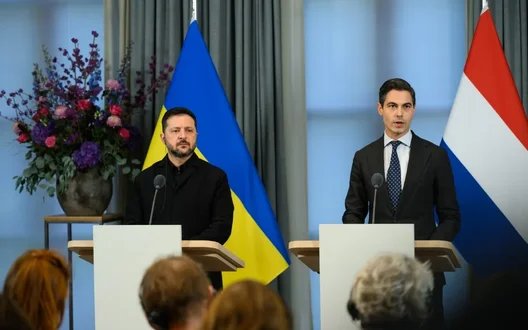
In an attempt to relieve Kyiv, the Dutch government on Oct. 28 outlined a package of non-military aid worth 1.2 billion euros ($1.3 billion), to be

  •  
❌