❌

Reading view

Is North Korea’s Lazarus Group behind massive $6.3 Billion Binance Hack?

ISLAMABAD – Billions of dollars vanished from leading cryptocurrency exchange Binance wallets in matter of minutes, leaving crypto-world stunned. As investigators race to trace staggering $6.3 billion heist, suspicion is turning towards North Korea’s Lazarus hacking network. But did Pyongyang really mastermind what could be the biggest crypto theft in history?

The extraordinary cyberattack, which hits world’s largest cryptocurrency exchange, jolted global digital asset market after hackers allegedly moved billions of dollars out of Binance-controlled wallets, with most of the theft unfolding within half an hour. The amount stolen is more than four times the $1.5 billion lost in the infamous Bybit breach in February 2025, showing unprecedented scale of latest attack.

Binance hit by $6.3b hack in potentially biggest crypto heist in history

While perpetrators have not been officially identified, two major blockchain intelligence firms, TRM Labs and Chainalysis, have expressed high confidence that North Korean cybercriminals were responsible. The suspected organisation is TraderTraitor, a sophisticated hacking operation associated with the Lazarus Group, which has previously been linked to major cryptocurrency thefts.

North Korea under Spotlight over Crypto Theft

Investigators believe Binance operation bears striking similarities to earlier attacks attributed to North Korean state-linked hackers. TRM Labs said its investigation uncovered technical patterns and operational methods consistent with previous TraderTraitor campaigns.

Chainalysis reported suspicious movements of stolen cryptocurrency, including transactions in which assets linked to the Binance breach were mixed with funds from another recent exchange attack widely attributed to North Korean actors. The findings have strengthened suspicions that the same hacking network may be responsible for multiple major cryptocurrency thefts.

North Korea repeatedly denied accusations of sponsoring cybercrime, while Binance has not confirmed any connection between the attackers and Pyongyang. For years, Western authorities have accused North Korean hacking organisations of stealing cryptocurrencies to generate foreign currency, evade international financial restrictions and potentially support the country’s weapons programmes.

However, the latest allegations remain intelligence assessments rather than a confirmed finding by law enforcement authorities.

The scale of the operation has raised serious questions about the security systems protecting the world’s biggest cryptocurrency exchange. Binance co-CEO Richard Teng disclosed that the attackers carried out a complex, coordinated intrusion rather than simply exploiting a single employee’s compromised computer.

An initial investigation suggested that a developer’s laptop had been breached, potentially providing access to internal systems.

According to blockchain security researchers, the attackers manipulated transaction-authorisation mechanisms involving Ethereum’s EIP-7702 functionality, enabling malicious instructions to drain cryptocurrency from an internet-connected wallet. The operation involved multiple blockchains, with digital assets rapidly transferred into addresses controlled by the attackers.

Teng also described the use of a self-destruct mechanism designed to erase parts of the attackers’ tools and reduce the digital evidence available to investigators. Binance has said it has not found evidence that wallet private keys were leaked.

US Secret Service on Hunt for Stolen Money

US Secret Service becomes involved in investigation, working alongside financial crime specialists, private-sector partners and law enforcement agencies. Investigators are attempting to trace the stolen assets, identify cryptocurrency addresses used by the attackers and prevent the funds from being converted into other digital currencies or withdrawn through exchanges.

The agency is coordinating with the US Attorney’s Office for the District of Columbia and other authorities to identify those responsible and potentially bring criminal charges. FBI has also acknowledged awareness of the incident. Authorities have cautioned that the investigation remains at an early stage, with further details expected as forensic teams examine the breach.

Despite unprecedented theft, Binance and its partners have made progress in restricting access to some of the stolen cryptocurrency. The exchange said approximately $3 billion in affected assets had been located, while stablecoin issuers and blockchain organisations moved to freeze billions of dollars linked to the attack.

Companies involved in restricting stolen assets include Tether and Circle, whose digital currencies were among those targeted. However, freezing cryptocurrency does not automatically mean the money has been recovered or returned to Binance. The exchange has pledged to cover customer losses and allocated more than $6.34 billion in company funds and assets to address the financial impact.

Binance also temporarily suspended withdrawals while engineers conducted additional security checks. Teng said the platform would restore withdrawal services only after completing rigorous testing, with an updated proof-of-reserves report planned to reassure customers about the exchange’s holdings.

Biggest breaches so far

Platform Year Cryptocurrency stolen
Binance 2026 $6.3 billion
Bybit 2025 $1.5 billion
Poly Network 2021 $600 million
Ronin Network 2022 $540 million

Binance theft alone exceeds the combined losses from these three previous major incidents. Security experts have also warned that cryptocurrency criminals are increasingly targeting individual investors through online fraud, stolen credentials and even physical intimidation intended to force victims to reveal private wallet keys.

The growing value of digital assets has made both large exchanges and ordinary cryptocurrency holders attractive targets. For Binance, which serves hundreds of millions of registered users worldwide, the attack represents one of the most serious security challenges in cryptocurrency history.


The post Is North Korea’s Lazarus Group behind massive $6.3 Billion Binance Hack? appeared first on Daily Pakistan English News.

  •  

Heli Crash leaves 6 Dead in Uttarakhand as India’s Aviation Safety faces scrutiny

NEW DELHI — India’s aviation safety and aerial monitoring capabilities are facing fresh scrutiny after passenger helicopter vanished from tracking systems and crashed in Himalayan state of Uttarakhand on Friday, killing all six people on board, including the pilot.

The helicopter, operated by private company Trans Bharat Aviation, was travelling from Hindu pilgrimage destination of Badrinath to Dehradun when it suddenly lost communication while flying over the Joshimath valley in Chamoli district.

🇮🇳🔞 Just In: All 6 On Board Were Killed in Helicopter Crash Near Joshimath While Returning from Badrinath; Debris and Bodies found.
A Trans Bharat Aviation helicopter returning from Badrinath to Dehradun crashed near Chai village in Joshimath, Uttarakhand, on 30 October 2026 amid bad weather, killing all six people on board — pilot Capt. Himanshu Sabharwal and five passengers from Bengaluru, including a police inspector.

The wreckage was found and bodies recovered by Army and disaster teams; the operator’s fleet has been grounded.

— World In Last 24hr (@world24x7hr) October 30, 2026

Uttarakhand Civil Aviation Development Authority (UCADA) said the aircraft disappeared from tracking system at approximately the same time that radio communication was lost, triggering an emergency search operation in the mountainous region. The helicopter, registered as VT-HCX, had departed Badrinath at approximately 1:14 pm. Its wreckage was subsequently discovered near Chhai village, close to Joshimath, after reports of smoke rising from the mountainside.

Authorities confirmed that all five passengers and the pilot died in the accident, turning what began as a missing-aircraft emergency into another aviation tragedy in India’s Himalayan pilgrimage corridor.

The incident renewed concerns over effectiveness of aviation monitoring, emergency communication and flight safety arrangements in one of India’s most geographically challenging regions. Joshimath holds importance because of proximity to India-China border and major Indian military installations. The region is also covered by military and civilian aviation infrastructure, making the sudden disappearance of a passenger helicopter particularly concerning.

The loss of both communication and tracking has raised questions about the reliability of civilian aviation monitoring in difficult mountain terrain, although authorities have not established whether any surveillance or technical failure contributed to the crash.

India invested heavily in modernising its military radar networks, aerial surveillance capabilities and aviation infrastructure, particularly in sensitive border regions. However, the latest tragedy shows continuing challenges of operating aircraft in the Himalayas, where rapidly changing weather, poor visibility, extreme altitude and difficult terrain can complicate navigation and rescue missions.

The incident brings attention to Indian government’s broader aviation safety commitments, with questions emerging over whether existing monitoring and emergency response measures are adequate for high-risk mountain routes.

Rescue personnel from the district administration, disaster management authorities, Indian Army and State Disaster Response Force were mobilised to locate the aircraft. The search operation faced difficult mountainous conditions, with reports indicating that rain and poor visibility complicated efforts to reach the crash site.

Despite the region’s military significance, the operation required coordinated ground searches and emergency response teams to locate the wreckage. The crash has also revived concerns about the safety record of helicopter operations serving Uttarakhand’s Char Dham pilgrimage destinations.

According to an Aircraft Accident Investigation Bureau report released earlier in October, the Char Dham aviation sector recorded eight helicopter accidents and one serious incident between 2015 and 2025. Five of those accidents were fatal, while several were linked to failures to follow established flight procedures.

The latest tragedy adds to pressure on aviation regulators and operators to strengthen safety procedures, flight monitoring and emergency preparedness along high-altitude routes. In response, Trans Bharat Aviation’s entire helicopter fleet has been grounded as a precautionary measure.

Uttarakhand Chief Minister Pushkar Singh Dhami has ordered an investigation into the crash and assured assistance to the victims’ families. India’s Aircraft Accident Investigation Bureau is expected to examine the circumstances surrounding the accident, including the loss of communication, flight conditions and possible operational or technical factors.


The post Heli Crash leaves 6 Dead in Uttarakhand as India’s Aviation Safety faces scrutiny appeared first on Daily Pakistan English News.

  •  

Iqbal Day 2026 Holiday Notification

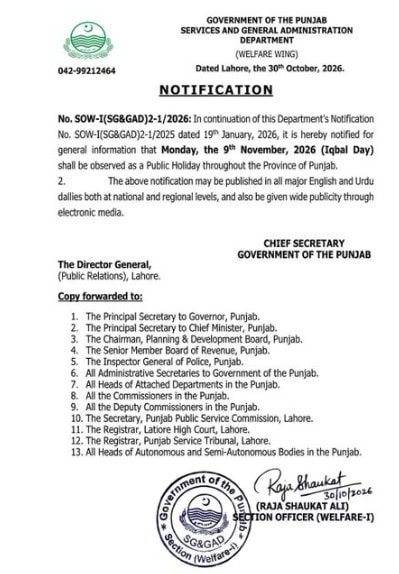
LAHORE – Punjab government announced province-wide public holiday on Monday, November 9, 2026, issuing fresh notification to mark birth anniversary of Pakistan’s national poet, Allama Muhammad Iqbal.

Services and General Administration Department (S&GAD) notification on Friday, October 30, ending uncertainty among employees and students over whether Iqbal Day would be observed as an official holiday this year. According to the notification, issued under reference number SOW-I(SG&GAD)2-1/2026, November 9 will be observed as a public holiday throughout Punjab.

The notification has been circulated to provincial authorities, including administrative secretaries, commissioners, deputy commissioners and heads of government departments, for implementation. Officials have also been instructed to ensure that the holiday announcement is widely publicised through national and regional newspapers and electronic media.

Three-Day Weekend

The announcement brings the prospect of an extended weekend for thousands of government employees and others who normally have Saturday and Sunday off. With November 9 falling on a Monday, eligible employees will enjoy three consecutive days off, beginning Saturday, November 7, and continuing through Monday, November 9.

However, the three-day break will depend on the normal weekly schedules of individual offices and institutions.

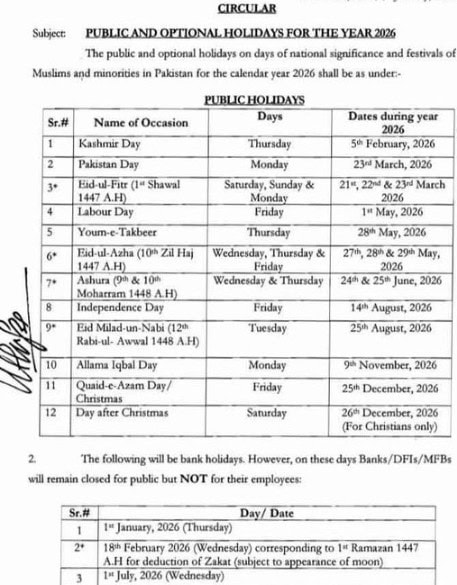
Punjab’s latest notification reinforces a decision already announced by the federal government earlier this year. Cabinet Division included Allama Iqbal Day in its official calendar of public and optional holidays for 2026, circulated on January 19. The federal schedule lists November 9 as a nationwide public holiday, confirming that the occasion is not restricted to Punjab.

The Punjab government has now issued its own notification to formally communicate the holiday across the province.

November 9 marks the birth anniversary of Allama Muhammad Iqbal, born in Sialkot in 1877. Widely regarded as the spiritual and intellectual inspiration behind the Pakistan Movement, Iqbal remains one of the country’s most influential poets and philosophers.

His writings on selfhood, freedom, faith and national identity continue to occupy an important place in Pakistan’s literary and educational traditions. Commemorative ceremonies, poetry sessions, seminars and special programmes are traditionally organised to honour his contributions.

Public Holidays in Pakistan 2026

Public holiday Date Day
Allama Iqbal Day November 9, 2026 Monday
Quaid-e-Azam Day / Christmas December 25, 2026 Friday
Day after Christmas (Christians only) December 26, 2026 Saturday


The post Iqbal Day 2026 Holiday Notification appeared first on Daily Pakistan English News.

  •  

Lawmakers voice alarm over KP situation, seek electoral reforms

• Achakzai questions govt’s handling of Tehran diplomacy, Afghanistan ties
• Senate resolution seeks coordinated national action to curb population growth

ISLAMABAD: Lawmakers in the National Assembly and Senate on Thursday raised concerns over the political situation in Khyber Pakhtunkhwa and alleged human rights violations, while both houses also discussed electoral reforms and the need to strengthen parliamentary institutions.

National Assembly Opposition Leader Mehmood Khan Achakzai criticised the government for failing to take parliament into confidence over recent diplomatic developments in Tehran.

“How can four people decide the future of the whole nation?” he asked, warning that such decisions could push the country towards “anarchy and civil war”.

Mr Achakzai also opposed the suspension of trade with Afghanistan, describing Afghans as traditional friends of Pakistan and criticising the country’s past policies towards its neighbour.

PTI Chairman Barrister Gohar Ali Khan said the parliamentary proceedings and the prevailing political situation in KP were creating a negative impression among the public. He also called for an end to hereditary politics in the country.

Rights concerns raised

Meanwhile, speaking on a point of order in the Senate, PTI parliamentary leader Barrister Syed Ali Zafar accused the government of undermining constitutional protections through the imposition of emergency and governor’s rule in KP.

He argued that fundamental human rights could not be suspended or compromised, regardless of the political situation. “There is one thing that cannot be broken, suspended or compromised: the fundamental human rights of the people of Pakistan,” he said.

Mr Zafar expressed concern over the detention of Noreen Niazi, sister of jailed PTI founder Imran Khan, claiming that she had suffered a heart attack and was hospitalised but her family was not being allowed to meet her.

Responding to the concerns, Adviser to the Prime Minister on Political Affairs Rana Sanaullah said Noreen Niazi had been provided medical treatment in Lahore and was in satisfactory condition.

On allegations that her family was being denied access, Mr Sanaullah assured the house that details would be sought and the matter addressed according to the circumstances.

He defended her detention, alleging that she had sought to create unrest by mobilising people for a protest march towards Islamabad.

Senate Opposition Leader Allama Raja Nasir Abbas also criticised the government’s actions in KP, alleging that the province had been “snatched from the people”.

He also questioned the imposition of emergency and governor’s rule in KP, arguing that democratic institutions could not function without respect for the law.

Population growth resolution

Separately, the Senate passed a resolution calling for urgent and coordinated national action to address the challenges posed by the country’s rapidly growing population.

The resolution, moved by PPP Vice President Senator Sherry Rehman, called for a comprehensive national response to population growth and its impact on public services and socioeconomic development.

Ms Rehman said Pakistan’s population was projected to reach approximately 390 million by 2050 at the current growth rate, placing unprecedented pressure on national resources.

Published in Dawn, October 30th, 2026

  •  
❌