Novaya Gazeta will be evicted from its office on Potapovsky Lane in central Moscow, where it has been based for 29 years, the news outlet Ekho reported. Ekho cited a letter to readers from editor-in-chief Sergey Sokolov and journalist Irina Gordiyenko.
“They’re simply throwing us out, giving us barely any time to pack up. The Anna Politkovskaya museum is closing, and portraits of our friends who were killed are being taken down from the walls,” Sokolov and Gordiyenko wrote.
Sources close to the newspaper told Ekho that staff members must leave the office by November 9. They have yet to find a new space.
Novaya Gazeta stopped publishing its print edition in 2022, after Russia launched its full-scale invasion of Ukraine. Russia’s Basmanny Court revoked its media license that same year.
In September 2026, Novaya Gazeta was designated a “foreign agent.”
At Meduza, we are committed to transparency about our use of artificial intelligence in the newsroom. The story you’re reading was written by one of our living, breathing journalists and translated from Russian using an AI model configured to follow our strict editorial standards. This translation process is the result of extensive testing and refinements to ensure our English-language coverage is timely and accurate. A Meduza editor reviews every draft before publication.
If you find any errors in this translation, please contact us at reports@meduza.io.
Routes for a humanitarian mission in Oleshky, in Ukraine’s Kherson region, have been cleared of mines. Russian and Ukrainian human rights commissioners Yana Lantratova and Dmytro Lubinets said the humanitarian convoy is ready to depart.
The convoy will head to the central district hospital, the commissioners said. Residents who have decided to leave the city will have until 2 p.m. on Friday, October 30, to do so.
Distribution of humanitarian aid to those remaining in the city will begin after 2:30 p.m. on October 30.
“Delegations from Ukraine, the Russian Federation, and the United States of America have now gathered to coordinate the next steps in the humanitarian mission. Journalists from the three countries are also present,” Lubinets said.
Russia and Ukraine halted fighting in Oleshky for the humanitarian mission under a deal brokered by U.S. first lady Melania Trump. The ceasefire took effect on the morning of October 27 and will remain in place until late on the evening of November 1.
At Meduza, we are committed to transparency about our use of artificial intelligence in the newsroom. The story you’re reading was written by one of our living, breathing journalists and translated from Russian using an AI model configured to follow our strict editorial standards. This translation process is the result of extensive testing and refinements to ensure our English-language coverage is timely and accurate. A Meduza editor reviews every draft before publication.
If you find any errors in this translation, please contact us at reports@meduza.io.
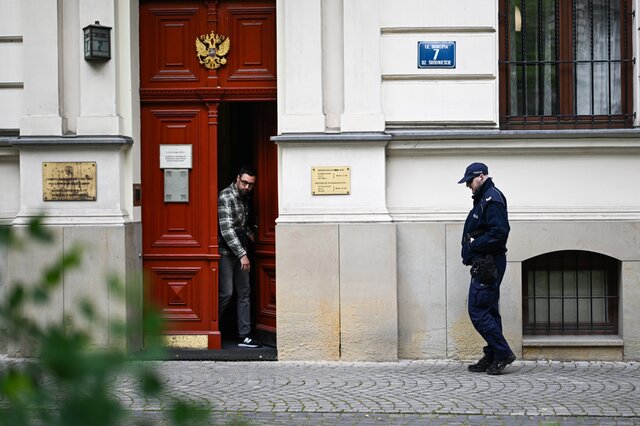
The Russian consulate in Krakow, Poland, on May 12, 2025. In summer 2025, Polish Foreign Minister Radoslaw Sikorski revoked the consulate’s permission to operate following reports of Russian intelligence services’ involvement in an arson attack on a Warsaw shopping center.
A company that charges Russians abroad to find available appointments at Russian consulates has ties to people in Roman Abramovich’s circle, Verstka reported.
Konsul Prime operates as an official partner under an agreement with Russia’s Foreign Ministry, offering help with paperwork and priority access to appointments.
The company always has appointments available, even though people usually wait weeks to book one. Konsul Prime began operating in late 2022. Russian emigrants say in group chats and online forums that getting a consular appointment has become even harder since the service launched.
Konsul Prime’s main legal entity, Tsentr Servis LLC, was established in December 2022 by Yefim Malkin. Malkin began working with Abramovich in the 1990s at Sibneft, according to Verstka. He was later linked to Millhouse entities that managed assets belonging to Abramovich and his partner, Yevgeny Shvidler.
In September 2022, Mikhail Livergand, another Abramovich associate who had previously worked in investment and real estate and served as Malkin’s assistant, took ownership of Konsul Prime. In August of that year, Livergand founded Tsentr Servis Digital, which owns the rights to Konsul Prime’s software platform.
Meduza found that Konsul Prime’s clients in Belgium, the Netherlands, Germany, France, and Switzerland sign contracts with legal entities registered in the United Arab Emirates: Docs Management L.L.C. and Konsul Prime DMCC. That information comes from the company’s privacy policy.
The owner of Docs Management L.L.C. is unknown, but Comfort Care Travel L.L.C. is registered at the same address in Dubai. It is the Dubai representative office of Malkin’s Russian company, Tekhnologii Meditsinskogo Turizma.
Konsul Prime DMCC is owned by Tsentr Servis, according to Tsentr Servis’ financial statements.
Since July 2023, Darya Zhurova, 53, has held 49% stakes in both Tsentr Servis and Tsentr Servis Digital, becoming another co-founder of both companies, according to Verstka. Livergand retained controlling stakes in both companies. Zhurova is the first co-owner with no ties to Abramovich, Verstka’s journalists wrote, suggesting that she may be a nominee owner.
Tsentr Servis founded most of Konsul Prime’s legal entities abroad, Verstka reported. Another company responsible for Konsul Prime’s branches, Konsul Tsentr, operates on behalf of Russia’s Foreign Ministry. Since 2024, Livergand and Zhurova’s Tsentr Servis has owned 90% of Konsul Tsentr, with just 10% belonging to an administrative office under the ministry.
In February 2026, Russia’s Unified State Register of Legal Entities stopped disclosing information about the founders of Konsul Prime’s Russian legal entities. But even the information still publicly available makes clear that Konsul Prime is not a state company at all, nor is it even formally dependent on the state. It has more ties to Roman Abramovich than to Russia’s Foreign Ministry. Yet the service still presents itself as the ministry’s sole partner, collects Russians’ data, and charges for exclusive access to consular services.
Tsentr Servis Digital’s business is currently valued at 1.17 billion rubles, according to its financial statements, which Meduza reviewed.
At Meduza, we are committed to transparency about our use of artificial intelligence in the newsroom. The story you’re reading was written by one of our living, breathing journalists and translated from Russian using an AI model configured to follow our strict editorial standards. This translation process is the result of extensive testing and refinements to ensure our English-language coverage is timely and accurate. A Meduza editor reviews every draft before publication.
If you find any errors in this translation, please contact us at reports@meduza.io.
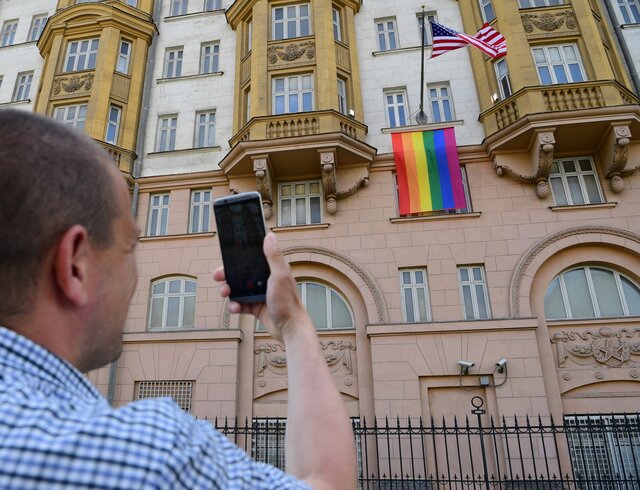
A rainbow flag on the U.S. Embassy building in Russia, June 2020
Nearly three years ago, Russia’s Supreme Court banned the nonexistent “international LGBT movement” as extremist. Since then, “LGBT extremism” has become grounds for at least 14 criminal investigations and hundreds of citations for administrative offenses. Because the system often doesn’t look into the context in which a rainbow flag appears on social media, even homophobes end up being targeted. Mediazona has compiled cases in which opponents of same-sex relationships have been punished for “promoting” them.
In 2013, Russia passed a law banning the promotion of “nontraditional sexual relationships” to minors.
In December 2022, the authorities extended the ban on “gay propaganda” to people of all ages. They also amended the Code of Administrative Offenses to prohibit “promotion of pedophilia” and the distribution of information “capable of making minors want to change their sex.”
In November 2023, the Supreme Court outlawed the “international LGBT public movement” by declaring it an “extremist organization.”
Vera Makeyeva, a retiree from Kurgan who welcomed Russia’s ban on the “LGBT movement,” was fined under that ban six months later — 1,500 rubles for old reposts of homophobic content featuring a rainbow flag. “It’s my own fault. I hadn’t cleaned up my photo albums in 13 years. Some people were interested enough to go through them,” Makeyeva told Mediazona.
Pyatigorsk resident Pyotr Voronin was jailed for one day for an image showing the presidents of Ukraine and France alongside a swastika and a rainbow flag (both are considered extremist symbols in Russia). Voronin had intended to mock Ukraine and France — and was outraged that “the FSB’s AI decided I was spreading propaganda.” “I asked [in court], ‘So maybe I should officially apologize to Zelensky?’ Basically, the AI that reads our messages online is a complete idiot, and we mean nothing to it,” Voronin concluded.
Vladimir Sugakov, a retiree from the Kemerovo region, was fined 100,000 rubles for “LGBT propaganda” in homophobic posts. Among the posts that caught law enforcement’s attention was a slideshow of photographs from Pride events set to Sergei Trofimov’s song “Petushki” (“Little Roosters,” Russian prison slang for gay men). Sugakov said the video criticized the LGBTQ community, but the police and the court didn’t bother to look into it. He decided against appealing the fine, saying he wasn’t an “idiot” who would “take on the system.”
In Moscow, a video titled “Nazi Initiation” led to a 100,000-ruble fine. In it, a young man shaves his head, puts on clothes popular with neo-Nazi skinheads, and has sex with two similar-looking men. The video ends with an image of a swastika and the message “Join our ranks!!!” The Moscow resident who posted the video said he had done so “as a joke.” The court saw “LGBT propaganda” rather than humor.
Father Grigory (Grzegorz Zwoliński), a Polish Catholic priest who lived in Kirov, had long criticized Archbishop Paolo Pezzi, who heads the Catholic Archdiocese of Moscow, for supporting the LGBTQ community. Father Grigory added a rainbow flag to one of his posts about Pezzi “to draw attention.” He was fined 1,000 rubles for it. The fine, in turn, led to the revocation of his Russian residence permit and a ban on re-entry. After 24 years in Russia, the priest returned to Poland, where he now writes that the “rainbow church” took revenge on him.
At Meduza, we are committed to transparency about our use of artificial intelligence in the newsroom. The story you’re reading was written by one of our living, breathing journalists and translated from Russian using an AI model configured to follow our strict editorial standards. This translation process is the result of extensive testing and refinements to ensure our English-language coverage is timely and accurate. A Meduza editor reviews every draft before publication.
If you find any errors in this translation, please contact us at reports@meduza.io.
Ukrainian President Volodymyr Zelensky has sent word to Russian President Vladimir Putin that he is ready to discuss territory at an in-person meeting, Ukrainian Foreign Minister Andriy Sybiha told the newspaper Helsingin Sanomat.
Finnish President Alexander Stubb and Norwegian Prime Minister Jonas Støre conveyed Zelensky’s position to Putin during a phone call on October 27.
Sybiha said the European leaders initiated the call in coordination with Kyiv. Its main purpose was to convey Ukraine’s message: Along with proposing an in-person meeting between the leaders, Ukraine also called for a ceasefire.
“We want this meeting and are ready for it. In all likelihood, only a meeting between Zelensky and Putin can change the dynamics of the negotiations. Zelensky is ready to discuss the most difficult and sensitive issues, including territory,” Sybiha said.
Stubb’s office had previously said the purpose of the call was to “convey Ukraine’s position on the upcoming peace talks in Abu Dhabi directly to President Putin.” Helsinki provided no details.
Putin’s conversation with Stubb and Støre was his first contact with European leaders who support Ukraine since July 2025, when he spoke with French President Emmanuel Macron.
At Meduza, we are committed to transparency about our use of artificial intelligence in the newsroom. The story you’re reading was written by one of our living, breathing journalists and translated from Russian using an AI model configured to follow our strict editorial standards. This translation process is the result of extensive testing and refinements to ensure our English-language coverage is timely and accurate. A Meduza editor reviews every draft before publication.
If you find any errors in this translation, please contact us at reports@meduza.io.
Russian President Vladimir Putin said Moscow is ready for war with Europe but does not want one.
Many [in Europe] talk about nothing but preparing for war [with Russia] by 2030. Is that the right approach? No. First of all, we’re ready, but we don’t want any war with Europe. If any of them want one, let them prepare.
Putin also urged those in Europe who advocate war to “remember” that “if things go too far, there will be no winners at all.”
He said Russia remembers the lessons of both world wars well and is doing everything it can to prevent anything like them from happening again.
At Meduza, we are committed to transparency about our use of artificial intelligence in the newsroom. The story you’re reading was written by one of our living, breathing journalists and translated from Russian using an AI model configured to follow our strict editorial standards. This translation process is the result of extensive testing and refinements to ensure our English-language coverage is timely and accurate. A Meduza editor reviews every draft before publication.
If you find any errors in this translation, please contact us at reports@meduza.io.
Gennady Stepakhno, a former deputy speaker of the Murmansk Regional Duma, is under criminal investigation for treason, the regional branch of Russia’s Federal Security Service (FSB) said.
The agency said Stepakhno, whom it described as “an opponent of the special military operation,” had cooperated with Ukraine.
The FSB alleges that the former lawmaker used his position to collect documents about the Murmansk regional government’s work and unspecified engineering facilities in the region and pass them to Ukrainian military intelligence. The agency believes this information “could be used to undermine Russia’s security.”
Sources cited by the news outlet Arktichesky Obozrevatel believe the investigation into Stepakhno began after he told a relative living abroad that a pharmaceutical plant was being built in the Murmansk region with India’s involvement.
A court has already ordered Stepakhno, 76, held in pretrial detention. His detention first became public on October 9.
Stepakhno is a veteran Communist lawmaker in the Murmansk Regional Duma. He served four terms from 2007 to 2026 and led the Communist Party faction. He did not return to the regional legislature for its new term.
At Meduza, we are committed to transparency about our use of artificial intelligence in the newsroom. The story you’re reading was written by one of our living, breathing journalists and translated from Russian using an AI model configured to follow our strict editorial standards. This translation process is the result of extensive testing and refinements to ensure our English-language coverage is timely and accurate. A Meduza editor reviews every draft before publication.
If you find any errors in this translation, please contact us at reports@meduza.io.
Several passages in the Russian translation of American author Joe Hill’s novel “King Sorrow” were rewritten to avoid censorship problems, changing the author’s meaning. Nikolai Karayev, who runs the speculative fiction Telegram channel Zvezdnye Mayaki Kapitana Norta, drew attention to the changes by sharing several passages from the original alongside their Russian translations.
Hill, Stephen King’s son, writes fantasy and horror. “King Sorrow” is about students who summon a dragon from another world. The Russian edition, translated by Dmitry Starkov, was published in August 2026 by Fanzon, part of the Eksmo publishing group.
Here are a few examples of changes in the Russian translation:
In one passage in the original, a character says he has “reliable information that the Russians are farming them. They grow trolls like potatoes in the permafrost of Siberia.” Eksmo’s version reads: “I have reliable information that the Ukrainians are breeding trolls. Raising trolls like little pigs.”
In another passage, the characters watch footage of the war in Ukraine as the novel describes a strike on a maternity ward in Mariupol. In the translation, Mariupol became Donetsk: “On March 9, something like that hit one of Donetsk’s maternity hospitals. A deafening explosion, a column of flame… One of the expectant mothers was killed in the explosion, and her baby was stillborn.”
A reference to “Russian oligarchs who vacationed in Italy with Vladimir Putin” became simply “Russian oligarchs who vacationed in Italy.”
Instead of “Russia invaded Ukraine,” the translation says “that night war broke out in Europe.”
After media coverage of the changes, Eksmo CEO Yevgeny Kapyev promised to “look into the situation thoroughly” and criticized Hill, writing:
So I’m wondering, this thing in Western popular culture that started with James Bond, where the bad guys are Russians or Asians, is it ever going to end? Russia could be portrayed as a wonderful country everywhere… at least in the future… Self-fulfilling prophecies are a thing, after all…
And I’m asking authors not to put “Easter eggs” about the current fraught political and military situation into their books… At this rate, they’ll be putting them in recipes soon. There are tons of other ways to get your point across…
In the spring, Kapyev was detained along with other senior Eksmo executives in the “publishers’ case.” The case concerned allegations by law enforcement authorities that Popcorn Books, another Eksmo-owned publisher, had engaged in the “distribution of LGBT literature.”
At Meduza, we are committed to transparency about our use of artificial intelligence in the newsroom. The story you’re reading was written by one of our living, breathing journalists and translated from Russian using an AI model configured to follow our strict editorial standards. This translation process is the result of extensive testing and refinements to ensure our English-language coverage is timely and accurate. A Meduza editor reviews every draft before publication.
If you find any errors in this translation, please contact us at reports@meduza.io.
On October 27, Forbes reported that Russia’s Digital Development Ministry is considering routing all foreign internet traffic through TSPU filtering equipment (TSPU is the Russian acronym for “technical means of countering threats”), effectively separating the Russian internet from the global internet at a technical level.
The measure could primarily affect people who use VPN services to bypass blocks. The plan is to cap the amount of foreign data each user can consume. The proposed limit is not yet known.
Several sources told Forbes about the proposals, which will likely be included in a bill to overhaul the telecommunications industry. The authorities have been preparing changes to telecommunications laws since the spring and are discussing specific proposals with major industry players. The Digital Development Ministry stressed that all the proposed measures “are being examined, but it is premature to say which will make it into the final amendments or in what form.”
Haven’t there been proposals like this before?
Not quite. First, in the spring, the Digital Development Ministry wanted to limit foreign traffic only on mobile networks. Now, the proposal apparently also covers home internet connections.
Second, the earlier plan called for telecommunications providers themselves to identify and limit foreign traffic. The ministry asked them to charge users extra if they used more than 15 gigabytes of foreign data a month. BBC News Russian reported that each additional gigabyte would have cost 150 rubles. Now, the ministry plans to impose the restrictions itself using TSPU equipment.
What would the authorities gain from this?
The Digital Development Ministry intends to use this approach to combat VPNs that allow users to bypass Russian internet blocks. These services are generally based abroad, as are most of their servers. So when users connect to one of these VPNs, all their traffic becomes foreign traffic, even when they visit Russian websites.
VPN services could try to rent servers inside Russia to get around the data cap. But this summer, the authorities banned Russian hosting providers from serving them.
There are also plans to create a register of violators who have used servers in Russia to run VPNs. If caught bypassing blocks, they will be barred from signing contracts with hosting providers in Russia for a full year. In other words, using Russian hosting infrastructure will become even harder in the future.
But for now, too much about the proposal remains unknown, Sarkis Darbinyan, a digital rights lawyer and expert at RKS.global, told Meduza:
It’s unclear what exactly the ministry will consider a foreign domain, whether there will be exemption allowlists, and what will happen once the quota runs out: disconnection, slower speeds, or an extra charge. These details will determine whether the measure specifically targets VPNs or affects everyone.
How does the ministry plan to identify foreign traffic?
We don’t know. Most likely, by IP address. Since 2019, Russia’s communications regulator, Roskomnadzor, has required Russian holders of autonomous system numbers, which identify networks, to report their network addresses and notify the agency of any changes within three business days. Roskomnadzor can use those addresses to determine whether a given data packet came from Russia or abroad.
But under this approach, even people who don’t use VPNs could find that some traffic from Russian websites is technically classified as foreign. Much depends on whether individual components of a webpage — fonts, images, or videos — load from foreign sources and exactly how the data is routed. Even traffic from a site with an IP address registered in Russia can pass through nodes abroad. This could happen, for example, because of the particular terms of traffic-exchange agreements between telecommunications providers or because traffic takes alternative routes during network outages.
How would TSPU equipment limit an individual user’s foreign traffic?
We don’t know this for certain, either. The difficulty is that TSPU equipment filters data packets that don’t explicitly identify the user they belong to. Only the source and destination IP addresses are visible. That information is not enough to limit a particular person’s foreign traffic: Different subscribers can use the same IP address at different times.
Telecommunications providers, however, have the missing information. In the spring of 2025, they were required to give Roskomnadzor comprehensive information about their subscribers, including their assigned IP addresses and the number identifying the specific TSPU device through which each user’s traffic passes.
Since December 2025, telecommunications providers have been subject to fines of 300,000 to 500,000 rubles for each failure to provide this information.
If the ministry’s proposal is adopted, how will it affect ordinary Russians?
For now, we can only speculate. But requiring all foreign traffic to pass through a filter that tracks quotas would clearly make it easier to slow and ration that traffic. This would be another major step in the authorities’ campaign against independent VPNs, and users of those services would be hit hardest, Darbinyan said. Besides finding a working VPN, they would have to decide how best to use their allotted gigabytes of foreign data, choosing between videos, games, social media, and other sites and services unavailable in Russia.
Darbinyan said there could be several other consequences:
There will be problems with updates. Updates for iOS, Windows, and games can run to tens of gigabytes. A single file could eat up a month’s allowance. “And then,” Darbinyan said, “if you can’t afford an extra international data package, you’re stuck without up-to-date software.” That creates an additional risk: Devices without updates are more vulnerable to scammers and malware, both of which are proliferating with the AI boom.
Developers, IT workers, and remote workers will suffer. Using GitHub, Docker Hub, cloud services, Zoom, and Microsoft 365, or working with foreign clients, means using lots of foreign data. “For freelancers, students taking international online courses, and scientists, the restrictions will become an obstacle to their work. Online gaming will probably become a pastime only for the wealthy, who can afford to pay for extra gigabytes, since gaming requires enormous amounts of data,” Darbinyan told Meduza.
Still, Darbinyan believes the authorities are unlikely to impose a strict, very low cap on everyone at once:
Technically, it’s very difficult, and politically, it’s costly — because it would upset users opposed to the government as well as businesses, the IT industry, and gamers. Most likely, they’ll start with mobile networks, a generous cap, and extensive allowlists, then gradually tighten the restrictions.
This measure is also unlikely to make foreign services disappear entirely. The aim, apparently, is to make access to foreign services inconvenient, slow, and expensive so that people switch to Russian alternatives on their own, rather than to cut off access to everything abroad.
At Meduza, we are committed to transparency about our use of artificial intelligence in the newsroom. The story you’re reading was written by one of our living, breathing journalists and translated from Russian using an AI model configured to follow our strict editorial standards. This translation process is the result of extensive testing and refinements to ensure our English-language coverage is timely and accurate. A Meduza editor reviews every draft before publication.
If you find any errors in this translation, please contact us at reports@meduza.io.
British actor Sacha Baron Cohen has publicly apologized to the people of Kazakhstan for his portrayal of Borat in the 2006 film of the same name. “Borat” follows Borat Sagdiyev, a fictional journalist from Kazakhstan who travels to the United States to make a documentary, encounters American culture, and finds himself in all sorts of comical situations.
“I want to apologize to the people of Kazakhstan for the first time ever because Borat has got nothing to do with Kazakhstan,” the actor said on the podcast “Happy Sad Confused.”
Baron Cohen said he had developed an earlier version of the character for the BBC, with a different name and Albanian nationality. His name and nationality later changed depending on which television channel was paying for the show. “I would just say, ‘Oh, that character already belongs to the BBC. I’ve got a completely new character, this guy’s called Alexi Krickler, he’s from Moldova,’” Baron Cohen said.
The actor reiterated that at some point he had chosen Kazakhstan as a place “that no-one knows anything about.” He emphasized that he doesn’t even know what a Kazakh accent sounds like. Before recounting a complaint from the Kazakh Embassy, he apologized for being unable to imitate a Kazakh accent and said he would use Borat’s accent for the anecdote because his knowledge of Central Asian accents was limited.
Baron Cohen described the apology as his first for the character he created, though he has had to defend Borat ever since the film came out. “The joke is not on Kazakhstan. I think the joke is on people who can believe that the Kazakhstan that I describe can exist,” the actor said in a 2006 interview with Rolling Stone.
Over the years, Kazakhstan’s authorities have shifted from hostility toward “Borat” to acceptance. In 2005, the country’s Foreign Ministry threatened to sue Baron Cohen and claimed his show had been commissioned for political ends to tarnish the international reputation of Kazakhstan and its people.
In 2006, shortly before the film’s release, the country’s authorities paid for a four-page advertising supplement in The New York Times and the International Herald Tribune touting Kazakhstan’s achievements in the 21st century.
Although “Borat” was not officially banned in Kazakhstan, it never screened in the country’s movie theaters after its world premiere. The film also did not receive a theatrical distribution license in Russia.
Over time, attitudes toward Borat in Kazakhstan softened. In 2017, Czech tourists in Astana got off with a small fine for walking around dressed as Borat (Baron Cohen himself offered to pay it). In 2020, Kazakh Tourism, the company responsible for promoting tourism within Kazakhstan, adopted his catchphrase “Very nice!” as the country’s official tourism slogan.
By then, a sequel to “Borat” had been released worldwide, and the Kazakh diaspora in the United States continued to oppose it. In November 2020, the Kazakh American Association called for “Borat 2” to be excluded from consideration for Oscar, Golden Globe, and other award nominations.
At Meduza, we are committed to transparency about our use of artificial intelligence in the newsroom. The story you’re reading was written by one of our living, breathing journalists and translated from Russian using an AI model configured to follow our strict editorial standards. This translation process is the result of extensive testing and refinements to ensure our English-language coverage is timely and accurate. A Meduza editor reviews every draft before publication.
If you find any errors in this translation, please contact us at reports@meduza.io.
At least 69 people subjected to politically motivated persecution by Russian authorities have died in Russia since the start of Russia’s full-scale invasion of Ukraine, according to a report published by Memorial’s Political Prisoner Support human rights project to mark the Day of Remembrance for Victims of Political Repression.
Illness and lack of medical care were the most common causes of death, accounting for 29 cases documented by the group. At least 20 people died from beatings, torture, or their aftereffects, and 10 died by suicide.
One person died as a result of a hunger strike, and another — Alexey Navalny — was deliberately killed in a penal colony. The causes of death of eight others remain unknown.
The group recorded the most deaths in 2024, when 26 people died. Another 13 died in 2025, and 16 died in the first 10 months of 2026, with October not yet over.
The average age of those who died was 51. The youngest on the list, Ukrainians Daniil Dakhov and Pavel Grimak, were both 18. The figures include people who died in pretrial detention centers and penal colonies, as well as during searches, under house arrest, and shortly after their release.
Memorial’s report recounts the stories of all 69 people who died. Meduza has reported in detail on some of them, including Ukrainian journalist Viktoria Roshchyna, pianist Pavel Kushnir, scientist Dmitry Kolker, Arctic researcher Valery Mitko, biker Kirill Buzmakov, and activist Anatoly Berezikov.
At Meduza, we are committed to transparency about our use of artificial intelligence in the newsroom. The story you’re reading was written by one of our living, breathing journalists and translated from Russian using an AI model configured to follow our strict editorial standards. This translation process is the result of extensive testing and refinements to ensure our English-language coverage is timely and accurate. A Meduza editor reviews every draft before publication.
If you find any errors in this translation, please contact us at reports@meduza.io.

 Login