More than 25 unions have announced actions spanning 113 ports in 22 countries and regions, warning that over $2 billion in cargo could face delays
Dockworkers across five continents have launched a coordinated anti-war strike, targeting Israeli arms shipments, US military cargo, and the growing militarization of civilian ports.
Organizers say more than 25 unions are mobilizing across 113 ports in 22 countries and regions on Friday in an unprecedented international action. The campaign includes 24-hour strikes, shorter walkouts, blockades, and solidarity rallies.
Major European ports joining the action include Genoa, Marseille, Le Havre, Hamburg, Valencia, Barcelona, and Piraeus. Beyond Europe, protests are planned at Tangier Med in Morocco, Nhava Sheva and Chennai in India, and Oakland and San Francisco in the US, with further actions across Türkiye, Cyprus, Sweden, Denmark, Ireland, Portugal, Brazil, Mexico, and Australia. France’s CGT Ports et Docks has called 24-hour strikes across 24 ports, while Italy’s USB has declared a nationwide general strike, with protests in more than 40 cities. Unions in Germany, Greece, Spain, India, and the US are also taking part.
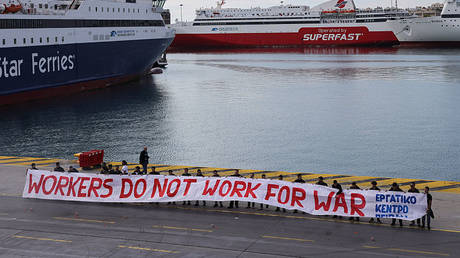
Dockworkers at the port of Piraeus, Greece, walked off the job as part of a global day of action, with protesters in more than 100 ports worldwide striking against the arms trade with Israel.
Dockworkers at Piraeus, Greece’s largest port, were among the first to join the action, with a three-hour stoppage scheduled from 08:00 to 11:00 GMT. Other Greek maritime unions announced 24-hour strikes affecting seven ports, threatening ferry services to the country’s islands.
Dockworkers across 21 major ports in Europe and the Mediterranean shut down operations in a coordinated day of action. Under the call “Port Workers Do Not Work for War,”
They blocked arms shipments and demanded a full trade and arms embargo on Israel. pic.twitter.com/43Srp1pYE5
Videos of demonstrations and gatherings at other ports have emerged online, although the full extent of the disruption to shipping operations remains unclear as actions are taking place at different times.
The unions demand a halt to weapons, ammunition, military equipment, and troop shipments through commercial ports, targeting both Israeli and US military supply chains. They also oppose turning civilian ports into military hubs and diverting public funds into rearmament while workers face stagnant wages, job insecurity, and worsening conditions.
Protesters gather outside Tilbury Docks in the UK, urging dockworkers to join an international mobilisation involving over 100 ports in solidarity with Palestine and against arms shipments to Israel. pic.twitter.com/7fulNOmU82
“From planes to tanks, guns to bullets, explosives to ammunition, uniforms to boots, our ports have become replenishing and forwarding bases for war and genocide,” the organizers said at a press conference on October 15 in Rome.
🇵🇸⚓Hoy están llamados a huelga estibadores de más de 100 puertos de todo el mundo contra el comercio de armas y el genocidio
The unions accused governments and shipping companies of keeping military supply routes open despite the Gaza ceasefire announced over a year ago, which they say has been rendered largely meaningless by continued Israeli strikes.
‘No Harbour for Genocide’, the campaign coordinating the action, claims that it tracked 315 shipments of components for Israeli arms manufacturer Elbit Systems through 56 ports in 29 countries over 14 months. It says it identified 3,400 shipments of US military cargo through 67 ports in 42 countries over ten months. The group also says US military cargo volumes at some European ports rose as much as tenfold following the start of the US-Israeli war against Iran. The figures have not been independently verified.
Organizers estimate the action could delay 40,000 containers carrying cargo worth over $2 billion, potentially costing shipping companies up to $43 million.
Is it the first strike of this kind?
Dockworkers have challenged military shipments for years, though resistance was largely scattered and localized. Since 2019, workers in Italy, Greece, Morocco, and France have staged sporadic blockades and stoppages, targeting arms shipments to Israel, US bases, and other conflict zones.
The movement gained momentum in late 2025 after Israel intercepted the Global Sumud Flotilla, a 40-plus-vessel convoy attempting to deliver aid to blockaded Gaza. Hundreds of activists were detained, sparking strikes and port blockades across Europe. The flotilla campaign also pledged to join the action on Friday with “coordinated, strategic actions on the water.”
100+ PORTS. WORLDWIDE. NO MORE WEAPONS.
On October 30th, dockworkers, seafarers, students and communities in more than 100 ports around the world are standing together to say one thing: NO MORE WEAPONS.
International coordination intensified in February, when dockworkers at more than 20 ports across seven countries staged their first joint day of action, reportedly stopping five suspect ships.
ANTWERP 🇧🇪 “We do not want our poets to be used for the transit of weapons.”
Members of Bond van Bedienden, Technici en Kaderleden (BBTK) have joined today’s historic international day of action to say: Dockworkers do not work for war. pic.twitter.com/Dhqyzjv6IN
In May, dockworkers’ unions from France, Greece, Italy, Türkiye, Morocco, and Spain’s Basque Country adopted the Istanbul Declaration, in which they pledged to block military cargo and troop shipments to war zones, including those supporting Israel and US military operations. The agreement laid the groundwork for Friday’s global strike.
The predictive market platform that allows users to bet on real-world events has blamed the breach on a compromised third-party provider
Hackers have swiped at least $2.6 million in user funds from predictive market platform Polymarket that allows people to wager on real-world events, including elections and military action. The company was forced to briefly pause trading on its international exchange, promising to reimburse all affected users.
In an X post on Thursday, a Polymarket-related account said that the company had “identified & fixed an issue impacting our international platform.”
“We have temporarily halted trading,” the statement read, adding that the breach occurred after “one of our 3rd party providers was compromised.”
The hack only affected Polymarket’s flagship platform, although Polymarket US, which operates independently as a federally regulated financial exchange, was spared.
Several media outlets, including the Wall Street Journal, reported that the third-party provider that Polymarket referred to was DebugBear - a UK-based performance-monitoring platform.
DebugBear wrote on X on Thursday afternoon that it was “aware of a security incident,” advising clients using its RUM product to “remove the embed code from your website.”
According to Business Today, citing blockchain analytics firm Bubblemaps, as many as 700 Polymarket accounts were affected, with users reporting unauthorized withdrawals and sudden balance liquidations.
The breach coincided with a major cyberattack at Binance, the world’s largest cryptocurrency exchange, that saw intruders steal an estimated $6.3 billion.
As for Polymarket, it suffered another breach as recently as June, with hackers getting their hands on more than $2 million.
In recent years, Polymarket, along with its major rival, Kalshi, have been at the center of multiple scandals, involving insider trading by American officials and military personnel, with several US states also accusing them of sidestepping gambling laws.
Last week, the Associated Press reported that US Secretary of War Pete Hegseth had issued a directive specifically warning service members against using classified material to bet on prediction markets.
Earlier this year, US Army Green Beret Master Sgt. Gannon Ken Van Dyke was arrested and charged with illegally profiting from advance knowledge of the January operation to abduct Venezuelan President Nicolas Maduro.
Prosecutors alleged that the defendant had placed more than $32,500 in Polymarket bets, mostly on January 2, hours before the US attack on Caracas. Van Dyke allegedly raked in $400,000 by betting on Maduro’s removal from power.
The man pleaded not guilty.
Newly created Polymarket accounts also placed suspiciously timed bets shortly before US President Donald Trump announced an April US-Iran ceasefire, generating hundreds of thousands of dollars in profits. The White House subsequently warned staff against trading on confidential information.
In late August, Trump’s long-time teleprompter operator, Gabriel Perez, was ordered to pay $65,000 to settle a case related to his “unlawful” prediction-market trading about the president’s speeches.
The White House aide was also required to give up $107,000 in ill-gotten profits from his wagers on Kalshi, the Commodity Futures Trading Commission said at the time.
Trade, resources and digital ‘cooperation’ sound harmless – until you look at the fine print
I’m trying to spend a few weeks back in Canada for some peace and quiet from the usual European drama. Just my luck that Queen Ursula would follow me here, circus and all.
She hadn’t even landed in Montreal for the EU-Canada Summit, and already everyone around me was saying that Canada’s “associate membership” had been canceled. They’d heard that countries like France and Germany objected to the idea, even as Von der Leyen was saddling up her broom for a trip across the Atlantic.
Someone even asked me if that meant that we’re now kicked out of Eurovision. I had to explain that the title never existed in the first place. EU treaties refer only to association agreements. It’s just the usual sort of branding that von der Leyen, the unelected EU chief executive, likes to roll out, much like her endless riffs about unity, as though dissent weren’t an actual virtue in a functioning democracy.
Or like the way she talks a good game about sticking it to Russia while simultaneously celebrating the €977 million spent this winter alone on gas purchases for Ukraine – much of which comes from Russia via Hungary and Slovakia. The EU writes cheques to Kiev. Kiev pays Hungary and Slovakia, who then pay Moscow.
Those middlemen exist mainly so that Queen Ursula can maintain a certain public image while engaging in more practical considerations behind the scenes, albeit at considerably greater expense to the European taxpayer.
Canadian Prime Minister Mark Carney got a taste of the spectacle when Ursula’s marketing campaign became the focus of the event. He was forced to acknowledge that he honestly didn’t give a damn what they called this new cooperation, so long as it was good for Canadians. Meanwhile, other EU leaders, like German Chancellor Friedrich Merz, had started referring to it instead as an “alliance for the future.”
But von der Leyen had already landed in Canada and continued promoting the “associate membership” label, smiling as Carney, sitting beside her, subsequently echoed the term.
Of course, all that the mental midgets are going to take away from this whole event is the intrigue over whether or not Canada is joining the EU. Spoiler alert: it isn’t. And never will. It’s not even legally possible. But this idiotic intrigue is distracting from the details of what lurks underneath, which could amount to a whole lot of iron-fisting through velvet gloves.
Turns out someone had already leaked a draft statement on these future relations to Politico, dated September 22, 2026. Cut out the diplomatic fluff and here’s what you’re left with.
Both sides are clearly looking for new markets as they diversify trade away from the US. Great. But it seems rather stupid for the EU to be begging Canada for its natural resources – gas, metals and minerals – while simultaneously slapping on carbon tariffs that get downloaded onto European citizens and companies. What’s the point of trying to bring prices down by increasing supply if you’re just going to top up the cost anyway.
You jokers also killed off your own nuclear industries, only to realize (a bit late) that perhaps it was preferable to having to resort to coal, before subsequently reviving it as the future of clean energy. So maybe you’re not exactly the best people to be doing commie-style central planning.
Technology is already advancing in favor of the environment, with those improvements increasingly built into the conditions for funding and financing. Just let it breathe already. Not every industry needs a Brussels bureaucrat hovering over it.
Perhaps the most troubling part is the Orwellian digital cooperation section of the agreement, which aims to “advance cooperation on artificial intelligence security and sovereignty, trusted data flows and digital governance and to align emerging AI and digital regulatory frameworks through associated country status for Canada.”
Does this mean Canadians get to have Queen Ursula block their bank accounts now, too, since we’ll all be connected and harmonized inside one giant digital panopticon? It’s hardly reassuring that Carney’s government has just appealed the federal court decision condemning his predecessor Justin Trudeau’s government for unconstitutionally invoking the Emergencies Act, which allowed it to block the bank accounts of Covid-era anti-mandate Freedom Convoy participants without a court order – all for the crime of honking too loudly. Nor is it reassuring that Canada and the EU have already signed an agreement on digital “trust services” involving things like government-controlled digital identity wallets.
One honk too many, one wrong opinion on some social media platform linked to the online ID system that they’re all ushering in – ostensibly under the pretext of adults needing to prove that they aren’t children requiring protection from online pedos – and there goes your whole life with the flip of a switch. It’s not like Queen Ursula’s European Commission isn’t already doing that with sanctions and asset freezes, in the absence of due process, for those whose views it qualifies as “propaganda.”
And if this is what they mean by an alliance for the future, then Canadians – the average citizens of this country – need full and open debate over the fine print before anyone signs us up.
At least 68 people are dead and more than 179 injured after a crash in central Spain, the country’s second major high-speed rail disaster in ten months
At least 68 people have been killed after two high-speed trains collided near Toledo, Spain, Castilla-La Mancha regional President Emiliano Garcia-Page has said, according to Spanish newspaper ABC. More than 179 people have reportedly been injured.
The crash occurred at 8:54 AM local time on Wednesday between the towns of Los Yebenes and Urda, around 120 km south of Madrid, on the high-speed line linking the Spanish capital with Andalusia. A Renfe AVE train reportedly struck an Iryo train from behind, sending two carriages off the tracks and down an embankment, according to rail infrastructure operator Adif.
WATCH: Dozens confirmed killed as aerial footage reveals devastation after train collision in Toledo, Spain https://t.co/vwdz3IlGlT
The two trains were carrying a combined total of more than 500 passengers, according to Spanish media reports.
Spanish Prime Minister Pedro Sanchez has announced three days of national mourning and pledged a thorough investigation into the disaster. Speaking at the crash site, he vowed to establish the cause of the collision and hold anyone responsible for negligence accountable.
Former Spanish Labor Minister Fatima Banez, 59, was among those killed, according to several Spanish media outlets. Banez served under Prime Minister Mariano Rajoy from 2011 to 2018 and was reportedly traveling aboard the Iryo train to attend a business event in Seville.
Spain’s Transport Ministry has identified human error by an operator at rail infrastructure manager Adif as the leading preliminary explanation for the crash. An operator reportedly authorized the Renfe train to pass a red signal despite the Iryo train remaining stationary on the same track.
BREAKING:
🇪🇸 The death toll from the train collision in Spain has risen to 50
At least 50 people were killed and 179 injured when two trains collided in Toledo, Antena 3 reported.
The Iryo train was carrying 147 passengers and the AVE train 397. https://t.co/8l4uJI7JgM
The suspected mistake followed a malfunction of the railway’s automatic safety system, which forced several trains to stop and required traffic controllers to manage movements manually. Investigators are still working to establish the exact cause.
Images shared online show overturned and badly damaged carriages, with emergency crews working at the scene.
Castilla-La Mancha regional President Emiliano Garcia-Page has requested assistance from Spain’s Military Emergency Unit. Adif has suspended high-speed rail traffic between Madrid and Andalusia. Iryo said it activated all emergency protocols.
Iryo confirma el accidente de su tren 6076 en Urda y cancela todos sus servicios hacia el sur
Patricia MedjidiJuez | Tribuna Digital7
28 de octubre de 2026
La compañía ferroviaria Iryo ha comunicado la activación de todos sus protocolos de emergencia tras el accidente sufrido este miércoles por uno de sus trenes a la altura de Urda, en la provincia de Toledo.
Según el comunicado difundido en sus redes sociales, el convoy afectado es el servicio 6076, que realizaba el trayecto Madrid-Sevilla.
La operadora asegura que trabaja en estrecha colaboración con las autoridades competentes para gestionar la emergencia y atender las consecuencias del siniestro.
Como consecuencia del accidente, Iryo ha cancelado todos sus servicios con origen en Madrid-Puerta de Atocha hacia el corredor sur.
La compañía advierte de que no existe por el momento ninguna previsión de restablecimiento de la circulación ferroviaria y anuncia que continuará informando a los viajeros a través de sus canales oficiales.
El accidente ha provocado también la interrupción de la línea de alta velocidad Madrid-Andalucía, confirmada por Adif.
El comunicado de Iryo no precisa el número de víctimas ni las causas de la colisión, que continúan pendientes de esclarecimiento.
Fuentes: Comunicado de Iryo difundido en redes sociales, según el texto facilitado a Tribuna Digital7; InfoAdif; La Voz del Tajo, 28 de octubre de 2026.
Wednesday’s disaster is the latest in a series of serious railway accidents in Spain this year, raising concerns over the safety of the country’s rail network. On January 18, two high-speed trains collided near Adamuz in the southern province of Cordoba, killing 46 people and injuring more than 150. Investigators have identified a broken section of track as the likely cause, although the investigation is ongoing.
WATCH: Sheer force of train collision between Los Yébenes and Urda in Toledo, Spain sends wheels flying far from the tracks; at least 46 killed https://t.co/32RoUdWDLT
Just two days later, a commuter train struck a collapsed retaining wall near Barcelona, killing the driver and injuring dozens. Another passenger train collided with a crane near Cartagena on January 22, injuring six, and a collision at a level crossing in February reportedly left one person dead.
The incidents have fueled concerns over railway infrastructure and maintenance standards, prompting demands for stronger safety measures. The Spanish train drivers’ union (SEMAF) has called a nationwide strike for Thursday, October 29, accusing Renfe and the Transport Ministry of failing to implement safety improvements promised after the disasters in January. Renfe dismissed the accusations, insisting it has fulfilled its commitments.
The full extent of the casualties and the circumstances surrounding Wednesday’s collision remain under investigation.
A Switzerland-based arbitration court has rejected claims that Russian athletes pose security risks to international competitions
The International Ice Hockey Federation (IIHF) has reluctantly accepted this week’s ruling by the Court of Arbitration for Sport (CAS) overturning its exclusion of Russian teams from international competitions.
The ban was challenged at the Lausanne-based court by the Russian Ice Hockey Federation (RIHF) in August, after the IIHF resisted a broader trend toward readmitting Russian and Belarusian competitors in July.
The IIHF said on Friday that it respected CAS' authority and would comply with its ruling, but maintained that the restrictions on Russian teams were “necessary to protect the safety and security of all participants and safeguard the integrity of its competitions” – an argument the court found was not supported by sufficient evidence. The federation also complained that the decision carried “significant practical implications” for upcoming championships.
The RIHF said that it would work with the IIHF to implement the CAS-mandated reinstatement. The World Junior Championship, scheduled to take place in Canada from December through January, is set to become the first major tournament featuring Russia following the ruling.
Russian and Belarusian athletes were barred from competitions organized by numerous international federations following the escalation of the Ukraine conflict in 2022. Over the following years, arguments that the exclusions were politically motivated and inherently discriminatory increasingly gained traction.
The International Olympic Committee (IOC), which wields considerable influence over international sports, withdrew its recommendations restricting Russian participation in July, clearing the way for athletes and teams to return.
The IIHF was among several federations that maintained restrictions, alongside track and field governing body World Athletics, the International Biathlon Union (IBU), and football authorities FIFA and UEFA. Other organizations retained partial exclusions, including requirements that Russian and Belarusian athletes compete without displaying their national symbols.
Moscow has argued that Western nations pressured international sports organizations into excluding Russian athletes as part of their broader strategy to contain Russia. It has also maintained that the restrictions have undermined the quality of international competitions by denying some of the strongest contenders an opportunity to demonstrate their skills.
Efforts to prevent Russian athletes from participating in international competitions have continued, with supporters of Ukraine resorting to visa restrictions, public ostracism, and other measures, sometimes at a cost to themselves.
Earlier this year, Estonia and Poland lost the right to host European fencing and weightlifting championships, respectively, after refusing to guarantee entry to Russian competitors. Both decisions preceded the IOC’s July policy change.
This month, the Netherlands denied entry visas to three prominent Russian gymnasts, prompting Moscow to demand that the World Artistic Gymnastics Championships in Rotterdam be stripped of their status as an Olympic qualifying event.
The reported warning comes as the Trump administration ramps up efforts to mediate the Ukraine conflict
The Pentagon has privately urged the Baltic NATO states to rein in their increasingly aggressive war of words against Russia, warning that the rhetoric is undermining European security, Reuters reported on Friday, citing sources. The reported rebuke comes as the US intensifies its diplomatic push to settle the Ukraine conflict through negotiations with Moscow.
The message was delivered by Pentagon policy chief Elbridge Colby, a key figure in an ongoing review of US troop levels in Europe, who advised a Baltic official against “poking” Moscow, four people familiar with the matter told the agency. Among the nations that received the warning were Lithuania, Latvia, and Estonia – countries that have been more hawkish on Russia than most of their NATO counterparts.
“We are helping you. The Americans are there,” one European official told Reuters, describing Washington’s message. “Just don’t be loud. Don’t make noise.” The Pentagon also reportedly urged an Estonian delegation to be “measured” in its public communications. It is unclear whether other NATO nations received a similar warning.
One European official told Reuters that Washington’s advice was “baffling,” claiming that Baltic intelligence services have already played down the likelihood of a direct Russian assault on NATO. The Pentagon declined to comment on private communications with NATO allies.
The warning came after Baltic officials issued a frenzy of aggressive statements against Moscow. In September, Estonian Prime Minister Kristen Michal likened Russian President Vladimir Putin to a “rat in a corner.” Lithuanian President Gitanas Nauseda made similar remarks as he warned that Ukrainian strikes deep into Russia – many of which target civilian facilities – could trigger Moscow’s retaliation. The jabs came despite Moscow’s forces making steady progress on the battlefield.
Meanwhile, Latvian Foreign Minister Baiba Braze went so far as to accuse Russia of “state-sponsored terrorism” over an explosives-laden drone discovered at Germany’s Leipzig airport.
Putin denied Moscow was responsible, saying that Berlin failed to provide any proof while suggesting that the incident was linked to the country’s own domestic woes. The Russian leader has also repeatedly dismissed speculation that Moscow could attack NATO and the EU, describing it as “political schizophrenia.”
The reported Pentagon intervention comes amid US President Donald Trump’s renewed diplomatic overtures to Moscow. Following an October 9 call with Putin, Washington temporarily eased sanctions to allow Russian diesel shipments to the US and global markets, with Trump suggesting the move would alleviate pressure on American truckers and farmers.
US envoy Steve Witkoff subsequently met Putin in St. Petersburg to discuss new Ukraine peace proposals, with Moscow agreeing in principle to restart trilateral talks with Washington and Kiev in November.
Trump’s deal with Putin triggered backlash from Ukraine’s Vladimir Zelensky, who denounced it as a “weak decision,” prompting the US president to suggest that Zelensky should be ousted to open the path to peace. Some of Ukraine’s EU backers have also sounded the alarm over the US-Russia agreement, describing it as risky and undermining NATO unity.
Demonstrators want the massive wildfires blanketing Indonesia in toxic smoke to be declared a national emergency
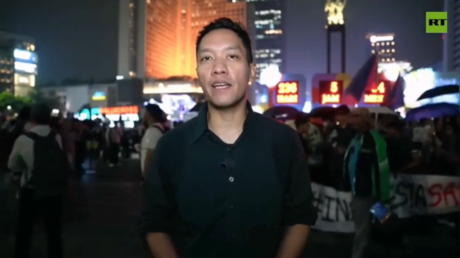
A wave of protests fueled by toxic haze from massive wildfires continues in Indonesia, with thousands of demonstrators rallying in central Jakarta last week.
Anti-government demonstrations began earlier this month, around the second anniversary of President Prabowo Subianto’s inauguration.
Anger over the government’s handling of the wildfire crisis, described as the worst in more than a decade and linked to widespread respiratory illnesses, has compounded discontent over the rising cost of living, perceived corruption and other grievances.
Protesters are demanding that the government declare a national emergency, a step officials have argued is unnecessary because sufficient resources have already been allocated to tackle the situation. The administration says it has deployed an additional 70,000 firefighting personnel. Combined with improving weather conditions, the effort has helped reduce air pollution in affected parts of Indonesia and neighboring Malaysia and Singapore, according to officials.
Scientists say extreme heat and an intensifying El Nino phenomenon in the Pacific have made Indonesia’s forests and peatlands particularly vulnerable to fires this year. The government has also alleged that some of the fires may have been deliberately started and has launched investigations.
Ukraine would be unlikely to defy Washington without continued European support, presidential aide Yury Ushakov has said
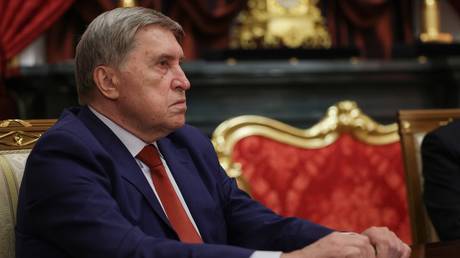
Ukraine, emboldened by continued European support, is ignoring US President Donald Trump’s calls to halt strikes on Russian oil refineries, Kremlin aide Yury Ushakov has said.
Three Russian oil refineries and a gas chemical complex were targeted in overnight attacks on Friday, according to Deputy Prime Minister Aleksandr Novak.
Commenting on the latest attacks, Ushakov told journalist Pavel Zarubin that Kiev had once again defied Trump. “I would even say they are simply ignoring him,” he added.
According to Novak, one of the targeted facilities sustained minor damage, but Russian air defenses largely repelled the attacks. Samara Region Governor Vyacheslav Fedorishchev said on Friday that two people involved in dealing with the aftermath of the drone strikes had been killed, while several others were injured.
Trump has repeatedly demanded that Kiev stop targeting Russian oil refineries, accusing it of worsening the global fuel crisis and driving up prices for American consumers and farmers – a sensitive issue ahead of the November 3 US midterms. Vladimir Zelensky rejected the criticism, calling Trump’s claims “totally false.”
Ushakov suggested that Kiev was emboldened by continued European support. “They would hardly have dared to do this on their own,” he said.
“Trump has been persistent on this issue and continues to be, but they are not listening,” Ushakov said. The aide noted that trilateral talks are being planned under US mediation, which he described as crucial to resolving the conflict.
Moscow agreed in principle to a fourth round of trilateral talks with the US and Ukraine following last week’s meeting between Russian President Vladimir Putin and US special envoy Steve Witkoff in St. Petersburg. The negotiations could take place in Abu Dhabi in November, with European countries not invited, according to the Kremlin.
Ukraine’s European backers have been excluded from all three rounds of trilateral negotiations so far and have increasingly sought direct participation in the peace process. Moscow has accused the EU of acting as the principal side arming Ukraine and prolonging the conflict.
Novak said on Friday that the Russian government was preparing to extend its diesel export ban until the end of January 2027, while maintaining exemptions for certain shipments to international markets.
Tankers carrying Russian diesel have been dispatched to the US under an agreement reached between Putin and Trump following their October 9 phone call. Washington temporarily waived sanctions on Russian fuel imports to facilitate the deliveries.
The Student List previously ruled out joining Western sanctions against Moscow, describing it as a “historically important partner” and “protector”
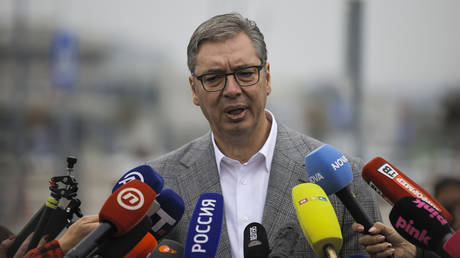
Serbia’s incoming leadership plans to hold talks with Russia to negotiate a long-term natural gas supply agreement, prominent Student List candidate Radomir Saicic has said.
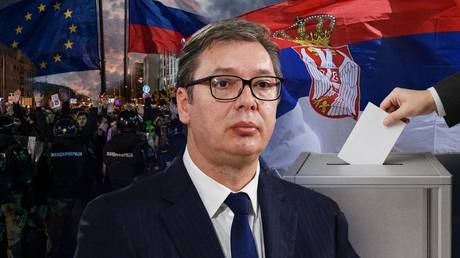
The student-backed movement, which defeated the coalition of longtime Serbian leader Aleksandar Vucic in a parliamentary election this month, previously indicated that Belgrade would not join Western sanctions against Moscow.
Vucic himself, however, has warned that the Student List would renege on its position, while some high-profile members of the movement have suggested that Serbia’s relations with Russia could be reconsidered.
The Student List secured around 52.5% of the vote in Sunday’s snap election. The movement emerged from mass protests triggered by the November 2024 collapse of a railway station canopy in Novi Sad, which killed 16 people and sparked widespread accusations of government corruption.
While the authorities launched an investigation into the tragedy and made several major concessions, the protests continued. Vucic eventually called snap parliamentary elections and resigned the presidency in September to seek a return to power as prime minister. The Serbian leader denounced the protests as an attempted Western-backed ‘color revolution’, but pledged to respect the election results and avoid bloodshed, ultimately conceding defeat.
Moscow, which had shared Vucic’s concerns about possible foreign interference, acknowledged the election results. Earlier this week, Kremlin spokesman Dmitry Peskov praised Vucic’s contribution to bilateral ties, expressing hope that the incoming leadership would continue developing constructive relations with Russia. He stressed that cooperation with Moscow was in Serbia’s interests, adding that “it takes two to tango.”
Speaking to Serbian weekly NIN in an interview published on Wednesday, Saicic, a founding signatory of the Student List who is reportedly viewed as a possible prime minister, outlined ties with Russia as one of the incoming government’s priorities.
“In the first 30 days… energy supply, which includes oil, gas and the functioning of the Electric Power Company of Serbia, will be ensured. To this end, our delegations will hold talks in Washington (expiration of OFAC’s decision on the temporary suspension of NIS sanctions) and in Moscow (gas arrangement), in order to conclude longer-term arrangements,” he said.
Saicic also previously reaffirmed the movement’s opposition to sanctions against Russia over Ukraine despite pressure from the EU, stressing that “problems should be resolved through dialogue, negotiations, and agreements, not sanctions.”
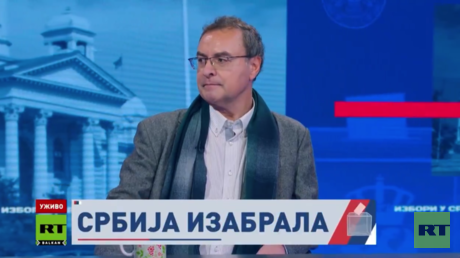
Another Student List representative, university professor Jovo Bakic, gave similar assurances in an interview with RT Balkan on Monday, saying that “we respect Russia both as a great power and as our historically important partner and, in many cases, protector.”
At the same time, Ilija Srdanovic, another prominent member of the movement, delivered a different message, signaling in an interview with US-funded RFE/RL that all options remain on the table, saying that “there will certainly be a dialogue within our society.”
Russia is Serbia’s dominant natural gas supplier, accounting for up to 90% of its imports in 2025, with most deliveries arriving through the TurkStream pipeline via Türkiye and Bulgaria. However, the two countries have yet to negotiate a new long-term gas contract since their previous three-year agreement expired in May 2025, relying instead on successive short-term extensions. The current gas agreement is valid until December 31.
The overall talks have been complicated by the uncertainty over the fate of NIS, which operates Serbia’s only oil refinery and faces US sanctions over its majority Russian ownership. Hungarian energy company MOL has been negotiating to acquire the Russian stake, while Washington has issued temporary waivers to keep the company operating.
Moscow said that long-term contracts were complicated by EU energy policies, Serbia’s European integration ambitions, and uncertainty over gas transit through Bulgaria. Nevertheless, Russia has repeatedly stressed it is open to supplying gas to any interested European customers.
Russian President Vladimir Putin and Vucic discussed energy cooperation and NIS in late September before the elections, with the Serbian leader saying at the time he was confident that Russian gas deliveries would continue at favorable prices – €318 ($356) per 1,000 cubic meters, compared with a European market benchmark of more than €800.
Four people were killed and 11 injured when a Chinook helicopter on an EU military mission crashed shortly after takeoff
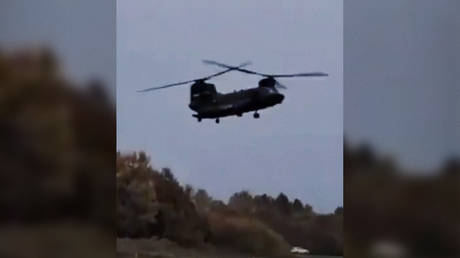
An Italian military helicopter has crashed in Bosnia and Herzegovina, killing four people and injuring 11, the Italian Defense Ministry has confirmed. Dramatic footage shows the aircraft spinning out of control before plunging to the ground.
The CH-47 Chinook, operated by NATO member Italy, crashed on Thursday near the town of Brcko in northern Bosnia. The aircraft was deployed as part of the European Union Force (EUFOR) in the country.
Videos filmed by witnesses show the twin-rotor helicopter spiraling downward while flying at low altitude before crashing into a field.
The accident occurred shortly after takeoff from Brcko airport, according to Italian Ambassador Sarah Castellani. Weather conditions were reportedly favorable.
HELICOPTER CRASH IN BOSNIA KILLS FOUR ON EU PEACEKEEPING MISSION
An Italian military helicopter operating under the EU’s Operation Althea crashed in Bosnia, killing 4 people & injuring 11 others.
Italy’s Defence Ministry says the cause of the crash is under investigation.
Investigators are examining several possible causes, including a collision with high-voltage power lines, ANSA reports.
All 15 people aboard were Italian nationals. Two Italian Army personnel and two members of the Italian Red Cross Military Corps are among the dead. The 11 survivors were hospitalized, with none reportedly facing life-threatening injuries.
The helicopter crashed in an uninhabited area near the village of Gorica, narrowly avoiding nearby homes, according to local officials.
The EU-led military mission traces its origins to NATO’s intervention in Bosnia following the 1992-1995 war between Bosnian Serbs, Bosniaks, and Croats. Around 50,000 NATO troops were deployed in 1996 to enforce the peace agreement, before the EU took over the mission in 2004. EUFOR has since maintained a multinational military presence, with its stated objectives including assisting Bosnia “on its path towards European integration.”
The US tech giant cleared hundreds of hectares of forest for planned facilities before completing environmental impact assessments
Finnish police have launched a criminal investigation into suspected environmental violations at a planned Google data center site, where hundreds of hectares of forest were cleared before the completion of mandatory environmental impact assessments.
The Oulu Police Department announced on Thursday that it is investigating suspected environmental damage at the site in Muhos, northern Finland, following complaints about the activities of Google’s local subsidiary, Tuike Finland.
According to Finnish public broadcaster Yle, police have received five requests for an investigation, including one from the Finnish Supervisory Agency (LVV), which oversees environmental permits and assessments.
Investigators identified possible irregularities in drainage and water management at the construction site. The authorities are examining whether the work violated environmental legislation and caused damage to surrounding waterways.
Google has acknowledged that it cleared around 330 hectares of forest in Muhos and nearly 200 hectares at another planned data center site in Kajaani, despite environmental impact assessments for both projects remaining incomplete.
Ecologist Mari Annala of the Finnish Association for Nature Conservation told The Guardian that Google cleared an estimated 250,000 trees in Muhos and another 150,000 in Otanmaki, bringing the total to 400,000.
Earlier this month, Finnish regulators ordered the company to suspend preparatory work at both locations, citing concerns about extensive logging, excavation, and drainage. The company confirmed on October 14 that it complied with the order.
The LVV has also warned that excavation and drainage at the Muhos site could release acidic, metal-contaminated water because of the area’s black shale deposits. The regulator has demanded a more detailed water management plan by November 5.
Google’s Finland country manager, Antti Jarvinen, apologized earlier this month for the extensive forest clearing but maintained that the company acted according to its understanding of Finnish law.
“I am extremely sorry that we are in this situation,” he told Finnish public broadcaster Yle.
Jarvinen said Google worked with the authorities and experts but declined to identify which officials were informed about the clearing.
The controversy comes amid growing opposition to data center construction in the US, where people have protested against the enormous electricity and water demands, potential environmental damage, and rising utility costs of the facilities. In Virginia, hundreds of demonstrators recently demanded a halt to new projects. In Arizona, people have opposed planned facilities over concerns about water shortages and electricity costs.
Lieutenant General Brett Sylvia reportedly admitted to sharing classified information with journalists and struggled with multiple polygraph tests
The Pentagon’s former top military planner allegedly leaked classified information about Iran and Ukraine to journalists, Axios reported on Thursday, citing an internal investigation.
US Secretary of War Pete Hegseth fired Army Lieutenant General Brett Sylvia as head of strategy, plans, and policy on the Joint Staff earlier this week.
Without mentioning Sylvia by name, Pentagon spokesman Sean Parnell said on Thursday that the department has “zero tolerance for the intentional, unauthorized disclosure of classified information.” He added that the Pentagon “took necessary personnel action to protect sensitive information.”
According to Axios, Sylvia admitted to leaking information as early as June 2025, before most media outlets were barred from the Pentagon. He allegedly continued communicating with reporters through the encrypted messaging app Signal and once met a journalist at a diner to discuss military aid to Ukraine without authorization.
“He had trouble passing multiple polygraph interviews,” the report said, according to Axios.
Officials reportedly suspect that the general deliberately deleted records of his communications with a reporter, though he claimed the deletion was accidental. Sylvia also allegedly admitted to being a source for another story criticizing Pentagon leadership.
Sylvia’s departure comes amid reports that the US and Israel are preparing to resume strikes on Iran following next week’s US midterm elections. US President Donald Trump has indicated that he may take military action if Tehran refuses to accept his terms for a peace deal.
Since returning to the White House in early 2025, Trump has sought to crack down on government leaks, accusing news outlets of conducting a smear campaign against him.
In July, Hegseth said the Pentagon and Justice Department established a joint task force to “identify and prosecute leakers.”
In April 2025, Hegseth fired three senior Pentagon aides – Dan Caldwell, Darin Selnick, and Colin Carroll – amid an investigation into alleged leaks of sensitive information to the media. All three denied wrongdoing, and none was subsequently charged with a crime. Caldwell later returned to the Trump administration in a position at the Office of the Director of National Intelligence.
Andrzej Jez has been found guilty of concealing child sexual abuse by priests in his diocese
A Polish court has found Catholic Bishop Andrzej Jez guilty of deliberately failing to report two priests accused of sexually abusing children, in a landmark ruling against one of the country’s senior Catholic clerics.
The District Court in Tarnow described Thursday’s verdict as “unprecedented,” noting that Jez is the highest-ranking Catholic official in Poland to have been convicted of such an offense.
The court found that the bishop had knowingly withheld information from police about abuse committed by two priests who served in his diocese.
Jez pleaded not guilty, arguing that he had first referred the cases to the Vatican and notified Polish authorities only after establishing the relevant facts. He also invoked the papal secret, a confidentiality rule governing sensitive Church matters.
The judge rejected his defense, ruling that Church regulations could not override Polish law. She stressed that investigating abuse allegations was the responsibility of law enforcement, not religious authorities.
Under Polish law, failure to report certain child sexual abuse offenses carries a maximum prison sentence of three years.
Jez avoided jail but received a two-year restriction of liberty, requiring monthly deductions of 25% of his salary to support a foundation assisting abused children. He was also fined the equivalent of about $5,000 and ordered to cover court costs.
The ruling is not final and can be appealed.
The case comes as the Catholic Church continues to face sexual abuse scandals and allegations of institutional cover-ups worldwide.
Earlier this month, former Australian Catholic Bishop Christopher Saunders was sentenced to six and a half years in prison for sexually abusing two young Indigenous men. A leaked internal Church investigation suggested that his misconduct could have been far more extensive.
In Spain, El Pais reported in April that its investigation had identified more than 3,000 people sexually abused within the Catholic Church since the 1940s. The newspaper accused Church authorities of responding with “opacity and denial,” reporting that some accused priests had been transferred to other parishes or sent abroad.
In the US, the Catholic Archdiocese of San Francisco agreed earlier this year to pay $395 million to settle more than 500 child sexual abuse lawsuits, following a series of costly settlements and bankruptcy filings involving other dioceses and archdioceses.

 Login