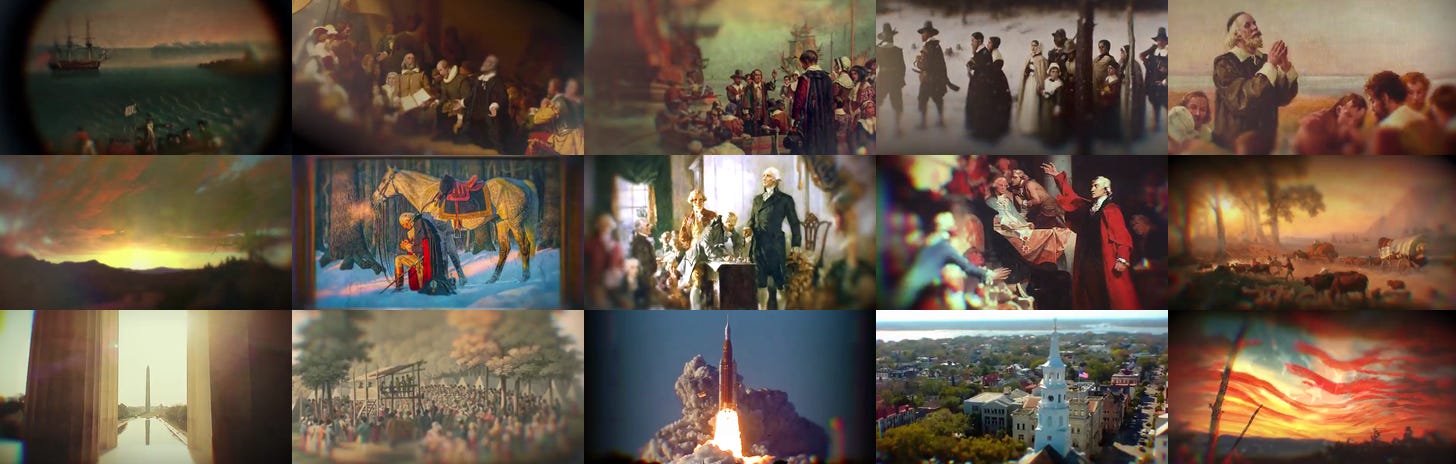
The United States Department of State has celebrated America’s Christian heritage in a social media post marking International Religious Freedom Day.
“America, more than any other nation in world history, was shaped by the Christian tradition of spreading the gospel unto all nations,” the department wrote.
The post was accompanied by a video of Secretary of State Marco Rubio, who said:
Our faith calls us outwards into the limitless darkness of the unknown. It tells us to go forth and preach the gospel to the world as a witness unto all nations unto the ends of the earth.
From that command came America. Our nation, more than any other in history, was shaped by this Christian idea. This is who we are.
And from the beginning, we have carried the belief that our country represents something new in the world. But the soul of our nation has always been rooted in an ancient faith.
For all its faults, the United States stands as a remarkable testament to Gospel truth. Its early leaders understood that the nation’s well-being and future depended upon the preservation of its religious and moral foundations.
On September 17, 1796, in his Farewell Address, George Washington described the Christian religion and morality as the “indispensable supports” of national prosperity.
For Washington, the Constitution alone was insufficient. Its stability depended upon two essential pillars: Religion and Morality.
He said:
Of all the dispositions and habits which lead to political prosperity, religion and morality are indispensable supports.
In vain would that man claim the tribute of Patriotism, who should labor to subvert these great pillars of human happiness, these firmest props of the duties of men and citizens.
The mere Politician, equally with the pious man, ought to respect and cherish them.
A volume could not trace all their connections with private and public felicity…
Washington went on to warn against the assumption that morality could be maintained without religion.
Let us with caution indulge the supposition that morality can be maintained without religion. Whatever may be conceded to the influence of refined education on minds of peculiar structure, reason and experience both forbid us to expect that national morality can prevail in exclusion of religious principle.
Topple the nation’s religious foundations, and its morality falters. Topple both, and the very basis for liberty, human rights and prosperity begins to collapse.
There’s little wonder why Washington’s fellow Founding Father, John Adams, similarly warned in 1798:
Our Constitution was made only for a moral and religious People. It is wholly inadequate to the government of any other.
Both men understood that a free society required a morally restrained people. Without that restraint, no constitution, however carefully written, could prevent its eventual decay.
The Christian religion and its moral framework were absolutely vital.
No doubt Washington would see little coincidence in the fact that America’s present disorder was preceded by decades of anti-Christian propaganda, which steadily infiltrated its institutions and public square under the guise of “secularism,” “diversity,” and “pluralism.”
For generations, Christianity has been pushed out of public life while the nation has continued to expect the benefits of the civilisation it produced.
We have been told that religion is a private matter, that morality can be maintained independently of God, and that a nation can abandon its Christian foundations without consequence.
Washington warned against precisely this delusion.
And while modern secularists insist that government must remain religiously neutral, Washington understood that the acknowledgement of God was not merely a private obligation.
Whereas it is the duty of all Nations to acknowledge the providence of Almighty God, to obey his will, to be grateful for his benefits, and humbly to implore his protection and favor.
Notice that Washington described this as the duty of all nations, not merely the United States.
This was no peculiar American obligation. Nations do not exist independently of God, nor are their rulers exempt from his moral authority.
Scripture makes this explicit. The kings and rulers of the earth are commanded to serve the Lord (Psalm 2:10–12), and Christ himself declared that all authority in heaven and on earth belongs to him (Matthew 28:18).
The state may refuse to acknowledge that authority, but it cannot escape it.
Surely, much of the moral and political chaos we are witnessing today is the inevitable consequence of neglecting this essential duty.
And it’s for that reason that the State Department’s proclamation is rightly being welcomed by Christians who have grown accustomed to seeing their nation’s religious heritage either neglected, ridiculed, or undermined.
It is an encouraging acknowledgement of something America’s founders understood, but successive generations have increasingly forgotten.
Christianity is not merely one cultural influence among many. It supplied the moral framework upon which American civilisation was built.
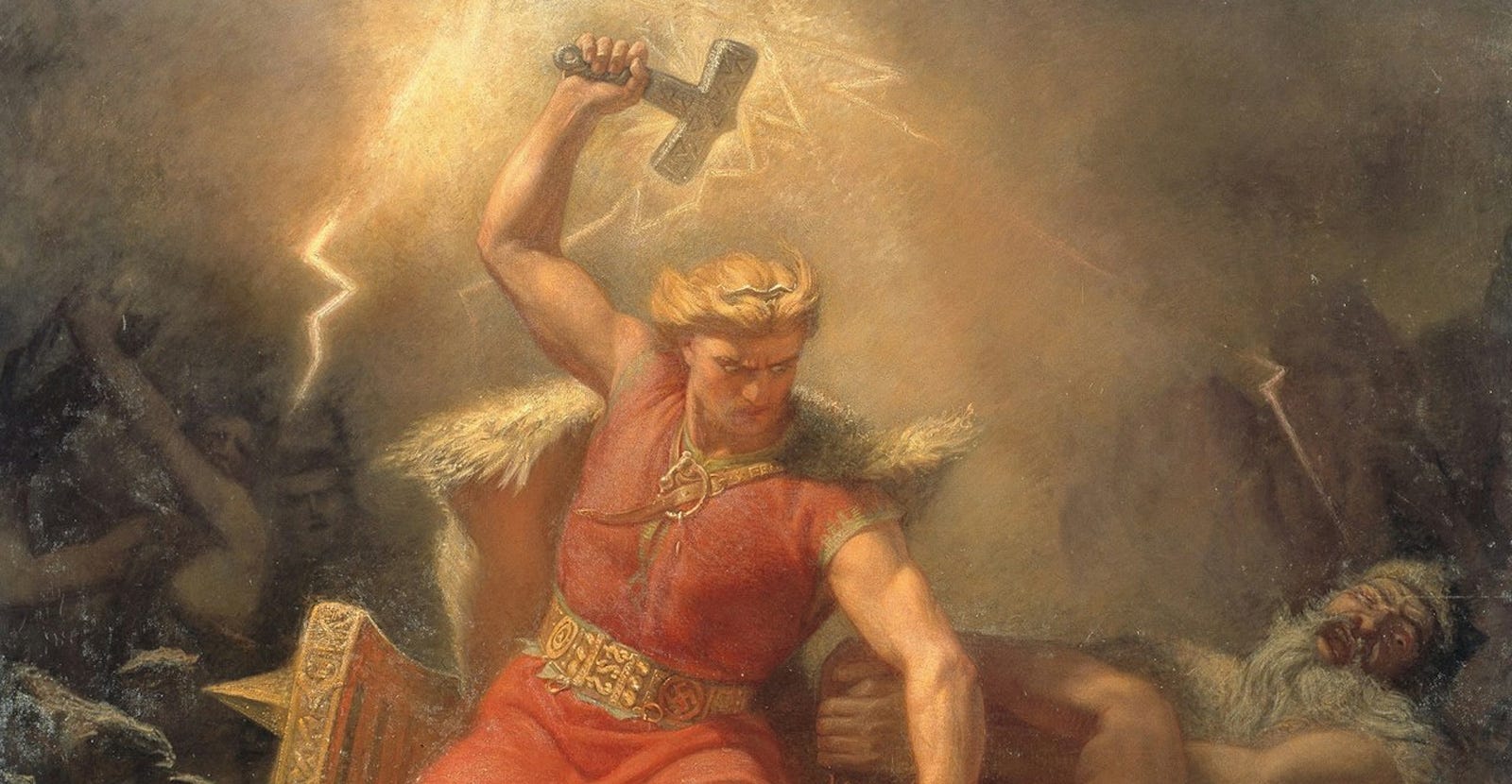
Thor’s Fight with the Giants (Tors strid med jättarna) by Mårten Eskil Winge (1872).
As disillusioned young Europeans turn to the pagan gods of their ancestors, they are embracing the very religion their forefathers abandoned, and often remaking its gods in the image of the Christ they reject.
There’s a growing temptation among young European men to look beyond their Christian heritage and return to the pagan religions that preceded it.
In an age of mass immigration, militant multiculturalism, and growing hostility towards Europe’s historic identity, the appeal is understandable. Many young Europeans are rediscovering an appreciation for their ancestry, their people, and the civilisation their forefathers built.
But some are looking in precisely the wrong direction.
Rather than recovering the faith that shaped European civilisation, they’re retreating into the mythology their ancestors rejected. In their attempt to reclaim their European identity, they’re abandoning one of the very things that made Europe what it became.
They’re exchanging Christ for Odin.
And the irony is that, to make these pagan gods worthy of admiration, they often have to remake them in the image of the very Christ they reject.
Pagan gods with Christian virtues
Spend any time observing the modern fascination with Norse mythology, particularly in nationalist and neo-pagan circles, and you’ll encounter a romanticised picture of the ancient gods.
Odin is presented as the wise, benevolent All-Father, a courageous protector willing to sacrifice himself for others. Thor is portrayed as the honourable defender of mankind, a selfless warrior who risks everything to protect the weak.
But anyone who’s read the Poetic Edda or Prose Edda knows these aren’t consistently the characters described in the surviving mythology.
The Norse gods certainly possess some admirable qualities, including courage, loyalty, and endurance. But they’re also frequently deceitful, selfish, treacherous, vindictive, and cruel. They’re driven by power, reputation, vengeance, and personal advantage.
These aren’t merely Christian criticisms of pagan mythology. They’re observations made by scholars who’ve studied the original texts.
“…judged by Abrahamic standards, the Norse gods are not at all godly.”
Likewise, scholars Ben Raffield, Neil Price, and Mark Collard, in their study Religious Belief and Cooperation, describe the Norse gods as morally inconsistent, sometimes concerned with morality while behaving immorally themselves.
“if Loki is the most disparaged of the gods, Ódinn runs a close second.”
Indeed, even Odin’s famous self-sacrifice upon the world tree, described in Hávamál 138–141, wasn’t performed to save mankind. He suffered to acquire knowledge of the runes and their supernatural power.
Compare that with Jesus Christ, who voluntarily suffered not to obtain something for himself, but to give salvation to others.
Odin sacrifices himself to gain. Christ sacrifices himself to give.
One seeks power. The other lays down his life for his people.
Even Odin’s title All-Father doesn’t make him a benevolent heavenly father. The mythology repeatedly depicts him as manipulative, deceptive, and willing to sacrifice others to accomplish his purposes.
Christ, by contrast, declares:
“Greater love hath no man than this, that a man lay down his life for his friends” (John 15:13).
The distinction couldn’t be clearer.
Hollywood’s Christianised paganism
Perhaps nowhere is this contradiction more obvious than in Hollywood.
Marvel’s Thor is portrayed as a noble hero who learns humility, compassion, and self-sacrifice. Odin becomes a wise father who teaches his son the virtues of restraint, responsibility, and sacrificial leadership.
But these characters are often closer to the Christian heroic ideal than to the gods described in the Eddas.
To make Thor admirable, Hollywood gives him virtues Christians recognise in Christ. To make Odin a better father, it softens the characteristics that distinguish him in the mythology.
In other words, they make the pagan gods more Christian and less pagan.
The irony is extraordinary.
Some men reject Christianity because they believe it has weakened European masculinity, only to celebrate fictionalised pagan gods whose most admirable qualities resemble those of Jesus Christ.
They want Thor’s strength, but Christ’s character.
They want Odin’s authority, but the heavenly Father’s benevolence.
They’re borrowing Christianity’s moral capital while rejecting its source.
The religion their ancestors rejected
There’s another irony that’s often overlooked.
Much of what we know about Norse mythology survives because Christians preserved it after Scandinavia’s conversion.
The Poetic Edda contains older traditions, but its principal surviving manuscript was produced in Christian Iceland during the thirteenth century.
The Prose Edda was compiled around 1220 by Snorri Sturluson, himself a Christian, to explain the mythology and poetic traditions of earlier generations.
These weren’t pagan scriptures preserved by a continuous pagan priesthood. They were medieval literary works recording traditions from a religious world their Christian compilers no longer believed in.
That doesn’t mean Christians invented Norse mythology. Its traditions are considerably older. But the texts modern neo-pagans rely upon owe much of their preservation to Christians.
Think about that.
Modern neo-pagans reject Christianity to recover the religion of their ancestors, yet much of what they know about that religion survives because their Christian ancestors recorded it.
They’re trying to revive a religion through texts preserved by men who didn’t believe its gods were divine.
And why did their ancestors abandon Odin?
Because they came to believe that Jesus Christ was greater than the gods they’d previously worshipped.
They exchanged gods who could deceive and betray for the God who cannot lie (Titus 1:2).
They exchanged gods who feared their own destruction for the eternal God who rules over creation.
They exchanged morally inconsistent deities for the God who demonstrated his love by dying for sinners (Romans 5:8).
The conversion of Europe wasn’t instantaneous, nor was it free from political pressure. But over the centuries, European peoples increasingly embraced Christianity and abandoned their former gods.
And today’s neo-pagans are now reversing that decision in the name of honouring their ancestors.
Christianity isn’t foreign to Europe
One of the more common arguments among European neo-pagans is that Christianity is a Jewish or Middle Eastern religion and therefore has no place among Europeans.
However, Christianity never claimed to belong exclusively to one ethnic group. Its claim is that the God who created all nations has revealed himself in Jesus Christ, and that every nation owes him allegiance.
Christ didn’t command his disciples to convert only the Jews. He commanded them to make disciples of all nations (Matthew 28:19).
Nor were Europe’s ancient pagan religions entirely isolated from the wider world. Germanic mythology belongs to a broader Indo-European religious heritage, with parallels to traditions beyond northern Europe. In fact, much of Norse mythology reflects the pantheon worshipped in Mesopotamia, Greece, ancient Iran, and possibly India.
But there’s a deeper irony here.
In rejecting Jesus on account of his Judahite identity, these neo-pagans find themselves agreeing with those who rejected his claim to be the Messiah, while rejecting the testimony of their own Christian ancestors who embraced him.
They claim to honour their forefathers while dismissing the very faith those forefathers passed down for generations.
For more than a thousand years, Christianity has been inseparable from Europe’s identity.
A European who abandons Christ for Odin isn’t returning to the religion of his fathers. He’s abandoning the religion of his fathers for an error his fathers long rejected.
The civilisation Christianity built
Christianity didn’t merely replace Europe’s religious ceremonies. It transformed the continent’s moral awareness, institutions, education, laws, and understanding of human responsibility.
Monasteries became centres of literacy, scholarship, agriculture, and manuscript preservation. Churches established schools, supported hospitals, developed universities, and commissioned some of Europe’s greatest architectural achievements.
Christianity also supplied a shared moral framework across peoples who’d previously belonged to competing tribes, kingdoms, and religious traditions.
It taught that kings, no less than their subjects, stood beneath God’s authority. Civil power wasn’t ultimate. Rulers were accountable to a moral law they hadn’t invented and couldn’t legitimately redefine.
And it transformed the meaning of greatness.
In the ancient heroic world, greatness was often measured by conquest, reputation, strength, and the ability to impose one’s will upon others.
Christ declared that greatness was demonstrated through service.
“Whosoever will be chief among you, let him be your servant” (Matthew 20:27).
Christianity didn’t abolish courage, honour, loyalty, or the natural bonds of family and nation. It placed them under a higher moral authority.
It gave Europeans something greater than the worship of their own strength.
It gave them a standard by which strength itself could be judged.
None of this means pre-Christian Europeans lacked civilisation or virtue, or that every Christian ruler acted righteously. But Christianity profoundly shaped the civilisation that emerged from the medieval world.
Europe didn’t flourish because its people ceased to be European. It developed, in substantial part, because European peoples built upon their inherited cultures within a Christian understanding of reality.
They didn’t have to abandon their ancestry, languages, homelands, or national traditions.
They had to recognise that these things weren’t ultimate.
Christ was.
The wrong answer to a real problem
There’s nothing wrong with young European men rediscovering their ancestors, preserving their heritage, studying their mythology, or defending the historical continuity of their nations.
But preserving one’s heritage and reviving its ancient gods are two very different things.
The growing disillusionment with secular liberalism and multiculturalism raises legitimate questions about national identity, cultural continuity, and the responsibilities owed to future generations.
But paganism isn’t the answer.
Indeed, much of Europe’s present crisis stems from its rejection of the Christian moral framework that helped sustain its civilisation.
Abandoning Christianity even further won’t reverse that decline.
There’s something profoundly contradictory about young European men denouncing Christianity as a foreign influence while venerating pagan gods whose most admirable modern portrayals have been Christianised.
They reject Christ, then praise Odin for resembling him.
They mock Christian humility, then admire Thor when he demonstrates it.
They denounce Christian self-sacrifice as weakness, then celebrate it as pagan heroism.
They reject the religion of their Christian ancestors in the name of honouring their ancestors.
And they recover their supposedly forgotten gods through literature preserved by Christians.
The qualities they’re searching for in Odin and Thor are already present, in their highest form, in Jesus Christ.
Europe doesn’t need to resurrect the gods its forefathers abandoned. It needs to remember why they abandoned them in the first place.

 Login