❌

Reading view

France Accelerates Rafale F5 Upgrade After Collapse Of FCAS Next-Gen Fighter Project

France is accelerating work on the Rafale F5 standard, bringing forward development of a major new configuration of its combat aircraft at a time when the country’s planned next-generation fighter with Germany has effectively collapsed in its original form. The contracts cover the equipment judged to have the highest technical risk, ahead of the overall development contract for the F5 standard, expected for the end of this year.

The French defense procurement agency, the Direction générale de l’armement (DGA), ordered the first upstream development work for F5 from Dassault Aviation, Thales, MBDA, and Safran. The contracts cover key areas including navigation, datalinks, radar, electronic warfare, and propulsion, laying the groundwork for the next configuration of the Rafale, which is planned to enter service with the French Air and Space Force and the French Navy starting around 2033.

#Commande | Rafale F5

La DGA commande les 1ers travaux en amont du prochain lancement en réalisation du standard F5 du Rafale

Ils concernent notamment :
➡la centrale inertielle
➡le moteur
➡le radar
➡la suite d’autoprotection de l’avion
⤵ pic.twitter.com/n3uhBYqIvi

— Direction générale de l'armement 🇫🇷 (@DGA) September 9, 2026

The most extensive modernization of the Rafale yet, the F5 standard was originally part of a longer transition toward France’s next-generation combat-air capability. But with the Franco-German New Generation Fighter (NGF) effort now effectively dead in its original configuration, the accelerated F5 program is taking on a much larger strategic role.

Concept artwork of the NGF future fighter. Dassault Aviation

Rather than simply keeping the Rafale relevant until NGF arrives, France is now developing a version of the aircraft that is set to carry much of the country’s high-end combat-air capability well into the 2030s and potentially beyond.

The increasingly capable F5 could, in turn, reduce the urgency of finding a replacement for the Rafale — while potentially adding to the fighter’s export appeal. After a slow start, Dassault has recorded export sales of 299 new-build Rafales to eight nations.

The DGA’s contracts engage four of France’s principal combat-aircraft industrial players. Dassault Aviation remains responsible for the aircraft and its overall integration; Thales is involved in major sensor, electronic warfare, and communications capabilities; MBDA is responsible for much of the weapons system; and Safran is responsible for propulsion.

The Rafale assembly line at the Dassault Aviation facility in Mérignac, France. Dassault Aviation – V. Almansa ALMANSA

Previous Rafale standards have largely consisted of incremental upgrades, focusing on software and other improvements to the existing aircraft configuration. F5 is notably more extensive, addressing many of the critical systems that determine how the aircraft senses the battlespace, communicates with other platforms, conducts electronic warfare, and generates the power needed to operate increasingly demanding equipment.

The DGA has specifically identified the Thales RBE2-XG radar as one of the major technological advances associated with F5.

The RBE2-XG is expected to feature gallium nitride (GaN) semiconductors. Compared with previous technology, GaN generates less heat and has the capacity to operate at higher voltages, meaning that output power can be increased, while component size can be reduced. Overall, using GaN should help to get more power out of the radar without increasing its size.

According to the DGA, “This new radar will benefit from a substantial increase in power, and consequently in detection range, as well as improvements in the identification of targets with an extremely low radar cross-section (RCS). Its computing capabilities will also be enhanced to facilitate the integration of artificial intelligence.”

The RBE2-XG will also be “designed with collaborative combat in mind, featuring sensors capable of working together without the need for pilot intervention.” It is also planned to have enhanced resilience, including against cyber threats.

France is already working on the concept of a combat drone to accompany the Rafale, with the future F5 standard providing the crewed aircraft around which those systems can operate.

A Rafale during a test mission with a Dassault nEUROn combat drone demonstrator. Dassault Aviation – A. Pecchi

The new radar will be combined with more capable electronic warfare equipment, improved communications and datalinks, expanded processing capacity, and a more capable propulsion system.

To be developed by MBDA and Thales, the forthcoming F5 version of the SPECTRA self-protection suite is intended to significantly improve detection and jamming capabilities, the DGA says, “through a fully digital approach, enabling a complete overhaul of the core electronic warfare system to counter the increasing density and broadening of the threat spectrum, as well as the growing complexity of threat waveforms, expected by 2035.”

Thales will also be responsible for the new Inter-Vehicle Data Link (IVDL) system, described as a “stealthy and resilient datalink.” The DGA says the new datalink will expand connectivity “thanks to a new high-speed, discreet, and jamming-resistant waveform. IVDL will allow the Rafale to penetrate hostile areas where jammers are widespread, while maintaining optimal quality of communication and dialogue between aircraft.”

Safran will begin preliminary design work on the M88 T-Rex engine, which is planned to increase the turbofan’s thrust from around 16,500 pounds to nearly 19,850 pounds, an increase of roughly 20 percent.

In terms of armament, the contract announcement mentions the ASN4G missile, set to be introduced to service by 2035, which will allow the Rafale F5 to continue to serve as the airborne nuclear component. The munition remains in the early stages of development, but it will be capable of hypersonic speeds — defined as speeds greater than Mach 5 — with a range in excess of 1,000 kilometers (621 miles).

Other likely new missiles include a beyond-visual-range air-to-air missile to succeed the current Meteor. As you can read about here, France’s Comet program, apparently led by the French side of MBDA, is already looking into this requirement, with an apparent plan to introduce the weapon around 2030.

An older video from MBDA showing some of the company’s weapons integrated on earlier versions of the Rafale:

For France, the original logic behind the pan-European FCAS program was that Rafale would eventually give way to the NGF as its principal crewed combat aircraft, operating from land bases and aircraft carriers.

With the collapse of the Franco-German effort, France cannot simply wait for a next-generation fighter program whose industrial and political future is uncertain. Instead, the Rafale has to remain capable against rapidly evolving threats throughout the 2030s and beyond.

With the F5 standard, however, France is looking to incorporate some of the concepts envisaged for NGF. These include distributed architectures in which crewed fighters, uncrewed aircraft, remote carriers, missiles, and offboard sensors cooperate across a battlespace.

The nEUROn drone and a Rafale M in flight over the aircraft carrier Charles de Gaulle, during tests to investigate the use of a UCAV in a naval context. Dassault Aviation – A. Pecchi

A highly upgraded Rafale operating as the crewed controller of uncrewed combat aircraft and remote weapons could perform some of the missions that France originally expected from NGF.

For now, F5 also sidesteps the central problem in the now-defunct Franco-German effort: whether the two countries could agree on the requirements, industrial structure, and workshare behind a new-generation combat aircraft.

Despite its advances, the F5 airframe remains derived from a design dating back to the 1980s, which first entered French service in the early 2000s. In particular, it falls well short of fifth-generation designs — let alone sixth-generation ones — in terms of low observability. This is one area where collaborative drones could potentially help compensate for the Rafale’s inherent limitations.

DA00052389_CCO_
The current standard F4 Rafale with a full weapons load. Dassault Aviation – C. Cosmao © Dassault Aviation – C. Cosmao / © Dassault Aviation – C. Cosmao

France has therefore bought itself some time with the F5 program. But it may eventually decide that it needs a future high-end crewed fighter to provide capabilities that an upgraded fourth-generation airframe cannot fully replicate, particularly in terms of survivability against advanced integrated air-defense systems, signature reduction, internal weapons carriage, and operations deep inside heavily contested airspace.

On an industrial level, F5 is also significant because it brings together the same French industrial heavyweights that would have formed the backbone of its FCAS effort. Dassault Aviation, Thales, Safran, and MBDA are now well-positioned to work together on whatever comes after F5, whether that is a crewed combat aircraft, uncrewed CCA-type platforms, or a combination of both. Based on its experience with the nEUROn program, France would be well placed to develop a UCAV that can work cooperatively as well as independently, taking over the deeper-penetrating fighter mission set, and potentially skipping a sixth-generation fighter altogether.

https://www.youtube.com/watch?v=frNsu7g7r94

Meanwhile, success with F5 — and, in particular, with the wider combat ecosystem planned around it — could put France in an even stronger position when it comes to any future European fighter project.

For the time being, Britain, Italy, and Japan are pursuing the GCAP/Tempest pathway toward a new combat aircraft. Germany and Spain remain tied to the wider FCAS architecture, even as the original Franco-German NGF arrangement has fractured. Sweden’s position is less clear, with indications that it could collaborate with either France or Germany.

France, for its part, is now investing heavily in an increasingly sophisticated Rafale architecture while maintaining its own sovereign industrial base.

In terms of acqusition, France is expected to pursue a mixed approach, buying new-build Rafales while upgrading suitable aircraft already in service to the F5 standard. The oldest jets are unlikely to receive the full F5 treatment, however.

The irony is that the failure of the NGF effort may ultimately make Rafale F5 more important — and potentially more capable — than it was ever expected to be.

Contact the author: thomas@thewarzone.com

The post France Accelerates Rafale F5 Upgrade After Collapse Of FCAS Next-Gen Fighter Project appeared first on TWZ.

  •  

Ukraine’s New Shershen SAM Can Fire A Wild Mix Of Adapted Air-To-Air Missiles

Ukraine has unveiled a new domestically developed surface-to-air missile system designed to turn a diverse collection of air-to-air missiles into a flexible ground-based air defense capability. Called Shershen, Ukrainian for hornet, the system combines a locally-developed command-and-control architecture, a dedicated surveillance radar, and multiple launchers that can employ both Ukrainian and Western missiles.

The system was displayed at the MSPO defense exhibition in Kielce, Poland, by the National Association of Ukrainian Defense Industries (NAUDI). The example shown is reportedly the second operational prototype and is described as being close to its production configuration.

At the ongoing MSPO-2026 defense and industrial exhibition in Poland, the launcher of the Ukrainian Shershen air defense system, developed by Radionix, has been presented for the first time, along with the R-120K surface-to-air guided missile specially developed for it (second… pic.twitter.com/5RfZWHWuxl

— 𝔗𝔥𝔢 𝕯𝔢𝔞𝔡 𝕯𝔦𝔰𝔱𝔯𝔦𝔠𝔱 🦩🇬🇪🇺🇦🇺🇲🇬🇷 (@TheDeadDistrict) September 9, 2026

The appearance of Shershen comes as Ukraine continues to develop an increasingly diverse family of indigenous air defense systems, while simultaneously adapting older missiles and foreign-supplied weapons to address a severe shortage of interceptors.

That effort has produced some distinctly unconventional combinations. Ukraine’s so-called FrankenSAM programs have paired existing Soviet-era launchers and radars with Western missiles, while other systems have adapted Soviet R-73 air-to-air missiles for ground launch. The United Kingdom and Denmark have also worked with Ukraine on the containerized Gravehawk system, another concept built around repurposed air-to-air missiles.

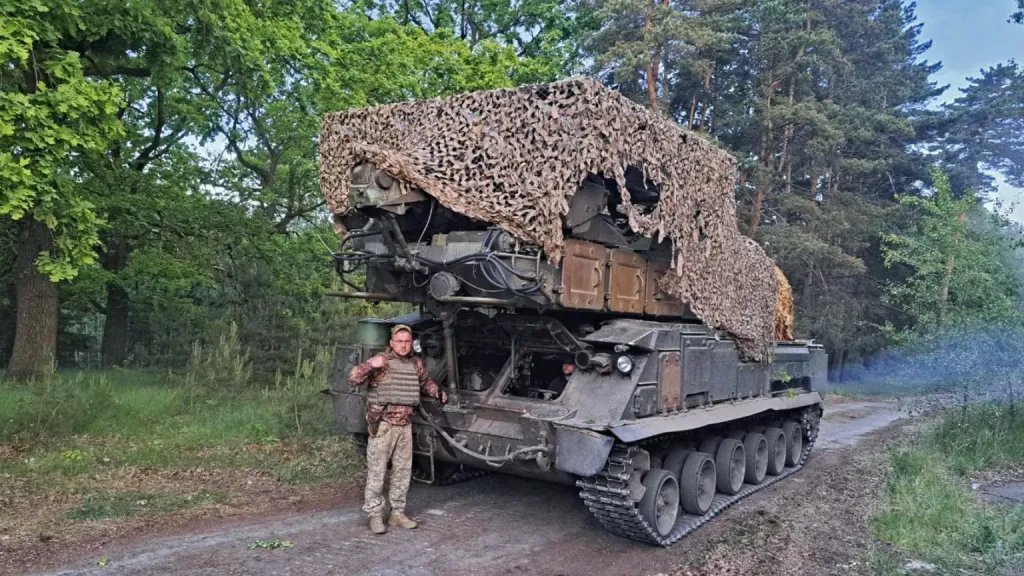
The Buk/Sea Sparrow FrankenSAM combines the Soviet-era Buk transporter-erector-launcher with U.S.-supplied RIM-7 Sea Sparrow missiles. Operational Command East

Shershen takes that philosophy a step further by making missile interchangeability a central feature of the system.

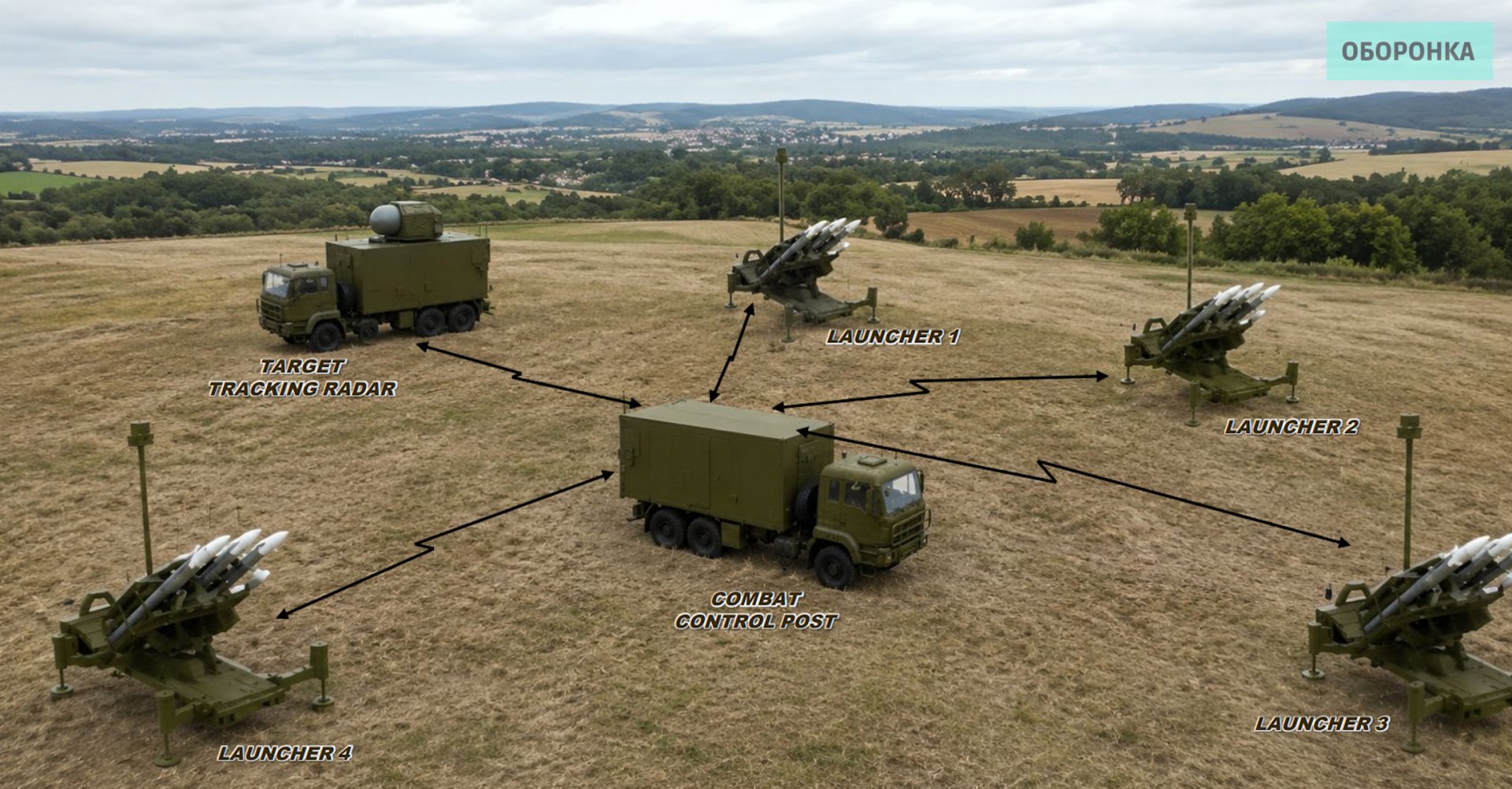
The Shershen battery consists of a Perun command-and-control vehicle, an Athena radar, and four Borei launchers.

A graphic shows a typical Shershen battery. via Oboronka

According to the developer, the system’s architecture is deliberately open. This allows it to use different missiles from different manufacturers and also permits the integration of third-party surveillance and guidance radars.

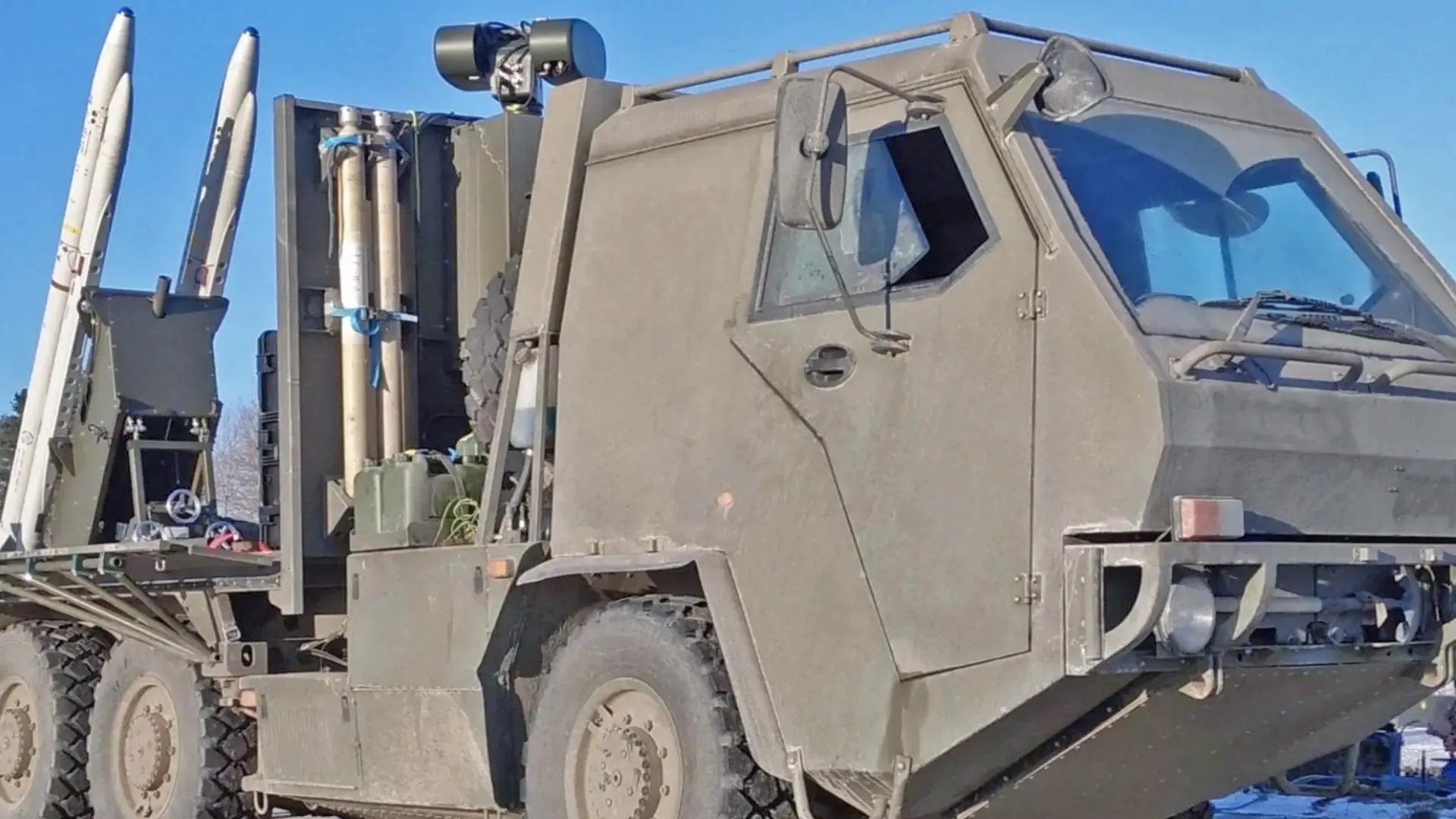
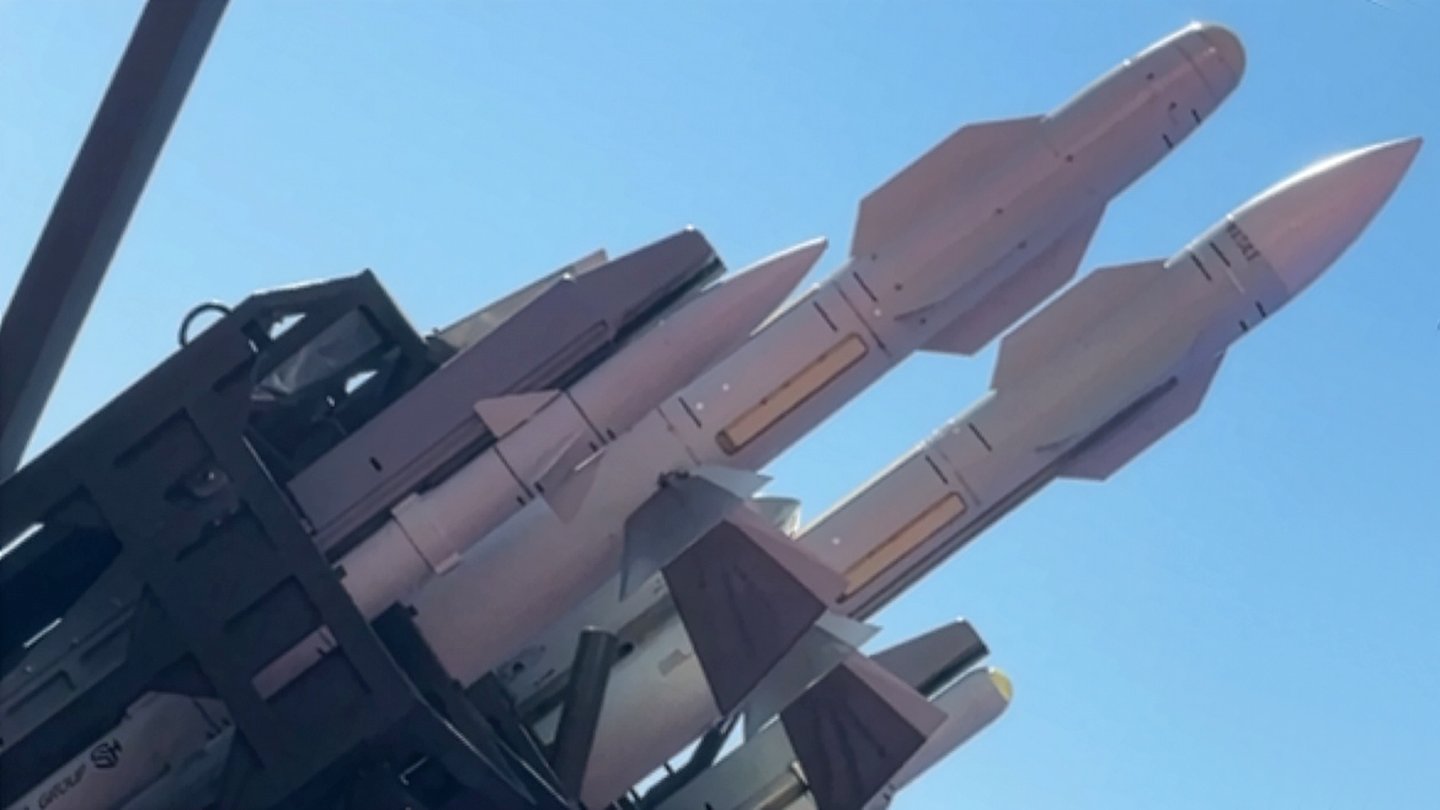
The company says Shershen can currently employ the R-27 (AA-10 Alamo), R-73 (AA-11 Archer), AIM-9 Sidewinder, and AIM-132 ASRAAM, while compatibility with the R-60 is also being explored. These weapons come with a mix of semi-active radar or infrared homing seeker heads.

One of the ASRAAM/Supacat air defense systems supplied to Ukraine. Ukrainian Armed Forces

Air-to-air missiles are already available in considerable variety across Ukraine’s arsenal and those of its foreign partners. Being able to employ several types from a common ground-based system provides much more flexibility than a conventional SAM designed around one dedicated interceptor.

It also offers a way to exploit missiles that were never originally intended to be fired from the ground. That means Shershen’s launcher and fire-control system are meant to be interceptor agnostic, at least to a certain degree.

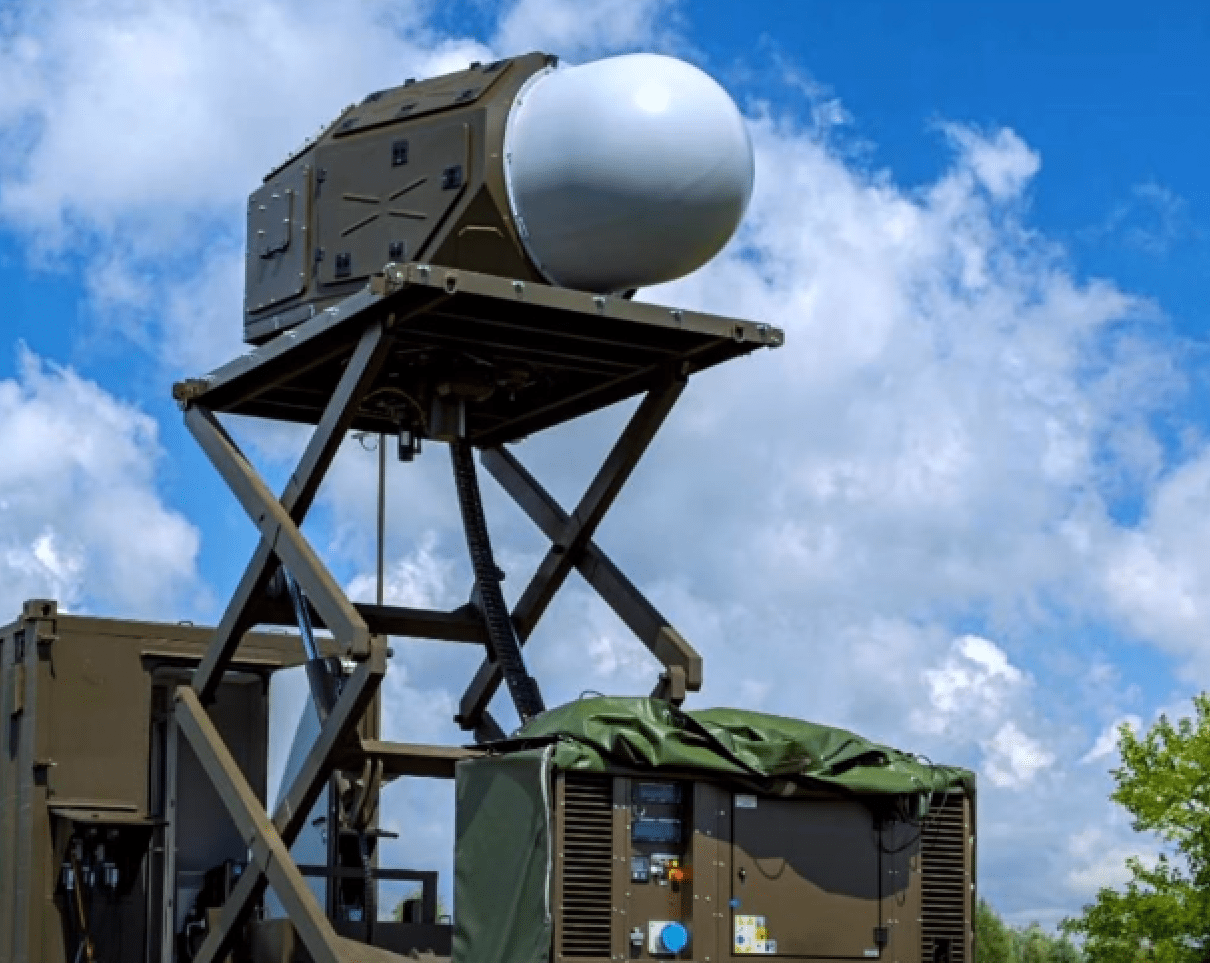
Shershen’s Athena radar is reported to be capable of detecting targets at ranges of up to 85 kilometers (53 miles).

The Athena radar for the Shershen. NAUDI screencap

In terms of the engagement envelope, Shershen is claimed to be capable of engaging aircraft, cruise missiles, and drones at ranges of up to 25 kilometers (16 miles) and altitudes of up to 10,000 meters (32,800 feet). Clearly, these figures will vary widely depending on the type of interceptor.

When employing radar-guided missiles, the system’s engagement architecture can reportedly guide as many as six missiles simultaneously.

The advertised performance figures have not been independently verified, and it remains unclear what target types and engagement conditions were used to establish them.

🇺🇦 Україна представила складові мультикаліберного зенітного ракетного комплексу «Шершень» на міжнародній виставці MSPO 2026 у польському місті Кельце.
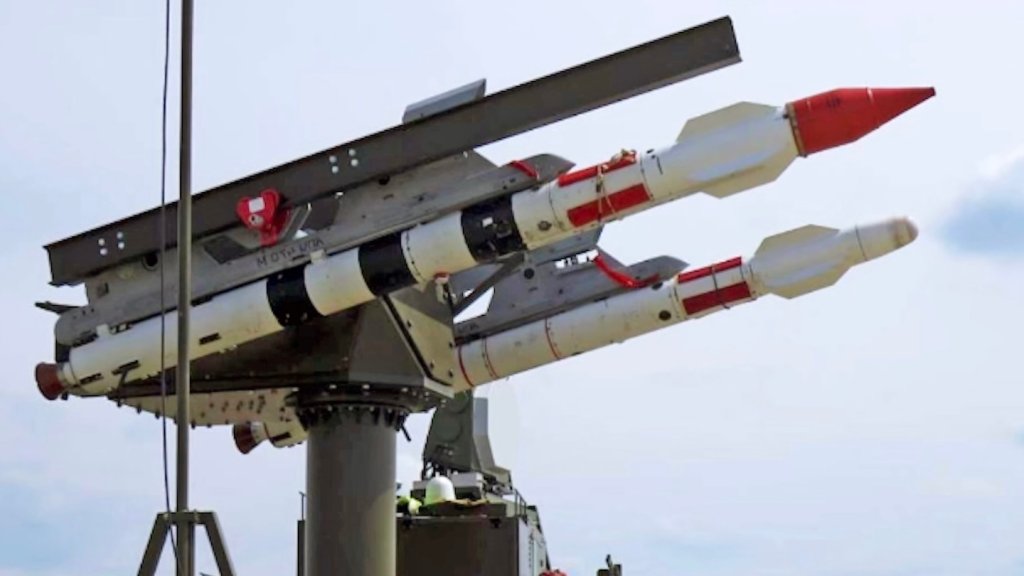
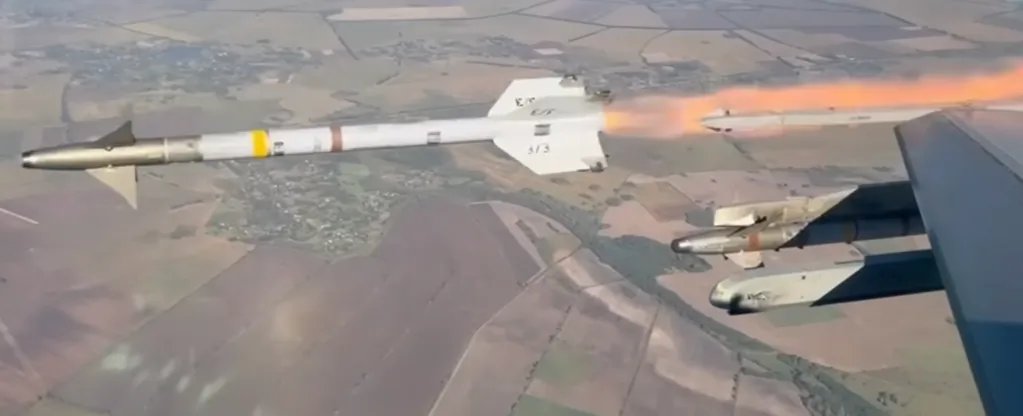
Міжнародний консорціум компаній Shershen Group, який створює ЗРК в інтересах України представив, показав командний пункт,… pic.twitter.com/9wAS7ewxzg

— Мілітарний (@mil_in_ua) September 10, 2026

The developer says the second prototype has completed initial testing, including successful interceptions at a test range.

One of the Borei launchers displayed at MSPO were armed with an R-120K, a new Ukrainian missile equipped with a radar seeker and is intended to be capable of both air-to-air and surface-to-air employment.

The R-120K remains under development, however. Work is reportedly continuing on its rocket motor, meaning that its eventual performance and production status remain uncertain. Still, having the option of including the R-120K on the Shershen system in the future is significant.

Ukraine has unveiled a new surface-to-air missile system designed to turn a diverse collection of air-to-air missiles into a flexible ground-based air defense capability. Called Shershen, or “Hornet,” the system combines a Ukrainian command-and-control architecture, a dedicated surveillance radar, and multiple launchers that can employ both Ukrainian and Western missiles.
A test launcher used for the Shershen program, armed with a radar-homing (nearest camera) and an infrared-guided R-27 missile. The latest prototype features a cage-type container launcher. NAUDI screencap NAUDI screencap

Rather than relying indefinitely on stocks of Soviet and Western air-to-air missiles, Ukraine could eventually have a domestically produced interceptor specifically tailored to its growing family of ground-based air-defense systems. That will become increasingly important as stocks of legacy missiles are depleted. Earlier this year, it was reported that Ukrainian F-16s were running low on their air-to-air missiles, which include the same AIM-9s that are used in some FrankenSAM systems, as well as being compatible with Shershen. But even before that, it was clear that Western-supplied missile stocks in Ukraine across the board were diminishing, in some cases drastically, with critical interceptors like the AMRAAM and Patriot being badly affected.

A live AIM-9L/M Sidewinder launched from the wingtip rail of a Ukrainian F-16. Ukrainian Air Force screencap

Ukraine’s need for additional surface-to-air missiles has become increasingly acute during the full-scale war, especially as Russian drone and missile barrages have stepped up.

The shortage has encouraged Ukraine to pursue a combination of indigenous development and unconventional adaptations.

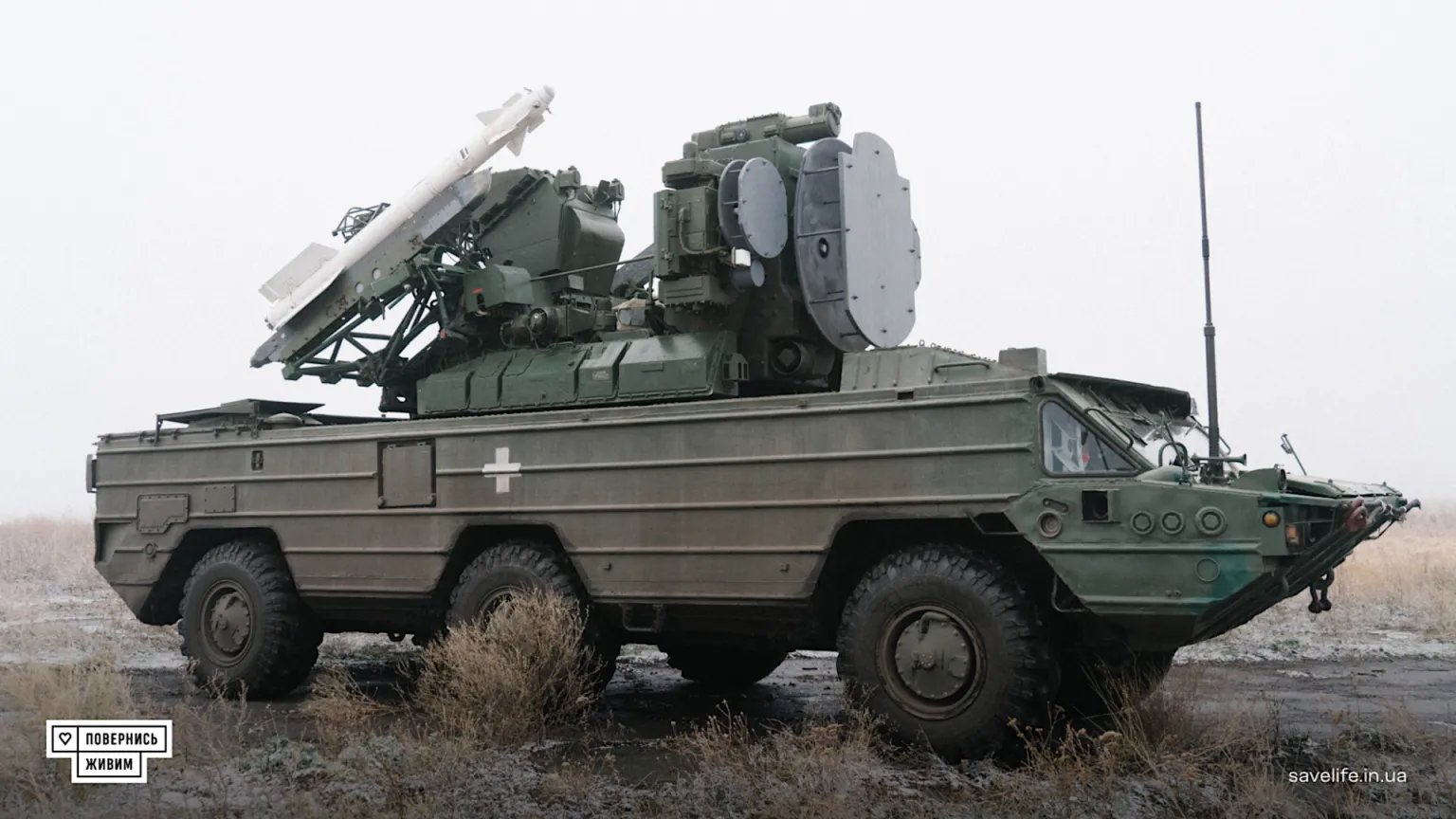
The FrankenSAM initiative, conducted with U.S. support, demonstrated how existing Ukrainian systems could be combined with foreign missiles to rapidly create additional air-defense capacity. Ukraine has also fielded modified Osa systems armed with R-73 air-to-air missiles rather than their original 9M33 interceptors. Other R-73-based concepts have even been demonstrated aboard Ukrainian uncrewed surface vessels.

An R-73 missile loaded on an Osa-AKM SHORADS vehicle. Come Back Alive

Shershen appears to reflect the next logical step in that evolution: rather than creating a one-off FrankenSAM combination, build an architecture from the outset that can accept multiple missiles. Additionally, with so many different ground-based air defense systems now being fielded, it comes with the significant advantage of a standardized launcher and control interface that can accommodate a range of interceptors.

At the same time, Ukraine is pursuing substantially more ambitious indigenous SAM projects.

Earlier this year, a previously secretive Ukrainian missile identified as the Koral made what appeared to be its first public appearance. The program dates back to at least 2021, when Ukraine’s Luch design bureau presented a concept for a medium-range surface-to-air missile.

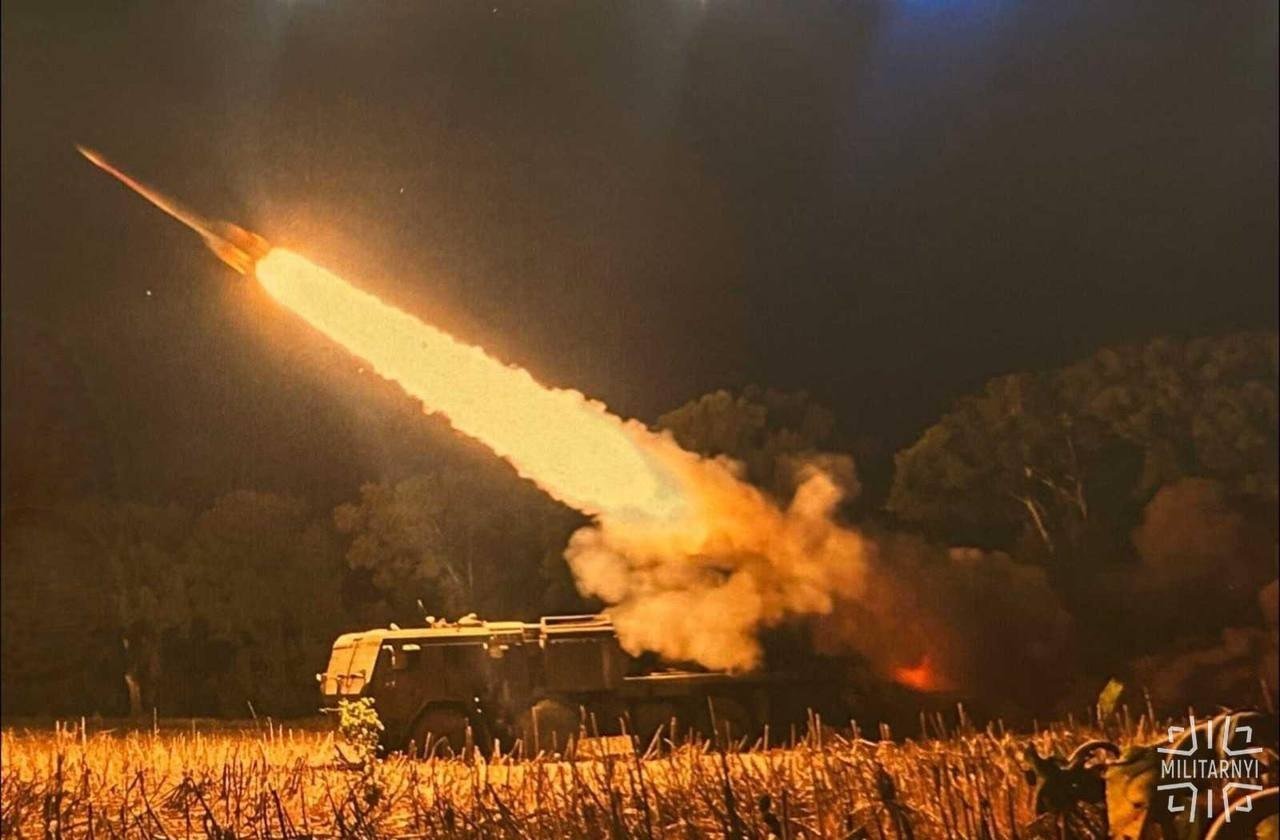
A missile is launched from a Koral air defense system, based on a Czech Tatra truck chassis. Ukroboronprom

Koral is intended to provide a much longer-range capability, potentially filling some of the gap left by Ukraine’s aging Soviet systems and supplementing the Western-supplied Patriot and SAMP/T.

Shershen, by contrast, is clearly focused on the short-range layer.

Together, the programs illustrate the breadth of Ukraine’s emerging domestic air-defense effort: from relatively inexpensive systems built around repurposed air-to-air missiles to new, purpose-designed interceptors intended to replace or augment Soviet-era systems.

Ukraine’s experience with FrankenSAM has demonstrated the value of getting unconventional air defense combinations into service quickly.

Once fielded, Shershen, with its architecture capable of accepting different Soviet-origin and Western-made interceptors, and eventually a Ukrainian one, gives Ukraine another way to stretch its missile inventory and enhance its air defense capabilities.

Contact the author: thomas@thewarzone.com

The post Ukraine’s New Shershen SAM Can Fire A Wild Mix Of Adapted Air-To-Air Missiles appeared first on TWZ.

  •  

Operational F-15EXs Drop Live Bombs For The First Time

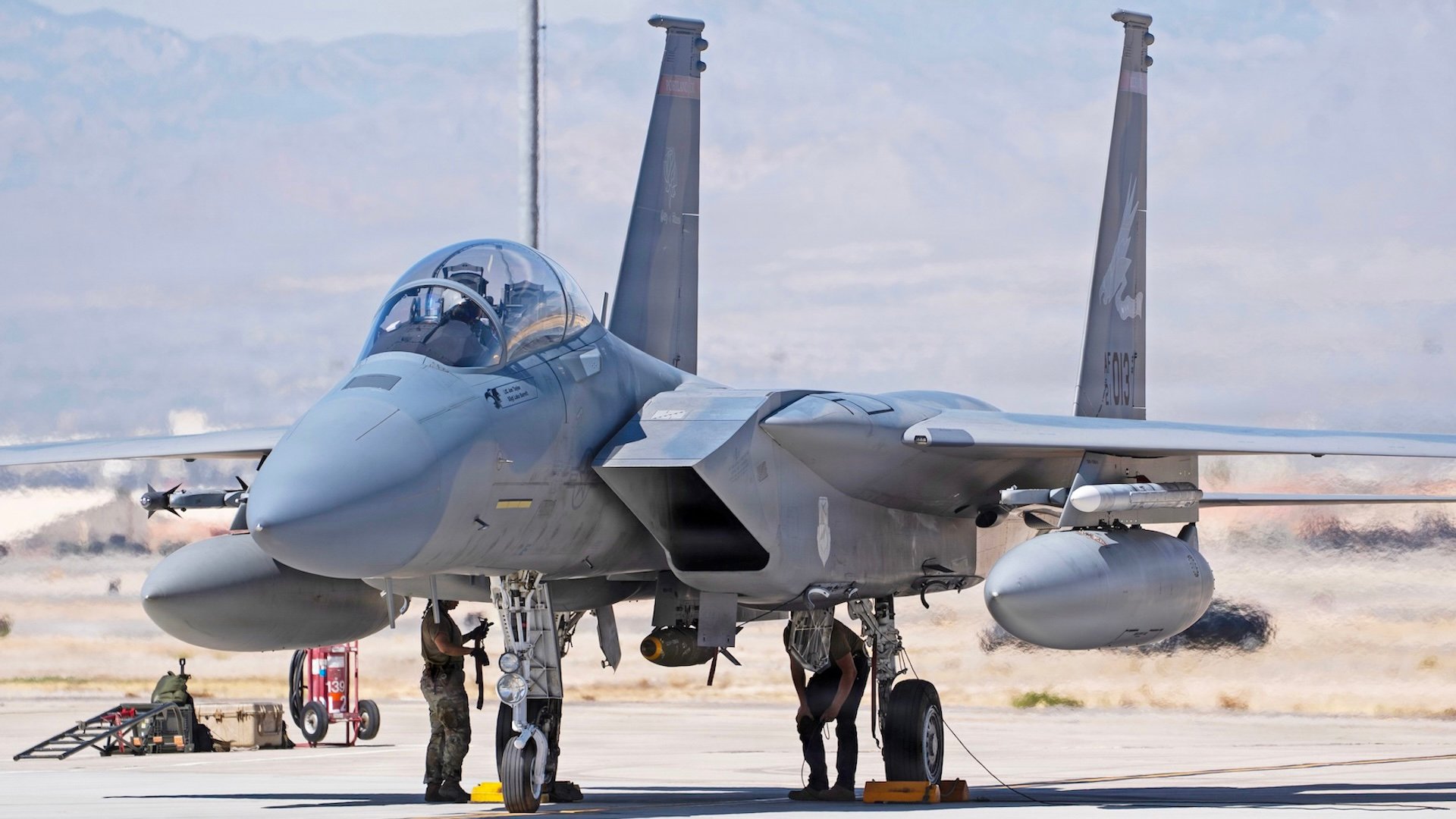
The Oregon Air National Guard’s 142nd Wing has taken another significant step toward turning the F-15EX Eagle II into a true multirole fighter, conducting the first live-bomb drops from operational F-15EXs during training at Nellis Air Force Base, Nevada. The milestone came during a roughly three-week deployment to Nellis in late August and early September in support of the U.S. Air Force’s Weapons Instructor Course (WIC).

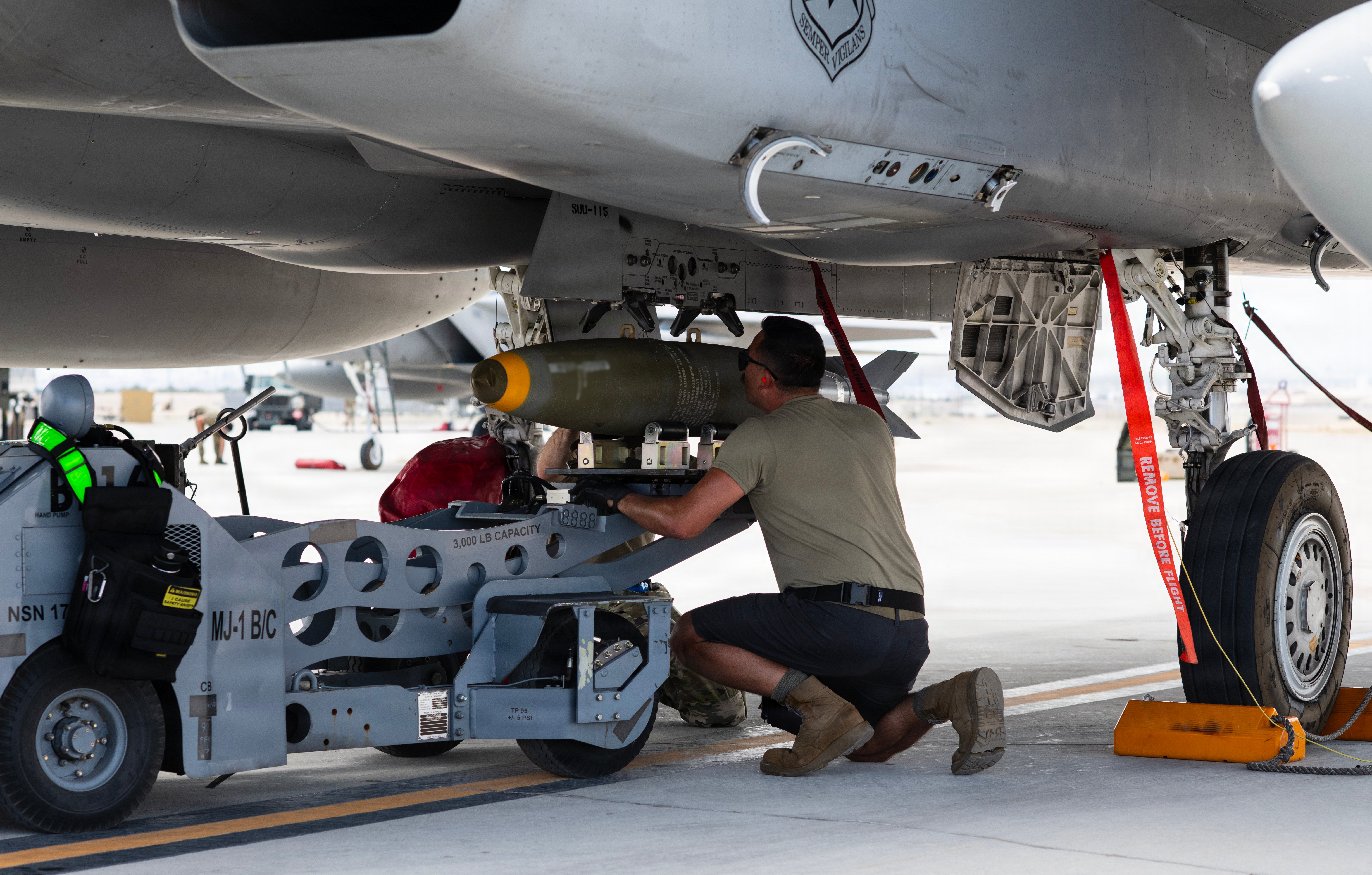
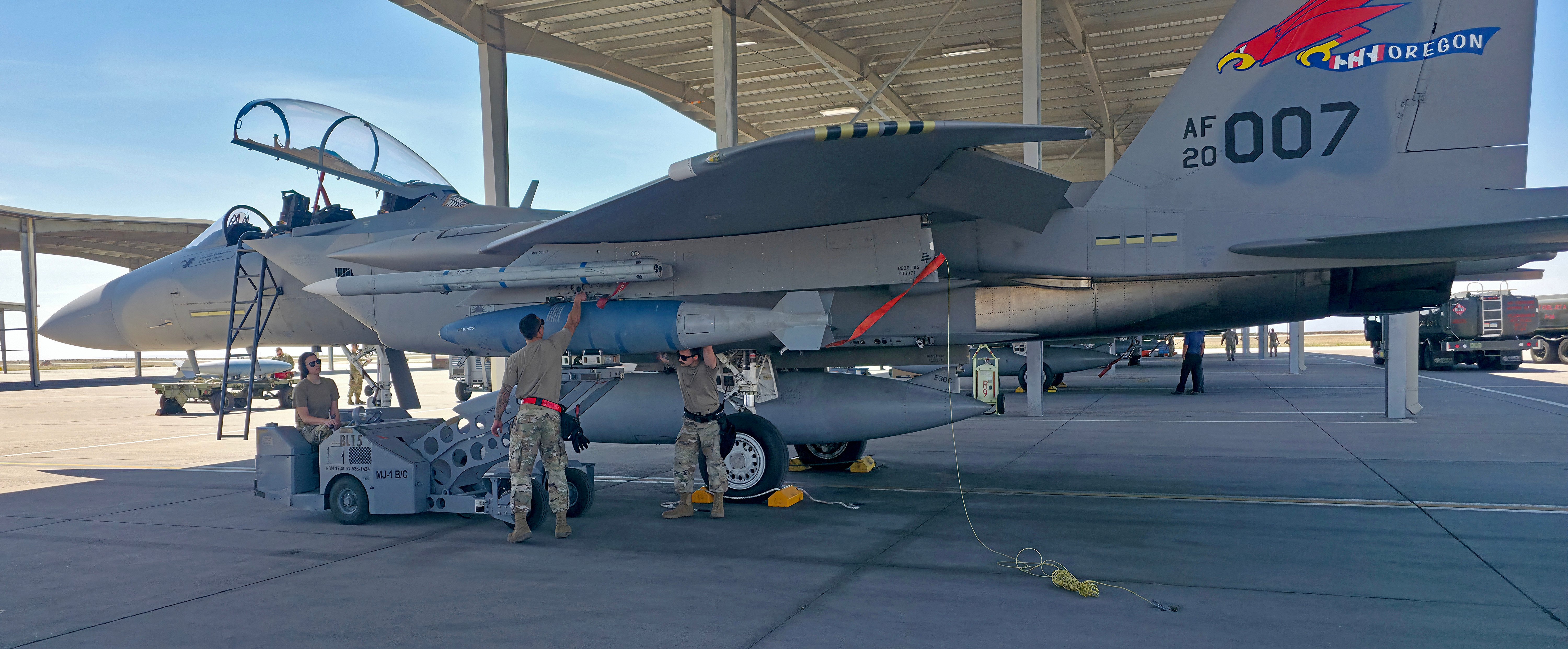
U.S. Air Force Master Sgt. Jay Aebi, non-commissioned officer in charge of weapons loading, 142nd Aircraft Maintenance Squadron, loads a bomb onto an F-15EX Eagle II aircraft at Nellis Air Force Base (AFB), Nevada on August 27, 2026. The 142nd Wing’s fleet of F-15EXs operated at Nellis AFB for three weeks in late August and early September in support of the U.S. Air Force’s Weapons Instructor Course (WIC). During this time, the unit hit a historical milestone, dropping live bombs from operational F-15EXs for the first time. (U.S. Air National Guard photo by Master Sgt. Steph Sawyer)
Weapons technicians from the 142nd Aircraft Maintenance Squadron load a bomb onto an F-15EX at Nellis Air Force Base, Nevada on August 27, 2026. U.S. Air National Guard photo by Master Sgt. Steph Sawyer

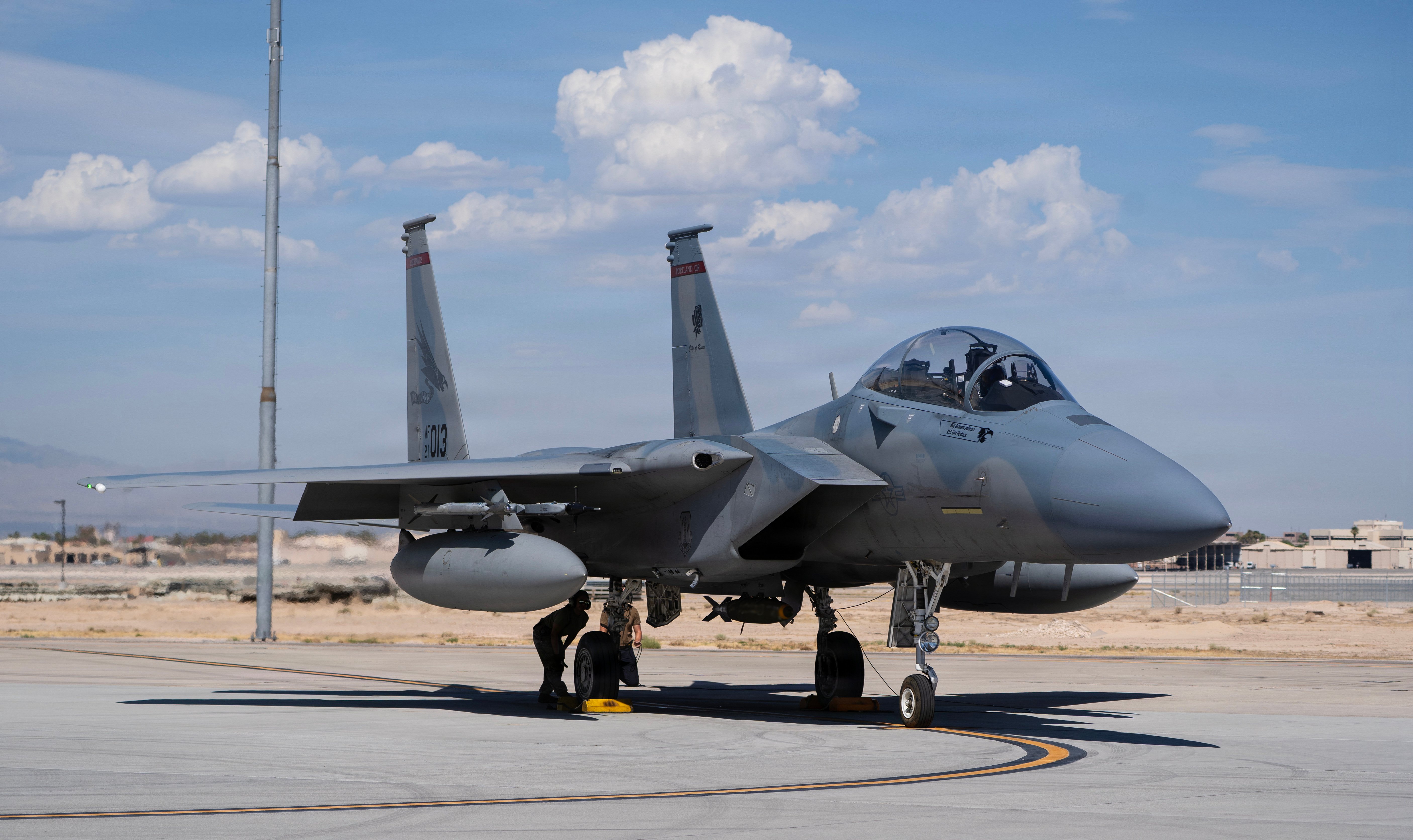
Photographs released by the Air National Guard yesterday show F-15EXs from the 142nd Wing carrying live bombs on the flight line and departing Nellis with the weapons loaded. Official imagery shows the jets armed with a single 500-pound Mk 82 freefall bomb on the fuselage centerline, while spotters also captured F-15EXs carrying a 2,000-pound Mk 84 freefall bomb in the same position.

The 142nd’s F-15EXs are only now acquiring a capability that was deliberately absent from the wing’s previous F-15C fleet. The Portland, Oregon-based unit was an air-superiority organization when it operated the F-15C, while the F-15EX is ultimately derived from the F-15E Strike Eagle and has considerably more inherent multirole potential.

As we reported in July, the wing had already begun laying the groundwork for this transition. In May, 142nd personnel traveled to Mountain Home Air Force Base, Idaho, where they loaded and dropped inert BDU-50 and BDU-56 training bombs from their F-15EXs. Those weapons replicate the size and weight of 500-pound-class Mk 82-series and 2,000-pound-class Mk 84-series bombs. Over 10 missions, the crews dropped 24 BDU-50s and 12 BDU-56s.

A BDU-56 is loaded onto an F-15EX assigned to the 142nd Wing during a training mission at Mountain Home Air Force Base, Idaho, in May 2026. U.S. Air Force

While the F-15EX had already been tested in an air-to-ground role by the Air Force’s test community, the Mountain Home deployment was the first time an operational Eagle II unit had loaded and dropped bombs. The next step, the wing said at the time, would be live weapons employment at Nellis.

The Air Force has emphasized that the F-15EX’s primary mission remains defensive and offensive counter-air, particularly in the homeland-defense role. At the same time, the service’s plans call for the aircraft to provide combatant commanders with strike packages capable of operating in contested environments.

An F-15EX fires an AIM-120D missile during a test mission near Eglin Air Force Base, Florida. The F-15EX can carry up to 12 AIM-120 missiles. U.S. Air Force photo by Tech. Sgt. John Raven

The F-15EX is inherently well suited to such a mission. Derived from the Strike Eagle lineage, it combines that aircraft’s large payload capacity and long range with substantially modernized avionics and electronic warfare systems. The aircraft’s design leaves considerable room for additional weapons and mission equipment, making an expansion into air-to-ground operations relatively straightforward compared with trying to add that capability to the F-15C.

The 142nd has been building the institutional knowledge required to make that transition. Three of its pilots underwent a nine-month course covering the science, tactics, and procedures associated with air-to-ground weapons employment before returning to help establish the wing’s training program. Weapons personnel also traveled to Nellis earlier this year to work with F-15Es assigned to the 59th Test and Evaluation Squadron and become certified in bomb loading procedures.

An F-15EX Eagle II aircraft assigned to the Oregon Air National Guard’s 142nd Wing sits on the flight line at Nellis Air Force Base (AFB), Nevada with a live bomb attached to its belly as it prepares for take off on August 27, 2026. The 142nd Wing’s fleet of F-15EXs operated out of Nellis AFB for three weeks in late August and early September in support of the U.S. Air Force’s Weapons Instructor Course (WIC). During this time, the unit hit a historical milestone, dropping live bombs from operational F-15EXs for the first time. (U.S. Air National Guard photo by Master Sgt. Steph Sawyer)
An F-15EX Eagle II assigned to the Oregon Air National Guard’s 142nd Wing sits on the flight line at Nellis Air Force Base, Nevada with a live bomb attached to its belly as it prepares for takeoff on August 27, 2026. U.S. Air National Guard photo by Master Sgt. Steph Sawyer \

As well as teaching pilots how to release a weapon, the wing had to develop an entirely new air-to-ground training pipeline for pilots, maintainers, and weapons personnel at a unit that had not previously operated an aircraft with an operational bombing mission.

Nellis is home to the Air Force’s Weapons School and is central to the Weapons Instructor Course, making it one of the most important locations in the service for developing and evaluating advanced tactics. The 142nd’s participation therefore places its emerging F-15EX air-to-ground capability in an environment specifically focused on integrating advanced weapons, tactics, and mission planning.

U.S. Air Force Staff Sgt. Parker Mayhew (center), a weapons loader assigned to the 142nd Aircraft Maintenance Squadron, prepares a bomb to be loaded onto an F-15EX Eagle II aircraft as U.S. Air Force Senior Airman Alexander Walker (left) looks on, August 26, 2026, Nellis Air Force Base, Nevada. The 142nd Wing’s fleet of F-15EXs operated out of Nellis AFB for three weeks in late August and early September in support of the U.S. Air Force’s Weapons Instructor Course (WIC). During this time, the unit hit a historical milestone, dropping live bombs from operational F-15EXs for the first time. (U.S. Air National Guard photo by Master Sgt. Steph Sawyer)
A weapons loader assigned to the 142nd Aircraft Maintenance Squadron prepares a bomb to be loaded onto an F-15EX at Nellis Air Force Base. U.S. Air National Guard photo by Master Sgt. Steph Sawyer

The wing’s new live bomb-dropping capability also comes as the Air Force continues to explore how broadly the Eagle II can be employed.

Test and evaluation units have already demonstrated that the aircraft can accommodate sophisticated air-to-ground weapons. Earlier this year, an F-15EX from the 85th Test and Evaluation Squadron participated in a munitions-load training event at Kadena Air Base in Japan, where Air Force personnel practiced loading live GBU-53/B Small Diameter Bomb IIs onto the aircraft.

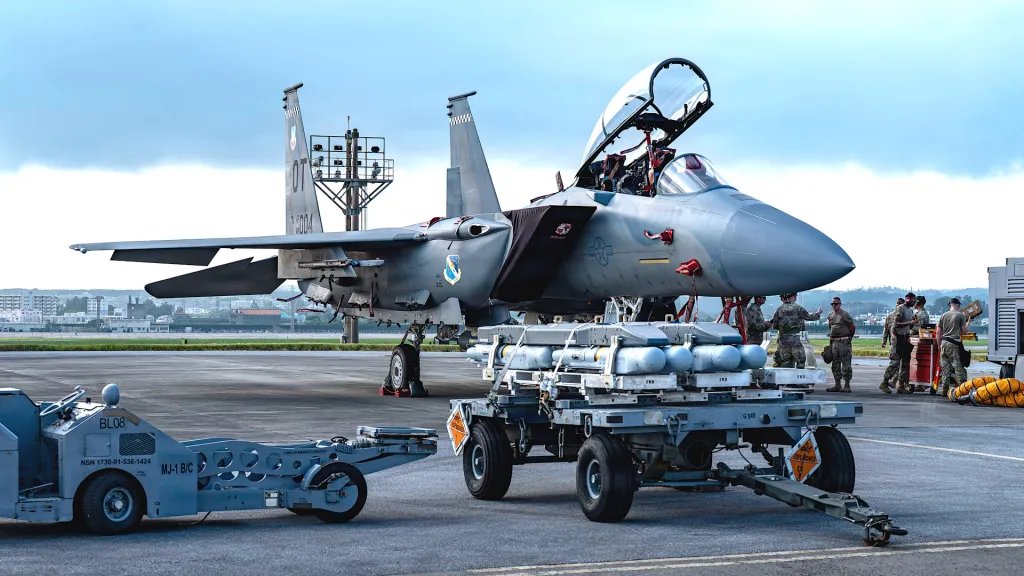
GBU-53/B Small Diameter Bomb IIs sit on a dolly in front of an F-15EX from the 85th Test and Evaluation Squadron during a training event at Kadena Air Base, Japan, on July 8, 2026. U.S. Air Force

The F-15EX is also capable of carrying the conformal fuel tanks used by the F-15E, which can provide additional fuel as well as additional weapons stations. The operational F-15EXs delivered to the 142nd have so far been seen without CFTs, however, and the status of the plan to equip the Oregon aircraft with them remains unclear.

CFTs could become increasingly important if the Air Force moves toward more demanding air-to-ground missions for the Eagle II, particularly those requiring substantial weapons loads and long-range operations.

Another unresolved question is how the Air Force will ultimately crew F-15EXs when they are performing more complex multirole missions.

U.S. Air Force Staff Sgt. Alisha Sargent, a weapons loader assigned to the Oregon Air National Guard’s 142nd Aircraft Maintenance Squadron, loads a bomb onto an F-15EX Eagle II aircraft at Nellis Air Force Base (AFB), Nevada on August 26, 2026. The 142nd Wing operated their fleet of F-15EXs out of Nellis AFB for three weeks in late August and early September in support of the U.S. Air Force’s Weapons Instructor Course (WIC). During that time, the unit and the EX hit a historic milestone, dropping live bombs from operational F-15EXs for the first time. (U. S. Air National Guard photo by Master Sgt. Steph Sawyer)
A weapons loader assigned to the 142nd Aircraft Maintenance Squadron loads a bomb onto an F-15EX at Nellis Air Force Base. U.S. Air National Guard photo by Master Sgt. Steph Sawyer

The Eagle II retains the F-15E family’s two-seat cockpit, although the Air Force’s initial operational concept has generally involved flying the aircraft with a single pilot. That leaves an unused cockpit that could potentially become an important asset as the mission set expands.

Former 142nd Wing commander Col. Michael Kosderka previously told TWZ that the addition of a weapons systems officer or other specialist in the rear cockpit could open the door to more air-to-ground capabilities.

“We can start talking about putting all kinds of air-to-ground capabilities into the airplane, potentially putting WSOs or other experts in the backseat as well to have us do any number of multi-role capabilities that it’s just physically not possible to in the C model,” Kosderka told TWZ in an interview back in 2024. “So the X has tremendous growth capability. It’s really exciting.”

Two crew would be particularly relevant to complex strike missions, where managing sensors, weapons, communications, electronic warfare, and other mission systems can place substantial demands on a single pilot. As we have discussed in the past, a back-seater would also be highly beneficial for the emerging drone controller role.

The Weapons School has also been associated with developing two-seat F-15EX operations, indicating that the second cockpit’s utility is already being considered at the tactical-development level.

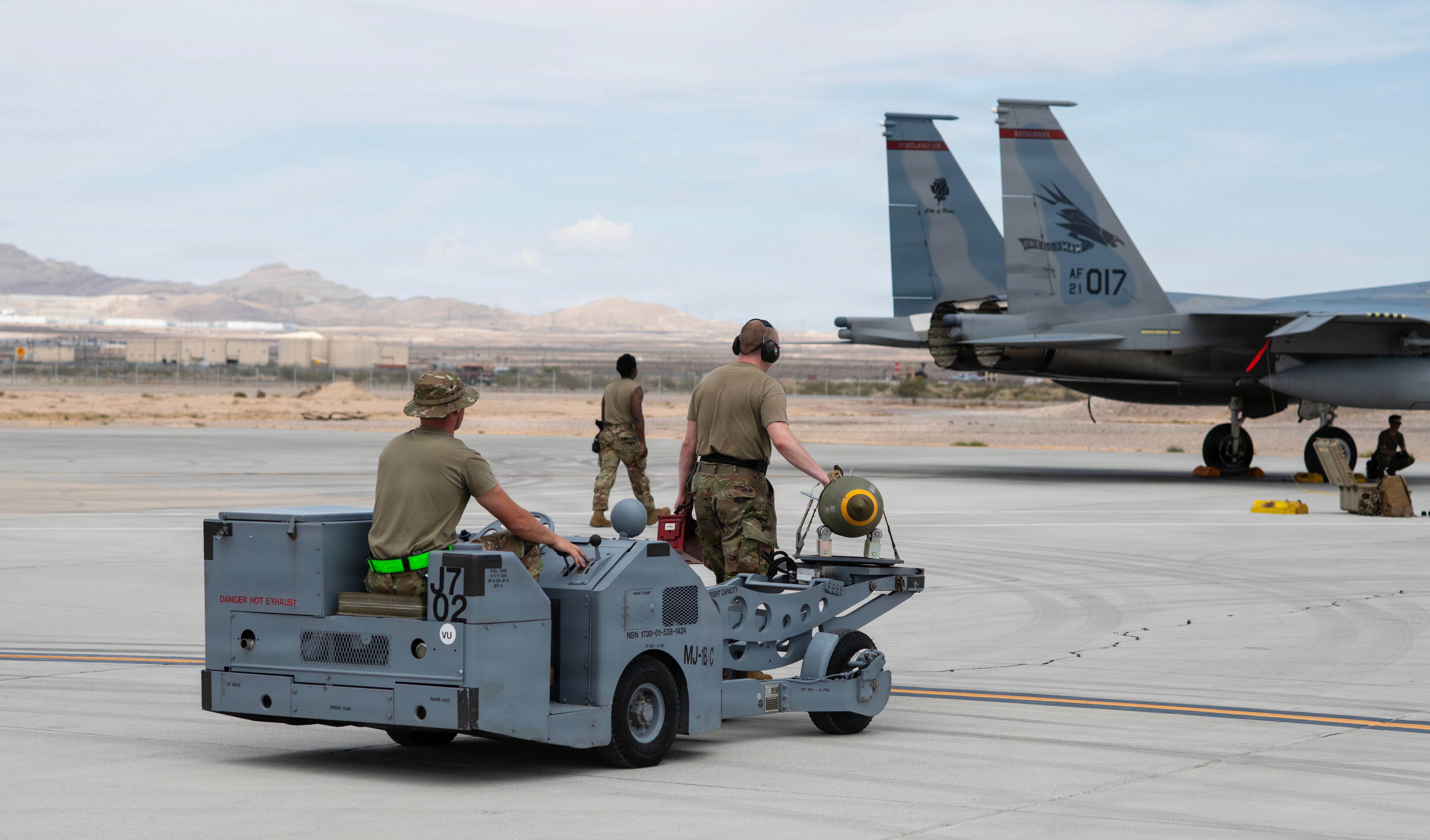
142nd Aircraft Maintenance Squadron weapons loaders, U.S. Air Force Staff Sgts. Parker Mayhew (left) and Eric Janson transport a bomb to an F-15EX Eagle II aircraft using a jammer, August 27, 2026, Nellis Air Force Base (AFB), Nevada. The 142nd Wing’s fleet of F-15EXs operated at Nellis AFB for three weeks in late August and early September in support of the U.S. Air Force’s Weapons Instructor Course (WIC). During this time, the unit hit a historical milestone, dropping live bombs from operational F-15EXs for the first time. (U.S. Air National Guard photo by Master Sgt. Steph Sawyer)
142nd Aircraft Maintenance Squadron weapons loaders transport a bomb to an F-15EX at Nellis Air Force Base. U.S. Air National Guard photo by Master Sgt. Steph Sawyer

For now, it would be premature to characterize the F-15EX as an operational replacement for the F-15E Strike Eagle in the air-to-ground role. The 142nd’s newly demonstrated bombing capability remains part of an ongoing training and development process.

Meanwhile, the Air Force is preparing to field substantially larger numbers of F-15EXs. Beyond the 142nd, additional Guard units are planned to receive the type, in California and Louisiana, as well as Michigan.

The Air Force has announced plans to base F-15EXs at Seymour Johnson Air Force Base, North Carolina, where they will eventually replace older F-15Es, which, in turn, are slated to move to Whiteman Air Force Base, Missouri, as part of a broader realignment of the Eagle fleet.

Another two active-duty F-15EX squadrons are slated to replace the former F-15C force at Kadena. The first F-15EX for permanent assignment at Kadena recently departed Boeing’s St. Louis, Missouri, facility for the 142nd Wing, where it will undergo final preparations before its eventual deployment to sprawling Okinawa.

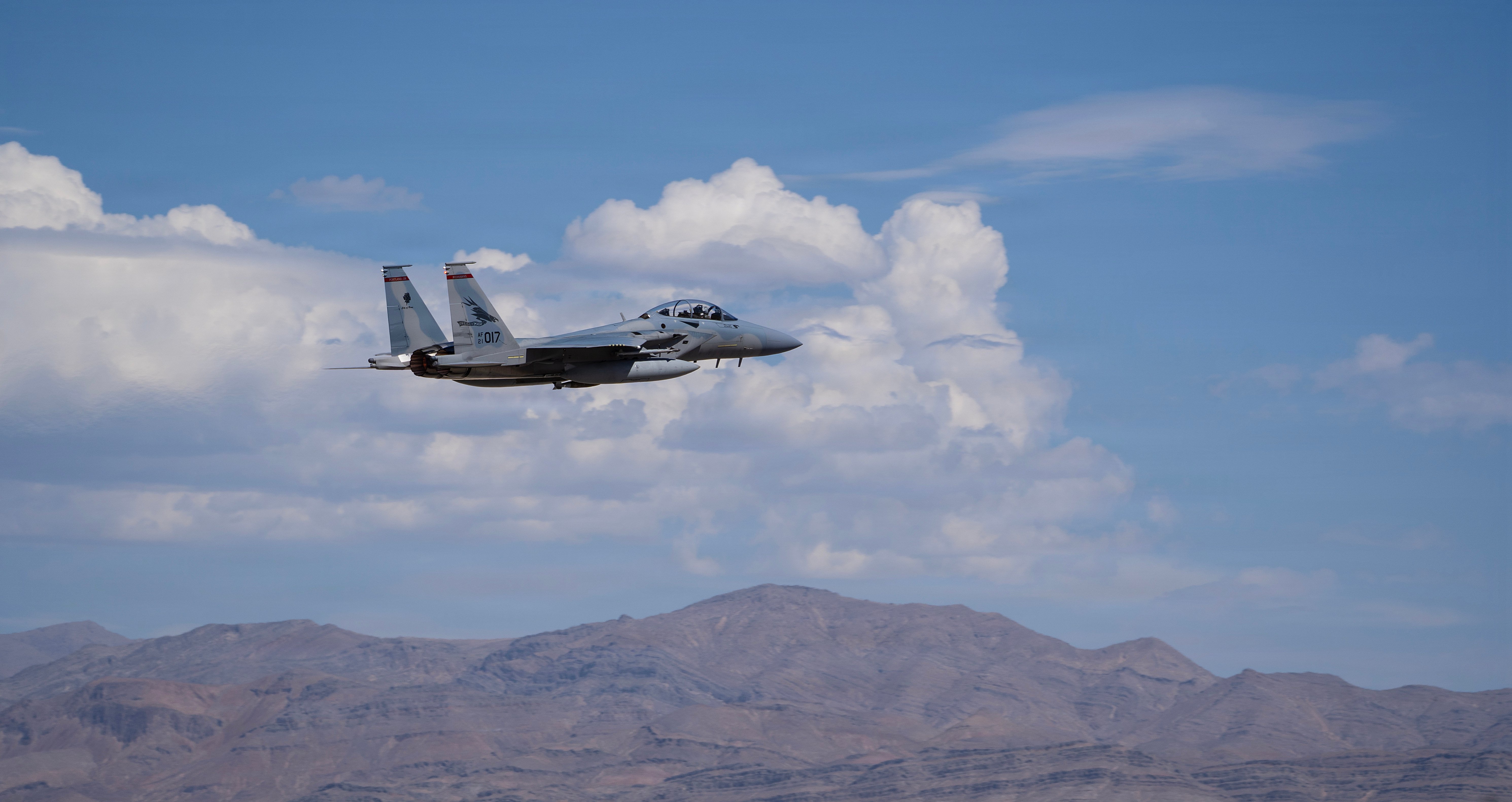
An F-15EX Eagle II aircraft assigned to the Oregon Air National Guard’s 142nd Wing takes off from Nellis Air Force Base (AFB), Nevada with a bomb attached to its belly, August 27, 2026. The 142nd Wing’s fleet of F-15EXs operated out of Nellis AFB for three weeks in late August and early September in support of the U.S. Air Force’s Weapons Instructor Course (WIC). During this time, the unit hit a historical milestone, dropping live bombs from operational F-15EXs for the first time. (U.S. Air National Guard photo by Master Sgt. Steph Sawyer)
An F-15EX assigned to the 142nd Wing takes off from Nellis Air Force Base with a bomb attached to its belly, August 27, 2026. U.S. Air National Guard photo by Master Sgt. Steph Sawyer

The operational implications of the air-to-ground training therefore extend well beyond Portland.

The Eagle II’s generous weapons payload, long range, modern sensors and electronic warfare systems, and ability to carry both air-to-air and air-to-ground weapons give the Air Force a platform that can potentially perform several missions without sacrificing the characteristics that make the F-15 attractive for homeland defense and counter-air operations. The same characteristics are also extremely relevant to any export operator, which would expect to operate the Eagle II in a multirole capacity.

As well as a weapons-training milestone, the first live-bomb drops by the 142nd Wing provide more evidence that the F-15EX’s mission is continuing to evolve.

Contact the author: thomas@thewarzone.com

The post Operational F-15EXs Drop Live Bombs For The First Time appeared first on TWZ.

  •  
❌