Login

What Horror Films Have to Say About God
The Christian podcaster Allie Beth Stuckey issued a Halloween-themed warning to her audience last week: Don’t watch scary movies. “How many times do we read throughout Scripture: ‘Do not fear,’” Stuckey wrote in a post that got more than 1 million views. For a Christian to “purposely consume content that is meant to make us scared,” she said on her show, amounts to “a direct contradiction of Jesus’s command to not fear or be anxious about anything.”
She eventually deleted the post—even many fellow conservative Christians found her argument overly simplistic—but she’s not the first person to make a religious case against the horror genre. After The Exorcist, in which two Catholic priests help a young girl possessed by a demon, came out in 1973, the televangelist Billy Graham said in an interview, “The devil is in every frame of the film” and likened it to “spiritual pornography, pandering to man’s innate superstition.” Christianity Today dismissed the film as “shrewd” and “obscene.”
I understand the criticisms: The genre’s frequent depictions of the occult or demonic can feel irreverent or profane. But many horror films are in fact quite open to theological ideas; the best ones are some of the most religious movies I’ve ever seen.
[Read: A religion that’s very ready for aliens]
Not all horror films take up deep questions about God, of course. Heretic, my colleague McKay Coppins wrote when it came out, was way too infatuated with “Reddit-level ideas about religion.” Jordan Peele’s excellent Get Out went light on religion and heavy on more contemporary social concerns. Sometimes, the horror elements themselves—the jump scares, the gore—can distract the viewer from any theological message that the film might be trying to send. If Saw is trying to tell me something about God—some viewers have referred to it as a morality play—I missed the message amid the slash-fest.
Still, many movies in the genre explore foundational religious concepts. Timothy Beal, a religious-studies professor at Case Western Reserve University, has written that horror movies resemble ancient texts such as Enuma Elish and the Book of Revelation, in which a god or gods overcome chaos brought by monstrous forces and establish cosmic order. Many of these films, Beal told me, are about experiencing “disorientation and threat to order.” Examples include the original Godzilla, about a building-crushing monster, or Dracula, about a cunning vampire who preys on naive mortals. Horror movies, moreover, propose that good and evil are real, not relative, ideals. Evil is out there, made concrete in the monster or demon or killer on the loose. So too is good, acknowledged in an audience’s desire for the villain to be tamed, caught, or cast out.
Many of these movies also don’t mind getting moralistic, and when they do, their moral code tends to skew traditionalist. The Exorcist presents substance abuse, parental neglect, and economic inequality as human failings that cause suffering just as evil supernatural forces do. Premarital sex has deadly consequences in so many horror movies—Halloween, Friday the 13th, and It Follows, to name just a few—that a character in the original Scream pokes fun at the trope. (“There are certain rules one must abide by in order to successfully survive a horror movie,” the character explains. “No. 1: You can never have sex. Sex equals death.”)
Some of the best horror movies suggest that reality is more than mere matter, and that humans encounter supernatural forces that they do not see or understand. Father Ryan Duns, a professor at Marquette University, and the author of Theology of Horror, told me that these films can demonstrate that “the world is more than what can be measured and managed.” His point reminded me of the masterful 2024 remake of Nosferatu, which is not an explicitly religious film but does take belief in the spiritual world seriously. It depicts the residents of a 19th-century Transylvanian hamlet who believe that evil beings exist and can be kept at bay through magic rituals. The wealthy, sophisticated urbanites who treat the townsfolk as simpletons, by contrast, are caught flat-footed when the vampire brings torment and death to their city. They misdiagnose his wrath as a common plague and try in vain to fight it with medicine and quarantines. “We have been blinded by the gaseous light of science,” says an unorthodox professor, one of the few characters who recognizes the actual source of the city’s misery. He continues: “If we are to tame darkness, we must first face that it exists.”
[Read: ]Carrie, with kid gloves
When Stuckey told her listeners to avoid horror—and when Graham and Christianity Today warned people away from The Exorcist—they missed the point and failed to acknowledge that Christian ideas of redemption can be visible in even the darkest places. The Exorcist, for example, might seem like a story about a demon, but it’s really about trust in God. At the beginning of the film, the protagonist, Father Damien Karras, is having a crisis of faith. He’s become aloof toward others. A homeless man in a New York City subway station asks him, “Father, would you help an old altar boy?” Father Karras walks on, keeping the man’s suffering at a distance. He seems to fear it.
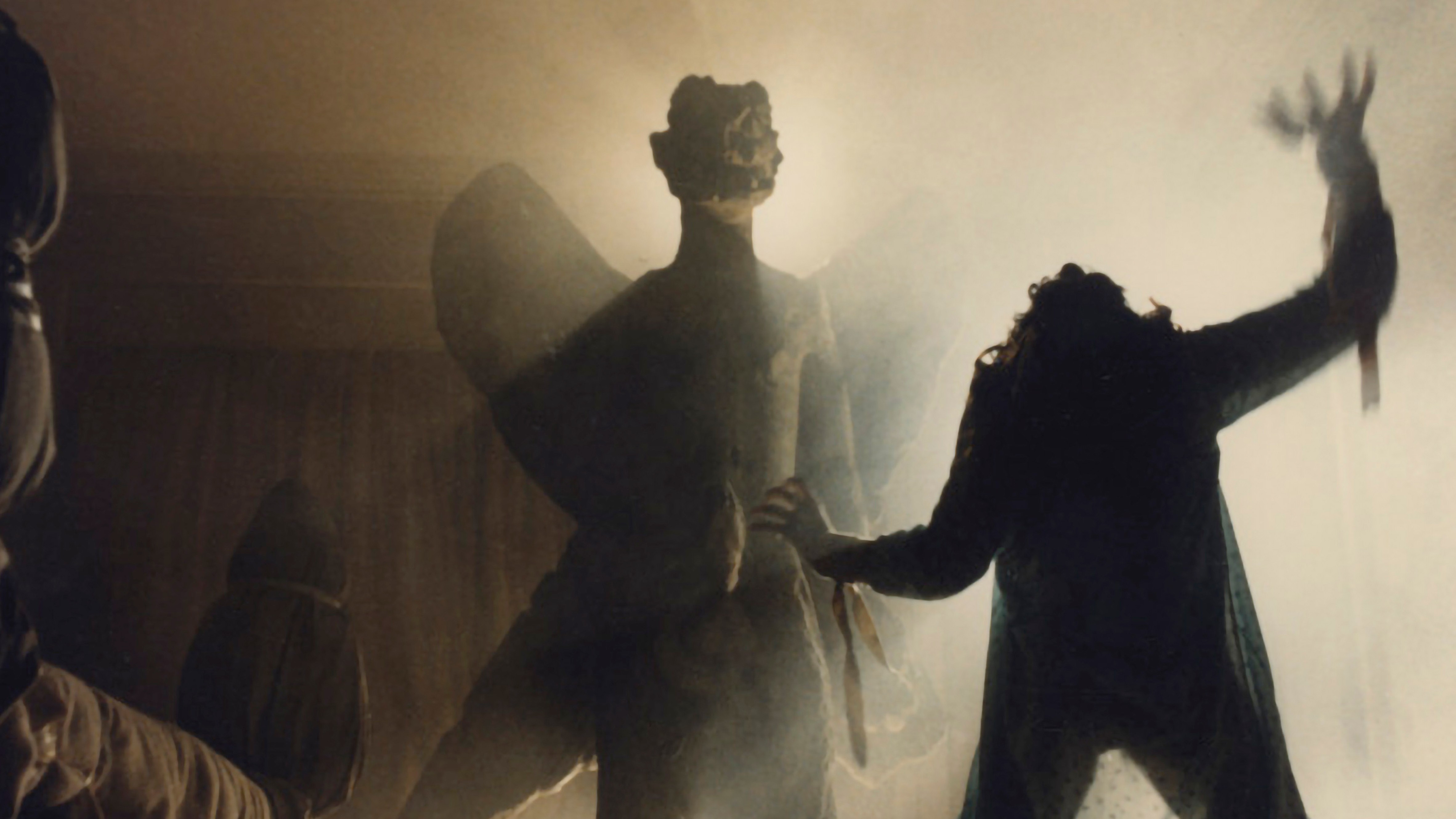
The exorcism referred to in the film’s title changes him. In ministering to the young Regan MacNeil, Father Karras watches her projectile-vomit, make violent outbursts, and, most famously, spin her head 360 degrees. Rather than turn away from the muck and frenzy of true terror, Father Karras confronts it. “Take me,” he tells the demon that has possessed the girl. He offers his life so that the body and soul of a vulnerable child might survive.
As the movie ends, we’re told the girl has no memory of being possessed or, presumably, of the man who cast the demon out. When she runs into another priest, however, her eyes focus on his clerical collar. She leans up and kisses his cheek. Something deep inside her senses that God was at work in putting an end to her horror story.
© Screen Archives / Getty