Login

The ‘Cuteservative’ in Chief
Inside a podcast studio at Turning Point USA’s headquarters last month, a former witch sat in a pink velvet armchair, telling Alex Clark about the demon that stalked her house. Even though this self-described witch, known on TikTok as @yourspiritualbigsis, had only ever used her powers for good, she believed that practicing sorcery had made her vulnerable to satanic forces. The demon—10, maybe 15 feet tall, whose face had “divots” for eyes—had tormented her, she said, until she spoke the name “Jesus” out loud and became a Christian.
Clark, whose Culture Apothecary is one of America’s top wellness podcasts, told her guest that she was going to ask “counter questions,” as she does with everyone she interviews. In this case: If the spells she was doing were technically producing good—helping people make money, get pregnant, pass a test—why is that evil? How can Christians tell whether someone has the spiritual gift of prophecy or they’re harnessing dark power? Clark wasn’t concerned about whether sorcery was real—“It is real,” she said—but when her guest brought up the occult sacrifice of babies procured through a sex-trafficking network supported by the government and Hollywood, Clark had no further questions.
This was just another day in the studio. Since 2024, when she launched her podcast with a mission to “heal a sick culture” and to do so “physically, emotionally, and spiritually,” Clark has welcomed a wild array of guests, united only by their willingness to contradict conventional wisdom and generally accepted facts. Listening to Culture Apothecary, you might hear a regenerative farmer recommend the subcutaneous fat of a “healthy, happy pig” as a miracle skin-care ingredient, a chiropractor talk about testing muscle strength using “homeopathically charged frequencies,” the self-described Christian nationalist Doug Wilson suggest spanking as a form of biblical discipline for children, or leaders in the “Make America Healthy Again” movement disavow vaccines and industrial agriculture.
On the podcast, Clark positions herself not as an expert but as a question-asking woman of the people. Depending on who you talk with—and I spoke with Clark’s colleagues, her critics, her close friends, her mom—she’s either a powerful force connecting everyday women to the GOP or an agent of chaos. She has been the Republican commentator posting bikini photos while her peers post pictures in cardigans and the single 33-year-old podcasting about child-rearing. By her own account, she is also the contributor at TPUSA, the late Charlie Kirk’s conservative organization, who causes the nonprofit the most trouble with the Trump administration.

Clark grew up in an evangelical, conservative home in southern Indiana. After high school, she worked at Sephora and took classes at a community college, and planned to transfer to a four-year school for fashion merchandising and journalism. But then she started an internship at a Louisville, Kentucky, radio station, which led to a full-time job as an anchor and the unofficial Millennial-woman correspondent for a morning show. She had always loved pop culture and politics, and came to TPUSA in 2019 so that she could air her conservative views while discussing Dancing With the Stars. Even before Robert F. Kennedy Jr. and Donald Trump teamed up, she pivoted to podcasting about wellness because she thought that talking about organic food, herbal medicine, and suspicions about vaccines could bring more women into the GOP. When the MAHA movement came to Washington, Clark’s own profile rose, and soon she had the attention of some of the most powerful men in the country.
But recently, MAHA and MAGA have started to drift apart. MAHA is failing to draw hordes of voters to Republicans; the Trump administration has failed MAHA on many of the issues Clark cares about. As the rift widens, Clark is stretching to keep a foot on each side and figuring out, if she does have to choose one, how to take her audience of MAHA moms and conservative young women along with her.
Between tapings, Clark ate takeout from a seed-oil-free restaurant as she reviewed podcast transcripts and a spreadsheet of upcoming episodes, reacting to them with facial expressions worthy of a mime. Her team member took notes while she dictated episode titles (“He Was Gay, Then Everything Changed” and “Acetaminophen Before Age 4: What Parents Should Know”). The whole time, she exuded the energy of someone who had incredible gossip to share. The minute I stepped away to check out a rack of Culture Apothecary sweatshirts (Trust Farms, Not Pharma), Clark shrieked. “We’re all peeing our pants, screaming, crying, throwing up,” she said, her eyes wide and made even more dramatic by false lashes. Taylor Swift had just announced a new single. She looked for clues in Swift’s post and predicted that the music video would debut later that week at the MTV Video Music Awards. (She was right.)
Like many 30-something women, she is devoted to Taylor Swift, and, however unfiltered Clark can sometimes seem, like Swift, she aims to make every detail of her world matter. Her studio’s forest-green wallpaper includes illustrations of her preferred remedies for America’s ailing culture: raw milk, steak, butter, wildflowers, hair bows, the Bible. Her podcast-planning spreadsheet is in that same bespoke shade of green, which she developed with graphic designers. (She calls it “Forks, Washington,” after the town made famous in Twilight.) Even her off-the-cuff X posts can be seen as part of her brand—a girl speaking her mind, even if that includes insinuating that Candace Owens performed oral sex on Vladimir Putin. The ads she writes for the show might seem borderline nonsensical—in one ad for a clean-beauty company, for reasons that I do not understand, she includes a monologue about a taxidermied possum who wears a cheerleading uniform and is named Gerald—but according to Clark, that strategy tends to bring high returns for her sponsors. What listener is going to want to skip those?
Not the “Cuteservatives,” as Clark calls her fandom. They keep tabs on her personal life, too, and at the TPUSA Women’s Leadership Summit in June, she orchestrated an announcement for them. “There’s one thing I haven’t told you guys,” she said. The stage lights went out, and when they came back on, she was standing beside Vance Voetberg, the bespectacled author of the MAHA fitness Substack Running on Butter. On her finger was a diamond ring. “I’m engaged!” The crowd screamed. Later, on Instagram, she described him as her “‘BUTTER’ half.” She has since released a steady stream of content about their small summer wedding at his family home in rural Washington State: a recipe for the prosciutto butter they served, details about the outfits she picked for Voetberg and her maid of honor, and a two-hour interview with her new husband, in which she revealed that she walked down the aisle to Swift’s “You Are In Love” and gifted all of her guests a Jaspr, perhaps the most aesthetically pleasing air purifier in existence.
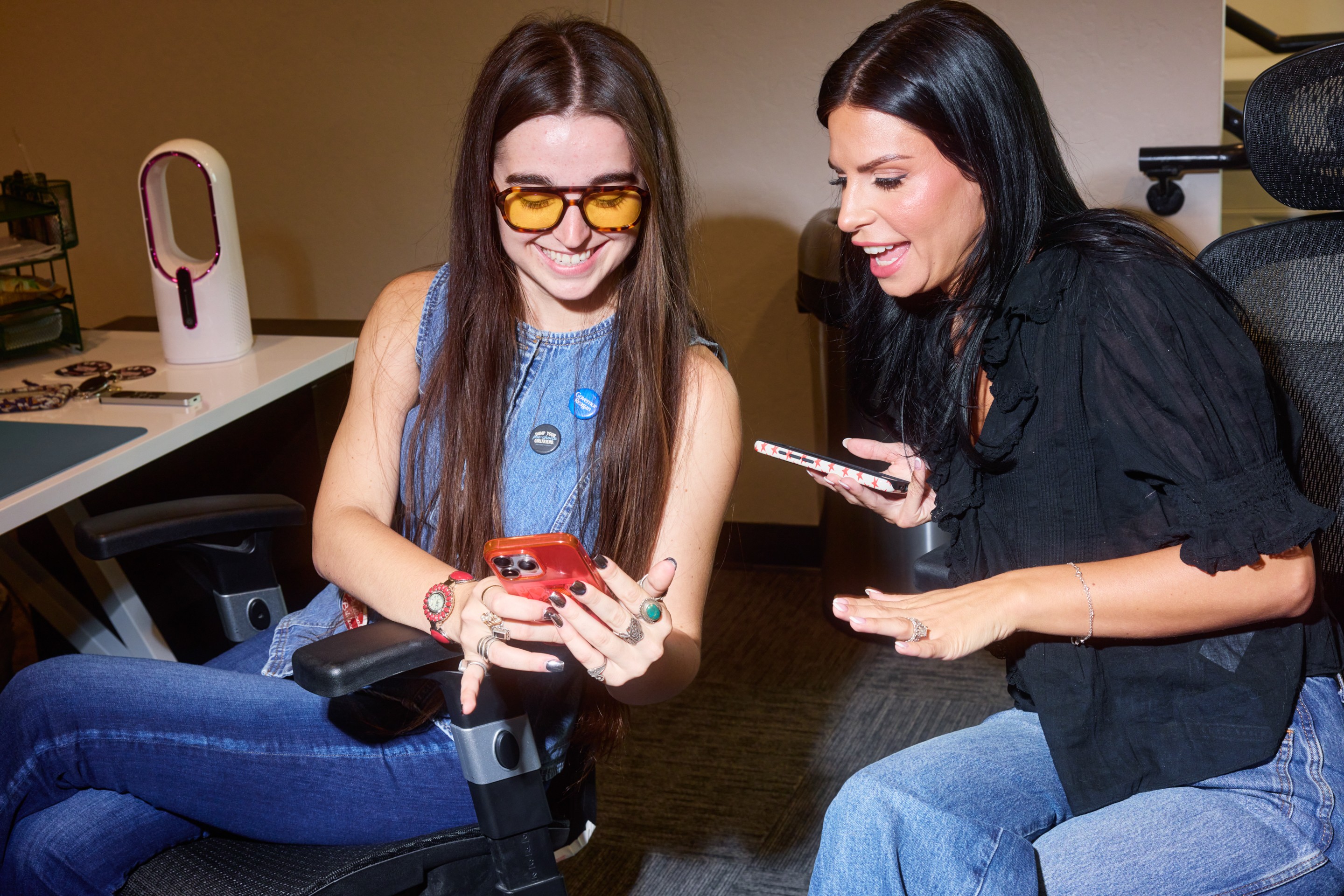
Clark is also, like Swift, a woman of distinct eras. For most of her life, she was focused not on health but pop culture. MTV was banned in her childhood home, but when she saw Britney Spears’s “I’m a Slave 4 U” music video at a sleepover, “I was absolutely mesmerized,” she said. She idolized Spears, Christina Aguilera, and Jessica Simpson. She was also so conservative “that she’d make Rush Limbaugh look like a liberal,” her high-school radio and TV teacher, Timothy Dench, told me.
She knew even then that she wanted an audience made up of young women. She dreamed about being a fashion writer at Teen Vogue or Seventeen, but got the job on a local radio show. Listeners knew her as a fast-food connoisseur and the “Chicken Nugget Princess”—she ate nuggets at least once a day and would peel off the skin, eat that, then turn to the meat. By 2019, she was co-hosting an Indianapolis morning show, but her superiors were telling her to stop bringing up politics on air and on Twitter. She imagined a show that would combine her passions for the GOP and for pop culture—“TMZ and Fox News if they had a baby,” she told me—and pitched it to Charlie Kirk at TPUSA as a way to show women that Republicans could be cool. POPlitics became TPUSA’s first show.
Clark’s wellness era started around 2020. She was skeptical of the COVID shot and never got it, and, after watching the Hulu series Dopesick, became convinced that Big Pharma’s misdeeds were the greatest true-crime story ever told. Practically overnight, she emptied out her fridge and began her transformation into someone who keeps a tiny vial of unrefined sea salt in her purse, sits in front of red light every day, and makes a morning smoothie with six different types of powder, glyphosate-free oats, aloe-vera juice, Cowboy Colostrum, collagen, creatine, strawberries, cherries, pineapple, peaches, and an entire avocado.
And she noticed that her audience was moving toward wellness with her. Whenever she had a guest on to talk about why, say, women should be suspicious of the pill, viewership spiked, so she met with Kirk about rebranding her show around health. “If we are the ones championing these issues, we will grab all the female voters,” she remembers telling him in July 2024. Two weeks before Culture Apothecary was scheduled to debut, she watched RFK Jr. endorse Trump live at a rally in Glendale, Arizona. The crowd was so electric it reminded her of Swift’s Eras Tour.
A month later, Clark got a standing ovation at the Capitol. Her speech at a Senate roundtable, on behalf of Millennial mothers outraged by food and pharmaceutical corporations harming their children, cemented her as MAHA’s big sister. Sponsors and listeners flocked to Culture Apothecary, and Clark, who now had the attention of both stay-at-home moms and powerful politicians, became the person most visibly fusing MAHA and MAGA for women.
Over the past year, that union has gotten shakier. Trump’s accord with MAHA—his promise to let RFK Jr. “run wild” on health and food—has been one defining force in his second administration, and the health secretary has managed to remake federal vaccine policy, change the food pyramid, and extract some voluntary commitments from companies about food dye. But many MAHA supporters feel like they were owed more—especially when it came to regulating food and pesticides. The disillusionment has gotten bad enough that one of MAHA’s top leaders, Calley Means, resigned from the Trump administration less than two weeks before the midterms, reportedly out of frustration that the government wasn’t advancing MAHA’s food policy.

Clark, meanwhile, keeps getting angrier. In January, she and other MAHA activists were abruptly disinvited from an event at the Department of Health and Human Services—which they believe was because MAHA had recently launched a petition to fire the head of the EPA. Someone later sent Clark a picture of the check-in table: On the front page of the “Not Permitted List” was her photograph. (In response to a request for comment, HHS referred me to the White House, which did not comment on the disinvitation; a spokesperson told me, “The MAHA coalition has never been stronger or more empowered.”) After the White House and the Supreme Court both came down in favor of the weed killer glyphosate, the chemical that MAHA hates most, Clark headlined a rally outside the Supreme Court Building, wearing a camo jacket that read: I TURN INTO ERIN BROCKOVICH WHEN I’M ANGRY.
Clark thinks that Trump is a true MAHA believer (despite his love of McDonald’s) and that he’s getting hemmed in by those around him. Before the April rally, Trump met with her and other MAHA leaders, and he kept talking about making an executive order about vaccines. According to Clark, what he described was so extreme that if she shared the details, they would “make him look bad right before midterms.” She believes that his advisers steered him away from it. (Trump did later issue an executive order reducing the number of diseases included in the childhood-vaccination schedule. The White House spokesperson wrote in an email that “President Trump wants to execute on ideas that are durable, long-lasting, and hold up in court to ensure the permanence” of the MAHA movement.) Clark still loves the president, but “I have zero stomach for conservative commentators that all they do is blow the Trump admin,” she said. “Sorry to be crass.” As a Republican, she’d be sad if the GOP loses this cycle, but as a MAHA leader, “then I’d kind of get to flex an ‘I told you so’” about the party needing her audience’s vote.
Clark’s own career doesn’t necessarily hinge on the White House’s approval or MAHA’s political viability. Her wellness episodes were doing well before the MAHA label existed, and she’s proved that she has an instinct for where the conservative movement is going and how to get American women—even those who don’t think of themselves as political—to follow it. Maybe this election will mark the end of an era for MAHA. But Clark is already entering a new one herself.
After a day of taping, Clark took me back to her apartment in Scottsdale, Arizona, where she now lives with her butter half. It still looked like a Millennial girl’s Barbie Dreamhouse: maximalist floral wallpaper, a brocade velvet shower curtain, black-and-white striped accent chairs. A Jaspr air purifier hummed in the corner, and on the floor, her Pekingese, Mochi, ate raw rabbit and organic pumpkin puree from his dog bowl and drank glass-bottled, micro-plastic-tested Loonen water.
Voetberg had homemade cookies and raw milk waiting for us. He is a national-champion fiddle player and competitive runner, who grew up homeschooled and one of 10 kids. He’d been a fan of Clark’s podcast for years, and after lobbying mutual friends to set them up, he and Clark had their first date last fall, got engaged over Memorial Day weekend, and got married at the end of August. They’d just returned from their Bora-Bora honeymoon. “We have sex now!” She laughed and leaned over their glasses of raw milk to kiss him.
Clark’s primary goal in life was always to get married and have a family. When, at 23, she appeared on the Fox dating show Coupled, she was so earnest about looking for a husband that the producers told her she needed to relax, she said. Over the years, being single became an occupational hazard. Groypers, the followers of the alt-right leader Nick Fuentes, would DM her pictures of empty egg cartons and tell her that she was useless because she wasn’t married with kids; feminists criticized her for being an unmarried career woman who told other women to focus on their families.
Now that she’s married, she told me, she will not be a tradwife who embodies a pioneer-esque domestic crunchiness: A nail artist comes to her house every two weeks, and she “wouldn’t last five seconds living more than 10 minutes away from a Sephora.” Nor does she plan to adhere to strict domestic gender roles. Voetberg told me that he takes the lead on household chores; he made those cookies and stepped in to cook chili for dinner while Clark was busy talking with me. She has said she will put family first, but she also wants a career. Between that and her choice to continue using the last name Clark professionally, some people on the right call her a closet feminist. She is not, she told me, and believes that feminism has been a “net negative.” Voetberg chimed in to say that he could see how people might think that she has benefited from the movement. But Clark kept returning to the idea that, overall, feminism had badly served women by pushing them to prioritize their careers over motherhood.

Her latest Culture Apothecary series—“Wife School”—certainly has gone well beyond any feminist’s comfort zone. In these interviews, she asked married Christian women about how to be a good biblical wife. Guests had tips on household organization but also on giving one’s husband input while still allowing him to be the family’s final decision maker. In one particularly controversial episode, the Christian writer Tilly Dillehay said that, for the health of a marriage, women should have sex with their husbands even when they do not want to.
If part of MAHA’s success was that it could speak to people across the political spectrum, the issues Clark is now exploring almost certainly don’t. Over chili, Voetberg said that he thought aspects of first-wave feminism had been good. Like the right to vote, I suggested.
“Don’t get her started on that,” Voetberg said.
“I’m not gonna advocate to repeal the Nineteenth!” Clark replied, although some people in the MAGAverse insist that the Nineteenth Amendment was a mistake that should, like Roe, be corrected. I asked whether they’d vote as a family, and they started talking about landownership, which was once attached to suffrage, and how the question of who should vote in America was a “giant, giant topic,” as Voetberg put it. Clark joked—maybe?—that she’d love it if she needed her husband’s permission to open a bank account, as American women once did. (Later, she wrote in an email that she and Voetberg had not consciously adopted household voting as a practice—“We just automatically vote the same.”)
When she has kids—and she wants to be pregnant before January—she said that she may look at her newborn and decide to never do another interview again. But her current plan is to keep working. Her audience loved “Wife School,” she said, and she is sensing another groundswell like the one she saw toward health—this one toward human connection, in community and family. Championing those issues could be another way to grab female voters: Moms of all political persuasions can probably agree that, as a recent Culture Apothecary episode argued, “babies don’t need all that STUFF!”—even if many of them are not quite ready to give their husbands the final say on their family decisions, finances, or sex lives.
Knowing how seriously to take Clark’s more provocative stances can be difficult. If Taylor Swift is one of Clark’s idols, so is 1980s and ’90s Howard Stern: He was clever and funny, and wasn’t afraid to be shocking. (“I’m not saying, as a Christian, that I agree with the type of content he was doing,” she said.) For similar reasons, she admires the early days of the sex-and-dating podcast Call Her Daddy, when the hosts graphically detailed their own exploits. “I don’t ever want people to feel comfortable,” Clark said—and her more MAHA-leaning listeners might not be, if she doubles down on a conservative vision of family and femininity. But, she told me, “I love controversy.” It keeps people listening. “Whether you listen to me because you love me, or listen to me because you hate me,” she said, “you’re still a fan either way.”

© Maggie Shannon for The Atlantic