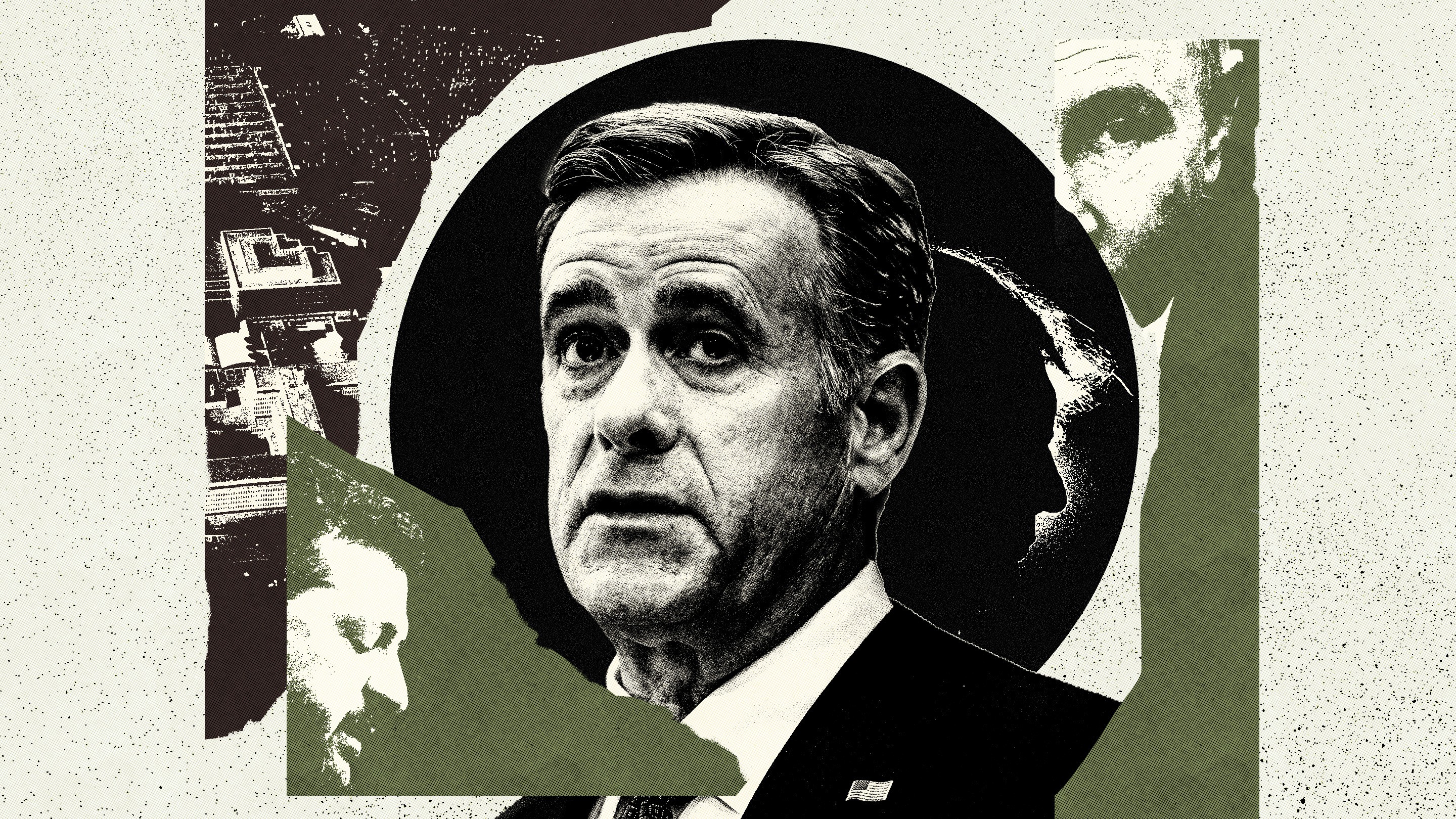
In a speech to the nation in July, Donald Trump said that reports from intelligence agencies showed that American elections were profoundly vulnerable to foreign interference. China had “bought, stolen, or hacked” voter data in 18 states, he said, and he implied that foreign operatives had somehow been able to manipulate actual votes. Reports by the CIA and other agencies that he made public that day did not back up his most extravagant claims. But Trump suggested that a foreign government may have stolen the 2020 election from him, and that it could strike again.
Democrats consider that speech a dress rehearsal for next week’s elections. For years, Trump has claimed that foreign governments possess the power to hack electronic voting machines to change the outcome of a race. Election-security experts and lawmakers told me that they expect him to trot out the same claims again if Republicans lose large numbers of seats in the House and Senate. And they’re concerned that he’ll use classified intelligence reports as a pretext for trying to seize ballots or stop vote-counting by the states.
“We start with the premise that the president is going to do that,” Representative Jim Himes of Connecticut, the senior Democrat on the House Intelligence Committee, told reporters last week. But according to the most recent intelligence that Himes said he had seen about foreign threats to the election, U.S. adversaries haven’t changed votes. “We have never seen an operation to actually interfere,” he said.
Years of reporting from intelligence agencies and election-monitoring groups back Himes up. Foreign governments disseminate propaganda and try to undermine confidence in the political process, and they seek to influence policy, sometimes through espionage. But there is a big difference between influence and interference, which experts define as manipulation of an election with the aim of altering the outcome. Top Trump officials have sought to prove that foreign actors worked with Democrats and other “deep state” interests to deny Trump a second term in 2020, only for their theories to come up empty. Former Director of National Intelligence Tulsi Gabbard went so far as to obtain voting machines from Puerto Rico and test them for evidence of tampering. Her probe found none.
One reason voting machines are so secure is that they’re not connected to the internet. “It would be extremely hard for a foreign or outside actor to reach the actual vote,” Lawrence Norden, the vice president of the Elections and Government Program at the Brennan Center, told me. “And we have a paper backup of almost every vote that is cast in the United States at this point,” he added. So even if a hacker managed to flip a vote from one candidate to another on a computer tally, election officials could spot the discrepancy. Norden said that, in his view, foreign governments aren’t the major concern this season. Instead, the dominant source of worry is closer to home. “The new threat in this election is the administration,” Norden said.
Real limits constrain Trump’s ability to interfere in the midterms, even if he tries to do so. The Constitution gives states the power to administer elections, and U.S. law prevents a president from carrying out what many experts consider a nightmare scenario of “nationalizing” the vote. “A mere declaration by the president is not going to be enough legally to justify going in and trying to seize voting machines or ballots,” Richard Pildes, a professor at NYU School of Law, told me. Federal agents would need a warrant to take control of election equipment or ballots, and first they’d need to persuade a judge there was probable cause that a crime had occurred. Any classified intelligence reports might have to be shown to a judge, Pildes said. Even if the government was successful, it cannot legally remove the ballots themselves from state custody, and must rely on copies or images of them, he added. “There’s certainly no power in the executive branch to take over or nationalize the election process,” Pildes said.
A White House spokeswoman told me that Trump was focused on prosecuting election crimes, including voter fraud, and on strengthening election infrastructure. The Department of Homeland Security has offered physical security and cybersecurity services to states and localities. “The only ‘concerns’ about election security are being caused by radical Democrats refusing to enact basic election security measures, supported by the majority of Americans, including voter ID and citizenship verification to ensure only Americans are electing America’s leaders,” the spokeswoman, Laruen Biss, said in a statement. “President Trump has done more than any other President to ensure we have free and fair elections.”
Should Trump claim that foreign operatives are changing votes, Himes and his counterpart on the Senate Intelligence Committee, Mark Warner of Virginia, told reporters they would call the president’s intelligence advisers and ask for the underlying facts. Himes said that he told CIA Director John Ratcliffe and Director of National Intelligence Jay Clayton, “When the president makes that announcement, you will answer your cellphone to give us information about what’s happening.”
A spokesperson for Clayton’s office told me that since he was confirmed this summer, he “has made it clear” to the leadership of the House and Senate committees “that he is available to them 24/7 on any issue.” A CIA spokesperson told me, “Director Ratcliffe is responsive to CIA’s Oversight Committees and will continue to be available as appropriate.”
Recently, House committee members met with career staff in Clayton’s office who monitor threats to election security. It’s a smaller group these days, after cuts by the administration, Himes said. “But we got a lot of confidence that they are doing their job, that if the president were to demand that they make something up, one way or another, we would learn about that,” he said.
The threat profile from U.S. adversaries this fall is similar to what it’s been before other major U.S. elections in recent years. Russia continues to spread misinformation aimed at undermining public confidence in the political system, voting machines, and Democrats in particular, according to lawmakers and election-security experts. In some cases, Moscow-aligned actors are making deepfake videos with the help of AI to spread false allegations of misconduct. China has focused more on local races and influencing specific policies, often by recruiting agents in the United States. (In May, a former mayor of a Los Angeles suburb pleaded guilty to acting as an illegal foreign agent, primarily by promoting Chinese propaganda.) As for the Iranians, who historically have tried to influence U.S. elections, they appear more focused this year on keeping gas prices high by disrupting traffic in the Strait of Hormuz.
Foreign influence has been a prominent feature of American politics for a decade now, since Russia used propaganda and selectively leaked emails to divide voters and denigrate Trump’s 2016 opponent, Hillary Clinton. But true interference would be novel, alarming, and contradicted by U.S. intelligence agencies’ best estimates about what foreign adversaries actually hope to achieve.
Norden said that both before the election and just after, Russian influence groups are likely to again sow divisions and political discord. One Russian propaganda group in particular, Storm-1516, was active in the 2024 election and could come on the scene again, he said. But peddling misinformation, however corrosive, is not the same thing as flipping votes. Meanwhile, Norden said, the Trump administration has laid the foundations to undermine the public’s confidence in the outcome of the election. That is its own kind of influence operation.
Intelligence officials seem aware of that particular risk. Back in July, when Trump tried to suggest that China might have had a hand in his loss, the declassified documents that the White House put on its website didn’t substantiate those claims. One CIA document that garnered significant attention from lawmakers and security experts contained a summary of China’s aggressive efforts to exert influence on American politics and economic policy. But it didn’t claim that China had ever interfered and changed votes.
If any renewed claims of foreign interference by Trump next Tuesday, or in the days that follow, are to be believed, they will require the sort of evidence that he has so far been unable to supply.
Donald Trump and Volodymyr Zelensky have never enjoyed a warm relationship, or even a stable one. But last week, it hit a new low. Trump called on the Ukrainian people to elect a new president, describing Zelensky as “more difficult to deal with” than Vladimir Putin. He accused Zelensky of prolonging Ukraine’s war with Russia. “He says he wants to settle, but he doesn’t,” Trump told Newsmax, without mentioning that it was Putin who started the war nearly five years ago. “Zelensky is not a good guy for us to deal with.”
The two leaders may find themselves at a personal nadir, but all the while, the U.S. intelligence community has shown no letup in its fight to defend Ukraine against Russian aggression. Armed with information that the U.S. provides, Ukraine’s military has launched strikes deep inside Russia. And U.S. spy satellites provide early warning about incoming missiles and drones. Among U.S. personnel on the ground, “the CIA is in the lead,” a retired senior officer who travels frequently to Ukraine told me. If anything, the Ukrainians, with the CIA’s help, have gotten too good at hurting Russia for Trump’s taste.
The administration’s policy is deeply conflicted, and perhaps no one understands that better than John Ratcliffe, the director of the Central Intelligence Agency. He has a foot in two worlds: advising a president who’s continuously at odds with Ukraine’s leadership, and running an agency that’s essential to Ukraine’s war for survival. One intelligence officer in the Baltics, who works closely with the Americans to counter Russian influence, told me that, though you’d never know it from Trump’s rhetoric, the CIA’s operations are now “much more aggressive” than they were during the Biden administration.
The Ukrainians don’t see Ratcliffe as their advocate. They know he works for a mercurial boss, and that if Trump were to follow through on his recent threat to halt intelligence support unless Ukraine stops attacking Russian oil refineries, Ratcliffe would carry out the order. But Ratcliffe came into office promising, with Trump’s support, to return to the agency’s roots of espionage and clandestine operations. For now, that battlefield still extends to Ukraine. The CIA helped build the modern Ukrainian intelligence apparatus after Russia annexed Crimea in 2014. Partly owing to that long history, officials in Kyiv said they trust Ratcliffe to tell Trump the truth about the war, and not simply what the president wants to hear.
More than a dozen current and former intelligence officials I spoke with in the U.S. and Europe described Ratcliffe, who served as the director of national intelligence in Trump’s first term, as clear-eyed about the threat Russia poses not just to Ukraine, but to the United States and its allies. (Most people shared their views on the condition of anonymity, to speak freely about the CIA director.) In that respect, Ratcliffe is not alone in the administration. Marco Rubio, when he ran for president in 2016, called Putin a “gangster and a thug.” And Pete Hegseth, when he was a television host, called him a “maniac” with ambitions to conquer Europe. But now, as senior Cabinet members with their own political ambitions, they have aligned themselves with the president’s rhetoric.
Ratcliffe is a quieter adviser. He gives few interviews or speeches. He rarely posts on social media. Without needing to take a more conciliatory tone toward Moscow at press conferences and on cable, Ratcliffe is free to offer more candid advice in private. “He is well informed and understands the real situation,” one senior Ukrainian intelligence official who works directly with the CIA told me. “Their people stationed here support us very well. They are absolute professionals.” The official suggested that Ratcliffe would be a more effective peace negotiator than Trump’s current envoys, Jared Kushner and Steve Witkoff.
Ratcliffe, who declined my request for an interview, has shown no inclination to switch jobs. And why would he? He enjoys a rare position in Trumpland—always in the room and (so far) never on the outs. He spends many working hours at the White House. He and the president regularly play golf together. Ratcliffe has advised Trump on some of his most consequential foreign-policy decisions of the last two years, including the choice to go to war in Iran.
Tulsi Gabbard, Trump’s first DNI during his second term, was so far removed from his inner circle that when the president was making final preparations to invade Venezuela, she was posting photos of herself from a beach in Hawaii. Ratcliffe was exasperated by Gabbard’s habit of stoking controversies and peddling conspiracy theories on social media, people who know them told me. Her most enduring contribution to national security was to gut the Office of the Director of National Intelligence, slashing the number of personnel by more than a third. As the ODNI has declined in size and relevance, the CIA, with Ratcliffe in charge, has reclaimed its traditional role at the center of the intelligence community. On paper, the president’s chief intelligence adviser is the director of national intelligence. In practice, it’s Ratcliffe.
How much influence Ratcliffe, or any intelligence leader, actually has over Trump depends on the president’s willingness to listen. And that record is mixed. (Trump didn’t exactly heed their warnings about how Iran would respond to American attacks.) But people who’ve worked for Ratcliffe told me he believes that his job is to advise the president, not to make policy. He can explain the consequences of potential actions, as he did when he helped Trump weigh the costs and benefits of bombing Iranian nuclear facilities last year. Ratcliffe had said he believed Iran was hoarding nuclear material in order to make a weapon. But he did not, and will not, advocate that the president pick one approach over the other, people who have worked with him told me.
In that respect, Ratcliffe has turned out to be like most of the CIA directors who preceded him. And that comes as some relief to skeptics—including inside the agency—who worried that he might follow the example of other top Trump officials who have vilified their employees or used their office to exacerbate culture wars. Elected to Congress from a deeply conservative Texas district in 2014, Ratcliffe got Trump’s attention during televised hearings about the FBI’s investigation of Russian election interference, which he suggested was motivated more by political animus than genuine concern about foreign-intelligence threats. He joined the Trump administration as DNI in 2020. Ratcliffe is still a Trump loyalist. But compared with Gabbard, Hegseth, or FBI Director Kash Patel, he is comparatively restrained in his criticism of the intelligence community, focusing mostly on Obama-era leaders and their alleged anti-Trump bias, instead of on his current employees.
“I’ve always thought he was a workhorse, not a show horse,” a former official who worked with Ratcliffe told me. He doesn’t roam the halls of headquarters to chat with staff. In the early days of his tenure, his conspicuous absences from Langley and his constant presence at the White House made some CIA officers question where his priorities lay, current and former officials told me. But it’s not unusual for directors to covet face time with the president. And his relationship with Trump and low-profile manner have probably helped keep the president from attacking the agency. (Gina Haspel, a career CIA officer who served as director in Trump’s first term, successfully pursued the same strategy, current and former officials noted.)
The CIA’s success in Ukraine has become a problem—at least from Trump’s perspective. Relentless attacks on Russian oil refineries have hobbled its economy and choked Putin’s war machine. The International Energy Agency estimates that in the first eight months of this year, Ukraine hit a refinery on average once every three days. Economists say that Iran’s restriction of shipping through the Strait of Hormuz has driven up the cost of diesel. But Trump blames the damage to Russian refineries for the spiking prices, and he wants the Ukrainian attacks to end.
On October 9, as officials from Kyiv and other European capitals met with Trump’s envoys in Miami for peace talks, the president announced that Putin had just agreed to start selling Russian diesel on the global market. With the midterms less than four weeks away, he sounded jubilant when he posted on Truth Social that diesel prices would be “COMING DOWN, IN RECORD NUMBERS, AND FAST!”
Trump’s announcement surprised the negotiators, three people with knowledge of the talks told me. Some of his advisers had urged him to hold off on speaking with Putin until there was a concrete peace proposal for him to respond to, concluding that Trump would look weak if he relaxed sanctions but came away with no reciprocal commitments. Putin made none.
Trump seemed to believe that dangling the prospect of fuel revenue to resuscitate Russia’s economy could bring Putin back to the table. But for years now, the U.S. intelligence community has assessed that Putin keeps fighting, despite an enormous loss of lives and money, because he thinks he will win—if not through an outright military victory, then by exhausting the support of Ukraine’s allies. To that end, Russia in recent months has escalated its “hybrid warfare” against Europe, plotting sabotage on commercial cargo aircraft, jamming communications, and probing NATO air defenses with drones. European intelligence officials told me they fear that Putin might even send forces across the border with Estonia, as he did in Crimea in 2014 when so-called little green men appeared, stripped of their military insignia.
Back in August, Trump tried a subtler tactic to bring the war to a close. He dispatched Ratcliffe to Moscow, where he met with his counterparts in the security services and laid out the agency’s view about how the war was going, people familiar with the meeting told me. The upshot: No one was winning. Russia’s military has failed to make meaningful advances, but Ukraine has not expelled Russian forces from its territory. That’s hardly a secret analysis. But Ratcliffe’s presence sent a message of its own.
The director was using a line of communication informally known as “the channel,” which allows Russian and American spies to talk candidly, away from the scrutiny of the press or the grandstanding of politicians. Putin, an ex-KGB officer, would understand that Ratcliffe had come not as a diplomatic envoy but as a fellow spy, with a message he felt was important for Putin to hear.
Ratcliffe never met with Putin; that’s not how the channel works. But the Russian intelligence chiefs would have been obliged to document whatever the CIA director told them, even if they tried to dismiss it out of hand, a Western intelligence official told me. The U.S. and its allies have long suspected that Putin’s advisers may be misleading him about Russia’s chances of success in Ukraine. If Ratcliffe could help convince Putin that he was pursuing a lost cause, perhaps he’d finally come to the table. Among all the officials in the Trump administration, Ratcliffe was uniquely situated to deliver that message. No one knows the state of the war, and the stakes involved, better than the CIA officers who are working in Ukraine and monitoring the fight from headquarters.
In September, Ratcliffe briefed Zelensky about his trip to Moscow when their planes were both in Ireland for refueling stops, a source familiar with the conversation told my colleague Simon Shuster. A U.S. official told me that the meeting took place entirely by happenstance. But it demonstrated the ability for Ukrainian leaders and the CIA director to have candid discussions on short notice.
Last week, Ukraine got a taste of what diminished U.S. intelligence support might look like. Russian missiles pounded Kyiv as reports emerged about disruptions to the Starlink satellite network and U.S. early-warning systems, which blinded Ukraine to some incoming Russian projectiles and limited its ability to intercept them, people familiar with the matter told me. The Ukrainian intelligence official said he blamed the Americans, but there’s also evidence that technical failures were responsible for the failure to intercept at least some of the incoming missiles. Officially, the Americans haven’t yet turned off the intelligence spigot, although Trump could act at any time.
If Trump were to do so, people who have worked with Ratcliffe tell me that he wouldn’t lobby the president to change his mind, no matter the misgivings at CIA headquarters.
At his confirmation hearing in 2025, Ratcliffe pledged to get the CIA back to what he considers its core mission. “We will conduct covert action at the direction of the president, going places no one else can go and doing things no one else can do,” he said, and told CIA officers listening that “if all of this sounds like what you signed up for, then buckle up and get ready to make a difference. If it doesn’t, then it’s time to find a new line of work.”
Many people have taken Ratcliffe up on his suggestion. Although the CIA doesn’t disclose personnel figures, current and former officers told me they have never seen such a large number of retirements and resignations in their career. Some have even left on the verge of a major promotion. Vacancies in senior posts might have to be filled by less experienced officers.
When CIA officers quit, their colleagues gather in the lobby of the headquarters building for a “clap out,” a round of applause to wish them well on their last day. Ratcliffe isn’t a fan of the tradition, two former employees told me. They serve as a reminder that many people have left.
Ratcliffe also made decisions early in his tenure that some now-former officers told me they couldn’t condone. At his confirmation hearing, he warned that “a politically motivated, bureaucratically imposed social-justice agenda” risked distracting intelligence officers from their work. Once in office, he dismissed senior personnel who had been assigned to DEI-related roles. Former officials told me many of the people who were fired were simply unlucky enough to have been assigned those jobs while they waited for higher-level positions to open up, and were unfairly maligned as activists. He also fired about 60 probationary employees, who had less than two years’ experience. Some of them had already been put on notice that they were underperforming, but the mass termination still shocked many agency officers.
This is not to say that everyone is unhappy at Langley. Broadly speaking, current and former officers told me, morale is highest in the operations directorate, among the officers who conduct the espionage that Ratcliffe wants to emphasize. Personnel in the Special Activities Center, which conducts covert and paramilitary activities, are particularly satisfied, recently retired officers told me, perhaps because they’re so busy, and not only in Ukraine.
CIA directors don’t typically crow about secretive operations, but Ratcliffe has eagerly shared what he’s described as operational successes. In a speech last June, he said that “thanks to CIA,” U.S. special forces were able to locate and apprehend Venezuelan President Nicolás Maduro “less than four minutes after their feet hit the ground on the largest military complex in that country.” (A senior Pentagon official told me that Ratcliffe took too much credit for the operation, but he didn’t deny that the agency’s contributions were important.) During the same speech, Ratcliffe credited the agency with helping locate a U.S. fighter pilot shot down over Iran, and for the “flawless intelligence picture” that had allowed more than 100 U.S. aircraft to hit Iranian nuclear facilities a year earlier.
But some of the agency’s more opaque activities have stirred anxiety. Press reports have revealed CIA operations in Mexico and El Salvador as part of the Trump administration’s clandestine efforts to combat drug cartels. In August, The Washington Post reported that a series of air strikes targeting Ecuadorean fishing boats near the Galápagos Islands, a known hub for drug traffickers, were part of a covert CIA program.
Legal experts have said that U.S. air strikes against boats suspected of carrying illegal drugs may violate the laws of armed conflict and in some cases could be considered murder. Recently retired officers told me that some of their colleagues have avoided taking jobs in the CIA’s Americas and Counternarcotics Mission Center. “There are people at the operational level who, when the Democrats take over the House, will be left holding the bag,” one former officer told me. “The agency is over its skis right now.”
At the other end of the morale spectrum are employees in the analysis directorate, who write the articles, reports, and assessments that the president and his team use to make policy decisions. Since Ratcliffe became director in January 2025, significantly more analysts have reported concerns that the objectivity of their work is being undermined, according to an annual survey that I first reported on in July. The respondents directed most of their criticism at Gabbard, after she fired senior analysts who refused to alter their reports to support administration policy. But the results reflect a broader suspicion that the administration will reject information that it doesn’t want to hear. That will cause analysts to pull their punches, which in turn will deprive policy makers of the best advice, former analysts told me.
Julia Curlee, who resigned in May as a senior CIA analyst, faulted Ratcliffe for not defending the agency officers whom Gabbard ordered be fired, and for rescinding or revising assessments that had been written before his tenure, after judging them to be politically biased. “Every officer drew the obvious conclusion: The director won’t protect even our most respected analysts when they tell hard truths, so they stopped telling them and learned to avoid topics the White House didn’t want to hear,” Curlee told me. “Ratcliffe isn’t protecting the CIA from politicization; he’s leading it.”
Analysts strive for objectivity. But intelligence as a practice is not truly apolitical, because it’s an instrument of presidential power. The most successful CIA directors know how to tell their bosses the truth while also serving their interests.
Ratcliffe has largely managed to walk that fine line. Last year, he ordered analysts to reexamine what Trump calls “the Russia hoax,” the agency’s conclusion that Russia interfered in the 2016 election with the goal of helping Trump win. In public remarks, Ratcliffe said the review proved that Obama-era national-security leaders had created a “politically charged environment,” and he threw the credibility of their findings in doubt. But the CIA review, which Ratcliffe released, offered scant evidence to support that assertion, didn’t change the conclusion, and generally praised the quality of the CIA’s work.
Over the summer, the agency declassified documents about China’s efforts to interfere in the 2020 election. In a prime-time national address, Trump said the intelligence was evidence of China’s malign actions and systemic weaknesses in the security of elections. But again, the documents didn’t support all of his claims. Ratcliffe issued a measured statement about backing Trump’s “transparency initiatives” that called out China’s interference, but he didn’t repeat the president’s assertion that the election was stolen. Election deniers close to the president have urged him to declare a national emergency and assert federal control over elections because of alleged foreign interference.
With the midterms approaching, the two top Democrats on the intelligence oversight committees in the House and Senate said this week that they had put Ratcliffe on notice: If Trump claims publicly that the CIA gave him intelligence that a foreign power interfered in the election, the lawmakers will call Ratcliffe and ask if Trump is telling the truth. “You must be available to us on that day,” Representative Jim Himes of Connecticut told reporters. “So when the president makes that announcement, you will answer your cellphone to give us information about what’s happening.” Himes and Senator Mark Warner of Virginia said Ratcliffe had promised to answer their call.
Even when he has waded into political controversy, Ratcliffe has managed to shield the CIA from Trump’s ire. Considering that when the president came into office the first time he compared intelligence officers to Nazis, this is not an insignificant achievement. Ratcliffe also does a better job than most Cabinet members of explaining the president’s hasty decisions. Last year, when Trump abruptly cut off intelligence to Ukraine after his televised blowup with Zelensky in the Oval Office, Ratcliffe spoke about why the pause would probably be short-lived. “Trump had a real question about whether President Zelensky was committed to the peace process, and he said: Let’s pause,” Ratcliffe told Fox Business five days after the leaders met. (That was a diplomatic summary. Trump had told Zelensky that he was disrespectful and ungrateful.) But after he left the White House, Zelensky sent Trump a note, which he also posted on social media, praising the president for his “strong leadership” and assuring him that “Ukraine is ready to come to the negotiating table.”
“We do really value how much America has done to help Ukraine maintain its sovereignty and independence,” Zelensky said. Trump read portions of the note to a joint session of Congress, and called Zelensky’s conciliatory words “important.”
Ratcliffe said that Trump’s pause had given time for Zelensky to consider his next move. The director clearly believed that the Ukrainian leader had made the right choice when he reached out to Trump, and he accurately predicted that the intelligence would start flowing again. “I think we’ll work shoulder to shoulder with Ukraine as we have to push back on the aggression that’s there, put the world in a better place for these peace negotiations to move forward,” he said.
The CIA director seemed to be counseling Zelensky over the airwaves, a technique Trump’s own advisers have employed. The message came down to this: Remember who you’re dealing with, and things might work out. Ratcliffe might not advocate to his boss, but he knows how to read him.
Simon Shuster contributed additional reporting.
*Illustration sources: Brendan Smialowski / AFP / Getty; Daniel Heuer/Bloomberg / Getty; Daniel Slim / AFP / Getty; Nicolas Economou / NurPhoto / Reuters; Vyacheslav Prokofyev / Pool / AFP / Getty.

 Login