Login

The Best Kind of Book Adaptation
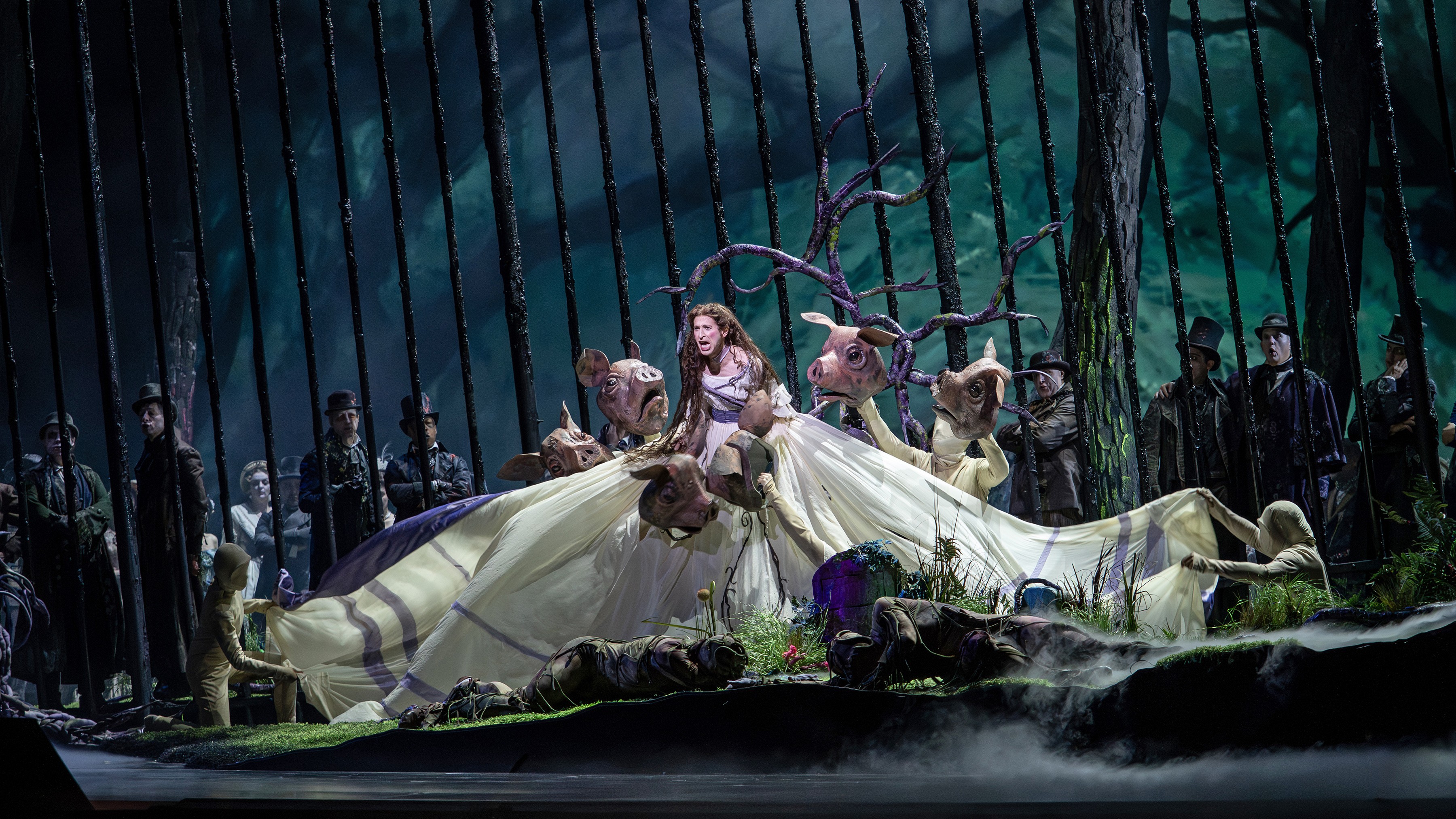
The couple seated next to me at the Metropolitan Opera’s latest world premiere did not stay for the second act; perhaps they didn’t appreciate the puppeteered genitalia that unfurled onstage shortly after the curtain rose. I understood their alarm. After watching a dress rehearsal a week earlier, I had texted my boyfriend: “I am shocked by the size of Hans Vollman’s puppet penis.”
Vollman is one of the central characters in Lincoln in the Bardo, adapted by the composer Missy Mazzoli and the librettist Royce Vavrek from George Saunders’s Booker Prize–winning 2017 novel of the same name. Like almost everyone else in the tale, Vollman is dead but in profound denial about that fact—in his case, because he can’t reckon with the tragedy of having expired before he could consummate his new marriage. Hence the outsize appendage: a perpetual reminder of Vollman’s unfinished business.
It may seem puerile for one of the most prominent opera companies in the world to put such effort into illustrating the undignified source of Vollman’s grief. In fact, although the puppet might make audiences laugh—or leave—it’s a striking symbol of why operatic adaptations of literature can be so exciting. At a moment when film or TV versions of novels often end up, at best, as decent airplane watches, opera, as the excellent Lincoln in the Bardo illustrates, has the potential to create something bolder and more bizarre.
Opera’s lingering reputation for being stuffy and elitist has helped obscure a fundamental truth about the medium: It’s weird. Even before modern composers started testing the limits of storytelling, operas tended to be guided by minimal logic; if you’d like to feel exceptionally confused, I suggest reading a synopsis of Richard Wagner’s Tannhäuser. And the form relies on artifice to function. There is nothing naturalistic about characters conversing in song with the kind of vocal power and dexterity that could make a skeptic believe in God. This means that there is effectively no such thing as a shy opera—at least not one that stands the test of time. Any opera that succeeds must quickly teach audiences to understand that what they’re going to experience won’t obey the laws of many other forms of entertainment—the kinds in which plot developments are reasonably justified, characters don’t share their every thought in repetitive and excruciating detail, and the gates of hell don’t suddenly open in a dining-room floor.
[Read: George Saunders has a new mantra]
This makes opera a natural fit for Lincoln in the Bardo, a not-very-realistic novel that’s written almost entirely in dialogue. Saunders’s book is set the night after the burial of President Abraham Lincoln’s 11-year-old son, Willie, and is narrated by more than 150 voices, most of them belonging to Willie’s new neighbors in Oak Hill Cemetery in Washington, D.C. Some become Willie’s spiritual guides: the Reverend Everly Thomas, the frustrated Vollman, and a young gay man named Roger Bevins III. Others are stranger and more profane. Some souls have suffered greatly, most notably the enslaved people buried outside the cemetery boundaries, and some have inflicted suffering, including an enslaver whose streams of pure bigotry are difficult to read. As Thomas, Vollman, and Bevins urge Willie to leave the bardo—a space between life and the afterlife, as defined in Buddhism, that’s dangerous for children—the living Lincoln wanders among them. His grief, more than anything else, is what keeps Willie from moving on to whatever comes next.
I’ve been trying to imagine what a Hollywood adaptation of this astonishing tonal chaos could possibly look like. (One is in the works, a hybrid live-action, stop-motion film in which Tom Hanks will play the president.) In recent years, the often risk-averse studio system has favored, with notable exceptions such as the joyously bizarro Poor Things, literary adaptations that hew to basic genre constraints: status-cast thrillers with blockbuster aspirations such as The Housemaid and Verity; prestige limited series, à la East of Eden, that seem destined to wither away algorithmically as they roll off the Netflix queue; and, as ever, the endless iterations of 19th-century British novels, including the recent Sense and Sensibility and the dubious, upcoming Ebenezer. There remains room, in that milieu, for real artistry, but perhaps not for a choice as wild and possibly alienating as the Met’s X-rated puppet. Without the freedom to be truly outlandish, could an adaptation really do justice to Bardo? I can’t envision a version of the novel that waters down its most outré choices but also manages to preserve its magic.
An opera adaptation of Bardo must, of course, pare back. Many dozens of well-defined characters bounding across the stage would be exciting, but also impractical. Yet it needn’t water down: A successful opera is big, and also strange. That’s especially true now; opera companies including the Met, recognizing the need to attract younger audiences, have put more emphasis on developing new works that can make the old form seem fresh. That shift has seemed to breed greater comfort with challenging choices. Among the many contemporary operas the Met has premiered in recent years are a new version of the myth of Orpheus and Eurydice narrated by three stones—yes, stones—and a harsh, mind-bending adaptation of Luis Buñuel’s surrealist film The Exterminating Angel.
Lincoln in the Bardo—the opera—is hugely entertaining. It’s full of apt little musical jokes; the most spiritually harrowing scene, in which Reverend Thomas recounts his journey to the bardo, is repeatedly interrupted by the ludicrous ditties of a “doodling Pennsylvanian.” But the show also embraces, and enhances, many of the most difficult elements of Saunders’s novel. The creators have made the striking decision, for instance, to have a teenage girl named Elise Traynor, who is trapped in the bardo in a state of grisly eternal torment, be portrayed by a male countertenor. The uncanniness of watching an adult man take the guise of a young girl helps make that girl’s plight more visceral. It is a constant reminder, almost below the level of awareness, that Elise will never reach maturity. She won’t have the chance to discover what kind of adult she might be—deep-voiced or dulcet-toned, rebellious or traditional, effeminate or masculine.
[Read: The art of book-to-film adaptations]
That kind of layered creativity represents opera’s literary capabilities at their best. A great book creates a private emotional landscape inside the reader: a kind of internal set piece that contains the characters, the space they occupy, and the feelings they provoke. When I open the book Lincoln in the Bardo, I also travel to the tiny, three-dimensional model of it that lives somewhere between my mind and my heart. Opera, like film, can’t re-create the personal experience of reading; the characters will never look just as you pictured them. But it can create an accentuating mirror to that experience. In my imagined version of Saunders’s bardo, Elise Traynor now has a voice. Because that voice isn’t quite what I expected, I’ve started to think about the character in new, unsettling, enriching ways. Because of the opera, she’s taken on a bit more of a life of her own.
The most haunting refrain in Lincoln in the Bardo belongs to young Willie Lincoln. Unsure of where he is and why, and desperate to be reunited with his parents, he invents a credo for how he will get home: “never if weak, maybe if strong.” The audience knows his case is hopeless, but it’s impossible not to be moved by his innocent courage, or by the sweet, mournful instrumentation that accompanies it. His words also function as something like an ethos for the opera itself: To stand a chance at success, it must do the thing with bravery, no holds barred.
© Karen Almond / Met Opera