Login

America Is Now an Ally of Russia
Sign up for Inside the Trump Presidency, a newsletter featuring coverage of the second Trump term.
In the past week, the president of the United States has conclusively turned America into an ally of the Russian Federation.
Donald Trump has now abandoned pretense and is openly aiding the Kremlin in its war against a friend and partner of the U.S. The American commander in chief has abandoned the Western order, the most successful—and powerful—security arrangement in human history. To judge from the available evidence, he has not done so out of a cold calculation of the national interest. Instead, he has based his decisions on his own interests; his open admiration for Russia’s dictator; his resentment of Ukraine’s democratically elected president; and quite possibly other factors that so far have remained obscured from the American public.
In September, Trump signed a sanctions bill that Congress had passed, named after the late Senator Lindsey Graham, a pro-Ukraine hawk. The legislation sanctioned Russia as well as other countries that are supporting Russia’s invasion and brutalization of Ukraine. The bill was approved with bipartisan support, but some Republicans and most House Democrats voted against the law, arguing that it contained a trap door, a provision that would allow Trump to suspend the prescribed sanctions at will.
Those critics were correct to be worried. Trump pulled the lever on that trap door just two days before the law was supposed to go into effect. In an executive order signed on Friday, Trump said that “such a waiver at this time is in the national interests of the United States”—he declined to explain exactly how the waiver was in America’s interests—and that the law would remain unexecuted until such time as his administration decides otherwise. This waiver came a short while after Trump lifted restrictions on Russia’s sales of diesel fuel to the U.S. and other markets.
Trump’s recent actions in support of Russia are so obvious that they have generated a rare moment of bipartisan disgust: Both Democrats and Republicans now seem to share a horror at the betrayal of Ukraine, and at the president’s reckless abdication of America’s role as leader of the free world.
The president’s aides are scrambling to explain why this capitulation to Russia isn’t exactly what it looks like. Secretary of State Marco Rubio, when pressed by a reporter, said that the administration would “assess” the impact of the Graham Act after a 60-day period. This was nonsense: The executive order includes no such timeline, and no one seriously believes that the administration is running numbers to decide whether sanctions are a good idea.
Rubio was joined in his excuse making by a handful of desperate Republicans who tried to cast Trump’s decision as some sort of tough-love patriotism. When asked on Sunday whether he agreed with Trump on lifting sanctions, Senator James Lankford of Oklahoma said, “He is choosing the American people first, is what he’s doing.” But few even on the American right seem willing to buy it. Trump loyalist Senator Ted Cruz called Trump’s move “a mistake,” and Senator Darline Graham, who now holds her brother’s seat, broke with Trump as well.
Some conservative commentators, including Andy McCarthy, a former federal prosecutor who writes for National Review, expressed considerably more rage. McCarthy wrote on Saturday that Putin is on a “quest to reconstitute America’s Soviet enemy,” and that “President Donald Trump is giving him aid and comfort.” As a lawyer, McCarthy surely did not choose those words at random. Aid and comfort are part of the criteria in Article III of the Constitution of the United States that define treason. McCarthy called for “immediate hearings about this week’s shocking escalation of the Trump-Putin alliance.”
Trump’s decision has nothing to do with American national security. His de facto alliance with Russia is a sordid arrangement rooted in his own fears and hatreds.
First, Trump knows that Republicans are almost certainly facing a beating in the midterm elections, in part over the price of gas—a spike caused by the kind of war in Iran that he promised during his 2024 campaign to never start. He is desperate to do anything he can to lower the price of gas, and because he does not seem to understand how the international economy works, he may well believe that some janky diesel deal with Russia will alleviate high fuel prices in the United States. (It will not, although it will certainly help some Russian companies.)
As Malcolm Rifkind, a former defense minister of the United Kingdom, put it this weekend: “Donald Trump has shown himself as a person to be repulsive; as a President of the United States to be a disgrace to his own people as well as to his international responsibilities. We all know his actual reasons for this are a grubby attempt to win a few more votes in the midterms by trying to get oil prices down.” The result, Rifkind rightly added, is that Trump will now be “directly responsible” for the deaths of Ukrainians who will die while Putin uses the Russian alliance with America to continue the fighting.
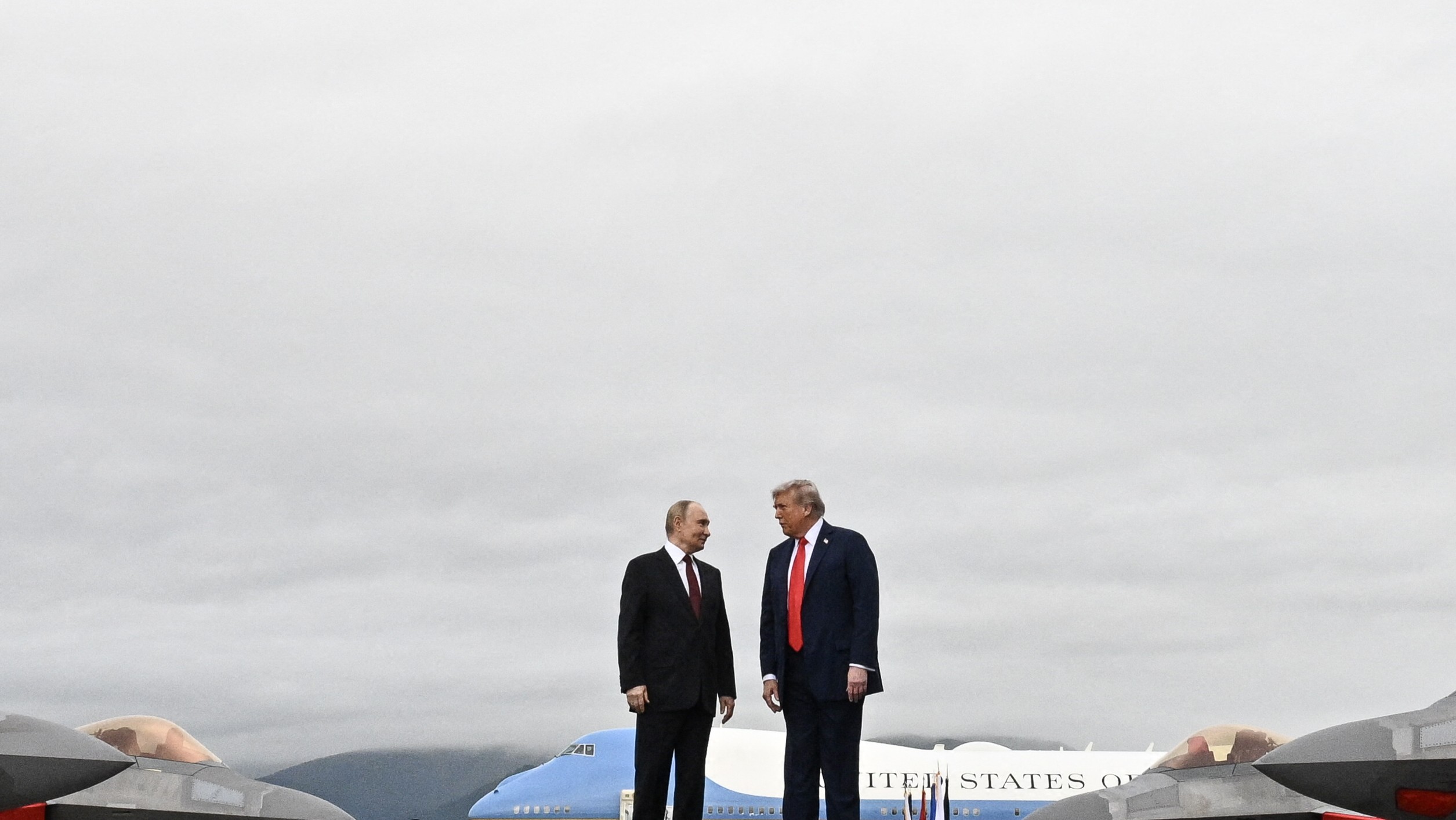
But even if the American economy were in better shape, Trump’s history with Putin suggests that he was never going to allow the sanctions in the Graham Act to be enforced. Trump’s suspension of the law is a signal to Ukraine, to Russia, to Europe, and to America’s NATO allies that the Trump White House and Putin’s Kremlin are now on the same side.
Trump’s man-crush on the Russian dictator has been well documented and need not be recounted in all its unctuous detail. His attachment is so obvious that for years it has sparked various complicated theories about its origins, but Occam’s razor suggests a more direct explanation: Trump is a weak man who is intimidated by stronger and smarter men. His humiliating relationship with Putin is different only in degree from the way he interacts with other authoritarian leaders, including China’s Xi Jinping and North Korea’s Kim Jong Un (a dangerous totalitarian with whom Trump claimed to have fallen in love).
As if to prove the point, this afternoon Trump posted a whiny screed on his Truth Social site in which he pleaded with the public to understand how overmatched he is against Putin. Trump tried to explain that he is accommodating the Russian leader because he doesn’t “want to do anything that will drive, foolishly, Russia away from the bargaining table.” In a deeply pathetic admission, he warned that angering Putin could have consequences in Iran: “Perhaps more importantly, Russia is doing very little, if anything, to help the Islamic Republic of Iran, compared to what they could be doing, and I want to keep it that way, and will, unless stupid people get in the way.” He then said that Ukrainian President Volodymyr Zelensky has gotten so much money from the Biden administration and from Europe that “he doesn’t want to end this war, and probably never did.”
Consider what the American president just told the entire world: Please don’t interfere in my relationship with a murderous dictator, or he might help the country that America’s men and women in uniform are fighting at this very moment. The leader of the most powerful nation on the planet—yes, that’s still the United States right now—is trying to get everyone else, including the American Congress, to avoid antagonizing Putin, instead of warning Putin not to even think about aiding Iran. Nothing better illustrates just how weak a supplicant Trump has become in his relationship with the Kremlin boss.
Trump engages in this kind of personalized diplomacy in part because he believes himself to be—against all evidence—a master dealmaker. But the greater irony, considering how much he rails against globalism, is that he also behaves this way because he is in fact a globalist himself. He does not view the world as a collection of sovereign nations; he sees it instead as territories run by mob bosses. The weaker ones, especially America’s allies, can be abused and threatened at will. The stronger godfathers, including America’s dedicated enemies, are peers and thus treated with respect. The interests of the innocent millions in those countries are of no consequence. What matters is what’s good for Trump, his underbosses, and his family.
Trump also seems to be motivated by his open loathing of Zelensky, a hostility that can be traced back to Trump’s first term, when the unwillingness of Ukrainian authorities to be part of a scheme to investigate Joe Biden led to Trump’s first impeachment. But Trump’s antipathy toward Zelensky is more than score-settling: To him, it seems, Zelensky is a loser, a nobody who is causing needless trouble for his friend Vladimir. The American president cannot understand why Zelensky and his people do not simply accept their situation and lie down under Russia’s tank treads.
Earlier this month, Trump called for Zelensky’s removal. Now he seems determined to let Putin, rather than the people of Ukraine, fulfill that demand.
In the words of another famous Russian named Vladimir, What is to be done? The answers are not comforting.
Congress, when it reconvenes, can try to pass new legislation, but a bill amending the Graham Act would require a veto-proof majority to become law. Republicans have shown no interest in taking the power to tariff out of Trump’s hands, and they are equally unlikely to strip him of the power to lift the sanctions they just tried to impose. The courts are also unlikely to challenge the president when he invokes national security, which he does for almost everything he wants.
An additional problem is that both Trump’s secretary of defense and his vice president are likely to support a policy aimed at securing a Russian victory. Vance joined Trump in an attempt to bully Zelensky during their infamous meeting in the White House in early 2025, and he is unlikely to ask Trump to reconsider helping Putin. Pete Hegseth, for his part, appears willing to say and do whatever keeps him in the Pentagon. America’s senior military officers may be sympathetic to Ukraine—as are most American citizens—but the idea that the adolescent, self-styled “secretary of war” is going to suddenly deliver a mature and stoic defense of democracy against Russian imperialism is laughable.
For the foreseeable future, Ukraine’s fate depends on aid from Europe. Perhaps Europe will continue to step up, and a new Congress might try to demand more support from the White House. But everyone will have to hurry: Winter is coming.
Zelensky, sadly, knows that a Russian victory looks to be exactly what Trump wants. If “the United States will support Putin,” he said on Sunday, “it’s unbelievable. It’s a tragedy.” He added: “Of course, if these two countries will be together, of course we will not prevail. And we will not be able to stand.”
A world in which the White House is allied to the Kremlin was, until now, the stuff of paranoid fiction. Manchurian candidates and red presidents were fantasies, dark tales that Americans told themselves, like ghost stories around a campfire. But this alliance now exists. If Stalin and his Cold War successors could see what Trump and Putin have created, and how the mighty United States has been humbled and humiliated, they might think that their evil hopes were not wrong, but only that they dreamed them too early.
© Andrew Caballero-Reynolds / AFP / Getty