Login

Maine Has Changed. Susan Collins Hasn’t.
Senator Susan Collins desperately needed to change the subject. As she stepped around cow manure at the annual Fryeburg Fair, a reporter was asking her about President Trump’s musing that he might campaign in Maine during the closing weeks of the election—an invitation that Collins, trying once again to save her seat, almost certainly had not extended to a man with an approval rating of 32 percent in the state. A campaign staffer tried to cut off the questioning, but the nearly 74-year-old Collins has not won five Senate elections through luck alone, and she quickly found a way out of the tricky Trump talk. “I do have some important news today,” she declared to the assembled scribblers.
Collins went on to announce that she had persuaded the Trump administration to speed up the release of $38 million in home heating assistance for Maine. Nevermind that her office had already publicized the news earlier that day, or that none of the journalists with Collins reported for local publications. This was either Collins at her senatorial savviest, or a stodgy politician reaching for a tattered playbook.
As temperatures plunge, the cost of heating oil is as potent a political issue in Maine as the price of gas is everywhere else. Collins has built her reelection campaign on the idea that she alone, as the chair of the Senate’s powerful appropriations committee and the lone Republican elected to Congress in all of New England, can deliver for Maine. She has boasted of bringing home billions for her sparsely populated state over the years. At a debate this month, Collins crowed that she had secured an exemption for road salt—another crucial supply during Maine’s perennial winter freeze—from the tariffs that Trump has slapped on Canadian goods. (“We can’t eat road salt,” her Democratic opponent, Troy Jackson, retorted.)
This strategy has worked for Collins before. In 2020, she defied polls forecasting her defeat and won reelection by nearly nine points over a well-funded Democratic opponent even as Joe Biden carried Maine that year by a similar margin. The contours of that campaign were largely the same as the one Collins is currently waging: Democrats tried to tie her to an unpopular Trump, denounced her claims to be independent, and assailed her vote to confirm Justice Brett Kavanaugh as a potential death knell for Roe v. Wade. Collins prevailed by leaning on her bipartisan record and the federal aid she had secured for her state.
Six years later, Democrats have reason to believe that a message that fell short in 2020 will resonate more deeply now. Both Collins and Trump have lower approval ratings in the state than they did then, and the decisive vote Collins gave to Kavanaugh proved consequential when he sided with a majority on the Supreme Court in overturning Roe. (Collins, who supports abortion rights, has said she relied on Kavanaugh’s statements that he considered the 1973 ruling to be settled legal precedent. Earlier this year, however, she told reporters that she did not regret her vote.) Democrats have added ammunition against Collins following a ProPublica report that, in late 2024, the FBI was on the verge of launching a bribery investigation into federal contracts she had helped land for her campaign donors (one of whom had pleaded guilty to making illegal contributions). The probe ended after Trump took office and the Department of Justice slashed its public-corruption units. Collins has denied wrongdoing.
On paper, Maine should be the easiest state for Democrats to flip during a year in which, polls suggest, voters are intent on punishing the GOP. It is the only state that Kamala Harris carried in 2024—she won by seven points—where a Republican incumbent senator is on the ballot. Yet Democrats have not been able to put Collins away. Polls show a close race; Jackson is leading narrowly in some surveys, and Collins is ahead in others. She is faring no worse—and in some cases better—than Republican incumbents running in more conservative states such as Ohio, Alaska, and Kansas.
Collins is benefiting, too, from a Democratic campaign that has at times verged on the shambolic. Party leaders initially tried to recruit Governor Janet Mills to challenge Collins, despite the fact that Mills would have been, if elected, a 79-year-old Senate freshman. Mills entered the race but withdrew when polls showed her getting crushed in the primary by Graham Platner, the progressive oyster farmer. Platner shot quickly to national stardom, surviving the revelation that he had a tattoo resembling an infamous Nazi emblem, but he was forced to withdraw following allegations of sexual assault (which he denied).
[Read: Platner just made things harder for Democrats ]
Democrats then nominated Jackson, another Bernie Sanders acolyte who had finished third in the party primary for governor earlier this year. Jackson and Collins hail from the same rural county in northern Maine, and he still sounds like he grew up a few miles from the Canadian border. Jackson followed his father into logging before entering politics; he’s served in the state legislature for most of the past two decades, rising to become the leader of the Maine Senate. He lacks both Platner’s strengths and weaknesses—less obviously flawed but also less polished and charismatic. “Troy does not have the energy or the engagement that Graham did,” Wendy Frayer, a 53-year-old social worker from Auburn, Maine, told me at a Jackson rally. “He probably lost some votes.”
Whether Jackson can reassemble, and possibly expand, Platner’s coalition is a key question in the closing weeks. But when I spoke with both Democrats and Republicans in Maine recently, they each argued that the race will turn less on voters’ views about Jackson than on their opinions of Collins. “Troy Jackson is a nonfactor,” one Democrat who’s not working on the campaign told me after being granted anonymity to speak bluntly about the party’s candidate. “The question is: Will the trends catch up with her this year?”
Collins is, at this point in her career, a pretty sporadic campaigner. She does not regularly hold large rallies or town halls, and during a six-day stretch in mid-October that I spent in Maine, her staff notified reporters of only a single public appearance aside from a televised debate with Jackson. (The rivals held four debates over two weeks, so voters have gotten to hear plenty from both candidates.)
The Fryeburg Fair, however, is always a fun stop for Collins, as well as an ideal place for her campaign to demonstrate that her connection to Maine’s voters remains strong. The annual festival is the state’s biggest, drawing upwards of 20,000 people a day and transforming a small town near the New Hampshire border into “Maine’s second-largest city,” according to a fair official who served as Collins’s guide for the day. Fryeburg sits in a rural county that voted overwhelmingly for Collins in 2020, and during a two-hour stroll through the fairgrounds, people flocked to her. “Please win,” one man told Collins as he introduced her to his family. (She offered campaign stickers to the kids.) “I’m doing my best,” the senator replied with a smile. Collins gamely posed for photos with all who sought them, including a pair of teenage boys wearing shirts that read I ❤️ Boobies, which they had purchased from a nearby T-shirt vendor. (One of them did remove his hat for the photo out of respect.) Collins also tolerated the reporters who were trailing her, although as she made her way through a fragrant, high-traffic stretch near the livestock barn, she chided one of them: “Don’t make me walk in shit.”
I was struck by how many people not only recognized Collins but seemed to be familiar with her accomplishments—an indication of both her standing and the imprint of millions of dollars that she and her allies are spending on TV ads. Multiple Collins supporters brought up, unprompted, the record-setting 10,000th consecutive Senate vote without an absence that she cast in June. “Character is huge, and Susan Collins has a great character record,” Chet Charette, the deputy fire chief in Fryeburg, told me. Charette is backing Collins even though he wants to see term limits for members of Congress, which she opposes. (During her first campaign, in 1996, Collins pledged to serve only two terms in the Senate.) “She’s a lot more cognizant than a lot of them are,” Charette said.
By virtue of her lonely position in the middle of a polarized political climate, Collins must also rely on votes from people whom she frequently disappoints. Outside the Portland TV studio that hosted one of her debates, a boisterous crowd of Collins supporters cheered her arrival. When I asked Marc Fournier, a 55-year-old from nearby Westbrook, why he was backing Collins, he began with a disclaimer: “Susan Collins is not my favorite person.” He explained that he was displeased Collins had opposed some key Trump priorities. “She’s giving votes away,” Fournier complained. But he added: “Just because I disagree with her doesn’t mean I’m not going to vote for her.”
As Collins was concluding her visit to the Fryeburg Fair, a man who gave his name as Jim greeted her with a notably less friendly message. He told Collins he had supported her for years, but she had lost his vote when she backed Kavanaugh and helped Trump “stack” the Supreme Court. “You don’t stand up when it’s important,” Jim said. “I do,” Collins protested.
[Read: The guard that won’t be changing]
A key explanation for Collins’s political resilience is that in deep-blue New England, plenty of Democratic voters pride themselves on rewarding GOP moderation. In 2024, Vermonters elected Phil Scott, a Republican, to a fifth term as governor by a 50-point margin even as they backed Kamala Harris for president and Sanders’s return to the Senate. New Hampshire has elected Republican governors for the past decade.
Yet that tendency among some Democrats in the region to vote for the “good Republican” extends less and less to federal officeholders in the Trump era, and the force of political gravity that Collins must overcome is stronger this year than ever before. When it was my turn for a question in Fryeburg, I asked Collins what she would say to Mainers who are unhappy with the direction of the country and who might use this election to vote for change. “Well, first of all, I contest the premise of your question,” Collins replied, pointing to her “enormously favorable” reception among the fairgoers. At that moment, a man started loudly heckling her. “You can’t eat road salt, can ya?!” he shouted. “There are always a few exceptions,” Collins observed with a tight smile, before going on with a lengthy defense of her record delivering for Maine. She did not seem especially concerned that her critics have grown significantly in number over the years or that, in a few weeks’ time, they could marshal the votes to end her long career.
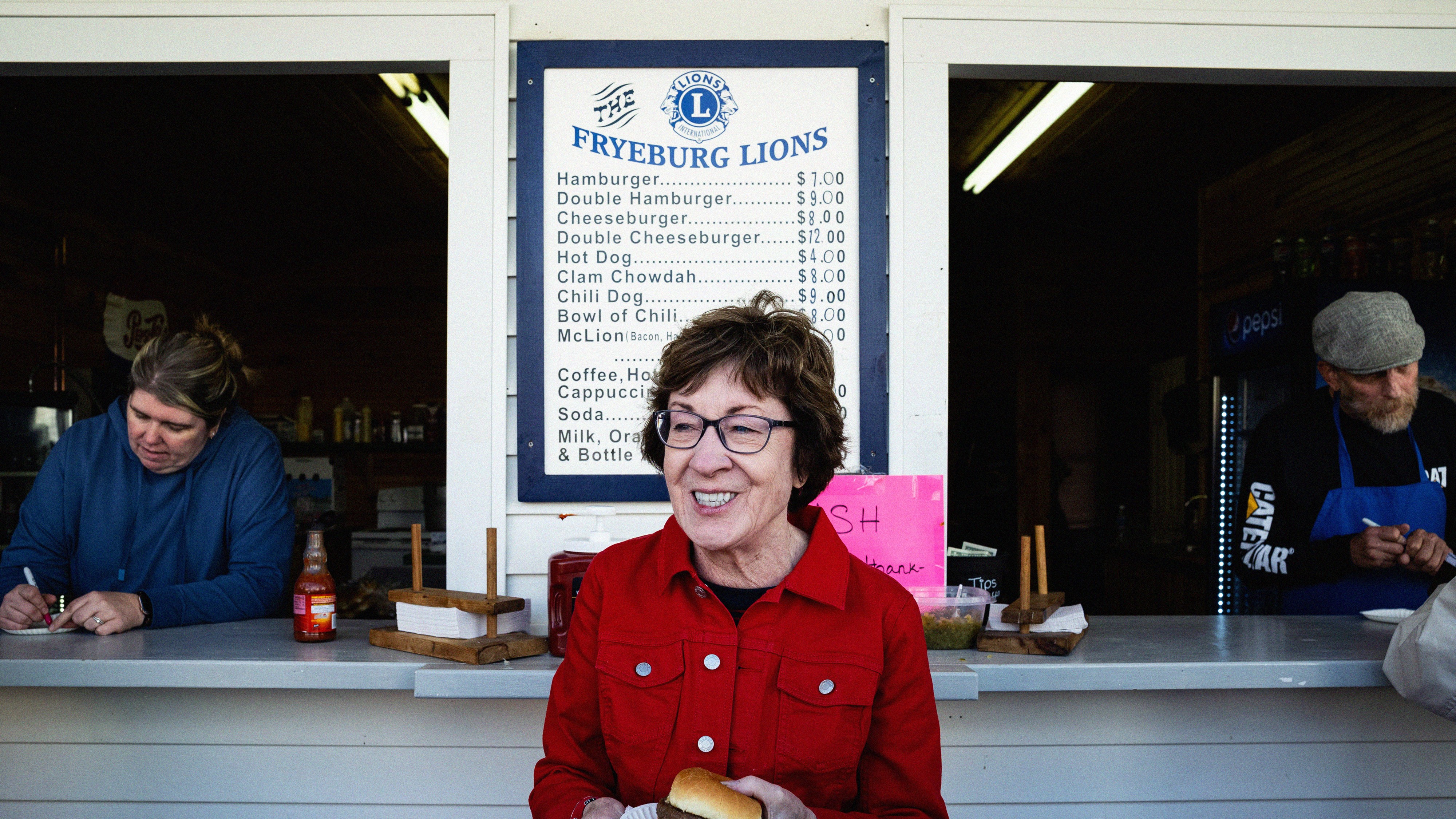
© Graeme Sloan / Bloomberg / Getty