Maybe you’ve seen the ad: A man and a woman are loading a shopping cart. The woman tells the man he must return a carton of eggs. “We have to set that $7 aside for killing Palestinians.”
The woman explains that grocery prices are rising because the United States gives so much aid to Israel. “It’s costing us a lot of money to drop bombs on Gaza,” the woman explains. “Don’t they get universal health care too?” the man asks. “We’re paying for that, too, probably,” the woman responds, at which point the man puts back the bananas.
The ad was produced by an independent political-action committee to support the Senate campaign of the Michigan Democrat Abdul El-Sayed. During the Democratic primary, El-Sayed regularly denounced American supporters of Israel as a shadowy, sinister special interest. Since winning the nomination, he has distanced himself from his earlier language. Now a super PAC is reviving it for him only a week before the general election.
The legendary journalist Hunter S. Thompson explained the ad half a century before it was produced. In his book Fear and Loathing on the Campaign Trail ’72, he described “one of the oldest and most effective tricks in politics,” which may have played a role in one of Lyndon Johnson’s early campaigns in Texas:
The race was close and Johnson was getting worried. Finally he told his campaign manager to start a massive rumor campaign about his opponent’s life-long habit of enjoying carnal knowledge of his own barnyard sows.
“Christ, we can’t get away calling him a pig-fucker,” the campaign manager protested. “Nobody’s going to believe a thing like that.”
“I know,” Johnson replied. “But let’s make the sonofabitch deny it.”
In the case of the ad supporting El-Sayed, the sonofabitch targeted by the false accusation is not El-Sayed’s theoretical opponent, the Republican Mike Rogers—not really. The ad concludes, “Mike Rogers is for”—ironic chuckle—“they/them.” We all know who they are, and they are the real target of the ad.
The accusation that Israel is to blame for America’s economic problems is not some unique quirk of El-Sayed supporters. During his campaign to become New York City’s mayor, Zohran Mamdani toldPolitico in 2025 that the dilapidated state of the city’s housing was the fault of the same villain: “The government refuses to fund public housing, all while we continue to find billions of dollars to drop bombs that kill tens of thousands of Palestinians over more than a year now.”
That same year, Marjorie Taylor Greene drew a similar link. American aid, she charged, typically accounts for up to a fifth of Israel’s defense budget, “even though Israel, nuclear-armed Israel, has universal healthcare for their citizens and subsidized college for their citizens. Here in America, we’re $37 trillion in debt.”
On Meet the Press in August, El-Sayed insinuated that U.S. aid for weapons in Israel was somehow an impediment to health care at home. “This campaign was a referendum on whether or not we want health care here or bombs somewhere else.”
Do supporters of Israel have to deny the false accusation? Okay, here goes. U.S. military aid to Israel is set at $3.8 billion a year from 2019 to 2028—about one-20th of 1 percent of the total federal budget. In 2024, Congress approved a $95 billion aid package for Ukraine, Israel, and other allies—of which, nearly two-thirds went to Ukraine, about $15 billion went to Israel, and about $9 billion was directed to humanitarian relief, including assistance for Gazan civilians displaced by the war that Hamas started. (The rest went to Taiwan and other allies in the Indo-Pacific region.)
Almost all U.S. assistance to Israel takes the form of credits that Israel can use only to buy American-made equipment. This assistance provides at least two direct and immediate benefits to Americans. First, it buys the United States access to Israeli military technology. By partly underwriting the development of Israel’s Iron Dome missile-defense system, the U.S. has gained the use of battle-tested systems that also protect American lives. Second, this assistance lowers the per-unit cost of U.S. systems. The United States buys up to 48 F-35 fighters a year. Israel has bought 75 and is considering an estimated 25 more. Foreign orders allow U.S. arms manufacturers to improve their economies of scale. At a time when other NATO allies are canceling their orders of American equipment because they no longer fully trust the U.S. as an ally or supplier, Israeli orders enhance the efficiency of American defense production.
Meanwhile, all U.S. aid to Israel amounts to a fraction of what Israel’s critics wish to spend domestically. Despite the implications of that El-Sayed ad: Americans spend $1.1 trillion a year on groceries. Canceling aid to Israel would deliver the equivalent of about 30 hours of that spending. Per Mamdani’s complaint that Israel is to blame for bad housing in New York City: The city’s housing authority estimates its backlog of deferred maintenance at almost $80 billion, or about 20 years’ worth of U.S. assistance to Israel at present levels. Expanding Medicare to cover all American citizens would cost perhaps more than $32 trillion in additional federal spending over the first decade. Covering even one month of this plan would take 70 years’ worth of aid to Israel.
By blaming the Jewish state for the price of bananas in Michigan, the super-PAC ad calls to mind political tricks older and more disturbing than the one attributed to Johnson. In 1899, Karl Lueger, the mayor of Vienna and one of the most notorious anti-Semites of the 19th century, gave a speech blaming the Habsburg empire’s economic troubles on its Jews. “Here in our Austrian fatherland the situation is such that the Jews have seized a degree of influence which exceeds their number and importance,” he argued. “And in this respect the Jews operate a terrorism of a kind that could hardly be worse. For us, in Austria, it is a matter of liberating Christian people from the hegemony of Jewry.”
As with the rising cost of living in the U.S., the problem Lueger was concerned with was real. His voter base of artisans and craftspeople was coming under immense pressure from factory competition. There was not much Lueger could do about his voters’ distress. But he could point them toward a politically useful target. Now, with a modest update of Lueger’s language, an outside PAC’s closing argument in one of the most watched Senate races of 2026 blames a familiar “they/them.”
On Wednesday, July 18, 2001, a freight train derailed in Baltimore’s Howard Street Tunnel. Flammable liquid ignited, causing a fire that raised the temperature in the tunnel to somewhere between 1,000 to 1,500 degrees. “We’re told some of the boxcars are actually glowing,” a fire-department spokesperson told the Associated Press. More than 100 firefighters were called to fight the blaze.
The National Transportation Safety Board investigated the fire but never figured out what went wrong. No one was killed, and other trains were rerouted to avoid the inferno. But more than trains navigated the tunnel’s brick-lined walls: Several internet-service providers and telecommunications companies were running cables through it. The internet couldn’t be so easily retransmitted. The cables that wound their way through the tunnel were damaged, and web traffic as far away as Atlanta and Los Angeles slowed to a crawl. One company that measures web performance said“the internet delays were the worst it had seen,” reported the Associated Press. A single tunnel was responsible for much of the country’s web traffic, and Americans paid the price.
The internet isn’t what we think. It is physical, subject to the vagaries of nature and time, just as our bodies are. Like us, it will flicker and fade. The internet’s fragility crops up everywhere: in the sudden disappearance of a relied-upon website, and in the endless thrum of posts, images, and videos.
In the case of the Howard Street Tunnel, the fragility became, without warning, quite obvious. As the writer Maria Farrell and the technologist Robin Berjon note in their 2024 essay titled “We Need to Rewild the Internet,” WorldCom—a major phone-and-internet company at the time—played an important role in the outages that followed the inferno. “WorldCom had spread web traffic over different fiber networks,” they write, but “the region’s narrow physical topography had concentrated all those different fiber networks into a single chokepoint, the Howard Street Tunnel. WorldCom’s resilience was, quite literally, incinerated. It had technological redundancy, but not diversity.” Despite dealing in the physical world—in the fiber-optic cables that make up the real, material internet—WorldCom had somehow forgotten that the land makes its own rules.
Bottlenecks can have their benefits. Efficiencies can be found in transmitting data through companies that consolidate the services we need to be online. In 2021, Fastly, a cloud-utility provider, stopped working for an hour, taking down the websites of major news outlets including CNN, The New York Times, and The Guardian. The Verge, a technology-news site, ended up publishing updates about the outage via Google Docs while its website was down. The day of the disruption, Fastly’s stock price actually rose. “Investors were delighted by headlines that informed them of an obscure technical service provider with an apparent lock on an essential service,” Farrell and Berjon write. “To investors, this critical infrastructure failure doesn’t look like fragility but like a chance to profit.” Fragility and profit go hand in hand, which makes some sense when you remember that corporate redundancy always carries inefficiency. Brittleness is big business, a feature and not a bug of the cloud economy.
But the cloud obscures the very real collection of companies, people, and processes that create and structure the internet. When we put something in the cloud, we don’t just offload the responsibility of maintaining our data to fickle chunks of magnetic metal alight with electricity; we also offload that responsibility to a rather limited set of fickle human institutions. You might want your family photos to live in the cloud for centuries, but “most companies do not last long,” Maxwell Neely-Cohen wrote for the Harvard Law School’s Library Innovation Lab. “They get acquired or split up into pieces or go bankrupt or decline into something much smaller or are upended by catastrophic geopolitical events.”
The cloud also shrouds the cables, data centers, and transmission towers that compose the internet itself. “The cloud is made possible by a relatively small number of undersea cables that require constant maintenance,” continued Neely-Cohen. For a medium so often praised as decentralized, for a metaphor that calls to mind something diffuse, that’s an awful lot of centralization. A small number of companies own the data centers, connected by a small number of cables also owned by a small number of companies, through which data, yet again owned by a small number of companies, flow. The internet, in this telling, looks much more like the Howard Street Tunnel than a cloud.
And now artificial intelligence has gusted in, revealing the physical infrastructure that the cloud used to hide. Ordinary people can see more clearly than ever the precarity of the supply chains and the power of the chips that fill the water-guzzling, electricity-hungry data centers that so many have come to loathe.
Just as AI reveals the physicality of our digital lives, it has also brought into sharp focus the crucial pieces of software that undergird the internet. Last week, an AI model found security vulnerabilities in PHP, a coding language used in 70 percent of websites. Despite its centrality to the modern web, I’d hazard a guess that PHP isn’t a household name. Originally named as an acronym for personal homepage, it was built to help host its creator’s résumé. As PHP grew in popularity, it shed some of that DIY spirit—and that acronym—but, like so many essential systems that keep the web online, volunteers remain an essential part of its maintenance.
In a classic comic about the state of modern infrastructure, a precarious Jenga tower is held up by a single block labeled “a project some random person in Nebraska has been thanklessly maintaining since 2003.” AI—swarming onto rarely used Wikipedia pages, probing poorly run government websites, discovering zero-day exploits—has shown the web to be the frail, uncanny place that it has always been. Indeed, the most cloudlike part of this state of affairs is the absence of human agency.
As users of the web, we have to pay attention to the data and infrastructure that the cloud cloaks. Hordes of flesh-and-blood engineers, sitting in glass-and-steel office buildings and water-and-air-cooled data centers, attend to the systems that hold our words, pictures, and videos. What we store and what we transmit are acts of attention to a world that remains resolutely material, despite the seeming immateriality of our digital lives. Human institutions remain central to the practice of storage and transmission—an inconvenient fact, because human institutions fade, just as human bodies do. The cloud is refreshed every moment of every day by the fresh attention of humans. Just as manure, in balance, can encourage the dogwood to flower, so, too, does our care—over generations—make the internet bloom.
Nothing makes me more nauseated than a row of multiple-choice questions and empty bubbles. After I turned 18, I thought I’d never encounter that feeling again, outside of stress dreams about forgetting my No. 2 pencils. And yet there I was, hiding in a cubicle at work to take a test intended for high schoolers, demonstrating my understanding of apostrophe placement and verb tense, and comparing the definition of truth in passages from Nietzsche and JFK.
I was taking the Classic Learning Test, an alternative to the SAT and ACT. The test is only 11 years old, and was originally taken mainly by kids who were homeschooled or had attended private religious academies. But use of the test is growing at an astonishing pace in red states where there’s a belief that the SAT and ACT have neglected the Western canon in an attempt to become “woke.” In the past three years, public universities in Florida, Arkansas, Texas, Georgia, Indiana, and Iowa announced that applicants could submit their CLT scores in place of SAT and ACT results. Oklahoma, Louisiana, and Wyoming now allow students to use their CLT scores to qualify for state scholarships. Defense Secretary Pete Hegseth recently called it the “gold standard” exam, and starting this year, military-service academies will accept CLT scores too. Some 200,000 kids will take the test this year. The problem is that the test is too easy.
The CLT was created by Jeremy Tate. As a remedial-English teacher at a public high school in New York, and then a college-admissions counselor in Maryland, he had become disillusioned with the American education system and what he saw as its emphasis on preparing students for the workforce. “What every other generation was doing in education was fundamentally a different kind of project,” he told me. They were doing two things: “moral formation” and the “transmission of this cultural, intellectual, Western inheritance.” College-entrance exams inform high-school curricula. Because the SAT and ACT emphasize rote reading and math skills, that’s much of what schools teach. But if students had to take a classical-learning test, Tate believed, schools would be forced to teach the Western canon.
In 2015, Tate opened the for-profit Classic Learning Initiatives and started administering the CLT. Students are recorded as they take the two-hour test online, to prevent cheating. The exam is divided into three sections: verbal reasoning, grammar and writing, and math. Most of the texts are taken from a list of classics beginning with The Epic of Gilgamesh and ending with Toni Morrison. The math section covers algebra, geometry, trigonometry, and mathematical reasoning.
Tate presents the CLT as more rigorous than the SAT and the ACT. The CLT is the only one that doesn’t allow calculators, and its reading passages are longer than those on the SAT. But his biggest sell is on the substance of the texts. The other tests, he argues, have altered their content to push “anti-Western left-wing ideology.”
(Representatives for the ACT and SAT denied that the tests had any ideological leaning, or any agenda beyond assessing college readiness. Granted, it’s been several years since I took either one, but I recall more questions about the definition of words such as zenith and benediction than any progressive polemics.)
Tate’s objection is a bit surprising when you remember that, for years, criticism of the SAT and ACT has mainly been a left-wing phenomenon. Some progressives oppose all standardized testing as inequitable, giving an unfair advantage to children from wealthy backgrounds and cutting students with lower scores off from future opportunities, while also failing to measure qualities such as creativity and grit. During the beginning of the pandemic, in 2020, many universities, including all of the Ivy League schools, made the SAT and ACT optional for applications. But since then, most top schools have reinstated the test requirements, finding that they’re the most reliable way to predict students’ abilities. Now, suddenly, the tests are being attacked from the other side.
Eventually, Tate intends for his test to dwarf the SAT and ACT. He has a long way to go; last year, 2 million graduating seniors had taken the SAT at some point during high school, and 1.4 million had taken the ACT. More than two dozen states, about half of which have Republican leaders, have all public-school students take the SAT or ACT. But Tate believes that Americans are waking up to the testing companies’ “hollowing out and politicization” of schools. “I think word is getting out more and more among students that the SAT and ACT just aren’t really serious,” he told me. Although Harvard and MIT do not accept the CLT, Tate said that a growing number of students are submitting CLT scores to impress their admissions offices. (An MIT spokesperson told me over email that CLT scores are not considered in admissions decisions. The not was underlined.)
Tate claims that the CLT, in contrast to the SAT and ACT, is not political. Yes, Christopher Rufo, the anti-critical-race-theory activist, is on the board of Classic Learning Initiatives. But so is Cornel West, the public intellectual who calls himself a “non-Marxist socialist.” “He’s a good friend,” Tate told me. (West did not reply to a request for comment.) There’s nothing partisan, Tate argues, about valuing rigor and revering old books. Recently, the CLT’s X account posted a collage celebrating what it called “arguably the 50 most influential books in history.” The image appears to be AI-generated; it includes The Aeneid by “Virmer.”
For the first eight years of its existence, only about 20,000 students took the CLT. But in 2023, Florida Governor Ron DeSantis got into a fight with the College Board over its AP African American Studies course, which he accused of indoctrinating students in left-wing ideology. DeSantis seized on CLT as an alternative. Florida began to allow high-school students to use their CLT score to apply to the state’s public universities and its biggest scholarship program. Among students who weren’t destined for college, those who failed Florida’s end-of-semester exams could use a CLT score to fulfill their English and math graduation requirements. Over the next two years, Florida’s high-school graduation rate increased by four percentage points.
In school-board meetings, administrators credited the CLT for the boost. The superintendent of Hillsborough County, which serves more than 200,000 public-school students, called the CLT a “pretty big bullet.” More than 70 percent of the county’s seniors who could not pass the state’s math exam were passing the CLT’s math section. For the English section, that number was more than 30 percent. Many school officials think this is a good thing, presumably, because it makes the schools look better. The CLT “allows students who never before would have gotten a high-school diploma to get a high-school diploma,” a Monroe County school-board member said in a meeting earlier this year. “It doesn’t have them college-ready, but typically those students aren’t heading to college, so this is enormous.” It’s unclear exactly how much of the rise in graduation rates can be attributed to the CLT; Florida’s Department of Education did not respond to a request for comment. But officials in at least seven other districts also claimed that the test helped students graduate, USA Todayreported.
The graduation jump clearly suggests that the test is easier than the state’s own exams, but how the CLT measures up against other assessments is surprisingly hard to figure out. The Classic Learning Initiatives recently gave a team of independent researchers access to the test and the evidence behind it. The researchers—who work at Arizona State University, the University of Cincinnati, the University of Alabama, and the University of Illinois Urbana-Champaign—compared the CLT’s content with the SAT and ACT. The group didn’t set out to measure rigor overall, but it found that of the three tests, the CLT contains the highest proportion of questions about number sense and pre-algebra, which are typically taught in middle school. (The CLT had about double the proportion on the ACT and six times the proportion on the SAT.)
Noah Tyler, the CLT’s chief financial officer, told me that this finding doesn’t mean the test is easier. The math section emphasizes mathematical reasoning, he said. For example, one question asks students to determine how many numbers between zero and 400 are both odd and a perfect square. “So even if it is some quote, unquote ‘middle-school content,’ it’s extremely hard. It’s dialed up to 11.” (The independent researchers confirmed that the CLT contained a higher proportion of reasoning questions.)
The researchers found that the verbal-reasoning section was also less cognitively complex than the SAT and ACT. Some students might struggle with the exam’s classic texts, which can contain arcane references and convoluted sentence structures. But the questions themselves tend to ask for a lower level of inference and interpretation than the SAT and ACT, according to Mark Sulzer, an associate professor at the University of Cincinnati and a member of the research team. Compared with the others, the CLT has more questions that direct students to a specific point in the passage and ask them to rephrase the information that’s already there, Sulzer told me.
My experience with the test confirmed this. It was daunting to start the timer and immediately plunge into a passage by Charles Dickens. But the questions—asking, for example, if a character delivered a letter with enthusiasm, annoyance, or another emotion—didn’t demand much understanding of the author’s work.
Tyler argued that the Florida graduation rate isn’t a fair measure of the test’s difficulty. Although many students pass Florida’s graduation cutoff, few earn a high score. A perfect score on the test is 120—40 on each section. Only 43 students got a 40 on the CLT math section in 2025, Tyler said. And none of them also aced the reading and grammar. “We wanted to make sure there were plenty of differentiators at the top. And so we left it hard,” Tyler told me. “We want to set an anchor and say: Let the whole world rise to the occasion.”
That may be true, but most aren’t taking the test to aim high. The company’s internal data indicate that about two-thirds of test-takers are using the exam not to apply to college at all but to satisfy Florida’s high-school requirements. To do that, they have to earn only a combined score of 36 on the verbal reasoning and grammar sections, and a 14 on the math.
The biggest problem is that it’s not clear what a good score on the test even is. Most companies that administer standardized tests go through a standard-setting process to determine which scores classify students into different proficiency levels. The company that administers the CLT hasn’t done that, the researchers said.
The company has put the test through a “concordance” process—basically, a way to determine what, say, a score of 85 on the CLT would be roughly equivalent to on the ACT (which has 36 total points) or the SAT (which has 1,600). The Classic Learning Institute told Florida officials that a 420 on the SAT math section—considered its passing score—was equivalent to an 11 on the CLT. That’s why Florida first adopted a score of 11 as the threshold necessary for high-school students to graduate.
But researchers say there were major weaknesses in the company’s process. How the institute determined the score was “so methodologically flawed, it’s, like, shocking,” said Audrey Amrein-Beardsley, a professor of teaching and learning innovation who heads the group of researchers studying the CLT. For one, Tate’s organization used fewer than 5,000 students to determine which SAT and CLT scores are equivalent, a sample size that is 100 times smaller than the one the SAT and ACT used. The company could access official SAT and CLT scores for only about half of that group. The rest were self-reported. When the organization studied whether official scores lined up with self-reported ones for a group of students in that sample, it found that about a quarter did not match. “If they were to put any of these technical reports up for peer review, the peer reviewers would literally eat them alive,” Amrein-Beardsley told me.
Florida seems to have recognized that it set the bar too low. This year, the state raised the threshold to pass the math section to 14. The state, Amrein-Beardsley said, is just throwing spaghetti at the wall: “If it doesn’t stick again, they’ll try again,” she told me. “That’s not the appropriate way to do it, but that is the way it’s being done.”
Tyler objected to the researchers’ findings, saying that his organization hasn’t yet been given the chance to review their work. “Before really doing her homework or even releasing a draft, she’s got these grand conclusions about our project and whether we ought to cease and desist,” he told me. “That seems totally inappropriate to me.”
Amrein-Beardsley emphasized that nothing is inherently wrong with the content of the CLT. And more standardized-testing options could be a good thing. Her conclusion is “not that the CLT can never become a good alternative, but that the current evidence does not justify placing it on equal evidentiary footing with the SAT and ACT, especially for high-stakes uses.”
The way to know for sure if a test is rigorous enough is to see how it predicts students’ college performance. But because the CLT is only about a decade old, little evidence exists to show how test-takers do once they matriculate. Currently, only three studies have examined the question. Two compared CLT scores with first-year GPAs at Grove City College and Franciscan University, private Christian schools that prepare many of their graduates for the clergy. The third looked at how 259 students did in their first year at five small Texas universities. A team of Texas A&M researchers who analyzed the CLT reported that, while there was enough data for the scores to be factored into admissions decisions, more evidence was needed before the CLT could be considered as reliable an assessment as the SAT or ACT.
A confession: I breezed through the test’s reading and grammar sections, as well as through the beginning of the quantitative-reasoning section: If there are seven male and nine female chimpanzees, and six male chimpanzees are removed, what is the probability of selecting a female chimpanzee from the remaining group? But then I got to trigonometry and realized that I had forgotten everything I’d learned in high school. I already had a degree, I remembered, and was free to quit at any time. And so I did.
Critics on the left say that all standardized testing is tiring and time-consuming. Critics on the right say that these tests are still the best way to determine what students are capable of. I think they’re both correct. But if we’re going to require students to take these tests, we should at least make sure they’re worth the effort.
For years, red-state politicians have criticized progressives for eroding the education system in service of an ideological agenda. They’ve promised a return to high standards and accountability. And yet, more and more seem to be jettisoning their states’ best measures of accountability in order to win an ideological argument. Does anyone think this is going to work out well for students? The correct answer is no.
This article originally said that the CLT included passages from Peter Pan and Pollyanna; those passages were in a version of the test for younger students.
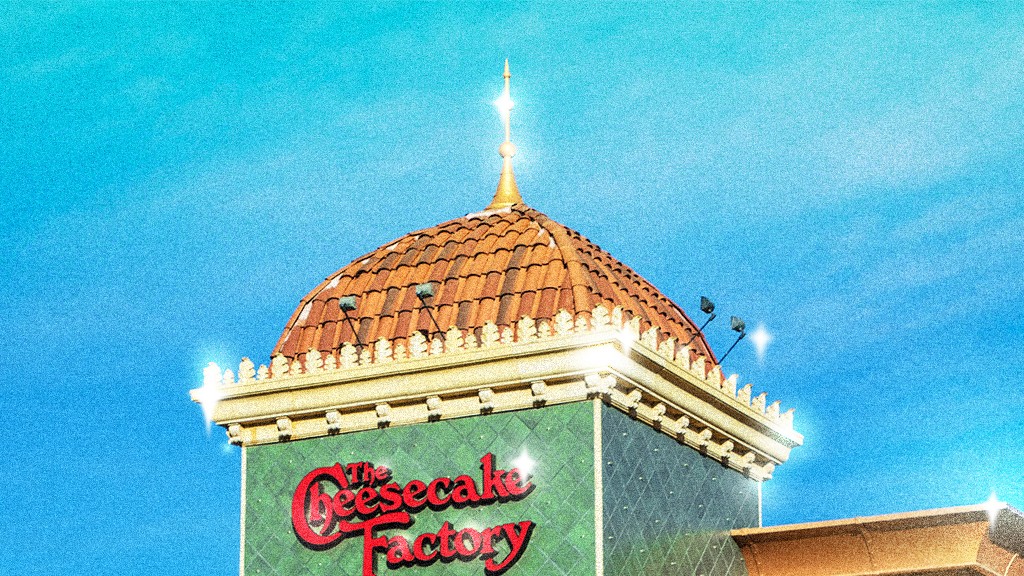
At 2 o’clock on Sunday afternoon, I found myself in a corner booth at the Cheesecake Factory, emerging from the fog of war.
Before me were a dozen half-empty plates, a cluster of dirty napkins, and several depleted beverages. The food had come in waves, unrelenting, like Normandy. There had been egg rolls, four ways; Roadside Sliders; a sheet tray of Factory Nachos; and something called Chicken Parmesan “Pizza Style.” Coke Zeros, I’d told the waitress at the beginning, andkeep ’em coming. There had also been cake. Much cake.
I checked in with myself. I was nauseated, for sure. But another feeling, too, was detectable within the churning volcano of my digestive tract: It was something like joy.
Let’s back up. Over the weekend, Barack Obama criticized President Trump’s schlocky White House aesthetic by saying it looked like “Saddam Hussein opened a Cheesecake Factory.” My first reaction was to laugh. It’s true! The restaurant is over-the-top opulent—as if ancient Egypt and Tuscany had a baby in Las Vegas. Any true Cheesecake Factory fan would certainly appreciate the joke, especially if they remembered the Iraq War and Saddam’s own design sensibilities.
What happened next, though, was disheartening. “Hasn’t eaten dinner that costs less than $250 in years. Has never been in a Cheesecake Factory,” the conservative commentator Scott Jennings wrote on X. “Undefeated at condescending to regular folks.” Other Republicans, and even some Democrats, logged on to police the former president’s tone. This was classic elitist Obama, they argued, making fun of the working man and his primitive taste. It was why Trump won and why Democrats will never win back blue-collar America. My “For You” page filled with commentary about which political party could more confidently claim ideological custody over the Cheesecake Factory.
Immediately, my head began to swirl like the raspberry drizzle in a Georgia Peach cocktail. My rage was congealing, like Cheddar Cheese Fondue on room-temperature Pretzel Bites. Enough! I wanted to scream. Leave the Cheesecake Factory out of your culture wars! Like any number of kitschy, charming American chain restaurants—Rainforest Cafe, Johnny Rockets, and even, God love it, Applebee’s—the Factory can obviously be mocked. But it must be mocked from a place of love. It should exist above partisan politics as a sacred third space, one of the few we Americans have left.
Quickly enough, my frustration gave way to hunger, then introspection, and then to investigatory zeal. Which is how, an hour later, I ended up at the Cheesecake Factory. (I was helped along the path by my editor, who said I could expense everything.)
My friends joined me at the restaurant, a block from the White House. No one asked why we were rushing to get a table. It wasn’t busy—just a handful of tourists and families—and we were seated quickly in a quiet corner, where James Blunt emerged softly from the speaker system. I looked around at the design, which I had seen plenty of times but never quite absorbed before: There were orange faux-marble ceiling beams, trellis-patterned dividers, and columns with faux-tile inlay. The vibe was vaguely Italian, loosely Moorish. There were no gilded trophies or signs, but I could see Obama’s point. I explained his joke to our waitress, who seemed about 20 and well adjusted enough to not be spending time on X. She laughed. “Oh, damn, we caught a stray!” she said. “That’s funny, though. Maybe that’s why we’re slow this morning.”
I knew that I loved the Cheesecake Factory before I ever went inside one. “Too expensive,” my mother would say before steering me toward the food court. But peering through the windows of the restaurant at Jordan Creek Town Center in Des Moines, I was awed by its sumptuousness: the orange, inviting glow from the knobbly chandeliers; the floral frescoes and painted columns; the generous fountain pops and the dense wedges of cake. It wasn’t attempting highbrow elegance but, rather, embracing a kind of madcap largesse, like a zany aunt who wears a lot of bracelets. Inside the Cheesecake Factory, everyone always seemed to be laughing.
Trump, Saddam, and the Cheesecake Factory share an unabashed commitment to aesthetic maximalism. To be sure, this commitment is slightly more appealing in a restaurant than in the office of a democratically elected leader of a country founded on the explicit rejection of monarchy. And there is obviously nothing appealing about Saddam’s palaces, or Saddam himself—which is why it is unfair to associate Saddam with the Cheesecake Factory in any way. I didn’t cover the Iraq War personally, being too young, but I can still promise you with a high degree of confidence that there were no Thai Lettuce Wraps on offer at the Babylon Palace. Laughter and togetherness were not, I gather, the order of the day at Qasr al-Nihayah.
Still, by all accounts, Saddam appreciated food—and especially, in spite of everything, American food. He was reportedly a great lover of hamburgers. After he was tried and convicted, but before he was hanged, his guards said he could polish off entire family-size bags of Doritos. (Nacho Cheese, I’d guess.) For breakfast, he apparently delighted in Raisin Bran Crunch. Just like my father.
Saddam might have been a happier, more reasonable dictator if he’d had a Cheesecake Factory nearby (this is what is known in journalism as a comically irrefutable assertion). The thing about the Cheesecake Factory is that the food is not simply good. It is absurdly varied, original, and, at times, totally, gloriously incomprehensible—a delicious crime against nature. The Cheesecake Factory has achieved in menu crafting what Saddam was rarely able to achieve in weapons manufacturing.
When we ordered our favorites yesterday, we tried to imagine what the Butcher of Baghdad might have enjoyed best. We had hamburgers three ways: Double Smash Cheeseburger Bites, burger sliders (which proved suspiciously similar to the Bites), and juicy cheeseburger meat wrapped in a crispy shell. We ate piping-hot macaroni-and-cheese balls, and saucy shredded chicken fried and sculpted into crunchy, almost papery triangles. Would Saddam have ordered the Buffalo Blasts? Of course he would have.
And these were just the appetizers! Later, we ate the Chicken Parm “Pizza Style” that was essentially a flattened chicken pie, topped with a coil of angel-hair pasta. We also had Chicken Madeira; a pile of thick, garlic mashed potatoes; and a grilled branzino, which I ordered because it was the dish that seemed to most resemble Saddam’s reported Iraqi favorite, masgouf, a roasted river fish. (Some other fun facts my friends and I learned in several minutes of Googling: Saddam apparently wrote a popular romance novel about himself. He was once given the key to the city of Detroit. The closest Cheesecake Factory to Baghdad is in Kuwait.)
We punctuated our meal with an alcohol-forward Lava Flow Punch, a Mai Tai, and the Georgia Peach, the Factory’s twist on a cocktail recommended by the rapper Drake. “We’re not driving today, right?” the waitress asked us at one point, looking nervous. We were not. But we were getting dessert. We requested a few of the restaurant’s namesake items, including a sprinkle-speckled Celebration Cheesecake featuring a birthday candle simply because we wanted one, plus a Chocolate Caramelicious Cheesecake With Snickers—a cake so out of control that after a single bite, one of my friends put down her spoon and exclaimed, “This is messed up!”
Indeed it was. Ultimately, it was a meal fit for a dictator, but one to be enjoyed by regular people. This, to me, is the beauty of the Cheesecake Factory. It is America at its utmost—all decadence, performance, and fun. The Cheesecake Factory is for all of us. Can’t we come together on this most American of pastimes—pursuing a deeply uncomfortable yet utterly satisfying food coma—without enlisting in the culture war?
When the going gets tough, the tough don’t get subtle. Yesterday, with polls casting doubt on his continuing as Israel’s prime minister after Tuesday’s election, Benjamin Netanyahu posted a closing argument on Instagram: an AI-generated image of Tel Aviv destroyed by a nuclear blast, with accompanying text that asked, roughly, Would you prefer to reelect Netanyahu, or be incinerated along with your family? The text—written by the commentator Yuval Bloomberg and reproduced approvingly by Netanyahu—called all of the other campaign issues a “smokescreen,” and accused Netanyahu’s opponents of being so blinded by hatred that they would rather increase their chances of being burned alive than see their country’s political maestro win another election. If you support another candidate, the Instagram post cautioned, “your hand should tremble” as you vote.
For years, Israelis both pro- and anti-Netanyahu have advised against counting him out. That advice remains sound. He has a Nixon-like ability to reemerge improbably stronger every time his political career has been declared over. It seemed over on October 7, 2023, when his government presided over an actual mass burning of Israelis. This time, the group of politicians cooperating to drive him from office is diverse and formidable. A former observer in Netanyahu’s war cabinet, retired General Gadi Eisenkot, is his chief antagonist. But two allied former prime ministers, the centrist Yair Lapid and Naftali Bennett on the center-right, are enthusiastic members of the anti-Netanyahu coalition, and another ex-general, Yair Golan, is attacking him from what remains of the Israeli left. These combined efforts have reduced Netanyahu’s chances of remaining in power to one in four, as of this morning.
These relatively long odds account, perhaps, for the wild messaging from Netanyahu during the past three days. Netanyahu’s statements have been, as George W. Bush said after Donald Trump’s “American carnage” speech, “some weird shit.” In addition to warning that his opponents will be too beholden to Islamists to stop the flattening of Tel Aviv, Netanyahu’s pronouncements include the following assertions: that it is “only a matter of time” before American military assistance for Israel is “over,” that Israel will be beset by international sanctions and compelled to cope without the friends who have in the past guaranteed its survival, and that blockchain-based technologies, such as cryptocurrencies, might provide ways around sanctions.
The other candidates have positioned themselves as normal people who can govern Israel competently in difficult times. Bennett replied to the atom-bomb post by calling for the “revival of our international standing,” and declaring his intention to improve the tech sector and force thousands of Israel’s 1.5 million ultra-Orthodox citizens to trade full-time religious study for military service and employment. (Netanyahu and his further-right coalition partners have refused these measures and tried to preserve draft exemptions.) Netanyahu, Yair Lapid wrote, “has gone off the rails. We must send him home.”
Netanyahu’s case is that he is an unusual man for unusual times. If the times are not unusual already, he will make them unusual, by shifting Israel’s politics and alliances preemptively—away from America and toward the United Arab Emirates, away from Western financial systems and toward crypto, in a manner reminiscent of sanctions-hobbled regimes like Russia, Iran, and North Korea. There is a logic to this frightening perspective. If you think Israel can be a liberal democracy in a familiar international order, and that competent institutions and international alliances are the way to stave off catastrophe, then vote from the menu of Netanyahu’s opponents. If you think Israel is doomed to being a pariah state, then vote for the guy posting images of his country torched in a nuclear holocaust. Today Avigdor Lieberman, the leader of the secular-nationalist Yisrael Beiteinu party and a member of the anti-Netanyahu club, requested a treason investigation into Netanyahu for intentionally “dragging Israel into war” to improve his electoral chances.
This threat of annihilation is not, of course, wholly concocted. But Iran’s open desire to annihilate Israel can be real and still be used as a political pretext to avoid the issues that have led so many Israelis to hate Netanyahu. The same Instagram post that warns of nuclear annihilation helpfully lists these issues: alleged links between Netanyahu and the government of Qatar, reports that Netanyahu received warnings before the October 7 attacks and did nothing, and his support for welfare and draft exemptions for ultra-Orthodox full-time Torah students. About 100,000 such ultra-Orthodox are liable for military service, and most instead study Talmud and are therefore too busy to cram themselves into tanks and fight in Gaza like other Jewish Israelis. Netanyahu’s response to all of these accusations is to crank up the end-of-days volume, to make even the most reasonable criticisms of his politics inaudible.
Among secular Israelis, the last of these gripes produces such bitterness that some seem willing to die rather than vote for a politician who would preserve the exemptions. The bitterness stems from the perception that Netanyahu (himself a religious novice) is eager to make unconscionable concessions to the most extreme elements of the ultra-Orthodox political machine in exchange for a few more seats in his coalition. The main ultra-Orthodox parties are Shas and United Torah Judaism (UTJ), both pro-Netanyahu and monomaniacal about preserving exemptions for as many Torah students as possible.
The cynicism of this move is easiest to appreciate not by assaying the venom of secular Israelis but by hearing the dismay of ultra-Orthodox Israelis, also known as Haredim (those who “tremble” before God) unaligned with Shas and UTJ. Ziva Glanz, a candidate for the upstart Haredi Public party, told me with exasperation that the “legacy” parties were immune to change, and that most Haredim were ready to move on, if only the ossified political system would let them.
Her party is broadly in the Netanyahu camp, and her party is happy to support Netanyahu’s view of Israel’s security. “Existential problems are existential problems,” she said. But they nonetheless want reform, and see his government and its partners as stopping it. Her party supports reducing the number of draft-exempt Torah students. Glanz, the wife of a rabbi, says she thinks the low civilian-casualty rate in Israel’s war with Hezbollah was a miracle granted by God because of Israel’s commitment to religious study. But she says there are 12,000 Haredim who purport to be studying, and whose institutions claim government funds, when in reality they are “hanging out in pizza shops.” They should be put to work. “Our community is a success,” she said, and “with success comes responsibility.” Netanyahu’s response to this modest attempt to disrupt Haredi politics and integrate Haredim into the Israeli national project has been to tell her party to back down.
When Netanyahu first won the premiership in 1996, he successfully campaigned on “making a safe peace”—peace guaranteed through Israeli military supremacy, rather than primarily through the negotiation or diplomacy preferred by his rivals. Three decades later, a “safe peace” guaranteed through military might has become so strategically desirable that it unites his rivals—security hawks, one and all—while Netanyahu himself has moved on. He once promised to bring peace. Now he promises that his opponents will bring annihilation.
In this account, Israel’s violent devastation is so imminent that corruption, pandering, and venality become mere foibles. But what if ignoring these political vices devastates Israel in slower, less lurid ways? What if limitless draft exemptions, unwillingness to scrutinize past failures, and international isolation are themselves devastating? Tomorrow Israelis will vote, many trembling for the future of their country, no matter which candidate they prefer.
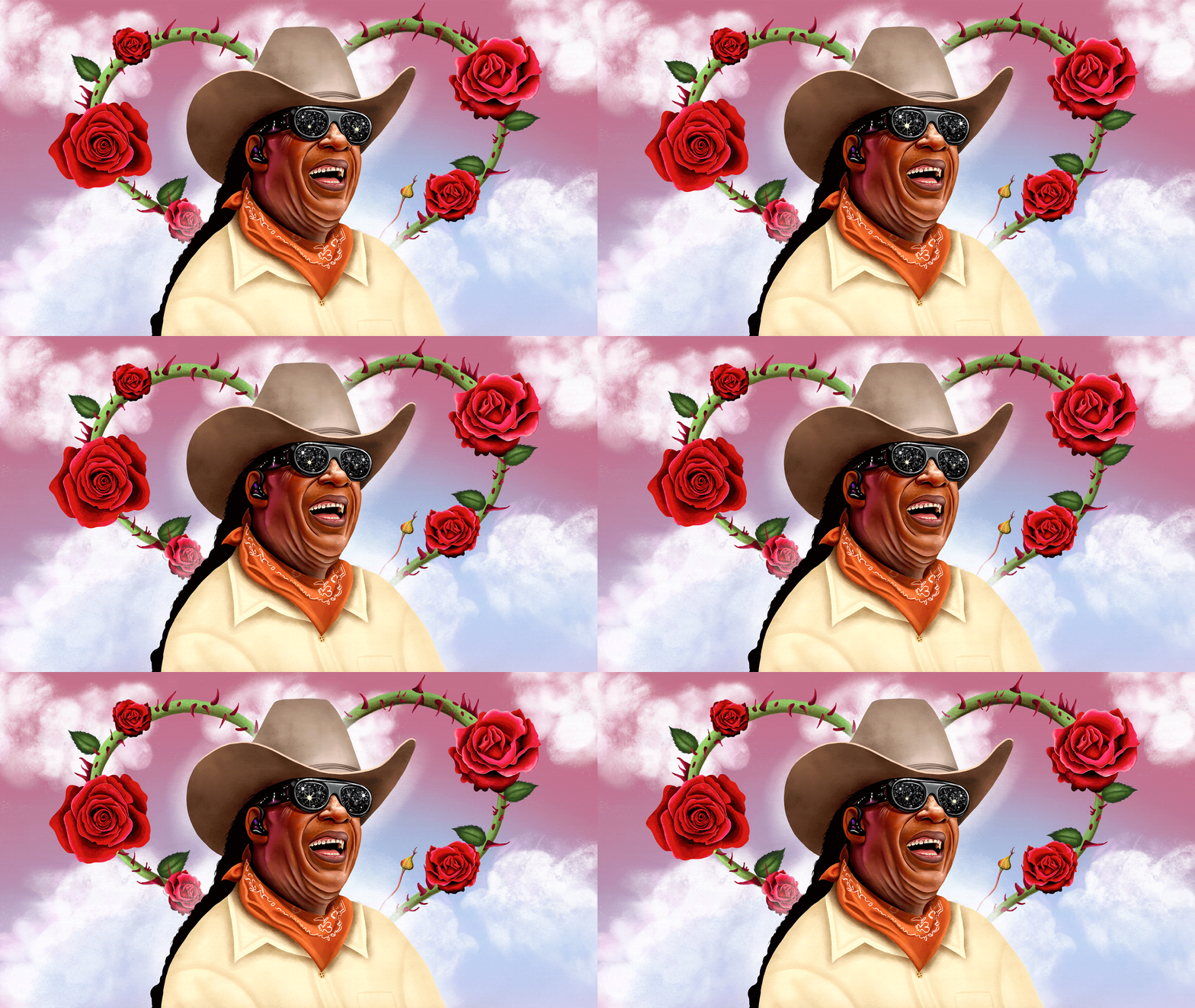
Stevie Wonder’s outfit seemed, at first, to be a strange choice. It was September 1976, and the 26-year-old Grammy winner, better known at that point for appearing on his album covers with a short afro or in cornrows and a tunic, was wearing a cowboy outfit: a collared, cream-colored shirt and matching trousers, a terra-cotta bandanna around his neck, a wide-brimmed hat. He also had a double holster wrapped around his hips, reading: NUMBER ONE WITH A BULLET.
Maureen Orth, then a young writer for Newsweek, was confused. Along with a herd of other journalists, she had traveled to a 145-acre farm in North Brookfield, Massachusetts, for a listening party for Songs in the Key of Life—Wonder’s new, 17-track album, which he was releasing along with a four-track EP, for a grand total of 105 minutes of soul-stirring sound. Western iconography hadn’t been on the menu, or so she thought. “It’s like, what? Stevie, you’re a cowboy? Why?” Orth recalled on the 2024 podcast The Wonder of Stevie, which I co-created and co-produced. (Wonder executive-produced.) “We haven’t heard the songs yet, but there aren’t any cowboy songs on the record.”
Orth was right: Nothing on the album sounded remotely like a cowboy song. But Wonder’s getup wasn’t so much about communicating the content of his opus as it was about playfully claiming the context around it. And that context was that he, a uniquely brilliant symbol of American promise, had sought and captured something uniquely, brilliantly American.
Five decades later, Songs’ message—one of optimism, resolve, and self-belief in the shadow of hyper-partisan politics and communities coming apart—still feels urgent. Which makes it seem right that Wonder recently began a 17-city tour across Europe and the United States to mark the 50th anniversary of the record’s release, putting on shows in which he is playing the entire album.
A lot was going on in the country back when Songs came out. It was the United States’ bicentennial, and although the nation had reason to celebrate, people also had much to mourn: race riots, economic recession, repeated paroxysms from the corrupt presidency of Richard Nixon. At the time, Wonder had been experiencing a sadness and disillusionment about politics and U.S. foreign policy so profound that he had seriously considered leaving the music business and moving to Ghana, where he planned to work with disabled children. “You can sing about things and talk about things,” he had said earlier in the ’70s, “but if your actions don’t speak louder than your words, you’re nothing.”
Wonder had gone so far as to announce a “farewell” tour. (Some believed this was a tactic to get a better deal as he renegotiated his contract with his label, Tamla, a division of Motown Records.) When Songs arrived, then, it seemed to be a reassertion of his primacy within American popular culture—and perhaps of his belief in America itself. Time magazine reported that the album took Wonder more than two years to produce. It cooked for so long that Motown executives had T-shirts made featuring a play on the phrase that Wonder kept using when asked about the project’s status: WE’RE ALMOST FINISHED. What they didn’t know was that Wonder, rather than struggling, was perfecting the simple message at the album’s heart—that to express love for America requires not only celebrating it with fireworks and flags but also acknowledging its missteps and failings.
Songs is a deeply personal album for millions of people. (The singer-songwriter India.Arie, born in 1975, has described it as a record that “feels like family.”) In fact, I’d initially thought of starting this article by describing how the record was the primary soundtrack to my early life—from the weekend afternoons of my childhood, when I studied the album’s liner notes and lyrics as my dad’s turntable crackled in the background, to one particularly tumultuous year during my 20s, when, rocked by a breakup, I shut myself in my bedroom, slid a disc into my CD player, and sang along to “I Wish,” “Joy Inside My Tears,” and “As.”
Over the years, I came to realize that the album owes much of its enduring power to its relevance as a source of personal and political optimism. It is a love letter to the listener but also a message, marked urgent, to a nation. When I say that Songs in the Key of Life—consistently voted one of the best albums of all time—is uniquely American, I mean that it is both by America and of it.
At that farm in 1976, Wonder’s outfit was a clever play on his argument about his country, but his songs provided the substance. They spoke of love and hope and faith and history and family and even fear. The first track, “Love’s in Need of Love Today,” offered a quiet opener with a devastating message: The country was veering from its imagined ideal. Hate was “goin’ ’round,” Wonder sang, “Breaking many hearts / Stop it please / Before it’s gone too far.”
The album’s third song, “Village Ghetto Land,” was where things started to get real. It was a nearly three-and-a-half-minute indictment of the economic and geographical segregation visited on America’s less fortunate, set to sober, almost mournful electronic strings. From there, the record unfolded like a map of the United States’ psyche, the soundtrack of a people (well, some people) who were wrestling with the gap between the stated promise of this country and its sobering reality.
Its eighth song, “Pastime Paradise”—which later inspired the 1995 Coolio hit “Gangsta’s Paradise”—was about coming to terms with an idealized past that had never actually existed. The lyrics chide people who glorify times “long gone behind,” those “wasting most their days / In remembrance of ignorance oldest praise.” Wonder cautions those living with a romanticized view of history against succumbing to inertia. He invites those whose nostalgia blinds them to the present to confront the truth of the past, to move toward a brighter future. “Tell me, who of them will come to be?” he sang. “How many of them are you and me?”
Then there was “Black Man,” perhaps the album’s most explicitly political track: a head-thumping, funk-inflected assertion about people of color’s contributions to the creation of America. Name-dropping figures including Squanto and Sacagawea, Benjamin Banneker and Harriet Tubman, Wonder sang:
We pledge allegiance
All our lives
To the magic colors
Red, blue, and white
But we all must be given
The liberty that we defend
For with justice not for all men
History will repeat again
It’s time we learned
This world was made for all men
For years, rumors circulated that Wonder had considered dozens or even more than 100 songs for inclusion on the record, many of which people never would have heard. So it was a delight when, on the date of the album’s anniversary this year, September 28, he surprised the music world by releasing on streaming services Songs in the Key of Life—The EP, a quartet of previously unreleased tracks from the era when he was recording the original album.
I was excited at first. But after listening to the EP a few times, I felt uninspired. I wanted more than what I’d heard (lyrics mostly about love, loss, and regret). So, I reached out to the cultural critic Wesley Morris, a Stevie stan like I am, and the host of The Wonder of Stevie. I wrote to him that one of the “new” songs (“It’s Easier”) felt a little stale, reminiscent of Wonder’s 1971 work Where I’m Coming From. “I’m Into Livin’” felt very Hotter Than July, the album that Wonder released four years after Songs in the Key of Life. And the others seemed like sentimental-bordering-on-empty attempts at saying something that—well, I couldn’t quite figure it out.
To be clear, I was in a horrible mood. The promise of America that Wonder had celebrated in Songs has been feeling, to me, further away than ever. The Trump administration has been unraveling many of the rights that previous generations worked so hard and long to ensure. It has been unleashing violent law enforcement in cities across the country; instigating political witch hunts; trying to make it harder to vote; and, contra “Black Man,” attempting to control how our national history is told, in part by downplaying the role that women and people of color have played in the political and cultural project that is America.
I was also frustrated. All this strife, all the ways in which the world has gone backwards, and Wonder had released four new songs about love? Then I remembered something that Morris had said on The Wonder of Stevie: “Anytime you hear a Black American singing about love, what you’re hearing is a choice not to be singing about a dozen other things. Being poor, getting ripped off, going to court or prison, driving your brother or your cousin to court, visiting them in prison. Talking about how affirmative action doesn’t need to end. Talking about voting rights and why that’s important.”
When these are the realities people are facing, a song about love—romance, love of people, love of community—can become its own declaration of independence. “In its own quiet way,” Morris said on the podcast, “a Black love song says, Here. Here’s my heart. And despite all of this other shit—betrayal, neglect, struggle, rage, lunacy, the pernicious old status quo,” he added, Wonder is asking: “Would you look at the world? How is it that I can know all of this and still make this gorgeous, contiguously gorgeous sound that is this whole album? This is the story of us all.”
That story evolves in fits and starts, and circles back on itself before moving forward—in a pattern somewhat similar to the cover art for Songs in the Key of Life, which to me evokes a spiral of warm, heavenly clouds. Wonder, a modern griot, understands that people need to tell stories to make sense of a complicated world, and that they need to believe in those stories to keep faith. As he sings in “Sir Duke,” the album’s fifth song and an homage to great American songwriters and singers such as Duke Ellington, Count Basie, Louis Armstrong, and Ella Fitzgerald, “Music is a world within itself.” With Songs, Wonder created a soundtrack, too, a picture of the world as it was—and of what it could become.
This article was featured in the One Story to Read Today newsletter. Sign up for it here.
A priest led me up battered stairs to a tiny room at the top of a church. From the window, we gazed down at the decayed colonial villas and scattered trash fires of eastern Havana. He pointed to the yellow wall behind us, where someone had sketched a meticulous map of the local street grid.
“They posted armed guards here, to watch over us,” he said.
Cuba’s Communist government, the priest said, took over the convent, cloister, and school of Los Escolapios after the revolution of 1959, expelling the nuns and setting up a guard post—one part of the regime’s sprawling apparatus of surveillance and control. The church downstairs was virtually closed, the congregation mostly exiled or jailed in accordance with Communist Cuba’s atheist principles.
The guards are gone now, along with the portraits of Fidel Castro and the secular schoolteachers who commandeered the convent’s lower floors after the revolution. The church is in the process of reclaiming the magnificent 18th-century cloister from the state, which left it in ruins. The priest, Iván Guerra Álvarez, made clear he believes that history is approaching another turning point, and that the Communist regime will soon be gone. “The Church will play a big role in the transition,” he told me. “We are the biggest institution in Cuba outside the government.”
No one can say when or how that transition will happen. Donald Trump may or may not have “the honor of taking Cuba,” as he boasted after imposing an oil blockade on the island earlier this year. The Cuban regime has stifled any viable domestic opposition. But the withering of the state—a process that has been under way for decades—has accelerated, and is shocking to see up close. The ration cards that used to guarantee basic foodstuffs for every Cuban had been blank for weeks when I visited in August. Police and soldiers were once ubiquitous throughout the country, but I saw hardly any.
In far-eastern Cuba, I met a fisherman who told me that he and others like him, who lacked electricity for refrigeration, have gone back to traditional methods of drying and salting fish. The average monthly salary for public-sector employees in Cuba—including doctors and teachers—is about 6,500 pesos, which is less than $10 and far below the cost of a subsistence diet (a single carton of eggs can cost up to 4,700 pesos). Even getting small amounts of cash can be a trial: Banks sometimes limit withdrawals to 1,000 pesos (less than $1.50) per person per day.
Moises Saman / Magnum for The Atlantic
A former boarding school in Cienfuegos, established after the 1959 revolution, where students combined classroom education with agricultural labor
The government still purports—on faded billboards, in party speeches—to meet all of the material and spiritual needs of its citizens, but it is now bankrupt in every sense. Almost no one believes in the system anymore, and many, especially outside Havana, behave as if the government simply does not exist. As in the Soviet-dominated Eastern bloc during its final years, destitution is leading people back to older faiths. Afro Cuban Santeria and Catholicism have flourished, and “house churches” have proliferated, often evangelical and sometimes consisting of nothing more than a dozen folding chairs in someone’s living room.
Guerra Álvarez led me down from the church tower to the main sanctuary of Los Escolapios, an atmospheric shift he half-jokingly likened to a trip from North to South Korea. We found ourselves in a noisy crowd of more than 100 schoolchildren and worshippers. A teacher dressed as an angel, with a white beard, wig, and gown, was giving Bible lessons in the dimly lit nave. Afterward, volunteers handed out lunches of rice and beans. To see so many people looking so cheerful was striking; Cuba is now a country full of empty streets and abandoned buildings, having lost as much as a quarter of its population to migration in the past few years.
The expanded role of the churches is partly an outcome of American policy: The U.S. government has long favored the Catholic Church as an intermediary. When the Trump administration approved a $100 million aid package for Cuba in May, it was on the condition that the funds be distributed by faith-based groups and humanitarian organizations. But the rise of religion in Cuba is also a measure of the state’s withdrawal—and perhaps a hint at the island’s future direction.
Moises Saman / Magnum for The Atlantic
Teens receive bread and drinks at a Catholic church in Havana.
I came to Cuba expecting to see suffering. What I did not anticipate was the near-total collapse of the state. This was evident even in Havana, where all-day blackouts are routine, but things are much worse in the eastern half of the island, which has long been poorer and less developed. Cuba’s religious revival has burned brightest there, especially among Pentecostal churches, whose traditions include faith healing and miracles.
I drove to the east with the photographer Moises Saman, an 18-hour journey that sometimes made us feel as if we were traveling back in time. Weaving slowly among enormous potholes, we passed few other cars. As we got closer to Santiago de Cuba, Cuba’s second-largest city, we saw almost as many horse-drawn carts as motorized vehicles.
Moises Saman / Magnum for The Atlantic
A weathered roadside billboard, bearing a portrait of Fidel Castro, reads, Son las ideas las que nos hacen un pueblo combatiente (“It is ideas that make us a fighting people”).
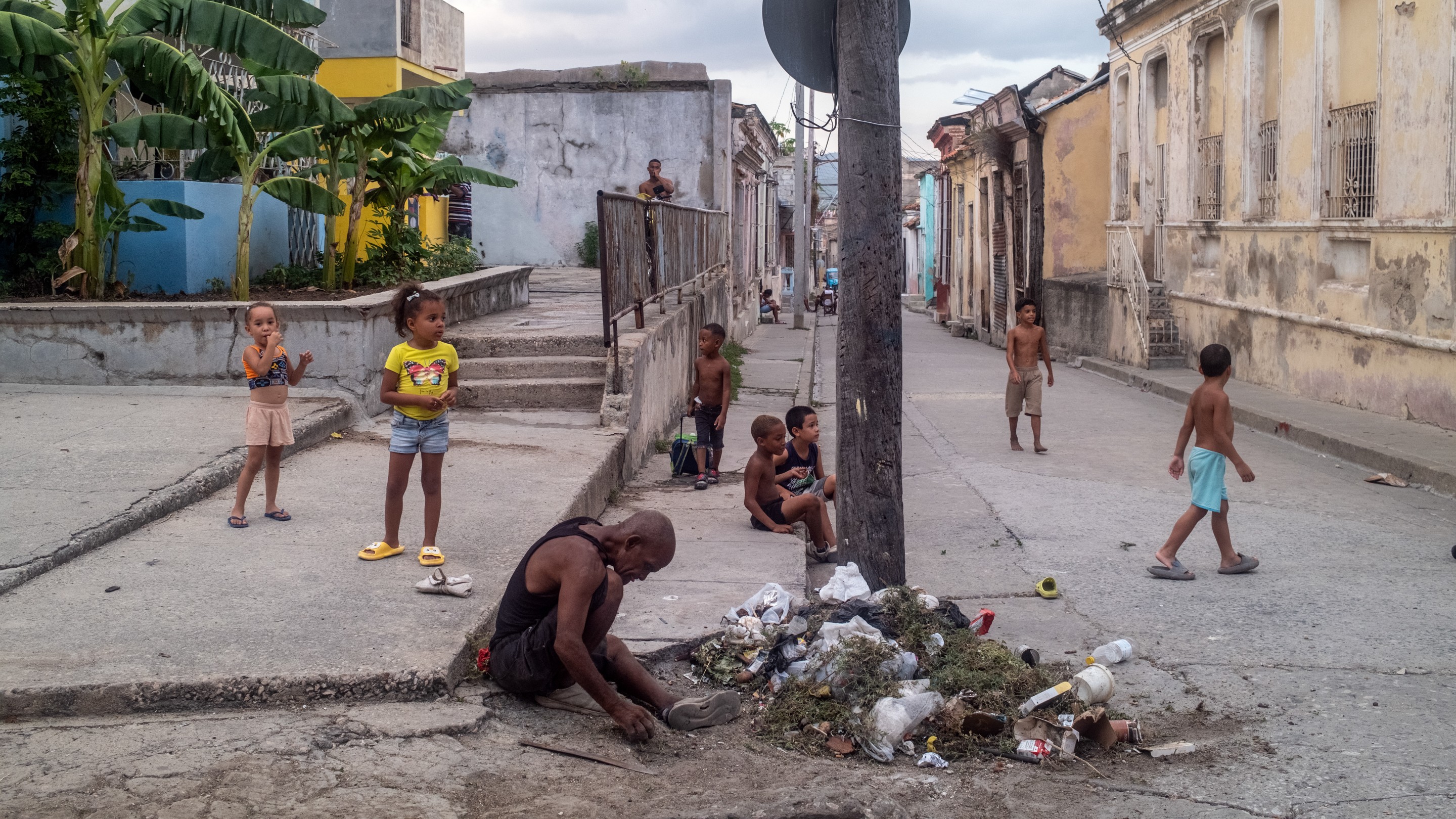
Poverty is not new in the country, but the number of street beggars I saw shocked me. On the seafront in Santiago, a mother and daughter approached me, both of them skeletally thin, to ask for money. The mother, a white-haired 76-year-old, told me that their only means of support had been her son, who had worked as a security guard and died of cancer last year. Now they spend all day begging and collecting plastic bottles in the hopes of trading them for a few pesos, she said. They get nothing from the state. Later, I visited their home, a filthy ground-floor room where they sleep on metal bed frames topped with cardboard instead of mattresses. When I asked whether there was any electricity, the mother said that they did not even have a bulb.
Moises Saman / Magnum for The Atlantic
The collapse of the state has left impoverished Cubans with few options besides begging or relying on charity.
The failure of Cuba’s health-care system may be the most damning indictment of its Communist regime. Castro once held up the country’s network of local clinics as a model for the world, visible proof that socialism could triumph where capitalism had failed. He sent hundreds of thousands of doctors overseas, an “army of white coats” to bolster Cuba’s image and generate money for the state. (It later emerged that the doctors had been given little choice and many were victims of what has been called forced labor.)
Some doctors are still being sent abroad, but more have simply fled Cuba. On Cayo Granma, an island at the entrance to the bay of Santiago, I found a single nurse caring not only for all 870 residents but also for many people from the neighboring coastal areas. She no longer knows how many people she is responsible for, because doctors have been leaving the region so fast that she cannot keep track of the patients forced to seek new care.
Her name is Clara Luaces, a woman of 55 with a direct gaze and an air of brisk competence. Her clinic was a room the size of a large closet, hot and crowded with patients when I arrived; outside, it was almost 100 degrees. A 12-year-old boy with a fever sat on a bench, an IV drip in his arm; a girl with a skin infection sat nearby with her mother.
“We have to work miracles here,” Luaces said, answering my questions as she checked the boy’s pulse and adjusted his IV. The government had stopped piping water to the island three months earlier, she said, and the resulting lack of clean water had led to a sharp rise in bacterial fevers and skin infections. “Even young people are dying on me,” she said. She was chronically short on medicine and had very little money of her own to supplement the clinic’s supply.
The boy began moaning, and Luaces comforted him, putting a pillow under his head and calling him “sweetheart.” “I’m not going to retire,” she said, looking up at me, “because there is no one else to take this on.”
Luaces did not want to talk about politics. She confined herself to saying that she had been a student during what Castro dubbed the “special period” in the 1990s, when Cuba went through a severe economic crisis after losing its Soviet patron and the regime seemed on the brink of collapse. What is happening now, she said, is “much more special.”
Moises Saman / Magnum for The Atlantic
Two people sit outside a house during a nighttime power outage in Camagüey.
Others lashed out directly at the state. Not long ago, the country bristled with informants working for the Committees for the Defense of the Revolution. But when I asked people about the CDR, some laughed, and few seemed worried about being overheard. One evening on a beach in Baracoa, a man in his 30s asked me what I thought about Communism. He was lying in a hammock talking with four other men, drinking cheap sugarcane rum from a plastic bottle; they had been complaining about the ever higher prices of rice, beans, and other basic foods. I told him I thought Communism was a lousy way to run a country.
He looked squarely at me and said, “I shit on Fidel Castro’s mother.” The other men laughed. He uttered a few more obscenities. Then, suddenly, all of the humor drained from the man’s face. His voice went taut with anger, and tears welled up in his eyes.
“Cuba is frozen in time!” he shouted. “There’s no hope. It’s a sad thing to be born a Cuban. That’s what I think, and I don’t care; they can send me to prison if they want.” The other men had gone silent.
Here is another measure of Cubans’ anger at their government: During nine days of travel around the island, I did not meet a single person who blamed Donald Trump or the United States for their situation. I sometimes reminded them about the blockade Trump had started earlier this year, cutting Cubans off from the cheap oil that Venezuela had been supplying before the U.S. military captured Nicolás Maduro in January. Hadn’t things gotten worse since then?
“I don’t see any change since January,” a retired engineer named Guillermo Almeida told me. “That oil from Venezuela wasn’t reaching the people anyway.” He and others said that the more important turning point was the coronavirus pandemic, which destroyed Cuba’s tourism industry and shrank the value of remittances from family members abroad that many Cubans depend on, exposing more fully a state that had long been depleted. Another man put it differently: “It seems to us that the real embargo is inside of Cuba.”
The churches have taken on much of the Cuban state’s old role in keeping people alive. In Baracoa, I met Raul de Jesus Muñoz Munder, a Pentecostal pastor who has been evangelizing in the area for 32 years. He had seen hunger and deprivation, he said, including during the years he spent in a tiny church in the mountains, but nothing as bad as the present.
Muñoz Munder described his work almost as if it were a military operation. Every week, he said, he meets with a team of associate pastors at his church, and each man reports on the situation in his home neighborhood: who is sick and needs medicine, who needs food, and how to get it to them. The pastor’s congregation has about 1,100 regular members, but he provides aid to a much larger group. His denomination, the Assemblies of God, has expanded from two to 40 churches in the Baracoa region over the past three decades.
The growth of the evangelical movement is hard to quantify in Cuba, where the Catholic Church was once almost universal. No independent numbers on religious affiliation exist—the government has long had a lock on surveys. But everyone I spoke with, both inside and outside the country, agreed that the evangelical presence has surged in recent years.
Moises Saman / Magnum for The Atlantic
A pastor and a church secretary at the Iglesia Evangélica Pentecostal Asambleas de Dios de Baracoa, in eastern Cuba. The congregation is one of the city’s most active Protestant churches.
In Baracoa, I stumbled upon several different evangelical services one Saturday evening, each of them loud and raucous, the congregation on its feet and clapping along. These kinds of scenes are still a little jarring to many older Cubans. They tend to associate church with more orderly Catholic rituals, and grew up without seeing much of the flamboyant evangelical religiosity that has become common across Latin America. But the island is changing. I heard a fair amount of God talk even on the street. One afternoon in Camagüey, a beautiful, decaying city in east-central Cuba, an elderly woman in a wheelchair called out to me as I passed her open front door.
“We have to tell people that God exists,” she said, in an urgent tone. “God’s word has to be fulfilled in its entirety.”
One of her children had left the country, and the other one, a high-school teacher, was in prison; she said he’d been given a 14-year sentence for accusing a high-ranking official of corruption. The old woman was living alone, and the only thing she had left was her faith.
In Havana, I visited a nursing home owned by the Catholic Church that was full of former civil servants and military officers. In one room I found a dozen old men, their beds lined up about a yard apart. Each had a single narrow locker for all of his earthly possessions. A nurse gave me permission to speak with residents but cautioned me that they were “very sad.” Many of them, she explained, had had distinguished government careers but had found themselves abandoned by both the state and their family at the end of their life. In many cases, their children had left the country.
Moises Saman / Magnum for The Atlantic
People in need receive a meal at the Concatedral de Nuestra Señora de la Asunción, a Catholic church in Baracoa.
One of the men, a wiry 65-year-old, had fought for two years in Angola, where Castro had sent hundreds of thousands of soldiers in the 1970s and ’80s to support a Communist-aligned government. The former soldier had once been a fan of the revolution; you could tell because he had a big tattoo of Che Guevara on his right arm. He’d gotten it when he was 18. He showed me several scars left over from battles in Africa, and I asked him how he felt about the situation in the country.
He answered with an expletive. I asked him what should be done to make things better. Cuba needed to be bombed, he told me. Specifically, Raúl Castro, Fidel’s brother and successor, should be bombed. And Raúl’s daughter Mariela. And the prime minister, Manuel Marrero Cruz.
Again and again during my travels on the island, people told me: Cuba is not like this. They didn’t just mean the hunger and sickness and lack of electricity. They meant the anger, the emptiness, the absence of music and laughter.
There used to be a musical group on every corner of Santiago, an 81-year-old man who had spent 45 years as a singer in a band recalled. Now there were none.
After the 1959 revolution, Fidel Castro enshrined atheism in the new state, exiling many prominent Catholic figures and sending believers to reeducation camps. But in a sense, he did not so much banish religion as create a new cult, with its own rituals and holy martyrs. That cult staggers on today in a weird half life, abandoned by most of its people after decades of misery and repression, yet somehow defying a final collapse.
Moises Saman / Magnum for The Atlantic
Soldiers perform a changing-of-the-guard ceremony at Santa Ifigenia Cemetery in Santiago, where Fidel Castro’s remains are entombed.
The only immaculately clean place I saw in all of Cuba was the Santa Ifigenia Cemetery, where Fidel’s ashes are held, in Santiago. The grass there is green and mowed to razor-perfection, the walkways carefully swept; not a single visitor was in sight when I went there.
As I stood looking at the rounded granite boulder that marks Fidel’s tomb, patriotic music began blaring from invisible loudspeakers, and an honor guard of soldiers in neatly pressed uniforms began goose-stepping in unison, rifles pointed skyward. They marched to the mausoleum honoring José Martí, Cuba’s great nationalist hero; presented arms; and relieved a group of similarly uniformed compatriots, who marched back. They do this changing of the guard every half hour, all day long, I was told.
Watching those perfect soldiers, you could believe for a moment that you were in another place—perhaps that far-off country Castro had dreamed of, where socialism is triumphant, no one is sick or unhappy, and everyone aspires to follow the heroic example of the man who led a glorious revolution. Then a breeze swept across the grass, carrying the acrid stench of burning garbage, and I remembered where I was.
This article appears in the December 2026 print edition with the headline “How Castro’s Cuba Ends.”
Toddler parenting is an exercise in picking battles, and one I almost never pick is the battle over sugar. Quite often, my 2-and-a-half-year-old eats just a few bites of his meal before proclaiming himself “done, done, done,” yet mysteriously also desirous of dessert. Generally, at this point, I’ll give him a cookie, or whatever sweet he’s fixated on—yes, even if he hasn’t finished his healthy dinner, or if it’s almost bedtime, or if we’re somewhere I need him to behave.
I feel good about these choices because: science. For one thing, the American Academy of Pediatrics’ recommendations on added sugar are generous, allowing for more than an entire Klondike bar’s worth of it a day. For another, sugar doesn’t make kids hyper. The sooner parents internalize this, the sooner they can drop sugar policing from the dreaded mental load and reapportion that slot to some other parental drudgery, such as keeping track of spirit days.
Wherever a child is tipping over a bin of Legos or jumping on a couch, a “sugar rush” is bound to be blamed. Popular shows including The Office and Abbott Elementary have episodes in which characters eat too much sugar, go into overdrive, and crash. I’m often warned by other moms not to give my son anything sweet—by which I guess they mean any and all toddler food—before naptime.
Their admonitions, however, are misguided. “I know parents, and many people would love to be able to point the finger at sugar” when a child acts up, Jill Castle, a pediatric dietitian, told me. “But it just doesn’t hold up in the research.” A series of studies from the 1980s and ’90s, led by a prominent pediatrician named Mark Wolraich, helped break the connection between sugar and hyperactivity, which is generally defined as restlessness, poor behavior, and impulsivity.
In 1985, Wolraich and his colleagues studied 16 hyperactive boys who were fed a clinically monitored, sugar-free diet for a day, then given either a sugary or an artificially sweetened drink. The researchers found no difference in behavior or cognition between the boys who consumed the sugary drink and those who had the sugar-free one. In a 1994 double-blind, controlled trial, Wolraich found that when kids ate a high-sugar diet for three weeks, they performed no differently on a series of behavioral and cognitive measures than when they ate little sugar. In a 1995 meta-analysis, he examined the results of 23 studies and concluded that “sugar does not affect the behavior or cognitive performance of children.”
For some children, sugar can have a slight sedative effect, and regularly consuming way too much can eventually put kids at risk for type 2 diabetes and obesity. The AAP recommends that kids ages 2 to 18 have no more than 25 grams of added sugar a day, the equivalent of about three fun-sized packages of M&Ms. (The guidance doesn’t apply to naturally occurring sugar, including the kind in fruit.) On special occasions such as Halloween, exceeding this limit is fine, Gwen Cook, a pediatrician at the University of Utah Hospital, told me. Many pediatricians discourage trying to eliminate sugar from a child’s diet entirely, Cook said, because doing so is “unnecessarily restrictive, especially socially.” No one wants to be the kid at a birthday party eating carrot sticks instead of cake.
Despite these findings, the sugar-hyperactivity myth has survived for decades because sugary foods tend to be served during celebrations that are otherwise chaotic and overstimulating, such as Halloween, Christmas, and birthdays. Some kids become wired at these festivities because the environment is novel and exciting, not because they’re eating chocolate. “They’re playing games; there’s music or decorations up that are different,” Cook said. “All of those things can feed into a child being more hyperactive.”
Parents may also expect kids to become hyper when they have sweets: In one study, mothers who were told that their kids had consumed a large dose of sugar rated their children as significantly more hyperactive than mothers who were told that their kids had received an artificially sweetened placebo—even though all of the kids had actually ingested the placebo. (This expectancy effect was stronger, the study authors said, for “cognitively rigid mothers.”) When kids eat sugar, parents may be more likely to interpret their behavior as wild, and attribute it to the sugar. So the myth lives on.
I also think parents persist in believing that sugar makes kids rambunctious for the same reason they believe in so many other dubious child-rearing fallacies. Parents long for an explanation for their kids’ inexplicable behavior and for a sense of control over it. If sugar really explained why kids became manic and naughty, parents could create peace by banning Skittles and soda. But sugar isn’t to blame, which leaves us to accept our kids for the frenzied, irrational beings that they are.
Sign up for Work in Progress, a newsletter where Rogé Karma investigates the mysteries of a complicated economy.
Voters have consistently cited the cost of groceries as their top economic concern—and it isn’t hard to understand why. From 2015 to 2019, the average worker’s wages grew about 30 times faster than the price of groceries. Then came the pandemic. From 2021 through the end of last year, grocery prices increased faster than both overall inflation and wages. Today, the cost of food is about 30 percent higher than it was in January 2020.
Unfortunately, most ideas in circulation for how to bring down grocery costs, such as city-run grocery stores and price controls, would hardly make a dent in the issue. But a new think tank called the Kitchen Table Project, run by a group of left-leaning economists and policy wonks, is floating a more direct intervention: a public option for food purchasing.
The U.S. government already uses its buying power to purchase food directly from suppliers at low prices on behalf of military families and public schools. If the government decided to do the same on behalf of American consumers more broadly, the proposal’s authors argue, it could save the average family hundreds of dollars or more at the grocery store every year while costing taxpayers almost nothing. Despite sounding eerily like Soviet-style central planning, the proposal’s economic merits are strong. Whether it goes anywhere or ends up in the same place as a public option for health care (rather far from reality) is another matter.
Every effort to lower food prices inevitably runs headfirst into an inescapable fact: Grocery stores don’t make a whole lot of money. The average business in the United States makes an 8 to 10 percent profit every year; grocery stores typically make just 1 to 3 percent. These margins rose slightly during the pandemic, because many large retailers used inflation as an excuse to jack up prices, but they have since returned to pre-pandemic levels. The main reason grocery prices have risen so much is that, thanks mostly to pandemic-era supply shocks, retailers themselves are paying far higher food and labor costs, which are then passed on to consumers.
This creates an impediment for many progressive proposals. New York City Mayor Zohran Mamdani has promised to establish city-run grocery stores that would charge 30 percent below market prices. But public grocers can’t sell food for much cheaper than private ones without large public subsidies, which effectively just shift the costs away from shoppers to taxpayers. Proposals to institute a version of price controls on grocery stores run into a similar issue: There just isn’t much room to lower prices without putting stores out of business. Earlier this year, the Center for American Progress, a progressive think tank, proposed a national price cap on a basket of grocery-store staples that it estimates would save the average family of four just $88 in the first year it could be implemented. “It’s harder for the government to intervene to lower grocery prices than in basically any other sector,” Jared Bernstein, the former chair of Joe Biden’s Council of Economic Advisers and a co-author of that proposal, told me. “For housing or health care or child care, there are all sorts of market inefficiencies you can fix to bring down costs. But when it comes to grocery stores, there’s just not a lot of extra money lying on the table.”
Grocery stores are just one node in a much larger food-supply chain. It includes farmers (who grow crops and raise livestock), food processors and meatpackers (who turn those raw inputs into ingredients such as flours, oils, and ground beef), food manufacturers (who take those ingredients and turn them into finished products such as cereals, frozen meals, and snack foods), and distributors (who deliver that food to grocery stores and restaurants). These other parts of the supply chain are collectively responsible for about three-quarters of the total cost that Americans pay for food.
Although neither farmers nor grocers make very much money, many of the middlemen who operate between them make plenty of it. Egg producers such as Cal-Maine and meatpackers such as Tyson’s generally make 4 to 12 percent profits. Food processors such as Ingredion make 10 to 15 percent. Leading food manufacturers such as General Mills and Kraft Heinz make 15 to 19 percent. “If you’re trying to figure out how to reduce prices, you have to ask: Where is the actual money being made?” Skanda Amarnath, the executive director of Employ America, an economics-focused think tank, told me. “And the answer is: It’s all in the middle.”
One reason food prices rose so much during the pandemic is that many of these middlemen took advantage of supply shocks and consumer confusion to boost prices. Tyson’s beef-packing profits more than tripled from 2019 to 2021 as slaughterhouse shutdowns generated a national beef shortage. Bunge, a commodities trader, saw profits nearly quadruple from 2019 to 2023 thanks to global crop-market disruptions, such as the Russia-Ukraine war. In 2022 and 2023, food manufacturers such as Pepsi, Kraft Heinz, and General Mills embraced a strategy, known as “price over volume,” in which they actively raised their prices, leading to higher profits even as they sold less overall. From 2024 to 2025, Cal-Maine saw its profits triple as avian flu wiped out a large portion of the country’s chicken population. When the Kitchen Table Project conducted an analysis of where food-industry profit margins have increased the most since 2019, they found those increases overwhelmingly concentrated among companies that operated in the middle of the supply chain.
Many grocery stores have little choice but to accept the high prices that these middlemen charge. That is because a large portion of America’s grocers are either independent local stores or midsize regional chains that own a tiny slice of the overall market, whereas many of their suppliers are megacorporations that operate in highly concentrated markets (Tyson’s, Cal-Maine) or have strong brand loyalty (Pepsi, Kraft Heinz). A local grocer can’t afford to lose, say, Pepsi as a supplier, but Pepsi doesn’t need every single local grocer. This power imbalance gives food suppliers the ability to set prices at relatively high levels, knowing that grocery stores need their business to compete for customers.
Although some small and independent grocers have formed buying clubs to correct this imbalance, they generally continue to face much higher prices than their larger competitors. In one study, a team of food economists compared the prices of “staple foods” such as eggs, milk, and rice among 140 small grocery stores and nearby supermarkets; they found that almost every single item was anywhere from 10 to 54 percent more expensive at the smaller store. When the National Grocers Association, an advocacy organization representing 21,000 independent grocers, recently conducted a survey of its members, many of whom were part of wholesale buying associations, it found that “in many cases, the wholesale price offered to independent grocers is higher than the retail price at wholesale clubs like Costco.”
This problem extends beyond just your local mom-and-pop grocer. Only four chains own more than 5 percent of the national market: Walmart (20 percent), Costco (8 percent), Amazon (8 percent), and Kroger (8 percent). As a result, even most national supermarket chains can’t secure the same low prices as Walmart. A February analysis from Consumer Reports compared identical grocery baskets across 35 major chains and found that relative to Walmart, Meijer’s prices were 10 percent higher; Kroger’s, 15 percent; Publix’s, 20 percent; and Albertsons’, 25 percent.
One way to lower food prices, then, would be for the government to provide a public option for food purchasing. The Kitchen Table Project argues that the federal government should launch an “affordable groceries partnership” in which it would agree to purchase a basket of food staples, including eggs, ground beef, milk, produce, rice, and peanut butter. Because the government would be buying in large quantities, it would have leverage to negotiate down the prices for these food items. Then it would sell to participating grocery stores at that lower price point.
If the program were successful, then independent local shops and midsize national chains would enjoy access to the same cost savings that only the largest supermarkets currently enjoy. In exchange, the stores would have to agree to pass the great majority of the savings on to consumers. People who now shop exclusively at Walmart probably wouldn’t see lower prices; Costco and Kroger shoppers might not either; but everyone else likely would, assuming that their store of choice decided to participate in the program. And “everyone else” includes millions of Americans. (More than half of the total grocery-store market consists of businesses with less than 5 percent market share.) “You can think of it almost like a Costco card for grocery stores,” David Ortega, a Michigan State University food economist, told me. “It’s one of the more promising potential solutions to lower food costs that I’ve seen.”
The federal government already does a version of this. The Defense Commissary Agency, part of the Department of Defense, engages in direct price negotiations with food suppliers to secure grocery items for the country’s active-duty service members and their families, roughly 3 million people in total. The Department of Agriculture has a similar program for securing low-cost food items for public schools and food banks across the country. The size of these purchases gives the federal government the leverage to demand low prices, and it then passes the savings directly on to its members (along with generous subsidies that lower prices even further). Analysts at the Kitchen Table Project estimate that if the typical American family were to gain access to the same food prices that schools and military families pay now (minus the subsidies), they would save roughly $315 a year on groceries. The initiative would cost taxpayers nothing aside from the relatively small expense of administering the program.
If anything, these savings estimates are conservative. They are based on the prices the government program is able to achieve at its current size. But expanding this program to any willing private grocery store across the country would create a large national network that could rival or surpass the size of even the largest supermarket chains in the U.S. today, giving the government more leverage to demand even lower prices. “There are lots of places in the food-supply chain where margins are relatively fat because of a power asymmetry between grocers and their suppliers,” Amarnath, who helped develop the Kitchen Table Project proposal, said. “If the government can fix some of that asymmetry, then it can produce some really meaningful savings.”
The proposal could also lower prices in less direct ways. Currently, giant chains are able to secure far lower prices from suppliers than smaller retailers are, which can allow them to drive their competition out of business and dominate local markets. (A 2019 analysis found that in 43 metropolitan areas and 160 smaller markets across the country, at least half of grocery sales went to just a single retailer: Walmart). This dominance, in turn, allows those larger supermarkets to raise prices in specific markets. A study this year from the Federal Reserve Bank of Atlanta found that from 2006 to 2020, food inflation was considerably higher in areas with more market concentration, because lack of competition allowed retailers to charge higher prices without worrying about losing customers.
But if small and medium-size stores could suddenly also secure lower prices from suppliers, that dynamic might change. Smaller retailers would be able to stay in business, areas dominated by a single chain would become competitive, and larger retailers would have to compete much harder in those markets if they wanted to retain their advantage. “I think we’d finally see some meaningful competition in many regional markets that currently lack it,” Claire Kelloway, a program manager for fair food and farming systems at the Open Markets Institute, told me. “And that would have knock-on benefits to the whole system that go well beyond just the initial savings.”
Although a public option for grocery buying might sound good on paper, implementing such a program would come with many challenges. It would involve scaling up a series of relatively small programs into one of the largest food-procurement systems in the world, responsible for securing food for tens of millions—perhaps hundreds of millions—of people. That would be a herculean undertaking for any government, let alone one that has had its workforce gutted over the past two years. (Between the end of 2024 and the end of 2025, USDA, the department most likely to be tasked with administering the public option, lost about 20 percent of its workforce.)
Even if the program could be successfully stood up, the list of open questions is long. Will a grocery store in a small town in Iowa or eastern Washington State get the same deal as a store in New York City or Los Angeles? Who would determine which products get priority shelf space in the grocery stores? (Right now, brands outbid one another for such space.) What happens if grocery stores try to game the system—for instance, by raising prices on nongovernmental items to boost their profits? Could the program ever hope to secure prices lower than what big chains already pay? “It’s a really interesting idea on paper,” Ortega, the food economist, said. “But there are a lot of questions you’d need to answer and details you’d need to figure out to actually make it work.”
Add to that list the politics of getting such a program passed in the first place. Sure, voters are concerned about the high cost of groceries, but that might not necessarily translate neatly to widespread support for new legislation. Here, the politics of health care provide a helpful analogy. For years, voters have relentlessly told pollsters they are upset about health-insurance costs and would theoretically support a public option to bring them down. But every effort to actually enact such a policy—most recently during the passage of the Affordable Care Act, which originally included a public option—has failed spectacularly in the face of overwhelming industry opposition. It isn’t difficult to imagine the same happening to a public option for groceries, given that several well-funded interest groups—including giant retailers, major food brands, and dominant suppliers—would inevitably team up to wage a public pressure campaign against it.
One key difference between the politics of health care and that of groceries, though, is that when it comes to health care, politicians have a range of backup options to lower costs for consumers, many of which eventually made it into the Affordable Care Act. When it comes to groceries, backups simply don’t exist; the public option is one of the only ideas that could meaningfully lower prices; even lifting President Trump’s tariffs would provide only a onetime windfall. The sheer difficulty of delivering on food affordability, in other words, may somewhat counterintuitively become the public option’s greatest asset. If there’s one thing that politicians fear more than angering Big Food, it may be failing to deliver oft-promised cost relief to seething voters.
When Eloise, a veteran who lives in Michigan, first heard about Trump Accounts last year, her mind immediately turned to other projects that had borne the name of the businessman turned president: a university, an airline, steaks, casinos. All had gone bust, and several had left creditors or investors holding the bag. Pregnant at the time, she wondered whether opening a Donald Trump–branded investment account would put her first child’s financial future at risk.
“Both my husband and I, our first reaction was like, Oh, this is a scam,” Eloise told me. Despite her initial skepticism, she did further research to determine whether to claim the $1,000 seed money the government was offering to most babies born during Trump’s second term. In the end, she decided not to accept it, opting instead to open a more traditional account to put money away for her child. She said she was skeptical that the Trump Account would work as promised and had a “moralistic” opposition to associating her newborn with the president. “Ultimately, it’s like, the man’s a con man,” said Eloise, who asked to be identified only by her middle name owing to fear of reprisals from the commander in chief.
It is rare for people to turn down free money from the government. But that’s what happens when a polarizing president attaches his name to a taxpayer-supported program originally pitched as a vehicle to help America’s children achieve financial security. An investment idea once championed by Democrats as a pathway to stability for millions of minors is now at risk of becoming yet another casualty of the country’s partisan divide. Lawmakers on both sides of the aisle say the program has promise. But its greatest obstacle to achieving widespread acceptance may be its name.
Tax advisers and economists told me that the president’s decision to brand the accounts in his image had become a major impediment for potential beneficiaries. “I have had personal experience where people have said, ‘I just can’t go along with something that has that man’s name on it,’” said Tom O’Saben, the director of tax content and government relations for the National Association of Tax Professionals.
About 7 million children had been signed up for Trump Accounts by late September, before the shift to automatic enrollment. That amounted to about 10 percent of the eligible population. With the pace of enrollment lagging, the Treasury Department late last month made a few regulatory changes aimed at jump-starting things. It shifted from an opt-in system, where signing up required filling out an IRS form, to an automatic system that could enroll more than 60 million eligible minors at once. It also allowed wealthy donors and corporations to contribute individual stocks directly into children’s accounts. The efforts have boosted the program’s reach, but what might have been an uncontroversial policy initiative has still become something of a political loyalty test. In addition to naming the accounts after Trump, lawmakers and regulators have restricted the most generous federal benefits to children born during his second term. They even named the document used to sign up for the account IRS Form 4547, to correspond with the president’s two tenures in office. Treasury Secretary Scott Bessent called it “the most aptly named tax document of all time” during a fawning press conference in which he hailed “the president’s gift to the American people.”
A survey of pregnant women and new moms conducted for the website BabyCenter in March found that scarcely half planned to open a Trump Account, while 27 percent said they did not plan to do so. A fifth of respondents said they did not know what the account was. The numbers were notable in part because all of the women surveyed would be eligible for the $1,000 seed funding. Even with the automatic enrollment, parents and guardians must claim an account for their children to receive the money.
“I don’t trust Trump and his entire Cabinet whatsoever, and I have concerns that this money is some type of scam—like the money might magically disappear one day,” a California mother whose baby is eligible for the seed funding, told me. She asked that her name not be published, because she is locked in a fight with her relatives about Trump Accounts. She worries that the money will be heavily taxed and will somehow eventually become “more of a burden than an asset.”
O’Saben said he regularly encounters such concerns when speaking with clients at his Illinois tax office. He tries to remind them that even though the program bears Trump’s name, the funds were allocated by Congress and are sourced from American taxpayers. He said the pitch from tax advisers to skeptical parents occasionally goes like this: The president’s multiple corporate bankruptcies and history of skipping payments to contractors should not be a factor in assessing the reliability of the new government-backed investment program.
“If anyone has an image of Donald Trump sitting at his desk and writing out checks to these accounts out of his own personal account, that shouldn’t be the perception,” O’Saben said. “Nor is that what’s happening.”
The Trump Accounts, known within the tax code as 530A accounts, were part of the major tax-cut bill Republicans passed last year. They operate as a new kind of individual retirement account, designed to give children an early pathway to financial security as well as a tangible lesson about the benefits of compound interest. Although the government provides the $1,000 seed money to babies born January 1, 2025, to December 31, 2028, any U.S. citizen minor with a valid Social Security number is eligible for an account. Once a child’s parents verify guardianship and claim the account, relatives, employers, and others can contribute funds to it—up to $5,000 a year. Those funds can currently be invested only in a broad index fund featuring U.S. companies. State governments and wealthy donors can also contribute. The money cannot be accessed until the year the child turns 18, at which point it becomes a traditional IRA. The child then assumes control of the account and can withdraw funds to pay for college, a home purchase, or other approved expenses without penalty, or leave the money in the retirement account. The White House Council of Economic Advisers has estimated that a child born in 2026 could have more than $300,000 in the account by age 18 if he or she receives the annual maximum of contributions each year, assuming average historical returns in the stock market.
Democrats have traditionally supported this kind of government-led incentive to give children a head start on building a nest egg. When he ran for president in 2020, Senator Cory Booker of New Jersey made “Baby Bonds” a key part of his economic platform. Under that proposal, the government would grant every child born in the United States a $1,000 savings account at birth and deposit up to $2,000 each year until the child turns 18. Children from low-income families would receive larger contributions. Booker has spoken positively about the Trump Accounts, calling them “children’s investment accounts” in a July press release that said the program had built on his idea. The release noted that the children’s accounts were “also known as Trump Accounts” but otherwise downplayed the president’s involvement. Booker did not respond to my request for comment.
Representative Ayanna Pressley, a Massachusetts Democrat who partnered with Booker to introduce the “Baby Bonds” legislation, has taken a different stance on the Trump-branded version. “Trump has stolen this idea and twisted it into a regressive policy that would exacerbate wealth inequality,” she told me. Because Trump Accounts rely primarily on private largesse rather than government support, she said, the ultimate outcome will “help the rich get richer and leave poor children behind.”
Some Democrats have suggested that the accounts might not survive long enough to provide the expected benefits after Trump leaves office. Representative Bennie Thompson, a Mississippi Democrat, says he would “pass on a Trump account” if given the option, referencing the president’s namesake university that was accused of deceiving thousands of students and failing to deliver promised returns. “Trump University already taught us what happens when his name is on the brochure,” he wrote on X in July. “Does a $25 million settlement ring a bell?” Trump agreed to the settlement a decade ago to resolve lawsuits from students but did not admit wrongdoing.
The White House rejects claims that Trump Accounts will not live up to their promise. “With Trump Accounts, President Trump has secured a signature economic achievement designed to help every American child build savings and support a stronger financial future,” the White House spokesperson Matthew Middleton told me in a statement. “With automatic enrollment now complete and nearly 70 million Trump Accounts created, families have a simpler path to giving their children a jump-start on the American Dream.”
During an event in the Oval Office earlier this month to celebrate automatic enrollment, Trump noted that no Democrats had voted for the legislation that created the accounts. He then pivoted to marveling at the fact that some senators had nonetheless offered praise for the program. “I may not like Trump, but I like the Trump Accounts,” the president said, attempting to capture the sentiment among his political opponents. “I have not heard anybody speak badly of it. It’s pretty amazing.” Nearby, a group of middle-school-age children stood holding a sign that read, Thank you for Trump accounts.
In August, California Governor Gavin Newsom called the program “one of the best things” Trump has done as president. He urged constituents not to “fall prey to the politics or the cynicism” and sign up for the accounts regardless of any partisan differences with the president. “It’s not Trump’s money,” he said. “It’s your child’s money.”
Democrats have slammed the tax-cut legislation that created the custodial accounts as a giveaway to the rich at the expense of the working class. Some argue that Trump Accounts do the same. “This $1,000 amounts to a bit of a gimmick,” Darrick Hamilton, an economist and the founding director of the Institute on Race, Power and Political Economy at the New School, told me. Hamilton, an early champion of the “Baby Bonds” program, testified about Trump Accounts at a congressional hearing last month, pointing out that with rising costs, low-income families would be hard-pressed to put any money into the savings accounts after paying their bills.
The Trump administration, meanwhile, is trying to cement the accounts as a major part of the president’s legacy. Frank Bisignano, the Social Security Administration commissioner and IRS chief executive, announced earlier this month that 26 million Trump Accounts had already been funded with $8 billion in investments, nearly double the amount from earlier in October.
The ultimate reach and durability of the program could depend on whether it gains broad acceptance. The California mother said that when family members recently asked for her son’s Social Security number, she thought they needed it for a 529 account set up for the child. She later learned that they had instead used the information to activate the child’s Trump Account and accept the $1,000 seed money. She told me that she considers herself a centrist rather than a Democrat or Republican but had still had opted against claiming the cash herself because “we don’t know what can happen to that money since Trump is so erratic and clearly corrupt.” She has since learned that her in-laws have been depositing monthly dividends from an inheritance into the Trump Account. When she tried to express how uneasy she felt about that and suggested alternative accounts, a minor family drama ensued, proving once again that divisions over Trump can seep into just about any aspect of American life—even free money for a baby.
Along the highways and farm roads of the southern tip of Texas, the bright-red campaign signs for Eric Flores are impossible to miss. Flores, the Republican candidate for the state’s Thirty-Fourth Congressional District, has Ken-doll looks, with gel-stiff hair and the kind of physique that Donald Trump admires. His bio appears across the top of the sign: Infantry Officer. Prosecutor. Father.
A second set of nearly identical red signs are scattered across the district, only these show Flores with President Trump giving a thumbs-up, sandwiched between the declarations Trump Endorsed and Support ICE! When I first saw these signs, I did a double take. Why would any candidate want to be associated with ICE in the Rio Grande Valley, where the population is more than 90 percent Hispanic? The answer appeared in tiny letters at the bottom: Paid for by Northern Cameron County Democrats.
The attack ad captures how much has changed since Trump won in the Rio Grande Valley two years ago. Hispanic voters—especially men—were a key part of the national coalition that put Trump back in the White House. Trump and Kamala Harris roughly split the votes of Latinos in 2024, after several cycles of Democratic presidential candidates winning the group by double digits. Exit polls in Texas estimated that Trump won Hispanic voters there by 10 percentage points. But that support appears to have evaporated. Nationally, nearly one-fifth of Latinos who voted for Trump in 2024 now say they do not want Republicans to control Congress, a poll earlier this month found. And a late-summer survey of Hispanic Texans who are likely to vote in the upcoming election showed Democrats with a 2-to-1 advantage.
The Rio Grande Valley had been a Democratic stronghold for decades, and the region is crucial to the party’s midterm-elections strategy. The Texas U.S. Senate race has become the nation’s most expensive contest of 2026, as James Talarico tries to become the first Democrat to win statewide office there in more than 30 years. Recent polls show him in a dead heat with Texas Attorney General Ken Paxton. For Talarico to win, Democrats need the Rio Grande Valley to swing back, which would make Trump’s 2024 multiracial MAGA coalition look more like a one-off.
For Republicans, a Talarico win would be a political and psychological blow, signaling a new purple era for the state made possible by a population that’s trending more urban and college educated, and less white. GOP candidates, taking their cues from the president, have been framing the election in apocalyptic terms, telling voters that a Republican loss will usher in communism, open borders, and gender anarchy. Paxton frequently says: “If we lose Texas, we lose America.” Elon Musk donated $158 million last month to the main super PAC supporting Senate Republicans to flood the airwaves with negative ads.
I spent several days earlier this month driving around the Rio Grande Valley to speak with voters and candidates. I found a fair amount of sympathy for Trump among those who voted for him two years ago. Negative ads and wild social-media claims left others unsure whom to believe. It was clear to me that the region’s political realignment remains in flux. Hispanics in South Texas, especially men, remain up for grabs in a way they weren’t before Trump came along.
Brian Finke for The Atlantic
Representative Vicente Gonzalez, the Democratic incumbent running against Flores, barely held his seat in 2024, winning by less than 3 percentage points. Since then, Republicans have recast the district’s boundaries, pushing farther north into the more conservative-leaning Corpus Christi. Gonzalez, a former trial attorney who was first elected in 2016, is running as a folksy, I-feel-your-pain populist, not a tough guy, with ads that flip between Spanish and English. One shows Gonzalez grilling steaks at a backyard cookout and rationing meager portions to disappointed guests as he blames Trump’s tariffs for high food prices.
I had lunch with Gonzalez and about 20 of his supporters earlier this month at Frijoles, a restaurant in Brownsville. The group was mostly men, a mix of taxi drivers and local business owners who cracked jokes about involuntarily losing weight from smaller hamburgers. Steve Torres, who operates 11 Airbnbs that house engineers working at Musk’s nearby Starbase, told Gonzalez that his electricity bills are soaring. “I’m paying more than $4,000 a month,” said Torres, who voted for Trump. Last year, he closed two restaurants that he owned after struggling to compete with franchises that could better withstand higher costs. Gonzalez told the group that 200 fishing boats are moored along the Gulf Coast in the district because owners can’t turn a profit with diesel at $6 a gallon.
Others at the table grumbled about labor shortages created by Trump’s immigration crackdown. Workers are scared to leave their homes, and ICE sightings—real and imagined—are shared widely on social media. Gonzalez said he knows a restaurant owner who had to close one of his three locations because he didn’t have staff. “I know a farmer with 15,000 acres who only planted half because he doesn’t have enough workers for the harvest,” Gonzalez told the group.
Chuck Rocha, a political consultant who is advising Democrats in the state, told me that lots of voter groups are moving away from Trump, but that Latino men appear to be doing so at a larger rate “because they were some of the biggest swingers to Trump over the past 10 years.” Rocha has helped Democratic candidates create messages appealing to what he calls “the big-ass-truck economy for Latino men.” Those voters want to provide for their families and enjoy the money they earn, Rocha said. “When I was making a TV ad a couple of weeks ago, a guy pointed to his truck in the front yard and said, That fucking thing has become a lawn ornament because I can't afford to drive it,” Rocha said.
Republicans have been using their fundraising edge to saturate South Texas with ads aimed at the region’s social conservatism. The Flores campaign has put up signs claiming that Gonzalez wants taxpayer-funded “child sex changes” because he voted against Trump’s One Big Beautiful Bill Act last summer. His attorney sent the billboard company a cease-and-desist letter demanding removal of the advertisements showing Flores with Trump, The Washington Sunreported.
Brian Finke for The Atlantic
Representative Vicente Gonzalez shakes hands at Luby’s at Sunrise Mall in Brownsville, Texas.
One evening, I walked around a rough-looking colonia knocking on doors with Roel Garza, a 20-year-old business student canvassing for Democrats. Roosters erupted in several yards, and a guy in a welding mask was fixing a cattle trailer with a blowtorch, shooting sparks out of his carport. We sought out residents on Garza’s list who’d voted in previous cycles, avoiding the homes with barking dogs. One man who smelled of alcohol and had bloodshot eyes came out of his trailer to fire up a charcoal grill, and told us he’d voted for Trump but didn’t realize another election was coming up. Rosalina Saenz, a mother of six, told us she voted for Trump last time and was still happy with him. She told Garza that she was open to voting for Democrats in local races, but wasn’t sure who to support, because she’d seen so many ads “trashing” the candidates.
Garza told me that he thought a lot of people backed Trump last time because “they wanted that macho figure.” But they remain open to persuasion. It was just a matter of getting them to connect the administration’s policies with the problems in their lives. “Once people know the issues, they’re smart enough to know how they want to vote,” Garza said.
The home-building industry in South Texas is where Trump’s least popular actions have converged to squeeze men working in construction. High mortgage rates have sapped housing demand, fuel prices are driving up construction costs, and the ICE crackdown has squeezed the labor supply.
Benny Melendez, a general contractor who started his business seven years ago, invited me to a half-built house he is trying to finish outside McAllen. Melendez told me that he used to build on spec, investing his own money in a project with confidence that he’d quickly flip a sale. Now he builds only for clients who pay up front. Building a house used to take him four months, but now it takes eight to 12, he said, because he can’t find enough workers.
Melendez voted for Trump two years ago and doesn’t “hate” him. He was less generous, and more profane, about the Trump adviser Stephen Miller, who orchestrated an ICE crackdown that has become so disruptive that Melendez and other members of his trade group felt like they had to get more involved in politics. At least 15 men he used to work with have been deported, and several of them were arrested by ICE en route to a job site. “If you have a ladder on your truck, they’ll start following you, and they’ll stop you,” Melendez said. “It is difficult for me to hear a 40-, 50-year-old guy cry in private with me, telling me he’s afraid that ICE is going to take him.” Melendez told me that the Rio Grande Valley is best-known for having a low cost of living and being family-oriented. “And now those are the two things being taken away from us,” he said.
Brian Finke for The Atlantic
Benny Melendez, a general contractor who voted for Trump, visits a house he is building.
Brian Finke for The Atlantic
A crew of subcontractors working for Melendez was supposed to install kitchen cabinets at the house that day. They didn’t show. Neither did the guys scheduled to pave the driveway. ICE vehicles had been spotted that morning in the area, and alerts had gone out across radio stations and social media. Most of the ICE officers making the arrests are other Hispanic men who grew up in the Rio Grande Valley, Melendez said, and as he watched video clips from construction sites, he recognized a close friend, despite his face mask. “I wrote to my friend and said, Dude, you know I love you, but you’re losing my respect,” he said. Melendez was even more disgusted when the friend told him the pay was too good to quit.
Melendez told me that construction workers across the Rio Grande Valley tune in each morning to the radio show El Zorro y Su Pandilla (“The Fox and His Gang”), which relays reports of ICE sightings. I went to see “El Zorro,” whose real name is Hector Lepe, at his home studio in Donna, where a pickup truck parked in the driveway was plastered with a promotional picture of Lepe and his wife. Lepe told me that callers often dial in to his show describing encounters with ICE and fears of what will happen to their families if they’re deported. It’s made him something of a community therapist for men who don’t have the time or money to see a professional.
Lepe, who grew up in Oaxaca, in southern Mexico, said he crossed the border illegally as a young man and spent years as an itinerant farmworker until he broke into broadcasting. He obtained legal status through his marriage and became a U.S. citizen. Even though the Rio Grande Valley is a border community, and has federal immigration officers and agents everywhere, it used to be a “place where you could take your family to the movies, to the circus, to eat, to dance” without fear.
Lepe said that he’s been especially bothered by stories of recently deported tradesmen being reduced to working in low-wage Mexican assembly plants along the border. They’ve been separated from their children in the United States but try to remain as physically close as possible. “Imagine one day you get up to go to work, and they just take you,” Lepe said. He told me that he plans to launch a new project, La Rescata (“The Rescue”), for men in ICE custody to call so that someone will secure their truck and tools until a family member can safely retrieve them. He’s been encouraging listeners to register to vote if they’re eligible, and to show up for Democrats.
Flat and muggy, the Lower Rio Grande Valley is about 250 miles south of San Antonio, and for most of the past century, it was practically an island, with Mexico on one side and millions of acres of Texas cattle ranches and scrublands on the other. Its counties have some of the highest poverty rates in Texas. Their residents were reliable Democratic voters who benefitted from the social-welfare policies of the New Deal and President Lyndon B. Johnson’s Great Society. The RGV was LBJ country.
The North American Free Trade Agreement of 1994 transformed the Rio Grande Valley into a trade and logistics hub for the manufacturing boom in northern Mexico. Its population doubled to about 1.5 million, and today the McAllen metropolitan area is the state’s fifth largest after Dallas, Houston, San Antonio, and Austin. Wealthy and middle-class families from northern Mexico began arriving, too, fleeing drug-cartel violence and kidnapping-for-ransom terror. Developers gobbled up farmland to build subdivisions and faux-Mediterranean mansions not far from unincorporated colonias with dusty ranch houses and trailers. For working-class Hispanic families, the Rio Grande Valley offered a South Texas version of the American dream with big houses, cheap gas, and plentiful jobs.
Bobby Pulido, the Democratic candidate in the Fifteenth Congressional District, has been campaigning on nostalgia for that aspirational vision. “The thing that the Democratic Party doesn’t understand is you don’t get anywhere down here calling people ‘the rich,’ as if it’s pejorative,” he told me. “That’s what a lot of people here aspire to be!” We were driving around a wealthy suburb in Edinburg, not far from where Pulido grew up.
Pulido, who is 53, was already a celebrity in the Rio Grande Valley, a two-time Latin Grammy–winning Tejano-music star whose 1995 hit “Desvelado” (“Sleepless”) featured a video of him wandering San Francisco, singing of unrequited love. Pulido’s Republican opponent, Representative Monica De La Cruz, dismissed him early in the race as unqualified, a washed-up singer from quinceañera parties. The comment backfired when Pulido started playing for free at local quinceañeras, generating publicity and easy access to large gatherings of potential voters who, Pulido notes, are already celebrating and drinking when he arrives.
Pulido’s family has long straddled music and politics. His father, Roberto, is a Tejano icon; his uncle was the top Hidalgo County executive and another uncle was its district attorney. Pulido studied political science in college, and—like Trump—is a natural showman, campaigning with swagger and a flair for spectacle. Last weekend, he played a concert to a sold-out arena. His opening act was a mariachi band that includes several members who were arrested this year by ICE.
De La Cruz won the district in 2024 by more than 14 points, but the latest polls show Pulido ahead. His campaign has focused on high gas prices, tariffs, and ICE cases that have stirred local outrage. Pulido denounced the actions of ICE last month after officers pepper-sprayed and detained two 17-year-old U.S. citizens, and this month he called attention to the government’s attempt to deport Giovanna Perez, a mother of four whose husband was at Army basic training when she tried to pick up her family’s military-ID cards at a base in Corpus Christi and was turned over to ICE.
Brian Finke for The Atlantic
Bobby Pulido attends a political rally.
I asked Pulido about the shifting politics of immigration enforcement in the Rio Grande Valley, where jobs at Border Patrol and other federal law-enforcement agencies have long been a path to middle-class life, especially for many Hispanic men whose parents immigrated here. Trump’s inroads with Hispanic voters two years ago were partly fueled by frustration with Biden’s inability to contain mass migration, as hundreds of thousands of migrants and asylum seekers—mostly from Central and South America—streamed into the region, overwhelming local charities and public services.
“When I was growing up, we were all Tejanos here for the most part. There were not many Mexicans,” Pulido told me. “This was a pass-through area, where people would go up north to look for opportunity.” That changed when drug-war violence sent families fleeing for safety. “Our restaurants got a lot better, because they started bringing in Mexican cuisine. Then, slowly but surely, they brought businesses, they started investing, and, man, we started booming. We started growing, and then something else happened: We started integrating with them,” he said.
The next day, I went to a happy-hour event for De La Cruz at a nearby tavern. There were about 40 people in the room, and De La Cruz, a former insurance agent, told them she got into politics to stand up for Border Patrol agents after a neighbor, the wife of an agent, had asked for donations of stuffed animals to give to children coming across the border without their parents. “I wanted to be their voice. I wanted to stand up,” De La Cruz told the crowd.
Like other Republican candidates, De La Cruz told her supporters that the implications of the midterms would extend far beyond South Texas. “This election is about making sure that your grandchildren, that your great-grandchildren, will have a free country to live in,” she said. The September 11, 2001, attacks were a galvanizing moment in her life, she noted, adding that Democrats had selected “a radical Islamic communist” as mayor of New York City “where the Twin Towers fell,” referring to Zohran Mamdani. The audience responded with cheers. “This election is about saving the soul of our country that was founded on Judeo-Christian values,” she shouted.
More quietly, De La Cruz has tried to distance herself from Trump’s mass-deportation policies, and during an interview after her speech, she told me that she supports “common-sense enforcement policy.” I asked why she voted, along with other Republicans, for two bills that together gave ICE more than $100 billion for immigration enforcement—10 times its annual operation budget. De La Cruz tried to steer the conversation to affordability and grew irritated when I pressed her about the ICE funding. She said she is candid with Republican leaders in Washington and tells them that enforcement should focus on criminals, “not hardworking families,” and that when a constituent needs help with ICE, her support for the Department of Homeland Security gives her clout that Democrats lack. “When I call Washington, D.C., for one of these families, guess what? They pick up the phone,” she told me.
Her campaign has been attacking Pulido for having played with a former bandmate who was a convicted sex offender. (Pulido says that he hadn’t been aware of the man’s criminal record and cut ties when he learned about the conviction.) Last week, De La Cruz seemed eager to distance herself further from the White House, and was running new ads that tout her as a corruption fighter who will stand up to members of her own party.
The next day, I went to see a Democratic candidate whose win seems like a foregone conclusion: Representative Henry Cuellar, an 11-time incumbent. Cuellar was meeting with supporters at a private residence where plates of cabrito (“kid goat”) were served around a pool. Trump had just called Cuellar a “LOSER,” and “one of the most disloyal political people on Earth!” in a Truth Social post. The president told Republicans to vote for Tano Tijerina, a former Democrat who switched parties in 2024.
In 2024, Cuellar and his wife were indicted on more than a dozen counts of bribery and corruption-related charges for allegedly taking $600,000 from an Azerbaijani energy company and a Mexican bank. Cuellar denied wrongdoing. Trump pardoned him last year, but to the president’s disappointment, Cuellar stayed with the Democratic Party.
Republicans redrew the boundaries of Cuellar’s district last year, but they used Trump’s 2024 margin of victory, rather than the closer margins of local races, to calculate their advantage. As Hispanic voters have swung back toward the Democrats, Cuellar’s district has turned bluer. The latest polls show him with a double-digit lead, and earlier this month the largest Republican House PAC essentially raised a white flag, redirecting $3 million in planned spending to more competitive races.
Cuellar’s district includes Starr County, one of the poorest in the state, which has a Hispanic population of about 97 percent. Trump lost to Hillary Clinton there by 60 points in 2016. Eight years later, Trump won it with almost 58 percent of the vote. It was the first time the county had voted for a Republican president since 1892. Cuellar told me that many of his constituents are men who work in oil and gas, and they once feared Kamala Harris would squeeze the industry. Now they’re getting crushed when they fill up their pickup trucks. “People used to tell me: El Trumpo va muy fuerte. Not anymore. The wind has changed. And the two issues are immigration and the cost of things,” Cuellar said, using the Spanish for “Trump is really strong.”
Cuellar’s district includes the border town of Roma, whose historic downtown is perched on a bluff overlooking the Rio Grande. The Trump administration had installed a floating orange barrier in the middle of the channel to block migrants from swimming across. It looked like a giant pool noodle.
Mass crossings into the Rio Grande Valley during Biden’s term galvanized voters for Trump in 2024. At the McAllen Country Club, I met with Judge Richard Cortez, the chief executive for Hidalgo County, who had to deal with the crisis. The golf course was under renovation, so the club looked out on a parched expanse of barren hills and construction machinery. Cortez was one of the South Texas Democrats who had urged the White House to halt illegal border crossings even if it meant angering pro-immigrant groups in the party’s base. “I knew Biden was in trouble with immigration because we were living it,” Cortez told me. He invited Biden to visit—twice, he said—to no avail.
When I asked Cortez whether he thought Trump still retained support among male voters in the district, he introduced me to a group of men drinking whiskey and playing dominoes across the bar. Cortez said they were local big shots in real estate and manufacturing. All four men said they planned to vote Republican. “The Hispanic vote has gotten more conservative here,” one of the men, Henry Temkin, told me. “People are getting a little bit more knowledgeable. They’re not voting straight Democratic like they used to. They’re analyzing what the policies are.” He said he didn’t believe the polls showing Democrats poised to win.
During my visit, I kept thinking back to something that Rocha, the political consultant, had told me: Many of these voters are not “voting for the Democrats because they love the Democrats.” The party has a lot of work to do before the 2028 presidential election, he said.
Many Rio Grande Valley voters who supported Trump in 2024 still backed Democrat candidates in local races downballot. But the Democrats’ legacy advantage is fading in a place where families are acutely sensitive to big changes in federal policies—on immigration, taxes, inflation. Election support will be won and lost based on whether the government is making voters’ lives better, or not.
Jack Rodriquez-Vars contributed research for this story.
This article originally stated that Donald Trump and Joe Biden roughly split the votes of Latinos in 2024. The Democratic presidential nominee that year was Kamala Harris, not Biden.

 Login