Since the beginning of the Gaza war, a record number of Israelis have left the country. More than 10 percent of the electorate now lives abroad, and the country generally does not allow absentee ballots: Those who want to vote in today’s election, the first since October 7, need to be there in person.
An estimated 67,000 Israeli expats have traveled thousands of miles—and spent thousands of dollars—to return home. Within Israel, the polls suggest a fairly even split between the parties that favor Prime Minister Benjamin Netanyahu and those that oppose him. But most of the expats are expected to support the opposition. The prime minister’s allies reportedly considered restricting airport capacity to limit the number of arrivals. But the flights still came.
Israelis returning from abroad expressed feelings of deep investment in this election and a belief that the outcome will affect them no matter where they live. Many are willing to travel a long way to vote for what they believe will be a better future.
Dana Golan for The Atlantic
Maya Mor Mitrani, a college student and opera singer in Philadelphia, spoke about concern for her father, who has served in the military reserves since October 7. “I just think the situation is really bad,” she said, “and I want to have at least some influence over how the government tries to solve the problems we’re facing right now. So if my influence amounts to just one ballot in the box, that’s what I’ll do.”
Dana Golan for The Atlantic
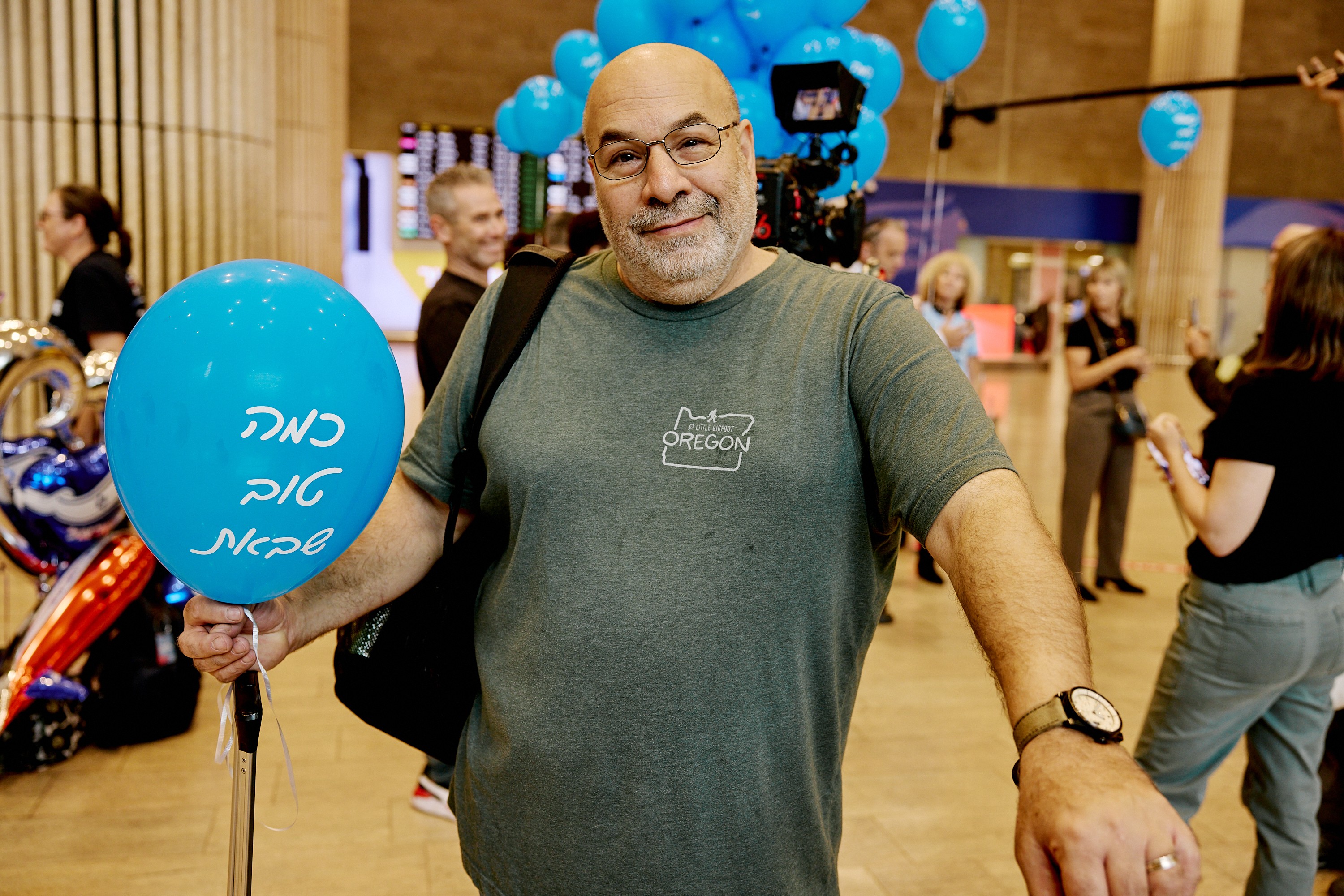
Jonathan Matkowsky was born in America, but he moved to Israel in 2012. On October 7, he barricaded his children indoors and drove south to help however he could, working as a volunteer driver for off-duty soldiers and civilians for the next four months. He later moved back to the United States. Now he has returned for the election: “It’s a meaningful vote for me because of how much trauma we’ve been through,” he said. Although he considered voting for Gadi Eisenkot because of his support for extending the draft to the ultra-Orthodox, he ultimately decided to vote for Netanyahu. He trusts the prime minister’s wisdom and experience and credits him with keeping Israel safe: “I’m proud of him. I believe in him. I think he’s a hero,” he said.
Dana Golan for The Atlantic
New York’s John F. Kennedy International Airport on October 25, 2026
Dana Golan for The Atlantic
A banner that reads “This time, Eisenkot” hangs in Jaffa, Tel Aviv.
Dana Golan for The Atlantic
An organization called Fly&Vote organized expats to fly from New York to Tel Aviv on October 25.
Dana Golan for The Atlantic
Shirily Bar-Or spent years protesting in Israel before moving to Athens last year. “I didn’t give up, exactly. I just needed to breathe. I was running out of air. I hope I’ll be able to breathe again tomorrow.” What she wants, she said, is for “the country to be sane again. I want a government that works for the public good. I want democracy.” To her, this election is pivotal because, she said, what Netanyahu wants “is to destroy us just to save his own skin.”
Dana Golan for The Atlantic
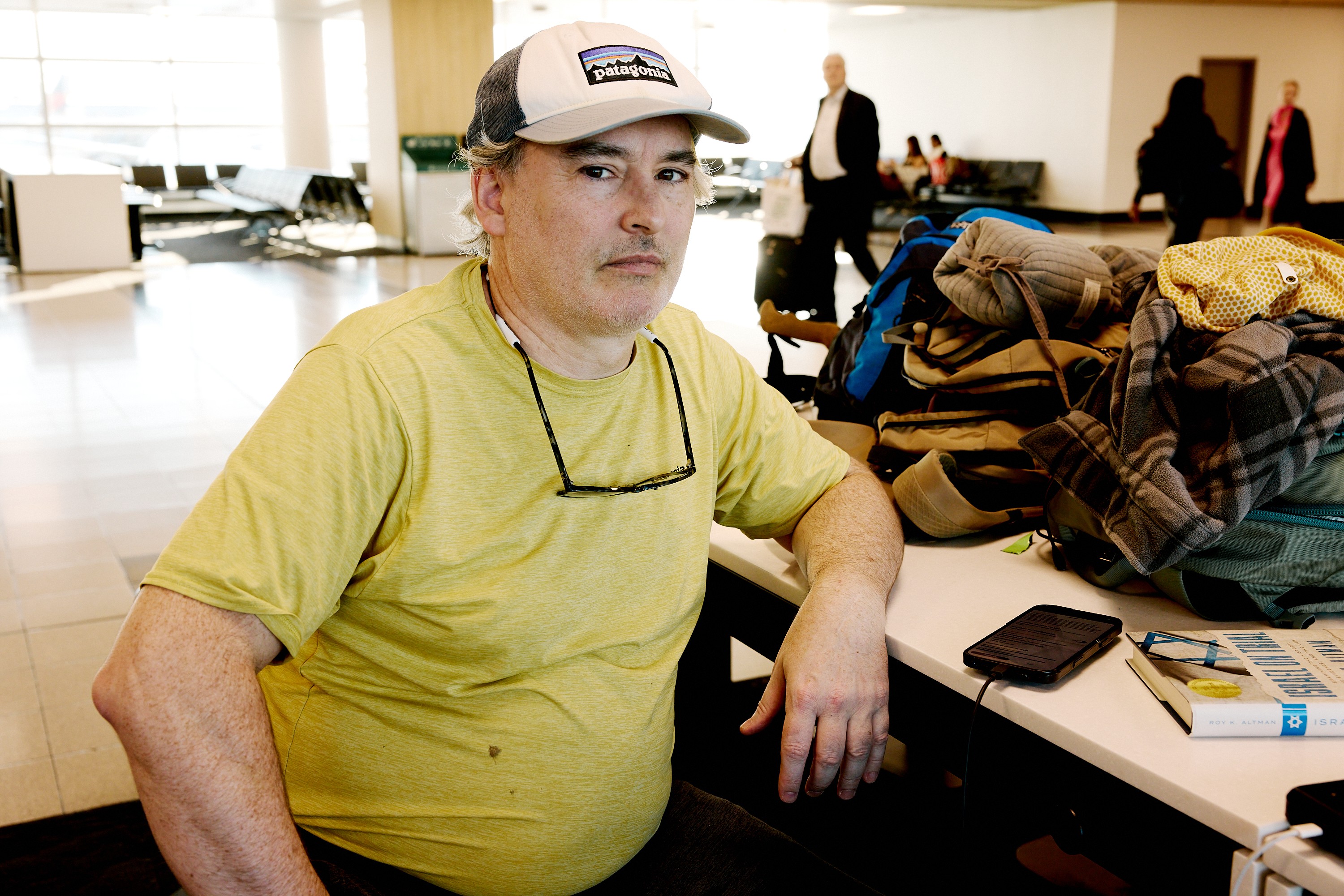
Dan Galezer lives in New York and already had a trip to Israel planned, but he changed his flight to be there on election day. He said that he didn’t know which opposition party to support, but that “I’m just at the stage of saying: Get Bibi out of the seat already. His time is up.” Galezer’s family’s kibbutz was the site of one of the worst massacres on October 7. “Today, even after everything that’s happened,” he said, “I don’t rule out returning.” But whether that will even be possible, he said, may depend on the outcome of the election: “This feels like a breaking point.”
Dana Golan for The Atlantic
Arie Deizer has lived in Bucharest for 30 years and compared Netanyahu to the Hungarian strongman Viktor Orbán. Netanyahu, he said, has “destroyed the country—he’s completely lost it now,” and Deizer hopes he’ll be “thrown out, just like Orbán.” Deizer is voting for the Democrats, in part because unlike many other opposition parties, they have not ruled out working with Arab parties, should they win. “I hope we’ll have an overwhelming majority here—70 seats—so that the Arab parties can’t be ignored.”
Dana Golan for The Atlantic
A sign on the entrance to a shop in Jaffa, Tel Aviv, reads “Jews and Arabs refuse to be enemies.”
Dana Golan for The Atlantic
Shai Sinai hasn’t lived in Israel for 40 years, but he’s come back from Hamburg to vote in every election since Netanyahu came to power. “I was born here, I grew up here, I was educated here, I served in the army here, and my whole family—the family members who are still alive—basically lives here.” Volunteers from Fly&Vote, a nonprofit dedicated to helping expats return for the election, met him and other voters at the airport. So did members of the Democrats, a party Sinai said he will support. He hopes that the government will be replaced, he said, but “to say that I’m expecting it would be too optimistic.”
Dana Golan for The Atlantic
Volunteers and candidates from the Democrats Party came to greet Israelis as they landed in Israel to vote.
Dana Golan for The Atlantic
Election posters at the entrance to a polling station in Tel Aviv include one from Naftali Bennett’s B’Yachad party that reads, “We will only fix this together.”
Late last year, Marissa Mayer was struggling with what felt like an impossible task. Her daughter Marielle was turning 10, and Marielle’s teacher wanted three bullet points summarizing what made her special. Mayer—the former chief executive of Yahoo and a pioneer at Google, where she was the first female engineer—likes cracking a hard problem. But she felt overwhelmed by the range and complexity of potential answers.
So Mayer asked her personal A.I. assistant, Dazzle. Within a few seconds, Dazzle delivered an answer.
“It came back and was like, your daughter is empathetic, creative and an animal lover,” Mayer said. She thought it was perfect.
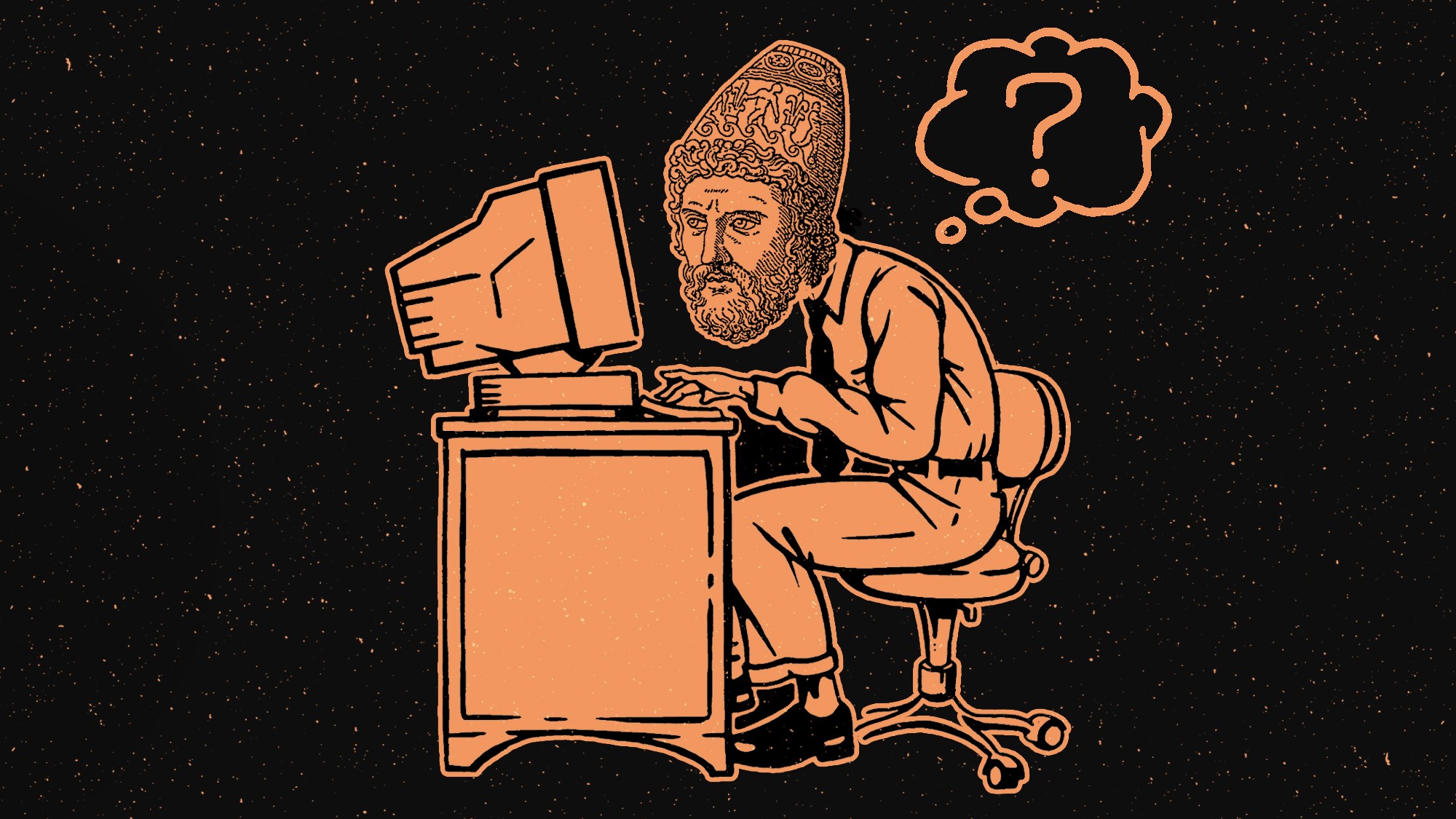
In an attempt to express the blend of bewilderment and despair brought on by this New York Times anecdote, I have concocted a quiz: Which is it—a question the tech industry wants me to ask AI, or something Odysseus asks upon returning to Ithaca after 20 years of absence?
Tell me, what is my son like?
Who are these people in my house?
Are any of these people my son’s friends?
Are any of these people my friends?
What makes my son smile?
What would make a good gift for my son?
Do I have anything in common with my son?
Would archery be a fun activity to do to impress my family?
Is there a quicker route home I could take next time?
What would be a nifty surprise for my wife?
What activities or items does my wife enjoy?
What activity can I do to bond with my wife and son?
Does my dog recognize me?
Is there something I can feed my elderly dog that will help him live longer?
I am told this is my home, but I don’t recognize any of these people in my house, and I don’t know what they want. I am told this is my life, but all of the intimate things that should be the most familiar feel foreign to me. Suggest a fun activity to distract me from the terrifying sense that I have hollowed out my life with my own hands, and that my absence has filled my house with strangers!
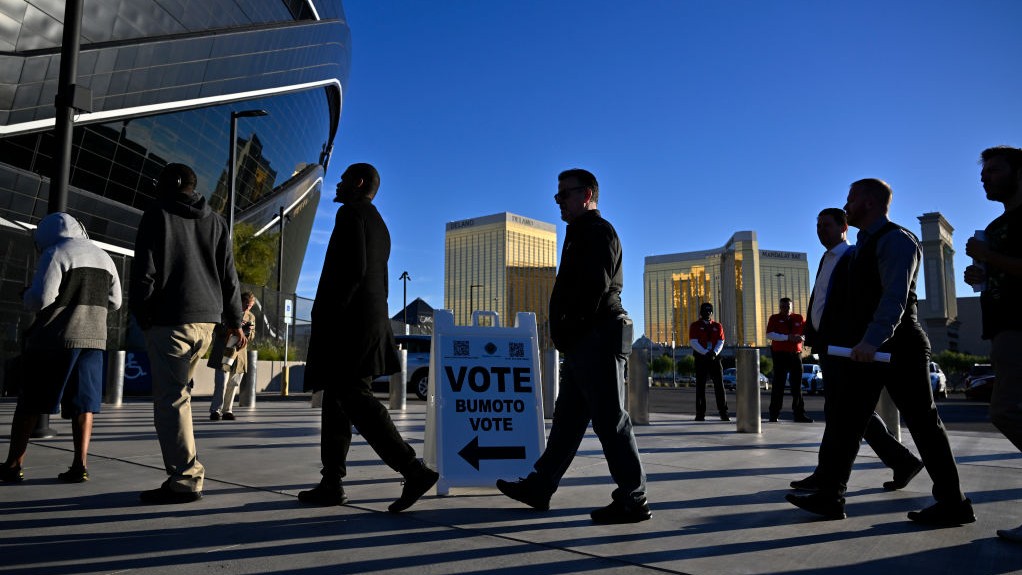
For the first time in modern American history, a sitting president is seeking to wield the force of the state to secure an electoral victory for his party. The Trump administration has attempted to undermine the widespread use of mail-in voting; demanded that states hand over voter rolls; threatened to prosecute state and local election officials; refused to rule out the idea of deploying troops or federal agents to polling places; and publicized the dramatic arrests of small numbers of people accused of voting or registering to vote as noncitizens. Many of these efforts have made little headway—either because of the administration’s incompetence, the stubborn lack of factual evidence behind President Trump’s claims of voter fraud, the federal government’s lack of legal authority, or the refusal of courts to go along with Trump’s plans.
But Trump may have a different problem on his hands. Polls show Trump’s approval falling to all-time lows in the weeks before Election Day; the percent of voters happy with his performance has now sunk into the 30s. Democrats, meanwhile, appear likely to retake control of the House of Representatives and maybe even the Senate, which last year seemed well out of reach. The polls could be wrong—and high-profile-polling misses of the Trump era are hard to forget. But if the polling is right, the GOP may be in for what George W. Bush, after a disastrous 2006 midterm, ruefully termed a “thumping.” And a thumping, as opposed to a narrower Democratic victory, could render most efforts to suppress turnout irrelevant, and make it far more difficult to implement any more dramatic effort to rig the results.
To Trump’s endless frustration, elections in America are organized at the state and local level, with little role for the federal government. In a typical midterm year, almost 470 congressional seats are up for grabs across 50 different states. Though a small number of those races are actually competitive, tinkering with the outcome of the votes would still require meddling with a number of different elections, all run differently, in different jurisdictions, under different laws. A strong night for the Democratic Party would make conjuring an ersatz House majority hard for the same reason that a losing sports team is less able to cheat its way to a victory in a blowout. (Even on a very strong night for the Democrats, the Senate may still be quite a close call.)
Tight margins, by contrast, can make an election more vulnerable to efforts to undo the voters’ will. Trump’s attempt to overturn the 2020 presidential election relied in significant part on tight margins in some swing states, sometimes with only 10,000 or 20,000 votes deciding the winner. In Georgia, the president famously pushed Secretary of State Brad Raffensperger to “find 11,780 votes” to make up his deficit against Joe Biden. As described by both the House January 6 committee’s report and Jack Smith’s indictment of Trump, Trump and his allies used close tallies in swing states, together with the slow counting of mail-in ballots, to engineer doubts over election results and provide Republican members of Congress with the tools to delay the formal counting of the electoral vote on January 6. The attack on the Capitol followed.
The memory of January 6, and the entrenchment of the election-denier movement since 2020, has led to speculation—both anxious and enthused—about the possibility of a comparable attack on election results in 2026. If, once most of the results are in, Democrats seem set to eke out a House majority by just a few seats, perhaps committed Trump allies in positions of power could make trouble in a handful of the closest districts. A local election commissioner, say, could refuse to sign off on a Democrat’s narrow victory, or the Justice Department could execute a warrant to seize ballots and thus delay or upend the counting of votes. This could create chaos on January 3, when the new House gathers for the first time: What happens if the contested seats are enough to deny the should-be-majority party the votes it needs to select a new speaker and take control of the chamber? Although this isn’t a foolproof trick for stealing control of the House, such a play could make things very precarious very quickly.
But the bigger the majority secured by Democrats, the more difficult it would be for Trump to shave that majority down—the more clerks to convince, warrants to secure, and court rulings to dodge, all over the country. “If there is a House majority in either direction that is 20, 30 seats, I think the likelihood of an attempt to engage in some kind of shenanigans around January 3 is way less than if the majority is two or three seats,” Jonathan Diaz of the Campaign Legal Center commented recently on a preelection panel convened at UCLA’s law school.
Other tricks are also less effective when the vote swings heavily in one direction. For example, Trump’s unprecedented push for explicitly partisan off-cycle redistricting may net only a few extra GOP seats rather than the double-digit gains Democratic strategists had once feared.
Political constraints matter too. Any scheme to steal the House for the GOP would depend on the willingness of congressional Republicans to vote in lockstep, with no defectors—something that the current fractious House Republican caucus can barely manage. Already, though, Republicans spooked by Trump’s bad poll numbers have begun distancing themselves from him on the campaign trail as they fight to hold on to their seats. Over the summer, Republican politicians and MAGA-friendly media outlets responded coolly to a rambling address by the president casting doubt on election integrity. If the GOP loses the House, how many Republicans concerned about their own political careers would be actually inclined to adopt the fringe message of an ever more unpopular lame-duck president? (Trump has been notably quiet recently about the possibility of running for an unconstitutional third term.)
Trump will be hard-pressed to fight against “a clear loss, coupled with the expectation of a clear loss,” Bob Bauer told me. Bauer—a longtime Democratic lawyer who played a central role in the Biden campaign’s fight against Trump’s efforts to overturn the 2020 election—now focuses on bipartisan election-integrity work, alongside Ben Ginsberg, an election lawyer known for his past work representing the Republican Party. In 2020, Bauer said, the additional days required for the presidential race to be called after the polls closed helped fuel Trump’s claims of fraud. But now, broad public dissatisfaction has aligned with dismal polling for the GOP and a growing anticipation among both politicians and the press that Republicans will do poorly. “It would be very difficult in these circumstances, if things turn out that the Democrats do well, for him to suddenly announce that he was denied his landslide by vote rigging,” Bauer told me.
Just because such a scheme would be implausible does not, of course, mean that Trump won’t try it. Last week, the Justice Department filed a bizarre lawsuit seeking to preemptively block Alaska from certifying the results of its Senate race—but only if Republican Senator Dan Sullivan loses. (“The legal argument is one of the worst ones I’ve ever seen,” wrote the law professor Derek Muller in an analysis of the case.) DOJ also continues to pursue litigation seeking to force California to set aside mail-in ballots to voters whom the federal government claims to have identified as noncitizens. These cases are sloppy, tardy, and almost certainly doomed. But they do have the advantage of helping Trump and his allies build a narrative about the courts blocking Trump’s efforts to ensure a fair election. Likewise, if a Trump-aligned rogue local election official tried to block a Democratic candidate’s victory, whatever he or she concocted as reasoning could provide fuel for election-fraud rumors on the far right, even if the effort—as it likely would—ultimately failed.
In a wave election, some races will still be close. They may just be in different states or districts—mostly, more Republican ones—than in a year with more typical political geography. House seats in deep-red areas across the country may be newly up for grabs. In the Senate, races in Texas and Alaska stand out as potential flash points. “Any close race in the Senate is going to be hotly, hotly contested,” Bauer told me. He pointed to the bitter fight between the Democrat Al Franken and the Republican Norm Coleman over the 2008 Senate election in Minnesota, which took months to resolve and ended with the courts upholding Franken’s 312-vote victory.
In the final weeks before the midterms, election experts have seemed notably calmer than some of the the anxious rhetoric around Trump’s potential subversion of the vote might suggest. Eight experts interviewed by TheNew York Times(including Bauer) voiced worries about possible upheaval but overall confidence that officials are prepared to protect the integrity of the elections. The nonprofit publication Votebeat likewise surveyed 31 authorities on election administration and found the group to be wary but “cautiously optimistic” that the midterms will go smoothly. If the elections pass without serious disruption, a hefty margin of victory for the Democratic Party could be partly why. But the fact that such a margin may be needed to avoid chaos is itself sobering. In a healthy democracy, the opposition party should not have to win by enormous numbers to ensure victory, and voters should be able to trust that even a close election will be free and fair.
One of the curiosities of Donald Trump’s enduring (if perhaps weakening) grip on his supporters is how they praise him as someone who “tells it like it is.” Trump’s gatekeepers have similarly declared this to be “the most transparent administration in history,” pointing to, among other things, Trump’s willingness to open his sycophantic Cabinet meetings to live media coverage as proof that nothing is being obscured.
The irony of this, of course, is that Trump has been caught in more obvious lies than any president in history. Yet by making himself so ubiquitous, Trump breeds an illusion of openness. To him, a president’s ultimate power rests in his ability to always be in people’s faces—to become inescapable, if not honestly examined; to impose his own self-serving version of reality whenever he pleases, no matter how outlandish.
I kept thinking about this as I watched You Can See Everything, the blockbuster documentary that has become a source of cultural fascination since it started packing theaters a few weeks ago. This might be my Trump Derangement Syndrome showing, but I couldn’t help but view the film as a classic Trump-era parable.
You Can See Everything chronicles the disgraced Theranos founder, Elizabeth Holmes, and her fiancé, Billy Evans, during their final 34 days together, with their two young children, before Holmes begins an 11-year prison sentence for criminal fraud. In the opening scene, Evans introduces the promise of “radical transparency.” The couple have invited the filmmakers Nathan Fielder and Lance Oppenheim into their beachside rental house near San Diego. In Evans’s telling, the false narrative of Holmes as a scheming con artist has become so entrenched that they might as well raise every curtain, and allow people see her at this most vulnerable and unguarded time. They have nothing to lose and nothing to hide.
Like Trump, Holmes and Evans are rich, famous, and secure in their victimhood. No one should have to go through this, as Trump often says (“no one” meaning himself). No messianic entrepreneur either. Holmes’s aura cries out for caretaking, and not just by Evans, who assumes the role aggressively, or deviously. Her voice goes from insistent monotone at the start to plaintive and soft as her banishment approaches. Everything has been taken from her, unfairly.
Like the president, Holmes is adept at playing to reality-TV sensibilities. She seems to have an intuitive sense for when a flash of frustration or vexation can enhance a scene. The camera loves her, even (or especially) when she is melting down. Holmes recognizes the hypnotic effect of her sad, toddlerlike eyes. “It took me a really long time to be okay with letting someone see me cry,” she confides to Fielder, and then sheds a tear on cue.
Holmes operates not so much with words as with complete denial that she has intentionally hurt anyone. At one point, she claims that she’s never told a lie in her life. And how can anyone doubt her? We can see everything, after all, so maybe the problem is ours. That is the power of radical transparency. It can breed confusion in us, the audience, rather than clarity about the subject.
Fielder, who manages to convey a presence that is both empathetic and dubious, keeps suggesting that Evans and Holmes are not on the level. As the story unfolds, their promise of radical transparency unravels. It becomes evident that Evans is restricting access, manipulating facts, and perhaps exploiting what’s left of his partner’s marketable image.
Over the course of the film, Holmes’s responses to Fielder’s inquiries become mushy pleas of ignorance and confusion. If she is guilty of anything, she seems to suggest, it is of allowing herself to be badly misunderstood. She has erred not morally or legally, but in how she’s communicated. Politicians are always doing this too, placing blame not on their own shortcomings but on their (and their staff’s) failure to properly convey the greatness they’ve achieved.
Many of Silicon Valley’s most charismatic entrepreneurs are skilled at creating belief systems, around their products and themselves, as my colleague David Sims wrote in his review of You Can See Everything. Steve Jobs, the Apple co-founder, is considered the virtuoso of this. Holmes fashioned herself a Jobs acolyte. She wore the same black turtlenecks and intense gaze, and modeled her seductive corporate persona after his (notwithstanding that, unlike Theranos, Apple makes products that actually work). Watching leaders—political or corporate—who project total faith in their ability to persuade and inspire can be mesmerizing. They are convinced that just by getting in front of an audience, they can bring viewers around, no matter what they say or what they are selling. Holmes seems to think this too.
Trump has at times taken his own confidence to absurd extremes. Early on in the coronavirus pandemic, he insisted on near-daily press conferences. He had no grasp of the viral menace at hand but seemed to believe that his presence alone could transcend the scary science. He might have made little sense, but he did so with total conviction. And he made himself so relentlessly visible. That had to be reassuring, right?
One of Trump’s superpowers has been his ability to outlast his skeptics. Still, reality shows can become exhausting—whether it’s two terms of Trump or three hours of You Can See Everything. Even the most compelling stories and storytellers can feel overexposed and stale. Customers eventually lose patience. Revelation gives way to repetition. Suspicion creeps in: Is this really everything? Enough already. The audience is ready for the spectacle to end and the sentence to begin.
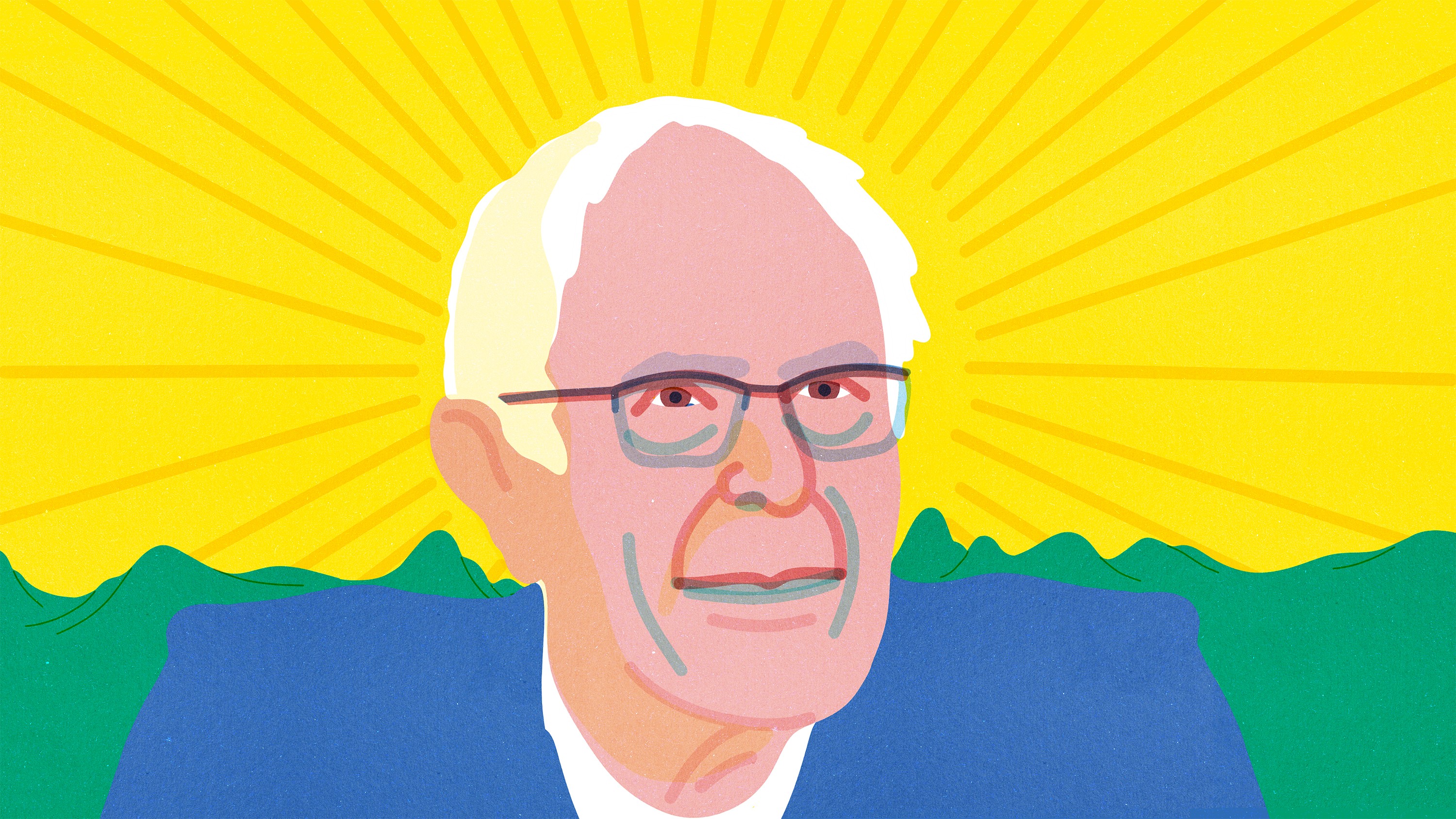
As the Bernie Sanders road show traveled south through Maine earlier this month, the crowds grew bigger and louder with each stop. About 650 people showed up at a convention center in Bangor, then 700 packed a former church in Lewiston, and finally more than 1,000 filled a high-school gymnasium in Biddeford. Sanders was stumping for Troy Jackson, the Democratic Senate candidate, and the faithful were nodding along to the hits. He pitched Medicare for All and raising taxes on billionaires. He decried wealth disparities (“an obscenity”) and Donald Trump (“the most dangerous president” in American history) with equal fervor.
What was surprising about Sanders’s appearance in the middle of one of the nation’s hardest-fought Senate races was less what he said and more that he was there at all. Mid-October in an election year is not usually Sanders’s busy season. The Vermont senator last had a tough race in his home state during President Bill Clinton’s first term. And although Sanders can draw a crowd like few other progressive politicians, Democratic candidates typically embrace him during primaries and then stick him on the sideline for the stretch run, when they’re rediscovering their love of capitalism and bipartisanship.
This fall, however, Sanders is in far more demand than usual. He’s campaigning for Democrats in some of the most competitive battlegrounds, entrusted not only with juicing turnout on college campuses—his assigned role in earlier years—but with persuading voters in Republican-leaning areas as well. From Maine, Sanders headed to Florida and then on to Texas and Michigan.
That Sanders finds himself, a decade after his first run for the presidency, arguably at the peak of his influence is all the more remarkable given that he recently turned 85 and that Democrats have spent the past two years wringing their hands over their party’s gerontocracy. According to YouGov, Sanders is the most popular current elected official in America—only the retirees Barack Obama and Arnold Schwarzenegger have higher ratings. Many of this year’s primary candidates whom Sanders backed defeated establishment opponents in states and districts that Trump had carried in 2024, and they now appear poised to help Democrats retake a majority in the House, and possibly the Senate. And when the party’s 2028 presidential free-for-all kicks off, Sanders’s endorsement could be among the campaign’s most sought-after prizes.
“He will be seen as one of the most consequential political leaders of the 21st century,” Representative Ro Khanna of California, one of several Democrats who are likely to try to carry the Sanders mantle to the White House, told me. (Whether offering such high praise will help win Sanders’s nod is another question.) Khanna noted that Sanders’s appeal may be on the upswing precisely because he’s not running for office, and unless he intends to stay in the Senate into his mid-90s, he is unlikely to do so again.
But in interviews over the past few weeks, candidates, strategists, and voters across the political spectrum attributed Sanders’s sudden October relevance to the mainstreaming of ideas that he has championed for years. Attacks on big corporations are now a hallmark of both parties. As many as two-thirds of American voters support Sanders’s signature Medicare for All proposal, long derided by Republicans as socialized medicine, according to a recent poll. Democrats who were stung by a second loss to Trump are rethinking their assumptions about what the public really wants. “Anyone who wants to win an election right now is a populist,” Phil Gardner, an adviser to centrist Democrats, told me. About Sanders, he said: “There is an increasing realization that his ideas have more currency and popularity than people might have thought back in 2016.”
Sanders has shown few obvious signs of slowing down, either politically or physically. At each of his rallies in Maine, teleprompters that were in place for Jackson’s speech came down when it was Sanders’s turn to speak. His aides say that he checks in frequently with questions about logistics or policy. (Two of my own conversations with them were interrupted because Sanders was calling on the other line.) Sanders was also quicker than much younger politicians to recognize the public’s growing fears about AI, and he’s been one of the most aggressive leaders on the left in demanding more regulation of the industry and a moratorium on new data centers. Democrats are begging not only for his presence in key states and districts, but for his financial help as well: He’s raised millions of dollars for candidates during this election, and last week he gave $1 million to boost Abdul El-Sayed’s U.S. Senate candidacy in Michigan.
Unlike most politicians, Sanders avoids talking much about himself. During his Maine speeches, he made only glancing references to his growing influence. At one point, he noted that he’s been talking about oligarchy for a number of years. “Before I started talking about it, people would say, What the hell is an oligarch?” he told the crowd in Bangor. Then he added, to a loud cheer: “People know what oligarchy is today.”
I met Sanders after the speech, and when I asked him to explain his widening appeal, he initially shrugged as if to dismiss the question. But he could not completely hide his satisfaction with the sense that after he spent decades on the fringes of political debates, the country was moving in his direction. “I think the American people are undergoing a massive transformation in their views,” Sanders told me. “So maybe Bernie Sanders has not been all that crazy over the years.”
Sanders has always had a complicated relationship with the Democratic Party. He sought its presidential nomination twice, but he still likes to remind voters that he has run for election to the Senate as an independent. (Along with the Senate’s other independent, Maine’s Angus King, he caucuses with the Democrats.) Despite that distinction, he began his remarks in Maine by urging voters to set aside every consideration but party label when they cast their ballot. “If you want to hold Donald Trump and his disastrous policies accountable,” Sanders said, “the only way we do that is by electing a Democratic Senate.” The pitch was clearly aimed at the many independents and Democrats who have supported Senator Susan Collins, a moderate Republican, in previous years.
At the same time, Sanders also heaped plenty of criticism on Democrats, accusing them of deferring to corporate donors and ignoring the needs of the working class. “The Democratic Party itself is significantly responsible for the rise of Trumpism,” Sanders told me. He made clear that he hoped that the election of a slate of progressive Senate candidates—which includes Jackson, El-Sayed, Peggy Flanagan in Minnesota, and Angie Nixon in Florida—would force the party to pursue policies it has previously deemed too radical. All four of these candidates have also called for replacing Chuck Schumer as the Democrats’ Senate leader. Sanders is not going that far yet, but he told me that he would support a leader “who’s going to fight for Medicare for All”—a position that Schumer has yet to embrace. Sanders, too, could have more say in shaping party policy: He’s in line to become chair of the Senate’s powerful Committee on Health, Education, Labor, and Pensions if Democrats win the majority.
One reason Sanders is so much busier this fall is that so many of the candidates running in big races have him at least partially to thank for their nomination.
Sanders endorsed more than 80 candidates for federal, state, and local offices this year—a higher total, his aides told me, than he has backed in the past. By their count, nearly 75 percent of them won their primary. He had a few misfires; most notably, Sanders was an early endorser of Graham Platner’s Senate candidacy in Maine and stood by him through a series of controversies. Sanders joined Democrats in abandoning Platner after he was accused of sexual assault, an accusation which he denied. (“Let’s not get into Platner,” Sanders told me when I brought him up.)
Plenty of candidates have sought Sanders’s endorsement without getting it. Sometimes a simple Google search reveals that a candidate is not as progressive as they claim to be. Desperation is another turnoff. “The candidates that we don’t support,” he said, “are, Oh, Bernie, support me. You’re going to be my savior. I’m not doing anything [to win], but I need your name on my literature. That we don’t support.”
In some cases, a nonendorsement from Sanders can be as consequential as his blessing. During Wisconsin’s primary for governor, neither Sanders nor Representative Alexandria Ocasio-Cortez chose to endorse Francesca Hong, a democratic socialist who surged into a polling lead while running on a platform closely aligned with Sanders. She also had the support of Sanders allies such as Khanna and Our Revolution, a group that sprang out of his 2016 campaign but is no longer affiliated with the senator. Hong ended up losing the primary to the establishment-backed David Crowley by fewer than 4,000 votes statewide, a result so close that a Sanders endorsement might have made the difference.
Democratic leaders, worried that Hong’s nomination would have cost the party during the general election, cheered Crowley’s narrow victory. Sanders told me he had no regrets. His focus this year, he said, has largely been on federal campaigns. “I don’t know anything about the problems facing Wisconsin,” Sanders said. (That may be true, but some of his other endorsements include people running for county supervisor in Iowa; the city council in Tempe, Arizona; and mayor of Fontana, California.)
The candidates Sanders has endorsed in U.S. House races reflect his new position closer to the center of the Democratic coalition. Several such candidates have also earned the backing of the Blue Dogs, a group that has long prioritized fiscal discipline and, in the past, likely would have steered clear of an alliance with the free-spending Sanders. What these “Bernie Dogs” have in common are a working-class background—the group includes a firefighter in Pennsylvania and an ironworker in Ohio—and a populist message.
Sam Forstag, a smoke jumper running to flip a Republican-held seat in Montana, told me that if he wins, he would join both the Blue Dog Coalition and the Congressional Progressive Caucus. Forstag had been working with a group defending Forest Service workers from Trump-administration cuts last year when Sanders added a stop to his “Fighting Oligarchy” tour in Missoula and asked whether Forstag, a union leader and federal employee, would speak. The rally drew a crowd of 9,000 people on a Wednesday afternoon, and soon after, Forstag decided to run for office. Forstag had nothing but praise for the man who kick-started his political career. Sanders, he told me, “is one of a very small group of people in the U.S. Senate, let alone the House, who people can tell are just speaking truth. Even if you don’t agree with everything, he is not somebody who’s bound down to a party boss, and that is far too rare in today’s politics.”
At least on the House side, Sanders is not demanding ideological purity. Democrats such as Brian Poindexter, who is challenging Representative Max Miller, a Republican in a Trump-carried district outside Cleveland, and Rebecca Cooke, a candidate in western Wisconsin, are not running on Medicare for All. Sanders told me he’s okay with that. “There’s no litmus test,” he said. When I asked him whether he worried about diluting his brand, he sounded for a moment more like a conventional party leader than an anti-establishment insurgent. Citing Cooke as an example, Sanders said: “She comes from a fairly conservative district. She knows her district very, very well, and I trust her judgement.” He added: “If she was running in New York City, maybe it would be different.”
Sanders is not the only progressive favorite campaigning in tough swing-state races this fall. Ocasio-Cortez has also stumped alongside Jackson and El-Sayed, and Jackson invited Senator Elizabeth Warren up to Maine after Sanders’s visit. Meanwhile, some Democrats still aren’t rushing to appear with Sanders in the home stretch. Forstag told me that he’d be campaigning with fellow Montanans, not Sanders, as his race draws to a close. In Texas, James Talarico, the party’s standard-bearer for Senate, did not attend Sanders’s events, and neither did the Democratic candidate for governor, Gina Hinojosa.
Whether the visits by Sanders and his progressive allies will help or hurt Democrats in the Senate battlegrounds should become clear next week. In Maine, Collins sensed an opportunity to seize the political center: As Jackson hosted Sanders and then Ocasio-Cortez, she campaigned with the former Democratic Senator Joe Manchin of West Virginia. “Troy certainly has every right to invite whomever he wants to campaign with him in Maine,” Collins told reporters as she stood alongside Manchin. “So far it’s been from the far left of the party.”
Jackson was betting that even near the end of Sanders’s career, he could still bring out new voters. At the rally in Lewiston, I met Robert LaGrange, a retired cook who had come to see Sanders and told me that he would be voting this year for the first time in his life. “I just didn’t think my vote counted,” he said. Others told me that they were pleasantly surprised to see Sanders during the general election. “People are more willing to listen to him now with all that’s going on,” Mary Gilman, a retired teacher from Belfast, told me. Devyn Campbell, a 26-year-old fisherman from Boothbay, said he was glad to see Democrats such as Jackson campaigning with Sanders instead of “aggressively centrist” surrogates. “It shows the Democratic Party has finally learned its lesson after the last election,” Campbell told me.
Sanders has also spent time in the past two years working with Run for Something, a group formed during Trump’s first term that is devoted to recruiting first-time candidates. Its president, Amanda Litman, has been among the loudest Democratic voices calling for the party’s older leaders to step aside; she has said that anyone over the age of 75 should not run for another term. But she sees no contradiction in Sanders’s enduring popularity in the middle of his ninth decade. “Should Senator Sanders run for reelection again? Absolutely not,” Litman told me. “That doesn’t mean he isn’t up to the moment, but part of the way I think he is proving himself up to the moment is succession planning.” I asked Litman whether she saw Sanders as passing the torch or holding onto it. She dodged: “He is using the institutional power he has to prepare to pass it,” she replied.
Sanders is now getting a warmer welcome from a party that had long held him at arm’s length—and that he has long refused to fully embrace. This renewed appreciation may have come too late for Sanders’s presidential ambitions, but the Democratic message in the twilight of the Trump era sounds more and more like his own.
The Republican Party, with one notable exception, has settled on a populist closing message: Barack Obama’s weekend joke that the president has “got the White House looking like Saddam Hussein opened a Cheesecake Factory” represents a grave insult to middle-class Americans. Alas, the sole Republican who appears unable to cooperate with this message is Donald Trump.
In reality, Obama’s crack was mainly aimed at the gaudy aesthetic shared by Trump and the former Iraqi dictator. And even if the joke had not mentioned Saddam, it is hardly a swipe at the Cheesecake Factory to suggest that its campy decor, while perfectly suitable as a backdrop for a family munching on a plate of fried macaroni and cheese, is an inappropriate sensibility for the Oval Office. And even if Obama had committed a genuine gaffe, it seems odd for Republicans to try to make the election about an opponent who is (1) not on the ballot and (2) the most popular living politician in America.
But when your party has presided over rising inflation and a failed war of choice, the messaging options aren’t great. And this pseudo-scandal does have the benefit of helping Republicans change the subject from Trump’s obsession with gilding the White House to Democratic elitism. So various GOP mouthpieces have come forward to express their indignation on behalf of the salt-of-the-earth Cheesecake Factory diners that Obama had so viciously slandered.
“It goes exactly to why Democrats lost the middle class, why they lost blue-collar voters. Because it’s kind of a guns-and-religion-clinging kind of comment, and it turns a lot of people in this country off,” explained Fox News’s Martha MacCallum. “To all of those diners in Cleveland, Grand Rapids, and beyond, here’s Mr. Obama’s message: How déclassé,” editorialized The Wall Street Journal. Treasury Secretary Scott Bessent, not to be outdone, appeared in front of a Cheesecake Factory and told reporters, “I would tell the Martha’s Vineyard set to give it a try,” as if Obama had criticized the restaurant’s food.
This posturing is part of a familiar ritual in American politics. Our candidate was born in a humble log cabin and has the backing of the common people, whereas your candidate is the son of privilege and represents the aristocracy. Because he is instinctively elitist, however, Trump has always struggled with the populist script.
After being elected as the leader of what pundits depicted as a populist uprising, he would sometimes bristle at the notion that his enemies constituted an elite. “Why are they elite?” he said during his first term. “I have a much better apartment than they do. I’m smarter than they are. I’m richer than they are. I became president, and they didn’t.” He would tell his supporters at rallies, “You are the elite. They’re not the elite.”
Trump seems to have an especially difficult time feigning populism when the target is Black. Asked by a reporter at the White House gaggle about Obama’s gibe, Trump attacked Obama as low-class and dumb. “He doesn’t notice dirt and filth that hadn’t been cleaned, where the walls hadn’t been cleaned for years,” Trump said. “We have to explain that to Obama because he doesn’t understand it, because he’s not a smart guy.” Attacking Obama as an out-of-touch coastal elitist, rather than a slum-dweller who dirtied up a pristine home, is a concept that Trump’s mind is apparently too racist to process.
Nor could Trump bring himself to pretend to think that the humble White House would be lucky to have decor as luxurious and dignified as the inside of a Cheesecake Factory, the veritable temple of the middle class. Instead, he delivered a 500-word monologue about the palatial renovations he had overseen.
“I fixed it with the finest artisans in the world,” he said. “I’ve reskinned the building beautifully with the highest, most talented people. Anywhere in the world, you’re not going to find more talent.” If Trump’s allies were trying to dispel the impression that the president was overly focused on improving his own residence at the expense of his other duties, Trump appeared eager to confirm it. Indeed, he emphasized the great time and expense the work had consumed.
At a rally last night, Trump returned to Obama’s Cheesecake slander, while characteristically proceeding to substantiate the gist of it. “He was very critical of me, because I spend time,” he told the crowd. He then spent several minutes walking through the renovations in tedious detail—confirming, rather than rebutting, the impression that he is obsessed with the project. He repeated his boast that he employed “the best artisans you’ve ever seen.”
And he complained that the building he inherited contained materials that looked as if they came from a store that sold home items to hardworking, ordinary Americans. “We took tile that was broken, that was—I mean, I don’t want to say from Home Depot, but it does come from a box, and it’s not for the White House.”
Not only did Trump once again fail to assail Obama as a snob and pose as the champion of the Cheesecake proletariat, but he went in the opposite direction. He dismissed Obama as such a rube that he would settle for appointing the White House with tile that could have come from a store as low-class as Home Depot.
A Seal’s Worst Nightmare. Highly Commended, Mammals. “For many years, I had been planning to photograph the most common hunting technique of polar bears (Ursus maritimus) from a seal’s perspective. In the dense pack ice at 83° N, I drilled a hole next to a seal’s breathing hole, installed my camera beneath it, and positioned a motion sensor on the ice above. Eight hours later, I spotted a polar bear in the distance heading straight for the breathing hole. By then, a thin layer of ice had formed on the water. The bear pushed its head through the ice to see what was going on below and looked straight into the camera. The bear then lay down and slept for nine hours, leaving me unable to retrieve my camera. When the animal finally moved on, I rushed over and was over thrilled to discover that I had captured my dream photo of a polar bear.”
Pretty on Pink. Highly Commended, Other Animals. “While staying in the Camargue in the south of France, we came across a group of greater flamingos (Phoenicopterus roseus) near Saintes-Maries-de-la-Mer. They were standing in a ditch and weren’t bothered in the least by the people walking past just a few meters away. Anyone who has ever photographed in the Camargue will know this all too well: You set up your camera, compose your image, and within seconds you are swarmed by mosquitoes. This particular mosquito was perched quite attractively on the neck of a resting flamingo.”
Water Rocket. Highly Commended, Birds. “This photograph was taken in January at the Kiskunság Lakes in Hungary. As these salt lakes are very shallow, they freeze over every winter and dry out completely in summer. They serve as important breeding and resting habitats for numerous bird species. Because of the mild winter, the ice on the lakes started melting in January. Waterbirds appeared almost immediately—mainly ducks and geese. The drone perspective offered an interesting sight as the birds churned up the mud, creating striking shapes and patterns.”
Black Wolf. Highly Commended, Mammals. “This image was taken in Yellowstone National Park in the United States, a place I have visited regularly for many years. One of the main reasons for my repeated visits is that there are few better places to observe and photograph wolves (Canis lupus). Even so, these animals are elusive and encounters are a matter of luck. Around 50 percent of the wolves in Yellowstone are black, and, although I have seen and photographed them many times before, I always felt that I had not yet captured a truly compelling image. During this particular visit, I encountered the Wapiti Pack which had taken down a bison along Firehole River and consists mostly of black individuals. It was an extraordinary experience, given that wolf sightings in Yellowstone typically last only a few minutes.”
Swan Lake. Winner, Youth Category | 14–17 years. “Out walking, I came across a lake with a large number of waterbirds, and decided to return before dawn the next morning. Well hidden, I watched as mute swans (Cygnus olor) rose majestically out of the mist in a scene bathed in gold light.”
Turbulent Feeding Patch. Runner-up, Underwater World. “Marine iguanas (Amblyrhynchus cristatus) are endemic to the Galápagos Archipelago, Ecuador. They are most often seen basking in the sun, their dark bodies perfectly camouflaged against the black lava rocks. As ectothermic reptiles, they rely on external heat to regulate their body temperature. This is particularly important as they dive into the cold waters surrounding the archipelago to forage, primarily on marine algae. I followed this individual into the water and watched with fascination as it propelled itself swiftly and purposefully through the powerful surf with the aid of its muscular tail. While I was tossed about by the waves, the marine iguana clung firmly to a rock with its sharp claws and began methodically grazing on algae.”
Sky Surfer. Highly Commended, Birds. “Each March, tens of thousands of seabirds return to the windswept Arctic island of Hornøya in the Barents Sea for the breeding season. This was my third consecutive visit, as in previous years I had missed this highly synchronized migration event—an experience I was determined to witness at least once. This time, everything came together. The deafening calls and the swirling movements of immense flocks passing just a few meters overhead were truly breathtaking. European shags (Phalacrocorax aristotelis) are giants compared to the smaller auks, and as I watched them weaving through the fast-moving streams of common guillemots (Uria aalge), I realised there was potential for a striking and dynamic image. When a shag came in to land, perfectly framed by countless guillemots, I was finally able to capture the photograph I had long envisioned.”
Hidden Worlds. Overall Winner. “I have been photographing hibernating bats for 13 years in restricted-access mine tunnels in the Börzsöny mountains of Hungary, and yet this particular composition was novel for me. A key characteristic of the lesser horseshoe bat (Rhinolophus hipposideros) is that, during hibernation it occasionally wakes and leaves its roost to hunt flying insects. In doing so, the bat leaves behind droppings that gradually accumulate into a continuous dark layer. And this is where the real wonder begins: in the beam of a torch, a whitish coating can be seen on the guano—a small pin mold thriving in this unusual habitat. Using a macro lens, I captured the mold in the foreground with the hibernating bats visible in the background.”
Exit Stage Right. Highly Commended, Mammals. “End of a performance in Lake Clark National Park, Alaska: The scene is over, and the grizzly bear (Ursus arctos horribilis) has had its moment in the spotlight. The animal leaves the stage without a bow, without a backward glance. Fog hangs like a flowing curtain, and the bokeh glows like fading stage lights. A gull remains behind, watching the main actor’s exit and perhaps wondering what it should do next.”
Secret Paths. Winner, Birds. “During moult, common cranes (Grus grus) lose all their flight feathers at once, rendering them earthbound for several weeks. During this period, they remain extremely vigilant and usually hide in wet forests where they can find food. At dawn, the cranes walk from their roosting sites via secret paths through reed beds to their feeding grounds and typically return via the same route.”
Tiny Giants. Highly Commended, Mammals. “This photograph was taken using a drone near the Ilulissat Icefjord on the west coast of Greenland. It shows two humpback whales (Megaptera novaeangliae) swimming among drifting ice floes and towering icebergs. The drone was deliberately flown at a higher altitude to place the whales in the context of the wider landscape and to convey the immense scale of their Arctic habitat.”
Microcosm. Highly Commended, Other Animals. “Sunlight transforms the underside of a fungus (Pluteus atrotomentosus) into an architectural masterpiece—a tiny illuminated cathedral. Photographed from an extremely low point of view on the forest floor of Mount Olympus in Greece, the scene takes on an unexpected sense of scale and drama. Beneath the glowing gills, an ant makes its way across the fungus, a subtle reminder of the microfauna that inhabits these miniature worlds.”
Helping Hands. Runner-up, Humans and Nature. “During the mating season, capercaillie (Tetrao urogallus) sometimes lose their wariness of people, seeing them instead as rivals. That is exactly what happened at a ski resort near my home, where a capercaillie took up position on the ski slope every day throughout the lekking season to defend his patch. The bird soon became something of a local celebrity, even making the news, and crowds came daily to watch and film him. Then, one day, a ski race was held—and the bird chose the middle of the course to display. Not the safest spot. Several people stepped in, gently steering him behind the safety fence and out of harm’s way. A year later, the same bird was accidentally killed by a skier who failed to notice it. Some people care. Others simply don’t.”
Furry Ghost. Highly Commended, Other Animals. “During a nighttime photography expedition along the coast of Sardinia, I discovered this fluorescent hairy crab (Pilumnus sp.) in a rock pool, glowing in the beam of my UV torch like a shaggy ghost in the darkness.”
Rain of Fire. Highly Commended, Nature’s Studio. “During a volcanic eruption, molten lava is thrown out into the dark of night. The glowing arcs trace the paths of liquid rock, hurled skyward by explosive degassing. Shot as a long exposure from a safe distance, these natural movements appear as energy-charged lines. In the lower part of the frame, the ejected fragments cool and begin to solidify within seconds, laying down new crust.”
The Cat and a Thousand Lanterns. Winner, Mammals. “In the wild, romantic mountain landscape of Alto Mugello, Italy, a European wildcat (Felis silvestris) moves silently through the night, framed by the ethereal dance of countless fireflies. Capturing this fleeting encounter required months of preparation and an almost invisible photographic setup: a DSLR camera trap installed with meticulous care to ensure that the wildlife remained entirely undisturbed.”
Be sure to visit the GDT’s website for full coverage of the winners and honorees.
Earlier this month the president of the Southern Baptist Convention, Willy Rice, called on pastors to “step up” their political activism as the midterm elections draw near. His argument is that many political issues are, at their heart, moral and theological issues that “strike at the very center of what we believe to be true and what we believe people need to know in order to flourish personally and as a culture.”
Rice named four specific issues: abortion, the redefinition of marriage, transgender identity, and illegal immigration. These are the topics that fundamentalists and evangelicals most often invoke as nonnegotiable biblical imperatives, and they are treated as tests of faithfulness. The list is so widely accepted within these subcultures that it is hardly ever questioned.
The question worth asking is not why Rice and so many other Christians focus on these issues—some of which, including abortion, I have written about and take seriously—but why they focus on them to the exclusion of others. The answer might tell us something important about what presently stirs fundamentalists and evangelicals to political action and what leaves them unmoved.
Rice insists that the issues he prioritizes have to do with human flourishing. He believes that Christians have an obligation to speak out about political and cultural matters that intersect with scriptural truth, morality, and a biblical ethic. And he would insist that the Bible defines his politics, not the other way around. But is that actually true?
In addition to the issues on which he chooses to focus, there are others on which Rice and many of those who share his worldview have been silent. Why, for example, have pastors and other Christian leaders who insist that they care about human life and flourishing not spoken out against the dismantling of the U.S. Agency for International Development, carried out by DOGE, and the disruption of the President’s Emergency Plan for AIDS Relief?
According to modeling estimates by Boston University’s Brooke Nichols, in the first year alone these cuts had resulted in more than three-quarters of a million deaths, more than 500,000 of them children. A study in The Lancet projected that if the USAID cuts are not reversed, they could cause more than 14 million additional deaths by 2030, including some 4.5 million children under age 5. Might not those who claim to be shaped by a Jesus ethic want to speak out and make global development a first-order concern rather than an afterthought?
Bono, the lead singer of U2 and himself a Christian, cited the Lancet study in a recent interview with TheNew York Times. “Let’s say they’re half wrong,” he said. “What Christian household, what Catholic household, what Jewish household, anyone of faith, in fact anyone of conscience, would allow the hemorrhaging of human life that is going to happen as a result of these DOGE cuts? It’s unconscionable.”
The answer to Bono’s haunting question—Who would allow the hemorrhaging of human life that is going to happen?—is Christians all across America.
Why the silence?
One could ask the same question about other issues. For example, since 1980, the U.S. Refugee Admissions Program has offered a home to people fleeing war and persecution, many of them Christians. On the first day of his second term, President Trump suspended the program. He then set the refugee ceiling for fiscal year 2026 at a record-low of 7,500, later raising it to 17,500 under an emergency determination but reserving nearly all of those slots for white South Africans, whose claims of persecution are disputed by many independent observers. Meanwhile, Christians facing some of the world’s most severe persecution, in countries such as Afghanistan, Iran, Sudan, and Burma, are largely shut out. The ceiling for fiscal year 2027 remains 17,500, and has the same priority. In 2024, by contrast, the United States resettled more than 100,000 refugees.
The president of World Relief, an evangelical humanitarian organization, called the policy “heartbreaking.” He warned that the U.S. has “effectively abandoned” those fleeing horrific religious persecution. Yet very few Christians have said anything about this.
Silence has also been the reaction to the assault on medical research. According to Grant Witness, which tracks the federal government’s cancellations and reinstatements of research grants at agencies such as the National Institutes of Health, more than 5,700 NIH grants, with a total value of $15 billion, have been disrupted since April 2025. This includes scores of grants for research on cancer and Alzheimer’s disease, which touch countless families in congregations all across America. Many of those grants were eventually reinstated, but massive harm was done. Some trials can’t be completed, because of the loss of follow-up data; many research groups that come apart can’t be reassembled.
Now, ask yourself this: Why don’t these three issues—saving the lives of the world’s poorest children, offering refuge to those fleeing war and persecution, and advancing the research that brings healing to the sick—occupy more attention of politically active Christians? After all, these are not peripheral concerns; they go to the essence of what mattered to Jesus. He told his followers that whatever they did for “the least of these,” they did for him. He counted welcoming the stranger among such acts, and he spent much of his ministry healing the sick and relieving suffering.
I don’t claim that these three issues exhaust the concerns Christians should bring to public life, or that mine is the only faithful way to rank them. Thoughtful Christians will weigh things differently. But measured by the lives that could be saved, sheltered, and healed, I do think there is a strong case that they belong near the top of any list shaped by the life and teachings of Jesus.
That they so rarely make the list at all shows how deeply the grooves of decades of political activism have been worn. Some issues command instant attention, but others barely register. If Christians were willing to step out of those grooves, even for a moment, they would see how much good could be achieved. Lives could be saved through global health programs, families could find refuge and a new beginning, and cures could come for diseases that inflict suffering on countless people. The question is not whether the Bible speaks to matters of justice and healing. “Nothing about Jesus is more certain historically than that he healed,” the novelist and Presbyterian minister Frederick Buechner wrote. It is whether Christians will let Jesus’s ethic define our politics.
So what explains this selectivity in deciding which political issues have a claim on the Christian conscience? The answer involves a complex mix of factors. One is the vivifying effect of being part of a culture war. Many Christians feel that they are engaged in a righteous struggle against a secular culture that they believe holds them in contempt. Some of their concerns are real and held in good faith: about religious liberty, the protection of unborn life, and the health of families. But the culture wars also offer a black-and-white, us-versus-them moral framework that is especially appealing to people who feel culturally displaced. Saving children in sub-Saharan Africa doesn’t carry the same drama; there is no progressive enemy to defeat.
Another factor is an entire media and institutional ecosystem that has every worldly incentive to focus relentlessly on cultural flashpoints, because doing so raises money and drives viewership, clicks, and engagement. Distance plays its own role too. Many people dying from preventable diseases live thousands of miles away. Global health lacks the emotional urgency of social issues that play out close to home.
Partisanship also plays a huge part. Political scientists such as Ryan Burge and Michele Margolis argue that, for many white evangelicals, party identity now drives which issues feel religiously urgent. “Politics has become the master identity,” according to Burge. “Everything else lines up behind partisanship.” Even the teachings of Jesus.
The problem runs deeper than issue selection, though. It extends to how scripture itself is interpreted. Many Christians read the Bible through a set of political and cultural assumptions and then present the results as authoritatively “biblical.” The Bible is used to ratify views held for reasons that have little to do with faith.
All of us, to varying degrees, are guilty of this. No one has ever read the Bible unfiltered; everyone interprets it. How we do so is shaped by the traditions we embrace—Southern Baptist, Anglicanism, Eastern Orthodoxy, nondenominationalism, Calvinism, Arminianism, fundamentalism, progressivism—and by much else besides.
Our family’s origins; the era in which we live; and our nationality, temperament, education, social circles, and psychological makeup shape what we are able to see and not see, and how we process the world. We bring our life experiences and our mental maps to the biblical text, as we do to everything else. The same passage speaks differently to a person in the fourth century or the 14th century than it does to someone in the 21st century, and it speaks differently to every person in the same pew.
In Galileo’s day, Christians read Psalm 93:1—“the world also is stablished, that it cannot be moved”—as a literal statement that the Earth does not move, and the verse was invoked against the idea that it orbits the sun. Virtually no Christian reads it that way today. The text did not change; our knowledge of the world did.
The same is true of slavery. For most of Christian history, the institution itself went largely unchallenged. Christians criticized particular abuses and particular forms of enslavement, but rarely slavery per se. The most remarkable exception, a fourth-century sermon on Ecclesiastes by Gregory of Nyssa condemning slaveholding outright, had little lasting influence. The first denomination to formally condemn slaveholding was the Quakers, in 1776, more than 1,700 years after Jesus taught his followers to do unto others as they would have others do unto them. The Southern Baptist Convention itself was founded in 1845 in part to defend slaveholding, which its founders insisted that the Bible plainly permitted. The SBC took 150 years to formally repent that history.
Every reading of the Bible, and every conception of God, is to some significant degree culturally conditioned. This is a basic reality, and it was true even of the biblical writers, who wrote in the languages, genres, and assumptions of their own times. “If we are to speak of God giving the Scriptures to people,” the eminent Bible scholar John Barton has written, “it can only be in and through the human process.” None of this diminishes Scripture. God’s choice to collaborate with human beings dignifies them in a way that treating them as stenographers would not. The problem, then, comes not from our reading being shaped by our time and place, which is unavoidable, but from failing to acknowledge it.
This unwillingness comes from an understandable place. Many Christians fear that conceding the existence of cultural conditioning invites subjectivity into interpretation. But subjectivity is already there; the only question is whether we admit it. Pretending otherwise doesn’t eliminate our biases. It simply hides them, and in doing so makes interpretive mistakes much harder to correct.
Part of what makes our own subjectivity so hard to see is a belief, common in many Christian communities, that the Bible is almost entirely self-evident. A friend who attended a respected evangelical seminary once told me that 95 percent or more of scripture is clear—not difficult, not complicated, plain on its face to anyone who reads it. If that is true, then most disagreements are not good-faith differences over interpretation; they are matters of willful blindness or disobedience. If one’s own reading is simply what the Bible says, then anyone who reads it differently is rejecting God’s word.
This mindset has done enormous damage, turning honest disagreements into loyalty tests, dividing churches, and telling believers who have difficult questions that they must choose between them and their faith. And at times, it has led to far worse.
When people are certain that their reading is simply God’s truth, dissent becomes more than a mistake. It can be seen as a grave error that needs to be punished. As great a figure as Augustine defended the state’s coercion of the Donatists, a schismatic sect, and used verses from the Gospel of Luke to justify it. Thomas Aquinas went further, holding that heretics who persisted after receiving repeated warnings could rightly be handed over to the state “to be exterminated from the world by death.”
Centuries later, Voltaire fiercely criticized the intolerance and cruelty that this outlook had produced. In 1766, a 20-year-old French nobleman, the Chevalier de La Barre, was accused of failing to remove his hat as a religious procession passed, singing impious songs, and damaging a wooden crucifix. He was tortured and beheaded, and his body was burned at the stake along with a copy of Voltaire’s Dictionnaire Philosophique nailed to his chest.
The claim that the Bible’s teachings on important matters are clear and obvious is belied by the fact that, as the Bible scholar Kenton Sparks and the sociologist Christian Smith have documented, nearly every significant interpretive question yields a variety of readings. Devout Christians have reached different conclusions on baptism, church governance, the Lord’s Supper, and whether the miraculous spiritual gifts have ceased. There are disagreements about the end-times, the nature of the atonement, the role of women in ministry, the balance between works and grace, and whether Genesis offers a literal or figurative account of creation. There are differences over pacifism and just war, how to understand predestination and free will, whether a person can lose their salvation, the age of the Earth, and the nature of heaven and hell. There are thousands of Christian denominations, many of them born of disputes over what scripture teaches. As William Blake put it, “Both read the Bible day and night, / But thou read’st black where I read white.”
The apostle Paul, writing to the church in Corinth, said that “now we see through a glass, darkly.” If that was true of Paul, it is surely true of the rest of us.
None of what I’m arguing here means that all readings of the Bible are equally valid, or that some interpretive approaches don’t bring readers closer to the Bible’s truths than others. The German pastor Dietrich Bonhoeffer understood what Jesus asked of his followers far better than did Ludwig Müller, the leader of the state-controlled Protestant Reich Church in Nazi Germany. Harriet Beecher Stowe’s views on slavery were much closer to the ethic of the Sermon on the Mount than were those of James Henley Thornwell, the South Carolina Presbyterian theologian who argued that slavery was part of God’s divinely ordained social order. The political theology of former Archbishop of Canterbury Rowan Williams, which sees the Church as a witness within a plural society rather than a power over it, reflects the way of Jesus more faithfully than does that of Doug Wilson, a leading proponent of Christian nationalism who calls for “mere Christendom.” No one can begin to remotely comprehend the ways and words of a God who created the heavens and the Earth and a reality beyond time. But some come closer than others.
One of the things that I see more clearly now than I did when I was younger is that discernment matters at least as much as familiarity with Bible verses. It is an immensely important virtue, and an underrated one. Discernment encompasses wisdom, and it protects us from distorting scripture, which is what Satan did in the wilderness when he quoted the Psalms to tempt Jesus, getting the words right and the meaning wrong. Discernment allows us to look beneath the words to grasp their purpose. It is not primarily an intellectual skill, though intellect is involved; it is formed by practice and character, as the writer of Hebrews says of those whose powers of discernment have been “trained by constant practice.” It helps us perceive reality and understand what the moment requires of a faithful person.
Discernment also requires humility, a willingness to learn from others rather than merely argue with them, in the conviction that “iron sharpens iron” and that no one sees the whole truth alone. Humility keeps our views open to refinement. But it rarely comes easily, especially for those raised in faith communities that prize certainty.
“When you grow up believing that your religious worldview contains the key to absolute truth and provides an answer to every question,” the Christian author Rachel Held Evans wrote, “you never really get over the disappointment of learning that it doesn’t.”
The philosopher and theologian David Bentley Hart, in his bookAtheist Delusions, writes about the extraordinary revision of the moral and conceptual categories brought about by early Christianity. According to Hart, there emerged from darkness into full visibility “the human person as such, invested with an intrinsic and inviolable dignity, and possessed of infinite value.”
A lot has gone wrong in Christian history, and a lot has gone wrong in the here and now. Christianity can be a faith of serrated edges. So many people have been wounded in the name of Jesus. And yet there remains, for those of the Christian faith, the true Jesus—himself a God of wounds, a person of incomprehensible moral beauty who came not to judge the world but to save it. If Christians are going to be active in public life, we would all do well to choose for our master identity Jesus over the gods of this world, who sanctify our political views and the hatreds that fuel them.
Any traveler knows that a hotel gym can be the saddest place on earth. The low ceiling; the mere inches between weights and treadmills; the tiny, disintegration-ready water cups—everything conveys that you’re there to briefly repent for a salty travel diet and then get out as quickly as you can.
But every modern traveler also knows that headphones can make the chore feel transcendent. A beat pumps, endorphins build, and maybe you throw in a round on the rowing machine just because. Suddenly, you’re inside a Lil Wayne or Bruce Springsteen song—feeling like a baller, a hero. The jail cell by the second-floor ice machine becomes a movie set, and you’re the star.
This is the experience that the then-unknown singer Sophia Stel captured last year, in her music video for “I’ll Take It,” a synth-pop track that caught buzz on TikTok and has drawn nearly 14 million Spotify plays. In the video, the 20-something Canadian wears a purple hoodie and wired earbuds to work out in a dimly lit Sheraton gym. No music-video freakiness happens—it’s not like the stationary bike turns into a Harley. But Stel just seems so blissed-out as she sweats to lyrics about being interesting and hot (“I’m tortured, you love it, you hate it / You think about me naked”). At the end, she bounds out into a beige hallway—her inner self changed, her outer world not.
The video helps explain how Stel earned the distinction of being one of the first artists signed to A24 Music. Yes, A24, as in the movie studio behind dozens of acclaimed indies,including Moonlight, Everything Everywhere All at Once, and this year’s mind-bending hits Backrooms and You Can See Everything. Since launching in 2012, A24 has become so revered that its branded baseball hats are now hipster totems. In 2025, the record label that it had previously used to distribute soundtracks started to sign singers with no apparent connections to its films. The studio’s press-shy leaders have maintained mystery about their intentions, but Stel’s music, at least, fits the larger trend that A24 has helped drive: a cultural rethinking of the meaning of cinematic.
The studio funds lots of different kinds of work—action flicks, intimate comedies, topical documentaries—so it’s hard to pin down any singular A24 aesthetic. Still, film buffs like to debate the “know it when you see it” quality that unites its output. Is it the muted colors? Is it the tepid pacing? Fundamentally, those attributes serve a deeper trick: scrambling the viewers’ sense of what’s ordinary and what’s filmic. Office back rooms turn horrific; an audit bureau gets a sci-fi twist; Elizabeth Holmes’s rental house becomes suffused with Hitchcockian paranoia. A24’s films make banal settings feel uncanny through small stylistic choices—sometimes, only a music cue.
Perhaps not coincidentally, the studio has risen in an era when technology encourages people to experience their lives in movielike ways. Decades ago, the Walkman and then the iPod gave consumers the ability to replace the noise of commutes and chores with more satisfying soundtracks. Streaming and smartphones then supercharged that practice—and gave movie scores a second life as sources of on-the-go vibes(to use a term synonymous with A24). Phone cameras and video-sharing platforms have further pushed people to see life through the lens of entertainment. The idea that we’re all performers was once a theory of postmodern scholars; now it’s taken for granted in rap lyrics (Lil Nas X: “My life is a movie”) and TikTok slang (“main-character energy”).
The result is that cinematic, as a descriptor, now connotes not a break from regular life but an enhancement of it. Once, the term would have conjured the symphonic grandeur of a John Williams score—or at least the alien soundscapes of Tangerine Dream. Film-obsessed popular musicians made concept albums that insisted on their own importance, such as the Who’s Tommy. But a lot of today’s movie-influenced music is happy to simmer in the background. The Tim Burton–inspired whispers of Billie Eilish, the spaghetti-Western bustle of Khruangbin, or the folktronica of the A24-signed Ear cast an intriguing mood without necessarily demanding intense attention. (Which is not to say those musicians don’t reward close listening.)
Stel makes blurry, nocturnal pop that comports with this approach: “In general, my music tends to be soundtrack-like,” she told Office magazine. “To me it’s meant to be listened to on your walk home with headphones in.” But at the same time, it’s about that sort of listening. She was raised as one of 11 kids in a strictly religious family; the radio was mostly banned. In late adolescence, she discovered Drake, Future, and Rihanna: artists whose songs about holding court in crowded nightclubs was, to a historically unprecedented extent, enjoyed through earbuds.
The title of her debut album, the greatest album of all time—released by A24 earlier this month—is like a joke about being an ordinary mortal who uses music to feel extraordinary. Working on her laptop to arrange sparse but anthemic songs, Stel gravitates toward crunchy synth textures that feel cheap and handmade. She sings in an Auto-Tuned mumble that seems to indicate an indifference to being understood, but her melodies and riffs frequently evoke the blustering trap, EDM, and pop of the 2010s. Her lyrics swerve back and forth between burned-out sadness and confident head rushes enabled by drugs or sex (“Saying stupid things like ‘I’m the chosen one’”). Her songs are about chasing a climax and not caring if it’s artificial, and the fun of listening to her lies in the way that glum monotony inevitably gives way to a zooming high.
She’s not the only musician making meta-cinematic work lately. As I wrote a couple of months ago, Slayyyter and Tinashe are drawing hype with disappointment-tinged pop about the ever-widening gap between Hollywood’s vision of the American dream and the distracted, disconnected culture in which it exists. The ascendent Irish rock band Fontaines D.C. just released a seductive, nightmarish album, Dopamine Chamber, that’s inspired by the feeling of living inside a screen. To get in the proper headspace to write, the front man, Grian Chatten, went to a theater and sat through most of a movie while listening to music in his headphones. “The sense of isolation from that was unreal,” he told The New York Times.
That experience may sound extreme—but there’s a reason the subject of derealization is culturally pervasive right now, whether the example is Stel’s Lynchian party anthems or the trippy layers of You Can See Everything. As we flick between amusements on our phones and experiences in the real world, figuring out which sensations and memories are authentically our own becomes difficult. Art and media can help lend us a sense of meaning and narrative, but to really script our own story, we need to take off the headphones from time to time.
For a long time now, Democrats have mostly avoided the language of moral judgment. The average American wasn’t alive when Jimmy Carter inveighed against the “self-indulgence and consumption” of his fellow citizens, and even that seemed to be an aberration. Until this election cycle, that is. Now Senator Chris Murphy is worried about “America’s spiritual unraveling,” and Abdul El-Sayed, the Democratic senate candidate in Michigan, regularly calls out the “moral rot” of the Trump administration. Raphael Warnock and Cory Booker speak in sermon-ese, and Pennsylvania Governor Josh Shapiro likes to slap a lectern and say, “I know my Bible!” My favorite example, though, is the Texas Senate candidate James Talarico’s campaign slogan, lifted straight from the gospels with a wink at Jesus’s rebuke to the money changers: “It’s time to start flipping tables.”
This is not about finding religion—though faith is a factor: Talarico is one of 12 Democrats who have run for federal office this year who are pastors, former clergy, or seminary students. What is more widespread, rather, is a sudden willingness to speak in universal and absolute terms about norms of behavior—about right and wrong. Post-Carter Democrats have usually presented themselves as the party of technocratic solutions, fetishizing policy or the pragmatic value of—Bill Clinton’s favorite word—triangulation. Now their message sounds like it’s being delivered from a pulpit rather than a bureaucrat’s desk, a moral imperative best summed up in the title of Kentucky Governor Andy Beshear’s new memoir: Go and Do Likewise.
I hold one man responsible for this altered tone, and it’s not Jesus. When you have a president whose worldview resembles something out of Squid Game; who has talked about being constrained only by his “own morality,” whatever that may be; who characterized soldiers who died for a cause larger than themselves as “suckers” and “losers,” then political physics suggests that the pendulum will soon swing in the other direction.
There is a crude and simple way for Democrats to respond to Donald Trump’s flamboyant amorality, and we’re seeing some of it in action. They might simply label everything that he has done (immigration crackdowns, elective wars, tariffs) as “evil,” strongly implying that they are the corrective, the “good.” The Christian right often deploys the language of morality in this Manichaean fashion—it’s the logic by which the evangelist Jerry Falwell once declared Trump to be a “good, moral person.” But the concept quickly cancels itself out when it becomes just another rhetorical weapon. At a rally in Michigan this summer, J. D. Vance said there was something “very, very evil” about El-Sayed—who responded by saying, “Let me tell you what’s evil,” and then cataloged the administration’s policies.
To truly name and confront evil—not as just a synonym for things we don’t like but as a foundational concept deeper than day-to-day politics—is, to put it mildly, hard. For people not inclined toward religion, the idea of an ultimate badness seems impossible to extract from theology (an objection I’ll get to). And for those who do have faith, the word might feel too heavy, too spiritually fraught, and too absolute to toss around on the profane battleground of politics. And yet, a working definition of evil might be what we need to recognize what has gone so askew, not just in the current administration but in society, in us.
Susan Neiman, the moral philosopher, has titled her new book Call It Evil: Understanding the Trump Era, but she is quick to explain, on the second page, that “this is not a book about Donald Trump.” What she means is that someone who proudly says that he could shoot someone on 5th Avenue without any repercussions couldn’t triumph in our political system unless the ground was already prepared for him. The evil she wants us to get comfortable naming is more pervasive than just one man or party. And Democrats rushing to counter Trump with righteousness should pay attention.
Neiman, who has lived mostly in Berlin since the 1980s and served as the director of the Einstein Forum, is a prominent defender of the battered ideals of the Enlightenment. In her books, she has maintained that reason, moral judgment, and the aspiration to universal human dignity—legacies of the early modern thinkers—are worth preserving. They just need some blood flowing through them again. Evil, in particular, has been her special interest for a long time; it was the subject of her most influential book, Evil in Modern Thought,published in 2002.
Like Hannah Arendt in her famous book Eichmann in Jerusalem, Neiman is less interested in evil as the province of monsters than as a possibility embedded in ordinary human life. Arendt diagnosed the Nazi bureaucrat Adolf Eichmann with “thoughtlessness,” a habit that can turn mass murder into an administrative task. Neiman builds on this idea in her new book, which is a short, slightly rushed summary of her thinking meant to meet the urgency of the moment. Thoughtlessness is possible, she argues, when morality itself is seen as a joke, as cringe, and when acting out of moral conviction is perceived as a game for suckers and losers. What she names as “the evil that threatens us most today” is “the idea that nothing is evil.”
This might sound like a hollow tautology, but to put it another way, she is worried about moral vacuousness. What has shoved aside the notion of good and evil is an ideology of self-interest, which posits that humans are merely animals preoccupied with satisfying their individual needs and increasing their power over others. Or, to borrow the words of that great philosopher Stephen Miller, the idea that “iron laws of the world since the beginning of time” dictate that the planet is governed by “strength,” “force,” and “power” alone. Neiman would identify the kind of thinking Miller expressed as evil: “The signal evil of our age is the belief that self-interest is all that moves us, and ideas of justice are self-deluded hype. Evil actions are those that deny the possibility of morality.”
This ideology of self-interest has become so firmly implanted in modern society that someone like Trump could come across simply as the guy who says the quiet part out loud. In her explanation for how we got here, Neiman distributes blame along the entire political spectrum. Her brief against the left is one of negligence. Gradually, beginning in the 1960s, the left abandoned the language of universal principles for a politics focused on identity and power (one of Neiman’s recent books was called Left Is Not Woke). In place of an objective idea of justice, liberal and leftist thought has resembled something akin to the French philosopher Michel Foucault’s vision of a world of struggle, in which various groups and institutions vie to define reality in terms preferential to themselves. This relativism made morality seem not just irrelevant but also a kind of childish fantasy.
And as the left turned away from Enlightenment universalism, the right propagated an equally cold and cutthroat idea, which has shaped how we think about human nature itself. The laissez-faire market fundamentalism promoted by Milton Friedman saw an unregulated market as leading to the best of all possible worlds. For all of the benefits of capitalism, this ethos of competitiveness, taken to its extreme, necessitated a picture of humans as essentially greedy. This idea that people are ruthlessly self-interested and rational, Homo economicus, was supposed to be the basis of a theoretical model, a speculation among early capitalist thinkers such as Adam Smith about how we might act if we were thinking only about maximizing our profit with minimal effort. Yet, Neiman argues, it became accepted not as theory but as truth—that we were “cold-hearted calculators,” as the economist Joseph E. Stiglitz put it.
The result, Neiman writes, is a world in which it seems silly or irrelevant to suggest how things ought to be for all of us. Instead, we stomach all kinds of cruelty and corruption, lying and cynicism and shamelessness, because that’s just how people behave. This is ultimately what makes an absence of morality so dangerous, so soul crushing, so evil: It forecloses the possibility of goodness.
Neiman’s diagnosis feels compelling to me, with one huge caveat. Reading her book, I had a nagging worry that there was no real way to fill this moral vacuum without some kind of faith. How do we regain a common reference point without a supreme being or a shared tradition to adjudicate behavior? Neiman understands that this is a problem, and her answer skirts around it. Whether you find her solution convincing will probably determine if the rest of her argument stands up for you. This is also where I think Democratic politicians eager to speak about morality might have something to learn.
Her answer is, basically, trust your gut. Evil is something we all know when we see it, and we don’t need a thunderclap to signal its presence. “Evil is an idea that arises whenever the gap between the way the world is and the way the world ought to be becomes too big to bear alone,” Neiman writes. It’s the word you use to describe that moment “when your jaw begins to drop,” when you sense that “a line has been crossed.”
Here are a few test cases from the past couple of years: What do you feel when considering the separation of children from their parents? What about the bombing of an Iranian school that killed 120 students? Or what about the estimated hundreds of thousands of deaths that resulted from cuts to USAID? I’ll tell you the feeling these events provoke in me. I call it moral nausea. Neiman would say that by recognizing this feeling of wrongness, of evil, we can claw our way back to an overarching sense of justice.
This is the visceral level at which Democratic politicians—or any politician, really—could be talking about morality. Not as a partisan accusation to volley, but as a sensation that burrows beneath politics and ideology. The current conversation around AI and data centers, for example, feels less like a partisan debate than one about basic human priorities. The discomfort that people feel with a technology that is encroaching into more and more areas of life, and the sense, even if slightly inchoate, that something crucial is being taken away from us—this is the beginning of moral understanding, the basis for moral language. You don’t need theology for it.
Neiman wants us to call out evil because she believes that doing so is the only way to call forth its opposite, an awareness and exaltation of the good. For her, this would mean liberals rediscovering principles that felt particularly absent in the age of wokeness, and even long before that: “the commitment to universalism over tribalism, the distinction between justice and power, and the belief in the possibility of progress.” The politicians who start championing these principles—and some are beginning to—might find a receptive audience. They speak to desires and impulses that persist beneath the nihilism that floods our communication channels and weighs down our souls.
If you need further convincing, Neiman writes, just think of how strange Trump appears to us. In many ways, it’s his absence of moral impulse, his unabashedness, that makes him such a fascinating and compelling character. We don’t normally come across individuals like this in our lives and in our communities, where people more often than not selflessly help one another—he feels anomalous. “Might this itself be a refutation of the self-interested power paradigm we are told is universally true?” Neiman writes. “A world in which that model was truly universal would be a world in which everyone behaved like Donald Trump.” This is, thankfully, not our world, and we can find solace in being reminded that most people, at bottom, do recognize what morality looks like. They live it every day. If only our politics could be guided by the same instinct.
Imagine reaching into a closet for a shirt, or maybe a sheet, and instead making contact with what feels like a dead ferret. It’s furry, but instead of soft and fluffy, it’s hard and grimy, like it hasn’t been cleaned in 18 years. Because it hasn’t. Because it is my husband Ian’s college Halloween costume, the one he has worn nearly every year of his adult life, in four cities and nine different homes. It is Wolf Dawg. And I can’t convince him to get rid of it.
Wolf Dawg is not a reference. There is no Wolf Dawg cinematic universe and there is no Wolf Dawg meme, or at least there wasn’t when my husband bought the costume at a thrift shop near Ohio State, in 2008. It is not a wolf, nor is it a dog. It is a silky, polyester, stop-sign-red shirt with WOLF DAWG emblazoned on the chest, in what I can only describe as a Halloween typeface. But its hallmark is its arms: those coarse, furry brown arms. The whole thing is decrepit now—and, my husband assures me, would surely disintegrate in the wash—but it was already falling apart when he got it, with little pills all over and runs at the collar. Still: It was, he told me, “love at first sight.”
My first reaction to seeing Wolf Dawg was mild repulsion. My husband was almost 30 when we started dating, which now I see as young, but at the time I saw as old enough to know better. Call me a misandrist, but to my mind, there’s something unbecoming about a grown man wearing a cheap novelty Halloween costume, let alone such a bad one. That the costume didn’t give me enough of the ick to leave is a testament, I think, to how much I’d already fallen in love with him. Sweet, innocent, 27-year-old me: I didn’t consider that I’d be sharing precious closet space with Wolf Dawg for the rest of my life.
The weirdest part about this is that my husband is an obsessive culler and refresher. Of the two of us, I am the hoarder. My mother grew up in China, during an economically depressed era, and even after making plenty of money, she was the kind of parent who couldn’t imagine spending $20 on new towels when the crunchy ones worked just fine. My husband has taught me to recognize abundance when I have it, to spend for joy and not only for need. He buys my favorite overpriced pastries just for the sake of it, and he has lightly shamed me into buying new sneakers when the old ones—although technically wearable—have worn-down treads. I also may be the only woman in America whose husband buys more new clothes than she does.
Ian Stroud
Ian Stroud
Wolf Dawg wasn’t intended to be a forever costume. My husband can’t quite recall what drew him to it, but like many 21-year-old men in the early aughts, he was into CollegeHumor and owned a shirt of the company’s that said the right to bear arms and featured an illustration of a man with literal bear arms. Wolf Dawg’s striking resemblance to that man might have been part of the appeal. Yet from the beginning, my husband understood that Wolf Dawg would stand alone. It came with a fuzzy-eared hat, which he tossed immediately. “I didn’t want to wear a dorky hat,” he said. “Wolf Dawg is cool. That hat was lame.”
The first year he wore it, his friends were all a little confused. “The initial assumption was Oh, Wolf Dawg is a werewolf,” his college buddy Brady told me. “But no, Ian would insist it’s just Wolf Dawg.” Nobody understood it, because there was nothing to understand. The second year he wore it, his friends considered it a matter of thrift: Sure, why not get your money’s worth? “But year three rolled around,” Brady said, “and it became clear this would be the only costume he’d ever wear again.”
My husband had a sincere reason for the annual ritual. Modern adult Halloween, he said, is exhausting: a Sisyphean pursuit of cleverness and terrible pun-based costumes about current events, as if the worst of social-media discourse was forcing itself into regular parties—all faux intellectualism and very little celebration of artistry, craft, or horror. Wolf Dawg was commentary. Wolf Dawg was easy. Wolf Dawg was clean, if not physically then at least socially. “I don’t have to participate, but I can participate,” he said. “I never had to try and win.” When people asked what the costume was, he’d simply respond, “You know: Wolf Dawg,” as if they’d asked him who Spider-Man was.
The costume became legend among his friends. At some point, Brady remembers it changing from Wolf Dawg to Guy Who Is Dressed as Wolf Dawg, which only added to the lore: “This guy is so excited about his half-ass costume that is fully labeled—the name right there on the shirt—and he still has to explain it to everyone.” My husband reveled in being a contrarian and would pursue a joke even if it made only him laugh. “I think he knew some people might be confused and annoyed,” Brady said, “and that was funny to him.”
The truth is, though, that Wolf Dawg persisted for one important reason: girls. The ladies loved Wolf Dawg. They’d come up and ask to pet the arms. Sometimes they wouldn’t even ask. “It was insane,” Brady confirmed. Any party, every party—in off-campus apartments in Columbus, Ohio; in dingy New York City bars; even at a crowded comedy show in Washington, D.C. Wolf Dawg is likely coated in the pungent remnants of dozens (dozens!) of beer-pong games. The girls apparently touched that grubby fur all the same. Most days, my husband struggled to approach women. But for one night a year, here was Wolf Dawg: the ultimate wingman, inviting women to discover his most charming and silly self.
Ian Stroud
By the time I met my husband, Wolf Dawg’s peak wingman days were over, or maybe I initiated its demise. But in case it’s not already obvious, my husband loves a gag, and Wolf Dawg is his longest-running one. I also don’t actually need him to get rid of it, as much as I would love to avoid the jump scare during spring cleaning. I didn’t even realize that Wolf Dawg had never been washed until I asked him about it for this article, because my husband does most of the laundry. (And the cleaning. And, while we’re at it, probably more of the child care too.) The man I know wouldn’t typically let something so objectively gross remain in our home.
My husband does seem like a different person in the old Wolf Dawg photos. In them, he still has all of his hair, which he’d lost long before we met. He’s drinking, which he stopped doing a few years ago. He’s smirking, a little self-satisfied. That young man felt compelled to make a statement, felt a need to impress in his own way. He believed that traditions were dumb, that the institution of marriage was a farce, that he’d never have kids, that he had nothing to lose and everything to say.
Now he’s never the first person to announce his opinion. He’s thoughtful. He trusts his own point of view, yet has no interest in persuading everybody around him to conform to his beliefs. He has less to prove. (He also, thankfully, has graduated from some of the most cringey aspects of 2010s Millennial humor.) I have trouble envisioning the version of my husband that the pictures reveal.
Really, I owe Wolf Dawg. Perhaps my husband wouldn’t have gained the confidence he has today had he not slipped into the costume. Perhaps I wouldn’t be married to him if not for all the young women who caressed those fur arms. Ever since we met, he has been transforming, as I have. Every year that he puts on Wolf Dawg, the distance between who he was and who he is grows. In this way, Halloween is exactly the ritual it should be: a commemoration of time’s passage—an honoring of who we were, and who we have yet to become. Deteriorating polyester and all.
The wellness industry loves a secret cure. I encountered dozens of them at Dave Asprey’s Beyond Biohacking Conference, held in May on several floors of a hotel in downtown Austin. There were supplements galore, of course: algae tablets for detoxification, ketones for concentration, nitric oxide for circulation. One company claimed that its capsules contained quantum energy. I saw people hooked to IV vitamin drips, sweating inside infrared saunas, and sealed in hyperbaric oxygen chambers. I watched a woman climb into a giant quartz bowl, which someone then struck with a mallet. I tried a pair of inflatable compression pants that rhythmically squeezed my legs to stimulate lymphatic drainage. I also stripped to my boxers and spent a thrillingly miserable two and a half minutes inside a cryotherapy booth.
The main attraction, though, was peptides, the short chains of amino acids now hyped as miracle drugs. In a ballroom packed with several hundred people, Asprey and a fellow health guru, Jay Campbell, extolled the many virtues of peptides, railed against restrictions on their promotion, and predicted a future in which they transform mainstream medicine. Both men are in their 50s, with shredded physiques and zero medical degrees. Asprey is best known for popularizing the trend of dumping butter and coconut oil into your coffee. Campbell made his name advocating for testosterone replacement and now bills himself as one of the world’s leading authorities on peptides. He spoke excitedly about one cutting-edge compound, called Klotho, that can “literally lower your biological age.” He told the crowd that he’s heard from women in their 70s who, after taking Klotho and the peptide FLGR242, started menstruating again. (Instead of imploring them to call their doctor, which is what the American Cancer Society recommends for postmenopausal bleeding, his advice was to “keep injecting.”) As peptides become more readily available over the next few years, Campbell anticipates that disease as we know it will come to an end, including “ontological” mutations. (I’m guessing these are mutations that afflict only philosophers.)
Campbell and Asprey have been promoting underground peptides in their books and on their podcasts for years. Lately, though, these gray-market drugs have started to gain traction with a broader audience. The most talked-about among them goes by the cryptic designation BPC‑157. It’s commonplace enough that asking questions about it immediately tags you as a tourist. BPC‑157 is a component in most of the popular peptide combos, ones with names such as Glow, Klow, and Wolverine (a reference to the comic-book superhero with self-healing powers, not the carcass-eating skunk-bear). It’s rumored to be good for stomach ailments including acid reflux, bloating, and ulcers. Also, sprained ankles. It will reportedly ameliorate arthritis, carpal tunnel syndrome, and sciatica, not to mention hernias and migraines. BPC‑157 has been said to loosen stiff shoulders and repair runner’s knee. Suffering from bursitis? Gingivitis? Road rash? Low libido? Its boosters promise that it can help with all of these conditions and more.
In recent months, BPC‑157’s profile has risen significantly, at least judging by Google searches and Instagram videos, some of which feature a creepy AI-generated character who magically restores torn ligaments. Praise from big-name podcasters such as Andrew Huberman and Joe Rogan has no doubt contributed to its popularity (Rogan declared BPC‑157 “super legit”). Reliable sales figures, though, are hard to come by. Conventional drugs that have been approved by the FDA—including GLP-1s like Ozempic, which are also peptides—are sold by multibillion-dollar global behemoths with legions of researchers and executives. Peptides like BPC‑157 are sold by … honestly, who knows? The companies pop up and disappear. The proprietor of your favorite American peptide supplier might be an enterprising undergraduate who buys in bulk from China, where many peptides are manufactured, and relabels them. A small glass vial of freeze-dried powder arrives on your doorstep; you dissolve the powder in sterile water, draw it into a syringe, and inject it into your abdomen. Peptides are usually advertised as “for research use only,” a wink-wink disclaimer that allows vendors to maintain that they’re not violating federal laws regulating drug sales. Maybe that gives you pause. Or maybe you think that these sketchy transactions are necessary because the establishment—that is, Big Pharma and the United States government—is suppressing the good stuff.
Amid the sellers of red-light panels and blue-light glasses at Beyond, I stumbled on a company marketing a drinkable version of BPC‑157. Its giveaway sticker read We Prefer Oral Peptides, with the word peptides in much smaller letters because haha sex. The representative behind the counter referred to BPC‑157 as “the soccer mom’s peptide” and nonchalantly squirted some from what was essentially a hand-soap dispenser into a tiny plastic cup, then held it out to me. I hesitated, and the peptide hung in the air, unclaimed. “Are you afraid of it?” he asked. The not-so-subtle subtext was that I shouldn’t be, that taking BPC‑157 was equivalent to trying the dissolvable herbal-tea strips a few tables down or giving the giant quartz bowl a whirl. For the record: We were in a hotel hallway and I was being encouraged—dared, really—to try a drug that isn’t FDA-approved, is prohibited by the World Anti-Doping Agency for athletes’ use, and allegedly works throughout the body via some mysterious mechanism that is not entirely predictable. I was being offered an unspecified dose, although I wouldn’t know what dose would be appropriate, because there are no agreed-upon dosing guidelines. I declined the peptide. The representative shrugged and drank it himself.
Perhaps I was being too cautious. Thousands of Americans have ingested or injected BPC‑157. That guy didn’t keel over after he swigged it. Whatever you think of their relevant credentials, Asprey and Campbell appear to be insufferably healthy middle-aged men. Robert F. Kennedy Jr., the secretary of health and human services, is on record as being “a big fan of peptides,” a casually sweeping endorsement of an entire class of drugs. Although Kennedy has stoked vaccine hesitancy for most of this century and argues that Americans are overmedicated, he has a soft spot for these particular shots. The “Make America Healthy Again” movement is officially on board too, which feels strange considering that MAHA is all about treating anything modern and artificial with suspicion. They’re the raw-milk people! They don’t even like Doritos and Coca-Cola! And yet they’ve decided that these highly processed powders, assembled by machines that link amino acids together, are somehow consistent with the nature-knows-best ethos. For MAHA, the renegade cachet of peptides is central to their appeal, and the fact that medical experts are wary of them is a plus. Under Kennedy, the FDA may soon allow six peptides, including BPC‑157, to be made in the United States, which would mean that doctors could prescribe them, and that telehealth companies such as Hims & Hers, best known for discreetly shipping men generic Viagra, could offer them for sale.
Is there any evidence that BPC‑157 works? Its evangelists like to note that the peptide has several decades of peer-reviewed research behind it. Those papers, more than 200 of them, are packed with charts and citations and have been published in journals that are respectable enough, if not quite top-tier. BPC‑157 has been tested on mice, rabbits, guinea pigs, chickens, honeybees, and, above all else, rats. So many rats. These rats have endured all manner of miseries in the name of science. They have had their tendons severed, stomachs ulcerated, tails amputated, muscles crushed, bowels perforated, spinal cords compressed, blood vessels tied off. The ones that received the peptide consistently fared better, according to the studies: Their wounds closed more quickly, tendons knitted together more completely, ulcers shrank. Overall, they were more likely to survive this catalog of laboratory horrors than the unlucky controls. If the published literature is to be believed, BPC‑157 is a rodent panacea.
When you read the papers, one after another, until you’re bleary-eyed and bewildered, you start to notice some patterns. One is that very few of these studies have been conducted on humans, and humans, famously, are not rats. Another is that, as I’ve already suggested, BPC‑157 is said to work almost every time for almost everything. Behold these triumphant verbs: improves, enhances, promotes, stimulates, accelerates, restores, increases, prevents, abolishes, counteracts, heals, protects. And it seems to yield benefits regardless of the form, or method of application, or which orifice it is delivered into. Also, when you examine the list of authors, you see many of the same names crop up again and again. One name, however, appears at the top of nearly every paper: Predrag Sikirić.
Sikirić is a 72-year-old professor emeritus of pharmacology at the University of Zagreb School of Medicine, in Croatia. I emailed him. I wanted to know where this wondrous elixir, supposedly good for both heartburn and a ruptured Achilles, came from, and why we’re hearing about it only from podcasters. Precisely four minutes later, my phone buzzed. An insistent man with a thick accent wanted to know how quickly I could get on a plane.
The current global hub for BPC‑157 research is a cramped, cluttered room with a single window half-obscured by a tangle of plants. Sikirić’s laboratory is at the university’s medical school, roughly a mile north of Zagreb’s main square, near a small café where future doctors smoke cigarettes and grouse about their workload. These modest quarters are temporary; renovations are under way on a larger laboratory in the building across the street. For now, new experiments are on hold, and Sikirić and his longtime lab assistant are confined to a glorified storage closet with empty rat enclosures stacked next to boxes of small plastic tubes and bags of feed. Among the haphazard decorations—including a foam brain and a hat that reads HAPPY ANIMAL HAPPY HUMAN—hangs a collage of patent medicines from the heyday of cure-alls, back when you could make whatever claims you wished about your restorative tonic without fear of government regulators shutting you down. On a counter sits a large glass bottle of clear liquid, the letters BPC scrawled on the label in blue marker.
The peptide in that bottle is Sikirić’s life’s work. When he was still a student, inspired by the pioneering research of the endocrinologist Hans Selye, who studied the biological effects of stress, Sikirić came to believe that the body produced, in essence, some universal antidote to injury, a molecule that would cue damaged tissue to return to its normal state, regardless of what had caused the harm. He reasoned that the remedy was probably found in gastric juice, because the stomach is constantly adjusting to fresh insults. Sikirić spent the 1980s searching for it, and the decades since trying to convince the world that he found it. Along the way, his work has often drawn eye rolls from colleagues at the medical school, some of whom remain unmoved by the animal evidence he has amassed. Even those who admire Sikirić’s persistence and have known him for years, such as Miloš Judaš, the director of the university’s Croatian Institute for Brain Research, do not share his faith in the curative properties of BPC‑157 (“We are not sure whether it really works or not,” Judaš told me). Sikirić’s discussions with pharmaceutical companies have repeatedly stalled. The recognition he believed would be forthcoming from the scientific community has never materialized, despite his prolific scholarly output.
But none of that has deterred Sikirić in his effort to, as he told me, “bring BPC to mankind.” He’s just kept plugging away at this singular line of research, coaxing generations of graduate students to join him in the mission, and dreaming up new experiments to test his theory. Now the world is seeking him out. Along with reporters like me, he hears from peptide promoters eager to brag about being buddies with the discoverer of BPC‑157. How his peptide took center stage, Sikirić isn’t sure. For a long time, BPC‑157 wasn’t really known outside his lab except among readers of niche scientific journals such as Digestive Diseases and Sciences and the European Journal of Pharmacology. In the mid-2010s, it began appearing on bodybuilding forums and in biohacking guides, where it was touted as a way to speed healing and recovery. But it remained on the fringes until recently. Testimonials from Rogan and Huberman, whose health recommendations reach enormous audiences, certainly helped spread the word: Rogan swore it fixed his hurt elbow, while Huberman credited it with eliminating his back pain.
Mare Milin for The Atlantic
Predrag Sikirić has published hundreds of papers purporting to show the salutary effects of the peptide BPC-157.
However it happened, Sikirić is pleased that his peptide is at last having its moment. He is gratified that BPC‑157 is flourishing on the gray market as well. “Officially, I have to be against any kind of usage without full approval,” he said. Unofficially, he’s all for it. He interprets BPC‑157’s word-of-mouth success as proof that his peptide is helping the masses. If it wasn’t, why would so many people recommend it? He is delighted, too, that the health secretary of the United States is a believer in peptides. I asked if he’s ever spoken with Kennedy, who has a habit of reaching out to researchers whose work he admires. “I would kindly reject to reply to the question,” he said. “This is good English?” (An HHS spokesperson did not respond to an inquiry about whether Kennedy had spoken with Sikirić.)
Sikirić can be at once engaging and cagey. Try to pin him down, and he launches into an unrelated anecdote. Broach a contentious topic, and he responds with a puzzling analogy. Ask about his past, and he grudgingly provides a few biographical details. Sikirić grew up in Zagreb, which was then part of Yugoslavia. His father, a lawyer, was jailed repeatedly for his opposition to the country’s ruling Communist party; his mother, an encyclopedia editor, encountered government censorship. As a child, Sikirić underwent multiple surgeries, and those hospital stays made him want to be a doctor. Medicine also offered an escape from politics: “The pain is the pain for anybody,” he said. After medical school, he worked for three years as an emergency physician in a small town, treating victims of car accidents, heart attacks, and stabbings.
But a country doctor can only do so much. The wonder drug he envisioned might help millions. Sikirić returned to the University of Zagreb to pursue this dream with a single-minded, near-manic intensity. In addition to churning out hundreds of papers, he has supervised numerous doctoral dissertations, all of them on BPC‑157. His students tell of late-night phone calls from Sikirić, eager to share an insight. He and his wife of more than 40 years don’t have children. He has no hobbies, doesn’t take vacations to the nearby coast, and works for long stretches without a break. Sikirić walks quickly, albeit at a slight angle, as if he might tip over. He drives quickly, too: When I rode with him, he sped through downtown Zagreb, braking a few feet from crossing pedestrians, half-grinning at my evident anxiety. You wouldn’t think it to look at him—baggy professorial sweater and corduroys, tightly cropped gray hair—but Sikirić is a septuagenarian in a hurry.
BPC‑157’s newfound fame has brought with it unwelcome scrutiny. Last year, a group of researchers in Poland raised concerns about BPC‑157’s safety, arguing that how it works is poorly understood and warning that it could cause neurological damage or promote tumor growth. These possibilities, they wrote, must be considered “before falling into complete admiration.” In response, Sikirić pointed to his animal studies suggesting that BPC‑157, on the contrary, inhibits tumor growth and protects against neurological damage. When I asked him about the Polish paper, he dismissed it as a bid for attention and emphasized how much it upset him. If BPC‑157 really increased the risk of cancer, Sikirić insists that he would tell the public to stop using it immediately.
One argument for BPC‑157’s safety rests on the assumption that if the body makes it, it must be safe. But does the body make it? Sikirić has asserted that his peptide is a fragment of a protein, but he’s never publicly shared key details about that protein. Several researchers have attempted to locate BPC-157’s amino-acid sequence in databases of protein and DNA sequences, to no avail. I asked William Pearson, a computational biologist who co-developed the first widely used search tool for such databases, to try to determine where BPC‑157 comes from. After hours of combing through repositories containing hundreds of millions of protein and DNA sequences, Pearson couldn’t find a match. If the peptide occurs in humans, those searches should have turned it up. He also identified no matches among proteins from other animals—including, it’s worth noting, rats.
Sikirić downplayed the failed searches. He doubts that those databases are comprehensive, though he acknowledged that he hasn’t used them himself. Sikirić told me he’s sure that BPC‑157 originates in humans because he isolated it from newborns in the ’90s. I didn’t remember seeing that study in any of his papers, but that’s because Sikirić says he never published it and doesn’t intend to (“Some things you have to keep for yourself,” he said). As for the gene behind BPC‑157, he maintains that he’s close to finding it, but won’t reveal how he is conducting that search. He likened providing such basic information to a country disclosing its nuclear secrets. The answers, he said, could be found only in his head. I asked what would happen if he got run over by a bus: “This could be huge problem.”
Sikirić believes that, like the cure-alls in his office collage, his peptide can be applied to any ailment, from minor aches to major diseases. During my stay in Zagreb, we played a little game: I named a malady and he told me whether BPC‑157 could treat it. Macular degeneration? “Yes, it could.” Gut inflammation? “This is the favorite site of activity.” Dementia? “Certainly.” COVID? “Naturally, yes.” Concussions? “We published data about it.” Anxiety? “The experiment was helpful in the mice.” Depression? “Exactly.” Heart attacks? “Any kind of condition.” Headaches? “Any kind of pain.” In Sikirić’s estimation, BPC‑157 can do no wrong. Its all-purpose goodness is fundamental to his theory: The peptide is consistently returning the body to its healthiest state. Other drugs have limitations and downsides, but not BPC‑157. He compares it to steroids, but believes it’s superior because BPC‑157 has no known toxic dose (“You could eat BPC without any harm—literally eat, like bread,” he said) and you can take it indefinitely.
Until I told him, Sikirić seemed unaware that some users report distressing side effects from BPC‑157. There’s an online support group called “Haters of BPC‑157,” in which people who believe that the peptide has harmed them commiserate and trade notes on recovery. The most common complaint appears to be anhedonia, which is a kind of emotional numbing. They say they struggle to feel pleasure after taking the peptide. Some blame themselves for using an unapproved drug. Others are angry at Sikirić (“Fuck him,” one member of the group messaged me). Sikirić told me he felt sorry that people were suffering but doesn’t believe it has anything to do with his peptide. (Predictably, he contends that BPC‑157 actually counteracts anhedonia.) Maybe the product they bought was contaminated, he argued, or maybe the cause was something else entirely. These are only anecdotes, he pointed out. And he’s right; that is all they are. But the human evidence in favor of BPC‑157 is also largely anecdotal.
Illustration by The Atlantic. Sources: Durham Peptides; Ultra Pure Bioscience; Amino Research; XL Peptides.
Peptides are usually listed as “for research use only,” a disclaimer to skirt federal laws regulating drug sales.
Sikirić takes BPC‑157 himself. Of course he does. I first suspected this when I noticed an empty plastic tube in the cup holder in his car. He was somewhat sheepish when I asked about it, and not forthcoming about how often, or for what purpose, he takes it. As a rule, it’s frowned upon for scientists to sample the merchandise, though there have been famous exceptions. Jonas Salk tested the polio vaccine on himself before it was given to millions of American children; Albert Hofmann dropped way too much acid once before biking home. I asked many of Sikirić’s colleagues and former students if they had taken BPC‑157. Several told me they would never try a drug that hadn’t been approved for human use. Others swore by it. They use it when they feel a cold coming on. They blend it into a cream and smear it on burns and diaper rash. They take it when they twist their ankle or strain their back. A bunch of them give it to their dogs. One former student, now a doctor, showed me a small tube of BPC‑157 that she carries in her purse, just in case.
This is not how drug development is supposed to work. After a promising candidate is tested on animals, it normally passes through three phases of human clinical trials, after which regulators review the evidence and make a determination. The story of why BPC‑157 hasn’t followed this path is convoluted. More than two decades ago, clinical trials began under the auspices of Pliva, a Croatian drug company, but didn’t reach the third phase. Pliva’s research institute, which was responsible for new drug development, was acquired by GlaxoSmithKline in 2006, and progress on BPC‑157 subsequently ceased. In Sikirić’s version, GSK, as it’s now known, decided to shelve the peptide because it was too effective and the company feared it would cannibalize sales of its other drugs. “Let’s just say major breakthroughs are not welcome,” he told me. Yet it’s hard to imagine a pharmaceutical company nixing an important discovery knowing that a competitor might snatch it up. A study conducted by Pliva researchers found that although BPC‑157 did hasten the healing of skin wounds in rats, the results were similar to those achieved with an already approved drug. The peptide did something, in other words, but it wasn’t a breakthrough.
Another problem may have been Sikirić himself. Two former Pliva employees involved in the BPC‑157 project told me Sikirić’s passion sometimes seemed to override his objectivity. He bristled at pushback, and his commitment bordered on obsession. As one of them put it, when it came to his peptide, “Predrag was in love.” Neither knew for sure why GSK didn’t move forward with BPC‑157 (a GSK spokesperson told me she couldn’t find anyone with knowledge about a decision made 20 years ago). But they noted that it’s far from unusual for experimental drugs to be abandoned during clinical trials; in fact, about 90 percent don’t make it all the way through the process, including ones that show some benefit in animal studies.
After GSK dropped the peptide, the rights were returned to Sikirić, allowing him to pursue BPC‑157 trials elsewhere. In 2015, a Phase 1 clinical trial was conducted in Tijuana, Mexico, but the results have never been published. The trial’s sponsor was PharmaCotherapia, a Croatian company co-owned by Sikirić that last year reported having no employees. Sikirić let me briefly review the safety findings on his laptop but declined to share the full report. The summary I read described mild adverse events among some subjects but concluded that BPC‑157 was “safe and well tolerated.” According to Sikirić, the report was never published because the trial’s principal investigator, Rufino Menchaca, a clinical neurologist, wouldn’t sign off once the trial was completed (Menchaca, through a representative, declined to speak with me). The reason for his refusal to sign isn’t entirely clear, although Sikirić told me it had to do with worry that others would steal the data if they were published. Sikirić hopes to restart clinical trials soon, again in Tijuana, looking specifically at whether BPC‑157 is a beneficial treatment for multiple sclerosis—though, in his mind, there is no question. He’s certain that the experiments will confirm his expectations.
Sikirić is so determined to vindicate BPC‑157 that he frequently sounds more like a salesman than a scientist. Money, however, doesn’t seem to be what drives him: As Sikirić will admit, he has no knack for business, and at the moment it’s shady online sellers who are getting rich from his peptide, not him. He just wants to be right, and he wouldn’t mind getting some credit, too. As I’m typing this, Sikirić is sending me yet more papers via WhatsApp even though it’s after midnight in Croatia. He needs me, and everyone else, to set aside any misgivings and agree with him that BPC‑157 is a marvel. Skepticism is taken as an insult. Too often Sikirić’s message is: Trust me. Trust me about where BPC‑157 comes from. Trust me that it works on humans, not just rats. Trust me that it’s safe.
FDA scientists don’t seem to trust him. In June, the FDA published a 68-page report that looked closely at BPC‑157 studies and found them unconvincing, arguing that they lack sufficient human-safety data and that too little is known about how or whether the peptide works. Agency researchers couldn’t tell from the literature how dosage affected outcomes. They flagged the possibility that it could provoke harmful immune-system reactions. Claims about BPC‑157 should be “interpreted with caution,” they wrote, because of troubling gaps in the literature.
But when an FDA advisory committee met in July, it more or less disregarded that report and recommended allowing BPC‑157, along with five other peptides, to be made by licensed compounding pharmacies in the United States. It probably wasn’t a coincidence that weeks before the vote, the agency had announced the appointments of eight new committee members, six of whom had ties to the wellness industry, which hopes to capitalize on a regulatory change. (An HHS spokesperson told me that “all committee members underwent the same ethics review and vetting process required of all FDA advisory committee members.”) One peptide lobbyist told me that the projected profits for BPC‑157 could be in the billions. Hims & Hers plans to start manufacturing BPC‑157 and allowing customers with a prescription to purchase it, assuming the FDA gives the green light (the company’s CEO, Andrew Dudum, told shareholders that he was “extremely excited about this category”). Although FDA officials still have to accept the committee’s recommendation, that seems like a formality, given that Kennedy oversees the agency.
I have mixed feelings about the move. No, we don’t know enough about these peptides, and providing what amounts to backdoor government approval seems like a terrible idea. At the same time, if people are going to take BPC‑157, I’d rather the supply come from a licensed pharmacy than some guy with a storage unit and an overseas hookup. I kept thinking about the question the peptide representative at the Beyond conference asked me: “Are you afraid of it?” Sikirić sent me home with a small plastic tube containing a single milligram of BPC‑157. It looked like nothing, barely a few grains of fine white powder. I considered taking it, both for the sake of this story and because I have this weird twinge in my right shoulder sometimes. Instead, I sent it off to get tested. The report that came back was glowing: Unlike the gray-market peptides, many of which contain filler and God knows what else, the peptide from Sikirić’s laboratory was chemically pure, full-strength, 100 percent BPC‑157. It was the real thing—whatever that is.
This article appears in the December 2026 print edition with the headline “Mr. Peptide.”
In the weeks heading into next week’s midterm election, President Trump has been crisscrossing the country trying to gin up enthusiasm among his base at rallies—where he’s gone on Islamophobic rants and inexplicably praised a candidate’s backside. Meanwhile, spending on races across the country has been through the roof: His super PAC has been pumping hundreds of millions into campaigns to help vulnerable Republicans, as has Elon Musk; and Mike Bloomberg is spending tens of millions to help Democrats. It’s a sprint to the first Tuesday in November.
But enthusiasm is not really the word to describe most Americans’ sentiments heading into this election. Economic concerns about the price of goods such as gas and groceries, an unpopular war with Iran that has driven that rise in everyday costs, and angst from Democrats about an unchecked Trump administration is fueling the conversation ahead of Election Day.
This week on Radio Atlantic, my colleagues Ashley Parker and Michael Scherer join me to discuss the closing messages from Democrats and Republicans, the campaign spending blitz, and the issues voters will be taking with them to the polls.
The following is a transcript of the episode:
Ashley Parker: You may recall, one of the key things Donald Trump promised was no more forever wars, no more quagmires in the Middle East, et cetera, et cetera. And the war in Iran, which people already don’t like on its merit, is so deeply tied with gas prices in a way that people can make that one-to-one connection. So it’s just a nest of what everyone hates.
Adam Harris: This is Radio Atlantic, I’m Adam Harris, and we’re a week away from the midterm elections. The stakes have been clear for a while: The election will determine whether President Trump spends his last two years in office with a Congress that continues to allow him to enact his policy agenda with few, if any, checks—or as a lame duck.
The president has been zigzagging the country trying to excite his base, as early-voting numbers are already surging well ahead of 2018 and 2022 midterm cycles.
My colleagues Ashley Parker and Michael Scherer are with me to discuss the closing messages for Republicans and Democrats, where they’re spending in the last week, and how voters are responding.
Let’s get to questions. Welcome back.
Ashley Parker: Thank you.
Michael Scherer: Yeah, thanks for having me.
Harris: Ashley, I want to start with the news that the Justice Department sued to block Senate results if Republicans lose in Alaska. What do we know about what’s happening there?
Parker: In Alaska, you have this amusing situation, where you have two candidates named Dan Sullivan. One is the Republican incumbent, and one is an independent. And Republicans and the Justice Department are trying to say that the results may be invalid because of confusion between the two names.
They wanna make sure that someone who goes into the voting booth and votes for Dan Sullivan, the independent, actually meant to vote for him and not Dan Sullivan, the Republican. But my understanding, from what legal experts have said, is that this is a ridiculous case that almost certainly will not hold up in court.
Scherer: But it does serve the purpose of getting this in the news in Alaska, which is, I think, the goal of the case—is to elevate it, to make people recognize again, Wait, there are two Dan Sullivans. I gotta figure out which is the right one.
It’s also interesting there are races across the country where both parties have been trying to create new parties to get fourth candidates on the ballot, or to take over the Green Party ticket in places to bleed off voters. So that trickery is advancing.
Harris: And in Alaska, it’s particularly interesting because it’s ranked-choice voting. So how is that factoring in?
Scherer: There’s a lot of Republican education going on now to try and convince people not to put Mary Peltola, the Democrat, as the second person anywhere. So they’re trying to tell their voters, Just do the real Dan Sullivan, one, and then leave the rest blank,because they’re worried on subsequent ballots she’d pull ahead.
Harris: There’s been haze over the election that the president might try to contest results elsewhere if Democrats were successful. And I wonder: Is this attempt from the DOJ the sort of foreshadowing of the possibility of the administration contesting the election in other states if things don’t go their way?
Parker: That was a point I was gonna make. Michael is right that part of this lawsuit—that, I think, any DOJ lawyer worth their salt knows is not likely to advance or be successful—is helping Republicans in Alaska understand that there is one Republican, Dan Sullivan, and that’s who they should vote for. That’s valuable for Republicans.
The flip side is, as you point out, there is a tremendous angst going back to January 6, where Democrats and a lot of the electorate is terrified that Donald Trump and his team will not accept the results of a free and fair election. You talk to the reasonable people in Trump’s inner circle, and they say—and Michael did a great story on this that he can talk about—they say, Yes, there is a contingent in the president’s ear trying to get him to declare martial law, but that’s a very tiny contingent. That’s not what’s gonna happen.But I do think the concern is this shows, for instance, that the Justice Department is willing to go forward with something that is objectively, on its face, according to lawyers, absurd, because the president wants them to do it. Which fairly raises the question: What else might they be willing to do simply because the president wants them to do it?
Scherer: I think there’s two categories of things, and the problem is you can’t easily define them ahead of time. One is: You very often have litigation after elections. And so I think there will be races that are close; there will be races where lawsuits are filed, where the DOJ might intervene. But I think the American people can rest assured, at least at the moment—the courts have been almost unanimously rejecting the president’s efforts to intervene in this election.
He’s tried five or 10 different ways—stripping voter rolls, banning mail-in ballots, all kinds of things. And the courts have just struck them down consistently. And so I think it’s likely that the litigation that follows a close race will be the way litigations follow[ing] close races have been in the past.
Now, the concern that Ashley mentioned is this other idea that the president tries to do something that’s never been done before, which is to declare, say, The election machines are fraudulent, and we can’t trust the vote; or to say, We have to seize these ballots; or even the martial-law idea.
Another concern is that Republicans refuse because of a dispute to seat the winner of a race. So you could have an effort that would have to be litigated and fought, where Republicans try and prevent a Democrat who was elected from taking power next year. And that would be a mess.
That said, I think it’s unlikely that that second category of things goes forward right now. And the reason is that there’s very little appetite in the Republican Party, and there’s very little appetite in the senior ranks of the White House. So to do it, the president would have to basically overrule his own advisers and pick a fight with the Republican Party in a way that he probably comes out worse from, not better. And the bottom line is he’s been expecting to lose this race since the beginning of the year. So it’s not like it was in 2020, where his entire reputation, his entire legacy, was on the line.
Parker: Right. And I was gonna say, he might be willing—that’s the sort of thing he was clearly, in 2020, willing to do on behalf of himself to try to stay in office for four more years. I don’t know that he’s going to expend that sort of reputational capital for a random House Republican.
Scherer: Although, the other thing we should say is it’s certain that, after this election, he’s gonna continue to demand changes to the voting system, and he’s gonna continue to launch investigations into the voting system.
And so the noise around this is gonna continue. He wants the voting system we have now changed. And he basically wasn’t able to do it before the midterms, but he has another window here to try and do it before the next presidential.
Harris: Michael, I want to talk about the spending. Trump’s super PAC has spent nearly a quarter-billion dollars to help Republicans this election cycle. What do we know about where the president is spending now in this last week, and why is he spending in those spaces?
Scherer: So the president, he claims that he will spend $400 million, and that includes some money—it’s on his [501(c)(4)], his dark-money side; we don’t have easy ways of tracking it when all is said and done—which is an enormous amount of money. This is basically additive money that didn’t exist in other cycles. Presidents don’t usually raise money separately to do this.
And so the result has been, in the key Senate races around the country, something like 30 or 40 percent more spending on the Republican side than on the Democratic side, all-in. Now, that doesn’t translate to 30, 40 percent more ads, because Democratic candidates are raising more money and candidates get to pay less money for their ads. So every outside dollar that comes in has to pay a different rate than the candidate has to pay.
In the House races, it’s closer to even. There’s a slight Republican edge, but again, Democratic candidates tend to be raising more, so on points, they’re doing better. There’s differences in spending by race, but those seem to be intentional strategic differences; different parties have different places. There’s not a huge margin there.
In terms of how the president is spending his money, there was concern—we reported back in August—concern that he was gonna spend all this money on himself. And it’s true: He has spent a portion of the money on ads about how great he is, which is not something Republicans wanna see. It’s something Democrats love to see. It really doesn’t clearly affect in a positive way these races. That message works if you narrowcast it to Trump supporters. It doesn’t really work on broadcast TV when Trump is polling at 30 percent in the state.
But in terms of the other spending, you can’t really separate the Trump spending from the ecosystem spending, and that’s because it’s all being coordinated. So what the Senate Leadership Fund, Congressional Leadership Fund, those are the outside groups tied to the Republican leaders in Congress; what Elon Musk is spending—all of that’s being coordinated. And so they’re basically divvying it up amongst themselves and operating as a single unit.
So to say, Well, the president’s priorities are here, and other people’s priorities are there—with the exception of that money that he spent on his own vanity ads, it’s all part of a single strategy.
Harris: Thinking about the spending from Musk, the spending from the president, the spending from the various PACs that are out there, spending from candidates themselves, Bloomberg sort of giving $80 million to Democrats. The money is becoming almost exorbitant to the point of nonsensical. And I wonder: Does having more money at this point even really matter?
Parker: The airwaves, at the end of the day, can get saturated. In terms of TV broadcast, at the end of the day, there is a finite amount of ads you can buy. And if you’re traveling to cover a race, and you are in Maine, or you are in Iowa, or you are in Texas, it is possible you turn on the TV and all you see are political ads. Gone are the somewhat sketchy prescription-drug ads, and it’s just candidate ads.
But I think the money does matter.
If you look at how much money they’re pouring into Texas to help prop up a pretty mediocre Republican Senate candidate in Ken Paxton, there is a sense that if Elon Musk had not put in the money he did, if Trump had not put in the money he did, that Ken Paxton would be floundering. And it’s also an open question about: If they weren’t putting all that money into Texas, could that money be more helpful in some of these other states that are close?
So I think at the end of the day, money still matters tremendously.
Scherer: The political science on this is that if two sides spend roughly equal amounts of money, they kinda cancel each other out. And generally, that’s true, unless you have new information being presented in the ads that really changes people’s mind, and I think that’s why you’ve seen a lot of data-center ads. It’s new information that’s being added to some of these races, and that’s mostly benefited Democrats.
What’s interesting is the late spending. So, the Senate Leadership Fund had just bought a bunch more ads, and they were buying ads in Mississippi, Kansas, South Carolina, and Nebraska—all deep-red states. There wasn’t very large sums of money, but that’s a situation where they’ve seen things in their polling that has made them panic at the late stage. They’re diverting money into deep-red areas, and I think spending in places where there is not a lot of spending, or where people aren’t used to it, could have a better, bigger effect. The real thing Republicans are after right now is not persuasion; it’s turnout. So that’s the other question here. There’s a lot of advertising that’s going on TV, but there’s also a lot of advertising that the Trump team is doing, for instance, on Facebook, using the list they have of Trump voters saying, You really have to get out to vote. Go vote; go vote; go vote. A lot of the Elon Musk spending is that. All the polling we have says those voters don’t wanna vote right now. They’re just not as excited as they were in 2024. But if they’ve found a new magic formula to do that, and that turns up on Election Day, it could have an impact.
Harris: Is that also why you’re seeing the president go and host these sort of boots-on-the-ground rallies in these really deep-ruby-red states, where people might say, Your energies may be spent better elsewhere, in states where races are more competitive?
Parker: That is precisely why. I was with the president in Grand Island, Nebraska, which is a very rural part, and red part, of an already red state. And it seemed confusing. At first, the thinking was, Trump is just going on a glory-days tour. He just likes the adulation, and these are places he can go. And that’s all true. He does like the adulation. But in talking to his advisers, they say they track the numbers before he goes into the state and when he leaves, and those trips are all about turnout.
Because you have to keep in mind that the Trump coalition that got him elected was a very unlikely coalition of people who specifically liked him, and so that’s why you see him saying, Pretend that I’m on the ballot. And those are people who don’t regularly vote in presidential elections, let alone in off-year midterms. And so, if Trump coming to your city and you standing in line and going to a rally can make you remember to mail in your ballot or go early or show up on Election Day, they believe that’s worth it.
Scherer: The problem is that if you’re in a state like Nebraska or Kansas, more than half the people are Trump supporters, naturally. If you’re in a state where it’s less than half, and only 30 percent of the people approve of Trump at this moment—which is a lot of states right now—and he says, Pretend I’m on the ballot,that means something very different for the 70 percent who don’t like him and the 30 percent who like him. So there’s a risk to that. Really what they wanna be doing is narrowcasting that message just to the hard-core believers.
Parker: Right. They don’t wanna turn out Democrats.
Scherer: But Trump doesn’t always get that nuance and is not convinced that he needs to be cautious.
Harris: And actually, to that point—where it could turn out Democrats—we are seeing in the early turnout numbers that they’re outpacing 2018, outpacing 2022 in places like Georgia and among Latino voters overall, who are largely dissatisfied. That coalition that the president had built in 2024 is deteriorating to an extent, if the poll numbers are taken at face value. And historically Democrats vote early; Republicans typically vote day-of. What are we learning from the early-voting numbers at the moment?
Scherer: I have a rule I adopted after the 2020 or 2016 race to never count early-vote numbers to mean anything. And the reason is that, like you said, different populations vote at different rates. Every election is very different. Midterms are very different from presidentials, and every district is reporting their own early votes. And so what you end up getting is like this barrage of numbers. It is clear that Democrats right now are voting with more enthusiasm and higher numbers than the past, but I don’t know what that means. Those Republicans can still go to the polls on Election Day. It doesn’t mean they’re not gonna vote. So I don’t know what any of it means. You just can’t. If person X has not yet voted, you don’t know whether they’re going to vote. And that’s the problem with relying too heavily on the early-voting numbers.
Parker: And good campaigns have lists and rolls that tell them person X hasn’t voted yet but probably supports you. So there’s a world in which, three days before Election Day, they get a phone call from their neighbor, and the knock on the door from the canvas, and someone from their church offering to drive them to the polls. So I’m with Michael.
Harris: When we come back, we discuss the issues driving voters to the polls.
[Music]
Harris: We’ve talked a lot about the logistics of the campaign, but I wanna get into some of these issues too. We know that affordability is troubling Americans. There was an AP story that I was reading where they were talking about the F-series truck, the F-150, and it’s the most purchased car in America, and it has been for some while. And right now, it costs about $100 to fill up a Ford F-150. That’s about $30 more than it was in 2025. So it’s the affordability issue in a nutshell there.
And then you have the Iran war that’s really unpopular with voters as well. As we’ve reported, the president is considering another escalation in the Middle East. What is the play there? Why is the president considering this sort of reescalation in Iran when it is already a deeply unpopular war with voters?
Scherer: The play is not a political play. There’s no political advantage to what he’s doing. The Republican campaign this cycle was always gonna be about prices. They had a playbook in February. It was blown up by the Iran war. Since then, you can track the president’s popularity in the generic ballot, which is, Do you plan to vote for a Republican or a Democrat in your congressional race by the price of gas? If gas goes up, Democrats do better, Trump does worse, and reverse.
And gas became very expensive in September, which totally explains the drop in polls. It’s gotten slightly better since then. It’s not a lot better, but it’s not getting worse, at least right now. What’s going on in Iran is you have a combination of Israel about to have an election, and Benjamin Netanyahu, the prime minister there, clearly wanting to amp up the idea of a conflict that Trump has to deal with. You have the Houthis continuing to attack places. You have U.S. intelligence saying diplomats in the region are unsafe, and so they’re having to evacuate people. And you have the president, who’s tried for weeks now to say, We’re gonna deal with this, but we’re gonna deal with this after the midterm, which is the politically sound thing to do.
The problem is that the Iranians know the same thing. And the best leverage they have right now over the president, barring whatever they’re gonna do if there’s another attack by the U.S., is to weaken him in the midterms.
Parker: And politically, the reason it’s such a problem for the president and Republicans is that people aren’t happy about affordability. People—independently of affordability—are unhappy about the war in Iran. Because you may recall, one of the key things Donald Trump promised was no more forever wars, no more quagmires in the Middle East, et cetera, et cetera. And the war in Iran, which people already don’t like on its merit, is so deeply tied with gas prices in a way that people can make that one-to-one connection. So it’s just a nest of what everyone hates.
Harris: As we mentioned throughout, the stakes of this are kind of clear. If Democrats win back control of the House and the Senate, Trump would be a lame-duck president. He would likely be subject to investigations. We saw, before the House left, even a Republican-introduced impeachment, articles of impeachment, against Pete Hegseth. If you were to open your reporter’s notebooks, what are some of the things that you will be thinking about and looking for from the president and the administration, and from Democrats as well, in the last couple of days?
Parker: So two things. I think, on the investigations front, you’re absolutely right. That is the biggest reason Donald Trump wants Republicans to win—is because he wants to shield himself and his staff from what will be myriad investigations. But I think one thing on the Democratic side is there is a risk of overreach. Remember, this is an affordability election. So there is a risk that Democrats can potentially go too far in their investigations in trying to impeach everyone. So that’s a debate the Democrat caucus will have to have themselves.
I’m also interested—there is this sense that if Democrats retake control of both chambers of Congress, that Congress will finally again be a check on Donald Trump because Republicans have fundamentally abdicated that role.
But my counterintuitive take is: I just don’t know how realistic that is. If Democrats win, especially in the Senate, it is not going to be by huge margins. It is going to be incredibly tight, and Donald Trump has mastered the art and the willingness of doing things without congressional approval, in the face of congressional approval, through executive orders, and other creative levers of power, and sort of saying, I’m gonna smash through everything until a court or someone stops me.
Harris: And once it’s broken, it’s harder to put back together.
Parker: Right. Once you’ve taken a wrecking ball to the East Wing and a court ruling says you weren’t allowed to do it—well? So I am skeptical of how effective Congress may be in Trump’s last two years if he chooses to try to bulldoze them.
Scherer: Trump needs money from Congress. He’s gotta pay for this war; he’s gotta fund his government. The more Democrats in power, the harder that is for him to get his priorities. They’re gonna have more leverage over him. He’s gonna have to eventually bend on some things. But it’s so remarkable, over the last two years, how much has changed and how little of it has had anything to do with legislation.
There was one tax bill—the last major piece of legislation they passed, which was a housing-affordability bill—he wouldn’t even sign, because he was so disinterested in it. It was a bipartisan bill. So the investigations will matter. They’ll fill the news cycle. There’ll be more disclosures. That sets the stage for 2028. But Trump did not have a legislative plan for the last two years.
Parker: It’s not like he’s Obama trying to pass the Affordable Care Act, and you need to really lift it through Congress.
Harris: There’s not some big omnibus legislation.
Parker: Yeah, exactly.
Scherer: And what he has is foreign policy. There’s something [that’s] gonna happen in Cuba in the next six months. He has his building projects, his hometown hobbyist stuff. He’s got the Olympics coming up. He’s got tariffs still he can play with, and he has an ability to pick fights all the time that have nothing to do with legislation, which he’ll continue to do.
Harris: So cementing his legacy is more about the things that he can build and the things that he can put together as opposed to—
Parker: Yeah, like the physical monuments to himself, rather than the legislation that lives on after him.
Harris: Well, Michael, Ashley, thank you so much for giving us so much to think about and helping us understand the last couple of the days before the election better.
Parker: Thank you.
Scherer: Thanks for having us.
Harris: That’s all for today’s show.
This episode of Radio Atlantic was produced by Mike Pesoli and edited by Hadley Robinson. It was engineered by Miguel Carrascal and has original music by Rob Smierciak. Claudine Ebeid is the executive producer of Atlantic podcasts, and Andrea Valdez is our managing editor. If you like what you saw here, new episodes of Radio Atlantic drop every Monday and Thursday. You can subscribe on The Atlantic’s YouTube page, on Apple or Spotify, or wherever it is you get your podcasts. And if you want to support this work and the work of my colleagues, you can subscribe to the publication at TheAtlantic.com/Listener.
This is an edition of The Atlantic Daily, a newsletter that guides you through the biggest stories of the day, helps you discover new ideas, and recommends the best in culture. Sign up for it here.
They say that patriotism is the last refuge of a scoundrel, but President Trump and his allies have found a new low: open bigotry against Muslims.
The bar for what can shock has been raised steadily over the past decade, but even by Trump-era standards, remarks that the president made yesterday at a rally in Port Huron, Michigan, are astonishing: a straightforward assertion that a Muslim candidate for office is a terrorist by virtue of his faith.
Trump was campaigning for Mike Rogers, the Republican candidate for U.S. Senate in Michigan, when he attacked Rogers’s opponent, the Democrat Abdul El-Sayed. “I’m here to keep a jihadist Muslim Brotherhood member from becoming a United States senator,” Trump said. “If Abdul and the Democrats win, they will open the floodgates and invite hordes of jihadists to our shores, creating a nightmare of violence and terror until you cannot even have a Christmas.” Trump also said that “anyone with that record of support for jihadists would be screened and unable to get a seat on an airplane.” He added that if elected, El-Sayed “would be the only senator that will have to go through a metal detector before he’s allowed to go into the Senate.” (In fact, the only time that members of Congress have had to pass through metal detectors in the Capitol was on the House side, as a security precaution after Trump supporters sacked it on January 6, 2021.)
To be clear: El-Sayed has disavowed the Muslim Brotherhood, and no one has produced any evidence that he has ties to the group. Neither has anyone produced any evidence that El-Sayed has ties to any jihadists or is one himself. If he did, the Justice Department would presumably be prosecuting him—it certainly hasn’t shied away from politicized cases under Trump.
The president and anyone else are free to critique El-Sayed’s views on the Israeli-Palestinian conflict, or any other policy matter, but that’s not what this is. Asking a candidate to disavow a foreign political group that has no American arm is a nonsensical and prejudiced thing to do, but Republicans have been trying hard in the past couple of weeks to draw some connection between El-Sayed and the group, despite a lack of evidence. (They have been assisted by allies in the press, including Bari Weiss, the editor in chief of CBS News, whose staffers complained toSemafor that she is disproportionately focused on candidates such as El-Sayed because of her own views on Israel. CBS News called the report “baseless.”) Perhaps this is because they believe “Muslim Brotherhood” sounds shadowy and scary to voters. The new tack is also silly because the GOP previously spent months trying to connect El-Sayed to the Democratic Socialists of America, another group that he says he is not a member of. Historically, the Brotherhood, an Islamist organization, has typically clashed with socialists in the Muslim world.
Trump’s idea of what a senator should be is an older white man. That’s not a guess—it’s what he said about Rogers, the Republican candidate. “I call him apple pie,” Trump said. “He’s like, perfect, this guy. He’s like central casting. He’s what your state is all about.” As I’ve written in the past, it’s not a dog whistle if everyone can hear it.Trump has also made light of El-Sayed’s full name, Abdulrahman Mohamed El-Sayed, mocking the prevalence of Muhammad in Muslim names. (The president’s own middle name is John.)
“Donald Trump and J. D. Vance, their whole campaign, Mike Rogers’s whole campaign, is to point at me and my name and my faith,” El-Sayed said in response at a rally yesterday evening. “But my name and my faith are not the reason you can’t afford your gas. My name and my faith are not the reason you can’t afford your groceries. My name and my faith are not the reason you can’t see a doctor.”
Trump’s latest remarks about El-Sayed are of a piece with a series of racist and Islamophobic remarks. Two frequent targets of late are Representative Ilhan Omar, the Minnesota Democrat, and the Somali community in Minnesota. He has called Omar “garbage” and said that Somalia is “filthy, dirty, disgusting, dirty.” He has labeled Somalis “low-IQ” but also complained that they are highly effective grifters.
Politicians allied with Trump are also getting in on the hate. Earlier this year, I wrote about a spree of bigoted remarks by GOP members of Congress. More recently, Representative Tom Emmer, a Minnesota Republican, said that Somali Americans should assimilate or “go the hell back.” (He added that he wasn’t afraid of being called an Islamophobe.) And Texas Governor Greg Abbott, who is in a tough reelection race, falsely claimed that his Democratic opponent, Gina Hinojosa, “supports Sharia law” because she received an endorsement from the Council on American-Islamic Relations. You don’t have to think too hard to guess why CAIR opted to back someone running against Abbott.
With this kind of talk, it’s no wonder that Muslim voters who backed Trump in 2024, largely out of frustration with the Biden administration’s policies toward Israel, are now angry and disillusioned, as The New York Times reports. (Anyone is entitled to cast a protest vote, but given Trump’s long record of anti-Muslim bigotry, those who lined up behind Trump shouldn’t be surprised.)
Islamophobic rhetoric deserves condemnation on its own terms, but the attacks don’t just affect El-Sayed, Omar, or even Muslim communities in the United States. During the same speech, Trump—who has previously said that Jewish Democrats are “disloyal to Jewish people”—called for ostracizing any Jewish Michiganders who vote for El-Sayed. “Any Jewish person that supports this guy should be ashamed of themselves,” he said. “You should never speak to them again.” Once bigotry against one community enters the mainstream, it tends to spread quickly to other groups.
Brazilian President Luiz Inácio Lula da Silva won a fourth term in yesterday’s runoff election, defeating Flávio Bolsonaro with 51.8 percent of the vote. Bolsonaro said he would challenge the results, citing a supreme-court justice’s same-day decision to extend voting hours at polling stations.
Anthropic, the maker of Claude, filed for an initial public offering that could value it at $2 trillion, potentially making it the largest IPO in history.
The U.S. military is prepared to launch major strikes against Iran within 96 hours of an order from President Trump, according to two U.S. officials. Trump has not made a final decision, the officials say, but military planners have identified potential targets including Iranian military sites, nuclear facilities, and energy infrastructure.
Illustration by The Atlantic. Source: LPETTET / Getty.
Leave the Cheesecake Factory Out of This
By Elaine Godfrey
At 2 o’clock on Sunday afternoon, I found myself in a corner booth at the Cheesecake Factory, emerging from the fog of war.
Before me were a dozen half-empty plates, a cluster of dirty napkins, and several depleted beverages. The food had come in waves, unrelenting, like Normandy. There had been egg rolls, four ways; Roadside Sliders; a sheet tray of Factory Nachos; and something called Chicken Parmesan “Pizza Style.” Coke Zeros, I’d told the waitress at the beginning, andkeep ’em coming. There had also been cake. Much cake.
I checked in with myself. I was nauseated, for sure. But another feeling, too, was detectable within the churning volcano of my digestive tract: It was something like joy.

 Login