❌

Reading view

China Hits Out at Trump’s Golden Dome as U.S. Intel Says Beijing Could Deploy Space-Based Laser Weapons by Late 2020s

The US Defense Intelligence Agency said in a new assessment that China could deploy space-based directed-energy weapons by the late 2020s, adding to an existing suite of ground-based systems already capable of affecting satellites.

Titled “Challenges to Security in Space,” and published on October 26, the assessment is the third in a series of reports examining the military space programs of China and Russia, as well as emerging capabilities in Iran and North Korea.

Although China already fields an array of ground-based lasers capable of disrupting, degrading, or damaging satellites in low Earth orbit, the DIA report said it could deploy these directed-energy weapons in space and field more powerful ground-based systems that could threaten American satellites by the end of the 2020s.

These DEWs will be part of a broader Chinese counterspace arsenal that includes electronic warfare, cyber tools, kinetic anti-satellite (ASAT) missiles, and co-orbital platforms.

The assessment follows US Space Force Gen. Stephen Whiting’s August 2026 public assertion that China has ASAT missiles, ground-based lasers, jammers, and maneuverable, dual-use satellites.

“These developments intend to degrade our current space superiority and would potentially give China a maneuver and logistics advantage in space – something we would not accept on the land, at sea, or in the air,” he emphasized at the time.

Directed-energy weapons, for one, transmit concentrated electromagnetic energy, including high-power lasers or high-power microwaves, toward a target to damage, disable, disrupt, or destroy it, rather than relying primarily on conventional fires, shells, or missiles.

DEWs are significantly cheaper than conventional weapons.

Chinese state-owned media dismissed the reports as “hype,” accusing the United States of raising alarms about purported space threats even as it presses ahead with its own orbital military buildup, deploys weapons in space, and advances the aspirational space-based Golden Dome missile defense initiative.

US Already Has Weapons in Space 

While the above is typical of a Chinese response to such accusations, the United States has indeed placed weapons in space whilst cautioning about the domain’s militarization.

USAF Secretary Troy Meink said in September 2026 that the country now possesses “on-orbit space control weapons” capable of defending US and allied forces, as the EurAsian Times reported at the time.

Although he did not say which weapons the US has deployed, US Space Force doctrine emphasizes “space control,” the ability to contest and control the space domain using kinetic and/or non-kinetic means to disrupt, degrade, or destroy adversary capabilities. Thus, the deployed weapons can serve either offensive or defensive purposes.

Meink linked the deployment to threats from China and Russia, asking rhetorically whether anyone doubted those countries’ development of similar weapons. “It is critically important that we maintain our dominance not only in the air but in space, and so we’ve had to take steps to make sure that when we’re threatened, we can take care of that,” he asserted.

At the time, the Chinese foreign ministry responded to the U.S. announcement by accusing Washington of “preparing for war in outer space” and warning against turning space into a battlefield or triggering an arms race, the same things it often campaigns against.

When asked whether the admission of placing weapons in space amounts to militarization of space by the US and if it could trigger an arms race, Group Captain Pandey (retd) told the EurAsian Times, “By design, the Pentagon wants potential adversaries to know that an operational defensive and offensive counterspace shield exists in orbit, without revealing how it functions. Disclosing exact specifications (such as frequencies, physical yield, or tracking systems) would allow rivals to develop countermeasures.” 

“Meink’s emphasis on innovating faster than competitors highlights the rapid technological race between the US, China, and Russia. Because space capabilities can be upgraded or deployed faster than ground infrastructure, staying ahead depends on continuous deployment, autonomous software, and rapid launch iterations,” he added.

Whether US systems include directed-energy weapons remains unknown and is the subject of speculation. However, non-kinetic options such as electronic warfare or jamming payloads are currently believed to be among the more plausible options for early on-orbit deployments, as they avoid generating debris.

space-china
File Image: Chinese Space Station

From Ground-Based To Space-Based DEWs 

China already fields a host of directed-energy systems, including counter-drone laser weapons and military-grade dazzlers used to intercept other fighter jets in international airspace, as the EurAsian Times has noted in the past.

However, US officials have repeatedly noted that China also has an inventory of ground-based laser weapons that could threaten satellites.

“Aside from missiles, the PLA has fielded multiple ground-based laser weapons able to disrupt, degrade, or damage satellite sensors. By the mid-to-late 2020s, we expect them to deploy systems high enough in power that they can physically damage satellite structures,” Gen. Chance Saltzman, Chief of US  Space Operations, warned in a strongly worded statement last year.

China allegedly operates lasers capable of reversible effects, such as temporarily blinding satellites’ optical sensors in low Earth orbit, although more powerful configurations could permanently damage satellite sensors and other onboard components.

These systems, however, face operational limits from atmospheric distortion, line-of-sight constraints, weather, and the time required to slew and track targets. 

Thus, putting lasers or microwaves in space would virtually remove these restrictions and provide unbridled access to potential targets. A satellite-based DEW could maintain longer dwell times on targets, engage satellites in higher orbits that are currently harder to reach from the ground, and potentially hold multiple targets at risk across successive orbits. 

China currently has multiple anti-satellite weapons in space that could endanger US satellites providing critical communications and situational awareness to its troops on Earth during a conflict. However, deploying DEWs in space would let Beijing attack designated targets without the lasting orbital debris generated by kinetic anti-satellite missiles.

Notably, kinetic interceptors create debris that threatens everyone’s satellites for decades, while directed energy weapons are expected to leave the orbital environment largely intact. Therefore, these non-kinetic options offer clearer escalation control and reduced risk of self-inflicted damage, while allowing military planning to operate in a contested space domain and preserve access.

This could be bad news for the United States because a conflict with China is never off the table, especially in the event of a Taiwan invasion.

Currently, the US military operations depend heavily on space for navigation, ISR (intelligence, surveillance, and reconnaissance), missile warning, and communications.

A capable orbital DEW capability would give China additional options to blind or degrade US or allied sensors and communications during a confrontation, especially in a Taiwan invasion scenario.

More importantly, it would give Beijing the option to conduct lower-escalation or deniable attacks targeting both LEO proliferated constellations (such as Starlink) and higher-orbit assets simultaneously. This would, in turn, complicate US  space domain awareness, attribution, and response timelines.

At the same time, however, directed energy weapons could be employed defensively—to protect one’s own satellites from interference or attack—and to support space domain awareness and integrated defense architectures.

Legally, China is allowed to place DEWs or other conventional weapons in space because the 1967 Outer Space Treaty only prohibits the placement of nuclear weapons or other weapons of mass destruction in orbit.

However, just because it can does not mean China can deploy or sustain directed energy weapons in space. This is because factors such as power generation, thermal management, beam control, and delivering militarily useful energy levels from a satellite remain substantial engineering challenges to fielding DEWs in space.

Whether China has overcome these obstacles sufficiently to field operational systems by the late 2020s remains to be seen.

The post China Hits Out at Trump’s Golden Dome as U.S. Intel Says Beijing Could Deploy Space-Based Laser Weapons by Late 2020s appeared first on EURASIAN TIMES.

  •  

USAF Revives “Shelved” AGM-183 ARRW Hypersonic Missile Program With $694M Lockheed Contract

The United States Air Force (USAF) just ordered the AGM-183 Air-launched Rapid Response Weapon (ARRW), officially reviving its first hypersonic missile program three years after it was unceremoniously shelved.

USAF said in a statement on October 26, 2026, that the  Department of the Air Force awarded Lockheed Martin a $694 million contract to produce and field the AGM-183A Air-launched Rapid Response Weapon (ARRW) on September 29, 2026. The Department of War executed the contract under its Enterprise-Wide Agile Acquisition Contract.

The US Air Force has described the AGM-183A as a long-range hypersonic boost-glide standoff weapon and “a lethal capability against high-value time-sensitive targets.”

It is intended to improve the service’s ability to strike heavily defended targets, such as enemy military bases and surface warships, from outside the range of many air-defense systems.

With the latest contract, the program officially moves from flight testing and prototyping into production. However, no information is currently available on how many missiles the contract will produce or when the Air Force will start receiving them. 

“This is a turning point in our advanced weapons roadmap,” Secretary of the Air Force Troy Meink was quoted as saying in the statement. “By moving ARRW from test to production, we’re providing our combatant commanders with a credible, high-speed strike weapon capable of penetrating the most advanced anti-access and area-denial systems.”

The order is noteworthy because the ARRW program, once expected to be the USAF’s first operational hypersonic weapon, was shelved in 2023.

ARRW is Back

The ARRW’s demise began after a failed test on March 13, when the missile was fired from a B-52H Stratofortress off the coast of California. The former Air Force Secretary Frank Kendall later told a Congressional hearing on March 28 that the “tests were not successful (and we) did not receive data from the tests that we needed.”

In late March 2023, the Air Force announced it would not pursue follow-on procurement of the AGM-183A Air-launched Rapid Response Weapon (ARRW) once the prototyping program  was over, as the EurAsian Times reported at the time.

At the time, USAF leadership said it intended to divert all resources and attention previously devoted to the ARRW to another USAF hypersonic program, the Hypersonic Attack Cruise Missile (HACM), which Raytheon and Northrop Grumman are developing. The HACM remains under development and has reportedly entered flight tests.

Despite funding cuts, the USAF urged that the program not be completely abandoned. In written testimony, then-Air Force acquisition chief Andrew Hunter recommended completing All-Up Round (AUR) test flights…to garner the learning and test data that will help inform future hypersonic programs and potential leave-behind capability.

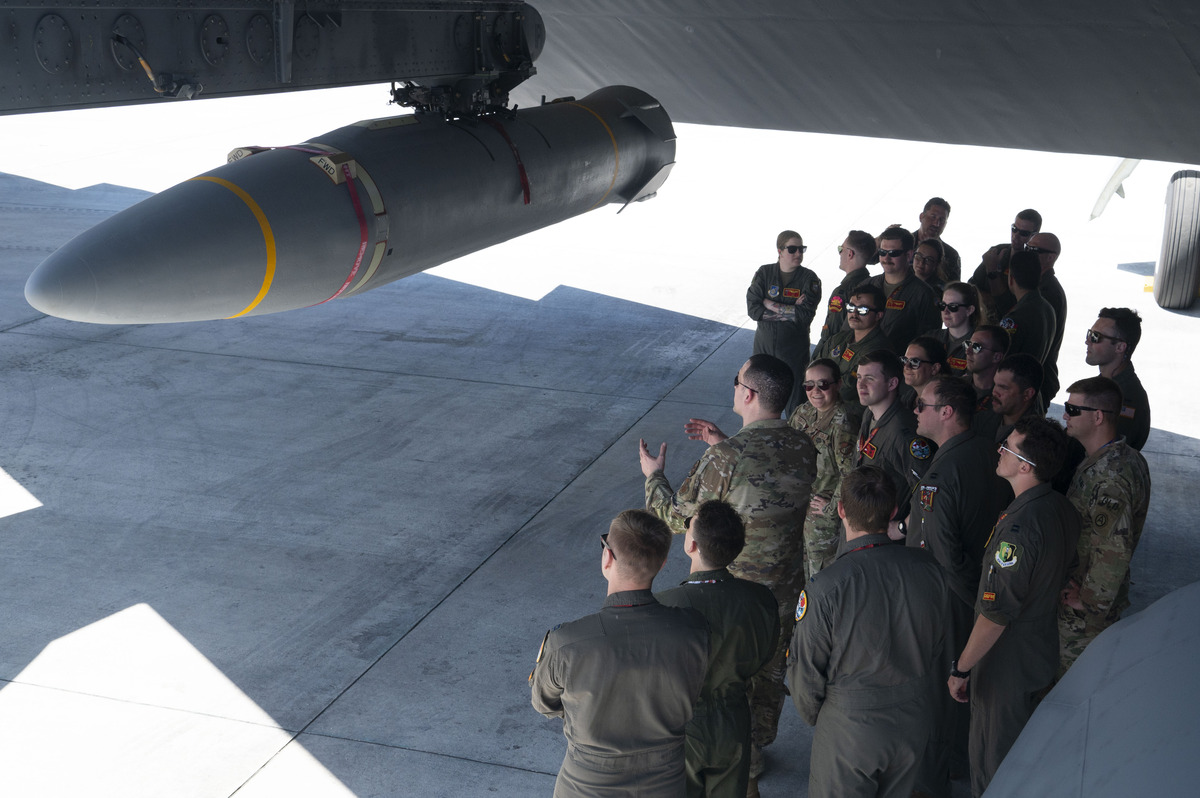
In fact, the USAF published photos of a live AGM-183 Air-launched Rapid Response Weapon (ARRW) affixed under the wing of a B-52H bomber at Andersen Air Force Base in Guam in February 2024. The last test of the hypersonic weapon reportedly took place on March 17, 2024, when it was launched from a B-52H flying out of Andersen Air Force Base, Guam, toward the Reagan Test Site.

B-52 Stratofortress crews from the 23rd Expeditionary Bomb Squadron, Minot Air Force Base, North Dakota and the 49th Test and Evaluation Squadron, Barksdale Air Force Base, Louisiana, participated in hypersonic weapon familiarization training at Andersen Air Force Base, Guam, Feb. 27, 2024

However, the USAF overturned its decision in June 2025 when former USAF Chief of Staff Gen. David Allvin told lawmakers in a hearing that the service wanted to include both ARRW and the HACM in the fiscal 2026 budget proposal.

“We are looking, and have in the budget submission — assuming it’s what we had put forward — two different [hypersonic] programs,” he said. “One is a larger form factor that is more strategic and long-range that we have already tested several times. It’s called ARRW, and the other one is HACM.”

More recently, plans “to begin [ARRW] INC 2 [Increment 2] technology efforts such as but not limited to integrating pre-planned product improvements, design, trade studies, hardware upgrades, facilitization, affordability initiatives, and testing” were disclosed in the service’s 2027 Fiscal Year budget request, which was published earlier this year.

The revival has been seen as an epic story, especially since the ARRW went from an abandoned program to the first USAF missile to enter production.

Notably, this comes as the US is grappling with a major problem: It has yet to operationally field a hypersonic weapon; its competitors, like China, Russia, and countries like Iran and North Korea, have purportedly fielded hypersonic weapons. 

The US’s primary adversary, China, has amassed a variety of weapons that travel at five times or more the speed of sound and are hard to intercept because of unpredictable trajectories, including the DF-17, the YJ-21 anti-ship missile, and the long-range DF-27, to name a few.

Russia, on the other hand, has Kinzhal, Zircon, Avangard, and Oreshnik, though doubts have been raised about whether Kinzhal and Zircon are truly hypersonic. 

Why is ARRW Back

To understand why the Air Force revived ARRW, it is important to know how the weapon works.

The AGM-183A is a boost-glide hypersonic missile: a rocket booster accelerates it to hypersonic speed and high altitude, then separates, releasing an unpowered glide vehicle that maneuvers toward the target.

Then, the ARRW’s nose cone separates, releasing a wedge-shaped, unpowered boost-glide vehicle that was hidden inside.

After that, the vehicle travels at hypersonic speed through the Earth’s atmosphere over a short flight path to reach its destination, likely maneuvering along the way on an unpredictable trajectory.

This combination of speed, flight path, and maneuverability makes interception of this missile extremely difficult.

The USAF has historically positioned both its hypersonic programs, the ARRW and HACM, as critical to success against near-peer adversaries, especially in the Indo-Pacific conflict with China’s People’s Liberation Army forces.

The service likely revived the ARRW program to diversify capabilities, possibly after concluding that relying on a single type of hypersonic weapon left significant gaps in its ability to hold targets at risk in heavily defended environments, such as those near China.

Both ARRW and HACM are air-launched weapons, but they differ significantly. 

ARRW is a larger boost-glide hypersonic weapon system, which makes it suitable for long-range strategic strikes launched from bombers such as the B-52 and B-1.

Meanwhile, HACM is a smaller air-breathing scramjet cruise missile. After an initial rocket boost, a scramjet engine provides continuous powered flight at lower altitudes, allowing greater sustained maneuverability. Its smaller size means tactical fighters such as the F-15E and F-15EX, as well as long-range bombers, could carry it.

Succinctly put, fielding both types forces an adversary to defend against two distinct flight regimes—one high-altitude, extremely fast, and quasi-ballistic, and the other lower-flying, continuously powered, and highly maneuverable.

For the US Commanders, using both missile types in a conflict would make it much harder for the adversary to defend itself, as it would require broader radar coverage, more varied interceptor capabilities, and more complex command-and-control systems. This would, in turn, multiply the defender’s costs and spread limited air-defense resources thinner, forcing the adversary to look in multiple directions at once.

AGM-183 US Missile
AGM-183A ARRW

Additionally, having both missiles would also give the USAF valuable operational flexibility: ARRW could strike a deep, heavily defended target from a bomber, while HACM could handle a more tactical engagement.

China, for instance, fields both types of weapons. Therefore, developing ARRW would help close the capability gap.

Moreover, awarding an ARRW contract may reduce risk, especially since hypersonic weapons are prone to delays, as Washington’s experience shows. For example, a July report from the US Congress watchdog, the Government Accountability Office (GAO), noted that the HACM risks delays, as the EurAsian Times explained in detail at the time.

The Air Force initially structured the HACM program around a compressed five-year rapid-prototyping phase, planning to transition to production if testing proved successful. It initially scheduled 13 flight tests between October 2024 and March 2027.

It later tightened the test plan and shrank the testing to seven flights as design delays pushed the program behind schedule. However, the plan revised again in 2025 as reports indicated the USAF was considering reducing the campaign from seven end-to-end demonstrations to five because of delays in finalizing the weapon’s hardware design. The missile’s first flight occurred only earlier this month.

The ARRW is not expected to be a panacea for the US military’s existing hypersonic woes, but moving ARRW into production gives commanders a concrete, high-speed standoff option while the Air Force continues to mature a complementary air-breathing system.

As the Chief of Staff of the Air Force, Gen. Ken Wilsbach said, “Fielding ARRW enhances our ability to hold targets at risk anywhere around the world. This hypersonic weapon provides the Joint Force a flexible and rapid response option for highly contested environments.”


The post USAF Revives “Shelved” AGM-183 ARRW Hypersonic Missile Program With $694M Lockheed Contract appeared first on EURASIAN TIMES.

  •  

Months After F-35 Shot Down Iranian Jet Over Tehran, Russia Arms Yak-130M With Missile Defense System

Just a few months after an Iranian Yak-130 was shot down by an Israeli Air Force F-35, Russia has armed its upgraded Yak-130M with the President-S130 onboard defensive suite to improve the aircraft’s survivability.

Russia’s state-owned arms conglomerate Rostec announced that the Yak-130M — the modernized version of the Yak-130 trainer/light combat aircraft–of the Russian Aerospace Forces (VKS) has been equipped with an active defense system that uses heat decoys and electronic jamming signals to fend off anti-aircraft missiles.

“The third Yak-130M prototype aircraft of our United Aircraft Corporation (UAC) has recently successfully completed its maiden flight. Its integration will accelerate testing of the new aircraft. The first deliveries to customers are planned as early as 2028. The aircraft is equipped with the President-S130 onboard system,” the company said in a statement, as reported by the state TASS news agency.

President-S130 is an onboard aircraft self-protection airborne defense complex, a specialized adaptation of the broader President-S family of optoelectronic and electronic warfare protection systems.

It is primarily designed to protect fixed- and rotary-wing aircraft from infrared- and radar-guided missiles, particularly man-portable air-defense systems (MANPADS), as well as a range of air-to-air and surface-to-air threats.

The base President-S system has been in service since around 2014 and has been tested and fitted on various Russian helicopters and aircraft. It typically includes radar, laser, or missile-approach warners, control units, jammers, and countermeasures dispensers.

The President-S130 system operates automatically in stages.

First, sensors detect an incoming missile launch/threat; second, the system generates radioelectronic jamming to disrupt enemy detection and guidance systems; and third, it dispenses decoys, flares, chaff, and other countermeasures to neutralize infrared and radar seekers.

“It automatically detects an enemy missile launch, then instantly applies electronic interference to its detection and guidance systems, and then deploys special traps to neutralize infrared and radar homing heads,” the Russian-language RIA Novosti stated.

Interestingly, the recent disclosure about equipping the Yak-130M comes months after the baseline version of the aircraft—a Yak-130 belonging to the Islamic Republic of Iran Air Force (IRIAF)—was downed in combat. However, integrating the President-S130 was not a direct consequence of that event; it was planned in advance. 

Israel downed an Iranian Yak-130 over Tehran on March 4, 2026, during Israeli (and US-supported) operations against Iran, as previously reported by the EurAsian Times.
Image
Yak-130M (Via X)

“An Israeli Air Force Adir (F-35I) jet shot down an Iranian combat aircraft (YAK-130) over Tehran skies a short time ago,” the military said in a statement at the time. “This is the world’s first shootdown of a manned fighter jet by an F-35,” it added.

The stealthy F-35 used its advanced radar and networked situational awareness to detect and engage the Yak-130 before the slower, less capable aircraft could mount an effective response.

Against that backdrop, the President-S130 could make the Yak-130M more survivable in permissive or lightly defended environments against ground-based air defenses and other threats, but it is unlikely to dramatically bolster the jet’s survivability if a cutting-edge stealth fighter, such as the F-35, is hounding it.

Russia’s Yak-130 Aircraft

Developed by Russia’s Yakovlev design bureau, the YAK-130 is an advanced trainer aircraft adapted for light combat roles and is reportedly armed with the Soviet-origin R-73 air-to-air missile. The Yak-130 also has a secondary light-attack capability, allowing it to strike enemy ground formations and serve as a force multiplier.

The aircraft can also train for close air support missions and carry several tons of ammunition, including various wing- and fuselage-mounted weapons. The Yak-130 can typically carry KAB-500 guided bombs, Kh-29 guided missiles, 80-mm, 122-mm, and 330-mm rockets, and 250- and 500-kilogram bombs.

The Yak-130’s fly-by-wire controls and computerized cockpit mimic the flight characteristics of modern advanced fighter planes. Furthermore, the aircraft’s ability to sustain steady, controllable flight at angles of attack up to 35 degrees puts it on par with the MiG-29 and Su-30.

The Yak-130 can take off and land from a variety of runways, making it a versatile platform.

Thanks to its remarkable thrust-to-weight ratio, the aircraft can withstand high g-forces and deliver remarkable climb and takeoff performance. It has a maximum combat payload of 3,000 kg, a top speed of 1,060 km/h, a range of about 1,600 km (internal fuel), and a service ceiling of 12,500 m (41,020 feet). Maximum takeoff weight is approximately 10,290 kg.

It features a three-hour endurance (with two drop tanks) and a detachable in-flight refueling probe. Some reports say it can also carry extra fuel tanks and two electronic warfare pods on the wingtips to extend its operating range.

Russia reportedly completed the first upgraded Yak-130M jet in October 2025. The Yak-130M keeps essentially the same two-seat airframe and engines but adds radar, targeting, self-protection, communications, and expanded guided-weapons capability, turning the jet from an advanced trainer/light-attack aircraft into a more capable light combat aircraft.

This variant adds a significantly updated mission system architecture while keeping the original airframe and AI-222-25 engines.

Notably, the latest disclosure comes months after reports noted that the Yak-130M advanced began flight testing with a new avionics package that included an updated self-protection complex, an electro-optical targeting system, and an active electronically scanned array (AESA) radar.

Reports say the most significant upgrade in the Yak-130M is the BRLS-130R radar. The original Yak-130 can carry weapons, but the M version can independently find and track targets, guide precision munitions, and potentially engage drones or aircraft beyond visual range, capabilities the baseline aircraft lacks.

In addition to the BRLS-130R AESA radar, the Yak-130M adds the SOLT-130K electro-optical/laser targeting system, the KSS-130 communications link, and the President-S130, enabling more autonomous target detection, precision weapon delivery, networking, and self-protection.

President-S130 turns the Yak-130M from a light attack aircraft into one with an integrated, automated survivability layer against surface- and air-launched missiles. Its value lies in letting the aircraft operate closer to contested airspace and in the low-altitude counter-drone or counter-insurgency roles Moscow is positioning the Yak-130M for.

With the President-S130, the aircraft can conduct low-altitude strike or armed-reconnaissance missions and automatically respond to a sudden missile launch, rather than relying solely on crew vigilance and flare dispensing. Moreover, in permissive-to-contested environments, the Yak-130M’s sensors and weapons can address risks from adverse UAVs and even neutralize light ground targets. 

Combined with KSS-130—the onboard communications link and radio unit developed as part of the Yak-130M avionics suite—the aircraft can receive cueing from ground stations or other aircraft, then use its own sensors to classify and engage a target, while the President-S130 protects it during approach and egress.

The post Months After F-35 Shot Down Iranian Jet Over Tehran, Russia Arms Yak-130M With Missile Defense System appeared first on EURASIAN TIMES.

  •  

USS Colorado to Sail into AUKUS History as 1st U.S. Nuclear Submarine for Australia. Will Arrive Late 2027

The United States will deploy USS Colorado as the first US nuclear-powered attack submarine to join a rotating force based in western Australia, under the AUKUS pact. 

US Secretary of War Pete Hegseth, Australian Deputy Prime Minister and Minister for Defense Richard Marles, and UK Secretary of State for Defense Wes Streeting said they were pleased to announce the designation of the USS Colorado (SSN 788) as the first US Navy Virginia-class fast-attack submarine assigned to Submarine Rotational Force-West (SRF-West) beginning in late 2027.

This announcement comes ahead of the upcoming United States Submarine Maintenance Period, which begins later this week and will further demonstrate Australia’s growing ability to sustain US and UK nuclear-powered fast-attack submarines. 

The deployment is a “significant milestone” in building joint U.S.-Australia-UK deterrence in the Pacific under their AUKUS defense pact, the allies said in a joint statement. The selection of the USS Colorado “marks a significant milestone for AUKUS Pillar I and is a decisive step in strengthening collective deterrence in the Pacific,” the statement added.

The rotating force of nuclear-powered submarines—known as Submarine Rotational Force-West—is to be hosted at a naval base in Western Australia, HMAS Stirling.

The base is projected to host up to five fast-attack submarines—four from the United States and one from the UK—on a rotational basis. The force will operate under existing arrangements, including the US-Australia Force Posture Agreement, and will not constitute a permanent foreign base.

The three countries said it will help Australia prepare to operate and maintain its own nuclear-powered submarines while supporting its allies’ deployments and maintenance. Australian sailors will gain at-sea experience on American and British submarines, while local maintenance personnel will support the vessels ashore.

Vice Admiral Jonathan Mead, director-general of the Australian Submarine Agency, called the designation “a clear demonstration of the trust and confidence the United States has in Australia’s people, workforce and infrastructure.”

He added that the Colorado’s presence “will help accelerate the development of the skills, experience and knowledge transfer that are fundamental to delivering Australia’s future conventionally armed, nuclear-powered submarine capability.”

Chief of Navy Vice Admiral Matt Buckley described the move as “a significant milestone for Australia, our Navy and the AUKUS partnership,” noting that sailors would work alongside “the world’s most experienced nuclear-powered submarine operators.”

USAF Revives “Shelved” AGM-183 ARRW Hypersonic Missile Program With $694M Lockheed Contract

Overall, AUKUS is part of a broader effort to build Australian “undersea power” in the Indo-Pacific region. Nuclear-powered submarines offer speed, endurance, and stealth that conventional submarines lack, and they serve as a cutting-edge deterrent rather than preparation for war against China.

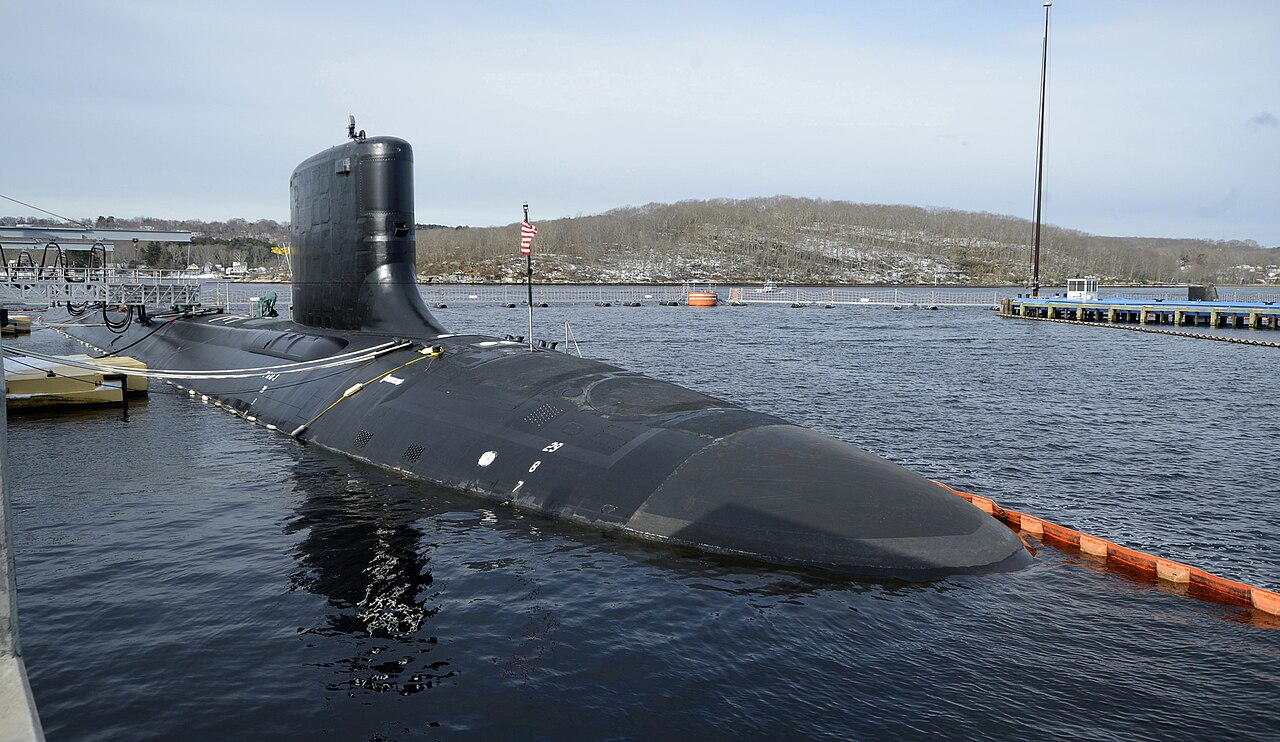
The USS Colorado, commissioned in 2018, is one of the US Navy’s most advanced attack submarines. It is the first of up to four US Virginia-class submarines expected to rotate through the base, alongside a Royal Navy Astute-class submarine.

The Trump administration launched a review of the 2021 AUKUS pact, signed under the Biden administration, on June 11.

File Image: USS Colorado (SSN-788): Wikipedia

AUKUS

Earlier, on July 29, the US said it would review the AUKUS pact with the UK and Australia.

The US Under Secretary of Defense for Policy, Elbridge Colby’s office, said in a post on X that the review will be an “empirical and clear-eyed assessment” of the deal.

“The Department anticipates completing the review in the fall. Its purpose will be to provide the President and his senior leadership team with a fact-based, rigorous assessment of the initiative.”

The Trump administration launched a review of the 2021 pact struck during the Biden administration on June 11.

The AUKUS pact, signed in September 2021, is a trilateral security partnership between Australia, the United Kingdom, and the United States aimed at promoting a “free and open Indo-Pacific.”

The deal has two central pillars.

Pillar 1 is about the supply and delivery of nuclear-powered attack submarines.

Under the pact, Australia will buy three second-hand nuclear-powered but conventionally armed (SSNs) Virginia-class submarines from the US, with options to purchase two more. These SSNs were expected to be delivered to Australia beginning in the 2030s.

After that, the plan is to design and build an entirely new nuclear-powered submarine model for the UK and Australian navies.

The United States and the UK will also deploy their own nuclear-powered submarines in the region as part of “Submarine Rotational Force-West.”

Pillar 2 focuses on allies collaborating on “advanced capabilities,” including sharing military expertise in critical areas such as long-range hypersonic missiles, undersea robotics, quantum technology, and AI.

The deal will tremendously boost Australia’s undersea capabilities. Nuclear-powered submarines offer many advantages over non-nuclear submarines, including extended range, endurance, and stealth, and they don’t have to surface as often, which could give away their position.

The deal will make Australia, alongside the UK, the only countries with which Washington would share nuclear-propulsion technology.

Furthermore, the US and UK commitment to deploy their own nuclear-powered submarines in the region will reinforce Australia’s position in the Indo-Pacific. In addition, Australia will gain access to sensitive technologies, substantially boosting its naval prowess.

AUKUS is Australia’s biggest-ever defense project, with a commitment of A$368 billion (US$240 billion) over three decades.

Months After F-35 Shot Down Iranian Jet Over Tehran, Russia Arms Yak-130M With Missile Defense System

Why Trump Wanted To Review AUKUS?

Questions have been raised over the deal’s relevance to Washington and whether it fits ‘America First’ policy.

Colby’s office said the AUKUS review would “be an empirical and clear-eyed assessment of the initiative’s alignment with President Trump’s America First approach.”

Notably, Colby has long been skeptical of AUKUS.

He has previously questioned the benefits of the pact’s submarine-sales element, arguing before the US Senate Armed Services Committee in March that the United States wasn’t producing enough submarines to meet its own Indo-Pacific requirements.

When the Senate’s Armed Services Committee asked Colby about the AUKUS deal, Colby replied: “I have expressed concerns, as I understand, shared by many on this Committee, regarding US attack submarine force structure and production rates. I believe we must increase US attack submarine production to meet US military requirements in the Indo-Pacific region.”

However, during that hearing, Colby also expressed his commitment to AUKUS, saying, “I also agree with Secretary Hegseth that AUKUS is a model for how we should engage with our closest allies and partners when it comes to technology cooperation, scaling production, and integrating our industrial bases.”

If media reports are to be believed, the US wants to impose additional conditions on the deal, including a commitment by Australia to spend 3.5% of its GDP on defense and a promise by Canberra to deploy its submarines to support the US in a potential conflict with China.

Speaking before the US Senate Armed Services Committee in March, Colby suggested the US should press Australia to increase defense spending.

“The main concern the United States should press with Australia, consistent with the President’s approach, is higher defense spending. Australia is currently well below the 3% level advocated for NATO by NATO Secretary General Rutte, and Canberra faces a far more
powerful challenge in China,” Colby had said.

Australian Prime Minister Anthony Albanese rejected that Washington was using AUKUS review as “leverage.”

“We expected a review from an incoming government, just like the Keir Starmer government did (in the UK). We expect that those things take longer than just 30 days,” Albanese added.

Mail us at: editor (at) eurasiantimes.com

The post USS Colorado to Sail into AUKUS History as 1st U.S. Nuclear Submarine for Australia. Will Arrive Late 2027 appeared first on EURASIAN TIMES.

  •  
❌