❌

Reading view

U.S. Eyes F-16 Revival With Blackbeard Hypersonic Missile as Air Force Continues its Stealth Push

As the US targets a 60% stealth force by 2035, the F-16 Fighting Falcon, the US Air Force’s combat-proven workhorse, is quietly seeing a revival.

Lockheed Martin, the F-16’s manufacturer, has hundreds of export orders in its backlog for the upgraded F-16 Viper variant; it is pitching a new variant, the F-16G, to the USAF and could arm it with hypersonic missiles.

Notably, the single-engine F-16 first flew in the 1970s. Lockheed Martin’s recent “F-16 Fast Facts” states that roughly 2,800 F-16s are operating in 29 countries.

Even as the USAF moves toward an overwhelming stealth force, the F-16 is refusing to quietly fade into oblivion, and Lockheed Martin expects the fighter jet to bring the company hundreds of new orders and another round of growth.

Hypersonic Missiles

When it comes to air-launched hypersonic missiles, Russia may have established a lead.

In the war in Ukraine, Russia demonstrated that it can launch hypersonic missiles, primarily the Kh-47M2 Kinzhal from the MiG-31 and R-37M from the Su-35 and Su-57.

However, many Western analysts question whether both missiles, the Kh-47M2 Kinzhal and R-37M, qualify as hypersonic missiles.

According to CSIS’s The Missile Threat, the Kh-47M2 Kinzhal is a nuclear-capable, Russian air-launched ballistic missile, likely derived from Russia’s ground-launched 9K720 Iskander-M. The missile follows a ballistic or quasi-ballistic flight path rather than operating as a scramjet cruise missile or a maneuvering hypersonic glide vehicle.

However, because the missile can reach speeds up to Mach 10, it may qualify as a hypersonic missile. Due to its limited maneuverability, Ukraine’s Patriot AD systems have intercepted the Kh-47M2 Kinzhal on multiple occasions.

kinzhal
Downed Kinzhal Missile

The US was trailing in the hypersonic race, but is currently testing four air-launched hypersonic missiles: the ARRW (Air-Launched Rapid Response Weapon), HACM (Hypersonic Attack Cruise Missile), Mako, and Blackbeard, with multiple aircraft, including the F-15EX, F/A-18 Super Hornet, F-35 & F-22.

The Blackbeard hypersonic missile, a low-cost, air-launched hypersonic weapon developed by American defense contractor Castelion for the US Navy and Air Force, has already been tested with the F/A-18E/F Super Hornet and can also be launched from ground-based HIMARS.

However, Castelion is now also trying to pair the hypersonic missile with the F-16.

Hypersonic Missiles for F-16s?

On October 26, Castelion announced it has received a contract modification under its existing work with the Air Force Research Laboratory (AFRL) to begin integrating its Blackbeard hypersonic weapon onto the F-16 Fighting Falcon.

Notably, Castelion has so far been a Navy and Army story in the US, working to integrate the missile into the US Navy’s carrier-capable F/A-18E/F Super Hornets and the US Army’s HIMARS.

If the F-16 integration succeeds, it will bring the Blackbeard hypersonic missile to the USAF fleet as well.
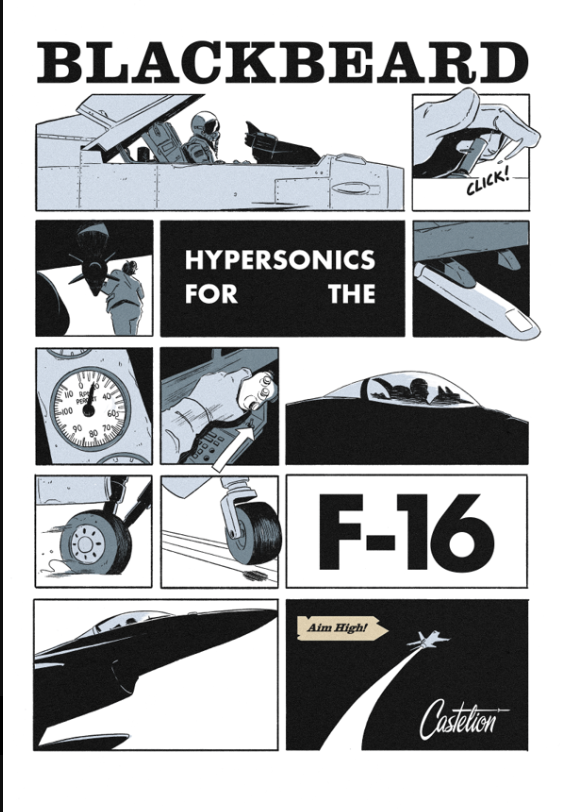
Blackbeard for F-16. Credits Castelion.

Castelion has not disclosed the contract’s financial terms with AFRL or when the F-16 might first carry or fire the weapon.

According to US Navy plans for the Blackbeard program, a single F/A-18E/F is designed to carry up to four of these long-range hypersonic weapons. Since the F-16 and F/A-18E/F have broadly similar payload capacity, a single F-16 is expected to carry four Blackbeard hypersonic missiles.

Blackbeard is designed to fly above Mach 5 while maneuvering, making it far harder to intercept than a weapon on a predictable ballistic path.

Additionally, because Blackbeard is designed as a relatively low-cost, mass-produced hypersonic weapon, integrating it with the USAF’s workhorse F-16 is a very different proposition from pairing the far more expensive ARRW or HACM missiles with the F-15EX, F-35, and F-22.

Procurement plans for fiscal years 2028–2031 call for acquiring more than 4,000 Blackbeard missiles.

Meanwhile, earlier this month, the USAF submitted its 2035 force structure plan to Congress, noting that the F-16 will remain an important component of the USAF over the next decade.

F-16’s  Role in the USAF During the Next Decade

Under the plan, the USAF will field 1,509 manned, combat-coded fighter aircraft by 2035, roughly 60 percent of which will be stealth platforms. The 60% stealth force will include 40% F-35As and 20% F-22 Raptors and F-47s. The remaining 40% of the fleet will be split evenly between the F-15EX and F-16 jets.

This means that by 2035, the USAF could still maintain nearly 300 F-16 fighters. The actual number of F-16 aircraft would be even higher if you also count the trainers and test aircraft.

The report, titled “Long-Term USAF Fighter Force Structure,” also mentions that the USAF is open to acquiring an entirely new fighter to reach its goal of 1,509 fighters by 2035.

“Accordingly, the USAF is also evaluating additional recapitalization options, including a new capacity fighter, increased reliance on CCAs, and developing air-to-air capabilities on bombers,” the report said.
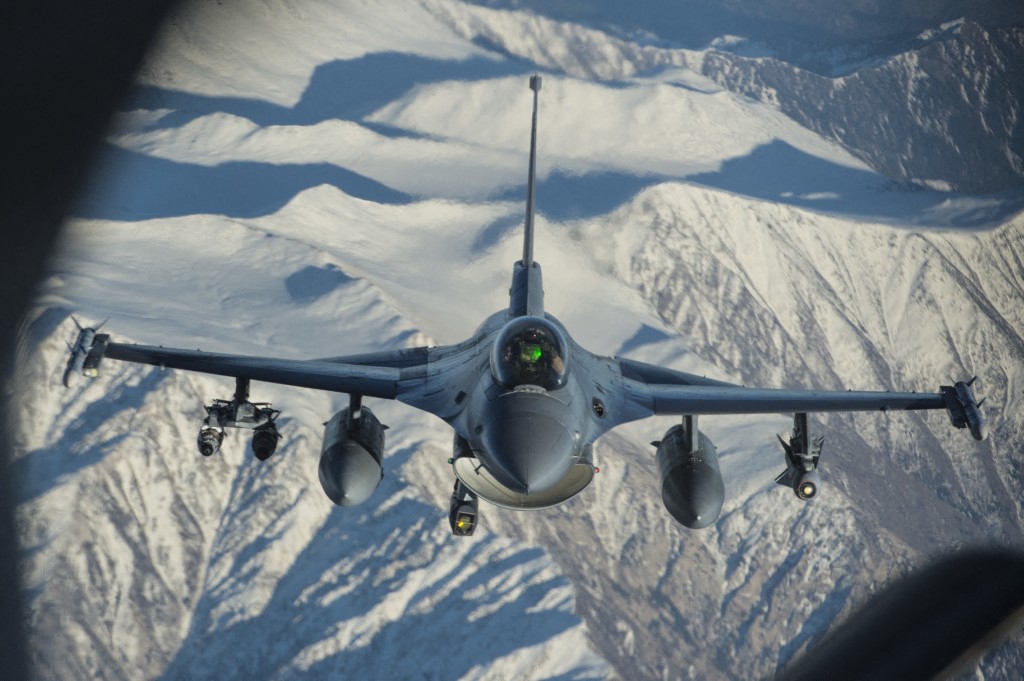
A US Air Force F-16 Fighting Falcon prepares to refuel (Photo by STAFF SGT. COREY HOOK / US Air Forces Central Command / AFP)

As EurAsian Times reported last week, the new fighter could be Lockheed Martin’s upgraded F-16, termed F-16G.

Commenting on the USAF force-structure plan, Lt. Gen. David Tabor, deputy chief of staff for plans and programs, said the USAF is considering the F-16G variant but doesn’t have to decide “immediately.”

“We’re not in a position where that decision has to be made immediately.”

He said the decision likely won’t be made in the 2028 budgeting process, but perhaps in the years that follow. “There is a spectrum of capability that we might want to replace the F-16s with,” he said.

“It’s not urgent, frankly. What we don’t want to get to is a point where it is urgent, and we haven’t done the homework and decided ‘hey, this is really the right place to be.’ We do have time to churn through that and make sure that we have a good option going forward.”

One advantage to buying more F-16s is that “it’s practically a ready-made aircraft,” Tabor said.

The U.S. already has an established F-16 production line in Greenville, South Carolina. So, ordering new F-16s wouldn’t require establishing a new production line or reviving a dormant one.

The EurAsian Times has previously reported that the USAF has been considering procuring the F-16G variant for nearly a year; however, no decision has been made yet, and as Tabor clarified in his media briefing on October 20, the decision is not urgent and can wait until 2028.

Lockheed Martin is also exporting the Block 70/72 variant to foreign customers and upgrading legacy F-16 fleets to the Viper standard. Taiwan, for instance, upgraded 139 of its existing F-16A/B Block 20 fighters to the F-16V standard and ordered 66 new F-16V fighters.

The F-16 has already received Northrop Grumman’s AN/APG-83 SABR AESA radar.

Lockheed Martin claims this upgraded radar, with electronic beam steering, high-resolution SAR mapping, improved jamming resistance, simultaneous air-to-air and air-to-ground modes, and the ability to track multiple targets at longer ranges, gives the F-16 fifth-generation radar capabilities.

New F-16 variants have also integrated the Lockheed Martin Sniper® Advanced Targeting Pod and the Legion-ES™ IRST system, which increase pilot situational awareness.

The newer F-16 variants are also certified for a very wide range of modern weapons, such as AIM-120D AMRAAM, AIM-9X, JASSM, JSOW, JDAM variants, and SDB, and use Link 16, which provides enhanced situational awareness and enables real-time command, control, and tactical data exchange among military aircraft, ships, and ground forces.

Overall, while the newer F-16 shares the same airframe, advanced sensors, computing, radar, and a new weapons package make it much more potent and lethal than the older F-16C/D variants. However, integrating an economical hypersonic missile on the F-16 could be a true game-changer, keeping the fighter relevant for years to come.

  • Sumit Ahlawat has over a decade of experience in news media. He has worked with Press Trust of India, Times Now, Zee News, Economic Times, and Microsoft News. He holds a Master’s Degree in International Media and Modern History from the University of Sheffield, UK. 
  • He can be reached at ahlawat.sumit85 (at) gmail.com


The post U.S. Eyes F-16 Revival With Blackbeard Hypersonic Missile as Air Force Continues its Stealth Push appeared first on EURASIAN TIMES.
  •  

Saab Challenges U.S. F-35s For Canadian “Rematch” Deal. Picks Local Firms to Build & Support Gripen-E Jets

Days after Canada received the first two of the 16 F-35A fighters from Lockheed Martin, Swedish defense and aerospace firm Saab has stepped up its “Gripen for Canada” campaign by selecting top Canadian aerospace firms to build the Gripen-E jets.

On March 28, 2022, Lockheed Martin edged out Saab to win a CAD $27.7 billion contract for 88 F-35A Lightning II stealth fighters, with an initial commitment of 16 jets.

Saab attributed the loss to unfair play. “The process was not transparent. The requirements were tailored to exclude competition. We delivered the best value—Canada chose politics over merit,” said the Saab Canada President, Simon Carroll.

After Canadian Prime Minister Mark Carney announced in March 2025 that it would review the purchase of F-35 stealth fighters amid rising tensions with the Trump administration, Saab revived its Gripen-E campaign last year.

Saab has offered a deal that may prove difficult to ignore. At the heart of this offer are local manufacturing, full technology transfer (ToT), access to source code for mission systems, sovereign control of data, and full independence in upgrades and maintenance for the Royal Canadian Air Force (RCAF).

Saab announced on October 27 that it plans to work with several of Canada’s leading aerospace companies as a first step toward creating a large national ecosystem to develop, deliver, and support the Gripen E fighters if the Canadian government decides to move forward with the acquisition.

If the RCAF chooses Saab, the company and its Canadian partners will provide an all-encompassing domestic capability for manufacturing, final assembly, maintenance, and advancing airpower capabilities, the company said in a statement. The partnership would also provide long-term sustainability, training, and in-service support (ISS). 

SAAB’s Tempting Offer

The Canadian government has been vocal about the industrial and regional benefits, jobs, technology transfer, and sovereign sustainment of major defense procurements.

“We think that we can use military procurement to get more,” Canada’s Industry Minister Mélanie Joly told reporters in November 2025 on the question of fighter programs creating jobs. “That is why we’re looking, indeed, at the Gripen.” “We’ll see how that is concrete,” Joly said. “And at the same time, we’re looking at what Lockheed Martin can do.”

Saab’s official partnership with Canadian companies is meant to appeal to this sentiment, especially since Canadian public and political opinion has grown more cautious about relying exclusively on the US amid ongoing trade and diplomatic tensions.

Saab has repeatedly promised to create around 10,000 jobs for Canadian, with some estimates rising higher when GlobalEye surveillance aircraft are included.

As noted in its official release, Saab has built teaming arrangements with Canadian firms CAE of Montreal, Quebec; IMP of Halifax, Nova Scotia; and Magellan Aerospace of Mississauga, Ontario. “Canada’s fighter capability is a long-term national investment. Together with CAE, IMP and Magellan Aerospace, we are prepared to establish a strong Canadian industrial ecosystem around Gripen that delivers operational effect, national sovereignty and lasting industrial and technological benefits,” said the Saab CEO.

The companies selected by Saab will be in charge of the following:

IMP Aerospace & Defense will establish and run a new final assembly line for the Gripen fighter in Canada, produce electrical assemblies, and provide in-service support (ISS) for Canada’s Gripen fleet. 

IMP is a vertically integrated Canadian aerospace company that specializes in In-Service Support (ISS) / Fleet Management (Full lifecycle support for military aircraft fleets), Maintenance, Repair & Overhaul (MRO), Aircraft Missionization and Modernization (aircraft upgrades and modernization), Engineering Solutions (Design, structural analysis, systems integration, avionics work, and airworthiness certification), and Manufacturing.

Magellan Aerospace will manufacture advanced aerostructures, composite structures, and structural assemblies in Canada.

Magellan mainly produces aeroengines and aerostructures (complex structural components and major aircraft assemblies), offers MRO, and also produces solid rocket motors, satellite buses, space hardware, and related systems for space-based applications. 

CAE will deliver advanced fighter pilot and technician training, handle mission systems engineering, and provide support and sustainment capabilities in Canada.

CAE  is a Canadian global leader in training and simulation technologies.

Its main segments include civil aviation, defense, and security. It delivers military training and simulation solutions for air, land, sea, and other domains, supplies mission simulators, live-virtual-constructive (LVC) training systems, and platform-independent training programs, and supports force readiness for defense forces, OEMs, and government agencies.

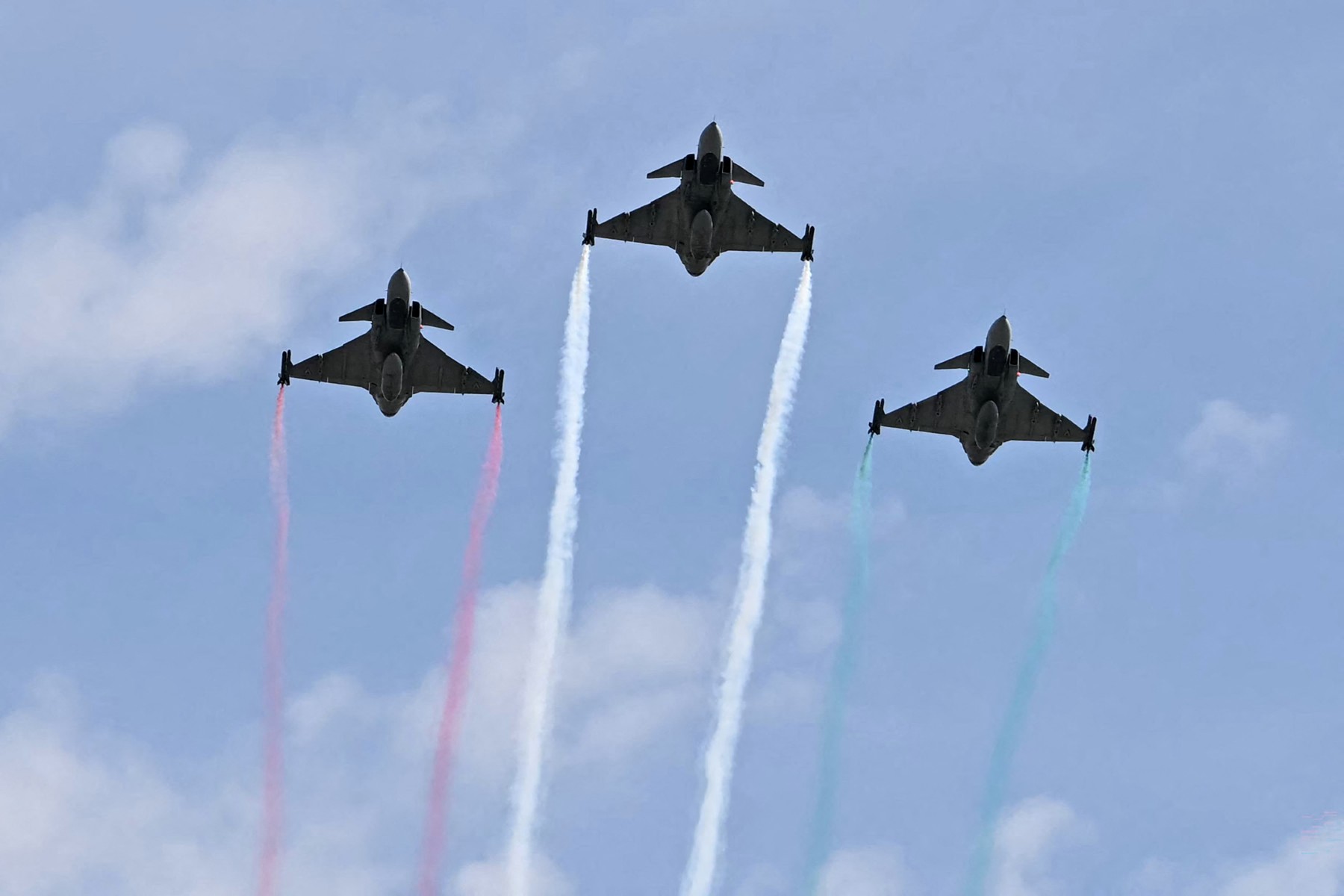
Gripen jets perform prior to the Formula One Hungarian Grand Prix at the Hungaroring racetrack in Mogyorod near Budapest, Hungary, on July 26, 2026. (Photo by Attila KISBENEDEK / AFP)

Saab formalizing partnerships with these companies is a major move in its campaign, turning “we will build in Canada” language into named, ready-to-execute industrial relationships.

It demonstrates that Saab has done the groundwork with capable domestic players who already have relevant expertise. In fact, it likely aims to show that the industrial package the company repeatedly offers is not just marketing.

These partnerships promise significant new high-tech jobs and skills development in advanced manufacturing, composite structures, electrical systems, model-based systems engineering, training, and much-needed long-term sustainment.

At the same time, Saab’s selection of these companies means work will be distributed across key regions, appealing to local governments and lawmakers.

Saab has stressed that “These partnerships are designed to strengthen Canada’s sovereign defense capability while contributing to the development of advanced aerospace and defense expertise across the country.”

Canada’s F-35 Review Still Ongoing

Political sensitivity around the F-35 deal has grown amid trade tensions with the US.

In August 2026, the head of the Defense Investment Agency said the Canadian public would not welcome sole-source military contracts awarded to American companies under the current conditions. “That’s just me reading the room,” Stephen Fuhr, secretary of state for defense procurement, said in an interview. “I think that would be a very difficult thing to do, especially after this last week. I think that people would not be happy about that.”

Fuhr stressed that Canada has recognized the risks of “putting all our eggs in one basket” and that Ottawa needs to form new strategic alliances or become more independent in military manufacturing, adding that he still sees the US as a crucial defense ally. 

Saab, for its part, appears hopeful.

In Saab’s Gripen final-assembly hall in Linköping, flags of its eight customer nations hang above the line—plus a ninth white banner marked “RESERVED,” the Globe and Mail had reported. However, ambiguity persists as Canadian leadership sits on the review, more than a year after Carney ordered it.

Canada
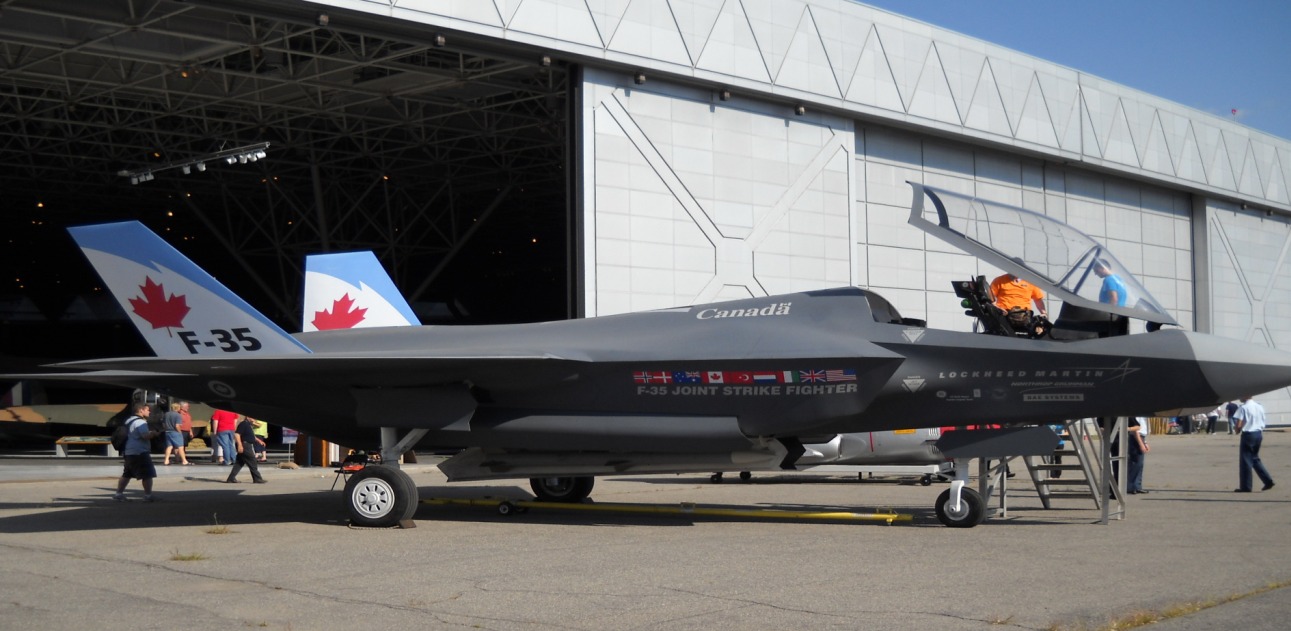
Lockheed Martin F-35 Lightning II for Canada – Wikipedia

Canada may not abandon the F-35 purchase entirely, as it is currently the only fifth-generation stealth fighter available in the market that offers deep interoperability with NORAD forces.

Moreover, top RCAF leadership continues to view the F-35 as the most credible counter to peer adversaries such as China and Russia, both of which field advanced stealth fighters and sophisticated air defenses.

Beyond proponents of the F-35 and Gripen-E/F, a third school of thought advocates a mixed fleet. Earlier this year, a report in Canadian media said the country could buy 72 F-35s and 72 Gripen-E/F jets, bringing its fighter-jet purchases to more than 88 and suggesting Ottawa was unlikely to abandon the US stealth fighter.

A mixed fleet, however, would add high costs and complexity in training, logistics, weapons integration, and infrastructure. Defense planners have long cited these factors as potential long-term drawbacks for the RCAF.

The post Saab Challenges U.S. F-35s For Canadian “Rematch” Deal. Picks Local Firms to Build & Support Gripen-E Jets appeared first on EURASIAN TIMES.
  •  

British Warship for the U.S. Navy: UK Firm Pitches Arrowhead 140 Design as Trump Approves Foreign Frigates

British shipbuilder Babcock is pitching one of its well-known frigates to the US Navy, which recently changed policy to welcome foreign warships from allies as part of its push to rebuild the “arsenal of freedom” at pace. 

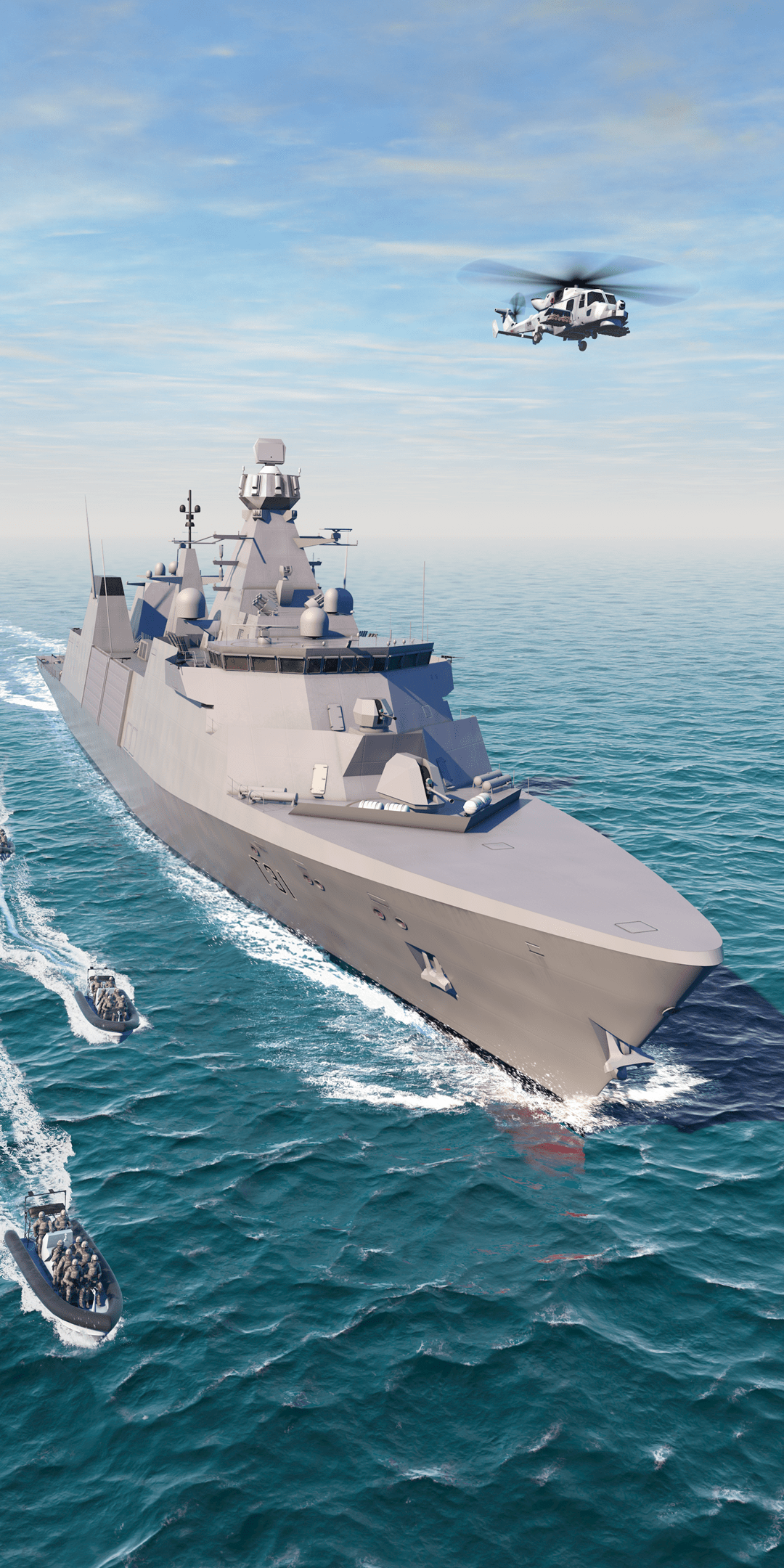
Babcock is offering its Arrowhead 140 design, which is the parent of the Royal Navy’s Type 31 Inspiration-class frigate, to the US Navy.

The company has already held initial talks with Pentagon officials about the offer and, according to British media reports, is poised to file an expression of interest (EoI) by the end of October. 

“Of course we’re interested. We have a world-class frigate, close links to the U.S. and U.S. industry. It would be insane for us not to respond,” Sir Nick Hine, head of Babcock’s marine business and a former Second Sea Lord,  was quoted as saying by The Telegraph earlier.

According to reports, the largest military shipbuilder in America, Huntington Ingalls Industries (HII), will be part of this plan. The two companies are reportedly exploring a deal that may allow the US to manufacture the Arrowhead 140 under license.

The offer is imminent, as US President Donald Trump issued a national security memo in August 2026 that allowed the Navy to acquire foreign ship designs and build some warships overseas amid delays, cost overruns, and limited shipyard capacity in the US.

Under the new model, foreign shipbuilders must invest in or take a majority stake in a US shipyard and build subsequent ships in the US after the first two overseas-built vessels.

This means that if Babcock wins a contract, the US will build most of its ships in its own shipyards, with the British company providing design and engineering technology.

This comes as the US Navy seeks to expedite the acquisition of smaller surface combatants after canceling the troubled Constellation-class in November 2025.

Arrowhead 140 - Babcock International Group
Arrowhead 140 (Via Babcock International Group)

The US Navy currently has no dedicated frigates in service.

Following Trump’s waiver, the US Navy is reportedly considering frigate designs, including Japan’s FFM Mogami-class guided-missile frigate, South Korea’s Chungnam-class guided-missile frigate, and Turkey’s Istanbul-class guided-missile frigate. This means that if Babcock files an official pitch, the US would have four designs to choose from.

Notably, Babcock and the US submarine industrial base already have a solid working relationship. For example, Babcock’s facilities have been producing tactical missile tube assemblies for General Dynamics Electric Boats since at least 2014 as part of the “Common Missile Compartment” shared by the US Navy’s Columbia-class ballistic missile submarines and the Royal Navy’s Dreadnought-class.

At the same time, Babcock’s partnership with HII has grown stronger through industrial collaboration.

While the prospect of the US Navy selecting a British ship design looks promising for ties between the age-old allies, the UK has little precedent for offering its own ships to the United States, long regarded as the world’s most advanced maritime power. In fact, a major historical naval transfer between the two countries went the other way in the 1940s.

On September 2, 1940, the-then US President Franklin D. Roosevelt announced the destroyers-for-bases deal with Great Britain.

Under the deal, the US transferred 50 of its aging destroyers to the United Kingdom. In return, Britain leased eight bases in the Western Hemisphere to the United States for 99 years. At the time, the United Kingdom was fighting to survive the Battle of Britain and repel a potential German invasion, while the United States remained at peace.

The deal followed British Prime Minister Winston Churchill’s request to the US for a loan of 50 destroyers to defend the English Channel against German invasion.

Under the deal, the US transferred 50 aging Caldwell, Wickes, and Clemson-class destroyers to the UK after extensive correspondence.

This agreement marked the beginning of the Anglo-American alliance during the war.

Following the deal, Churchill declared in the British Parliament that “these two great organizations of the English-speaking democracies, the British Empire and the United States, will have to be somewhat mixed up together in some of their affairs for mutual and general advantage”.

Against this background, the imminent offer to the US Navy from a British firm represents a significant departure in historical approaches.

Mogami-class warship

What Do We Know About Arrowhead?

Arrowhead 140, for one, has already been marketed to Poland and Indonesia, and is now being pitched to Chile. The Arrowhead 140 has a baseline length of around 455 feet, a beam of 65 feet, and a displacement of about 5,700 tons.

The ship can reach more than 28 knots and has a baseline endurance of about one to two months. It has a large flight deck and hangar, and multiple large, dedicated boat bays for rigid-hulled inflatable boats (RHIBs), Unmanned Aerial Vehicles (UAVs), and other craft. 

The ship’s open architecture and generous internal volume allow different weapon, sensor, and mission-system fits without major structural changes.

The ship is a general-purpose warship capable of surface warfare, escort, and maritime security operations. It can be outfitted with a medium-caliber gun up to 127 mm, secondary guns of 40 mm caliber, a vertical Launch System with provision for up to 32 cells, anti-ship missiles, close-in weapon systems, a combat management system, 3D air or surface search radar, electro-optical sensors, hull-mounted sonar, and also offers options for towed-array or variable-depth sonar. However, it is highly configurable, and the armament can be modified to meet the customer’s requirements.

Despite these attributes, the British offer carries a significant caveat: the Royal Navy’s Type 31 program, which is based on Arrowhead 140, remains unproven in operational service.

The Type 31 was envisioned as a vessel intended to provide the Royal Navy with five relatively affordable general-purpose frigates to replace older Type 23s in lower-threat presence roles. Designed for modularity, long endurance, and a range of missions, from maritime security to escort duties, the class remains mired in delays and cost overruns, with Babcock and the British Defense Ministry facing skepticism from critics.

The class’s lead ship, HMS Venturer, was launched in 2025 and is currently being fitted out, while the second ship, HMS Active, has been rolled out. The keel of the third, HMS Formidable, was laid in December 2025, and steel has been cut on the fourth. The program still has momentum on paper, but timelines have slipped, and delays continue. For example, the first two ships still need a Capability Insertion Period after initial delivery, including installing Mk 41 vertical launch systems, further delaying operational capability.

HMS Venturer | Royal Navy

The British Ministry of Defense (MoD) has grown increasingly vague about in-service dates, and cost pressures continue to cloud the outlook for the later ships of the class.

Babcock declared a £140 million charge against the program in May 2026 because rework on HMS Venturer and HMS Active was higher than anticipated due to design modifications and out-of-sequence build activity early in the project. Needless to say, late outfitting corrections are more difficult and costly than those made in the build hall.

More recently, the MoD confirmed ongoing inflationary pressures, particularly on labor and the wider supply chain. The British Defense Minister Luke Pollard went so far as to say that the program’s affordability “remains under review,” and any budget changes will follow standard processes.

Observers are also questioning whether the baseline Type 31 will be sufficiently capable for the roles expected of a modern general-purpose frigate, as well as cost and schedule. The design is intended to be affordable, modular, and to perform presence tasks, but key systems such as the Mk 41 vertical launch cells are planned to be inserted later rather than as a day-one fit, and the initial anti-submarine warfare sensors have been described as limited compared with specialized peers or some earlier Type 23 general-purpose frigates.

The ships have faced familiar British procurement challenges, including inflation, supply-chain strain, and changing requirements, and critics warn they risk entering service as among the more lightly armed frigates of their generation.

Therefore, Babcock is now offering the world’s most advanced navy a capability that has yet to prove itself within the Royal Navy.

At the same time, however, a deal with the US would be the much-needed endorsement for the Arrowhead 140 and the Type 31 program. This success would let Babcock and the Ministry of Defense argue that the design is mature and flexible enough to meet the US Navy’s exacting standards, providing a powerful counter to domestic critics who question the ship’s capability and the program’s delivery track record.

However, if the US chooses another design on offer, given strong interest in designs from allies like Tokyo and Seoul, it may make things much harder for Type 31 proponents at home.

The post British Warship for the U.S. Navy: UK Firm Pitches Arrowhead 140 Design as Trump Approves Foreign Frigates appeared first on EURASIAN TIMES.

  •  

Deadlock in Israel: What a Netanyahu or Eisenkot Victory Would Mean for the U.S., India and China

Israelis have voted but, it seems, have not chosen a clear winner.

Exit polls suggest that Prime Minister Benjamin Netanyahu’s right-wing bloc and his principal rival and erstwhile cabinet colleague, Gadi Eisenkot, who once headed the Israel Defense Forces (IDF), are neck and neck in the race to cobble together the 61 seats required for a majority in the 120-member Knesset.

However, whoever wins is unlikely to fundamentally change Israel’s strategic outlook.

A change in the leadership, that is, if Eisenkot becomes the Prime Minister, is unlikely to see any radical departure from Israel’s policies towards the Palestinian issue, Lebanon, Iran, the United States, and even India.

Held on 27 October 2026, it was the country’s first national election since the 7 October 2023 attacks and served as a critical referendum on Netanyahu’s long-standing rule amid protracted regional conflicts. Driven by massive mobilization in liberal bastions and Arab communities, voter turnout surged to 77.7%, marking the highest participation rate in Israel in nearly 30 years.

Arab-majority parties, meanwhile, appear to have made significant gains, potentially emerging as kingmakers in the negotiations that follow in a hung Knesset, though neither Netanyahu nor Eisenkot would like them to play that role, as yet.

For a clear picture to emerge, it will take weeks of complex coalition jockeying. The President of Israel will consult all factions before tasking a Knesset member with forming a government.

If neither Netanyahu nor Eisenkot can assemble a 61-seat majority through floor-crossing defections or a broad unity agreement, Israel will remain in political limbo, potentially triggering yet another national election in 2027.

Netanyahu’s Likud party seems to be emerging as the largest party, but that does not guarantee success in leading the next government; yet in his post-election address a few hours ago, he was confident he could form “a strong new right-wing government”.

However, the more consequential point is not simply whether Netanyahu survives. The more consequential question is whether his departure, should it happen, will fundamentally reorient Israel’s strategic vision. Because, though many considered yesterday’s election a referendum on Netanyahu,  it was not necessarily on Netanyahu’s worldview.

Eisenkot and Netanyahu may differ sharply over leadership, accountability and the handling of the 7 October 2023  Hamas attack. They nevertheless share important assumptions about Israel’s security, the threat posed by Iran and the need to maintain overwhelming military superiority.

After all, Eisenkot is not a dove who opposed Netanyahu. He is a hawk who served under him, joined his war cabinet after the attack, and left in June 2024, citing the lack of a post-war strategy. His difference is not ideology, but statecraft.

Now he blames Netanyahu for the unprecedented security failure of October 7.

He has made accountability for that failure central to his challenge- the adequacy of intelligence and preparedness. He also questions Netanyahu’s subsequent conduct of the war and the absence of a convincing political endgame.

When, in September 2025,  Eisenkot founded his “centrist”  Yashar Party, his slogan was “Israel Must Win”,  alongside concepts inspired by former hostages regarding “ a straight, direct path”.

He authored what is called “the  Dahiya Doctrine”,  which relies on disproportionate, heavy force directed at civilian and dual-use infrastructure in areas used by hostile forces to establish long-term deterrence.

He also strongly favors continuous, low-signature military and intelligence operations to degrade adversaries below the threshold of an all-out war. He explained this military philosophy as his advancement of MABAM (Hebrew acronym for Ma’aracha Bein HaMamilchamot or “Campaign Between the Wars”).

Eisenkot supports aggressive military objectives against Hamas, Iran, and Hezbollah, but sharply criticizes Prime Minister Benjamin Netanyahu over endgame strategy and domestic political motives. He accuses Netanyahu of prolonging conflicts for political reasons – to serve his own political survival rather than national security.

On Palestine, Eisenkot does not believe in the “two-state” formula. He has said Israel must heavily control the area between the Jordan River and the sea. He opposes a Palestinian state, though he would consider the Palestinian Authority preferable to continued Hamas rule if forced to choose.

He favors legal settlements in occupied territories “that serve national interest”, but opposes the present trend of Netanyahu encouraging “settlement blocks”  and suggests outpost violence needs military policing, not civilian control.

On Gaza, his plan is blunt – destroying  Hamas’s military wing and dismantling its leadership within 18 months through US President Donald Trump’s ceasefire plan or “creative” military means, while retaining an Israeli security corridor and allowing incremental reconstruction.

In other words, Eisenkot’s Palestine policy is essentially the same as Netanyahu’s in substance; it is a change of tone, not of map.

In Lebanon, Eisenkot supports a security zone while seeking stronger American and French involvement against Hezbollah. This is classic IDF establishment thinking — buffer, not occupation.

Netanyahu’s Lebanon war degraded Hezbollah significantly, and Eisenkot, as author of Dahiyeh, would not hesitate to use overwhelming force again. But he is more likely to couple it with a US-led diplomatic arrangement, giving Washington what analysts called “more room to pursue regional diplomacy, including Saudi-Israeli normalization”.

On Iran, Eisenkot has the same goal as that of Netanyahu – Iran must not get a nuclear weapon and deserves attacks. He has told supporters that the conflict is not finished, since Iran retains 440kg of highly enriched uranium,  and that the war must end in destruction in case Trump-guided diplomacy of  US-enforced restrictions around enriched sites and their eventual dismantlement fails.

In other words, while Netanyahu seeks military decisions to manage Iran, Eisenkot seeks military pressure to compel a diplomatic closure. But for Tehran, the threat remains the same, though Eisenkot may be more predictable for Washington and less prone to unilateral fait accompli.

In fact, though Trump endorsed Netanyahu, he has no institutional reason to miss him if the latter fails to save his Prime Ministerial post. Trump’s loss will be strictly personal since he considers Netanyahu a close friend.

American support for Israel rests on intelligence cooperation, military technology, defense assistance and shared regional interests. These foundations are unlikely to disappear with Netanyahu.

File Image: Trump & Netanyahu

An Eisenkot government is likely to value a more structured relationship with Washington, with closer coordination on military operations and a clearer understanding of the political objectives behind them. An Israeli government that consults Washington more closely could reduce the risk of strategic miscalculation in the Middle East.

Similarly, it may be argued that though Indian Prime Minister Narendra Modi, like Trump, will feel sorry for not seeing Netanyahu remain the head of the Israeli government, Indo-Israeli relations on defense, water, agri-tech, and the I2U2 (India, Israel, United Arab Emirates and the United States) framework will continue, as the partnership is now bipartisan in both capitals.

Eisenkot has said nothing that would downgrade India. As the champion of MABAM, he would equally appreciate India’s need for calibrated kinetic options without full war.

An Eisenkot government may actually be smoother for New Delhi. Netanyahu’s far-right partners frequently embarrassed India with statements on Gaza that forced New Delhi’s official balancing, particularly when India’s principal opposition Congress party is a big votary of the Palestinian cause.

A centrist security government of Eisenkot, focused on Iran and Hamas, not on Temple Mount provocations, allows Delhi to maintain its “friend to both” — strong with Israel, credible with Palestine. This also makes it easy for Modi to maintain his pragmatic, open-ended image in the Gulf countries, which he has built solidly over the last 14 years.

However, for China, an Israel led by Eisenkot may not be exactly good news.

Under Netanyahu, Israel maintained a transactional relationship with Beijing. This was visible in major infrastructure projects like the Haifa port, Chinese tech investments, and a deliberate refusal to fully align with US technology bans. This strategy gave Jerusalem some diplomatic and economic autonomy from Washington.

By contrast, a government led by Eisenkot, a former Chief of Staff deeply integrated into CENTCOM interoperability, would likely prefer to restore institutional trust with the US.

He would not like his administration to risk being perceived by Washington as a backdoor for Chinese influence. While basic trade continuity will likely remain with China, screening on dual-use technology, critical infrastructure, and artificial intelligence could become significantly tighter.

In that sense, for China, an Israel led by Eisenkot becomes a less viable strategic hedge against American influence.

Viewed thus, a hung parliament has given Israel a choice between a familiar Prime Minister and a familiar General. It is unlikely that the overall strategic approach will change substantially, though the style could differ if the General becomes Prime Minister.

Eisenkot’s style is likely to be more institutional, more American-aligned, and more predictable.

  • Author and veteran journalist Prakash Nanda is Chairman of the Editorial Board of the EurAsian Times and has been commenting on politics, foreign policy, and strategic affairs for nearly three decades. He is a former National Fellow of the Indian Council for Historical Research and a recipient of the Seoul Peace Prize Scholarship.
  • The author can be reached at prakash.nanda (at) hotmail.com

The post Deadlock in Israel: What a Netanyahu or Eisenkot Victory Would Mean for the U.S., India and China appeared first on EURASIAN TIMES.

  •  

1,800 Jets, Nearly 500 Stealth Fighters — Why China’s Air Force May Still Struggle to Dominate the IAF?

With India-China border tensions back in the news over border skirmishes, the Indian Air Force (IAF) Chief said the PLA Air Force (PLAAF) “has a larger overall inventory” but that “its operations against India are constrained by the geography of the Tibetan Plateau.”

Explaining China’s vulnerability, Air Chief Marshal Singh said that the Tibetan Plateau’s “high-altitude airfields reduce payload, range and turnaround times.”

However, he said the IAF does not face these constraints. “The IAF, by contrast, operates from lower-altitude, all-weather forward air bases with full payload and shorter response times.”

Turnaround time is the time fighter jets take to refuel and rearm; response time refers to scramble, the urgent, high-speed mobilization and takeoff of fighter jets in response to an immediate air-defense threat.

In the 1962 India-China War, the Tibetan Plateau’s geography favored Beijing.

Tibet’s flat, arid terrain aided road construction, army mobilization, and logistics, and gave Beijing a high-altitude advantage, while the steep, rugged mountains and dense forests on the Indian side made road construction and troop movement challenging.

However, any future conflict between the two countries is likely to involve the Air Force, and both countries are ramping up their air bases near the contested Line of Actual Control (LAC), the de facto border between India and China.

The same altitude that gave Beijing an advantage during the 1962 land war could limit its aerial operations.

Indian vs Chinese Forward Air Bases Near the LAC

Air Chief Marshal Singh said the IAF operates from “lower-altitude, all-weather forward air bases,” which offer several advantages compared with Tibet’s high-altitude air bases.

The reality, however, is more nuanced, as some of India’s forward air bases in Ladakh sit at altitudes comparable to, or even higher than, China’s main Tibetan plateau bases.

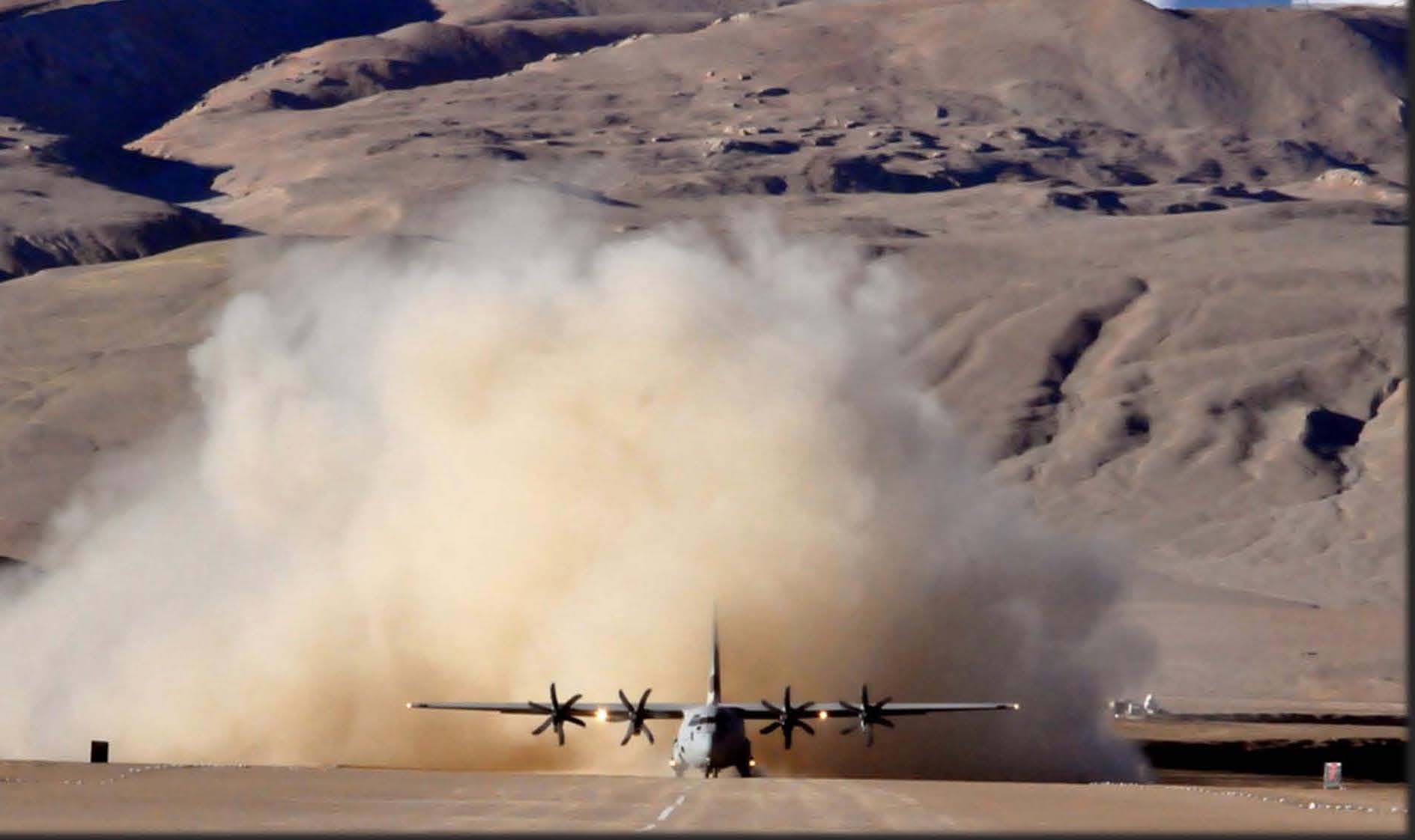
India also operates the world’s highest airstrip at Daulat Beg Oldi (DBO), at an elevation of 5,064 meters. DBO, however, is not an air base but only an unpaved, gravel-and-sand-earth advanced landing ground (ALG), suitable only for certain kinds of aircraft, such as heavy-lift C-130J Super Hercules aircraft and rotary-wing helicopters.

For reference, USAF’s Hill Air Force Base in Utah sits at 1,460 meters, making it one of the highest major US Air Force bases.

IAF Super Hercules
A file photo of an IAF C-130J Super Hercules landing at Daulat Beg Oldie (DBO), the highest airstrip in the world. (IAF photo)

Similarly, Chushul ALG sits at an elevation of 4,267 meters.

The Nyoma Air Base, a newly upgraded frontline military airfield in eastern Ladakh commissioned last November, sits at an elevation of 4,175 meters. The Nyoma Air Base is just 23 to 35 kilometers from the Line of Actual Control (LAC) with China.

The IAF also operates the Fukche Advanced Landing Ground (ALG), another critical high-altitude tactical military airfield. Located in the Demchok sector of eastern Ladakh, it sits just 2.5 kilometers from the LAC with China, at an altitude of approximately 4,176 meters above sea level.

The Leh airfield, IAF’s main logistics base in Ladakh, sits at 3,256 meters.

These forward airstrips, ALGs, and airfields are comparable in altitude to some of China’s forward air bases in Tibet, such as Ngari Gunsa (4,274 meters), Shigatse Tingri (4,317 meters), Qamdo Bamda (4,334 meters), and Shigatse Peace (3,782 meters).

India’s advantage comes from its low-altitude bases, such as Ambala, Bhatinda, Sirsa, Hasimara, and Chabua. These bases are near sea level and within 500 kilometers of the LAC; however, given the vast expanse of the Tibetan plateau, the PLAAF’s rear air bases in the plains are much farther away and have limited utility when operating near the LAC.

For instance, Hasimara Air Base in West Bengal, home to the IAF’s Rafale Falcons Squadron, is about 150 kilometers from the LAC and sits at an elevation of just 104 meters. In comparison, China’s Shigatse Peace Air Base, nearly 100 kilometers from the LAC, sits at an elevation of 3,782 meters.

Similarly, Chabua Air Base in Assam is about 100 kilometers from the LAC and sits at an elevation of 112 meters above sea level. In contrast, the Qamdo Bamda air base in Tibet is equidistant from the LAC but sits at an elevation of over 4,000 meters.

The Ambala Air Base in Haryana, home to the IAF’s second Golden Arrows Rafale squadron, is about 500 kilometers from the LAC and sits at an elevation of 275 meters. However, the Lhasa Gonggar air base in Tibet is about 200 kilometers from the LAC but sits at an elevation of 4,275 meters.

The IAF’s Bathinda and Sirsa air bases are also about 500 kilometers from the LAC and sit at around 100 meters above sea level.

This means IAF warplanes can operate at full capacity with maximum payload and have shorter response and turnaround times, unlike the Chinese PLAAF.

The thinner air in Tibet nearly cripples PLAAF jets as they cannot operate with their full weapons payload.

Additionally, IAF bases in the plains remain operational year-round, whereas Chinese air bases in Tibet face limited operability during the harsh winter season.

PLAAF

Who Holds the Edge?

However, given the widening gap between the IAF and the PLAAF’s inventory, one could argue that Beijing has already neutralized the IAF’s geographic advantage.

The IAF is currently at a historic low in maintaining fighter squadrons. India currently has around 29 fighter squadrons, compared with a sanctioned strength of 42.5. Meanwhile, China’s PLAAF already has more than 1,800 combat aircraft, including nearly 300-500 fifth-generation stealth J-20 fighters.

Air Chief Marshal Singh’s remarks are no revelation and have circulated in Indian policy circles for over six decades.

In fact, during the 1962 Sino-Indian War, Prime Minister Jawaharlal Nehru’s decision not to use air power against Chinese forces remains one of the most enduring criticisms of his leadership.

Critics argue that had India used its Air Force, New Delhi could have turned the tide in its favor.

During the war, the IAF deployed only helicopters and transport crews to serve forward pickets in the then North East Frontier Agency (NEFA) and Ladakh.

The IAF’s use in offensive operations was considered but rejected for fear of escalation.

Many analysts argue that in 1962, the IAF had both qualitative and quantitative superiority over the PLA Air Force.

At that time, the IAF had nearly 22 combat squadrons and over 500 aircraft. The IAF’s mainstays included the Hunter Mk-56 fighter-bomber, Gnat interceptor, French-built ground-attack aircraft such as the Mystere and Toofani, Canberra bomber-reconnaissance jets, and the Vampire ground-attack jet.

Meanwhile, the PLA Air Force (PLAAF) operated the MiG-15, MiG-17, MiG-19, and medium-range IL-28 bombers.

India’s intelligence agency, the Intelligence Bureau (IB), cautioned that if India deployed the IAF for offensive operations, then in return, the PLAAF could bomb Indian cities, such as Kolkata (then Calcutta).

However, it did not account for the fact that PLAAF aircraft could reach targets in India only if they operated from airfields in Tibet, where high altitudes severely restricted their weapon-carrying capacity.

In contrast, IAF fighters could have carried full weapon loads from airfields in the plains of Assam and Punjab.

General B.M. Kaul, the commander of IV Corps in NEFA, alleged in his memoirs – The Untold Story (1967) – that the IAF was not used in close support of the Army.

Neville Maxwell, correspondent of The Times (London) in 1962, in his book India’s China War, says: “The government had decided that tactical air support with bombers on ground attack must be ruled out for fear of Chinese retaliation against Indian cities, especially Calcutta. Considering the terrain in NEFA and the limitations of the IAF, it is doubtful whether its intervention in a tactical role could have had much effect.”

However, many people still believe Nehru committed a blunder by overestimating the PLAAF’s capabilities and not paying attention to the geographic limitations the Tibetan Plateau imposed on Chinese aircraft operations.

  • Sumit Ahlawat has over a decade of experience in news media. He has worked with Press Trust of India, Times Now, Zee News, Economic Times, and Microsoft News. He holds a Master’s Degree in International Media and Modern  History from the University of Sheffield, UK. 
  • He can be reached at ahlawat.sumit85 (at) gmail.com

The post 1,800 Jets, Nearly 500 Stealth Fighters — Why China’s Air Force May Still Struggle to Dominate the IAF? appeared first on EURASIAN TIMES.

  •  
❌