
❌

Reading view

I'm raising two sets of twins in Vietnam. The chaos suits our family.

A woman with four children on a motorbike in Ho Chi Minch City, Vietnam.
Marissa Goldstein and her husband moved to Vietnam 10 years ago and are raising two sets of twins in Ho Chi Minh City.

Provided by Marissa Goldstein

  • Marissa Goldstein and her husband traveled to Vietnam for work in 2016 and decided to move there soon after.
  • Now, a mother of two sets of twins, Goldstein says her family of six is happily settled in Ho Chi Minh City.
  • The city's low costs and kid-friendly culture make family life easier — though international school fees are high.

This as-told-to essay is based on a conversation with Marissa Goldstein, a 40-year-old entrepreneur from the Boston area who lives in Ho Chi Minh City. It has been edited for length and clarity.

In 2016, my husband and I flew to Vietnam with our 1-year-old twins and two bags. We told everyone we'd be back in three months.

Ten years later, we have four kids — two sets of twins — and a life in Ho Chi Minh City that I wouldn't trade. We've taken our kids to about 50 countries and spend summers with our families in Boston, then come back to the chaos of a city we love.

A couple with four kids in Vietnam.
They are raising four kids — two sets of twins — in Ho Chi Minh City.

Provided by Marissa Goldstein

Asia had my heart long before Vietnam

I grew up outside Boston. I studied communications at the University of Maryland, and a trip to Thailand during my junior year abroad was my first taste of Asia. I fell in love.

My husband and I met in high school and married after I graduated. I worked in PR and sales, then got my MBA at Babson College. Around 2015, there was an opportunity to help US companies diversify their supply chains away from China, so we started The Timroon Group, a manufacturing and sourcing company focused on Vietnam.

Being home with two babies overwhelmed me. Even though we had an incredible support system, living with my parents in a six-bedroom house in the suburbs. I quickly realized that staying home wasn't for me.

When traveling, though, I felt unstoppable. We headed to Ho Chi Minh City the day after their first birthday.

A family of six in Ha Giang Loop in Vietnam.
The family travels regularly around Vietnam and the region.

Provided by Marissa Goldstein

Vietnam won me over through my kids

I loved it right away, especially how people treat children. We'd bring the twins to dinners and big brunches, and the staff would take them and play. I felt really safe. Within a month, we had friends from all over the world. Three months turned into 18.

When the twins were 18 months old, we took an overnight train to Sapa in northern Vietnam. Hmong women were selling their textiles, and I decided to start my own travel accessories brand, working with women artisans. On that same trip, we decided to have one more child. Soon after, we found out we were having twins again.

In January 2020, we returned to Boston, where I grew Raffi Nova, my textile accessories brand. But by 2022, my husband's business was picking up, and we had the itch to return to Vietnam.

A family of six at an aiport in Boston.
When she travels back to Boston in the summer, she gets surprised by how expensive things are.

Provided by Marissa Goldstein

Ho Chi Minh City works for a family of 6

We live about 15 minutes from the city center. There are a lot of foreigners living here, several international schools, and everything is within a 10-minute drive.

There are good doctors and hospitals, Michelin Guide-rated street food, French bakeries, and plenty of activities for the kids, from taekwondo to tennis.

The cost of living is much lower, though school and housing add up. Housing in our area ranges from about $1,500 a month for a smaller apartment to around $10,000 for a villa. We're somewhere in between, in a five-bedroom serviced apartment.

We spend about $1,000 a month on groceries, buying fruit and vegetables at the local market, and spending more on meat and imported food. A latte at a cute, bougie café is about $2, so I treat my friends to coffee without thinking twice.

We have a live-out helper who we pay about $900 a month. She cleans, preps groceries, and helps with the kids. Health insurance for our family runs under $10,000 a year.

I get serious sticker shock when I go home in the summer. I take the kids out for bagels, and it's $100 or more.

Schooling is by far our biggest cost. International school fees in the city range from about $8,000 to $30,000 per child per school year. We're at the higher end, but we strongly believe in a good education.

With fees for four kids, we probably spend about the same as we would in the US, where we wouldn't have to pay for school. But there, we wouldn't eat out or travel as much.

Western family on two motor bikes in Vietnam.
Goldstein says she thrives on chaos, so Vietnam is the right pick.

Provided by Marissa Goldstein

Being far away is hard, but travel makes up for it

Both our big families live in the Boston suburbs.

There's also the weather: hot, hotter, and wet. In rainy season, it pours at school pickup every single day, even when you're sure it won't. The upside is that the kids need only one wardrobe all year.

I see Vietnam is our launchpad to the world.

Last spring, we spent a night in the jungle in Phong Nha, home to Vietnam's largest cave. We've been to Thailand about 20 times. Last February, we rented an RV and drove around New Zealand's South Island. On a trip to Sri Lanka, the kids learned to surf, and we stayed at a homestay in the mountains.

Traveling as six is hard. Most hotels don't allow four children in a room, and we can't fit in a regular car. Our best trips have never been at nice resorts. They're homestays, campsites, and RVs.

That's probably why this life suits us. I never wanted to say, "This is the house we'll live in for the next 50 years." Predictability scares me. I thrive in chaos, and with two sets of twins, there's always plenty of it — I wouldn't have it any other way.
Read the original article on Business Insider

  •  

Binance and Polymarket are investigating potential hacks. The former says $6.3 billion is affected.

CANADA - 2026/10/13: In this photo illustration, the Binance logo is seen displayed on a smartphone screen. (Photo Illustration by Thomas Fuller/SOPA Images/LightRocket via Getty Images)
Binance is investigating a potential hack that could result in billions of dollars in losses.

Illustration by Thomas Fuller/SOPA Images/LightRocket via Getty Images

  • Binance and Polymarket reported potential security breaches on Thursday.
  • Binance is investigating a possible hack, with over a billion in losses potentially at stake.
  • Polymarket also temporarily halted trading after a suspected breach.

Two major trading platforms — Binance and Polymarket — were investigating security incidents on Thursday, with the former facing potential losses in the billions. There's no evidence the incidents were related.

Binance, the world’s largest cryptocurrency exchange by trading volume, said it was actively investigating reports of a "potential security issue."

In an update late Thursday, Binance said that its initial investigation suggested that the incident may involve a compromised development operations engineer's laptop. This allowed an attacker to access a service container and submit unauthorized withdrawal transactions.

"We have found no evidence of any wallet private key leak," the company added.

Binance said the estimated total impact is about $6.3 billion, and it has worked with its blockchain partners to freeze around $3 billion in assets so far.

"Binance will cover all losses," Binance said on X. "As a precaution, all deposits and withdrawals are temporarily suspended while our team conducts security checks, freezes funds, and works with law enforcement."

The company did not respond to a request for comment.

Binance founder and former CEO, Changpeng Zhao, said on X a hack seemed likely.

“User funds are safe! It does look like a hack on Binance,” Zhao wrote in a post on X. “I don't manage Binance anymore, but as a shareholder, I expect all user funds will be fully covered.”

Zhao expressed appreciation to Tether and Circle, issuers of cryptocurrencies traded on Binance, for quickly freezing funds.

Tether CEO Paolo Ardoino said on X the company froze more than $1.5 billion related to the potential Binance hack. Circle CEO Jeremy Allaire said the company froze over $800 million in connection with the incident and that it was coordinating with law enforcement.

Polymarket also reported a security incident

Also on Thursday, Polymarket, the world's largest prediction market by trading volume, temporarily halted trading after users reported unauthorized withdrawals.

The company said in a statement on X that one of its third-party providers was compromised and that the incident had been referred to law enforcement. It also said trading had resumed by 3 p.m. Eastern time.

A Polymarket spokesperson told Business Insider that the malicious activity occurred in the UK and that the company will reimburse affected users. The company was unable to confirm the amount that may have been stolen.

Polymarket's US exchange was not halted and did not appear to be affected.

A person familiar with the matter attributed the Polymarket hack to a compromised third-party provider called DebugBear, a web performance monitoring platform designed to help businesses optimize website speed. It's unclear exactly how Polymarket uses the platform.

DebugBear did not respond to a request for comment. The company said in an X post on Thursday that it was aware of a security incident and was treating it as a "top priority."

Read the original article on Business Insider

  •  

WeWork CEO explains how a dress code and RTO flexibility helped change the culture at the once-troubled company

WeWork CEO John Santora at Business Insider's The Long Play event.

Carl Timpone/BFA

  • John Santora took the helm of WeWork in 2024, shortly after it emerged from bankruptcy.
  • Two years later, the company is making money.
  • At Business Insider's Long Play Event, Santora told Executive Editor Cadie Thompson how he did it.

For WeWork's CEO, Fridays are for sneakers. Sometimes.

At Business Insider's The Long Play event on Thursday, John Santora told Deputy News Chief Cadie Thompson that he rebuilt WeWork in part by establishing a sense of trust and decorum among employees.

In pursuit of that goal, Santora instituted a dress code for employees, but also gave them one day a week to work from home.

"I didn't have the ability to go watch my son play a 3 o'clock baseball game," Santora said, adding, "We have to give our employees that flexibility to do all that."

Santora, formerly the chief operating officer at Cushman & Wakefield, a real estate firm, became WeWork's CEO in 2024 as the once-buzzy office startup emerged from a disastrous Chapter 11 bankruptcy filing.

Santora had a short time to decide whether to join the faltering company, he recalled. And it wasn't exactly an easy choice.

"I was kind of at that point of, 'Should I retire?'" he said. "My daughter Nancy said, 'Dad, you know we love you, but when you have too much time on your hands, you're a pain in the ass.'"

Since those deeply red days in 2019 when WeWork's valuation plummeted from $47 billion to roughly $8 billion before it was bailed out, the company has stabilized. It posted eight quarters of EBITDA profitability and expects a fourth straight quarter of cash-flow profitability.

In 2025, it reported about $2.3 billion in revenue.

Though it hasn't hit the valuation it once had, the fact that the company could be revived at all is remarkable. WeWork, founded in 2010, rents out office space, spruces it up, and parcels it out to freelancers, startups, and other businesses.

Its first CEO and founder, Adam Neumann, made bold pronouncements that WeWork would "change the world" and "elevate the world's consciousness" by renting out office space to startups.

But after a bungled IPO, it became clear to the new stakeholders that a different type of leader was sorely needed.

As it turned out, Santora was that leader.

Having worked for 47 years at Cushman & Wakefield, Santora had the real estate experience that Neumann lacked, albeit without the magnetism of a Silicon Valley whiz kid.

"From a leadership standpoint, I'm a very structured, disciplined person," he said. "I'm a suit and tie, buttoned-up real estate person."

Santora recalled an early trip to one of the offices, where he discovered employees wearing jeans, pajamas, slippers, and shorts.

"I grabbed my head of HR," he said. "See that? I don't want to see it anymore."

Santora, who at one point described himself as an "old chubby guy from Staten Island," didn't just force employees to wear sports coats to important meetings. In his words, there was some "give and take."

"I don't look at what time they leave, what time they come in," he said of his employees. "As long as they're getting their work done and they're keeping their clients happy."

And Santora allows himself one exception to his suit-and-tie persona.

"Fridays, I'll actually sometimes wear sneakers, depending on what my schedule is," he said.

Read the original article on Business Insider

  •  

'My body is my business': How a model leveraged her career into brand-building power

Ashley Graham is a model and entrepreneur who has spent her career challenging who is seen, heard, and marketed to, transforming that influence into a growing business.

Ten years after her "Sports Illustrated" cover, Graham took the stage at Business Insider's The Long Play to unpack how she has built a personal brand across fashion, beauty, entertainment, and consumer products without losing what's at the core of her identity.

Graham spoke about Lucci, her new venture in the wine business, and her longtime partnership with JCPenney during her interview with Business Insider's executive editor, Leena Rao.

During the conversation, titled "Breaking the Mold," Graham also said that getting lots of rejection early on in her career has made her into a better businessperson.

"If it's not for you, there's another thing for you. And you can't take it personally," Graham told Rao.

Read the original article on Business Insider

  •  

Ashley Graham launched her wine brand and realized raising money was 'very hard and humbling'

Model Ashley Graham talks to Business Insider's Leena Rao at Business Insider's The Long Play in New York City on October 29, 2026.
Ashley Graham at Business Insider's The Long Play.

Carl Timpone/BFA

  • Supermodel turned businesswoman Ashley Graham spoke at Business Insider's The Long Play on Thursday.
  • Graham has invested in startups and launched her own ventures, including Lucci sparkling wine.
  • She said that raising money for the alcohol brand was "very, very hard and humbling."

Ten years after making history as the first plus-size model on the cover of the Sports Illustrated Swimsuit Issue, Ashley Graham has built a business portfolio spanning skincare and clothing to baby care and alcohol.

The 38-year-old supermodel turned businesswoman spoke at Business Insider's The Long Play event in New York City on Thursday to discuss her breaking barriers in fashion and navigating the difficult world of investment and entrepreneurship.

"I realized quickly that my body is my business," she told Business Insider's Leena Rao. "So how can I scale this?"

That crossover appeal has helped her build a massive social media audience — nearly 30 million followers across platforms — with whom she connects and brings along as she expands her ventures.

Among her latest projects is Lucci, a sparkling Italian Lambrusco wine brand she co-founded in February. Graham said Lucci was started from the ground up and was the first time she had to ask investors to come in.

"Asking people for money is very, very hard, and humbling," she said, adding later that it's been a "great learning curve" as it was the first time she had to answer to investors for the 'why' behind decisions.

From swimsuit model to leading a brand empire

In 2016, Graham appeared on the cover of Sports Illustrated's Swimsuit issue, becoming the first plus-size model to do so.

The following year, she was named one of TIME's most influential people of the year, had a Barbie doll modeled after her, and released her first book, "A New Model: What Confidence, Beauty, and Power Really Look Like."

Ashley Graham at Business Insider's The Long Play in New York City on October 29, 2026
Ashley Graham at Business Insider's The Long Play in New York City.

Carl Timpone/BFA

Forbes listed her as one of the highest-paid models in 2017, with an estimated income of $5.5 million; she was the first plus-size model to break the top 10. Her namesake JCPenney collection, which launched in October 2025, is made exclusively for customers who wear size 14 and up.

Building beyond the runway

After the SI cover launched her to international fame, Graham said she monetized on the viral moment by releasing swimsuit and lingerie lines. Today, she still regularly releases collaborations with intimate brands like Knix, for which she serves as Global Ambassador and investor.

"When your body is your brand, you're always talking about it," she said.

She's also become an investor: Graham has backed the period-care brand Rif Care, the infant-formula company Bobbie, and the sustainable skincare brand Fig.1 Beauty. In 2022, she joined Fig.1 as both an investor and a partner, saying she wanted involvement beyond a typical celebrity endorsement.

As the years have passed, Graham said she's learned from past mistakes, learned how to say no, and has leaned into being very intentional about building teams around her that she can trust.

Graham also said she was surprised by "just how ruthless [VC] can be," as well as by how much success there can be.

Her most recent exit as an investor was with Wonderbelly, a clean antacid startup, which was acquired by Procter & Gamble in January.

Balancing a business with raising 3 children

Ashley Graham walks the Victoria's Secret Fashion Show runway.
Ashley Graham walked the Victoria's Secret Fashion Show runway for the first time two years after giving birth to twins.

Dimitrios Kambouris/Getty Images

Graham has managed to balance that growing career with motherhood. She and her husband Justin Ervin, whom she wed in 2010, welcomed their first child in 2020, followed by twin boys in 2022.

In 2024, she walked the Victoria's Secret runway for the first time. In making the decision to join the fashion show, she said she asked the company about its plans to expand its size range.

"I don't want to just come on as a token," she said. "I don't want to be the one-trick pony."

During the years she was having her children, she said, her investments also took on a family focus, leaning into brands she "felt like they were in [her] zeitgeist at the moment," including babycare and women-led brands. Now, her businesses are growing with her kids.

At Business Insider's event, she teased about her next business venture launching next summer: A home company partly inspired by her children.

Read the original article on Business Insider

  •  

Amazon CEO sees AI spending 'meaningfully' higher in 2027

Amazon CEO Andy Jassy

Michael Nagle/Bloomberg via Getty Images

  • Amazon reported third-quarter earnings on Thursday.
  • Amazon stuck with its $220 billion capex forecast for 2026.
  • CEO Andy Jassy expects the company to spend "meaningfully more" next year.

Amazon is already spending a record amount on AI data centers. Next year will be even bigger.

The world's biggest cloud-computing company reported third-quarter results on Thursday and reiterated its plan for $220 billion in capital expenditure for 2026.

Then, CEO Andy Jassy shared his outlook for next year, saying Amazon expects "to spend meaningfully more in 2027."

Amazon’s spending has become the central question hanging over the company. It's building massive data centers and buying expensive chips and other gear to meet surging demand for AI.

That's pushed its free cash flow into negative territory, with third-quarter results showing a hole of $42.4 billion for the trailing twelve months.

Amazon spent $75.9 billion in cash capital expenditures during the third quarter alone, CFO Brian Olsavsky said, primarily on AWS and AI infrastructure.

The results did little to ease investors' concern about the spending. Amazon's third-quarter revenue and earnings came in below Wall Street expectations, and its shares fell roughly 6% in after-hours trading.

"The cloud unit's improving operating margin was one welcome signal, but it may not be sufficient to alleviate concerns about the sharp spike in capex spending and corresponding freefall of its free cash flow," Sky Canaves, a principal analyst at eMarketer, said in a statement.

Amazon has argued that AI infrastructure takes years to build before it can begin generating revenue, and that AI chip servers typically break even in less than three years once deployed. But the scale of the outlay has raised the stakes for Amazon's cloud business to sustain rapid growth as competitors make similarly enormous bets.

On Thursday, Jassy reiterated his confidence in the company's AI business model and outlook, saying there's a "clear line of sight to attractive financial returns."

The time it takes Amazon to turn newly delivered servers into revenue-generating capacity has also come under scrutiny.

Last week, Business Insider exclusively reported that Amazon has begun receiving billions of dollars in Nvidia server racks before all of the gear can be deployed at their final data-center sites, as power shortages and construction delays hold back new capacity.

"We can fund this plan"

Jassy argued Thursday that Amazon has visibility into the demand supporting its huge AI investments. Customers that need the largest AI deployments reserve capacity well ahead of time, he said, in blocks ranging from hundreds of megawatts to, in some cases, as much as a gigawatt.

"We have very good visibility into 2027 and 2028 and some of '29 too with respect to what customers want in those really big chunks of capacity," Jassy said.

AWS revenue rose 39.3% year over year to $46 billion in the third quarter, its fastest growth in nearly five years. Jassy said he expects AWS revenue to grow more than 40% in both 2027 and 2028, a projection that requires the company to keep rapidly adding capacity.

Jassy described the spending as a once-in-a-lifetime opportunity rather than an optional expansion. It would be more convenient, he said, if Amazon could spread the investment over 25 years. But the speed of the AI market does not allow that.

"We can fund this plan," he said. "It will forever change our revenue. It will forever change our free cash flow."

Have a tip? Contact this reporter via email at ekim@businessinsider.com or Signal, Telegram, or WhatsApp at 650-942-3061. Use a personal email address, a nonwork WiFi network, and a nonwork device; here's our guide to sharing information securely.

Read the original article on Business Insider

  •  

Smartbird's CEO talks about converting a shoe company into an AI player

Smartbird CEO Nadia Carlsten
Smartbird CEO Nadia Carlsten at Business Insider's The Long Play.

Carl Timpone / BFA

  • Nadia Carlsten, CEO of Smartbird, spoke on the public company's shift from sneakers to AI.
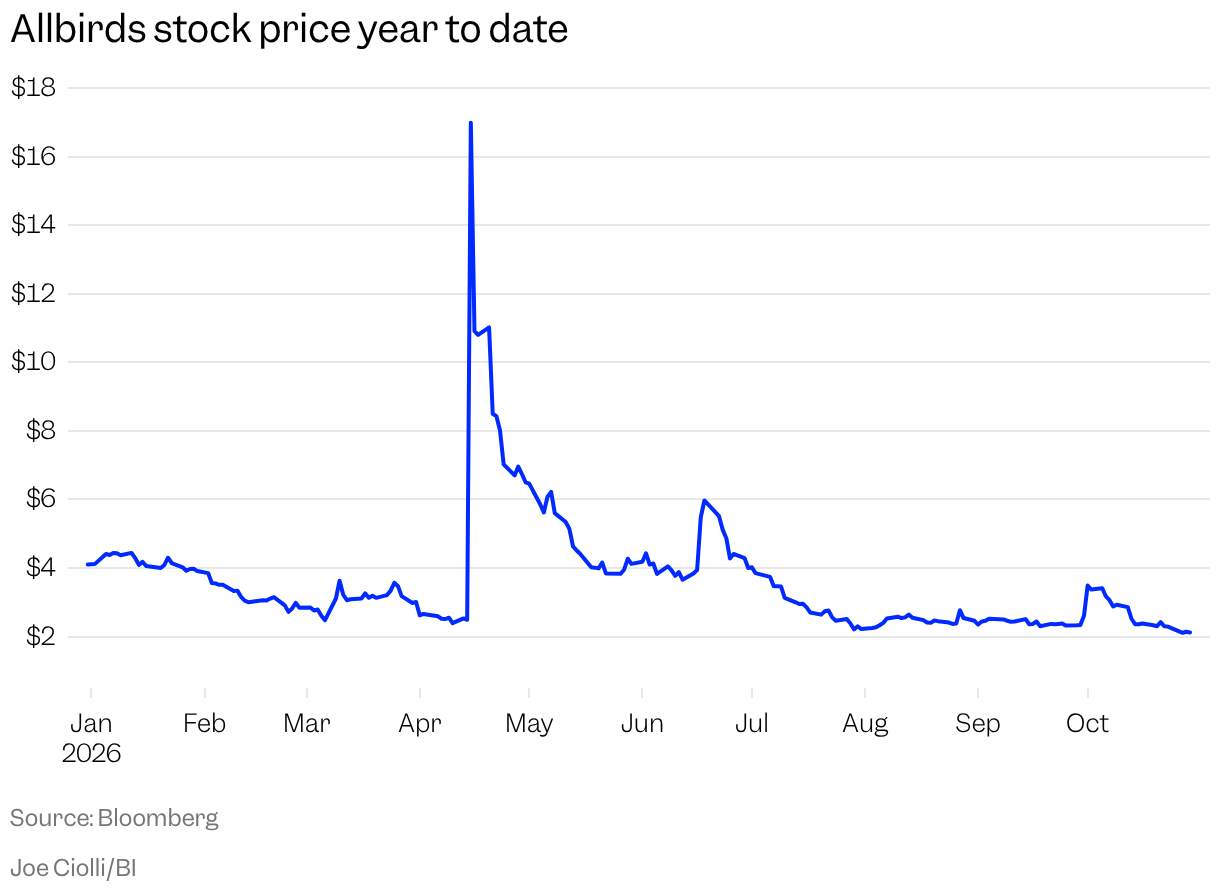
  • When the AI pivot was announced, the company's stock skyrocketed. It has since come back down.
  • Carlsten said Smartbird has a different approach to AI infrastructure, focusing on customer needs.

Before Smartbird was powering large language models, it was making shoes.

The CEO of the AI infrastructure company, Nadia Carlsten, spoke about the transition with chief correspondent Ben Bergman on Thursday at Business Insider's The Long Play.

Its roots are the sustainable sneaker company Allbirds, which skyrocketed in the late 2010s. The shoes were particularly popular among the Silicon Valley crowd. Allbirds went public in 2021 before the market turned on many direct-to-consumer businesses. The stock quickly fell, and it sold to American Exchange Group in March for $39 million.

"The short answer is the shoe business wasn't doing that well," Carlsten said.

The company then sold off its footwear business and shed most of its workforce, rebranding as Smartbird. The AI pivot skyrocketed the stock and was briefly up 800%, though it has since come back down. Carlsten, who became CEO in June, said she had never worn those wool shoes.

"The goal of the company was to do something valuable and meaningful. And for me, I knew I wanted to do AI infrastructure," she said.

After looking at the emerging AI infrastructure sector, she believed with the company's transformation, it was the "right place at the right time" for her to join.

In the five months since she took over, Carlsten said the experience can be described in one word: exciting.

"Never in my life thought that I would be the CEO of a former shoe company and managing what is essentially a startup." Since taking on the role, she has focused on building out a new team, scouring new technologies for the company to look into, and producing a new pipeline of customers.

While the stock price has gone down since the initial pivot-induced spike, Carlsten does not regret taking on the challenge. She is betting on the company's long-term potential.

Line chart

"The stock market is going to do what the stock market does," she said. "What I care about is making sure that we're putting the company on the right path, and that we're able to build it quickly enough and well enough that we have a sustainable business that investors will love. So what happens in the short term? Not that important. What happens in the long term is very important."

When asked why the company decided to reinvent itself in the public eye instead of beginning as a private start-up, Carlsten countered with a question: "Why not?" she said, "It will come back up."

Having to reinvent the company from scratch can be challenging, and the public's presence is clear, she said. Yet, Carlsten said reinvention is inevitable for companies.

"This is a very public reinvention of the company, and people are watching," she said. "I think every company needs to reinvent itself every now and then."

When asked why the company is fully remote, Carlsten said most of the work at Smartbird is done virtually or at data centers, meaning an office would not be of much use.

"We spend a lot of time actually building things, which I actually love. So if my people are sitting in an office, something's wrong," she said.

Working within the emerging AI sector

Carlsten said that although her competitors are building similar AI infrastructure, the way Smartbird is going about it is unique.

"For us, it's about the right infrastructure for the right company at the right time," she said. "Our business model allows us to work more closely with customers, but it also is a lot less capital intensive."

Smartbird is looking to work with companies that have yet to explore implementing AI in their systems, she said. As more companies outside the tech realm look to adopt AI into their businesses, they have the choice to build infrastructure themselves or outsource it, and Smartbird wants to be the one to do it for them, she said.

"We'll do the infrastructure part. We'll let you focus on the actual business," she said.

The most common misconception Carlsten said she has encountered in the business is that it's all about GPUs. She said the company does a lot more than just run GPUs.

"It's really about having a holistic system that a customer can use to do AI," she said.

Another rumbling that's taken over the tech company discourse is whether there's an AI bubble and if it will pop. Carlsten said that depends on how people go about defining the bubble.

Excitement in the sector means funding might be going into companies that may not prosper in the future, but this is something that happens with the arrival of new technologies, she said.

"Every time there is a transformational technology, this happens," she said. "Even if we assume that there is a bubble, that doesn't mean that the technology is not good. It also doesn't mean that the adoption of the technology is going to go away."

Read the original article on Business Insider

  •  

Take-Two CEO Strauss Zelnick's management style: No chief of staff, no 'toxic' discretionary pay programs

Take-Two Interactive CEO and chairman Strauss Zelnick speaking at Business Insider's The Long Play.
Take-Two Interactive CEO and chairman Strauss Zelnick speaking at Business Insider's The Long Play in New York on October 29, 2026.

Carl Timpone/BFA

  • Take-Two's CEO says his 13,000 employees share a collective goal: make the world's best entertainment.
  • His philosophy to get there? A formulaic pay program aligned with that mission, empathetic listening, and direct CEO access.
  • Take-Two Interactive is getting set to launch its hotly-anticipated GTA 6 in November.

Strauss Zelnick is relentlessly focused on making "the best entertainment on earth." There's no confusion about that mission among his employees, he said.

"I have 13,000 colleagues," the Take-Two Interactive CEO said at Business Insider's The Long Play event in New York City on Thursday. "100% of them can and will tell you exactly what I just said."

His management philosophy — "establish a mission, establish a strategy, and promulgate collective culture" — is about to get its biggest test in years.

Take-Two is the publisher behind popular games like "Red Dead Redemption" and "NBA 2K," and, on November 19, they'll launch a new "Grand Theft Auto." The wildly popular series hasn't had a new mainline installment since 2013 and has delayed its launch twice in an effort to meet the studio's exacting standards. GTA 6 is central to Take-Two's forecast for at least $8 billion in net bookings for fiscal 2027.

Zelnick has run the company since 2007. To align employee incentives with Take-Two's big expectations, he believes compensation should be based on a formula aligned with the company's mission — not left to manager discretion.

"I personally believe that discretionary compensation programs are toxic," he said, adding that they create "politics and get you the wrong results, especially over time."

"So, we're all formulaic," he said. "You perform, the company performs — you get paid. You perform, the company doesn't perform — you don't get paid. Company performs, you don't perform — if you still have your job, you get paid."

Zelnick also said he has no chief of staff, is available on Slack 24/7, and shares his cellphone number with employees.

"If you're not president of the United States, you have no reason to have a chief of staff," he said.

That doesn't mean he will swoop in and override an employee's manager, said Zelnick, who considers himself an empathetic listener. He said workers should feel heard — and that he will try to help them solve a problem.

Still, he doesn't believe his formula at Take-Two is necessarily the right approach for every leader.

"Leadership comes in all flavors," he said. "You have to be your own kind of leader, and I don't think anyone should adopt my skills, because you're not me."

Read the original article on Business Insider

  •  

Barry Diller has a plan for monetizing legacy media in the AI age

Media titan Barry Diller, the chairman of publishing empire IAC, has built and rebuilt his career more than most executives, from network television to Hollywood studios to the earliest internet empires.

As part of Business Insider's The Long Play, Diller talked to Peter Kafka, Business Insider's chief correspondent covering media and technology, about what successful businesses require: good timing, nerve, and the willingness to walk away from what's working.

During this conversation, titled "The Art of the Comeback: A Masterclass on Resilience," Diller shares his perspectives on AI adoption. He also talks about why his MGM Resorts deal fell apart and how he's leveraging legacy print publications like Southern Living to create new revenue streams.

The 84-year-old media and tech exec told Kafka he wants to keep working as long as he can be engaged and useful.

Read the original article on Business Insider

  •  

The CEO behind Grand Theft Auto has an 8-part longevity routine for shredded abs and sharp decision-making. Here's why peptides aren't part of it.

Take-Two Interactive CEO and chairman Strauss Zelnick speaking at Business Insider's The Long Play.
Take-Two Interactive CEO and chairman Strauss Zelnick, 69, loves a hard workout.

Carl Timpone/BFA

  • Strauss Zelnick, the CEO of Take-Two Interactive, said he prefers working out to playing video games.
  • He is a longevity buff, deep into fitness and anti-aging habits.
  • In a candid conversation with Business Insider, he said skip the peptides, and try these 7 things instead.

Media mogul Strauss Zelnick spends his days hyper-focused on making the most creative, innovative, best video games in the world.

As the CEO and Chairman of video game-maker Take-Two Interactive, he's readying to release Grand Theft Auto 6 next month.

At home though, he doesn't play games. He prefers to spend his time working out and staying healthy for a long time.

At Business Insider's "The Long Play" event on Thursday, Zelnick said his formula for healthy aging is both simple and effective.

While he calls biohacker Bryan Johnson, the man behind the "Don't Die" movement, a friend, he said trying to live forever is a pretty silly strategy.

"There's almost no evidence that anything anyone is doing will increase your lifespan," he told Business Insider's Senior Leadership & Workplace Correspondent, Sarah Needleman. "How many of us really want to increase our lifespan from like 96 to 101? Look, that is not on my bucket list, thank you very much."

Instead, Zelnick, who wrote a book on "Becoming Ageless" in 2018, focuses on the same core behaviors for "taking care of yourself" that longevity experts around the world swear by for maintaining health and happiness for the long haul.

1: Do not smoke

"Smoking is the factor most highly correlated with a short, unhealthy, and frankly, unhappy life," Zelnick said. "Don't smoke."

2: Don't abuse alcohol and drugs

These lead to "a bad old age, or no old age," he said.

3: Get some exercise

Zelnick said: "You don't have to do what I do," with 6 a.m. wakeup calls for group training sessions, or twice-a-day workouts.

"I do what I do because I love it, it's my passion," he said. "If you walk 30 minutes a day, four or five days a week — just walk — you're like 80% of the way there."

4: Eat a "responsible" diet

Zelnick says he doesn't have an "insanely healthy diet," but he tries to maintain some balance. "I eat a lot of vegetables and salads and protein — I also like sweets, and I do eat carbs."

5: Sleep at least 7 hours a day

Zelnick says he treats this as a non-negotiable for his business.

"If you're getting less than six hours, you're making bad decisions," he said.

6: Have "some kind of emotional or spiritual life"

Longevity experts stress this is key for mental health, and establishing a sense of purpose in the world.

7: Find community

Zelnick said it's critical to get support from "people who love you."

8: Skip overhyped health hacks

strauss
Strauss Zelnick, 69, is the CEO of Take Two Interactive.

Carl Timpone / BFA

Zelnick says don't waste your time with all the overhyped, unproven health hacks.

"All the other stuff, like, peptides? A: No," he said. "We have an FDA for a reason. Don't take something that is not double-blind tested."

And, he said, be careful with some of the internet's most famous longevity gurus. He name-checked controversial Harvard professor David Sinclair, who has made bold promises about the anti-aging effects of unproven supplements, including resveratrol, a plant polyphenol found in grapes and red wine, and NMN, which is a precursor to NAD, the vital coenzyme that's in every cell of our body.

"A medical doctor actually is a degree: M-D, an MD degree," Zelnick said. "Not a David Sinclair degree, he is not actually a doctor."

Read the original article on Business Insider

  •  

Giants and Gotham FC co-owner says community-building is good for business

As Gotham FC's governor and lead owner, Carolyn Tisch Blodgett is capitalizing on the moment: she's turning a championship soccer club into a breakout New York brand with the reach, relevance, and staying power to lead the next era of sports.

Tisch Blodgett — shared her approach to investing in women's athletics, including leveraging fandoms and AI technologies, as part of Business Insider's The Long Play.

Interviewed by Nathan McAlone, Business Insider's deputy editor covering media and advertising, Tisch Blodgett said that her marketing background has been invaluable for building strategy in the business of sports.

Read the original article on Business Insider

  •  

How a co-owner of the New York Giants is using AI to build a women's sports powerhouse with Gotham FC

CTB BI Live
Carolyn Tisch Blodgett, the owner of Gotham FC, thinks AI can make women's sports more lucrative.

Carl Timpone / BFA

  • Carolyn Tisch Blodgett, a co-owner of the New York Giants and Gotham FC, is using AI to cut costs.
  • "There's a lot of parts of a sports team that are just expensive to operate," Tisch Blodgett said.
  • Tisch Blodgett shared how she's turned around Gotham FC at Business Insider's The Long Play.

New York Giants and Gotham FC co-owner Carolyn Tisch Blodgett is betting on AI to transform women's sports into a major moneymaker.

"If AI can make you more efficient, that totally changes where women's sports can go," Tisch Blodgett said at Business Insider's The Long Play event on Thursday afternoon.

Tisch Blodgett, who's the lead owner of Gotham FC in the National Women's Soccer League, sees AI as a way to reduce the costs of running a sports business without cutting corners.

"There's a lot of parts of a sports team that are just expensive to operate. It's expensive to operate a stadium, it's expensive to operate a ticketing team, expensive to operate a marketing team," Tisch Blodgett said.

Those struggles are heightened for women's sports, which historically haven't gotten the same level of investment as men's sports.

CTB NMA
Tisch Blodgett spoke with Business Insider's Nathan McAlone about how to make women's sports more financially successful.

Carl Timpone / BFA

"The revenue was not high enough to really justify building out an entire business team, and the business model just didn't really work," Tisch Blodgett said of women's sports.

Tisch Blodgett made a name for herself by starting sports-focused venture capital firm Next 3, which has invested in Gotham FC, the Los Angeles Golf Club in golf league TGL, Premier Lacrosse League, and lottery ticket site Jackpot.com.

The Gotham FC owner has had a front-row seat to running sports since she was a kid: Her family bought half of the NFL's New York Giants in 1991. The Tisch family runs Loews Corporation, a hotel and insurance conglomerate worth about $22.9 billion.

Under the Tisch's ownership, the Giants have won two Super Bowls. Tisch Blodgett has already matched that title count in the three years she's owned Gotham FC — though building a winner hasn't been easy.

Building a champion by gathering feedback

Tisch Blodgett felt firsthand the challenges that women's sports teams face after taking over Gotham FC in 2023. The New York-based team had talent, as it went on to bring home its first title months later.

But success on the pitch hadn't translated to a winning business. Gotham FC didn't have its own business office when Tisch Blodgett took over, and players shared a practice field with a club team of 16-year-old boys.

While Gotham FC had "a great product on the field," Tisch Blodgett said, "attendance was really low" due to a lack of awareness.

"It was clear that the people that came really liked it, but it was very small," Tisch Blodgett said of Gotham FC's fanbase in 2023.

A speaker gestures in a chair on a Business Insider stage with flowers nearby.
Under Tisch Blodgett, Gotham FC is moving from New Jersey to a stadium in Queens in 2028.

Carl Timpone / BFA

Tisch Blodgett has since flipped the script. This July, Gotham FC sold out Citi Field in Queens, drawing over 42,000 fans in what she said was the biggest women's sports event ever in New York City.

Gotham FC announced in July that it would call Queens home starting in 2028 — a major upgrade from its current stadium in Harrison, New Jersey, which is difficult to reach from New York City by public transit.

One key to Gotham FC's success has been gathering feedback. Tisch Blodgett, who led marketing for fitness giant Peloton before starting Next 3, said learning from fans "makes the whole business smarter" and has been crucial to the soccer club's growth.

"Fan feedback is incredibly important to me — it's how we run our organization," Tisch Blodgett said. "After every game, we send out a survey to every person that attended, essentially saying, 'Did you like it? Would you recommend it to a friend?'"

Gotham FC's Net Promoter Score — which measures how likely customers are to recommend the brand to a friend — rivals Apple, Tisch Blodgett said.

"It makes every person in the organization understand what we're building towards in a much more efficient way," Tisch Blodgett said.

Read the original article on Business Insider

  •  

Leaning into convenience helped Nubank break into American fintech, cofounder says

Cristina Junqueira helped build Brazilian fintech player Nubank into one of the world's largest digital financial services platforms.

Now, as she leads Nu's emerging US business, she is taking on its biggest challenge yet: breaking into America's crowded banking market.

As part of Business Insider's The Long Play, Junqueira sat down with Dan DeFrancesco, executive editor and anchor of Business Insider Today, to share her insights on how to build trust and scale in banking, like leaning into convenience through digital banking products.

During the discussion, called "Building a Global Challenger," Junqueira also talked about her plan to take on incumbents in retail banking.

Read the original article on Business Insider

  •  

Patrick Stewart, 'Star Trek' and 'X-Men' star, dead at 86

Patrick Stewart on the red carpet of the 2021 Emmys.
Patrick Stewart at the 73rd Primetime Emmy Awards in 2021.

Rich Fury/Getty Images

  • Actor Patrick Stewart has died at 86.
  • His rep announced he died after "a brief and poignant journey" with Alzheimer's and Lewy Body Dementia.
  • Stewart was known for his stage work and roles in "Star Trek" and "X-Men."

Legendary actor Patrick Stewart, known for his roles in the "Star Trek" franchise and "X-Men" films, has died at age 86.

A post on his official Instagram page announced Steward died at his Los Angeles home on Wednesday, "in the loving care of his beloved wife Sunny, following a brief and poignant journey with Alzheimer's Disease and Lewy Body Dementia."

"He has been held in the warm embrace of family and friends, surrounded by live music, prayer, tears, laughter, and the kind of profound emotion that only he could inspire after a lifetime of devotion to us all," the post continued. "We will forever cherish the peaceful ease and reflection on his face, an enduring reminder of his invincible grace."

In lieu of flowers, the family requested that memorial contributions be made to Johns Hopkins Alzheimer's Disease Research Center Fund and Alzheimer's Foundation of America Caregiver Resources.

Patrick Stewart wearing a red and black uniform on "Star Trek: The Next Generation."
Stewart as Captain Jean-Luc Picard in "Star Trek: The Next Generation."

CBS via Getty Images

Born on July 13, 1940, in Mirfield, Yorkshire, England, Stewart became interested in acting at age 12, when an English teacher introduced him to William Shakespeare's writing.

Although Stewart initially dropped out of school at age 15 to work as a journalist, he quickly abandoned that pursuit and began performing in theater productions. He graduated from the Bristol Old Vic Theatre School in 1959.

At 26, Stewart joined the Royal Shakespeare Company, where he spent much of the 1960s establishing himself as a celebrated stage actor. He made his Broadway debut in 1971 in "A Midsummer Night's Dream" and would go on to perform in over a dozen stage adaptations of classics like "The Tempest" and "A Christmas Carol."

"I knew from before drama school that Shakespeare was my great love," Stewart told Playbill in 2010.

Alongside his stage work, the actor also launched his TV career in the '60s — but his big Hollywood break came two decades later, when he landed the role of Captain Jean-Luc Picard on the series "Star Trek: The Next Generation."

The sci-fi show lasted for seven seasons between 1987 and 1994. Stewart also reprised his role for an episode of the show "Star Trek: Deep Space Nine" as well as several more movies, including "Star Trek Generations" (1994), "Star Trek: First Contact" (1996), "Star Trek: Insurrection" (1998), and "Star Trek: Nemesis" (2002). He also did voice work for "Star Trek" video games.

Stewart would go on to star in another popular franchise, Sony's "X-Men," making his debut as Professor Charles Xavier, a telepathic mutant and founder of the X-Men, in the 2000 movie "X-Men."

Patrick Stewart as Charles Xavier in "X-Men."
Stewart as Charles Xavier in "X-Men."

Twentieth Century Fox

Ian McKellen, who was also a member of the Royal Shakespeare Company in the '60s and '70s, starred opposite Stewart in the original "X-Men" series as the powerful mutant Magneto.

Despite playing onscreen rivals, the two actors became close friends in real life, with McKellen officiating Stewart's 2013 wedding to singer Sunny Ozell in Reno, Nevada.

"We became good friends as a result of shooting multimillion-dollar adventure movies," Stewart later told NPR of McKellen.

Stewart's most recent roles included voice work for the animated series "American Dad!" and the 2026 movie "The Sheep Detectives." He reprised his role as Jean-Luc Picard from 2020 to 2023 in the series "Star Trek: Picard," and returned as Charles Xavier in 2017's "Logan," 2022's "Doctor Strange in the Multiverse of Madness," and the forthcoming Marvel film "Avengers: Doomsday," out this December. The blockbuster will mark his final onscreen appearance.

Despite starring in multimillion-dollar movie franchises, Stewart returned to the stage throughout his career. He was nominated for a Tony Award for his portrayal of Macbeth in the 2008 Broadway revival and starred opposite McKellen in two-play repertory productions of "Waiting for Godot" and "No Man's Land" in 2013 and 2014.

"I have often heard actors say, 'I can't afford to go back to the theater,'" Stewart told NPR. "I look at a lot of the work that I do in film and television — which I love — but, at the same time, it underwrites and supports the other work that I want to do."

Stewart did not see his onscreen work and his stage work as at odds; on the contrary, he described his two most recognizable roles, Picard and Xavier, as "entirely complementary" to his theater career.

"The techniques are different, and the rhythm and pattern of the work are different, but the approach to how I act doesn't change — the fundamental thing is to pursue the truth," he told Playbill.

Stewart is survived by Ozell and his two children, Daniel Stewart and Sophia Stewart, from his first marriage to Sheila Falconer.

Read the original article on Business Insider
  •  

Barry Diller is 84 and says he has no plans to retire: 'I have a motor inside me.'

Barry Diller on stage
Barry Diller says he has a motor that doesn't quit, and that retirement isn't on the table.

Carl Timpone/ BFA

  • Barry Diller isn't ready to slow down.
  • The 84-year-old media and tech exec says he wants to keep working as long as he can be engaged and useful.
  • Diller says he isn't focused on his legacy. He says it's "boring" to look backward.

He may have run Paramount, built the Fox television network, and just pulled a buyout offer for MGM Resorts, but media and tech executive Barry Diller says he's not done yet.

He has a "motor inside" that just won't stop, Diller said Thursday at Business Insider's The Long Play in New York.

"I'm still curious," he told Peter Kafka, BI's chief correspondent. "If I can be engaged and hopefully be useful, then OK."

"At some point, someone will tell me in some masterful way, either it's over or, in another way, it will be over," he said, alluding to the final bow. "I will either pay attention, or not, and they will drag me out to the heap."

Diller's desire to keep leading companies means staying on top of major technological changes, such as AI.

"I am, at any point, ready to change my mind based on events of that moment," he said. "I don't think whatever the past process is should educate that," he said.

At People Inc., Diller has overseen multiple strategy shifts. The company is evolving from print to a digital business, and like other publishers, it's had to adjust to significant Google traffic declines.

On Thursday, People Inc. laid off 195 workers, according to a memo from its CEO, Neil Vogel, which Business Insider viewed. The company cut workers from its "print and legacy web businesses," while adding hundreds of staffers in other business areas that it hopes to grow, the memo said.

Diller told Kafka that People's layoffs were a sign that its print business was in a "steady kind of decline," and that it was shifting its workforce to focus on new business priorities.

Diller's time isn't solely focused on business: He's also worked on various public-interest projects, such as developing New York's High Line and Little Island alongside his wife, Diane von Fürstenberg.

On Thursday, he teased a coming project for Los Angeles, too, but wouldn't reveal details.

Despite taking joy in seeing satisfied attendees at Little Island on the Hudson River, Diller said he's not focused on his public legacy.

"I don't do legacy," he told Kafka. "If you say legacy, it kind of means all you're doing is looking backward, and that's just boring to me."

Read the original article on Business Insider

  •  

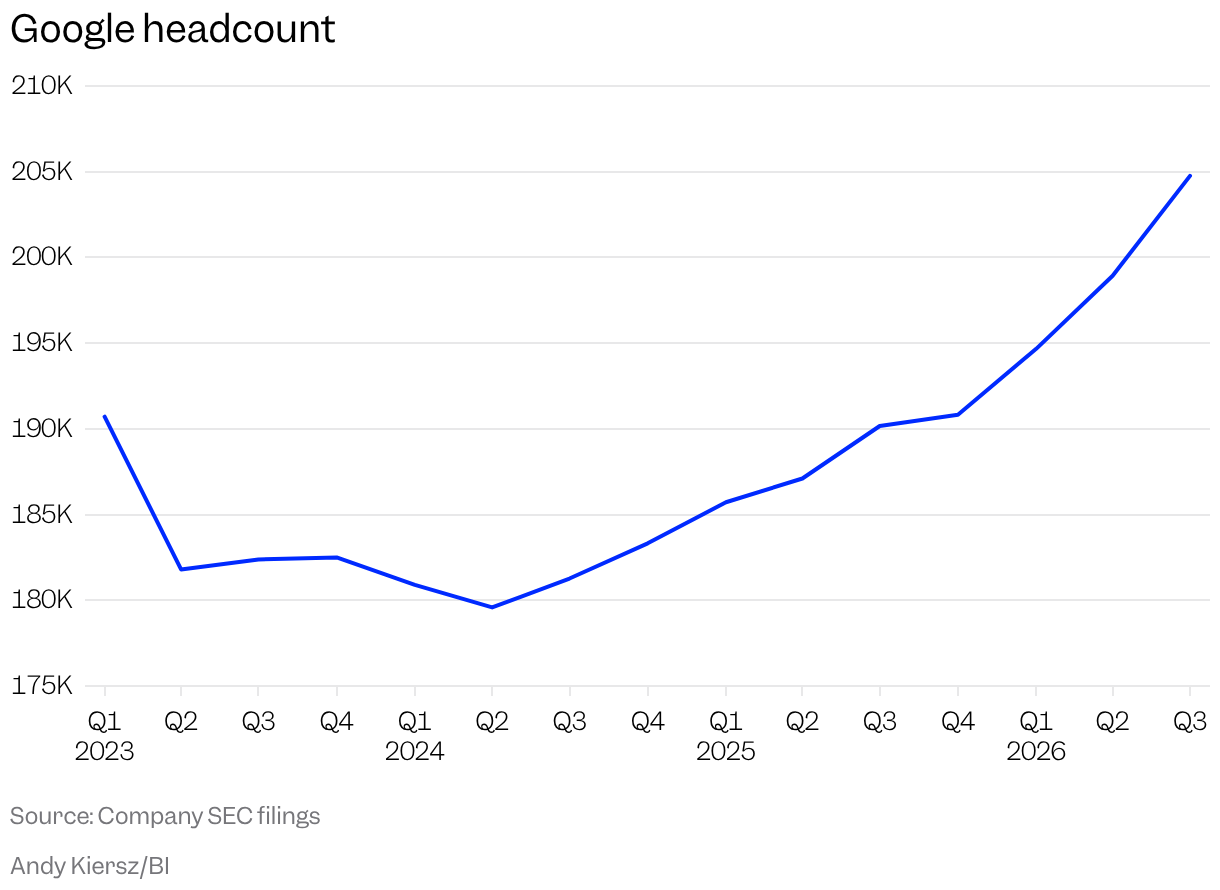
This chart shows how much Google's head count surged in the AI boom

Google CEO Sundar Pichai
Sundar Pichai, chief executive of Alphabet Inc., during an interview on "The Circuit with Emily Chang" on May 1, 2024.

David Paul Morris/Bloomberg via Getty Images

  • While some companies are slashing head count, Google's is surging.
  • The company had nearly 205,000 employees at the end of September.
  • While Google has conducted layoffs, it has also ramped up hiring and acquired Wiz.

While AI may be driving some companies to slash their head count, Google's is soaring.

When Google reported its Q3 earnings on Wednesday, it said it had 204,757 employees for the quarter ending September 2026. That means Google added roughly 10,000 people to the payroll since the end of March.

The uptick in head count runs counter to another trend across the tech industry, where some of Google's peers are slashing their workforces. Meta has been on a cost-cutting odyssey for several years, while Microsoft recently offered voluntary buyouts to 60,000 employees.

Some of Google's head count growth can be attributed to mergers and acquisitions. On March 11, Google said it had completed its acquisition of cybersecurity firm Wiz, which had roughly 2,000 employees.

Line chart

In January 2023, Google announced it would slash roughly 12,000 roles — around 6% of the workforce at the time — and has since made several smaller rounds of layoffs, Business Insider has reported.

While the head count has grown somewhat steadily since Q2 2024, it has accelerated since the end of 2025. Google also reported Wednesday that its quarterly revenue grew 25% from this period last year.

Have something to share? Contact this reporter via email at hlangley@businessinsider.com or Signal at hughlangley.01. Use a personal email address and a non-work device; here's our guide to sharing information securely.

Read the original article on Business Insider

  •  

Nubank, Latin America's largest digital bank, is turning its eyes toward the US — where foreign rivals have failed

Cristina Junqueira, the co-founder and CEO of Nubank
Cristina Junqueira, the co-founder and US CEO of Nubank, with Dan DeFrancesco, executive editor and anchor of Business Insider Today.

Carl Timpone/ BFA

  • Nubank's US CEO joined Business Insider's The Long Play to discuss the bank's expansion into the US.
  • The company looks to simplify banking with a digital-first fintech approach.
  • US CEO Cristina Junqueira focuses on building trust through credit options and brand building.

Nubank is the largest digital bank in Latin America — now it's turning its eyes towards the US.

Cristina Junqueira, the co-founder and US CEO of Nubank, sat down with Dan DeFrancesco, executive editor and anchor of Business Insider Today, at Business Insider's The Long Play, to talk about the digital bank's expansion on Thursday.

How it began

Since its founding in 2013, the fintech bank has pushed for financial inclusivity in Latin America by providing access to banking and financial services through its mobile app. Headquartered in Junqueira's home country of Brazil, the simple, low-cost, and digital-first approach discarded the need for physical banks, which are at times harder to reach in parts of Latin America — a key part of its success in the region.

It all started with a purple credit card with no fees.

"We had this vision that data, design, technology, completely transforms people's relationship with money," she said.

Junqueira previously worked as an executive at Itaú Unibanco, the largest private-sector financial giant in the region, also headquartered in Brazil and now a direct competitor of Nubank. Today, it is the largest company in Brazil based on primary banking relationships, and two-thirds of the country's adult population are customers, she said.

Entering the US market

The digital bank is set to expand into the US after opening a branch in September, operating under the name Nu. This comes after expansion into Mexico and Colombia in 2021.

"We always saw the thesis as a global one," she said. "Everywhere in the world, people want more convenience. People want more transparency. People want simpler experiences managing their finances. People still get like paralyzed by complexity through their financial lives."

Entering America's crowded banking sector is a risk — but for Junqueira, entering no country goes without risk.

"The US is a very hard market, but I haven't found easy ones either," she said. "Building a bank is hard everywhere, so you might as well go for the biggest payout."

In the US, she said getting a bank account is still "surprisingly hard" and normally requires you to go to a physical branch, while Nu offers an easier alternative to that, she said. Foreign digital-first banks have tried to bring their platforms to the US before and failed. German fintech N26 and UK fintech Monzo both tried to expand their businesses to the US, and ultimately withdrew from the market.

The American consumer is unique, which is why Junqueira aims to take a different approach than her competitors to earn trust and scale the platform. She said most other companies started with debit cards, while Nubank is the first to start with credit cards.

Starting people out with a debit card "requires you to build a lot of trust with those customers because you're asking them to deposit their money with you," she said. "In our case, all the countries that we started, we started with credit. This is a very different relationship because you're the one trusting the consumers," she said.

Some Latin American immigrants who already live in the US are responding positively to Nu as it enters the market.

"I've been positively surprised not only by the amount of people, sure, but Brazilians, Mexicans, and others are here and have been waiting for this," she said.

Junqueira also pointed to emerging AI technology and how it could impact the company and the banking sector. She said the company is "heavily leveraging AI," integrating it in credit underwriting, customer support, and product development.

Brazil's presidential election on Sunday made headlines as President Luiz Inácio Lula da Silva unexpectedly won a runoff against Flávio Bolsonaro, who fled the country to the US after he was under investigation for alleged corruption and money laundering. When asked about how she reacted to the big market sell-off in response, Junqueira said volatility is part of operating in a country like Brazil, but having 13 years of experience in the country has helped them learn they are going to run the company for the long run.

"We got to focus on the fundamentals, and the reality is, last quarter we turned over a billion dollars in net income," she said. "Markets don't like surprises, right? But we manage our business regardless of what happens."

Building a brand

The founder said one of the hardest things Nu will have to do in the US is build a brand that connects with users on an "emotional" level. Junqueira's dream scenario, five years from now, is to find evidence of that connection in the US.

One of the ways Nubank is attempting to spread its brand is through a recently signed deal with the Mercedes F1 team. Junqueira pointed to fans' passion for specific teams, as they follow the championship around the world, which was part of why they wanted to take part.

"We got a lot of visibility out of that, and we're working with them on brand activations," she said. "We're producing very interesting activations for consumers that help us amplify the branding fast, and that really help us bring this partnership to life."

Another huge part of the digital bank's brand is gender equality. In 2021, Nubank set a goal for 50% of Nubank's leadership to be women by 2025. Junqueira said today that the company's workforce is over 45% women, with many in leadership positions. In the four countries where they operate, all top leaders are women. Junqueira said the biggest challenge of being an executive while raising a family is not having the flexibility to juggle the demands of both roles.

"The reality is, as hard as we have to work, I think the hardest part is not having enough flexibility," she said. "It has been wonderful for us to have that type of opportunity, for us to really be able to tap into this part of the workforce that often struggles to have this type of career opportunity."

Correction — October 29, 2026: An earlier version of this article misstated Junqueira's title; she is the co-founder and CEO of US Nubank. The article also has been updated to note that the top leaders in the four countries where Nubank operates are women.

Read the original article on Business Insider

  •  

Barry Diller shares why his deal to buy MGM fell apart

Barry Diller and Peter Kafka on stage
Barry Diller told Business Insider's Peter Kafka that "forever assets" like MGM and its Las Vegas resorts are protected from AI disruption.

Carl Timpone/ BFA

  • Barry Diller says he tried to buy all of MGM because real-world experiences like a trip to Las Vegas are a strong hedge against AI.
  • He said the deal fell apart because he didn't want to take on debt or raise money from third parties.
  • Diller spoke to Chief Correspondent Peter Kafka at Business Insider's The Long Play.

Media mogul Barry Diller thinks businesses that operate in the real world have a strong protective moat against AI.

That was the inspiration for his company People Inc.'s June bid for MGM Resorts International's casino and hotel business, which he called "forever assets."

As some consumers turn to AI chatbots to complete tasks like buying plane tickets or managing subscriptions, digital-only businesses could get boxed out. That creates real risks for internet brands like Expedia Inc., where Diller is an investor and board member. It's less of a problem for companies whose businesses exist in the real world, he said.

Nothing is going to replace Las Vegas, Diller said — and no one's going to buy another one. Gaming is only part of the equation, he said.

"No disintermediation is coming between a person who wants to go to a place, and that place," he said, speaking to BI's Chief Correspondent Peter Kafka at Business Insider's The Long Play event in New York on Thursday.

People Inc. first took a 27% stake in MGM in 2020. The company, which operates magazines such as Food & Wine, People, and Southern Living, later offered to buy the Las Vegas brand outright in June but withdrew its bid in September.

Diller said the deal fell apart after he became uncomfortable with the proposed structure, which involved taking on debt and asking third parties for money.

MGM later offered to buy People Inc. instead, but told investors on Wednesday that it had shelved the plan. Diller said it was "highly unlikely" that MGM was interested in People's magazine assets, but rather it had hoped to buy back People's MGM shares.

People remains MGM's largest investor, though it has agreed not to buy more than a 29.9% stake in the company and to vote with MGM's board in connection with a change-of-control transaction.

Barry Diller on stage
Barry Diller says AI isn't going to get between someone who wants to go to Las Vegas and the resort town.

Carl Timpone/ BFA

People, which, beyond its magazine portfolio, also owns stakes in The Daily Beast and the car-rental company Turo, laid off 195 workers on Thursday, per a memo from CEO Neil Vogel, which Business Insider viewed. The vast majority of impacted staffers worked on its "print and legacy web businesses," the memo said. The company has "added 320 new employees so far in 2026," it said.

Diller told Kafka that the layoffs were a sign of a healthy company that has a profitable print business in a "steady kind of decline."

"We've been transferring out people in these legacy businesses and transferring in people to do the new work," he said.

Diller is a longtime media operator. He served as chairman and CEO of Paramount Pictures in the 1970s and 80s, before joining Fox Inc. and helping to start Fox Broadcasting with Rupert Murdoch in the mid-1980s. He then worked at QVC before serving as CEO of IAC and taking on roles at Expedia Group. He is on the board of directors at MGM.

Read the original article on Business Insider

  •  

Instagram is trying to woo YouTube creators with six-figure checks

Adam Mosseri, head of Instagram at Meta Platforms Inc., during the Bloomberg Screentime event in Los Angeles, California, US, on Thursday, Oct. 9, 2025. Screentime gathers the moguls, celebrities, and entrepreneurs defining the next phase of pop culture to discuss and debate the future of Hollywood studios, the boom in sports and live music and the impact of AI on the creative industries. Photographer: Kyle Grillot/Bloomberg via Getty Images
Adam Mosseri is the head of Instagram at Meta.

Kyle Grillot/Bloomberg via Getty Images

  • Instagram is offering some creators six figures to help make it a long-form video hub.
  • The Meta platform is reviving its IGTV ambitions, allowing horizontal videos of up to 90 minutes.
  • Creators are required to cross-post their long-form YouTube content to Instagram as part of nonexclusive deals.

Instagram wants what YouTube has — and it's willing to pay up to get it.

In an effort to persuade content creators to post long-form video on Instagram, the company is paying a select number of creators hefty sums, according to people familiar with the deals.

Not every deal is equal. The Meta-owned platform has offered select creators $50,000 to post long-form video to its new "Features" product, while others have been offered six-figure deals, some of which have reached $500,000, Business Insider exclusively learned.

"We've been public about the fact that we are funding Features content directly with some creators right now to support them," a Meta spokesperson told Business Insider. "The details of those deals are confidential, but we're excited to see the content going live."

On Monday, Instagram unveiled an overhaul of its video formats. Most importantly, it's resurrecting IGTV — a long-form video product Instagram launched in 2018 and sunset in 2022 — in the form of Features. The horizontal, wide-screen videos will exist within the Instagram app, and can be as long as a feature film: 90 minutes.

Instagram is launching more video tools.
Instagram is expanding its offerings for long-form video content.

Meta

Long-form video isn't exactly what people are used to watching on Instagram. Reels, the platform's answer to TikTok's meteoric rise, has redefined the Instagram experience and is driving time-spent and revenue across Meta's apps.

YouTube, however, reigns king as the internet's destination for sit-down, longer-form videos.

Instagram knows this. The deals do not require exclusivity to Instagram, multiple people familiar with the agreements said; one person familiar with the offers said it's asking creators to post to Instagram any of the long-form content they publish to YouTube that same day.

Reza Izad, partner at Underscore Talent, which reps clients like "Subway Takes'" Kareem Rahma and Noah Beck, called the deals an "exciting opportunity" for creators.

"Every time there's a new feature in these apps that the company's promoting, people will have more opportunity to be seen because there's going to be algorithmic preference to this kind of content," he said. "And unlike short-form, there's not a lot of abundance."

Money, money, money

This isn't the first time Instagram has inked paid deals with creators to lure them to post more on Meta's apps.

Last year, Meta was paying creators thousands of dollars to post short-form videos to Instagram and Facebook in the midst of TikTok's potential ban. The company has tested several bonus programs paying creators for the performance of their Reels on Instagram, though those programs have dwindled.

Back in 2021, when IGTV was still part of Instagram's big video bet, it inked deals with creators, funding long-form episodic shows from creators like TikTok's "Sway Boys" and "Dance Moms" alum Nia Sioux. Briefly, IGTV had its own monetization program, too, which let some creators earn a cut from ad revenue on the format.

While Instagram is paying some creators directly, a big question looms over the creator economy: What about the rest of them?

A major draw of YouTube is its long-standing Partner Program, which pays eligible creators a share of the ad revenue generated by their videos. Even though YouTube has increased its eligibility requirements, the potential to turn a hobby or passion project into a cash-earning career has kept YouTube on top as the go-to video platform for creators.

It's no surprise, then, that when Instagram announced its video overhaul, creators immediately had questions about monetization.

"We understand the economics matter a ton, and are exploring multiple options to help long-form creators get paid," Instagram's top executive, Adam Mosseri, wrote in an X post on Wednesday.


Have a tip?

Contact Lucia via email at lmoses@businessinsider.com, (917) 209-8549, or on Signal at @luciamoses.81.

Contact Sydney via encrypted messaging app Signal at @sydneykbradley.123, sydneykbradley@proton.me, or sbradley@businessinsider.com.

Use a personal email address, a nonwork WiFi network, and a nonwork device; here's our guide to sharing information securely.

Read the original article on Business Insider
  •  

17 photos that show how Kelly Clarkson's style has changed since her 'American Idol' days

Kelly Clarkson in 2005 and 2024.
Kelly Clarkson in 2005 (left) and in 2024 (right).

J. Merritt/Kevin Mazur/Getty Images

  • Kelly Clarkson made history when she won "American Idol" in 2002.
  • Since then, America has watched her fashion journey unfold on red carpets and TV shows.
  • She's worn punk-rock looks, glamorous red-carpet gowns, and fun minidresses.

Kelly Clarkson is a national icon.

After winning "American Idol" in 2002, she's remained a household name through her music, children's books, and TV roles. She was also involved in public drama this year when she started feuding with a Brooklyn toy store.

No matter the occasion, though, Clarkson has stood out onstage and across red carpets with her ever-evolving style.

Here's a look at how her fashion has changed over the years.

Kelly Clarkson was the ultimate girl next door when she became a household name in 2002.
Kelly Clarkson attends the 2002 premiere of "Swimfan" in Westwood, California.

Robert Mora/Getty Images

After winning "American Idol," she wore one of her most memorable looks to date at the "Swimfan" premiere.

It included a strapless tie-dye dress over bootcut jeans and platform sandals. Clarkson also sported a statement pendant and a red newsboy cap.

She embraced little black dresses throughout 2003.
Kelly Clarkson attends the 2003 Billboard Music Awards in Las Vegas, Nevada.

Carlo Allegri/Getty Images

Clarkson wore various versions of the fashion staple that year, including at the Billboard Music Awards.

Her strapless dress that night had a knee-length skirt, a bustier bodice, and all-over ruching. She wore it with pointed pumps and long diamond earrings.

And she showed her feminine side in 2004.
Kelly Clarkson attends the 2004 American Music Awards in Los Angeles, California.

Jon Kopaloff/Getty Images

At the 2004 American Music Awards, Clarkson walked the red carpet wearing a floor-length gown with satin detailing.

She accessorized the red ensemble with gold sandals and matching earrings, and completed the look with an updo hairstyle.

The next year was defined by punk-rock outfits.
Kelly Clarkson attends the 2005 KIIS-FM Wango Tango in Los Angeles, California.

J. Merritt/Getty Images

For most of her performances in 2005, Clarkson appeared onstage in torn band T-shirts, low-rise jeans, and either sandals or sneakers.

She wore a version of that exact outfit — a Rolling Stones top, low-rise pants, and a studded belt — to perform at the 2005 Wango Tango concert.

She mixed her edgy and glamorous styles in 2006.
Kelly Clarkson attends the 2006 Grammy Awards in Los Angeles, California.

Gregg DeGuire/Getty Images

For the 2006 Grammy Awards, Clarkson stunned in a black Max Azria gown.

The strapless piece had a form-fitting bodice and full, ruffled skirt, which added unique texture and mirrored the wavy style of her hair.

Normally a fan of gowns, Clarkson began experimenting with minidresses in 2007.
Kelly Clarkson attends the 2007 ASCAP Pop Music Awards in Los Angeles, California.

Jeffrey Mayer/Getty Images

She attended the ASCAP Pop Music Awards that year in an olive-toned shift dress with a beaded neckline and bubble skirt.

Clarkson also debuted a new bob hairstyle that night and accessorized with a silver bracelet and sandals.

The musician sparkled throughout 2009 and the early 2010s.
Kelly Clarkson attends the 2009 American Music Awards in Los Angeles, California.

Frazer Harrison/Getty Images

At the 2009 American Music Awards, Clarkson walked the red carpet in a sleeveless CD Greene design.

The knee-length dress had clusters of silver sequins at the top and more embellishments cascading down its bodice and skirt.

She wore the garment with fishnet tights, black pumps, and a crimped red hairstyle.

Clarkson returned to her rock roots in 2012.
Kelly Clarkson performs a 2012 show in Birmingham, United Kingdom.

Steve Thorne/Getty Images

At concerts that year, Clarkson performed while wearing band T-shirts and skinny jeans.

For a show in Birmingham, for example, she hit the stage in black denim, a ripped UFO concert tee, and a sparkling vest.

She wore a ton of red throughout 2013.
Kelly Clarkson visits the SiriusXM Studios in New York City.

Taylor Hill/Getty Images

Clarkson especially seemed to favor the color while promoting her Christmas album "Wrapped in Red."

She wore it during a visit to the SiriusXM Studios via a plaid dress with zipper detailing, a cropped sweater, and studded sandal heels.

By 2015, Clarkson's fashion was full of bold prints.
Kelly Clarkson visits the SiriusXM Studios in New York City.

Cindy Ord/Getty Images

During another visit to the SiriusXM Studios, she wore a music-inspired outfit that included a knee-length skirt printed with images of vinyl records.

She also wore gold sandals and a yellow T-shirt that said New York City.

Clarkson opted for chic looks in 2016.
Kelly Clarkson makes a 2016 appearance on "Extra" in New York City.

Dia Dipasupil/Getty Images

Her office-ready style included black minidresses, sheer tights, and pointed pumps — just like she wore to appear on "Extra" that year.

Clarkson was also sporting blonde hair in loose waves at that point.

By 2019, Clarkson was having more fun with her red-carpet outfits.
Kelly Clarkson attends the 2019 "UglyDolls" premiere in Los Angeles, California.

Steve Granitz/Getty Images

At the "UglyDolls" premiere, Clarkson walked the orange carpet in a hot-pink gown designed by Christian Siriano. It had a floor-length skirt with a short train and giant, puffy sleeves.

The outfit was likely inspired by Moxy, the pink "UglyDolls" character that Clarkson voiced for the film.

In the 2020s, Clarkson has seemingly found her signature style: a mix of glamour and rock 'n' roll.
Kelly Clarkson attends the 2020 Billboard Music Awards in Los Angeles, California.

Amy Sussman/Getty Images

She attended the 2020 Billboard Music Awards in an outfit that perfectly embodied that style.

Balmain designed her silver gown, which had large shoulder pads and fringe hanging from its skirt and sleeves.

She's not afraid to experiment with daring looks.
Kelly Clarkson performs at the  2023 iHeartRadio Music Festival in Las Vegas, Nevada.
Kelly Clarkson performs at the 2023 iHeartRadio Music Festival in Las Vegas, Nevada.

Rich Polk/Stringer/Getty Images

In 2023, Clarkson performed in a series of bold outfits — including the lace jumpsuit she sported at the iHeartRadio Music Festival.

She wore the see-through garment under a blazer styled as a dress, and thigh-high leather boots.

Minidresses and metallics have become signature parts of her wardrobe.
Kelly Clarkson at the 2024 Rock & Roll Hall of Fame induction.

Kevin Mazur/Getty Images

Clarkson attended the 2024 Rock & Roll Hall of Fame induction ceremony in a Rebecca Vallance minidress.

The long-sleeve piece was black with a sheer waist panel and metallic sequin embellishments all over.

She wore it with black sandal heels and her new wavy hairstyle with bangs.

So have glamorous gowns.
Kelly Clarkson performs at her Las Vegas residency in 2025.

Denise Truscello/Getty Images

When Clarkson performed her Las Vegas residency in 2025, she wore a tan gown covered in sparkles and feathers.

It hugged her body from her shoulders to her knees, where the gown was made of mesh and embellished with silver sequins.

Its sleeves and skirt were more dramatic. They puffed out and were covered in rows of feathers, which added texture and shape to the look.

Today, Clarkson's style is simple but elevated.
Kelly Clarkson performs on "The Kelly Clarkson Show" in 2026.

Weiss Eubanks/Getty Images

Before "The Kelly Clarkson Show" ended in August 2026, Clarkson appeared in a multitude of chic outfits.

One of them was a sheer black gown with a plaid pattern. It revealed the bralette and miniskirt she wore beneath the floor-length piece.

She completed the outfit with neutral makeup and a wavy hairstyle.

Read the original article on Business Insider
  •  
❌