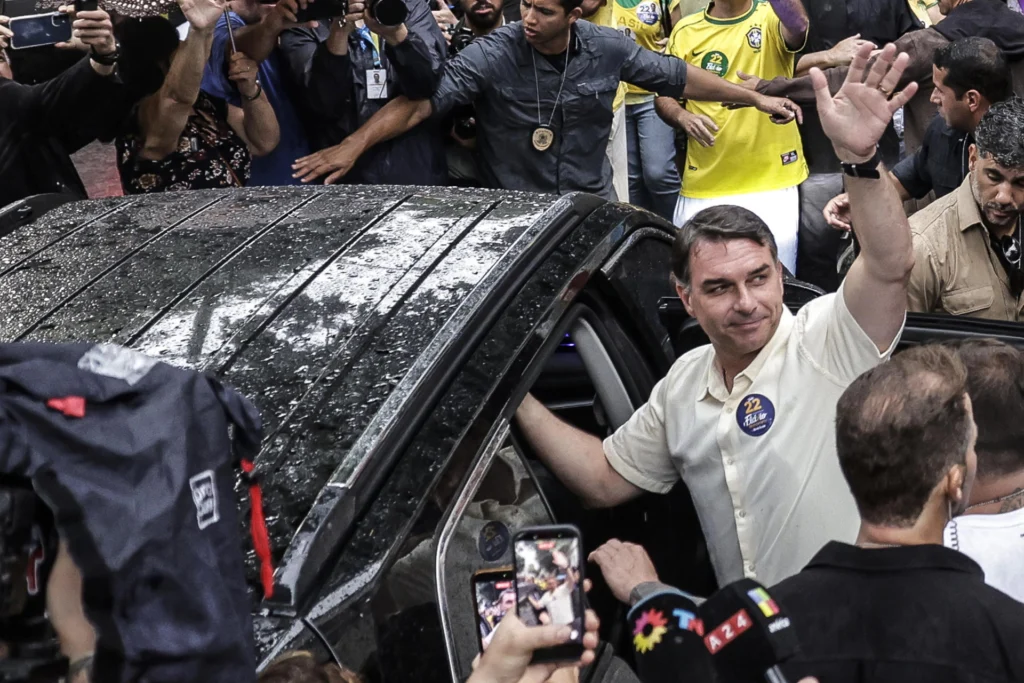
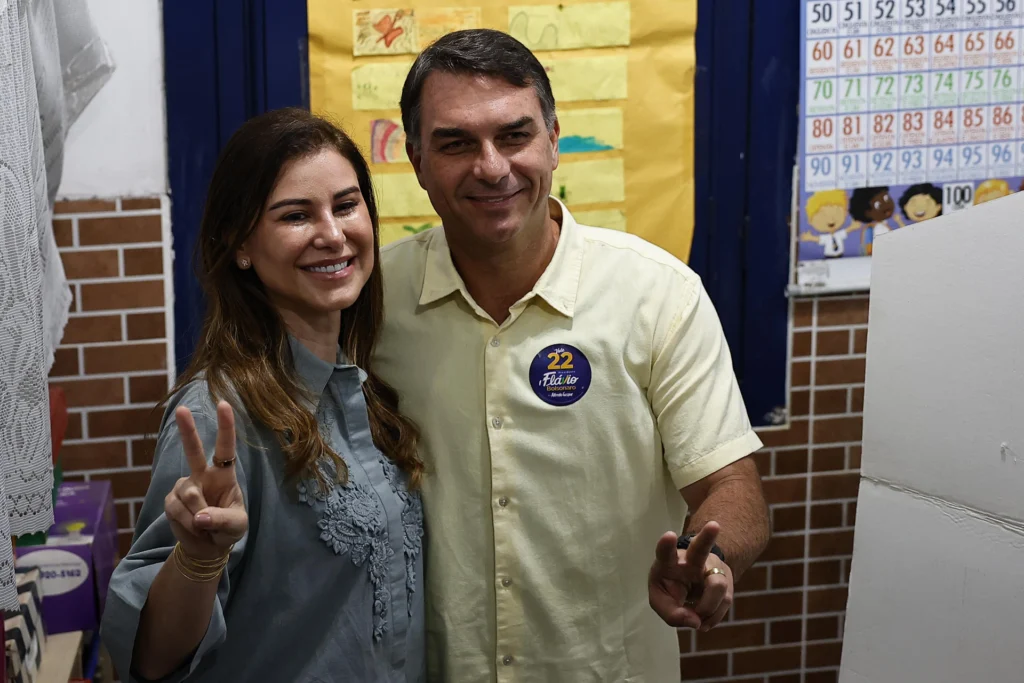
Argentine lawmaker Marcela Pagano filed a criminal complaint against officials of the Milei administration to investigate how Brazilian senator Flavio Bolsonaro crossed into Argentina and departed for United States despite a judicial ban on leaving Brazil.
The complaint was presented before the Federal Court in Puerto Iguazu, in Misiones province. It seeks to establish the circumstances of Bolsonaro’s entry into Argentina and his later departure toward United States.
The far-right senator, son of former President Jair Bolsonaro, lost the presidential run-off to Luiz Inacio Lula da Silva on Sunday. He faces criminal cases in Brazil for corruption and money laundering, and Supreme Federal Court justice Alexandre de Moraes had prohibited him from leaving the country.
Pagano framed the matter in stark terms. “The justice system has to establish who organized Bolsonaro’s passage through our territory toward U.S. and whether Argentine officials facilitated it. A government cannot become the escape route for someone who is barred from leaving his country by court order”, she said.
The reconstruction presented to the court traces the route in detail. The Brazilian Senator crossed the international border between Foz do Iguazu and Puerto Iguazu through the Tancredo Neves crossing at 10.50 P.M. local time on Tuesday.
Forty minutes after entering Argentine soil, Flávvio Bolsonaro and his family boarded a private Gulfstream G400 jet at Iguazu International Airport. The aircraft belongs to the firm Baires Fly and had been positioned there since Monday.
🇧🇷 "I address the Brazilian people and the international community as the true elected president of Brazil."
Senator Flávio Bolsonaro, who lost Sunday's presidential runoff to incumbent Lula da Silva by about 4.4 million votes, is claiming the presidency in a statement released… pic.twitter.com/oTTodsaOcU
The jet traced a path through the airspace of Paraguay, Bolivia, and Peru. It made a technical stop in Guayaquil, Ecuador, before landing Wednesday in Miami, avoiding Brazilian airspace at every stage.
Pagano detailed that Flávio Bolsonaro reached the air terminal under escort from an Airport Security Police patrol car. That force answers to the Security Ministry, which falls under the federal Executive.
The National Directorate of Migration initially denied on Tuesday that the conservative leader was present or had any flight plans. Yet the government of Javier Milei officially acknowledged his passage at 2.00 A.M. Wednesday, when the aircraft was already airborne.
The complaint demands clarification of another element, the presence in Misiones of Santiago Caputo, political strategist and chief advisor to the Argentine presidency. Caputo reportedly arrived in the province earlier in the week aboard the same private plane.
La Dirección Nacional de Migraciones informa que a las 22:50 hs del dia 27/10, ingresaron por el paso fronterizo de Puente internacional Tancredo Neves en la provincia de Misiones, los ciudadanos Flavio Nantes Bolsonaro, Fernanda Antunes Figueira Bolsonaro, Carolina Figueira…
Text reads: “The National Directorate of Migration reports that at 10:50 P.M. on October 27, entered through the border crossing of Tancredo Neves International Bridge in the province of Misiones, citizens Flávio Nantes Bolsonaro, Fernanda Antunes Figueira Bolsonaro, Carolina Figueira Bolsonaro and Luiza Figueira Bolsonaro, who did so with skilled travel documentation without any legal impediment to entry into the country, also the transits were registered by the enforcement authority without incidents. For its part, at 11:30 P.M., the incoming party boarded a private flight dispatched by the company Baires Fly S.A to the city of Guayaquil, Ecuador, as reported in the flight plan.”
The written filing asks the court to investigate alleged crimes of illegal trafficking of persons, facilitation of illegal stay, abuse of authority, violation of public official’s duties, and cover-up. It requests urgent evidence measures including camera footage from the border bridge, aeronautical records, and the Airport Security Police duty logs.
The political fallout reached the legislature quickly. Argentine Congressman and former Defense Minister Agustin Rossi formalized a request to summon the Chief of Cabinet, Diego Santilli, to answer before Parliament.
The sequence raises the question at the heart of the complaint. A senator barred from leaving his country crossed a border, boarded a private jet, and flew to Miami without touching Brazilian airspace, all with a police escort on Argentine soil.
The government first denied any knowledge. It then confirmed the passage hours later, after the plane was gone. That gap between denial and confirmation sits at the center of the criminal filing.
The denunciation now forces the federal justice system to determine whether officials in the Milei administration facilitated a fugitive’s exit. The demand in Congress puts the same question to the Cabinet’s Chief.
U.S. federal judge Alvin K. Hellerstein, who presided over the criminal case against Venezuelan President Nicolas Maduro and his wife Cilia Flores, died Wednesday at the age of 92, and his pending cases will pass to another judge.
Alvin K. Hellerstein died Wednesday at 92 of natural causes after nearly three decades presiding over high-profile matters. He had led the penal process against President Maduro and Cilia Flores since the two were kidnapped on January 3 during a U.S. military incursion into Venezuelan territory.
Ed Friedland, administrative director of the Federal Court for the Southern District of New York, confirmed the death.
Hellerstein held the role for nearly three decades. He was appointed in 1998 by then U.S President Bill Clinton to the Southern District of New York, considered one of the most significant federal tribunals in United States.
BDE: Longtime Manhattan federal Judge Alvin Hellerstein, an Orthodox Jew appointed by President Clinton in 1998, has died at 92, according to a court spokesperson. He was overseeing the prosecution of deposed Venezuelan leader Nicolás Maduro. pic.twitter.com/w0nHyrcwc2
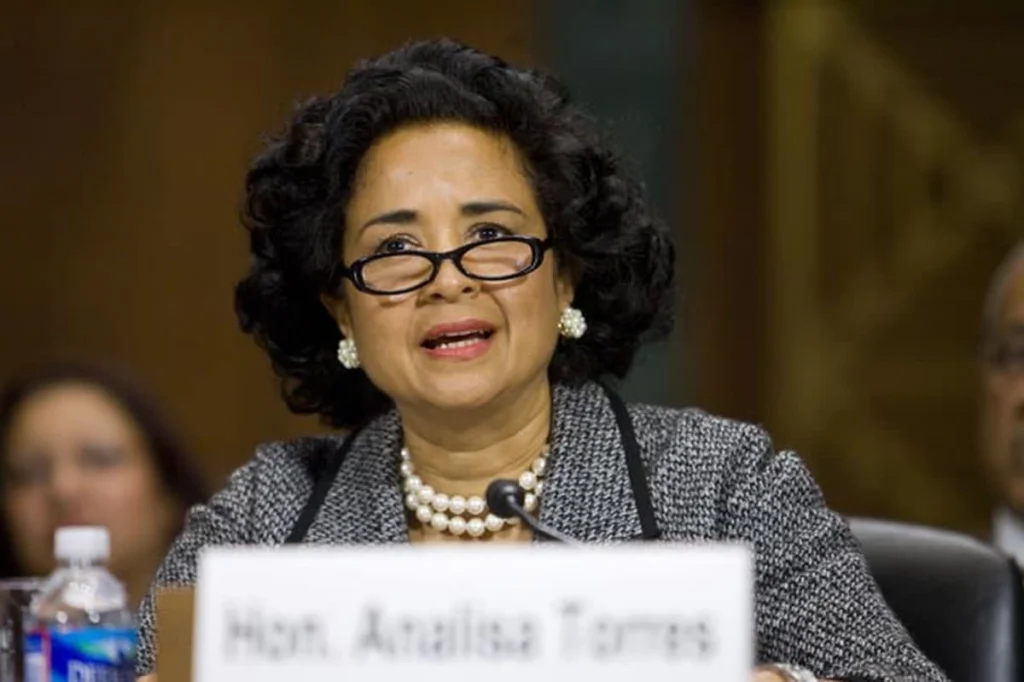
The federal case against Venezuelan President Nicolas Maduro has a new judge. Analisa Torres will preside over the Southern District of New York proceedings after the death of Alvin K. Hellerstein, court records confirmed Wednesday.
The tribunal posted a document covering the reassignment of matters “previously assigned to judges no longer serving due to retirement or death.” The notice names Torres as the magistrate now handling the file.
The court’s standard procedure produced the transition. A docket left by a deceased judge passes to a colleague, assigned without public choice. The reassignment document makes no special provision for the President Maduro file, treating it like every other pending matter.
Analisa Torres was born in New York in 1959. She reached the federal bench in 2013 by appointment of President Barack Obama, and she has since presided over a wide range of civil, criminal, and regulatory matters.
Her path runs deep in the law. Descended from a family of Puerto Rican judges, she graduated with honors from Harvard, earned her doctorate at Columbia Law School, and worked in private firms before entering the courts. Before her federal appointment she sat for almost a decade on the New York State Supreme Court. Earlier she served on the city’s civil and criminal benches.
The trial against the Venezuelan President and his wife remains set for June 14, 2027. The judge’s death did not alter that date, and the schedule already fixed by the court holds.
On October 15, President Maduro and Flores appeared at a judicial hearing in New York after prosecutors tightened the accusations against them. The two listened to the arguments and pleaded “not guilty” to the new charges of alleged conspiracy to commit torture brought by the U.S. Attorney’s office.
That same day Hellerstein accepted a request presented by both the prosecution and the defense to postpone the start of the trial by two weeks. The extra time allows both sides to present pretrial motions.
The next hearing was programmed for December 17. On that date the defense will argue its motions to dismiss the case. The outcome of those arguments could reshape the proceeding before it reaches a jury. President Maduro’s lawyers affirmed that sovereign immunity shields the President from prosecution in a foreign court.
Hellerstein’s career extended far beyond this single file. Over nearly three decades on the federal bench he supervised a wide variety of matters, including the litigation tied to the September 11 attacks.
That new judge will inherit the pretrial motions, the pending defense requests, and the responsibility of presiding over a trial that involves a sitting head of State and his spouse.
Venezuelan authorities have characterized the detention of President Nicolas Maduro and Cilia Flores as a kidnapping carried out during a military incursion into sovereign territory. The December 17 hearing stands as the next concrete step in a process scheduled to stretch into mid 2027.
Acting President Delcy Rodriguez demanded Wednesday that the Bank of England return Venezuela’s gold, calling the metal a Central Bank reserve that belongs to the Venezuelan people and declaring that no excuse remains.
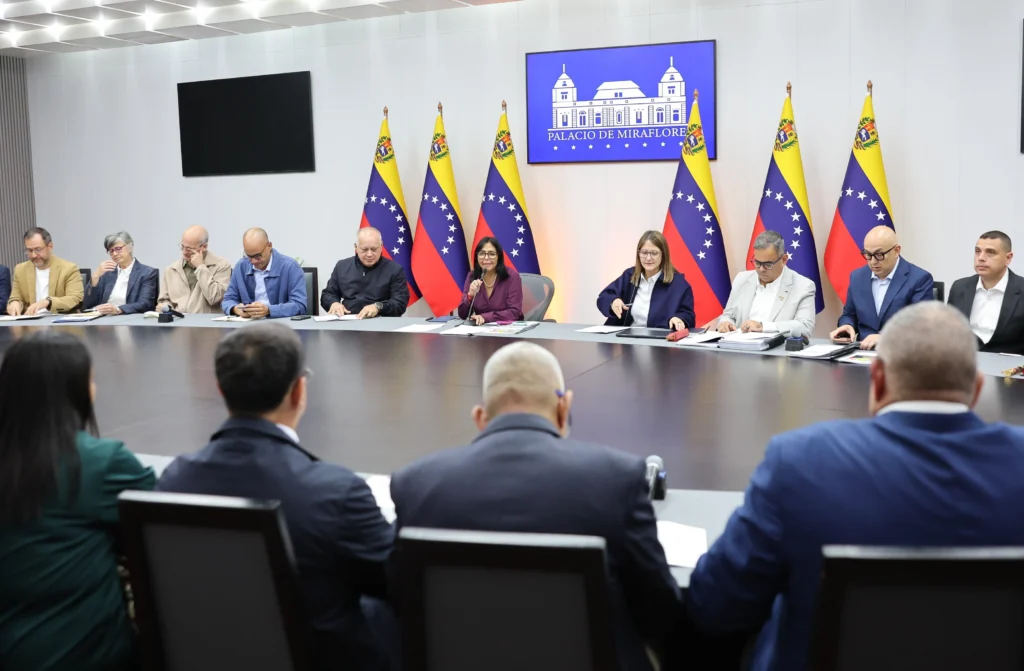
Venezuelan Acting President Delcy Rodriguez delivered the demand during a working meeting with the Council of Ministers and regional authorities held at Miraflores Palace. She insisted the gold constitutes a reserve of the Central Bank and belongs to the nation.
Rodriguez recalled that the National Assembly, including the 2015 legislature, had produced an agreement in which political sectors of Venezuela called for the gold’s return, framing the demand as a settled matter of national will.
The Acting President added that an irrational legal action that opposition figures had attempted was dropped by those same actors. That withdrawal, she argued, removed any remaining justification for the Bank of England to hold the metal.
“There is no excuse. That is the only thing I have to tell the Bank of England. They must return Venezuela’s gold, which belongs to Venezuelan men and women”, she stated.
The language was direct. Rodriguez offered no room for negotiation, framing the gold as a sovereign asset held outside the country against the will of Venezuelan institutions.
#28Oct | La presidenta encargada de Venezuela, Delcy Rodríguez, solicitó a la Cancillería de la República y a la Procuraduría General que inicien las gestiones correspondientes para recuperar el oro venezolano que se encuentra en el Banco de Inglaterra.
Text reads: “The Acting President of Venezuela, Delcy Rodriguez, requested the Ministry of Foreign Affairs and the Office of the Attorney General to initiate the appropriate steps to recover the Venezuelan gold that is at the Bank of England. “I will not stop demanding the Bank of England to return our gold. Enough excuses. There was an agreement”, said Rodriguez, referring to the agreement to recover international reserve assets reached last August during the first cycle of dialogue between the delegations of the elected National Assembly in 2015 and the government (…)”
Mining Push Grows
The same working session included a live link with Mining Minister Hector Silva from the Choco plant in Bolivar state. Silva confirmed the arrival of 41 surface machines, part of a total of 544 pieces of equipment purchased by the state.
Those machines are meant to boost gold and coal production. The government tied the mining drive to strengthening the country’s reserves and generating income for social projects, health care, and worker welfare.
The equipment delivery anchors the government’s broader argument. Venezuela insists it does not need foreign permission to manage its resources, whether gold underground or gold stored abroad.
The Bolivarian government also pledged a productive revival across the country to energize the engines of the economy and support organized local development. The gold demand sits at the center of that agenda. Every program announced, from ham production to health brigades, depends on revenue the government says its reserves should generate.
Venezuela has long argued that the Bank of England’s refusal to release the gold violates its sovereignty. Acting President Rodriguez renewed that claim in the sharpest terms, insisting the metal funds the welfare of a people, not the accounts of a foreign institution.
No response from the Bank of England appears in the official record. The demand now stands public, delivered from the presidential palace and addressed directly to London.
The Spain’s government has declared three days of national mourning, from October 29 to 31, for the 64 people killed in the collision of two passenger trains on October 28 in the province of Toledo.
The Spanish government declared three days of national mourning, to be observed on October 29, 30 and 31, 2026. The order requires flags to fly at half-staff on public buildings and military installations across the country during the three days.
Pedro Sánchez announced the measure in memory of those who died in the rail collision in the province of Toledo, in the autonomous community of Castilla-La Mancha.
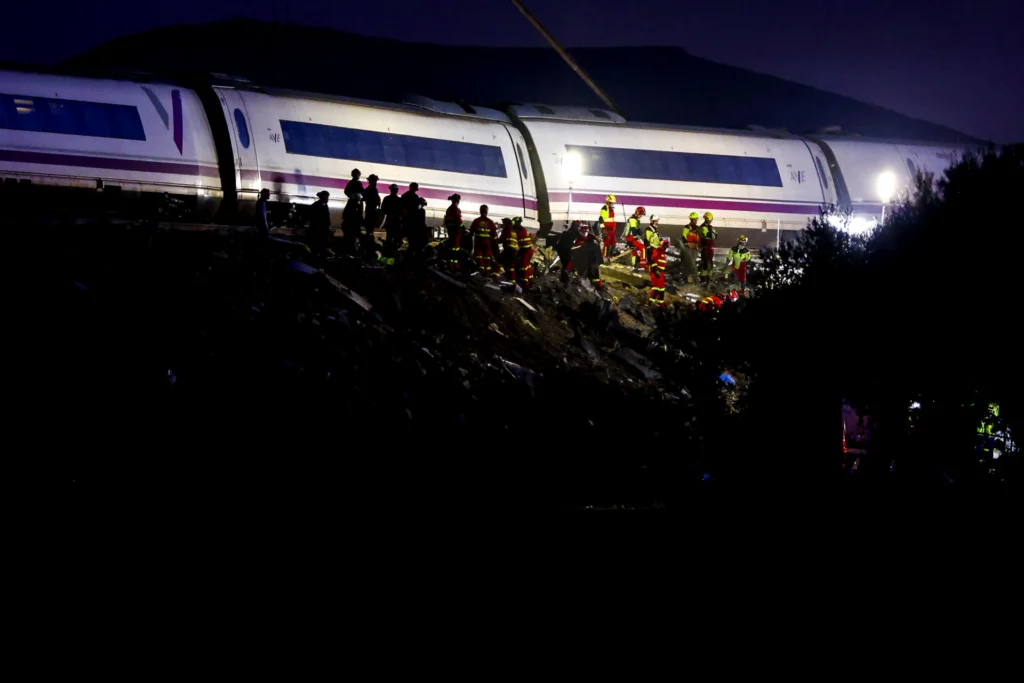
The impact occurred at 8:54 A.M. local time near the municipality of Urda. A high-speed AVE train, operated by state-owned Renfe, hit the rear of a train operated by the private company Iryo, which was stopped on the tracks. The collision derailed the last two cars of the Iryo train and sent several units down a ravine.
Following a deadly train crash near Toledo, Spanish PM Pedro Sánchez declares 3 days of national mourning and demands strict safety measures: "It is unacceptable for Spain to suffer two high-speed rail accidents in the same year." pic.twitter.com/IeiKNHndtf
The crash involved two operators that share Spain’s high-speed network. Renfe, which is state-owned, runs the AVE, while Iryo, which is privately owned, operates the train that was struck from behind. Both companies carry passengers on high-speed corridors.
65 people died in the crash, according to the President of Castilla-La Mancha, Emiliano García-Page. There were 544 passengers aboard the two trains at the time of the impact: 397 on the AVE and 147 on the Iryo, including a baby.
The rescue operation involved 100 members of the Military Emergencies Unit. The Civil Guard’s Major Disasters Team also took part. The search for bodies continues, meanwhile the injured remain in hospitals.
Official activity was suspended in the central government and in regional administrations while emergency teams continue their work at the crash site.
Sánchez traveled to Toledo to assess the response at the scene. King Felipe VI set aside his official engagements after speaking with the prime minister about what had happened. Both cleared their public schedules.
For her part, Health Minister Mónica García suspended her scheduled activities and merged state medical resources with the regional administrations of Madrid and Castilla-La Mancha to assist victims of the disaster in Urda. The order pulled national capacity and local response into a single coordinated operation.
Signaling and safety failures on the high-speed network are the focus of the technical investigation. Transport Minister Óscar Puente went to Atocha station in Madrid to review those systems. He also examined the factors surrounding the collision between the two trains.
‼️Accidente tren
🚨 La Guardia Civil ha desplegado en la zona personal de Seguridad Ciudadana de la provincia de Toledo, OMAC (Oficinas Móviles de Atención a la Ciudadanía) así como agentes del SEPRONA y de la Jefatura de Tráfico.
Text reads: “The Civil Guard has deployed personnel from the Citizen Security area of the province of Toledo, OMAC (Mobile Offices for Citizenship) as well as agents from SEPRONA and the Traffic Headquarters.”
The January Precedent
The Urda disaster follows a wreck that Spanish investigators still struggle to explain. In January 2026, on the Madrid-Andalucía route near Adamuz in Córdoba province, an Iryo train departing the capital derailed and struck another unit serving the Huelva-Madrid corridor.
That collision produced no immediate answers and the track had been renovated shortly before. The first train cleared its technical inspection only four days earlier, moving between 200 and 210 kilometers per hour. Minister Óscar Puente described the crash as a highly unusual event.
The consequences spread fast. Rail service toward the south of the country stopped temporarily while experts examined the wreckage. Atocha station, Madrid’s main rail terminal, absorbed massive cancellations as passengers rebooked or abandoned their journeys.
Months later, the cause remains open. Renovated track, a freshly inspected train, and routine high speed, none of it explained the collision. That unresolved record shaped the public mood when the news from Urda arrived.
Two railway disasters within a single year have now tested Spain’s emergency systems twice. January demanded a forensic response, an effort to understand an accident that defied easy explanation. Urda has demanded a medical one.
Spanish authorities have not yet released a complete account of the Urda disaster. Investigators will face the same task that followed Adamuz, determining what failed and why. The January wreck left a toll of 39 dead and more than 100 wounded, and the questions it raised remain unresolved as the country confronts a second emergency on the same network.
The national mourning decreed by the government will last until October 31. Technical teams will determine the causes of the crash and the condition of the signaling systems on that stretch of the network, as well the recovery of the hospitalized injured completes the authorities’ immediate agenda.
The Brazil’s government warned that false social media posts claimed the 6×1 workweek law had been changed and that social programs such as Bolsa Familia faced cuts, and it urged citizens to consult official sources.
The Secretariat of Social Communication (Secom), denied that any change had been made to the constitutional amendment that ends the 6×1 workweek.
The posts, which spread after the presidential run-off, offered incorrect information about labor legislation and social benefits.
Constitutional Amendment 141 guarantees two paid rest days each week without any reduction in salary. The way those free days are organized can be settled through collective bargaining, as long as the constitutional conditions are respected. The Secretariat of Social Communication stressed that the norm remains in force and untouched.
The false claims included an alleged exclusion of certain professional categories from the new rules. No such proposal exists. The Secretariat of Social Communication explained that conversations with different sectors concern only how to implement rules that have already been approved.
The reduction of the workweek will unfold gradually. The initial limit will be 42 hours a week, and later 40 hours, with no salary reduction at any stage.
The government offered a blunt explanation of why the Executive holds no power over the text. Since the measure is a constitutional amendment approved by the National Congress, the Executive cannot modify or veto it.
O Governo do Brasil alerta para informações falsas que circulam nas redes sociais neste período pós-eleitoral sobre um suposto recuo no fim da escala 6×1 e cortes no Bolsa Família e no Gás do Povo. pic.twitter.com/SIR0but5Vl
Text reads: “The Government of Brazil warns about false information circulating on social media in this post-election period about a supposed retreat at the end of the 6×1 scale and cuts to Bolsa Família and Gás do Povo.“
Welfare Programs Intact
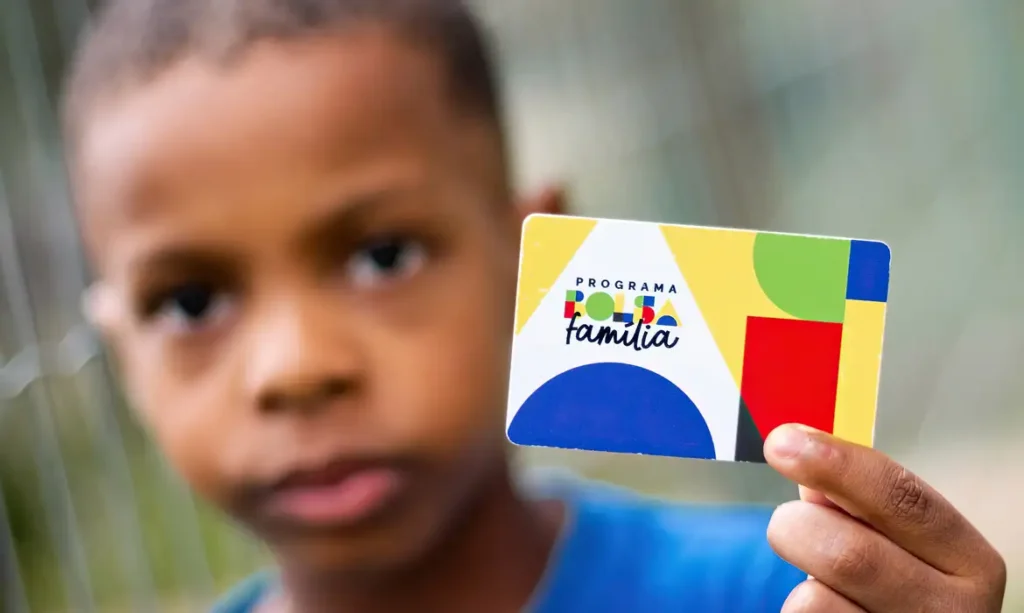
Separate rumors suggested that the Bolsa Família program faced suspension or reduced benefits. The Secretariat of Social Communication confirmed that the program keeps operating normally, with payments continuing and no cuts applied.
In October the minimum amount per family rose by 15.04%, from R$600 (about 112 U.S. dollars) to R$691 (around 129 U.S. dollars). That adjustment contradicted the online claims, since a program facing cuts does not raise its floor. Families can verify their information through the Bolsa Familia app, the Caixa Tem platform, or by calling 111, the direct line of the Caixa Economica Federal bank.
The government also rejected rumors about Gas do Povo, the program that provides free refills of 13-kilogram gas cylinders to families that meet the requirements. The Secretariat of Social Communication (Secom) affirmed that the initiative already has budget assigned for 2026 and that resources appear in the 2027 budget proposal sent to Congress.
The pattern was consistent across all the false messages. Each one targeted a program or a right that benefits working families, and each one crumbled against the official record.
The Secretariat of Social Communication (Secom) advised the public to distrust messages that do not identify reliable sources. Citizens should verify whether information has been confirmed by competent authorities before sharing it. The Social Direct Line 121 and official digital channels remain open for questions about benefits.
The warning reflects a government trying to contain a wave of misinformation at a politically charged moment. False posts about labor rights and welfare can spread faster than corrections, especially when they play on fear of losing income or benefits.
The facts, however, tell a different story. The workweek amendment stands. The Bolsa Familia Program pays more than before. Gas do Povo holds its funding for this year and next. None of the alleged changes appears in any official document.
The government’s message closed with a practical instruction. Before passing along a message about labor law or social programs, check the source. The tools to do so, apps and official channels, remain available.
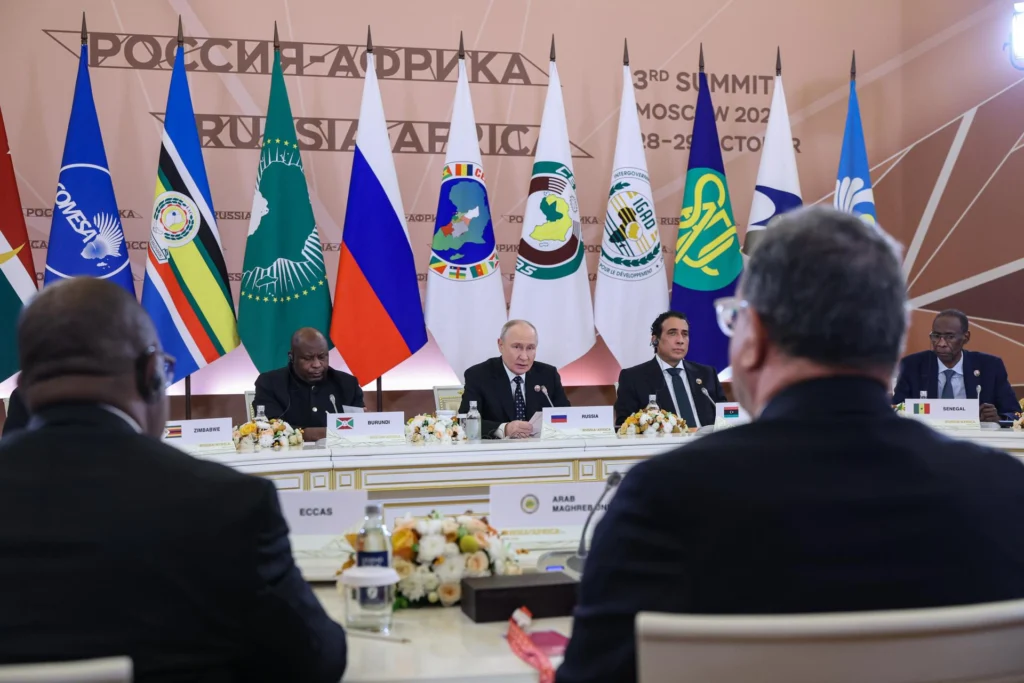
Serguéi Lavrov described Africa as a civilization in its own right and one of the pillars of an order that, in his view, is replacing five centuries of Western hegemony. Russia opens the third summit on Wednesday with 48 delegations and an offer to support the continent’s industrial and technological sovereignty, with the El Dabaa nuclear plant already under construction.
Serguéi Lavrov spent nearly an hour and a half on Tuesday with the heads of Africa’s leading media outlets, gathered in Moscow on the eve of the third Russia-Africa summit, and laid out how Russia sees the continent.
“We regard the African continent as a distinct civilization, one of the most important pillars of the multipolar world that is now, as an objective course of history, actively taking shape on the international stage, replacing the hegemony that Western countries have exercised for more than 500 years,” the Foreign Minister said.
According to Lavrov, Russia wants to help strengthen the sovereignty of African states, the development of their industries and greater self-sufficiency in the economy, finance and technology. The summit agenda, on October 28 and 29, groups those goals into four areas, namely political and economic cooperation, security, science and technology, and cultural and humanitarian ties.
Nearly all the delegations from the 48 confirmed countries are already in Moscow, and 22 of them are led by heads of state. On the table are 33 documents, among them an agreement on cooperation in artificial intelligence, and the 2027-2029 joint action plan, which Vladimir Putin and Burundi’s Évariste Ndayishimiye, the current chair of the African Union, will adopt at Thursday’s plenary session. Putin also has 24 bilateral meetings scheduled, with the leaders of Egypt, Ethiopia, Ghana, Mali and Libya, as well as Iran and Qatar, in a week when the Russian capital is also hosting the Gas Exporting Countries Forum.
Seven years separate this gathering from the first one, held in Sochi in 2019, which closed with 92 agreements worth some $12.5 billion. The second brought together delegations from 48 countries in St. Petersburg in July 2023, and since then the Russian Foreign Ministry has created the Department of Partnership with Africa to follow up on what was signed, while intergovernmental commissions grew from four in 2023 to nine in 2025. In August, Ministry Spokeswoman Maria Zakharova announced that Moscow would bring to this summit a package of contracts on peaceful nuclear energy, independent payment systems, food security, digitalization and artificial intelligence.
Paul Kagame confirmed his attendance after several Western governments suspended part of their financial aid to Rwanda in 2025, and in Moscow he will sign the creation of a cooperation commission with a country he has already invited to build fertilizer plants. Ghana, whose parliament is processing a military-technical cooperation agreement with Russia, has an open tender for its first nuclear power plant, a 1,000-megawatt facility, in which Rosatom is competing with suppliers from China, South Korea, Canada and the United States.
In 2023, oil, refined products, wheat and metals made up 90% of Russian exports to Africa, while Russia bought mainly fruit, cocoa and coffee. The balance leaves Russia with a surplus of more than $10 billion a year.
Settling that trade became harder when Russia’s exclusion from SWIFT in February 2022 cut off the usual channels of Russian banks. Moscow responded with its own payment network, in which the rublealready covers 84% of transactions with Africa, backed by the Russian financial messaging system, China’s CIPS, crypto assets and the A7 payment agent, which operates in Nigeria and Zimbabwe. For African importers the circuit still carries costs, since obtaining rubles requires a double conversion through dollars, exposes them to the volatility of that currency and leaves their banks open to Western secondary sanctions, which is why several banks on the continent refuse to process payments linked to Russia.
Egypt, which accounts for 30% of Russia’s trade with Africa, hosts the Russian Industrial Zone on the Suez Canal, agreed in 2018 for 50 years, which took its first step in July 2026 when Moscow selected the developer. An Egyptian government source estimates investment of up to $5 billion and completion in 2028, and goods made there with more than 30% local content will enter as Egyptian products the markets where Cairo has preferential agreements. Benedict Oramah, President of Afreximbank, the African Export-Import Bank, urged Russian companies to seize an open market in energy, mining, railways and health, and in June the bank signed contracts with four Russian manufacturers.
Uranium for Europe, Blackouts in Niger
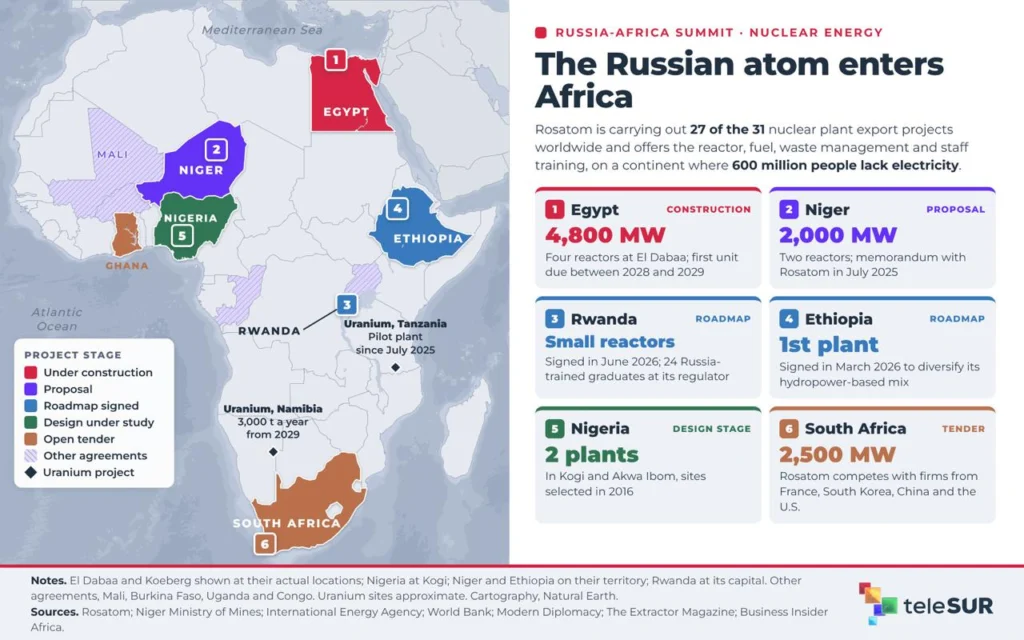
On Egypt’s Mediterranean coast, at El Dabaa, Rosatom is building four 1,200-megawatt reactors that will supply 10% of the country’s electricity. A Russian state loan covers most of a cost set in 2017 at $28.75 billion, which other estimates put at $30 billion, and the first unit is due to come online between 2028 and 2029.
The Russian corporation, which is carrying out 27 of the 31 nuclear plant export projects underway worldwide, offers a complete package covering the reactor, fuel, waste management and staff training over a 40- to 60-year lifespan, to a continent where some 600 million people live without electricity. The International Energy Agency estimates that universal access requires $15 billion a year, six times what was committed in 2023 for sub-Saharan Africa.
Niger, the world’s eighth-largest uranium producer, supplied France’s power plants for more than five decades (France gets about 70% of its electricity from nuclear power) and in 2022 provided almost a quarter of the natural uranium delivered to European plants.Only 20% of its 25 million inhabitants have electricity, and in Arlit and Agadez, where the ore is mined, coverage is close to zero. French company Orano took 86.3% of all the uranium sold from the Somaïr mine since 1971, more than its 63.4% shareholding. General Abdourahamane Tiani’s government nationalized the mine and the power utility Nigelec in June 2025, and although a tribunal of the International Centre for Settlement of Investment Disputes ruled in Orano’s favor in September and barred the sale of the ore, some 1,000 tonnes of concentrate are waiting at Niamey airport. The French press reported a deal to sell them to Rosatom.
Niger’s Mines Minister, Ousmane Abarchi, brought to Moscow a proposal for two reactors totaling 2,000 megawatts. “Electricity must be accessible to everyone on this planet; it should not be a privilege,” he said, and his Russian counterpart for energy, Sergei Tsivilev, replied that Moscow wants to build a complete peaceful nuclear energy system in Niger, beyond mining.
A plant of that size takes ten to fifteen years from contract signing to the first unit in operation, and costs tens of billions of dollars. The Russian model, tested in Egypt and Bangladesh, rests on state loans repaid over decades, and analysts following the case note that in Niger the most visible collateral is the uranium itself.
In Namibia, the world’s third-largest uranium producer, Rosatom plans to invest $500 million in a mine set to start production in 2029. Rwanda signed a roadmap in June for small modular reactors, Ethiopia signed another in March for its first power plant and Nigeria resumed the design of two plants. South Africa, home to Koeberg, the continent’s only commercial nuclear plant, launched a tender for 2,500 megawatts in which Rosatom is competing with French, South Korean, Chinese and U.S. companies.
Rosoboron export has military-technical cooperation agreements with 46 African countries and has signed some 150 contracts worth more than $20 billion since 2023. Between 2020 and 2024, Russia was the continent’s leading supplier of heavy weapons, with 21% of imports, ahead of China and the United States, helped by a Soviet-era arsenal that still needs spare parts and by contracts free of political conditions. Even with the war in Ukraine, which cut its global arms exports by 64% between 2021 and 2025, Africa accounts for 30% of the state company’s order book.
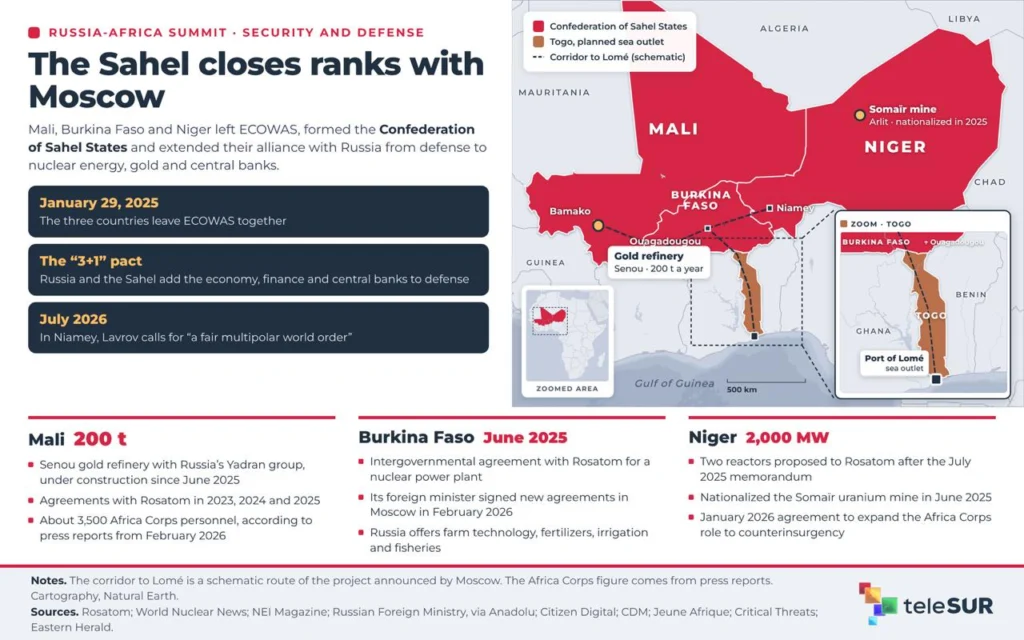
Mali, Burkina Faso and Niger asked French troops to leave, formed the Confederation of Sahel States and opened their barracks to the Africa Corps, the force that replaced the Wagner Group under the direct command of Russia’s Defense Ministry. The “3+1” pact, signed in Niamey, extends cooperation to the economy and the central banks of the three countries, and Moscow plans to use the Togolese port of Lomé as a sea outlet for a landlocked region.
In July, during the second round of consultations with the Sahelian foreign ministers in Niamey, Lavrov spoke of building together “a fair multipolar world order” against “neocolonial practices.” Russia reopened its embassy in Niger this year, and Putin asked his Foreign Minister to invite the three presidents to the summit.
The alliance is fighting the jihadist coalition JNIM, which in September 2025 blockaded fuel supplies to Bamako and in April 2026 forced the Africa Corps out of Kidal. When Human Rights Watch attributed killings of civilians to Russian forces in July, Moscow and Bamako jointly rejected the accusation.
Lavrov announced in August a security memorandum with ECOWAS, the bloc the three Sahelian countries left in January 2025, and offered to mediate between the two; the regional organization has not yet confirmed the scope or the signing date.
Washington Tries the Russian Formula
The break with Niger cost the United States the withdrawal of 1,000 troops and a $110 million drone base in 2024, and Donald Trump brought a transactional approach. Massad Boulos, the presidential adviser for Africa, toured Burkina Faso, Mali and Niger in early 2026 and acknowledged past mistakes in the name of sovereignty, while Erik Prince, owner of a military contracting firm and an informal adviser to Trump, has been meeting with Madagascar’s junta since late 2025.
A U.S. company agreed in late 2025 with Mali’s state mining company to revive a gold deposit valued at $11 billion. In Madagascar, Washington is negotiating the $700 million Toliara project to extract titanium, zirconium and rare earths, along with a proposal for a military presence at the former naval base of Antsiranana. Colonel Michaël Randrianirina, who came to power after the overthrow of Andry Rajoelina, received Russian drones and instructors and U.S. envoys almost at the same time.
The Washington think tanks that call the Russian offer a “survival package”for military governments now note how their own government is adopting a similar scheme, with security in exchange for minerals.
From Classrooms to Fields
The places Russia funds for African students rose from 2,100 in 2021 to about 4,800 in 2026, and some 35,000 young people from the continent are now studying at Russian universities. The Association of African Universities opened an office in October at St. Petersburg Mining University, and Rwanda already has 24 graduates in nuclear fields working at its Atomic Energy Board and the country’s regulator.
Russia’s ambassador to Burkina Faso, Igor Martynov, pledged technology transfers in agronomy, fertilizers, irrigation, fisheries and animal vaccines. In Togo, which signed a military agreement with Russia in 2024 and keeps its security channels with the West open, the first intergovernmental commission closed on October 1 with a protocol, a memorandum on cultural heritage and plans for mechanization and fertilizer production from local phosphate.
Egypt is building its nuclear plant with Rosatom without distancing itself from Washington or the Gulf monarchies, South Africa defends its non-alignment and Ethiopia joined BRICS without breaking with its Western lenders. According to an analysis published within that bloc’s orbit, Russia is welcome in Africa wherever it offers what others do not.
This week’s 33 documents will add to the 92 from Sochi and those from St. Petersburg, and the 2027-2029 plan will have its first milestones at the Suez industrial zone in 2028 and, a year later, at the first unit of El Dabaa and the Namibian mine. With those projects, Moscow seeks to give concrete form to the idea of Africa as a pillar of the multipolar world that Lavrov laid out on Tuesday before the African media.
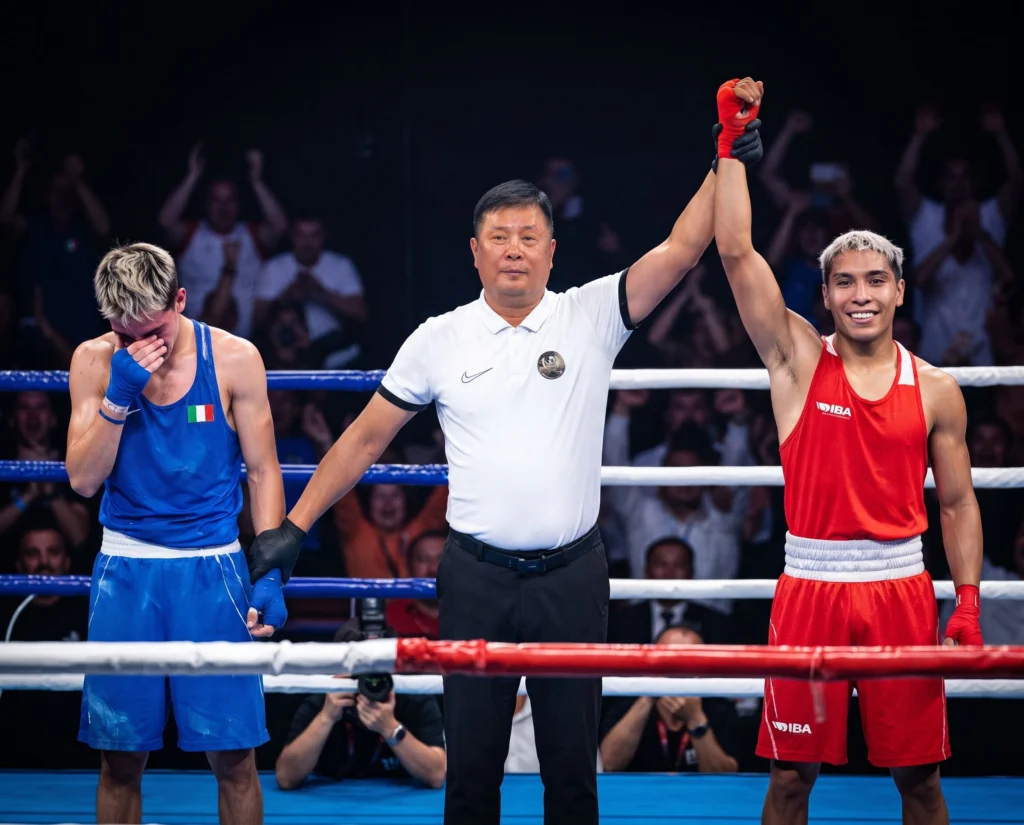
Eighteen-year-old Argentine boxer Edgardo Nicolás Peralta won the under-19 world title in Budva, Montenegro, on Tuesday, beating Ireland’s Kalib Walshe by unanimous decision to claim his country’s first gold medal at the tournament.
Argentina celebrated a historic first in youth boxing on Tuesday. Edgardo Nicolás Peralta, an 18-year-old from the city of Reconquista in Santa Fe province, was crowned world champion in the under-60-kilogram division at the Under-19 World Boxing Championships in Budva, Montenegro.
The medal is the first gold the country has ever claimed at the event, which is organized by World Boxing, the body that governs international Olympic boxing.
Peralta closed the tournament with a flawless record. In the final he defeated Irish boxer Kalib Walshe by unanimous decision, the fifth straight victory of a campaign that also saw him beat opponents from Belarus, Romania, Spain and Kazakhstan. His versatility in the ring and a rigorous technical preparation allowed him to dominate each bout and place himself among the elite of his discipline.
Edgardo Nicolas Peralta completes a brilliant campaign in Budva 🇦🇷🔥
The Argentine defeats Ireland’s Kalib Walshe in the men’s 60kg final to become a U19 World Champion 🥇
The triumph carries weight beyond the medal itself. Peralta’s run through five opponents underscored a level of consistency rarely seen from a first-time representative at this stage. Judges scored the final decisively in his favor, confirming the dominance he had shown from the opening bell of the tournament.
His path to the top was built in Argentina’s amateur circuit, far from the spotlight that surrounds professional boxing. The young fighter honed his craft in working-class neighborhoods, relying on daily sacrifice from his family and his immediate circle rather than on institutional backing.
That lack of support nearly cost him the final. The delegation traveled to Montenegro with scarce official assistance and faced severe logistical problems. The scheduled return flight coincided exactly with the time of the gold-medal bout, forcing the team to scramble for a change. The national sports agency (ENARD), refused to adjust the air tickets, according to the reports.
🇦🇷 I Justo cuando Argentina -tras 20 años- se quedó sin ningún campeón mundial profesional (ni hombres, ni mujeres, ni interinos) aparece Nicolas Peralta (69-0) y se consagra -con 18 años recién cumplidos- como el mejor boxeador juvenil en toda la historia amateur del país. pic.twitter.com/W4nsDxEzlv
Text reads: “Just when Argentina – after 20 years – was left without any professional world champions (men, women or interim) appears Nicolas Peralta (69-0) and is consecrated – at 18 years old – as the best youth boxer in the entire amateur history of the country.”
No Official Support
The financial barriers and the persistent absence of state backing did not stop Peralta. His family’s everyday effort sustained a career forged far from privilege, and the result on Tuesday vindicated that persistence against what Argentine media have described as official neglect.
The contrast is stark. While the young boxer celebrated on the podium, his delegation had spent the hours before the fight resolving a travel schedule that never accounted for the possibility of an Argentine reaching the final. The episode lays bare the wider conditions facing amateur athletes in Argentina, where talent often outruns the support available to develop it.
Peralta’s gold marks a milestone for Argentine boxing and for the country’s youth sport. It also sends a message about the potential waiting to be unlocked when athletes from popular neighborhoods get a genuine chance to compete on the world stage.
The victory positions Peralta as one of the rising names in international amateur boxing, with the under-19 title serving as a platform toward senior competition. His next steps will likely draw attention from federations and sponsors alike, though the structural problems that almost derailed his final remain unresolved.
Brazil’s Supreme Federal Court ordered an investigation Tuesday into Flávio Bolsonaro’s presidential campaign over suspected illegal foreign financing, algorithmic manipulation on digital platforms and possible deals involving strategic minerals.
The ruling targets the campaign of the far-right senator who lost the 2026 runoff to Luiz Inácio Lula da Silva. Justice Flávio Dino issued the decision under a constitutional action (the Fundamental Precept Non-compliance Argument 1178 (ADPF), after formal requests from Lula’s campaign and from former presidential candidate Renan Santos of the Missão movement.
The Court stressed that Brazil’s Constitution and laws expressly bar parties and candidates from receiving funds from foreign entities or governments.
At the center of the inquiry sits Rockbridge Network, a conservative U.S. organization tied to the political origins of JD Vance, now U.S. Vice-president.
Federal Police will determine whether the group, through the alleged mediation of Brazilian businessmen Tallis Gomes and Pedro Sang, offered financial resources, services or economic advantages to the campaign of the Senator Flávio Bolsonaro, the Liberal Party’s presidential candidate.
Breaking: Supreme Court Minister Dino has ordered a police investigation into foreign interference in the elections. It is already widely known that the US government and US tech companies were meddling to benefit Flávio Bolsonaro’s failed presidential bid. pic.twitter.com/xWSQXqnmfl
Investigators will also examine possible underlying geopolitical and economic interests. The probe will look into whether negotiations linked political financing to the exploitation and control of strategic minerals and rare earth elements on Brazilian soil, resources that have drawn marked interest from the government of Donald Trump.
The Court framed the case as a matter of national sovereignty. Foreign interference in an election, the ruling argued, does not merely distort the vote; it compromises the state’s ability to decide its own direction. That framing elevates the investigation beyond a routine campaign finance dispute.
Ten federal agencies received the order to carry out the work, which includes the Brazilian Intelligence Agency (Abin), the Council for Financial Activities Control (Coaf), the Federal Revenue Service and the Central Bank.
Failed far-right candidate Flávio Bolsonaro has reportedly fled Brazil to the US where he intends to seek political asylum, according to news website Metrópoles, citing people close to the Bolsonaro family. After Flávio missed a Tuesday morning deadline to surrender his… pic.twitter.com/xZQHoj1Cn9
The technological front carries equal weight. The Supreme Court ordered an inquiry into the role of Meta, owner of WhatsApp, Instagram and Facebook, after detecting what the ruling describes as “intentional asymmetries and algorithmic manipulations.”
Case documents reveal internal messages in which employees admitted restrictions on the promotion of Lula’s ads while Flávio Bolsonaro’s profile received irregular positioning. UN experts had previously warned of the risk of an artificial electoral imbalance.
Federal Police will also trace paid content favorable to the far right that was distributed through accounts based abroad without proper identification of the contractors, as well as the use of Polymarket projections to tilt public perception.
The pressure on Meta is not new. On October 15 a judge had already barred the company from interfering in the distribution of electoral content following complaints from progressive sectors. Meta denied any favoritism, attributing the imbalance to an artificial intelligence glitch that benefited the Liberal Party candidate. The current process now escalates to criminal and national security levels.
For Flávio Bolsonaro, the investigation compounds an already difficult legal position. The same Court recently ordered him to surrender his passports, and lawmakers have sought his preventive detention and an Interpol red notice over a reported flight to United States. The new probe broadens the scope from his personal conduct to the machinery that financed and amplified his campaign.
Whether Rockbridge or Meta ultimately face charges depends on the evidence Federal Police gathers. The Court’s message, however, is already clear: foreign money and foreign platforms will not operate in Brazil’s elections without scrutiny.
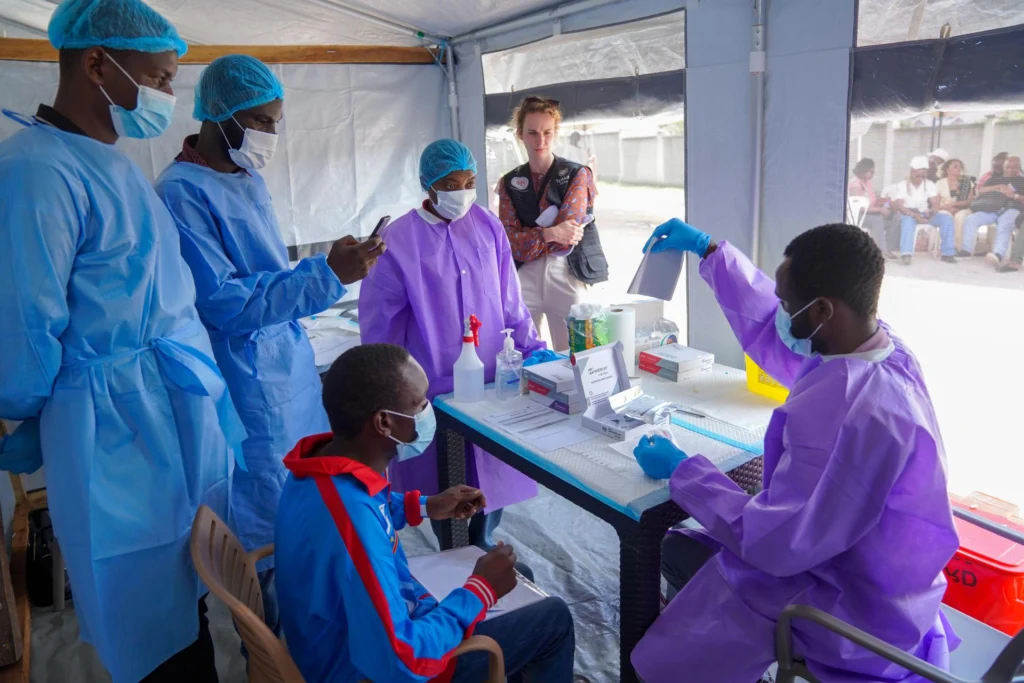
The Ebola outbreak in the Democratic Republic of the Congo (DRC) surpassed 10,000 confirmed cases on Tuesday, with 4,887 deaths recorded since the epidemic was declared in May.
The Ebola outbreak in the Democratic Republic of the Congo crossed a critical line on October 27, when confirmed infections passed the 10,000 mark. The National Institute of Public Health (INSP), announced the milestone with figures current through October 25.
The official tally stands at 10,060 cases and 4,887 deaths since the outbreak was declared on May 15. In just over five months, the virus has spread well beyond its initial clusters.
Nearly half of those infected have not survived. The case fatality rate reached 48.6%, a level that makes this one of the deadliest health emergencies on record. It also confirms a trend the institute had flagged weeks earlier, when the outbreak first crossed the 9,000 infection mark.
❗️EBOLA SURPASSES 10,000 CASES IN DR CONGO — Reuters
The virus killed 4,887 people, with confirmed infections reaching 10,060
Only the West African epidemic of 2014 to 2016 was worse. That crisis left roughly 11,000 dead and 28,000 cases across Guinea, Liberia and Sierra Leone. The current Congolese outbreak now ranks second in global history and has already outpaced the Ebola epidemic that struck the country’s eastern region between 2018 and 2020.
Transmission now spans 66 health zones in eight of the DRC’s 26 provinces, less than a third of the national territory. Ituri and North Kivu carry the heaviest burden. Tshopo, Bas-Uélé, Haut-Uélé, South Kivu, South Ubangi and North Ubangi follow behind. Bafwasende, Beni, Mandima and Bunia face the most critical conditions on the ground, the health agency warned.
“The situation underscores the need to strengthen early detection, contact tracing, dignified and safe burials, and the safety of response teams, especially in Bafwasende, a town in Tshopo province,” National Institute of Public Health’s authorities said.
Recovery figures offer a narrow thread of hope. A total of 2,684 patients have overcome the illness, and contact tracing coverage holds at 81.6%. Even so, the institute described early detection, safe burials and protection for field teams as urgent in the hardest-hit zones.
WHO is working closely with the DRC Government to intensify and sustain the #Ebola response.
During his recent visit to Beni, @ProfJanabi engaged with communities and handed over supplies and equipment, including motorbikes and #IPC materials, to strengthen the response. pic.twitter.com/CtuxNcDstT
The outbreak is driven by the Bundibugyo strain, a lineage with no specific treatments. That gap has pushed scientists toward new solutions. The World Health Organization is advancing two experimental vaccines, and their phase 1 human trials have already produced safe profiles.
The country is also running an immunization campaign with Ervebo, a product developed for the Zaire variant that showed favorable signs in animal tests. But the experimental candidates have only reached the earliest stage of evaluation in people, while Ervebo rests on limited preclinical evidence. Neither option yet offers a conclusive tool to stop transmission.
The cumulative data through October 25 shows the epidemic is far from contained. Health workers confront a virus without a specific therapy across a vast territory where contact tracing is uneven. The National Institute of Public Health has already set the immediate priorities, halting the spread and protecting the teams deployed on the ground.
Lawmakers from Brazil’s ruling Workers’ Party (PT) asked a court on Tuesday to order the preventive detention of former presidential candidate Flávio Bolsonaro and trigger an Interpol red notice, accusing him of fleeing to United States to evade Brazilian justice.
The request landed one day after the far-right senator ignored a Supreme Federal Court order to surrender his passports within 24 hours. He had previously said he would comply with the measure and had no plans to leave Brazil.
Federal deputy Lindbergh Farias filed the motion alongside colleagues Rogério Correia and Ana Elisa Santos. “We have filed a request for preventive detention for Flávio Bolsonaro, who did not surrender his passport and has allegedly fled to United States,” Farias explained. “We have also asked for the Interpol red alert to be activated,” he detailed.
The lawmakers argue that Jair Bolsonaro’s eldest son is trying to dodge criminal proceedings opened against him over alleged corruption, money laundering and illegal currency transfers. Correia went further, assuring the former candidate “was plotting a new coup attempt in case he did not win the elections.”
🚨AGORA: Os deputados federais Lindbergh Farias, Ana Elisa e Rogério Correia pedem prisão de Flávio Bolsonaro e alerta vermelho da Interpol. pic.twitter.com/aRjy0px2S4
Regional media reported from the early hours of Tuesday that the senator had left national territory bound for United States, with a stopover in Argentina, but his exact whereabouts remain unknown. His campaign team has stayed silent, neither confirming nor denying the reports of a flight.
Brazilian Federal Police reinforced inspections at border points and kept inquiries open to determine whether he actually left the country. The order demanding his passports grew out of a recent interview with his brother Eduardo Bolsonaro, who suggested that Flávio should leave Brazil and contest the vote count if he suffered an electoral defeat.
Flávio Bolsonaro now faces a tightening legal perimeter. At the Supreme Federal Court, Justice Alexandre de Moraes oversees investigations into money laundering schemes connected to betting houses and large transfers with lawyer Willer Tomaz. Justice André Mendonça runs separate probes into irregularities in fundraising for the film “Dark Horse.”
The alleged escape raises the stakes of those cases. A defendant who remains inside the country can fight charges through the courts; one who crosses a border becomes the subject of an international pursuit, and the request filed Tuesday is aimed at exactly that outcome.
The episode carries a family precedent. Eduardo Bolsonaro has lived in United States since 2025 to avoid a four-year prison sentence for coercion of justice in the coup attempt trials against their father, former President Jair Bolsonaro. Flávio’s own passport order traces back to Eduardo’s public suggestion that his brother flee and challenge the results.
That connection is now central to the Workers’ Party argument. The lawmakers contend the senator’s failure to hand over his passports was not a bureaucratic lapse but a deliberate move to escape accountability, a claim the defense has not addressed while the campaign team holds its silence.
The court will now weigh the detention request against the evidence that Flávio Bolsonaro left the country. If the Interpol red notice is activated, it would oblige member states to locate and provisionally arrest him, transforming a domestic legal dispute into an international manhunt.
For now, Brazilian authorities are working to confirm the exact circumstances of his departure. The investigation will determine whether the border crossing was legal, and whether any official assisted it. Those questions will shape the next phase of a case that has already drawn the attention of the entire region.

 Login