❌

Reading view

US stocks slide as Google parent's revenue miss revives AI spending jitters

US stock prices retreated on Thursday, with investors reassessing big tech’s massive AI spending spree as they digested high-profile earnings, crucial inflation data and the US Federal Reserve’s policy decision.

All three major US stock indexes were in negative territory, with the Nasdaq dragged sharply lower by tech and tech-related megacaps in the wake of Alphabet’s disappointing quarterly results released late Wednesday.

In contrast, the smallcap Russell 2000 advanced 0.8 per cent.

Semiconductor stocks were poised to snap their four-day winning streak, dropping 2.0pc as investors sought to distinguish between companies that can fund their lofty AI ambitions from those that burn through cash and borrow funds to realise their ambitions.

Alphabet was in the latter camp following its quarterly report released late on Wednesday. The Google parent’s revenue miss was compounded by its accelerated AI-related cash burn. Its shares slid 13.2pc.

“A risk-off day like this, with small caps outperforming, is a good sign that thus far the market’s interpretation of cracks in the AI story doesn’t mean cracks in every corner of the market,” said Ross Mayfield, investment strategy analyst at Baird in Louisville, Kentucky.

“There’s plenty of other places to go with your money outside of the AI trade that have pretty decent prospects.”

On Wednesday, Federal Reserve policymakers chose to hold US rates steady, acknowledging that while price pressures remain “elevated”, the central bank will decide on its next move as it “accumulates more information”.

A raft of economic data released on Thursday answered that call, with a first take on third-quarter GDP that showed the US economy grew at a faster-than-expected pace in the third quarter, while price growth continued to gain heat with a war-related oil supply crunch feeding into broader, systemic inflation.

The Dow Jones Industrial Average fell 315.36 points, or 0.59pc, to 52,163.07, the S&P 500 lost 48.73 points, or 0.63pc, to 7,695.25 and the Nasdaq Composite lost 441.15 points, or 1.66pc, to 26,108.35.

Among the 11 major sectors in the S&P 500, communication services and tech were down the most, while healthcare led the gainers.

Third-quarter earnings season has crossed the halfway point, with 253 of the companies in the S&P 500 having reported. Of those, 81pc have beaten analyst expectations, according to the most recent LSEG data.

Analysts now expect aggregate third-quarter S&P 500 earnings growth of 31.0pc, year-on-year, per LSEG.

Caterpillar topped quarterly profit estimates but left its growth targets unchanged. The heavy equipment maker’s shares tumbled 9.5pc.

Eli Lilly jumped 6.3pc after the drugmaker lifted its revenue outlook on the strength of weight-loss drug sales.

Ford gained 2.9pc following the automaker’s third-quarter revenue beat.

Merck beat earnings expectations on the strength of its cancer drug Keytruda and its HPV vaccine Gardasil. The drugmaker’s shares advanced 4.4pc.

Software stocks were broadly weak. Fortinet and ServiceNow dropped more than 20pc each after their quarterly results.

Marvell Technology slumped 12.8pc after media reports said the company was in advanced talks to buy data-centre optics maker Lumentum Holdings. Lumentum shares rose 2.0pc.

Amazon’s shares were off 3.9pc ahead of its earnings report, expected after the closing bell.

Advancing issues outnumbered decliners by a 1.59-to-1 ratio on the NYSE. There were 113 new highs and 155 new lows on the NYSE.

On the Nasdaq, 2,416 stocks rose and 2,221 fell as advancing issues outnumbered decliners by a 1.09-to-1 ratio.

The S&P 500 posted 19 new 52-week highs and six new lows, while the Nasdaq Composite recorded 81 new highs and 131 new lows.


  •  

Afghanistan's Rashid Khan becomes first men's player to claim 200 T20I wickets

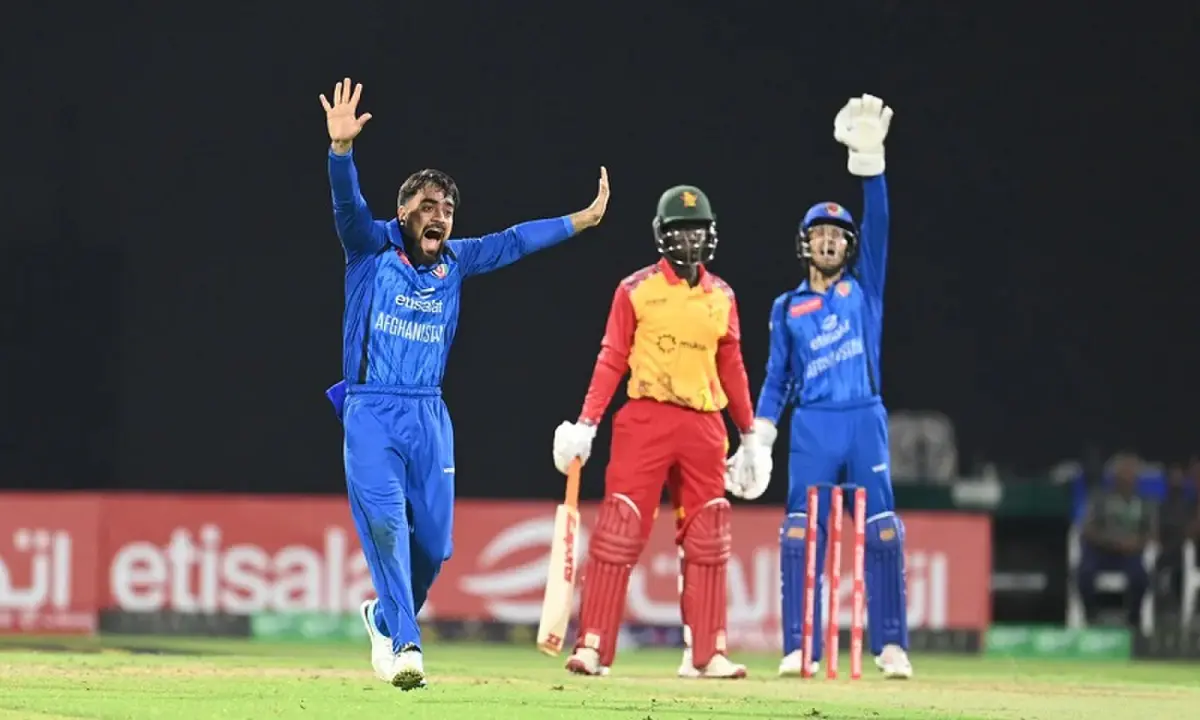
Former Afghanistan captain Rashid Khan became the first bowler to claim 200 wickets in men’s Twenty20 Internationals on Thursday, reaching the milestone during Afghanistan’s second T20 against Zimbabwe in Sharjah.

The leg-spinner brought up the landmark when he trapped Tadiwanashe Marumani lbw for two in the ninth over.

Rashid achieved the feat in his 120th T20 international, with the 28-year-old boasting an average of 13.96 and an economy rate of 6.13 in the format.

His record includes two five-wicket hauls, with best figures of 5-3.

The Afghan sits comfortably atop the list of leading wicket-takers in men’s T20 internationals with 200 wickets, 29 clear of England’s Adil Rashid in second place.

Rashid Khan became the first Afghanistan bowler to reach 200 ODI wickets during a match against Bangladesh in Abu Dhabi in October last year.

  •  

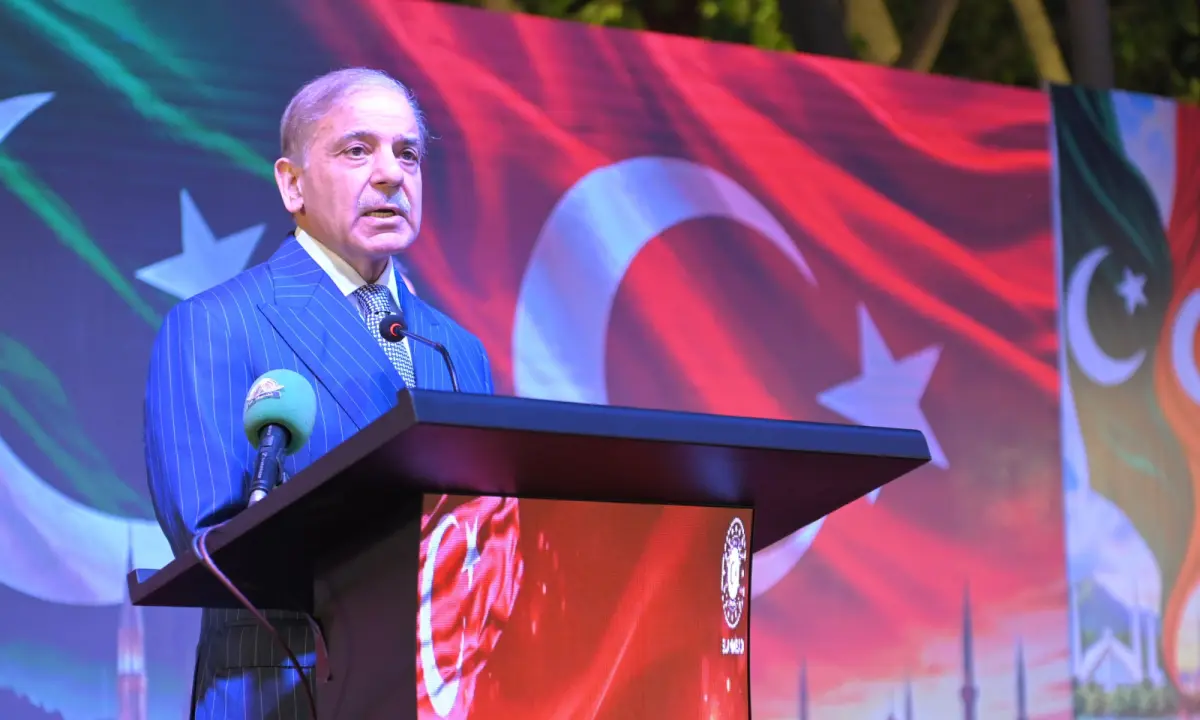
Pakistan, Turkiye shall 'continue to champion dialogue, diplomacy' alongside bolstering defences: PM Shehbaz

Prime Minister Shehbaz Sharif on Thursday affirmed that Pakistan and Turkiye would continue to push for dialogue and diplomacy while strengthening their defences under the Makkah Defence Agreement.

He made the remarks while addressing an event in Islamabad marking the 103rd national day of Turkiye, with which Pakistan enjoys strong bilateral ties and maintains multi-sectoral cooperation.

The premier said the pact, signed on Aug 7 between Pakistan, Turkiye and Saudi Arabia, marked an “important milestone” in cooperation between Islamabad and Ankara.

“It strengthens our collective deterrence and reinforces our shared commitment to regional peace and stability,” PM Shehbaz noted.

“While we strengthen our defences, we shall continue to champion dialogue, diplomacy, respect for international law and the peaceful settlement of disputes.”

The prime minister hailed Turkiye’s diplomatic support during Marka-i-Haq last May, when India initiated unilateral aggression against Pakistan, triggering a four-day conflict between the nuclear-armed neighbours.

“Turkiye stood firmly by our side with unwavering commitment and dedication. This sincere act of solidarity was a profound source of comfort and strength for the people of Pakistan, a gesture that will forever remain etched in our hearts and our memories,” he emphasised.

Additionally, the premier observed that Islamabad and Ankara’s relationship had evolved into a “multifaceted strategic partnership”, spanning political dialogue, defence, trade, culture and people-to-people ties, among other areas.

He stressed that the economic partnership between Pakistan and Turkiye needs to match the heights of the political and strategic bond between both nations.

“In July this year, at the Pakistan-Turkiye business conference in Istanbul, I announced the establishment of the President Tayyip Erdogan Special Economic Zone in Karachi,” PM Shehbaz said.

“Now I invite Turkish businessmen to look at Pakistan with its young population, strategic location and growing economic opportunities. Let us translate the goodwill between our two peoples into joint ventures, shared prosperity and meaningful jobs for our young people.”

During his speech, the prime minister highlighted the longstanding, historic ties that the two countries shared, recalling that during the Khilafat Movement — a campaign to protect the Ottoman Empire after World War I — people donated whatever they could from the subcontinent, including money and jewellery, to support their “Turkish brethren”.

“A century ago, our forefathers sent their love across the seas. Generations later, that love returned to our doorsteps during our darkest times,” he added, referring to humanitarian aid from Turkiye during the 2005 earthquake and the devastating floods of 2010.

PM Shehbaz also highlighted that under Turkish President Recep Tayyip Erdogan’s instructions, Turkiye established a modern hospital, a school and modern villages for the people of Muzaffargarh after the floods.

“The 100 years between the Khilafat Movement and that moment seemed to close into a single circle,” the premier said, noting that when a massive earthquake rocked Turkiye in February 2023, “the people of Pakistan grieved as if the rubble lay upon our own homes”.

“We stood with our Turkish brothers and sisters, in their hour of sorrow, just as they had stood with us.”

Earlier this week, Pakistan, Turkiye, Saudi Arabia and Iran participated in a quadrilateral meeting where Iranian President Masoud Pezeshkian called for “regional unity” and hoped that the presence of other Islamic powers would “further consolidate regional unity and cohesion”.

Earlier this month, both nations signed an agreement to enhance cooperation in combating terrorism, narcotics trafficking and organised crime and agreed to establish a joint working group to strengthen collaboration between their interior ministries.

The decisions were taken during a meeting between Interior Minister Mohsin Naqvi and his Turkish counterpart Mustafa Çiftçi in Istanbul.

  •  

Pakistan 'overperformer' in innovation, climbs 4 ranks globally in 2026: report

ISLAMABAD: Pakistan rose to 95th place among the 139 economies of the world featured in the ‘Global Innovation Index 2026’ published by the World Intellectual Property Organisation (WIPO), it emerged on Thursday.

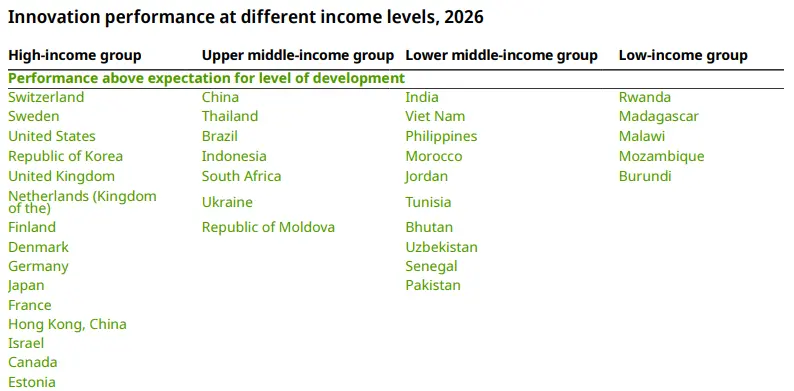
Advancing in rank from 99th place in 2025, Pakistan also reclaimed its “overperformer” status for the fourth time, a status given to economies identified as performing above expectations for their level of economic development. It also held the status in 2022 and 2024.

The global index report showed that Pakistan performed better in innovation outputs than innovation inputs in 2026. This year, Pakistan ranked 121st in innovation inputs and 72nd in innovation outputs — both higher than last year.

“Innovation overperformance shows that innovation does not follow a straight line from income to results,” the report said.

“The 2026 overperformers show that economies can generate more innovation than expected for their level of development when they build on focused strengths.”

A list of countries that performed above expectations for their level of development in innovation in 2026, according to the Global Innovation Index 2026. — screengrab from WIPO report

WIPO highlighted that Pakistan’s strengths were concentrated in the digital economy, particularly mobile app creation, ICT services exports, high-tech imports, and software spending. It added that the country’s “relatively strong” scientific production and university quality supported a developing digital economy.

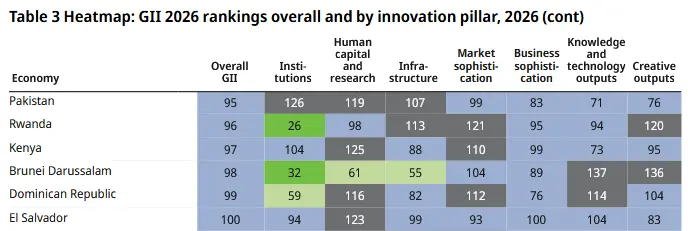
In the 2026 index, Pakistan ranked 15th among the 36 lower middle-income group economies and eighth among the 11 economies in central and southern Asia. It did not rank among the top innovation clusters in any specific innovation pillar of the index (including ‘human capital and research’, ‘infrastructure’, etc).

 This partial screengrab from WIPO report shows Pakistan ranks 95th overall and does not rank among leading countries in any innovation pillar, in Global Innovation Index 2026.
This partial screengrab from WIPO report shows Pakistan ranks 95th overall and does not rank among leading countries in any innovation pillar, in Global Innovation Index 2026.

Pakistan’s GII ranking (2020-2026) showed a rise over the past seven years, ranking 107th in 2020; 99th in 2021; 87th in 2022; 88th in 2023; 91st in 2024; and 99th in 2025.

Meanwhile, Switzerland, Sweden and the United States remained the world’s top three innovation economies, with Switzerland ranking first for a 16th consecutive year. The organisation noted, “In a period of major geopolitical and economic turbulence, the most striking feature about the top of the ranking is its stability.”

According to the report, the leading economies broadly remain the same as in 2025, with no new economy in the top 15 since last year, and Europe once more accounting for the largest share of the group with 14 economies out of 25 innovation leaders. Additionally, the Netherlands moved up to seventh place and Austria to 18th.

“The main signal at the innovation frontier this year is continuity, rather than the emergence of any single new entrant,” the report said.

Five Asian economies were also among the top 25: South Korea and Singapore in fourth and fifth place respectively; China remaining 10th — as the only middle-income economy among the innovation leaders — Japan at 12th and Hong Kong, China in 14th place.

The report highlighted that the presence of Asian economies was now an “established feature of the top ranks, rather than a development unique to this year”.

According to the report, the GII 2026 Innovation Tracker pointed to “continued but slower progress across the innovation cycle”. Most indicators advanced, with notable gains in scientific output, corporate research and development (R&D), battery costs and technology adoption; however, about three-quarters remained below the decade average.

Research effort nonetheless remained at a historic high, it pointed out, with global R&D intensity close to two per cent of GDP.

The WIPO report identified that the near-term environment was more demanding than the previous year: “Global growth of about 3.4pc in 2025 is expected to ease to around 3pc in 2026, held back by higher energy prices and elevated uncertainty, before recovering modestly in 2027.”

It highlighted that AI-related investment remained “the main engine on the upside”, with the largest hyper-scalers set to spend over $1 trillion on AI infrastructure across 2025 and 2026.

“This will be increasingly financed through debt and private credit, meaning a downward revision of expected AI returns could tighten financing conditions well beyond the sector,” it added.

The report noted that emerging economies, including Pakistan, could build on their standout strengths to improve their overall innovation performance.

  •  

Rising interest payments, uplift spending strained Pakistan's fiscal position in early FY27: ministry

ISLAMABAD: Despite a massive 90 per cent cut in subsidies and higher-than-targeted revenue collection, Pakistan’s fiscal and current account buffers weakened at the beginning of the current fiscal year (FY27) owing to an almost 37pc increase in interest payments coupled with greater development spending.

The “overall fiscal surplus narrowed to 0.8pc of GDP (Rs1.198 trillion), compared with 1.7pc of GDP (Rs2.124tr)” in the corresponding period of FY26, said the Ministry of Finance’s Monthly Economic Update & Outlook report issued on Thursday.

“Similarly, the primary surplus declined to 1.6pc of GDP (Rs2.3tr), from 2.3pc of GDP (Rs2.94tr) recorded in the same period last year,” it added in the report’s October edition.

The government, however, pledged to keep fiscal policy focused on preserving stability through stronger revenue mobilisation and prudent expenditure management.

The report said the overall fiscal operations began on a positive note in FY27 as tax revenues surpassed target. Net federal revenue amounted to Rs2.9123 trillion, exceeding federal expenditure of Rs2.124tr. This contributed to a federal fiscal surplus equivalent to 0.5pc.

The Federal Board of Revenue’s (FBR) tax collection posted 3.6pc growth during July-August. Total expenditure increased by 20.7pc, “driven primarily by a 69.5pc surge in development expenditure, significantly outpacing the 14.7pc growth in current expenditure”, the report said.

“The relatively moderate increase in current expenditure was largely attributable to an 8.1pc decline in non-interest expenditure, mainly reflecting a sharp 90pc reduction in subsidies. In contrast, mark-up payments increased by 36.6pc,” it highlighted.

While flagging the geopolitical tensions, trade disruptions, elevated commodity prices and uncertainty around technology investment as principal downside risks, the government also expressed cautious optimism over continued economic recovery, drawing support from better crop output, selective manufacturing industries and improving external earnings.

“The recovery in FY2027 is expected to draw support from improving crop prospects, selected manufacturing industries, domestic construction activity and expanding external earnings,” the finance ministry said in its report.

It expressed hope that steady demand in Pakistan’s main markets – the United States, the United Kingdom and the Organisation for Economic Cooperation and Development (OECD) – would support the outlook for goods and services exports.

FBR revenues grows 7pc in 1st quarter

During July-September FY27, the report said the FBR tax collection grew by 7pc to reach Rs3.086tr, exceeding the target by Rs33.2bn.

Both direct and indirect taxes posted positive growth, increasing by 5.5pc and 8.3pc, respectively. Within indirect taxes, sales tax recorded the strongest growth at 11.6pc, followed by federal excise duty at 3.6pc and customs duties at 0.5pc.

In its report, the finance ministry also supported the State Bank of Pakistan’s (SBP) decision to increase the policy rate by 50 basis points to 12pc earlier this week despite higher interest burden on the fiscal account.

It said the decision was meant to address rising inflationary risks stemming from the intensifying Middle East conflict and persistently high global energy prices.

“The decision aims to anchor inflation expectations, contain second-round effects, and keep inflation within the target range while preserving macroeconomic stability and supporting sustainable economic growth”, it said.

According to the report, the current account deficit in the first quarter of the current fiscal year was reported at $874 million, almost 16pc higher than $755m in the comparable period last year.

The finance ministry boasted of the $3bn Eurobond issue in September as the “quarter’s significant development” in delivering stronger foreign inflows and improved access to international capital markets.

The report said portfolio investment consequently recorded net inflows of $2.9bn, compared with net outflows of $633.3m a year earlier. Foreign direct investment (FDI) also increased by about 20pc to $720m, “providing further support to the financial account”.

“Together, these developments helped deliver an overall balance of payments surplus of $3.1 billion, compared with a deficit of $274 million in the corresponding quarter last year,” the report underlined.

It added that by Oct 16, the SBP’s liquid reserves stood at $21.5bn and total liquid reserves at $26.8bn.

“The stronger reserve position and broader financing access enhance Pakistan’s capacity to meet external obligations and sustain economic activity despite fluctuations in global energy prices,” it said.

The finance ministry expected the stronger agricultural output to support food processing, rural incomes and trade, while machinery imports contribute to productive capacity as investment projects are implemented.

“Rising services exports and remittances provide a further source of foreign exchange and household income. The stronger reserve position and broader access to external financing are creating a more supportive environment,” the report stated.

The report projected the headline inflation to be in the range of 9.5pc to 10.5pc for Oct 2026 and linked the subsequent price trajectory to international energy prices, food supplies and base effects.

“Continued progress on tax administration, energy efficiency, and state-owned enterprise reform is expected to support a durable expansion while containing pressures on the external account,” it said.

  •  

Hesson hoping struggling Pakistan top order shows up on big occasion in tri-series final

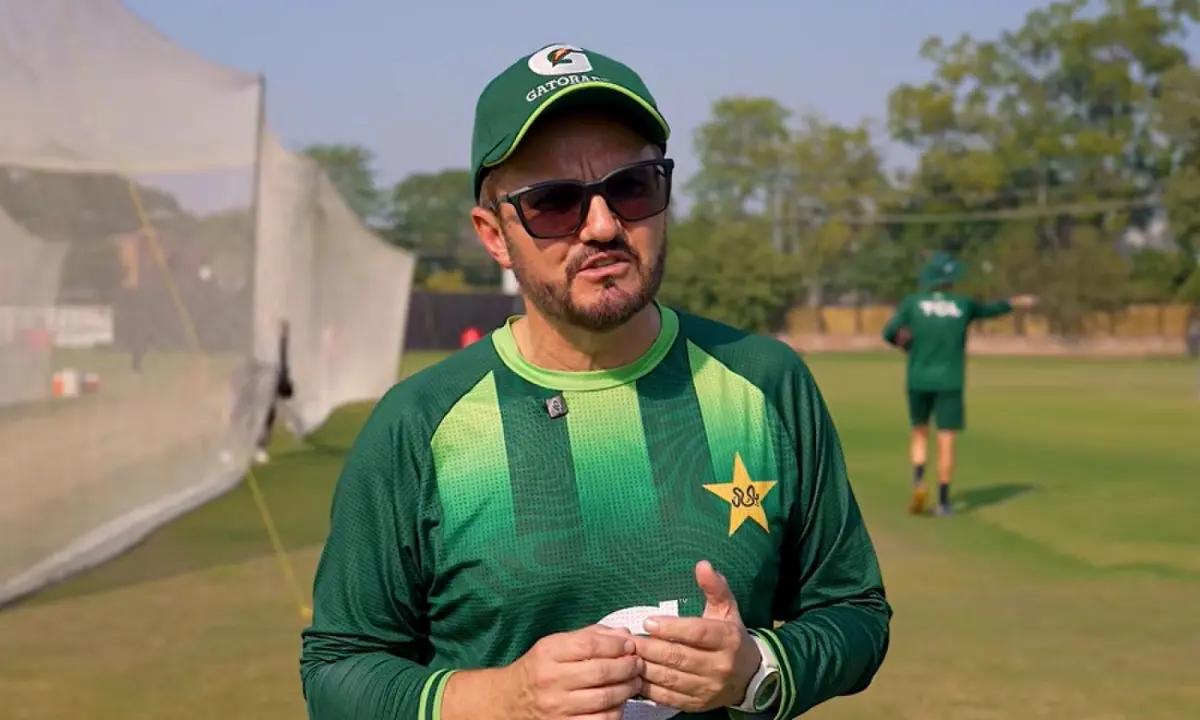
Pakistan head coach Mike Hesson is banking on his experienced top order to deliver when it matters most as the hosts prepare to face Sri Lanka in Saturday’s One-day International (ODI) tri-series final at Gaddafi Stadium in Lahore, with the opening batters’ inconsistent form remaining a major concern.

Pakistan qualified for the final with three consecutive victories before suffering an eight-wicket defeat against Sri Lanka in their last league match, when they were dismissed for just 110. The hosts will need a substantial improvement from their leading batters to avoid a repeat against the Islanders, who chased down the target with more than 30 overs to spare.

Speaking to PCB Digital in a video released on Thursday, Hesson said Pakistan had secured their wins despite some key players failing to make significant contributions, and expressed hope that the final would bring out their best.

“It’s been a pretty good couple of weeks. We have played some decent cricket without being perfect. To get three wins in a row without contributions from a few of our key players is a good sign,” he said.

“I still don’t think we have played our best game yet. Hopefully, we are saving that for the final.”

The numbers underline the challenge facing Pakistan’s top order. Fakhar Zaman has managed just 31 runs in four innings, while former captain Babar Azam has scored 118 in the same number of outings. Saim Ayub, who opened alongside Fakhar in the first three matches before being released from the squad at his own request, scored 21 runs in three innings.

Fakhar made 16 against Sri Lanka in the opening match, fell for a first-ball duck against England and scored 10 in the second England fixture before managing only five against Sri Lanka on Tuesday. Babar began with 45 against Sri Lanka, followed it with 34 against England and then made 10 before scoring 29 in the latest defeat.

Saim scored seven, eight and six in his three appearances. He was subsequently released to return to domestic cricket and work on his batting form, with Sahibzada Farhan named as his replacement, while opener Maaz Sadaqat was also called up earlier.

Hesson, however, remains confident that Pakistan’s senior batters Fakhar and Babar can rise to the occasion, describing the final as an ideal opportunity for them to produce a match-winning performance.

“You are talking about two of the greatest players in Pakistan’s history in the top three. I expect big players to stand up in big games,” he said.

“The fact that we have been able to achieve the wins that we have without the top order performing as well as we know they are capable of is a good sign. A couple of our key players are searching for that match-winning performance and there’s no better place to do it than in a final.”

While the top order has struggled, Pakistan’s middle order has provided important contributions. Salman Ali Agha struck a commanding 107 off 90 balls in the opening victory over Sri Lanka, while Hasan Nawaz scored 79 against England. Arafat Minhas also made 59 in that match.

Shadab Khan’s unbeaten 113 against England in Lahore proved decisive, as he and Haris Rauf put together an unbroken 89-run stand for the last wicket to secure a remarkable one-wicket win.

Hesson singled out Salman’s achievements and praised Hasan’s development, particularly his growing ability to manage pressure in the middle order.

“Salman Ali Agha has got the most hundreds of any Pakistan player batting at number five or below in an ODI,” he said. “His performance is often underrated.”

He added that Hasan was learning to “control the chase, understand risk and manage it”, describing his progress as encouraging.

Pakistan’s bowling, led by captain Shaheen Shah Afridi, has also offered positives, with Hesson praising the left-arm pacer’s ability to take early wickets and acknowledging contributions from Naseem Shah, Haris Rauf and young Arafat Minhas.

Pakistan, who have won 12 of their 19 ODIs since Hesson took charge as white-ball head coach last year, will hope their collective strength is complemented by a decisive contribution from the top order when the trophy is at stake.

  •  

Amid internal doubts, PTI affirms Sohail Afridi 'remains KP chief minister'

ISLAMABAD: The PTI on Thursday reaffirmed its support for Sohail Afridi, the ex-chief minister who was rendered nonfunctional after the imposition of governor’s rule in Khyber Pakhtunkhwa, ruling out any move within the party to consider an alternative candidate for the office.

Afridi has not been seen since the Centre imposed governor’s rule and emergency in KP on Oct 11. The very next day, a federal minister confirmed that he and some of his cabinet members were in preventive custody.

In the notification issued by the party’s central secretariat for the “purpose of clarity and emphasis”, PTI Chairman Barrister Gohar Ali Khan said that Afridi “remains and shall continue” to serve as the KP chief minister with the “confidence and support” of party founder and ex-premier Imran Khan.

“All PTI members, office-bearers, parliamentarians and party functionaries are hereby directed not to convene or participate in any meeting, introduce any agenda, initiate or entertain any proposal, or encourage or engage in any discussion concerning the nomination, replacement or consideration for the office of chief minister,” the notification said.

“It is categorically reiterated that no one other than the founding chairman has the authority to nominate an alternative candidate or alter this decision in any manner whatsoever. His decisions in this regard are final and binding upon all party members,” it said.

In a post on X, Barrister Gohar said that all party members part of the KP Assembly were a “source of pride for us” and that they had stayed loyal to Imran, complied with every decision and remained steadfast.

“However, in view of the unnecessary speculation and discussions circulating on social media and certain TV channels regarding the chief minister, this notification has been issued to provide further clarification and reassure party workers and supporters that decisions within our party are made solely in accordance with the directives of Imran Khan sahib,” he said.

The development comes after several PTI members expressed dissatisfaction with the party leadership’s handling of the prevailing challenges, questioning its decisions and overreliance on Afridi.

Heated arguments were witnessed during a joint parliamentary party meeting on Tuesday that lasted over seven hours, with some questioning why the top leadership had handed so much authority to Afridi, who, they said, held no position within the party hierarchy.

Some criticised the PTI chairman and Secretary General Salman Akram Raja, questioning why the party leadership appeared to be functioning under Afridi.

They alleged that the top leadership had left everything to Afridi, who had become non-functional after the imposition of governor’s rule in KP, because of its interest in transfers, postings and financial matters in the province.

  •  

Rana Sanaullah says Imran's jailed sister Noreen 'fine' after being provided medical treatment

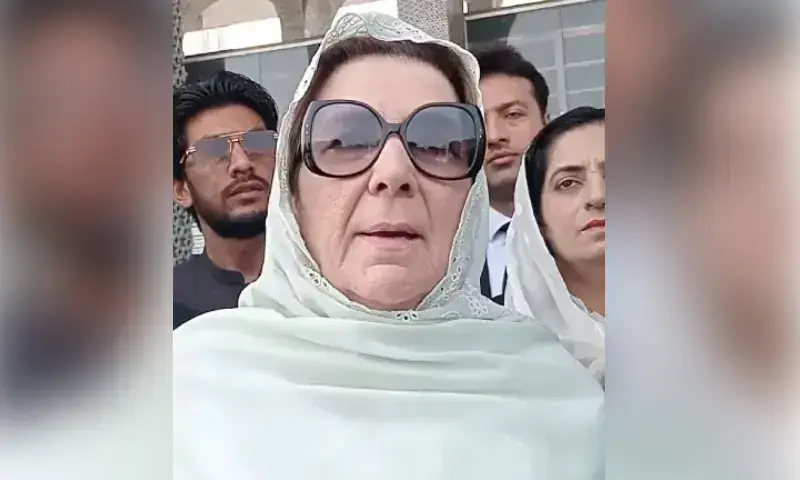
Adviser to the prime minister on political affairs, Rana Sanaullah, on Thursday informed the Senate that Noreen Niazi, the sister of jailed PTI founder Imran Khan, was fine after being provided medical treatment in Lahore.

Imran’s three sisters — Noreen, Aleema Khan, and Uzma Khan — have been in detention since Sept 21 under the Punjab Maintenance of Public Order Ordinance, 1960 (MPO) on the Lahore deputy commissioner’s (DC) orders.

On Wednesday, Noreen’s lawyer said that she was moved from Lahore’s Kot Lakhpat jail to the Punjab Institute of Cardiology (PIC) due to high blood pressure. Her lawyer claimed that no family member had been informed about her deteriorating health condition.

Speaking on the floor of the Senate on Thursday, Sanaullah responded to the query by PTI parliamentary leader Barrister Ali Zafar, who sought information regarding Noreen’s health and her being taken to the hospital.

The PML-N senator said Noreen was “immediately provided with medical facilities”.

“As per the information available, she is fine and all her medical tests are normal,” he said.

On concerns about Noreen’s family allegedly not being allowed to meet her, the prime minister’s adviser said details would also be sought on the matter. He assured the PTI that if this was true, it would be addressed depending on the circumstances at the hospital.

During his address, PTI Senator Mashal Yousafzai continued to interrupt Sanaullah, questioning the need for Noreen’s detention.

The PML-N senator replied: “She is in jail because she wanted to spread turmoil in the country. She wanted to attack Islamabad by launching a long march and inciting the people.”

Addressing Zafar, Sanaullah said that as the PTI founder was in jail under judicial custody, any relief regarding his health and meeting should be sought from the courts.

Imran’s sisters are currently serving the second term of a 30-day detention under the MPO, which was extended on Oct 7. The detention came amid reports of a crackdown on the PTI ahead of its countrywide protest and march to Islamabad, which the party had called to demand Imran’s release from jail and mobilise people for the supremacy of the Constitution.

‘Must never allow our humanity to fail’

In his remarks on the Senate floor, Zafar contended that Noreen had been detained despite not having committed any crime.

While Noreen’s lawyer had said she had faced high blood pressure, Zafar said she suffered a heart attack and claimed that her family was not being allowed to meet her.

Quoting Shakespeare’s phrase “milk of human kindness”, Senator Zafar said if even a little human kindness remained, the government must immediately stop grave human rights violations.

“If there is even a minimum of human kindness left in you, release her. At least allow her family to meet her and ensure proper medical care,” he said while speaking on a point of order.

He also condemned the detention of Imran’s nephews, asking why family members should suffer for their relationship with a political leader.

He alleged Imran had been kept in solitary confinement for a year and was being subjected to torture, claiming that the PTI founder’s wife Bushra Bibi was also facing inhumane treatment.

He demanded an immediate end to their mistreatment, which the government denies, saying both are being provided with the facilities they are entitled to.

Zafar claimed that the government believes the Constitution can be broken and suspended, as witnessed in the imposition of governor’s rule and emergency in Khyber Pakhtunkhwa, which has rendered the elected provincial government non-functional.

“There is one thing that cannot be broken, suspended or compromised: the fundamental human rights of the people of Pakistan,” he asserted.

Senator Zafar stressed that even if governor’s rule was claimed to be justified, it could never be a licence to violate fundamental rights, detain the chief minister, speaker and elected representatives, or keep their whereabouts undisclosed.

He warned that violating the sanctity of home and family honour, which hold deepest importance in Pashtun society, would provoke strong resentment among people of KP.

He also referred to reports of attacks on homes of MNAs and alleged violence against their wives and sisters, calling for impartial investigation.

“These are not merely political issues. These are matters of human rights, human dignity, family honour and rule of law. Human rights stand above politics,” he said.

Concluding, he said: “The Constitution may be violated by those who wield power, democratic mandates may be undermined, and institutions may fail in their duty. But we must never allow our humanity to fail.”

PTI condemns Noreen’s hospital transfer ‘sans informing family’

Meanwhile, in a statement, the PTI condemned the transfer of 70-year-old Noreen to the PIC without informing her family, expressing grave concern over her health and the treatment of “political prisoners”.

PTI Central Information Secretary Sheikh Waqas Akram criticised the authorities for not informing Noreen’s family after she felt unwell while in custody at the Kot Lakhpat jail.

He described the handling of her medical emergency as “callous and inhumane”, arguing that denying family members timely information about the condition of an elderly heart patient raised serious questions about prisoners’ rights, legal safeguards and basic human dignity.

“Noreen Niazi’s transfer to the PIC without prior notification to her family is alarming,” Akram said, demanding an immediate explanation from the Punjab government and the relevant authorities.

He demanded that Noreen receive the best possible medical treatment under the supervision of senior cardiologists without any delay, that her necessary diagnostic tests be conducted, and that her family be allowed access in accordance with applicable law.

“The authorities must provide her family with complete, credible and timely information about her condition,” the PTI leader further stressed.

Warning the government against disregarding fundamental rights in the alleged pursuit of political objectives, he said the PTI would not compromise on the protection of human life, health or constitutional freedoms under any circumstances.


Additional input by Ikram Junaidi

  •  

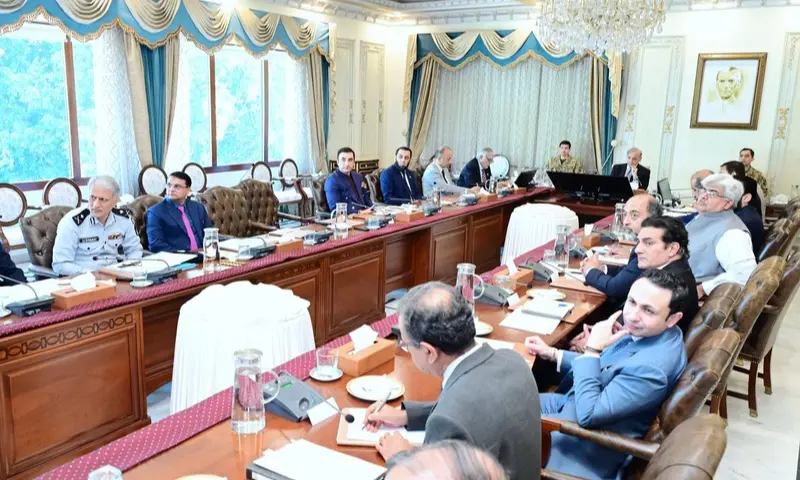
PM approves expansion of Jinnah and Allama Iqbal airports, eyes making Karachi 'air cargo hub'

Prime Minister Shehbaz Sharif on Thursday approved the expansion of Allama Iqbal International Airport and Jinnah International Airport as outlined in their respective masterplans while seeking to turn Karachi into an “air cargo hub”.

According to a statement by the Prime Minister’s Office (PMO), the directives came during a meeting held in Islamabad under the premier’s chairmanship. It was attended by Deputy Prime Minister and Foreign Minister Ishaq Dar, federal ministers Khawaja Asif, Musadik Malik, Ahad Khan Cheema, Attaullah Tarar and other senior officials.

The statement said the meeting was briefed on a survey recently completed by an international firm assessing the quality of travel facilities at major airports.

During the meeting, the premier directed that no compromise be made on quality in the expansion projects, that they be aligned with international requirements and that third-party validation be ensured for reforms aimed at improving the expansion projects.

The meeting was informed that work on the installation of automated border management systems (e-gates) at major airports was underway. Furthermore, “work is also ongoing on the air cargo village to make Karachi an air cargo hub,” the statement said.

Per the statement, it was discussed that facilitating passengers at Pakistani airports should be made the “top priority”. PM Shehbaz directed that facilities be improved in line with international standards. To that effect, he directed to obtain the services of internationally renowned institutions.

He also emphasised the provision of regular training in high-quality service delivery to officers and staff facilitating passengers at airports, along with an improvement in the coordination among various entities present at airports.

“The services of the best caterers [should] be obtained for passengers at airports, and there will be no compromise on the quality of food and beverages,” the statement said.

The meeting was further briefed on the upgradation of various airports across the country and ongoing development work by the Civil Aviation Authority (CAA).

Furthermore, the meeting was informed that the expansion of the runway at Jinnah International Airport had been completed. According to the PMO, the Federal Investigation Agency (FIA) had also increased the number of staff and counters, keeping in view passenger convenience.

A meet-and-greet service had been launched at Islamabad airport, the statement added. Similarly, the FIA had established pre-departure desks at major airports in the country for timely guidance to passengers.

“The meeting was informed that the existing aviation institution in Hyderabad is being further improved to establish an international standard aviation university, with work to commence by February 2028,” PMO’s statement said.

Earlier this month, PM Shehbaz had also ordered the installation of “smart scanners” at all international airports to facilitate travellers.

  •  

US fires top military planner over alleged leaks: reports

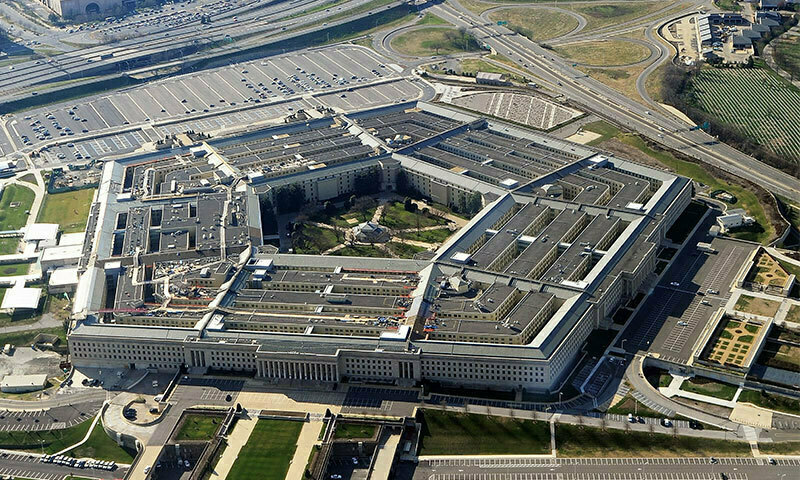
The United States has fired a top military planner, US media reported, with some outlets saying the dismissal was due to the officer allegedly leaking classified information.

Army Lieutenant General Brett Sylvia was removed from his role as head of strategy, plans and policy on the Joint Staff, US media reported on Wednesday, citing unnamed sources.

CBS and Fox both reported that Sylvia’s dismissal was related to leaks, with the former citing a Pentagon official as saying the general failed three polygraphs about sharing classified information with the media.

A spokesperson for the Joint Staff, a top Pentagon body that handles planning and other issues, initially issued a statement that confirmed Sylvia’s departure and wished him well but later withdrew it, saying: “Upon further review, we determined that the statement did not appropriately reflect the full circumstances.”

Pentagon spokesman Sean Parnell then said in a post on X that the Defense Department “has zero tolerance for the intentional, unauthorised disclosure of classified information” and took “necessary personnel action to protect sensitive information.”

Parnell did not identify Sylvia by name and said “no further comment will be made regarding the individual or the circumstances of this action”.

“This matter, along with others, have been referred to the Justice Department for potential further legal action,” he added.

The Justice Department did not immediately respond to a request for comment.

Since returning to office early last year, Trump has overseen a purge of top military personnel, including the chairman of the Joint Chiefs of Staff, general Charles “CQ” Brown, whom he fired without explanation in February 2025.

Renewed Iran strikes?

Other senior officers pushed out include the heads of the US Army, Navy and Coast Guard, the general who headed the National Security Agency, the vice chief of staff of the US Air Force, a Navy admiral assigned to Nato, and three top military lawyers.

Secretary of Defence Pete Hegseth has insisted the president is simply choosing the leaders he wants, but Democratic lawmakers have raised concerns about the potential politicisation of the traditionally neutral US military.

Hegseth said last month that the US had slashed the number of its generals and admirals by 20 per cent, in a move he said was aimed at “accountability”. He suggested the cuts targeted officers who failed to get on board with his efforts to ensure the military is focused on war-fighting rather than the “woke” policies of previous administrations, describing the reductions as an “accomplishment”.

The reported sacking of Sylvia comes as Trump is believed to be weighing fresh strikes against Iran after US midterm elections next Tuesday.

“We may do another little Epic Fury,” Trump said last week, referring to US-Israeli attacks on Tehran in February that triggered the war. He did not give any indication on timing.

Neither the US nor Iran has engaged in major attacks on land-based targets since early September, settling instead into a pattern of strikes on commercial ships.

No reason was given for Sylvia’s reported departure. His previous roles included leading the 101st Airborne Division — the US army’s air assault division — and heading a unit in Iraq.

  •  

3 dead in rock spire collapse at tourist site in Turkiye's Cappadocia

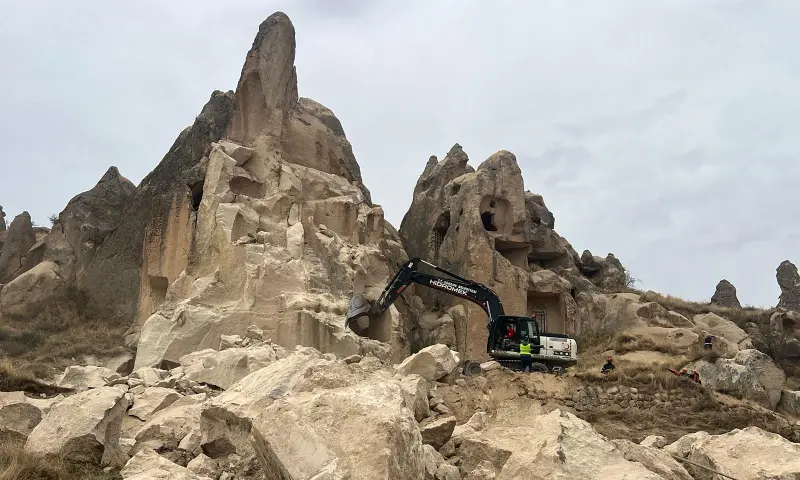
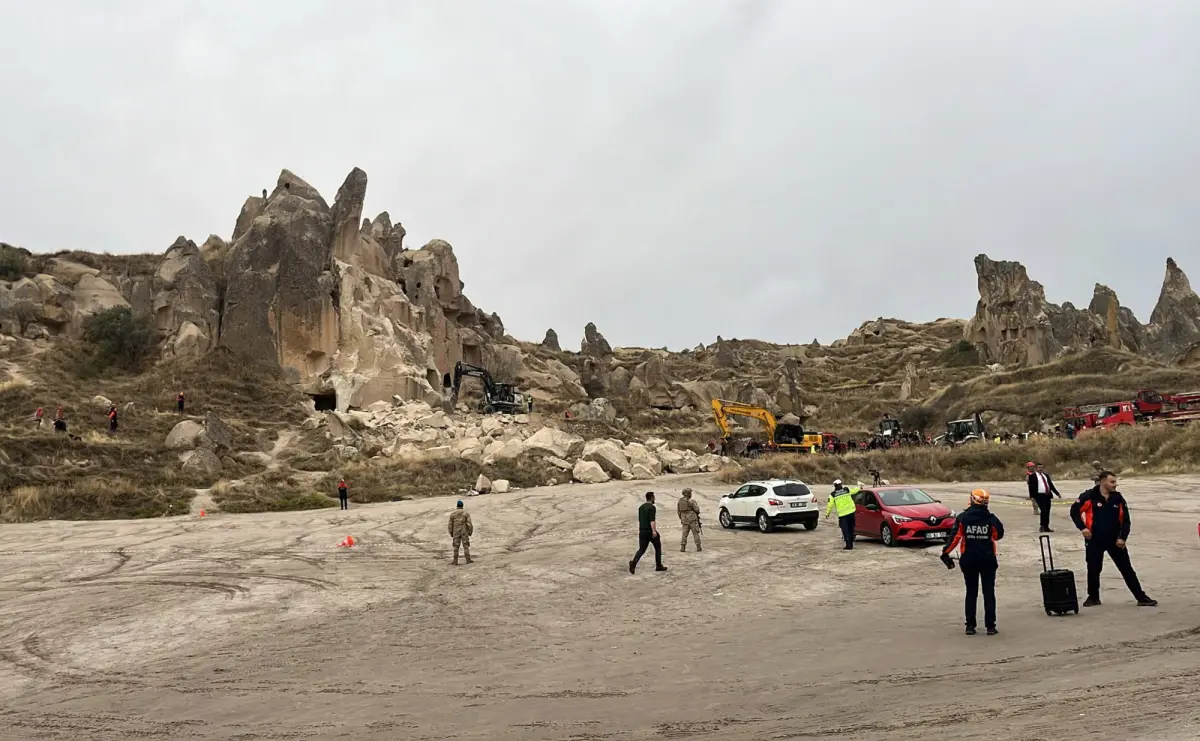
A landslide triggered by heavy rainfall caused a rock spire to collapse in Turkiye’s Unesco World Heritage-listed Cappadocia region on Thursday, bringing the death toll to three, officials said.

Turkiye’s Cappadocia region, a magnet for tourists from around the world, is home to cone-shaped rock formations known as “fairy chimneys”, created by ancient volcanic activity.

“According to initial findings, two people were killed and five others injured in the incident,” Justice Minister Akin Gurlek said on X.

Rescue teams pulled another body from the rubble, bringing the death toll to three, Nevsehir Governor Huseyin Kok said.

The nationalities of the dead were not immediately known.

“Search and rescue teams are continuing intensive, coordinated operations to locate any other victims who may be trapped under the debris,” the minister said.

Television footage showed heavy machinery digging through the rubble as rescue teams gathered at the site in an effort to recover people. Excavators and rescue workers worked into the night at the site, using powerful floodlights as the search operation continued.

This handout photograph taken and released on October 29, 2026 by Turkish news agency DHA (Demiroren News Agency) shows rescue teams searching for victims at the site of a rock formation that collapsed due to a landslide triggered by heavy rains in Cappadocia district of Nevsehir. — AFP

The incident occurred at 3:15pm local time (5:15pm PKT) when a landslide triggered a rockfall in the town of Goreme near the open-air museum, local governor Kok said.

The area was closed to the public following the collapse, according to reports.

Eyewitnesses described hearing a loud noise as the rock spire near a car park collapsed, sending up a huge cloud of dust.

Restoration

Turkiye’s culture and tourism ministry has launched restoration work in the region to help preserve the fragile rock formations from climate-related damage, natural erosion and human activity.

In 2024, another rockfall was reported in Cappadocia, although no deaths or injuries were recorded.

A Unesco heritage site since 1985, Goreme national park and the rock sites of Cappadocia are “a landscape of harmony combining human interaction and settlement with dramatic natural landforms,” according to the UN agency.

Some of the cones and pillars have experienced earthquake damage, but this is seen as a naturally occurring phenomenon.

“Overuse by tourists and some vandalism have been reported and some incompatible structures have been introduced,” it said on its website.

The Cappadocia region is also home to rock-carved underground cities and early Christian churches.

In 2025, some 4.5 million domestic and foreign tourists visited the region, according to tourism ministry figures.

Hot-air ballooning in Cappadocia is a thriving industry that sees dozens of balloons take to the skies on clear mornings. But concerns have been raised about safety following a series of accidents.

  •  

EU hits pause on country-level social media bans for children

The European Union (EU) said on Thursday it does not want any more national-level bans on social media before a pan-European law is approved, as it blocked draft rules put forward by Austria.

Under EU law, member states must notify the European Commission to ensure their bills do not break the bloc’s rules. Austria wanted to ban children under 14 from social media, but the EU said no.

“The commission has decided to postpone for 12 months any draft national laws overlapping with the future harmonised rules,” EU spokesman Thomas Regnier said.

The European Commission last month proposed to ban children under 13 from social media, and permit only limited, supervised access until the age of 15.

The EU believes allowing countries to move ahead with national laws would divide the bloc, creating varying age-limits among member states.

Brussels also fears EU countries will not rush to pass the bloc-wide law if they have their own country-level rules in place.

“We need to now focus on the negotiations of the EU Kids Act and to ensure an effective enforcement of our rules,” Regnier said. The commission hopes EU countries and the European Parliament will reach a deal on the new rules in the next few months.

There will, however, be exceptions to the EU’s decision.

Although the commission demanded France’s proposed law be reworked, it is not expected to be blocked because Paris notified Brussels of the law before bloc-wide legislation was put forward.

And Greece has been able to pass its own rules, drafted long before September. Regnier would not be drawn on whether France would be prevented from enacting its national legislation.

The EU has yet to deliver verdicts on bans by other EU states, including Italy and Slovakia.

  •  

Fact check: Viral video of JUI-F chief asking for forgiveness in NA is doctored

Several social media users, including PML-N supporters based on their past posts, shared a video on X on October 28 allegedly showing Jamiat Ulema-i-Islam-Fazl (JUI-F) chief Maulana Fazlur Rehman asking for forgiveness in the National Assembly amid his tensions with the government.

However, the video is doctored using AI.

Fazl on Oct 28 accused the federal government of misusing the Constitution by imposing governor’s rule and an emergency in Khyber Pakhtunkhwa. Speaking in the National Assembly, he argued that the measures amounted to a forced transfer of power rather than change through public opinion. He also criticised Defence Minister Khawaja Asif for failing to protect the sanctity of Parliament and called for a new Charter of Democracy to prevent unconstitutional actions and political violence.

He also recounted his efforts to ease tensions between the federal government and the PTI, claiming that the government had abandoned attempts to reach a consensus. He rejected questions about his patriotism, highlighting his party’s sacrifices in the fight against terrorism and condemning the ridicule of martyrs.

The JUI-F chief has recently been consistently criticised by government officials for his criticism of the state and support of the PTI.

On Oct 28, a pro-PML-N account, based on its past posts, shared a video on X, allegedly showing Fazl asking for forgiveness in the National Assembly, with the following caption: “See how Fazlu kept grovelling in the assembly today for forgiveness, but no one will share this part of the speech.”

The post garnered 20,277 views.
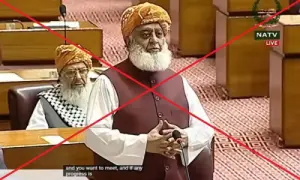
In the clip, Fazl can be heard saying: “What is my fault? Why are they after me? I have asked for forgiveness, but they are not accepting it. Is my sin greater than PTI? What did I do wrong? Why am I being treated unjustly? These are the questions you should ask the media. But you are not doing it.”

Another PML-N supporter, based on their bio and past posts, shared the same video with the following caption: “All the antics, today in the assembly, the ripples of apology. Fazlu’s politics is also masterful — where he needs to show off, his speeches go viral, and where he has to apologise, the camera, workers, and share button all vanish. Just spread this clip too; the public has the right to see the full film.”

The post garnered 12,785 views.
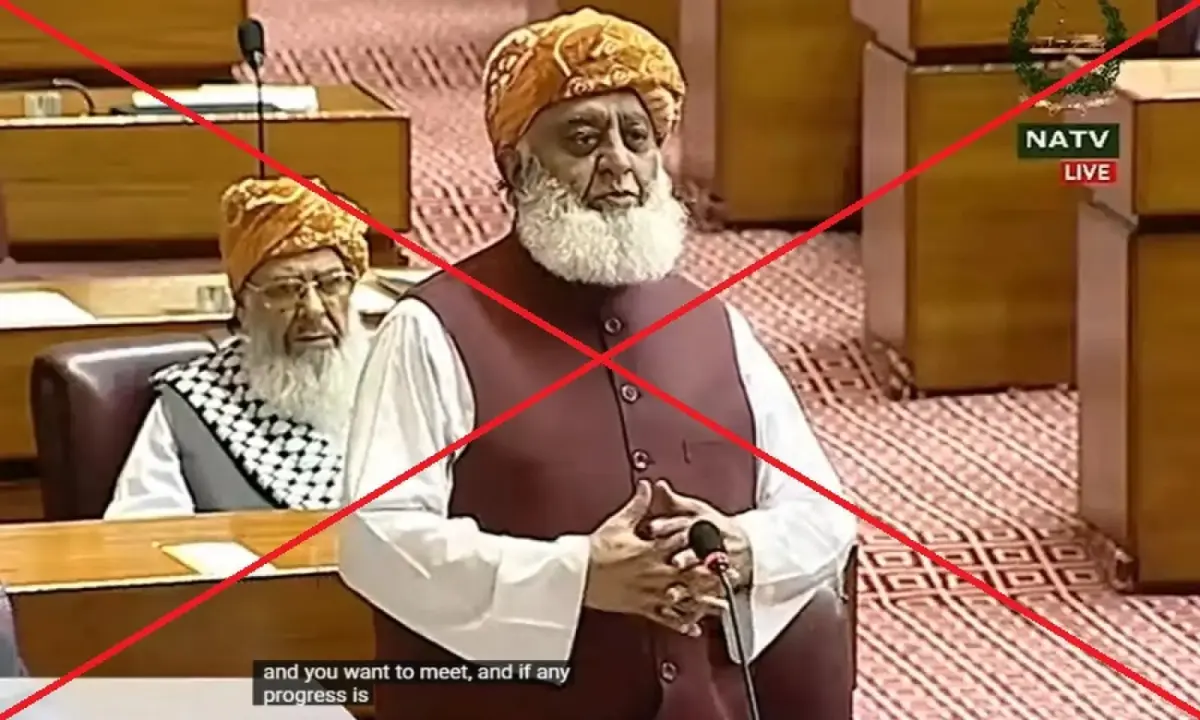
Jalal Sherazi, who identifies himself as a coordinator in the Prime Minister’s Office in his bio, shared the same video with the caption, “Look, even today, Fazlur Rehman kept talking about demanding an apology in the assembly, but this part of his speech is being avoided from being shared on social media.”

The post garnered 1,775 views.

Shahzad Younas Sheikh, who, according to his X bio, is a former spokesperson for Punjab, also shared the video with the caption: “See how Fazlu kept mumbling apologies in the assembly even today, but no one shares this bit of his speech.”

The post garnered 661 views.

Similarly, several other PML-N supporters, based on their past posts, shared the same video in a similar context on X, as can be seen here, here, and here.

A fact check was initiated to determine the veracity of the claim due to keen public interest in the tense relations between the JUI-F chief and the government amid his support for the PTI and criticism of the Centre’s actions in KP.

A keyword search conducted to determine whether credible mainstream media outlets had reported the alleged remarks yielded no results to corroborate them.

Investigating the clip showed discrepancies in the synchronisation between the audio and Fazl’s lip movements, suggesting that the video appeared to be dubbed.

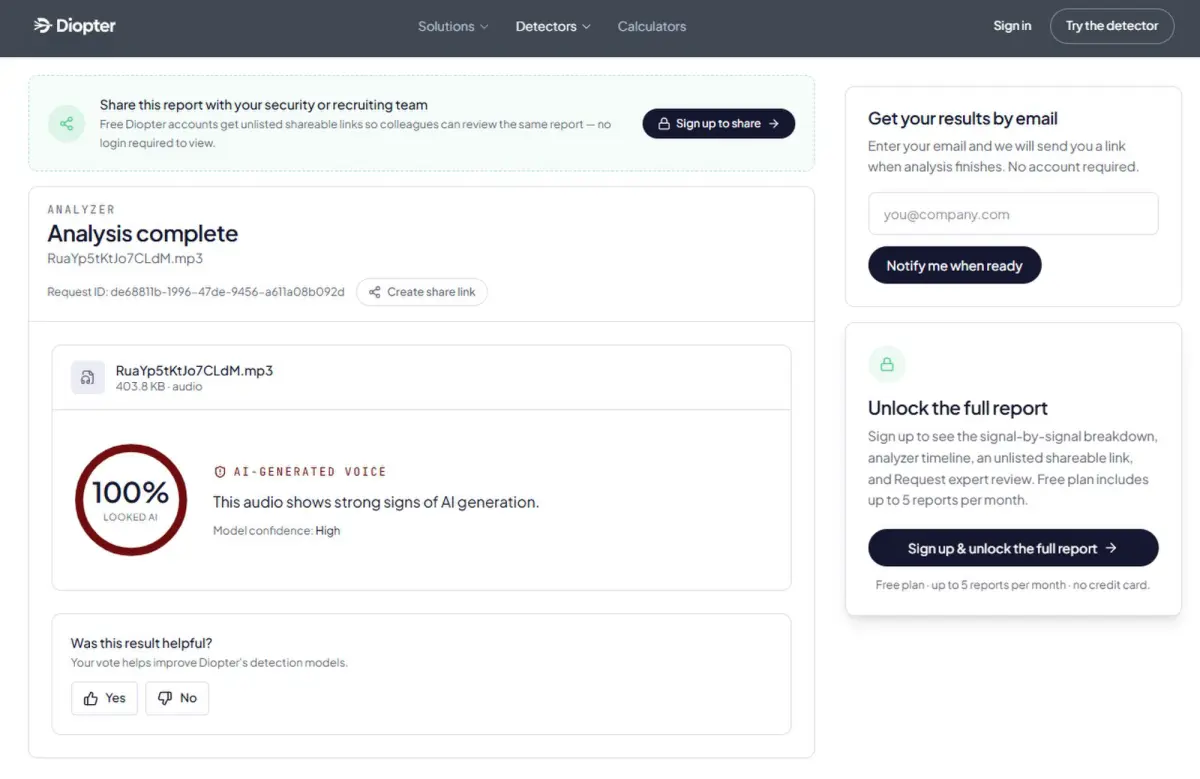
The viral video was then analysed using AI detection tools. Diopter, an AI audio detection tool, flagged the audio as 100 per cent AI-generated.

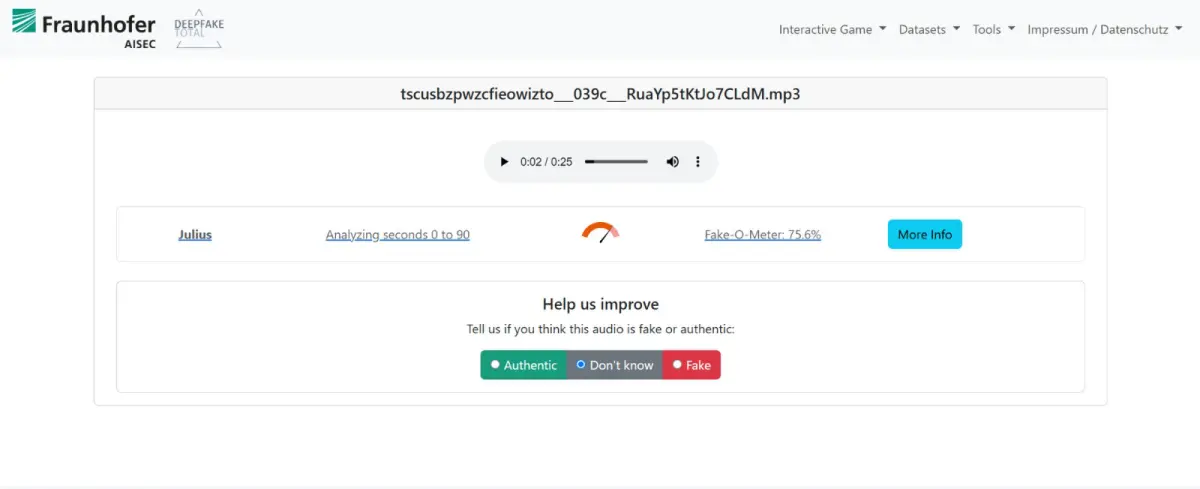
Another audio detection tool, Deepfake Total, detected a 75.6pc likelihood of AI manipulation.

Hive also showed a 92pc likelihood of AI-generated speech.

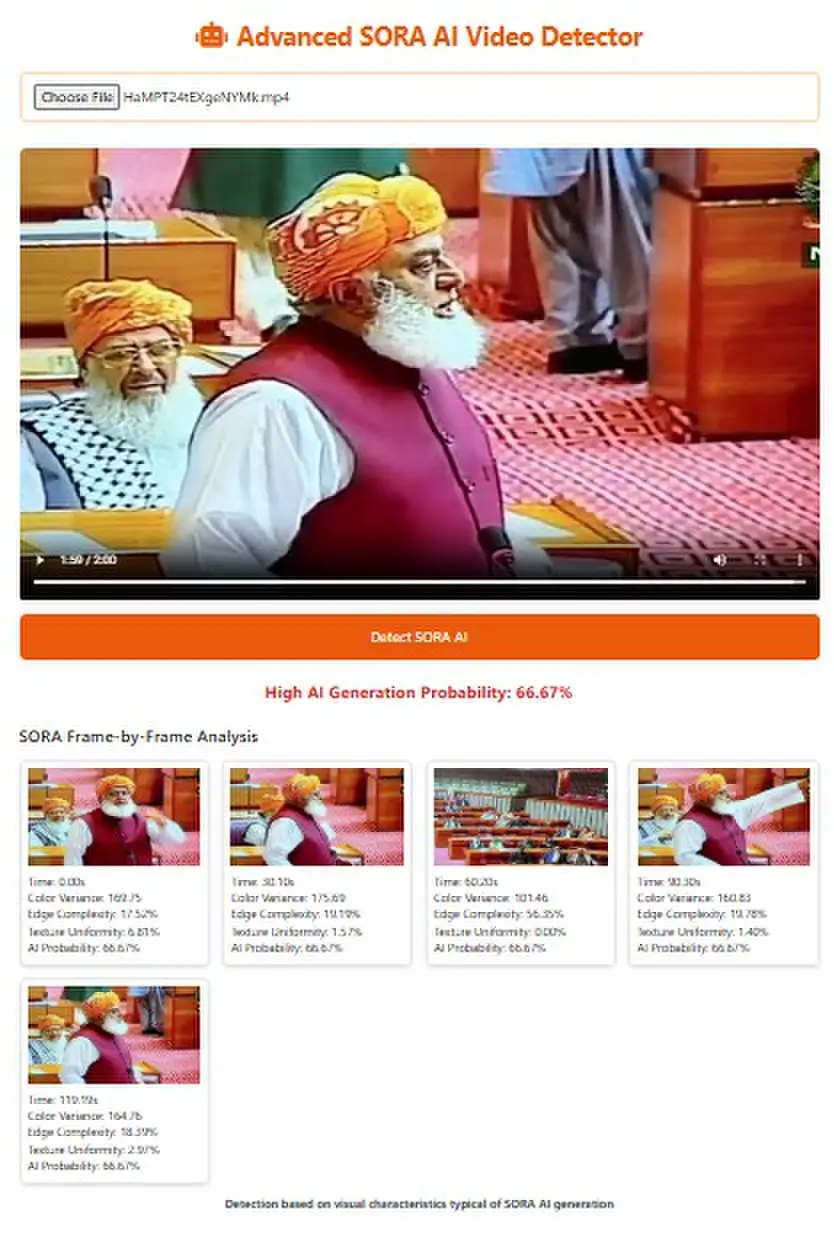
Similarly, the SORA AI Video Detector flagged the video as 66.67pc AI-generated.

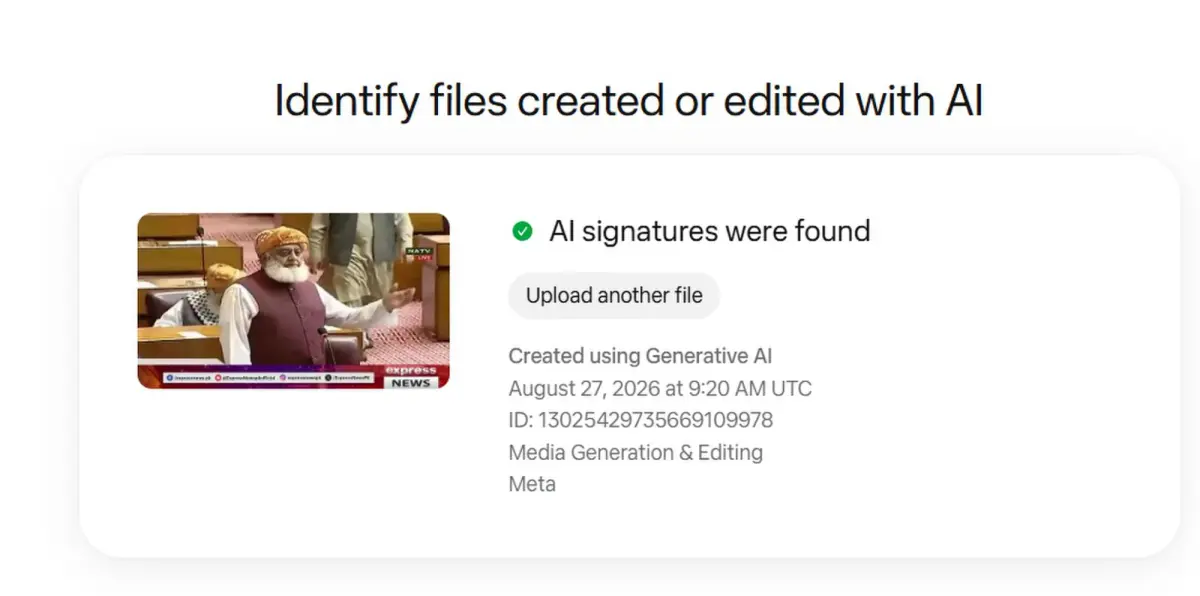
Meanwhile, Meta AI’s detector identified a digital watermark in the clip, suggesting that it had been generated using OpenAI.

A reverse image search conducted to trace the original clip yielded a video posted on the National Assembly of Pakistan’s official YouTube account, dated October 28, 2026, with the following title: ‘JUI F chief/MNA Maulana Fazal Ur Rehman expresses his views during National Assembly Session.’

The viral clip starts at the 3:25-minute mark and continues until 3:51.

In the original clip, Fazal said, “Gauhar Sahib was also there; Asad Qaisar Sahib was also there. And he said to me that if they are calling you and you wish to meet them and if there is any further discussion on this topic, then we are 100pc ready to accept your mandate.

“Although I have not met the prime minister for the past four to five months. And for the purpose that I can save the citizens of Pakistan from their blood, save the country from extremism, pave the way for the government and pave the way for the opposition, and that the country does not go towards bloodshed.”

At no point in his entire speech did he apologise or make such remarks as shown in the viral video.

The same was also corroborated by a keyword search that yielded a news report from the Express Tribune, dated October 29, 2026, with the following title, ‘Fazl calls for new Charter of Democracy.’

As per the report, the JUI-F chief urged political forces to resolve their differences through dialogue rather than resorting to unconstitutional measures or violence.

Further searches also yielded the original video shared by Jamiat Digital Media on X on October 28, 2026. The clip, too, contained no apology or any such remarks.

The claim that a viral video shows JUI-F chief Maulana Fazlur Rehman asking for forgiveness in the National Assembly is false.

The clip is doctored and has been dubbed over using AI.

  •  

Israel piles pressure on Arab parties as Netanyahu seeks government

Prime Minister Benjamin Netanyahu’s bloc on Thursday piled pressure on Israeli Arab leaders over unproven accusations of foreign funding, in a push to neuter parties that could hold the key to forming a government after an inconclusive election.

Israeli President Isaac Herzog called for an investigation into allegations of fraud but cautioned against stigmatising the entire Arab Israeli community, who voted at unprecedented rates.

Israel was nearing the completion of ballot-counting from Tuesday’s election, in which neither Netanyahu nor the opposition bloc led by former military chief Gadi Eisenkot looked able to secure a majority in the parliament known as the Knesset.

The Netanyahu camp’s accusations, which a key Arab party has rejected, could bring uncertainty to the electoral process at a time when the threat of a return to war with Iran looms over the region.

Israel’s election saw soaring participation by Israeli Arabs, descendants of Palestinians who stayed after the country’s creation in 1948, as outrage boiled at calls by officials such as National Security Minister Itamar Ben Gvir to treat their community much as Israel has dealt with Palestinians in Gaza and the occupied West Bank.

Following Netanyahu’s accusations of impropriety, Ben Gvir went so far as to encourage Israel to “immediately” order the arrests of Arab party leaders.

Raam party leader Mansour Abbas said he welcomed an investigation into claims of wrongdoing, adding that his party had “no connection” with the accusations.

The Arab parties together have enough votes to take the opposition bloc over the finish line, but Eisenkot has baulked after relentless attacks by Netanyahu, who warned his right-wing Jewish base that voting for the opposition would put Arabs in power.

‘Political earthquake’

Supreme Court Justice Noam Sohlberg, a conservative who heads the Central Election Commission, requested an investigation by the Shin Bet security service into allegations that Raam received money from Qatar.

“The Raamgate scandal is a political earthquake. Israel’s elections have been stolen!” Netanyahu’s Likud party said.

Government officials did not offer evidence to back the allegations, and left-wing candidate Yair Golan accused Netanyahu of attempting to stir controversy after failing to get a majority.

“Now he is trying to challenge the election results through an ugly delegitimisation campaign against the will of the people, and against the Arab public in particular.”

Netanyahu himself has long been under the cloud of allegations related to Qatar after the arrests last year of two of his aides for allegedly receiving payments from the Gulf state.

Meanwhile, Qatar’s foreign ministry spokesman on Thursday rejected accusations “made by certain Israeli politicians and their contacts in the media” that his country had interfered in the Israeli elections.

“We categorically deny allegations that Qatar has interfered in Israeli elections or funded any activities intended to influence their outcome,” said Majed Al Ansari.

“They accuse Qatar of buying off Benjamin Netanyahu, the Israeli political left and now, in this latest campaign, the Arab vote […] These accusations are ridiculous and dangerous in equal measure.”

Kingmakers under pressure

With nearly 93 per cent of the vote counted, Netanyahu’s bloc was at 53 seats and the opposition forces led by Eisenkot on 48 — both well under the 61 needed to form a government.

The two main Arab formations were on track for an unprecedented 19 seats between them.

Some observers quickly said that the allegations would help Netanyahu by making the Arab lawmakers even more toxic to Eisenkot.

Yousef Jabareen, the head of the leftist Arab-majority Joint List, told AFP on Wednesday that he was willing to cooperate with the opposition to bring down Netanyahu but without joining it in a government.

In response to the new allegations, Eisenkot said he was receiving updates and promised “utmost vigilance” against election interference.

“On the other hand, we cannot allow political actors to exploit the situation and influence the timing of the inauguration of the 26th Knesset,” he said.

One of Eisenkot’s right-leaning allies, Avigdor Lieberman, called the allegations “dramatic and unprecedented” and urged a swift investigation.

An Israeli police statement said that they would investigate every complaint about election integrity.

The great survivor

Netanyahu, who has led Israel on and off for more than 19 years, is known as a wily political operator.

He tried on Tuesday to raise allegations of fraud, saying that Arab parties were caught with envelopes of cash, and his Likud party peddled the accusations throughout Thursday.

Police said they arrested three suspects but the election commission called it an isolated local case.

Another factor that could play into the formation of a government is an attack on Iran.

Netanyahu has repeatedly threatened to strike Iran, with his ally US President Donald Trump signalling he was ready to attack after next Tuesday’s US midterm elections, in which his Republican Party is forecast to lose ground.

Eisenkot has warned the military that Netanyahu has no mandate and that officers must put Israel’s security over the premier’s “political needs”.

An attack could raise pressure on Eisenkot to join an emergency unity government, an option he has publicly ruled out, or keep the clock running until Israel can call new elections.

President Herzog will decide after the publication of the official results which person to task with a first chance of forming a government.

Palestinian president says hopes for peace talks with new govt

Meanwhile, Palestinian president Mahmoud Abbas said on Thursday that he hoped the election of a new Israeli government would allow for the resumption of peace talks.

“For many years now, we have been extending a hand to the Israeli side in order to achieve peace with them, so that Israel and Palestine may live in security, stability and peace,” Abbas said during a meeting with Cypriot President Nikos Christodoulides in Nicosia.

“We hope that, immediately after a new Israeli government is formed, we will be able to engage in dialogue together,” he added.

The Israeli-Palestinian peace process has been stalled for years, despite the recognition of the State of Palestine by a growing number of countries.

Under Netanyahu’s watch, settlement construction and violence against Palestinians has soared in the occupied West Bank, where Abbas’ Palestinian Authority exercises limited self-rule.

  •  

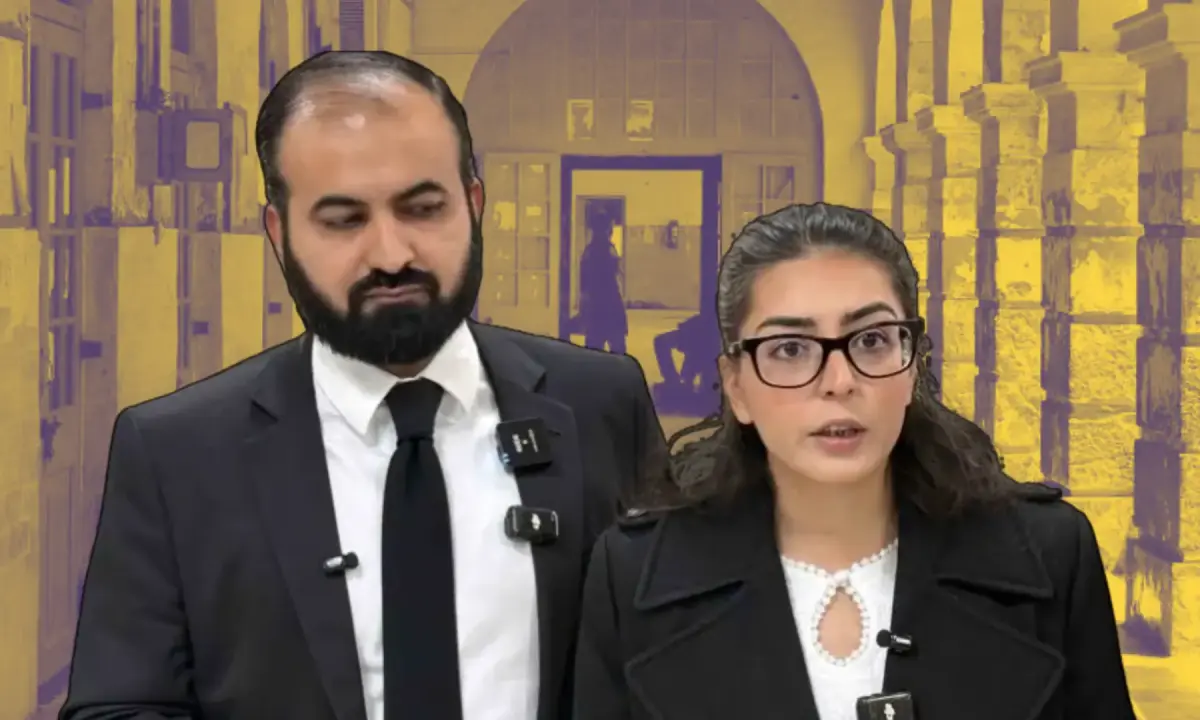
'Absolutely absurd verdict': Lawyers, journalists react to Imaan, Hadi's sentencing in security breach case

Human rights lawyer Imaan Zainab Mazari-Hazir and her husband, Hadi Ali Chattha, were convicted for the second time in less than a year on Thursday. This time, the couple was sentenced to 10 years in a security breach case following a jail trial.

The 2024 case pertained to the alleged disruption of an international cricket team’s security route and incitement to public unrest. The couple, accused of removing barriers from the route, was indicted on Oct 7.

After an anti-terrorism court pronounced them guilty, journalists and lawyers raised questions and expressed reservations.

Legal adviser for the International Commission of Jurists Reema Omer termed the convictions “cruel, vindictive and textbook examples of using law and the judicial process as weapons of persecution”.

“Imaan and Hadi are prisoners of conscience,” she posted on X.

Lawyer Rida Hosain said the convictions were “a stain on our judicial system”.

“Those entrusted with upholding the rule of law are weaponising it to persecute courageous human rights lawyers.

“This only further exposes a system that is functioning as an instrument of repression,” she said.

Op-ed editor at The News, Zebunnisa Burki, reacted to the development with “beyond ridiculous”.

Journalist Zarrar Khuhro also pointed out that the couple was sentenced to 10 years for “removing a barrier”.

“A decade in jail is what rapists usually get,” he said.

Journalist Asma Shirazi reacted to the news by calling it “reprehensible and regrettable”.

Journalist Maryam Nawaz Khan criticised the judgement saying: “A sham/ secret trial delivers a sham sentence. Imaan Mazari and Hadi Ali Chattha, two human rights lawyers, sentenced to 10 years in prison over road barriers they maintain they never removed. First, their tweets; now, this. Criminalising dissent and persecuting lawyers is an assault on fundamental rights and constitutional freedoms. This sentence is outrageous and unlawful.”

Academic Nida Kirmani said the couple was “paying the price for standing up to a cruel and vindictive state run by petty men with fragile egos”.

“Absolutely absurd verdict,” she said.

Journalist Saqib Bashir said the couple was sentenced without a “transparent” trial.

“This is a mockery of the judiciary and the justice system; it is a judicial murder of dissenting voices,” former Jamaat-i-Islami senator Mushtaq Ahmed said.

“Imaan and Hadi are strong voices against enforced disappearances and extrajudicial killings and that is their only crime,” he said.

“Those who speak up for justice face jail. Those who justify the state’s dictatorial actions ascend to higher positions,” journalist Veengas said.

The National Commission for Human Rights also expressed serious concern, saying the right to a fair trial, due process and effective judicial remedies must be fully protected.

“The severity of the sentences raises concerns about proportionality and the protection of fundamental rights,” the commission said.

  •  

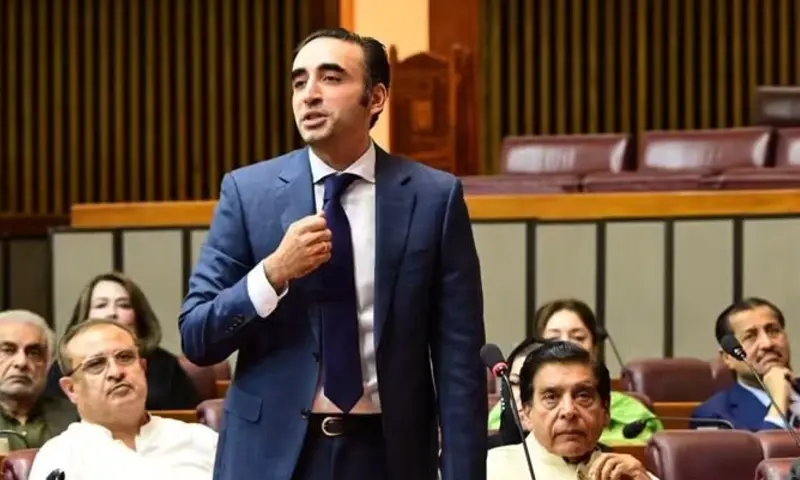
Bilawal urges Achakzai to use ‘authority’ delegated by Imran, asks opposition to play role in Parliament

PPP Chairman Bilawal Bhutto-Zardari on Thursday urged National Assembly Opposition Leader Mehmood Khan Achakzai to use the “authority and power” delegated to him by jailed PTI founder Imran Khan to direct opposition members to participate in House committees and discuss pressing national issues.

He made the remarks while addressing the National Assembly during a session chaired by Deputy Speaker Syed Ghulam Mustafa.

Addressing the House, Bilawal called for strengthening Parliament by taking decisions on matters of national interest collectively on a single platform.

“If Parliament is powerful, we are all powerful; this is the power bestowed on us by the people of Pakistan,” he said.

Urging the speaker and the government to fulfil their responsibilities, the PPP chairman also called on the opposition to play its role in the House.

“Those who want this House to remain dysfunctional and do not want the people of Pakistan to benefit from it have succeeded,” he said, pointing towards the opposition benches. “Congratulations to you,” he added sarcastically.

“You have played a part in helping these people achieve their objective,” he said, criticising the opposition.

Bilawal also criticised the opposition’s decision to boycott committee proceedings, saying it had contributed to the “weakening” of Parliament.

“It is your responsibility to represent your party, the people and your constituencies in these committees. However, you are not raising their concerns on the relevant platforms,” he said.

Turning to Achakzai, Bilawal urged the opposition leader to use the “authority and power” delegated to him and the Senate opposition leader by Imran Khan to direct opposition members to participate in committee proceedings and discuss pressing national issues.

Bilawal said that since Parliament had decided, on a motion moved by the PPP, to constitute a committee on electoral reforms, the opposition leader should nominate a representative to the committee and submit the name to the speaker’s office.

He recalled that the opposition had described electoral rigging as its “fundamental issue”.

Urging the opposition leader to participate in the committee’s proceedings, Bilawal said the move was necessary if the opposition wanted the issue of alleged rigging to be addressed before the next general election, local government polls or by-elections.

The PPP chairman also described participation in the committee as a fundamental step towards restoring Parliament’s respect and authority.

“I request the opposition to at least exercise the power it has,” he said, questioning the purpose of an electoral reforms committee if the opposition did not participate in its proceedings.

“If we make efforts to bring all stakeholders together in a committee or arrange a briefing on terrorism, economic and security issues, and other concerns without the opposition’s participation, it will be pointless,” he said.

Against the backdrop of the evolving geopolitical situation, Bilawal called for the foreign, interior and defence ministers to brief the House on the challenges facing Pakistan.

“Tell this House about the potential threats facing Pakistan and the region, particularly as three key maritime routes are closed,” he said.

He also called for a briefing on developments related to the war in Iran and its implications for Pakistan. In addition, he sought a briefing from the government on the recent defence pacts signed by Pakistan.

“Every member of this House has the right to be informed about the challenges facing Pakistan, whether terrorism or other domestic issues, the steps being taken to address them and their potential consequences in the days ahead,” he said.

Addressing a rally in Karachi earlier this month, Bilawal had also extended an olive branch to the opposition parties, saying their positive engagement with the federal government could result in the reversal of governor’s rule in Khyber Pakhtunkhwa.

The PPP chairman had invited the opposition to join the Parliamentary electoral reforms process and “engage with the federal government”.

The Centre imposed governor’s rule and emergency in KP on Oct 11, citing the provincial government’s “deliberate disengagement” from the fight against terrorism. The move had drawn criticism from the opposition.

PPP delegation meets Achakzai

Separately, a PPP delegation met Achakzai and invited the PTI to join the parliamentary committee on electoral reforms, according to a statement the party issued on X.

The PPP delegation comprised of Raja Pervez Ashraf and Syed Naveed Qamar. Senate Opposition Leader Raja Nasir Abbas was also present.

The delegation invited Achakzai to participate in the parliamentary committee to promote consultation and discussion among parliamentary representatives on electoral reforms, the statement said.

Later, in a press conference, Ashraf said the PPP delegation had a meeting with Achakzai on Bilawal’s instructions to invite him to join the committee.

“The PPP wants the PTI to participate in parliamentary standing committees as well as the electoral reforms committee,” he added.

Achakzai had sought time to consult before responding to the invitation, he said.

The PPP has consistently sought to improve the electoral process, Ashraf said, adding that PTI also wanted electoral reforms.

“The PTI will respond to the PPP after consultations,” he said.

  •  

Polluted priorities

LAHORE is choking again, and the government’s answer is to send more machines onto its streets. On Wednesday, its air quality index reached 296, putting children, outdoor workers, and the elderly at particular risk.

Yet Punjab plans to acquire 30 more truck-mounted fog cannons. These can suppress road dust locally, but their ability to reduce the fine particles most harmful to health remains questionable. Authorities must explain what the existing fleet has achieved in terms of measurable pollution reduction before spending more public money.

Last year, disruptions to Punjab’s air monitoring network raised suspicions that pollution levels were being hidden; officials cited technical faults. Whether equipment is recording pollution or spraying water, public confidence depends on transparent data and independent scrutiny. A temporary improvement at a pollution hotspot, or near a monitoring station, cannot prove that the city’s air is becoming safer.

Monitoring should expose pollution. Punjab must publish continuous readings and independent assessments of its interventions. It should also fund research into the relative contributions of traffic, industry, construction, and crop burning, how these change with the seasons, and which measures actually reduce exposure.

That scientific effort must extend beyond the border. Punjab officials say easterly winds have been bringing polluted air from India into Lahore. But this does not absolve Pakistan of responsibility for its own emissions. The air over the two Punjabs is shared, and both populations suffer when political hostility obstructs cooperation.

Calls for joint action are not new. Cooperation was proposed with Indian Punjab in 2017 and 2024. Yet neither initiative led to sustained cooperation. Environmental diplomacy with New Delhi should be prioritised, despite wider tensions. Both sides could begin by exchanging verified air-quality and weather data, jointly studying the movement of pollutants and developing common approaches to agricultural burning and industrial emissions. Universities and scientific institutions could help build a shared evidence base.

At home, dedicated research funding, stronger monitoring, and open evaluation of anti-smog spending are essential. Enforcement must continue, but decisions should follow evidence, not the visibility of machinery on city roads. Until the air itself improves, no amount of official activity can be called progress.

Published in Dawn, October 29th, 2026

  •  

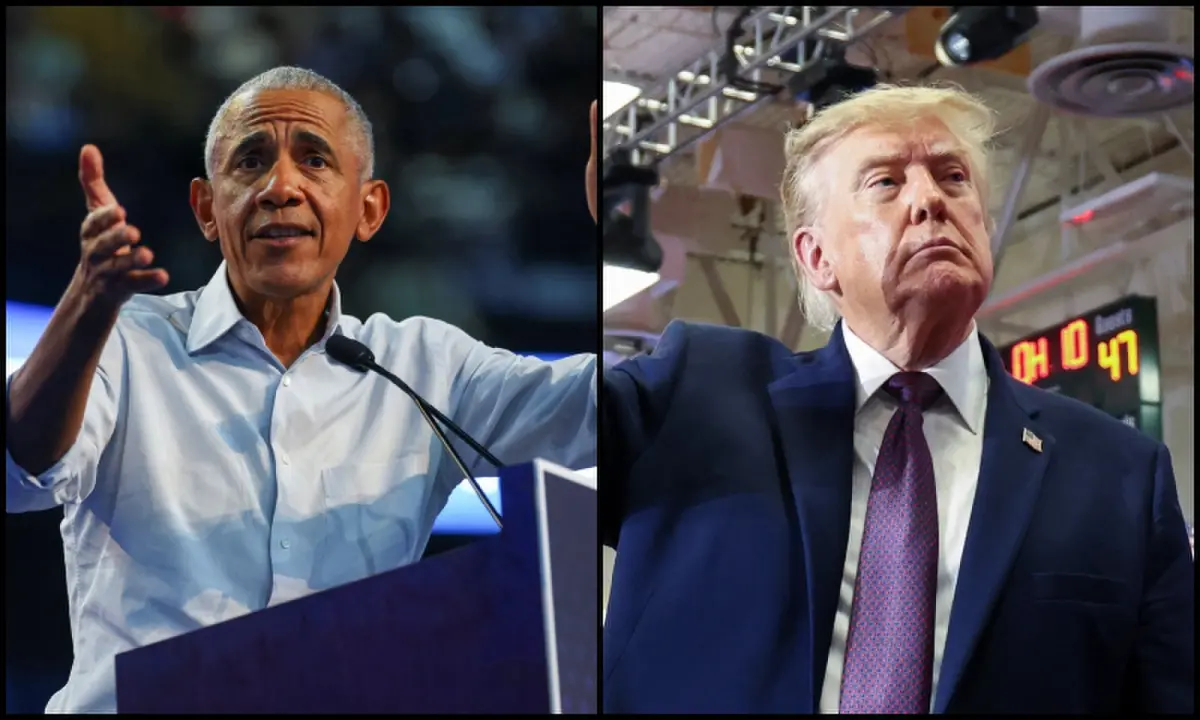
Obama mocks Trump’s government-wide response to Cheesecake Factory remark ahead of US midterms

Former US president Barack Obama on Wednesday mocked President Donald Trump for mobilising a government-wide response to his earlier remark that Trump had “got the White House looking like Saddam Hussein opened a Cheesecake Factory”.

“The White House even called the Secretary of Treasury,” Obama remarked, as he continued his campaign ahead of the congressional races in the US.

Obama quipped, “This is the man who is in charge of the economy. The person who’s supposed to be figuring out how to make your life more affordable… They told him he should hold a press conference in front of the Cheesecake Factory.”

Trump defended his White House decor and said Obama left the property deteriorated.

“The White House, I think, is the number one symbol of our country, and we can’t have a White House with broken windows, with broken stone that hasn’t been painted in 30 years,” Trump said in Ohio.

Neither man is on the ballot, but Republican President Trump and Democratic former president Obama took prominent roles on the campaign trail on Wednesday, with less than a week to go before congressional races that could shift the balance of power in Washington.

While Trump has been on a weeks-long campaign blitz that has underlined Republican concerns about losing control of Congress for the final two years of his presidency, Obama had kept a relatively low public profile until the past week, during which he has delivered blistering speeches criticising Trump.

Thirty-five of the 100 Senate seats and all 435 seats in the House of Representatives are being contested next Tuesday. Nonpartisan analysts generally favor Democrats’ chances of capturing a majority in the House, with the contest for the Senate seen as very close.

On Wednesday, Obama appeared in Morrow, Georgia, near Atlanta, where he urged voters to support Democratic Senator Jon Ossoff, who faces a challenge from Representative Mike Collins, a Republican.

While delivering the standard Democratic critique of Trump for imposing tariffs and going to war in Iran, Obama also said America’s values were on the ballot, as he recalled the vision of slain civil rights leader Martin Luther King Jr., who is buried in Atlanta.

“There is a moral component to the choices we face right now,” Obama said.

“We are not going to fix the system that’s broken, we’re not going to unrig our economy, so long as we’ve got a culture where anything goes, where people in the highest offices of the land think it’s OK to lie and cheat and bully, if we continue to have a culture where money is deemed the only measure of our worth,” Obama said.

Trump’s public approval rating has fallen to a near record low, with Americans increasingly sour on the high cost of living and the Iran war, but he remains an animating force in the party and has campaigned hard to increase Republican turnout.

Americans have been voting for weeks, with 40 million ballots already cast, according to the University of Florida’s Election Lab. A total of 45.9 million Americans voted early in the last midterm elections in 2022.

Addressing a rally inside a modest college gymnasium in the Ohio town of Chillicothe, the president appeared with Senator Jon Husted of Ohio as he faces a challenge from Democratic former senator Sherrod Brown.

Trump attacked Brown for supporting immigration policies the president said had overwhelmed Springfield, Ohio, with Haitian migrants. “The town went to hell,” he said.

Trump spread false claims during the 2024 presidential campaign that Haitian immigrants in Springfield were eating cats and dogs, allegations local officials repeatedly said were untrue.

Trump faces protesters

Enthusiastic crowds have cheered Trump at rallies throughout the campaign, but hundreds of protesters lined Trump’s motorcade route in rural Chillicothe, raising banners that read, “Republican against Trump,” “Grab them by the ballot” and “GOP: Guardians of pedophiles.”

During the rally, protesters interrupted Trump several times, including at least one who shouted about deceased convicted sex offender Jeffrey Epstein.

“I threw Jeffrey Epstein the hell out of Mar-a-Lago,” Trump said in response.

Trump and Epstein socialised in the 1990s and early 2000s, but Trump has said they later had a falling out and that he barred Epstein from Mar-a-Lago, Trump’s private club in Palm Beach, Florida.

Justice Department releases from the Epstein files have included references to Trump, as well as many other prominent figures. The department has cautioned that some materials contain allegations that were unverified or uncorroborated.

Protesters have interrupted Trump at virtually all his recent rallies. He typically accuses them of being paid protesters as they are carted off by security.

Alaska, Michigan races

Democrats will need to pick up seats in traditionally Republican-leaning states such as Ohio, Iowa or Alaska to overcome the current 53-47 Republican majority in the Senate.

The New York Times reported that aides to Mary Peltola, the Senate Democratic nominee in Alaska, worked with the campaign’s lawyers and senior staff at Senate Democrats campaign arm to recruit two candidates who are on the ballot and could siphon votes from incumbent Republican US Senator Dan Sullivan.

Representatives for Peltola did not immediately respond to requests for comment.

“Mary Peltola should resign from the race. I think she should be criminally prosecuted for what she did,” Trump told reporters before departing for Ohio.

In Michigan, where Republican Mike Rogers and Democrat Abdul El-Sayed are locked in a tight race for the Senate seat being vacated by Democratic Senator Gary Peters, both campaigns are relying on high-profile allies to energise supporters and boost turnout.

Rogers spent the day campaigning with Senator Ted Cruz of Texas on a four-stop bus tour culminating in Imlay City, a small community northeast of Detroit. El-Sayed, meanwhile, was scheduled to join Peters and fellow Michigan Senator Elissa Slotkin for an evening canvassing rally in Downriver, southwest of Detroit.

  •  

Pakistan, China sign agreement to operationalise green channel at Sost-Khunjerab border

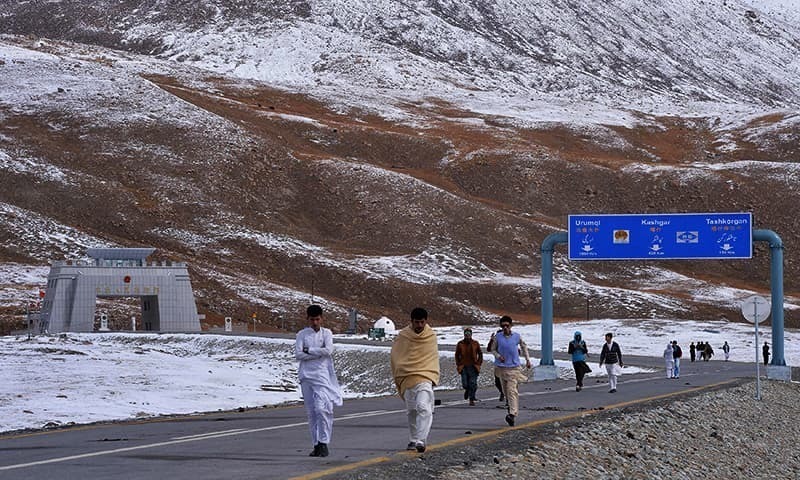
ISLAMABAD: Pakistan and China have signed an agreement to operationalise a green channel at the Sost-Khunjerab border for agricultural and allied products to facilitate bilateral trade.

The agreement was signed online between the customs administrations of the two countries at the Federal Board of Revenue (FBR) on Thursday. The Pakistani delegation was led by Member Customs (Operations) Syed Shakeel Shah, while the Chinese delegation was headed by Li Qinghua, deputy head of Urumqi Customs and director of Tashkurgan Customs.

According to an official announcement, the agreement aims to establish a green channel for an agreed list of agricultural products, allowing eligible consignments to undergo priority processing and examination while maintaining risk-based customs controls.

The arrangement also provides for enhanced information sharing and the exchange of risk alerts between the two customs administrations to strengthen coordination and improve cross-border trade management.

The agreement also provides for enhanced exchange of information and risk alerts between the two customs administrations to strengthen coordination and improve the management of cross-border trade.

It further envisages priority handling of perishable consignments to minimise delays and ensure their timely movement across the border.

The Pakistani delegation also included the chief collector of customs, Peshawar; the collector of customs, Gilgit-Baltistan; representatives of the Department of Plant Protection, NAFSA, Pakistan Single Window and the Ministry of Commerce; and the commercial counsellor at the Pakistan embassy in China.

The operationalisation of the green channel is expected to improve the efficiency of agricultural trade and strengthen customs cooperation between the two countries.

Khunjerab Pass connects Gilgit-Baltistan with China’s Xinjiang region and is the highest paved international border at 15,500 feet above sea level. Under the border protocol agreement signed between the two countries in 1985, the pass remains open for travel and trade between April and November. In winter, trade and travel are hampered by excessive snowfall.

Last year, Pakistan Customs collected Rs15 billion in revenue on imports from China through the Khunjerab Pass, breaking the previous record. Goods worth Rs2.8bn were also exported to China and Central Asian countries through the border crossing.

  •  
❌