❌

Reading view

After NCCIA, Pakistan moves to tighten Social Media Control with New Regulatory Authority

ISLAMABAD – Just when Pakistani social media users were getting used to National Cyber Crime Investigation Agency (NCCIA) keeping an eye on their online activities, the federal government announced plans to bring another regulatory authority into action as the country of nearly 245 million needs another watchdog.

Federal Minister for Information Technology Shaza Fatima Khawaja said the government intends to operationalise Social Media Regulatory Authority soon, in another step towards tighter oversight of Pakistan’s digital landscape. Sharing her views at ceremony of Cybersecurity Awareness Week, the minister presented the initiative as part of the government’s broader strategy to strengthen cybersecurity, protect personal information and tackle emerging online threats.

The announcement comes at time when Pakistan’s internet users are already facing increased scrutiny under the Prevention of Electronic Crimes Act (PECA), with the NCCIA now functioning as a specialised agency responsible for investigating cybercrime.

One Cybercrime Watchdog is Not Enough?

The latest move follows a stern warning from NCCIA officials that online activities involving alleged anti-state content, harassment and defamatory material are under observation.

NCCIA Additional Director Atif Ameer delivered a particularly memorable warning to social media users: “You are not clicking alone.” The official identified three major enforcement priorities: fraudulent call centres, content considered anti-state and harassment conducted through digital platforms.

Now, with another regulatory authority expected to become operational, questions are likely to emerge about how far government supervision of social media will extend and where the line between cybersecurity and online expression will be drawn.

Explaining the government’s position, Shaza Fatima said increasing dependence on digital technology had exposed Pakistan to new cybersecurity challenges, particularly as artificial intelligence made online threats more sophisticated. She stressed the need for stronger reporting mechanisms, improved cybersecurity awareness and better protection of sensitive information.

The minister also gets attention to children’s growing exposure to social media, warning that cyberbullying, online fraud and careless sharing of private details could create serious risks for individuals and their families. Her remarks highlighted genuine concerns surrounding digital safety, particularly in a country where online services and social media are becoming part of everyday life.

While authorities maintain that stronger regulation is necessary to counter cybercrime, the planned activation of another social media watchdog is also likely to revive debate over digital freedoms, privacy and the potential misuse of regulatory powers.

The government has yet to provide a firm date for the authority’s operational launch or fully explain how its responsibilities will differ from the NCCIA’s existing mandate.

NCCIA Officer tries to Sound ‘Tough’, ends up becoming Internet Meme with ‘Cyber Petroleum’ comment

The post After NCCIA, Pakistan moves to tighten Social Media Control with New Regulatory Authority appeared first on Daily Pakistan English News.
  •  

FACT CHECK: Has Punjab govt banned showering Currency Notes at Mujra and Qawwali Events?

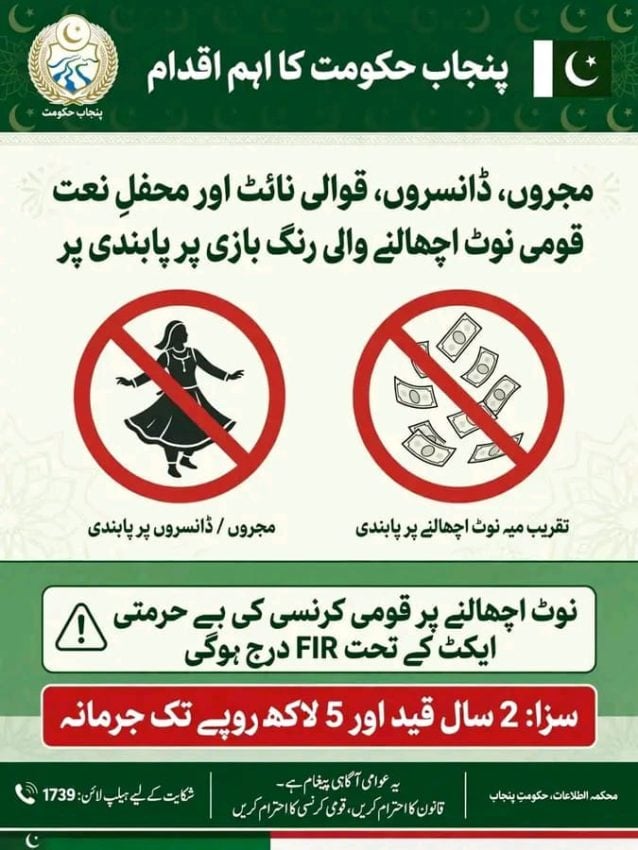
LAHORE (Daily Pakistan) – Social media is buzzing with claims that Punjab government imposed ban on showering currency notes at mujra performances, dance shows, qawwali nights and Mehfil-e-Naat gatherings, with violators reportedly facing imprisonment and hefty fines.

The viral posts claim that anyone found throwing currency notes at such gatherings could face registration of a First Information Report (FIR), imprisonment for up to two years and a fine of Rs500,000. Some posts mentioned “National Currency Disrespect Act”, calling the measure as an officially approved government crackdown.

Fact Check Has Punjab Govt Banned Showering Currency Notes At Mujra And Qawwali Events

However, a review of available legal records, media reports and government-related information raises serious questions about the accuracy of these claims. Despite the circulation of official-looking posters, no Punjab government official has publicly confirmed the alleged province-wide ban or the punishments being widely shared online.

Although the latest viral claims remain unconfirmed, Punjab authorities have previously acted against money-throwing during stage performances. In September this year, Punjab Council of the Arts and Information and Culture Department initiated proceedings against several stage performers and theatre managements in Lahore and Gujranwala.

The action followed alleged violations of the Punjab Drama Act, government policies and standard operating procedures. Some notices specifically referred to money being thrown towards performers and the failure of theatre managements to stop the practice.

This shows that authorities addressed currency showering in regulated entertainment venues. It does not, however, establish that every such act is now a criminal offence across Punjab.

It’s Raining US Dollars at this viral Pakistani wedding; See Video

A review of currency-related legislation listed by State Bank of Pakistan and relevant sections of the Pakistan Penal Code did not identify any statute called the National Currency Disrespect Act. Existing Pakistani laws address offences involving counterfeit banknotes, forged currency, fraudulent circulation and related misconduct.

Sections 489A to 489E of the Pakistan Penal Code deal with specified currency-related offences. These provisions do not establish a general two-year prison sentence or Rs500,000 fine for simply showering genuine currency notes at gatherings.

State Bank also maintains regulations concerning the handling and condition of banknotes. However, penalties imposed on commercial banks for currency-management violations should not be confused with criminal punishment for individuals attending public events.

No Confirmation So Far

So far, there is no public statement from Punjab government official or government run social media handle confirming the alleged ban, the supposed National Currency Disrespect Act or the claimed imprisonment and fine has been verified.


The post FACT CHECK: Has Punjab govt banned showering Currency Notes at Mujra and Qawwali Events? appeared first on Daily Pakistan English News.

  •  

Israel Election 2026: Latest Party-Wise Seats, Netanyahu’s Position

TEL AVIV — Israel is heading towards fresh political deadlock after 2026 general election failed to get clear majority, leaving Prime Minister Benjamin Netanyahu facing uncertainty over his political future as opposition parties and Arab lawmakers gain influence in the 120-member Knesset.

The latest provisional results show Netanyahu’s right-wing and religious alliance projected to secure 53 parliamentary seats, eight short of the 61 required to form a government. The opposition bloc, led by former Israeli military chief Gadi Eisenkot, is expected to capture 48 seats, while Arab political parties are projected to win a combined 19 seats, potentially placing them at the centre of negotiations over Israel’s next government.

With more than 98 percent of ballots reportedly counted, the parliamentary balance is becoming clearer, although individual party allocations remain subject to change until the results are officially certified.

Israel Election 2026: Latest Vote Count

Political alliance Projected seats Position
Netanyahu-led alliance 53 8 short of majority
Eisenkot-led opposition 48 13 short of majority
Arab political parties 19 Potential coalition partners
Total 120 61 required for majority

Even though Netanyahu’s bloc is ahead of the opposition, it lacks support to establish a government independently. The opposition could theoretically secure a majority with Arab parties, but political disagreements and coalition restrictions remain major obstacles.

Netanyahu’s Likud party has retained its position as Israel’s largest individual political force, with projections placing its parliamentary representation at approximately 26 to 27 seats. However, the results suggest that several of Netanyahu’s political allies have lost ground. The parties associated with far-right leaders Itamar Ben-Gvir and Bezalel Smotrich are projected to secure seven and six seats respectively, reducing their combined representation to 13 seats from 20 in the previous parliament.

Their reduced parliamentary strength could complicate Netanyahu’s efforts to rebuild his governing alliance.

Israel Election 2026: Latest Party-Wise Seat Position

Political party Leader Projected seats
Likud Benjamin Netanyahu 26–27
Yashar Gadi Eisenkot 21
B’Yachad (Together) Naftali Bennett and Yair Lapid 12
Joint List Arab political alliance 12
The Democrats Yair Golan 8
Otzma Yehudit Itamar Ben-Gvir 7
United Torah Judaism Yaakov Asher 7
Yisrael Beiteinu Avigdor Liberman 7
Ra’am Mansour Abbas 7
Shas Aryeh Deri 6–7
Religious Zionism–Zehut Bezalel Smotrich and Moshe Feiglin 6

One of the key developments in Israel’s latest parliamentary election has been the increased representation of Arab political parties. Joint List is projected to win 12 seats, while Mansour Abbas’s Ra’am party is expected to secure seven. Together, these parties would control 19 parliamentary seats, giving Arab lawmakers a potentially influential position during negotiations over the next government.

The growing parliamentary strength does not automatically guarantee participation in a governing coalition. Several Jewish-led political parties remain reluctant to rely on Arab parties for parliamentary support, while Netanyahu’s alliance has also opposed such arrangements.

Former Israeli army chief Gadi Eisenkot has emerged as one of the election’s central political figures, with his Yashar party projected to win 21 seats. The party’s performance places it behind Likud but ahead of several established political forces.

Eisenkot’s opposition alliance also includes parties associated with former Prime Minister Naftali Bennett, Yair Lapid, Yair Golan and Avigdor Liberman. The joint Bennett-Lapid list is projected to secure 12 seats, while the Democrats and Yisrael Beiteinu are expected to win eight and seven seats respectively.

Israel’s latest parliamentary election recorded voter turnout of approximately 77.7 percent, reflecting substantial public participation. Arab citizens of Israel also voted in large numbers, contributing to stronger parliamentary representation for Arab-led political parties.

Israel Elections 2026: Netanyahu faces Toughest Political Battle as ex-Army Chief Eisenkot eyes power

The post Israel Election 2026: Latest Party-Wise Seats, Netanyahu’s Position appeared first on Daily Pakistan English News.

  •  

Supreme Court Bar Elections 2026: Amjad Ali Shah locks horns with Amanullah Khan for SCBA top post

ISLAMABAD (Daily Pakistan) – Pakistani lawyers are heading to polling stations today to elect new leadership of the Supreme Court Bar Association (SCBA) for 2026-27, with two powerful rival groups battling for control of the influential lawyers’ body.

The elections brought Asma Jahangir Group and the Hamid Khan Group into direct competition, with the presidency and other crucial positions at stake. A total of 4,634 registered voters are eligible to participate in the nationwide electoral exercise, for which 13 polling stations have been established. However, the voting process encountered an early hurdle in Karachi, where polling was delayed as election officials awaited the arrival of polling agents.

The key contest is unfolding between Syed Amjad Ali Shah, the presidential candidate of the Asma Jahangir Group, popularly known as the Independent Group, and Sardar Amanullah Khan, representing the Hamid Khan Group, also called the Professional Group. The rivalry between the two established groups has traditionally been a defining feature of Supreme Court Bar politics, making the presidential contest particularly significant for the country’s legal community.

Beyond the presidency, several key positions are also being fiercely contested. For secretary’s office, Muhammad Arif Awan of the Independent Group is taking on Mian Irfan Akram of the Professional Group. The race for additional secretary features Qazi Shehryar Iqbal and Saira Khalid Rajput, while Muhammad Tanveer Chaudhry and Rai Azhar Iqbal Kharl are competing for the finance secretary’s position.

Supreme Court Bar Association occupies strong position in Pakistan’s legal landscape, frequently taking positions on judicial independence, constitutional matters, legal reforms and issues affecting the judiciary. Its elected leadership represents Supreme Court practitioners and can play a prominent role in debates concerning the justice system.

With the Independent and Professional groups competing for the association’s most influential offices, the outcome will determine which camp leads the SCBA during the 2026-27 term.


The post Supreme Court Bar Elections 2026: Amjad Ali Shah locks horns with Amanullah Khan for SCBA top post appeared first on Daily Pakistan English News.

  •  

Imaan Mazari, Husband Hadi Chattha get 10 Years Sentence in Security Breach Case

RAWALPINDI (DAILY PAKISTAN) – Lawyer and rights activist Imaan Mazari and her husband, Advocate Hadi Ali Chattha have been sentenced for 10 years in prison each in case involving allegations of breaching security arrangements during an international cricket team’s visit to Pakistan.

The duo gets prison terms totalling 13 years each under three separate legal provisions in a security breach case, with the effective imprisonment set at 10 years each under terrorism-related charge. The court also imposed two years’ imprisonment and a Rs50,000 fine under Section 353 of the Pakistan Penal Code, which concerns assault or criminal force used to deter a public servant from performing official duties.

Additionally, one year’s imprisonment and a Rs50,000 fine were awarded under Section 186, relating to obstruction of a public servant in the discharge of official functions. The sentences under the three provisions total 13 years for each convict, while the combined fines amount to Rs200,000 per person.

However, the court extended the benefit of Section 382-B of the Code of Criminal Procedure, which provides for time already spent in custody to be counted towards imprisonment. According to the reported short order, the effective prison term will be 10 years rather than 13 years, indicating that the sentences will run concurrently.

The case stems from allegations that the lawyer couple interfered with security arrangements during an international cricket team’s visit to Islamabad in October 2024. The case was registered at Aabpara Police Station.

The ruling, announced on October 29, 2026, followed months of legal proceedings over allegations that the lawyer couple interfered with security arrangements established for the visiting cricket team, creating potential risks and obstructing official duties.

The case was registered at Islamabad’s Aabpara Police Station, with prosecutors accusing the couple of disrupting security protocols and interfering with state functions.

The verdict came despite a last-minute attempt by the defence to secure an adjournment on the grounds that related legal challenges remained unresolved before superior courts.

During the proceedings, defence counsel Aimal Mandokhail strongly opposed the announcement of the judgment, arguing that the court should first await decisions on petitions pending before the Supreme Court and the Islamabad High Court.

He maintained that proceeding with the verdict while those applications remained under judicial consideration raised serious legal and procedural concerns. Mandokhail also informed the court that an application seeking the transfer of the trial to another court was still pending before the high court. The defence argued that the outstanding petitions should be decided before the trial court delivered its final judgment.

Security Breach Case

The prosecution centres on an incident dating back to October 2024, when security arrangements were in place for an international cricket team’s movement through Islamabad. Authorities alleged that Mazari and Chattha interfered with the designated security route and removed barriers intended to protect the visiting players.

The couple faced accusations involving obstruction of government officials and violations of security arrangements, with terrorism-related provisions also included in the proceedings. The defence has disputed the allegations and challenged the application of anti-terrorism laws to the incident.

The case formally advanced earlier this month when the court indicted both lawyers on October 7, despite objections concerning access to case documents and the completion of procedural requirements.

The latest judgment followed the conclusion of trial proceedings at Rawalpindi’s Adiala Jail earlier this week. Both accused recorded their statements under Section 342 of the Code of Criminal Procedure, which allows defendants to respond to evidence presented against them. State prosecutors subsequently completed their final arguments, after which the court reserved its decision for October 29.

Meanwhile, the couple had approached the Supreme Court to challenge an earlier Islamabad High Court decision declining to halt the trial. Their legal team also contested the framing of charges and the inclusion of terrorism-related provisions, maintaining that the proceedings suffered from procedural irregularities.


The post Imaan Mazari, Husband Hadi Chattha get 10 Years Sentence in Security Breach Case appeared first on Daily Pakistan English News.

  •  

Islamabad to get New Water Source after 3 decades as CDA moves ahead with Shahdara Dam

ISLAMABAD (Daily Pakistan) – With Pakistani capital struggling to meet water needs of a rapidly expanding population, the Capital Development Authority (CDA) has taken a major step towards building the capital’s first significant new surface-water source in nearly three decades, launching the procurement process for the long-awaited Shahdara Dam project.

The proposed Rs3.62 billion development will help Islamabad with daily water demand of 250 million gallons, while CDA’s existing network supplies only around 70 million gallons. The staggering gap of approximately 180 million gallons per day has placed growing pressure on the city’s aging infrastructure, leaving many communities dependent on underground water resources and alternative arrangements.

CDA Chairman Sohail Ashraf confirmed that the authority is advancing Shahdara Dam project, with construction expected to begin once the tendering and contractor selection process is completed.

Located along Shahdara stream near the famous Shahdara picnic spot in the Margalla Hills foothills, the planned reservoir is expected to supply an additional 5 to 10 million gallons of water daily, offering some relief to Islamabad’s overstretched water distribution system. Although the approved project planning document, known as PC-I, provides a two-year completion period, CDA is aiming to complete the dam in approximately 20 months.

The authority initiated prequalification for an Engineering, Procurement and Construction (EPC) contract in October 2026, inviting interested firms to submit applications through the electronic procurement platform EPADS. The initial notices appeared around October 12, followed by a corrigendum, with the application deadline falling around October 28.

Construction, however, has not yet started. The project must first pass through the remaining procurement, technical and contractual requirements. The dam’s preliminary estimated cost stands at Rs3.62 billion, though the final financial outlay could change depending on detailed engineering work, land requirements, water conveyance infrastructure and treatment facilities.

The project is designed to capture rainwater flowing through Shahdara stream, turning runoff that would otherwise pass through the area’s natural drainage channels into a usable water resource. Earlier feasibility assessments outline a concrete gravity dam approximately 33 metres high and 68 metres long. Its reservoir would cover roughly 25 acres, with a gross storage capacity of around 690 acre-feet, equivalent to approximately 225 million US gallons.

The project has a lengthy planning history. The Water and Power Development Authority (WAPDA) completed its feasibility assessment, which was provided to CDA earlier in 2026, while engineering consultancy NESPAK has been involved in planning and design activities.

Land surveys and acquisition arrangements have also formed part of the preparatory work, including survey-related involvement by SUPARCO. The final specifications and operational water yield will depend on detailed design and hydrological assessments.

Islamabad’s growing water crisis presents a striking contradiction: the city receives substantial annual rainfall but continues to experience persistent supply shortages. With average annual rainfall estimated at approximately 1,100 millimetres, Islamabad receives considerable water during the monsoon season. Yet much of this runoff travels through streams and drainage channels without being retained for future consumption.

Beyond Shahdara, the civic agency is preparing another major push to conserve rainwater and replenish Islamabad’s declining groundwater reserves. CDA Chairman Sohail Ashraf has outlined plans for four smaller check dams in the Margalla Hills foothills, with proposed locations including D-12, Shah Allah Ditta and Saidpur.

The authority is also exploring two other reservoirs that could significantly strengthen water availability in Islamabad and adjoining areas. Chinot Dam, proposed within the Simly Dam catchment, is intended to capture additional water that might otherwise escape during periods of heavy rainfall.

Pakistan Water Week to begin on Nov 2 in Islamabad

The post Islamabad to get New Water Source after 3 decades as CDA moves ahead with Shahdara Dam appeared first on Daily Pakistan English News.

  •  

Khawaja Asif clarifies Field Marshal Asim Munir’s Tehran Visit in strong response to Fazlur Rehman

ISLAMABAD – Defence Minister Khawaja Asif strongly responded to JUI-F chief Maulana Fazlur Rehman in heated National Assembly session, clarifying that Field Marshal Asim Munir’s Tehran visit was aimed at promoting regional peace, not negotiating a defence agreement.

A fierce political showdown occured in National Assembly as Defence Minister Khawaja Asif launched counterattack against Jamiat Ulema-e-Islam-Fazl (JUI-F) chief Maulana Fazlur Rehman, questioning his political legacy, challenging his performance on Kashmir and accusing him of exploiting religion for personal and political gains.

Asif defended Chief of Defence Forces (CDF) Field Marshal Asim Munir’s visit to Tehran, rejecting suggestions that the high-level diplomatic engagement involved negotiations over a new defence agreement. The minister insisted that Pakistan’s military leadership is playing key role in reducing regional tensions and bringing rival countries to the negotiating table.

Asif maintained that the Tehran visit was a diplomatic initiative focused on regional peace, not a mission to negotiate or finalise a military pact.

Why Khawaja Asif Did Not Attend the Tehran Meeting?

Addressing questions surrounding his absence from high-level gathering, Asif explained that his participation was unnecessary because the discussions did not concern any agreement falling under the Ministry of Defence.

He said the meeting brought together representatives holding different positions, including Saudi Arabia’s defence minister and Türkiye’s intelligence chief, rather than the defence ministers of all participating countries. The minister argued that describing the gathering as a defence-related negotiation would misrepresent its purpose.

Asif praised Field Marshal Munir’s diplomatic involvement, saying the military leader had consistently encouraged dialogue as a way to resolve regional disputes. Referring to Pakistan’s military victory last year, Asif said the field marshal had subsequently contributed to efforts aimed at promoting negotiations and restoring stability across the region.

He stressed that Pakistan and its military leadership deserved wider international recognition for their contributions to peace-building initiatives.

The defence minister’s response became increasingly confrontational as he shifted from explaining the Tehran visit to challenging Fazlur Rehman’s political credentials. Although Asif acknowledged JUI-F chief’s seniority and influence in national politics, he argued that those questioning others should also be prepared to defend their own records.

He reminded the house that Fazlur Rehman had enjoyed positions of influence in several governments and had served as chairman of the National Assembly’s Kashmir Committee for approximately a decade. Asif questioned what tangible achievements the JUI-F leader could claim for the Kashmir cause during his lengthy tenure.

Asif further claimed that he had been willing to acknowledge his own mistakes publicly, describing himself as the only politician to have apologised for his past positions. He conceded that his earlier speeches frequently returned to haunt him whenever he discussed the country’s hybrid political system, but insisted that political accountability should apply equally to everyone.

The parliamentary clash took a sharper turn when Khawaja Asif accused Fazlur Rehman of using religious influence to advance his political interests and obtain financial benefits. The defence minister alleged that JUI-F leader had made religion a source of political and financial advantage, contrasting his approach with that of other mainstream political parties.

The confrontation followed Fazlur Rehman’s criticism of the government’s representation at the Tehran discussions. JUI-F chief had questioned why Pakistan’s defence minister remained in Islamabad while the country’s senior military leadership participated in important regional security talks.

The diplomatic engagement took place against the backdrop of growing instability in the Middle East and efforts by regional powers to prevent another escalation. October 26 discussions involved Field Marshal Asim Munir, Saudi Defence Minister Prince Khalid bin Salman, Turkish intelligence chief Ibrahim Kalin and senior Iranian officials.

Iranian authorities described the initiative as an effort to develop regional security cooperation and reduce the risks of further conflict. The talks also drew attention because of the existing Makkah Joint Defence Agreement involving Pakistan, Saudi Arabia and Türkiye.

Fazlur Rehman rejects emergency in KP, vows strong political response


The post Khawaja Asif clarifies Field Marshal Asim Munir’s Tehran Visit in strong response to Fazlur Rehman appeared first on Daily Pakistan English News.

  •  

YouTube starts bringing Faster Payments for Small Creators with $20 Payout Limit

LONDON – Good news for those who just started earning from posting shorts or long duration videos on YouTubers and struggle to reach platform’s $100 payment threshold as the streaming giant begins testing 80 percent reduction in the minimum amount creators must earn before receiving their money.

Google-owned video-sharing platform is experimenting with new payout system that allows selected content creators to receive payments once their earnings reach just $20, instead of waiting until they accumulate $100. The move could be breakthrough for smaller YouTube channels, particularly those generating modest advertising revenue and waiting several months to receive their earnings.

The new move has already been introduced for randomly selected members of the YouTube Partner Program (YPP) in the US, and some other countries. The revised threshold applies to payments beginning in October 2026, marking a potentially important shift in how YouTube distributes earnings to its content creators.

Under YouTube’s existing monetization system, creators generally need to accumulate at least $100 in eligible earnings before receiving payments through AdSense for YouTube. For popular channels attracting millions of views, reaching this threshold is rarely a challenge. However, smaller creators earning $10, $20 or $30 a month can spend several months waiting for their first payment.

The latest experiment aims to address that problem by reducing the payout requirement to $20, or its equivalent in local currency. For example, a creator earning $25 per month would normally need approximately four months to accumulate $100. Under the experimental arrangement, the same creator could qualify for a payment every month, provided other payment requirements are satisfied.

The change does not increase advertising earnings or alter YouTube’s revenue-sharing structure. It simply allows eligible creators to access money they have already earned sooner.

YouTube has initially limited the experiment to selected creators in three major markets: the United States, India and Indonesia. Not every monetized channel in these countries will automatically qualify. Instead, YouTube has randomly selected participating accounts and notified their owners about the revised payment arrangement.

Selected creators can monitor their payment activity through the YouTube Studio mobile application. They can also choose to maintain a higher payout threshold through their AdSense for YouTube accounts if they prefer receiving larger payments less frequently. YouTube says the initiative is designed to provide greater flexibility in accessing earnings, particularly for creators whose revenue remains below the traditional payment threshold.

Pakistan is not among the three countries participating in the initial experiment, and YouTube has not announced any timeline for extending the facility to Pakistani creators. Nevertheless, a wider rollout could make a considerable difference for emerging Pakistani YouTubers, including students, vloggers, educational content producers and small independent channels.

Many new creators generate relatively limited monthly revenue despite investing considerable time and resources in producing videos. Allowing these channels to receive payments at $20 instead of $100 could reduce lengthy waiting periods and provide more regular access to earnings.

The experiment comes at a time when competition between YouTube and Instagram is intensifying as both platforms attempt to attract video creators. Instagram is reportedly experimenting with longer video uploads, potentially challenging YouTube’s traditional dominance in long-form video content.

While Instagram is exploring new opportunities for video publishing, YouTube’s latest experiment focuses on improving the financial experience of creators already earning through its platform. Making relatively small earnings accessible sooner could strengthen YouTube’s appeal among emerging content producers, particularly in developing markets where even modest digital payments can make a meaningful difference.

Despite the excitement surrounding the development, YouTube has not confirmed whether the reduced payment threshold will become a permanent feature. The company has also not disclosed how long the experiment will continue or when additional countries might be included.

‘Not Just YouTube’: FBR moves to Expand Tax Rules to Facebook, other Social platforms

The post YouTube starts bringing Faster Payments for Small Creators with $20 Payout Limit appeared first on Daily Pakistan English News.

  •  

District Judge kidnapped by ‘JAAC Activists’ rescued in Rawalakot Police Operation

RAWALAKOT – A daring police operation in Azad Kashmir ended with recovery of Additional District and Sessions Judge Muhammad Akram, who was reportedly kidnapped at gunpoint while travelling to Muzaffarabad, as separate incidents of armed violence in Rawalakot left a police officer and a civilian injured and parts of a government hospital damaged.

The developments triggered serious security concerns in Rawalakot, where police accused armed members of banned Jammu Kashmir Joint Awami Action Committee (JAAC) of involvement in the judge’s abduction and firing incidents.

According to Rawalakot police, Judge Muhammad Akram was travelling from Rawalakot to Muzaffarabad through Palandri when armed individuals allegedly intercepted his vehicle on the Rawalakot-Palandri highway. The suspects reportedly stopped the vehicle at gunpoint and abducted the judge along with his car. His driver and armed security guard were also present in the vehicle at the time of the incident.

The alleged kidnapping of serving judicial officer sparked triggered police operation, and he was rescued during the intervening night of Wednesday and Thursday, October 28 and 29.

A Rawalakot police official confirmed that the judge had been recovered following the operation. However, police did not immediately disclose whether any suspects had been arrested or provide further details about the circumstances surrounding his recovery.

District Judge Kidnapped By Jaac Activists Rescued In Rawalakot Police Operation

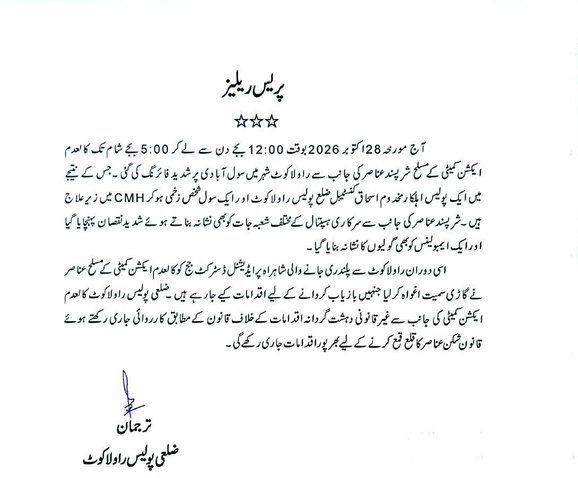
The judge’s alleged abduction came amid reports of armed violence in Rawalakot, where police said firing incidents between noon and 5pm on Wednesday left two people injured.

Both injured individuals were shifted to Combined Military Hospital (CMH) Rawalakot for medical treatment. The violence reportedly extended to a government hospital, where several sections of the facility sustained damage during the firing.

Police further claimed that an ambulance also came under gunfire, raising concerns about the safety of medical facilities and emergency services during the unrest. The authorities did not immediately disclose the identities of the injured individuals or provide detailed information about their medical conditions.

Rawalakot police directly linked the incidents to armed elements allegedly associated with the banned Jammu Kashmir Joint Awami Action Committee. According to a police statement, JAAC activists allegedly opened fire outside a hospital during the operation connected to the judge’s recovery.

After these incidents, Rawalakot District Police announced that legal proceedings were being initiated against individuals allegedly involved in violent and unlawful activities. Officials warned that further action would be taken against those found responsible for disturbing public order and violating the law.

The police initially reported the judge’s abduction as a separate incident and said efforts were underway to secure his release. Hours later, authorities announced his recovery following the overnight operation.

Four security personnel martyred in Rawalakot firing by banned group

The post District Judge kidnapped by ‘JAAC Activists’ rescued in Rawalakot Police Operation appeared first on Daily Pakistan English News.

  •  

Pakistan slams Afghan Taliban for targeting Civilians in Deadly Border Attack

MIRAN SHAH – A mortar strike on house in South Waziristan’s Angoor Adda killed one civilian and wounded five members of the same family, security sources said, prompting a Pakistani military response that the information ministry said destroyed seven Afghan Taliban posts.

The fresh confrontation garnered strongly rebuttal from Pakistan’s Ministry of Information and Broadcasting, which rejected the Afghan Taliban’s version of events as “false and fabricated”. It said mortar shell fired from the Afghan side landed on a house in a residential neighbourhood, causing the casualties and spreading fear among communities living along the volatile frontier.

The ministry accused Afghan Taliban forces of starting the clash with unprovoked gunfire and mortar shelling directed at unarmed civilians inside Pakistani territory.

𝐅𝐚𝐜𝐭 𝐂𝐡𝐞𝐜𝐤 | 𝐌𝐢𝐧𝐢𝐬𝐭𝐫𝐲 𝐨𝐟 𝐈𝐧𝐟𝐨𝐫𝐦𝐚𝐭𝐢𝐨𝐧 & 𝐁𝐫𝐨𝐚𝐝𝐜𝐚𝐬𝐭𝐢𝐧𝐠

◼ Afghan Taliban regime’s latest fabrication of lies on Angoor Adda border incident again confirms their deceitful character. Fact of the matter is that their cowardly forces initiated unprovoked fire and mortar shelling on unarmed civilians on Pakistani side, following pattern and instructions of their proxy masters India.

◼ Immediate, effective and disproportionate response by our brave and proud security forces not only silenced their guns but inflicted heavy casualties to their men in addition to material losses including destruction of seven posts.

◼ Such lies of Taliban regime so called official spokespersons carry no value and are part of a litany of fabricated stories that they keep on telling, mostly to their own people suffering under their imposed and non representative regime.

𝐓𝐫𝐮𝐭𝐡 𝐏𝐫𝐞𝐯𝐚𝐢𝐥𝐬 𝐎𝐯𝐞𝐫 𝐅𝐚𝐥𝐬𝐞𝐡𝐨𝐨𝐝

— Fact Checker MoIB (@FactCheckerMoIB) October 28, 2026

Pakistani security forces responded immediately, the ministry said, silencing the firing positions and inflicting heavy losses in personnel and equipment. It claimed seven Taliban posts were destroyed. Security sources separately said several checkpoints were targeted during the retaliation.

The ministry also accused Taliban spokespersons of presenting a misleading account of the confrontation, describing their statements as part of a recurring campaign of fabricated claims aimed largely at audiences within Afghanistan.

The statement further alleged that the firing had been carried out on India’s instructions and reflected a pattern associated with Indian-backed proxies. The supplied information contained no independent evidence substantiating that allegation.


The post Pakistan slams Afghan Taliban for targeting Civilians in Deadly Border Attack appeared first on Daily Pakistan English News.

  •  

Petrol Price in Pakistan jumps to Rs377.91; Diesel also gets Costlier

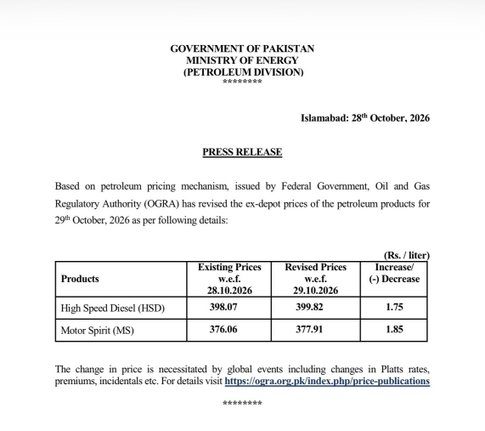
ISLAMABAD – Pakistanis face another increase in fuel costs for October 29, 2026, with petrol rising by Rs1.85 per litre and high-speed diesel becoming Rs1.75 per litre more expensive, according to the Petroleum Division press release.

The revision takes petrol to Rs377.91 per litre from Rs376.06, while high-speed diesel climbs to Rs399.82 from Rs398.07. Both calculations match the revised prices listed in the notification dated October 28.

Petrol Price In Pakistan Jumps To Rs377 91 Diesel Also Gets Costlier

Despite the latest increase, petrol remains cheaper than at the beginning of October. Historical price records show it stood at Rs387.40 per litre on October 1 before reaching Rs398.96 on October 9. It subsequently declined to Rs390.23 on October 16 and Rs381.14 on October 20.

Recent revisions underline the uneven trend. Petrol rose to Rs379.25 on October 27, dropped to Rs376.06 on October 28 and will now recover to Rs377.91. Diesel, meanwhile, has climbed from Rs389.27 on October 20 to the newly announced Rs399.82.

Internationally, Brent crude futures traded at $115.47 a barrel, while US West Texas Intermediate stood at $101.33 at 0435 GMT, or 9:35am Pakistan time, on October 28. Both benchmarks were approximately 1.4% higher amid renewed concerns about Saudi Arabian supply risks.

Petrol Price in Pakistan drops to Rs376, Diesel nears Rs400 mark

The post Petrol Price in Pakistan jumps to Rs377.91; Diesel also gets Costlier appeared first on Daily Pakistan English News.

  •  

Imran Khan’s sister Noreen Niazi hospitalised after Chest Pain as doctors probe ‘Heart Attack’

LAHORE (Javed Iqbal) – Imran Khan’s sister Noreen Niazi has been moved from Lahore jail to Punjab Institute of Cardiology on Wednesday evening, where doctors start investigating possible heart attack after she developed chest pain and difficulty breathing.

Noreen, the wife of Hafeezullah Niazi, was brought to the hospital’s emergency department at 6:51pm under strict police supervision, according to sources. Noreen arrived with rapid heartbeat, elevated blood pressure, chest pain and shortness of breath. Some changes in her ECG prompted doctors to order blood tests to determine whether she had suffered a heart attack.

A heart attack has not yet been confirmed. Doctors said the ECG findings could indicate a cardiac event, but a definitive diagnosis would depend on blood test results, particularly those checking for damage to the heart muscle.

After immediate examination and initial medical care, Noreen was moved to the relevant surgical ward, where she remains under continuous observation and treatment. Sources said she had been experiencing heart discomfort while incarcerated in a Lahore jail. Her worsening condition prompted the transfer to the specialist cardiac hospital.

The hospital also saw heightened security presence following her arrival, with a heavy police contingent and senior officials reaching the premises. Strict security arrangements were put in place around the section where she was being treated, restricting access to her.

Noreen is the sister of Pakistan Tehreek-e-Insaf founding chairman Imran Khan. Doctors are continuing to assess her condition, with the blood test results expected to clarify whether her symptoms and ECG changes were caused by a heart attack.

Imran Khan undergoes Medical Check-Up by PIMS, Shifa Doctors at Adiala

The post Imran Khan’s sister Noreen Niazi hospitalised after Chest Pain as doctors probe ‘Heart Attack’ appeared first on Daily Pakistan English News.

  •  

Pakistan steps up Fight against Money Laundering in Crypto Market with AMLA

ISLAMABAD – Pakistan’s crypto market is entering new chapter of accountability as Pakistan Virtual Assets Regulatory Authority (PVARA) joins country’s anti-money laundering framework, strengthening oversight of digital asset businesses and efforts to curb illicit money flows.

National Executive Committee on Anti-Money Laundering and Counter-Financing of Terrorism approved adding PVARA to Schedule IV of the Anti-Money Laundering Act (AMLA), strengthening the authority’s role in overseeing cryptocurrency exchanges and other virtual asset service providers.

The decision brings regulatory accountability to a market used by millions of Pakistanis, and it reinforces efforts to establish clearer operating requirements for crypto businesses as the country develops a formal framework for digital finance.

Under the strengthened oversight arrangements, licensed platforms must maintain anti-money laundering programmes, report suspicious transactions and meet applicable Financial Monitoring Unit requirements. Firms that fail to comply can face regulatory action.

For businesses seeking to enter Pakistan’s digital asset market, the development adds another layer of clarity to a sector undergoing rapid regulatory change. Stronger supervision could also help build confidence in licensed platforms and support their integration with the wider financial system.

PVARA’s mandate rests on the Virtual Assets Act, passed by parliament in March 2026, following a presidential ordinance introduced in 2025. The legislation established a dedicated legal framework for licensing and supervising virtual asset businesses, alongside market surveillance provisions.

Chairman Bilal bin Saqib has described the Act as Pakistan’s first dedicated cryptocurrency law. He has also said the regulator has issued No Objection Certificates to several firms as it advances the authorisation process. The authority works alongside the State Bank of Pakistan and the Securities and Exchange Commission of Pakistan. While PVARA leads licensing and supervision within its mandate, the central bank is working on banking arrangements for virtual asset businesses.

Pakistan’s large crypto user base makes the transition particularly significant. Bringing more activity into a supervised environment could improve transparency and give businesses a clearer route into the formal economy.

PVARA operates regulatory sandbox where companies can test services under supervision before pursuing full licences. The initiative provides space for innovation while allowing the regulator to assess emerging products and potential risks.

PVARA Chief calls for UN-Led Push on Global Digital Finance Regulation

Pakistan’s boom in crypto market faces critical test to keep dirty money out of digital finance. Criminals are exploiting weak ID checks and poorly supervised platforms to disguise illicit funds as routine trading. Pakistan’s Financial Monitoring Unit has flagged virtual assets as vulnerable to money laundering and terrorist financing, citing analysis that included domestic suspicious transaction reports.

The scale makes effective oversight essential. Around 40 million Pakistanis hold crypto-linked accounts, PVARA Chairman Bilal bin Saqib told a Senate committee, according to reporting in September 2026. The figure represents an official estimate rather than a verified count of active traders

Stronger safeguards can prevent criminal proceeds from slipping into legitimate trading activity. Verifying customers, monitoring unusual transfers and reporting suspicious transactions give authorities a better chance of detecting abuse while supporting a more accountable crypto market.


The post Pakistan steps up Fight against Money Laundering in Crypto Market with AMLA appeared first on Daily Pakistan English News.

  •  

Pakistan steps up Peace Diplomacy as Middle East faces Fresh Escalation

ISLAMABAD – As attacks on Saudi Arabia and fears of renewed Israeli strikes on Iran deepen Middle East crisis, Pakistan reaffirmed its backing for the Makkah defence alliance, calling it a critical force for lasting regional peace.

Deputy Prime Minister and Foreign Minister Ishaq Dar delivered the message during a meeting with retired Lieutenant General Nauman Mahmood, the alliance’s first secretary-general, as Islamabad continued diplomatic efforts to ease tensions.

Dar highlighted efforts to promote regional and international stability and stressed the alliance’s importance in securing lasting peace. He also congratulated Mahmood on his appointment and wished him success.

Pakistan, Saudi Arabia and Türkiye in August, the Makkah Joint Defence Agreement binds the three countries to a collective security commitment under which an attack on one member is considered an attack on all. The pact took shape amid a widening regional confrontation following US and Israeli attacks on Iran in February. Tehran responded by targeting American military bases and civilian infrastructure across the Gulf.

The crisis has since spread to Saudi Arabia, where attacks by Iran-backed Houthi rebels have heightened concerns over the security of civilian facilities and the risk of further escalation.

Pakistan warned the Houthis against attacking the kingdom and reaffirmed its commitment to protecting Saudi Arabia’s sovereignty and territorial integrity. Islamabad has repeatedly stressed that the agreement is defensive and is not directed against any country.

The meeting comes as Pakistan works with Saudi Arabia, Türkiye, Qatar and other regional partners to advance peace efforts at a time of mounting military and diplomatic uncertainty. On Monday, senior officials from Pakistan, Saudi Arabia and Türkiye met Iranian officials in Tehran to discuss ways to ease the confrontation.

Saudi Defence Minister Prince Khalid bin Salman, Pakistan’s Chief of Defence Forces Field Marshal Asim Munir, Turkish intelligence chief Ibrahim Kalin and Iran’s Supreme National Security Council Secretary Mohsen Rezaei participated in the talks. Meanwhile, negotiations between Washington and Tehran remain stalled, placing renewed attention on Qatar’s mediation efforts.

An earlier report suggested Iran was considering a draft agreement presented by Qatari mediators on Sunday, with a response expected by the end of the week. The proposal was aimed at ending the war involving Iran, the United States and Israel.

However, a subsequent statement attributed to a senior Iranian official challenged that account, describing the suggestions as unacceptable ideas rather than a new peace proposal.

Middle East braces for Military Escalation as US mulls Massive Iran Strikes after November 3


The post Pakistan steps up Peace Diplomacy as Middle East faces Fresh Escalation appeared first on Daily Pakistan English News.

  •  

Pakistani Court hands Afghan National Death Sentence in Blasphemy Case

PESHAWAR – A Peshawar court on Wednesday sentenced Afghan national to death and imposed Rs100,000 fine after convicting him in a blasphemy case reported in Hayatabad in 2022.

Additional Sessions Judge Rafiullah announced verdict against Mullah Din after the completion of the trial, finding him guilty on the basis of witness testimonies and evidence presented by the prosecution.

Din, a resident of Afghanistan, made derogatory remarks about Prophet in 2022, within the jurisdiction of Hayatabad police station. Local residents apprehended him following the incident and handed him over to police. A case was subsequently registered under Section 295-C of the Pakistan Penal Code, and an investigation was launched.

Police later submitted a charge sheet to the relevant court, paving the way for formal trial proceedings. During the hearings, prosecution witnesses recorded their statements and other evidence was placed before the court for examination.

At the conclusion of the trial, the judge convicted Din and ordered his execution by hanging in accordance with the law. The written verdict directed that he be hanged by the neck until dead.

The court also ruled that failure to pay the Rs100,000 fine would result in an additional six months in prison.

Pakistan has strict blasphemy laws, with offences involving derogatory remarks about Islamic personalities carrying death penalty under Section 295 of the Pakistan Penal Code.

Pakistani Court sentences 4 Men to Death over ‘Blasphemous Content’ shared on WhatsApp

The post Pakistani Court hands Afghan National Death Sentence in Blasphemy Case appeared first on Daily Pakistan English News.

  •  

Fauji Fertilizer earns nearly Rs8 Billion More as Profits hit Rs71 Billion

ISLAMABAD – Fauji Fertilizer Company Limited has reported sharp increase in earnings, reinforcing its position among Pakistan’s major corporate profit-makers as higher sales and stronger operating income helped the company deliver double-digit growth.

According to financial results for 9 months ended September 2026, the fertilizer manufacturer earned Rs71.02 billion in net profit, compared with Rs63.04 billion during the corresponding period last year. The figures show increase of around 13%, meaning the company generated nearly Rs8 billion more in profit than it did during the same nine months of 2025.

FFC’s Board of Directors announced an interim cash dividend of Rs18.50 per share, continuing the company’s shareholder payout strategy. With the latest declaration, total interim dividends announced for 2026 have reached approximately Rs41.50 per share, including earlier distributions. The latest results showed earnings per share (EPS) climbing to approximately Rs48.77 from Rs43.30 a year earlier, reflecting improved profitability.

The company’s strong performance was not limited to its nine-month figures. During the July–September quarter, FFC generated approximately Rs28.60 billion in net profit, compared with Rs25.09 billion in the corresponding quarter of 2025. This shows year-on-year growth of nearly 14%, indicating that the company maintained positive earnings momentum during the third quarter.

BankIslami Reports Profit After Tax of PKR 3.1 Billion for the Nine Months of 2026; Strengthens CASA Ratio to Over 74%

FFC had already reported Rs42.42 billion in profit during the first half of 2026, accompanied by an interim dividend of Rs14.50 per share. The latest financial figures reveal that FFC’s consolidated revenue climbed to approximately Rs373.24 billion during the nine-month period, registering growth of nearly 15.7%.

Gross profit increased to around Rs124.64 billion, up 14.9%, while operating profit advanced 13.9% to approximately Rs92.08 billion. The company recorded profit before taxation of Rs108.62 billion, while its tax expense stood at nearly Rs37.60 billion. However, rising borrowing costs remained a concern, with finance expenses increasing by approximately 37.1% to Rs7.60 billion.

Despite this pressure, FFC maintained strong profitability, supported by its fertilizer operations and investment income. Operational figures also showed stronger demand for the company’s key fertilizer products. FFC’s urea offtake increased to approximately 2.16 million tonnes from 1.96 million tonnes a year earlier, highlighting improved sales volumes.

Production of prilled urea at the company’s Goth Machhi and Mirpur Mathelo facilities increased by around 2% to 1.91 million tonnes. However, gas supply constraints affected granular urea production, which declined by approximately 15% to 281,000 tonnes. Sona DAP production also fell to 586,000 tonnes from 622,000 tonnes amid raw material availability challenges and elevated phosphoric acid prices.

The financial announcement attracted attention on Pakistan Stock Exchange, where FFC shares were trading near Rs549–550 on October 28, compared with the previous session’s price of approximately Rs537.

FFC’s financial growth comes as the company continues to benefit from its expanded operations following the merger with Fauji Fertilizer Bin Qasim Limited. The merger strengthened the company’s position in Pakistan’s fertilizer industry, particularly in urea and DAP production and distribution.

The company’s standalone nine-month profit reached approximately Rs64.16 billion, while consolidated earnings, which incorporate the relevant group results, climbed to Rs71.02 billion.

BOP powers ahead with Strong 9-Month 2026 Operating Performance, strengthened Capital Base, Accelerated Lending Growth

The post Fauji Fertilizer earns nearly Rs8 Billion More as Profits hit Rs71 Billion appeared first on Daily Pakistan English News.

  •  

KP to hold Local Govt Elections in all Districts except THOSE under Emergency

ISLAMABAD – Election Commission of Pakistan (ECP) ordered immediate local government elections in 23 districts, rejecting further delays in areas where electoral preparations have already been completed.

ECP decision opened the door for fresh electoral contest in the region, where local government institutions have remained inactive for months following the expiration of their constitutional terms. The electoral exercise will not extend to 12 tribal districts currently affected by emergency conditions, where security concerns and extraordinary administrative arrangements have forced authorities to put elections on hold.

The decision was announced by a five-member ECP bench headed by Chief Election Commissioner Sikandar Sultan Raja, following hearings over prolonged delays in holding local government elections. In its ruling, the commission made it clear that elections cannot be held hostage to administrative delays in districts where all legal requirements have already been fulfilled.

The electoral watchdog directed the provincial government and its election wing to immediately prepare a polling schedule for the 23 districts where the delimitation of constituencies has been completed. For remaining areas where constituency boundaries have yet to be finalised, the commission ordered authorities to announce a fresh delimitation schedule without wasting further time.

ECP directed provincial administration and relevant institutions to provide the necessary security, logistical assistance and administrative arrangements to ensure the smooth conduct of elections.

The latest ruling comes after months of uncertainty surrounding the future of local government institutions in Khyber Pakhtunkhwa. The 4-year tenure of local bodies elected during the first phase expired in March 2026, while representatives elected in the second phase completed their terms in June 2026.

Since then, the province has faced a prolonged gap in elected local representation, raising questions about grassroots governance and the delivery of municipal services.

‘KP Emergency Could Last Until 2029 Elections’, Rana Sanaullah hints at Govt’s Strategy

According to Election Commission, amendments introduced by the provincial government to local government legislation, coupled with administrative complications, disrupted the delimitation process and prevented the timely announcement of elections. During the hearings, election officials informed the commission that essential preparations had already been completed in most districts, strengthening the case for allowing the electoral process to proceed.

The controversy surrounding local government elections intensified after the federal government imposed emergency measures in Khyber Pakhtunkhwa under Article 232 of the Constitution and Governor’s Rule under Article 234. The extraordinary constitutional arrangements created fresh challenges for holding elections, particularly in areas facing serious security threats.

The provincial administration approached the ECP, seeking the postponement of local government elections in 12 districts. Officials cited deteriorating law and order, military deployments in sensitive areas and the prevailing emergency situation as major obstacles to organising polling.

The commission accepted that elections could not proceed immediately in the emergency-affected districts but refused to extend the suspension to areas where electoral arrangements were already complete.

The ruling does not announce an exact polling date, but it requires authorities to move ahead without unnecessary delay. For political parties, prospective candidates and millions of voters across Khyber Pakhtunkhwa, the decision could mark the beginning of a fresh battle for control of local government institutions.


The post KP to hold Local Govt Elections in all Districts except THOSE under Emergency appeared first on Daily Pakistan English News.

  •  

Hania Aamir and Yashma Gill melt hearts with Cute Birthday Moments

KARACHI – Pakistani showbiz stars Hania Aamir and Yashma Gill sparked frenzy online with birthday celebrations that left fans divided.

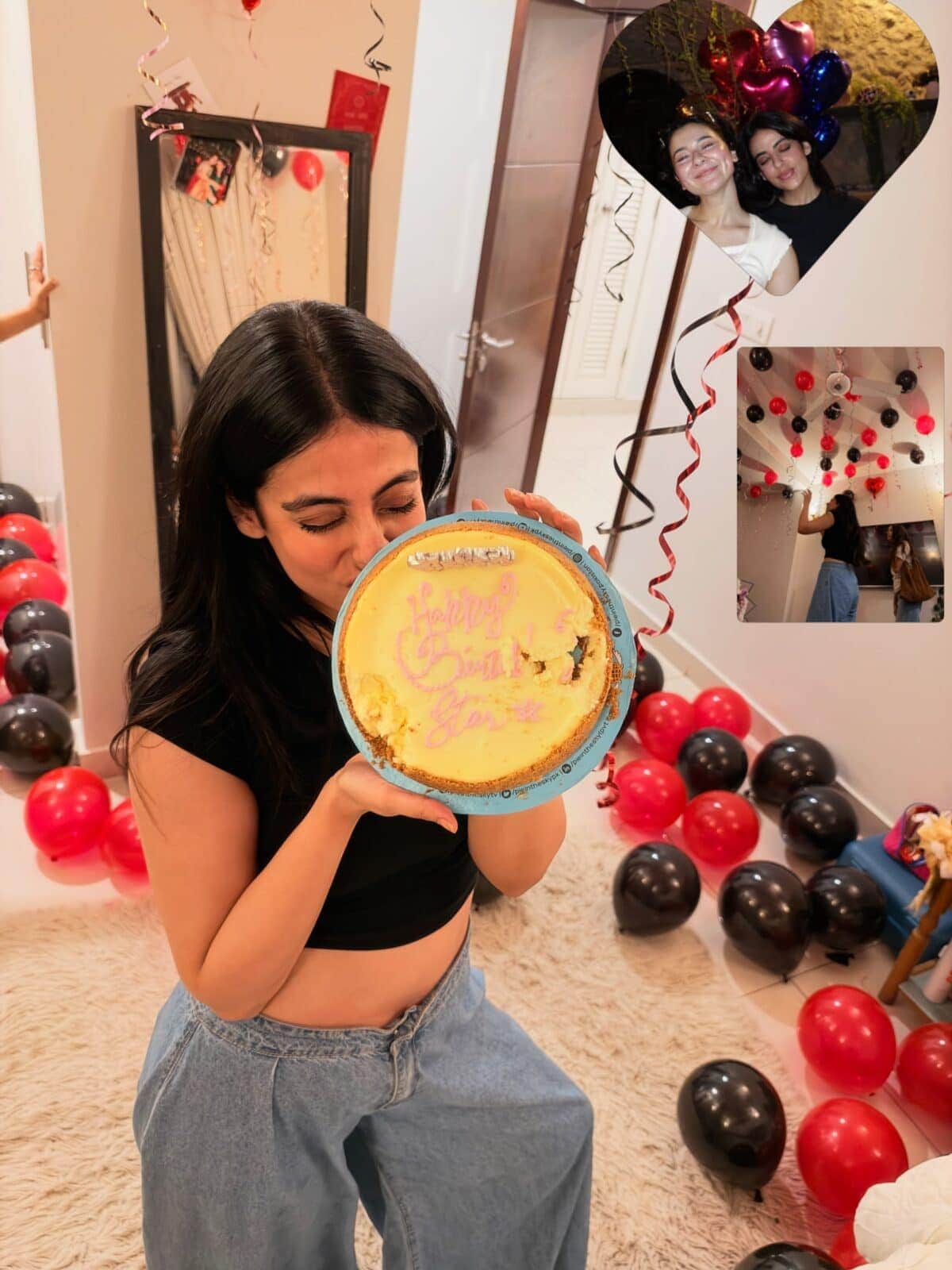
Mere Humsafar star decided to make close friend Yashma feel extra special with a surprise at her apartment. The actress went all out to create a festive atmosphere, decorating the apartment with red and black balloons, including shiny heart-shaped decorations. She arrived with a birthday cheesecake featuring a message written in pink icing, catching Yashma in a moment of genuine excitement.

Hania Aamir And Yashma Gill Melt Hearts With Cute Birthday Moments Hania Aamir And Yashma Gill Melt Hearts With Cute Birthday Moments Hania Aamir And Yashma Gill Melt Hearts With Cute Birthday Moments Hania Aamir And Yashma Gill Melt Hearts With Cute Birthday Moments Hania Aamir And Yashma Gill Melt Hearts With Cute Birthday Moments

Dressed in a white lace-trimmed top, Hania appeared delighted as she celebrated alongside Yashma, who opted for a black crop top and loose blue jeans. Snaps from the celebration captured birthday girl surrounded by balloons, flowers and presents. A beautiful arrangement of flowers added another colourful touch to the occasion.

Hania Aamir And Yashma Gill Melt Hearts With Cute Birthday Moments Hania Aamir And Yashma Gill Melt Hearts With Cute Birthday Moments Hania Aamir And Yashma Gill Melt Hearts With Cute Birthday Moments

Another cake, decorated with red frosting and an amusing stick-figure illustration, became part of the playful birthday moments. Yashma was photographed posing with the cake while making funny expressions for the camera.

As pictures made their way across social media, the celebration attracted sharply divided reactions. A large number of admirers showered the actresses with birthday greetings, praised their friendship and wished them happiness in the years ahead. However, another section of social media users took issue with their clothing choices.

Yashma Gill is among Pakistan’s well-known television actresses, recognised for her versatile performances, outspoken personality and active social media presence. With 1.6 million Instagram followers, she has built a substantial online audience, although some of her posts and fashion choices have occasionally generated controversy.

Her television career includes appearances in popular dramas such as Ab Dekh Khuda Kia Karta Hay, Kis Din Mera Viah Howe Ga, Sadqay Tumhare, Bebak, Tere Ishq Ke Naam, Phaans and Haq Meher. She also received appreciation for her acting in Habil Aur Qabil, further strengthening her presence in the television industry.

Yashma Gill sets Internet Ablaze in Sultry Black Saree Photoshoot

The post Hania Aamir and Yashma Gill melt hearts with Cute Birthday Moments appeared first on Daily Pakistan English News.

  •  

Pakistan closes Airspace to Taiwan flights in strong show of support for China

ISLAMABAD – Pakistan delivered setback to Taiwan’s aviation industry by shutting its skies to Taiwanese airlines, forcing international passenger jets to abandon their usual flight paths and take alternative routes through Russia in dramatic move that reinforces Islamabad’s unwavering support for Beijing.

The restrictions disrupted flights operated by Taiwan’s leading carriers, China Airlines and EVA Air, particularly on busy routes connecting Asia with Europe. Defence Minister Khawaja Asif publicly confirmed the government’s position saying Islamabad’s aviation policy strictly follows the One-China principle, under which only airlines from mainland China are permitted to use Pakistani airspace.

The development is unsual escalation of diplomatic dispute surrounding Taiwan into international aviation, with South Asian nation introduced first such restriction. There has also been no prominent official response so far from Taiwan’s Foreign Ministry or the Chinese government specifically addressing the reported Pakistani decision.

The first signs of change reported earlier this week, when aviation tracking platforms started recording unexpected shift in the routes used by Taiwanese passenger aircraft. Data from Flightradar24 shows that China Airlines and EVA Air crossed Pakistan during certain long-haul journeys, begun steering their aircraft away from the country.

Instead of following their established flight corridors, more than 10 Asia-Europe services reportedly diverted northward through Russian airspace. The sudden change caught the attention of aviation analysts, who observed Taiwanese aircraft taking substantially different routes between October 25 and 27.

For Taiwanese airlines, Pakistan’s decision is another blow as Taiwanese commercial carriers already face restrictions on flying across mainland China, leaving them with limited corridors for their long-distance journeys to European destinations.

Pakistan’s airspace provided key passage through South Asia, allowing certain aircraft to avoid more complicated and potentially longer routes. With that corridor now reportedly blocked, airlines must reconsider how they connect Asian cities with major European aviation hubs.

Another option takes aircraft northward through Russia, a route that Taiwanese carriers had largely avoided amid Russia-Ukraine war. Russian option reportedly become more attractive with the beginning of the International Air Transport Association’s winter scheduling season on October 25.

Beyond the disruption to international flights, Pakistan’s decision carries considerable political significance. Islamabad maintained a consistent position on Taiwan for decades, recognising Beijing as the sole legitimate government of China and supporting its claim that Taiwan is an inseparable part of Chinese territory.

Pakistan’s Foreign Office reaffirmed that position earlier in 2026 amid renewed international tensions over the Taiwan Strait. The same commitment has repeatedly appeared in joint statements issued by Islamabad and Beijing, reflecting the two countries’ close strategic and diplomatic relationship.

China and Pakistan describe their partnership as ironclad and all-weather, with cooperation spanning defence, economic development, infrastructure and regional security. The latest aviation development gives that diplomatic position a practical dimension, extending Pakistan’s support for Beijing into decisions affecting international commercial air traffic.

Islamabad already restricted Indian aircraft from using its airspace, with restrictions extended through aviation notices amid tensions between the nuclear-armed neighbours.

Pakistan extends airspace ban on Indian aircraft for another month

The post Pakistan closes Airspace to Taiwan flights in strong show of support for China appeared first on Daily Pakistan English News.

  •  

Afghan Taliban Ban Eye Transplants despite Free Cornea Donations from Pakistani Doctors

KABUL — Afghan Taliban restricted corneal transplant surgeries, declaring the sight-restoring procedure ‘Un-Islamic’ despite free eye tissue donations from Pakistani-origin doctors.

The controversial move forced hospitals in Kabul and Jalalabad to suspend operations, shattering the hopes of hundreds of blind Afghans. The restriction has also disrupted a humanitarian programme backed by the Association of Physicians of Pakistani Descent of North America (APPNA), which had already helped more than 150 Afghan patients undergo corneal transplants.

Hundreds of blind Afghans who were hoping to regain their eyesight have been dealt a devastating blow after Taliban authorities reportedly banned corneal transplant surgeries, declaring the life-changing medical procedure contrary to their interpretation of Islamic teachings. The controversial decision brought free eye-transplant programme to a sudden standstill, forcing hospitals in Kabul and Jalalabad to turn away patients who had spent months waiting for the chance to see again.

Even more alarming is that the restriction was reportedly imposed through verbal instructions rather than a publicly issued written decree. Doctors say they have no choice but to comply, fearing punishment if they continue performing the operations.

The development gets attention to growing challenges facing Afghanistan’s healthcare system under Taliban rule, particularly as patients with treatable blindness find themselves caught between medical necessity and religious restrictions.

The transplant programme had been stopped in August following orders attributed to Taliban authorities.

The reported ban particularly affected humanitarian programme supported by Association of Physicians of Pakistani Descent of North America (APPNA), a US-based organisation with a long history of providing donated corneas to patients in Pakistan.

Established in 2017, APPNA’s charitable corneal donation initiative has helped thousands of people receive sight-restoring treatment. Its earlier records documented more than 5,000 donated corneas supplied through the programme, with subsequent updates reporting further expansion.

In 2026, the organisation extended its services to Afghanistan, where decades of conflict and inadequate healthcare facilities had created an urgent need for specialist eye treatment. The results were significant. Within approximately four months, more than 150 corneal transplant surgeries were performed with the programme’s support.

Pakistan disappointed at Afghan Taliban’s ban on women education

The post Afghan Taliban Ban Eye Transplants despite Free Cornea Donations from Pakistani Doctors appeared first on Daily Pakistan English News.

  •  
❌