
❌

Reading view

Pakistan fires back at Afghan Taliban over ‘Baseless’ Civilian Death claims

ISLAMABAD – Pakistan turned down Afghan Taliban’s allegations that its military operations have killed and injured Afghan civilians, escalating an already volatile dispute over cross-border terrorism, airstrikes and regional security.

Foreign Office termed to Afghan accusations “baseless and unsubstantiated,” defending its military actions as necessary responses to persistent terrorist threats.

Islamabad maintained that its operations were conducted with restraint, remained proportionate to the threats involved and targeted terrorist organizations and their logistical infrastructure rather than civilians. The statement invoked the principles of self-defence, necessity and last resort, while emphasizing compliance with the international humanitarian law principles of distinction and precaution.

Pakistan also delivered pointed warning: it reserves the right to take whatever measures are necessary to protect its sovereignty, territorial integrity and citizens.

The latest exchange shows deepening confrontation between Islamabad and Kabul, with both sides advancing sharply conflicting accounts of military operations and civilian casualties.

Afghan territory caused more than 3,500 casualties in Pakistan during 2026. Foreign Office accused Afghan Taliban authorities of failing to prevent militant organizations, particularly Tehreek-i-Taliban Pakistan (TTP) and the Balochistan Liberation Army (BLA), from operating across the border.

As per Pakistani officials reports, around 1,327 deaths and 2,484 injuries occurred due to terrorism originating from Afghanistan. These figures shows massive scale of the threat Islamabad says it faces from Western neighbour.

Pakistan has repeatedly argued that the presence of armed groups in Afghanistan has allowed attacks against its security personnel, police and civilians to continue despite repeated diplomatic appeals.

Afghan authorities countered Pakistan’s claims with allegations of significant civilian losses caused by Pakistani military strikes. Afghan Foreign Ministry spokesperson Abdul Qahar Balkhi reportedly told CNN that Pakistani operations had killed or injured 1,119 Afghan civilians since late 2021 or early 2022. Afghan media outlets, including Tolo News, reported similar claims around October 25–26, 2026.

Pakistan however rejected allegations that its forces deliberately target civilians, maintaining that its operations are directed against terrorist hideouts and infrastructure used to plan and support attacks. The competing figures remain difficult to reconcile independently. Access restrictions, security conditions and conflicting accounts complicate efforts to establish the precise number of civilian casualties and determine responsibility for individual incidents.

Nevertheless, the allegations intensified diplomatic pressure on both sides, placing civilian protection at the centre of an increasingly bitter security dispute.

Pakistan strengthened its argument by pointing to findings from United Nations monitoring mechanisms concerning militant activity in Afghanistan. UN Analytical Support and Sanctions Monitoring Team’s 38th report, covering December 16, 2025, to June 9, 2026, identified continued Taliban support for the TTP as a factor contributing to the increased frequency and lethality of terrorist attacks in Pakistan.

The report also termed relocation of around 2,000 TTP fighters and their family members farther into Afghanistan, alongside continuing concerns about militant networks operating within the country. UN reporting has also examined connections among the TTP, Al-Qaeda, Islamic State Khorasan Province and other militant organizations, including the BLA.

For Islamabad, these findings reinforce its longstanding contention that militant activity inside Afghanistan represents a direct threat to Pakistan’s national security.

Afghan Taliban denies systematically supporting groups that attack Pakistan. The disagreement over the TTP’s presence, activities and relationship with Afghan authorities remains one of the most serious obstacles to stabilizing bilateral relations.

Foreign Office statement also comes amid a separate dispute involving former US special representative for Afghanistan Zalmay Khalilzad. Around October 24–25, Pakistan’s information ministry rejected allegations attributed to Khalilzad that Islamabad was arming Afghans or recruiting them to fight the Taliban in connection with anti-Pakistan insurgent activity.

Pakistani officials described the allegations as baseless and misleading, arguing that they distracted attention from the presence of militant groups accused of operating from Afghan territory. Islamabad again cited UN reporting on the TTP and Al-Qaeda to support its position that Afghan authorities must prevent their territory from being used to organize attacks against Pakistan.

Afghan Taliban Taste their own Medicine as Resistance Groups claim 38 Killed across 12 Provinces

The post Pakistan fires back at Afghan Taliban over ‘Baseless’ Civilian Death claims appeared first on Daily Pakistan English News.

  •  

Pakistan’s Upgraded Fatah IV meets India’s 800km BrahMos Missile, Is Mumbai in Range?

ISLAMABAD – Pakistan’s latest cruise missile test shows a potential shift in conventional restraint , with an extended-range variant reportedly exceeding 750 kilometers and raising new questions about India’s military vulnerability, US publication The Diplomat reported.

The upgraded Fatah-IV missile test reshapes strategic calculations between Islamabad and New Delhi. The country tested extended-range version of Fatah-IV ground-launched cruise missile, showing range exceeding 750 kms and potentially expanding Pakistan’s ability to threaten military installations deep inside Indian territory.

The test marks third known launch of the Fatah-IV system, following earlier trial in May 2026. Unlike the previous tests, the latest launch reportedly involved an extended-range configuration, suggesting that Pakistan is working to increase the reach of its conventional precision-strike capabilities. Although the missile’s maximum operational range has not been independently established, some assessments based on available imagery suggest that the upgraded version could eventually approach 1,000 kilometers. If that estimate proves accurate, the system could significantly broaden Pakistan’s conventional strike options.

First publicly displayed during Pakistan’s Independence Day celebrations on August 14, 2025, the Fatah-IV emerged against the backdrop of the military confrontation between India and Pakistan that year.

The ground-launched cruise missile reportedly travels at speeds of up to Mach 0.7 and carries 330-kilogram blast-fragmentation warhead. Its terrain-hugging flight profile is intended to reduce radar exposure by allowing it to fly at low altitudes, potentially complicating detection and interception. Pictures of extended-range variant appear to show changes to the missile’s aerodynamic configuration. Its wings seem to have moved from the central portion of the fuselage to a position beneath the body. The newer missile also appears somewhat larger than its predecessor.

These differences show redesigned airframe or changes intended to accommodate additional fuel. However, the precise engineering modifications and maximum range of the upgraded missile remain unconfirmed. The reported performance nevertheless points to a clear strategic objective: increasing the distance from which Pakistan can threaten high-value targets with conventional weapons.

One of the key consequential implications of Fatah-IV upgrade concerns future operational strategy of the Indian Air Force (IAF). Following aircraft losses reported during the May 6–7, 2025, confrontation, India could place greater emphasis on launching weapons from aircraft operating farther from Pakistani airspace. Such an approach would reduce the need for Indian fighters to enter areas where they might face Pakistani aircraft and air defense systems.

Longer-range air-launched weapons would be central to that strategy. They could allow the IAF to engage targets while keeping its aircraft at a greater distance from hostile defenses. India’s reported plans to extend range of its BrahMos supersonic cruise missile could further strengthen this capability. Some reports have put the proposed range of an upgraded BrahMos at approximately 800 kilometers, although the operational status and deployment timeline of such a variant remain important uncertainties.

For Pakistan, the prospect of Indian aircraft launching long-range weapons from relatively secure locations creates a difficult challenge. Its response would not necessarily depend on intercepting every incoming missile or engaging every attacking aircraft. Instead, Islamabad could seek to hold the infrastructure supporting those operations at risk.

Is Mumbai in Range?

Mumbai is particularly important. If extended-range Fatah-IV achieves range suggested by some preliminary assessments, parts of the Mumbai region could potentially fall within reach from suitable launch locations in Pakistan.

Such a possibility would carry implications beyond the immediate physical effects of a missile strike. The threat to a major financial center could affect investor sentiment, public confidence, commercial activity, and political calculations during a crisis.

Pakistan could view this capability as a means of reinforcing deterrence against conventional attacks on its own cities and economic infrastructure. The underlying logic is that decision-makers may exercise greater restraint if they believe that an attack against their adversary’s urban centers could invite retaliation against their own.

However, the existence of a missile capable of reaching a metropolitan area does not automatically make a retaliatory threat credible. Its effectiveness would depend on operational readiness, targeting accuracy, the ability to penetrate defenses, and the willingness of political leaders to authorize its use.

India’s growing investment in air and missile defense presents another potential reason for Pakistan to pursue longer-range cruise missiles. Since 2025 confrontation, New Delhi moved to strengthen its defensive architecture through additional systems, including the Russian-origin S-400. India has also advanced its indigenous Kusha long-range interceptor program and announced Mission Sudarshan Chakra, an initiative intended to improve the integration and effectiveness of the country’s defensive capabilities.

For Pakistan, these developments create pressure to ensure that its conventional strike options remain credible against increasingly sophisticated defenses.

Fatah-IV’s low-altitude flight profile could offer a potential advantage. Terrain-hugging cruise missiles can exploit the radar horizon and surrounding terrain to reduce the distance at which certain ground-based sensors detect them. This may shorten the time available to identify, track, and engage an incoming weapon.

Yet the technology does not make the missile undetectable. Modern air defense networks can combine multiple sensors and interception systems, while the effectiveness of low-altitude flight depends on terrain, radar coverage, electronic warfare, and other operational factors. The extended-range configuration could nevertheless complicate India’s defensive planning by combining a longer potential flight distance with a flight profile intended to reduce exposure to detection.

For Islamabad, the objective may be to preserve a credible conventional strike option even as New Delhi strengthens its ability to defend strategically important sites.

Fatah-IV’s development speaks of broader security consequences of May 2025 conflict. That confrontation underscored importance of airpower, long-range weapons, military infrastructure, and the ability to impose costs beyond the immediate battlefield. It also reinforced the importance of maintaining credible retaliation options in a region where conventional clashes can carry the risk of wider escalation.

Pakistan framed military modernization as necessary to protect its national security and territorial sovereignty. In this context, the extended-range Fatah-IV can be understood as part of a wider effort to strengthen conventional counterforce capabilities. Rather than relying exclusively on aircraft, Pakistan could use ground-launched cruise missiles to threaten selected military targets without requiring its own aircraft to penetrate defended airspace. This could provide additional flexibility during a confrontation and complicate an adversary’s planning.

For India, the development could add another consideration to the protection of airbases, radar sites, and other strategic installations. For Pakistan, it could provide an additional instrument for deterring attacks and responding to a future confrontation.

Obama blasts Trump as Iran War dents US Missile Stockpiles, fuels Inflation

The post Pakistan’s Upgraded Fatah IV meets India’s 800km BrahMos Missile, Is Mumbai in Range? appeared first on Daily Pakistan English News.
  •  

Study in China for Free with Shanghai Ocean University 2027 Scholarship; Apply Online

ISLAMABAD – Imagine pursuing master’s or PhD in China without worrying about tuition fees. Pakistani students now have opportunity to explore Shanghai Ocean University’s 2027 Chinese Government Scholarship, which covers tuition, accommodation, a living stipend and medical insurance.

Pakistani students seeking postgraduate education in China can explore fully funded master’s and PhD opportunities at Shanghai Ocean University, with applications closing on February 1, 2027. Shanghai Ocean University (SHOU) announced 2027 Chinese Government Scholarship (CSC) programme for international students, opening a potential pathway for Pakistani graduates to pursue advanced studies in China without paying tuition fees.

The scholarship package includes tuition coverage, accommodation in a shared double room, a living stipend and comprehensive medical insurance. However, the stipend amount has not been disclosed in the available announcement, so applicants should confirm the latest financial details with the university before applying. The programme is particularly relevant to students interested in marine sciences, aquaculture, fisheries, biological sciences and food-related research.

Master’s and Doctoral Specialisations

Shanghai Ocean University is offering postgraduate programmes across several research-oriented disciplines. Master’s degrees generally take three years to complete, while doctoral programmes have a duration of four years.

The available subjects are:

Master’s programmes

  • Aquaculture
  • Biology
  • Fishery Resources
  • Marine Science
  • Food Science and Engineering
  • Fishery Economics and Management
  • Machinery

PhD programmes

  • Aquaculture
  • Biology
  • Fishery Resources
  • Marine Science
  • Food Science and Engineering
  • Fishery Economics and Management

These options may appeal to Pakistani students planning academic or research careers in fisheries, marine ecosystems, food technology and related scientific fields.

Apply for 2027 Scholarship

Applicants must meet the academic, age and language requirements specified for their intended degree. For a master’s programme, candidates must possess a bachelor’s degree and be aged 30 or younger. Those applying for doctoral studies must hold a master’s qualification, be no older than 35 and demonstrate research experience and academic achievements, including at least one published scientific paper.

The academic requirement is GPA above 3.0. Applicants should verify how the university evaluates grades from different educational systems and whether any additional programme-specific conditions apply. Language proficiency requirements depend on the language of instruction.

Students applying to English-taught programmes must provide an IELTS score of at least 6.0, a TOEFL iBT score of 80 or equivalent evidence accepted by the university. Candidates seeking admission to Chinese-taught programmes must have HSK Level 5 with a score above 180.

Applicants must also satisfy the university’s nationality, medical fitness and other applicable admission requirements.

Documents To Apply

  • Valid passport
  • Academic certificates and transcripts
  • An updated CV or résumé
  • English or Chinese language proficiency results
  • A research proposal
  • Two recommendation letters
  • A medical examination record
  • A police clearance certificate or non-criminal record
  • Evidence of financial support, where required
  • A three-minute personal introduction video

Candidates should check the official application instructions to determine the required formats, certification standards and any additional documents needed for their selected programme.

Supervisor Approval

Unlike application process that begins and ends with a single online form, the SHOU procedure requires candidates to identify a suitable supervisor before proceeding with their scholarship application.

Applicants should first research faculty members whose academic interests align with their proposed studies and seek preliminary consent from a prospective supervisor. Once a supervisor has been identified, candidates should prepare a research proposal and obtain the supervisor’s signature as required by the university. They must then submit an online application through the university’s designated portal.

A separate scholarship application is also required through the Campus China website. Candidates must select CSC Programme Type B and enter Agency Number 10264, which is associated with Shanghai Ocean University in the provided application instructions.

The university’s stated application fee is RMB 400 and is non-refundable. Applicants should confirm the payment procedure and any additional instructions through the official university channels.

Application Deadline

The stated deadline for the 2027 scholarship intake is February 1, 2027. Prospective applicants should begin preparing their academic records, language certificates and research proposals well in advance. Doctoral candidates, in particular, may need additional time to document their research achievements and published work while establishing contact with a suitable supervisor.

The scholarship offers an opportunity to pursue postgraduate education in China, but meeting the minimum eligibility requirements should not be interpreted as a guarantee of admission or funding.

Before submitting an application or paying the fee, candidates should consult Shanghai Ocean University’s official website and verify that their intended programme is available under the 2027 CSC scholarship scheme.

They should also confirm the stipend amount, accommodation arrangements, language requirements, document authentication rules, supervisor approval process and final submission instructions. These details should be checked against the university’s latest official guidance rather than relying solely on third-party announcements.

For Pakistani graduates interested in international research opportunities, the programme could be worth exploring, particularly if their academic background aligns with SHOU’s marine, fisheries and biological science specialisations.

Study in UK with Fully Funded Scholarships for Pakistani Students

The post Study in China for Free with Shanghai Ocean University 2027 Scholarship; Apply Online appeared first on Daily Pakistan English News.
  •  

Field Marshal Asim Munir leads Pakistan delegation to Tehran as Iran hosts Makkah Alliance members

TEHRAN – Chief of Defence Forces Field Marshal Syed Asim Munir is visiting Iran for high-level diplomatic engagements, as Tehran prepares to host regional meeting involving senior representatives from Pakistan, Saudi Arabia, and Turkiye.

According to the Inter-Services Public Relations (ISPR), Field Marhal is undertaking official visit to Iranian capital Tehran. The meeting brings together key regional figures, with Pakistan represented by Field Marshal Asim Munir, Saudi Arabia by Defence Minister Prince Khalid bin Salman, and Turkiye by the head of its intelligence service, according to a foreign news agency.

The gathering is key diplomatic development amid heightened regional tensions. All eyes are at Tehran moot as this is the first high-level meeting involving Iran, Saudi Arabia, Pakistan, and Turkiye amid Houthi attacks on Saudi Arabia.

Iranian Foreign Ministry spokesperson Esmaeil Baghaei also confirmed that Tehran is hosting senior officials from Pakistan, Turkiye, and Saudi Arabia. He further revealed that Field Marshal Asim Munir had proposed convening the meeting.

Discussions are expected to centre on the evolving situations in Palestine and Lebanon, alongside broader regional security challenges and diplomatic relations. Baghaei stressed that building mutual trust among countries in the region is essential to addressing shared concerns and strengthening regional cooperation.

The meeting shows effort to bring influential regional players into dialogue at a critical time, with its discussions expected to focus on pressing political and security issues affecting the wider Middle East.

Pakistan, Saudi Arabia and Turkiye officials to meet Iranian leadership amid Houthi attack

The post Field Marshal Asim Munir leads Pakistan delegation to Tehran as Iran hosts Makkah Alliance members appeared first on Daily Pakistan English News.

  •  

Gold Price rebounds to Rs423,436 Per Tola in Pakistan after Massive October Dip

KARACHI – After steep losses last week, gold prices reversed direction on first day of October’s last week amid tweaks in international bullion rates.

According to the latest figures released by the Sarafa market, the price of one tola of 24-karat gold rose to Rs423,436, with an increase of Rs1,400. The price of 10 grams of gold also recorded a significant jump, increasing by Rs1,201 to Rs363,028.

Latest Gold and Silver Prices

Category New Rate Change
Gold (24K) per tola Rs423,436 +Rs1,400
Gold (24K) per 10 grams Rs363,028 +Rs1,201
Silver per tola Rs5,878 +Rs20
International gold per ounce $4,009 +$14

The latest recovery comes after gold suffered a decline of Rs2,500 per tola on Saturday, October 24, when the precious metal dropped to Rs422,036. Despite Monday’s rebound, gold remains Rs1,100 per tola below its level before Saturday’s decline, indicating that the market has yet to recover all its recent losses.

The upward movement in Pakistan coincided with gains in the international precious metals market. Global gold prices increased by $14 per ounce, reaching $4,009 compared with the previous level of $3,995.

Gold Rates in Lahore

In Lahore, local bullion dealers reported separate quotations for different categories of gold. The two quoted rates for piece gold stood at Rs418,500 and Rs417,800, while Pathoor gold was quoted at Rs413,500 and Rs411,500.

The reported local gold rate in Karachi stood at Rs419,000, while the corresponding quotation in Peshawar reached Rs432,500.

City Reported Gold Rate
Lahore (Piece Gold) Rs418,500 / Rs417,800
Lahore (Pathoor Gold) Rs413,500 / Rs411,500
Karachi Rs419,000
Peshawar Rs432,500

Monday’s increase has brought some relief to bullion traders following the previous session’s decline, but the latest figures indicate that prices remain below their pre-weekend level. The domestic gold market continues to reflect changes in international bullion prices, while movements in the rupee-dollar exchange rate and local trading conditions can also influence rates.

For jewellery buyers, investors and traders, the latest rebound highlights how quickly precious metal prices can change from one trading session to the next.

Gold Price Today in Pakistan: Latest Per Tola, 10 Gram Rates – 26 October 2026

The post Gold Price rebounds to Rs423,436 Per Tola in Pakistan after Massive October Dip appeared first on Daily Pakistan English News.

  •  

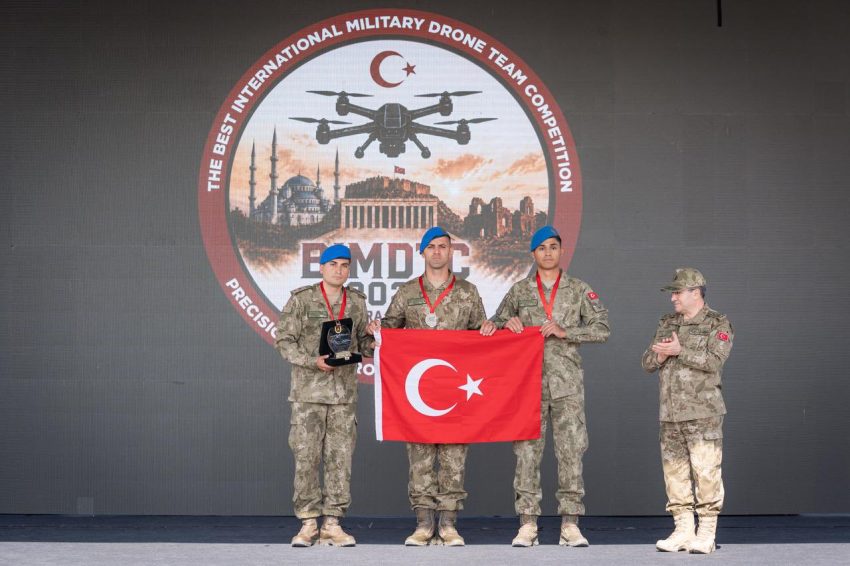
Pakistan beats Italy, France to secure 2nd spot in Global Military Drone Competition

ANKARA — Pakistan finished as runner-up in inaugural Best International Military Drone Team Competition 2026 (BIMDTC), held in the Turkish capital.

Türkiye claimed the championship, while Pakistan secured second place, pushing Italy into third position and France into fourth. The competition, held on Saturday, brought together military drone operators from 33 nations, making Pakistan’s podium finish a notable demonstration of its expertise in modern unmanned aerial technology.

Congratulations to the Turkish team for securing 1st place and Pakistan for achieving 2nd place at the Best International Military Drone Team Competition 2026 (BIMDTC-2026) in Ankara, bringing together competitors from 33 different countries. Congratulations also to Italy for securing 3rd place and France for finishing 4th.

The outstanding performances of the Turkish and Pakistani teams stand as yet another testament to their skill, precision and growing expertise in the field of unmanned aerial systems.

🇹🇷🇵🇰

ذترکیہ میں منعقدہ بہترین بین الاقوامی عسکری ڈرون ٹیم مقابلہ جس میں 33 ممالک نے حصہ لیا میں ترکیہ کو پہلی اور پاکستان کو دوسری پوزیشن حاصل کرنے پر مبارک باد۔ اٹلی کو تیسری اور فرانس کو چوتھی پوزیشن حاصل کرنے پر بھی مبارک۔

ترکش اور پاکستانی ٹیموں کی شاندار کارکردگی بغیر انسانی فضائی نظاموں میں انکی مہارت, درستگی اور بڑھتے تجربے کا ایک اور ثبوت ہے۔

🇹🇷🇵🇰

Ankara’da, 33 farklı ülkeden katılımcıların bir araya geldiği Uluslararası En İyi Askeri Uçangöz Takımı Yarışması (BIMDTC-2026) birinciliği elde eden takımımızı ve ikinciliği kazanan Pakistan’ı tebrik ediyoruz. Üçüncülüğü elde eden İtalya’yı ve yarışmayı dördüncü sırada tamamlayan Fransa’yı da kutluyoruz.

Türk ve Pakistanlı takımların sergilediği üstün performans, insansız hava sistemleri alanındaki becerilerini, operasyonel yetkinliklerini ve giderek artan deneyimlerini bir kez daha ortaya koymuştur.

— Türkiye in Pakistan (@TC_IslamabadBE) October 25, 2026

Turkish Embassy in Islamabad confirmed the results and congratulated the winning teams, acknowledging the technical skills and operational precision displayed during the international event.

Pakistan Beats Italy France To Secure 2nd Spot In Global Military Drone Competition

The competition focused on the ability of trained military personnel to operate drones with speed, accuracy and control under demanding conditions. The participating countries were allowed to send teams consisting of no more than three members. Each team had to include at least two qualified First-Person View (FPV) drone pilots, who were required to be either active-duty military personnel or reservists.

FPV technology allows operators to fly drones using a real-time camera feed, giving them a pilot’s-eye view of the aircraft’s surroundings. This capability has become increasingly important in modern military operations.

During the competition, participants were required to navigate their drones along a designated route while attempting to complete the course in the shortest possible time. Teams recording the fastest performances advanced to the final stage, where their ability to maintain control, navigate accurately and complete the challenge under pressure determined their standings.

Pakistan’s performance proved strong enough to secure second place overall, ahead of several technologically advanced countries.

Pakistan’s success comes as the country continues expanding its domestic drone development programmes while maintaining defence technology partnerships with allies, particularly Türkiye.

The South Asian nation used combination of Turkish-made and locally developed unmanned aerial vehicles during its brief military confrontation with India in May 2025. The reported systems included the Turkish YIHA-III and ASISGUARD SONGAR drones, along with Pakistan’s indigenous Shahpar-II unmanned aerial vehicle.

Shahpar-II was developed by Global Industrial & Defence Solutions (GIDS), a Pakistani state-owned defence organisation involved in developing military equipment and advanced technologies. These systems reflect Pakistan’s broader ambition to strengthen domestic defence manufacturing, reduce dependence on imported military equipment and expand its capabilities in unmanned warfare.

The achievement in Ankara also comes against the backdrop of longstanding defence cooperation between Pakistan and Türkiye. Both countries maintain close military relations encompassing training, defence equipment, technological cooperation and broader strategic engagement.

Their partnership has received renewed attention amid efforts to deepen security coordination with Saudi Arabia. In August, Pakistan, Türkiye and Saudi Arabia were reported to have signed a trilateral defence agreement in Makkah, featuring a collective-defence commitment under which an attack on one participating country would be treated as an attack on all three.

Pakistan turns to US Drone Powerhouse POWERUS in push for Autonomous Warfare


The post Pakistan beats Italy, France to secure 2nd spot in Global Military Drone Competition appeared first on Daily Pakistan English News.

  •  

WhatsApp Web, Desktop Users in Pakistan Warned of Cyberattacks on Windows PCs

ISLAMABAD – Pakistan issued HIGH-level cyberattack alert, warning government officials to immediately stop using WhatsApp Web and Desktop on Windows computers as hackers target users with malicious files capable of stealing passwords, sensitive data and gaining remote control of devices.

Pakistan’s National Cyber Emergency Response Team (National CERT) declared HIGH-level cybersecurity threat, urging government officials and individuals handling confidential data to immediately avoid using WhatsApp Web and WhatsApp Desktop on Windows systems.

The emergency advisory warns that cybercriminals are exploiting messaging platforms and emails to launch targeted phishing attacks, distribute malicious files and gain unauthorized access to computers.

Malware as Documents

According to CERT, attackers are impersonating government departments, officials and trusted contacts to deceive their targets. Malicious files are being circulated through WhatsApp Web, WhatsApp Desktop and email, often disguised as important official documents.

If users open and execute the malicious content, hackers could gain remote access to their Windows computers, steal passwords and obtain confidential information.

The threat is particularly concerning for government departments and organisations dealing with sensitive records, where a single compromised computer could expose valuable data.

The cybersecurity watchdog has warned that users should not automatically trust messages received from familiar WhatsApp contacts. An unexpected document, attachment or suspicious link, even from someone known to the recipient, could be part of a targeted cyberattack.

National CERT has also advised users to regularly inspect WhatsApp’s Linked Devices section, warning that an unfamiliar connected device could indicate unauthorized account access.

As urgent precaution, the national cybersecurity agency has recommended that officials handling sensitive information stop using WhatsApp Web and WhatsApp Desktop on Windows computers. The advisory also warns against transferring files received through WhatsApp to official Windows systems.

Users have been instructed to immediately terminate suspicious WhatsApp Web sessions, avoid unverified attachments and never disclose passwords, one-time passwords (OTPs) or verification codes. National CERT has further recommended enabling two-step verification on WhatsApp and other online accounts.

Windows operating systems, web browsers and installed applications should also be updated with the latest security patches.

The advisory outlines immediate emergency measures for anyone who suspects their computer or WhatsApp account has been compromised. Affected Windows computers should be disconnected from the internet and local networks without delay to limit further unauthorized access.

Users should preserve suspicious messages, attachments and relevant system logs as evidence and avoid reopening potentially malicious files.

The warning does not amount to a nationwide WhatsApp ban. Instead, it specifically highlights the dangers of using WhatsApp Web and Desktop on Windows systems handling sensitive information.

WhatsApp Hack Alert: Your messages might already be compromised

The post WhatsApp Web, Desktop Users in Pakistan Warned of Cyberattacks on Windows PCs appeared first on Daily Pakistan English News.

  •  

Sahibzada Farhan replaces Saim Ayub in Pakistan ODI Squad after Shock Exit

LAHORE – Pakistan Cricket makes major change to unbeaten ODI tri-series squad, with struggling opener Saim Ayub stepping away from action amid string of disappointing performances.

PCB confirmed Sahibzada Farhan as his replacement, raising fresh questions over the national team’s opening combination just days before the tournament final. The unexpected development comes less than 24 hours after Pakistan pulled off sensational one-wicket victory over England at Gaddafi Stadium, where another top-order failure nearly cost the hosts the match.

Despite Men in Green’s winning consecutive matches and securing a place in the final, the team management has moved to address growing concerns surrounding the opening batting positions.

Saim Ayub leaves Pakistan Squad

PCB clarified that Saim Ayub himself requested to be released from the national squad. The left-handed opener approached head coach Mike Hesson and expressed concerns about his recent batting performances, seeking an opportunity to return to domestic cricket to regain his form and confidence.

Amid consultations, the national selectors and coaching staff accepted his request, appreciating the youngster’s willingness to acknowledge his shortcomings and work on improving his game. The decision means Saim will miss the remaining matches of the ODI tri-series involving Pakistan, England and Sri Lanka.

Cricket board has neither announced a timeline for his return nor clarified whether he will be considered for Pakistan’s next international assignment.

Saim’s struggles came under renewed scrutiny during Sunday’s dramatic clash against England, where he managed just six runs before returning to the pavilion. His early dismissal contributed to a disastrous start for Pakistan, leaving the hosts facing the possibility of their first defeat in the competition.

Meanwhile, all-rounder Shadab Khan produced sensational rescue on Sunday, smashing an unbeaten 113 to turn the contest in Pakistan’s favour. With the match hanging in the balance, Shadab and Haris Rauf stitched together an extraordinary unbeaten last-wicket partnership to secure a thrilling one-wicket triumph.

The victory extended Pakistan’s winning streak, but the recurring failures at the top of the order remained a serious concern. Even before the England encounter, captain Shaheen Shah Afridi had acknowledged the inconsistent performances of Pakistan’s opening batters and indicated that the management had alternative options available.

As Saim heads back to domestic cricket, Sahibzada Farhan has been handed another opportunity to establish himself in Pakistan’s ODI setup. The right-handed opening batter was surprisingly absent from the original tri-series squad but has now received a call-up for the remaining matches.

Farhan’s selection comes after he was entrusted with significant leadership responsibilities in Pakistan’s shorter-format cricket. Earlier this month, he was named captain of Pakistan’s T20I team for the series against Sri Lanka. He also led the national side at the Asian Games.

Saim’s exit is not the only adjustment made to Pakistan’s squad. Just a day earlier, the selectors included promising 21-year-old batter Maaz Sadaqat, who had initially been excluded from the tri-series. The young cricketer was drafted into the squad as additional cover for players experiencing minor fitness problems.

His inclusion followed the release of left-arm wrist-spinner Sufiyan Moqim, who was instructed to resume domestic cricket. According to the PCB, the decision involving Sufiyan was influenced by the characteristics of the pitches at Lahore’s Gaddafi Stadium.

Pakistan’s recent performances have produced contrasting pictures. On one hand, the hosts remain unbeaten after winning their opening three matches and have already secured qualification for the tri-series final. On the other, repeated top-order setbacks have exposed vulnerabilities that could prove costly in high-pressure encounters.

Pakistan will face Sri Lanka in the fifth match of the tournament at Gaddafi Stadium on Tuesday, October 27. The final is scheduled for Saturday, October 31, at the same venue.

Shadab Khan’s century guides Pakistan to one-wicket thriller against England

The post Sahibzada Farhan replaces Saim Ayub in Pakistan ODI Squad after Shock Exit appeared first on Daily Pakistan English News.

  •  

Wedding Joy turns into Tragedy as 7 Family Members die in Murree Crash

MURREE – A family’s joyful return from wedding ended in tragedy after their vehicle plunged into a deep ravine and burst into flames on Baroha Link Road in Murree, leaving seven members of the same family dead, including women and young children.

Over a dozen family members were travelling home after attending a wedding ceremony in a nearby village, but the journey filled with celebrations turned into a nightmare when their vehicle veered off the mountainous road and crashed into a deep gorge.

مری رکھالہ روڈ پر خوفناک حادثہ: کیری بولان میں آگ لگنے سے متعدد افراد جاں بحق
#MurreeAccident #BreakingNews #RakhalaRoad #Tragedy #RawalpindiNews #HolyFamilyHospital #SadIncident https://t.co/iD1rPkokTM

— Potwar (@potwar_ai) October 26, 2026

The impact was so severe that the vehicle caught fire shortly after plunging into the ravine, leaving seven occupants dead at the scene. Among those who lost their lives were 40-year-old Arshad, 35-year-old Nighat, 17-year-old Laiba, 10-year-old Tayyab Mahmood, seven-year-old Raima Noor, four-year-old Kashan and one-and-a-half-year-old Aima Noor.

The deaths of several young children, including a toddler who had barely begun her life, added to the scale of the tragedy. Rescue authorities confirmed that the vehicle was carrying 14 people when the accident occurred. However, details about the condition of the remaining occupants were not immediately available.

After tragic accident, the bodies of the seven victims were shifted to Holy Family Hospital in Rawalpindi for necessary medico-legal formalities.

The incident came just a day after another devastating road accident near Muzaffarabad claimed seven lives, raising fresh concerns over road safety in Pakistan’s mountainous regions.

In previous incident, a passenger jeep carrying seven people, including two children, plunged into a deep ravine in the Shakar Pattian area on the outskirts of Muzaffarabad. Rescue officials said the jeep was loaded with grass and travelling along a difficult mountainous route when the driver reportedly lost control, sending the vehicle crashing into the gorge.

Together, the two accidents have claimed 14 lives in just two days, once again showing deadly road accidents on treacherous mountain routes, where steep drops and difficult driving conditions can turn a momentary loss of control into a major disaster.


The post Wedding Joy turns into Tragedy as 7 Family Members die in Murree Crash appeared first on Daily Pakistan English News.

  •  

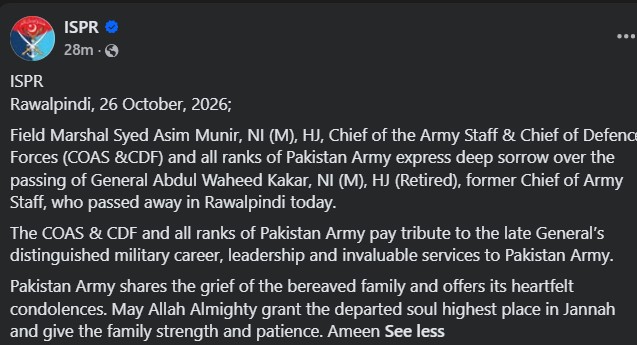
Pakistan’s ex-Army Chief General (r) Abdul Waheed Kakar breathes his last at 89

RAWALPINDI – Former Chief of Army Staff General (r) Abdul Waheed Kakar, who led the Pakistan Army during one of the country’s most turbulent political periods, breathed his last at age of 89, ISPR said Monday.

Fileld Marshal Syed Asim Munir and top military brass expressed deep grief over the passing of the former army chief, whose military career spanned more than three decades. Gen Asim Munir along with officers and soldiers of the Pakistan Army, paid tribute to General Kakar’s leadership, professional dedication and contributions to the country’s armed forces.

Pakistans Ex Army Chief General R Abdul Waheed Kakar Breathes His Last At 89

The military leadership extended heartfelt condolences to the bereaved family and prayed for the departed general to be granted a high place in Jannat-ul-Firdous. The Pakistan Army also expressed solidarity with his family during this difficult time.

Who was General Abdul Waheed Kakar?

Born in Peshawar in 1937, General Abdul Waheed Kakar belonged to a Pashtun family with ancestral roots in Balochistan’s Kakar tribe. He was also the nephew of Sardar Abdur Rab Nishtar, a prominent figure in the Pakistan Movement.

His military journey started at Pakistan Military Academy, and he was commissioned into the Frontier Force Regiment in 1959. During his military career, Kakar took part in 1965 and 1971 wars between Pakistan and India. He served in the Chawinda sector near Sialkot during the 1965 war and was subsequently deployed in the Sulemanki sector during the 1971 conflict.

Pakistans Ex Army Chief General R Abdul Waheed Kakar Breathes His Last At 89

Over the following decades, he rose through the army’s ranks and held several key appointments, including General Officer Commanding of the 16th Infantry Division, Adjutant General at General Headquarters and commander of XII Corps in Quetta.

His career took a decisive turn in January 1993 when then-Army Chief General Asif Nawaz Janjua died unexpectedly. Kakar, who was serving as corps commander in Quetta, was selected to lead the Pakistan Army despite several officers being senior to him. He took command on January 12, 1993, and remained Chief of Army Staff until January 12, 1996, completing his three-year tenure.

Pakistans Ex Army Chief General R Abdul Waheed Kakar Breathes His Last At 89

With the political situation deteriorating, General Kakar played a central role in negotiations that eventually resulted in both Nawaz Sharif and Ghulam Ishaq Khan stepping down in July 1993. The political settlement became widely known as the Kakar Formula, a term that remains part of Pakistan’s political history more than three decades later.

The agreement paved the way for a caretaker government headed by Moeen Qureshi and fresh general elections, which ultimately brought Benazir Bhutto back to power. Unlike earlier military interventions, General Kakar did not impose martial law or assume control of the government. Nevertheless.

Another part in General Kakar’s career came in 1996, when his 3-year term as army chief ended. Then-PM Shaheed Benazir Bhutto offered him an extension in service, but he reportedly declined the proposal and chose to retire on schedule. His decision attracted attention in Pakistan’s political and military circles, particularly because extensions for senior military commanders have frequently remained a contentious issue.

After leaving armed force, General Kakar preferred private life rather than maintaining a prominent role in national affairs.

Lt Gen (r) Ishfaq Nadeem passes away

The post Pakistan’s ex-Army Chief General (r) Abdul Waheed Kakar breathes his last at 89 appeared first on Daily Pakistan English News.

  •  

State Bank raises Policy Rate to 12pc as Inflation risks Mount in Pakistan

KARACHI – State Bank of Pakistan (SBP) jacked up its benchmark policy rate by 50 basis points to 12%, in line with market expectations, as policymakers seek to contain inflationary pressures and address growing economic uncertainties.

The decision was taken by the Monetary Policy Committee (MPC) at its third meeting of the fiscal year 2026–27 on Monday.

Borrowing costs in Pakistan could rise again as State Bank of Pakistan (SBP) prepares to reveal monetary policy decision today, with a majority of financial market participants expecting interest rate increase amid mounting inflation fears and soaring global oil prices.

SBP Monetary Policy Decisions 2024 to 2026

MPC Meeting Date Policy Rate Change 
26 Oct 2026 Pending —
14 Sep 2026 11.50% 0
27 Jul 2026 11.50% 0
15 Jun 2026 11.50% 0
27 Apr 2026 11.50% +100bps
9 Mar 2026 10.50% 0
26 Jan 2026 10.50% 0
15 Dec 2025 10.50% -50bps
27 Oct 2025 11.00% 0
15 Sep 2025 11.00% 0
30 Jul 2025 11.00% 0
16 Jun 2025 11.00% 0
5 May 2025 11.00% -100bps
10 Mar 2025 12.00% 0
27 Jan 2025 12.00% -100bps
16 Dec 2024 13.00% -200bps
4 Nov 2024 15.00% -250bps

SBP keeps Interest Rate at 11.5% as Oil Prices fuel fresh Inflation Fears

Topline Securities itself supports forecast of 50-basis-point increase, arguing that the ongoing geopolitical crisis and uncertainty surrounding global energy supplies have significantly increased the risks facing Pakistan’s economy. The brokerage warned that prolonged disruptions could fuel inflation and create additional pressure on the country’s external financial position.

Another brokarge house also backed expectations of rate hike, forecasting that MPC will increase borrowing costs by 50 basis points. It also pointed to improving economic activity, suggesting that the central bank has room to introduce a measured increase before inflationary pressures become more entrenched.

The Monday’s meeting could have implications for businesses, investors and ordinary Pakistanis. An increase in the policy rate would make fresh borrowing more expensive and could raise repayments on loans linked to floating interest rates. Businesses dependent on bank financing could face higher operating costs, potentially affecting investment and expansion plans.


The post State Bank raises Policy Rate to 12pc as Inflation risks Mount in Pakistan appeared first on Daily Pakistan English News.

  •  
❌