Novaya Gazeta will be evicted from its office on Potapovsky Lane in central Moscow, where it has been based for 29 years, the news outlet Ekho reported. Ekho cited a letter to readers from editor-in-chief Sergey Sokolov and journalist Irina Gordiyenko.
“They’re simply throwing us out, giving us barely any time to pack up. The Anna Politkovskaya museum is closing, and portraits of our friends who were killed are being taken down from the walls,” Sokolov and Gordiyenko wrote.
Sources close to the newspaper told Ekho that staff members must leave the office by November 9. They have yet to find a new space.
Novaya Gazeta stopped publishing its print edition in 2022, after Russia launched its full-scale invasion of Ukraine. Russia’s Basmanny Court revoked its media license that same year.
In September 2026, Novaya Gazeta was designated a “foreign agent.”
At Meduza, we are committed to transparency about our use of artificial intelligence in the newsroom. The story you’re reading was written by one of our living, breathing journalists and translated from Russian using an AI model configured to follow our strict editorial standards. This translation process is the result of extensive testing and refinements to ensure our English-language coverage is timely and accurate. A Meduza editor reviews every draft before publication.
If you find any errors in this translation, please contact us at reports@meduza.io.
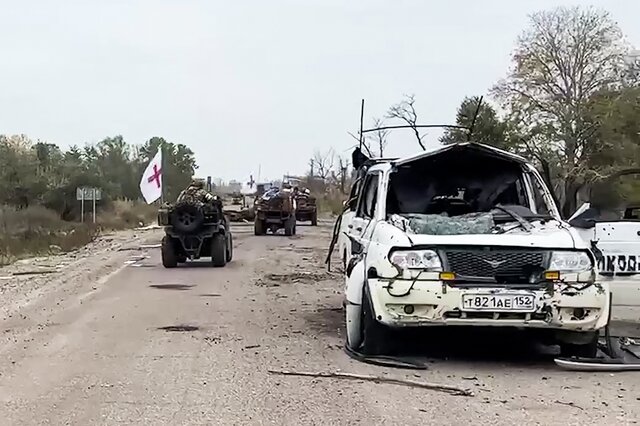
Routes for a humanitarian mission in Oleshky, in Ukraine’s Kherson region, have been cleared of mines. Russian and Ukrainian human rights commissioners Yana Lantratova and Dmytro Lubinets said the humanitarian convoy is ready to depart.
The convoy will head to the central district hospital, the commissioners said. Residents who have decided to leave the city will have until 2 p.m. on Friday, October 30, to do so.
Distribution of humanitarian aid to those remaining in the city will begin after 2:30 p.m. on October 30.
“Delegations from Ukraine, the Russian Federation, and the United States of America have now gathered to coordinate the next steps in the humanitarian mission. Journalists from the three countries are also present,” Lubinets said.
Russia and Ukraine halted fighting in Oleshky for the humanitarian mission under a deal brokered by U.S. first lady Melania Trump. The ceasefire took effect on the morning of October 27 and will remain in place until late on the evening of November 1.
At Meduza, we are committed to transparency about our use of artificial intelligence in the newsroom. The story you’re reading was written by one of our living, breathing journalists and translated from Russian using an AI model configured to follow our strict editorial standards. This translation process is the result of extensive testing and refinements to ensure our English-language coverage is timely and accurate. A Meduza editor reviews every draft before publication.
If you find any errors in this translation, please contact us at reports@meduza.io.
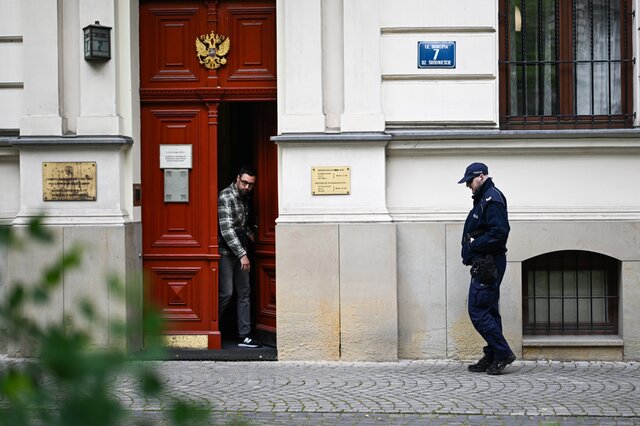
The Russian consulate in Krakow, Poland, on May 12, 2025. In summer 2025, Polish Foreign Minister Radoslaw Sikorski revoked the consulate’s permission to operate following reports of Russian intelligence services’ involvement in an arson attack on a Warsaw shopping center.
A company that charges Russians abroad to find available appointments at Russian consulates has ties to people in Roman Abramovich’s circle, Verstka reported.
Konsul Prime operates as an official partner under an agreement with Russia’s Foreign Ministry, offering help with paperwork and priority access to appointments.
The company always has appointments available, even though people usually wait weeks to book one. Konsul Prime began operating in late 2022. Russian emigrants say in group chats and online forums that getting a consular appointment has become even harder since the service launched.
Konsul Prime’s main legal entity, Tsentr Servis LLC, was established in December 2022 by Yefim Malkin. Malkin began working with Abramovich in the 1990s at Sibneft, according to Verstka. He was later linked to Millhouse entities that managed assets belonging to Abramovich and his partner, Yevgeny Shvidler.
In September 2022, Mikhail Livergand, another Abramovich associate who had previously worked in investment and real estate and served as Malkin’s assistant, took ownership of Konsul Prime. In August of that year, Livergand founded Tsentr Servis Digital, which owns the rights to Konsul Prime’s software platform.
Meduza found that Konsul Prime’s clients in Belgium, the Netherlands, Germany, France, and Switzerland sign contracts with legal entities registered in the United Arab Emirates: Docs Management L.L.C. and Konsul Prime DMCC. That information comes from the company’s privacy policy.
The owner of Docs Management L.L.C. is unknown, but Comfort Care Travel L.L.C. is registered at the same address in Dubai. It is the Dubai representative office of Malkin’s Russian company, Tekhnologii Meditsinskogo Turizma.
Konsul Prime DMCC is owned by Tsentr Servis, according to Tsentr Servis’ financial statements.
Since July 2023, Darya Zhurova, 53, has held 49% stakes in both Tsentr Servis and Tsentr Servis Digital, becoming another co-founder of both companies, according to Verstka. Livergand retained controlling stakes in both companies. Zhurova is the first co-owner with no ties to Abramovich, Verstka’s journalists wrote, suggesting that she may be a nominee owner.
Tsentr Servis founded most of Konsul Prime’s legal entities abroad, Verstka reported. Another company responsible for Konsul Prime’s branches, Konsul Tsentr, operates on behalf of Russia’s Foreign Ministry. Since 2024, Livergand and Zhurova’s Tsentr Servis has owned 90% of Konsul Tsentr, with just 10% belonging to an administrative office under the ministry.
In February 2026, Russia’s Unified State Register of Legal Entities stopped disclosing information about the founders of Konsul Prime’s Russian legal entities. But even the information still publicly available makes clear that Konsul Prime is not a state company at all, nor is it even formally dependent on the state. It has more ties to Roman Abramovich than to Russia’s Foreign Ministry. Yet the service still presents itself as the ministry’s sole partner, collects Russians’ data, and charges for exclusive access to consular services.
Tsentr Servis Digital’s business is currently valued at 1.17 billion rubles, according to its financial statements, which Meduza reviewed.
At Meduza, we are committed to transparency about our use of artificial intelligence in the newsroom. The story you’re reading was written by one of our living, breathing journalists and translated from Russian using an AI model configured to follow our strict editorial standards. This translation process is the result of extensive testing and refinements to ensure our English-language coverage is timely and accurate. A Meduza editor reviews every draft before publication.
If you find any errors in this translation, please contact us at reports@meduza.io.
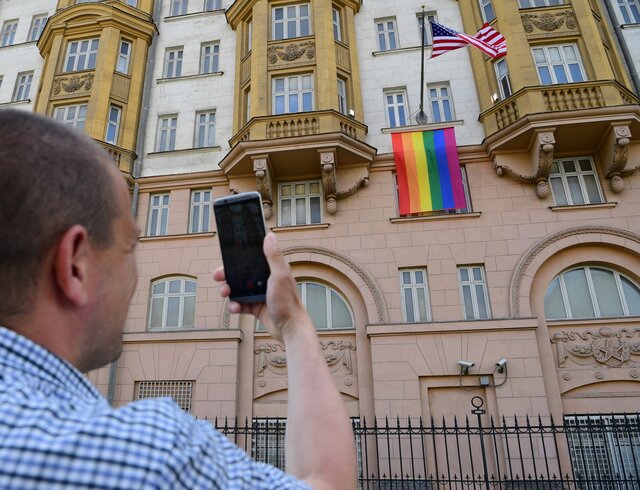
A rainbow flag on the U.S. Embassy building in Russia, June 2020
Nearly three years ago, Russia’s Supreme Court banned the nonexistent “international LGBT movement” as extremist. Since then, “LGBT extremism” has become grounds for at least 14 criminal investigations and hundreds of citations for administrative offenses. Because the system often doesn’t look into the context in which a rainbow flag appears on social media, even homophobes end up being targeted. Mediazona has compiled cases in which opponents of same-sex relationships have been punished for “promoting” them.
In 2013, Russia passed a law banning the promotion of “nontraditional sexual relationships” to minors.
In December 2022, the authorities extended the ban on “gay propaganda” to people of all ages. They also amended the Code of Administrative Offenses to prohibit “promotion of pedophilia” and the distribution of information “capable of making minors want to change their sex.”
In November 2023, the Supreme Court outlawed the “international LGBT public movement” by declaring it an “extremist organization.”
Vera Makeyeva, a retiree from Kurgan who welcomed Russia’s ban on the “LGBT movement,” was fined under that ban six months later — 1,500 rubles for old reposts of homophobic content featuring a rainbow flag. “It’s my own fault. I hadn’t cleaned up my photo albums in 13 years. Some people were interested enough to go through them,” Makeyeva told Mediazona.
Pyatigorsk resident Pyotr Voronin was jailed for one day for an image showing the presidents of Ukraine and France alongside a swastika and a rainbow flag (both are considered extremist symbols in Russia). Voronin had intended to mock Ukraine and France — and was outraged that “the FSB’s AI decided I was spreading propaganda.” “I asked [in court], ‘So maybe I should officially apologize to Zelensky?’ Basically, the AI that reads our messages online is a complete idiot, and we mean nothing to it,” Voronin concluded.
Vladimir Sugakov, a retiree from the Kemerovo region, was fined 100,000 rubles for “LGBT propaganda” in homophobic posts. Among the posts that caught law enforcement’s attention was a slideshow of photographs from Pride events set to Sergei Trofimov’s song “Petushki” (“Little Roosters,” Russian prison slang for gay men). Sugakov said the video criticized the LGBTQ community, but the police and the court didn’t bother to look into it. He decided against appealing the fine, saying he wasn’t an “idiot” who would “take on the system.”
In Moscow, a video titled “Nazi Initiation” led to a 100,000-ruble fine. In it, a young man shaves his head, puts on clothes popular with neo-Nazi skinheads, and has sex with two similar-looking men. The video ends with an image of a swastika and the message “Join our ranks!!!” The Moscow resident who posted the video said he had done so “as a joke.” The court saw “LGBT propaganda” rather than humor.
Father Grigory (Grzegorz Zwoliński), a Polish Catholic priest who lived in Kirov, had long criticized Archbishop Paolo Pezzi, who heads the Catholic Archdiocese of Moscow, for supporting the LGBTQ community. Father Grigory added a rainbow flag to one of his posts about Pezzi “to draw attention.” He was fined 1,000 rubles for it. The fine, in turn, led to the revocation of his Russian residence permit and a ban on re-entry. After 24 years in Russia, the priest returned to Poland, where he now writes that the “rainbow church” took revenge on him.
At Meduza, we are committed to transparency about our use of artificial intelligence in the newsroom. The story you’re reading was written by one of our living, breathing journalists and translated from Russian using an AI model configured to follow our strict editorial standards. This translation process is the result of extensive testing and refinements to ensure our English-language coverage is timely and accurate. A Meduza editor reviews every draft before publication.
If you find any errors in this translation, please contact us at reports@meduza.io.
Ukrainian President Volodymyr Zelensky has sent word to Russian President Vladimir Putin that he is ready to discuss territory at an in-person meeting, Ukrainian Foreign Minister Andriy Sybiha told the newspaper Helsingin Sanomat.
Finnish President Alexander Stubb and Norwegian Prime Minister Jonas Støre conveyed Zelensky’s position to Putin during a phone call on October 27.
Sybiha said the European leaders initiated the call in coordination with Kyiv. Its main purpose was to convey Ukraine’s message: Along with proposing an in-person meeting between the leaders, Ukraine also called for a ceasefire.
“We want this meeting and are ready for it. In all likelihood, only a meeting between Zelensky and Putin can change the dynamics of the negotiations. Zelensky is ready to discuss the most difficult and sensitive issues, including territory,” Sybiha said.
Stubb’s office had previously said the purpose of the call was to “convey Ukraine’s position on the upcoming peace talks in Abu Dhabi directly to President Putin.” Helsinki provided no details.
Putin’s conversation with Stubb and Støre was his first contact with European leaders who support Ukraine since July 2025, when he spoke with French President Emmanuel Macron.
At Meduza, we are committed to transparency about our use of artificial intelligence in the newsroom. The story you’re reading was written by one of our living, breathing journalists and translated from Russian using an AI model configured to follow our strict editorial standards. This translation process is the result of extensive testing and refinements to ensure our English-language coverage is timely and accurate. A Meduza editor reviews every draft before publication.
If you find any errors in this translation, please contact us at reports@meduza.io.
Russian President Vladimir Putin said Moscow is ready for war with Europe but does not want one.
Many [in Europe] talk about nothing but preparing for war [with Russia] by 2030. Is that the right approach? No. First of all, we’re ready, but we don’t want any war with Europe. If any of them want one, let them prepare.
Putin also urged those in Europe who advocate war to “remember” that “if things go too far, there will be no winners at all.”
He said Russia remembers the lessons of both world wars well and is doing everything it can to prevent anything like them from happening again.
At Meduza, we are committed to transparency about our use of artificial intelligence in the newsroom. The story you’re reading was written by one of our living, breathing journalists and translated from Russian using an AI model configured to follow our strict editorial standards. This translation process is the result of extensive testing and refinements to ensure our English-language coverage is timely and accurate. A Meduza editor reviews every draft before publication.
If you find any errors in this translation, please contact us at reports@meduza.io.
Gennady Stepakhno, a former deputy speaker of the Murmansk Regional Duma, is under criminal investigation for treason, the regional branch of Russia’s Federal Security Service (FSB) said.
The agency said Stepakhno, whom it described as “an opponent of the special military operation,” had cooperated with Ukraine.
The FSB alleges that the former lawmaker used his position to collect documents about the Murmansk regional government’s work and unspecified engineering facilities in the region and pass them to Ukrainian military intelligence. The agency believes this information “could be used to undermine Russia’s security.”
Sources cited by the news outlet Arktichesky Obozrevatel believe the investigation into Stepakhno began after he told a relative living abroad that a pharmaceutical plant was being built in the Murmansk region with India’s involvement.
A court has already ordered Stepakhno, 76, held in pretrial detention. His detention first became public on October 9.
Stepakhno is a veteran Communist lawmaker in the Murmansk Regional Duma. He served four terms from 2007 to 2026 and led the Communist Party faction. He did not return to the regional legislature for its new term.
At Meduza, we are committed to transparency about our use of artificial intelligence in the newsroom. The story you’re reading was written by one of our living, breathing journalists and translated from Russian using an AI model configured to follow our strict editorial standards. This translation process is the result of extensive testing and refinements to ensure our English-language coverage is timely and accurate. A Meduza editor reviews every draft before publication.
If you find any errors in this translation, please contact us at reports@meduza.io.
Several passages in the Russian translation of American author Joe Hill’s novel “King Sorrow” were rewritten to avoid censorship problems, changing the author’s meaning. Nikolai Karayev, who runs the speculative fiction Telegram channel Zvezdnye Mayaki Kapitana Norta, drew attention to the changes by sharing several passages from the original alongside their Russian translations.
Hill, Stephen King’s son, writes fantasy and horror. “King Sorrow” is about students who summon a dragon from another world. The Russian edition, translated by Dmitry Starkov, was published in August 2026 by Fanzon, part of the Eksmo publishing group.
Here are a few examples of changes in the Russian translation:
In one passage in the original, a character says he has “reliable information that the Russians are farming them. They grow trolls like potatoes in the permafrost of Siberia.” Eksmo’s version reads: “I have reliable information that the Ukrainians are breeding trolls. Raising trolls like little pigs.”
In another passage, the characters watch footage of the war in Ukraine as the novel describes a strike on a maternity ward in Mariupol. In the translation, Mariupol became Donetsk: “On March 9, something like that hit one of Donetsk’s maternity hospitals. A deafening explosion, a column of flame… One of the expectant mothers was killed in the explosion, and her baby was stillborn.”
A reference to “Russian oligarchs who vacationed in Italy with Vladimir Putin” became simply “Russian oligarchs who vacationed in Italy.”
Instead of “Russia invaded Ukraine,” the translation says “that night war broke out in Europe.”
After media coverage of the changes, Eksmo CEO Yevgeny Kapyev promised to “look into the situation thoroughly” and criticized Hill, writing:
So I’m wondering, this thing in Western popular culture that started with James Bond, where the bad guys are Russians or Asians, is it ever going to end? Russia could be portrayed as a wonderful country everywhere… at least in the future… Self-fulfilling prophecies are a thing, after all…
And I’m asking authors not to put “Easter eggs” about the current fraught political and military situation into their books… At this rate, they’ll be putting them in recipes soon. There are tons of other ways to get your point across…
In the spring, Kapyev was detained along with other senior Eksmo executives in the “publishers’ case.” The case concerned allegations by law enforcement authorities that Popcorn Books, another Eksmo-owned publisher, had engaged in the “distribution of LGBT literature.”
At Meduza, we are committed to transparency about our use of artificial intelligence in the newsroom. The story you’re reading was written by one of our living, breathing journalists and translated from Russian using an AI model configured to follow our strict editorial standards. This translation process is the result of extensive testing and refinements to ensure our English-language coverage is timely and accurate. A Meduza editor reviews every draft before publication.
If you find any errors in this translation, please contact us at reports@meduza.io.
British actor Sacha Baron Cohen has publicly apologized to the people of Kazakhstan for his portrayal of Borat in the 2006 film of the same name. “Borat” follows Borat Sagdiyev, a fictional journalist from Kazakhstan who travels to the United States to make a documentary, encounters American culture, and finds himself in all sorts of comical situations.
“I want to apologize to the people of Kazakhstan for the first time ever because Borat has got nothing to do with Kazakhstan,” the actor said on the podcast “Happy Sad Confused.”
Baron Cohen said he had developed an earlier version of the character for the BBC, with a different name and Albanian nationality. His name and nationality later changed depending on which television channel was paying for the show. “I would just say, ‘Oh, that character already belongs to the BBC. I’ve got a completely new character, this guy’s called Alexi Krickler, he’s from Moldova,’” Baron Cohen said.
The actor reiterated that at some point he had chosen Kazakhstan as a place “that no-one knows anything about.” He emphasized that he doesn’t even know what a Kazakh accent sounds like. Before recounting a complaint from the Kazakh Embassy, he apologized for being unable to imitate a Kazakh accent and said he would use Borat’s accent for the anecdote because his knowledge of Central Asian accents was limited.
Baron Cohen described the apology as his first for the character he created, though he has had to defend Borat ever since the film came out. “The joke is not on Kazakhstan. I think the joke is on people who can believe that the Kazakhstan that I describe can exist,” the actor said in a 2006 interview with Rolling Stone.
Over the years, Kazakhstan’s authorities have shifted from hostility toward “Borat” to acceptance. In 2005, the country’s Foreign Ministry threatened to sue Baron Cohen and claimed his show had been commissioned for political ends to tarnish the international reputation of Kazakhstan and its people.
In 2006, shortly before the film’s release, the country’s authorities paid for a four-page advertising supplement in The New York Times and the International Herald Tribune touting Kazakhstan’s achievements in the 21st century.
Although “Borat” was not officially banned in Kazakhstan, it never screened in the country’s movie theaters after its world premiere. The film also did not receive a theatrical distribution license in Russia.
Over time, attitudes toward Borat in Kazakhstan softened. In 2017, Czech tourists in Astana got off with a small fine for walking around dressed as Borat (Baron Cohen himself offered to pay it). In 2020, Kazakh Tourism, the company responsible for promoting tourism within Kazakhstan, adopted his catchphrase “Very nice!” as the country’s official tourism slogan.
By then, a sequel to “Borat” had been released worldwide, and the Kazakh diaspora in the United States continued to oppose it. In November 2020, the Kazakh American Association called for “Borat 2” to be excluded from consideration for Oscar, Golden Globe, and other award nominations.
At Meduza, we are committed to transparency about our use of artificial intelligence in the newsroom. The story you’re reading was written by one of our living, breathing journalists and translated from Russian using an AI model configured to follow our strict editorial standards. This translation process is the result of extensive testing and refinements to ensure our English-language coverage is timely and accurate. A Meduza editor reviews every draft before publication.
If you find any errors in this translation, please contact us at reports@meduza.io.
At least 69 people subjected to politically motivated persecution by Russian authorities have died in Russia since the start of Russia’s full-scale invasion of Ukraine, according to a report published by Memorial’s Political Prisoner Support human rights project to mark the Day of Remembrance for Victims of Political Repression.
Illness and lack of medical care were the most common causes of death, accounting for 29 cases documented by the group. At least 20 people died from beatings, torture, or their aftereffects, and 10 died by suicide.
One person died as a result of a hunger strike, and another — Alexey Navalny — was deliberately killed in a penal colony. The causes of death of eight others remain unknown.
The group recorded the most deaths in 2024, when 26 people died. Another 13 died in 2025, and 16 died in the first 10 months of 2026, with October not yet over.
The average age of those who died was 51. The youngest on the list, Ukrainians Daniil Dakhov and Pavel Grimak, were both 18. The figures include people who died in pretrial detention centers and penal colonies, as well as during searches, under house arrest, and shortly after their release.
Memorial’s report recounts the stories of all 69 people who died. Meduza has reported in detail on some of them, including Ukrainian journalist Viktoria Roshchyna, pianist Pavel Kushnir, scientist Dmitry Kolker, Arctic researcher Valery Mitko, biker Kirill Buzmakov, and activist Anatoly Berezikov.
At Meduza, we are committed to transparency about our use of artificial intelligence in the newsroom. The story you’re reading was written by one of our living, breathing journalists and translated from Russian using an AI model configured to follow our strict editorial standards. This translation process is the result of extensive testing and refinements to ensure our English-language coverage is timely and accurate. A Meduza editor reviews every draft before publication.
If you find any errors in this translation, please contact us at reports@meduza.io.
Lithuania’s State Defense Council has decided to introduce universal conscription in 2032, President Gitanas Nausėda said.
Universal conscription will apply to men ages 18 to 22, replacing the current selective draft. Women will still be able to volunteer for military service.
Lithuania currently drafts about 5,000 young people each year. Nausėda said the annual intake under universal conscription would be about 7,500 young men, based on demographic trends and the number of conscripts fit for service.
The 2032 start date was chosen to give the military time to prepare its infrastructure for the larger intake.
Lithuania abolished compulsory military service in 2008. It reinstated conscription in 2015 amid “increased threats” following Russia’s annexation of Crimea. Lithuania requires nine months of military service, or three months for those with specialized military qualifications.
At Meduza, we are committed to transparency about our use of artificial intelligence in the newsroom. The story you’re reading was written by one of our living, breathing journalists and translated from Russian using an AI model configured to follow our strict editorial standards. This translation process is the result of extensive testing and refinements to ensure our English-language coverage is timely and accurate. A Meduza editor reviews every draft before publication.
If you find any errors in this translation, please contact us at reports@meduza.io.
Users of the Claude chatbot say Anthropic, the service’s developer, has blocked their accounts after they completed identity verification using Russian documents. The complaints appeared on Reddit, on X, and on Telegram.
Users said Claude required them to complete verification through a service called Persona. Why they were asked to do this is unclear. Persona requires users to select the region of their document, upload a photo of it, and complete a facial scan.
Users say the ban happens immediately after they upload a Russian passport. The ban is issued even to users who do not live in Russia but lack a residency permit elsewhere.
One now-blocked Claude user said on Reddit that he is a Russian citizen living in New Zealand on a four-year visa (unlike Russia, New Zealand appears on Anthropic’s list of countries where Claude is officially available). He said he used the paid version of the chatbot for both work and personal purposes, as well as Claude Code.
Anthropic blocked the user’s account immediately after he uploaded his Russian international passport, without explanation. The company had charged his account for a subscription payment two days before the block.
In the comments, other users with Russian documents living in Georgia and Armenia described similar problems. A user in Georgia published a letter from Anthropic’s security team, which said he had been banned for violating the chatbot’s usage policy but did not specify what he had violated:
Our automated systems detected a large number of signals associated with your account that violate our Usage Policy. These signals were, in turn, reviewed by our team to confirm the system’s findings. As a result, we have revoked your access to Claude.
Another user said that after uploading his Russian passport, he was blocked and could no longer send new queries to the chatbot. He could only export his chat data. He was unable to restore his account through an appeal.
Users with Chinese citizenship have faced similar checks. China is also not on the list of countries where Claude is officially available, though some users with Chinese passports have managed to pass verification successfully.
In early October, it was also reported that users from regions not supported by Claude, including Russia, who were bypassing the restrictions with a VPN, had faced blocks.
What exactly is driving the current blocks remains unclear. Anthropic has not commented on the complaints. Claude itself said it cannot verify the authenticity of users’ posts.
The company’s policy does not mention restrictions based on nationality or citizenship. It lists the countries and regions where Anthropic’s products are officially supported. In countries not on the list, the products are “not supported,” meaning people in those countries or regions cannot use the company’s services.
At Meduza, we are committed to transparency about our use of artificial intelligence in the newsroom. The story you’re reading was written by one of our living, breathing journalists and translated from Russian using an AI model configured to follow our strict editorial standards. This translation process is the result of extensive testing and refinements to ensure our English-language coverage is timely and accurate. A Meduza editor reviews every draft before publication.
If you find any errors in this translation, please contact us at reports@meduza.io.
Russia and Ukraine have halted hostilities around the occupied city of Oleshky since October 27. The Verkhovna Rada’s human rights commissioner, Dmytro Lubinets, confirmed on the morning of October 29 that the ceasefire had held for more than two days. Russia’s human rights commissioner, Yana Lantratova, said humanitarian aid — “food, fuel, medicine, and hygiene products” — had been sent to Oleshky.
Lubinets and Lantratova set out for Oleshky on the afternoon of October 29. Lubinets will be the first Ukrainian official of such rank to visit Russian-occupied territories. Both commissioners said their main task is to deliver humanitarian aid to residents and ensure the safe evacuation of those who want to leave.
Sources who spoke to the Ukrainian news outlet Ukrainska Pravda and were involved in organizing the ceasefire said the ceasefire around Oleshky is meant to test whether Ukrainian and Russian military commanders can carry out political agreements to end hostilities.
Organizing a halt to the fighting turned out to be “an extremely difficult task,” according to the outlet’s sources. A political order to cease fire does not by itself guarantee automatic compliance on the front line, a source in Ukrainian President Volodymyr Zelensky’s administration told Ukrainska Pravda. Even Ukrainian troops demanded guarantees several times that if they stopped, “nothing bad would happen afterward,” the source said. The source explained:
We want to get the military — both our General Staff and the Russian one — used to the idea that if the political leadership has decided that in a given sector of the front we stop, freeze in place, and no one opens fire, the military can make that happen. They can guarantee it. Not a situation where the political leadership has reached an agreement and the military says, “Sorry, we can’t stop, we’ve got something going on.”
It is easier for the Russian side than for the Ukrainian side to organize and maintain a ceasefire, according to Ukrainska Pravda’s sources. “They [the Russians] have a rigid military vertical. We have a decentralized army. And someone — some well-known military blogger — could stir up the mood on air so much that everything falls apart afterward,” a source said.
If the ceasefire in Oleshky can be maintained, as planned, until the evening of November 1, the Ukrainian side expects to repeat this kind of local ceasefire later along other parts of the front. “That’s precisely so the military can learn how to do this: stop, ensure safe passage, and so on. So that later, if there’s some major agreement, we could implement it right away,” a source who spoke to Ukrainska Pravda said.
If this works, this will be the first example of a real ceasefire across a fairly large stretch of the front. It’s come at such a cost — the military, Russia’s Federal Security Service, and everyone else are doing nothing but trying to sabotage it. But we believe it will work out and that this will set a precedent.
The war in photographs
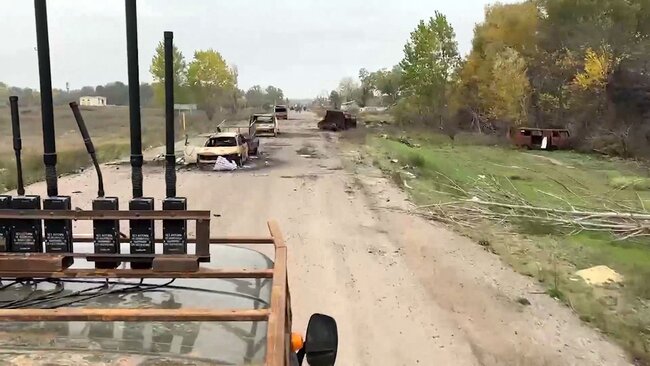
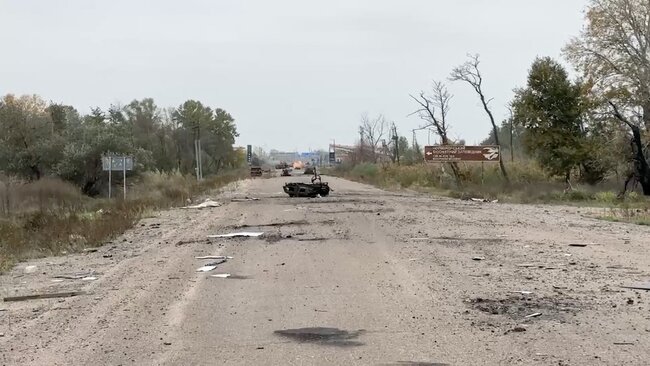
Russia’s Defense Ministry announced that it had begun clearing mines from roads leading into Oleshky and published photos and video of sappers at work. Russian President Vladimir Putin, speaking at a plenary session of the Russia–Africa summit underway in Moscow, claimed it was Ukraine that had mined the approaches to Oleshky, creating “practically a humanitarian catastrophe.”
At Meduza, we are committed to transparency about our use of artificial intelligence in the newsroom. The story you’re reading was written by one of our living, breathing journalists and translated from Russian using an AI model configured to follow our strict editorial standards. This translation process is the result of extensive testing and refinements to ensure our English-language coverage is timely and accurate. A Meduza editor reviews every draft before publication.
If you find any errors in this translation, please contact us at reports@meduza.io.
On May 23, 2021, Belarusian security services tricked a Ryanair flight from Athens to Vilnius into landing in Minsk. On board were Roman Protasevich (Raman Pratasevich) and his girlfriend, Sofia Sapega. Protasevich had been the former editor-in-chief of the popular Telegram channel Nexta, which coordinated the 2020 protests in Belarus. Sapega administered the Telegram channel “Black Book of Belarus,” which published the personal data of security officials involved in violence against protesters. The couple was detained. Both cooperated with investigators, and both managed to avoid the lengthy prison sentences they faced — though in very different ways. Protasevich became one of the mouthpieces of Alexander Lukashenko’s propaganda. Moscow intervened on Sapega’s behalf (she holds Russian citizenship), which led to her being pardoned in 2023 and transferred to Russia. Unlike Protasevich, Sapega tried to stay out of the spotlight and spent about a year in a penal colony before her release.
Sofia Sapega is now back in Lithuania, where she lived and studied before the ill-fated Ryanair flight was forced to land in Minsk. In a lengthy interview with Zerkalo, she gave her version of what happened to her and Protasevich after their detention. The interview is split into two parts; only the first has been published so far. Meduza has collected the most interesting quotes from Sofia Sapega. We present them with minor abridgments.
The plane’s landing
I was sitting with my headphones on and had dozed off. I knew we were supposed to land in 15 or 20 minutes. Then suddenly there was an announcement over the loudspeaker that we needed to land in Minsk because of some kind of threat. I didn’t scream or cry. But at some point I noticed my knees were shaking. Roman, though, started shouting at the flight attendant: “You can’t, don’t land the plane now, this is about us!” He completely panicked and was practically hysterical. That’s why, when I hear that he supposedly knew everything in advance and was a KGB agent, it’s hard for me to believe it.
***
Everyone [the other passengers] buckled their seatbelts and waited to land, as if it were normal. Then we got off the plane and went into the airport building. Customs officers started calling women in for inspection. I thought, “This is for me.” I stood there for a couple of minutes, then reasoned: why make people wait? In the end, I was among the first to go. […] I was taken into a small room. There I saw a tall, red-haired man surrounded by officers from the GUBOPiK. It was Artur Gaiko. And at that moment I thought, “Oh, shit!”
***
I think [Protasevich’s claim that the opposition staged the plane’s landing in Minsk to secure sanctions against Belarus] is simply the absurd theory of a man who wasn’t in his right mind. There’s no logic to it: why would people who were documenting the crimes of Belarusian security officials organize a plane landing involving us, putting us in danger ourselves, just to get sanctions imposed? Sanctions were already being imposed in response to the actions of the Belarusian authorities, and there was no need to stage something like this to achieve that.
After the detention
[First they took me to the GUBOPiK building, where they recorded] a forced “confession” video. I desperately didn’t want to do it. At first they wanted to hang a Belarusian red-and-green flag behind me, but I refused to record anything with it in the background. Then Gaiko said, “Just get that damn Belarusian flag out of here. There’ll be a text now, she’ll say it, and that’s it, we’re leaving.” One of the GUBOPiK officers said flatly, “Either you read the text, or we’ll beat you right here, right now.” I was never beaten at home, and I didn’t want to be beaten in this place. In the end, I read everything they gave me.
***
Artur Gaiko, along with other officers, brought me to the Okrestina detention facility. He seemed to think I didn’t realize who he was. But I recognized him [by his voice], and by that point I already understood quite clearly how information had leaked from Black Book of Belarus. And afterward it was very painful to realize that many people thought it was me who had given them up. […] The only person I talked about was Bogdanovich… I also said that Protasevich worked for Nexta. But, as far as I understand, by that point they already had that information anyway.
***
It was freezing cold in the cell. The first night I slept on a mattress right on the floor and was terribly cold. The next day I was moved to another cell with women going through withdrawal and sex workers. To warm up a little, I sat huddled with one of them — she had a down jacket on. At that point it felt like this was the end for me. I found something like a pebble or a piece of soap and wrote on the dirty green wall: “I will die here.” I had no hope of getting out. But I felt almost nothing. I hadn’t cried once since my detention.
***
[I was beaten] once, at Okrestina. A man over 45 in black calls me out into the corridor. We step out. He’s standing there along with a young guy holding a baton: the [duty officer]. He says to me, “Turn around.” I turn around, and I get hit on the back. I didn’t say anything, didn’t make a sound; it all felt as if it wasn’t happening to me, as if I were a silent observer. I didn’t feel any pain either. Then they turned me back to face the man in black, and he says, “Well, scum, now you’ve been caught.” And I stay silent. What am I supposed to say? You’re a grown man, and you’re seriously doing this?
Interrogations
From May 23 to 25, I was held in the detention facility, after which I was transferred to the KGB pretrial detention center. I still remember that cell. It looked like a coffin: it widened slightly at the far end and narrowed toward the door. The window was tiny, and instead of a toilet there was a bucket. It was at the KGB that I was first allowed to see a Russian consul. […] The consul asked if I needed anything passed along to my parents. I answered, “Could you please take me out of here?”
***
A month [I spent in the KGB pretrial detention center]. And the whole time I was there, I stayed silent… Gaiko tried several times to talk to me nicely. […] I was supposed to fully admit guilt, ideally go on a show like Protasevich did, and cooperate with the investigation. […] I refused to testify, citing the Constitution. I was used to not giving anyone up, and I expected the same from others. For me it was simple: if we stay silent, we stay silent together.
Cooperating with the investigation
[Protasevich and I] hadn’t seen each other from the moment of our detention until I ended up in the KGB pretrial detention center. And what did this idiot do at our first meeting? He started trying to talk me into signing a pretrial cooperation agreement. He unleashed a whole tirade on me: “God, Sofia, you’re not going to give anyone up. They’re abroad, and you’re about to go to prison, they’ll give you 12 years.” Then he started crying and got down on his knees in front of me. I was sitting on a chair, and he knelt in front of me repeating, “Sonya, please, sign it.”
***
In the end, after sitting and thinking it over, I decided to sign the agreement. You understand, just a few days before that, they brought another woman into my cell. Her face was a mess: she came in completely purple [from beatings]. Of course, that also influenced my decision. But it’s also important that at that point I still had some feelings for Roman and was afraid for him. Now, looking back, I understand that it was a kind of emotional game.
***
By that point, my [cooperation] agreement no longer had any practical use for the Belarusian side. They had Artur Gaiko. And a large part of the information I could have provided was, one way or another, already known to them long before my detention. Whatever I said or did, much of it had already been recorded. One investigator even told me once that my admission of guilt and cooperation were just for show. So I saw the whole thing more as part of a political farce.
Under house arrest
A couple of days after signing the agreement, [Protasevich and I were placed under house arrest]. At first we lived in a two-story house outside Minsk. The KGB had rented the house posing as IT workers. We were taken there wearing sleep masks. Several officers sat on the first floor and in one of the rooms on the second floor. We lived in one room and tried to support each other. […] I’m sure they were filming and recording everything there. Still, the security officials treated me with complete politeness.
***
We lived in the house for about a month. About two or three weeks in, Protasevich was given a phone, and later a laptop (naturally, both had been modified by the KGB so they could track IP addresses and so on). He had to show that he was alive and well. There were all kinds of rumors going around that his heart had given out or that something else had happened to his health. On top of that, while under house arrest he got access to Twitter. Running it was part of his cooperation agreement.
***
[I wasn’t asked to run social media]. They knew I’d refuse. I turned down interviews too. The only thing I did was give an interview to [propagandist] Ksenia Lebedeva. It was done under duress. Obviously, of my own free will I would never have gone to her. But by that point, it was a question of either my well-being or the lack of it.
On her attitude toward Roman Protasevich
Not even a day had passed, not even a couple of hours [after our detention], and [Protasevich] started talking. For which, naturally, he got privileges. After I was placed under house arrest, I learned that they bought him shirts for his appearances, that he got to stay not in a cell at the pretrial detention center but in a separate room with a bed, that they bought him kebabs. The most surprising thing for me was the episode when he said he had been drinking with KGB officers. The carrot-and-stick approach worked on him perfectly. He gave investigators enough testimony against me to fill an entire volume of the case file. I only found out about it when I reviewed the case files.
***
He gave up right away. Just like that, with a snap of the fingers. There was a moment involving the plane when he was writing some kind of rebuttal. I told him, “The facts don’t add up. What are you doing?” The only thing he said in response was, “Does it even matter anymore? None.”
***
[His words about how he tried to save me] are disgusting nonsense, if only judging by what actually happened afterward. I did time in a penal colony while he played video games and got married severaltimes. So he’s a self-styled knight in shining armor, it turns out.
At Meduza, we are committed to transparency about our use of artificial intelligence in the newsroom. The story you’re reading was written by one of our living, breathing journalists and translated from Russian using an AI model configured to follow our strict editorial standards. This translation process is the result of extensive testing and refinements to ensure our English-language coverage is timely and accurate. A Meduza editor reviews every draft before publication.
If you find any errors in this translation, please contact us at reports@meduza.io.
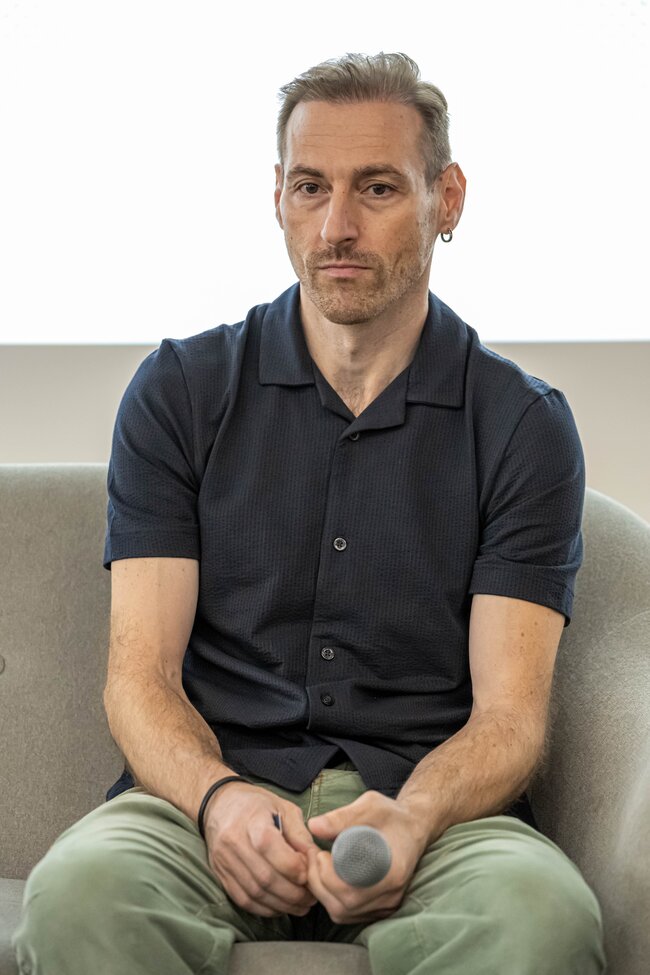
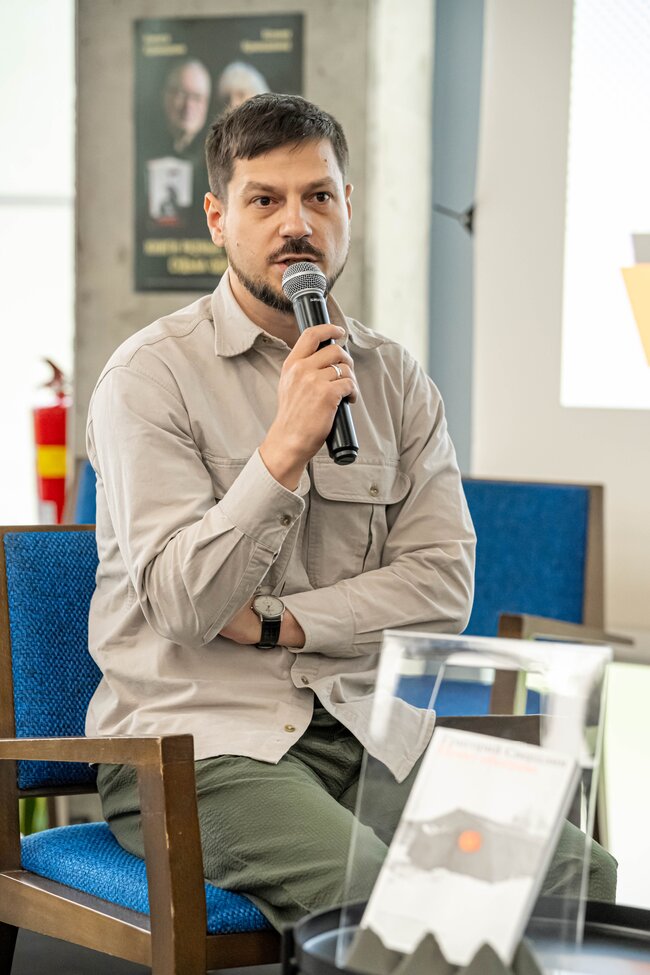
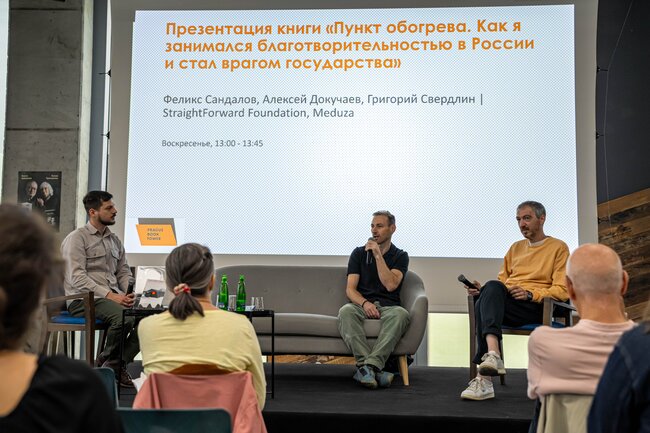
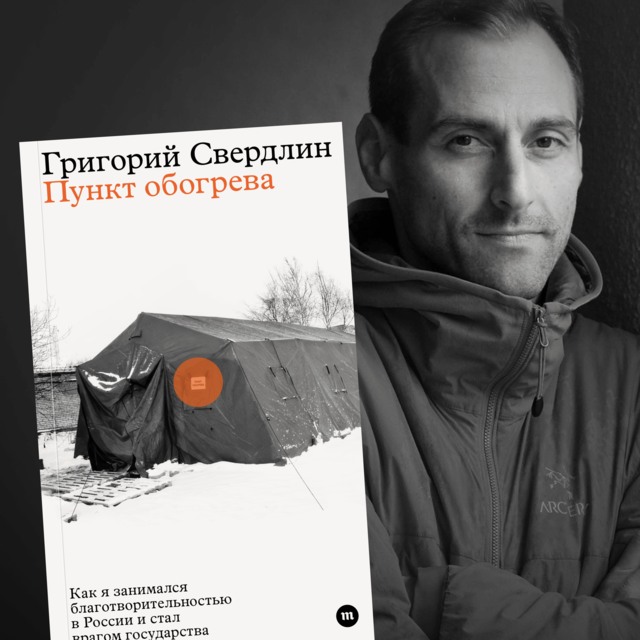
In fall 2026, the Prague Book Tower, a fair for Russian-language tamizdat, presented Grigory Sverdlin’s book Punkt obogreva: Kak ya zanimalsya blagotvoritelnostyu v Rossii i stal vragom gosudarstva (“Warming Station: How I Did Charity Work in Russia and Became an Enemy of the State”), published by Meduza’s publishing house. Sverdlin previously headed Nochlezhka, Russia’s oldest organization helping homeless people. In 2022, he stepped down as director, left the country, and, once in exile, launched the project Idite Lesom (“Get Lost”), which helps Russians desert the army and flee the country. In Prague, Felix Sandalov and Alexey Dokuchaev, founders of the StraightForward foundation, which supported the publication of Warming Station, spoke with Grigory Sverdlin about what kind of people work in the field of charity, why it’s almost impossible for projects like Idite Lesom to find financial support, and what future awaits an organization so closely tied to the war. Meduza is publishing a lightly abridged version of this conversation.
Felix Sandalov: Grisha and I first started talking about a book — not this one, but a completely different book at the time — I think around six or seven years ago, back in our time at the Moscow publishing house Individuum. The book was conceived as a kind of field guide to the work of nonprofit organizations, since Grisha already had a great deal of experience at Nochlezhka by then. But what came out now is an entirely different [book]. In its own way, it captures the difference between charity work and civil resistance. Grisha made a real “leap of faith” and founded an entirely new organization for himself, built on new principles.
Warming Station describes a kind of seasonality in the work of charities that help homeless people. When cold weather sets in, the work grows more urgent: people die on the streets, and staff have to respond quickly — it’s a genuinely difficult period for anyone working on these projects. That was certainly true at Nochlezhka. Is there a similar seasonality to the work at Idite Lesom? And given that the media keeps stirring up talk of an impending mobilization, which Russian authorities routinely deny, are you seeing a surge in requests to Idite Lesom right now?
Grigory Sverdlin: First, let me correct you a little. You’re talking about seasonality in helping homeless people, but the real seasonality is in donations. In winter, people donate more, more often, and more willingly to help the homeless, while in summer, for obvious reasons, the issue falls out of public attention. That doesn’t mean there are fewer homeless people — they don’t go anywhere. It’s a bit easier to survive, yes, but it’s still incredibly hard.
That’s exactly the pain point and the subject of discussion in the charity community that helps people who end up on the street: raising donations is incredibly hard, and the amount of work never decreases.
As for helping people who have ended up in the Russian army, or those trying to avoid ending up there, we’re completely swamped at Idite Lesom. If you’ve written to us and have been waiting several days for a reply, I want to take this opportunity to apologize. We will definitely answer everyone.
This summer we’ve gotten about one and a half times more requests than in spring, and about three times more than last summer. Right now, about 150 to 200 people contact us every day. Many people currently in Russia are, of course, panicking about a possible mobilization this fall and thinking about how to protect themselves, their children, and their loved ones.
The number of requests from people who want to desert from the Russian army is also growing. Just two days ago, we were tallying up the numbers for August: we helped almost 150 people desert that month alone.
Sandalov: You write about all of this with such vividness and enthusiasm — you can feel how obstacles energize you, how much you enjoy finding solutions to nontrivial problems. That’s always admirable.
Tell me about your method of writing the book. You describe nearly 20 years with all the vividness of someone who lived through every event firsthand. How did you reconstruct it all? How did you transport yourself back in time? How did you reconstruct the dialogue? Did you keep some kind of diaries? Or did you [reconstruct something] from letters, or do you just have a photographic memory?
Sverdlin: Thanks for the kind words. My memory is pretty poor, so I actually did some serious “pre-research” — digging up publications that are now archival, corresponding with colleagues, and interviewing colleagues from other charities who appear in the book. It’s primarily about Nochlezhka and Idite Lesom, but of course I wanted — and I hope I managed — to paint a broader picture and talk more generally about how the charity sector sprouted up through the asphalt in Russia. It didn’t exist in Soviet times, because only the state was supposed to help. Horizontal ties weren’t welcomed. They were banned.
Alexey Dokuchaev: So who should actually be doing the helping? The state, or society and organizations like Nochlezhka?
Sverdlin: I’d rather not frame it in terms of who “should.” Overall, global experience shows that the support system works best when many charitable organizations run by enthusiasts operate alongside various state, regional, and municipal structures that are also engaged in providing help. What you end up with is a network of different charitable projects, both private and government-run, that step in when someone is in trouble.
And indeed, the ratio of private to government assistance can vary somewhat, but practice shows that private initiatives are always more empathetic and more progressive, thanks to the greater enthusiasm of the people working there, and, being less bureaucratic, [these initiatives] are able to adapt more quickly to what’s happening.
Government structures, meanwhile, will always have more stable funding and greater organizational resources. In Finland, for example, which is the world champion in helping homeless people, that’s exactly the kind of interaction between the charitable and government sectors that exists.
Sandalov: Are there organizations in other countries that, like Idite Lesom, help conscripts avoid being sent to the front? Do you have an international community that shares its pains and hopes with one another?
Sverdlin: We do have some colleagues, and I found it fascinating when, a couple of years ago, we more or less accidentally met people in America who, during the Vietnam War, did something similar to what Idite Lesom does now. They were elderly hippies by then, recounting their extensive experience.
Obviously, given the specific nature of the subject, there aren’t many such colleagues, and we can’t really exchange experience with them. With our Finnish colleagues on the subject of homelessness, we always tried to pick up tips, to bring some of Finland’s practices back to Russia. But when it comes to helping with desertion… You can’t really swap routes for crossing the Finnish border with people who help men avoid service in the Pakistani army.
Dokuchaev: Nochlezhka is, in general, an organization whose structure makes sense to all of us. With Idite Lesom, we know the name, we understand what it does. But how does the organization actually function now, and to what extent can it be built into a system? And should it be? What does systemic success look like for you, apart from the war ending? Could you get an entire regiment or division out [of combat zones] if you were given far more resources?
Sverdlin: In general, I’m a believer in sustainable structures. My professional pride is that Grisha Sverdlin isn’t in St. Petersburg, in Moscow, or at Nochlezhka anymore, and yet Nochlezhka keeps living, working, and developing. I’m very glad about that, because it’s a crucial stress test for any leader: does everything still work once they’re no longer there? With Idite Lesom, I also want to believe that we’ve managed to build that kind of system.
Idite Lesom has 10 staff members: people who receive at least some salary, myself included. There are also around 80 volunteers, though we’re constantly recruiting more. Without this professionally organized work, it wouldn’t be possible to counsel 150 to 200 people every day.
“I got a summons, what do I do?” “I want to leave Russia, can I get out?” “There’s some kind of restriction on my ‘Gosuslugi’ account. Can you explain it?” “My boyfriend was detained on the street, and they’re pressuring him to sign a contract. Help.” “I’m a conscript who’s already been forced to sign a contract, and we were told we’ll be sent to the occupied territories next week. Help, save me, what do I do?” And so on, and so on. These really are hundreds of requests every week.
To answer your question about a regiment, I feel a little awkward bragging about numbers, but I’ll say it anyway, because it’s the result of enormous work by our volunteers. We launched in September 2022. To date, we’ve counseled more than 82,000 people, and there are around 3,600 people we’ve helped desert. We’ve gotten most of them out of Russia, although in the end a fairly significant number of people decide to stay in the country, and we help them hide.
So it’s a huge amount of work, but there’s always room to grow. Just last week, we met in person with colleagues and tried to come up with new ideas for how to undermine our home country’s defense capability more effectively.
Dokuchaev: How do people find out about you? Do you work only off the requests that come in? How does someone who doesn’t read Meduza or follow your Facebook find out that if they’re sent to occupied territory tomorrow, they should write to you?
Sverdlin: Honestly, good old word of mouth works best. Besides Meduza’s readers and my Facebook, 200,000 people also follow Idite Lesom’s social media accounts. That’s a great achievement by my colleagues who handle our social media.
These people spread the information among their friends and classmates, dropping it into chat groups like those for conscripts’ mothers. I think, above all, it’s this kind of organic reach.
Second, it’s probably independent Russian journalists and bloggers, whom I’d also like to take this opportunity to thank. They write about us, which means more people find out about Idite Lesom, and more people get the chance to escape the jaws of the leviathan.
Sandalov: Several fascinating pages of Warming Station are devoted to your great lifelong passion, namely technical mountaineering. By risking your life, you get access to some of the craziest views on planet Earth. In your view, is there a connection here: do people with a propensity for all kinds of extreme activity (there’s a crude expression for it, adrenaline junkie) want to work in charitable organizations or civil resistance projects more than others? Does charity work genuinely attract that kind of crowd, or is it a coincidence?
Sverdlin: I think it’s more of a coincidence. Of course, as someone who used to work at commercial companies, I was incredibly curious when I first started out in the nonprofit world. I wanted to see what kind of people worked there and how they differed from people in business.
What I ended up seeing, first, was people with a sharper sense of justice. For most of us, I think, that sense applies to ourselves and our immediate circle, but we’re unlikely to call up the relevant city service and complain about every broken traffic light. I had a colleague, though, who would see a broken traffic light and immediately start working to get it fixed.
Second, it’s a more developed sense of empathy, one that seems to stretch to more people and more situations. I also tried to write about this in the book. You shouldn’t idealize the people who come to work in charity, because everything has a shadow side, a flip side. The amount of conflict, scandal, and manipulation I was subjected to in the charity world is something no business could even dream of.
Sandalov: Tell me about civil resistance. Over the past few years, you’ve done a lot of notable things with Idite Lesom. Probably the biggest recent one was hacking into and destroying data from Russia’s military registration database. Tell me how that changed your life.
Sverdlin: Specifically, hacking the registry — or rather, the registry developer’s systems, to be precise — didn’t change anything, because by that point we’d already been engaged in “subversive activity” for three years, and our websites had already been blocked multiple times. We had, of course, already been designated “foreign agents” by Russian authorities. I’d already been sentenced in absentia to six years. If you want details, now whenever I fly somewhere, I always check where the airline’s backup airport is, because some airlines that fly to, say, Kutaisi use Sochi as their alternate airport. If there’s some technical problem in Kutaisi, the plane will land in Sochi. And I shouldn’t be showing up in Sochi. I also almost never write about my plans, and I try not to post photos from my window — basically, I take these and other obvious security precautions.
Coming back to the organization, so far, aside from being blocked and periodic attempts to hack us, nothing major has happened. Obviously, we vet people who want to become our volunteers in multiple stages, because there’s no doubt some “comrade major” would love to get in among them. But when you’re living inside all of this, this kind of shit just feels like routine.
Hi, I’m N.
I report for Meduza from inside Russia. I could go to prison for my work. To stay safe, I have to follow strict security protocols. I know my lawyer’s phone number by heart. And, of course, my articles are published anonymously.
Working for an independent news outlet while still living in Russia feels like something out of a spy film. My friends know me by one name. My colleagues and sources know me by another. But sometimes there’s a glitch. At a close friend’s birthday party, someone I don’t know reaches out to shake my hand. “Hi, I’m Lyosha.” It takes me a few seconds to decide how to introduce myself. Do I use my real name or my pseudonym? I’m trying to figure out whether this is someone I might one day end up writing about.
What I do is journalism in exile, even though I’m not in exile myself. I have the rare opportunity to do uncensored, on-the-ground reporting in Russia. Please support Meduza so I can continue this work.
Dokuchaev: Tell me, does having this kind of work get in your way, or does it actually help you? Does it give you strength to make plans for your own life? We’re living now in pretty pleasant places, where other people don’t have a war, but we do. Still, this war will end sooner or later. Given that, it seems obvious that the best thing that could happen to Idite Lesom is for it to shut down. How do you picture [life after that]?
Sverdlin: It’s true, when I came up with this project during the mobilization in Russia, I assumed we’d be doing it for six months, maybe a year — then the war would end, and we’d all go our separate ways to other things. I was naive.
I think that for me, and for many people I’m friends with, the war has cut off any sense of a horizon ahead. I don’t know what will happen in 10 years, or even five. And for now, unfortunately, I’m not able to look that far ahead.
I have to say this is something I miss, because when I worked at Nochlezhka, my colleagues and I tried to build strategic plans. Even if we specifically wouldn’t be at Nochlezhka in 10 years, we still tried to figure out how to move toward a future with room for many different charities and government projects. We were trying to grow that mycelium. Idite Lesom, of course, is a project with no future. God willing, this project will never have a future.
Dokuchaev: A project like this really shouldn’t have a future. But the people you’ve managed to help clearly do have one. Do you keep track of what happens to the people you got out, or, conversely, the people you weren’t able to get out?
Sverdlin: We do keep track. Idite Lesom is partly a charity project, not purely civil resistance. And there’s a well-known thing in charity work: a large share of the people organizations help never come back to say thank you.
Yes, Nochlezhka’s social workers are often brought boxes of chocolates. But that’s still a tiny fraction of the boxes they’re actually owed. People who’ve been through homelessness and managed to get out of it with Nochlezhka’s help don’t look back: behind them lies a nightmare, and thank god it’s over.
It’s the same with the deserters we’ve helped get out of the Russian army. It’s often harder because we’ve never even met some of them in person. Even so, we still know where quite a lot of them are and what they’re doing. By the way, a large share of the people we help desert end up in Kazakhstan and Armenia, because those are countries where you can legally live with a Russian internal passport. I’d guess around 90% of them now live in those two countries. We stay in touch with some of these people — they write to us and share their successes in their new lives.
Sandalov: In Warming Station, you write about the complicated, ambiguous world we all live in. On one hand, the Idite Lesom initiative obviously makes sense, with a very clear goal. But there are still plenty of contradictions. I’m thinking, for instance, of accusations that you’re helping war criminals. Or, say, you write in the book yourself that American philanthropists aren’t willing to give money to help people cross the border illegally, because in their view that’s human trafficking, and charitable money can never go toward something like that. What complaints do you run into most often?
Sverdlin: As for the money issue, it’s pretty funny: when we were just starting out, we knocked on every door, obviously. And we often heard from European grant-making foundations: “What you’re doing is good, but we still support some projects in Russia — cultural or charitable ones — so we can’t get involved with such a blatantly anti-Russian project.”
American grant-making foundations really did tell us that what we’re doing is good, but under American law it counts as human trafficking, and no one will bother to sort out that we’re not smuggling live cargo across the border but Russian deserters. So we made peace with that a long time ago. Huge thanks to the people who donate to Idite Lesom, because today probably 70% to 80% of our small budget comes from donations by Russian emigres. Obviously, we stopped accepting any donations from within Russia long ago, so as not to put anyone at risk, god forbid.
When I came up with this project, I decided right away that one fewer soldier in the Russian army means one person who won’t pull the trigger and fire toward Ukraine. I still hold to that logic. Every person we’ve helped desert, or helped avoid ending up in the Russian army in the first place, is a victory, because it weakens the criminal Russian army and in that way helps Ukraine.
About 80% to 85% of the soldiers and officers we help desert never even make it to the occupied territories. They’re stationed somewhere like Sakhalin or Rostov-on-Don. When these people find out — or even before they find out — that they’re going to be sent to the front, they get in touch with us, and we start helping them desert.
We vet the people who come to us as best we can, but there’s still a small chance that a war criminal could be among them. My colleagues and I aren’t happy about that, but we understand that, yes, in theory it’s possible.
We’ve decided that we will keep doing that vetting, but we’re still not an investigative body. It’s not our job to determine who is a war criminal and who isn’t. And thank god, there are institutions whose job and resources are suited to that: the United Nations war crimes commission and so on. Basically, we’ve decided that we do what we can in this area. Beyond that, I’d like to believe that after the war, all the war criminals will be found.
At Meduza, we are committed to transparency about our use of artificial intelligence in the newsroom. The story you’re reading was written by one of our living, breathing journalists and translated from Russian using an AI model configured to follow our strict editorial standards. This translation process is the result of extensive testing and refinements to ensure our English-language coverage is timely and accurate. A Meduza editor reviews every draft before publication.
If you find any errors in this translation, please contact us at reports@meduza.io.
Russian authorities detained several young men and women in Moscow, St. Petersburg, the Leningrad region, and other regions between August and October after Ukrainian intelligence services recruited them through the Telegram dating bot Leonardo Daivinchik to carry out acts of sabotage, according to Russia’s Investigative Committee.
Investigative Committee spokesperson Svetlana Petrenko described several cases of teenagers drawn into carrying out acts of sabotage. In one case, she said, a teenager bought flammable liquids and set fire to several gas stations. Other cases involved the arson of police department service vehicles and the arson of a transformer cabinet. All those detained face charges under Russia’s criminal statute against terrorism.
The FSB said it detained eight teenagers, ages 14 to 17, along with two adults, ages 19 and 24, in Moscow and St. Petersburg, as well as the Leningrad, Nizhny Novgorod, Omsk, Ryazan, and Sverdlovsk regions, between August and October.
In late July 2026, Russia’s Federal Security Service (FSB) accused Pavel Durov of aiding terrorism. The agency said the Telegram founder’s messaging app had failed to remove bots used by Ukrainian intelligence services. Among other things, the agency said Ukrainian intelligence services had drawn young Russians into “sabotage and terrorist activity” through the popular Telegram dating bot Leonardo Daivinchik.
At Meduza, we are committed to transparency about our use of artificial intelligence in the newsroom. The story you’re reading was written by one of our living, breathing journalists and translated from Russian using an AI model configured to follow our strict editorial standards. This translation process is the result of extensive testing and refinements to ensure our English-language coverage is timely and accurate. A Meduza editor reviews every draft before publication.
If you find any errors in this translation, please contact us at reports@meduza.io.
Russia’s Digital Development Ministry has proposed cutting off cellular service to smartphones brought in from abroad starting in April 2027 if their owners fail to register them by IMEI number within two weeks, the Russian business news outlet RBC reported.
IMEI is a unique 15-digit number assigned to every mobile device during manufacturing.
The initiative, under discussion at the Digital Development Ministry, would apply to smartphones brought into Russia from abroad for personal use. Owners would have two weeks to register their phones after bringing them into the country, or carriers would disconnect the devices from the network.
“This [registering] can be done on Gosuslugi within a two-week period. If registration is not completed within the established period, such devices will not be serviced on the networks,” the ministry said.
The ministry said the measure aims to combat people who import smartphones into Russia one at a time to resell them.
The initiative will not affect phones that were working on Russian networks before April 2027.
In June, the State Duma, the lower house of Russia’s parliament, passed a second set of measures aimed at fighting fraud. It calls for creating a unified IMEI database in Russia with a “blacklist” of phones that were stolen or illegally brought into the country.
At Meduza, we are committed to transparency about our use of artificial intelligence in the newsroom. The story you’re reading was written by one of our living, breathing journalists and translated from Russian using an AI model configured to follow our strict editorial standards. This translation process is the result of extensive testing and refinements to ensure our English-language coverage is timely and accurate. A Meduza editor reviews every draft before publication.
If you find any errors in this translation, please contact us at reports@meduza.io.
Yandex has withdrawn its previously published forecasts for 2026 revenue and adjusted EBITDA.
“After the October attacks on the data centers, the company faced additional external factors that complicate assessing its financial results through the end of the year,” the company said.
Yandex said it would consider resuming forecasts beginning next quarter.
Yandex said its long-term strategic priorities remain unchanged, that it does not plan to revise its development plans for key business areas, and that it will continue investing in new technologies and products.
In forecasts published earlier, Yandex had expected annual revenue to grow about 20% year-over-year, with adjusted EBITDA of about 350 billion rubles, the Russian business news outlet RBC said.
In early October, Ukrainian drones struck three of Yandex’s six data centers over the course of a week: in Sasovo in the Ryazan region, in Kaluga, and in Vladimir. Following the strikes, some Yandex services were temporarily unavailable or functioned with limitations. As of late October, Yandex reported, key functions of all services were available. The company said engineers “are working to fully restore all functionality.”
The Russian business daily Kommersant wrote that, according to experts’ estimates, replacing equipment at Yandex’s data centers damaged in the Ukrainian drone strikes would take about six months.
At Meduza, we are committed to transparency about our use of artificial intelligence in the newsroom. The story you’re reading was written by one of our living, breathing journalists and translated from Russian using an AI model configured to follow our strict editorial standards. This translation process is the result of extensive testing and refinements to ensure our English-language coverage is timely and accurate. A Meduza editor reviews every draft before publication.
If you find any errors in this translation, please contact us at reports@meduza.io.
Russia’s human rights commissioner Yana Lantratova said humanitarian aid has been sent to the city of Oleshky in the Kherson region.
“People need food, fuel, medicine, and hygiene products,” she wrote on the morning of October 29 in the Max messenger.
Lantratova added that residents of the occupied city “will have the opportunity to leave the combat zone regardless of where they want to go.”
Oleshky, which Russia occupied at the start of the full-scale war, fell into a dire situation in fall 2026, when residents were left without food, electricity, or adequate medical care and had no way to leave the city safely.
Russia and Ukraine agreed in October to halt hostilities in Oleshky for a humanitarian mission. The truce took effect on the morning of October 27 and will remain in force until late evening on November 1. As of October 28, the truce was being observed.
Under the agreement, representatives of both Russia and Ukraine will take part in the humanitarian mission in Oleshky. Journalists from the right-wing American channel Newsmax will cover the mission, Melania Trump said.
At Meduza, we are committed to transparency about our use of artificial intelligence in the newsroom. The story you’re reading was written by one of our living, breathing journalists and translated from Russian using an AI model configured to follow our strict editorial standards. This translation process is the result of extensive testing and refinements to ensure our English-language coverage is timely and accurate. A Meduza editor reviews every draft before publication.
If you find any errors in this translation, please contact us at reports@meduza.io.
The Federation Council, the upper house of Russia’s parliament, has recommended that Rosobrnadzor consider raising the minimum scores required on the Unified State Exam (USE) for admission to Russian universities, according to a resolution the chamber issued October 28.
The new requirements would apply to all universities “regardless of their departmental affiliation or ownership structure.”
The Federation Council also recommended eliminating distance learning for engineering and technology majors. For fields where enrollment exceeds labor-market demand, it proposed capping the number of tuition-paying slots. It also proposed revisiting the rules and criteria for admission benefits.
In addition, the senators proposed suspending the issuance of new university licenses “until amendments aimed at improving the licensing process are made to Russian law.”
During an October 14 plenary session, Federation Council speaker Valentina Matviyenko called for tightening university licensing requirements. According to her, opening a university in Russia today is easier than opening a newspaper kiosk, and “anyone who wants to can do it, literally by pressing a couple of buttons.”
Matviyenko also proposed reducing the number of tuition-paying students at Moscow universities by limiting admission for students from other regions: “Enroll as many as are needed in the necessary fields, and no more. The rest can study at home,” Matviyenko said.
In recent years, Russian authorities have increasingly encouraged students to leave school after ninth grade and enroll in vocational schools rather than universities, BBC Russia reported. Some schools have begun reducing enrollment in upper grades, and it has become harder to get into a university after vocational school: starting in 2025, students who skip the USE can only choose a similar field of study.
In 2025, the government already gained the right to allocate tuition-paying slots across the 40 most popular fields of study that, in the authorities’ view, produce too many graduates.
At Meduza, we are committed to transparency about our use of artificial intelligence in the newsroom. The story you’re reading was written by one of our living, breathing journalists and translated from Russian using an AI model configured to follow our strict editorial standards. This translation process is the result of extensive testing and refinements to ensure our English-language coverage is timely and accurate. A Meduza editor reviews every draft before publication.
If you find any errors in this translation, please contact us at reports@meduza.io.

 Login