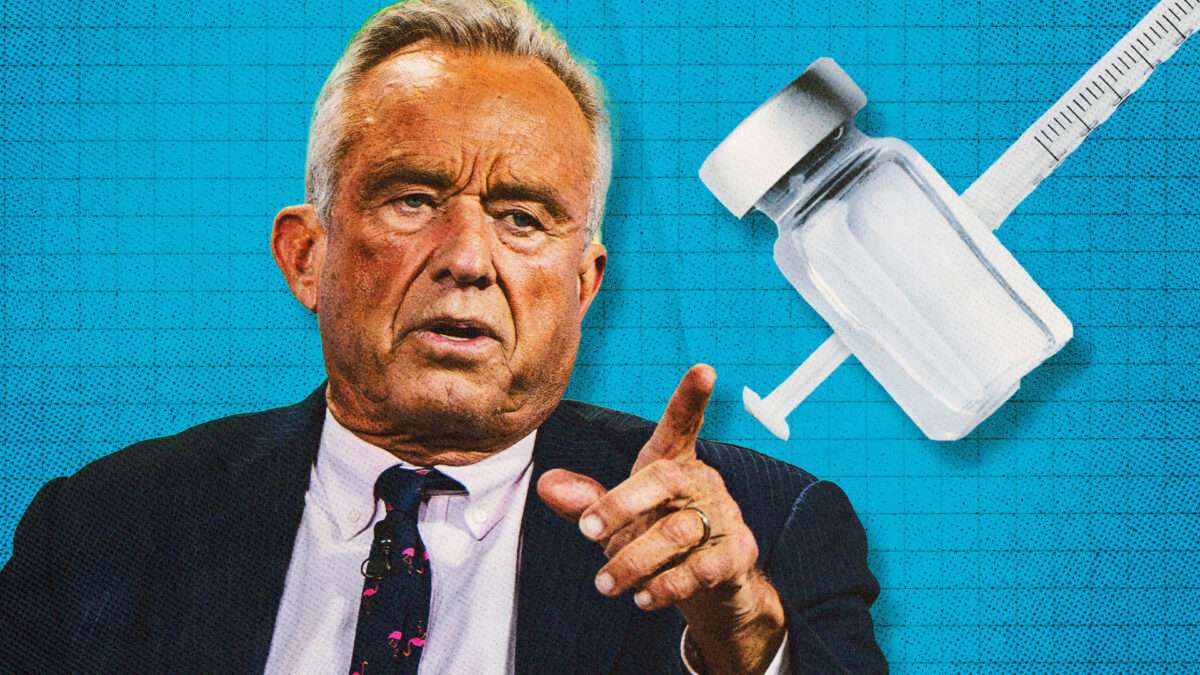
The Department of Health and Human Services (HHS) will let pharmacies produce and sell treatments involving six peptides that aren't specifically approved by the Food and Drug Administration (FDA). The move is meant to provide a "controlled alternative" to buying peptides from possibly sketchy foreign pharmacies, HHS said.
Under the new HHS policy, the agency will not "take enforcement action against a State-licensed pharmacy, Federal facility, or licensed physician compounding a drug product" using one of six named "peptide bulk drug substance[s]."
This is a major win for peptide proponents, compounding pharmacies, and health freedom—and hints that HHS Secretary Robert F. Kennedy Jr. may be feeling frustration with the slow pace of things at the FDA.
Up for debate was whether these six "bulk drug substances" and another, Emideltide, should be put on the FDA's Section 503A Bulks List. That list governs which substances licensed physicians and specialty pharmacies can compound into drug products without them being a component of an already FDA-approved drug or having "an applicable United States Pharmacopeia (USP) or National Formulary (NF) monograph."
In July, the panel voted to put six of the seven peptide-related substances under consideration (all except Emideltide) on the bulks list. But the panel's vote is not binding.
It's ultimately up to FDA authorities to decide whether they accept the advisory committee's recommendations. So far, no decision has been released.
Kennedy can't ensure FDA approval, of course. But he can—and will—stop HHS from taking action against physicians or pharmacies that compound and distribute these substances under his prescribed rules.
In an explainer about the new policy, HHS notes that "compounded drugs are not FDA-approved, which means FDA does not review their safety, effectiveness, or quality before they are marketed." Nonetheless, "compounded drugs can serve an important medical need for certain patients" and "there is significant interest in the use of these peptides in compounding," it says.
Opponents of allowing more peptide-based treatments to be compounded by licensed U.S. pharmacies often focus on the fact that these products don't have FDA approval and may not have the extensive experimental backing required of FDA-approved treatments.
But people are already taking BPC-157, MOTS-c, and other peptides anyway, buying them from companies selling them under "for research use only" labels or obtaining them from foreign distributors. Peptides can even be found on discount everything-marketplaces like the China-based AliExpress.
Allowing licensed physicians and pharmacies in the U.S. to compound these substances without fear of being punished gives people access to safer options than they might otherwise have.
Pharmacies compounding peptide-based products under the rules set forth by federal law still have to be licensed in the states where they operate and follow certain rules, including a requirement that active ingredients used for compounding must be "accompanied by valid certificates of analysis" and "be compounded based on the receipt of a valid patient-specific prescription." Per the new HHS policy, they must also follow several other rules regarding the packaging and labeling of these peptides.
"The Secretary of HHS has determined that this limited enforcement-discretion policy will discourage the continued, widespread use of certain research-use-only peptides supplied by foreign manufacturers that pose a safety risk to US patients," notes the HHS explainer. "By allowing limited compounding of the substances addressed in this guidance under appropriate safeguards, the policy provides patients with a more controlled alternative."
It's an astoundingly reality-based policy for government health officials, who often act as if matters like this come down to a binary between perfect health and safety on one hand and certain danger on the other.
Rather than relegating peptides to gray or black markets until they (may be) pronounced all clear by the FDA, RFK Jr.'s HHS has chosen to balance safety with "patient choice and freedom," as the HHS states.
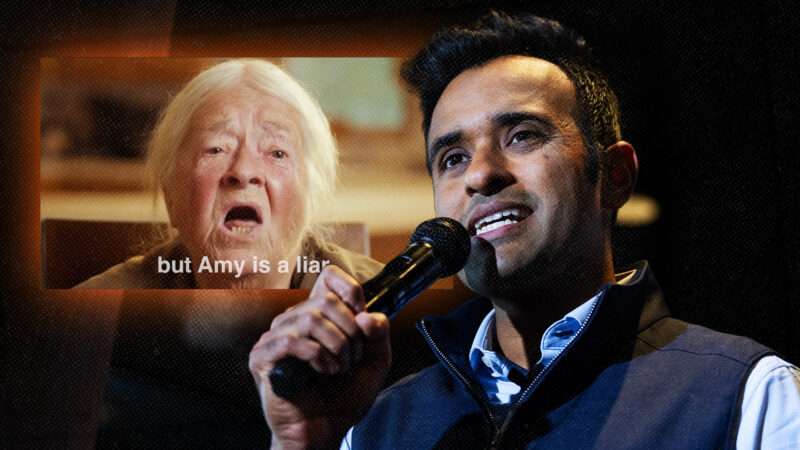
My home state of Ohio has earned a not-so-nice distinction in the 2026 election: It is the site of "the ugliest" contest in the country. Nasty attack ads have been an ongoing feature of the governor's race between Republican Vivek Ramaswamy and Democrat Amy Acton—piercing many a peaceful Hulu-watching session on my end with allegations that Acton is a pill-popping drunk and Ramaswamy a con man.
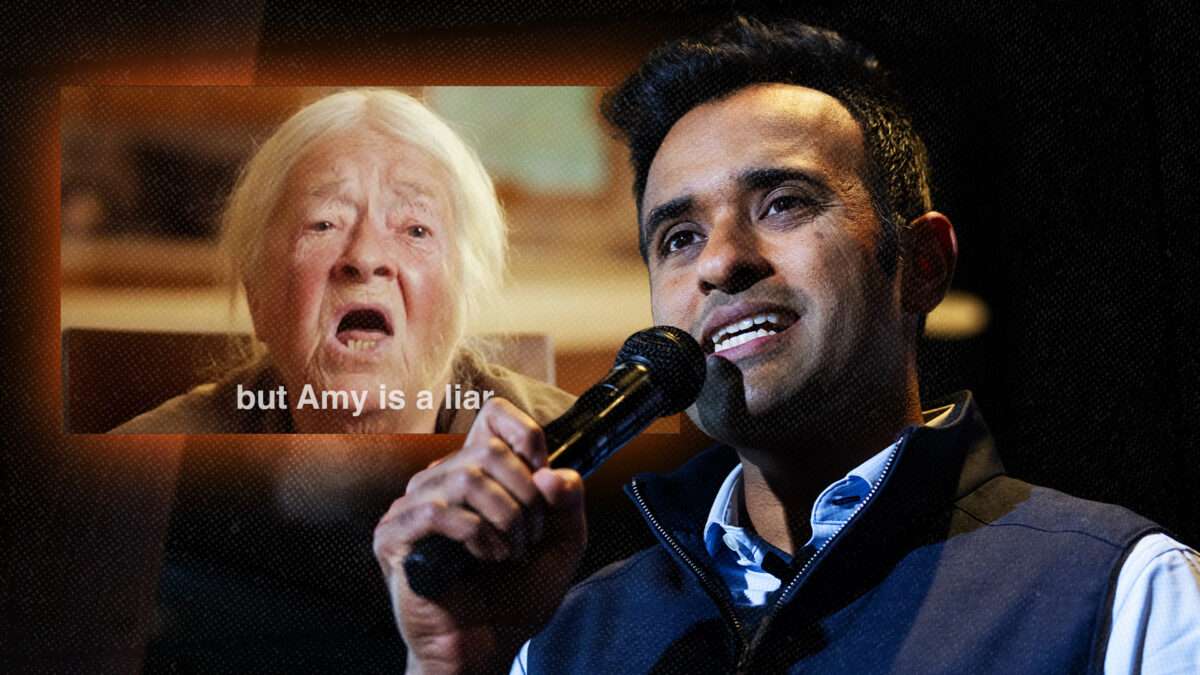
But the nastiness reached a whole new level in recent weeks, with the release of a Ramaswamy campaign ad implying that Acton lied about childhood sexual abuse by her stepfather.
Understandably, many Republicans bristled at being viewed as the party that defends accused child rapists. Not Trump. His only regret here is that he didn't get to run an ad like this, he said.
The ad features Acton's mother, Donna Arthur, from whom Acton has been estranged for decades for what seem like very good reasons. When Acton was 12, her mom took her stepfather's side when she accused him of sexually abusing her for years.
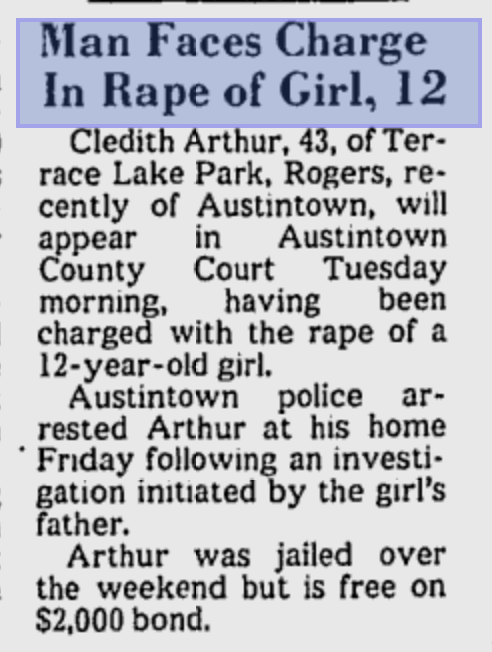
In 1978, Acton's stepfather, Cledith Arthur, was arrested and charged with child rape. Records from the case, obtained by Signal Statewide, "also contains a reference to a previous incest charge against Cledith Arthur from 1974…although it's not clear how that case was resolved."
Acton's mom lost custody of both Amy and her brother. But the stepfather was never tried, since he and Acton's mom fled the state. He remained a fugitive—and married to Amy's mother—until he died in 2004.
screenshot of Clip from the Youngstown Vindicator on July 17, 1978
In the new Ramaswamy campaign ad, Acton calls her daughter a liar. "It's not easy for a mother to say this, but Amy has a serious problem. She is a liar," says Arthur in the video. "She lies about her past.…She's lied her entire life. My daughter needs help."
Arthur doesn't outright say "she lied about being molested by her stepfather," but given the historical context here, the implication is pretty clear. In effect, the Ramaswamy campaign has helped Acton's mom accuse her daughter on a national scale of making it all up.
That's despicable, even by political campaigning standards.
And—providing us with some hope for humanity—it also backfired. People roundly condemned the ad and the Ramaswamy campaign for running it. Acton's brother, Philip Stearns, corroborated her story. Even many Republicanshave objectedto the ad.
There are still some lines you don't cross, public figures left and right seemed to agree.
Public figures except President Donald Trump and Vice President J.D. Vance.
Telling Republicans to "stop whining" about the ad, Vance said he was getting "a little bit disgusted when I see Republicans across the country who are whining more about that advertisement than they are about what the congressional Democrats and other Democrats want to do to the United States of America."
"Vivek Ramaswamy had the audacity to run a TV commercial which calls it out like it is and calls Amy Acton a liar," Vance continued.
Trump went further, calling the ad "very powerful" and urging the Ramaswamy campaign to keep it up. Trump also criticized the current Ohio governor, Republican Mike DeWine, for calling the ad "deeply troubling."
DeWine is a moderate Republican who, for the most part, adheres to pre-Trump standards of decency. Their differing reactions here seem a perfect microcosm of pre-MAGA and post-MAGA standards for conduct and bounds of acceptability.
DeWine "probably wants a Dumocrat to win," Trump wrote in a Truth Social post last Thursday. "I suggested, on the other hand, that Vivek should keep it up, and let everyone listen to the mother of a defective, dishonest, and incapable Candidate, explain how the daughter is a DISASTER who, uncontrollably, lies, cheats, and steals!"
Talking to reporters that same day, Trump just kept repeating that if an ad had been made with his mom calling him a liar, the press would love it. He stuck to that talking point again and again, acting clueless about the childhood sexual abuse allegations at the center of this whole controversy.
The idea that the president would passionately post about and answer questions about this without knowing the whole story is almost beyond belief. But even if Trump somehow didn't know the full context when he first started talking about it, he was made aware and then kept right on praising the ad.
Trump on Ramaswamy Ad: The mother is calling the daughter a terrible person and a liar. Why would you shield somebody from that? Why would we do that? So I told him, leave it up and say thank you God. I only wish I could have had an ad like that. pic.twitter.com/M2TYz3jhUy
At a campaign rally in Iowa last Thursday, he said, "I only wish I could have had an ad like that against somebody."
Ramaswamy has also defended the ad, saying, "Unfortunately, the person I'm running against does have serial problems with the truth" and that the ad highlights a "pattern" of the "people who are closest to her" telling Ohioans not to vote for her.
But this is no longer just about one candidate's mistake or one campaign's poor judgment. The response from Trump and Vance has raised Ramaswamy's ad into bigger and uglier territory.
"It's actually kind of hard to find a prominent Republican who is defending the ad other than Vivek Ramaswamy himself, Vice President JD Vance and, quite fervently today, President Trump," noted CNN's Kaitlan Collins last Friday.
But Trump and Vance are the leaders of not just the Republican Party but the nation. And as we've seen again and again, Trump's responses tend to set the tone for what will become acceptable among conservatives by and large.
"Vance's acceptance of this campaign ad only breathes life into the disease that we should be seeking to cure," former New Jersey Gov. Chris Christie toldThe Washington Post.
Do voters agree?
Whatever happens with Ramaswamy next Tuesday, it will be impossible to know how much of it is related to this ad campaign and how much of it is related to many other possible factors. But it's hard not to look at the Ohio gubernatorial election results now as something of a referendum on what type of political discourse is OK. Are voters over Trump-style belligerence and nastiness? Or do they accept the premise that politics is a war in which no low is too low if it helps you win?
In the News
Release the FISA Ruling: "Two Democratic senators who have long overseen US intelligence say the Trump administration is illegally withholding a secret court's findings from Congress until lawmakers renew a program that lets federal agents read Americans' communications without a warrant," reportsWired:
Seven months ago, the Foreign Intelligence Surveillance Court objected to search filters that let intelligence analysts pull Americans' messages from intercepted data without the approvals, written justifications, or records the law requires. The court approved another year of surveillance anyway. The ruling has never been made public, and Senators Ron Wyden of Oregon and Adam Schiff of California say the administration's own deadline for releasing it passed in September.
"This opinion details serious abuses of Americans' rights under Section 702 of the Foreign Intelligence Surveillance Act (FISA) and, by law, should have been released before September 13," wrote Wyden and Schiff in a letter to the director of national intelligence and the U.S. Attorney General. "Yet this opinion remains hidden over a month later, suggesting that the administration hopes to secure a renewal of Section 702 while keeping Congress and the public in the dark."
Wishful thinking from Flock. Garrett Langley, the CEO of Flock, told a conference of cops to believe him rather than what's right in front of their eyes. The backlash to Flock "is not real," he said at the International Association of Chiefs of Police conference, per leaked audio obtained by 404 Media:
"Somebody was paying for [the social media posts and] stopped paying for it," Langley said about the many viral posts criticizing his company's technology. "Social media chatter on Flock is down about 95 percent from July. It went down 50 percent last week when Ukraine bombed a Russian data center with a drone. Literally 50 percent overnight. And so look, I'm the last person, my wife as well, she's like 'This is crazy, these people are getting paid to say these things,'" he added, repeating a disproven theory that Ukraine's strikes on Russian data centers had a significant impact on internet bot activity.
"It's anonymous bots, and so it is not real," he continued. "Inorganic activity has led to organic activity, but when I look at protests across the country, it is the same people with the same signs and the same message. That's not normal. That's not organic at all." Langley's comments echo another unsubstantiated theory that said opposition to Flock comes from a far-left network spreading propaganda at the behest of China.
The backlash is widespread and multifaceted. Backlash to Flock "has just exploded, like no other issue that I have seen in my time at the ACLU," Becca Eastwood, deputy policy director at the American Civil Liberties Union of Iowa, told Reason recently.
On Substack
Techlash on the campaign trail. Democrats have been panning data centers in campaign ads, but artificial intelligence was the subject of only a small fraction of ads, notes the Blue Horizon Project, an initiative from Chamber of Progress "to restore tech optimism in the Democratic Party and reset the relationship between Democrats and the technology sector." And when Democrats have focused on AI and data centers, it's been more about economics than general anti-AI sentiment, Dave Vorland writes:
Data centers are the important exception to the lack of ads focused on AI and technology. In AdImpact's tables, they appear among the three leading Democratic advertising topics in 5 of the 21 Toss-Up House races. They are not politically irrelevant, and dismissing the local backlash would be a mistake.
But look more closely at what these ads actually argue. Using AdImpact's data on 2026 campaign spending, ads matching either a tax-language screen or energy message, or both, account for $69.76 million, or 76.2% of all data center advertising.
The race with the highest spending on data centers is the Ohio Senate race, where Democratic spending accounts for $32.10 million. AdImpact's data shows Sherrod Brown's campaign spent over $1.5 million to air a data center ad 3,100 times. The message shows that while he is willing to hit his opponent for the data center tax breaks, his solution is ensuring that data centers don't raise energy costs, an idea that could have been drawn directly from our Data Center Development Playbook.
Vorland points out that "AdImpact's data for 2026 Congressional spending shows that less than $2.5 million went to ads supporting a data-center construction pause, moratorium, ban, or stopping new construction, a minuscule portion of the Democratic ad buy."
Interesting that "let data centers build but don't subsidize them" is the implicit message here. It feels like at least somewhat of a good sign that Democratic candidates don't by-and-large think "ban new data centers" is a message that voters want to hear.
More Sex & Tech News
• An interesting essay in Works in Progress looks at "the rise of prudishness" and what demographics might have to do with it.
• "Technology has advanced for centuries, shuffling workers among occupations, industries, and regions without making human labor obsolete," writes Nathan Smith at Human Progress:
As machinery pushed millions of Americans away from farming over the past century, most workers moved to factories, towns, and cities. They ended up with more comfortable lives than their predecessors plowing the fields. The AI economy will likely follow the same path: destroying jobs while creating better ones.
• The New Jersey Assembly recently advanced a bill that would increase prostitution penalties, and several other prostitution-related criminal justice bills are pending in the Assembly and state Senate. Tara Burns has details.
• Florida's attorney general said he plans to introduce even more stringent social media regulation, even as the state's earlier restrictions on minors using social media are still being challenged in federal court.
• British tech regulator Ofcom says its Online Safety Act isn't actually stopping kids from seeing "harmful content" online. So it wants to do more of it. "Instead of suggesting to repeal the Online Safety Act because it does not seem to be working or because it imperils online freedom, Ofcom's report proposes to broaden the law's scope," writesReason's Meagan O'Rourke.
NEW: The Online Safety Act has been a failure, according to a new report from Ofcom.
Ofcom have found "no significant change" in children encountering harmful content since the law came into effect last July. This is despite the signifigant threats to free speech and privacy.
• "Social media decentralized the information environment and weakened the influence of expert opinion. LLMs are likely to have the opposite effects," writes Dan Williams at Persuasion. "Whereas social media has been a democratizing technology, LLMs are a technocratizing force. They shift influence back towards expert opinion."
• Ten states have no birth centers and eight others only have one, according to a new report from The Commonwealth Fund. "Two dozen centers closed between 2023 and 2026, with some publicly blaming onerous regulations and steep increases in malpractice insurance," notesOhio Capitol Journal.
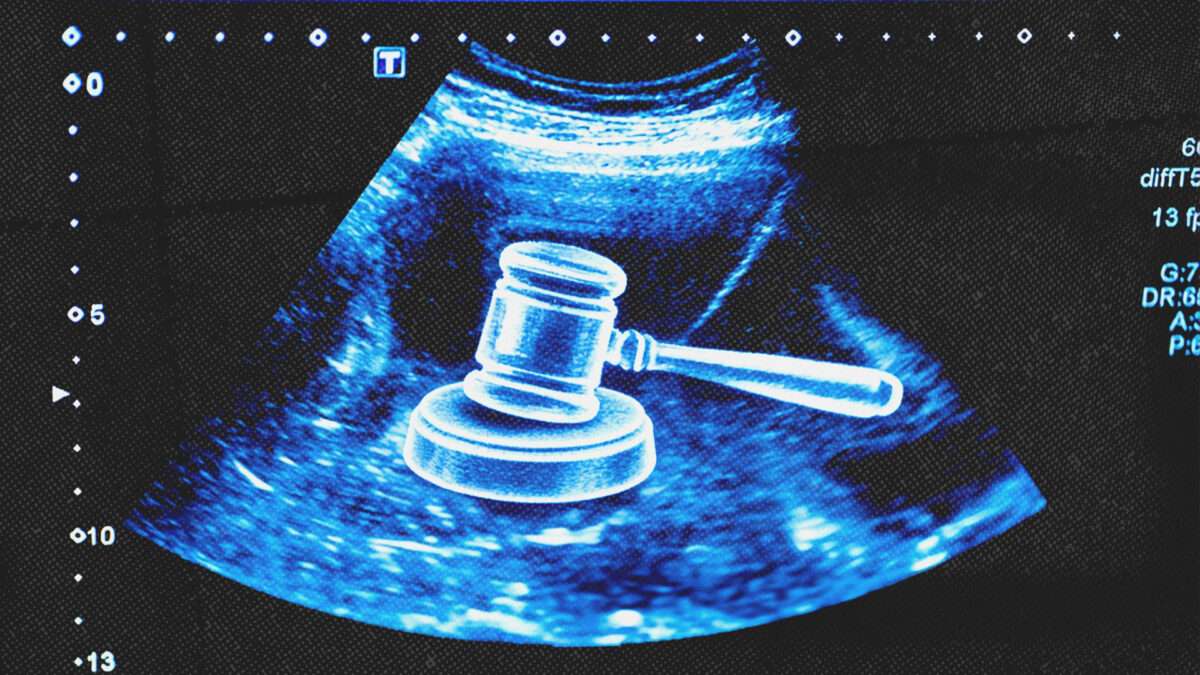
An Arizona abortion clinic that didn't tell a pregnant woman about the physical characteristics of her 8-week-old embryo before prescribing abortion pills has been found liable in a case brought by the ex-husband of the pregnant woman, who didn't want her to get an abortion.
The ex-husband, Mario Villegas, was awarded $67,500 in a civil lawsuit accusing the clinic of violating an informed consent law that an Arizona court declared unconstitutional earlier this year.
'A Dangerous Precedent'
The Lawyering Project, which represented the doctor and clinic being sued by Villegas, had warned that the case could "establish a dangerous precedent in Arizona concerning embryonic personhood and chill the provision of abortion care."
"A pre-viability embryo or fetus is not a person," says its website in a summary of the case, "and a physician cannot be subject to a wrongful death action for providing high-quality abortion care to a patient who wants an abortion."
In an August 2024 order, Judge Bryan B. Chambers of the Arizona Superior Court in Gila County agreed with the defendants that Arizona's wrongful death statute does not, as written, apply to the death of embryos. The court is "unwilling to expand the common law definition of 'person' as applied to the wrongful death statute to include all unborn children whether viable outside the womb or not," Chambers wrote.
But that doesn't mean he tossed Villegas' lawsuit entirely. And in a judgement released July 22 but largely unnoticed untilthis week, Chambers wound up holding that Villegas is entitled to $5,000 in statutory damages and $62,500 "in compensatory damages for his psychological, emotional, and physical injuries."
No one in the case alleges that Villegas' ex-wife—referred to in court documents as M.S.V.—was tricked, coerced, or generally uninformed about the abortion. The case turns on technicalities and Arizona's onerous, biased (and now barred) requirements for what abortion doctors must tell patients in order to obtain informed consent.
'Deprived of the love….of his child'
M.S.V's abortion took place in July 2018, when she was around eight weeks pregnant. At the Camelback Family Planning clinic in Phoenix, she was provided with information at least 24 hours before she could come back for the abortion pills, and she signed various consent forms, including one affirming that she was "comfortable with [her] decision to terminate this pregnancy," according toProPublica.
Around two years later, in July 2020, Villegas—now divorced from M.S.V.—sued the clinic and physician Gabrielle J. Goodrick, alleging medical malpractice and wrongful death. Villegas "has been deprived of the love, affection, comfort, and companionship of his child," his initial complaint stated. He "has been deprived of his constitutionally protected right to parent Baby Villegas."
Villegas sought to have himself appointed the personal representative of the estate of the aborted embryo, and a probate judge agreed.
In an amended complaint, Villegas added that "the estate has been deprived of the net income Baby Villegas would have earned during her lifetime" and sought damages for that, too. (Villegas took the liberty of assuming the embryo was a girl, even though the abortion would have been too early in the pregnancy to tell.)
"Across the U.S., people have sued for negligence in the death of a fetus or embryo in cases where a pregnant person has been killed in a car crash or a pregnancy was lost because of alleged wrongdoing by a physician," noted ProPublica in a 2022 article about the case. "But a court action claiming the wrongful death of an aborted embryo or fetus is a more novel strategy, legal experts said."
Informed Consent or Compelled Speech?
Ultimately, the case came down to Arizona's informed consent law, not fetal personhood.
That law—declared unconstitutional in February 2026—said that doctors must obtain informed consent before performing abortions (which is normal) and then added that this consent only counts if clinics obtain it in highly particular (and medically unnecessary) way and tack on a lot of loaded language and anti-abortion rhetoric.
It says that "at least twenty-four hours before the abortion, the physician who is to perform the abortion or the referring physician" must inform a patient woman "orally and in person" about topics such as "alternatives to the procedure or treatment" and "the probable anatomical and physiological characteristics of the unborn child at the time the abortion is to be performed." Doctors were also required to tell a woman seeking an abortion that if she went through with the pregnancy, various forms of assistance may be available.
Villegas alleged that even though his wife technically consented to the abortion, it didn't count because the information wasn't provided by the same doctor who prescribed her the pills, and because doctors didn't warn her about the potential "loss of the 'maternal-fetal' attachment bond inherent in birthing a child" and didn't explain alternatives to abortion or the 8-week-old embryo's physical characteristics.
He also complained that the printed form M.S.V. was given "changed the statutory term 'the probable gestational age of the unborn child' to 'the probable gestational age of the pregnancy,' which misstates Arizona's legislative determination that every pregnant woman is carrying a human child."
M.S.V. testified in court "that nothing would have changed her mind about obtaining the abortion," as Chambers put it in his judgement. And no one alleges that the clinic simply failed to discuss some risks and other relevant information with her before the procedure. It simply failed to use the loaded language preferred by the state.
But "the statute does not require proof that M.S.V. would have made a different decision had she been fully informed," wrote Chambers in his judgement. And even if some of the rules of informed consent were followed, "nothing in [Arizona law] suggests that substantial compliance with the consent provisions is all that is necessary."
Fortunately, the informed consent law at the heart of this case has been struck down, so future doctors don't have to worry about being sued for failing to say "unborn child."
But there's still something chilling about the way all this played out. M.S.V. had argued to court that she was tricked into pregnancy—she thought her ex-husband "was fixed," because he'd had a vasectomy, though it was since reversed. Chambers said this did not negate her consent to sex with him, since M.S.V. "was not deceived about the nature of the act. At most, she was deceived about a potential consequence (pregnancy risk)."
In M.S.V.'s telling, she did not exactly give informed consent to the sex that led to pregnancy, but she did give informed consent to the abortion procedure. In neither situation, however, do M.S.V.'s claims about her own consent seem to have mattered much at all.
In the News
The Transportation Security Administration (TSA) shows "significant weakness" when it comes to protecting passenger data, according to the Department of Homeland Security Office of Inspector General.
A TSA authentication vendor "was able to access and extract sensitive passenger information, including driver's license and passport images, during system troubleshooting and enhancements, without TSA's knowledge," the report says. More:
TSA lacked clear policies, did not track when this data was extracted, could not verify that extracted information was properly deleted, and did not notify passengers when their biometric and biographic information may have been stored. As a result, although passenger information was generally protected during routine operations, weaknesses in vendor oversight created a risk that sensitive personal information could be retained or exposed.
As the OIG's audit underscores, this technology presents privacy risks associated with unsecured data, unauthorized access, and data breaches. The government's use of this technology also creates a mass surveillance system and facilitates the creation of warrantless biometric records for unconsenting parties.
[…] Given that facial recognition technology is prone to mistakes, combined with the OIG's audit revealing significant privacy weaknesses, it is imperative that travelers remember that opting out is possible. TSA's own website emphasizes that travelers who wish to decline to have their photo taken for facial comparison can do so without any delay, disruption, or recourse.
More Sex & Tech
• You could make a full-time beat out of covering cops' misuse of Flock cameras these days. The latest: "A former Joliet police lieutenant is now facing felony charges for misusing the city's Flock camera system," per CBS News. And, in Sharonville, Ohio, "a police lieutenant was indicted Tuesday after he allegedly used Flock camera systems…29 times between Dec. 19, 2024, and April 20, 2026, to track a person's whereabouts" for personal reasons, Fox 10 reports.
• Airbnb says hosts can't make you wash and dry your own dishes anymore:
I just got an email from Airbnb laying out new ground rules for what hosts can demand of guests, and THANK GOD.
At my last Airbnb, I had to strip the beds, wash every dish, clean the kitchen, haul the trash out to the road, and there was still a $100 cleaning fee! https://t.co/tfQGqQKsRo
• Another case challenging the use of Flock cameras to get convictions. In Texas, Charles Brownlee—sentenced to 60 years in prison for armed robbery—is asking a federal appeals court to throw out his conviction, "arguing that the AI-powered camera system gives law enforcement more surveillance power than the Constitution allows," per The Texas Tribune.
• A California law that takes effect in 2027 "will require large companies to make a good-faith effort to link customers to a human by phone within 15 minutes," notesThe San Francisco Standard. "But it has a carveout for companies that never offered phone support in the first place. It remains to be seen whether the legislation will hold any sway over the AI firms leading the charge to replace human agents."
• Jacob Sullum delves into a convoluted lawsuit filed against Students for Life by a Texas woman who opposes a Texas anti-abortion law.
• In the latest incident to blur the line between the FBI catching criminals and creating them, an FBI task force catfished a high school maintenance worker using an AI-generated image of a 15-year-old, then used Clearview AI facial recognition tools to identify him and Flock to track his car.
Matt Gaetz resigned from the U.S. House of Representatives in November 2024, shortly before the House Ethics Committee released a report accusing him of having sex with a 17-year-old girl in 2017, when he was 35, and "regularly pa[ying] women for engaging in sexual activity with him." The probe was widely discussed as a sex trafficking probe, but the ethics committee "did not find sufficient evidence to conclude that Representative Gaetz violated the federal sex trafficking statute," per its report.
Now two women have filed a civil lawsuit accusing Gaetz of sex trafficking.
The suit, filed in the U.S. District Court for the Middle District of Florida, says that Gaetz and two other men (Joel Micah Greenberg and Christopher Dorworth) broke federal anti-trafficking laws by using "their public office, power, and wealth to prey on the economic vulnerability" of Jane Doe 1 and Jane Doe 2.
Gaetz, who now hosts The Matt Gaetz Show on One America News Network, said many of the suit's allegations against him are false. "The lawsuit relies almost exclusively on a Congressional Committee report that didn't allow me to confront my accusers," he said. "Now I will finally have that chance."
On X, Gaetz posted an image of three women in bikinis seated next to bottles of beer and looking at the ocean and wrote "Jane Doe Strikes Again! Two adult women sued me today alleging they were sex trafficked to the Bahamas. I'm shocked nobody responded to their repeated cries for help, posted to instagram."
Jane Doe Strikes Again! Two adult women sued me today alleging they were sex trafficked to the Bahamas. I'm shocked nobody responded to their repeated cries for help, posted to instagram. https://t.co/HPvX2xypzs
This does not seem like especially helpful behavior from a public relations perspective, to say nothing of whether it's legally wise to for Gaetz to be posting to social media about the suit against him.
But Gaetz's point isn't entirely off base. The actions described in the suit against him are hardly what most people would consider sex trafficking.
Jane Doe 1 and Jane Doe 2 were adult women willingly advertising on Seeking Arrangement, a site aimed at connecting young women with rich men for mutually beneficial relationships. And by their own account, that is what went down. They were taken on trips and paid thousands of dollars while hanging out, partying, and having sex with Gaetz and his friends.
Needless to say, advertising on a sugar baby website does not make you fair game for forced prostitution or sexual assault. But nowhere in the lawsuit are forced prostitution or sexual assault alleged.
Instead, we get sentences like this: Gaetz and the other defendents "led [Jane Doe 1] to believe they could solve her financial problems as long as she kept performing sexual acts for them and their associates," states the suit. But "the money never came as a single payment that would have solved Jane Doe 1's financial issues."
So…it's sex trafficking because he didn't pay her enough at one time? I don't think that's how the law works.
Overall, it's a stretch to say that Gaetz's actions as described in this suit fall under the scope of the federal Trafficking Victims Protection Reauthorization Act. Under federal law, sex trafficking must involve an element of force, fraud, or coercion, and/or must involve commercial sex involving someone who is under age 18.
In this case, both alleged victims were in their 20s at the time of the alleged trafficking. No element of force or fraud is claimed. And the type of "coercion" alleged seems more appropriate for a college debate than a courtroom.
There was no suggestion that harm would come to the women or their families, that a job or housing would be lost, or that failure to engage in sexual activity with Gaetz and his friends would result in some sort of other (physical, reputational, legal, etc.) harm befalling them. There was nothing on Gaetz's end that would seem to arise to "coercion" under federal trafficking statute, which defines it as involving "threats of serious harm to or physical restraint against any person," a scheme to make someone believe that serious harm will befall them if they don't comply, or abuse or threatened abuse of the legal process.
The suit contains a lot about Greenberg—a former tax collector who is in prison after pleading guilty to charges that include sex trafficking—and comparatively little about Gaetz. It seemingly attempts to make up for the lack of direct allegations against him by noting findings from the Ethics Committee, even though that committee specifically said it could not find evidence of sex trafficking.
Gaetz is accused of having sex with Jane Doe 1 at a party while Jane Done 1 was on MDMA. But the suit does not accuse Gaetz of foisting drugs on her, simply saying "controlled substances circulated at the party, and Jane Doe 1 took MDMA during the evening." Nor does it say that anyone forced Jane Doe 1 to be at the party or to have sex with Gaetz.
Gaetz is also accused of paying Jane Doe thousands of dollars—never directly after sex or as a direct quid pro quo, but during the same time period during which he was having sex with her. The payments were labeled things like "Being my friend," "Being awesome," "Here," and "Just because," the suit says.
And Gaetz is accused, along with the other defendants, of paying to fly Jane Doe 1 and Jane Doe 2—whom Greenberg met through the sugar baby website and introduced to Gaetz—"to Venice Beach, Miami, Las Vegas, the Florida Keys, the Bahamas, and New York City" and paying for their hotel rooms. The suit does not say that they were forced or coerced on these trips, merely that the trips exposed them to "men they would never otherwise have met, and every part of that access, from the flights to the hotel rooms, was paid for by men, including the Defendants, who expected sex in return."
The women's lawyer told the Associated Press that there was "an exploitative power imbalance," because on one side you had a congressman and some other powerful men and on the other "young financially vulnerable women in their early twenties."
Morally speaking, that might be relevant. And for a congressman, it may have been grounds for sanction. But the fact that these women were younger and less financially successful does not make a relationship between them and Gaetz de facto "coercive" or illegal.
Age gaps in relationships—even substantial ones—are not outlawed. And relationships in which an older man is attractive precisely because he has more money and power than the younger female involved, and offers to spend it lavishly, are not uncommon. The idea that this violates federal criminal law simply showcases how distorted our ideas of sex trafficking have become.
In the News
Children have a fundamental right to access the internet, says India's Supreme Court. The Free PressJournalreports:
"The safety of our children and their freedom are not at odds with each other. Our children are entitled to both," the court observed.
The bench explicitly recognised the right to access and use the internet as a fundamental right under Article 21, which protects life and personal liberty, read with Article 19(1)(a), which guarantees freedom of speech and expression.
Meanwhile, in the U.S.: "A federal appeals court panel has ruled that Florida's 2024 law restricting access to social media for teens is likely constitutional and can continued to be enforced while the legal challenge continues," notes the Florida Phoenix.
We were promised REPEATEDLY that age-verification law was narrow, and would ONLY apply to porn. But— as we warned —it was always a ruse.Since conservatives got their ruling in FSC v Paxton, they've pushed to age-gate anything and everything. It's not going to stop with social media or chatbots.
'Appropriate safeguards.' A small change in the language of the Apple App Store's app review guidelines could portend big changes. Via9to5Mac:
Under Section 1.2, which covers user-generated content, the guidelines now read (changes in bold):
Apps that enable users to create, generate, upload, share, or otherwise contribute content present particular challenges, including intellectual property infringement, nonconsensual intimate imagery, and anonymous bullying.
Apple's new terms add that "Developers who fail to implement appropriate safeguards or fail to remediate identified violations after notice may be considered in violation of the Developer Code of Conduct."
The change is being reported as a crackdown on "nudification" apps, and that certainly seems to be part of it. But the language about going after "developers who fail to implement appropriate safeguards"—combined with the broad warning about user-generated content—could signal a broader intent to crack down on social media platforms and other types of apps that don't implement ID verification or engage in more intense content moderation.
On Substack
Don't sacrifice due process to outrage. We can't let anger over allegations of gang rape at Cornell convince us to re-implement old Title IV policies that disregard due process, writes Robert Shipley of the Foundation for Individual Rights and Expression:
There's a groundswell of demand to "do something" in the wake of the sexual assault claims at Cornell. But amid the outrage and concern over the incident, it's critical to remember that one attempted remedy we actually know will not work is to return to a campus justice system in which the burden of proof is on the accused and basic civil liberties are cast aside. That social experiment has already been run. It failed.
Title IX, the law against sex discrimination in federally funded education programs, was passed in 1972. Debates at the time focused on how it would affect single-sex colleges and college athletics. Explicitly aimed at sex discrimination, the text of the law itself mentions neither sexual assault nor sexual harassment. Those became matters for Title IX gradually over the next couple of decades, as courts determined that sexual assault and sexual harassment were both forms of sex discrimination, and therefore covered under Title IX.
The Jane Doe lawsuit against Cornell and the accused students (as well as a fraternity, a sorority, and a local bar) hit national news at nearly the same time that the Trump administration officially removed the Biden-era regulations from the Federal Register. While almost certainly not related, some have connected the two, citing the Cornell incident to argue that regulations surrounding Title IX need to be changed again to reduce due process protections for the accused.
Not to pick on Sam here, but this is a useful point to highlight some of the impossibility of trust & safety work. Meta actually used to have a program *exactly* like this, BUT it became a central feature of Frances Haugen's Facebook Files as an example of Meta being evil.I'll explain…
• A new pair of high-tech sunglasses from Meta "can read your mail, describe the person in front of you, tell you what is on a restaurant menu, and help you find your way home," writesReason's Reem Ibrahim. "For the approximately 700,000 Americans who are blind, it is potentially life-changing."
• "The Supreme Court of Canada has upheld a decision ordering new trials for two people facing human trafficking and sexual services offences, after concluding they should have been able to cross-examine a complainant about the commercial aspect of her prior sex work," reportsThe Canadian Press. "The case looked at the application of section 276 of the Criminal Code, known as the rape shield law, which limits use of evidence about a complainant's sexual history in court proceedings."
• Markets in everything:
This website lets you attend the wedding of complete strangers
Couples list their weddings and users can buy a ticket to attend https://t.co/8b7EawyFod
• The People First Transportation Alliance has been campaigning against robot taxis in D.C. "But just who is behind the group remains unclear, even as it has sought to sway the outcome of a contentious issue with vast sums of money and thousands of jobs at stake across the country," reportsThe Washington Post.

 Login

 NEW: The Online Safety Act has been a failure, according to a new report from Ofcom.