❌

Reading view

ICE is Now Even More Unpopular than the IRS

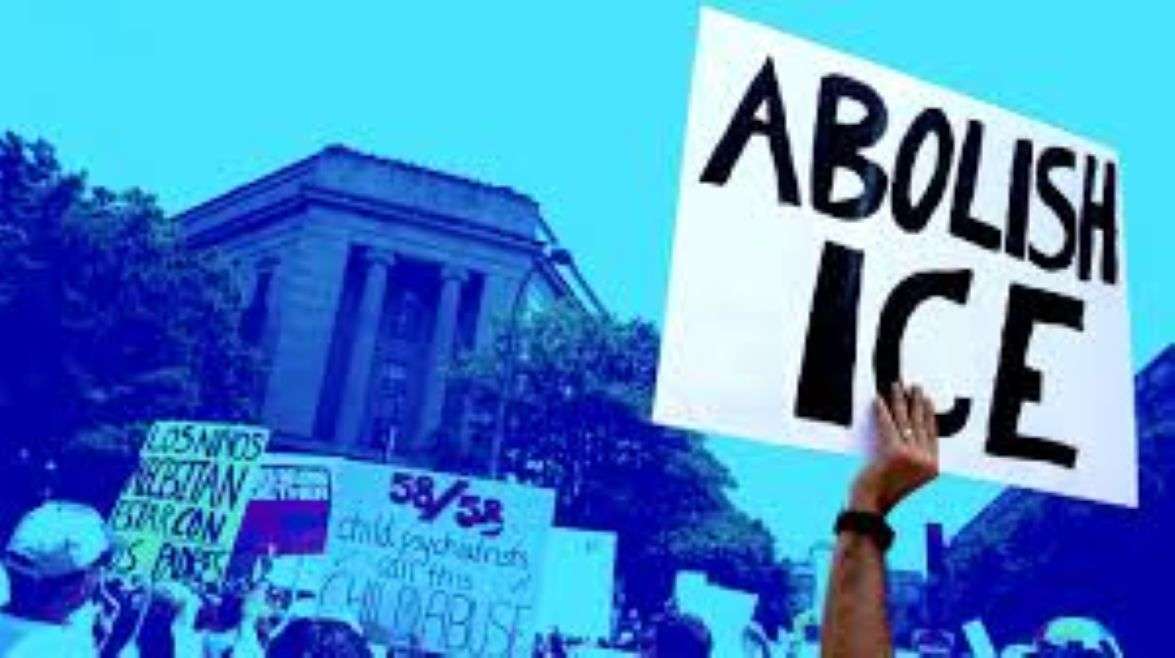
Reuters (2018).

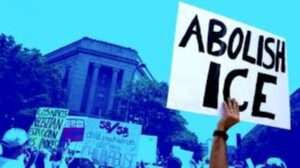
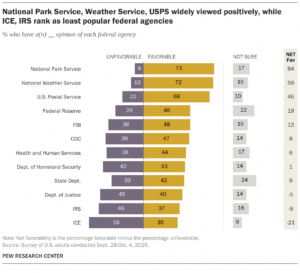
A recent Pew Research Center survey finds that Immigration and Customs Enforcement (ICE) is by far the most unpopular federal agency, easily outstripping even the widely despised IRS. According to Pew, 56% of Americans disapprove of ICE, compared to only 35% who approve. That's substantially worse than the IRS (which is disapproved by only a 46-37 margin).


Other recent surveys show growing public support for abolishing ICE. For example, a July YouGov poll indicates that 48% support abolition, compared to 40% who oppose it. Another survey,  conducted in March of this year, showed a similar 50-39 margin in favor of abolition.

The fact that ICE is unpopular doesn't by itself prove the agency should be abolished. Having written a book and many other publications on widespread public ignorance about government policy, I would be the last to argue that popularity is a good metric of a policy's - or an agency's - merit. But, in this case, public opinion is right. As I explained in an August 2025 article in The Hill, and a follow-up piece for the Boston Globe, (non-paywalled version here), ICE's many abuses do indeed justify abolishing it. And the case for doing so has been strengthened by more recent events, such as the brutal killing of two US citizens in Minnesota.

While ICE abuses have been exacerbated by the policies of the second Trump Administration, many predate it, and are inherent in the entire enterprise of mass deportation.

As explained in my article in The Hill, abolishing ICE would not completely end interior deportations. But it would make them heavily dependent on the cooperation of state and local governments, thereby strengthening constitutional federalism and reducing incentives for abuse, at least to a significant degree.

In that article, I also explain how support for abolition be further bolstered by combining it with shifting ICE funds to state and local law enforcement. This undermines the principal political obstacle to abolition: the fear that getting rid of ICE would increase crime. Transferring the funds to state and local police would help defuse such concerns, win the support of law enforcement agencies, and foster genuine reductions in violent and property crimes; social science evidence shows that putting more police on the streets has that effect, whereas deportations do not.

The post ICE is Now Even More Unpopular than the IRS appeared first on Reason Magazine.

  •  

Trump Hands Alliant Energy $5.1 Billion in Loans Ahead of Key Midterm Races in Iowa and Wisconsin

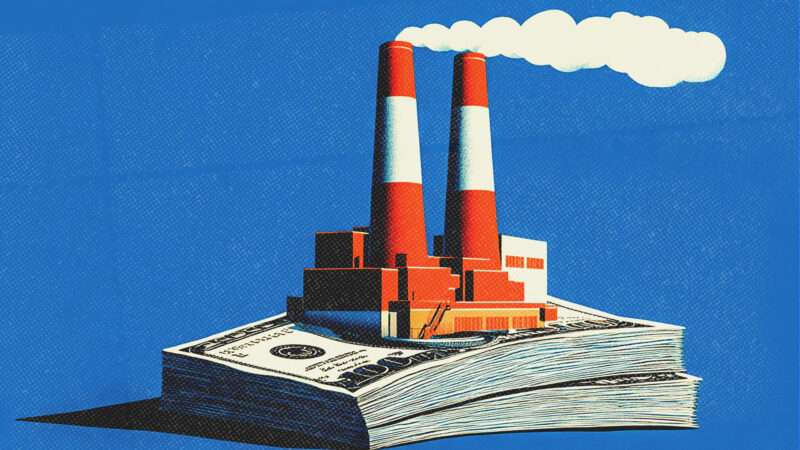
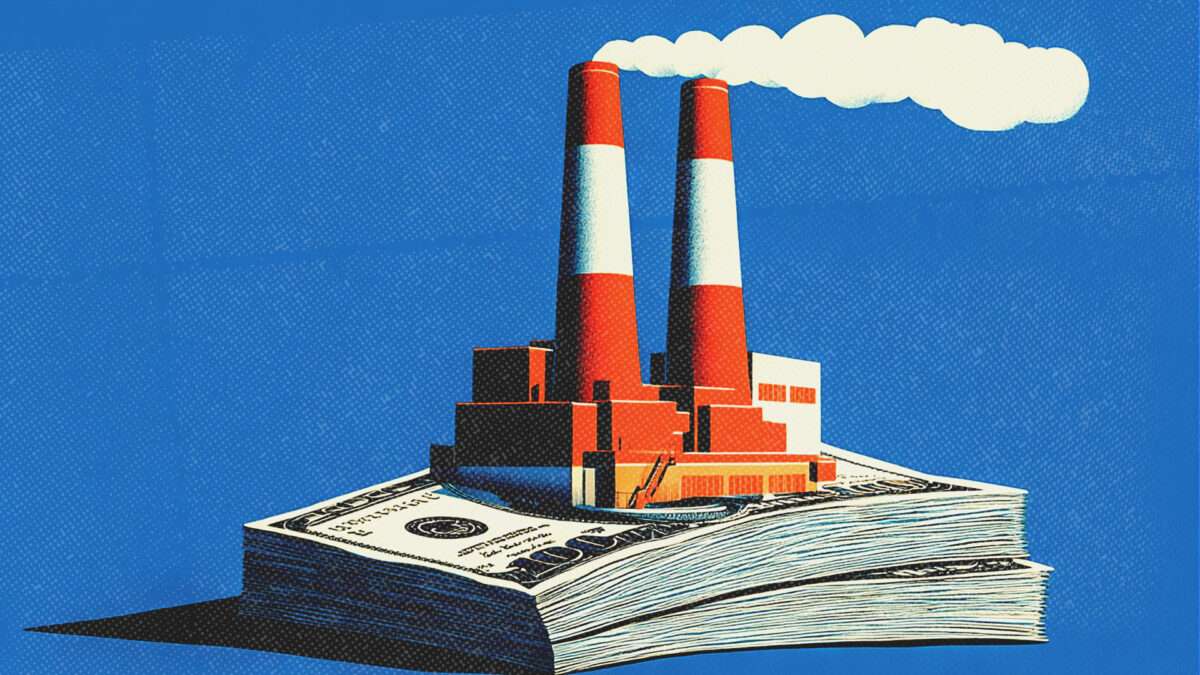
An illustration of a power plant sitting on top of a stack of cash against a blue background | Illustration: Midjourney

On Wednesday, the Office of Energy Dominance Financing at the U.S. Department of Energy announced it had closed a $5.1 billion loan package to Alliant Energy—a utility company with over 1.5 million customers across Iowa and Wisconsin—to "lower electricity costs, expand firm power generation, and strengthen grid reliability" in the Midwestern states. 

The loan package is part of the Energy Department's response to President Donald Trump's April 2025 executive order directing the agency and its secretary, Chris Wright, to ensure the nation uses "all available power generation resources" to expand and secure America's electric grid amid growing demand. 

In a press release, Alliant said the 30-year loan package will finance 1.6 gigawatts of new natural gas generation, 240 megawatts of increased capacity at its existing natural gas facilities, and a gigawatt of energy storage. The loan package will also allow Alliant to add 2 billion cubic feet of liquefied natural gas storage. All told, these upgrades and additions will generate enough electricity to power 2 million homes annually, according to the Energy Department.

Alliant estimates the deal will result in "up to $1.2 billion in cumulative customer savings," as well as the creation of "more than 1,600 local jobs" through construction projects financed by the loans. Of course, some of the savings likely stem from Alliant receiving more favorable loan terms from the Energy Department than it would from an open-market lender. 

A report filed with the Securities and Exchange Commission outlining the deal's terms shows that the interest rate to be charged on each loan aligns with the government's borrowing costs. However, the markup on each loan will remain a fixed percentage, regardless of whether lending to Alliant becomes riskier or more expensive. Under the deal's terms, Alliant has until May 15, 2056, to repay the loan, but it is only responsible for paying interest until the first principal payment is due in 2052. 

The Energy Department said the deal is the Trump administration's 10th financial close and its "sixth and seventh utility financing completed through the Energy Dominance Financing Program." As of September 30, the department had issued $132 billion in loans and guarantees through the program, including $47.5 billion announced in conditional commitments, and disbursed $53.2 billion. 

While the Trump administration is taking credit for the deal, the loan is essentially a repackaging of a $3 billion conditional commitment offered by the Biden administration in 2025 as part of its last-ditch effort to spend as much taxpayer money on green projects as possible before Trump took office. Under the terms of the Joe Biden-era deal, Alliant would have used the loan to "finance multiple clean energy and battery energy storage system projects." Instead, the company will now receive an additional $2.1 billion in funding, without the climate goals the Biden administration stipulated.

Gregory Beard, director of the Office of Energy Dominance Financing, said the agency is "putting capital to work." The deal is perhaps better described as the Energy Department usurping a role that should be reserved for private-sector, institutional lenders. "This type of government involvement is only another example of the current Energy Department distorting the power generation market," says Tom Opdyke, director of energy and environmental policy at the R Street Institute.

The agency's meddling seems even more unnecessary given that Alliant's revenue is expected to grow 6.8 percent annually over the next three years, with its profit margins increasing from 18.4 percent to 22.2 percent, according to the stock research and portfolio-tracking platform Simply Wall St.

The timing of the announcement also raises some red flags. While an Alliant spokesperson tells Reason they spent "months reviewing the details and finalizing contracts" before the loan package "was finalized this week," the money is conveniently being directed to energy projects in two fairly competitive states in this year's midterm elections. The Cook Political Report has the Iowa Senate race as a toss-up and several incumbent House Republican seats in Iowa and Wisconsin leaning Democrat.

The loan package could be a ploy to boost Trump's and Republicans' favorability with the electorate in Iowa and Wisconsin by appearing to address a cost-of-living issue high on voters' list of concerns. "Even if that's the case, those things aren't going to happen by Election Day, and voters' opinions aren't likely to shift on the promise of future jobs and savings," says Opdyke. "So it might be too little, too late."

Trump is scheduled to speak this weekend in an Iowa-Wisconsin border town.

Whatever the reasoning, the loan package is effectively a subsidy for Alliant to expand its operations and grow its customer base at a lower cost. It's cronyism that enriches Alliant and disadvantages its competitors, at American taxpayers' expense.

The post Trump Hands Alliant Energy $5.1 Billion in Loans Ahead of Key Midterm Races in Iowa and Wisconsin appeared first on Reason Magazine.

  •  

The Failed Indictment of Cassidy Hutchinson Reflects Grand Jury Resistance to Politically Motivated Charges

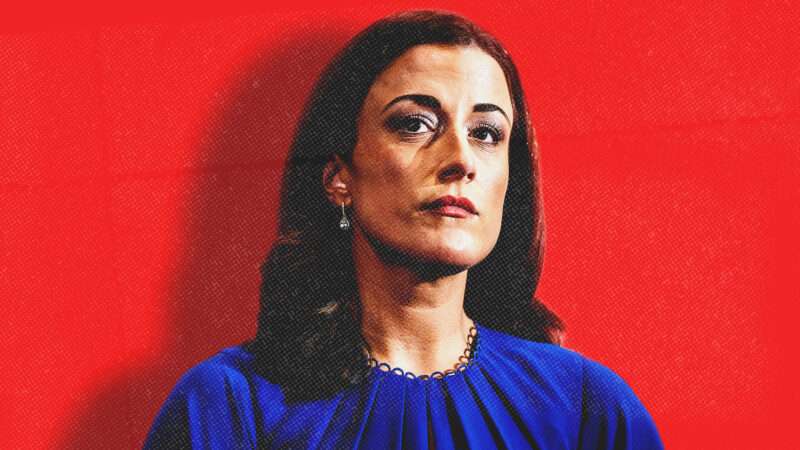
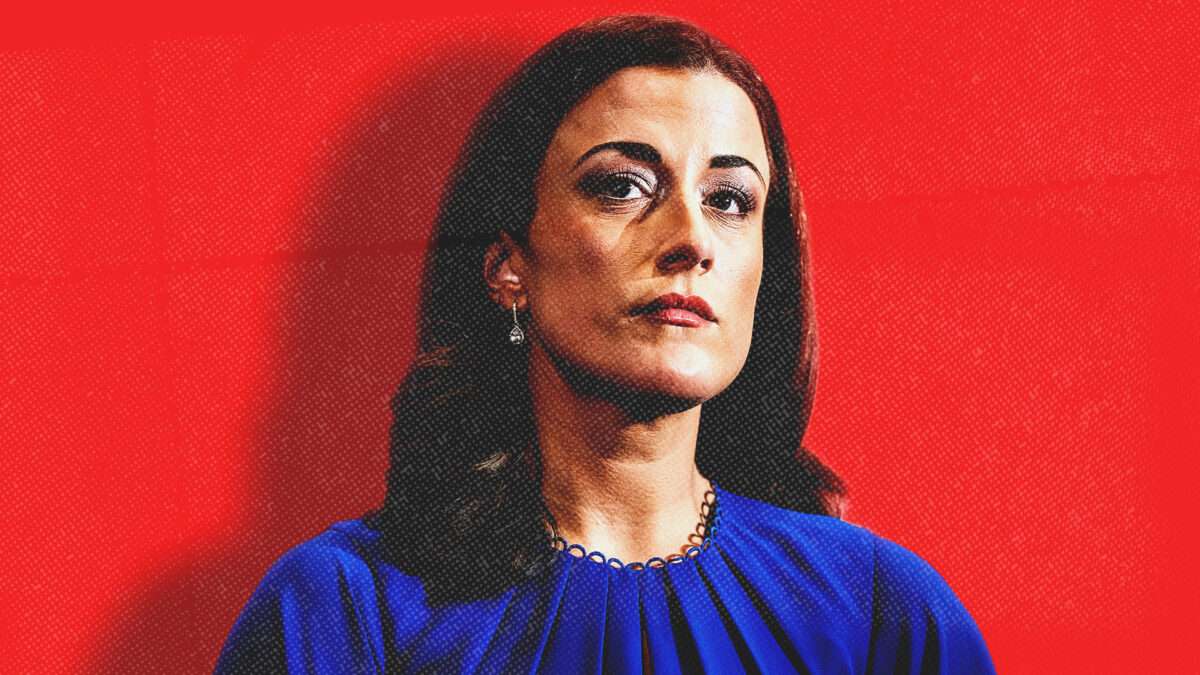
Cassidy Hutchinson | Tom Williams/CQ Roll Call/Newscom

"I am very concerned about the weaponization of the Justice Department," Sen. Bill Cassidy (R–La.) told reporters in August, explaining his reservations about voting to confirm Todd Blanche as attorney general. Cassidy specifically cited the attempt to prosecute Cassidy Hutchinson, a White House aide during President Donald Trump's first term, based on her 2022 testimony before the House select committee that investigated the 2021 riot at the U.S. Capitol. "I'm told there is a grand jury being empaneled to investigate her," Cassidy said. "Why? Tell me that. Shouldn't every American be afraid of the weaponization of the Justice Department?"

Grand jurors in Washington, D.C., who on Tuesday declined to approve an indictment of Hutchinson, apparently shared the senator's concerns about the case against her. That setback is part of a pattern: Grand juries, which historically have almost never rejected charges proposed by federal prosecutors, have done so repeatedly during the last two years, reflecting the Trump administration's tendency to pursue politically motivated cases based on inadequate evidence.

A grand jury hears only the government's side of a case, and the probable cause standard for approving an indictment, which requires reasonable grounds to believe a crime has been committed and that the person identified by prosecutors committed the crime, is much less demanding than the proof beyond a reasonable doubt required for a conviction. But the Justice Department's manual for prosecutors says they should not pursue criminal charges unless "the admissible evidence will probably be sufficient" to meet the latter test. It is a pretty striking indication that prosecutors are disregarding that injunction when a grand jury determines that they have failed to meet the minimal burden of establishing probable cause.

Hutchinson, who at the time of the Capitol riot was White House Chief of Staff Mark Meadows' principal assistant, delivered the testimony at the center of the failed indictment on June 28, 2022. She described Trump as unconcerned about weapons carried by some of the people who attended the speech he delivered the day of the riot, during which he reiterated his false claim that Joe Biden had stolen the 2020 presidential election and urged his supporters to "fight like hell" against congressional ratification of his victory.

Hutchinson said Trump wanted the Secret Service to stop screening rally participants with magnetometers because he was worried it would reduce the size of the crowd. "I don't effing care that they have weapons," Trump said, according to Hutchinson's approximate recollection. "They're not here to hurt me. Take [the] effing mags away. Let my people in. They can march to the Capitol from here. Let the people in."

Hutchinson also said Trump was irate when the Secret Service told him he could not join the protesters at the Capitol. That much was consistent with the testimony of other witnesses. But Hutchinson added disputed details, saying Deputy Chief of Staff Tony Ornato had told her Trump was so angry that he "lunge[d] towards Bobby Engel," the head of his protective detail, and "reached up towards the front of the vehicle to grab at the steering wheel." The Secret Service agent who was Trump's driver that day contradicted Hutchinson's account, and Ornato said he had no recollection of any such incident.

Last March, Reps. Barry Loudermilk (R–Ga.) and Jim Jordan (R–Ohio) urged the Justice Department to prosecute Hutchinson for lying to Congress. "Hutchinson's potential prosecution became a point of controversy between lawmakers and employees of the Justice Department," CNN reports. "Some inside the department believed there was not enough evidence to bring a viable criminal case."

You would expect such a case to be handled by Jeanine Pirro, the U.S. attorney for the District of Columbia. But the investigation of Hutchinson was instead conducted by the Justice Department's Civil Rights Division, which is run by Assistant Attorney General Harmeet Dhillon, another Trump loyalist.

You might wonder what scrutinizing Hutchinson's testimony had to do with "protecting the civil and constitutional rights of all Americans," which is how Dhillon's division describes its mission. Dhillon's involvement is all the more puzzling given that Pirro previously had not hesitated to pursue dubious charges against the president's enemies.

Last February, Pirro sought an indictment of six Democratic members of Congress who appeared in a November 2025 video that reminded U.S. military personnel of their duty to "refuse illegal orders." Trump condemned that message as "SEDITIOUS BEHAVIOR AT THE HIGHEST LEVEL," saying the lawmakers "should be ARRESTED AND PUT ON TRIAL." But as a federal judge later noted, the allegedly criminal video was "unquestionably protected" by the First Amendment.

That did not deter Pirro from trying to deliver on her boss's threat. But as in Hutchinson's case, the grand jury apparently was not willing to participate in Trump's vendetta. After it unanimously refused to approve the indictment, Pirro gave up.

That embarrassing experience may have deterred Pirro from getting involved in Hutchinson's case, especially if she thought there was not enough evidence to obtain a conviction. She would have had good reasons for reaching that conclusion.

It is not clear exactly what charges the grand jury rejected this week. But the most obviously relevant statutes are 18 USC 1001, which covers false statements "in any matter within the jurisdiction of the executive, legislative, or judicial branch," and 18 USC 1621, which covers false testimony under oath. Both are felonies punishable by up to five years in prison. But a conviction under Section 1001 requires proving that the defendant "knowingly and willfully" made a "materially false, fictitious, or fraudulent statement," and the perjury statute applies only when a sworn witness "willfully and contrary to such oath" makes a "material" statement that "he does not believe to be true."

Those elements would have been hard to satisfy in Hutchinson's case. Her testimony about Trump's insouciant attitude toward weapons carried by his supporters was based on what she said she heard him say, an account that pits her word against that of a habitually dishonest politician whose speech that same day was full of misrepresentations. And even if her recollection of Trump's comments was not fully accurate, that does not necessarily mean she intentionally gave false testimony. The same goes for the alleged lunging-and-grabbing incident, an account Hutchinson said was based on a conversation with Ornato that he says he does not recall.

Maybe Hutchinson, who had a lawyer and was surely aware of the potential penalties for lying to Congress, nevertheless fabricated both of those claims. But assuming her testimony was inaccurate, it seems more likely that she misremembered or misconstrued what Trump and Ornato said. In any event, the task of proving the first proposition beyond a reasonable doubt would give pause to any reasonably cautious prosecutor. And the grand jurors, even without the benefit of hearing a rebuttal to the government's case, thought the evidence of deliberate deception was so weak that it fell short of probable cause.

That determination is just the latest in a series of similar rebukes. In addition to the rejection of Pirro's charges against the "Seditious Six," they include the attempt to prosecute New York Attorney General Letitia James for mortgage fraud, which two separate grand juries in two different Virginia cities blocked last December.

Grand jurors also have stood athwart felony prosecutions of protesters in Washington, D.C., including Sean Dunn, the guy who threw a sandwich at a Customs and Border Protection officer, and Sydney Reid, who allegedly interfered with immigration arrests while using her phone to record them. In the latter case, Reason's Joe Lancaster noted, prosecutors unsuccessfully sought a felony assault indictment "not once, not twice, but a staggering three times." Reid was ultimately acquitted of a misdemeanor charge.

In the summer of 2025, federal grand juries approved just seven of 38 proposed felony indictments against protesters in Los Angeles, an amazingly bad track record. A few months later, federal prosecutors dropped assault charges against two Chicago protesters after a grand jury declined to indict them.

"For decades, federal grand juries have almost never said no," Ballard Spahr attorneys Henry E. Hockeimer Jr. and Brad Gershel noted last year. In 2016, for example, grand juries declined to approve federal indictments just 0.004 percent of the time. "That dynamic is now being tested," Hockeimer and Gershel added. "As the DOJ has adopted a more assertive charging posture in politically sensitive cases, grand juries appear to be reasserting their independence."

The post The Failed Indictment of Cassidy Hutchinson Reflects Grand Jury Resistance to Politically Motivated Charges appeared first on Reason Magazine.

  •  

Farewell to Weil

Today the law firm of Weil Gotshal announced that it would wind down. I don't have any connections to the firm, though I did have one vignette to share that I wrote for another project. It concerns Greg Coleman, the first Texas Solicitor General.

In 2001, Coleman returned to Weil Gotshal to head his firm's Supreme Court practice. In 2006, Coleman took on a case that would change the face of constitutional law. He represented a municipal utility district from Northwest Austin, which challenged the constitutionality of Section 5 of the Voting Rights Act, known as the "preclearance requirement." This case had the potential to revolutionize voting rights, and bring our country closer to a colorblind Constitution. Unfortunately, Coleman's firm did not see things that way. As Senator Cruz recalled, "his partners at the firm lost their freaking minds." Coleman, who was dedicated to his client and the Constitution, left that firm and joined what would become Yetter Coleman LLP. In 2009, Coleman would argue two landmark Supreme Court cases that would set the stage for future constitutional restorations.

Farewell to Weil.

The post Farewell to Weil appeared first on Reason Magazine.

  •  

How Wolford v. Lopez Refines Second Amendment Doctrine

The Supreme Court's June decision in Wolford v. Lopez prevented the obliteration of the right to bear arms in five States, holding that governments may not make carrying a licensed handgun presumptively illegal almost everywhere. 609 U.S. 185 (2026).  Important as the result is, perhaps of even greater significance is how Wolford clarified Second Amendment doctrine. According to Wolford:

  1. Determining whether a challenged law falls within the "plain text" of the Amendment is much simpler than some lower courts and gun control advocates have claimed.

  2. Modern gun control laws do not always have to be justified by analogies from past practices, but analogies cannot be based on oddities and outliers.

  3. Racist gun control laws from the past, which were long ago repudiated by constitutional amendment, are not valid precedents for infringing the rights of modern Americans.

This essay will also discuss the Hawaii Attorney General's argument that only a weak version of the Second Amendment should apply in the Aloha State. And the argument that Hawaii's "Vampire Rule" to prohibit licensed carry throughout the State did not even implicate the Second Amendment.

The "plain text" of the Second Amendment

In a constitutional case, the court must decide if the challenged government action involves a constitutional provision. Often the issue is simple; for example, a public meeting about a political controversy is an example of "the right  . . . to assemble."

In edge cases, judges may have to decide how literally to read the text. For example, the First Amendment protects "the freedom of speech," and while Justice Hugo Black was often absolutist in his protection of literal "speech" (saying words out loud), he disagreed with Supreme Court majorities that gave "freedom of speech" protection to conduct. E.g., Cox v. Louisiana, 379 U.S. 559, 578 (1965) (Black, J., concurring in part and dissenting in part) ("Picketing, though it may be utilized to communicate ideas, is not speech, and therefore is not of itself protected by the First Amendment.").

For the Second Amendment, the textual inquiry is, "When the Second Amendment's plain text covers an individual's conduct, the Constitution presumptively protects that conduct." New York State Rifle & Pistol Assoc. v. Bruen, 597 U.S. 1, 24 (2022).

Unfortunately, some lower courts did not take the "plain text" language seriously, and began importing all sorts of rules into the plain text determination. For example, the "plain text" of "the right of the people" was said to require proof that the individuals were "law-abiding" and "responsible." The plain text of "Arms" was said to require proof that the arms in question were frequently "used" (such as gun being fired, or a knife being used to cut) for self-defense. I described some of the misapplications of "plain text" in a 2024 post, How Some Courts are Evading Bruen by Changing its Rules: Lower Courts evading the "plain text" of the Second Amendment.

The Wolford Court showed that the plain text inquiry is not nearly so complicated as some of the lower courts had claimed. In fact, there are just three simple questions:

  • "First, does the law apply to 'the people'—which is to say, to 'all members of the political community'?"
  • "Second, does it concern any form of 'Arms,' i.e., any weapon customarily used for offensive or defensive purposes?"
  • "Third, does the law place any restrictions on either the 'keep[ing]' (i.e., possession) or the 'bear[ing]' (i.e., carrying) of arms?"

Question 1: Because the Second Amendment guarantees "the right of the people," the court must ask if the law applies to "the people"— that is, to members of the American political community. The Court here contradicts the notion of some lower courts that "the people" excludes various subsets of the American people — such as persons under 21 years old, or persons who have been convicted of a crime. While some of the American people can be restricted in their Second Amendment rights, all Americans start with the right, and it is up to government to justify the deprivation. The justification, however, comes later in a case, and is not part of the plain text inquiry.

Question 2: The class of "Arms" covered by the plain text is very broad: "any weapon customarily used for offensive or defensive purposes." Again, this is the plain-text step only. Just as some members of "the people" may lawfully be disarmed, some weapons (e.g., machine guns) may be found not to be protected by the Second Amendment right. Any determination that particular persons or arms fall outside the Amendment's protection comes later in the case, not in the plain-text inquiry.

The Wolford Court's rule implicitly rebukes some lower courts that had ruled that "Arms" in the Second Amendment's plain excludes all arms related to military arms. Or that "Arms" includes only weapons that the challengers prove to be frequently used for self-defense against criminal attacks in progress.

The term "customarily" does not mean "most often." For example, the number of times that handgun triggers are pressed for target shooting competitions vastly exceeds the number of times that handguns are fired at criminal attackers.

Question 3: As for "any restrictions" on "possession" or "carrying" of arms, some lower courts may continue their current very narrow readings, holding that laws such as bans on gun stores do not implicate the Second Amendment's plain text at all — even though acquiring arms is a prerequisite to  possession and carry.

The Wolford majority found that Hawaii's Vampire Rule easily passed all three questions. The law affected American citizens with Hawaii carry permits, and those Hawaiians are among "the people." The law applied to carrying handguns, which are customarily used for defense. And the law made it pervasively illegal to carry licensed handguns in public.

Guidance on analogues

According to Wolford:

"If a challenged law falls within the plain text of the Second Amendment, it is presumptively unconstitutional—which means that it may violate the preexisting right that the Amendment codified. But because that right was not in every way coterminous with the Amendment's literal language, further analysis may be needed. Specifically, the relevant government—federal, state, or local—may be able to show that its challenged law did not infringe the historical understanding of the codified right."

"A variety of sources, including scholarship, may aid this inquiry. But often, the best evidence may be what Bruen called historical analogues. These are old legal rules from which a court may draw a strong inference that the modern law at issue is consistent with the codified right. A party defending against a Second Amendment claim may rely on a single analogue or a group of analogues." (citations omitted).

Building on and clarifying Bruen's discussion of historical analogues, the Wolford Court explained that Bruen had "identified three important inquiries that courts should undertake in evaluating proffered analogues."

"The first is the number of jurisdictions in which they were adopted. . . . When we assess whether a challenged law is consistent with the right the Second Amendment codified, we seek the general understanding of that codified right at the relevant point in time. An outlier legal rule adopted in a few locales is not enough."

"The second is the extent to which they were well-accepted. This acceptance may be express, as when judicial decisions explicitly acknowledged the rule's legality. Or the acceptance may be tacit, as when a restriction on the keeping or carrying of arms was 'open, widespread, and unchallenged.'" (Quoting Bruen).

Inquiries one and two add some specificity to the Bruen rule of "a well-established and representative historical" analogue.

"The third is whether any analogue or collection of analogues is 'relevantly similar' to the modern law."

Determining whether an analogue is "relevantly similar" requires consideration of "how" it restricted the keeping or bearing of arms. "And a court must also consider 'why' the analogue restricted the keeping or bearing of arms—that is, whether its rationale was similar to that of the new law."

As seen in other cases, the "how" and "why" inquiries often involve "who." For example, some 18th- and 19th-century surety laws required an individual to post bond for peaceable behavior if the individual had been found by a court to be potentially dangerous. In United States v. Rahimi, the Court's majority found surety laws to be relevant analogues for modern laws disarming persons who have been issued a domestic violence restraining order based on an individualized judicial finding of danger to a past or present domestic partner. 602 U.S. 680 (2024). In Bruen, however, the surety laws were not relevant analogues for state laws preventing almost everyone from carrying firearms.

A standard argument in favor of originalism is that while it does not conclusively resolve every issue, it constrains judicial decisions more than do alternative methods. In Wolford's words, "Making this determination is far more disciplined than the 'interest-balancing,' 'judge-empowering' standard that Heller emphatically rejected, but it is not mechanical." The Court added, "It undeniably necessitates an exercise of judgment."

In Wolford's words, "Making this determination is far more disciplined than the 'interest-balancing,' 'judge-empowering' standard that Heller emphatically rejected, but it is not mechanical." "It undeniably necessitates an exercise of judgment," the Court added,

For example, in the three cases where the Court has applied Bruen and examined analogies, the Court was unanimous in one, and divided in two others: United States v. Hemani, 146 S.Ct. 1677 (2026) (9-0) (historical vagrancy, civil-commitment, and surety laws concerning habitual drunkards who had lost the capacity for self-control were inadequate analogues for prosecuting a gun owner based on his regular marijuana use); United States v. Rahimi (8-1) (historic laws, such as sureties, against persons proven to be dangerous are sufficient analogues for modern laws that go even further, such as by felonizing firearms possession in the home); Wolford v. Lopez (6-3) (as described below, laws against poachers or Black people are not analogues for preventing everyone from carrying firearms).

Applying Wolford's rules for analogues to the Vampire Rule

The Supreme Court's Bruen decision had directly applied to three States where licensed carry was almost completely prohibited (Hawaii, Maryland, New Jersey) and to three where it was prohibited by some local jurisdictions and allowed in others (California, New York, Massachusetts). After Bruen, all of the above states, except Massachusetts, enacted a law that had been proposed by University of Alabama law professor Fredrick Vars and Yale law professor Ian Ayres; as they frankly stated, the purpose of the law was to make licensed carry extremely inconvenient, and thereby discourage people with carry licenses from using those licenses.

Under the Hawaiian statute, a person with a concealed handgun carry permit "shall not . . . enter or remain on private property of another person . . ." while carrying a loaded or unloaded firearm "unless the person has been given express authorization" by the owner, lessee, operator, manager, or other person authorized under the statute. The "express authorization" must be "Unambiguous written or verbal authorization" or "clear and conspicuous signage at the entrance." Private property meant all property other than the permit holder's own property, or government property. Hawaii Revised Statutes § 134-9.5.

Separately, and not at issue in Wolford, the Hawaiian legislature's Bruen response law had outlawed licensed carry on most government property and vast swaths of private property by labeling them "sensitive places."

The Wolford plaintiffs challenged the Hawaii "express authorization" statute as it applied to business premises that are open to the public. As of the time that the Court was considering Wolford, similar laws were held unconstitutional by the Second, Third, and Fourth Circuits. Antonyuk v. James, 120 F.4th 941 (2d Cir. 2024); Koons v. Attorney General of New Jersey, 156 F.4th 210 (3d Cir. 2025); Kipke v. Moore, 165 F.4th 194 (4th Cir. 2026). But the Ninth Circuit had come to an opposite result. Wolford v. Lopez, 116 F.4th 959 (2024). The Supreme Court granted certiorari, perhaps influenced by a U.S. Solicitor General amicus brief in support of the petition.

Critics of the express authorization rule call it the "Vampire Rule," because in some stories, vampires can only enter certain buildings when invited. The history of the Vampire Rule in literature was detailed in my amicus brief, which I coauthored on behalf of the National Rifle Association and the Independence Institute. While vampires are malignant and dangerous, Hawaii's Vampire Rule "applies only to beings who are exceptionally not dangerous: law-abiding citizens who have passed a background check, completed safety training, and have been licensed by the government to carry concealed handguns." The brief provided empirical evidence of the extremely low rate of gun misuse by persons with carry permits, compared to the general population. The brief also described the legality, in the Founding Era, of carrying on private property that was open to the public. That part of the brief was cited by the United States and by petitioners' counsel during oral argument (pages 50, 125).

Most of the analogues proffered by the Hawaii Attorney General in support of the Vampire Rule were colonial and Founding Era anti-poaching laws that forbade armed trespassers from entering other persons' enclosed farms or pastures without consent. Justice Alito's majority opinion found the purported analogy preposterous:

"To test whether these analogues are 'relevantly similar' to the challenged Hawaii law, we may ask the question set out earlier: 'Because it was accepted that prohibiting unauthorized hunting on private land was consistent with the Second Amendment right, can we infer that it is also consistent with that right to ban a person who is lawfully carrying a concealed handgun for self-defense from entering a gas station, coffee shop, grocery store, or other private property open to the public without express and unambiguous consent?' The question answers itself. The gap between the State's anti-poaching analogues and its new rule is just too wide."

Justice Barrett joined the majority opinion, and also wrote a concurrence. In her analysis:

"So the problem with Hawaii's default rule is not that it targets a regulatory problem besides poaching. It is that the rule does not target any particular abuse of firearms at all. Rather than identifying a specific threat to public peace and safety, Hawaii admits that it enacted the rule because many of its citizens oppose the public carry of guns. In other words, Hawaii is responding to the general danger associated with the presence of firearms, not to any specific, heightened risk of their misuse."

"Mere disapproval of protected conduct is not a valid reason to severely restrict it."

The Hawaii Attorney General pointed to an 1893 Oregon statute against carrying arms on enclosed premises or lands without the consent of the owner. While the Hawaii Attorney General claimed that the statute applied to business premises, there was no indication that such an interpretation had ever been used in Oregon.

"But even if this provision is read as Hawaii would have it, a lone statute adopted nearly a century after the adoption of the Second Amendment and well after the adoption of the Fourteenth Amendment sheds little if any light on the meaning of the Second Amendment right," wrote the Wolford Court.

Racist analogues are no good

The Wolford Court's disparaging treatment of far-fetched (poaching) or isolated and very late (Oregon 1893) analogues did not break new ground. What does significantly affect Second Amendment doctrine is the Court's treatment of the 1865 Louisiana Black Code. Ever since Bruen was decided, anti-gun advocates and some lower court judges have been pointing to laws against enslaved people or against free people of color as supposed justifications for modern laws aimed at other groups of people, or at the public in general.

After the Civil War ended with Confederate surrender in April 1865, everyone could see that abolition was coming, and the former slave States would soon have large populations of newly free Black people. The 1865 Louisiana legislature enacted a statute that really did match the scope of Hawaii's Vampire Rule. As the Wolford Court explained:

"Finally, we come to the State's most remarkable analogue, an 1865 Louisiana statute that made it unlawful 'for any person or persons to carry fire-arms on the premises or plantations of any citizen, without the consent of the owner or proprietor, other than in lawful discharge of a civil or military order.' 1865 La. Acts No. 10, § 1, p. 14. Regardless of this provision's pedigree, it has no probative value for present purposes. As we have said, in considering the probative value of a historical analogue, we must consider whether it was widespread, well-known, and widely accepted. See Bruen, 597 U.S. at 35. Because this statute was neither widespread nor widely accepted, it carries no weight."

So far, nothing novel. However:

"We could stop there, but there is another reason for rejecting Hawaii's reliance on this statute. It was adopted by the Louisiana Legislature between the end of the Civil War and the beginning of Reconstruction. When the war ended, the legislatures in defeated Confederate States quickly enacted so-called Black Codes that aimed to perpetuate the subjugation of blacks. The statute Hawaii cites was part of Louisiana's Black Code, and it provided a tool for disarming blacks and thus leaving them defenseless against attacks. See 125 F.4th at 1239 (VanDyke, J., dissenting from denial of reh'g en banc)."

"As we laid out in McDonald, the right to keep and bear arms was crucially important for vulnerable blacks during this period. See 561 U.S. at 757, 771, 776–779; id., at 843–846 (opinion of THOMAS, J.). And this was well-understood by the Republicans in Congress who were responsible for drafting, approving, and securing the ratification of the Fourteenth Amendment. The Republican Party Platforms of 1856 and 1860 called for protection of the right to keep and bear arms for self-defense. Unless we put history entirely out of our minds, Hawaii's claim that this tainted artifact illuminates the original understanding of the right to keep and bear arms cannot be taken seriously."

Concurring, Justice Barrett added, "The State seems to think Bruen is a matching game: Southern States enacted broad default rules, Hawaii reasons, so it can do the same today. But even if Hawaii is right that the how is analogous, it also must identify an analogous why. The Black Codes were enacted to subordinate newly freed slaves. Hawaii obviously does not contend that its law promotes an analogous interest." Therefore, the Hawaii law and the Black Codes were not relevantly similar.

Dissenting, Justice Jackson accurately described the doctrinal effect of the majority opinion: "it cuts Black Codes out of this country's tradition categorically and completely."

Yes, and properly so. As Bruen explained at length, the purpose of the judicial inquiry into "tradition" about the right to arms is not because tradition itself is the rule. Rather, tradition can shed light on original meaning. The original meaning of the Fourteenth Amendment includes how the constitutional right to arms was understood when passed by Congress in 1866 and ratified in 1868. As the Wolford majority pointed out with its citations to the extensive history provided by the majority and by Justice Thomas's concurrence in McDonald v. Chicago, the Fourteenth Amendment was meant to crush the Black Codes and the practices they perpetuated, including the obstruction of the right to arms.

Justice Jackson suggested that the Louisiana statute might have been facially compliant with the Second Amendment, the only problem being the discriminatory enforcement against Blacks. Tradition shows the opposite: not one law in American history before 1865 came close to such an outrageous nullification of the right to bear arms. (In a footnote, she cited the anti-poaching laws, which were not close to the Louisiana statute.)

Surprisingly, Justice Jackson's dissent claimed that the elimination of the Black Codes as precedents to justify modern gun control laws "deepens race-based wounds, by classifying the experiences of those who have been historically excluded as categorically irrelevant."

To the contrary, the Wolford majority follows the path laid down by McDonald:  classifying the experiences of persons who were historically excluded as of the highest categorical importance.  The Black Codes must never be forgotten or glossed over. The abuses (including extreme gun control) against them are an enduring negative example of what must never again be imposed in the United States.

Implications for other gun control laws based on prejudice

Wolford seems to do away with the precedential value of the post-Civil War Black Codes as affirmative historical support for modern gun restrictions. Its reasoning may also undermine reliance on antebellum race-based gun control laws targeting enslaved persons or free persons of color.

Justice Jackson asked "What do we do about other types of animus? For example, consider the use of statutes that were prejudiced against Catholics. See Kanter v. Barr, 919 F.3d 437, 457 (CA7 2019) (Barrett, J., dissenting). Does it offend history to use those?"

The Catholics question is easy to answer, based on text. The 1689 English Bill of Rights, which applied in British North America, protected only "Protestants." James Madison, however, wrote the Second Amendment without any religious restrictions. From American independence in 1776 onward, there appears to be no record of disarmament of Catholics — unlike the sizeable record of race-based disarmament.

Even before 1776, restrictions on Catholics in the future United States were rare. In 1756, during the French & Indian War, Virginia required Catholics to take a loyalty oath; if the oath were refused, arms would be confiscated for the militia, except for arms "necessary" for "the defence of his house or person." The same year, Pennsylvania confiscated "papist" arms and gave them to the colonial militia. In 1696, after an attempted assassination of King William III in England, the royal governor of New York confiscated the firearms of all ten Catholic men in the colony. For more, see Johnson, Kopel, Mocsary, Wallace, & Kilmer, Firearms Law and the Second Amendment 935 (Aspen Pubs. 4th ed. 2026); my Rahimi Amicus brief (for professors, including VC's Randy Barnett); my 2023 post, Old gun controls that were constitutionally repealed are not precedents for modern gun control; and my 2015 post, The Second Amendment versus anti-Catholicism.

"Aloha" should mean "goodbye" to Plessy v. Ferguson

Jim Crow jurisdictions justified themselves by reference to local conditions and tradition, which were supposedly accepted by almost everyone there. For example, Louisiana's 1890 Separate Car Act ordered railroads to place Blacks and Whites in separate cars. Upholding the Act, Justice Henry Billings Brown's majority opinion in  Plessy v. Ferguson described the Act as compliant with the "the established usages, customs, and traditions of the people." 163 U.S. 537 (1896).

But that wasn't true. The legislature had acted because the railroad companies refused to. The railroads preferred to segregate customers by sex, so that the men smoking cigars wouldn't foul the atmosphere for the women. Had customers preferred cars segregated by race rather than sex, the railroads presumably would have offered what was demanded. See, e.g., David Bernstein, Rehabilitating Lochner: Defending Individual Rights Against Progressive Reform (2011).

In Wolford, the Hawaii Attorney General made similar arguments to Justice Brown. Justice Jackson pointed an arms ban imposed in 1833 by King Kamehameha III. In a similar vein, the Hawaii Supreme Court declared that the Hawaii Constitution right to arms, which is worded identically to the U.S. Second Amendment, protects no right at all. The nullification was said to be justified by "the spirit of Aloha." State v. Wilson, 154 Haw. 8, 543 P.3d 440 (2024) ("Hawaiʻi's historical tradition of firearm regulation rule out an individual right to keep and bear arms under the Hawaiʻi Constitution.").

The Wolford majority replied that the Second Amendment, like everything else in the U.S. Constitution, applies equally in every State. "Merely local attitudes can neither shrink nor inflate the meaning of fundamental Bill of Rights guarantees that apply to the States through the Fourteenth Amendment." The Second Amendment is the same in "our 50th State (where about 8% of adults possess guns) and our 49th State [Alaska] (where the figure is roughly 59%)."

The Vampire Rule and property law

The principal dissent, by Justice Jackson and joined by Justice Sotomayor, argued that Wolford had nothing to do with the Second Amendment. It was just a property law case; because nobody has an inherent right to enter the property of another, Hawaii had merely changed a background rule about when consent could be presumed.

In fact, the inventors of the "default rule" (a/k/a Vampire Rule) created it for the express purpose of discouraging firearms carry by making it extremely difficult. See Ian Ayres & Fredrick E. Vars, Weapon of Choice: Fighting Gun Violence While Respecting Gun Rights (2020). They touted the rule in an op-ed published the month after the Bruen decision, pointing out the purpose of "substantially decreasing the places where concealed firearms can be carried." Ian Ayres & Fredrick Vars, "A new no-carry default for the U.S.: A gun law that could really change things," (New York) Daily News, July 20, 2022.

The Wolford majority chose not to blind itself to the law's purpose of massive suppression of the exercise of constitutional rights. To the majority, the dissent's argument that Hawaii had not infringed the Second Amendment:

"fails because States may not adopt property-law rules that violate constitutional rights. For example, a State may not adopt property-law rules that violate the freedom of speech. See, e.g., Reed v. Town of Gilbert, 576 U.S. 155, 159 (2015) (ordinance regulating signs on private property); City of Ladue v. Gilleo, 512 U.S. 43, 45 (1994) (similar). Nor may a State adopt zoning rules that violate the equal protection of the laws. See, e.g., Buchanan v. Warley, 245 U.S. 60 (1917). Likewise, a State may not "'sidestep the Takings Clause'" by enacting a law purporting to extinguish a property interest. Tyler v. Hennepin County, 598 U.S. 631, 638–639, (2023). The right protected by the Second Amendment is entitled to no less protection than other constitutional rights."

Justice Barrett's concurrence made similar points: "when a State enacts a property law that regulates arms-bearing conduct, that law implicates the Second Amendment."

"Consider how Hawaii and the principal dissent's argument would play out in another context. What if a State made it a crime to wear religious head garb (say, a hijab) onto private property open to the public without obtaining express authorization? Could that statute evade constitutional scrutiny? On Hawaii and the principal dissent's logic, the answer is apparently yes: No one has the right to enter another's property without permission, and the State has merely adjusted the default to require permission to be clear. But that is plainly wrong. Because the law regulates religious and expressive conduct, its enactment is state action that triggers First Amendment scrutiny. Cf. Martin v. City of Struthers, 319 U.S. 141, 143 (1943) (municipal ordinance prohibiting door-to-door solicitation violates the First Amendment)."

"The same goes for a default rule, like Hawaii's, that targets the right to bear arms. Property laws, no less than other laws, are subject to constitutional limits. So when a property law "restrict[s]" the bearing of arms, the State must prove that the law abides by the limits of the Second Amendment." (cross-references omitted).

"If Hawaii and the principal dissent were right that the Second Amendment does not kick in until a property owner gives consent, one wonders: Could a State simply prohibit its citizens from authorizing the carry of firearms onto their property? This would certainly interfere with the liberty of property owners, but it is hard to see how, on Hawaii and the principal dissent's logic, the Second Amendment would come into play."

The post How Wolford v. Lopez Refines Second Amendment Doctrine appeared first on Reason Magazine.

  •  

The Bigger Problem With Judge Ada Brown's Woke Tirade: She Said The Quiet Part Out Loud About "White Saviors"

For some time, I've heard rumors about unusual behavior from Judge Ada Brown in the Northern District of Texas. I was hesitant to write about the situation, because my information was incomplete and some of it was revealed in confidence. Now, the accusations are public, in part, because Judge Brown personally disclosed items to the press and others.

At the outset, let me praise the other members of the Northern District of Texas, and in particular, Chief Judge Reed O'Connor. They have picked up all of the cases that Judge Brown has not decided. These are very busy judges, and they have quietly assumed even more responsibilities to ensure the business of the court continues. Judge O'Connor has been routinely maligned by the press but he is a gracious and thoughtful member of his court who never seeks the spotlight. Indeed, it seems that Judge Brown has attacked Judge O'Connor, who has bent over backwards to help her. No good deed goes unpunished.

Moreover, I need to praise the leadership of Chief Judge Jennifer Walker Elrod. She has given Judge Brown every possible benefit of the doubt and made the process as transparent as possible. I need to contrast Chief Judge Elrod's performance with that of Chief Judge Moore in the Federal Circuit. Judge Newman has been subjected to a stealth impeachment through arbitrary one-year suspensions, and only after nearly two years was the case reassigned to another circuit. Judge Brown has been given shorter suspensions after she refused to decide cases. She has had every opportunity to make her case.

Now, onto the substance. There seems to be something seriously wrong with Judge Brown. Her behavior in court that has been reported in the press is extremely troubling. Her refusal to decide cases seems to be an abdication of her responsibility as a federal judge. And her unwillingness to participate in any disciplinary proceedings suggests something is amiss. I will hold off on opining on these issues in more depth, as I suspect more facts will come out.

Here, I want to focus on Judge Brown's behavior in court that gave rise to an ethics complaint earlier this year. Jacqueline Thomsen of Bloomberg Law, who has her finger on the pulse of the Fifth Circuit, offers the stunning details. Here is a summary:

A lawyer's misconduct complaint against US District Judge Ada Brown stemmed from a hearing during which she repeatedly directed racial insults at him, according to documents reviewed by Bloomberg Law.

Attorney Ezra Young, who has represented a Black woman professor suing over a tenure denial, filed a complaint against Brown following the April 2026 hearing in Dallas, he confirmed in an interview with Bloomberg Law. Young's complaint and the judge's formal response were among the documents that Brown circulated in an Oct. 17 email to lawyers, judges, and members of the media.

Throughout the hearing, the judge, a Black woman with Native American ancestry, accused Young of mistreating Black attorneys, took "judicial notice" of her own background in making findings against Young, and repeatedly referred to Young, who is Latino, as being White. Brown called the hearing months after she revoked Young's ability to practice in her courtroom to weigh whether the lawyer should face sanctions.

"I think what's happening here, quite candidly, is you are very intimidated for some reason, Mr. Young, with Black excellence, in light of your White mediocrity. Yeah. Right?," Brown said, according to the transcript. "You should write that down. I mean, you — I'm — you look like a White man, right?"

"I'm not White, Your Honor," Young replied, adding that he's Latino.

"Well, you are White-presenting; is that fair to say?" Brown said, according to the transcript. Young said that he's "fair-skinned," and Brown said that Young had "White privilege" when he argued his client didn't receive key evidence in the case.

"You're the White savior, come to save all the stupid Black lawyers in Texas who need your help, from New York," Brown later said, according to the transcript. . . .

During the April 24, 2026 hearing, Brown accused Young of "racial bullying" toward Black attorneys in the case.

Brown also said that Young was acting like a "Chad," a term Young wasn't familiar with. The judge said it was the male version of a "Karen." "It's someone who calls the manager when they don't get their way. They stomp their foot when the rules are supposed to apply to them, right?" Brown said, according to the transcript. . . .

During the April hearing, Brown took issue with an article headline describing the case when it went before the Supreme Court of Texas. The article quoted a brief filed by Young that referenced another law professor apparently comparing what happened in the tenure denial to a "lynching."

The judge accused Young of making up that quote to "get a headline."

"And so when I read a headline — a sensationalized, very racialized headline that says, 'it's like I've been lynched,' and it's literally got no connection to this case, I have to ask you, Mr. Social Media, Main Character Chad, White Hero, Savior, Loves to Help Black People Be An Ally, where the lynching in this case came from?" Brown said, according to the transcript.

She also apparently gave Young a copy of a 1920 newspaper article that described a lynching. "So we don't find lynching jokes funny down here, sir," Brown said, according to the transcript.

The implication of Young's defense is that a Latino person cannot be racist against African Americans. That claim is wrong on its face, even under the misguided intersectionality pyramid. The bigger problem is that Young, a lifelong liberal, is unaccustomed to being called a racist.

Toward the end of the hearing, Young said that Brown seemed to be "using vicious stereotypes about White people, when I've repeatedly disclosed to this Court I am Latino."

He said that it appeared that Brown "is trying to tar and feather me for anti-Black animus, that has never been raised by anyone but this Court," according to the transcript.

"This Black woman?" Brown replied.

"No, Your Honor. This Court," Young responded.

Young later said he was "concerned that this Court has made light of my actual work as a civil rights lawyer." Brown asked Young what he has done for Black people, as she viewed his actions in the case toward Black attorneys as "abuse."

Young said he has gone "out of my way" to support the work of Black professors and others. When he described his interest in representing the plaintiff in the case, Brown cut him off.

"Can I pause and just tell you, I appreciate, on behalf of Black people, your White saviordom," Brown said.

"Your Honor, again, I'm not White," Young replied.

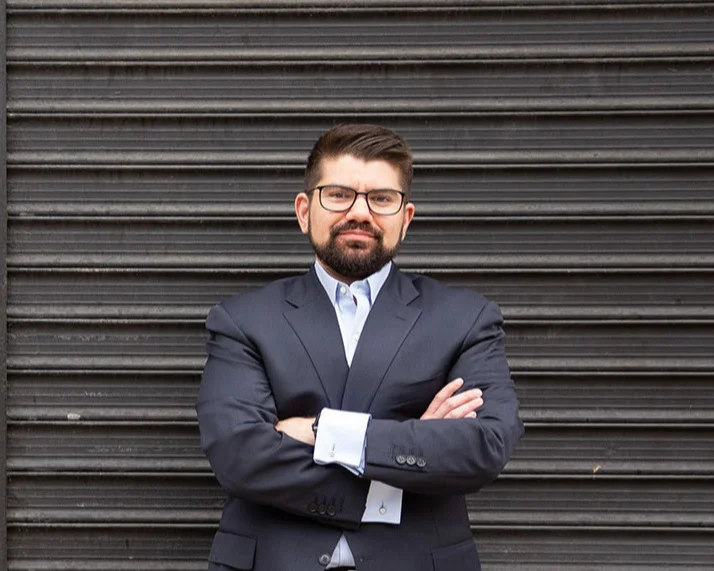
This is Ezra Young.

I'll let other people decide how "White presenting" Young is. Young has taught a class titled "Critical Race Theory, and Transgender People and the Law" at Cornell Law School. Young's scholarship "explores the rights of trans persons and is situated in the nascent field of critical trans theory." Young served as board secretary of the African American Policy Forum and was a founding board member of the National Trans Bar Association. Young's post doctoral studies focused on trans rights, Critical Race Theory, and intersectionality and were supervised by Kimberlé Crenshaw. Young is Admitted to practice in the Chickasaw Nation. In what universe can Judge Brown possibly claim Young is some sort of "white savior" who is hostile to black litigants?
Some people may be shocked at what Judge Ada Brown said in court, but the truth is that she is parroting standard dogma from Anti-Racists and Critical Racial Theorists. The charges may be completely absurd for someone like Ezra Young, but imagine the black plaintiff was represented by a white lawyer. Would that person be a "White Savior"? Think of the most famous white lawyer in American literature. Could even Atticus Finch from To Kill a Mockingbird be derided as a "White Savior"? Yes.

Welcome to the world of academia.

In 2015, Law Professor Osamudia R. James wrote an essay in the New York Times, titled Now We Can Finally Say Goodbye to the White Savior Myth of Atticus. Here is an excerpt:

Like many Americans, I read Harper Lee's "To Kill a Mockingbird" as a high school student. In a curriculum devoid of explicit discussion about the impact of implicit and structural racism on both blacks and whites, the book stood out from the whitewashed reading list as one that directly engaged with the topic of race. It did so, however, in a matter quite conventional: Atticus Finch was the white savior, a good white liberal whose ethics and values compelled him to defend a black man who had been falsely accused of rape – and all this during a time when many whites would just as soon have lynched the accused without trial. Harper Lee won a Pulitzer Prize for tackling racial inequality, no surprise given how America likes its stories about race: centered on innocent white protagonists benevolently exercising power, with black characters relegated to the margins even in stories about their own oppression.

The anxiety and debate surrounding 'Watchman,' lets us re-examine white liberalism in literature and how it shapes our responses to racial injustice in real life.
Atticus Finch presented an enduring model to which many white liberals still cling. But besides being a fictional character, Atticus Finch is a myth. And a dangerous myth because he keeps good white liberals from reconsidering the fact that they live in white neighborhoods; from challenging administrators about the racial segregation of their children's schools or white supremacy advanced in the curriculum; or from acknowledging how they benefit from a system that keeps people of color laboring in their homes but excluded from their social and professional spaces. Like Finch, it is sufficient that they simply "do their best to love everybody."

Randall Kennedy used similar terms in an ABA Journal interview:

Though Watchman isn't Harper Lee's best work, Kennedy says, it "does reveal more starkly the complexity of Atticus Finch, her most admired character. Go Set a Watchman demands that its readers i and the mesmerizing performance of Gregory Peck in the film adaptation of To Kill a Mockingbird."

I searched the Westlaw Law Review database for "White Savior" /p Atticus and there were many such articles. Here is a sampling:

Add to that the concern that Atticus exemplifies a problematic white savior trope.31 The figure of a local lawyer, embedded in the local culture but nevertheless rising to the occasion of representing an unpopular defendant, is not only problematic but unsupported by the legal history, which was driven by those historic social movements.32 In her thoughtful piece examining this trope, Cynthia Bond notes, "[To Kill a Mockingbird] focuses on the radical individual as hero, essentially invisibilizing social movements that existed both during the 1930s, when the novel takes place, and the 1960s, when it was published." Sarah Gerwig-Moore, To Outgrow A Mockingbird: Confronting Our History-As Well As Our Fictions-About Indigent Defense in the Deep South, 54 Ga. L. Rev. 1297, 1302 (2020).

This "white savior" motif has become common in popular depictions of the civil rights struggles of the 1960s,94 and Atticus may be the prototypical white savior.95 The problem with idealizing the white savior is that it simply reinforces white empowerment, the same sort of white empowerment that resulted in the oppression which is now being resisted. The white savior motif deprives African-Americans of agency. The white savior motif has been recognized by critics who have characterized Atticus as a Christ figure, a man of exemplary virtue who sacrifices himself in order to save others, and there is support in the novel for this view of Atticus. Judy M. Cornett, Atticus Finch: Christian or Civic Hero? A Response to Professor Mcmillian, 77 Tenn. L. Rev. 723, 734 (2010)

Thus, as mere cinema, TKAM has great power for many viewers, including me. I too feel the power of the film's aesthetic and the pull of the idealized father figure, while simultaneously knowing that the film clings to the White Savior Frankian father. I don't teach the film so much despite of my own deep ambivalence about it, but rather because of it.55 But my main motivation in teaching TKAM is that many students respond to it as a film about the importance of social justice lawyering. Even students that do not see themselves pursuing public interest law frequently see Atticus as a model of selflessness and socially conscious legal practice. While I don't endorse the white savior heroism that lurks at the core of TKAM, I do want to encourage students to think about law as a social practice that impactslives. Cynthia D. Bond, To Kill A Lawyer-Hero: Atticus Finch in the Law School Classroom, 45 Rutgers L. Rec. 191, 204 (2018)

After considering this commentary, I began to wonder: What if a person of color had been included among my interviewees in "Does Popular Culture Influence Lawyers, Judges, and Juries?" Might that person have had a different opinion of Atticus and a different "greatest all-time movie" about lawyers?9 Harvard law professor Randall Kennedy describes the book as one about "the nobility of the white savior."10 Fighting words, perhaps, for the fans of To Kill a Mockingbird, but a valuable and different perspective for sure. Ronald M. Sandgrund, Esq., InQ., Can We Talk? Bias, Diversity, and Inclusiveness in the Colorado Legal Community, Colo. Law., February 2016, at 49, 59

The Atticus Finch Lee remade is indisputably an icon of American fiction, though even the Mockingbird character has his flaws. He can be criticized for his too-perfect principles and all-encompassing tolerance.224 With these qualities, he can be criticized for too passively accepting the status quo of segregation.225 Moreover the novel can fairly be taken to task as a "'white savior' story, except that Atticus Finch fails at saving Tom Robinson."226 Yet, many of these very weaknesses are traceable to the transformation Atticus undergoes between Watchman and Mockingbird. By definition, the Atticus who is a leader of the local White Citizens' Council chapter did not possess an all-encompassing tolerance. Mary Ellen Maatman, The Mockingbird's Brief, 47 Cumb. L. Rev. 85, 115 (2017)

To Kill a Mockingbird is an early example of what has come to be known as the white savior genre.96 Atticus Finch provides soothing confirmation that not all whites in the South are afflicted with "Maycomb's usual disease." For that he has been placed on a pedestal by To Kill a Mockingbird admirers who regard his platitudes with almost scriptural reverence.97 His exalted status rests in no small measure on a cultural myopia that undermines productive discussion of racial issues. It perpetuates the demeaning and false notion that blacks were submissive and passive in the face of the relentless cruelties of the Jim Crow South. They were not. Albert M. Pearson, Charles Hamilton Houston: Mockingbird with Talons, 61 How. L.J. 319, 333 (2018)

The film adaptation of real-life attorney Bryan Stevenson's memoir Just Mercy63 brings the issue of race-disparate mass incarceration and wrongful conviction to the screen. In doing so, it invokes uber white-savior lawyer Atticus Finch of To Kill a Mockingbird, the best known (albeit fictional) attorney in Maycomb, Alabama, which Harper Lee based on Monroeville, now home to Stevenson's Equal Justice Initiative.64 As Stevenson stresses in his memoir, Atticus' place in the civil rights hero pantheon is belied by the persistence of race-based discrimination in Monroeville's legal system:
Sentimentality about [author Harper] Lee's story grew even as the harder truths of [To Kill a Mockingbird] took no root. The story of an innocent black man bravely defended by a white lawyer in the 1930s fascinated millions of readers, despite its uncomfortable exploration of false accusations of rape involving a white woman …. Today, dozens of legal organizations hand out awards in the fictional lawyer's name to celebrate the model of advocacy described in Lee's novel. What is often overlooked is that the black man falsely accused in the story was not successfully defended by Atticus ….65 Cynthia D. Bond, Representations of Law and Race Revisited: An Updated Survey of Recent American Film, 30 U. Den. Sports & Ent. L.J. 51, 67 (2025).

Many lawyers and judges harbor the "anti-racist" views that Judge Brown spewed, but have the mental faculties to keep it private.

If Judge Brown leaves, or is removed from the bench, she would be right at home in virtually any faculty lounge. She could get another kind of lifetime tenure with ease!

The post The Bigger Problem With Judge Ada Brown's Woke Tirade: She Said The Quiet Part Out Loud About "White Saviors" appeared first on Reason Magazine.

  •  

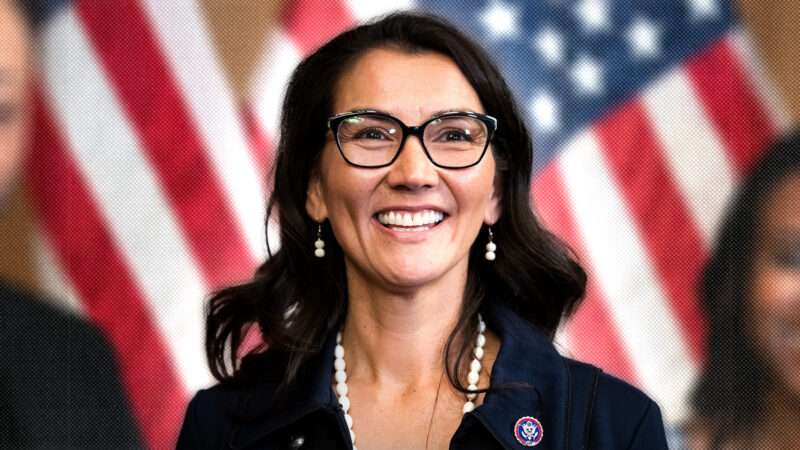
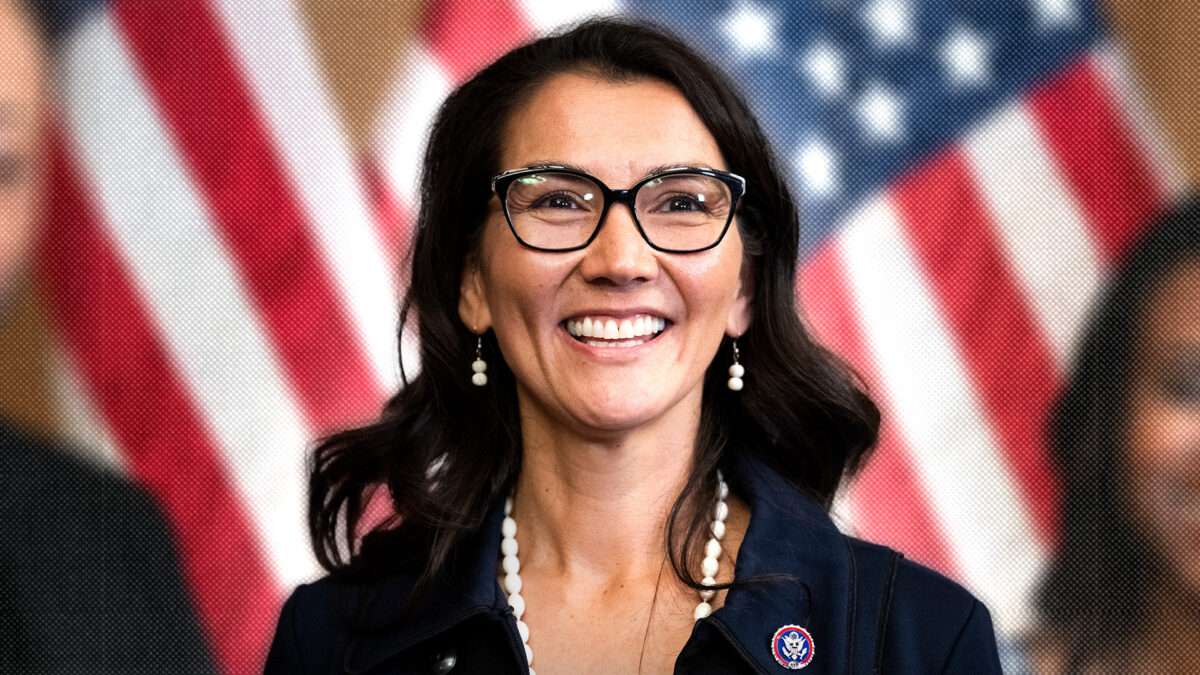
To Confuse Voters, Mary Peltola's Campaign Recruited a Second Dan Sullivan

Mary Peltola | Tom Williams/CQ Roll Call/Newscom

Perceptive citizens of the great state of Alaska may have noticed that there are two Senate candidates on the ballot named Dan Sullivan: the incumbent, Republican Sen. Dan S. Sullivan, and Dan J. Sullivan, a completely unknown person who is not actively campaigning for the seat.

The intention seemed obvious: The false Sullivan is trying to siphon off some votes from the real Sullivan in hopes of benefiting the actual challenger, Democratic candidate Mary Peltola. But while it was clear who stood to gain from this scheme, how this had all been arranged remained unclear. Until now.

The rumors are apparently true: Political strategists working closely with the Peltola campaign and the Democratic Senatorial Campaign Committee (DSCC) explicitly recruited the other Sullivan, according to bombshell reporting by The New York Times. All deny any involvement, but the Times has them dead to rights:

The Times has found, based on interviews and text messages, along with documents prepared for a potential lawsuit against the campaign, that not only did Ms. Peltola's team work with people trying to recruit Mr. Sullivan to run for Senate, but the effort was much broader. The group worked to coax other would-be spoilers into the race, to dilute the incumbent's support and help catapult the Democrat to victory.

The campaign consulted with Jerid Kurtz, a Democratic operative, to find and recruit Sullivan, a retired teacher. Kurtz went so far as to fly to Sullivan's remote Alaskan village and personally convince him to run. Sullivan said he "didn't have any interest in being a politician," but loathed President Donald Trump and was eager to help Democrats win the Senate.

Elisa Rios, Peltola's former campaign manager, willingly admitted all this to the Times, claiming that voters deserved to know the truth; reading between the lines, it seems like she's a disgruntled former employee. However, she reconsidered before publication and asked the Times to disregard her interview. The Times quite reasonably declined. In any case, numerous other staffers confirmed her story.

Trump's Justice Department has filed suit, claiming that the other Sullivan's presence on the ballot would render the election illegitimate if Peltola wins. It seems unlikely the administration will win that argument, and these sorts of tactics are nothing new.

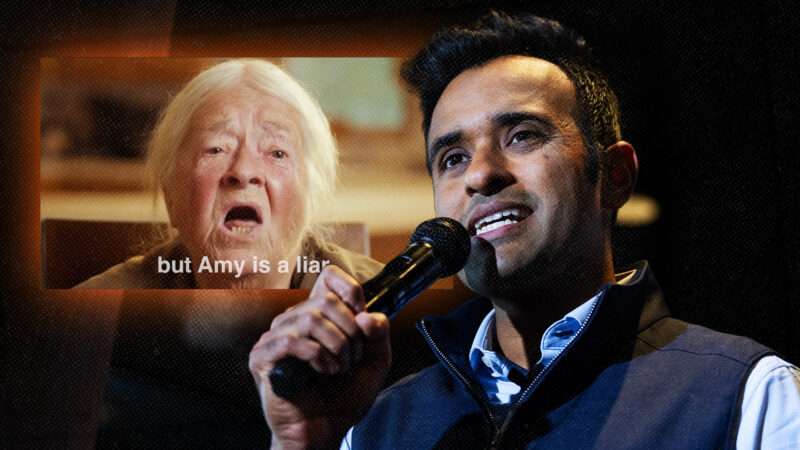
They are still quite contemptible, however. Peltola, who was well aware of the scheme, is trying to trick the people of Alaska into voting for the wrong person so that she's more likely to win. Maybe that's not quite so despicable as Vivek Ramaswamy's ad about Amy Acton, but it's just as dastardly—and much more likely to damage the integrity of the election. Ramaswamy's actions generated significant bipartisan backlash; will Democrats who claim that democracy itself is on the ballot speak up and denounce this?

The post To Confuse Voters, Mary Peltola's Campaign Recruited a Second Dan Sullivan appeared first on Reason Magazine.

  •  

Foundation for Individual Rights and Expression Cases (2025-26) and Their Ideological Valence

FIRE has billed itself as a nonpartisan organization that fights speech restrictions that are seen as left-wing, right-wing, and no-wing. Some have, however, argued that FIRE mostly fights left-wing restrictions (and thus mostly protects right-wing speakers), and goes after only a few right-wing restrictions as supposed "tokens" to hide its true nature.

To test that, I used Westlaw to find all 2025 and 2026 court opinions that mention FIRE as a lawyer for a party, and tried to classify them. Note that I'm not including cases where there has been no court decision yet or cases where the last court decision was before 2025. I'm also not including the many cases where FIRE has filed amicus (friend-of-the-court) briefs: This is partly to keep the list manageable, but chiefly because amicus briefs, while potentially valuable (I file plenty myself), don't represent the same level of commitment of resources as representing a party would.

Here is the list of the 23 cases that I found that meet my criteria, listed in reverse chronological order by the date of the most recent decision in the case that I could find. For each restriction, I've tried to indicate whether it's a restriction that basically comes from the right, from the left, or from neither direction; sometimes, as you can see, it's difficult to figure that out. I may have missed some cases, but I think this should be a pretty complete and at least representative list:

Case Challenged restriction Restriction coming from …
Meeks v. Lawrence (M.D. Tenn.) Firing of government employee for post critical of Charlie Kirk after his assassination Right
Streever v. Mullin (D.D.C.) ICE warning and investigation for critical letter sent to ICE official Right
Mastriano v. Gregory (W.D. Okla.) Libel lawsuit over allegations of errors in Ph.D. thesis Right (plaintiff is conservative legislator)
Stanford Daily Publishing Corporation v. Rubio (N.D. Cal.) Deportation of noncitizens for anti-Israel views Right
Pernell v. Florida Board of Governors of State University (11th Cir.) Florida's Individual Freedom Act ("Stop WOKE Act"), which bars university instructors from promoting or endorsing eight listed concepts about race and sex (viewpoint-based restriction; vagueness). Right
Spectrum WT v. Wendler (5th Cir.) Ban on drag shows on campus Right
Nazarene v. Dehmer (D.N.J.) Ban on board members discussing board business in public None; defending apparently conservative school board member
Reges v. Cauce (9th Cir.) Retaliation against professor for criticism of land acknowledgments on class syllabus Left
Robinson v. Damphousse (W.D. Tex.) Professor's off-campus pro-Palestinian talk Right
Rosado v. Bondi (N.D. Ill.) Government's alleged jawboning of Facebook and Apple to remove ICE-monitoring content Right
Coble v. Ballentine (N.C. Ct. App.) Harassment restraining order barring critic from speaking about former mayoral candidate Right? (speaker was apparently criticizing right-wing candidate from the left)
Kershnar v. Kolison (W.D.N.Y.) University's firing of philosophy professor for podcast comments on adult-child sex Neither
NetChoice, LLC v. Bonta (9th Cir.) California Age-Appropriate Design Code Act aimed at social media speech to children Neither
Hogarth v. Hayes (E.D.N.C.) Bans on ballot selfies Neither
B. A. v. Tri County Area Schools (6th Cir.) School banning "Let's Go Brandon" slogan as vulgar Left?; defending conservative speech
I.P. v. Tullahoma City Schools (E.D. Tenn.) High school student posting memes with images of principal Neither
Donnelly v. Des Moines Register (S.D. Iowa) Trump supporters' consumer fraud lawsuit over election poll Right
Fellowship of Christian University Students v. Eltife (W.D. Tex.) Law requiring public universities to ban expressive activity at night and at the end of the semester Right, though representing conservativish organization
Volokh v. James (2d Cir.) Law requiring social media platforms to post "hateful conduct" policies Left
Phillips v. Collin County Comm. College Dist. (E.D. Tex.) Firing of college professor for public statements about COVID policies Right
Jensen v. Brown (9th Cir.) Discipline of professor for conceerns about change to math curriculum Left?
Students Engaged in Advancing Texas v. Paxton (W.D. Tex.) Texas SCOPE Act restricting minors' use of social media Neither
Palsgaard v. Christian (E.D. Cal.) College requiring pro-DEI teaching Left


One can't expect complete partisan balance, of course, since much depends on where most of the speech restrictions are coming from in 2025-26; which litigants already have lawyers of their own; which cases happened to be decided during the relevant time; and so on. But I think it's fair to say here that FIRE is challenging restrictions coming from all parts of the ideological spectrum.

To be sure, some people argue that the real reason FIRE is going after right-wing speech restrictions and thus protecting left-wing speakers is just to give it political credibility for its real mission, which is protecting right-wing speakers. Based on my knowledge of the people at FIRE, I doubt that this is so: I think they really do want to protect speakers with a wide range of ideological views.

But in any event, one reason people have long protected speakers they disagree with is precisely to build protection for the people they agree with. To quote the noted liberal Justice Hugo Black (in a statement also adopted by Justice Powell's majority opinion in Healy v. James (1972)),

I do not believe that it can be too often repeated that the freedoms of speech, press, petition and assembly guaranteed by the First Amendment must be accorded to the ideas we hate or sooner or later they will be denied to the ideas we cherish.

Even if an organization defends speakers it disagrees with simply because it wants that to lead to more protection for speakers they agree with—again, I don't think that's FIRE's motivation, but even say that it were—that strikes me as a perfectly worthy mission for a pro-free-speech organization.

Note that I was once engaged on a consulting project for FIRE (several years ago now); I have gotten honoraria from them for various talks, and will likely be getting more in the future; I am being represented by them in Volokh v. James; I have been represented by them in First Amendment Coalition v. Chiu; I have represented them in amicus briefs in various other cases; and I am friendly with various people there. If this leads you distrust my analysis, you can certainly go through the cases yourself and tally your own results. I was not asked by anyone to put up this post, and I didn't discuss this post with them before putting it up.

The post Foundation for Individual Rights and Expression Cases (2025-26) and Their Ideological Valence appeared first on Reason Magazine.

  •  

Ireland Is Banning Vape Flavors. This Shop Owner Warns It Could Cost Lives.

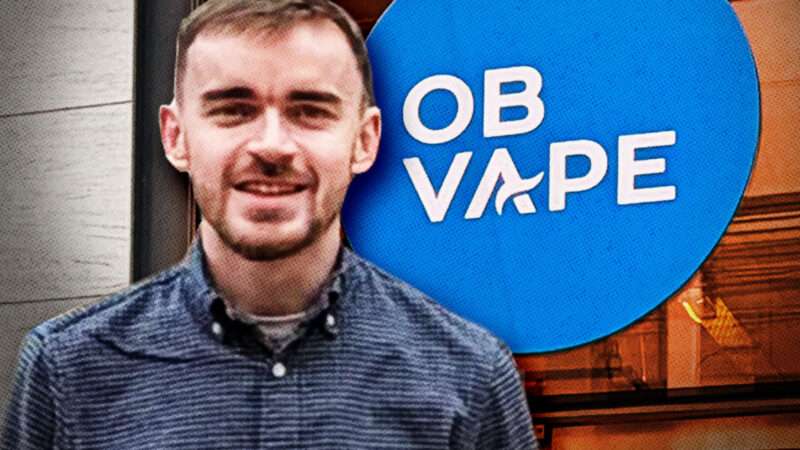
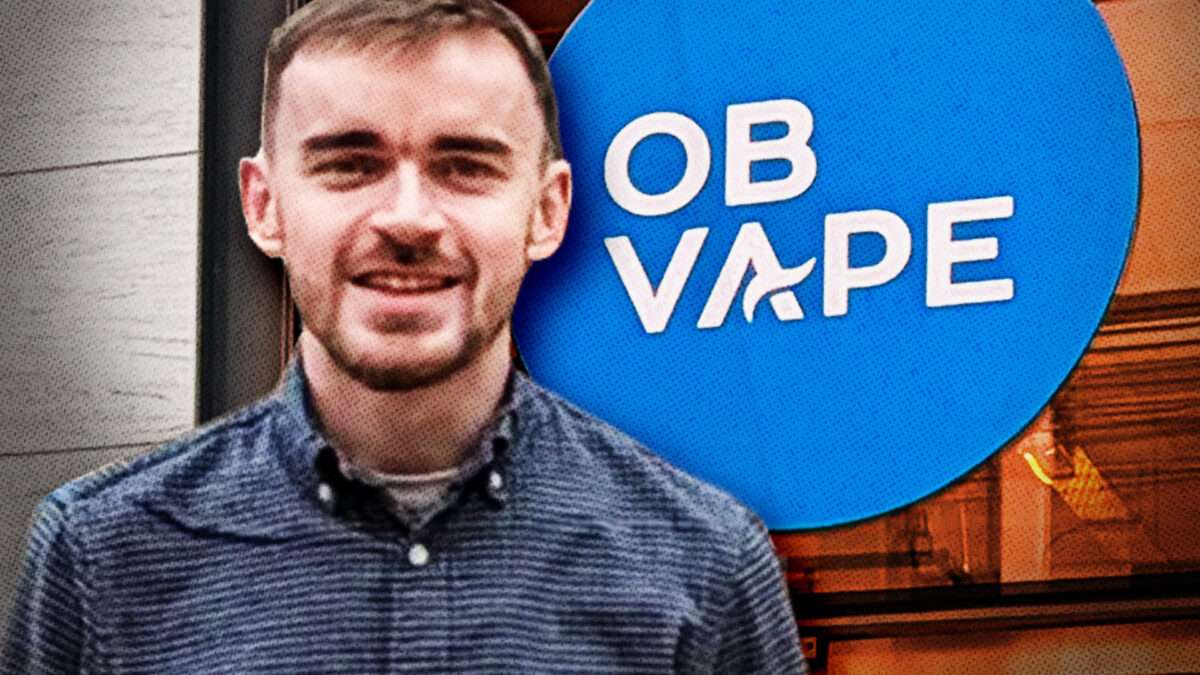
Eoin O'Boyle | Eoin O’Boyle

"Am I living in a fucking parallel universe here or something?" asks Eoin O'Boyle, a 28-year-old Irish vape shop owner facing the prospect of losing his business. "If there's a piece of policy that makes sense, the government will do the opposite for some reason."

Last Wednesday, the Irish Seanad passed the final stages of a sprawling public health bill, which prohibits the sale of vaping products with flavor names other than "tobacco" or "unflavored." The bill also restricts the colors and imagery permitted on vaping devices and packaging, bans advertising in shops and online, and requires most retailers to keep vaping products out of public view.

In a cliché as old as time, Irish politicians are asking the public to think of the children. "We are dealing with an increasingly aggressive industry marketing attractively packaged addictive products that appeal to children," Ireland's public health minister Jennifer Murnane O'Connor said in a statement. "We are responding strongly with measures that will protect our young people against current and future threats."

Ireland's Taoiseach (head of government), Micheál Martin, has described vaping as "nearly worse than cigarettes," calling them the "revenge of Big Tobacco." Of course, as studies by Public Health England, Cancer Research UK, the Royal College of Physicians, and countless other organizations show, vaping is vastly safer than smoking and is an extremely effective cessation tool.

"The government [is] insane to do this," O'Boyle, the owner of OB Vape in Drogheda, Ireland, tells Reason. "It's going to cause excess deaths. It's infuriating."

O'Boyle began smoking at the age of 12, before quitting when he was 18 by using vapes. "I loved smoking. I absolutely loved it," he recalls. His mother and brothers also quit cigarettes by vaping. While studying enterprise computing at Dublin City University, O'Boyle worked part-time at a vape shop, where he spotted an opportunity to build a business of his own. In 2019, he took out a small loan and opened OB Vape, hoping to create something akin to the Apple Store of vaping. He says he repaid the loan within six months and has since helped around 22,000 customers quit smoking.

Now, O'Boyle fears the business he's spent nearly eight years building could disappear. "I never thought I'd be in a position where I would have to close down my business through no fault of my own," he says.

Last week's health bill is not the first of Ireland's vape restrictions. In 2023, the country made it illegal to sell to minors, followed by advertising restrictions the following year, and an e-liquid tax in 2025.

These measures were designed to stop vaping among minors, and while Ireland's rate of teenage vaping has declined since 2019 and is below the European average, teens in the country have still been able to access these devices. As the government's own data show, 32 percent of Irish 15- and 16-year-olds have tried vaping, 16 percent said they had vaped in the previous month, and 7 percent vaped daily. By comparison, just 2 percent smoked cigarettes daily, and a 2024 report found the proportion of teens who had ever smoked once fell from 73 percent in 1995 to just 24 percent in 2024 (the lowest number on record).

Regardless of this decline among the youth, smoking remains widespread across the country. According to the government's 2025 Healthy Ireland Survey, 17 percent of the population smokes, with 13 percent smoking daily and 4 percent occasionally.

For those smokers, vaping is among the most effective tools for quitting cigarettes. An August review from Cochrane that examined 80 randomized controlled trials involving nearly 30,000 participants found that nicotine e-cigarettes are more effective at helping people quit smoking than conventional nicotine replacement therapies, such as patches and gum. The review found that vapes resulted in about four more quitters per 100 people, concluding that vaping is a "proven and viable option." Indeed, half of current vapers in Ireland are former smokers, according to government data.

Ireland's vape flavor ban could hurt adults trying to quit smoking. Vape flavors, O'Boyle argues, are crucial in helping smokers move on from tobacco flavors and successfully quit cigarettes. "People don't want to be reminded of tobacco," he says, estimating that around 96 percent of his customers use nontobacco flavors, including menthol and fruit flavors like pineapple.

Research suggests O'Boyle's experience is widespread. A 2020 study published in JAMA Network Open found that adults who started vaping nontobacco flavors had more than twice the odds of subsequently quitting smoking compared with those using tobacco flavors. A 2025 study of 886 smokers published in Nicotine & Tobacco Research found that "non-tobacco flavors were preferred and may be also more effective" at helping smokers quit.

"Without flavors, my business would be gone, and the smoking rates in the country would be up," says O'Boyle.

While the government ban will prohibit the legal sale of flavors, illegal sales are likely to be bolstered. After the Netherlands banned nontobacco vape flavors in 2024, a survey found that 47 percent of existing vapers continued using illegal flavors. Among those users, more than a third purchased them from shops abroad, while others got them from acquaintances, websites, or social media. In Australia, where vaping products can only be purchased legally at pharmacies, a 2025 government study found that 93 percent of vapers obtained their products from illicit sources. Businesses like O'Boyle's will be forced to shut down, but the missing demand will undoubtedly be met by the illicit black market.

"The restrictions that the government [is] planning to put on, and have already put on, are going to jeopardize not just my business," O'Boyle warns, "but the lives of Irish people."

The post Ireland Is Banning Vape Flavors. This Shop Owner Warns It Could Cost Lives. appeared first on Reason Magazine.

  •  

Ramaswamy's Attack on Amy Acton Was Bad Enough. Trump and Vance Made It Worse.

Vivek Ramaswamy | Illustration: Medium Buying/X/Tom Williams/CQ Roll Call/Newscom

My home state of Ohio has earned a not-so-nice distinction in the 2026 election: It is the site of "the ugliest" contest in the country. Nasty attack ads have been an ongoing feature of the governor's race between Republican Vivek Ramaswamy and Democrat Amy Acton—piercing many a peaceful Hulu-watching session on my end with allegations that Acton is a pill-popping drunk and Ramaswamy a con man.

But the nastiness reached a whole new level in recent weeks, with the release of a Ramaswamy campaign ad implying that Acton lied about childhood sexual abuse by her stepfather.

Understandably, many Republicans bristled at being viewed as the party that defends accused child rapists. Not Trump. His only regret here is that he didn't get to run an ad like this, he said.

The ad features Acton's mother, Donna Arthur, from whom Acton has been estranged for decades for what seem like very good reasons. When Acton was 12, her mom took her stepfather's side when she accused him of sexually abusing her for years.

In 1978, Acton's stepfather, Cledith Arthur, was arrested and charged with child rape. Records from the case, obtained by Signal Statewide, "also contains a reference to a previous incest charge against Cledith Arthur from 1974…although it's not clear how that case was resolved."

Acton's mom lost custody of both Amy and her brother. But the stepfather was never tried, since he and Acton's mom fled the state. He remained a fugitive—and married to Amy's mother—until he died in 2004.

screenshot of Clip from the Youngstown Vindicator on July 17, 1978

In the new Ramaswamy campaign ad, Acton calls her daughter a liar. "It's not easy for a mother to say this, but Amy has a serious problem. She is a liar," says Arthur in the video. "She lies about her past.…She's lied her entire life. My daughter needs help."

Arthur doesn't outright say "she lied about being molested by her stepfather," but given the historical context here, the implication is pretty clear. In effect, the Ramaswamy campaign has helped Acton's mom accuse her daughter on a national scale of making it all up.

That's despicable, even by political campaigning standards.

And—providing us with some hope for humanity—it also backfired. People roundly condemned the ad and the Ramaswamy campaign for running it. Acton's brother, Philip Stearns, corroborated her story. Even many Republicans have objected to the ad.

There are still some lines you don't cross, public figures left and right seemed to agree.

Public figures except President Donald Trump and Vice President J.D. Vance.

Telling Republicans to "stop whining" about the ad, Vance said he was getting "a little bit disgusted when I see Republicans across the country who are whining more about that advertisement than they are about what the congressional Democrats and other Democrats want to do to the United States of America."

"Vivek Ramaswamy had the audacity to run a TV commercial which calls it out like it is and calls Amy Acton a liar," Vance continued.

Trump went further, calling the ad "very powerful" and urging the Ramaswamy campaign to keep it up. Trump also criticized the current Ohio governor, Republican Mike DeWine, for calling the ad "deeply troubling."

DeWine is a moderate Republican who, for the most part, adheres to pre-Trump standards of decency. Their differing reactions here seem a perfect microcosm of pre-MAGA and post-MAGA standards for conduct and bounds of acceptability.

DeWine "probably wants a Dumocrat to win," Trump wrote in a Truth Social post last Thursday. "I suggested, on the other hand, that Vivek should keep it up, and let everyone listen to the mother of a defective, dishonest, and incapable Candidate, explain how the daughter is a DISASTER who, uncontrollably, lies, cheats, and steals!"

Talking to reporters that same day, Trump just kept repeating that if an ad had been made with his mom calling him a liar, the press would love it. He stuck to that talking point again and again, acting clueless about the childhood sexual abuse allegations at the center of this whole controversy.

The idea that the president would passionately post about and answer questions about this without knowing the whole story is almost beyond belief. But even if Trump somehow didn't know the full context when he first started talking about it, he was made aware and then kept right on praising the ad.

Trump on Ramaswamy Ad: The mother is calling the daughter a terrible person and a liar. Why would you shield somebody from that? Why would we do that? So I told him, leave it up and say thank you God. I only wish I could have had an ad like that. pic.twitter.com/M2TYz3jhUy

— Acyn (@Acyn) October 23, 2026

At a campaign rally in Iowa last Thursday, he said, ​"I only wish I could have had an ad like that against somebody."

Ramaswamy has also defended the ad, saying, "Unfortunately, the person I'm running against does have serial problems with the truth" and that the ad highlights a "pattern" of the "people who are closest to her" telling Ohioans not to vote for her.

But this is no longer just about one candidate's mistake or one campaign's poor judgment. The response from Trump and Vance has raised Ramaswamy's ad into bigger and uglier territory.

​"It's actually kind of hard to find a prominent Republican who is defending the ad other than Vivek Ramaswamy himself, Vice President JD Vance and, quite fervently today, President Trump," noted CNN's Kaitlan Collins last Friday.

But Trump and Vance are the leaders of not just the Republican Party but the nation. And as we've seen again and again, Trump's responses tend to set the tone for what will become acceptable among conservatives by and large.

"Vance's acceptance of this campaign ad only breathes life into the disease that we should be seeking to cure," former New Jersey Gov. Chris Christie told The Washington Post.

Do voters agree?

Whatever happens with Ramaswamy next Tuesday, it will be impossible to know how much of it is related to this ad campaign and how much of it is related to many other possible factors. But it's hard not to look at the Ohio gubernatorial election results now as something of a referendum on what type of political discourse is OK. Are voters over Trump-style belligerence and nastiness? Or do they accept the premise that politics is a war in which no low is too low if it helps you win?


In the News

Release the FISA Ruling: "Two Democratic senators who have long overseen US intelligence say the Trump administration is illegally withholding a secret court's findings from Congress until lawmakers renew a program that lets federal agents read Americans' communications without a warrant," reports Wired:

Seven months ago, the Foreign Intelligence Surveillance Court objected to search filters that let intelligence analysts pull Americans' messages from intercepted data without the approvals, written justifications, or records the law requires. The court approved another year of surveillance anyway. The ruling has never been made public, and Senators Ron Wyden of Oregon and Adam Schiff of California say the administration's own deadline for releasing it passed in September.

"This opinion details serious abuses of Americans' rights under Section 702 of the Foreign Intelligence Surveillance Act (FISA) and, by law, should have been released before September 13," wrote Wyden and Schiff in a letter to the director of national intelligence and the U.S. Attorney General. "Yet this opinion remains hidden over a month later, suggesting that the administration hopes to secure a renewal of Section 702 while keeping Congress and the public in the dark."

Wishful thinking from Flock. Garrett Langley, the CEO of Flock, told a conference of cops to believe him rather than what's right in front of their eyes. The backlash to Flock "is not real," he said at the International Association of Chiefs of Police conference, per leaked audio obtained by 404 Media:

"Somebody was paying for [the social media posts and] stopped paying for it," Langley said about the many viral posts criticizing his company's technology. "Social media chatter on Flock is down about 95 percent from July. It went down 50 percent last week when Ukraine bombed a Russian data center with a drone. Literally 50 percent overnight. And so look, I'm the last person, my wife as well, she's like 'This is crazy, these people are getting paid to say these things,'" he added, repeating a disproven theory that Ukraine's strikes on Russian data centers had a significant impact on internet bot activity.

"It's anonymous bots, and so it is not real," he continued. "Inorganic activity has led to organic activity, but when I look at protests across the country, it is the same people with the same signs and the same message. That's not normal. That's not organic at all." Langley's comments echo another unsubstantiated theory that said opposition to Flock comes from a far-left network spreading propaganda at the behest of China.

Cute spin, but I don't think "Russian bots" can explain this congressional hearing, or Sen. Josh Hawley's (R–Mo.) Stop Flock Abuse Act, or this recent court ruling, or Connecticut's new restrictions, or canceled contracts, or all the charges that police officers are facing for abusing Flock, or poll results like these.

The backlash is widespread and multifaceted. Backlash to Flock "has just exploded, like no other issue that I have seen in my time at the ACLU," Becca Eastwood, deputy policy director at the American Civil Liberties Union of Iowa, told Reason recently.


On Substack

Techlash on the campaign trail. Democrats have been panning data centers in campaign ads, but artificial intelligence was the subject of only a small fraction of ads, notes the Blue Horizon Project, an initiative from Chamber of Progress "to restore tech optimism in the Democratic Party and reset the relationship between Democrats and the technology sector." And when Democrats have focused on AI and data centers, it's been more about economics than general anti-AI sentiment, Dave Vorland writes:

Data centers are the important exception to the lack of ads focused on AI and technology. In AdImpact's tables, they appear among the three leading Democratic advertising topics in 5 of the 21 Toss-Up House races. They are not politically irrelevant, and dismissing the local backlash would be a mistake.

But look more closely at what these ads actually argue. Using AdImpact's data on 2026 campaign spending, ads matching either a tax-language screen or energy message, or both, account for $69.76 million, or 76.2% of all data center advertising.

The race with the highest spending on data centers is the Ohio Senate race, where Democratic spending accounts for $32.10 million. AdImpact's data shows Sherrod Brown's campaign spent over $1.5 million to air a data center ad 3,100 times. The message shows that while he is willing to hit his opponent for the data center tax breaks, his solution is ensuring that data centers don't raise energy costs, an idea that could have been drawn directly from our Data Center Development Playbook.

Vorland points out that "AdImpact's data for 2026 Congressional spending shows that less than $2.5 million went to ads supporting a data-center construction pause, moratorium, ban, or stopping new construction, a minuscule portion of the Democratic ad buy."

Interesting that "let data centers build but don't subsidize them" is the implicit message here. It feels like at least somewhat of a good sign that Democratic candidates don't by-and-large think "ban new data centers" is a message that voters want to hear.


More Sex & Tech News

• An interesting essay in Works in Progress looks at "the rise of prudishness" and what demographics might have to do with it.

• "Technology has advanced for centuries, shuffling workers among occupations, industries, and regions without making human labor obsolete," writes Nathan Smith at Human Progress:

As machinery pushed millions of Americans away from farming over the past century, most workers moved to factories, towns, and cities. They ended up with more comfortable lives than their predecessors plowing the fields. The AI economy will likely follow the same path: destroying jobs while creating better ones.

• The New Jersey Assembly recently advanced a bill that would increase prostitution penalties, and several other prostitution-related criminal justice bills are pending in the Assembly and state Senate. Tara Burns has details.

• Florida's attorney general said he plans to introduce even more stringent social media regulation, even as the state's earlier restrictions on minors using social media are still being challenged in federal court.

• Sarah Hepola takes a stand against…vibrators?

• British tech regulator Ofcom says its Online Safety Act isn't actually stopping kids from seeing "harmful content" online. So it wants to do more of it. "Instead of suggesting to repeal the Online Safety Act because it does not seem to be working or because it imperils online freedom, Ofcom's report proposes to broaden the law's scope," writes Reason's Meagan O'Rourke.

🚨NEW: The Online Safety Act has been a failure, according to a new report from Ofcom.
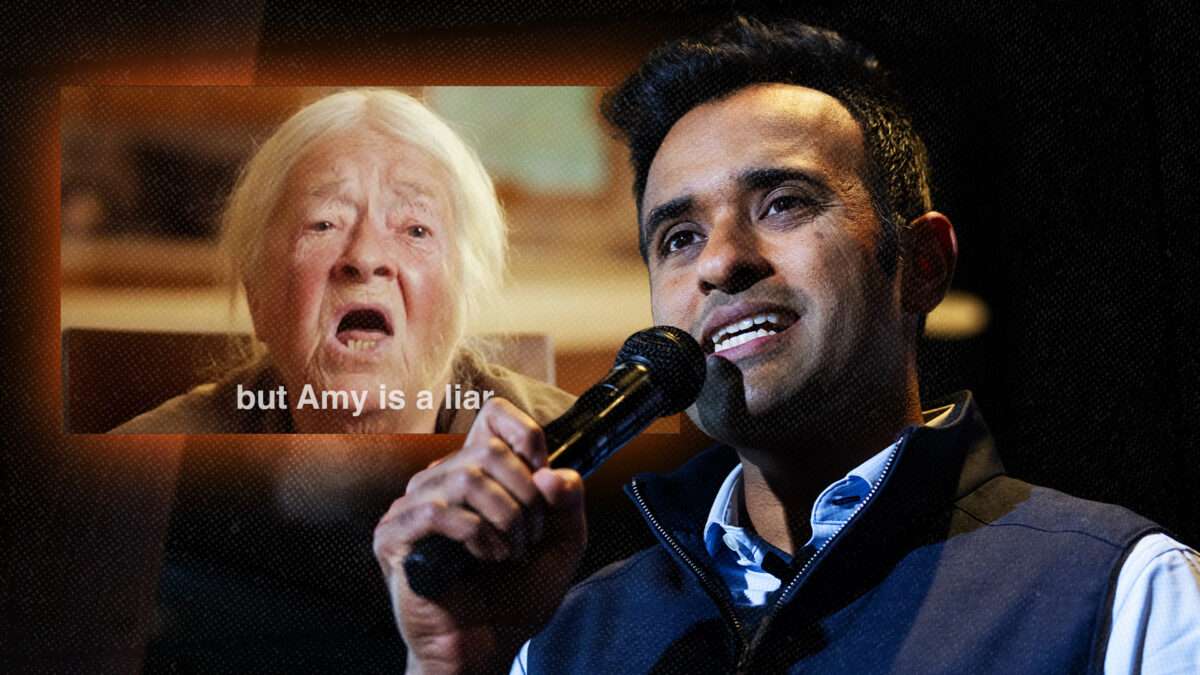
Ofcom have found "no significant change" in children encountering harmful content since the law came into effect last July. This is despite the signifigant threats to free speech and privacy.

— Matthew Lesh (@matthewlesh) October 22, 2026

• "Social media decentralized the information environment and weakened the influence of expert opinion. LLMs are likely to have the opposite effects," writes Dan Williams at Persuasion. "Whereas social media has been a democratizing technology, LLMs are a technocratizing force. They shift influence back towards expert opinion."

• Ten states have no birth centers and eight others only have one, according to a new report from The Commonwealth Fund. "Two dozen centers closed between 2023 and 2026, with some publicly blaming onerous regulations and steep increases in malpractice insurance," notes Ohio Capitol Journal.

The post Ramaswamy's Attack on Amy Acton Was Bad Enough. Trump and Vance Made It Worse. appeared first on Reason Magazine.

  •  

L.A. Teachers Union Flunks Math, Blames Billionaires

A protestor holding a sign that says 'Fund the school not the police' | Homes.com/Ted Soqui/Sipa USA/Newscom

Californians facing not one but two wealth-tax initiatives on next week's ballot may well be asking themselves how all these tens of billions of forcibly extracted dollars will be spent.

The answer, based on new studies and weary observation: horribly.

Take the Los Angeles Unified School District (LAUSD), the country's second largest. In July, L.A. County Superintendent of Schools Debra Duardo designated the LAUSD as a "lack of going concern," due to its ongoing operating deficits, exacerbated by fresh salary increases for unionized workers. The state's longstanding school Fiscal Crisis and Management Assistance Team (FCAMT) then issued a damning report in September, placing the district at a "high risk" for fiscal insolvency. Why? Because payroll was expanding while enrollment was collapsing.

"From 2019-20 through 2024-25," the report found, "noncharter school enrollment declined from 440,365 to 369,830 students, a decrease of approximately 16.0%. Over the same period, total [full-time equivalent jobs] increased from 60,344 to 64,148, or approximately 6.3%. As a result, the number of students per total FTE declined from 7.3 to 5.8."

This incongruent math is a feature, not a bug, of Californian education spending.

"From 2002 to 2023," Reason Foundation Managing Director of Education Reform Aaron Garth Smith and Managing Director of Government Finance Jordan Campbell wrote in a study this June, "California led the nation in K-12 spending growth." And when exactly did K-12 enrollment peak in the LAUSD? 2002!

Between fiscal years 2013 and 2023, Smith and Campbell found, LAUSD enrollment fell by 34.7%, yet "inflation-adjusted expenditure on employee compensation—including salaries, benefits, and other wages—grew by…27%." In a city, county, and state dominated by public sector unions (the California Teachers Association has already spent more than $65.5 million this election cycle), collective bargainers sit across the table from the politicians they helped elect, leaving only taxpayers and public-school families on the outside looking in.

United Teachers Los Angeles (UTLA), one of the most radical teachers unions in the country, reacted to the FCAMT "high risk" report with an innumerate defiance redolent of President Donald Trump.

"This fake independent analysis disparages the school board for rightfully addressing the needs of working people who face some of the worst housing and childcare costs in the country," UTLA Vice President Julie Van Winkle told the Los Angeles Times. The union's website called the report "a so-called 'analysis'" that used "a rigged scoring system with a predetermined outcome."

The UTLA broke with the statewide California Teachers Association in backing Proposition 40, the retroactive 5 percent tax on billionaires' paper wealth that would send 90 percent of the proceeds toward healthcare spending. ("California's schools, hospitals, and clinics need funding. Billionaires do not," Van Winkle explained.) But while the controversial Prop. 40 is looking wobbly at the polls, amid caterwauls over big money in politics, the much less ballyhooed Prop. 3, which makes permanent some wealth taxes that were sold as temporary in 2012, looks set to sail through without much resistance. Literally.

Spending on Prop. 3, L.A. Times education reporter Howard Blume concluded this week, "adds up to more than $81 million for and about $5,500 against." For those keeping score at home, that's a ratio of more than 14,700 to 1, brought to you primarily by teachers unions, who incidentally are lying about the initiative.

"Strict accountability [will] ensure every dollar gets to classrooms, not Sacramento politicians," vows the Yes on 3 website. Nonsense: The higher income-tax brackets, which begin at $371,479 for individuals and $742,958 for couples filing jointly, just feed into California's general fund, of which 40 percent goes to transitional kindergarten through community college.

Californians who routinely support such tax hikes and spending increases may flatter themselves that they're taking the side of children over rapacious billionaires, as well as the odd hundred-thousandaire. But the results produced by these massive money transfers have stubbornly failed to adhere to the alleged beneficiaries.

In 2024–25, the California Policy Center noted in July, "approximately 54 percent of tested LAUSD students did not meet or exceed the state standard in English language arts, 63 percent did not meet it in mathematics, and 73 percent did not meet it in science." With results deflation has come grade inflation, meaning that Los Angeles public schools are increasingly passing students who don't meet grade-level standards.

Far from acting as a bulwark against heartless spending cuts, California's never-ending won't-you-think-of-the-children tax-and-spend cycles are blunting economic growth and creating hollowed-out monuments to the folly of central planning. Just as the LAUSD was beginning its dizzying enrollment descent, the district launched a $20 billion, eminent domain–abusing school-construction program that was routinely characterized as "the largest public works project in the western United States."

More than a thousand homes, plus such landmarks as the Ambassador Hotel and Hollywood Star Lanes (from The Big Lebowski) were plowed over, only to create an overall building stock that now stands half-empty, incurring massive sunk costs.

As Blume detailed this week in the L.A. Times, "A modern, vacant and vandalized $34-million public school sits next to Los Angeles Unified School District headquarters — a campus paid for with taxpayer-financed bond money, but so burdened with debt and damage that it's not clear that anyone can afford to move in. The compact, aesthetically striking campus is marred by widespread graffiti. Vandals have punched holes in floors, walls and ceilings over the last five years. Recent photos of the inside appear to show puddles and stains from water damage and char marks from fire. The district is paying at least $20,000 a month in security and maintenance, and last year calculated having spent more than $1 million to secure and maintain the building."

Good luck, California!

The post L.A. Teachers Union Flunks Math, Blames Billionaires appeared first on Reason Magazine.

  •  

The Untold Story Behind the Race for the Atomic Bomb

Today's guest is Neal Stephenson, the bestselling author of Snow Crash, The Diamond Age, and Cryptonomicon. His latest novel, D: Heavy Water, revisits the early days of World War II, when scientists were racing to understand nuclear fission and a secret mission sought to keep a crucial ingredient for atomic weapons out of Nazi hands.

Nick Gillespie talks with Stephenson about what drew him to this forgotten chapter of history and how revolutionary idealism can give way to authoritarianism. The conversation also explores the internet's early promise of decentralization, how Big Tech came to dominate it, and why the metaverse hasn't lived up to the vision Stephenson introduced in Snow Crash. They discuss his early work with Jeff Bezos at Blue Origin, President Donald Trump's disruption of American politics, and why Stephenson believes the West's Enlightenment values remain worth defending.


0:00—The failure of the metaverse

9:59—Did the internet fail on its original promise?

14:36—The impact of technology conglomerates

17:22—What we get wrong about the Puritans

21:45—Mother Earth Mother Board

25:14—Blue Origin and space exploration

31:22—D: Heavy Water synopsis

35:49—Creating characters with nuance

40:00—Francoists

41:29—Atomic bomb development

44:13—Communism

46:22—Cryptonomicon

50:06—The Big U

52:46—Stephenson's literary influences

55:23—Democracy and politics

1:00:28—The aftermath of 9/11

1:05:34—Faith and science


Previous Reason features:

"Neal Stephenson's Past, Present, and Future," by Mike Godwin

"Wiki Magazines on the Way, Neal Stephenson Is Awesome," by Katherine Mangu-Ward

"Intelligence at Work," by Anders Monsen

"If We Told You Neal Stephenson Invented Bitcoin, Would You Be Surprised?" by Peter Suderman

"Neal Stephenson Wants to Tell Big Stories," by Tyler Cowen

"Neal Stephenson's Polostan Is a Compact Epic About Communism, Science, and the Dawn of the Atomic Age," by Peter Suderman

The post The Untold Story Behind the Race for the Atomic Bomb appeared first on Reason Magazine.

💾

© Illustration: Fatima Ruiz

Nick Gillespie appears on the left. Neal Stephenson appears on the right. A black and white image of an atomic bomb exploding is seen in the center square. Bold text across the top of the screen reads "The Secret Nuclear Race"
  •  

Social Security Is Like a Ponzi Scheme. How Do We Fix It?

John Stossel stands in front of a Social Security Card and the U.S. Capitol with a red downward arrow | Stossel TV

"We will always protect Social Security, Medicare!" says President Donald Trump.

That would be nice.

But when I look at these programs' balance sheets, I don't see how he's protected anything. Both Social Security and Medicare are on track to run out of money.

Politicians mostly ignore the problem. Worse, progressives like Sen. Bernie Sanders (I–Vt.) and Rep. Alexandria Ocasio-Cortez (D–N.Y.) say they want to expand Social Security benefits.

That's just irresponsible.

My new video points out what we've known for years: These programs are unsustainable.

The problem is that people like me live longer. We like getting monthly Social Security checks and medical care that appears free.

Since we vote more consistently than others, politicians don't want to make us mad by cutting our handouts.

My fellow geezers say, "Social Security is not a handout! I contributed to the 'trust fund' every year. I'm just getting back what I paid in!"

But that's not true. Today, most of us get back much more than we paid in.

In 1935, politicians created the handout, saying, even if you don't save for retirement, government will save for you.

But that was another political lie. They didn't create individual retirement accounts. They didn't save our Social Security payments. They spend every penny as it comes in.

It's why Social Security is like a Ponzi scheme.

Bernard Madoff went to jail because he used new investors' money to pay old investors. That's exactly what our government does.

Few Americans realize it.

"What happens to the money?" I ask people on the street.

"It's held in trust," said one woman.

It isn't.

When politicians started Social Security, there were enough young workers to tax to cover the cost of sending checks to old people.

But now, since we live longer, there aren't enough young workers to fund our payments.

Social Security's costs exceed its income by billions of dollars.

"There is a plan out there to save it, but it requires some tough choices," says the Cato Institute's Romina Boccia. "Commonsense tweaks we can make."

Those include raising the retirement age, capping checks to the affluent, and letting young people opt out of Social Security. Reforms like that require tradeoffs. But ignoring the problem doesn't make it disappear.

We need to act, says Boccia, because Social Security is like the Titanic—gradually heading for disaster.

"Make reforms now," she says, "we can avoid the iceberg. [But] if we wait until the iceberg is in front of our noses and try to turn the ship, we're going to run right into it."

Medicare will hit its iceberg in 2033; then benefits will automatically be reduced. Social Security will hit it the year before.

At that point, incoming taxes will cover only about 78 percent of promised retirement benefits.

Yet irresponsible Democrats say: Spend even more.

"Human wants and needs are unlimited," replies Boccia. "There's always another program that needs more funding."

Sanders says, pay for it by taxing the rich more.

"There isn't enough money even that the rich would have, to pay for the…unfunded liabilities," Boccia points out.

If only politicians had listened years ago, when Cato and the Heritage Foundation proposed letting workers put some of their Social Security money into personal retirement accounts. Instead of relying on future taxpayers, workers could accumulate real assets that grow over time.

Personal accounts give workers something Social Security doesn't: assets we own.

"Even a conservative portfolio of stocks and bonds that got you a 5 percent annual return would have made you many times more [than Social Security]," says Boccia.

Private accounts helped Chile rise from one of the poorest countries in Latin America to one of the richest. Yet leftists still object to capitalists getting a cut of the pie.

"We lack gratitude for what the free market provides," says Boccia.

We should adjust these programs now.

The longer politicians wait, the worse the choices become.

But today's politicians will probably be gone by then.

Our children get the bill.

COPYRIGHT 2026 BY JFS PRODUCTIONS INC.

The post Social Security Is Like a Ponzi Scheme. How Do We Fix It? appeared first on Reason Magazine.

  •  

A Democratic Senate?

Barack Obama giving a speech supporting the Democrats in the 2026 midterm elections | Kyle Mazza/ZUMAPRESS/Newscom

The House looks pretty likely to go Democrat, but the Senate appears to be more in play. Basically, Democrats need to pick up four seats to get control of it; seven races are considered toss-ups by Cook Political Report as of right now, just a few days before Election Day, but Democrats have leads (within the margin of error) in all of them, despite heavy Republican spending in most.

"If Democrats win all seven races, along with the ones in which they are favored, they would secure their largest Senate majority since the Obama administration," notes The Washington Post. "If Republicans win all seven races, they would maintain their current 53-47 majority in the Senate, picking up a Democratic-held seat in Michigan to offset a loss in North Carolina."

The math is less daunting for Democrats than it was at the start of the cycle. They need three of the six Republican-held toss-ups to reach 51, assuming they also hold Michigan, the only Democratic seat on the list. Michigan looks like the GOP's best shot at going on offense, since Mike Rogers cleared the Republican field without a primary while Democrats slugged it out all through August.

Meanwhile, the rest of the map looks like a list of Republican problems rather than Democratic strengths; make of that what you will. Maine is the only Republican seat up this year in a state Trump lost in 2024; Ohio features Sherrod Brown, who lost his seat by just four points in 2024 while Trump carried the state by 11; and Alaska has Mary Peltola, who in 2022 became the first Democrat to represent the state in the House in half a century. Each of these races is close for its own reasons, but the reasons happen to cut one way this year.

Not included in the list of toss-ups—Alaska, Kansas, Maine, Iowa, Michigan, Texas, and Ohio—are Georgia, where Democrat Sen. Jon Ossoff looks likely to win, and New Hampshire, an open seat that anyone could technically take but that looks likely to go Democrat. Toss-up is merely a description of how close races look right now; earlier in the cycle, Georgia and New Hampshire were considered toss-ups, but Democrats are now favored to win. These things aren't static, of course, and different forecasters think about each race differently. Some of the toss-up races are primarily due to one party—frequently Republicans—running really terrible candidates (such as Ken Paxton in Texas, whose prospects we discussed on this week's Reason Roundtable). Other races have their own specific quirks, like in Kansas, where a Democratic Methodist pastor who is broadly liked (with no voting record to ding) is running against a Republican incumbent, who is facing headwinds related to high diesel prices that have raised the cost of running farm equipment and shipping goods, along with beef import tariffs that have pissed off farmers.

It's always possible pollsters are wrong. But most pollsters surveyed by The New York Times—including Nate Silver and Patrick Ruffini, both former guests on my show, Just Asking Questions—seem to believe Democrats will win both the House and Senate.


Scenes from New York: "After a woman said she was raped at knife point in Central Park over the weekend, the police said on Monday that they had stepped up patrols of the park as they searched for an assailant," reports The New York Times. "The 39-year-old woman told the police that she was jogging on the east side of the park near East 66th Street shortly before 8:30 p.m. on Saturday when a man dressed in black approached her brandishing a knife. He dragged her into a wooded area, raped her and ran off, the police said." This is the latest in a string of crimes in the area, including the murder of a 63-year-old homeless woman who slept in the park, and a 32-year-old woman who was robbed while riding a bike.


QUICK HITS

  • "Flávio Bolsonaro fled Brazil for the US hours after losing the presidential election and being ordered to surrender his passports, Folha de S.Paulo reported citing allies of the conservative senator," reports Bloomberg.
  • Microsoft shrinks headcount.
  • "Fox News is suffering a catastrophic drop in viewership, which has plunged to historic lows just before the midterm elections, according to new data. Preliminary Nielsen ratings obtained by Status ahead of their official release show that the Trump-friendly juggernaut is on track to post its lowest-rated month in total day viewers since December 2023, averaging just 1.1 million total viewers throughout October 2026," reports The Daily Beast. "Among the key 25-54 demographic coveted by advertisers, the outlet is headed for its lowest-rated month in a quarter-century, averaging a paltry 98,000 viewers. The collapse represents a brutal 27 percent drop in total viewers and a 32 percent dive in the 25-54 demographic compared to last October."
  • Subprime mortgages for people with bad credit! How could this go wrong?

.@PhillyMayor Cherelle Parker tells @EmilyRPeck that the city hopes to launch its historic mortgage program "before the end of 2026."

"Imagine getting a mortgage, a 30-year commitment, with no PMI," Parker said, and accessible "with less-than-perfect credit." #AxiosLive pic.twitter.com/DDDYMWBMAL

— Axios (@axios) October 27, 2026

The post A Democratic Senate? appeared first on Reason Magazine.

  •  

The Midterms Offer a Choice Between Two Brands of Socialism

Two puzzle pieces fit together, one with a Democratic donkey and the other with a Republican elephant. | Illustration: Peter Kovac/Mishkacz/Dreamstime

In the country with arguably the most successful market economy on Earth, it's not unreasonable to ask for just one major political party to favor a system of relatively unfettered voluntary exchange. And yet, the midterm elections offer Americans a "choice" between a party openly embracing socialism by name, and one that increasingly embraces state-directed economic activity in the cause of nationalism. Not every candidate running as a Democrat or Republican is on board with their parties' statist transformations, and there are certainly other issues separating the two dominant political tribes. But if you want reliable advocacy of economic freedom, you won't find it in the two major parties.


Open Socialism vs. Nationalist Economic Control

The shift in the Democratic Party's policy preferences from a heavily regulated market economy to outright government control has been well-documented, but it's worth noting Eric Bradner August report at CNN about "a growing list of victories by democratic socialists who are a prominent part of the Democratic Party's left-wing insurgency."

Before his election as mayor of New York City, Zohran Mamdani called for "seizing the means of production," as has congressional candidate Darializa Avila Chevalier. The Democratic Socialists of America (DSA), which backs many of the new breed of officeholders and candidates and organized their insurgency, boasts of its solidarity with the totalitarian regimes in Cuba and Venezuela. Just a year ago, it sent "a delegation of 40 DSA elected leaders and rank-and-file members" to Havana to learn "about the achievements and challenges of Cuban socialism."

At 65 percent support for socialism in Gallup polling, more Democrats favor a state-controlled economy than back capitalism (35 percent)—though the odd tie in favorability with free enterprise (also 65 percent, but declining) suggests the schools aren't doing a great job of explaining ideas.

Republicans nominally hold very different economic preferences, with only 14 percent favoring socialism, while 86 percent support free enterprise and 75 percent have positive views of capitalism. But when asked by CNBC's All-America Economic Survey whether government should have control of private businesses, "66% of Democrats found it not appropriate for the U.S. to take equity stakes in American companies, while only 34% of Republicans agreed."

That's likely because under the Republican Trump administration, the federal government has been grabbing a piece of the action from tech and resource firms—40 companies, at the current count—and party stalwarts are happy to go along so long as the S word isn't used to describe the arrangement. Instead, it's cloaked as top-down encouragement of domestic jobs and manufacturing.


Two Parties With a Similar Taste for Government Economic Intervention

"American political leaders on the left and right are rebelling against the market-first consensus that dominated Washington for four decades," concluded Axios's Courtenay Brown and Neil Irwin in July. "It's evident in everything from the Trump administration taking government stakes in dozens of private companies to socialist candidates winning Democratic primaries promising a more active government role in the economy."

A glimpse of a socialist future can be found not only in the rising tide of explicitly socialist Democrats, but in GOP heir apparent and Vice President J.D. Vance's repeated denunciation of free-market economic thinking and its emphasis on private choice.

"Do we serve pure, unfettered commercial freedom?" he asked in First Things in 2019. "Or do we serve something higher? And are we willing to use political power to actually accomplish those things?"

In a June interview with The Daily Wire's Michael Knowles, Vance returned to the topic to criticize the market-oriented ideas of economist Milton Friedman and called for a state-directed and Christian-infused "American developmentalist" approach to escape what he called "a hyper globalized economy."

"The policies supported by both major political parties suggest a growing embrace of state ownership of the economy," warns economist Daniel J. Smith for the American Institute for Economic Research. "The range of policies widely accepted as legitimate options, referred to as the 'Overton Window,' has shifted toward greater government direction of the economy, with some conservative politicians and voters now treating partial state ownership as an acceptable function of government."

Smith pointed out that the economist F.A. Hayek had observed this phenomenon among authoritarians of the right and left in the 1930s. It was why he dedicated his book, The Road to Serfdom, "to the socialists of all parties."


Rejecting Free Markets Means Losing Liberty and Prosperity

Why this is important is illustrated by Smith's recent research into the correlation, or lack thereof, between socialism and political liberty: "The record, from 1789 forward, is not ambiguous. High degrees of political freedom and heavy state ownership of the economy have not been sustained together."

Smith's observation is supported by the prominent socialist writer Robert Heilbroner's admission in his 1986 book, The Nature and Logic of Capitalism, that "political freedom in modern times…has only appeared in capitalist states." He added, "democratic liberties have not yet appeared, except fleetingly, in any nation that has declared itself to be fundamentally anticapitalist."

Also important, as the Fraser Institute's recently published Economic Freedom of the World: 2026 report points out, "economic freedom tends to be associated with better outcomes." Specifically, the report indicates strong correlations between free-market economies and higher GDP per capita, higher level of income for the bottom 10 percent of earners, lower poverty, higher life expectancy, and lower infant mortality. As with the sources cited above, the report found that "personal freedoms such as freedom of speech, association, and religion are highly correlated with economic freedoms."

So, the benefits of having a major political party that believes in and supports free markets with minimal government intrusion are found not just in expanded political choice, but also in policies that promote freedom, prosperity, and human well-being. Unfortunately, both the Democratic Party and Republican Party are retreating from economic liberty and embracing state control over how we produce, work, own, buy, and sell. Democrats' explicit embrace of socialism, and Republicans' dismissal of free markets in favor of state management and ownership, promise a future of less freedom and reduced wealth.

Maybe Americans would vote against socialism—both the open kind and the implicit nationalist variety—if given the choice. But it's increasingly difficult to find a free-market option on the ballot.

The post The Midterms Offer a Choice Between Two Brands of Socialism appeared first on Reason Magazine.

  •  

Brickbat: The Perils of Posting

Najmeh Amini, by the ocean | Middle East Matters/Instagram

Iranian authorities have sentenced to death Najmeh Amini, an accounting student, for blasphemy over a social media post that reportedly insulted Muhammad. Amini, who is being held in Vakilabad prison in Mashhad, was also sentenced to more than 12 years in prison in a separate case involving charges of acting against national security and spreading propaganda against the government. She was reportedly arrested following online monitoring by the Iranian Cyber Police after nationwide anti-government protests. Amini told the court that she posted the remarks while hallucinating after taking psychedelic mushrooms, and her lawyer argued that the comments were unintentional, but the judge rejected this defense. The content of the offending post has not been made public.

The post Brickbat: The Perils of Posting appeared first on Reason Magazine.

  •  

A Supreme Court Case Underlines the Absurdity of the Federal Ban on Home Distilling

a still in a jail cell | DPST/Newscom/Kari Høglund/Dreamstime/Fatima Ruiz

Years ago, I bought a contraption designed to separate and concentrate the most volatile components of a liquid mixture. I would tell you what I did with it, but I don't want to implicate myself in a federal felony.

Since 1868, it has been illegal for Americans to locate a "distilled spirits plant" in "any dwelling place," an offense currently punishable by a maximum $10,000 fine and up to five years in prison. The federal ban on home distilling is at the center of a case that the Supreme Court recently agreed to hear, which raises a specific constitutional issue but also highlights the absurdity of treating this hobby as a crime.

That policy, the U.S. Court of Appeals for the 5th Circuit ruled last April, cannot be justified as an exercise of the federal government's tax power. To the contrary, Judge Edith Jones said in the court's opinion, the ban is "an anti-revenue provision that prevents distilled spirits from coming into existence," meaning its effect is "to reduce revenue instead of raising it."

Nor is the provision consistent with "the Supreme Court's explanation of how the federal power of taxation works," Jones wrote. When Congress imposes a tax, the Court explained in 2012, it "leaves an individual with a lawful choice to do or not do a certain act, so long as he is willing to pay a tax levied on that choice." But in this case, Jones noted, would-be home distillers "have only the choice not to do as they wish or risk fines and imprisonment."

The government argued that the ban helps collect liquor taxes by prohibiting a form of production that is difficult to detect. But "Congress cannot prohibit intrastate activity solely because it might produce products hard to tax," Jones said. If it could, she warned, there would be "no limit whatsoever" to its tax power.

Under the government's logic, Jones noted, "Congress may criminalize nearly any at-home conduct only because it has the possibility of concealing taxable activity. Home-based businesses may be forbidden. Remote work may be deemed a crime."

The Trump administration, which wants the Supreme Court to overturn the 5th Circuit's decision, argues that threatening to imprison home distillers is a "necessary and proper" safeguard against tax evasion. But whatever your take on the constitutional question, that policy is morally indefensible, haphazardly enforced, and inconsistent with the federal government's treatment of wine and beer.

The lead plaintiff in this case is Scott McNutt, a member of the Hobby Distillers Association. In 2014, McNutt received a "Notice of Potential Civil and Criminal Liability" from the Treasury Department, which said it had reason to believe he "may have purchased a still capable of producing alcohol and/or equipment and materials that may be used in the manufacture of a still."

The notice warned that "federal law provides no exemptions for the production of distilled spirits for personal or family use." It added that "unlawful production of distilled spirits is a criminal offense," which it erroneously claimed was "punishable by a fine of up to $500,000" as well as "imprisonment for not more than 5 years."

Meanwhile, online retailers such as Amazon sell a wide variety of home stills, many of which are explicitly advertised as appliances designed to produce alcoholic beverages such as vodka, gin, brandy, and whiskey. Customers could be forgiven for assuming that's legal, especially since federal law has long permitted home wine and beer production "for personal or family use."

McNutt's lawyers say he "owns a still that he has used to lawfully distill fuel alcohol and seeks to 'tinker around' with beverage spirits." Another plaintiff, Thomas Cowdrey, "likewise seeks to experiment in creating new beverage spirits, including 'apple pie vodka,' for which he has developed a recipe."

Because of a law Congress enacted 158 years ago, McNutt and Cowdrey would be felons if they acted on those desires. It might be time to rethink that policy.

© Copyright 2026 by Creators Syndicate Inc.

The post A Supreme Court Case Underlines the Absurdity of the Federal Ban on Home Distilling appeared first on Reason Magazine.

  •  

1,000,000 Miles on United

A few moments ago, I crossed the 1,000,000 mile threshold on United Airlines. There was nothing particularly special about this flight. (I'm en route from Denver to Birmingham for a talk tomorrow at the University of Alabama.) The flight attendant gave me a brief congratulation (shortly after I initially published the post.) It was just like any other flight. If my math is right, a million miles is roughly two round trips from the Earth to the moon.

I started accruing United miles around 2012 when I moved to Houston. United and Continental had just finished the merger. For the first eight years or so, I sought to earn as many miles, as that was the key to status. Longtime readers will recall that I took mileage runs to Singapore, Hong Kong, and Sydney to make status at the end of the year. All of these tickets were purchased at low rates. The goal was to fly as far as possible while spending the least amount of money. By 2016, I had already accrued nearly 300,000 lifetime miles. But shortly before the pandemic, United switched the format. Now, to make status, you had to spend money, not fly miles. It made more sense to take a very expensive trip to San Francisco than to take a very cheap trip to Singapore. As a result, my pace of collecting miles dropped precipitously. I barely flew in 2020 through 2022. I ramped up in 2023. In 2024, I reached about 750,000 miles. And it took another two years to complete the goal.

Hitting the one million mile mark provides me with lifetime gold status. That status, alas, is basically meaningless. There are very few benefits with gold status that are not provided by the United Club credit card. In the past, United would let you gift your status to a companion--for me that is 1K--but United will only allow you to gift gold status.

Going forward, United had substantially increased the cost of making status. For 2026, I could earn 1K status with 60 segments and about 22,000 PQP. For 2027, segments no longer matter and I will need to hit 32,000 PQP. Unless something significant changes in my spending, I won't be able to meet that threshold. I could become a free agent, and take flights on whichever airline provides the best deal, but living in Houston severely limits my options. So I will likely stay tied to United, albeit without 1K status.

At this point, even 1K status is less desirable than it once was. I rarely receive complimentary upgrades. And even when I use plus points, the upgrades are still rare on busy routes. I can't remember the last time I was upgraded on a flight to DCA or EWR. (I was upgraded on the flight to Birmingham.) United, and the other airlines, would much rather sell an upgrade than provide it to a loyal flyer. The value proposition just isn't what it used to be.

On the plus side, United now has Starlink on most of the flights, which makes the skies far more productive.

The post 1,000,000 Miles on United appeared first on Reason Magazine.

  •  
❌