Elon Musk was worth almost $200 billion at the beginning of 2024, the year he went all in on aligning himself with Donald Trump’s re-election bid. Since then, Musk has briefly become the world’s first trillionaire – and the biggest known political donor in the United States.
Musk’s ballooning wealth over the last two years– a gain of around $700 billion– has coincided with a political transformation, from previously a Democratic funder to one of the GOP’s most enthusiastic and generous backers. Now his future is increasingly intertwined with those new alliances– from federal contracts with the Trump administration to defenses against Democrat-led congressional investigations.
Musk is on track to be the election’s single biggest known political donor with almost half a billion dollars in spending ahead of the midterms, according to MS NOW’s tally of top individual donors at the federal level since 2010 based on campaign disclosures to the Federal Election Commission. He beat his own record this year after he contributed some $290 million to help Trump and Republicans win in 2024.
While there is not a clear direct link between Musk’s campaign contributions and the rapid growth in his fortune, his businesses’ contracts with the federal government have expanded over the past two years.
This cycle, Musk is pumping tons of cash into political organizations backing Republican candidates. So far he’s given at least $446 million in political donations to his own super PAC, America PAC, and other political groups and campaigns, according to FEC disclosures.
His single biggest fiscal priority this cycle so far has been the competitive Texas Senate contest between GOP Texas Attorney General Ken Paxton and Democratic state Rep. James Talarico. Musk has poured well over $200 million into the race through various super PACs supporting Paxton.
He’s been a prolific commenter on X, the social media platform he owns, attacking Democrats and warning that he will retaliate if lawmakers investigate him after the midterms. “Those who pick fights with me should understand that I will find out who is really pulling the strings and come for them, not just their puppets,” Musk wrote on X. “Live by the sword, die by the sword.”
His enormous spending has itself become a central focus for Talarico and his supporters. “This Senate seat doesn’t belong to Elon Musk. This Senate seat belongs to you. It belongs to the people of Texas,” Talarico said at a rally on Tuesday. “We have an affordability crisis because we have a corruption crisis.”
It’s an about face for Musk, who just last year indicated he’d rein in his vast political spending. “I think I’ve done enough,” he said in May 2025 after a fierce public blowback to his role in the early months of Trump’s second term.
Since that period, which marked the end of his official role in policymaking, public opinion about Musk has failed to improve. The majority of Americans, 65%, say they dislike Musk, according to YouGov’s popularity tracker, as of early October.
Musk’s enormous political contributions this year will represent less than one-tenth of one percent of his net worth.
The tech mogul is nearly a trillionaire. He officially crossed the trillionaire threshold earlier this year, but that valuation is tied to regular fluctuations in the stock market. His net worth was estimated to be nearly $920 billion, as of Thursday, according to data compiled by Forbes. The Bloomberg Billionaire Index, meanwhile, put his wealth at $913 billion.
The figure largely reflects his company stakes, including in his aerospace venture SpaceX and automaker Tesla, which both trade publicly. Both businesses have received billions of dollars in federal funds over the last two decades. Neither company responded to a request for comment on Thursday. Musk’s super PAC did not immediately offer a comment for this story and MS NOW was unable to reach Musk directly by email.
By December 2024, Musk’s net worth doubled in the wake of Trump’s election victory and his forthcoming return to office for a second term. Musk, who was the world’s richest billionaire at the end of that year, was frequently seen spending time with Trump’s inner circle during the transition period, including at Trump’s Mar-A-Lago golf club and traveling on his private plane.
Between 2024 and 2026, SpaceX’s valuation rose sharply as a result of the expansion of Musk’s AI business, known as SpaceXSI, along with the growth of his satellite internet-company, Starlink.
Some of his key firms are closely linked with the federal government, and a backlash among Democrats could weigh on parts of his empire in the long run. Under Trump, federal agencies have signed multiple contracts for use of Musk’s artificial-intelligence software, Grok, including the Pentagon and the General Services Administration.
An online chatbot recently launched by the White House to disseminate federal information also utilizes Grok, along with Google’s AI software. Musk recently changed the name of his artificial intelligence business from xAI to SpaceXSI following Trump’s rebranding of AI as “super intelligence.” Earlier this month, he told a user on X– the social-media platform he owns– that he would reflect Trump’s preferred moniker in the company’s name. If the House comes under Democratic control, as polls suggest, Musk is likely to face investigations into his business dealings and his four-month stint in the Trump administration.
After financially backing Trump’s presidential campaign, Musk was appointed to serve as a senior advisor and a co-leader of the government’s cost-cutting initiative, which he labeled the Department of Government Efficiency. DOGE made a series of controversial moves including the reduction of more than 300,000 federal workers, shuttering agencies created by Congress and suddenly slashing funding to aid programs that fed poor people around the world.
Democratic lawmakers serving on the House Judiciary Committee accused the administration of targeting staff and leadership at agencies that have pursued investigations into Musk’s businesses, pointing to personnel firings including inspector generals, according to a Feb. 2025 fact sheet. The White House said Musk did not play a direct role in firing decisions and Musk dismissed conflict of interest concerns.
Musk’s powerful role drew scrutiny given his numerous contracts with government entities. Trump notably attributed his departure in May 2025 to his criticism of a Republican-passed tax and spending bill that ended electrical-vehicle tax credits for Americans last year earlier than expected. Musk denied that the EV-credits attributed to his decision to leave Washington. He instead cited the statutory requirements for special government employees.
The president threatened to review Musk’s federal contracts amid their falling out, causing Musk’s personal wealth to nosedive by $34 billion that day, according to the Bloomberg Billionaire Index, the second-largest loss in the tracker’s history.
The two men made amends sometime in late 2025. Musk made a sharp political shift in 2024 after previously supporting mostly Democrats, who he referred to as “the kindness party” which notably largely supported the electric-vehicle boom that Musk championed. Prior to 2024, he donated modestly to Democratic candidates, but at a much smaller scale than his million-dollar donations to Republican groups in recent years.
Driven in part by the suicide of Virginia Giuffre, survivors of sexual misconduct have coalesced into a formidable force that has transformed the country’s midterm elections.
Their voices helped push the Democratic nominee for Senate in Maine to drop out and a sitting Republican congressman to announce that he would not seek re-election, even though both men denied wrongdoing. One congressional candidate even came forward to say she had been raped while tending to her campaign signs.
Survivors of sexual violence have channeled their pain into marches, candidate endorsements and ads targeting Republican lawmakers over the Epstein files. On Thursday afternoon, a protester at a Trump rally in South Carolina was thrown out while yelling Giuffre’s name.
All that work generated enough momentum that survivors have started to look toward what they want from a new Congress. That list includes ensuring the release of the complete Epstein files and accountability for people implicated in them, as well as for the authorities who handled the documents. But it goes beyond Epstein to include legal protections for victims of sexual violence in general.
Those months of momentum took a jolt last week with the release of a TV ad from the campaign of Republican Vivek Ramaswamy in the Ohio gubernatorial race. The spot features Democratic nominee Amy Acton’s estranged mother saying the candidate, who has spoken publicly about having been sexually assaulted as a child, is a liar.
The ad has been broadly condemned, including by fellow Republicans, with the notable exceptions of President Donald Trump and Vice President JD Vance.
Epstein survivor Dani Bensky told MS NOW she watched Trump and Vance defend Ramaswamy and thought, “I can’t believe this is reality.”
Bensky said she believes that the Ramaswamy ad and the lack of investigations stemming from the Epstein files, among other developments, make the case that America is becoming desensitized to sexual violence and institutional failure to do anything about it.
Dani Bensky during a press conference to announce new legislation to establish financial relief for survivors of sexual violence on Capitol Hill on Sept. 15, 2026.Annabelle Gordon / Reuters
Still, Bensky has hope that the midterms carry the possibility of large-scale legislative change. While she and other survivors who spoke to MS NOW stressed that combating sexual violence should be a nonpartisan issue, many said November is a chance to usher in a new majority that better supports survivors.
“I can’t speak to survivors of sexual violence across the board, but I do know when we walk into Republican offices there is already generally a stigma, with the exception of a few,” said Bensky, who named Sen. Lisa Murkowski of Alaska and Rep. James Comer of Kentucky as two of the more receptive GOP officials.
In a new report, House Judiciary Democrats describe Trump’s connections to Epstein, call for a special counsel to further investigate Epstein’s network, and urge Congress to “use its legislative and oversight powers to pursue justice for survivors and bring an end to the Trump Administration’s shameful, bureaucratic, and political cover-up.”
MS NOW spoke to a range of survivors about the legislative agenda they would pursue with more allies in Congress and statehouses across the country, and a handful of themes emerged.
The rest of the Epstein files
3.5 million pages, 3,437 bound volumes of the Epstein files are displayed during a pop-up exhibit on May 11, 2026, in New York City.Angela Weiss / AFP via Getty Images
In compliance with the Epstein Files Transparency Act, the Department of Justice has released more than 3 million pages of documents related to investigations into the late financier and sex trafficker Jeffrey Epstein. But Rep. Ro Khanna, D-Calif., who co-sponsored that legislation in the House, is not easing up before the remainder of the 6 million pages the DOJ named as “potentially responsive” are released.
“We still don’t have the FBI 302s — interviews with survivors that their attorneys have said are critical,” Khanna told MS NOW. “Meanwhile, the DOJ has excessively redacted some records while exposing survivors’ names and sensitive information in others.”
Khanna is shepherding the Epstein Files Transparency Act II through Congress. Among other things, it would bolster efforts by state attorneys general, members of Congress and victims of Epstein and his co-conspirators to challenge the Department of Justice in court for failing to disclose materials required by the initial Epstein Files Transparency Act.
“The Department complied with the EFTA, making public the nearly 3 million investigatory documents which were responsive to the Act,” a DOJ spokesperson said. “The Department also freely offered members of Congress the opportunity to view the files unredacted.”
Khanna believes the bill will eventually pass in both chambers. It has already secured the 218 signatures needed to be brought to the House floor for a vote after the midterms.
More broadly, he sees the treatment of Epstein victims as setting an example for how the United States addresses sexual violence nationally.
“There is a direct line between the alleged gang rape in Cornell and the elite impunity of the Epstein class,” Khanna said, referring to the case that has roiled the Ivy League university and brought calls for New York state to update its sexual assault laws. “The fact that for decades we allowed rich and powerful people to get away with the biggest sex trafficking scandal in American history sent a message in this country that we don’t take sexual violence or sexual assault with the seriousness that we should.”
Epstein-related prosecutions
To date, the Department of Justice has not charged anyone, politician or otherwise, who had known associations with Epstein, aside from his longtime companion, Ghislaine Maxwell.
Asked about additional investigations, a department spokesperson said, “While we cannot talk about the existence of any ongoing investigations, the Trump administration is the only administration to prosecute Jeffrey Epstein and Ghislaine Maxwell and make any of these documents available to the public.”
Survivors and lawmakers point to the idea that if the Justice Department were to charge even one of the wealthy, well-connected men implicated in the Epstein files, more prosecutions would follow.
“The Epstein case has always been about the power structure and the power versus the vulnerable,” Bensky said, adding: “I think it’s that question of ‘Do we have the same structure in place for America’s most powerful people as we do for the average citizen?’ We can’t let them operate with impunity under another set of rules.”
Todd Blanche’s handling of the files
Bensky, left, speaks during a news conference following a Senate Judiciary Committee confirmation hearing for Todd Blanche on July 15, 2026, in Washington, D.C.Daniel Heuer / Bloomberg via Getty Images
Bensky told MS NOW that she and other Epstein survivors had endured not one but two abuses: the abuse perpetrated by Epstein and his co-conspirators, and the mishandling of the Epstein files by now-Attorney General Todd Blanche and the Department of Justice.
In the millions of Epstein documents Congress compelled it to release, the DOJ redacted information belonging to accused predators but revealed some victims’ personal information, such as phone, Social Security and bank account numbers. The department also published dozens of nude photos of women, some of whom might have been teenagers.
The back and forth survivors have had with the government to get their information removed from the internet has made their trauma “a wound that can’t close,” Bensky said.
Pam Bondi was attorney general when the files were released, but in a May 2026 interview with the House Oversight Committee after she stepped down, Bondi said she delegated oversight of the files to Blanche, her deputy.
In a social media post at the time, Bondi disputed lawmakers’ characterization of her comments, while not contradicting her statements that Blanche had overseen the files’ release. She said she had praised his handling “of this Herculean task. I said his ethics are beyond reproach and that he is an incredible Attorney General.”
Survivors say Blanche’s and the DOJ’s handling of the redaction process prioritized the privacy and safety of predators over victims, prompting widespread suspicion that those involved are protecting people in the files. They note that Blanche only met with Epstein survivors when it became clear that it was a condition for getting Senate approval for his confirmation.
Additionally, just days after Blanche interviewed Maxwell in prison, she was transferred to a minimum-security facility. (Blanche told NBC’s “Meet the Press” that the decision was made by the Bureau of Prisons, but that “every decision that they make lands on my desk to the extent that it needs to.”)
A DOJ spokesperson rejected assertions from Democrats that Blanche’s interview with Maxwell was performative, pointing to sections of the transcript indicating that he pressed her for her recollections of wrongdoing by Epstein and others.
Regardless, in their recent report, House Judiciary Democrats wrote that the Department of Justice’s conduct constituted a “cover-up” that needs to be investigated by a special counsel.
Rep. Robert Garcia of California, the top Democrat on the House Oversight Committee, has said Democrats are prepared to subpoena Blanche, among other administration officials, on “Day 1” if they gain control of Congress.
Lawsuit protections
In her final months in Congress, Rep. Nancy Mace has introduced the Speak Your Truth Act, which would force abusers who lose defamation suits against victims to pay their legal fees. The law aims to discourage the use of costly defamation suits as a tactic to silence survivors.
The Speak Your Truth Act has become law in five states with broad bipartisan support and has been introduced in at least 15 others. Victoria Burke, a lawyer who wrote the legislation after a man she alleges drugged and assaulted her sued her for defamation, said that even with support of lawmakers behind them, many Epstein victims were afraid to name their abusers out of fear of financially devastating lawsuits.
Burke told MS NOW that the Cornell case had prompted New York lawmakers to reach out to her about the legislation.
Burke also said she sought out Mace because of the South Carolina Republican’s leadership in fighting for Epstein victims, and because the congresswoman herself was sued for defamation after calling four men “predators” in a speech on the House floor in which she described her own sexual assault. (Three of the four were criminally charged this month.)
“Women are put in financial ruin simply for doing the right thing,” Mace told MS NOW. “And this is just one small tool in a much larger toolbox of things that survivors and victims of abuse can use when they’re trying to fight back and to stay alive from their abusers.”
Giuffre’s legacy
Amanda Roberts, sister-in-law of Virginia Giuffre, holds up a photo of Giuffre outside the Capitol on Nov. 18, 2025, during a news conference on the Epstein Files Transparency Act.Heather Diehl / Getty Images
When Dana DiFilippo learned that Virginia Giuffre had taken her own life last year, she felt as if a grim promise had been made to her and all other survivors of sexual violence: that their struggles were more likely to end in suicide than in justice.
DiFilippo, a co-founder of the Survivors’ Solidarity March, is among the countless survivors who tracked Giuffre’s fight for justice as the most well-known of Epstein’s victims.
DiFilippo says she spent 19 years “in the dark” internalizing the sexual abuse that happened to her, and by the time she was ready to act on it, she found she was too late: Colorado’s statute of limitations for prosecuting sexual assault is 20 years, but only for assaults that occurred after the Legislature updated that window beginning in 2022.
That is why survivors are pushing for the passage of Virginia’s Law, which would eliminate the statute of limitations for lawsuits over sexual abuse.
The federal version of the bill was introduced by Sen. Chuck Schumer, D-N.Y., and Rep. Teresa Leger Fernández, D-N.M., in February.
Housing security
Sexual violence can happen to anyone, but circumstances like housing insecurity or substance abuse can put people at greater risk. That is why Democratic congressional candidate Christina Hines of Michigan supports expanding the Fair Housing for Survivors Act.
In 2021, Hines became chief of the special victims unit in the Washtenaw County prosecutor’s office, where, she told MS NOW, she witnessed the effects of human trafficking and abuse. But she also identified gateways that could be stopped with the right policies.
Survivors may stay in dangerous situations when they do not have a place to relocate, and they often face housing discrimination if they have spent time in a domestic violence shelter.
“One of the things that we realized is, until we get more housing and shelter options for trafficking survivors, they were going to keep falling through the cracks,” Hines said.
Last March, Sen. Jeanne Shaheen and Reps. Debbie Wasserman Schultz and Nicole Malliotakis introduced the Fair Housing for Survivors Act, which would make survivors of domestic abuse a protected class under the Fair Housing Act. This would ensure that they cannot be evicted or denied housing on the basis of being survivors.
Hines would support this legislation in Congress and advocate for the revitalization of the Crime Victims Fund, which Congress created by passing the Victims of Crime Act in 1984 to support victim compensation.
“Survivors see themselves in the cover-up, the corruption, the failure of the system to act in a way that protects them or gets them justice,” Hines told MS NOW. “That is true regardless of whether you’re an Epstein survivor or a survivor right here in Macomb County.”
Yet even in her own district, Hines said, not all survivors are certain that a Democratic majority in Congress will bring change. They still remember when Joe Biden was president and did not prioritize investigating the Epstein files.
Beyond the House Judiciary Committee’s report and House Oversight Democrats hammering on the Epstein files, party leadership has not been publicly prioritizing the issue, leaning instead into matters such as affordability. Top Democrats have released a laundry list of issues they would like to tackle in the first 100 days after their victory in Congress, and missing from that is any mention of the Epstein files.
Mace is a MAGA disciple who fell out of favor with Trump over his objection to releasing the Epstein files, and is leaving Congress after losing the Republican primary for governor. She is blistering on her own party’s inaction on protections for survivors, but she doesn’t have faith Democrats will be any better.
“Both parties are just mouthpieces to survivors just to win an election,” she said, calling that “ devastating” and ripping Ramaswamy for the attack ad against Acton.
“I’m not a Democrat. I’m a die-hard f—-ing raging conservative, and you have Republicans playing politics with pedophilia,” she said. “It’s disgusting what’s going on right now. It’s just disgusting.”
Mace does not know if anyone will take up the various bills she has introduced on behalf of survivors after she leaves the House. The federal version of Virginia’s Law hasn’t gone anywhere since Schumer and Leger Fernández introduced it. Ditto for the expansion of the Fair Housing Act to benefit survivors.
To be sure, survivors are not taking for granted the notion that a Democratic Congress would move such measures forward.
But they have recognized that they might have some say about that.
“Survivors are powerful,” said Elisa Batista, the campaign director of UltraViolet, a gender equity nonprofit that worked with Giuffre’s brothers to organize a vigil for her.
“We have the numbers. Please vote.”
Bensky wears a butterfly necklace, representing hope, during a field hearing by the Democrats as part of their investigation into Epstein on May 12, 2026, in West Palm Beach, Fla.Marco Bello / Reuters
Fallon Gallagher contributed to this report.
__ If you or someone you know has experienced sexual assault, help is available. Call the National Sexual Assault Hotline at1-800-656-4673, text “HOPE” to 64673, or access online assistance atrainn.org/get-help.
Dani Bensky during a press conference to announce new legislation to establish financial relief for survivors of sexual violence on Capitol Hill on Sept. 15, 2026.
3.5 million pages, 3,437 bound volumes of the Epstein files are displayed during a pop-up exhibit on May 11, 2026, in New York City.
Bensky, left, speaks during a news conference following a Senate Judiciary Committee confirmation hearing for Todd Blanche on July 15, 2026, in Washington, D.C.
Amanda Roberts, sister-in-law of Virginia Giuffre, holds up a photo of Giuffre outside the Capitol on Nov. 18, 2025, during a news conference on the Epstein Files Transparency Act.
Bensky wears a butterfly necklace, representing hope, during a field hearing by the Democrats as part of their investigation into Epstein on May 12, 2026, in West Palm Beach, Fla.
For the past several weeks, Republicans worried about the outcome of Alaska’s U.S. Senate race have focused on one aspect of the contest above all others: the fact that there are two Dan Sullivans on the ballot.
After months of arguments, a state judge in Alaska ruled in late June that retired teacher Dan J. Sullivan could run against incumbent Republican Sen. Dan S. Sullivan, and a few months later, after the first round of balloting, state election officials finalized the top four candidates for Alaska’s unique system. Both Dan Sullivans advanced to the general election.
This has generated all kinds of allegations that the Democratic nominee, former Rep. Mary Peltola, and her allies coordinated behind the scenes to get the other Sullivan onto the ballot. The candidate and her team repeatedly said they weren’t involved, but The New York Times published a report Wednesday that called those denials into question. From the article:
The Peltola campaign has repeatedly denied any involvement in his candidacy. But The Times has found, based on interviews and text messages, along with documents prepared for a potential lawsuit against the campaign, that not only did Ms. Peltola’s team work with people trying to recruit Mr. Sullivan to run for Senate, but the effort was much broader. The group worked to coax other would-be spoilers into the race, to dilute the incumbent’s support and help catapult the Democrat to victory.
Not surprisingly, Republicans who were already worked up about the allegations when there was no evidence became apoplectic in response to the newspaper’s report. Donald Trump publishedfourseparaterants to his social media platform, for example, each of which alleged unidentified crimes, called for Peltola’s disqualification or both. Around the same time, the president told reporters that the Democratic nominee “should resign,” and at a Wednesday night rally in Ohio, he also called for her prosecution.
On Thursday morning, Trump hedged on whether Peltola should be allowed to serve in the Senate, even if Alaskans elect her.
Other Republicans went down a similar path. Incumbent Alaska Gov. Mike Dunleavy ordered an investigation into whether Peltola’s campaign should face criminal or civil penalties; Attorney General Todd Blanche scurried to Fox News to accuse Democrats of “cheating”; House Oversight Committee Chairman James Comer launched a congressional investigation; and even Sen. Lisa Murkowski, who’s generally been friendly with Peltola, complained of “a culture of deception.”
For now, it’s fair to say that there are legitimate questions about what transpired, though they don’t yet have definitive answers. That said, even if the allegations are true, it’s important not to lose sight of the relevant details.
There’s a qualitative difference between genuine electoral scandals and routine campaign mischief. Asking an official who oversees a state elections system to “find” 11,780 votes that don’t exist is disgraceful on a historic scale, but looking for candidates with names similar to an opponent is a tactic with a deep American pedigree. It’s common enough to have earned a familiar name: ballot-stacking.
That’s not to say it’s a good thing. It’s not. But both parties have utilized this strategy for generations — there’s a classic story from 1946 about John F. Kennedy’s first congressional primary, which included two men named Joseph Russo — and it’s never been the subject of hysterics, Justice Department prosecutions or federal investigations.
The same is true of campaign mischief in general. Republicans, including one of Trump’s own lawyers, tried to help Kanye West qualify for the presidential ballot in 2020, as part of a dumb trick. GOP operatives did the same thing in the 2024 race, trying to boost Cornel West’s independent presidential campaign as part of an effort to improve Trump’s chances.
Even in the Sullivan-Peltola race, the Senate Republicans’ top super PAC has invested in a Green Party candidate from Arizona — not because it supports his candidacy, but because it’s playing a cheap electoral game.
Again, if members of Team Peltola denied involvement in a scheme they were involved in, they’ll deserve to be criticized for underhanded campaign tactics. But to pretend that the latest apparent instance of ballot-stacking is some kind of hair-on-fire scandal is a mistake.
Today’s installment of campaign-related news items from across the country.
* In Kansas’ U.S. Senate race, the Rev. Adam Hamilton, the Democratic nominee, joked Wednesday that that he considers it “a great compliment” that national Republican leaders keep campaigning in his home state.
“It tells me that they are terrified that they’re going to lose this race — and they should be,” he said.
Soon after, the latest CNN poll in Kansas showed Hamilton leading incumbent Republican Sen. Roger Marshall, 49% to 45%.
* In Texas’ U.S. Senate race, the latest CNN poll also found Democratic state Rep. James Talarico leading Republican state Attorney General Ken Paxton, 49% to 43%, although most other recent polling has pointed to a closer race.
* In Maine’s U.S. Senate race, the same CNN poll also found Democrat Troy Jackson ahead of incumbent Republican Sen. Susan Collins, 49% to 45%.
* In Michigan’s U.S. Senate race, the latest CNN poll also found Democrat Abdul El-Sayed leading former Republican Rep. Mike Rogers, 49% to 42%, which is also a wider margin than we’ve seen in other recent high-quality polls.
* MS NOW’s polling averages for the races above, compiled by data partner FiftyPlusOne, are broken out here.
* In Mississippi’s U.S. Senate race, the Democratic Senatorial Campaign Committee has made another final-week investment, hoping to boost local prosecutor Scott Colom in his surprisingly competitive race against incumbent Republican Sen. Cindy Hyde-Smith.
* In Wisconsin’s gubernatorial race, the latest Marquette Law School Poll found Democrat David Crowley leading Republican Rep. Tom Tiffany, 51% to 44%.
* Though Louisiana has been generally considered one of the least competitive states in this year’s election cycle, Donald Trump announced that he will lead “a major TeleRally” on Monday night in support of Republican Rep. Julia Letlow’s Senate candidacy. With so many other competitive races on the ballot, it’s not clear why the president would spend the night before Election Day focused on helping Letlow in a race she’s all but certain to win anyway.
* In a key congressional race in Pennsylvania, No Going Back, a group affiliated with Trump’s MAGA Inc. super PAC, recently tried to boost Republican Rep. Scott Perry with an attack ad targeting Democrat Janelle Stelson. The ad included unsubstantiated allegations that were so problematic that a Harrisburg-area television station pulled the commercial from the air. This is the first and only instance from this election cycle that a campaign ad has been pulled by a station.
* And in Ohio’s gubernatorial race, Axios reported that Republican officials are increasingly convinced that Vivek Ramaswamy’s notorious attack ad is poised to cost him the election. At a Wednesday night rally in the Buckeye State, Trump nevertheless defended the ad and said it had merit.
A couple of months ago, Donald Trump announced plans to create a new national military academy, which he called the U.S. Space Academy. “You think of West Point, and you think of Annapolis, and you think of the Air Force Academy, and you think of the Coast Guard Academies,” the president said. “Great, they’re all great, but we’re going to have now the Space Force.”
It’s not altogether clear exactly what Space Academy graduates would do, but if the Republican’s plans are implemented, this will be the first new federal military academy opened in the United States since 1954.
The White House also hasn’t said where exactly this service academy would be. As it turns out, the president has some thoughts on the matter, which he shared at his latest campaign rally. NBC News reported:
Trump pledged to establish the new U.S. Space Force academy in Ohio, but only if Sen. Jon Husted wins re-election next week.
“And I wanted you to know that if Jon Husted wins, I am going to consider putting the Space Academy right here, if you win,” Trump said.
He added that “every state” wants the Space Force academy (itself a dubious claim), but that Ohio will be the one to get it — if Ohioans vote the way he wants them to in a Senate race.
If former Democratic Sen. Sherrod Brown prevails, Trump can still deliver the service academy to the Buckeye State, but by his own admission, he won’t. For the president, this is a transaction: He’s prepared to deliver a treat to Ohio, but it’s conditional on his satisfaction with a specific election, which has literally nothing to do with the Space Force or its academy.
This has become a staple of his midterm messaging:
Sept. 16: Trump told a North Carolina audience he wouldn’t approve federal disaster relief funds for the state unless they elected former Republican National Committee Chairman Michael Whatley to the Senate. (He seemed to be kidding about this, though it wasn’t funny, and with him, it’s sometimes tough to tell.)
Oct. 3: The president told an Ohio audience he might look unfavorably at the state’s future emergency aid requests if they didn’t elect a Republican governor.
Oct. 19: Trump told a Kansas audience he was prepared to approve a yearlong waiver for selling fuel blended with 15% ethanol (the E15 policy), but if Kansans elected a Democratic senator, “I’m not doing it.”
Oct. 20: The president told a North Carolina audience he would settle claims related to contaminated water at Camp Lejeune, but only if Republican candidates won. “If we don’t win, there’s no money,” Trump declared. “If we do win, you’re getting it.”
Almost daily: At effectively every 2026 campaign rally, Trump vows to send $5,000 checks to every American adult — but only if the election results make him happy. (Last week in North Carolina, the president explicitly said, “If we lose, you get nothing. You’re going to get nothing. If we lose, you get nothing.”)
In case this isn’t obvious, nothing about a Democratic-led Congress would prevent Trump from delivering any of these benefits to these states or constituencies. The president made the commitments conditional, not because he had to, but because he chose to.
In any normal American election, candidates tell voters about the priorities they’ll advance if elected. That’s not controversial in the slightest. What Trump is saying is qualitatively different — and vastly worse. The incumbent Republican is effectively telling voters, in state after state, that he could deliver for them, but if he’s not satisfied with the election results, he simply won’t bother.
So they better make sure he’s satisfied with the election results.
Trump has goodies to hand out, and the public will benefit from his benevolence — unless voters dare to hurt his feelings. This isn’t how elections are supposed to work in a healthy democracy.
More than a year ago, we launched our Hungary Briefing series, a weekly roundup of news from Hungary’s election campaign. The series continues, covering developments following the historic election and the actions of the Tisza government. This week’s topics:
The great Covid scam.
Former minister kept €25m in cash at home.
Closer ties with the Czech Republic.
Mixed results for the revolution’s anniversary commemorations.
Poll of the week: Tisza supporters lean liberal.
The Covid scam
Shortly after the Covid pandemic broke out in the spring of 2020, the Orbán government purchased almost 17,000 ventilators for 300 billion forints, equivalent to €860m at the exchange rate at the time.
The machines were imported from China through various foreign intermediary companies. Viktor Orbán later said he had consulted mathematicians about how many ventilators Hungarian hospitals would need under the worst-case scenarios.
They did not save lives
Yet most of these machines never reached hospitals — and even if they had, they would not have been able to save lives. György Velkey, a state secretary in the Tisza government, wrote on Facebook, citing a 2020 military medical report, that only around half the machines had been classified as usable. The remaining half were either recommended for hospital use “only with serious compromises” or not recommended at all.
Many of the machines are still gathering dust in warehouses.
In 2023, former opposition MP Tímea Szabó showed what 12,000 unopened ventilators looked like in a warehouse in Gödöllő. The Hungarian state was paying 80 million forints, or approximately €200,000, a month just to store them.
The middlemen cashed in
And that is not all: the companies contracted by the Ministry of Foreign Affairs and Trade, headed by Péter Szijjártó, made a fortune from procuring the machines. Further details emerged after a raid on Tuesday(27 Ocober) by the National Tax and Customs Administration (NAV).
NAV detained three people, while an international arrest warrant was issued for the suspected leader of the criminal organisation. He is believed to be in Indonesia — and the news outlet 444 discovered that he operates a Ferris wheel in Bali.
“Acting as part of a criminal organisation, the perpetrators who sold ventilators and medical masks to state bodies during the Covid-19 pandemic laundered more than three billion forints [approximately €7.5m] in profits, then deprived the state treasury of 660 million forints [approximately €1.7m] by evading tax,” NAV said.
Footage recorded during the raid also reveals the luxury in which the suspects lived. As 444 notes, this may be only part of the story: other companies may also have been involved in the overpriced procurement deals. There is no word yet on whether the authorities are investigating any responsibility Szijjártó or Orbán may bear in the case.
Presented as a success story
The Orbán government tried to portray its pandemic response as a success story. In early 2025, it released a short film entitled How We Defeated the Covid Pandemic.
Almost 49,000 people died in the pandemic in Hungary. According to international statistics, the country had the world’s fifth-highest death toll per million inhabitants.
Former minister kept €25m in cash
Hungarian authorities accuse Miklós Seszták, who served as development minister in the Orbán government between 2014 and 2018 and was re-elected to parliament this year, of accepting at least 11 billion forints, or approximately €27.5m, in bribes. On Wednesday (28 October), a court extended his pre-trial detention until the end of January.
Its ruling revealed an important detail in the corruption case.
During a search of Seszták’s home, investigators found an empty safe in which, according to the court, he had kept nine billion forints in cash — approximately €25m at the current exchange rate. He had arranged for the money to be hidden before he was questioned.
As 444 calculated, that amount of cash would be extremely heavy: 450,000 banknotes with a face value of 20,000 forints could weigh 450kg.
They did not know where to put the cash
Commenting on the news, investigative journalist Szabolcs Panyi wrote that “in principle, this is entirely consistent with what several colleagues and I have long been hearing from sources with inside knowledge of the NER” — the political and economic system built around Orbán.
According to Panyi, as early as the 2010s, one of the major problems facing people within the Orbán regime was how to store the vast amounts of cash generated by corruption. They could not deposit it in a bank without having to explain where it came from.
This article continues, but the full version is available only to EUobserver.com subscribers. Visit account.euobserver.com/membership
Spending a little time on the incumbent’s obsession with renovations and interior design, Obama noted Trump turning the Oval Office into a showcase for gold curios. “He’s got the White House looking like Saddam Hussein opened a Cheesecake Factory,” the former president said to hearty laughter.
Predictably, Trump and his allies spent the ensuing days (a) whining incessantly about Obama having hurt his successor’s feelings; (b) defending the Cheesecake Factory, which obviously wasn’t the target of the joke; and (c) celebrating the Republican’s redecorating efforts, effectively proving Obama’s point about Trump fixating on renovations instead of his duties.
On Wednesday night, Obama returned to the stump, this time in Georgia, where he took some time to reflect on the truly bizarre reaction to his line from days earlier.
"The president wasn't even mad about the Saddam Hussein comparison! But he was very upset about the Cheesecake Factory" — here's Obama's full riff about the "phony outrage" over his Trump/Cheesecake Factory comments and how it illustrates that "these are not serious people"
After beginning his riff talking about how much time he and his family spent at the Cheesecake Factory, especially as his daughters were growing up, Obama noted, “Of course, the real problem is, prices have gotten so high a lot of folks can barely afford to go out to eat.”
“So you would think that this administration would be spending time worrying about that,” he continued. “But that was the interesting thing about how the administration responded to the speech I gave the other day. They did not dispute what I said about them being directly responsible for rising prices; they did not argue with that. They did not deny tariffs were contributing to higher costs for families; they didn’t say anything about that. I accused this administration, based on the facts, that they were engaging in unprecedented levels of corruption; they didn’t say anything about that.
“The president wasn’t even mad about the Saddam Hussein comparison. That part didn’t bother him. But he was very upset about the Cheesecake Factory comment. He took great umbrage. He said I didn’t understand the work of the ‘artisans’ in the White House.
“It’s all crazy, but this was the really crazy part: They mobilized a whole-of-government response to that joke — not to inflation, but to that joke.”
After highlighting Treasury Secretary Scott Bessent’s weird event at a Cheesecake Factory earlier this week, the former president concluded, “To everybody out there, including the press, I want you to understand this: This is what I mean when I say these are not serious people. They don’t have solutions to actual problems, so they’d rather have the media and you talking about the Cheesecake Factory. That’s the game they’ve been playing for the last two years. Just keep throwing distractions out there. Attacks, fabrications, phony outrage, and hope that you won’t notice that your bills are higher and your life is tougher.”
As luck would have it, right around the same time that Obama was speaking in Atlanta, the incumbent president was delivering remarks of his own in Ohio, where he spent even more time talking about how impressed he was with himself for devoting so much attention to White House renovations.
“President Obama, who doesn’t understand cleanliness, who doesn’t understand broken, cracked stone and sidewalk, who doesn’t understand that having asphalt going to your main entrance is not the right thing,” the Republican said. “We’d like to have granites and marbles. We’d like to have it look nice. You don’t use asphalt.”
He then proceeded to share some additional thoughts on asphalt, which probably isn’t the message his political operation had in mind for the election season’s closing days, though it went a long way toward proving Obama’s point.
Thousands of Election Day observers are expected to be dispatched by the Democratic Party to monitor potential voter intimidation at polling places around the country.
The Association of State Democratic Committees, a branch of the Democratic National Committee representing state-level parties, trained more than 4,000 volunteers to notify the party’s voter protection programs if federal law enforcement is deployed while voters are casting their ballots on Tuesday. The individuals will be wearing blue on Election Day, according to a memo shared with MS NOW.
The volunteers will “provide a peaceful, secure presence at polling locations — countering intimidation, including from ICE and other federal agents, and reinforcing public confidence in the vote,” the memo states.
President Donald Trump and his allies have floated ordering Immigration and Custom Enforcement officers, National Guard troops and Federal Bureau of Investigations agents to polling sites, fueling concerns about election interference in the midterm elections, which historically favors the political party out of power in Washington. Testifying before the Senate earlier this fall, FBI Director Kash Patel, did not rule out sending agents to the polls, saying, “Election integrity is of paramount importance. This FBI will not shy away from that effort.” Federal law prohibits armed federal agents or military personnel at polling locations.
For years, Trump has pushed unsubstantiated claims about widespread voter fraud in the United States, and never conceded his 2020 election loss to former President Joe Biden. On Tuesday, Trump told reporters that he would respect the results of the midterms “if they’re honest.” Ahead of the midterms the Trump administration has threatened states over alleged noncitizen voting, arguing those cases have reached “emergency” proportions in California. MS NOW has found, however, that federal prosecutions based on those allegations remain low in California and across the country.
Former Vice President Kamala Harris taped a video message, first reported by MS NOW, for volunteers from the program, known as “Democracy Protectors” who are gathering on a virtual call on Wednesday.
“Thank you so very much for the work you do every day that is about lifting up the people, lifting their spirits, lifting their voice, lifting the importance of all people having the dignity they so rightfully deserve,” Harris says in the video.
Harris has been campaigning across the country, showing up in Wisconsin earlier this week and is expected to be in Georgia Thursday to stump with Sen. Jon Ossoff.
In addition to the blue-shirted volunteers, a senior Democratic lawmaker told MS NOW’s Stephanie Ruhle that Democrats will have 15,000 lawyers volunteering at poll sites across the country on Election Day.
Ahead of the 2020 elections, Donald Trump told anyone who would listen that a Joe Biden victory would lead to “a depression the likes of which you’ve never seen.” The then-president’s claim was obviously foolish and quickly discredited by reality.
The Republican is nevertheless recycling the line, declaring at a campaign rally in Mississippi this week, “If the Democrats win, you will have a 1929-style economic depression. What they want to do is so bad for our country, you’re going to end up with a massive recession or depression.”
The incumbent president never got around to saying how this economic calamity would happen, which parts of the Democratic agenda are so dangerous or why he was so spectacularly wrong when he made the same prediction six years earlier.
But what struck me as especially notable was that even Trump doesn’t seem to believe his own fearmongering.
Just hours before his event in Mississippi, the president briefly spoke to reporters, one of whom asked how he’d “work with Democrats if they have control of the House or the Senate.” He replied:
We’ll figure a way. Look, I have strong veto. I hope that that won’t be the case, but if it is, that’s happened before with many presidents. And you have strong veto and you end up working out deals.
Oh.
So on the one hand, Trump wants Americans to believe that a Democratic majority on Capitol Hill would transform the nation into a hellscape in which transgender Muslim immigrants come to your home to turn your children into communists.
But on the other hand, Trump also wants Americans to believe that if there is a Democratic majority, he’ll veto bad ideas while working on possible bipartisan agreements — which is unlikely to sound all that scary to many voters.
The president made similar comments in early September, telling Fox News’ Laura Ingraham, “I’ll block all their bad stuff for two years. It won’t be the same, but I’ll be a blocker, what can I tell you?”
He then added that he’ll “probably be able to make deals” with the possible Democratic majority.
The Republican Party’s line is that the stakes in this election cycle are effectively existential — but Trump’s line is that it just won’t be that big a deal if Democrats prevail. That’s quite a message for the incumbent president to take to the electorate in the cycle’s closing days, but here we are.
Headed into Election Day, it’s not exactly a secret that House Republicans are likely to lose their majority. Democrats only need a net gain of a handful of seats, and all of the available evidence suggests that won’t be a problem.
House Speaker Mike Johnson, however, keeps taking issue with the evidence.
“Republicans are no longer responding to polls,” the GOP leader told Fox News over the weekend. He added, “I’m telling you these polls are off — all of them.”
On Monday night, the Louisiana congressman returned to the network and pushed effectively the same line. “I’m telling you the polling is inaccurate,” the House speaker said.
Maybe so. Maybe Johnson’s right — we can probably all think of instances when polls have been off to one degree or another — and it could be the political world is in for an enormous surprise next week.
But if that were to happen, Republicans themselves would be among those who are shocked.
As a matter of campaign strategy and tactics, I can appreciate why Johnson is pushing this line with so much enthusiasm. He is, after all, Congress’ top GOP lawmaker. If he were openly accepting the available data on public attitudes, the House speaker would effectively have to admit the odds of him holding onto his gavel are poor, which wouldn’t exactly motivate his party’s rank-and-file voters to cast a ballot.
But regardless of Johnson’s motivations, even his own party doesn’t genuinely believe his talking point. We know this for certain because Republicans keep moving campaign money around to protect vulnerable GOP incumbents — not based on pleas and anecdotal evidence, but because of their own polling data.
The same is true for Donald Trump’s campaign schedule. The president hasn’t invested his time in states such as Texas, South Carolina, Mississippi and Kansas — states he won by enormous margins two years ago — because he finds local conditions pleasant this time of year. The White House political operation is deploying Trump in response to polling data, even as Johnson insists that Republicans “are no longer responding to polls.”
Of course they are. There’s nothing else for them to use when making difficult electoral decisions.
During a brief Q&A with reporters on Tuesday afternoon, Donald Trump was asked whether he’ll “respect the results” of the midterm elections, “whatever happens.” Before we get to the president’s answer, it’s worth taking a moment to dwell on the question.
Not to put too fine a point on this, but we used to be a country in which questions like these weren’t even asked. It was a foregone conclusion for generations: The United States was a stable democracy and the world’s pre-eminent superpower. There was no real need to wonder: American candidates for powerful offices agreed to honor election results. The entire line of inquiry was unnecessary since the answers were assumed.
But as the radicalization of Republican politics intensifies, and GOP rejection of election results becomes more common, it’s no longer considered outlandish to ask Republican leaders whether they’ll accept voters’ judgment — just as it’s no longer surprising when they fail to say “Of course I’ll honor the will of the electorate.”
All of which brings us to Trump’s response on Tuesday afternoon.
Q: You'll respect the election results whatever happens?TRUMP: If they're honest elections(That's a no!)
“I will,” the president replied, indicating that he’d accept the election results, before quickly adding, “if they’re honest elections.”
And who gets to decide whether the elections are “honest”? According to Trump, he does.
To be sure, this isn’t altogether new. As The Washington Post reported, “In 2016, Trump said he would accept the election results ‘if I win.’ In 2020, he repeatedly declined to commit to accept the results, saying ‘We’re going to have to see what happens.’ In 2024, Trump said he would accept the results if the election was ‘fair and legal and good.’”
In other words, when it comes to conditional respect for democracy — the results are only legitimate if he likes and agrees with them — the Republican is at least consistent.
But this isn’t just a matter of Trump giving a Trumpian answer during a brief exchange with a reporter. On the contrary, there’s a more systematic effort underway, which appears designed to deliberately undermine confidence in the elections themselves. The Post separately reported:
President Donald Trump and his allies have spent the final weeks before the midterms showering his supporters with a relentless stream of doubt about the legitimacy of the election, priming them to question results if Republicans lose.
In court, the administration is telegraphing its readiness to challenge results based on alleged fraud. In podcasts and social media posts that are delivered nonstop to Trump’s core backers, right-wing influencers are telling supporters to expect cheating.
The newspaper’s analysis also found that the misinformation campaign is twice as intense as it was ahead of the 2024 elections.
It might be tempting to shrug this off, since Trump lies to so many people about so many things, and the president’s deceptions tend to have limited practical effects. But let’s not forget that the last time he tried to lay the groundwork for rejecting election results he didn’t like, and Republican candidates fared poorly, thousands of the president’s followers launched an insurrectionist attack on the U.S. Capitol.
Today’s installment of campaign-related news items from across the country.
* In case Republicans weren’t already worried about South Carolina’s U.S. Senate race, Annie Andrews, the Democratic nominee, has received endorsements from two former South Carolina governors — including one Republican.
Two former Governors of South Carolina – one from each party – have endorsed Democrat Annie Andrews who is running against Sen. Darline Graham R-SC
With a week remaining before Election Day, former Republican Gov. David Beasley and former Democratic Gov. Jim Hodges star in a video endorsement in which they throw their support behind the pediatrician taking on appointed incumbent Sen. Darline Graham.
Beasley, a former chair of the Republican Governors Association, said in the ad that “Annie understands that leadership isn’t about making people angrier. Well, it’s about making things better.”
* As MS NOW reported, election officials in Alaska filed a motion Monday night asking a federal judge to “immediately” dismiss the lawsuit brought by the Justice Department that seeks to block the results of the state’s U.S. Senate race should incumbent Republican Sen. Dan Sullivan lose, claiming it has “no legal basis.”
On a related note, while the DOJ case is predicated on the idea that voters will be confused by the appearance of two Dan Sullivans on the same ballot — despite the fact that the same ballot clearly identifies one of them as the “Republican incumbent” — it’s worth noting that there were also two Dan Sullivans on Alaska’s ballot in 2014, and the state’s electorate managed just fine.
* In Maine’s U.S. Senate race, the latest Marist poll found Democrat Troy Jackson with a narrow advantage over incumbent Republican Susan Collins, 49% to 47%.
* A relatively new super PAC called Building the Future, which represents the data center industry, initially launched an ad hoping to boost Graham in South Carolina, and now it’s spending more than $1.5 million in support of Republican Ty Masterson’s gubernatorial candidacy in Kansas.
* Donald Trump headlined a rally in Mississippi on Monday night, where the president said, “I’m here because Cindy is doing great,” referring to Republican Sen. Cindy Hyde-Smith. Of course, that didn’t make a lot of sense: If the incumbent were “doing great,” there’s no reason Trump would have traveled to Mississippi to help her campaign.
* In Pennsylvania’s four most competitive U.S. House races, the latest polling from The New York Times, The Philadelphia Inquirer and Siena University found Democrats with modest leads in three of the contests. The fourth race is Republican Rep. Scott Perry’s rematch against Janelle Stelson, a Democrat and former news broadcaster, and the poll found them tied at 48% each.
* And in one of Iowa’s most competitive congressional districts, the Congressional Leadership Fund, a super PAC aligned with the House Republican leadership, is airing an attack ad alleging that Democratic nominee Sarah Trone Garriott is “dangerous” when it comes to children. What the ad neglects to mention is that the critic who makes the claim previously pleaded guilty to charges related to child endangerment.
To a degree without modern precedent, White House Cabinet secretaries have spent recent months on the campaign trail, serving as pieces on an electoral chessboard to be moved around to the benefit of the Republican Party — despite ethics laws that are supposed to keep some distance between these powerful officials and partisan political activities.
Health and Human Services Secretary Robert F. Kennedy Jr. isn’t the only offender in the Trump administration, although he has arguably been the most ambitious, making all kinds of appearances with vulnerable GOP incumbents and even trying to orchestrate partisan strategies to give Republican lawmakers a boost.
To that end, Kennedy appeared at a partisan campaign event in Michigan on Monday, against a backdrop of several key contests up and down the ballot, most notably a highly competitive U.S. Senate race that may very well determine which party controls the chamber in the next Congress.
That Kennedy was critical of the Democratic nominee, Abdul El-Sayed, wasn’t too surprising, since this was one of the principal reasons the event was organized. What was notable, however, was how Kennedy targeted the Senate hopeful.
After briefly claiming to have some expertise about the Muslim Brotherhood — the conspiratorial secretary is an environmental lawyer by trade and has no meaningful background in studying transnational religious organizations — Kennedy shared his perspective on “Arab Muslims.”
RFK: "There's five hundred million Arabs in the world. And yet they don't produce science. They don't win the Nobel Prize. They don't win the Fields Prize. They don't win the Wolf Prize. They don't produce literature."
“There’s 500 million Arabs in the world,” he declared. “And yet they don’t produce science. They don’t win the Nobel Prize. They don’t win the Fields Prize. They don’t win the Wolf Prize. They don’t produce literature.”
In context, I think the point Kennedy was trying to make had something to do with criticizing the Muslim Brotherhood, which is itself a pointless observation, since El-Sayed has already denounced the organization and denied any ties to it. But instead of focusing on one group, the health secretary ended up trashing the accomplishments of a half-billion people.
For the record, whether the anti-science activist understands this or not, his criticisms were plainly inaccurate: Plenty of Arab Muslims have received those honors, and plenty of Arab Muslim authors have published works of literature. (In fact, Muslim authors such as Abdulrazak Gurnah and Naguib Mahfouz have won the Nobel Prize in literature.)
What’s more, as Kennedy ought to know, the United States is currently at war in the Middle East, and there are U.S. troops stationed in allied nations in the region. For a White House Cabinet secretary to declare that Arab Muslims are somehow inferior in the fields of science and literature isn’t wrong, it’s wrong on a geopolitical scale.
But there’s also the broader electoral context. As Donald Trump leans into Islamophobic rhetoric in the midterm cycle’s closing days, and the closing message of the president’s party relies heavily on overt and unapologetic bigotry, Kennedy traveled to the state with the largest percentage of Muslims to question the contributions of 500 million people.
Many Muslim voters also took an enormous risk two years ago, moving toward the Republican Party. Now, as many of those same voters feel used and betrayed by the party, if GOP officials are counting on them to remain a part of the Republican coalition, they’re likely to be disappointed.
When Barack Obama returned to the campaign trail in Michigan over the weekend, the former Democratic president took aim at his Republican successor on a variety of fronts, but he seemed especially interested in mocking Donald Trump’s misplaced priorities.
“I don’t know if you’ve noticed, but he seems very focused on home renovations. He should be on HGTV,” Obama said. “The guy’s building a ballroom that’s bigger than the White House. He’s paved over the Rose Garden, put a helicopter pad on the South Lawn.
“And there’s gold everywhere. What’s up with the gold? He’s got the White House looking like Saddam Hussein opened a Cheesecake Factory. Just gold everywhere.”
“He’s got the White House looking like Saddam Hussein opened up a Cheesecake Factory” — Obama
The comments drew hearty laughter, probably because Obama was right: Trump really is fixated more on remodeling, renovations and interior design than on his weighty responsibilities. That preference has gone poorly, because Trump’s presidency is failing and because the Republican’s gaudy taste has turned the Oval Office into a showcase for gold curios.
If the incumbent president were capable of thinking strategically, he would have taken this opportunity to push a constructive message that reflected the concerns of the American mainstream and proved Obama wrong. Trump instead spent Monday doing the opposite.
Before departing for Mississippi, for example, the Republican held a seven-minute Q&A with members of the White House press corps, and he spent more than half of it whining in response to Obama’s ridicule.
Soon after, the president headlined a rally in support of struggling GOP Sen. Cindy Hyde-Smith, where he spent another six minutes whining in response to the joke.
The pushback was itself foolish. To hear Trump tell it, Obama is “a stupid person” and “a lousy president” who “doesn’t like” companies like the Cheesecake Factory. The Republican also said he had spent “peanuts” on White House renovations, which seemed like an odd way to characterize roughly $1 billion in investments.
Just as notably, Trump wants Americans to know he’s worked tirelessly with the world’s “finest artisans” to overhaul the presidential mansion and make it “beautiful.” (He didn’t comment on Obama’s reference to Saddam Hussein, about whom Trump has said positive things in the recent past.)
So as Obama poked fun at his successor’s fixation on vanity projects and his failure to focus on what really matters, triggered Trump thought it would be good to fixate on his renovations in the most vainglorious way — and to prove Obama right.
CORPUS CHRISTI, Texas — Everything is bigger in Texas, and with a week to go until Election Day here, that holds true both for the amount of money being spent in the campaigns and for the political capital at stake for President Donald Trump.
The president made his third visit in the past month to the Lone Star State Tuesday with his endorsement power on the line. In the state’s primary, he helped oust incumbent Republican Sen. John Cornyn in favor of embattled state Attorney General Ken Paxton.
More than $1 billion in overall ad spending by both parties has already poured into Texas, and the critical race between Paxton and Democrat James Talarico, where well over half of that money has gone, is on track to become the most expensive Senate contest in U.S. history.
According to the latest polling average from MS NOW/FiftyPlusOne, Talarico has a slight edge over Paxton, 49.2% to 46.5%.
Trump’s trip back to Texas to stump for Paxton and other Republicans is another stop on his red state tour to turn out his base in the campaign’s closing days, with control of the House and Senate at stake.
On Tuesday he sought to energize those supporters, particularly young men, with two former college football stars beloved in the state, Johnny Manziel and Colt McCoy, along with two-time Super Bowl champion Danny Amendola, who joined him in Texas, according to a White House official. Axios was first to report the former football players joining Trump on the trail.
Trump made two stops, rallying first in the southern coast city of Corpus Christi followed by a visit to Lubbock in deeply conservative West Texas. Corpus Christi is located in Texas’ 34th Congressional District, which is one of a handful across the country that voted for Trump in the 2024 presidential election but elected a Democrat to the House.
At his first stop in Corpus Christi, Trump spent a considerable amount of time touting the acquisition of one million barrels of oil from Venezuela, calling it the “greatest oil victory in history.” He also doubled down on his proposal to make Venezuela the 51st state, saying that instead of voting for a president, “we’ll have an election for a governor” in Venezuela.
In a rare cameo, Secretary of State Marco Rubio took the stage briefly mid-speech as Trump repeated that he was going to “drop him off in Cuba.” The crowd chanted Rubio’s name as he was introduced by the president.
Paxton also spoke at the podium during pre-program and briefly joined Trump onstage during the president’s remarks.
A GOP strategist knowledgeable about Republicans’ thinking in the midterms who was given anonymity to talk freely about party strategy told MS NOW that the district is “one of the best offensive opportunities for us in the entire country in the House.” The competitiveness is evident in ad spending here: Republicans’ efforts to flip Democratic incumbent Vincent Gonzalez’ seat and Democrats’ attempts to defend it make it the most expensive House race in the state, according to data from ad tracking firm AdImpact.
As Trump travels from the southern coast to Lubbock, he’ll have company: Talarico is set to hold a community rally in town, just a few miles from where the president will be at about the same time.
“Lubbock is a chance for us to juice turnout in a red area,” the GOP strategist said, adding that bringing out “hardcore Trump supporters” from some of the reddest parts of red states to boost Republican votes in statewide elections has been a “theme” of many of Trump’s other rallies in the final stretch of the midterms.
“Texas is a state where the more people turn out, Dems don’t have the path to victory,” the strategist explained.
But as Trump urges his supporters to pretend he’s on the ballot in November, it remains to be seen whether his support will translate to a win for Paxton.
Paxton does have a clear financial advantage. It’s not from his own campaign fundraising, however, but instead from outside super PAC money that has poured in. Almost $560 million has been spent on advertisements in the Senate race, according to AdImpact, with Republicans’ spending making up nearly $400 million of that total.
One of Paxton’s biggest backers is SpaceX and Tesla CEO Elon Musk. Last month he dropped an eye-popping $158 million into a Senate GOP leadership-linked super PAC, to be directed to another group focused on boosting Paxton, making Musk the single biggest known GOP donor at the federal level this election cycle. That was after he gave $10 million to support Paxton in August.
But historically low voter turnout among active-duty military members and frustrations over the war with Iran may put a damper on Hegseth’s hopes for how the military will vote —- if its members vote at all.
Earlier this month, Hegseth ordered a one-day “stand down” to all commanders to give their troops a day to vote in the U.S. elections.
“Every warrior deserves an opportunity to cast his or her ballot and be confident that it will be counted. Keep our nation the land of the free and the home of the brave,” Hegseth said in a video on X. “Get registered and vote.”
Hegseth did not direct troops how to vote as he urged them to cast their ballots.
Military voters have largely been characterized as a constituency highly favorable to Republicans, but that isn’t necessarily the case, given how few service members actually cast ballots.
“Would he [Hegseth] do this if he thought that it was just about soldiers getting to vote and if he didn’t have some idea of which way they might go?” asked Jason Dempsey, an Army veteran and professor of International and Public Affairs at Columbia University who specializes in military demographics and civil-military relations. “He’s just not somebody who respects the normal processes and the independence of the military,” Dempsey said.
Support for Republicans might be lower than Hegseth hopes when low turnout combined with slim margins are taken into consideration.
“The key with the military is always, they come from the American public and so they bring the predispositions and proclivities towards politics that their fellow citizens do,” said Dempsey.
Dempsey says that demographics like race and gender are much more likely to influence a servicemember’s vote more than the fact that they are in the military, but he notes that senior officers have historically leaned toward voting Republican. Almost 20% of the military is Black, much higher than the American general population, and Dempsey notes that these servicemembers have been more likely to vote Democratic in the past.
This November’s elections come as service members are also raising a growing list of concerns about Hegseth’s and Trump’s leadership and directives, including the rise of Christian nationalism within the Pentagon, Trump’s use of the National Guard in cities across the U.S. and possibly illegal orders in military campaigns.
And as Trump and Hegseth continue to send troops to the Middle East on record-breaking deployments, the administration’s policies could become a motivating force for troops who might otherwise sit out the election.
“They want to follow leaders, and they want to do what they’re told, and they’re strong believers in defense and will go on deployments, but they just don’t believe that the leaders know what they’re doing,” said retired Navy Capt. Donald Inbody, author of “The Soldier Vote,” a history of how American service members gained the right to vote while serving away from home.
In March, the organization Blue Star Families reached out to about 200 military families and found that 81% reported elevated stress from the Middle East conflict, with 43% reporting “a great deal of stress,” driven by safety concerns, deployment changes and fear of escalation.
Hegseth’s stand-down day is another way to address a persistent challenge: getting troops to vote.
The nation’s 1.3 million active-duty military members have historically turned out to vote in lower numbers than civilians. Forty-three percent of active-duty service members cast a ballot in the 2024 general election, according to a report published by the Federal Voting Assistance Program. That’s compared with the 65% of all U.S. citizens who voted in 2024, according to the U.S. Census Bureau.
Plus, military service compounds a youth turnout problem.
Of about 1.32 million active-component members, 36.8% were under age 25, 60.3% were under 30, and 76.7% were under 35, according to Defense Health Agency data. Troops start from the baseline of young voters, a demographic with already low turnout.
The logistical challenges of casting an absentee ballot then push participation below what age alone would predict.
Experts say the timing of Hegseth’s stand-down directive leaves little time for service members to obtain, fill out and return their ballot in time for it to be counted.
Inbody said that service members needed to plan in advance to have their vote counted. Service members who didn’t request a ballot until the October stand-down face a tight round-trip by mail.
The Military and Overseas Voter Empowerment (MOVE) Act, which was signed into law by President Barack Obama in 2009, requires states to send requested ballots for military and overseas voters by Sept. 19 — which was 45 days before the Nov. 3 election, Inbody said.
“You basically have to plan really far in advance to not only receive the ballot, but then also mail it in time to get it back,” Inbody said.
“The absentee ballot will probably get to them within a week. Then they need to fill the ballot out and get it back, and assume that maybe it takes two weeks for it to get back. So there, you’ve eaten up three weeks of your 45 days.”
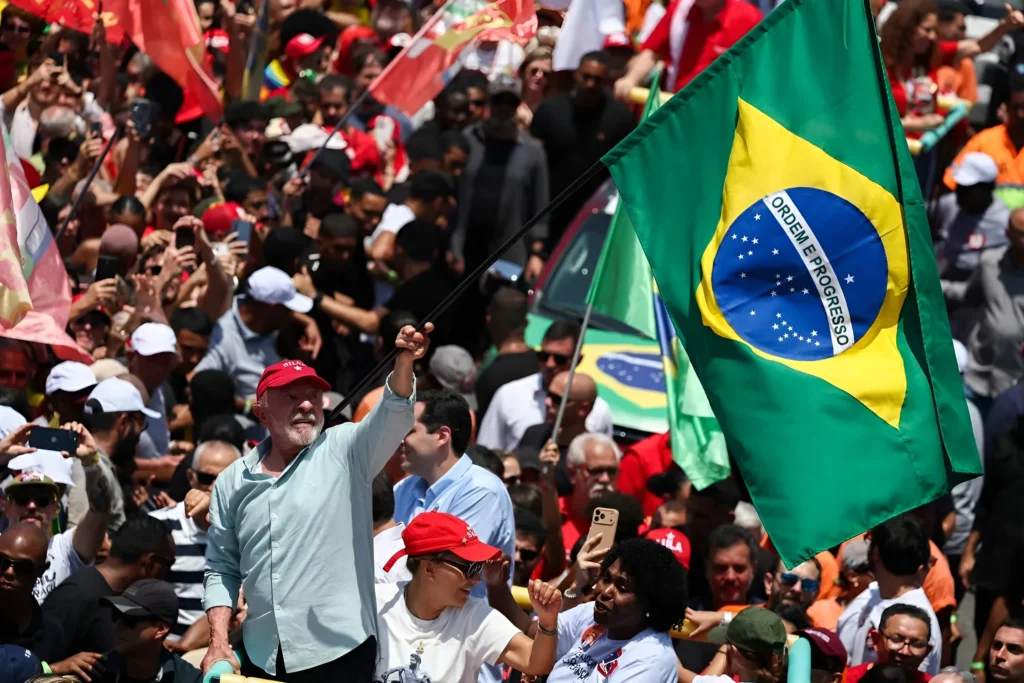
An emergence in working-class turnout delivered Lula a historic fourth presidential term, and that outcome signals a shift in climate policy and Latin American integration.
The 2026 Brazilian presidential election ended in a runoff, determining the leadership of Latin America’s largest nation for the next four years.
According to official data released by the Superior Electoral Court (TSE), incumbent President Luiz Inácio Lula da Silva of the Workers’ Party (PT) secured a fourth non-consecutive term after defeating Senator Flávio Bolsonaro of the Liberal Party.
The TSE’s final official count showed that Lula da Silva received 64,256,232 votes, representing 51.79 percent of the total valid votes. Flávio Bolsonaro garnered 59,826,041 votes, accounting for 48.21 percent of the valid ballots cast.
Voter turnout and participation figures underscored the civic engagement across the country, with total reporting reaching 100 percent of polling stations nationwide.
This electoral result marks a significant political milestone, occurring against a backdrop of intense political polarization in Brazil and the growing political influence of the far right across Latin America.
Lula’s victory sparked a wave of strong emotion in Brazil’s streets, eliciting a wide range of reactions, both positive and negative, to the outcome. In this in-depth article, we explore the discourse that has emerged following the confirmation of Lula da Silva’s win, which secures him a fourth term in office.
El triunfo electoral de Lula en Brasil redefine el tablero geopolítico y la correlación de fuerzas en América Latina.
The text reads, “Lula’s electoral victory in Brazil redefines the geopolitical landscape and the balance of power in Latin America. Do you think Lula’s win could shift the political equilibrium in the region?”
Domestic Mobilization and National Reactions to the Election Outcome
Brazil’s highest electoral authority, the Superior Electoral Court (TSE), announced the results of the presidential election runoff held this Sunday, October 25.
Following the official declaration, various reactions emerged within Brazil, reflecting the country’s political landscape.
Social organizations, trade union federations, and grassroots community networks gathered in major urban centers, including São Paulo, Rio de Janeiro, and Belo Horizonte, to await the election outcome.
Once the results were known, union leaders and civil society representatives emphasized that these elections, and Lula’s victory, demonstrate public support for the social welfare programs, minimum wage adjustments, expansion of public housing, and labor protections established during the current administration.
National media outlets highlighted the narrow electoral margin between the two candidates and its implications for the executive power exercise.
Market analysts noted that investor attention will focus on fiscal discipline targets, the management of public spending, and upcoming ministerial appointments for the new presidential term.
Is important to highlight that civic mobilization during the three-week interval between the first and second rounds played a decisive role in shaping voter participation.
Campaign committees focused on reducing voter abstention in metropolitan suburbs and organizing localized voter outreach efforts. Youth organizations and community groups conducted door-to-door awareness campaigns, while labor unions like the Unified Workers’ Central (Central Única dos Trabalhadores) coordinated transportation logistics to facilitate polling access for working-class voters in distant municipal sectors.
The national reaction also reflected broader debates regarding institutional stability and social cohesion. Differences emerged among religious organizations; even before the elections, the Catholic Church had issued statements noting that Flávio Bolsonaro’s proposals diverged from the Church’s social doctrine. Conversely, evangelical leaders have supported the claims of the defeated candidate by calling for the election results to be annulled.
BRAZIL ERUPTS AS LULA DEFEATS BOLSONARO
Brazil’s leftist President Luiz Inácio Lula da Silva staged a remarkable political comeback, defeating far-right candidate Flávio Bolsonaro to secure a historic fourth term, sparking mass celebrations nationwide.
Flávio Bolsonaro Response and Political Posture of Conservative Forces
In the immediate aftermath of the vote tabulation, Flávio Bolsonaro addressed his supporters and members of the press regarding the election results.
Bolsonaro and his campaign team requested that the TSE review procedures for voting hours at polling stations and the transmission of digital vote tallies in certain municipalities.
Candidate Flávio refused to acknowledge the election results that declared Lula the winner, stating: “It is impossible to recognize the outcome of these elections given the circumstances under which these events took place. We are going to request their annulment.”
Political analysts note that this post-election reaction aligns with common strategies used by conservative political groups in the region. Rather than immediately accepting the preliminary results, opposition leaders signaled their intention to maintain rigorous scrutiny over electoral authorities and administrative procedures.
Furthermore, Liberal Party representatives said that they will form an organized opposition bloc in the National Congress to oversee government actions, exercise legislative oversight, and challenge proposed changes to public policy throughout the legislative term.
🇧🇷 Lula's victory. A good day for socialists and not so good for capitalists.
80 years old and will be serving his last term as President. In 2022, after months in prison, he returned and won. He wins again after losing the 1st round in early October.
The Executive Victory Address and Focus on Institutional Integrity
President Luiz Inácio Lula da Silva delivered his victory address in São Paulo before supporters, party leaders, and domestic and international news agencies.
Lula’s speech outlined the strategic direction for his upcoming presidential term, focusing on national unity, poverty alleviation, re-industrialization, and democratic institutions’ preservation.
A central focus of the president’s address was digital communication, social media platform operations, and election administration. President Lula highlighted the impact of algorithmic distribution networks and automated messaging systems during political campaigns, asserting that digital platforms must adhere to national legal frameworks to prevent the spread of disinformation.
Lula said: “Brazil is no one’s backyard. We will change the way we run this country; we will make people participate more in the decision-making process.”
In his speech, President Lula emphasized the urgency of implementing updated regulatory guidelines for foreign technology companies operating within Brazil.
Lula stated that national sovereignty encompasses digital infrastructure, data protection, and the integrity of public communication channels.
The administration announced plans to work within the National Congress and regulatory bodies to draft legal frameworks addressing content moderation standards, corporate transparency, and digital network accountability during future democratic processes.
China takes note of the announcement by Brazil’s Superior Electoral Court of President Lula’s runoff victory @LulaOficial and extends congratulations. China stands ready to work with Brazil to advance the building of the China-Brazil community with a shared future. pic.twitter.com/1ClWUSx61b
International leaders and foreign governments issued statements following the announcement of the TSE election results. Despite the rejection of the results by Flávio Bolsonaro, leaders from Latin America, North America, and Europe weighed in on the outcome.
Mexican President Claudia Sheinbaum congratulated President Lula and the people of Brazil. Meanwhile, Uruguayan President Yamandú Orsi spoke with Lula by phone to congratulate him on the democratic process.
Even presidents with openly right-wing leanings, such as Noboa in Ecuador, Fujimori in Peru, and Kast in Chile, commented on the results and congratulated Brazil on Lula’s victory.
A common theme among these different heads of state was their emphasis on the importance of regional cooperation, economic integration through platforms like CELAC, and a shared vision regarding environmental sustainability.
In the United States, lawmakers such as Senator Bernie Sanders celebrated the election result, describing it as a reaffirmation of democratic governance and citizen participation in the hemisphere.
Meanwhile, Europe and Asia also reacted to the election result. French President Macron congratulated Lula on his fourth electoral victory and urged the deepening of the bilateral partnership between the two nations.
Spanish Prime Minister Sánchez described the win as a great victory via his social media channels, while Costa, the president of the European Council, spoke with Lula by phone to reaffirm the bloc’s ties with Brazil.
Additionally, a spokesperson for China’s Ministry of Foreign Affairs expressed Beijing’s full readiness to foster mutual development. Russian President Putin also sent his warmest congratulations via an official statement.
The Celebrations in Brazil for Lula's Victory are MASSIVE
There are THOUSANDS on the streets celebrating these Presidential Elections Results
Legislative Challenges and Regional Implications for Latin America
President Lula’s fourth term will be shaped by institutional dynamics and broader regional shifts. Domestically, the executive branch faces a conservative-majority National Congress, where conservative and center-right coalitions hold substantial parliamentary seats.
Pushing forward key agenda items, such as tax reform, social welfare expansion, fiscal adjustments, and climate conservation policies, will require building broad legislative alliances across party lines.
For their part, followers and supporters of Lula da Silva have announced that they will be monitoring the promises Lula made during his campaign, such as safeguarding the Family Allowance (Bolsa Família) program, strengthening food security, and increasing the real minimum wage.
Regionally, Lula’s victory consolidates left-of-center leadership in two of Latin America’s largest economies, Brazil and Mexico. This alignment provides institutional support for regional integration efforts, sustainable development initiatives in the Amazon basin, and coordinated strategies on international trade and environmental governance.
The election outcome signals sustained continuity for progressive policy frameworks while requiring pragmatic negotiation to navigate economic constraints and political polarization both domestically and internationally.
Sources: Brasil de Fato – Agência Brasil – Gov.br – O Globo – Folha de S.Paulo – O Estado de S.Paulo – El País – CNN Brasil – EFE – Instituto Tricontinental – La Base América Latina – Diario Red – TeleSUR – Al Jazeera
Attorney General Todd Blanche said on social media over the weekend that the Department of Justice does not seek “to stop the certification of Alaska’s election.”
The Department of Justice does not seek to stop any ballot from being cast or to stop the certification of Alaska's election. This litigation seeks to ensure that after Alaskans cast their ballots, they are preserved in a manner so that only Alaska's governing officials have the…
— Attorney General Todd Blanche (@AGToddBlanche) October 24, 2026
That statement is tough to square with the lawsuit the DOJ filed days earlier against Alaska’s election officials, as the department seeks to intervene there and in California amid GOP fears of losing congressional control in next week’s midterm elections.
The federal government’s Alaska complaint stems from its concern that Republican Sen. Dan S. Sullivan could lose a close race to Democratic challenger Mary Peltola due to the presence of a candidate on the ballot named Daniel J. Sullivan, who the DOJ said is running “with the intention of misleading supporters of Senator Sullivan into voting for him.”
But even if that claim about the other Sullivan’s intention is true, the legal question is: What can a federal court do for the federal government about it?
In the part of its complaint in which the DOJ makes its case for having legal standing to bring the suit, it said that its asserted legal injuries would be solved by a court order “declaring a certification of an election result prejudiced by Daniel J. Sullivan’s inclusion on the ballot unlawful and enjoining defendants [Alaska officials] from allowing such a certification to occur.”
Putting the merits of the DOJ’s argument aside — election law experts have deemed it incredibly weak — its complaint expresses an interest, contra Blanche’s post, in stopping the certification of Alaska’s election. To “enjoin” something is to stop it from happening. At least, according to the complaint, the DOJ wants to halt Alaska’s certification if the result is “prejudiced” by the other Sullivan’s inclusion on the ballot, At least, according to the complaint, the DOJ wants to halt Alaska’s certification if the result is “prejudiced” by the other Sullivan’s inclusion on the ballot — a claim that would be difficult to demonstrate in a timely manner, if ever.
Furthermore, in the complaint’s “prayer for relief,” which is the standard section where a plaintiff tells a court what it wants, the DOJ lists two specific things.
First, it asks the court to: “Declare that certification of any result that may be impacted by voter confusion, as defined above, would violate Defendants’ duties under the NVRA [National Voter Registration Act] to ‘protect the integrity of the electoral process.’”
Second, it asks the court: “Defendants from certifying any result that may be impacted by voter confusion, as defined above, pending an investigation to determine whether votes cast for Daniel J. Sullivan were meant to be cast for Senator Sullivan and any further procedures or relief this Court deems necessary and appropriate to determine what the result would have been absent Daniel J. Sullivan’s inclusion on the ballot.”
That second request for relief reads as if it is missing a word at the beginning. If so, then based on the rest of the complaint, the word “Enjoin” would seem to fit well. As in: Enjoin defendants from certifying … (I asked the DOJ press office whether a word is missing there, and if so, what that word is, but I did not immediately hear back.)
Whatever’s happening with that line, the government’s opponents are reading the complaint as seeking to block certification. Peltola’s campaign committee and the Democratic Senatorial Campaign Committee, which are attempting to join in the case to get it dismissed, said in a Sunday filing that the “DOJ seeks an unprecedented order precluding certification of the U.S. Senate election if the candidate the President favors loses narrowly.”
Calling the government’s claims “utterly without legal basis,” they said the Alaska district court “should not allow this lawsuit to hang like the Sword of Damocles over the ongoing election, lending false legitimacy to the President’s and the Attorney General’s ongoing efforts to spread false narratives about Alaska’s elections as voting continues and as results begin to be tabulated next week.”
One of the recurring themes this election cycle is a sense of betrayal: There are a growing number of constituencies that backed Republicans two years ago, only to feel abandoned by Donald Trump and his party.
Farmers, for example, voted for the president by lopsided margins in the 2024 race, and many have been let down by an administration that’s repeatedly made matters worse for the agricultural industry. Latino voters also shifted to Republicans in large numbers two years ago, confident that Trump would focus his deportation agenda on violent criminals. They now know better.
Similarly, many Muslim voters also took at enormous risk in 2024, moving toward a GOP nominee who championed a Muslim ban in his first term. Two years later, it’s a community that feels used and betrayed by a party that has seized on Islamophobia as the foundation for its closing message in the midterm elections.
But it’s also worth sparing a thought for those who believed Trump when he promised he was committed to “making America healthy again.” An overwhelming body of evidence leaves little doubt that he didn’t mean a word of it. The New York Times reported on the findings of a devastating investigation:
In total, since taking office again, Mr. Trump exempted 202 facilities in 39 states and Puerto Rico from clean-air regulations that were going into effect. Some were among the country’s worst industrial polluters, including chemical manufacturers, copper smelters and coal-burning power plants. About 3.3 million people live within three miles of at least one affected facility.
The exemptions represent the biggest presidential intervention in enforcement of the Clean Air Act in the half-century since President Richard M. Nixon signed the bedrock environmental law. And that is only one of the ways the Trump administration is dismantling a variety of federal environmental protections.
The Times documented in great detail the degree to which the Republican administration has systematically dismantled public safeguards to champion the wishes of polluters and chemical manufacturers, in ways without precedent in American history.
I’m mindful that much of the “MAHA” movement’s base is comprised of activists who are focused almost entirely on opposition to vaccines. But to the extent there are others who are genuinely interested in making America healthy again and who have sincere concerns about the spread of cancer-causing pollution, the Republican White House has gone to stunning lengths to express total indifference to those issues, instead elevating chemical industry lobbyists to leadership roles inside Trump’s Environmental Protection Agency.
“Donald Trump and [Health and Human Services Secretary Robert F. Kennedy Jr.] keep treating MAHA activists like disposable political pawns and now wonder why many resent it,” Protect Our Care President Brad Woodhouse recently said in a statement. “There’s not one MAHA promise Trump hasn’t been willing to break once the checks clear from his big chemical, food and tobacco donors. Food, air, water safety and kids’ health have all been compromised to feed profits for makers of addictive fruit flavored vapes, cancer-linked pesticides, and PFAS forever chemicals. And every time RFK Jr. proves himself a phony by making excuses for Trump’s latest MAHA double-cross, like making glyphosate great again.”
Time will tell how many of these constituencies move toward Democrats in the midterms or decide not to cast to ballots at all; but after the dust settles on the election cycle and the president and Republican leaders assess what went wrong, they might want to start by acknowledging the Americans who felt betrayed after counting on the GOP to deliver.
As October got underway, Donald Trump threw an online tantrum by way of his social media platform, lashing out at Sen. Tom Cotton because the Arkansas Republican hedged on a daylight saving time proposal supported by the White House. The president, however, didn’t just throw around some juvenile names.
Nearly two weeks later, as the president expressed fears about Texas’ U.S. Senate race, he threw another online tantrum, this time targeting Republican Sen. John Cornyn of Texas, whom Trump labeled a “WEAK and INEFFECTIVE” political hack who would deserve the blame if state Attorney General Ken Paxton loses.
On Friday, after Trump’s Justice Department filed an outlandish lawsuit targeting Alaska’s U.S. Senate race, Republican Sen. Lisa Murkowski of Alaska (who is not up for re-election this year) denounced the radical gambit, declaring in a statement, “Alaskans don’t need any help voting for their preferred candidates, and the State of Alaska has already handled this by clearly distinguishing the candidates on this year’s ballot. The Department of Justice should never have filed this lawsuit.”
Naturally, the president who demanded the lawsuit wasn’t pleased. In yet another lengthy online rant published Saturday night, Trump labeled Murkowski “the Republicans’ Worst Senator, by far,” before falsely saying that the senator “only got elected” because of the state’s system of ranked choice balloting, which he falsely described as “corrupt” and a “total Democrat [sic] scam.”
He added that Murkowski “probably wants” Democrats “to steal the Election,” before adding, “Lisa Murkowski is a DISGRACE to Alaska and our Country. You just don’t get any worse!”
Trump concluded that if incumbent Republican Sen. Dan Sullivan loses, “everything we’ve done for Alaska will come to an immediate hault.” (In context, I suspect he meant “halt.”)
For good measure, shortly before midnight, the president kept going, adding in a follow-up tirade, “They’ve been trying to get rid of Lisa Murkowski forever in Alaska, then she came up with the Ranked Choice Voting SCAM.” (Again, it’s not a scam; Murkowski isn’t the one who came up with it; and the system was not responsible for rescuing her career.)
That Trump holds the GOP senator in contempt is not exactly new, but the recent series of harangues directed at senators from his own party is a timely reminder that this guy, 11 years into his political career and nearly six years into his presidency, still has no idea how to deal with Congress.
Evidently, as the president sees it, if he can just harass his ostensible allies enough through online antics, then maybe they’ll succumb to his intimidation efforts and follow his demands.
Except, as he probably ought to know by now, his harassment efforts tend not to work. Cotton didn’t change his mind about daylight saving time; Cornyn hasn’t become a Paxton cheerleader; and Murkowski hasn’t backed off her criticisms of an indefensible lawsuit.
What we’re left with is a president who keeps picking pointless fights with intraparty allies, whose support he might yet need in the near future, in the run-up to critically important U.S. elections — which is every bit as foolish as it sounds.

 Login