The GCTP has appealed to motorists to obey traffic signals, wear helmets and seat belts, avoid speeding and dangerous driving, and refrain from using mobile phones while driving
OpenAI CEO Sam Altman said the AI giant is sorting through how to continue research while making sure those in specialized fields "get the best version of the future that they can have."
Minh Connors/Bloomberg via Getty Images
OpenAI CEO Sam Altman is conflicted about how AI models are changing fields like mathematics.
Altman said that he had some "sadness and melancholy" when he saw what OpenAI's models could do.
Prominent mathematicians have blasted AI companies for pursuing some of the field's most complex problems.
OpenAI CEO Sam Altman said he feels conflicted about OpenAI solving some of math's biggest problems.
"As I said, I don't think it was bad for AI," Altman told Stripe President John Collison during an episode of "Cheeky Pint" that was released on Thursday. 'And I think, on net, the world deserves to understand how the universe works. But I do have empathy for the method."
A number of prominent mathematicians have blasted AI companies for pushing frontier models to solve some of the most complex math problems. OpenAI pulled out of a Caltech "math hackathon" after current and former Caltech mathematicians and others in the field said the event was "likely to have destructive impacts for the mathematical community."
Separately, 28 Fields Medal winners published their own open letter, warning that "the push by AI companies to solve mathematical problems as a benchmark is detrimental to the science of mathematics, and to the mathematical community."
OpenAI received considerable attention after announcing that its models had solved a 90-year-old, unresolved problem related to the Navier-Stokes equations, a set of formulas that predict how liquids and gases move. The Clay Mathematics Institute had offered $1 million to anyone who could determine whether those formulas would always behave as we would expect in the physical universe, part of a series of difficult mathematical questions known as the "Millennium Problems." OpenAI said that its AI models found an example where the equations do not, and end up with a "singularity" where a vortex starts spinning infinitely quickly.
Altman said OpenAI is "working through" how to continue scientific research while also making sure those in highly specialized fields "get the best version of the future that they can have."
"I would like to figure out a way to do this that is as sensitive to the communities that have driven these fields forward for centuries as we can," he said, adding, "It's a hard thing."
Collison tried to assuage Altman's feelings, reminding the OpenAI CEO that "the longshoremen union weren't happy about the port automation."
Altman said part of the reason he feels differently about the whole experience is based on an OpenAI Slack channel that was named "Model Name-Hold My Beer" after the meme about if you think this is crazy just wait. (He did not explain if this was a released model or not.)
"People were just throwing that at the hardest problems they could," Altman said. "And people didn't think the model was going to do these things."
The AI model tackled "people's hardest research problems from their academic career." Altman said he was so excited, "I couldn't go to bed."
In addition to the euphoria, he said other feelings set in.
"I also had much more sadness and melancholy, and a feeling of something ending than I was expecting," Altman said.
The OpenAI CEO said it was "beautiful" that any mathematician could solve even the most formidable problem if only they worked hard enough. Altman said AI is changing that equation.
"I mean, certainly, most mathematicians never solve a Millennium Prize problem," he said. "But the idea that you might be able to."
Microsoft offered a buyout to 60,000 employees this week.
The offer spooked the tech industry and stoked chatter and concern inside the company.
The key question: How many employees Microsoft is prepared to lose?
Microsoft's huge employee buyout stunned the industry this week, raising urgent questions about why the software giant might want so many people to leave.
Inside the company, concerned staff debated the meaning of the move. Why might Microsoft want to shed 60,000 workers? Will roles be replaced by AI? Are more layoffs ahead?
Business Insider spent recent days speaking with Microsoft insiders to find out what's really happening. The people asked not to be identified discussing sensitive matters.
The main takeaway so far is that Microsoft seems to have unnecessarily spooked employees with the sheer size of its buyout offer, leaving leaders scrambling to calm the troops.
Chief Financial Officer Amy Hood in an internal memo explained the offer was intended to "offer employees agency if they choose to leave the company on their own terms" and said the company expected "very few people" to accept.
Microsoft doubled down later and told Business Insider it anticipates 3,000 or fewer employees will take the buyout. That's only about 5%, or less, of those eligible.
Layoff concerns
Earlier this year, the company offered a retirement buyout to employees based on age and tenure. About one-third accepted.
Soon after, Microsoft did another round of layoffs. Some employees who didn't accept the retirement offer ended up losing their jobs.
That's led to speculation that more layoffs may come in the wake of this week's bigger buyout offer.
"Future workforce needs will continue to be based on business needs and priorities," Microsoft said in a statement.
Misconceptions and differences
Business Insider spoke to Microsoft executives who said there are misconceptions about the current buyout offer.
These executives could only speak about their own teams, and they were hesitant to definitively say layoffs aren't coming. However, they pointed out a few differences between the current buyouts and the retirement offer.
"Microsoft doesn't want to shrink by 60,000 people," one executive said, while asking not to be identified. "We are not replacing everyone with AI."
This person thinks Microsoft made latest buyout offer because some employees complained that they weren't eligible for the retirement buyout earlier this year.
And in the case of the retirement buyout, when employees left, Microsoft didn't fill those roles — the headcount went away.
This week's buyout works differently. In some cases, when staff leave this time their roles will be backfilled with new hires.
Why the latest buyout looks so big
One reason the latest buyout looks so huge: Some leaders decided it would be simpler to offer it to their entire organization, rather than try to pick which specific teams or individuals should be included.
"It's easier to opt-in giant organizations," one Microsoft executive told Business Insider.
Charles Lamanna, the executive in charge of the Copilot Platform, AI agents, Office and Word, decided to offer it to everyone in his organization, one of the people said. That includes many people in critical positions. The organization is prepared to backfill roles if any of those critical employees accept the buyout, this person said.
The Cloud + AI group took a different approach
Microsoft's key Cloud + AI division took a slightly different approach, according to another executive from the company.
Two teams — Azure Hardware Systems and Infrastructure and Cloud Operations + Innovation teams — decided not to offer the latest buyout to staff.
Most other groups within the Cloud + AI division did offer the buyout to employees. And this division can backfill some roles, this executive told Business Insider.
Cutting costs and avoiding layoffs
Backfilling roles could still help Microsoft cut labor costs. One executive at the company said if a senior person were to leave, they would likely backfill the role with someone more junior who would potentially be paid less. A Microsoft spokesperson said that's not an official company position.
If all this seems overly complex, compared to layoffs, there may be a reason: Microsoft has been under fire for cutting American staff while employing foreign workers.
"Never say never, but there's a lot of desire not to do big layoffs, especially as an American company," one of the Microsoft executives told Business Insider.
I spent my Thursday at The Long Play, where attendees made new connections and debated the future of work.
Henry Chandonnet/Business Insider
I schmoozed with CEOs, founders, and investors at Business Insider's The Long Play in New York.
Attendees heard from speakers ranging from Barry Diller to Ashley Graham — and spent a whole lot of time networking.
Some attendees tried pitching deals. Others debated the future of work.
The New York venue was bustling with executives, some of whom governed companies with thousands of employees.
I met my first one within seconds of walking in.
On Thursday, I attended Business Insider's The Long Play event at Perelman Performing Arts Center. (Full disclosure: Business Insider is my employer, and you're probably reading this on its website.) I entered the event with a mission: to chat, network, and maybe learn a thing or two about my own career.
Workplace debates and startup chatter filled the air at Business Insider's The Long Play.
Carl Timpone/BFA
Mingling among the crowd, I chatted with the founders of AI startups and communications chiefs. They debated remote work, asked about management styles, and discussed working together. "I've got to work on my elevator pitch," one CEO told me.
I sat down for lunch with some attendees to discuss a question: Is workplace loyalty dead? Most said no, or that it was more complicated. One brave soul, the content creator Colin Rocker, said yes.
"I still think it's dead," he told me after the lunch chat. "But, I will say, I got more context that it's not necessarily working across the org chart."
He added: "That hurts managers, too."
Fancy napkins!
Carl Timpone/BFA
Others at our table traded mentorship techniques and thoughts on leading an office. Nitzan Shapira said that, while working at Intel and Cisco, meetings were crucial. He has more flexibility while leading his AI startup, Harmony. "I'm kind of allergic to meetings," he said.
Munching on my plate of salmon, salad, and a caprese sandwich, I continued to chat with the crowd. Then came the dimming of the lights and the voice on the loudspeaker. The interviews were about to begin.
A who's who of the audience
Ashley Graham at Business Insider's The Long Play.
Carl Timpone/BFA
You can tell a lot about the crowd from when people raise their hand — and when they don't.
I learned, for example, that much of the crowd had played "Grand Theft Auto." What better way to blow off some steam after a career-building conference than with some virtual vice? The attendees didn't consider themselves avid gamers, though; only a few hands shot up when Take-Two CEO Strauss Zelnick asked.
There were also a handful of investors in the crowd. Supermodel Ashley Graham asked for a show of hands, and I spotted three. During one of the breaks between talks, I talked shop with yet another venture capitalist.
As for GLP-1s, the crowd was less eager. Senior correspondent Melia Robinson asked while interviewing Ro CEO Zach Reitano, and she got only a few raised hands. (I bet, if we swapped the public hand-raising for a blind survey, that number would go up.)
The crowd at Business Insider's The Long Play.
Carl Timpone/BFA
The attendees around me were rapt. My seatmate, who worked for an AI startup, took notes with pen and paper. I saw some others jotting down learnings in the Notes app on their phones.
WeWork CEO John Santora described upping the once-freewheeling company's dress code. When he got there, Santora spotted pajamas and shorts; he now spots some salespeople in sport coats.
It prompted me to look around and check out what the audience was wearing. There were lots of blazers, button-ups, and slacks. A handful went more casual with their denim jackets and colorful blouses.
Take-Two Interactive CEO and chairman Strauss Zelnick and Business Insider senior correspondent Sarah E. Needleman at The Long Play.
Carl Timpone/BFA
There were belly laughs, like when my talented colleague Sarah Needleman flubbed "how do you define success" with "how do you define sex" while interviewing Zelnick. He chuckled; the crowd joined in, and it bonded the audience.
And there were sobering moments, like when Noa Argamani described her drive to fund Israeli startups after spending 246 days in Hamas captivity.
The list goes on: There were chats with media mogul Barry Diller, banking entrepreneur Cristina Junqueira, and Nadia Carlsten, the CEO of the sneaker-company-turned-AI-infrastructure-provider Smartbird.
The bar at The Long Play.
Carl Timpone/BFA
The event was really about meeting other people, though, and being inspired. I endlessly looped around the room, talking to C-suiters at startups and public relations agents. You could always hear the hum of new connections coming from the back of the room.
It ended with glasses of wine and hors d'oeuvres. After biting into a surprisingly delicious slider — Graham talked about pairing her wine with Korean barbecue and lasagna, and it made me hungry! — I had officially reached my schmoozing limit.
Drinks are served!
Carl Timpone/BFA
I ended the day with a full heart and a handful of new phone numbers. If you gave me yours, expect a text soon with plans to get coffee.
Amazon, Alphabet, and Microsoft were among the top spenders in 2026 amid the race to build out AI infrastructure.
Getty Images
Amazon, Alphabet, Meta, Microsoft, and SpaceX all reported increased capex spending for Q3.
There's no sign of slowing down, as company executives pledge to increase spending in 2027.
Total spend for 2026 is forecast to be between $803B and $828B.
The hyperscalers are investing big to build out the physical backbone of the AI economy, and there's little sign of it slowing down.
Amazon, Alphabet, Meta, Microsoft, and SpaceX each reported a jump in capital expenditures in their latest earnings reports and are on track to spend between $803 billion and $828 billion this calendar year based on their guidance and disclosed fourth-quarter plans.
That figure covers broad capital spending, not just on AI. However, executives at each company have consistently pointed to AI infrastructure as the main driver in the spending surge. And they've all indicated that they plan to keep it up.
"We continue to expect our CapEx to increase significantly in 2027," Anat Ashkenazi, Alphabet CFO, said during its Q3 earnings call on Wednesday.
Here's a quick breakdown of some of the numbers:
$227 billion spent in Q3
Across all five companies, total spending for the third quarter of the calendar year was about $227 billion.
That represents about a 20% increase from the $188.5 billion the companies spent the previous quarter.
Amazon was the biggest spender, reporting $75.9 billion in cash capex. CFO Brian Olsavsky said on Thursday that the figure is primarily related to AWS and AI.
$556.2 billion spent in 2026 so far
Tallying up the total capex for all three quarters, the five hyperscalers have spent a whopping $556.2 billion so far in 2026.
Elon Musk's SpaceX remains the smallest spender in the group with a capex of $48.1 billion, but its CFO, Bret Johnsen, has indicated that it expects to ramp up spending by the next quarter.
Up to $272 billion forecast for Q4
Next quarter's implied capex forecast ranges between $247 billion and $272 billion.
The low end of the range assumes Meta and Alphabet hit the low ends of their full-year capex ranges.
Based on the implied fourth-quarter calculations, Amazon is the only company whose spending would decline from its third-quarter level.
CEO Andy Jassy said during Thursday's earnings call that Amazon expects to spend "meaningfully more in 2027."
Up to $828 billion forecast for 2026
Microsoft expects calendar-year capex of about $170 billion, down from its prior outlook due to delays in third-party data-center capacity. Amazon, meanwhile, maintained its forecast for about $220 billion in cash capex this year.
Even so, 2026 is turning out to be a huge spending year. Altogether, the companies are projected to spend between $803 billion and $828 billion this year.
The companies haven't shared concrete numbers for 2027 capex, but all signs point upward.
"Looking beyond 2026, we are still developing our budget and capacity plans for next year," Meta CFO Susan Li said during the company's earnings call on October 21, "but we expect to continue investing aggressively to support both our core business and emerging AI initiatives."
A court-appointed Interim Administration Board of the Sai Baba temple at Mylapore flags alleged financial irregularities, unauthorised loans, and the clandestine demolition of the temple’s sanctum sanctorum by past administrators. Eight interim reports were submitted to the Madras High Court.
Google announced new capabilities for the Gemini app on Thursday. The Mountain View-based tech giant has introduced new tools that let users create, preview, and edit documents, PDFs, presentations,...
Desde que Harold Bloom puso el Juicio Final de Miguel Ángel en la cubierta de su famoso catálogo occidental de 1994 sabemos que todo canon es fruto del miedo. O por decirlo de un modo menos apocalíptico y con una palabra empleada por el propio Bloom: que todo canon es una elegía. También lo es este, centrado en el premio Formentor.
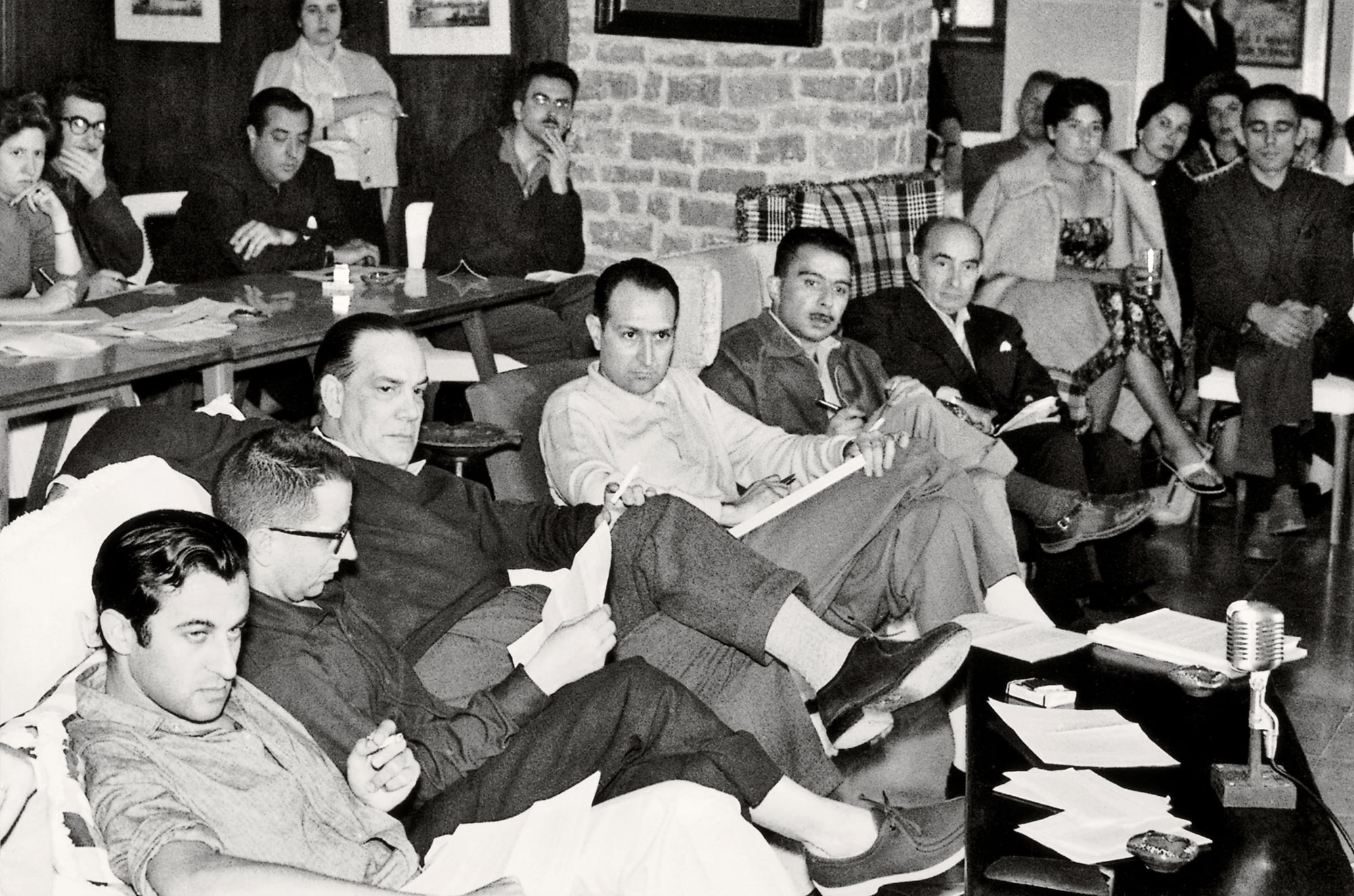
Juan Goytisolo, Víctor Seix, Camilo José Cela, Josep María Castellet y Juan García Hortelano durante una de las sesiones del Coloquio Internacional de Novela, en Formentor, en 1959.
It’s almost hard to remember, but just a few years ago, a lot of very smart people thought that science was in terminal decline. Respected researchers were writing papers with titles like “Are Ideas Getting Harder to Find?”, “Papers and patents are becoming less disruptive over time”, and “Slowed canonical progress in large fields of […]
Google shares fell 12 percent in morning trading after the company reported its first combined revenue and profit miss in nearly four years, driven in part by a sharp swing into negative free cash flow. The drop, which is the largest in Google's history, wipes out about $500 billion in shareholder value.
Israeli and foreign airlines alike must submit crew information 48 hours before departure; non-Israeli crew and passengers required to fill out online form before entering country
On Thursday’s broadcast of “CNN News Central,” Rep. James Walkinshaw (D-VA) reacted to the GDP report by saying that investment in AI and data centers is boosting GDP, “The question is, are hard-working families seeing the benefits of that? And
WeWork CEO John Santora at Business Insider's The Long Play event.
Carl Timpone/BFA
John Santora took the helm of WeWork in 2024, shortly after it emerged from bankruptcy.
Two years later, the company is making money.
At Business Insider's Long Play Event, Santora told Executive Editor Cadie Thompson how he did it.
For WeWork's CEO, Fridays are for sneakers. Sometimes.
At Business Insider's The Long Play event on Thursday, John Santora told Deputy News Chief Cadie Thompson that he rebuilt WeWork in part by establishing a sense of trust and decorum among employees.
In pursuit of that goal, Santora instituted a dress code for employees, but also gave them one day a week to work from home.
"I didn't have the ability to go watch my son play a 3 o'clock baseball game," Santora said, adding, "We have to give our employees that flexibility to do all that."
Santora, formerly the chief operating officer at Cushman & Wakefield, a real estate firm, became WeWork's CEO in 2024 as the once-buzzy office startup emerged from a disastrous Chapter 11 bankruptcy filing.
Santora had a short time to decide whether to join the faltering company, he recalled. And it wasn't exactly an easy choice.
"I was kind of at that point of, 'Should I retire?'" he said. "My daughter Nancy said, 'Dad, you know we love you, but when you have too much time on your hands, you're a pain in the ass.'"
Since those deeply red days in 2019 when WeWork's valuation plummeted from $47 billion to roughly $8 billion before it was bailed out, the company has stabilized. It posted eight quarters of EBITDA profitability and expects a fourth straight quarter of cash-flow profitability.
In 2025, it reported about $2.3 billion in revenue.
Though it hasn't hit the valuation it once had, the fact that the company could be revived at all is remarkable. WeWork, founded in 2010, rents out office space, spruces it up, and parcels it out to freelancers, startups, and other businesses.
Its first CEO and founder, Adam Neumann, made bold pronouncements that WeWork would "change the world" and "elevate the world's consciousness" by renting out office space to startups.
But after a bungled IPO, it became clear to the new stakeholders that a different type of leader was sorely needed.
As it turned out, Santora was that leader.
Having worked for 47 years at Cushman & Wakefield, Santora had the real estate experience that Neumann lacked, albeit without the magnetism of a Silicon Valley whiz kid.
"From a leadership standpoint, I'm a very structured, disciplined person," he said. "I'm a suit and tie, buttoned-up real estate person."
Santora recalled an early trip to one of the offices, where he discovered employees wearing jeans, pajamas, slippers, and shorts.
"I grabbed my head of HR," he said. "See that? I don't want to see it anymore."
Santora, who at one point described himself as an "old chubby guy from Staten Island," didn't just force employees to wear sports coats to important meetings. In his words, there was some "give and take."
"I don't look at what time they leave, what time they come in," he said of his employees. "As long as they're getting their work done and they're keeping their clients happy."
And Santora allows himself one exception to his suit-and-tie persona.
"Fridays, I'll actually sometimes wear sneakers, depending on what my schedule is," he said.
Amazon reported third-quarter earnings on Thursday.
Amazon stuck with its $220 billion capex forecast for 2026.
CEO Andy Jassy expects the company to spend "meaningfully more" next year.
Amazon is already spending a record amount on AI data centers. Next year will be even bigger.
The world's biggest cloud-computing company reported third-quarter results on Thursday and reiterated its plan for $220 billion in capital expenditure for 2026.
Then, CEO Andy Jassy shared his outlook for next year, saying Amazon expects "to spend meaningfully more in 2027."
Amazon’s spending has become the central question hanging over the company. It's building massive data centers and buying expensive chips and other gear to meet surging demand for AI.
That's pushed its free cash flow into negative territory, with third-quarter results showing a hole of $42.4 billion for the trailing twelve months.
Amazon spent $75.9 billion in cash capital expenditures during the third quarter alone, CFO Brian Olsavsky said, primarily on AWS and AI infrastructure.
The results did little to ease investors' concern about the spending. Amazon's third-quarter revenue and earnings came in below Wall Street expectations, and its shares fell roughly 6% in after-hours trading.
"The cloud unit's improving operating margin was one welcome signal, but it may not be sufficient to alleviate concerns about the sharp spike in capex spending and corresponding freefall of its free cash flow," Sky Canaves, a principal analyst at eMarketer, said in a statement.
Amazon has argued that AI infrastructure takes years to build before it can begin generating revenue, and that AI chip servers typically break even in less than three years once deployed. But the scale of the outlay has raised the stakes for Amazon's cloud business to sustain rapid growth as competitors make similarly enormous bets.
On Thursday, Jassy reiterated his confidence in the company's AI business model and outlook, saying there's a "clear line of sight to attractive financial returns."
The time it takes Amazon to turn newly delivered servers into revenue-generating capacity has also come under scrutiny.
Last week, Business Insider exclusively reported that Amazon has begun receiving billions of dollars in Nvidia server racks before all of the gear can be deployed at their final data-center sites, as power shortages and construction delays hold back new capacity.
"We can fund this plan"
Jassy argued Thursday that Amazon has visibility into the demand supporting its huge AI investments. Customers that need the largest AI deployments reserve capacity well ahead of time, he said, in blocks ranging from hundreds of megawatts to, in some cases, as much as a gigawatt.
"We have very good visibility into 2027 and 2028 and some of '29 too with respect to what customers want in those really big chunks of capacity," Jassy said.
AWS revenue rose 39.3% year over year to $46 billion in the third quarter, its fastest growth in nearly five years. Jassy said he expects AWS revenue to grow more than 40% in both 2027 and 2028, a projection that requires the company to keep rapidly adding capacity.
Jassy described the spending as a once-in-a-lifetime opportunity rather than an optional expansion. It would be more convenient, he said, if Amazon could spread the investment over 25 years. But the speed of the AI market does not allow that.
"We can fund this plan," he said. "It will forever change our revenue. It will forever change our free cash flow."
Smartbird CEO Nadia Carlsten at Business Insider's The Long Play.
Carl Timpone / BFA
Nadia Carlsten, CEO of Smartbird, spoke on the public company's shift from sneakers to AI.
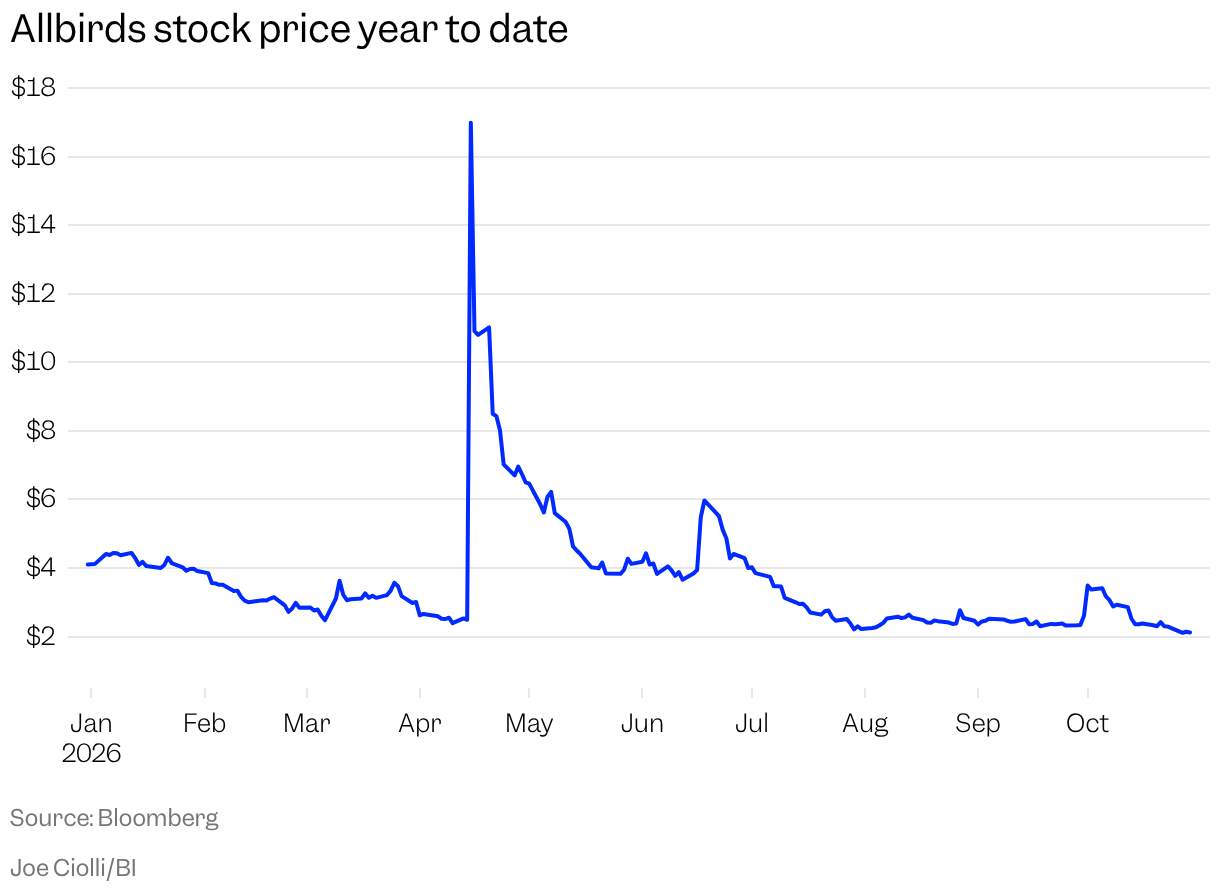
When the AI pivot was announced, the company's stock skyrocketed. It has since come back down.
Carlsten said Smartbird has a different approach to AI infrastructure, focusing on customer needs.
Before Smartbird was powering large language models, it was making shoes.
The CEO of the AI infrastructure company, Nadia Carlsten, spoke about the transition with chief correspondent Ben Bergman on Thursday at Business Insider's The Long Play.
Its roots are the sustainable sneaker company Allbirds, which skyrocketed in the late 2010s. The shoes were particularly popular among the Silicon Valley crowd. Allbirds went public in 2021 before the market turned on many direct-to-consumer businesses. The stock quickly fell, and it sold to American Exchange Group in March for $39 million.
"The short answer is the shoe business wasn't doing that well," Carlsten said.
The company then sold off its footwear business and shed most of its workforce, rebranding as Smartbird. The AI pivot skyrocketed the stock and was briefly up 800%, though it has since come back down. Carlsten, who became CEO in June, said she had never worn those wool shoes.
"The goal of the company was to do something valuable and meaningful. And for me, I knew I wanted to do AI infrastructure," she said.
After looking at the emerging AI infrastructure sector, she believed with the company's transformation, it was the "right place at the right time" for her to join.
In the five months since she took over, Carlsten said the experience can be described in one word: exciting.
"Never in my life thought that I would be the CEO of a former shoe company and managing what is essentially a startup." Since taking on the role, she has focused on building out a new team, scouring new technologies for the company to look into, and producing a new pipeline of customers.
While the stock price has gone down since the initial pivot-induced spike, Carlsten does not regret taking on the challenge. She is betting on the company's long-term potential.
"The stock market is going to do what the stock market does," she said. "What I care about is making sure that we're putting the company on the right path, and that we're able to build it quickly enough and well enough that we have a sustainable business that investors will love. So what happens in the short term? Not that important. What happens in the long term is very important."
When asked why the company decided to reinvent itself in the public eye instead of beginning as a private start-up, Carlsten countered with a question: "Why not?" she said, "It will come back up."
Having to reinvent the company from scratch can be challenging, and the public's presence is clear, she said. Yet, Carlsten said reinvention is inevitable for companies.
"This is a very public reinvention of the company, and people are watching," she said. "I think every company needs to reinvent itself every now and then."
When asked why the company is fully remote, Carlsten said most of the work at Smartbird is done virtually or at data centers, meaning an office would not be of much use.
"We spend a lot of time actually building things, which I actually love. So if my people are sitting in an office, something's wrong," she said.
Working within the emerging AI sector
Carlsten said that although her competitors are building similar AI infrastructure, the way Smartbird is going about it is unique.
"For us, it's about the right infrastructure for the right company at the right time," she said. "Our business model allows us to work more closely with customers, but it also is a lot less capital intensive."
Smartbird is looking to work with companies that have yet to explore implementing AI in their systems, she said. As more companies outside the tech realm look to adopt AI into their businesses, they have the choice to build infrastructure themselves or outsource it, and Smartbird wants to be the one to do it for them, she said.
"We'll do the infrastructure part. We'll let you focus on the actual business," she said.
The most common misconception Carlsten said she has encountered in the business is that it's all about GPUs. She said the company does a lot more than just run GPUs.
"It's really about having a holistic system that a customer can use to do AI," she said.
Another rumbling that's taken over the tech company discourse is whether there's an AI bubble and if it will pop. Carlsten said that depends on how people go about defining the bubble.
Excitement in the sector means funding might be going into companies that may not prosper in the future, but this is something that happens with the arrival of new technologies, she said.
"Every time there is a transformational technology, this happens," she said. "Even if we assume that there is a bubble, that doesn't mean that the technology is not good. It also doesn't mean that the adoption of the technology is going to go away."
Media titan Barry Diller, the chairman of publishing empire IAC, has built and rebuilt his career more than most executives, from network television to Hollywood studios to the earliest internet empires.
As part of Business Insider's The Long Play, Diller talked to Peter Kafka, Business Insider's chief correspondent covering media and technology, about what successful businesses require: good timing, nerve, and the willingness to walk away from what's working.
During this conversation, titled "The Art of the Comeback: A Masterclass on Resilience," Diller shares his perspectives on AI adoption. He also talks about why his MGM Resorts deal fell apart and how he's leveraging legacy print publications like Southern Living to create new revenue streams.
The 84-year-old media and tech exec told Kafka he wants to keep working as long as he can be engaged and useful.
RIYADH: For a generation that has grown up with social media, smartphones and increasingly accessible artificial intelligence, cyberbullying is no longer confined to hurtful comments or anonymous messages. Generative AI has introduced new ways to manipulate images, create misleading content and amplify harassment, making it increasingly difficult for young people to distinguish between what is real and what has been digitally fabricated. For 15-year-old Saudi content creator, public speaker and

 Login