The Pentagon is treating a string of freezer malfunctions at U.S. military base commissaries in late August as a suspected cyberattack, according to four officials familiar with the matter. Investigators are working with officials in France where a widespread cyberattack on supermarket freezers caused millions of dollars worth of damage.
Federal Judge Alvin K. Hellerstein, who was presiding over the trial of former Venezuelan president Nicolás Maduro in the United States, died Wednesday at the age of 92, according to The New York Times. It is not immediately clear who will replace Hellerstein in the high-profile case, which is scheduled to begin on June 14.
Defense Secretary Pete Hegseth ousted a top military strategist from the Pentagon, The Hill has learned, marking another senior officer who has been removed from the department since Hegseth took the helm close to two years ago. Hegseth fired Army Lt. Gen. Brett Sylvia, who was the director for strategy, plans and policy on the…
Defense Secretary Pete Hegseth ousted a top military strategist from the Pentagon, The Hill has learned, marking another senior officer who has been removed from the department since Hegseth took the helm close to two years ago. Hegseth fired Army Lt. Gen. Brett Sylvia, who was the director for strategy, plans and policy on the…
Soldiers at the 7th Army Noncommissioned Officer Academy's basic leaders course in the Grafenwoehr Training Area, Germany, Oct. 27, 2026.
Sgt. Collin Mackall/US Army
The Army is working to cut delays between recruitment, training, and assignments.
New scheduling tools aim to fill empty training seats and get soldiers into units faster.
The Army also wants to consider family medical needs earlier in assignment decisions.
The US Army wants to streamline how it trains new soldiers and places them into roles, part of a larger push to cut bureaucratic delays that can leave recruits waiting months for training and create logjams down the line.
Service leaders want to cut the time soldiers spend waiting between recruitment, training, and assignments, while also ensuring specialties are consistently filled by personnel who are prepared for and interested in the jobs.
At the Association of the United States Army conference in Washington, DC, earlier this month, leaders from Army Human Resources Command discussed how they're modernizing personnel management to get soldiers trained into the jobs where they're needed faster.
The data-driven approaches are aimed at connecting what have long been separate processes to better match soldiers to specific locations and jobs based on the Army's needs and scheduling.
Part of the challenge for the service is getting "hundreds of disparate systems" to talk to each other, said Lt. Gen. Charles Lombardo, who's overseeing the effort.
The Army is tackling that problem through a broader technology overhaul touching systems spanning from personnel management to battlefield operations. The Army has described its wider human-resources overhaul as an effort to replace fragmented, paper-based processes with a unified data environment. It says that the effort is intended to improve forecasting, resource management, and real-time personnel services.
For training, Army leaders want better scheduling with an approach they're calling People Supply Chain Management.
Rather than handling enlistment, basic training, and advanced training as separate events, the service is examining how to better coordinate these processes to reduce downtime and fill empty training seats.
The Army announced the initiative last year, saying it recruits, trains, and assigns tens of thousands of people annually across more than 200 specialties. Some of the Army's most in-demand technical specialties, such as military intelligence and air defense, are top of mind because they have more specialized recruiting and training requirements. Without synchronization, bottlenecks can leave recruits waiting months for training or leave too many soldiers in particular job fields.
With this approach, if two dates are available for advanced training, the system would route soldiers graduating from basic training to the class that best fits their schedule or redirect soldiers to fill seats that open up if someone can no longer attend.
It's still early days for the program, and it remains to be seen whether the new approach can meaningfully reduce wait times, fill more training seats, and get qualified soldiers into units faster.
The service also hopes overhauls will improve assignments for families with members requiring special medical care or specific childcare by matching them with bases that have the necessary services and providers.The aim is to account for those needs before assigning soldiers to duty stations, rather than after a job match has been made.
An Indonesian taxi driver who went looking for work abroad ended up in Russia's army and died in his first battle in Ukraine, Ukraine's military intelligence (HUR) said. Russian recruiters found him through a job application, and he reached the front in Donetsk Oblast within weeks of signing. HUR calls him one more foreigner drawn into Russia's war through deception.
Russia's war against Ukraine consumes men faster than the Kremlin is ready to replace them through another mobilization at home, so it keeps hiring abroad. Ukraine has identified nearly 46,000 foreigners who signed with Russia's army since 2022. On 26 October, a UN commission found “compelling evidence” that Russia trafficked men from 29 countries into its forces.
A résumé that reached Russian recruiters
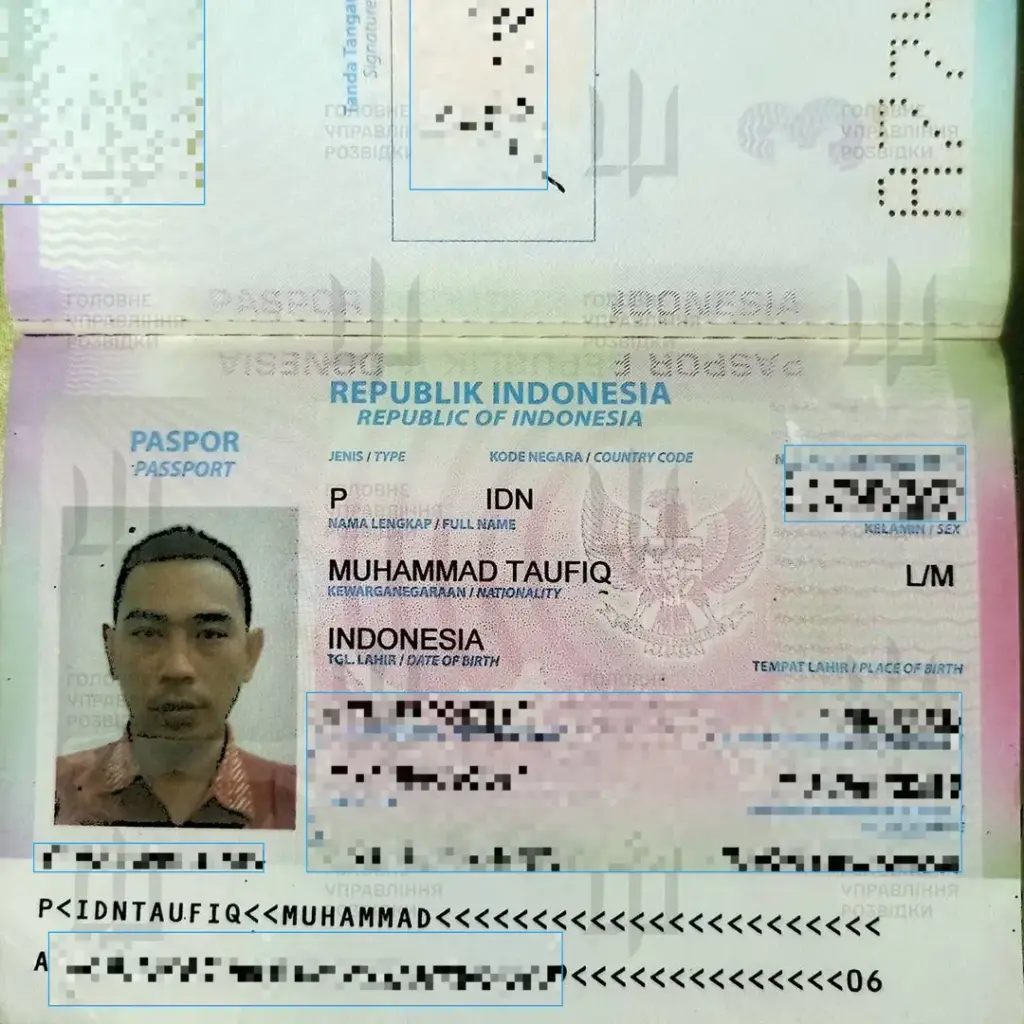
Taufiq Muhammad, born in 1978 in Sorong, Indonesia, drove a taxi in Jakarta and had once worked in the US. Russian recruiters found him through a résumé he had sent out while looking for work, the agency said. He probably believed promises of “easy money” and traveled to Moscow. HUR sees his case as part of a pattern.
“In fact, he became yet another victim of Russia's scheme of recruiting foreigners for the criminal war through deception,” HUR said.
A week and a half of training, then the front
Muhammad signed a one-year contract with Russia's army in Korolyov, near Moscow, on 19 April 2026. HUR called that term typical for foreigners Russia uses as “disposable” infantry. Russia made him a machine gunner and gave him only a week and a half at a training center near Voronezh, Army Inform reported, citing HUR.
Passport of Taufiq Muhammad, an Indonesian citizen Ukraine’s military intelligence says Russia recruited, with his personal data pixelated by Euromaidan Press. Photo: HUR
Russia moved him to occupied Ukraine in early May. He died almost at once, in his first battle. Russian troops were trying to advance from the village of Zelena Dolyna toward Novoselivka and Drobysheve in Donetsk Oblast, Militarnyi reported.
Indonesia is the newest recruiting ground
Russia's recruiters have been working in Indonesia for months. In August, Ukraine's Foreign Intelligence Service said it held documents on at least eight Indonesians recruited into Russia's army.
Another Indonesian, Rendi Apriyanto, 30, was reportedly killed in September, his family learned from an Indonesian fighting for Russia. Rendi had told his family he was recruited for logistics work, The Jakarta Post reported.
HUR has traced the same fast track before. In January, it identified a Filipino recruit killed in a Donetsk Oblast assault after one week of training. A Nigerian, 34, died in Kharkiv Oblast after a similar week of training, HUR said in May.
Russia courts Africa ahead of a summit
Ukraine's Foreign Ministry has counted at least 2,982 Africans recruited into Russia's army, and 486 of them have died. Ahead of a Russia–Africa summit on 28–29 October, Moscow plans military and port-access deals with a string of African states, HUR said. The deals would help expand the campaign of Russia's Africa Corps, the Defense Ministry-controlled force on the continent, Army Inform reported, citing HUR.
Each recruit Ukraine identifies gives his home government a documented case to act on. Jakarta has said citizens shown to have been deceived will get its protection, while those who enlisted by choice could lose their citizenship.
Russian authorities committed war crimes and crimes against humanity through attacks on Ukraine’s energy infrastructure, the UN Independent International Commission of Inquiry on Ukraine said in a report to the UN General Assembly on 26 October.
International Criminal Court (ICC) warrants for former Russian Defense Minister Sergei Shoigu and Chief of the General Staff Valery Gerasimov, issued in June 2024, already covered alleged crimes linked to Russia’s 2022–2023 strikes on Ukraine’s energy infrastructure. The UN commission’s new report reaches into last winter, 2025–2026, and the cumulative toll since 2022, documenting what the attacks did to civilians living through outages in freezing temperatures.
“As the cold season approaches, the attacks have intensified once again, raising serious concerns about the threats to civilians’ lives and health,” commission chair Erik Møse said.
Russian commanders knew heating facilities were vital
The commission said Russian commanders knew that heating facilities in large cities were indispensable to civilians, particularly during winter. Russian authorities also made official declarations about further attacks and referred to a plan to carry them out, it said. It found that Russian authorities intentionally directed attacks against civilian objects, constituting war crimes.
The commission also concluded that the attacks were carried out under a state policy aimed at depriving civilians of electricity and other essential energy-dependent services and causing suffering. It classified these acts as crimes against humanity in the form of “other inhumane acts.”
Minus 21°C, weeks without heat, and shelters out of reach for older people
Last winter, temperatures fell to minus 21°C as millions of Ukrainians endured prolonged disruptions to heating, electricity, water, and gas, the commission said.
The commission relied on the accounts of 255 people from Dnipropetrovsk, Kyiv, Kharkiv, Kherson, Mykolaiv, Odesa, Poltava, Zaporizhzhia, and Zhytomyr Oblasts, alongside officials, doctors, and nongovernmental organizations.
Older people and those with limited mobility were particularly affected. Fear of becoming trapped in elevators during blackouts prevented some residents from reaching shelters during air raid alerts. They remained in unheated homes, sometimes without access to life-support equipment.
A 53-year-old Kyiv resident told investigators he tried to stay awake at night because he feared he might not wake up if he fell asleep in the cold.
Meanwhile, school closures disrupted children’s education, and children fell ill in unheated homes, the report said.
Russia rejects the findings
Russia’s UN mission said Moscow did not recognize the commission’s mandate and dismissed its findings as “falsified data,” the Associated Press reported.
The commission also examined Ukrainian attacks on energy infrastructure in Russia and Russian-occupied Ukraine. It said it could not investigate their impact fully because Russia denied access and did not respond to its requests.
Foreign recruits trafficked to the front
The same report found “compelling evidence” that Russian authorities trafficked men from 29 countries into the Russian armed forces through deception and coercion.
Recruitment agents arranged visas and travel, presenting themselves as legitimate businesses. After arriving in Russia, the men were forced to sign military contracts in Russian and were sent to the front, where many were killed or went missing, the commission said.
North Korea has the fourth-largest number of active armed forces in the world.
Alain Nogues/Corbis via Getty Images
China, India, and the US have the largest active armed forces in the world.
The International Institute for Strategic Studies compiled data about the world's militaries.
The world's top armies spend hundreds of billions of dollars on defense each year.
The US military may lead the world in budget size and in the ambitions of its warfare technology, but there is one measure by which it is outsized by other nations.
Using data from the International Institute for Strategic Studies' 2026 Military Balance report, Business Insider ranked the top 25 countries by the size of their active armed forces during 2025 and listed their defense budgets that same year.
Active-duty force size is a tally of a country's uniformed troops: airmen, soldiers, sailors, special operators, and Marines.
Armies, in particular, depend on size to gain and occupy ground during armed conflicts.
Militaries can also be a tool of domestic repression. North Korea, for example, is one of the world's most repressive states, led by a dictator who has repeatedly threatened neighboring South Korea — and it also has one of the world's largest militaries.
The number of active-duty military personnel is far from the only factor that matters when comparing military power between countries, but it reflects latent power.
"Numbers have value, but there's a lot more to military capability," Mark Cancian, a senior advisor at the Center for Strategic and International Studies, a Washington, DC-based foreign policy and national security think tank, told Business Insider.
IISS, a London-headquartered think tank, counts active armed forces, reservists, and paramilitaries as separate categories in its analysis, showing a fuller picture of each nation's manpower.
Some countries have significantly more reservists than others — Vietnam has the largest number in the world, estimated at 5 million — but the quality and longevity of their expertise can vary between systems.
"When you look at some countries' reserve numbers, you're often looking at people who haven't trained in 10 or 20 years," Cancian said. "It gives you a big number, but their military value is questionable."
Even when accounting for all of a military's manpower, personnel is only one of the factors that can qualify a nation's military strength, which also includes equipment and readiness.
There's also the role of technologies in global warfare, the size and sophistication of air forces and naval fleets, amphibious capabilities for landing assault forces, command-and-control systems, and nuclear forces, all of which shape military power.
Still, comparing global manpower offers insight into how countries prioritize military power.
See how the world's largest militaries stack up in terms of active troop numbers.
Kazakhstan, Kyrgyzstan, and Kenya are seeking the return of citizens drawn into Russia’s war, Ukraine’s Foreign Intelligence Service (SZRU) said on 25 October. According to relatives and officials the agency cites, many of the men had gone to Russia for work, only to be tricked or forced into its army.
Russia fills its ranks partly with foreigners. In April, Ukraine’s military intelligence (HUR) said the Russian Defense Ministry plans to enlist at least 18,500 of them in 2026. Foreign recruits let the Kremlin put off hard choices about another mobilization at home, the Atlantic Council argued in May. Home governments have pushed back before, among them Ghana in August. The new statements show the limit of that pushback. Once a man is serving in Russia’s army, his government has to ask Russia to let him go.
Kyrgyz minister: contracts are forced in enlistment offices and jails
Kyrgyz Foreign Minister Jeenbek Kulubaev addressed the problem at a parliamentary committee on 13 October, answering lawmakers’ questions. He said Kyrgyz citizens in Russia are forced to sign contracts at military enlistment offices or in pretrial detention centers. If warned in time, diplomats try to stop the men from reaching the front.
Kazakhstan is compiling a list for Moscow
Kazakhstan is negotiating with Russia over citizens in the combat zone. Its Foreign Ministry said on 7 October that it was checking each hotline request. Once the checks are complete, the ministry said, it will send the compiled list to the Russian side.
SZRU separately cited unnamed relatives of one Kazakh worker. After he complained about working conditions, they said, he and other men were taken to an enlistment office and forced to sign contracts.
Kenya wants five men held by Ukraine treated as possible trafficking victims
Prime Cabinet Secretary Musalia Mudavadi, who also handles foreign affairs, gave lawmakers a count on 8 October. “The Ministry has records of 354 Kenyan nationals involved in the Russian-Ukraine crisis,” he told them. Families who petitioned Parliament dispute that number and put their own count at 841, Kenya’s The Star reported.
Explore further
Kenya says Russia agreed to stop recruiting its citizens – families of the missing are still waiting
Ukraine holds five Kenyans captured while fighting for Russia, and Nairobi has already appealed to Kyiv over them. The government told Parliament it wants them treated as people who may have been trafficked abroad.
For Kenyans still serving in Russia’s army, the way out runs through Russian officers. Moscow informed Nairobi that unit commanders will consider requests to end military contracts case by case, the same government response said.
The U.S. Army is training Apache pilots to shoot down drones as militaries around the world assess the efficacy of 20th-century technologies in a new era.
Bohdan Vitvitsky examines the renewed dispute between Poland and Ukraine over the legacy of the Ukrainian Insurgent Army, questioning Warsaw’s claims to moral authority over Ukraine’s historical memory and whether such interventions are consistent with European principles of sovereign equality.
The strange historical dispute between Poland and Ukraine, in which Polish officials keep making demands upon Ukraine, seems unwilling to die down. Most recently, on October 20 the L’viv oblast (regional) council announced plans to honor the World War II-era Ukrainian Insurgent Army (UPA) and its military leader, Roman Shukhevych. The council declared 2027 as the Year of the UPA, the Year of Shukhevych and the Year of Oleh Olzhych, a Ukrainian poet and political activist. In response, the Polish charge d’affaires in Kyiv, Piotr Lukasiewicz, responded by stating that “glorifying the UPA and criminal figures runs counter to European values and the strategic and neighborly relations between Ukraine and Poland.” Similar statements were then echoed by other Polish officials, including ministers. Are the Poles right about it being the Ukrainians who are running afoul of European values? And are Poles right to think that they have the right and the authority to police whom in history Ukraine chooses to memorialize? I would suggest that the answer to both questions is no.
Sovereign equality is a fundamental principle in international law that asserts that all states are equal, regardless of their size or power. The equality of states is a fundamental constitutional principle that governs how the European Union functions. As a general proposition, it is, thus, contrary to European values for Poland or Polish officials to assume that Poland has some sort a special right to dictate to Ukraine whom it may or may not memorialize, as one can presume that Poland would vigorously reject Ukraine’s or anyone else’s attempt to tell Poland which historical figures it may or may not memorialize based on that outside country’s views of the demerits of Poland’s various heroes.
But given the spirit behind the set of values that developed after the horrors of World War II and after the Western European countries finally lost all of their colonies by the 1960s, there are certain actions by Ukraine or any European country that could merit criticism or even condemnation. For example, it is incontestable that in the summer of 1943 the UPA, which was newly formed in Volyn, attacked Polish villages and there killed civilian men, women and children in the tens of thousands. It is also incontestable that according to most definitions, that massacre was a war crime. With respect to these events, what actions by contemporary Ukrainians could merit condemnation? There are two. First, if any Ukrainian official or political figure or public intellectual or organization were to deny that this massacre took place, he/she/they/it would clearly merit condemnation. Have any current or recent Ukrainian officials or other spokespersons denied the occurrence of the Volyn massacre? The answer is no.
Second, if any Ukrainian official or political figure or public intellectual or organization were to admit that the Volyn massacre took place but nevertheless deny that it was a war crime or actually condone it on the basis of some one or another historical Ukrainian grievance against the Poles, that would, in accord with contemporary European values, merit condemnation. Have any current or recent Ukrainian officials or other spokespersons denied that the massacres of Poles were a war crime or maintain that for some reason these massacres were to be viewed approvingly? The answer, once again, is no.
So why do Polish officials still complain? They complain because in effect they want to assert that they have the right more generally to be the ones to define Ukraine’s historical past. As the great British historian of Poland Norman Davies has pointed out, this is absurd. About 4% or 5% of the soldiers in UPA participated in the Volyn killings, and in fact most of the members of UPA joined after 1943. UPA is memorialized in Ukraine because of the extraordinary heroism of many, but certainly not all, of its members in the Ukrainian anti-colonial struggle against the Poles, the Germans and the Soviets that extended into the 1950s against the Soviets. The Poles seem to think that, ignoring what UPA did against the Germans and for much longer against the Soviets, and regardless how large or how small was the percentage of the UPA that was involved in the 1943 massacre, it is what happened to the Poles who were massacred that is more important than all else and it must be that which defines who and what UPA was. The Poles are of course entitled to view the UPA however they choose, but they insist on more. They insist on having the right to dictate to Ukrainians how to view the UPA.
There is another major problem with Polish complaints about Ukrainian memorialization. It is the problem of moral standing. The Polish minority in Volyn, about at most 16% in the interwar period, represented the nation that had militarily conquered and then occupied Volyn and other parts of western Ukraine. Ukrainians constituted between 65% and 70% of Volyn’s population. Some among the Polish minority were the descendants of the Polish lords and their administrators who had colonized Ukraine in the 15th – 17th centuries when Ukrainians were enserfed, a form of slavery that continued into the 19th century. In the interwar period between World War I and II, the Polish minority maintained its political, economic, educational and cultural domination of the Ukrainian majority. And, during World War II, the Polish government in exile in London continued to insist that Poland had the right to include Volyn in Poland and thus to continue to maintain dominion over the Ukrainian majority living there. None of this obscures what was a war crime, but given the Polish history of domination and exploitation of Ukrainians, it does call into serious question whether today’s Poles as putative representatives of the historical Polish nation should today have moral standing to make complaints against Ukrainians.
Lastly, killing civilians is killing civilians. It is a war crime. As has been well documented, during World War II various Polish units, including units of the Polish Home Army, which army is widely venerated and memorialized in Poland, attacked Ukrainian villages and killed civilian men, women and children. Those killings are often waived off as supposedly “retaliatory” attacks, but that is nonsense. The villages that were attacked were not even in Volyn but were simply Ukrainian. So if today’s Poles think that they have a right to make grievance claims on historical memory relating to events multiple generations ago, then they must also accept the burdens of accepting grievance claims against them. To put it in legal terminology, as regards history, it’s not as if Poles had clean hands.
In light of all of the above considerations, and with the exceptions discussed above, contemporary Polish officials do not have the right to routinely keep injecting themselves into Ukrainian decisions to memorialize historical figures that, for Ukrainians, were predecessors of Ukraine’s current efforts to fight off yet another attempt to subjugate it.
Dr. Bohdan Vitvitsky is a retired federal prosecutor and a former U.S. diplomat who holds a Ph.D. in philosophy.
Recent midlife upgrades to China’s older surface combatants highlight an ongoing debate over whether preserving naval fleet mass provides an operational edge over purely qualitative technological modernization in naval warfare. This month, the South China Morning Post (SCMP) reported that the People’s Liberation Army Navy (PLAN) has carried out an extensive midlife refit of its […]
Defense Secretary Pete Hegseth barred all Pentagon staff from using undisclosed information to place wagers on forthcoming U.S. military action using betting platforms and prediction markets like Kalshi and Polymarket. “Make no mistake why this matters. Our enemies watch movements in these markets,” Hegseth said in a memo, first obtained by CBS News. “When an American…
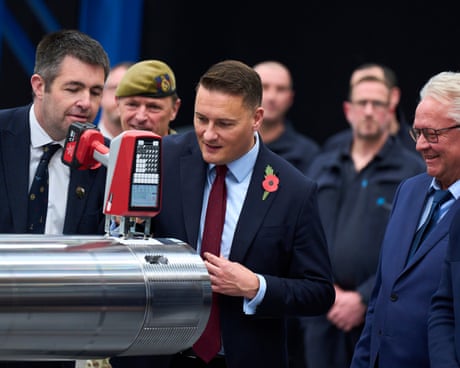
Defence secretary says Britain must manufacture at scale as Germany’s Rheinmetall opens Midlands factory
For the last 20 years, Britain was unable to put a barrel on its tanks without buying from abroad. Relying on foreign allies seemed like a reasonable choice during years of relative security (for wealthy countries at least) after the end of the cold war.
Poland has paused the delivery of a large military aid package to Ukraine after a Lviv regional council honored the Ukrainian Insurgent Army (UPA), a WWII nationalist force, a source in the Ukrainian government told European Pravda on 21 October. A Polish Defense Ministry spokesperson told Fakt the report was untrue, though he told WP he knew nothing about a possible delay in shipment.
If confirmed, the freeze would carry a history dispute into Poland’s military aid. The row flared in May, when Kyiv named a special forces unit after the UPA, and in June Poland’s president stripped Zelenskyy of Poland’s highest honor. Even so, Ukraine’s ambassador said in August that Polish military aid was still flowing.
A vote and a disputed freeze
The Lviv Oblast Council voted on 20 October to name 2027 the year of the UPA, its commander Roman Shukhevych, and nationalist activist Oleh Olzhych. The UPA fought Nazi Germany and the Soviet Union, but Poland holds it responsible for mass killings of Poles in Volhynia and Eastern Galicia in 1943–1944. The resolution disappeared from the council’s website late that evening, RMF24 reported.
The source blamed what it called the councilors’ irresponsible actions, saying the vote came as Poland prepared the shipment and that work through closed channels is underway. The ministry spokesperson, Janusz Sejmej, called the report untrue. Asked whether it could reflect a delay in shipment, he said he knew nothing about that.
Explore further
Progress on a sore point for Ukraine and Poland: remains of over 40 Ukrainians killed by Polish WWII units found in Łasków
Polish officials push back
On 20 October, Defense Minister Władysław Kosiniak-Kamysz wrote that Ukraine’s authorities must distance themselves from the council’s position.
The next morning, Prime Minister Donald Tusk called the vote unwise and harmful above all to Ukraine. He said he had warned Zelenskyy earlier that such gestures hinder Ukraine’s friends, though the president was not responsible for this vote. At such moments, Tusk said, Russians always rub their hands.
Foreign Minister Radosław Sikorski then requested that councilor Sviatoslav Sheremeta, who proposed the resolution, be added to Poland’s list of unwanted persons. That afternoon, Interior Minister Marcin Kierwiński said the decision had been made. Sheremeta is barred from the Schengen zone until 2031, RMF24 reported. Poland had already barred him once, in 2017, the outlet said.
Kyiv asks for restraint
Earlier on 21 October, before the ban, Ukraine’s Foreign Ministry called the vote counterproductive in a reply to journalists and urged Warsaw to avoid abrupt steps. Zelenskyy’s closest aides had also promised the resolution would not take effect, Deputy Foreign Minister Marcin Bosacki told TVN24.
The U.S. Army wants to infuse new autonomous capabilities into its current and future fleets of amphibious landing ships and other watercraft. The service is also aiming to acquire up to 100 new purpose-built uncrewed surface vessels (USV). The maritime assets the service has now, often referred to as ‘the Army’s Navy,’ are obscure and generally underappreciated. However, the small force offers an important additional set of naval logistics capabilities, especially for any future fight in the Pacific, which could be further bolstered with optionally-crewed or entirely uncrewed platforms.
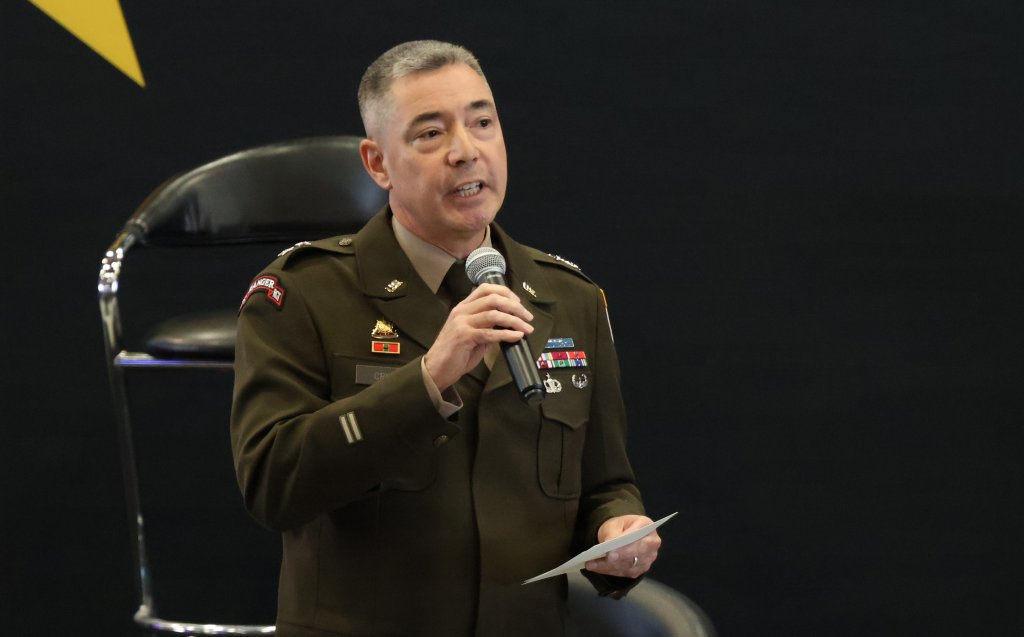
Army Maj. Gen. Frederick Crist, head of 8th Theater Sustainment Command (TSC), issued plans for future autonomous watercraft capabilities during a talk last week during a talk at the Association of the U.S. Army’s (AUSA) main annual symposium. 8th TSC, which has its main headquarters at Fort Shafter in Hawaii, is one of the top formations tasked with managing U.S. military logistics across the Pacific.
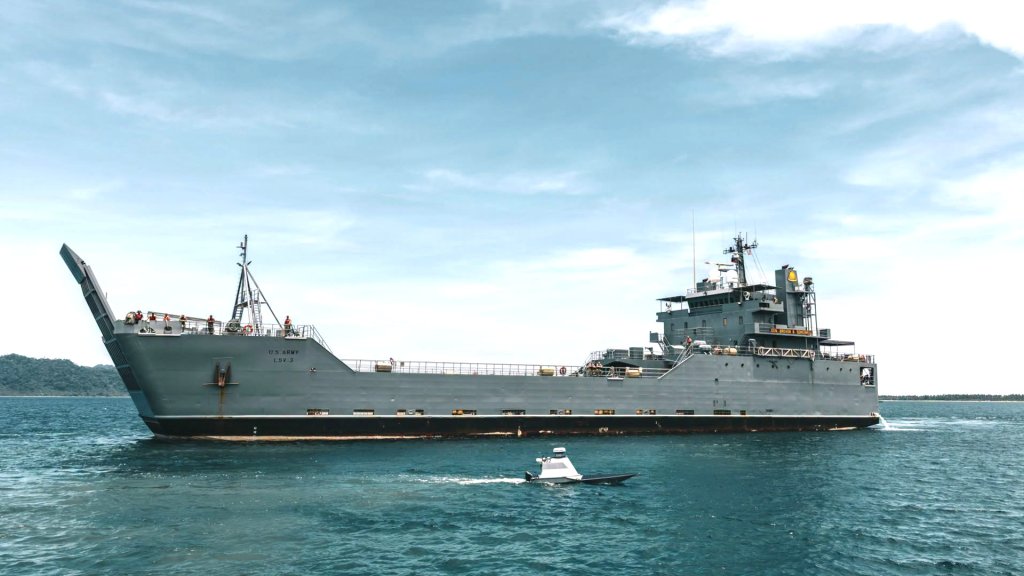
An uncrewed surface vessel (USV) passes by the US Army’s General Frank S. Besson class Logistics Support Vessel USAV General Brehon B. Somervell. US Army
“In order to be able to increase theater distribution, we have the two composite watercraft companies, at end state there, west of the IDL [International Date Line],” Crist explained, referring to the Army’s future planned maritime force posture in the Pacific. “We continue partnering with industry to be able to move into autonomous watercraft systems to be able to conduct other means of maritime distribution.”
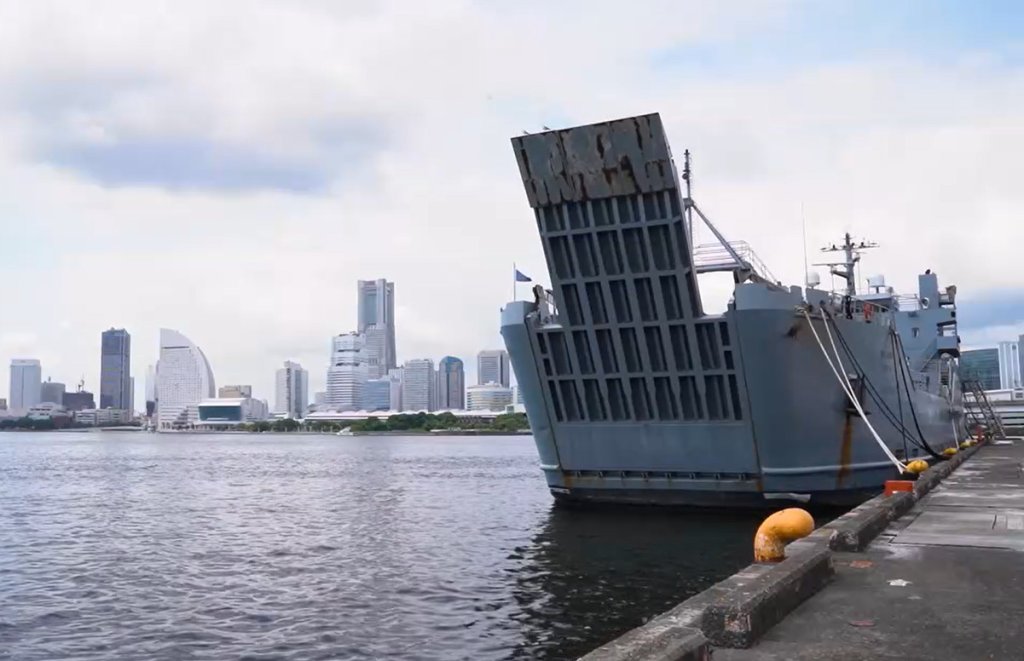
To take a step back quickly, as part of its broader regional role, 8th TSC also has forward-deployed elements in Japan. This includes the 5th Transportation Company, which is currently organized as what the Army calls a composite watercraft company. As of 2024, the unit had a pair of General Frank S. Besson class Logistics Support Vessels (LSV), as well as 10 smaller Landing Craft Utility (LCU) type vessels and four small tugs, according to the Government Accountability Office (GAO).
The Army has eight LSVs, in total, and these are by far its largest and most capable ships. The two youngest LSVs, which were acquired in the mid-2000s, also form a distinct subclass, and their design is optimized for long-distance open-ocean operations, as you can read more about here. It’s not immediately clear which LSVs are currently assigned to the 5th Transportation Company. The unit is also set to receive new Maneuver Support Vessel (Light) landing craft.
Examples of the original LSV design, at left, and the open-ocean-optimized design, at right. An LCU-type landing craft is also seen at far right. US Army
Until very recently, the 10th Support Group (Regional), headquartered in Okinawa, was more directly responsible for overseeing forward-deployed Army logistics units in Japan. Earlier this month, the Army performed a so-called ‘reflagging’ of that formation, a largely administrative process that transformed it into the 45th Sustainment Brigade.
As part of the reflagging of the 10th Support Group into the 45th Sustainment Brigade, the Army has also been pushing ahead with plans for “the standup of a second composite watercraft company in Yokohama North Dock,” in the port city of the same name on the Japanese home island of Honshu, Maj. Gen. Crist explained last week. “That end state will have two composite water[craft] companies west of the IDL [International Date Line] under the command and control of the 45th Sustainment Brigade.”
A US Army LSV at the pier in Japan. US Army
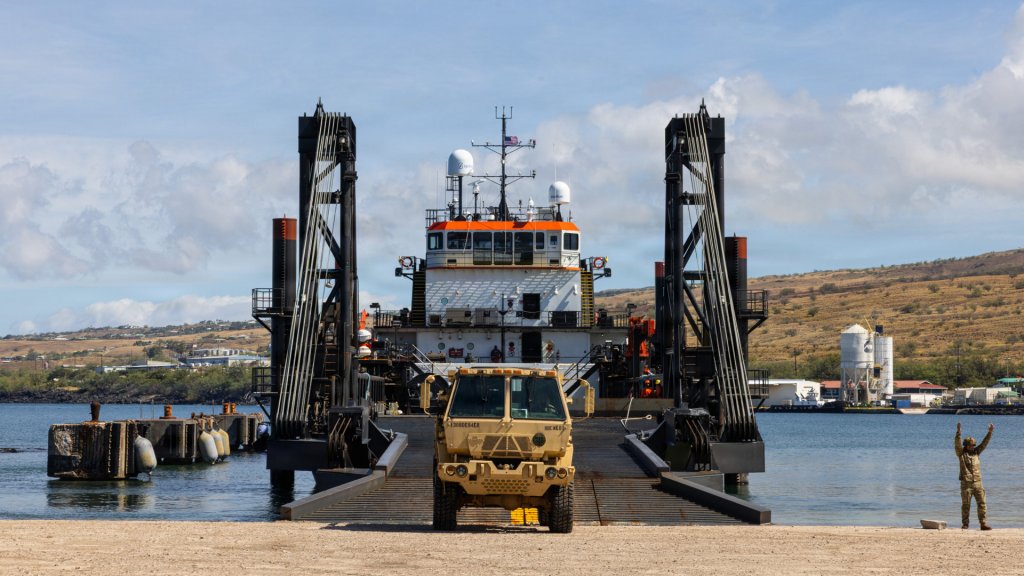
When it comes to the watercraft assigned to these units, “we’re also moving into the autonomous lane,” Crist added. “Just in August, USARPAC [U.S. Army Pacific] had an opportunity to conduct an experiment by retrofitting an existing commercial vessel, the HOSResolute [sic; HOSResolution], with a kit to provide autonomous navigation.”
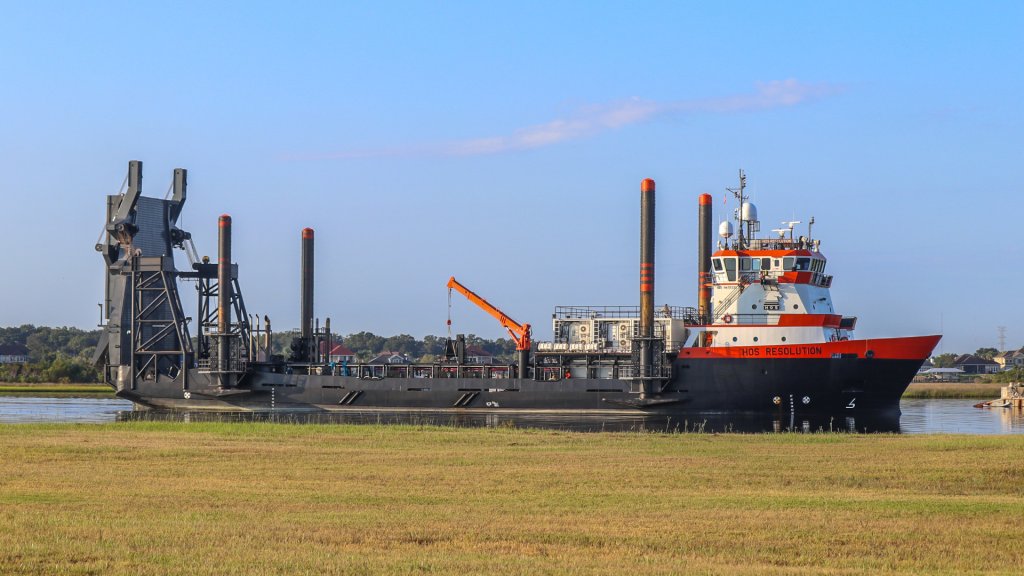
Maritime autonomy firm Sea Machines was able to integrate its SM300 software package on the HOSResolution in just nine days for this demonstration. The ship is a 257-foot-long offshore support vessel more typically used to support oil and gas rigs. However, it features a stern ramp and four jack-up legs that also make it well suited to loading and unloading cargo at remote beaches.
A US Army truck drives off the HOS Resolution during the experimenting in August where the ship was fitted with the Sea Machines autonomy package. US Army
Another look at the HOS Resolution, in 2023, while operating under contract to the US Marine Corps. USMC
The Army sees the August experiment as a potential stepping stone to integrating increasing degrees into its existing watercraft fleets.
“You could increase the fleet of autonomous vessels by tapping into the existing manned fleet,” Maj. Gen. Crist said. “Put on retrofitting kits to be able to conduct navigation, and then eventually propulsion and engine room activities, and eventually get to a fully autonomous system.”
Even just adding in autonomous navigation capabilities could help reduce the workload for the human crews on Army vessels and provide added margins of safety. Blending autonomy with “propulsion and engine room activities” could improve reliability and reduce maintenance demands. Being able to operate those ships in a fully uncrewed mode, if desired, would open up additional operational possibilities, including just for repositioning ships across the broad expanses of the Pacific.
Army Maj. Gen. Frederick Crist, head of 8th Theater Sustainment Command (TSC), speaks at AUSA last week. US Army
Reduced manning requirements could be especially attractive for the Army’s ‘Navy,’ which is already a very small part of the service’s overall force structure. Last week, Maj. Gen. Crist also talked about further leveraging traditional crewed vessels owned and/or operated by contractors.
“It’s going to be a broad portfolio of systems of systems,” he said of the overall watercraft vision for the Pacific. “Army watercraft with Army Mariners will be, of course, one aspect of it. We also look for the opportunity to be able to leverage USTRANSCOM’s (U.S. Transportation Command) contracting capability to leverage operational support vessels that are commercially owned and commercially operated. We’re considering ways of being able to have commercial vessels that become manned by Army mariners.”
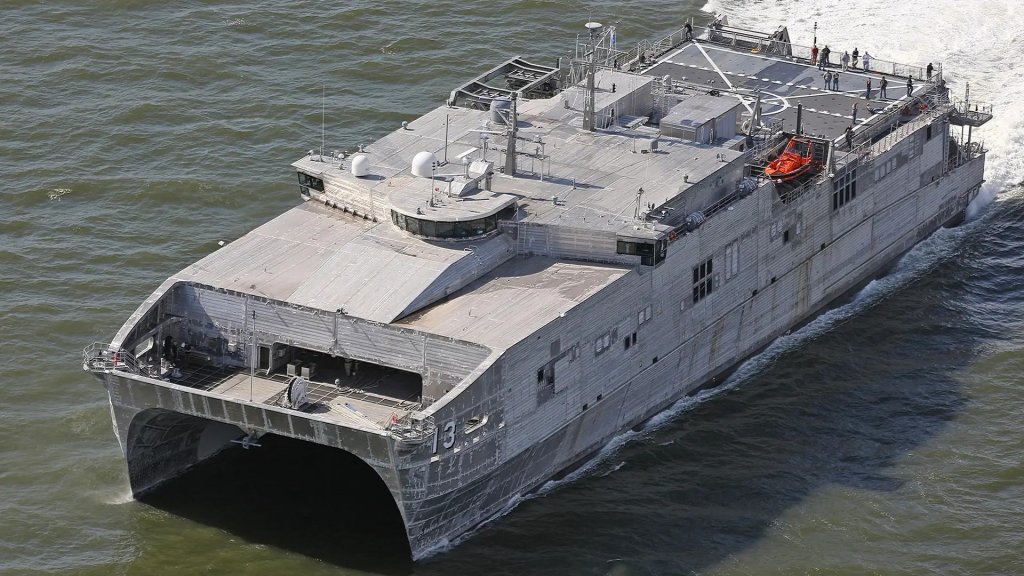
It is also interesting to note here how extremely similar this all sounds to the modifications the U.S. Navy made to the Spearhead class Expeditionary Fast Transport USNS Apalachicola ahead of its commissioning in 2023. However, despite tens of millions of dollars spent and successful demonstration of autonomous capabilities, the Navy curiously decided to put the Apalachicola into service without any plan to make use of these features operationally. There does not appear to have been any effort to integrate these capabilities more broadly within the Spearhead class since then, either.
The Spearhead class Expeditionary Fast Transport USNS Apalachicola. Austal USA USNS Apalachicola. Austal USA
Last year, the Navy struck the four oldest Spearhead class ships from its rolls entirely and has put several others on reduced operating status, ostensibly as a cost-saving measure. The service is still acquiring new Expeditionary Fast Transports, including members of the Expeditionary Medical Ship subclass that feature expanded medical facilities. The Spearhead class was born out of a program specifically to meet Army and Marine Corps requirements, and the ships are regularly used to support those services in the Pacific and elsewhere globally.
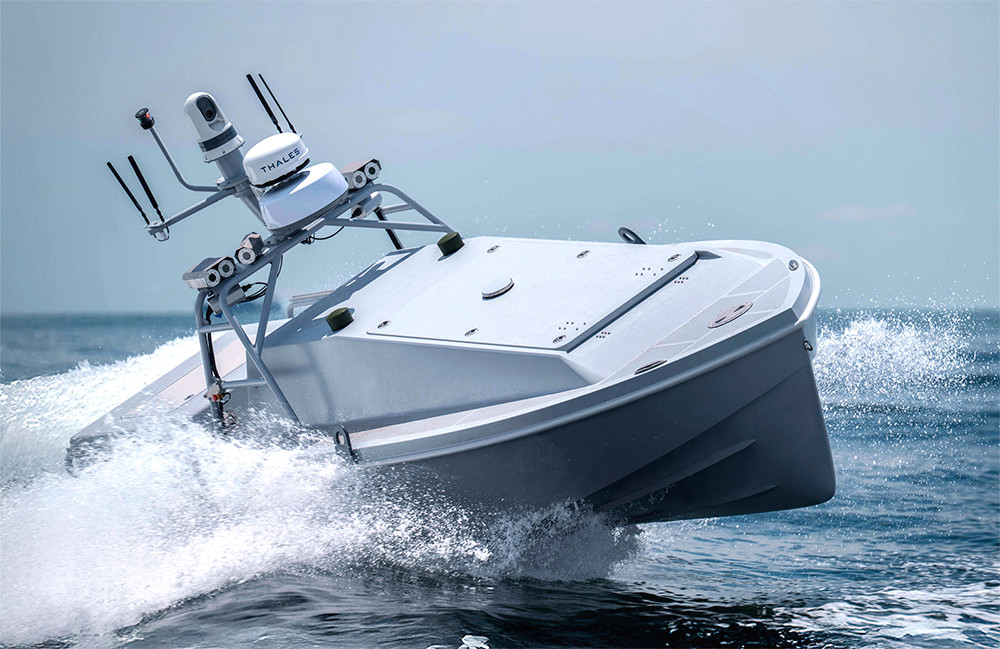
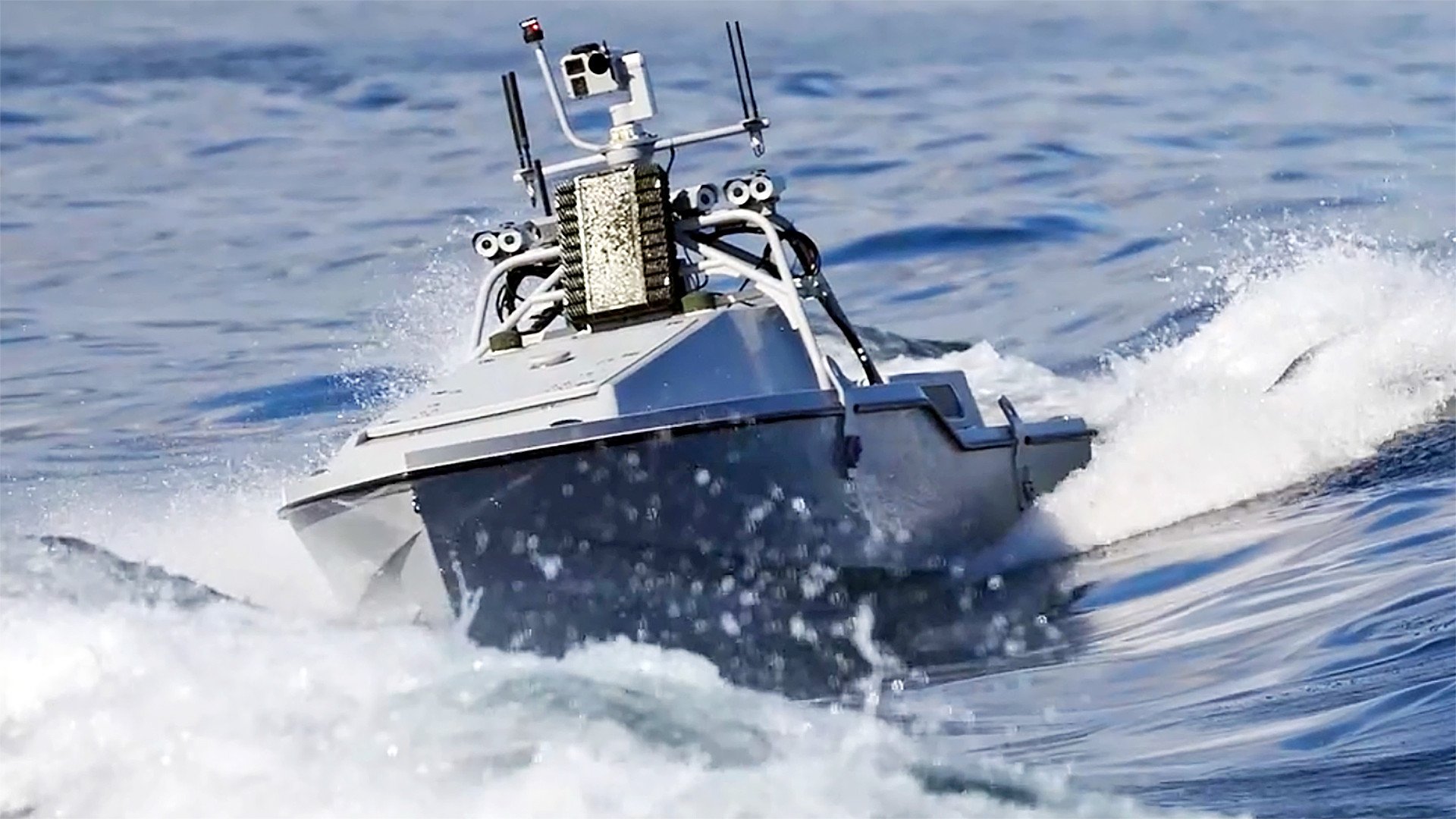
The Army also wants to expand its fleets of purpose-built uncrewed surface vessels (USV) for use in the Pacific, as well as elsewhere globally. Just earlier this year, Army Maj. Gen. Gavin Gardner, who preceded Maj. Gen. Crist as head of the 8th Theater Sustainment Command, said he wanted to rapidly acquire as many as 100 drone boats. His vision included larger USVs capable of carrying eight to 10 standardized shipping containers.
“I could see those operating in the U.S. PACOM area of responsibility,” Gardner told reporters at a roundtable in June, according to Military Times. “I think that gives you a ton of operations, inventory in motion, easy to respond. And then because they’re autonomous, and we can work with our partner nations forward, you have those berthed up everywhere from Korea to Japan, the Philippines, Australia, Singapore, Thailand, etc.”
“Clearly, [the autonomous vessels] would be forward in the theater, kind of moving supplies, because we have a constant demand for Army watercraft time now, to deliver equipment and supplies forward in the theater,” Gardner added at that time.
One of the inherent benefits of the Army watercraft fleets, and its LSVs in particular, is their ability to help alleviate the need for the U.S. Navy to meet more localized littoral logistics needs, if they are even available to help in the first place. Navy amphibious and military sealift ships would already be heavily strained by high demand during any major conflict in the Pacific or elsewhere globally. This could easily be further exacerbated by threats to those supply lines. All of this has already been underscored this year by pressure on maritime logistics chains in the context of the war with Iran. The Army’s ‘Navy’ also offers valuable additional capabilities and capacity in non-combat contingencies, such as responding to natural disasters.
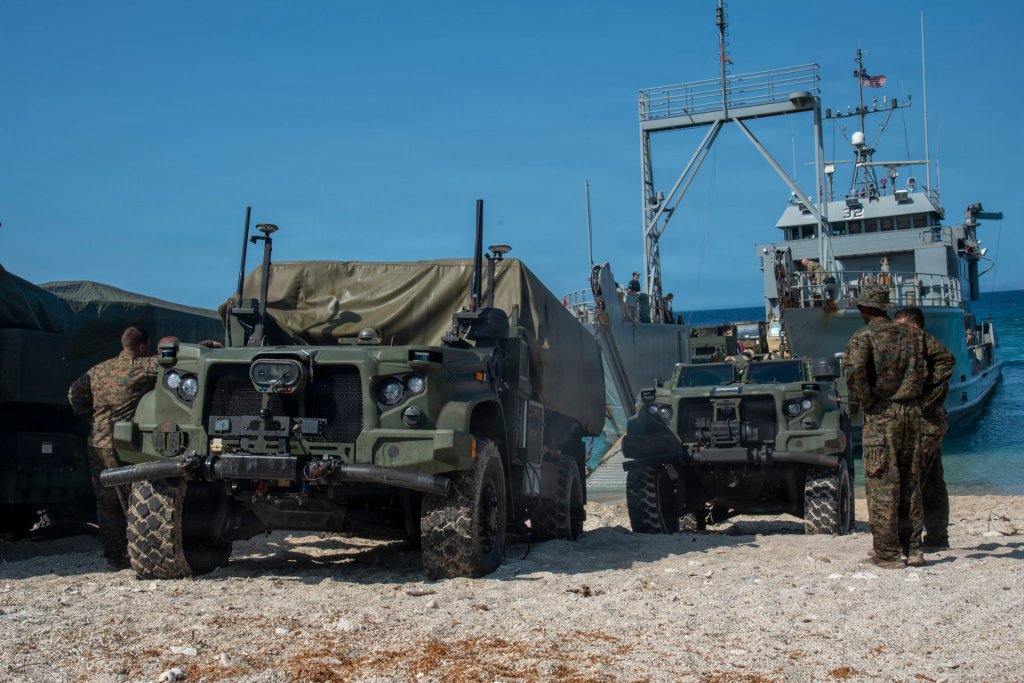
Marine vehicles drive off an Army LCU landing craft during an exercise. USMC/Cpl. Ernesto Lagunes
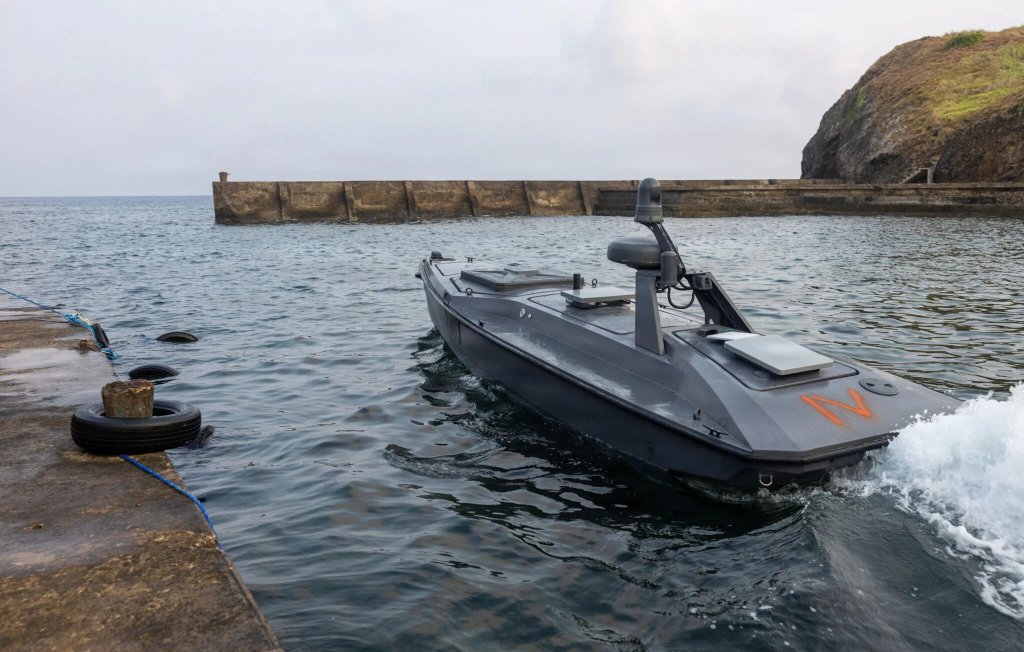
The 7th Infantry Division, one of the Army’s main maneuver combat formations in the Pacific, just recently experimented with a Ukrainian-developed Magura-series USV during an exercise in Michigan. That particular USV was configured to launch a quadcopter-type drone. Another member of the Magura family was observed being used in a one-way-attack configuration by U.S. Army Green Berets from the 1st Special Forces Group during the annual Balikatan exercise in the Philippines earlier this year.
A Magura-series USV seen in use at the annual Balikatan exercise this year. US ArmyAnother Magura-series USV in use during Exercise Bayonet Quest 2026 in Michigan. US ArmyThe Magura USV launches a quadcopter-type drone during Exercise Bayonet Quest 2026. US Army
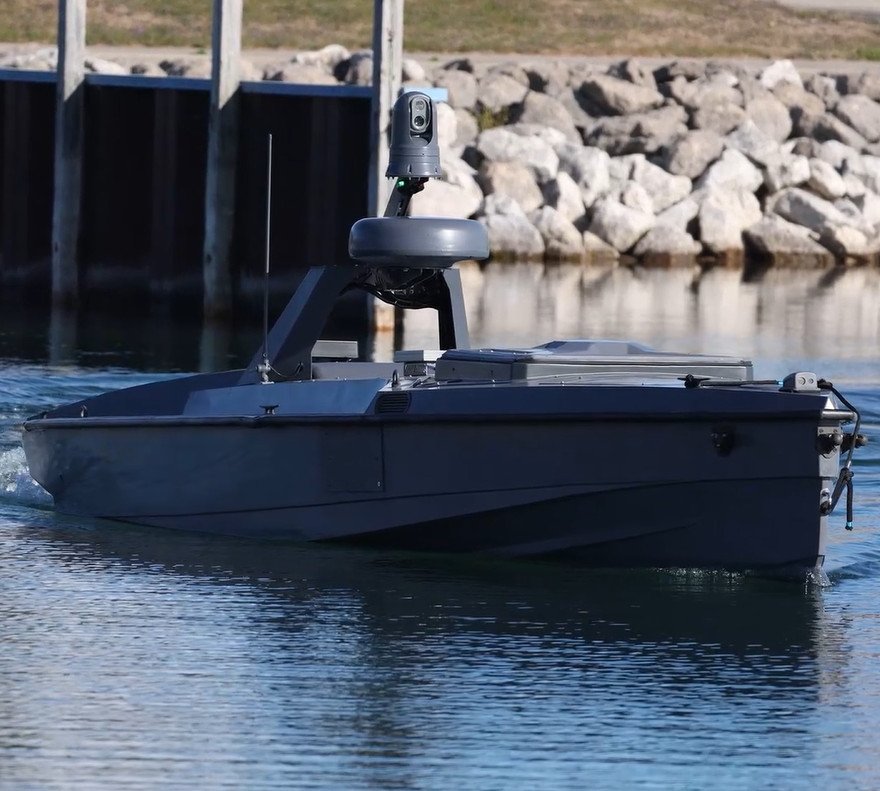
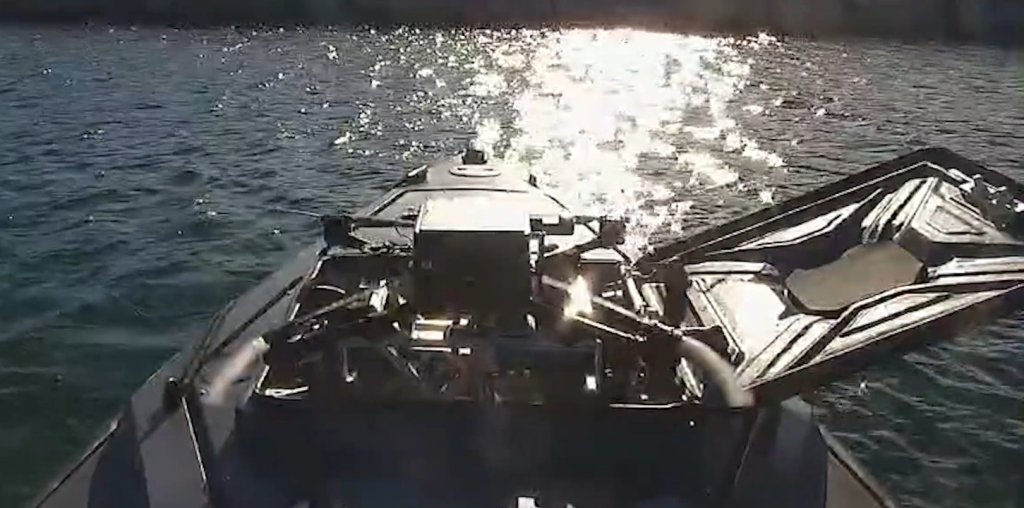
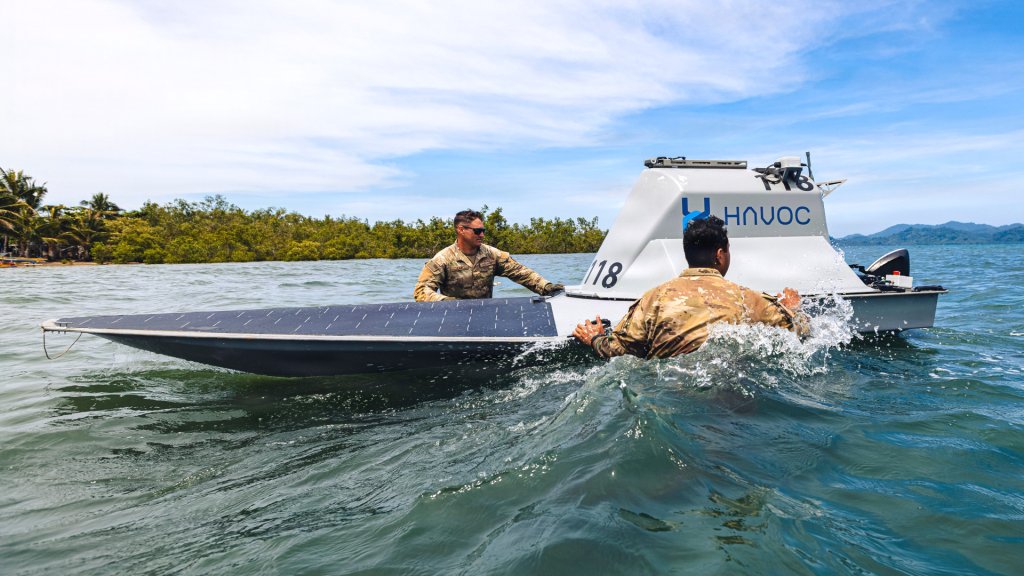
During another separate exercise in the Philippines this year, Salaknib 2026, Army forces used unarmed Rampage USVs from U.S. firm Havoc, as seen below. As part of that exercise, the USVs escorted a crewed General Frank S. Besson class LSV to its destination, heading out in front to help spot potential hazards.
US Army
“There’s all the work that the Department’s already doing with autonomy and autonomous systems that we look to take advantage of in the [Pacific] theater, as well,” Maj. Gen. Crist said at AUSA.
In September, Secretary Pete Hegseth also announced several new initiatives aimed at further expanding use of uncrewed platforms and advanced autonomous capabilities across the U.S. military and all domains. The Pentagon is presently laying the groundwork for the establishment of an all-new top-level Autonomous Warfare Command (AUTOWARCOM), which it hopes to see come to fruition next year.
What is clear now is that the Army’s vision for future watercraft operations, especially in the Pacific, is increasingly autonomous.
Ukraine holds personal data on each of the nearly 46,000 foreigners it has identified as signing with Russia’s army since 2022, Dmytro Usov, secretary of its prisoner-of-war coordination headquarters, said on 19 October. If the current pace holds, he expects this year’s contracts to reach Moscow’s plan. Meanwhile, a survey of captured foreigners gave a split answer on how many knew they were heading to war.
Usov said 41% of surveyed foreign POWs signed at enlistment offices and recruitment points, which the headquarters reads as a sign of a systematic campaign. He also said the hiring is meant to ease the social and budget burden of Russia’s own losses. Russia has long turned to foreigners to offset shortages in its regular forces. In April, Ukraine’s military intelligence (HUR) said enlistment offices had reportedly been assigned regional quotas.
A count built name by name
Usov, a brigadier general and secretary of Ukraine’s Coordination Headquarters for the Treatment of Prisoners of War, spoke at the international conference Crimea Global. He said Russia’s Defense Ministry has signed 45,959 foreigners from 151 countries. Ukraine’s records include each one’s rank, dog tag, and contract date.
The figure counts everyone who signed, not only those serving now. In April, Usov said his count left out North Korea’s regular troops, that 25–30% more recruits were likely still unidentified, and that at least 5,149 foreign recruits had died, Interfax-Ukraine reported.
This year’s contracts near the plan
Contracts have grown every year: 94 in 2022, 4,067 in 2023, 8,877 in 2024, and 16,085 in 2025. Some names surface late. At the same April event, Interfax-Ukraine reported, Usov had put 2025 at 13,997 and said the headquarters adds newly identified foreigners every month.
For 2026, Russia’s Defense Ministry planned 18,500 foreign contracts. Ukraine knows of 16,168 so far, roughly level with all of 2025. Another 668 contracts still have no year assigned. If the same dynamic holds, Usov said, the ministry will fully meet its plan and may even exceed it.
He named Indonesia, Peru, Chad, and Zimbabwe among the ten countries that drove the growth in recruits, Ukrinform reported. At the same time, he said, Ukraine’s Foreign Ministry and POW agencies have cut recruitment in some countries and stopped it in others.
What captured foreigners told Ukraine
Ukrainian forces have captured citizens of 59 countries since the full-scale invasion began. Uzbeks, Tajiks, Belarusians, and Colombians are among the largest groups.
In the headquarters’ survey of foreign POWs, nearly half said they knew they would fight Ukrainian soldiers and civilians. Another 28% said they didn’t know, 14.8% weren’t sure, and 13.8% said they were deceived. The headquarters ran the survey, and neither report gave a sample size or explained how the shares fit together. Usov said the results showed most knew where they were going. Almost 47% said they signed up for Russian citizenship.
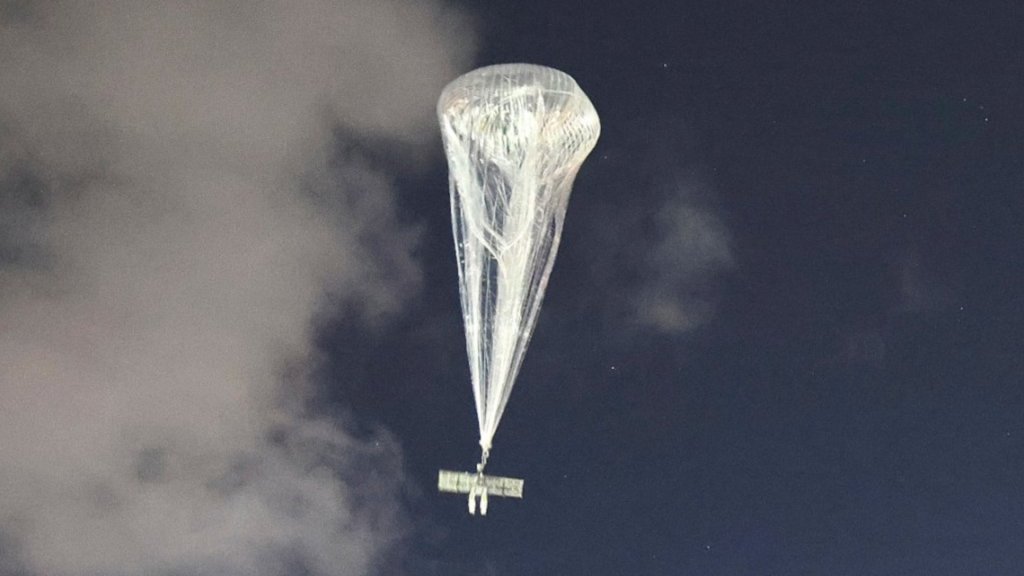
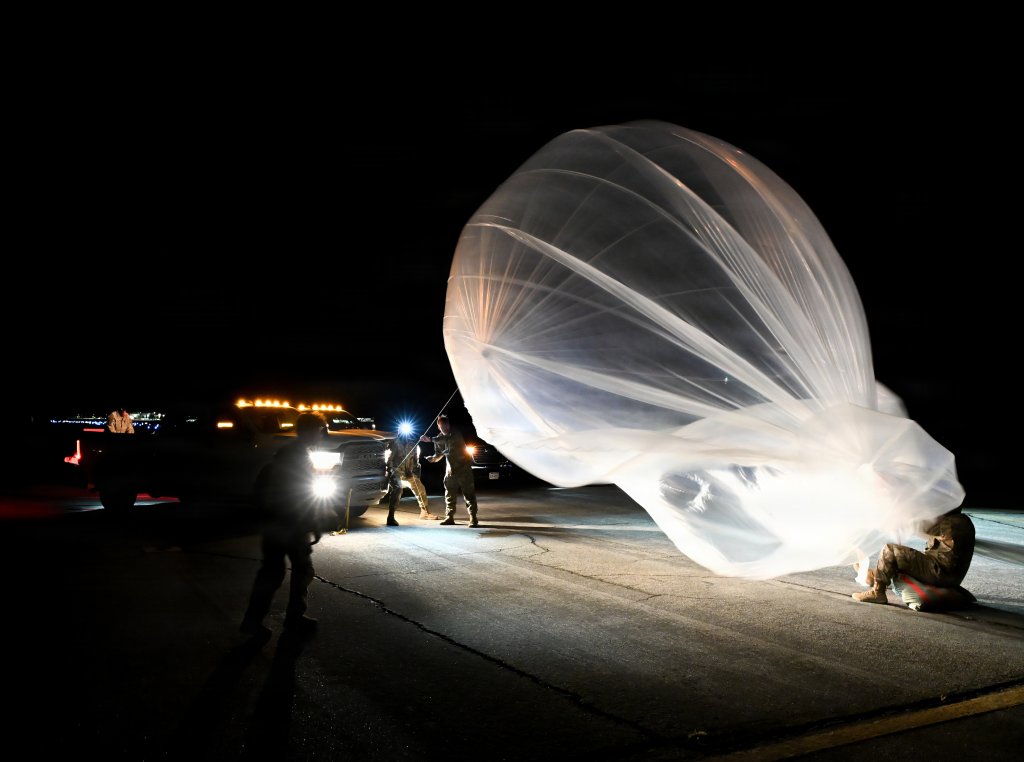
Basically, in the European scenario, hundreds or possibly thousands of balloons would be sent east. They would provide attritable real-time reconnaissance, strike, and decoy capabilities, while also acting as a force multiplier for other assets by providing a resilient active network over the battlefield — one that could help fill in the gaps if the space-based layer gets degraded.
“We would like to proliferate the stratosphere with high-altitude balloons, but I mean 200, 300 at a time,” Carpenter told us during last week’s Association of the U.S. Army (AUSA) conference in Washington, D.C., which TWZ attended. The Army would utilize high-altitude balloons “not only as decoys, a lot of decoys, but also communications retrans[mission platforms], electronic sensing, as well as electronic attack, and then obviously air-launched effects to be able to drop them down and use kinetic means as well.”
A sensor-laden high-altitude balloon from Aerostar seen lifting off from Won Pat International Airport on Guam during an exercise in 2024. US Army
Air-launched effects (ALEs) is a collective term the U.S. military now commonly uses to discuss air-launched drones configured for a wide array of missions. The ALE umbrella encompasses designs that can be used for surveillance and reconnaissance, electronic warfare tasks, or signal relay, and can act as decoys. It also includes loitering munitions often referred to as kamikaze drones, capable of carrying kinetic attacks.
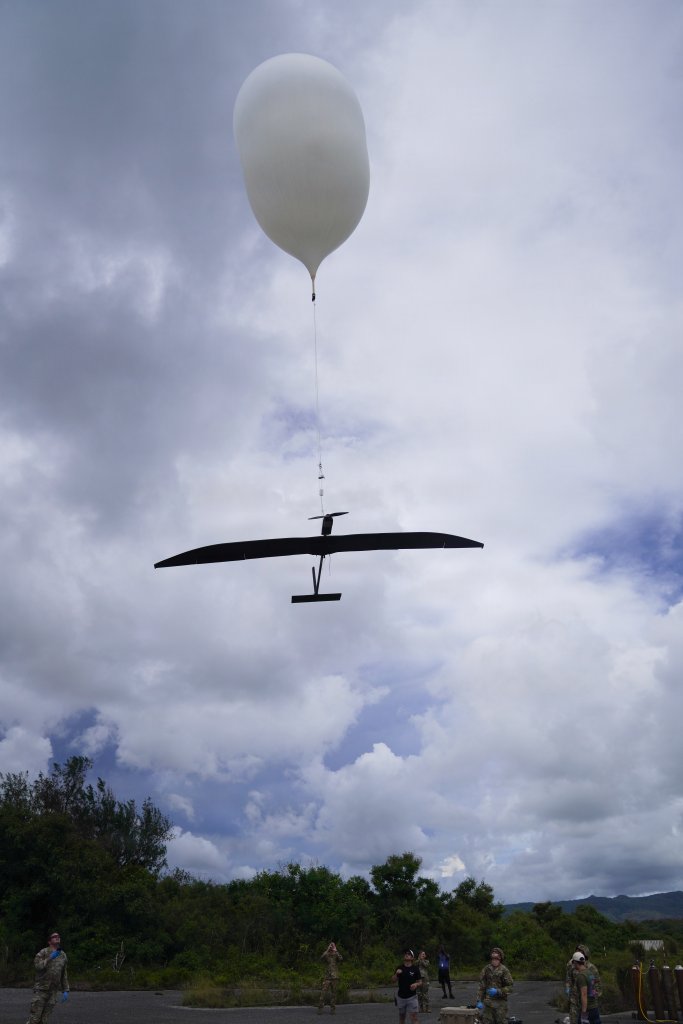
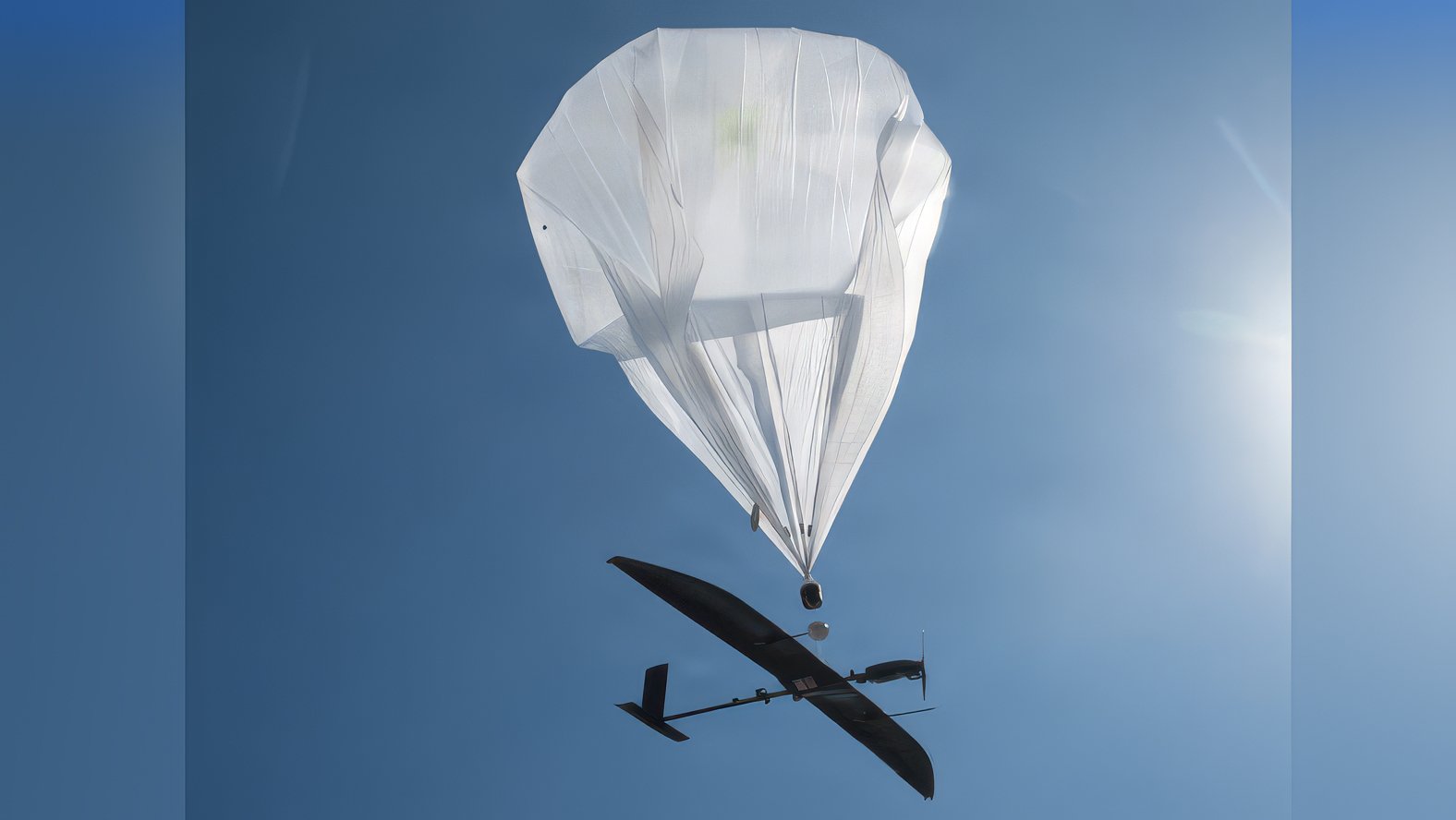
U.S. Army soldiers assigned to the Extended Range Sensing and Effects Company, 3d Multi-Domain Effects Battalion, 3d Multi-Domain Task Force, and industry partners attach an Icarus Apollo R stratospheric fixed wing aircraft to an Urban Sky high-altitude balloon during a multi-day Special User Demonstration at Orote Airfield on Naval Station Guam, June 24, 2026, for Valiant Shield 26. (U.S. Army photo by Sgt. 1st Class Ondirae Hamil Abdullah-Robinson) Sgt. 1st Class Ondirae Abdullah-Robinson
In general, modern high-altitude balloons offer persistent deployment that can last for days, weeks or even months at a time. After navigating to an assigned operating area, some modern balloon systems can hold their position, in spite of prevailing winds, by modulating their altitudes to keep on station.
In addition, high-altitude balloons operate at heights providing excellent fields of view for radars, cameras, and other sensors in all directions and across very broad areas. From a perch of 60,000 feet or more, they also offer a way to peer into certain denied areas while still soaring in international airspace and keeping farther away from potential threats. During a conflict, the balloons could be deployed deep into enemy airspace as they are attritable.
Though some balloon systems can hold their general positions in many circumstances, Carpenter told us that seasonal weather changes will still play a role in deployment.
“The flight paths are different. We study that,” he noted. “We understand during what seasons where the best places are to launch those high-altitude systems, and then again to hold enemy cities and capabilities at risk at any time, so that we can defeat them at the time and place of our choosing.”
We asked Carpenter for more details about how he sees balloons being used by troops in Europe.
“I think everybody knows there’ll be a point where satellite communications are going to be degraded, if not eliminated,” he stated. “One of the things that we’re focusing on is in the stratosphere, so above 60,000 feet up to 80,000 feet, which is next to impossible to target unless you’re using one of your exquisite systems, fifth-gen fighters, SA-21 Bravo [S-400 Triumf surface-to-air missile system], etc. to shoot that stuff down.”
Many of the balloons would be equipped with Link 16, a NATO-standard tactical datalink communication system central to U.S. and allied military operations, the general said. Link 16 allows coalition forces to seamlessly transmit and exchange real-time situational awareness data. You can read more about how Link 16 works, and its increasing dependence of space, in our story here.
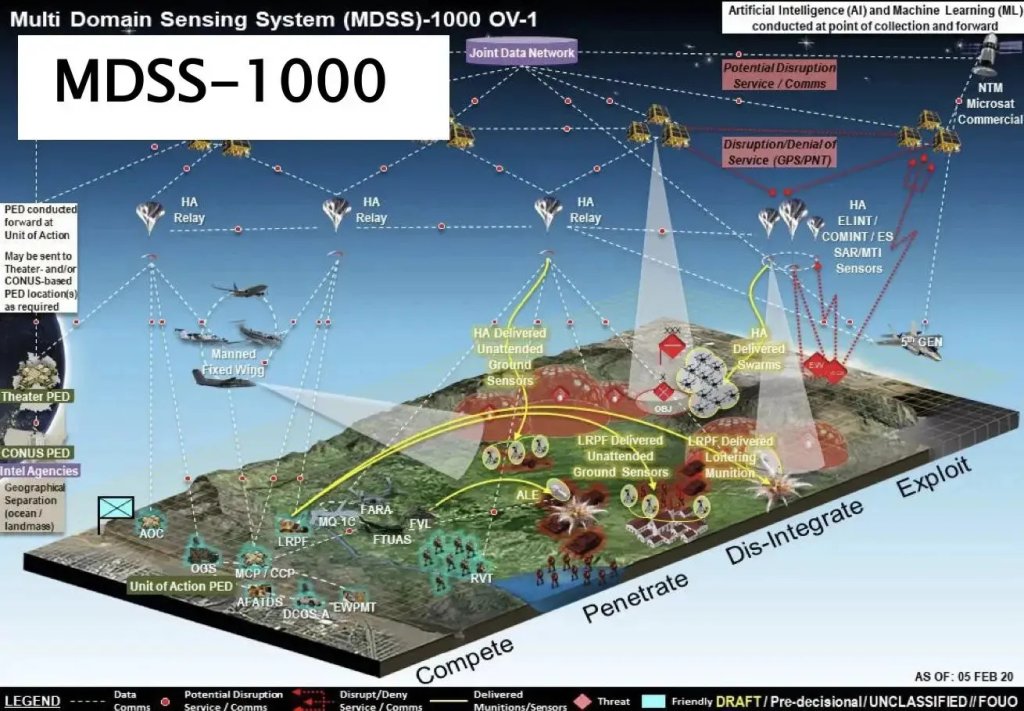
A graphic the Army previously released showing a notional “operational view” for how its planned the Multi-Domain Sensing System (MDSS) system of systems, including crewed ISR aircraft, might be employed in conjunction with other assets. (U.S. Army)
As for using balloons as ALE delivery platforms, Carpenter told us there are “different technologies, different altitudes that we’d have to deliver those from” at “different ranges, different levels of yield or lethality. But for us, it’s really just a single arrow in a quiver full of arrows, utilizing space capabilities, cyber capabilities, or surface-to-surface capabilities. In this case, you’re talking just another air-to-surface capability with your air-launched effects off balloons.”
Carpenter said that when it comes to balloon-launched ALEs, he is looking at “everything from shorter range, lower yield, maybe targeting an adversary ballistic missile radar, to longer range, higher yield capabilities that you might use to maybe take out a ballistic missile system.”
In such cases, the balloons would carry drones deep into enemy territory, where they would be launched opportunistically to strike the targets Carpenter suggested. The size of the target, and how well it is protected, would determine what kinds of drones the balloons would launch, as well as their proximity to the target.
Russian air defense systems like these S-400 launchers could be targeted by balloon-launched weapons, an Army general told us. (Sergei Malgavko / TASS)
Should a fight break out in Europe tonight, Carpenter said he is confident he can rely on the technology.
“Our operating concept is proven,” he stated, noting that “we’ve already tested those capabilities against most modern adversary systems that exist. We’ve already validated our operating concept in terms of getting to mass and scale that we would need in large-scale conflict.”
As we have previously reported, while high-altitude balloons have been used for decades, the modern concept of these systems was recently employed operationally by the U.S. in a combat theater.
The Army had planned to demonstrate the ability of balloons to operate in swarms with a high degree of autonomy in the Pacific region last year before those assets were redirected to the Middle East. When exactly that deployment occurred and how long it lasted are unclear.
“We were asked to pivot and do some experimentation in combination with operations, and we pivoted and supported operations in CENTCOM [U.S. Central Command],” Andrew Evans, Director of Strategy and Transformation with the Office of the Deputy Chief of Staff of the Army, or G-2, told Breaking Defense, according to a story the outlet published last week. “They were effective for the mission that they were assigned,” he added. However, Evans was not able to disclose the exact location and operational scenarios in which they were used.
To achieve the effects he laid out, Carpenter told us that he will still need to surge capacity to Europe.
“The Army will make decisions on which vendors they’re going to go with,” he pointed out. “But the ability to field that at scale is just simply based on the resources provided. I’m talking about money to go ahead and bring them into theater.”
Pushed to provide details of how quickly he could have the desired number of balloons, Carpenter told us that “if the United States or NATO and its allies were on a wartime footing, it would be extremely rapid, but we would need to get them into theater before crisis turned to conflict. So we’d have to keep a close eye from an IC [intelligence community] perspective on indicators and warnings to make sure we have the right systems on the ground at point of need.”
U.S. Army soldiers from Multi-Domain Command–Europe deploy high-altitude balloons at Tehachapi Airfield, April 22, 2026. (U.S. Army photo by Staff Sgt. Rajheem Dixon, Multi-Domain Command–Europe) Staff Sgt. Rajheem Dixon
The concept Carpenter laid out for how balloons will be used in a future European conflict is another example of the renaissance in lighter-than-air military technology and how the Pentagon is increasingly seeking to weaponize it on a grand scale.
The Ukrainian Armed Forces say they have carried out the world’s first frontline evacuation of a wounded soldier by aerial drone. The soldier, from the 30th Mechanized Brigade, is said to have been recovered successfully and is undergoing treatment and rehabilitation.
“This is a historic event, at least for our unit for sure,” said “Napalm,” a squad commander and programmer with the 92nd Assault Brigade’s uncrewed ground vehicle (UGV) company. The precise date and location of the operation have not been disclosed, and the claim of a global first has not been independently verified. However, a video of the event has been published by the 92nd, which you can watch below:
At this point, it should be noted that the footage has not been independently verified and could depict a staged demonstration rather than an actual combat evacuation. It should, at least, be treated with a degree of caution.
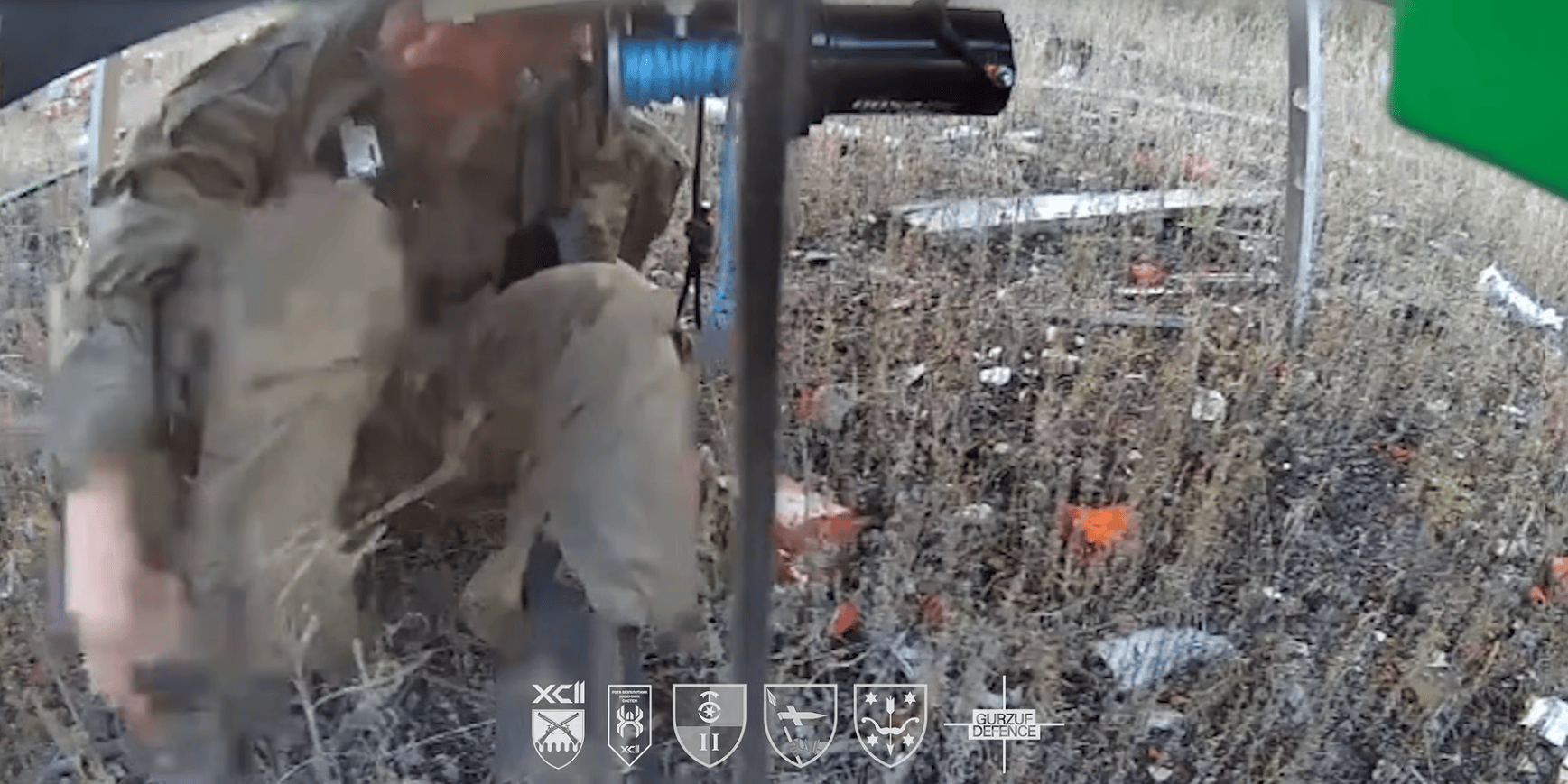
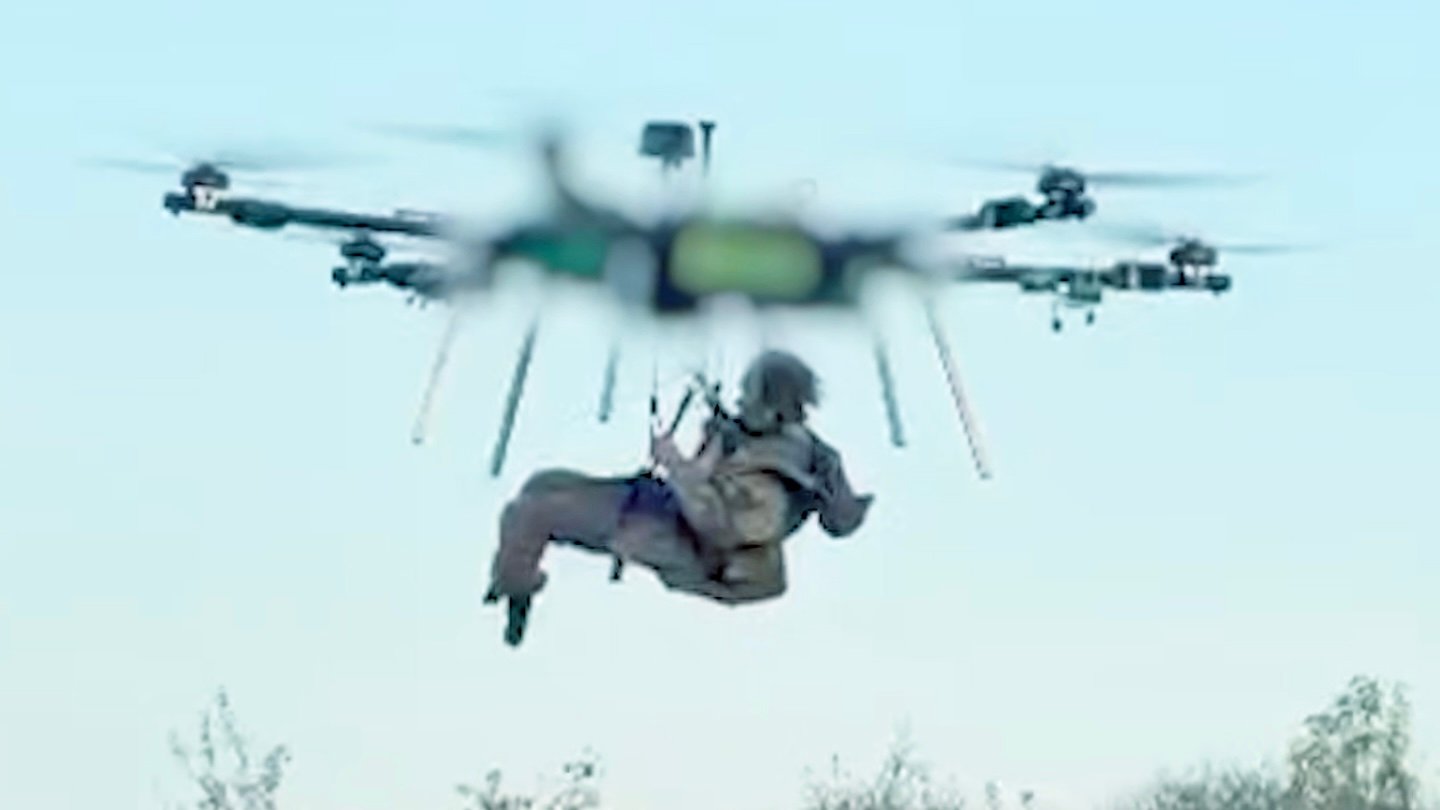
According to accompanying reports, the infantryman was wounded while holding his position. Mines and intense Russian drone activity prevented a conventional ground evacuation, prompting the 92nd’s specialists to attempt an aerial extraction. The video shows the soldier clipping himself to the underside of the drone via a harness before being flown to safety. The extemporized nature of the platform is underscored by the fact that, while in the air, the soldier dangles below its rigid landing legs.
The soldier is seen hunched under the hexacopter before attaching his harness to the drone. 92nd Assault Brigade/YouTube screencap
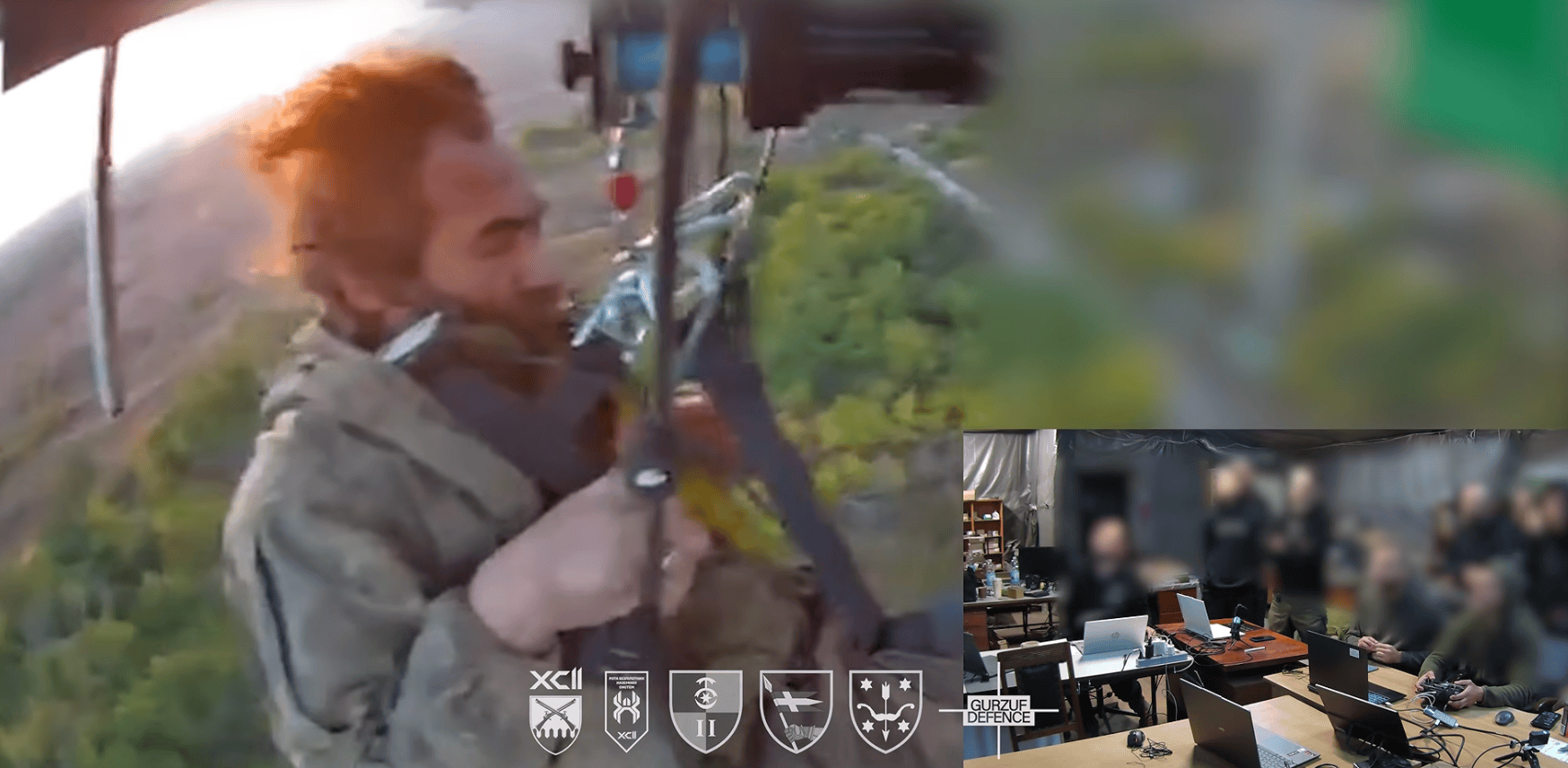
The aircraft was a heavy hexacopter manufactured by Ukrainian company Gurzuf Defense, which provided it free of charge. A UAV operator from the 30th Mechanized Brigade piloted the drone. Throughout the recovery, the soldier remained in contact with the drone operator.
With the drone now airborne, the drone controllers monitor the flight from the ground. 92nd Assault Brigade/YouTube screencap
The operation involved the 92nd, 30th and 14th Mechanized Brigades, the 10th Army Corps and Gurzuf Defense.
Ukraine increasingly uses uncrewed ground vehicles to deliver supplies and evacuate casualties from exposed positions. According to Euromaidan Press, Ukrainian UGVs conducted approximately 112,000 logistics and evacuation missions between January and August 2026.
However, ground robots can struggle with mines, mud, and cratered terrain, while remaining vulnerable to drones and artillery. These obstacles make it especially difficult to conduct UGV operations in the battlefield’s “kill zone,” which can extend six to nine miles or more from the front line. You can read an in-depth account of Ukrainian UGV efforts in this previous story.
A video showing a Ukrainian UGV in action in the Donetsk region:
Aerial platforms are able to reach casualties in places where ground vehicles cannot safely travel, and can get there far quicker, without having to stick to specific routes.
The 92nd has not disclosed the evacuation distance or flight duration of the mission. If, as reported, the drone used was an Audag-6 model, this is stated to be capable of carrying a 200-pound payload over a distance of up to 15 miles.
Meanwhile, the recovery points to a growing trend in the Ukrainian Armed Forces.
Only days before the story of the evacuation broke, it emerged that Ukraine is also now testing the StarGate, a purpose-built aerial medical evacuation drone — also of the heavy hexacopter type — developed by the SkyFall company. This is a rather more tailored solution to the problem, with a covered, medical-grade stretcher slung below the drone. It has a reported payload capacity of around 330 pounds, uses AI-assisted navigation, and can also deploy nets against hostile drones attempting to intercept it.
The 92nd’s operation used a heavy-lift hexacopter adapted for an ad hoc casualty transport, rather than a more bespoke design. This means the soldier had to be adequately trained on how to strap in, and also had to be in a condition that they could actually perform this procedure. This would also be the case even if other soldiers were able to assist them in strapping in.
While these kinds of solutions may be new to the battlefield in Ukraine, using uncrewed aerial systems for personnel recovery and medical evacuation is far from new.
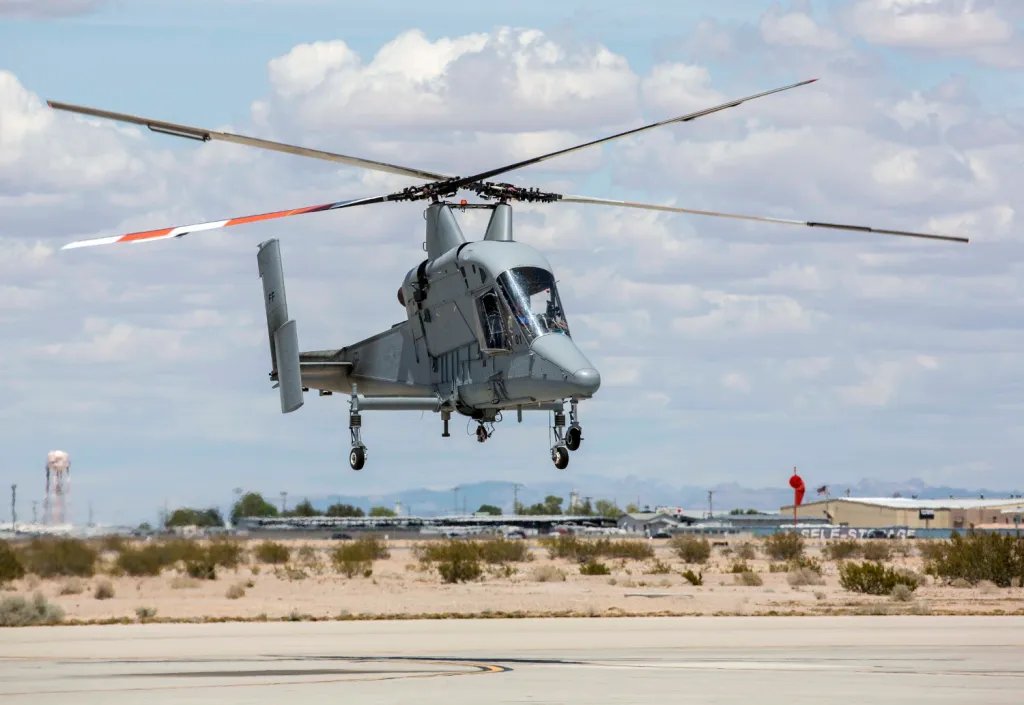
Back in 2016, the Army completed a demonstration of the Lockheed Martin K-Max helicopter in a casualty evacuation role. The K-Max can operate with and without a pilot and was used as a drone by the Marine Corps to deliver cargo in Afghanistan.
A U.S. Marine Corps K-Max helicopter. U.S. Marine Corps
“Unmanned and autonomous platforms have the potential to completely rewrite the medical doctrine,” Army Col. Daniel Kral, head of the Army’s Advanced Technology Research Center (TATRC), explained during a conference at Fort Detrick in Maryland in 2017.
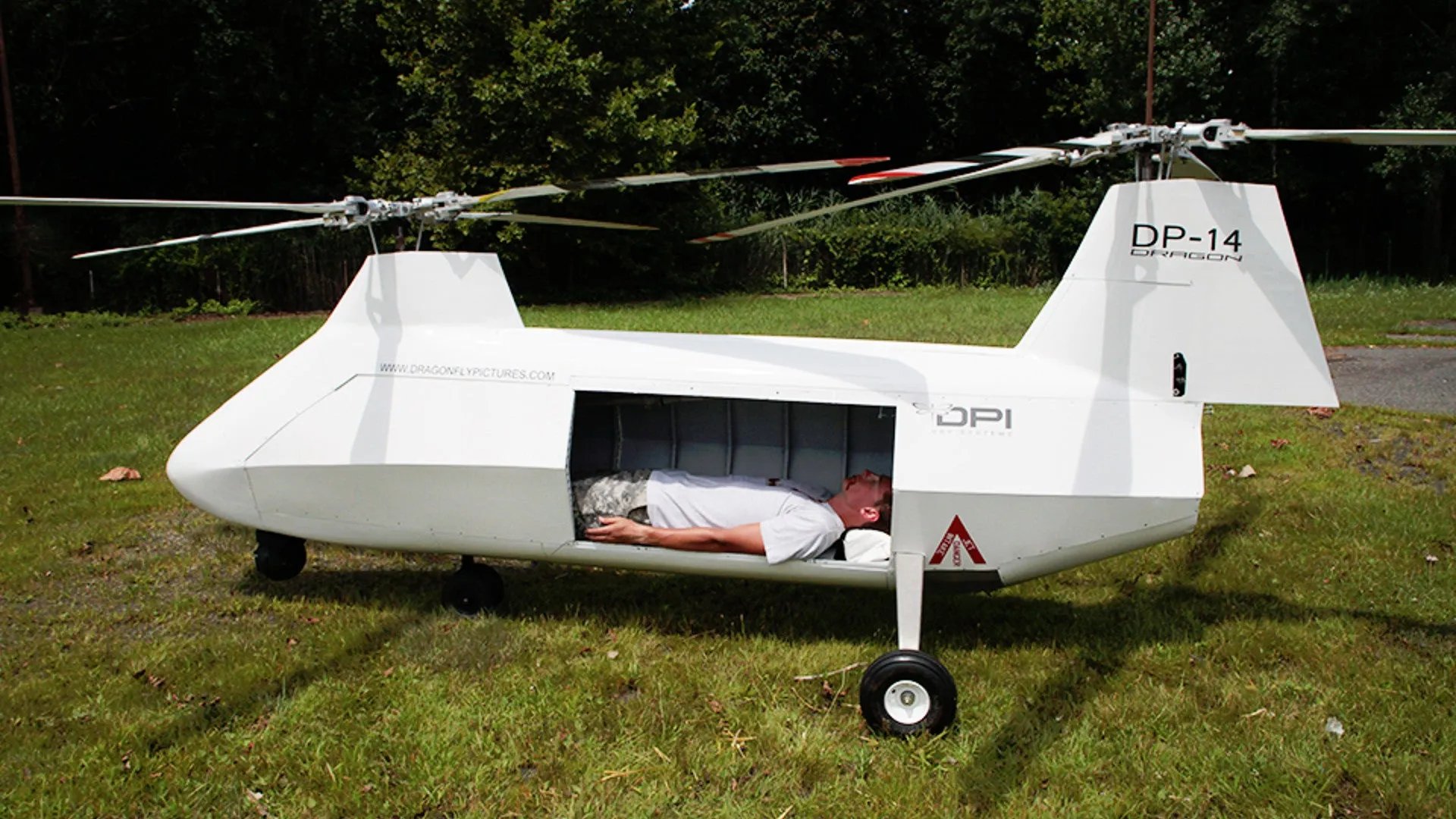
In 2019, TWZreported on U.S. Army efforts to explore how uncrewed craft might speed up the casualty evacuation process. This work included evaluation of the Dragonfly Pictures, Inc. (DPI) DP-14 Hawk, a small, tandem-rotor drone with a 400-pound cargo capacity.
A DP-14 Hawk shown configured for casualty evacuation. Dragonfly Pictures, Inc.
The emergence of autonomous air vehicles, or uncrewed ‘flying taxis,’ with short or vertical take-off and landing capabilities in the urban air mobility sector has also generated military interest. The U.S. Air Force Research Laboratory, for example, has conducted studies into how craft such as these could be adapted for combat search and rescue, with the idea that they would be airdropped to recover a fighter pilot shot down while operating over hostile territory.
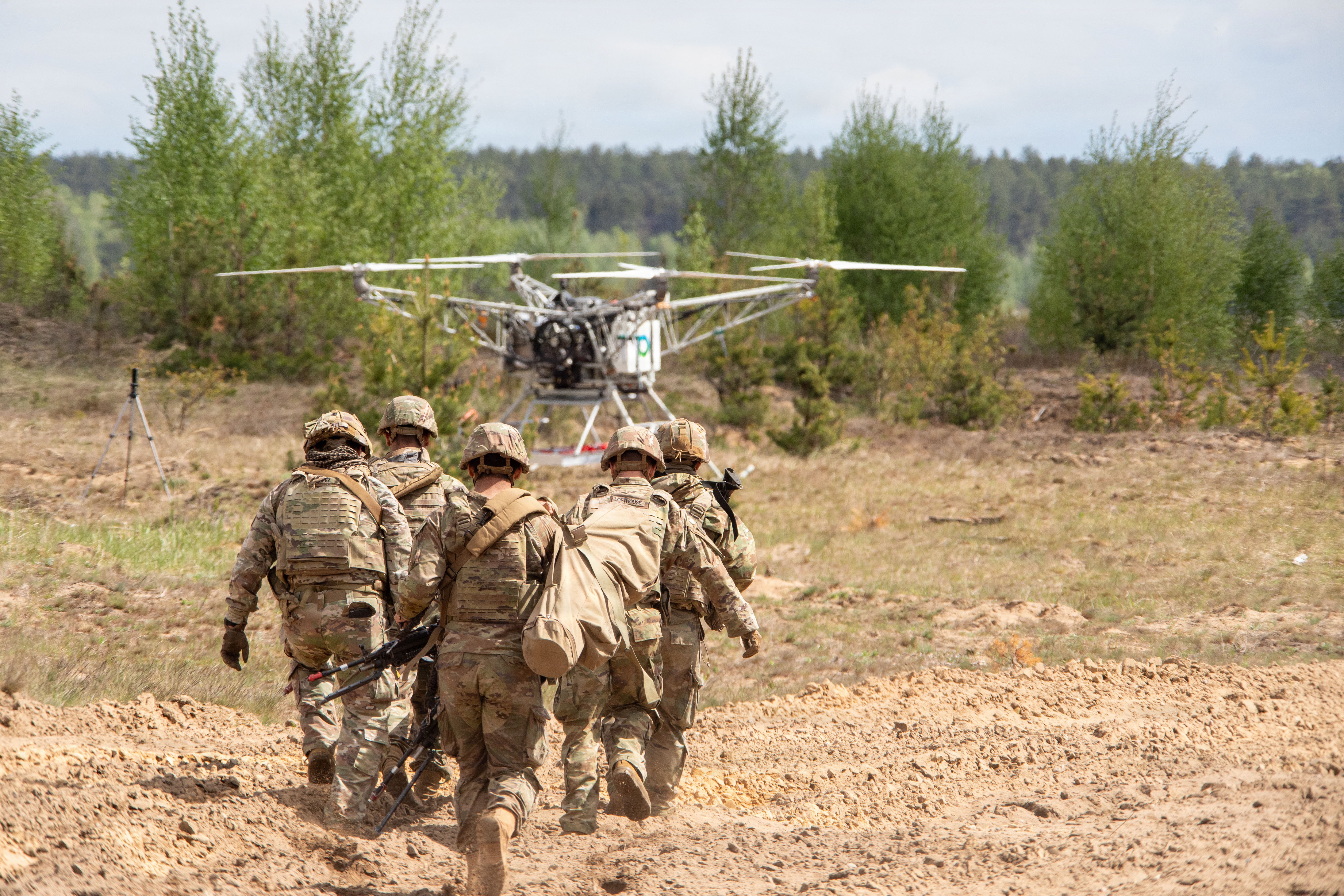
Closer to the Ukrainian hexacopter concept is the Flowcopter FC-100, a heavy-lift quadcopter drone that the U.S. Army tested in a medical evacuation capacity in Poland during the large-scale Saber Strike exercise earlier this year. Carrying a 220-pound payload, the drone has a range of more than 60 miles.
U.S. Army soldiers run with a test dummy in a stretcher towards a Flowcopter FC-100 drone during an Autonomous Triage and Treatment Challenge taking place near Bemowo Piskie Training Area, Poland, May 10, 2026, as part of Exercise Saber Strike. U.S. Army Reserve photo by Spc. Thomas Madrzak
All of these concepts aim to address the inherent vulnerability of larger personnel recovery platforms in more contested environments.
In their favor, they offer the potential to rescue troops from more precarious situations, with the smaller drones touching down in relatively tight areas in mountainous, forested, or jungle environments. Autonomous navigation systems can guide the drones through smoke, dust, or bad weather, too.
On the other hand, these small craft have no space for a medic, pararescuemen, or other additional personnel. Bearing in mind their limited range and lower speeds, they also need to be in the right location to respond to emergencies as and when they occur.
For the Ukrainian Armed Forces, aerial medical evacuation drones are being rapidly developed and now fielded to help address another problem: the vulnerability of UGVs in areas of the battlefield that have long become far too hazardous for crewed medevac platforms to operate.
By now, both sides in the Ukraine war are relying heavily upon small, autonomous uncrewed aircraft to perform a wide variety of resupply, surveillance, communications, and strike roles on and around the front lines. With that in mind, the adaptation of these kinds of vehicles for casualty evacuation and personnel recovery missions is the next logical step.

 Login