
❌

Reading view

Amazon warehouse workers tell us what they think about their new robot coworkers

Amazon robots
Robots at work inside an Amazon warehouse

Jess Lynn Goss for BI; Rebecca Zisser/BI

Amazon warehouse workers used to spend much of their days walking, pushing carts through long aisles to manually retrieve customer orders from shelves.

Today, hundreds of "Hercules" robots do this instead, carrying towering yellow storage pods filled with inventory to employee workstations.

"I'd walk like 10 miles a day on average," said Mohammed Khan, who started as an entry-level picker 12 years ago and is now a senior manager at an Amazon warehouse in Tracy, California.

Amazon's robots "cut down all that walking time," he told Business Insider during a recent tour of the facility.

Person in a high-visibility safety vest stands beside yellow structural columns in an industrial facility.
Mohammed Khan

Jess Lynn Goss for BI

This site is ground zero for a wave of automation that's beginning to wash over the industry. The warehouse and logistics sectors have been powerful sources of job growth since Amazon kicked off the e-commerce revolution 30 years ago, as Business Insider's award-winning Warehouse Nation series revealed in 2022.

If robots automate many warehouse tasks, this powerful engine of job growth could grind to a halt, wiping out thousands of positions and countless opportunities for future workers.

Amazon says employees are being retrained to do more valuable work, such as managing and maintaining robots. Will these new jobs be enough to cover what might be lost? Or could we actually end up with more or better jobs?

Business Insider went looking for answers inside the giant facility in Tracy, a city in California's Central Valley where suburban neighborhoods give way to open farmland.

"Autonomous to an extent"

Cardinal, a large robotic arm, loads sorted orders into carts at an Amazon warehouse in Tracy, Calif.
Amazon's Cardinal robot

Jess Lynn Goss for BI

Across 1.4 million square feet — the equivalent of 23 football fields — robots with names like Hercules, Robin, Cardinal, Pegasus, and Proteus move inventory and sort packages. But they don't run the warehouse alone. Human workers still pick and pack orders, load trucks, and intervene when automated systems fail.

Jobs have not disappeared, but they're changing. Machines increasingly handle work that once required employees to walk miles and lift boxes, while workers monitor and troubleshoot them. The Tracy site employs more than 3,000, up from roughly 1,000 when it opened in 2023, an Amazon spokesperson told Business Insider.

"They're autonomous to an extent," Khan said of his robot counterparts. "They still need a lot of help and maintenance and oversight."

Hercules Robots
Amazon's Hercules robots on the move

Jess Lynn Goss for BI

An Amazon spokesperson said rising customer demand drove the facility's workforce growth and that robots help workers process more packages safely and efficiently rather than simply replacing them.

Amazon's more automated, next-generation fulfillment centers are about 25% more productive and cut order-processing time by as much as 25%. And these sites support roughly 30% more skilled jobs in areas including reliability, maintenance, and engineering.

Workers in high-visibility vests use computer workstations in an industrial operations control area.
Process assistants monitor robot activity

Jess Lynn Goss for BI

The "Quarterback" watches robots

One of the workers now doing that kind of job is Briana Brager.

She joined Amazon about two years ago as an entry-level employee after spending years caring for her family. She had no prior experience in a traditional workplace.

Today, she's a process assistant who helps oversee the warehouse's robotic systems. When a chute jams or a robot stops working, she coordinates the response to keep packages moving.

Person in a high-visibility safety vest stands on an elevated walkway inside an industrial facility.
Briana Brager

Jess Lynn Goss for BI

"The robots do a lot, but we still have to maintain them," she said.

Brager began as a picker before moving into a specialized role supporting robotic-floor operations. She got two weeks of intensive training, followed by additional job shadowing, to learn how to work safely around the equipment. Her current job is less physically demanding than her previous one, she said.

Her role is informally known as the "quarterback" position. She monitors fleets of robots and dispatches employees when a machine needs intervention.

"We call the shots," Brager said.

Meet Robin

Robin robot
Amazon's Robin robot at work

Jess Lynn Goss for BI

At the Tracy warehouse, humans and robots move orders together from storage to the loading dock. Employees stow individual items in fabric inventory pods, which Hercules robots carry to pick stations. Workers retrieve the items, then pack and label them.

Robin, a large robotic arm, picks finished packages off a conveyor and places them on small Pegasus mobile robots. Pegasus carries the packages to staging areas alongside other orders headed to the same destination. Cardinal then loads the sorted orders into carts, and Proteus ferries the carts toward outbound trucks.

Warehouse worker in a high-visibility vest handles packages on a conveyor inside an industrial sorting facility.
Briana Brager and Robin

Jess Goss for BI

Khan, the warehouse manager, said workers performed Robin's task manually until a few years ago. They handled packages one at a time, checked them for damage, scanned them, and fed them into the sorting system. He estimated that one Robin can perform roughly the work of two to seven people doing that process manually.

Amazon said that when it introduces systems such as Robin, employees take on other work at the site, including operating robots, clearing jams, monitoring the robotic floor and quality control, and maintenance engineering.

Robots move the carts, too

Proteus offers a clear example of how these new warehouse jobs are taking shape. Amazon brought the robots to Tracy last year.

Blue Amazon warehouse carts line an industrial aisle beneath bright overhead lights and yellow section signs.
Proteus robots

Jess Lynn Goss for BI

Unlike Hercules, which operates in fenced-off areas, Proteus can move through spaces shared with people. There are roughly 200 of the robots at the Tracy facility, Amazon said.

Before Proteus arrived, workers manually pushed carts filled with packages to the loading dock. Now the robots pick up full carts, carry them to staging areas near the dock, and retrieve empty carts for the return trip.

Some employees who once moved those carts now work as "ground-floor monitors," Amazon said. Instead of spending their shifts moving packages, they respond when a Proteus reports a fault. If the problem is simple, they can reset the robot; otherwise, human maintenance staff take over.

Some workers trained in these jobs have gone on to Amazon's mechatronics apprenticeship program, which can lead to more technical maintenance work.

Proteus Robot
Proteus robots at work

Jess Goss for BI

When automation hits the "jackpot"

For all the robots moving through the Tracy warehouse, people remain essential when automation breaks down.

Amazon calls one such destination the "jackpot." When an item loses its routing information while moving through the facility, the automated system sends it to this area, which works a bit like a lost-and-found for packages.

Here, a human worker must determine where the wayward package belongs and return it to the correct flow. "It will require manual intervention," an Amazon representative said.

Other situations require human judgment, too. Products can fall from storage pods and inventory can be damaged or mislabeled. Packing individual products into boxes and loading them onto delivery vehicles are tasks that also remain heavily dependent on people.

Dustin Mean, a stower at an Amazon warehouse in Tracy, Calif. sorts items into fabric inventory pods, which Hercules robots carry to pick stations.
Dustin Mean, a stower at an Amazon warehouse

Jess Lynn Goss for BI

This helps explain why even a highly automated Amazon warehouse still employs thousands of workers. The company said it needs people for new packing stations as well as roles across the facility that keep operations running safely and efficiently.

Current and future Tetris

By the time packages get to the loading dock at the Tracy facility, the robots are gone. At least for now.

A person loads each trailer. Amazon uses equipment that extends into the trailer and adjusts to a worker's height, reducing bending and back-and-forth walking. But workers still arrange the packages themselves, trying to fill the trailer to use as much of the space as possible.

"It's a lot of Tetris," one Amazon representative said.

Amazon facility entrance with blue “main entry” canopy, glass doors, bollards, and the Amazon smile logo above.
Amazon's warehouse in Tracy, California

Jess Lynn Goss for BI

Amazon is already exploring how to automate this task, though. As Business Insider previously reported, Project Tetromino aims to use AI and robotics to automate sorting and vehicle loading at delivery stations, where the work has long remained stubbornly manual.

But that vision remains a work in progress. Amazon's machines can carry shelves, sort packages, stack boxes, and move carts around people. Workers still pack orders, load trailers, perform quality checks, handle hiccups and exceptions, and keep the machines running when they fail.

For Amazon, the immediate payoff is not necessarily a warehouse with fewer people, but one where the same workforce can accomplish more. Tracy employs roughly the same number of people as a nearby Amazon facility with fewer robots, company officials said, but the Tracy location processes more volume.

Workers in high-visibility vests stand at computer workstations inside a warehouse or industrial operations area.
Process assistants monitor robot activity

Jess Lynn Goss for BI

Khan compared the technology to something far less futuristic: a calculator.

The robots streamline work that once consumed employees' time without necessarily eliminating the work itself, he said. "It's not that the amount of work has changed," he said. "It's how we approach it."

Asked whether robots could eventually replace more jobs, including his own, Khan did not try to predict the future.

"Who knows? That's not in our purview right now," he said. "But I would say roles are evolving, and that's the cool aspect about it."

Have a tip? Contact this reporter via email at ekim@businessinsider.com or Signal, Telegram, or WhatsApp at 650-942-3061. Use a personal email address, a nonwork WiFi network, and a nonwork device; here's our guide to sharing information securely.

Read the original article on Business Insider

  •  

A Months-Old Anti-Robotaxi Group Is Steering Transportation Policy From Albany to D.C.

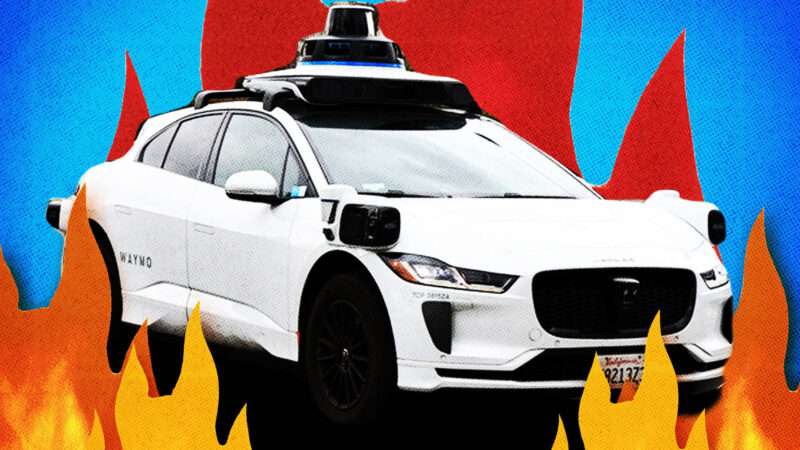
Waymo | Illustration: Walter Cicchetti/Dreamstime/Midjourney/Fatima Ruiz.waymo

At a protest against a bill to legalize Waymo in Washington, D.C., earlier in October, the main tagline was: "Robotaxis don't vote; we vote." Little is known about the group behind it, raising questions about who's fueling the pushback against robotaxis in America's major cities.

People First Transportation Alliance (PFTA), the organization in question, describes itself as a "statewide coalition of labor unions" dedicated to putting "people over untested technology." The PFTA states it's a "coalition of community organizations, safe-streets advocates, and faith leaders." However, as The Washington Post reported on Monday, the group appears to have overstated its affiliation with four of the 13 individuals and organizations listed as its founding members.

"Several groups and individuals said statements made about them on the Transportation Alliance website were inaccurate," the Post reported, adding that PFTA "appears to be newly formed, with a minimal social media presence. Its website domain was created in late April, according to the Internet Corporation for Assigned Names and Numbers." The group created its social media accounts in May, but it has no posts and no followers. 

Apart from its recent interest in the nation's capital, the PFTA lists New York and Philadelphia as its priorities, two cities led by lawmakers who publicly oppose Waymo's presence. Yet for a relatively unknown, recently created organization, the PFTA has found success in its campaign to shut autonomous vehicles like Waymo out of America's Northeast.

In February, the New York Post reported that Gov. Kathy Hochul (D–N.Y.) withdrew her own proposal—which would have allowed commercial robotaxi services such as Waymo to operate in smaller cities in upstate New York—after a PFTA-led coalition prompted enough backlash to kill support for the measure. A Hochul spokesperson told the Post that it was "clear that the support was not there to advance this proposal." 

The PFTA told the Post that the organization would urge the state to "pass legislation requiring a human driver behind the wheel in every vehicle and a comprehensive study leading to a plan to address the impact driverless cars would have on New York State." 

The group's resolution comes despite customer support for autonomous vehicles: A 2025 study on Waymo, Uber, and Lyft by Obi—a company that aggregates real-time rideshare prices—found that 70 percent of riders who've used Waymo preferred it over Lyft or Uber and 42.7 percent of all respondents were willing to pay Waymo's premium price (up to $10 more) to use the service.

Despite consumer support, autonomous vehicles can't count on a fair shake from lawmakers in some of the country's largest cities. In New York City, Waymo's permit to operate a pilot program on public streets expired in March. Mayor Zohran Mamdani has so far been noncommittal on renewing the company's permit. At a press conference that same month, he said his administration would be prioritizing workers such as the city's taxi drivers who "for far too long, have been sold a dream of being able to work their way to the middle class, only to have the rug pulled out from under them." 

Despite the mystery surrounding the PFTA, its D.C. protest drew enough public support to elicit a statement from a person who will likely be the city's next mayor, current D.C. Councilmember Janeese Lewis George. In a post on X, Lewis George said D.C. was "facing a jobs crisis" that would be exacerbated by "rushing the legalization of autonomous vehicles." She urged the D.C. Council—which is currently considering a punitive proposal to legalize commercial autonomous vehicles—to "get this right and not rush Waymo legislation this year."

It's unclear how much longer Lewis George wants the District's residents to wait before autonomous vehicles are available for use. D.C.'s approach to legalizing commercial robotaxis hardly seems rushed. 

Waymo began testing its vehicles in the city nearly two and a half years ago, in spring 2024. The company's co-CEO Tekedra N. Mawakana said its fleet has driven "more than 300,000 miles in Washington, D.C."Meanwhile, the District Department of Transportation (DDOT) has been conducting studies and organizing working groups on autonomous vehicles for nearly a decade. Still, the agency has been unable to draft a regulatory framework that would eventually enable commercial robotaxi use in the nation's capital. In March, UrbanTurf reported that DDOT would be conducting a long-awaited study on autonomous vehicles—originally due in 2022—and "expects to propose recommendations on AV deployment later this year."

Opponents of autonomous vehicles, such as Lewis George and the PFTA, often cite job loss as a reason not to legalize the tech. Still, with only 200 full-time ride-share drivers in a city of roughly 400,000 workers, as Lewis George has reportedly stated, the situation is a far cry from a crisis.

As for PFTA's public safety claims, Waymo's independently reviewed data show that, compared with an average human driver over the same distance, its vehicles caused 95 percent fewer serious-injury-or-worse crashes and 93 percent fewer pedestrian crashes with serious injuries.

PFTA claims it represents the people most directly affected by transportation policy. The little publicly available information suggests the group is more focused on protecting its members' position in the ride-share market than enhancing the experience of riders, who are increasingly opting for robotaxis when given the opportunity.

The post A Months-Old Anti-Robotaxi Group Is Steering Transportation Policy From Albany to D.C. appeared first on Reason Magazine.

  •  

Why We Like Things

“Taste is a new core skill,” OpenAI President Greg Brockman declared earlier this year—one voice in a growing chorus of pronouncements about the centrality of judgment and preference in an economy built on artificial intelligence. And yet taste itself is largely undefined by many of its loudest proponents. Celine Nguyen considers the historic relationship between automation and taste; the “seemingly irrelevant, unimportant” inputs that shape our critical perceptions; and the perils of wielding taste like a cudgel. A striking, insightful blend of criticism and personal essay.

Today’s frontier models are trained on enormous quantities of data. One takeaway from Anthropic’s 2025 settlement with a group of authors, in which the company agreed to pay $1.5 billion (or an estimated $3,000 per book) for scraping copyrighted books from shadow libraries like LibGen, is that its models have “read” at least 482,460 books. But even Claude Opus 4.8 hasn’t written a short story that I enjoy more than those by Lydia Davis or Jessi Jezewska Stevens — both of whom, despite being prodigiously well-read, have almost certainly read fewer books.

  •  

The Beauty of a Stone Wall

By the time I encountered the fifth photo in Matt Seaton’s contemplative essay about New England’s stone walls, I found myself participating in the image, trying to figure out the maneuvers that had made the structure cohere. That’s a lot of the gratification here—”striving for coherence,” as Seaton, a former Atlantic editor, describes the work of walling. This is a quick read, and Seaton makes every word count, fitting a bit of Robert Frost and a lot of rock knowledge together just like he was building a . . . well, you know.

Bit by bit—which is the way with walls—my interest and knowledge deepened until what had begun as recreation morphed into a hobby job, mending other people’s walls. Eventually, I realized not only that I liked building walls, but also that I could scratch a subsistence living at it. In what probably struck friends and family as an act of lunacy, I quit my day job as an editor at this magazine and became a part-time waller.

  •  
❌