❌

Reading view

An armored capsule instead of an open platform: Ukraine develops an evacuation module for the Murakha UGV

The Murakha UGV with the CASEEVAK module.Photo: Robotic Complexes company

Ukrainian company Robotic Complexes is developing CASEEVAK, an armored module that lets the Murakha unmanned ground vehicle carry wounded soldiers off the battlefield, the company told Militarnyi on 28 October. The casualty rides in a closed capsule with ventilation, heating, lighting, and a first-aid kit, and side and rear doors let medics load and reach the soldier from any side.

Drones that can fly long distances pose a threat to both wounded soldiers and the crews evacuating them, making transportation the main challenge, said Ukrainian military medic Daryna Boiko, The Independent reported. Developers are looking for new ways to counter this threat. The current Murakha model is being equipped with passive anti-drone protection elements, the developers say.

An armored capsule that keeps the wounded connected

After a wounded soldier is loaded onto an evacuation platform, it is important not only to transport them to a safe location but also to protect them and monitor their condition during transit.

The module is built around a closed armored capsule made of 3.5 mm-thick Armox 500T steel with an inner lining of HDPE 1000, the media outlet reports. Side and rear doors allow the wounded to be loaded from different directions and accessed during evacuation.

A military personnel member inside the CASEEVAK module of the Murakha UGV. Photo: Robotic Complexes company

To enable the operator to monitor the person inside and maintain contact with them, the capsule is equipped with a camera with day and night channels and two-way audio communication. The system can be controlled via ELRS, LTE, Starlink, or fiber-optic communications. Militarnyi reports that even if the capsule is detached from the main platform, it retains two independent communication channels.

The developers are also working to integrate vital-signs monitoring systems intended to provide medical personnel with information about the wounded person’s condition during transport.

An electric platform and protection against FPV drones

The evacuation module requires a platform capable of carrying it as it moves through dangerous areas. The Murakha is equipped with two electric motors, delivering a combined torque of 1,600 N·m, and a 35 kWh battery. The system’s stated range is up to 80 km, according to the media outlet.

Another area of development is protection against drones. Measures intended to protect the system include net launchers and electronic warfare (EW) equipment. However, work on a protective cage against FPV drones is still ongoing, according to the report.

The company has already conducted ballistic tests of the armor steel at a distance of 50 meters, using ammunition of various calibers, Militarnyi reports.

The Murakha-Mini logistics platform


The same company previously developed the Murakha-Mini logistics platform. Ukrainian military personnel began using it on the front line to deliver equipment, provisions and other supplies, Militarnyi reported on 24 October 2025.

Ukraine’s Murakha-Mini unmanned ground vehicle. 2025. Photo: Robotic Complexes company

The UGV can carry up to 250 kg and travel up to 40 km on a single charge, the media outlet reported. During one combat mission, it transported 150 kg of cargo and towed a six-metre platform carrying another drone and provisions, covering 16 km in one direction, Militarnyi reported.

  •  

“The enemy has changed tactics”: Zaporizhzhia faces record number of Russian FPV drone attacks, hitting public transport 3 times in one day

Municipal bus in Zaporizhzhia hit by a Russian FPV drone, 29 October 2026. Photo: Zaporizhzhia Regional Prosecutor’s Office

Zaporizhzhia experienced a record number of Russian FPV drone attacks on 29 October, injuring 14 people, including a 14-year-old boy, regional authorities said.

Russian forces used FPV drones and multiple-launch rocket systems to attack civilian infrastructure, targeting municipal transport and damaging residential buildings, warehouses, and cars, prosecutors said.

Zaporizhzhia reports record FPV drone attacks

Zaporizhzhia Regional Military Administration head Mykhailo Semikin said Zaporizhzhia had experienced a record number of FPV drone attacks on Thursday. After meeting with military officials, he said the authorities were aware of the situation and relevant services and Ukrainian defenders were responding.

He said Russian forces had “changed their tactics and modified their drones,” adding that Ukrainian military personnel were working on countermeasures to address the new threats.

Semikin urged residents to remain calm, heed air raid alerts, and exercise particular caution.

Russian forces launched a record number of FPV drone attacks on Zaporizhzhia on 29 October, repeatedly targeting civilian public transport.

Drones struck a municipal bus, a minibus, and a trolleybus. Four people were injured in the bus attack alone. Across the city, at least 14… pic.twitter.com/WfemZSh7yr

— Euromaidan Press (@EuromaidanPress) October 29, 2026

Russian drones target municipal transport

The attacks included strikes on a municipal bus, a minibus, and a trolleybus, according to Semikin.

In the morning, a Russian FPV drone struck a municipal bus, injuring four people.

In a separate attack, Russian forces struck 15 vehicles, a warehouse building, and a power line, sparking a fire and damaging a nearby apartment building. Two men, aged 41 and 66, were injured.

At around midday, another FPV drone hit a minibus in central Zaporizhzhia, injuring one person. 

Later, a Russian drone struck a municipal trolleybus, critically injuring a 56-year-old woman and lightly injuring two other women, aged 71 and 66.

Russian attacks on Zaporizhzhia injured two men, aged 41 and 66.

The strikes set four cars and an open area on fire, damaged a warehouse, and damaged four cars and four buses.

📷Ukraine’s State Emergency Service pic.twitter.com/oqRfYvMa7T

— Euromaidan Press (@EuromaidanPress) October 29, 2026

Zaporizhzhia’s proximity to the front line

Zaporizhzhia lies relatively close to the front line in southern Ukraine, leaving the city exposed to Russian attacks with weapons that can be used at shorter ranges, including FPV drones and multiple-launch rocket systems. 

The proximity allows Russian forces to threaten civilian infrastructure more easily without relying solely on long-range missiles or drones.

Prosecutors investigate suspected war crime

The Zaporizhzhia Regional Prosecutor’s Office said it had opened a war crimes investigation. Investigators from the Security Service of Ukraine’s regional directorate are conducting the pretrial investigation.

The casualty count and damage reports were preliminary, and authorities said information was still being updated as the attacks continued.

Russian attacks kill civilians in several Ukrainian cities

Zaporizhzhia was not the only major city hit by Russian attacks on 29 October. In Dnipro, a Russian strike on the railway station killed at least 14 people. 

In Chernihiv, two teenage girls were killed and 23 people injured, including four children. In Kremenchuk, Poltava Oblast, three people were killed and 15 injured, including three children. 

The attacks damaged residential buildings and civilian infrastructure in all three cities.

  •  

Licensed, not banned: what China’s new rules mean for the parts inside Russia’s Shahed-type drones

licensed banned what china’s new rules mean parts inside russia’s shahed-type drones · post russian president vladimir putin chinese xi jinping beijing 2024 china russia ukraine news ukrainian reports

China’s updated drone export rules will cover the engines in Russia’s Geran attack drones, Russia’s version of Iran’s Shahed, Ukraine’s sanctions commissioner Vladyslav Vlasiuk said on 27 October. He cited a clarification from China’s Commerce Ministry, Ukrainska Pravda’s defense desk Oboronka reported. The license requirement takes effect on 18 November.

Licensing itself isn’t new. China has required permits for some drone engines since September 2023. Even so, Chinese engines kept reaching Russian drone plants, some shipped as refrigeration units, Reuters reported. Russia’s jet-powered Gerans rely fully on Chinese turbojets, HUR deputy chief Vadym Skibitskyi has said. So the update’s value lies in enforcement, not in the list.

Three agencies, one list

Beijing issued the update in a joint announcement by the Commerce Ministry, the General Administration of Customs, and the Central Military Commission’s Equipment Development Department. Announcement No. 49 bars exports of listed drone items without a license, including specially designed autopilots and certain drone engines. China will approve applications that comply with the rules, a Commerce Ministry spokesperson added.

Flags of Russia and China.
Explore further

China calls itself neutral—but its fiber ends up in the drones that hit Ukraine

Vlasiuk said the core of Russia’s long-range strike drones has formally come under control. He named engines for Gerans, turbojets for their jet versions, autopilots, and jam-resistant navigation. The announcement lists anti-jam navigation as a technology, not as hardware. He called the step an opening for Ukraine because Beijing now formally takes responsibility for these categories. Kyiv will press for the rules to be applied to known suppliers of Russia’s arms industry and, with partners, track licenses, transit routes, and re-exports, he said.

Permits, refusals, and FPV parts

Licensing does not mean a ban, Vlasiuk stressed. Exporters China deems reliable can get general permits for up to three years, while the rules leave broad grounds for refusal. The new thresholds do not cover motors and speed controllers for FPV drones, batteries, cameras, or optical fiber, he added.

The rules do cover brushless motors that meet all of these: at least 48 volts, at least 3 kW, a power density of at least 3 kW per kilogram, and no more than 3,000 rpm. Their speed controllers are covered too, Militarnyi reported. Russia could still obtain parts with Beijing’s approval, the outlet noted. Ukraine, without such close ties, could face delays, inspections, and higher costs.

  •  

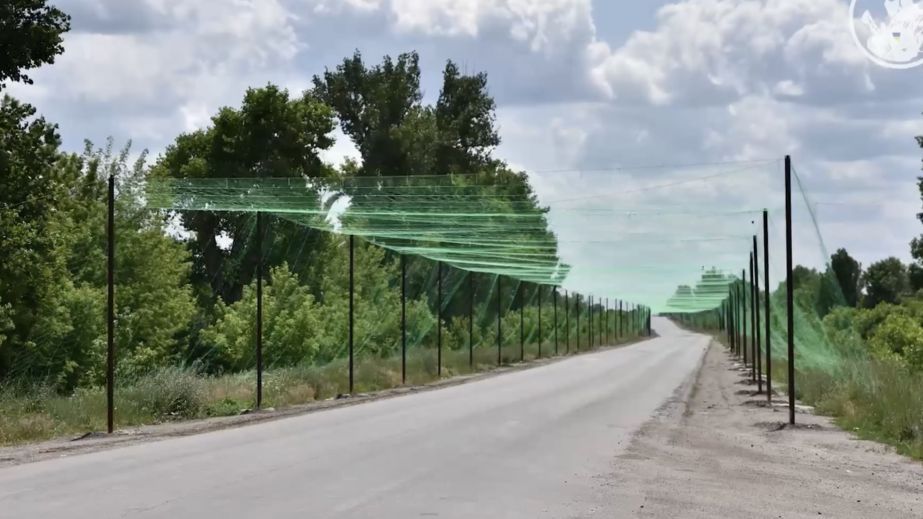
Ukraine makes its anti-drone road nets a national standard in a new strategy for defensive lines through 2028. It has already strung over more than 1,000 kilometers of road

Netting tunnel over a road in Zaporizhzhia, protecting civilians and vehicles from FPV drone attacks.

Ukraine’s government has approved a Strategy for the Engineering Equipment of Defensive Lines through 2028. It makes strengthening anti-drone protection of logistics routes one of its priorities, the Defense Ministry says.

Russian FPV drones hunt almost anything that moves within 15 to 30 kilometers of the front, which has forced Ukraine to drape its logistics roads in overhead netting, wire-mesh canopies and reinforced barriers that catch an attacking drone before it reaches a vehicle. Ukraine had already built more than 1,066 kilometers of such protection by mid-July and aims for 4,000 kilometers by the end of 2026.

The new strategy turns that scramble into a single national standard, setting deadlines, assigning responsibility, and building control mechanisms, the ministry explained.

“Solutions that have proven effective we will scale. But we will also account for new challenges, threats and changes in Russian tactics. The main goal is the protection of our service members and civilians,” the Defense Ministry says.

One digital map for every trench and net

The plan puts the entire defensive network onto a screen. To track and monitor the state of defensive lines, Ukraine will introduce a single digital geographic information platform, built on and expanding existing systems, including the DELTA situational-awareness system.

The database will hold object passports, photographs, and data on each structure’s location and condition, helping officials verify that work is done, identify repair needs, and distribute resources on evidence rather than guesswork.

From trenches to supply roads, one cycle

The strategy covers the full span of military engineering. Its main lines of work are building and maintaining fortifications, laying engineering obstacles, strengthening anti-drone protection of logistics routes, using modern designs, materials and camouflage, creating a reserve of construction materials, and maintaining digital records of the work.

Developed on the Defense Ministry’s initiative based on combat experience, the document spans the entire cycle from planning and construction to accounting, upkeep, and restoration, the ministry noted. Financing will come from the state and local budgets for the relevant year and from other sources not prohibited by law.

  •  
❌