❌

Reading view

Ukraine says it has finished its part of FREYJA, Europe’s joint anti-ballistic project. Partners’ work is still underway
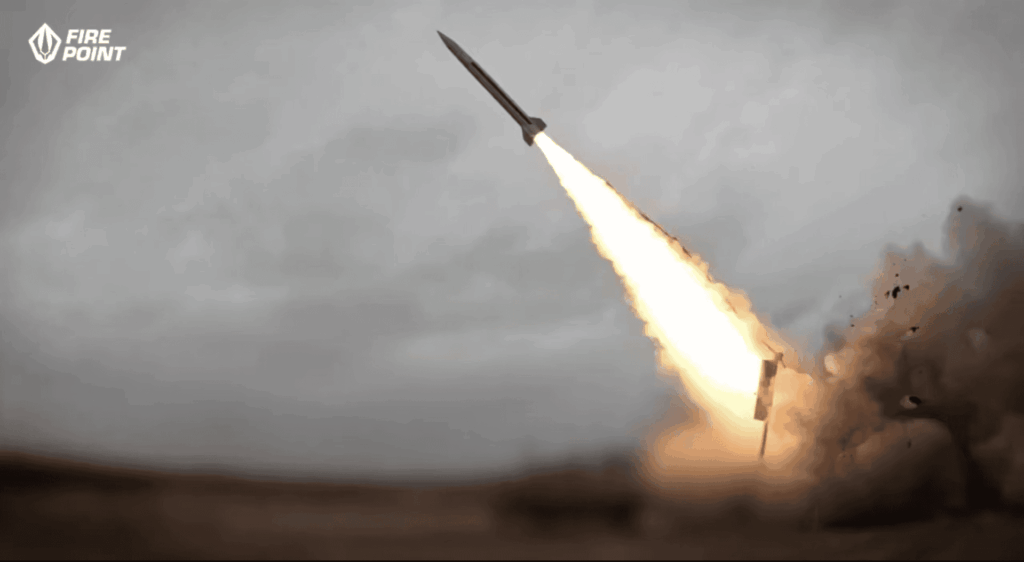
ukraine advertise its new ballistic missiles until factories can mass-produce ex-security officer says · post test launch fp-7 missile prototype fire point news ukrainian reports

Ukraine has finished its share of FREYJA, a joint European project to build a system against ballistic missiles, President Volodymyr Zelenskyy told journalists on 17 October, Ukrinform reported. He added that Kyiv wants to test the first system as soon as possible.

Ukraine still relies on US-made Patriot interceptors to stop Russian ballistic missiles. Zelenskyy told ABC News on 23 October that Ukraine had received only 24 of them from the US in three months, while it needs 350 a month on average. FREYJA can not close that gap soon, because the system is still in development.

Ukraine’s missile and launcher, partners’ radars and sensors

Zelenskyy said the partners’ share of the work, with 10 countries taking part, is still underway. He also said he had discussed the project with French President Emmanuel Macron, and he named Norway as a key partner.
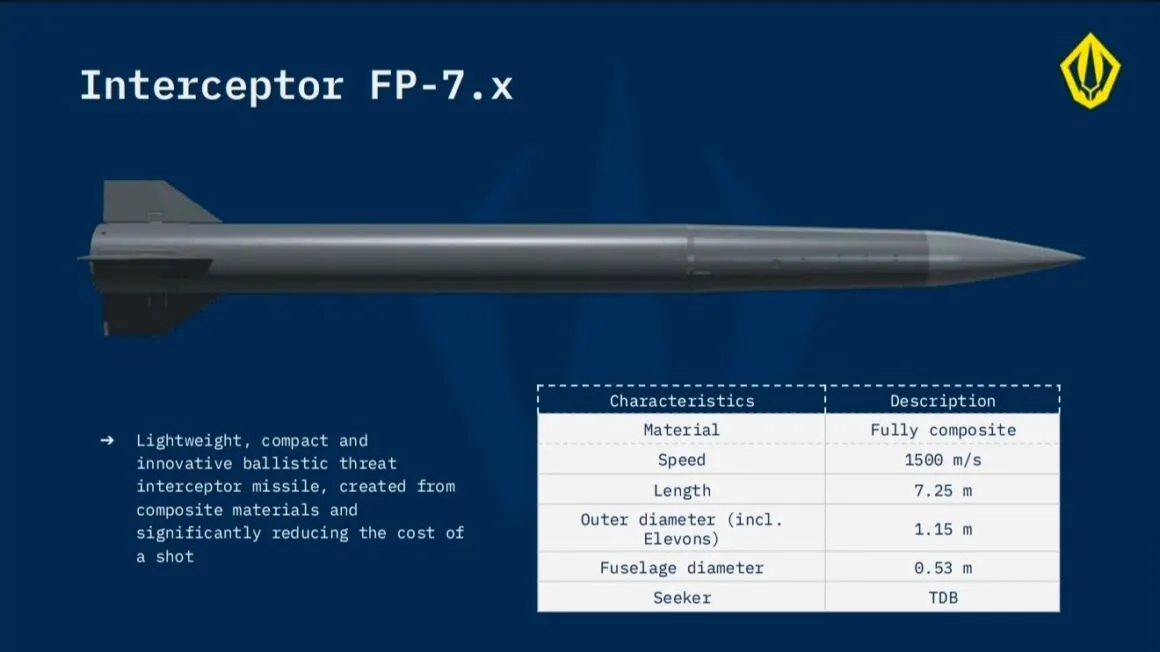
Fire Point concept graphic showing the FP-7.x interceptor missile beside a table of proposed specifications.
Explore further

Ukraine’s missile, Europe’s sensors—FREYJA enters active development on an early-2027 clock

Zelenskyy did not say what the partners still have to deliver. In August, he said Ukraine is capable of making the missile and launcher, while partners would supply critical components such as radars and sensors.

One part not made in Ukraine

In May, Fire Point co-founder and chief designer Denys Shtilerman said all components of the FP-7.x interceptor are made in Ukraine except one. “As for that one part we don’t manufacture in Ukraine, we’ve contracted a certain quantity of it. We already have it,” he said, but did not name the part.

In June, however, Shtilerman told the Financial Times that mass production depended on an infrared seeker Fire Point hoped to get from Germany’s Diehl Defence. Neither statement says whether the seeker is that one part.

Fire Point co-founder Iryna Terekh said in September that FREYJA was going through testing and technical integration in combat conditions in Ukraine. The company plans its first intercept of a ballistic target by mid-2027.

The official timeline has since moved closer. On 21 October, Zelenskyy wrote that officials had identified where to speed up so FREYJA reaches testing by the end of this year. A test is still a step short of an intercept.

  •  

Ukrainian OSINT analyst: Russia’s Yandex data center in Sasovo burned out inside, though its roof shows almost no significant holes

Cloud-free satellite image of the damaged Yandex data center in Sasovo, Ryazan Oblast, posted 22 October 2026

Russian tech giant Yandex's data center in Sasovo burned out from the inside, a Ukrainian OSINT analyst wrote on 22 October. On cloud-free satellite images, he saw almost no significant holes in its roof. Ukrainian drones hit the site overnight on 8 October.

Sasovo was the first strike on a data center in Russia. It came two weeks after Russia destroyed data centers in Kyiv. Drones then hit Yandex sites in Vladimir and Kaluga, a Sber data center, and a VK data center near St. Petersburg, which VK acknowledged. In occupied Donbas, monitoring channels reported hits on buildings housing telecom operators.

What the analyst sees

The analyst, who goes by Harbuz, runs the Ukrainian OSINT channel Dnipro Osint. His roof reading comes from the images. His interior claim comes from what he called available information: he wrote that a fire broke out inside and put part of the equipment out of action.

Cloud-free satellite image of the damaged Yandex data center in Sasovo, Ryazan Oblast, posted 22 October 2026
Cloud-free satellite image of the damaged Yandex data center in Sasovo, Ryazan Oblast, posted 22 October 2026. Image: Dnipro Osint

In an earlier post, Harbuz wrote that a third of the data center had burned out. In the new one, he writes that the building burned out from the inside. He does not say whether he revised the earlier figure.

Russian outlet Agentstvo studied Airbus images from 12 October. It found damage on about a third of the building. Unlike Harbuz, though, Agentstvo described a blackened western roof with damage resembling holes.

What Yandex says

On 8 October, Yandex stated that the attack caused a fire and forced it to suspend operations at the site, which hosts tens of thousands of servers, Reuters reported. Yandex Cloud and the Disk and Documents services that run on it ran with major disruptions that morning, Russian outlet The Bell reported.

Later that day, the company stated: "The scale of the damage to the infrastructure is still being assessed. For the moment, we cannot confirm whether it is possible to restore the data centre equipment in Sasovo." Two of Yandex's three supercomputers, used to develop its AI model, are housed there.

The same day, journalists asked Ukrainian President Volodymyr Zelenskyy whether Ukraine was targeting Russian data centers. He did not refer specifically to the Yandex strike, Reuters noted, but said: "We always respond in mirror-like fashion."

  •  

Denmark puts a $112.6 million state guarantee behind the maker of Ukraine’s Flamingo missiles

flamingo vs oreshnik ukraine's genstaff now details damage russia's launch site · post fp-5 cruise missile targeting kapustin yar test range ukraine confirmed ballistic infrastructure previous strikes astrakhan oblast intermediate-range

Denmark will guarantee a loan to the Danish subsidiary of Fire Point, the Ukrainian maker of Flamingo cruise missiles, the Danish Business Ministry announced on 21 October. The financing will run through EIFO, Denmark’s state export and investment fund.

Ukraine uses its Flamingo missiles to strike defense plants deep inside Russia as Moscow continues its full-scale invasion. Fire Point broke ground in December 2025 on a plant in Vojens, southern Denmark, to make solid fuel for the missiles. The project has since grown far more expensive. In August, CEO Iryna Terekh said its estimated cost had risen from €50 million to above €150 million, calling the figure “very rough.” The war, meanwhile, stands in the way of Fire Point borrowing on ordinary terms in Denmark, the ministry said. That is why the Danish state is guaranteeing the loan.

What Denmark is putting up

The guarantee covers 750 million Danish kroner, or about $112.6 million, Reuters reported. Terekh said in August that the plant’s launch had slipped to late 2027. The ministry called the deal another big step toward starting production. However, Ukrainian outlet Defender Media noted that the statement does not say directly that the loan will fund the plant.

ukraine start mass production 3000 km flamingo missile zelenskyy says workers inspect cruise fire point's secret factory 18 2025 ap photo/efrem lukatsky fb/efrem 535397328 _24984278831178579_1839062619339783429_n long-range weapon has already completed
Explore further

Ukraine’s Fire Point company is working on revolutionary system which can also transform European air defense

EIFO chief Peder Lundquist said the fund is involved in nearly 40 projects linked to Ukraine. Business Minister Martin Lidegaard said hosting a Ukrainian defense company brings Denmark knowledge, production, and partnerships. Europe’s security and freedom, he added, start in Ukraine.

Better shielded from Russian strikes

Defense Minister Jeppe Bruus said Denmark was the first country to decide to let a Ukrainian defense company set up on its soil. Production outside Ukraine, he argued, is better protected from Russian attacks. He added that Fire Point’s presence opens cooperation that could give Denmark access to technologies developed in wartime.

Denmark first said in September 2025 that Fire Point would make long-range missile fuel on Danish soil. Since then, the company has signed deals with more than a dozen European firms for FREYJA, an anti-ballistic project. It could reduce Europe’s long-term reliance on scarce US-made Patriot interceptors. Fire Point aims for a first ballistic missile intercept with it by mid-2027.

  •  

The drones flew 1,000 km. St. Petersburg’s oil terminal, fuel depot, and a nearby data center were waiting at the end

russia’s st petersburg wakes up burning oil sites hit bridge damaged data center after night ukrainian drones · post fire ozon distribution kolpinsky district drone attack 18 2026 astra ukraine

Ukrainian drones struck St. Petersburg’s oil terminal, a fuel depot, an Ozon distribution center, and a VK data center overnight, setting off fires across the city, monitoring channels reported. Russian outlet Meduza called it apparently the largest attack on the city and Leningrad Oblast since the war began. Russian officials acknowledged fires, damaged homes and substations, and power cuts.

Russia keeps fighting along the front while bombarding Ukrainian cities and the grid behind it. Ukraine’s long-range drones, in turn, target the oil exports and logistics that fund and supply that war, and Russia’s Baltic oil ports have been hit repeatedly this year. St. Petersburg is a symbolic place: Russia’s so-called second capital and Putin’s hometown.

Oil terminal and fuel depot on fire

Ukrainian forces struck the Petersburg Oil Terminal with FP-1 drones, starting a fire, Ukrainian drone maker Fire Point said. The company described the terminal as one of the region’s largest, handling 12.5 million tonnes of petroleum products a year, including for export.

Piter port and oil facility in one shot pic.twitter.com/KfptwkhsDS

— Exilenova+ (@Exilenova_plus) October 18, 2026

St. Petersburg Governor Aleksandr Beglov acknowledged fires at the terminal and in four city districts, adding that Pulkovo airport had restricted flights. By morning, firefighters were still battling blazes at the terminal, the Ruchyi oil depot, and industrial warehouses in the Kolpinsky district, he wrote. He claimed one person was killed and five injured. Ukrainian monitoring channel Exilenova+ reported that the Ruchyi depot had been burning since the night.

Ozon hub, VK data center, and a bridge

An Ozon distribution center in Kolpinsky district caught fire after the attack, the company said, Russian independent outlet Astra reported. Astra’s open-source intelligence analyst described it as one of Ozon’s busiest fulfillment centers in northwestern Russia, covering up to 79,000 m².

Ozon in St. Peterburg pic.twitter.com/tA9iwRJf7d

— Exilenova+ (@Exilenova_plus) October 18, 2026

FP-1 drones also hit a VK data center in Novosergiyevka, Leningrad Oblast, causing serious damage, Fire Point said. VK acknowledged a drone attack on the site but claimed its services were working normally. Leningrad Oblast Governor Aleksandr Drozdenko claimed air defenses downed 145 drones over the oblast alone. He acknowledged damage to the data center’s transformer equipment and warehouse complex, and minor damage to the Vostochnaya substation. Two other substations in Yanino went offline, cutting power to about 20,000 people, he said.

Damaged VK data center building in Novosergiyevka, Leningrad Oblast, after a Ukrainian FP-1 drone strike, 18 October 2026
Damaged VK data center building in Novosergiyevka, Leningrad Oblast, after a Ukrainian FP-1 drone strike, 18 October 2026. Photo: Fire Point/X

A drone also hit the cable-stayed bridge over the Korabelny fairway, part of a toll highway linking the city’s north and south, Exilenova+ reported, adding that the extent of the damage was still being clarified. The channel also reported a fire near a Russian Aerospace Forces radar company outside the village of Kaporskoye.

Smoke rising over St. Petersburg after the overnight drone attack, 18 October 2026
Smoke rising over St. Petersburg after the overnight drone attack, 18 October 2026. Photo: Astra

To reach St. Petersburg, Ukrainian drones had to cover 1,000 km across four Russian regions guarded by air defenses and electronic warfare, said Serhii Beskrestnov, adviser to Ukraine’s president on defense technology.

“And these are not cruise missiles with special systems, these are drones that fly at speeds of up to 200 km/h,” he wrote.

Satellite image marking the drone hit on the cable-stayed bridge over the Korabelny fairway in St. Petersburg, 18 October 2026
Satellite image marking the drone hit on the cable-stayed bridge over the Korabelny fairway in St. Petersburg, 18 October 2026. Image: Dnipro Osint via Exilenova+

Strikes resume after a one-sided truce

The same night, Russia hit Ukraine’s grid again, and Ukrainian President Volodymyr Zelenskyy counted 76 Russian strikes on energy since the ceasefire was announced. US President Donald Trump declared the truce on 11 October. Ukraine paused its refinery strikes for three days at Washington’s request, but Russia struck a Kharkiv power plant within hours and kept hitting the grid. Zelenskyy then said Ukraine was resuming strikes on Russian oil and would stop again only in exchange for more US interceptors for its Patriot systems. Trump called the renewed strikes “a disgrace” and said he found Zelenskyy “more difficult to deal with than Putin.”

Ukraine has hit the St. Petersburg area before. In July, drones set fire to Wildberries warehouses near the city. In August, Ukraine began striking Ozon hubs, starting in Samara Oblast. The hubs move dual-use goods such as electronics and drone components.

  •  
❌