Judge blocks Trump administration's Medicaid work requirement rule forcing proof of medical frailty


On this week's episode of Freed Up, Robby "Lestat" Soave and Christian "Lizard" Britschgi sport their Halloween costumes while reviewing Nathan Fielder's buzzy new documentary, You Can See Everything. During their discussion, they analyze the psyche of Elizabeth Holmes as well as the differences between documentaries and biographical dramas, and Christian gets an opportunity to defend his written critique of the film. Next, the boys shift gears and unpack reports that Mary Peltola's Senate campaign in Alaska helped recruit a second "Dan Sullivan" to confuse voters who meant to support the incumbent, Sen. Dan Sullivan (R–Alaska).
0:00—Halloween costumes
4:58—Robby and Christian review You Can See Everything
9:05—The ethical dilemmas in You Can See Everything
16:00—Elizabeth Holmes is still a liar
30:00—The Dropout vs. You Can See Everything
42:24—Mary Peltola's dirty tactics come to light.
54:06—Freed Up live for the 2026 midterm elections
If you enjoy Freed Up, come watch Robby debate at our upcoming Reason Versus event in Washington, D.C. Tickets are available here.
The post <em>You Can See Everything</em>, Halloween Costumes, Mary Peltola appeared first on Reason Magazine.
© Illustration: Fatima Ruiz
Patients diagnosed with progressive dementia may know exactly how much deterioration they are willing to endure. They can articulate their wishes, discuss alternatives, and put their instructions in writing. Should losing the ability to repeat those instructions invalidate them?
Canada is preparing to address that question. On October 23, its Justice Department announced planned rules that would allow adults diagnosed with an incurable illness expected to destroy their decision-making capacity to consent in advance to assisted suicide (or, as Canada calls it, medical assistance in dying (MAID)). Ministers will discuss the proposal on October 27, but it must pass both houses of Parliament and receive formal approval from Canada's governor general before becoming law. Parliamentary committees can hear testimony and consider amendments along the way. The announcement promises safeguards but offers few details. Those details will determine how well the proposal respects patients' choices.
A free society recognizes individuals as sovereign over their own bodies provided they respect the rights of others. That freedom includes deciding how much suffering they are willing to endure. A competent adult's decision deserves respect even when physicians, relatives, or public officials would choose differently.
Competent adults should be free to choose clinician-assisted suicide or clinician-administered euthanasia, provided they give fully informed, voluntary consent and those assisting them do so willingly. That freedom should include planning for the loss of decision-making capacity. A patient's loss of decision-making capacity should not automatically grant the government authority to override instructions given while the patient was competent.
Physician-assisted deaths are now authorized in 13 states and Washington, D.C. Twelve states and the district enacted laws; Montana permits it under a state Supreme Court ruling. American statutes generally follow the Oregon model: Patients must have decision-making capacity, have a terminal illness expected to cause death within six months, and self-administer the medication.
These restrictions exclude people who suffer greatly but cannot meet the government's timetable or physically perform the final act. Progressive dementia creates another barrier. By the time patients reach the condition they hoped to avoid, they may no longer qualify.
In 1999, Michigan convicted Jack Kevorkian of second-degree murder after he administered lethal drugs to Thomas Youk, a patient with amyotrophic lateral sclerosis ("Lou Gehrig's disease") who had consented to the procedure. As I wrote in Reason, patients' bodily autonomy includes the freedom to request a willing physician's assistance in ending their lives. Requiring patients to administer the medication themselves denies that choice to people whose illnesses have stripped them of the physical ability to act. Dementia raises a further question: whether an informed decision can survive the loss of the capacity to express it.
Other countries give patients more latitude. At least a dozen countries permit some form of assisted dying, though their rules vary considerably. Canada does not require a terminal prognosis. In the Netherlands, euthanasia is permitted for unbearable suffering with no prospect of improvement, subject to statutory safeguards.
Some countries also recognize advance requests, though under different conditions. In the Netherlands, a written advance request can replace an oral request once a patient loses the ability to express a choice, including in advanced dementia. The remaining legal requirements, including unbearable suffering without prospect of improvement, still apply.
Belgium permits advance requests more narrowly, only when a patient becomes irreversibly unconscious. Patients who lose decision-making capacity due to dementia while remaining conscious cannot obtain euthanasia under an earlier directive.
Respecting a patient's earlier wishes raises difficult questions. How clearly must patients describe the circumstances in which they want assistance? Who determines whether those circumstances have arrived? What happens if a patient who can no longer understand the directive resists the procedure or appears content with life?
Legal scholars, working with clinicians and patients, must help lawmakers answer these questions. Finding the right answers is difficult, but the obstacles are not insurmountable. Lawmakers must develop careful safeguards that respect patients' choices rather than impose a blanket refusal to honor decisions made while patients were competent.
Patients already use advance directives to refuse life-sustaining treatment after losing decision-making capacity. Authorizing someone to administer life-ending medication requires additional legal consideration. But the principle of planning ahead deserves the same respect: People should have a meaningful say over what happens to their bodies when illness prevents them from speaking for themselves.
The law has a legitimate role in protecting patients from coercion, fraud, and life-ending procedures they never consented to. Before another person intentionally helps end a patient's life, the law must require reliable evidence that the patient gave informed, voluntary consent and that the applicable conditions were met. Neither a relative's preferences nor a clinician's assessment of whether a life remains worth living can substitute for the patient's decision.
Participation must also remain voluntary. Clinicians and private institutions should be free to decline participation on moral, ethical, or professional grounds. Respect for autonomy extends to all involved.
Oversight should focus on compliance with the law. An independent body could audit cases retrospectively, publish anonymized findings, and refer credible violations to investigators. It should not require patients to obtain bureaucratic approval for individual decisions, nor should it have the authority to rewrite eligibility standards.
Eligibility should hinge on a serious, incurable condition causing enduring, intolerable suffering and on reliable evidence of informed, voluntary consent. A six-month prognosis gives the government too much power over how long patients must endure suffering they consider intolerable.
Canada's proposal deserves careful examination once its details are available. A law that honors clear advance instructions while protecting patients against violations of those instructions would expand their control over the course of an incurable illness. A law that allows others to substitute their preferences would undermine the autonomy it purports to protect.
Dementia can rob people of their memories, judgment, and ability to communicate. The government should not use those losses to erase choices they freely made while competent. Patients who leave clear, informed instructions deserve laws that let willing clinicians honor them. Their bodies belong to them, even when they can no longer say so.
The post Canada Wants To Let Dementia Patients Consent to Euthanasia in Advance appeared first on Reason Magazine.
Vinay Prasad has been on both sides of the public health establishment. A physician, author, and professor at the University of California, San Francisco, he went from prominent COVID-era critic to Food and Drug Administration (FDA) insider when he was tapped to lead the agency's Center for Biologics Evaluation and Research in May 2025. His tenure there included an abrupt resignation in July 2025, a return a few weeks later, and his final departure in April 2026.
Prasad joined Reason's Zach Weissmueller in August to discuss what he learned from his time inside the FDA, what he was able—and unable—to change, and whether the agency can ever regain public trust. Their conversation ranges from Anthony Fauci and the origins of COVID-19 to vaccine policy, plus regulatory barriers, his growing sympathy for libertarian critiques of the FDA, and whether the agency is ready for an era of AI-driven medicine.
Reason: The FDA saw a clearing out of the old guard and a replacement with a new one—COVID dissidents such as yourself, former FDA Commissioner Marty Makary, and National Institutes of Health Director Jay Bhattacharya. What was that like? Did you have any misgivings about stepping away from academia and your role as an outside critic to join the public health bureaucracy?
Prasad: Maybe we changed 4 percent, 2 percent of the FDA. The FDA is an 18,000-person agency. There's tens of thousands of people still there. Before Marty, the commissioner, and I got there, DOGE [the Department of Government Efficiency] had just struck and they got rid of a couple thousand people. But the system is largely the same as it's always been.
There are critics of the COVID pandemic response and then there are critics. Although Marty, Jay, and I are critics of many aspects of the response, we don't go as far as some of the most extreme critics out there.
Am I glad I did it? Yes, I'm glad I did it. It was an adventure. It was a learning experience. I learned more in one year than I'd learned in the prior decade about how the world works. I'm glad to have improved some aspects of government, which I think will be enduring, and at least tried to improve other aspects of government, which may not be enduring.
Anthony Fauci personified the old guard. He's recently been in the news because he appeared before Congress and pleaded the Fifth after Sen. Rand Paul (R–Ky.) published his diary. What did those diary entries reveal to you about Fauci's character and about the way he operated?
Probably the greatest news story is that the mainstream media refuses to be honest about his legacy. Fauci was in his late 70s when the pandemic began. Had he retired at a ripe old age of 75, he'd be leaving behind a stellar legacy. But he continued. He pushed it. He stayed through the whole pandemic. He was the face of many things that his diaries get into, what he privately thought while he was publicly saying different things.
Fauci has not only been a proponent that the only answer to where the virus came from is a natural spillover event. He's gone further than that. He orchestrated a paper published in Nature Medicine called the "Proximal Origin" paper, written by a bunch of people who bolstered that point of view. He edited that paper before it was published. Then in public, he pretended like he didn't know those people; it was an independent group that validated what he was saying. Whereas in many respects, he puppeted that paper. The people who wrote that paper—Rand Paul has released their Slack channel messages showing they didn't really even believe what they were writing. Their messages reveal considerable ambiguity about lab leak vs. natural spillover event.

In terms of the origin, he also funded EcoHealth Alliance, which had a subcontract to Wuhan. He had a huge role in the origins and trying to frame the narrative, making lab leak—you couldn't even discuss it. Facebook put a ban on even talking about the topic. Then masking 2-year-olds. He played a huge role in that. Lockdowns, school closure. He said he didn't close any schools. In his own diary, he says, "I told [Mayor] Bill de Blasio, you need to close schools in New York City."
At some point, the man's got to take ownership over the decisions he did make and advocated for. When [Gov. Ron] DeSantis in Florida reopened schools in 2020, he went on every television show to say what a bad idea that was. Now, it's very clear—many of us said so at the time—school reopening was always the right decision. Maybe it could have been closed for a week or two, but certainly not beyond that. Fauci kept it closed much longer.
Vaccines make a lot of sense for elderly people who had not yet had COVID. But do they need to be given to a 4-year-old, a 7-year-old, a 12-year-old, a 22-year-old who'd already had COVID? This is where considerable ambiguity exists. But for Fauci, the answer was clear: You need all the shots. You need the initial series. You need a yearly booster. It doesn't matter how young you are or how many times you've had COVID. Fauci was wrong about almost every single pandemic policy he advanced.
Some of his defenders say to me, "At least he didn't tell people to drink bleach." And I said, "Is that the bar for a guy who's a doctor and a scientist?" Drinking bleach is not a good idea, but that's not the bar for a Fauci-level figure. He should be saying things that are correct. If they're not correct, he should be collecting evidence to weigh in. He did none of that.
Fauci's pardon stretches back to 2014, when he was authorizing funding in contravention of U.S. policy on gain-of-function research. Do you think he actually committed a crime?
Yes. The other thing about it is people will say, did that money go directly for this research? The money went for viral genomic research at a Chinese institute, very similar to the sorts of things we would be worried about. That was a crime for which he's been pardoned. It's not just my assessment. That's what Joe Biden's autopen thought, or whoever signed that pardon, that he committed a crime. That's why he has a pardon that goes that far back. It was a crime. Now that he's been pardoned for it, I don't know what you can do about it.
You rode in on this wave of anti-Faucism. What was your biggest hope for what a new version of public health might look like, or for the kinds of changes that could be made?
I had a very narrow mandate because I was just in charge of biologics at the FDA. The hope continues, which is that public health could aspire to be honest, to use its powers proportionately and judiciously, to exercise humility. Public health is far from these things. Public health could actually aspire to be bipartisan. Public health is not. It's becoming an increasingly entrenched left-wing discipline run by left-wing ideologues, reaching even more and more absurd conclusions. What public health can be and what it is are still light-years apart.
You don't think that has changed very much?
Not much at all. Changing an entrenched organization with tens of thousands of people is very difficult. There have been some changes. The pandemic has been a catalyst. But I don't think a real reform is possible. I suspect it'll splinter into different public health groups.
Your role was at the part of the FDA that oversees biologics, such as vaccines and gene therapies. Vaccines became an increasingly polarized and politicized issue during COVID. What was your goal specifically pertaining to vaccines when you took over after the pandemic?
The right drug given to the right person at the right time is lifesaving, but the wrong drug given to the wrong person at the wrong time can be harmful. Vaccines are the same way. You can't say anything about all vaccines, just like you can't say anything about Tylenol, aspirin, and Plavix all in the same breath. They're all very different drugs.
Is this the same phenomenon we observed during COVID, where you're either for the vaccine or you're against it, for a medicine or against it, without breaking things down by age, health, or other individual factors? Everything has to be flattened or compressed.
Same phenomenon. One-size-fits-all public health—where the shoe doesn't fit the guy with the big foot or the person with the small foot—is a completely wrong view of public health. COVID is a great example. An 80-year-old who's never had COVID, and we're talking about February of 2021, should they get a vaccine? Absolutely. A 7-year-old who's had COVID and we're talking about 2022? No, a healthy 7-year-old makes no sense. Public health is, in this country, so broken. It cannot appreciate these distinctions.
Something you've been writing about for a long time is poor experimental design in drug trials. Was that something you wanted to change when you came into the FDA? Do you feel like you made any progress toward that goal?
In one year, we did more than what our predecessors have done in a decade. You can look at just the sheer number of announcements and policy changes we made. We're talking a lot about one side of the coin, which is where the companies are not doing the right study to inform the American public. We're not talking about the other side of the coin, where the FDA is asking them to do things that don't make any sense at all, that burden them, that cost money, and that are wasteful. We did a lot of work in that space too. The FDA makes both errors. They also do a lot of things right, but they make both errors and they can get better.
You mentioned there were two sides of this FDA reform. One was raising standards for things like vaccines. The other was acknowledging how expensive and cumbersome it can be to get something approved in the United States. What were the biggest barriers you saw at the FDA on that side of the equation?
So many. During my time at the FDA, I was often sympathetic to the people who work at companies who told me about the hurdles they were forced to jump through. The FDA does two things: We regulate what's approved and can be marketed and sold on the U.S. market, but also what you can study.
Imagine you're a researcher and you want to study something. We're not talking about approving. You want to gather people together who may be interested in trying something new, have an informed consent, get them to volunteer, but they know that we don't know for sure it's going to work. We do so many things in that space, regulating what you can study and how you can study it, that I think are sensible. You don't want to let people sign up for something that's going to blind them or maim them. But some things that aren't sensible, that are overly burdensome, that are quality controls that don't make sense for small companies and super-rare diseases that don't have a huge budget to study these things. The regulation in this early side of research is tremendous in the United States. A lot of it is well-intentioned, but not all of it is fit for purpose.
You said that your time within the FDA made you somewhat more sympathetic to the libertarian critiques of the FDA.
I'm really sympathetic in one way: We tax people a lot of money to pay for healthcare in America—trillions of dollars. We're taking trillions of dollars from people's paychecks, from taxation, and we're taking it for this thing that we think is a benefit to people, which is we're going to offer a service that's maybe a human right, a societal good. Surely, the service we offer, we do have some of that stuff in there. If you have a heart attack, you go to the doctor here with or without insurance, they're going to open up that blockage. That's a great thing. But along with that package deal, we're going to insert a few things that may or may not work, that cost a lot of money. All that's doing is taking lots of money from taxpayers and redistributing it to the shareholders of those companies.
It's a huge financial system with the rare adverse event of helping someone's health. The libertarian comes along and says, "I'd rather not pay the tax—have more skin in the game, decide what's right for me. I'm the best person to decide how to use my own money." I do feel a sympathy to that point of view, because this system has so many places where it can be taken advantage of, where people get something that doesn't help that much, that only may kill without any possibility of benefit. And we take a lot of other people's money to pay for that.
Dario Amodei, the CEO of Anthropic, recently called out the FDA, and I'm wondering what you think of this. He wrote, "Regulatory systems were designed for a slower pace of innovation and we are not prepared for the deluge of new products and advances that AI will bring. AI may also make these downstream technologies safer and more predictable in a way that violates the skeptical assumptions of regulatory agencies like the FDA."
If Amodei is right about the effect AI is going to have on the field, do you think the FDA will be able to adapt?
I see kernels of truth in what he's saying, but maybe I don't go all the way he goes. Where I see the big core truth is the FDA tries to regulate AI itself, medical AI. You wear a watch that's supposed to give you information and the FDA wants to do a lot of that regulation. That's a very tough thing to regulate, because this technology is changing so much faster than our ability to judge it. I do agree with Marty and others who think that that's probably not the best role for regulating all the potential aspects of digital health and health AI. For instance, you can imagine the absurdity where I'm a doctor, I'm seeing a patient later this afternoon, should government regulate the apps I can use to learn about the disease or ask questions? Should it regulate open evidence? I don't think it should.
I spoke to a company called Doctronic that is acting as an AI prescriber in Utah, where AI is being allowed to refill prescriptions. That's another example of where these questions are going to have to be answered: Where does the government step in, and where does it step back?
Government is much more likely to get in the way of these kinds of innovations. It's changing so quickly. It's going to be very difficult for government to regulate that. You talk about drug discovery and drug science and those kinds of aspects of AI. If I was a pharmaceutical firm, I would definitely invest in AI. There's so many things around running clinical trials that we can do better with AI, help us run them cheaper and faster and more efficiently.
But when it comes to molecule discovery and basic science, I'm not as optimistic as Dario for a couple of reasons. One, a lot of the information that is fed into models about cancer biology is basically as close to fraudulent research as you can imagine. We're talking about like the Stanford president whose Western blots look Photoshopped kind of research. You got research that's not reproducible. It's not just my opinion. Many companies have taken samples of the literature and they tried to replicate it in their own labs and they have massive strikeout rates. If you train AI on garbage, what can it learn? It's only trained on inaccurate information. That's a challenge it faces.
The second challenge is AI will be happy to give you hypotheses to study, but you'll still need to run it with a few people to validate those hypotheses. I suspect the limiting reactant is not coming up with ideas; we have more ideas than we can study with people. The limiting reactant is getting the people to consent and manufacturing the products and those kinds of things.
I hope he's right. If he is right, it sounds like a great future. But I'm a little bit skeptical that he's totally right, because I think the biology of it is a lot harder.
Do you think enough has happened for people to start regaining trust in public health?
No way. I wouldn't trust it at all.
What still needs to happen for public health to legitimately earn back the trust of the public?
I don't know if it's even possible. It's so fragmented now. People tell you with a straight face, people I know, "Anthony Fauci, he made no mistakes. Literally, did the best job he could with the information he had." Then I said, let's just focus on one tiny thing. He did say you should take your 24-month-old kid and put a cloth mask on that kid all day in daycare. He said that. You don't think he had any clues at the time that that was a dumb idea? It's so obviously dumb, right? That's their position on every issue.
Public health is so myopic. It doesn't understand that you have to look at the whole issue. Isn't that a perfect analogy for COVID? Don't go outside. Just stay in your house all day. As if human beings don't need contact with other people and see face to face as if that doesn't matter at all.
Public health has not learned its lesson. The problem with public health is that they're completely politically captured now. Public health and the far left wing of the Democratic Party are synonyms. There's no political balance there. A little balance would go a long way. A little bit of open-mindedness would go a long way in public health. A little bit of humility to just admit a few things we got wrong in the pandemic.
The federal public health apparatus is still staffed with Robert F. Kennedy Jr. at the top and Jay Bhattacharya is still head of the National Institutes of Health. Is that not having some sort of trickle-down effect or creating a countercurrent within the system?
I don't know.
Don't get me wrong, I love Jay and I think Jay's heart's in the right place. He's already made some really important changes. I agree a lot with the kernel of Bobby's ideas. I agree with the kernel. I always say the kernel because I can think of a way that makes sense and I can sometimes think of ways it doesn't make sense.
But before I went to government, people told me that there is a fourth branch of government and it's the career state employees. I never believed that to be true, but now I'm certain that it's true. You have a lot of people who are in government. They tend to be in just three or four counties in one area, the blue pocket of America. They have strong views, and they really do a lot of the governance of this country. They make the decisions that regulate all of us in a way that's unaccountable to Congress and unaccountable to the president. I suspect they'll continue to stay. The COVID pandemic revealed to so many people that we made mistakes and that distrust in medicine and public health will just continue to grow and that there will continue to be more of these reckonings in the years to come.
How did working at the FDA affect your own confidence as a consumer in the regulatory system?
It gives me a little bit of pause sometimes. I like to trust but verify. I am cautious always with new therapies and particularly cautious that some safety information is being missed. It also makes me a bit more libertarian. I can imagine a system where we give people in America greater flexibility in what kind of products they can try. Maybe there's some third-party agencies, Consumer Reports–style agencies, that give different levels of quality and seals of approval of different products, and people can choose what they want and also have a little bit more skin in the game and use their own money. The moment you start to use your own money, suddenly tiny changes in surrogate biomarkers and elevated liver enzymes take on greater importance in a way that might not exist if you're using commercial insurance to pay for it.
Is it that you saw something inherent to the process that creates problems, holes, or gaps?
The fundamental idea that there's this one-size-fits-all balance where safety and efficacy is acceptable. What might be acceptable to you and acceptable to me might be different. I might want a little bit more efficacy information, a little bit more safety validation, and you might be willing to try more. The idea that a single monolithic government agency in the suburbs of D.C. can set that bar for every single person in America, that to me is a tougher pill to swallow now.
This interview has been condensed and edited for style and clarity.
The post Vinay Prasad on Anthony Fauci, COVID-19 Restrictions, and RFK Jr. appeared first on Reason Magazine.

French economist Gabriel Zucman has come to California bearing a familiar French solution to a fiscal problem: another tax.
Once based at the University of California, Berkeley, Zucman is back and campaigning for Proposition 40, which would impose an allegedly one-time 5 percent tax on the net worth of Californians worth more than $1 billion. Zucman, who coauthored the proposition, estimates that the tax could raise about $100 billion and claims that 90 percent of the proceeds would go to health care.
The California Legislative Analyst's office is far more cautious, saying it would raise only "tens of billions" and could cause a long-term loss of income-tax revenue as wealthy people leave the state with the companies they created.
I've written plenty about why wealth taxes are economically destructive, administratively nightmarish, and unlikely to achieve anything close to what their advocates promise. But Zucman's prescription is wrong for a more fundamental reason, as his (and my) native country shows: Raising taxes to fuel ever-larger demands for government spending is a recipe for disaster.
Unless you've been living in a remote cave recently, you've likely seen all the protests and destruction in France. But do you know why it's happening?
As another economist, Paul Krugman, rightly noted back in 2017, "France offers a social safety net beyond the wildest dreams of U.S. progressives: guaranteed high-quality health care for all, generous paid leave for new parents, universal pre-K, and much more."
For decades, France has answered any perceived desire with government spending, then responded to the resulting fiscal problem by seeking new revenue sources. Today, French government spending consumes roughly 58 percent of gross domestic product (GDP).
Krugman gloated that France wasn't suffering social collapse and speculated that it was due to all the spending. He certainly can't say that anymore. In fact, he is now worried that France may be on the precipice of a debt crisis. The truth is that France hasn't done well for some time, even when Krugman cheered its spending.
One of the groups in the street today, young people, has faced widespread unemployment for a long time. The youth unemployment rate in France (ages 15-24) has hovered between 17 percent and 27 percent since 2000. In the second quarter of 2026, it was 21.6 percent, against 14.8 percent in the Eurozone and 9.9 percent in the U.S.
French people also pay some of the highest taxes in the developed world, and they're not happy with the return. The government already takes more than 52 percent of the country's output in revenue, runs deficits exceeding 5 percent of GDP, and has accumulated debt approaching 120 percent of GDP. Nonetheless, French students complain that the government is shortchanging schools, while everyone sees that it is shortchanging its army and police.
The students aren't wrong to feel left out. At The Two Cents Substack, Hoover Institution scholar Hanno Lustig calculates that, between 1995 and 2024, spending on social protection and health (most of which benefits older people) rose from 53.1 percent to 58.7 percent of all French government spending. The share devoted to education, defense, and public order fell from 15.2 percent to 13.7 percent. Transportation fell from 5.3 percent to 3.8 percent.
In other words, France has built an enormous welfare state, much of it devoted to older citizens, while letting other state capacities and basic services fall apart. As transfers of wealth swallow a larger share of the budget, everything else gets squeezed.
That is the fiscal ratchet Californians should worry about when Zucman tells them Proposition 40 is necessary to "save" health care. Proponents claim Washington "cut" Medicaid, but that language is misleading. California's deficit started long before any Washington spending reductions. Besides, federal Medicaid spending isn't falling—not even close. The Congressional Budget Office estimates it will reach $708 billion in 2026, 8 percent more than in 2025. What Washington did in the 2025 budget reconciliation law was reduce Medicaid's future growth relative to previous projections, partly by changing eligibility and enrollment rules and financing arrangements.
This is how the ratchet works. Once the government projects a spending increase, anything less becomes a cut. And once Washington fails to finance the entire projected increase, Californians are told that Sacramento must backfill the missing money. And how should it do that? Conveniently, by creating an entirely new tax.
France has run this experiment for decades. It has an incredibly generous welfare state paid for with very high taxes; it's even tried a wealth tax and has a value-added tax, yet somehow it's never enough. Its welfare state has not eliminated scarcity. It has merely transferred the job of rationing scarce resources to politicians.
Zucman looks at California and sees hundreds of billions of dollars of private wealth waiting to solve a public finance problem. Californians should look across the Atlantic and ask a different question: What happens after politicians decide that every spending adjustment can be delayed until tomorrow by finding another pot of private wealth?
France should not be sending California tax advice. It should be sending a warning.
COPYRIGHT 2026 CREATORS.COM
The post France Is a Warning to California's Tax-the-Rich Crowd appeared first on Reason Magazine.
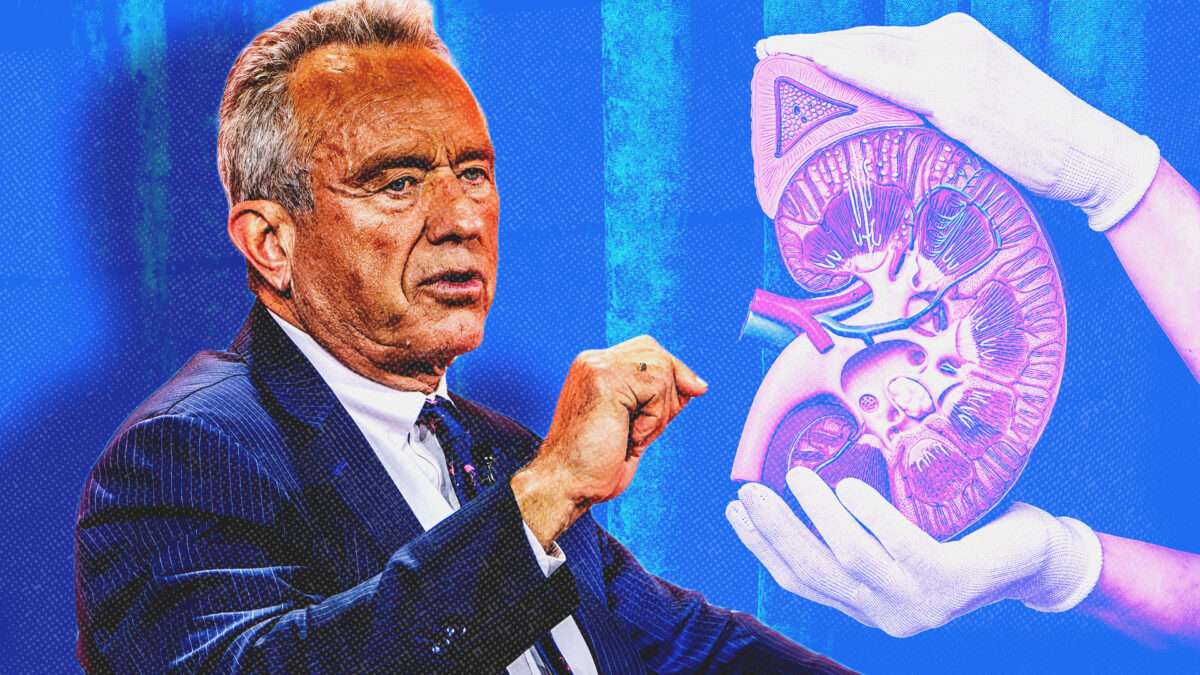
Like most of American healthcare, kidney care has for decades been plagued by red tape. The Trump administration says it wants to change that. On Tuesday, Department of Health and Human Services (HHS) Secretary Robert F. Kennedy Jr. announced his department's Kidney Care National Plan, which promises to introduce more competition, reduce regulatory barriers, expand patient choice, and overhaul America's kidney transplant system.
Much of the plan focuses on barriers to entry in dialysis care, which treats nearly 558,000 Americans. While dialysis can be performed at home, most patients receive treatment at specialized facilities, which must comply with federal certification requirements governing equipment, staffing, water quality, and patient safety in order to participate in Medicare.
Kennedy argues that regulatory barriers have discouraged competition and innovation, leaving patients with fewer dialysis treatment options. "Dialysis technology is an extraordinary technology," said Kennedy at the press conference, but "because of monopolies in the system and the barriers to new entrants, we have not seen any real improvements in that technology."
Of course, the existence of large or even monopolistic companies is not in itself evidence of a problem, but government regulation can often entrench those companies' positions in the market. "I like the fact that they're recognizing that a lot of regulatory…barriers are contributing to the problem, and that's refreshing to hear," says Jeffrey Singer, a practicing general surgeon and senior fellow at Reason Foundation, the nonprofit that publishes Reason. Singer says that removing barriers that prevent new companies from competing with established providers could not only increase choice but also drive down prices.
HHS says that two companies, DaVita and Fresenius Medical Care, control approximately 74 percent of the American dialysis market. As of 2019, roughly a third of Americans lived in areas where the only available dialysis provider was one of those two companies, according to the agency. The administration argues that government regulation has helped entrench this dominance by making it difficult for new providers to enter the market.
To address this, the Kidney Care National Plan suggests a number of reforms, including simplifying certification requirements. HHS also plans to investigate whether dominant dialysis providers have used payment arrangements and legal strategies to secure higher reimbursements without delivering better care.
The 17-page report calls for a review of existing requirements, but it does not specify which regulations will be repealed, nor does it establish a timeline for doing so. It also does not propose any significant reduction in the government's role in financing the distorted market. Instead, the plan largely seeks to make existing government-financed systems such as Medicare more competitive and efficient.
Kennedy has also correctly identified the need for reform regarding kidney donations. Nearly 90,000 people are waiting for a kidney transplant at any given time in America, and 11 people die every day waiting for a kidney. The transplant process is currently managed by Organ Procurement Organizations (OPOs), which are federally certified nonprofits responsible for recovering organs from donors and coordinating their transfer. There are currently just 55 federally designated OPOs operating in the United States, and HHS argues that they behave as "regional monopolies." Since no new OPOs have been approved in the last year, the Kidney Care National Plan suggests fast-tracking certification.
The plan also seeks to make living kidney donation easier by reducing financial barriers. Following the passage of the Honor Our Living Donors Act in February, HHS revised federal reimbursement rules so that a donor's eligibility for financial assistance is no longer determined by the transplant recipient's income. Eligible donors can receive up to $6,000 to cover expenses, including travel, lost wages, and childcare.
However, the reforms proposed stop short of allowing kidney donors to receive direct compensation for the organs themselves, which remains prohibited under federal law. "I can sell my blood. Why can't I sell my kidney?" Singer asks.
Peter Jaworski, director of the Georgetown Blood and Plasma Research Group, feels similarly, arguing that financial incentives are available to nearly everyone involved in kidney transplantation except the donors themselves. "According to this plan, it's OK to use incentives to encourage them to be more productive, to actually do a better job," Jaworski tells Reason, referring to transplant surgeons, hospitals, and organ procurement organizations. "The only exception, once again, is the donor who is offering a kidney."
Better solutions exist, according to Jaworski, who points to the proposed End Kidney Deaths Act. The bill, which was introduced by Rep. Nicole Malliotakis (R–N.Y.) last year, would offer living kidney donors a $50,000 refundable tax credit, distributed over five years. "We have those systems in order to make sure that we can treat patients. That's the point of blood donation. That's the point of plasma donation. That's the point of kidney donation too."
America's plasma market is an excellent example of financial incentives encouraging donation. Unlike many other countries, the U.S. allows plasma donors to be compensated, and despite accounting for just over 4 percent of the world's population, it supplies approximately 68 percent of the plasma collected globally for manufacturing medicines.
"Why do you think America does it? Is it because in America there's way more altruism than in France or Italy or Belgium? No, it's because in the United States you can be paid to donate plasma," argues Jaworski.
The Trump administration appears to recognize that government overreach has stifled competition and restricted patient choice. It also recognizes that living adults donating kidneys will be part of the solution to the long, deadly waiting lists. But its plan leaves the government's outsize role in kidney care largely untouched. For patients facing years on dialysis or waiting for a lifesaving transplant, recognizing the problem is not enough.
The post RFK Jr. Wants To Cut Red Tape in Kidney Care. He Should Go Further. appeared first on Reason Magazine.


This article was originally published by Truthout on Oct. 21, 2026. It is shared here under a Creative Commons (CC BY-NC-ND 4.0) license.
The U.S. Supreme Court has denied an emergency petition from the Trump administration, which sought a stay on a lower court’s injunction on a policy that would have denied gender-affirming care to federally incarcerated transgender people.
That policy was implemented by the Bureau of Prisons (BOP) after President Donald Trump signed an executive order in January 2025 that denied the existence of transgender people. The order also directed federal agencies to take steps that would be consistent with that view, and included specific instructions for the BOP.
“The Attorney General shall ensure that the Bureau of Prisons revises its policies concerning medical care to be consistent with this order, and shall ensure that no Federal funds are expended for any medical procedure, treatment, or drug for the purpose of conforming an inmate’s appearance to that of the opposite sex,” the order reads.
After the BOP conformed to the order, a group of incarcerated trans people who had been receiving gender-affirming care sued the administration. The group is being represented by the American Civil Liberties Union (ACLU), which argued that their Eighth Amendment protections against cruel and unusual punishment were being infringed upon.
A federal judge agreed, and, in August, ordered the policy to be blocked. The Trump administration challenged that finding, but the U.S. Court of Appeals for the District of Columbia Circuit upheld it, prompting Solicitor General John Sauer to submit an emergency appeal to the Supreme Court.
The court has regularly ruled against transgender people, allowing state bans on trans athletes’ participation in sports, ruling in favor of a ban on transgender people in the military, and upholding state laws that bar gender-affirming care for trans children and teens. Yet on Wednesday, the court denied the Trump administration’s request.
“The application for stay presented to The Chief Justice and by him referred to the Court is denied,” the order read, giving no further explanation. Two justices for the court — Samuel Alito and Clarence Thomas — would have granted the Trump administration’s request for a stay, the document said.
The ACLU heralded the high court’s denial of the emergency petition, stating, “This ruling affirms that federal prison officials can’t deny transgender people essential health care.”
Around 1,000 federally incarcerated trans people have also been diagnosed with gender dysphoria. The ruling means these individuals can continue receiving gender-affirming care while they remain in federal prisons or jails and the case moves forward in the lower courts.


On August 27, registered nurses, patients, and community allies rallied and stopped traffic in cities around the US to demand that hospitals and elected officials cut all ties with artificial intelligence giant Palantir. In this episode of Working People, we speak with a panel of registered nurses—Kelli Brennan (Portland, Maine), Lee Barker (Kansas City, Missouri), and Kiera Arbour (Chicago, Illinois)—about National Nurses United’s “Purge Palantir!” campaign, and about the disturbing creep of Big Tech and Big Brother into a US healthcare system that is already in crisis.
Additional links/info:
Featured Music:
Credits:
The following is a rushed transcript and may contain errors. It will be updated.
Maximillian Alvarez:
Alright. Welcome everyone to Working People, a podcast about the lives, jobs, dreams, and struggles of the working class today. My name is Maximillian Alvarez, and today we are speaking with union nurses who are speaking out against big tech and big brother, sneaking more of their tentacles into our healthcare system and into our lives. They and their union, National Nurses United, participated in a National Day of Action on August 27th, which brought together hundreds of registered nurses, patients, and community allies in cities around the country to demand that hospitals and elected officials cut all ties with artificial intelligence giant Palantir. As a press release from NNU lays out, “The nurses who are members of National Nurses United, the nation’s largest union of registered nurses, stop traffic in an act of civil disobedience in eight cities, Palo Alto, California, Los Angeles, California, Chicago, Illinois, Washington DC, Portland, Maine, Asheville, North Carolina, Austin, Texas, and New Orleans, Louisiana.
Union nurses cannot be silent when our most vulnerable people, babies and children are being detained by federal immigration agents,” said NNU President Jamie Brown. “While our patients and neighbors are living in fear of immigration raids enabled by Palantir, our hospitals are facing huge cuts and our patients are facing mounting healthcare costs because of H.R.1. Nurses aren’t just saying no to Palantir, but we’re calling for our public resources to go toward the benefit of working people, not billionaires and their corporations. “The press release continues. From 2009 to 2025, Palantir received $2.5 billion in federal government funding, but this number has grown tremendously in just the past year. Last July, the Department of Defense announced a $10 billion agreement with Palantir to use its technology to share data across federal agencies, enabling unprecedented surveillance power. This followed a $30 million contract awarded to Palantir by the Department of Homeland Security to build an AI-powered system that would identify immigrants for deportation.
In February of 2026, the Department of Homeland Security and Palantir signed a $1 billion contract. In the hospital industry already, Palantir manages more than one fifth of US hospital beds. For nurses, this marks a dangerous threat to their nursing profession, which is seeing a glut of untested and unregulated technology introduced into patient care settings.” All right, so we got a lot to talk about here, and to talk about all of this, I am really grateful to be joined on the show today by three guests who are all registered nurses, all members of National Nurses United. Thank you all so much for joining me today. I really appreciate it. Please introduce yourselves to our listeners.
Kiera Arbour, RN:
My name’s Kiera Arbour. I’m a registered nurse from Chicago, Illinois.
Kelli Brennan, RN:
My name’s Kelli Brennan . I’m a registered nurse from Portland, Maine.
Lee Barker, RN:
I’m Lee Barker. I’m a registered nurse in Kansas City, Missouri.
Maximillian Alvarez:
Well, again, thank you all so much for joining me today. I really, really appreciate having you all three here to talk about this because there’s so much here that I didn’t even know before I saw the day of action and started digging into this. So before we really get into Palantir and all this AI stuff, I want to start at the shop floor worker’s eye level, and I want listeners to get to know more about you all and to have y’all give us more of a lay of the land here. So could you start by telling us more about the jobs that you do, the hospitals that you work at, the kind of patients that you care for? And I guess could we talk a bit about all the non-AI workplace issues that you and your coworkers are already dealing with on a daily basis?
Kiera Arbour, RN:
This is Kira. I am a nurse in the neurosurgical ICU at Stroger Hospital of Cook County. We are one of the largest safety net hospitals in the United States. So I am just finishing up my first year as a nurse. Just graduated from my nurse residency program last week, came to nursing late in life. I took my licensing exam the day after I turned 50. For me, I think the thing that has really been the most challenging part of my first year of practice as a nurse is the patient population that we serve at Stroger Hospital as a safety net hospital in the third largest city in the country is just all of the poverty related, social determinants of health related illnesses. So in the neurosurg ICU, anybody who’s a gunshot wound to the head comes to us, blunt force trauma to the head, two gunshots to the head on the unit last night, one blunt force trauma, and then a whole bunch of people who have had strokes because they live in food deserts, they don’t have access to healthy things to eat or they don’t know how to manage chronic conditions like diabetes and high blood pressure.
And as somebody who grew up pretty privileged and whose parents are heading into their 80s over the next year and a half or so, I see my amount of death play golf every day. They go swimming with their grandkids every day because they grew up middle class, they grew up with money. And then I see people 20 years younger than them who are looking at end of life type of illnesses in our hospital. And it has really kind of overwhelmed me emotionally just because we live in a system that doesn’t do a very good job of allocating resources to folks. And so I’m watching people be very sick and eventually die from very preventable diseases and things that are associated with poverty. Violence is associated with poverty.
Kelli Brennan, RN:
I’m Kelly. I’m at Portland, Maine. Similar to Kara, I also work in neurosurgery, neurotrauma. My background is in stroke. I’ve been a nurse for a little over 17 years from Boston and then I moved to Georgia. I was a director of neurosciences in Georgia, so I was in management, left management to come back to the bedside and be a union nurse and use everything I learned as a manager now for the good of the union. So happy to be here. I’ve been at MaineMed for about five years. I was a member of the original facility bargaining committee when we were organizing for our union. And when I got here, I was coming from Georgia right after COVID and COVID in Georgia was awful, made me realize I needed to go back to New England. So I left the South, came back to New England, wanted to be near family.
So I came to Maine and just wanted to work at the bedside, work my three 12s, get my shifts done and go home and not have twenty four seven responsibility. Now I’m in the union and I have a different kind of twenty four seven responsibility, but I love it. So I started and when I got to the hospital in Maine, I was almost like, well, this is compared to where I came from in Georgia, I was like, “Well, this is pretty nice.What are you guys all upset about?” And started talking to the staff and learning things. And then I shifted my thinking and I was like, “I just came from a really bad situation. Things aren’t that bad up here in Maine, but I know that the way healthcare works, because what I saw in Georgia was consolidation of healthcare systems, lots of financial issues, lots of layoffs and closures and all that kind of stuff.
I didn’t want any of that bad healthcare to come up to this hospital.” So I was like, “You know what? The best thing is to start a union and to lock it in what we have now so that it can’t get taken away because we know the turnover in the C-suite is every five years. These people are not dedicated to the communities. They’re not dedicated to the hospital. They are there for five years just to make a resume, just to go on to the next place.” So I got all in with the union. I’m a charge nurse, I’m a steward, I’m chair of our professional practice committee, and I’m co-president of the Maine State Nurses Association. Yeah, I’m all in. And the things that we’re working on now outside of AI is staffing. There’s this huge misconception or this though process that there’s a nursing shortage.
And we’ve been saying for years there’s not a nursing shortage. There’s a shortage of nurses willing to work in unsafe conditions at the bedside. And that’s why I went into management when I did because the working conditions at the bedside suck and nobody wants to work every weekend. Nobody wants to work every holidays. You can go to management and have your weekends off, have your holidays off, get paid more. So you see the shift of people leaving the bedside because the work is just unmanageable. The working conditions aren’t safe. The patients are sicker, more complex. Our nursing turnover is super high. The years of experience on the floor are low. When I work, there’s a lot of times I’m the most experienced nurse on my unit by 15 years. So it’s a lot of challenges in that, and there’s no focus on nurse retention. They just let one go and then just hire a traveler or temporary staff and we try to make the best of it.
I was at my professional practice committee meeting this morning and it was all about staffing. The hospital has budgets and staffing grids and plans, but they fall through. They don’t hold themselves accountable.
Lee Barker, RN:
Just wanting to build off of what Kelly said, staffing is also an issue at the hospital that I work at research in Kansas City, Missouri. I work specifically in our inpatient psychiatric population. Our staffing grids call for one nurse to every eight patients. That’s already an unsafe ratio and our management likes to push us to one to nine, one to 10. I’ve seen 11 and 12 as well. And like Kelly said, it’s not that there’s a nursing shortage in this country. There’s a shortage of nurses that are willing to work in the unsafe conditions that the hospitals push on us. At research, I mean, we used to have, I think, 800 nurses when we were fully staffed up. Currently we have like 550 and we just can’t. The hospital doesn’t care to retain nurses. Somebody leaves and, oh, we can hire in a new grad and they’ll stay for their two years, get their experience and leave and well, we’ll just hire another new grad.
Maximillian Alvarez:
Well, and it’s like, I hate to make light of all the incredibly serious and important stuff that y’all just laid out, but in 2026, hearing all this, my mind is imagining the Pawn Stars meme of like, “Hey, hospitals, can you fix any of these problems?” And the response is, “No, the best I can do is nothing, and I’m going to add Palantir to your list of things to be worried about now.” So that’s the kind of upside down, topsy-turvy nightmare reality that we’re living in right now, but it is what it is and we got to deal with it.
I’m so grateful to all of you for laying that out for folks because it’s such important context for everyone to understand even though we’re all focused on AI and Palantir right now, let’s not lose sight of the forest from the trees here. There’s so many other systemic issues that are running workers into the ground and screwing over patients and all of us for the benefit of a few. Those sorts of dynamics are already at work in the stories you’ve been hearing on this show about the working conditions for healthcare workers around the country. We’ve been covering it for years, but now we got to worry about ICE coming into hospitals. We got to worry about these truly super villain-esque big tech oligarchs putting their AI into our most sensitive and private systems and information. So let’s talk about this gang, because I need your help unpacking this for myself and for our listeners.
So I want to stay in the world of healthcare right now, and I want to ask if you could sort of lay out for us how is AI in general and Palantir specifically seeping into your workplaces and your work lives?What are nurses seeing here that perhaps the average patient is not?
Lee Barker, RN:
So the hospital that I work at is owned by HCA or the Healthcare Corporation of America, and what HCA has done in their partnering with Palantir is to build an AI scheduler called Timpani. We don’t really know how it works. It’s like a black box. We put our preferred days of working in. Timpani spits out a schedule that’s allegedly balanced, so we have enough nurses working throughout the week. They’re supposed to also balance our level of experience so we don’t have a unit full of new grads and then all of the experienced nurses are working different shifts. These were the promises that we were made. And unfortunately, at the end of the day, Palantir is giving us a shitty product. Aside from all of the moral reasons that Palantir sucks, they can’t even provide us again with the product that meets the promises that they told us, which is that it would take the burden of scheduling off of our managers.
And now our managers in the building don’t have any way to adjust our schedules. So when the AI inevitably screws up, puts out a bad schedule, nobody in the building has any way to fix the schedule unless it’s, I think, within 24 or 48 hours of the shift beginning, which is ridiculous. Part of what Timpani does as well is HCA is using it to push short staffing. Allegedly, our understanding of how Timpani works is that it somehow looks at the average daily census on the unit and decides, “Oh, for 16 patients on this psych unit, we need two nurses every shift.” What Timpani doesn’t see is that that unit can hold up to 24 patients, and frequently we are trying to fill it up to 24. Timpani will schedule only two nurses and management will say, “Well, really, we could admit a couple more patients.
We’ll push you guys up to one nurse can take 10 patients instead of one to eight.” And so they’ll sneak in and just ask us to do more and more with less and less.
Kelli Brennan, RN:
So at MainMed or Maine Health, we have Palantir in our hospitals through their application called Foundry. When we first heard about the potential, we asked the hospital or MaineHealth to let us know what they were using it for. And at first they told us it wasn’t really any of our business. We further pushed, sent letters to the board asking what’s going on, what’s it for? And their response was that they’re using it for insurance denials. So they’re using it. So say a patient comes in and they have pneumonia and the doctor doesn’t write the details of the pneumonia clearly. The insurance company will deny the claim and say that there’s lacking documentation for payments or whatever. So the hospital or MaineHealth’s idea is that Palantir’s AI software will look at these denials and claims and figure out what the letter or what the documentation needs to be in order for the claim to get approved.
So this requires us, Maine Health, sharing information with Palantir of our patient’s information.
Maximillian Alvarez:
I’m sorry. So was our whole system of already not approving so many prescriptions and surgeries in our American healthcare system, was that all not bad enough that now we need a fucking AI bot denying us as well? I can’t believe that that is actually happening.
Kelli Brennan, RN:
It’s very much crazy. The argument is that the return on investment is already better than projected, so the hospital will be gaining so much money, but they’re claiming that they’re losing money because the insurance company is denying it because the insurance company changes the rules 15,000 times a year. It has no obligation to tell the hospitals, so that’s why they’re getting denied. So instead of holding the insurance companies accountable, now we’re introducing Palantir to help solve it. That’s the solution. It doesn’t make any sense, and it just makes us complicit in this whole thing.
Kiera Arbour, RN:
Thankfully, in Chicago, we don’t have Palantir software anywhere near our patient’s information. Our action was based on the fact that our pension fund has $28 million invested in Palantir. That includes all county employees, not just nurses. So everybody who works for Cook County, which is where Chicago is, including all the people who work at the hospital, the doctors, the administrators, the nurses, the PCTs, the environmental service people, the folks who work in the cafeteria, the people who work in the forest preserves of Cook County, where I like to ride my mountain bike. All these people unknowingly have their pension funds, A, invested in a company that’s heavily aligned with the current administration and could potentially go, if Democrats screw his spine, could go belly up in a couple years. And then B, is doing some pretty nefarious stuff, is collaborating with ICE and making it so.
Kellyann mentioned that the patients are getting sicker and sicker. One of the reasons the patients are getting sicker and sicker is because they know that they have the potential to get arrested if they come seek healthcare. So they delay and defer care and then they come to us and they’re a lot of times near death. I took care of somebody last night who intubated completely unconscious body full of ammonia because their liver had failed and they had deferred care. And I couldn’t get this person’s story because obviously they were intubated and in a coma, but judging from this person’s last name, they very easily could have been somebody who was undocumented. But for us, for me, for the nurses at Cook County, we became nurses because it sounds cheesy, but it is a calling. I walked away from a six-figure career in supply chain and logistics management to come do this with the rest of my life because I felt a calling to do so because in 2020, I was at the George Floyd protest.
I said, “Wow, I’m actually the baddie and I need to get my life right.” And so I was feeling really good about what I was doing every day, taking care of some of the sickest people, the poorest people, the least fortunate people in my community and serving my community. And then I find out the thing that I’m relying on for my retirement is heavily invested in a company that’s collaborating with ICE, that is writing software for the IDF, that is tracking kids home from school in Gaza so that the Israeli Defense Force can send a bomb to this person’s house because there’s a one in two million chance that this kid’s dad is part of Hamas. And so that doesn’t align in any way with my values. And so we felt the need to step up and demand that our pension board divest itself from Palantir, and we were kind of blown off.
So I am looking to put together a run to be part of the pension board in the next few months. So that’s where our involvement with Palantir is.
Maximillian Alvarez:
Hell yeah. Well, I want to keep going in the direction that y’all are leading us to. I want to keep zooming out here and take this discussion beyond the world of healthcare, but I think it bears repeating or reminding all of us who and what we’re talking about here. I mean, if you’re still asking yourself or you listen to this and you’re saying, “Well, why is Palantir so bad? Who are they?” They’re telling us who they are. They published a whole batshit manifesto about their evil vision of and for the world. Their CEO, Alex Karp is constantly saying super villain type stuff about the kind of future he imagines with AI. And there’s a piece that we’ll link to in the show notes from The Guardian that is literally titled Palantir Manifesto described as Ramblings of a Super Villain Amid UK Contract Fears. And in that article, here’s a quote that says, “Palantir’s manifesto, which embraces AI state surveillance of citizens along with national service in the USA is either a parody of a Robocop film or a disturbing narcissistic rant from an arrogant organization.” And that was actually from a liberal Democrat MP in the UK.
But read that, read the manifesto. They are telling us who they are and we should believe them. I don’t want this creep carp near my healthcare or my information or any of my government data. I don’t want them near anything having to do with the administration of our society or what remains of it these days. And yet they are getting in there in our government. The data centers that are popping up everywhere. They’re tied up in all of that too. So I wanted to ask y’all to sort of zoom out and keep talking about that bigger picture. And I wanted to ask why you and your union are demanding that not only hospitals, but elected officials cut ties with Palantir. Why is it important for you to speak out against this kind of larger onslaught of big tech and to speak out as union nurses to stop it?
Kiera Arbour, RN:
I would say first of all, we have our own manifesto. It’s called Vision for a Healthy Society, and it’s not super villainy. We want people to live happy, healthy, self-fulfilled, self-actualized lives where they have the resources they need to not just survive day-to-day, but to thrive as human beings in the way that human beings were meant to exist and to flourish, not to be beholden to these giant unelected powers, whether it’s Palantir, whether it’s Anthropic, who was just in the news yesterday because they have their own AI building dossiers on folks like us who are opposed to what they do, and nobody elected these people. They became billionaires because venture capitalists invested money in them, and now they call the shots. They own pretty much both parties. Shout out to Rokana for giving that money back from Palantir, but for the most part, they’re heavily invested in both Democrats and Republicans.
As far as union nurses, because we can’t, because our union has our backs, because they’re going to protect our free speech rights, they’re going to protect our right to go out there and say, “This is wrong. We don’t agree with it.” And they allow me, because they are themselves, my union is itself anti-colonial, anti-imperial. They stand up for these values that I try to model myself, and so I need to stand in solidarity with my working class siblings, and I need to work for the society that I think is going to allow human beings the best chance to live the lives they deserve.
Kelli Brennan, RN:
In Maine, in January, we had operation Catch of the Day, which Maine is one of the whitest states in the country. We have a Somali population. So for us to be targeted with this operation, it was devastating. It affected our community, it affected the hospital, our housekeeping workers, our transporters, our ancillary services, and all staff felt this. You could feel the emotions throughout the hospital as this was going on. About 30% of our housekeeping were calling out because they were afraid. We were picking up food because we had a food bank, but people were afraid to go to the food bank. So our C-suite was storing groceries, so we were bringing our immigrant vulnerable community members to get food. And then one of my coworkers, who’s of the vulnerable community, I offered to give her a ride into work because everything was so escalating. So I picked her up one morning and we were driving to the hospital to go to work, and it was about six o’clock in the morning.
It was dark out. We were driving down the street, and as we were driving, pulled up to what seemed to be ice activity. There was a bunch of unmarked cars, out-of-state license plates, just seemed suspicious. So I couldn’t just drive by. So I pulled into a parking lot across the street and started filming on my phone what these officers were doing, just trying to see if they had anybody, if anybody was in trouble. But I also had my friend in the car, so I didn’t want to draw too much attention, so I didn’t honk my horn. I didn’t get out. I didn’t yell. I just sat there with my phone on recording, and the officers saw me. They flashed their flashlight at me as to say, “Hey, we see you.” And then I saw them heading to their car. So at that point, I decided that this was not a safe situation and we should leave.
So we pulled out of the parking lot, carried on down the street, and realized that they were following us. So got to a red light, and they pulled up in the lane next to me, and I could feel them staring at me through the window. So I rolled my window down because I could see that they were wanting that, and they rolled down their window and they looked at me. It was a male and a female officer, and they said, “Can we help you?” I said, “Yeah.” I said, “You can get the fuck out of Maine.” To which they replied, “Oh, looks like we have another Karen here.” At this point, the light is still red, and I’m like, “Okay, this is going to escalate.” I was worried My friend. And so when the light turned green, they looked at me and they said, “I’m going to arrest three more people today just for you.
Ha ha ha ha ha.” And pulled out in front of me, did a U-turn and carried on down back to where they came from. I don’t think anybody was abducted that morning, but my friend and I continued to drive to work and it was just like I felt so awful. It was traumatizing. And so that right there for me was like, this isn’t okay. And so we went to work and then this was happening across our town and the hospital went through so much to help and support people. They changed where they were picking up employees so that the parking lot was gated so that there couldn’t be agents in there. And they did all these things. And then we find out that they have a contract with Palantir and it’s like, wait a minute, we just went through this in January. We felt the effects of this in the hospital.
So that’s where we all kind of started to get involved. And then fast forward through the summer, we get to July and we have the murder of Johan Sebastian Guerrero in Biddeford, which is three miles down the street from a Maine health facility. And at this point we are aware about the app called Elite that Palantir is using to target immigrants in our communities. So at this point, we’re concerned that this is really ramping up in our community. And then fast forward to August when our own nurse was abducted by ICE at an airport in Portland. And then to still find out that MaineHealth is still doubling down on their contract and Susan Collins is still holding onto her money, it’s just infuriating. And I think for us up here in Maine, you’re going to see us out and doing everything we can to try to tell the community that Palantir has no place in our hospitals, no place in our community.
And that if patients can’t trust the hospital, if they can’t trust where they’re going is safe, they’re not going to come and get care. And that’s not what we’re here for. Nurses are advocates first. We’re trained to advocate and to speak up when something is wrong and that’s what we’re doing.
Lee Barker, RN:
I mean, exactly. I think the biggest reason that union nurses are speaking out against Palantir is simply because we can. It’s the right thing to do. And like Kelly said, we’re advocates for our patients, we’re advocates for our communities.
Maximillian Alvarez:
Well, my God, thank you all so much for that. That was really, I think, important, really powerful. And I’m really grateful to y’all again for speaking out the way that you are and letting our listeners know why this is important. And I want to end on that and bring us back to where we started in the beginning where I learned about this Purge Palantir campaign from NNU because of the day of action in August. So I wanted to ask if you could tell folks more about now that we’ve thoroughly covered why we should all be invested in this and horrified that these tyrants and oligarchs and freaks and villains who want to control everything and everyone, why we should not just go quietly into that dark night and why people should stand up and fight back and that we can choose a different path. We don’t have to go down this path.
And that’s what I see all around me and in every kind of story we cover at The Real News. People around the country are pissed, they are fighting back, they are doing so wherever they can, however they can, whether it’s speaking out as union workers in mobilizations or it’s people in deep red, rural areas where there are data centers popping up or people here in quote unquote deep blue cities like Baltimore where data centers are also threatening to pop up. This is kind of forcing us all together and we’re going to need to work together to figure this out. And so in that spirit, I wanted to end by asking y’all if you could tell folks more about what NNU is doing to fight back and what people listening, what your message is to them about why they should get involved and what they could do to get involved.
And if you have any final words about what will happen to all of us if people don’t fight back against this now.
Kiera Arbour, RN:
So I would say that, and probably understanding that the demographic of your podcast are what we like to call fellow travelers. They’re socialist, anarchists, anti-capitalists, what have you. We need to get people off the sidelines. We’ll take care of our own business here in Chicago with this pension fund. What I would suggest that your listeners do is reach out to somebody who they would probably consider a liberal or a conservative and do something simple like, I don’t know, go take them to see the movie American Doctor. I don’t know if you’ve heard about that. It’s the story, it’s a documentary of people trying to go provide aid in Gaza in the midst of a genocide because I really feel like there is a large percentage of the population out there who just doesn’t really understand. It’s not that they don’t care, it’s just that A, they don’t understand what’s happening and B, they don’t know or don’t feel like they have any sort of political agency to change it.
And there are a lot of people who probably identify as neither any sort of political affiliation, and those are the people that we need to reach out to to let them know what’s happening around us. So go see something like American Doctor, which is really going to get you right here. Understand that Palantir and all these big tech companies played a very large part in all the horrible things that you’re going to see in that movie. And then wherever you live, I guarantee you there are people that there’s an anti-war committee. There are mutual aid groups who are going out every day and collecting donations and trying to feed the less fortunate in our community, the people who are undocumented, who are afraid to go to work. There’s so many opportunities to go out there and connect with the people in your community and that’s what’s going to make you feel safe and that’s what’s going to make you feel like you have power over this and that’s what’s going to make you feel like you have agency over this.
And that’s how we defeat this in solidarity together as working class human beings.
Kelli Brennan, RN:
I think it’s going to be really important that people get out and vote in November. I think it’s really going to be, we don’t know what the outcomes of the elections will be, but if they go the way we want them to go, there’s a chance that those results aren’t going to be accepted. So I think we have to prepare and organize and make sure that we’re getting everyone out to vote, making sure people are registered. I think there’s no hesitation on my mind about that we need a huge voter turnout this midterm. And I think if people aren’t involved, be a poll watcher, drive people to the polls, make sure your community members know if they’re registered, how to register, where the voting locations are, and notify your elected officials that you don’t approve of Palantir. Whenever I do stuff lobbying, one things that representatives in Congress or locally or wherever, they say that I don’t hear from my constituents.
No one’s called me to tell me about this. And that really matters. So I think it’s important for people to get out and vote. I think it’s important for people to join an organization, unionize. If you’re not in a union, join one, make one, connect with one because there’s so many resources. And if we’re all doing different things, we need to all do the same thing together at the same time. And we need to sustain organizing, sustain networking, talk to people that you don’t normally talk to. What I love is our candidate for Senate, Troy Jackson, one of his sayings I love is we’re not from the left, we’re not from the right, we’re from the bottom and we’re rising. This is a working class issue. They’re sayings that unions save the middle class, unions built the middle class. We’re going to have to do that again.
And even if you’re not in a union, you’ve got to link up with somebody because it’s going to take all of us to get through this. And nurses are first and foremost humanitarians, right? We’re the trusted profession over and over again. So we know what’s needed in healthcare. And as a nurse for 17 years, I’m so sick and tired of apologizing to my patients and their families on behalf of health insurance executives and hospital CEOs. So everyone get out and do something.
Lee Barker, RN:
Absolutely. Just to echo that, getting out to vote, reaching out to your elected representatives, telling them to purge Palantir. I’m going to put a couple links in the chat also. There’s a purgepalantir.com. You can get on there and find out what’s going on with the Purge Palantir campaign, Actions Near You. The other link I put in there is there’s a letter that people can fill out that will go to HCA specifically telling them to cut ties with Palantir. Anyone can sign that. Anyone can sign that. Anyone can find that.
Maximillian Alvarez:
All right gang, that’s going to wrap things up for us today. I want to thank our guests, Kelly Brennan, Lee Barker and Kira Arbour, all three registered nurses, all three members of National Nurses United, all participating in NNU’s Purge Palantir campaign. And you can learn more about that campaign in the links that we provided in the show notes for this episode. And of course, I want to thank you all for listening and I want to thank you for caring about this. We do this work for you, but we cannot do it without you. Working People is brought to you in partnership with In These Times Magazine and the Real News Network. This show is produced by the great Jules Taylor and is a proud member of the Labor Radio Podcast Network. We’ll see y’all back here next time for another episode of Working People. And in the meantime, go explore all the great work that we’re doing at the Real News Network, where we do grassroots reporting that lifts up the voices and stories from the front lines of struggle around the US and across the world.
Subscribe to our YouTube channel. Check out our great podcasts like Under the Shadow and the Mark Steiner Show and connect with us on social media and get updates on our reporting there and help us do more work like this by going to therealnews.com/donate and becoming a supporter today. I promise you guys, it really does make a difference. I’m Maximillian Alvarez. Take care of yourselves. Take care of each other. Solidarity forever.


This story originally appeared in Common Dreams on Aug. 19, 2026. It is shared here under a Creative Commons (CC BY-NC-ND 3.0) license.
The Teen Pregnancy Prevention program, first authorized through bipartisan legislation in 2009, has been credited with helping to dramatically reduce the number of American teenagers who have experienced unwanted pregnancies in the past decade and a half, dropping by more than 65% over 16 years, according to one congressional report.
Despite the best efforts of President Donald Trump and Health and Human Services Secretary Robert F. Kennedy Jr., a federal judge’s ruling on Wednesday sent the message that the push to reduce teen pregnancy in the US will continue, with the administration’s limits on the program’s federal grants paused.
Judge Christopher Cooper of the US District Court for the District of Columbia granted a preliminary injunction in the case of Hennepin County, Minnesota v. US Department of Health and Human Services, in which officials joined King County in Washington state, Planned Parenthood of the Heartland, and the Sexuality Information and Education Council of the United States (SIECUS) in challenging HHS’s changes to the program’s grant policy. The plaintiffs were represented by Public Citizen and Democracy Forward.
The changes, said Cooper, were “likely arbitrary and capricious.”
LAWSUIT WIN: The court blocked the Trump admin’s attempt to turn the Teen Pregnancy Prevention Program into an abstinence-only program.
— Public Citizen (@Public_Citizen) August 19, 2026
The court said the plan would seem to defy social reality, common sense, & scientific evidence alike.
A win for young Americans' wellbeing.
The new policy, announced in June, canceled 53 of 66 active grants that had gone to public universities, health departments, and nonprofits for programming related to sex education, including information that was given to teens on contraception and communication with sexual partners.
In Trump’s 2027 budget, the grants are described as promoting “radical leftist ideology,” and officials claim there is no evidence that teen pregnancy prevention programs that go beyond educating young people about abstinence have “contributed to the historic decline in teen pregnancy, which is now at an all-time low.”
Under new guidance issued in June, Teen Pregnancy Prevention (TPP) program grantees are required to focus lessons on abstinence, deemphasize contraception, and teach teens about fertility and “body literacy.”
“HHS is perfectly entitled to formulate its own views about how to stem teen pregnancy—or even whether it is worth preventing at all—and to pursue policy initiatives consistent with its viewpoint. But it is not at liberty, under the Administrative Procedure Act (APA), to impose conditions on grant recipients that Congress did not intend or that are unreasonable or unexplained. The preliminary record suggests that HHS has done just that,” wrote Cooper in the ruling.
“Through the TPP, Congress sought to fund a range of evidence-based teen pregnancy prevention strategies, not just abstinence. According to unrebutted record evidence, programs that teach abstinence to the exclusion of all other approaches are ineffective in delaying sexual initiation and reducing adolescent pregnancy, at least as a general matter,” Cooper continued.
The judge took aim at the administration’s promotion of “body literacy,” which he called “a nebulous concept that appears to elevate fertility and marital procreation over well-tested forms of contraception and pregnancy prevention.”
Cooper also suggested that HHS had not bothered to find genuine evidence of its claims about “body literacy,” instead “remarkably” referencing “public health studies that appear either not to exist or not to support the propositions for which they are cited—a hallmark of AI-generated citations.”
The judge stopped short of reinstating the dozens of grants, amounting to about $67 million, that have been terminated, saying it was unclear whether he had the authority to do so.
The plaintiffs and other advocates of comprehensive sex education have called for a permanent injunction; Cooper called on both parties in the case to propose a schedule for next steps by September 1.
Callie Simon, executive director of SIECUS, said the group was “encouraged that the court has halted implementation of the new harmful policy” but emphasized that “the impacts of terminating existing grants remain.”
“Today’s decision sends a clear message that the Trump-Vance administration cannot replace the proven, bipartisan Teen Pregnancy Prevention program with an ideologically driven alternative that harms young people,” said Simon. “Communities across the country are still without the evidence-based programs they relied on, and we will continue fighting to ensure young people have access to the sex education they deserve.”
Sandra J. Valenciano, director and health officer for public health in Seattle and King counties, said local communities were facing a measurable loss due to HHS’ stripping of TPP grants
“This federal action threatened our ability to complete a study on a new science-based, community-informed sex education curriculum specifically for young men and boys,” said Valenciano. “This ruling gives us hope that we may still be able to get to the finish line with this study and ultimately empower more young people to build healthy families if, when, and how they choose.”
Ruth Richardson, president and CEO of Planned Parenthood North Central States, said the ruling “reaffirms the value of trusted, evidence-based education programs that help youth make informed choices and plan for their futures.”
“Attacks on the Teen Pregnancy Prevention program not only put young people at risk, they also risk increasing costs for taxpayers,” said Richardson. “No one benefits from these politically motivated attacks. It’s time for them to end.”

Frontline healthcare workers and the patients they serve are facing a major crisis at the University of Vermont Health network—the state’s leading healthcare provider. “In June, UVM Health eliminated over 140 positions across its network, a third of which were union positions,” Matt More reports at The Rake Vermont. “The cuts, which the hospital estimated will save $9.5 million, comes as the network faces a $300 million budget shortfall… Later that month, UVM Health handed down a speed-up order to its Medical Group, which includes outpatient clinics and more than 1,000 physicians, which practitioners say will result in briefer appointments with patients.”
How did Vermont’s flagship health network end up in this crisis? How is it affecting healthcare workers and their patients? And what can be done to fix it? In this episode of Working People, we speak with Melissa Lavallee, secretary of UVMMC Support Staff United and VP of healthcare for AFT-Vermont; and Teagan Cook, lead outpatient chemotherapy scheduler at her hospital and a chief steward in UVMMC Support Staff United.
Additional links/info:
Featured Music:
Credits:
Maximillian Alvarez:
Alright. Welcome everyone to Working People, a podcast about the lives, jobs, dreams, and struggles of the working class today. Working People is a proud member of the Labor Radio Podcast Network and is brought to you in partnership with In These Times Magazine and The Real News Network. This show is produced by Jules Taylor and made possible by the support of listeners just like you. My name is Maximillian Alvarez, and today we are headed north to the state of Vermont, where frontline healthcare workers and the patients they serve are facing a major crisis at the University of Vermont Health Network, the state’s leading healthcare provider. In an article published in the Rake Vermont, which is an independent worker-owned news outlet based in Vermont, writer Matt Moore breaks down the situation like this. “In June, UVM Health eliminated over 140 positions across its network, a third of which were union positions, according to AFT Vermont, which represents workers there.
The cuts which the hospital estimated will save $9.5 million comes as the network faces a $300 million budget shortfall. Rules set by the Green Mountain Care Board, which regulates Vermont hospitals, will require UVM Health to cut expenses by that amount over the next three years. Later that month, UVM Health handed down a speed up order to its medical group, which includes outpatient clinics and more than a thousand physicians, which practitioners say will result in briefer appointments with patients. Owen Foster, the former chair of the Green Mountain Care Board, took aim at what he saw as the excesses of UVM Health in a board meeting last September. “It’s essentially an expensive and ineffective layer of overpriced and unnecessary corporate bureaucracy that has proven itself both physically and spiritually distant and unconnected from the mission of our flagship academic medical center and the needs of Vermonters,” Foster said.
Foster found that the surplus revenue earned by UVM Medical Center was being siphoned off by UVM Health to subsidize its hospitals in New York State that the network has been unable to manage profitably to the tune of over a hundred million dollars over the last several years. He noted that at the same time that UVM Health was shutting down kidney dialysis services in St. Alban’s, Rutland, and Newport, it was moving $10 million from UVMMC to its New York hospitals. Multiple executives, many of whom had received a combined $3 million in bonuses in 2024, were laid off in October of 2025 as part of a restructuring process. However, the most recent round of cuts and likely future cuts are aimed directly at the caregiver and support levels, leading to reductions in the quality of care for a majority of Vermonters.” To talk about all of this, I am really grateful to be joined on the show today by two guests.
Melissa Lavalle is secretary of UVMMC Support Staff United and VP of Healthcare for AFT Vermont. And Teagan Cook is lead outpatient chemotherapy scheduler at her hospital and a chief steward in UVMMC Support Staff United. Melissa Teagan, thank you both so much for joining me today. I really appreciate it. And I know we got a lot to dig into here, and I want to talk to you about everything that’s happening now at the UVM system with these devastating cuts or restructurings or whatever we’re calling them and the events that led to this point. But before we do that, I’d really love to start by getting to know more about you all and the work that you do. Every week we strive to remind listeners that there are flesh and blood human beings and fellow workers behind every name tag, every job title, and every one of us has a story worth telling.
So please tell us more about yourselves and how you got into this work and the kind of jobs that you do.
Melissa Lavalle:
Thank you so much for having us. I’m Melissa and I’ve lived in Vermont my whole life. I was born here. My family lives here. I was the kid that moved furthest away because I was 45 minutes from mom and dad. I’ve worked retail. I’ve been a grocery store clerk. I was a photographer inside a Kmart for Holy Mills. And when they were going to cut my health insurance, I decided it was time to get into a job line that would give me health insurance. And that’s what brought me to working in medical. I’ve been a medical assistant and I am currently the finance and admin assistant for the psychiatry and mental health departments. There’s a lot of backend bureaucratic needs, paperwork, vacation time, continuing education stuff. And so I am the department Santa. I love my job and love serving the folks that are giving wonderful and such needed mental health care to our community.
Teagan Cook:
Thank you so much for having us. I’m Teagan. Like you said, I’m the lead outpatient chemotherapy scheduler here at UVMMC. And I got into my job after previously working in law, which is where I have a degree. Not the one you can actually do something with, but still a degree in law. And the industry of law has just so many miserable soul-sucking problems without a lot of real emotional reward, at least that I was feeling. So I ended up moving into healthcare, which is a place where you can actually make a real difference to real people. And not all of it is couched in a bunch of pseudo-Latin nonsense. A lot of it is just making real connections with your patients, understanding what their daily lives look like. A lot of what my day-to-day looks like, if you came behind my computer, it would look like I was playing Tetris a lot of the day because I’ve got the blocks of each person’s treatment that we’re trying to all stack together to make fit to get as many people as possible safely treated in the amount of time and the amount of space that we have.
It’s very rewarding. I get to make contact with a lot of different people from across the state. I’ve got patients in New York, I’ve got patients in New Hampshire, I’ve got some patients in Canada. And working here has been really incredibly rewarding. But unfortunately, as time has gone on over just the past three years that I’ve been here, sometimes the stress and the weight has started to outweigh that reward in some ways that are really specifically related to the way that our labor as workers here is treated.
Maximillian Alvarez:
And I want to really talk to y’all about that at the shop floor day-to-day level. But I guess I need your help here because I want to talk about the crisis that is happening right now in the UVM Health Network. And first we need to help our listeners understand what is this crisis exactly? What do folks need to understand? Is it a budget crisis? Are you facing draconian cuts? Is it a shortfall? I guess we don’t have to get too far into the weeds that we lose sight of the whole plot, but help us understand what exactly the nature of the crisis that y’all are facing there at UVM is right now.
Melissa Lavalle:
It is incredibly complex, and I can kind of scratch the surface. For years, for decades, management at the top was kind of left alone to do what they want. And what they wanted to do was give incredible salaries to the folks at the very top. We went from being Fletcher Allen to University of Vermont Medical Center, and then the Health Network was formed. So now the network encompasses five hospitals in Vermont, and I think two or maybe three in Northern New York as well. So that necessitated an extra level of administrative folks at the top, and they’re not the ones making $20 an hour by any stretch of the imagination. Vermont’s really unique that we have what’s called the Green Mountain Care Board. It came out of the work of activists in 2011 in the passing of Act 48, which ostensibly created universal healthcare in Vermont.
We never had a governor that was able or willing to find funding for that. So instead this advisory board was created and yearly Green Mountain Care Board reviews and either approves or denies budgets for hospitals in the state. About three years ago, Green Mountain Care Board really put their foot down. Vermont is the most expensive state in the country to buy or get healthcare. And they said, “This is insane. UVM Health has an obvious monopoly on the state. You folks have been making way too much profit for too long, and now it’s going to be a cut.” So the budget, instead of having any growth to it, actually had a reduced amount of profit that was allowable. So now that they’re not able to charge the most exorbitant prices for literally everything, they are saying, “We’re losing money every day. Austerity measures need to go into place.” And what that looks like is those 140 cuts and staff just being overworked in almost all locations.
Teagan Cook:
Yeah, Melissa has a much more of a bird’s-eye view of it than I do because Melissa is much deeper into the daily goings on of the union. So she’s much more well-briefed than I am. But as far as how I’ve seen this in my day-to-day work, it’s been, for example, in my clinic, which is the outpatient cancer clinic at the flagship hospital in the network, the scheduling team is about three weeks behind at any given moment, which doesn’t necessarily sound like a big deal if what you’re generally familiar with as far as healthcare scheduling is just a primary care physician’s office. If you’re three weeks behind looking at that, generally it’s not going to be a huge deal for scheduling. But here in the outpatient cancer clinic, these are patients who are coming in twice a week or every single day, five days long once a month, or they’re coming in every other week, which means that if we get three weeks behind, we are operating so far behind the patient’s actual reality that it functionally doesn’t even make sense for us to be doing our jobs because we are working with outdated information that we then have to crosscheck with the more up-to-date information that we’re seeing in the chart.
Everything takes longer because we have to do that. We get further and further behind. Patient care falls further and further behind. And we’re all very concerned about the safety of the care that we’re able to deliver because of this. And this could be solved with safer, better staffing by increasing our numbers by just two or three more people. And we’ve been refused for months and months and months. Even while going through an official grievance process to try to address the issue, we have continued to be denied.
Maximillian Alvarez:
Well, I want to ask one more kind of clarifying question here because it seems like in all the kind of research I was able to do before we started recording this episode, there’s some competing narratives going on here, and that’s sort of muddling the picture and making it hard for folks to understand what’s going on here and why it’s so egregious. So I wanted to ask who is behind the narrative that this is a $300 million budget shortfall that requires squeezing people at the bedside level, people in the office level, and cutting back the most essential labor and piling more work onto the most essential workers?
Melissa Lavalle:
So there’s always yours, mine and theirs, but Green Mountain Care Boards saying, “You folks have made way too much money off of Vermonters for way too long. You need to lower your prices.” UVM Health is saying, “Oh my God, we used to make this much money, but now we’re only allowed to make this much money.” So normally in my mind, folks would lower the prices of things. What they’ve done instead is lower the number of available inpatient beds. So they’re seeing fewer patients, so therefore less money is getting made. And there was a law that went in that said they had to drop their prices on cancer infusion drugs because those were just astronomical through the roof. So care board says you’re making too much. Hospitals says we’re not making enough any longer. And from the union’s perspective, we’re saying this was poor management over decades and you’re now asking your lowest paid workers to bear that burden.
Maximillian Alvarez:
Well, let’s talk about that sort of how we got here question. Because sadly, this is a story that I have heard from healthcare workers across the country in different contexts. I’ve talked to workers on the picket line at a private Catholic hospital here in Baltimore saying very similar things. I’ve interviewed workers on strike at Kaiser Permanente in the Pacific Northwest saying similar things. Workers in Chicago at a university healthcare system there, very similar story. But the devil is also in the details and not every story’s the same. But it feels like the effects that people are feeling are very similar, which is that workers are being burnt out because they’re being asked to do more with less for less while either hedge fund type corporations are buying up their hospitals and forcing them to speed up production for the sake of more profits. Or you got a system like your guys’ system where you’re being forced to claw back your operations to sustain an unreasonably poorly managed from the top down system.
Again, those are different situations, but the effect is very similar on the workers and the patients. But as you said, Melissa, that didn’t happen overnight. And so I wanted to ask how the hell did it happen? And how did you all as rank and file workers experience this over that time?
Melissa Lavalle:
A fact I heard once that really blew my mind was most hospitals used to be owned by the doctors. They were kind of co-ops that the doctors owned. And so if something terrible happened, you know whose door to knock on to complain. But letting hedge fund managers, letting private equity into healthcare. And even in Vermont, UVM Health is a nonprofit network, but letting business managers run health decisions does not work. And every other industrialized country in the world has figured it out that it’s most effective not to be paying these insurance middlemen to do nothing but mostly deny folks. Are governments capable of administering Medicare, which folks are generally happy with. With Medicaid, folks are generally happy with. And this introduction of the business element into health is where things went wrong, to be totally honest. Folks are making money off of something that should not be a money-making enterprise.
Teagan Cook:
I mean, I think what it boils down to, to your point, Melissa, is the fact that hedge fund managers, extremely well-paid executives in the healthcare industry, it’s kind of like the final frontier of late stage capitalism. This is the last way that you can profit off of not only your workforce, but the physical bodies of your workforce and the people around you. UVM Health has a monopoly on healthcare in Vermont, which means that all of their workers are here receiving care from them for the vast, vast majority, which means that not only are we struggling to get them to pay us wages that are meaningful in the economy of Vermont, which is total trash garbage right now, but there’s also the fact that we are functionally handcuffed to whatever decisions they’re making about what our healthcare is going to be like. I know, and I’m not alone in this, my fiance and I have been having to have really serious talks about when we get married, what’s going to happen to his healthcare?
Is it going to be worth it? Are we going to have to delay our wedding? I don’t know when I’m going to be getting married until we get a new contract for our union because I don’t know what my healthcare is going to look like. I don’t know what guarantees I’m going to have, and I’m not going to be able to get married if I have to pay $800 a month for me and my fiance to both have care as chronically ill people.
Maximillian Alvarez:
Jesus, man. I don’t know how people can hear stories like that from everybody everywhere all over the place. And we all just accept it as like, well, I guess that’s just the way things got to be, but that’s not the way things got to be. And I do want to talk about in the end, what can be done? What can folks listening do? But by way of getting there, I wanted to bring things back down to that worker and patient eye level. Can you tell us how, since those initial cuts, what this is translating to for frontline workers providing healthcare and for patients seeking healthcare?
Melissa Lavalle:
Patients seeking healthcare are definitely experiencing waits. They know it. They know why. When my husband goes to his primary care that’s part of the network, there’s one person to check in and check out folks in an office with 25 providers. You’re waiting longer when you call in to try to talk to a nurse to get a prescription refilled from your primary care. It’s just more work, more stress. You know that the cuts happened. And it’s so weird how they always seem to happen a couple of months before bargaining. So we have been in bargaining. And when we did our pre-bargaining survey, we’re doing combined bargaining between our support staff unit and the technical professionals unit of the VFNHP nurses union. So your radiologists, your respiratory therapists, those sort of folks.
But the layoffs really also energized our members to see that this is why we’re bargaining. And when we did our pre-bargaining survey, 3,300 members across the board, the priority was safe staffing. And our folks are not in great economic shape. We know wages are a thing, but we work in healthcare because we care about our patients and because we know we are the patients as well. And that was far and away what folks cared about, that when community members are coming to us, that we are safely staffed and they’re not going to get worse because they came to UVMC for care.
Teagan Cook:
Yeah, I think that the staffing is really the critical issue. And some of those layoffs did affect union members and some of them were non-unionized staff. For example, folks in IT, folks who were in MGET, which is medical group education and training. Those are the folks who train newly oncoming doctors how to use our health record system, which is byzantine and complex. So you know how it is. The money that the people at the top are getting is never going to trickle down, but the consequences that the people at the top impose trickles down. So it takes longer for these doctors to get appropriately onboarded. It takes longer for them to get the hang of how things are supposed to be done in these systems so that things are going through workflows correctly so that people like me are making sure that you are getting scheduled out for your treatments appropriately and safely.
People in IT getting laid off. I have had a ticket out for a fax machine that my unit uses to get looked at since April, and nothing has happened about it. And that doesn’t sound like a big deal except for the fact that not all outside facilities will accept electronic faxes. And that means that we are not able to, until that gets addressed, send imaging orders to those other hospitals because they won’t accept them because they’re only e-faxable right now because we don’t have a fax machine, which can result in patients getting delayed care in something as important as getting imaging done to figure out if their chemotherapy is working or not.
It’s difficult. The layoffs and the threat of more layoffs has created such an environment of paranoia and distrust, which is the exact opposite thing that anyone needs. We’re already all struggling enough, but it’s just created an incredibly difficult work environment from the things that are tangible, like the stupid fax machine, to wondering every day when you come into work, is this the day where I find out that I don’t have a job anymore and that my patients are going to call in and just end up waiting on the line for three hours to get a simple answer.
Maximillian Alvarez:
So where do things stand now and what can be done about this? And what can anyone who is listening to this conversation right now do to help?
Melissa Lavalle:
The base of the problem is the for-profit healthcare system. That just has to be the foundation that we’re working from. In our bargaining, like I said, priority safe staffing, we’re fighting for safe staffing committees. The hospital came proposing takebacks from our first contract. So that is one of the places where we’re kind of far apart. But one of the things we’re also doing on top of joint bargaining is a common good platform. We’re asking for protections for our immigrant coworkers. If they get detained, they don’t lose their jobs position, they don’t lose their health insurance. They get time off to go to these appointments when they need to, even if it’s short notice, like we know is happening more and more often. We’re asking the hospital to join our local community group as Migrant Justice, and they have a Milk with Dignity program to only source milk from farms in Vermont that treat their workers appropriately, give them safe housing, give them safe work conditions, pay them fairly.
And we are also saying that the hospital, in all its poverty, stop using its very high paid lobbyists and publicity folks to fight us in our plate for universal healthcare. Act 48 is on the books. We intend to get it funded and enforced. And every time we’ve tried in the past, the hospital, which is a huge economic driver in the state, has had their people at the state house pushing back, pushing back. And the time has come to stop. We cannot cut our way out of this. And I would encourage everybody listening, if they don’t have a union that they can get involved in and push them to fight for universal healthcare, get involved with a grassroots organization. They are just literally everywhere. Folks see this problem, and we know what the solution is. It’s a single-payer healthcare system.
Teagan Cook:
Yeah. I mean, what Melissa said, what it comes down to is that the for-profit healthcare system is functionally a vampire that is sucking us out of money without any real significant payoff. I don’t know anyone who has gone from being on Medicaid or Medicare to being on private health insurance and gone, wow, this is so much better.
Maximillian Alvarez:
All right, gang, that’s going to wrap things up for us today. I want to thank our guests, Melissa Lavalle, Secretary of UVMMC Support Staff United and VP of Healthcare for AFT Vermont, and Teagan Cook, lead outpatient chemotherapy scheduled at her hospital, and a chief steward in UVMMC Support Staff United. And of course, I want to thank you all for listening, and I want to thank you for caring. We’ll see y’all back here for another episode of Working People. And in the meantime, go explore all the great work that we’re doing at the Real News Network, where we do grassroots reporting that lifts up the voices and stories from the front lines of struggle. Check us out across our YouTube channel, our podcast feeds, our website, and our different social media pages, and help us do more work like this by going to therealnews.com/donate and becoming a supporter today.
I promise you guys, it really makes a difference. I’m Maximillian Alvarez. Take care of yourselves. Take care of each other. Solidarity forever.

A few weeks ago, we argued the Trump administration was seeking to invent new ways to punish Americans. The idea was that the authoritarian impulses of the MAGA-run government will need to dial up the cruelty in order to sow chaos and pave the way for a broader assault on democracy.
Well, this week a rule was issued by Medicare and Medicaid services that shows just how proficient the Trump administration is at inflicting pain. And the consequences for poor, seriously ill Americans could be devastating.
Before we explain the rule, it’s worth contemplating the often destructive role healthcare — both the lack of it and exorbitant costs associated with it — play in the lives of working-class Americans.
Poll after poll shows that working people rank anxiety over healthcare costs at the top of the list of high-priority concerns. Unpaid medical bills are the most likely cause of personal bankruptcy in the US. Unlike any other wealthy nation on earth, when Americans lose their jobs, they often lose access to a doctor as well.
The US healthcare system is already inherently extractive — making it even more prohibitively expensive means more people will suffer with diseases that can be cured and die from afflictions that would otherwise be treatable. All of this makes the working class vulnerable and likewise incapable of asserting their right to be healthy.
And that’s where the new rule comes in.
The government agency that administers Medicaid has created a new criterion, ‘medically frail,’ which must be met to qualify for the program without working — even if you only have weeks to live. It didn’t exist prior to the passage of the Big Beautiful Bill.
Before that landmark legislation was signed into law, Medicaid was primarily a means-tested program, accessible to those with low enough incomes to qualify. But the new rule means even if you have pancreatic cancer, HIV, or Parkinson’s, you will have to meet work requirements to maintain eligibility, or prove you are too sick to comply. Your doctor’s opinion won’t matter. It will be up to the bureaucrats.
Essentially, this amounts to navigating a process fashioned explicitly to kick people off the program. That means filling out forms and filing papers and hoping someone sitting at a desk determines you comply with a definition critics say is vaguely written and open to interpretation.
This is all part of a scheme hatched during the passage of the massively destructive Big Beautiful Bill last year. Trump and his MAGA cohorts wanted to give a trillion-dollar tax break to the top one percent. But the cuts were projected to add trillions to an already historically high federal debt.
The nonpartisan Congressional Budget Office projects the additional work rules will lead to 11.8 million people dropping Medicaid over the next decade — 7 million of whom they project will not find insurance elsewhere.
So, to conjure a so-called “pay for,” Republicans turned to Medicaid, the critical program that provides healthcare to the poorest Americans.
Simply slashing funding was politically unpalatable, even for the party best known for trying to dismantle Obamacare multiple times without providing a viable alternative. So Republicans came up with a workaround: make it more difficult to qualify.
In practice, that translated into the aforementioned new work requirements.
The medical frailty rule shows, in part, how this overarching plan will lead to fewer beneficiaries: create a complicated bureaucracy difficult to navigate, then cut people who can’t comply.
The nonpartisan Congressional Budget Office projects the additional work rules will lead to 11.8 million people dropping Medicaid over the next decade — 7 million of whom they project will not find insurance elsewhere.
And it won’t be millions of idle young men playing video games and refusing to work who are affected by the new rules, as House Speaker Mike Johnson suggested. Instead, as the CBO concludes, the burdensome paperwork and subjective standards will lead to most people simply dropping out, whether they qualify or not.
Democrats are pushing back hard against the regulation. In a letter to the Health and Human Services secretary, a group of Connecticut representatives argued that the rule exceeded the intent of the law.
“The overwhelming impact of this rule is that eligible citizens will be denied Medicaid coverage, states will expend unacceptable resources processing complex paperwork, safety-net providers will be further burdened, and population health will decline,” wrote Democratic Reps. John Larson, Joe Courtney, Rosa DeLauro, Jim Himes, and Jahana Hayes.
On the House floor, Courtney said vague standards and arbitrary rules would create confusion for critically ill people without care.
“The hope was that a medical diagnosis for cancer or HIV or other serious chronic conditions would qualify for protection. Instead the rule makes clear that a cancer diagnosis will not automatically qualify for an exception. Instead the patient will have to document that the disease actually impairs their ability to work,” he said.
“This rule will create chaos and dramatically increase the number of desperately ill people who will lose their coverage.”
We reached out to the Centers for Medicare and Medicaid Services, the agency that administers both programs. They have yet to respond.
In the meantime, if you’re skeptical that work requirements are mostly aimed at reducing the number of people on Medicaid, consider what’s happening with the federal government’s primary program for distributing food aid to low-income families.
The bureaucratic demands for SNAP are so extreme that some beneficiaries have been asked to provide documentation of money obtained from panhandling.
Known as SNAP, or Supplemental Nutrition Assistance Program, it’s been a frequent target for Republicans, who argue it’s rife with fraud and abuse. Those claims are exaggerated or unfounded — but, again, the Big Beautiful Bill imposed work requirements, and the consequences have been catastrophic.
A recent New York Times article reported that since the new paperwork requirements for SNAP were instituted in Arizona, nearly 440,000 recipients have lost assistance. The piece recounts how the bureaucratic demands are so extreme that some beneficiaries have been asked to provide documentation of money obtained from panhandling.
If this is what people receiving SNAP benefits have been subjected to, imagine what’s going to happen to people who will need to navigate the new Medicare requirements while struggling with a debilitating or terminal illness.
The point is that the same burdensome processes are combining to leave some of the poorest, sickest Americans facing death without care. That’s cruelty with a capital C. The frightening part is that it seems this administration is just getting started.