
❌

Reading view

DRC Ebola Cases Top 10,000 as Death Toll Reaches 4,887
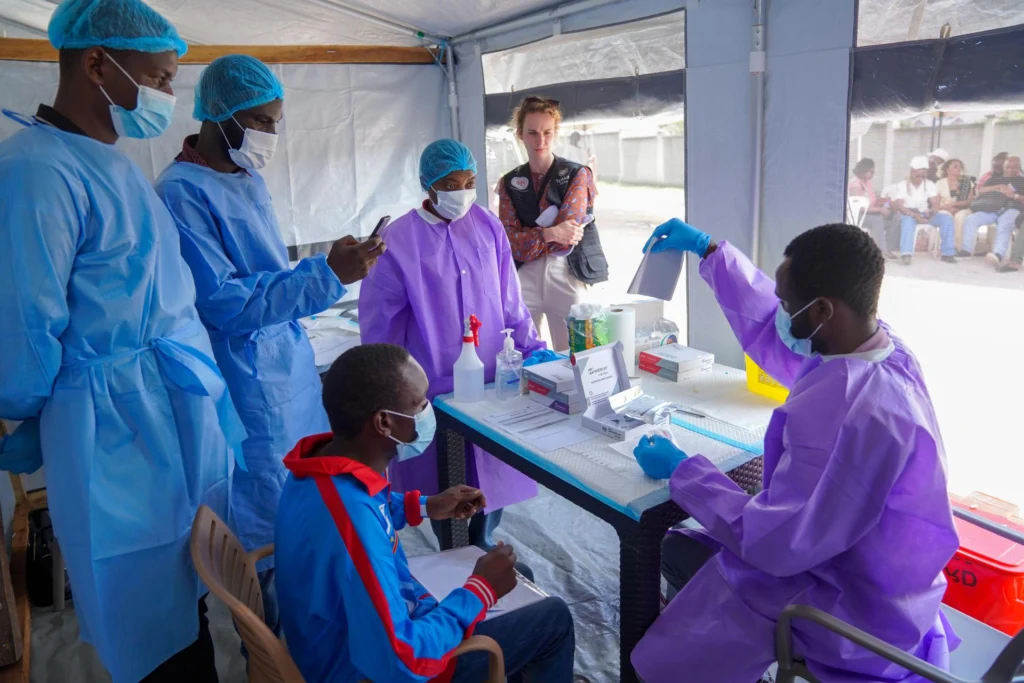
The Ebola outbreak, caused by the Bundibugyo strain, is spreading to eight provinces as the W.H.O. tests two experimental vaccines. Photo: EFE.

The Ebola outbreak in the Democratic Republic of the Congo (DRC) surpassed 10,000 confirmed cases on Tuesday, with 4,887 deaths recorded since the epidemic was declared in May.


The Ebola outbreak in the Democratic Republic of the Congo crossed a critical line on October 27, when confirmed infections passed the 10,000 mark. The National Institute of Public Health (INSP), announced the milestone with figures current through October 25.

The official tally stands at 10,060 cases and 4,887 deaths since the outbreak was declared on May 15. In just over five months, the virus has spread well beyond its initial clusters.

RELATED: Ugandans Who Travel DRC Will Spent 21 Quarantine Days at Come Back Due Ebola

Nearly half of those infected have not survived. The case fatality rate reached 48.6%, a level that makes this one of the deadliest health emergencies on record. It also confirms a trend the institute had flagged weeks earlier, when the outbreak first crossed the 9,000 infection mark.

❗️EBOLA SURPASSES 10,000 CASES IN DR CONGO — Reuters

The virus killed 4,887 people, with confirmed infections reaching 10,060

The concerns grow over a possible spread to other African nations https://t.co/DwohGnqfA6 pic.twitter.com/vGQ6yifZNw

— RT Intl (@RT_on_X) October 27, 2026

Second Deadliest Ever

Only the West African epidemic of 2014 to 2016 was worse. That crisis left roughly 11,000 dead and 28,000 cases across Guinea, Liberia and Sierra Leone. The current Congolese outbreak now ranks second in global history and has already outpaced the Ebola epidemic that struck the country’s eastern region between 2018 and 2020.

Transmission now spans 66 health zones in eight of the DRC’s 26 provinces, less than a third of the national territory. Ituri and North Kivu carry the heaviest burden. Tshopo, Bas-Uélé, Haut-Uélé, South Kivu, South Ubangi and North Ubangi follow behind. Bafwasende, Beni, Mandima and Bunia face the most critical conditions on the ground, the health agency warned.

“The situation underscores the need to strengthen early detection, contact tracing, dignified and safe burials, and the safety of response teams, especially in Bafwasende, a town in Tshopo province,” National Institute of Public Health’s authorities said.

Recovery figures offer a narrow thread of hope. A total of 2,684 patients have overcome the illness, and contact tracing coverage holds at 81.6%. Even so, the institute described early detection, safe burials and protection for field teams as urgent in the hardest-hit zones.

WHO is working closely with the DRC Government to intensify and sustain the #Ebola response.

During his recent visit to Beni, @ProfJanabi engaged with communities and handed over supplies and equipment, including motorbikes and #IPC materials, to strengthen the response. pic.twitter.com/CtuxNcDstT

— WHO African Region (@WHOAFRO) October 27, 2026

No Proven Treatment

The outbreak is driven by the Bundibugyo strain, a lineage with no specific treatments. That gap has pushed scientists toward new solutions. The World Health Organization is advancing two experimental vaccines, and their phase 1 human trials have already produced safe profiles.

The country is also running an immunization campaign with Ervebo, a product developed for the Zaire variant that showed favorable signs in animal tests. But the experimental candidates have only reached the earliest stage of evaluation in people, while Ervebo rests on limited preclinical evidence. Neither option yet offers a conclusive tool to stop transmission.

The cumulative data through October 25 shows the epidemic is far from contained. Health workers confront a virus without a specific therapy across a vast territory where contact tracing is uneven. The National Institute of Public Health has already set the immediate priorities, halting the spread and protecting the teams deployed on the ground.
  •  

Africa CDC Urges Global Help as Ebola Spreads

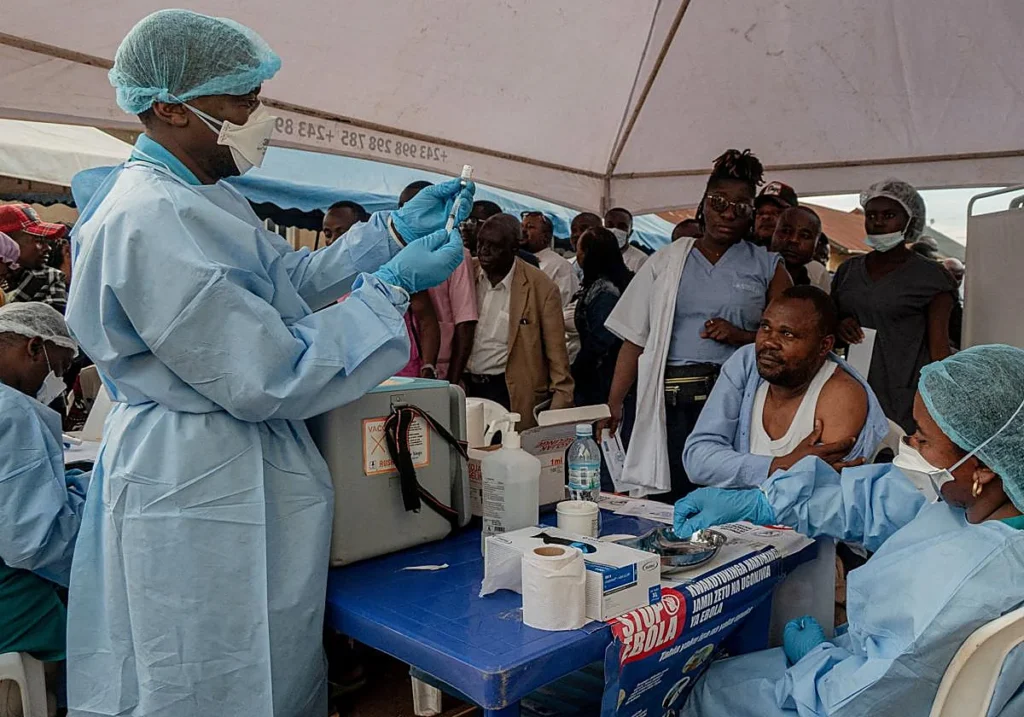
The Africa CDC made an urgent call to the international community to support the fight against the Ebola outbreak with funding, medical supplies, diagnostic tests and trained response personnel. Photo: ABC.

The Africa Centres for Disease Control and Prevention issued an urgent call for international solidarity Wednesday, warning that the Bundibugyo strain of Ebola is spreading faster and across a wider geographic area than any previous outbreak of its kind.


The alert followed confirmation by Nigeria’s government on Tuesday of the country’s first case, a woman who arrived in the capital Abuja on an international flight from Uganda, who remains isolated under medical care while authorities work to contain any possible transmission.

Nigeria has become the fourth nation on the continent to report confirmed infections, joining the Democratic Republic of the Congo, Uganda and Kenya.

RELATED: Nigeria Confirms First Ebola Case as Outbreak Spreads in Africa

Jean Kaseya, director general of Africa CDC, described the gravity of the moment in direct terms. “We cannot allow this outbreak to spread to more countries or continue for another year,” he said, stressing that the virus has now achieved the widest geographic reach in the history of the disease.

"This Ebola outbreak is no longer one country's fight."

Africa CDC Director General H.E. @Dr_JeanKaseya calls on every @_AfricanUnion Member State to detect early, trace every contact and protect health workers. On the 28th of October, he will be convening Africa's ministers of… https://t.co/7esmXLjk1N

— Africa CDC (@AfricaCDC) October 21, 2026

Four Countries Affected

The current episode stands as the second deadliest Ebola outbreak ever recorded worldwide, with more than 4,600 deaths across the region. In the Democratic Republic of the Congo alone, the toll has surpassed 4,205, a figure that underscores how deeply the epidemic has taken root there even as it extends into new territory.

Kaseya framed the response as inseparable from global security. “Every day of delay costs lives. Africa’s health security is global health security. Stopping Ebola in Africa today means protecting the world,” he said, adding that Nigeria has the agency’s total solidarity and that the outbreak must be defeated together.

Africa CDC had already anticipated the crisis. In May 2026 the specialized agency of the African Union declared a public health emergency of continental security, a warning that positioned the region’s institutions ahead of the current escalation. The agency has since begun mobilizing assistance toward Nigerian territory while reinforcing response operations in the Democratic Republic of the Congo, Kenya and Uganda.

Urgent Call for Funding

Kaseya directed his appeal beyond the continent, telling the international community what the response requires. “We need immediate and flexible funding, medical supplies, diagnostic tests, trained response personnel and stronger community surveillance,” he said.

The public health agency of the African Union has moved quickly to convert the appeal into action. On Wednesday it invited the region’s health ministers to a virtual meeting scheduled for October 28, where they will debate the spread of the virus and coordinate next steps. The gathering arrives less than a week after Nigeria’s first confirmed case, a timeline that reflects the urgency Kaseya has attached to the response.

Nigeria’s entry into the outbreak carries particular weight. The country is the most populous on the continent, and its capital’s connection to an international flight from Uganda raises questions about how far the virus may have traveled before detection. For now, the patient remains the single confirmed case in the country. But the presence of the disease in Abuja, rather than in a border community, changes the calculus for responders who must now trace contacts across a dense urban network. The woman’s isolation is one line of defense; the contact tracing around her is another, and both depend on the resources Africa CDC is struggling to assemble.

The outbreak’s trajectory since May has followed the pattern Kaseya warned about. Declared an emergency when still confined to a smaller footprint, it has now breached four national borders and shows no sign of slowing. The October 28 meeting of health ministers will test whether that warning has finally translated into the funding and supplies that African institutions have been requesting for months.

  •  
❌