❌

Reading view

France will lurch from crisis to crisis until it confronts its retirement timebomb | Letter

Amid widespread protests, Muriel E Cockcroft has sympathy for French youth but fears how much steam will be let out at the next convulsion

I’m writing in response to your editorial (The Guardian view on France’s protests: a polarised country is in a perilous political moment, 19 October). While the focus is on Emmanuel Macron, let us not forget the hierarchical structure of French administration, from mayors to MPs to senators to prefects and heads of region. All are part of the government, but few stood up to bring leaky school roofs and missing teachers to national consciousness. I deplore the senseless destruction of shops and state buildings. But I also deplore the fact that students had to protest to be heard. In the many administrative tiers of this highly hierarchical country, no one acted and inertia prevailed.

Centrally, the government is financially challenged but refuses to acknowledge that having a huge deficit, an ageing population and a low retirement age are perhaps connected. Modest attempts to increase the retirement age also provoked violent protests. Financial tools for individual retirement remain complex and restricted. Thus, this sclerotic system presses on until the next crisis.

Continue reading...

© Photograph: Roses Nicolas/ABACA/Shutterstock

© Photograph: Roses Nicolas/ABACA/Shutterstock

© Photograph: Roses Nicolas/ABACA/Shutterstock

  •  

Melenchon Urges Macron to Meet Protesters’ Demands Before Leaving Office

French leftist leader warns of weekly demonstrations and an impending general strike.

On Saturday, French radical left leader Jean-Luc Melenchon urged French President Emmanuel Macron to yield to protesters’ demands before leaving office in May 2027.

RELATED:

Two French Protesters Arrested for the Burning of the Limoges Town Hall

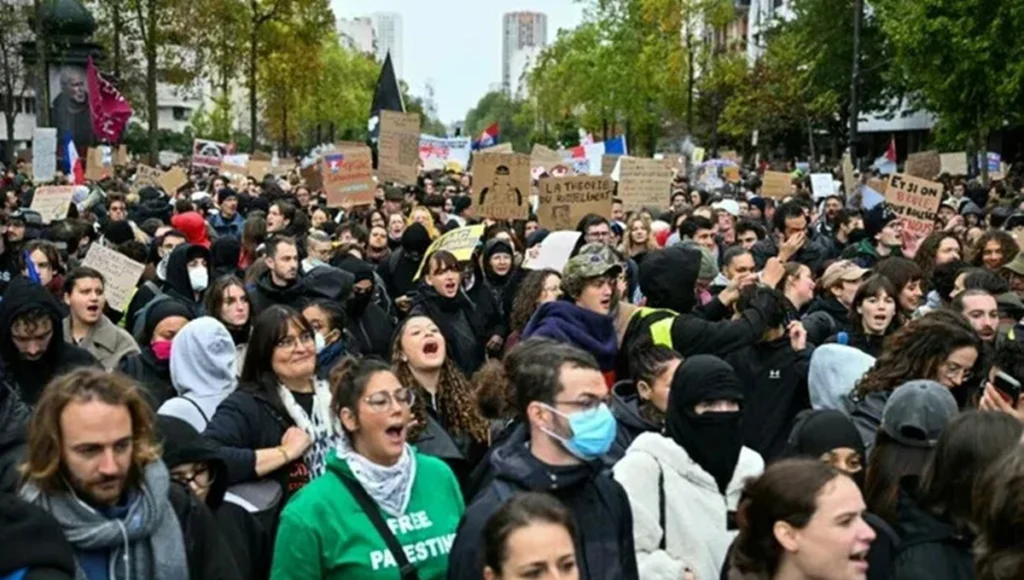
“You still have time to give in; afterward, you will have no choice but to leave. Give in and stop wasting our time,” Melenchon, a four-time presidential candidate, said as he marched in the Paris demonstration, which proceeded between Porte d’Italie and Porte de Vincennes.

Melenchon, leader of France Unbowed (LFI), warned Macron that if social demands go unanswered, mobilizations such as the one taking place in France for the second consecutive Saturday “will be repeated every week.”

“This is a very important moment in the history of popular movements in our country,” Melenchon said, convinced that “a general strike is coming” for the authorities.

Victoire totale du mouvement social. La marche s'est rassemblée au nouveau point autorisé et déferle dans le calme sur plus de quatre kilomètres. Les provocations aux désordres du préfet de police et de Lecornu sont un échec total. Pour les autorités, il est temps de céder, sinon… pic.twitter.com/S3d6k2DWf3

— Jean-Luc Mélenchon (@JLMelenchon) October 24, 2026

Jean-Luc Mélenchon’s text states: “A total victory for the social movement. The march has gathered at the newly authorized location and is proceeding calmly along a route over four kilometers long. The provocations intended to incite disorder—orchestrated by the police prefect and Lecornu—have failed completely. It is time for the authorities to yield; otherwise, they will soon have no choice but to head for the exit.”

Macron must decide whether to yield to the demands now or do so later under much more unpredictable circumstances, Melenchon said. He also accused the French president of adopting an attitude characteristic of an “absolute monarchy” by claiming to be “always right” in his dealings with others.

Melenchon said Macron had taken advantage of the state of shock caused by the racist terrorist attack in Trappes, on the outskirts of Paris, to change the route of the protest through the French capital, creating confusion among demonstrators.

“Everything is being prepared to provoke an explosion” and spark unrest, he said. He questioned the deployment of military personnel to protect public buildings and authorities’ recommendations that business owners turn to private security services, arguing that both measures contribute to rising tensions.

“They are doing absolutely everything to provoke an incident,” Melenchon insisted, urging demonstrators to remain calm, follow union instructions and maintain collective discipline “so that everything goes smoothly.”

Immense cortège à Paris pour demander l’abrogation de parcoursup, 10 milliards pour les lycéens, la hausse du SMIC et des salaires.

Et pour défendre notre liberté de manifester !

Les manœuvres de Nunez et Lecornu ont échoué. pic.twitter.com/eGJIiVKkH8

— Paul Vannier (@PaulVannierFI) October 24, 2026

The text reads, “A massive procession in Paris calling for the repeal of Parcoursup, 10 billion euros for high school students, and an increase in the minimum wage and salaries—as well as the defense of our right to protest! The maneuvers by Nunez and Lecornu have failed.”

For all these reasons, the leftist leader called on the French government to “stop provoking” demonstrators and “adding fuel to the fire,” and to listen to “demands that are not so difficult to meet.”

Melenchon also criticized meetings held during the week between the Macron administration and political parties, describing them as useless and theatrical.

“They live in a bubble, make decisions that have no connection to reality and are not even coordinated among themselves. That is why they are dangerous,” he said.

On Saturday, France faced a second day of nationwide demonstrations called by unions, students and the Yellow Vests movement to protest the rising cost of living and demand more public funding for education.

Following serious incidents on Saturday, Oct. 17, authorities deployed a major security operation on Saturday and banned demonstrations in several French cities, particularly those not organized by unions.

teleSUR/ JF

Source: EFE

  •  

The debt crisis leaves the French government with no room to respond to social demands

A little over a month ago, at a high school on the outskirts of Paris, a group of students blocked their school to protest the condition of the facilities and the lack of teachers. Within days, students from other schools joined in, first in Paris and then across the country, complaining of leaks in classrooms and even cockroaches, and of walls that are cracking. They are cold in the winter and hot in the spring. That image of public schools — long considered a pillar of the French Republic, but gradually falling apart — also illustrates the economic decline of recent years.

Seguir leyendo

© Christophe Ena (AP Photo/Christophe Ena)

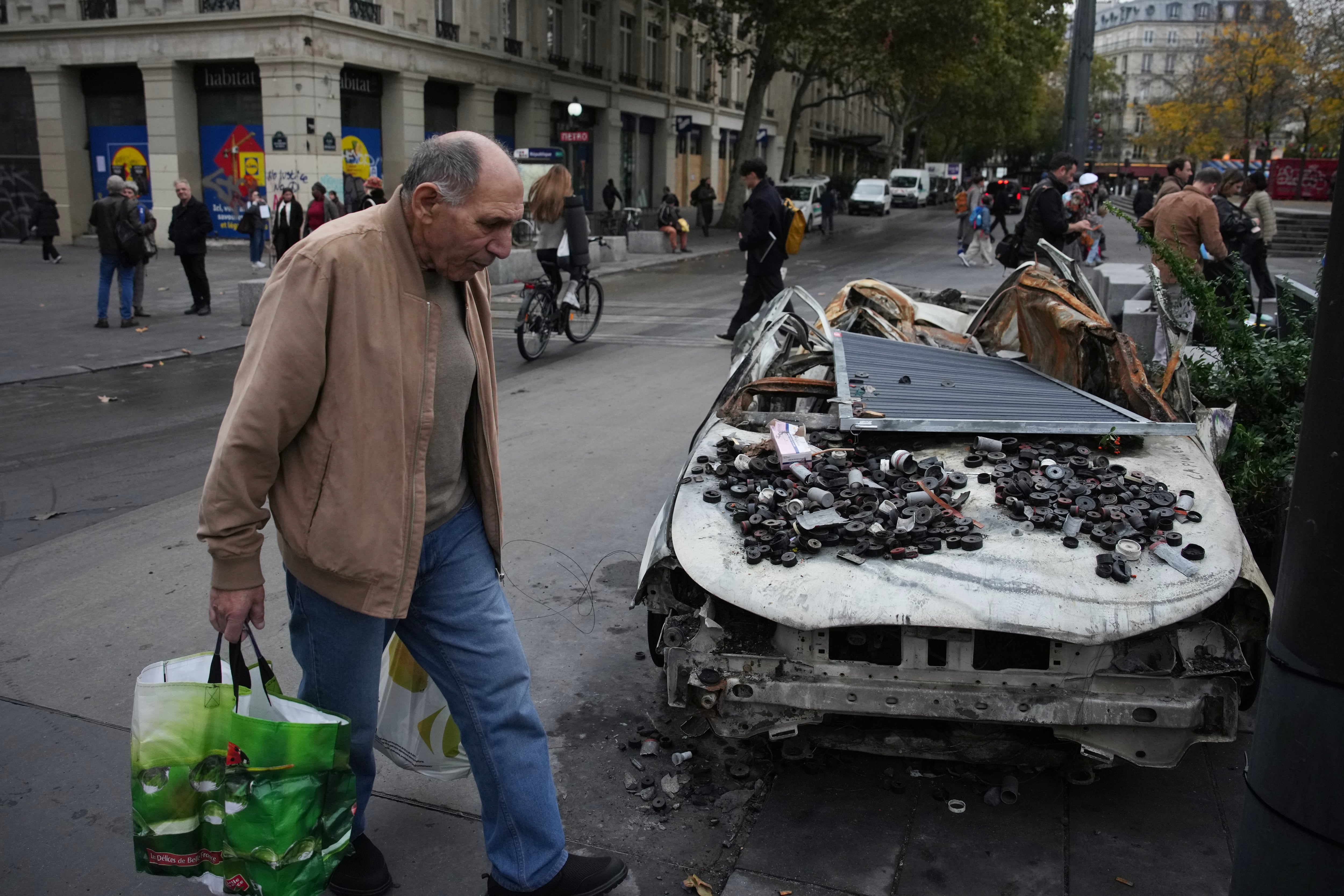
A man walks past a car that was destroyed during the riots in Paris on Tuesday.
  •  

After the violence and chaos in France, there’s only one beneficiary: Marine Le Pen | Paul Taylor

The far-right leader’s promise to restore order will appeal to many ahead of next year’s presidential elections – the stakes are suddenly much higher

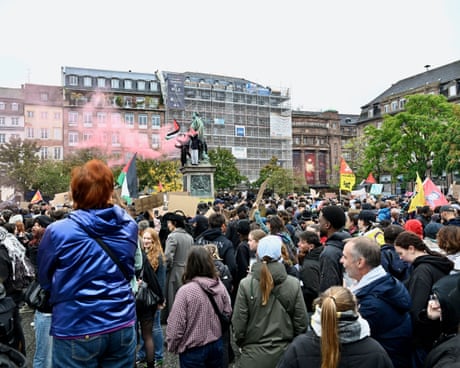
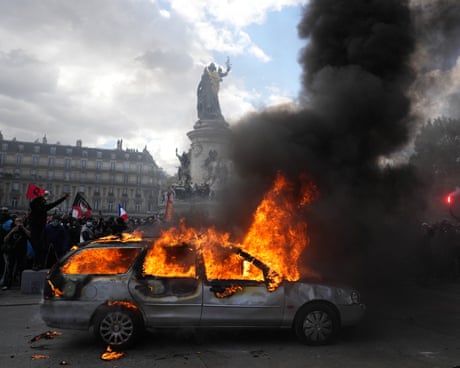
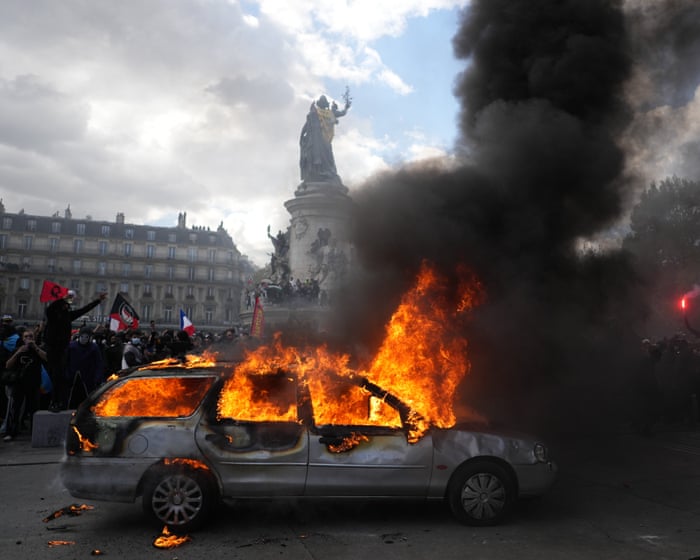
There is only one clear winner so far from France’s chaos: Marine Le Pen. The violence and rioting that engulfed towns and cities across the country over the weekend, six months before a pivotal presidential election, is a godsend for the hard-right, Eurosceptical, anti-immigration candidate. As buildings burned, shops were looted and police attacked, the rioting largely drowned out peaceful mass protests over the dilapidated state of schools , fuel prices and the cost of living.

Across France and the rest of Europe, people are in shock at scenes of arson and pillage in city centres, the wrecking of symbols of the republic such as the 19th-century town hall in peaceful provincial Limoges and the bust of Marianne in Marseille’s city hall, and the looting of more than 2,000 shops.

Paul Taylor is a senior visiting fellow at the European Policy Centre

Continue reading...

© Photograph: Firas Abdullah/Anadolu/Getty Images

© Photograph: Firas Abdullah/Anadolu/Getty Images

© Photograph: Firas Abdullah/Anadolu/Getty Images

  •  

The Guardian view on France’s protests: a polarised country is in a perilous political moment | Editorial

The scenes of social unrest and violence at the weekend are an ominous portent, ahead of elections which may deliver a far-right presidency

In Emmanuel Macron’s book Revolution, published ahead of the 2017 presidential election that he went on to win, he promised to restore hope to a country that was losing faith in its future. As Mr Macron’s lame-duck second term enters its last phase against a quasi-insurrectionary backdrop of torched public buildings and looted shops, the failure of that political project appears total.

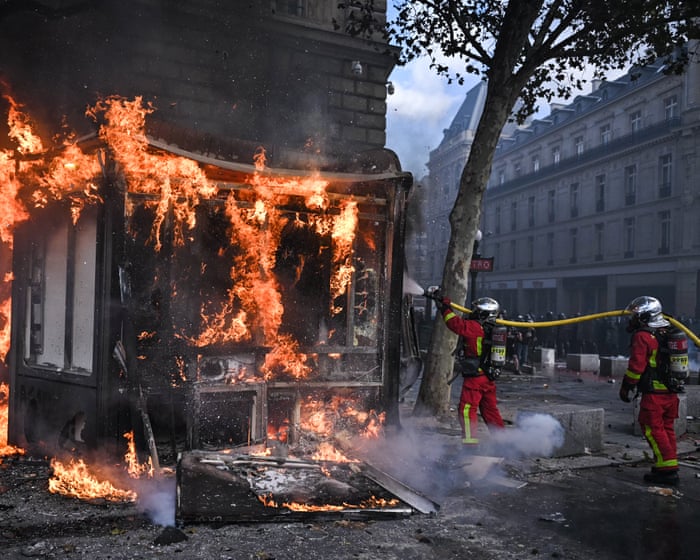
The worst scenes of urban violence for years overshadowed a weekend of protest that gravely undermined what is left of the French president’s authority. As police lost control of the streets, more than 2,000 shops were ransacked. Far-left groups targeted town halls and local buildings, and engaged in pitched battles with the police, whose disastrously heavy-handed response to last week’s high school protests has succeeded only in escalating tensions.

Do you have an opinion on the issues raised in this article? If you would like to submit a response of up to 300 words by email to be considered for publication in our letters section, please click here.

Continue reading...

© Photograph: Thibault Camus/AP

© Photograph: Thibault Camus/AP

© Photograph: Thibault Camus/AP

  •  

France’s Unrest Exposes the Failure of Macron’s Centrist Political Model

What began as a student protest over deteriorating schools has developed into a nationwide revolt against economic hardship, political paralysis and declining public services. With the 2027 presidential election approaching, the violence has exposed problems that neither the government nor its principal opponents have convincing plans to resolve.

France’s latest wave of unrest has developed into one of the most serious domestic crises of Emmanuel Macron’s presidency. More than 550,000 people participated in demonstrations on 17 October, according to official estimates, before violence spread through Paris and other major cities. Shops were looted, police confronted rioters, and the historic town hall in Limoges was largely destroyed by fire.

The scale of the destruction prompted emergency government consultations and a televised presidential address. Macron promised to prosecute those responsible, while stopping short of declaring a state of emergency. Yet the immediate security challenge conceals a more difficult political question: why have protests that began with relatively specific demands over education become a confrontation involving such different sections of French society?

From school protests to a national revolt

The movement originated among secondary-school students demanding better facilities, more teachers and improvements in educational standards. Their complaints subsequently attracted trade unions, workers, farmers and elements of the Gilets Jaunes, the Yellow Vest movement that challenged Macron’s government in 2018.

The resulting coalition has no coherent political programme. Students protesting overcrowded classrooms share demonstrations with workers concerned about purchasing power and motorists angered by fuel prices. Their interests are not necessarily compatible, but they reflect a common dissatisfaction with the government’s ability to deliver functioning public services while containing living costs.

This distinction matters. The presence of masked rioters and organised groups engaged in violence does not establish that the hundreds of thousands who demonstrated peacefully supported their actions. Equally, the destruction of public buildings, attacks on police and widespread looting raise legitimate questions about the state’s capacity to maintain public order.

The economic problem behind the protests

At the centre of the discontent lies a structural problem that successive French governments have struggled to confront: the distribution of public expenditure between an ageing population and the services required by younger generations.

A French government budget assessment published in October revealed that pension obligations accounted for approximately 32 per cent of the education ministry’s budget, including €28.5 billion in pension expenditure. These obligations restrict the resources available for other departmental priorities.

France nevertheless remains a substantial spender on education. According to official figures, expenditure reached €199.2 billion in 2025, equivalent to 6.7 per cent of GDP. However, after inflation, the annual increase was only 0.1 per cent.

The issue is therefore not simply how much France spends, but how efficiently resources are allocated and whether expenditure meets changing educational needs.

The OECD’s 2025 PISA assessment found that French pupils’ performance in mathematics and reading had declined compared with 2022. Results were among the country’s lowest recorded, although broadly comparable with the OECD average.

These figures give the student protests a significance extending beyond the immediate condition of classrooms. They raise questions about France’s longer-term economic competitiveness and its capacity to provide younger generations with opportunities comparable to those enjoyed by their predecessors.

The limits of Macron’s reform programme

Macron entered office in 2017 promising to modernise the French economy and overcome the traditional division between left and right. Nearly a decade later, his administration faces a fragmented parliament, constrained public finances and growing resistance to further structural reforms.

The suspension of his pension reform illustrated the difficulty. Raising the retirement age was intended to reduce pressure on the pension system, but parliamentary opposition forced the government to defer the measure until after the presidential election.

The underlying financial pressures have not disappeared. Nor can they be resolved easily through additional spending when public debt, borrowing costs and budgetary obligations already restrict the government’s room for manoeuvre.

This creates an uncomfortable political reality: the state is expected to provide better services, greater purchasing-power protection and stronger security, while the available resources remain limited.

Can the opposition benefit?

The unrest comes approximately six months before the presidential election, with Marine Le Pen’s National Rally and Jean-Luc Mélenchon’s France Unbowed competing to establish themselves as alternatives to Macron’s political centre.

Le Pen has sought to combine support for economic grievances with demands for tougher policing. That position may attract voters concerned by the violence, but it also exposes tensions within a movement that previously supported the Yellow Vest protests.

Mélenchon faces a different difficulty. Supporting demonstrations against government policy is consistent with his political programme, but the involvement of violent groups risks shifting public attention from social demands towards questions of security.

A recent presidential opinion poll even suggested that Le Pen and Mélenchon could contest the final round, illustrating the weakening position of more conventional political alternatives.

Neither, however, can escape the fiscal constraints that have frustrated Macron’s government. A change of president would not automatically provide the resources required to expand public services, reform pensions and reduce the deficit simultaneously.

A wider problem for France and Europe

President Donald Trump has attributed the French unrest to immigration, although the movement’s documented origins lie principally in education, living costs and dissatisfaction with public services. Without established evidence about those responsible for individual acts of violence, broader claims about the demonstrators’ backgrounds remain speculative.

For the European Union, France’s instability carries consequences beyond its domestic political debate. France is central to European defence, fiscal negotiations and support for Ukraine. Sustained political paralysis would complicate its ability to negotiate and implement decisions requiring substantial public expenditure.

The immediate task for Macron’s government is to restore security without allowing the legitimate grievances of peaceful demonstrators to disappear from political consideration. The more difficult task will fall to whoever enters the Élysée in 2027.

France’s crisis is not simply a repetition of the Yellow Vest movement. It reflects a growing conflict over public resources, expectations of the state and the ability of established political institutions to reconcile competing demands.

The violence may subside, but the economic contradictions that brought such different groups onto the streets will remain. The presidential election will determine who inherits them, rather than whether they exist.

  •  

The Far Left Fans the Flames as France’s Classroom Revolt Turns Violent

France’s schools are burning, police officers are being injured, barricades are appearing outside classrooms and teenagers are being drawn into confrontations that have travelled a very considerable distance from complaints about absent teachers and dilapidated buildings.

Hovering over this combustible mixture is Jean-Luc Mélenchon. The leader of La France Insoumise (LFI) insists that his movement neither controls nor directs France’s extraordinary wave of student protest. He has now explicitly advocated non-violent methods. That defence deserves to be recorded.

But it does not dispose of an uncomfortable political question: who benefits when legitimate teenage frustration is transformed into a wider revolt against the French state?

For Mélenchon, the answer is potentially obvious. The disturbances began with genuine grievances. Pupils complained about teacher shortages, overcrowding, poor facilities and the pressures of the French education system. The original protests in Créteil appear to have been spontaneous rather than the creation of a political party. That distinction matters. France’s teenagers should not collectively be caricatured as revolutionaries simply because some demonstrations subsequently descended into violence.

But what followed was something quite different. Schools were attacked and fires started. Cars were torched. Explosive fireworks and other projectiles were directed at police. By October 1st, Reuters reported hundreds of arrests and incidents of arson in several French cities. French intelligence agencies, according to a source close to the prime minister cited by Reuters, told a government crisis meeting that hard-left politicians had played a role in initiating the spreading protests. LFI emphatically denied the allegation.

That dispute should not obscure what is visible. LFI politicians have been remarkably eager to place themselves alongside the protesters. MPs Clémence Guetté and Louis Boyard appeared at the original Créteil mobilisation; Boyard turned his intervention into a TikTok video reportedly watched 1.5 million times. Other LFI representatives have similarly appeared around demonstrations. Le Monde describes the party as closely following protests and notes that this proximity simultaneously strengthens LFI’s relationship with young voters and leaves it associated with the movement when violence erupts.

Where Mélenchon’s political opportunism deserves scrutiny.

France is heading towards the 2027 presidential election. Younger voters are potentially one of Mélenchon’s greatest political assets, but also one of his greatest organisational problems: sympathy does not automatically become votes when younger citizens disproportionately abstain.

Recent polling reported by Le Monde put Mélenchon above 40 per cent among 18-to-24-year-olds in some presidential scenarios. LFI coordinator Manuel Bompard has openly acknowledged the opportunity, saying the movement has enormous room for growth among young people.

One hardly requires Machiavelli to understand the calculation. A generation of teenagers that believes itself ignored by government is politically interesting. A generation persuaded that it is being oppressed by government is considerably more useful.

The transformation is crucial. The original argument concerned teachers, classrooms and school buildings. The developing political narrative encompasses police violence, racism, inequality, Palestine, the far right and hostility towards the political establishment.

Mélenchon did not invent all these causes, nor is there evidence that he commands the young protesters like troops. But LFI understands political insurgency extremely well. Its political vocabulary depends upon conflict between ordinary citizens and an allegedly discredited establishment.

A spontaneous youth rebellion therefore offers almost perfect terrain. Mélenchon initially called upon supporters to “interpose” themselves against what he described as police savagery. Only as images of burning schools, vandalism and violent confrontation became increasingly politically toxic did he place greater emphasis upon non-violence, telling supporters that setting things on fire undermined their cause.

Perhaps that was sincere. But it also illustrates the danger of playing political games with youthful anger. It is relatively easy to tell teenagers that authority is their enemy, the far-left have sung this tune since the 1960’s. It is considerably harder, however, to regain control when confrontation develops its own momentum.

For years, public discussion of “political violence” has often been dominated by the threat from the extreme right. That threat is real and should never be minimised. Indeed, British Prevent statistics for the year ending September 2025 provide an important corrective to anyone claiming that extremism as a whole is overwhelmingly left-wing: 2,103 referrals concerned extreme-right ideology, compared with only 32 categorised as left-wing extremism.

But terrorism statistics and street politics are not the same thing. Europe also has a long-established tradition of violence emerging from anarchist, autonomist and revolutionary-left protest cultures: black-bloc tactics, attacks on police, destruction of property, arson and attempts to turn demonstrations into confrontations with the state. The current French disturbances make it legitimate to ask whether this form of political violence receives the same sustained political scrutiny as violence associated with the extreme right.

In Britain, too, claims of ideological double standards should be examined rather than assumed. Violence and intimidation occurring around demonstrations should be judged according to conduct, not according to whether those responsible march beneath banners fashionable on the Left or Right.

The correct principle is remarkably uncomplicated: political violence is political violence.

Throwing an explosive firework at a policeman does not become morally superior because the person throwing it considers himself anti-fascist. Burning a school does not become progressive because the person holding the match claims to oppose inequality. Intimidation does not become activism merely because its perpetrator believes his politics virtuous.

Nor, conversely, should peaceful demonstrators be branded extremists because violent individuals attach themselves to their cause.

This is a particularly important point in France because there is evidence that radical groups have attached themselves to genuine student grievances. Education Minister Édouard Geffray has distinguished protesting pupils from violent “ultra-left” elements. Former environment minister Delphine Batho, herself once a school-student union leader, has warned of the movement being taken over by the far left and urged pupils to preserve their independence.

Those pupils would do well to heed the warning. Their complaints may be legitimate. They have every democratic right to demonstrate. And allegations of disproportionate police violence must themselves be investigated: teenagers have suffered serious injuries and France has opened internal investigations into police actions.

Young people should ask themselves who is standing behind them — and why?

Mélenchon wants political change. He wants young voters mobilised. LFI wants to convert social discontent into an electoral force capable of reshaping France.

There is nothing inherently illegitimate about that ambition. Every political party attempts to convert public dissatisfaction into votes. The troubling point comes when politicians discover that confrontation itself is electorally useful.

The French government undoubtedly has incentives of its own to emphasise LFI involvement. By presenting the crisis primarily as an extremist public-order problem, ministers can divert attention from the failings in schools that produced the original demonstrations.

But that does not absolve Mélenchon. A responsible politician confronted by angry teenagers should attempt to reduce the temperature while addressing their grievances. An opportunist sees an emerging political constituency.

The danger for France is that its young people cease being participants in a legitimate argument about education and become raw material in somebody else’s struggle for power.

Once that happens, the classroom has ceased to be the issue, and barricades become the political objective.

Paris Attack: Europe Must Not Allow Ideological Violence to Become the New Normal

  •  
❌