❌

Reading view

A Supreme Court Case Underlines the Absurdity of the Federal Ban on Home Distilling
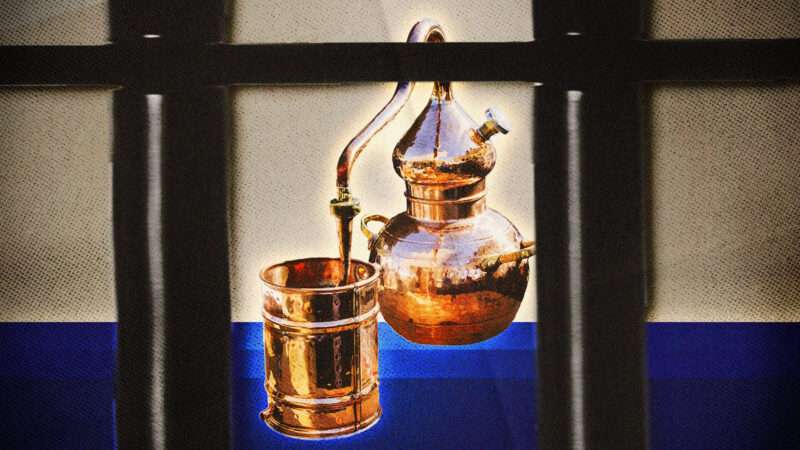
a still in a jail cell | DPST/Newscom/Kari Høglund/Dreamstime/Fatima Ruiz

Years ago, I bought a contraption designed to separate and concentrate the most volatile components of a liquid mixture. I would tell you what I did with it, but I don't want to implicate myself in a federal felony.

Since 1868, it has been illegal for Americans to locate a "distilled spirits plant" in "any dwelling place," an offense currently punishable by a maximum $10,000 fine and up to five years in prison. The federal ban on home distilling is at the center of a case that the Supreme Court recently agreed to hear, which raises a specific constitutional issue but also highlights the absurdity of treating this hobby as a crime.

That policy, the U.S. Court of Appeals for the 5th Circuit ruled last April, cannot be justified as an exercise of the federal government's tax power. To the contrary, Judge Edith Jones said in the court's opinion, the ban is "an anti-revenue provision that prevents distilled spirits from coming into existence," meaning its effect is "to reduce revenue instead of raising it."

Nor is the provision consistent with "the Supreme Court's explanation of how the federal power of taxation works," Jones wrote. When Congress imposes a tax, the Court explained in 2012, it "leaves an individual with a lawful choice to do or not do a certain act, so long as he is willing to pay a tax levied on that choice." But in this case, Jones noted, would-be home distillers "have only the choice not to do as they wish or risk fines and imprisonment."

The government argued that the ban helps collect liquor taxes by prohibiting a form of production that is difficult to detect. But "Congress cannot prohibit intrastate activity solely because it might produce products hard to tax," Jones said. If it could, she warned, there would be "no limit whatsoever" to its tax power.

Under the government's logic, Jones noted, "Congress may criminalize nearly any at-home conduct only because it has the possibility of concealing taxable activity. Home-based businesses may be forbidden. Remote work may be deemed a crime."

The Trump administration, which wants the Supreme Court to overturn the 5th Circuit's decision, argues that threatening to imprison home distillers is a "necessary and proper" safeguard against tax evasion. But whatever your take on the constitutional question, that policy is morally indefensible, haphazardly enforced, and inconsistent with the federal government's treatment of wine and beer.

The lead plaintiff in this case is Scott McNutt, a member of the Hobby Distillers Association. In 2014, McNutt received a "Notice of Potential Civil and Criminal Liability" from the Treasury Department, which said it had reason to believe he "may have purchased a still capable of producing alcohol and/or equipment and materials that may be used in the manufacture of a still."

The notice warned that "federal law provides no exemptions for the production of distilled spirits for personal or family use." It added that "unlawful production of distilled spirits is a criminal offense," which it erroneously claimed was "punishable by a fine of up to $500,000" as well as "imprisonment for not more than 5 years."

Meanwhile, online retailers such as Amazon sell a wide variety of home stills, many of which are explicitly advertised as appliances designed to produce alcoholic beverages such as vodka, gin, brandy, and whiskey. Customers could be forgiven for assuming that's legal, especially since federal law has long permitted home wine and beer production "for personal or family use."

McNutt's lawyers say he "owns a still that he has used to lawfully distill fuel alcohol and seeks to 'tinker around' with beverage spirits." Another plaintiff, Thomas Cowdrey, "likewise seeks to experiment in creating new beverage spirits, including 'apple pie vodka,' for which he has developed a recipe."

Because of a law Congress enacted 158 years ago, McNutt and Cowdrey would be felons if they acted on those desires. It might be time to rethink that policy.

© Copyright 2026 by Creators Syndicate Inc.

The post A Supreme Court Case Underlines the Absurdity of the Federal Ban on Home Distilling appeared first on Reason Magazine.
  •  

Trump Administration Urges SCOTUS To Uphold Federal Ban on Distilling Liquor at Home

homedistilling | Ioannis Syrigos/Dreamstime/Midjourney

The U.S. Supreme Court's 2026–2027 term just got a whole lot boozier. On Monday, the justices agreed to hear arguments later this year or next in the case of Department of Justice v. McNutt. At issue is whether the 1868 federal ban on distilling liquor at home is unconstitutional because it exceeds the lawful regulatory power of the federal government. If any modern Supreme Court case ever deserved its own drinking game, this one is it.

In April, the U.S. Court of Appeals for the 5th Circuit found the federal ban on home distilling to be unconstitutional because Congress lacked the proper authority to issue such a ban in the first place. It was not a legitimate exercise of the congressional authority "To Lay and collect Taxes," the appellate court reasoned, because "the purpose of a tax is to raise revenue for the government;" yet this law "amount[s] to an anti-revenue provision" that only "prevents distilled spirits from coming into existence." And if it does not exist, of course, the government cannot tax it.

The 5th Circuit also denied that the federal ban on home distilling could be saved by the government's appeal to the Necessary and Proper Clause, which says that Congress has the authority "To make all Laws which shall be necessary and proper for carrying into Execution the foregoing Powers, and all other Powers vested by this Constitution in the Government of the United States, or in any Department or Officer thereof."

But the federal ban on home distilling cannot be "necessary" to the execution of the enumerated taxing power, the 5th Circuit argued, because the provisions of federal law at issue "tax nothing, and are distinct from the regulation of distilling alcoholic products that is permitted by federal tax law."

Nor did the 5th Circuit find the ban to be "proper." "By purporting to ban activity without a plain connection to the exercise of Congress's taxation power," it held, "Congress has essentially—and 'improperly'—invaded the reserved police and regulatory power of the states."

The Trump administration lost this case at the 5th Circuit and has now successfully urged the justices to hear its appeal. In its petition seeking review, the Trump administration faulted the 5th Circuit for its overeagerness to "second-guess" the "legislative judgment" of Congress. Instead, the Trump administration argued, the federal judiciary owes a great deal more deference to the federal government's regulatory priorities in a case like this. "A law is necessary and proper if it is 'convenient' or 'useful' for carrying an enumerated power into effect, and 'plainly adapted' to that legitimate end," the Justice Department's brief argued. "That is the case here."

This case may lead to an interesting divide among the Supreme Court's more conservative members. In United States v. Comstock (2010), a 7–2 Supreme Court embraced the Necessary and Proper Clause as sufficient constitutional grounding for the Adam Walsh Child Protection and Safety Act, which had empowered federal officials to order the indefinite civil commitment of "sexually dangerous" individuals who had already finished serving their prison sentences. Chief Justice John Roberts joined the majority opinion in that case, while Justice Samuel Alito voted in concurrence. In other words, they both endorsed a broad view of congressional power under the Necessary and Proper Clause. By contrast, Justice Clarence Thomas, joined by the late Justice Antonin Scalia, voted in dissent. The Comstock ruling, Thomas protested, "comes perilously close to transforming the Necessary and Proper Clause into a basis for the federal police power that 'we always have rejected.'"

Are we about to see a similar Alito-Thomas split over the proper reach of federal power in this case? And what about Justices Neil Gorsuch, Amy Coney Barrett, and Brett Kavanaugh? Will one or more of them play the Scalia part and similarly reject the Trump administration's broad reading of the Necessary and Proper Clause?

Stay tuned.

The post Trump Administration Urges SCOTUS To Uphold Federal Ban on Distilling Liquor at Home appeared first on Reason Magazine.

  •  
❌