
❌

Reading view

Ecuador Protesters March Against Noboa Ahead of Local Elections
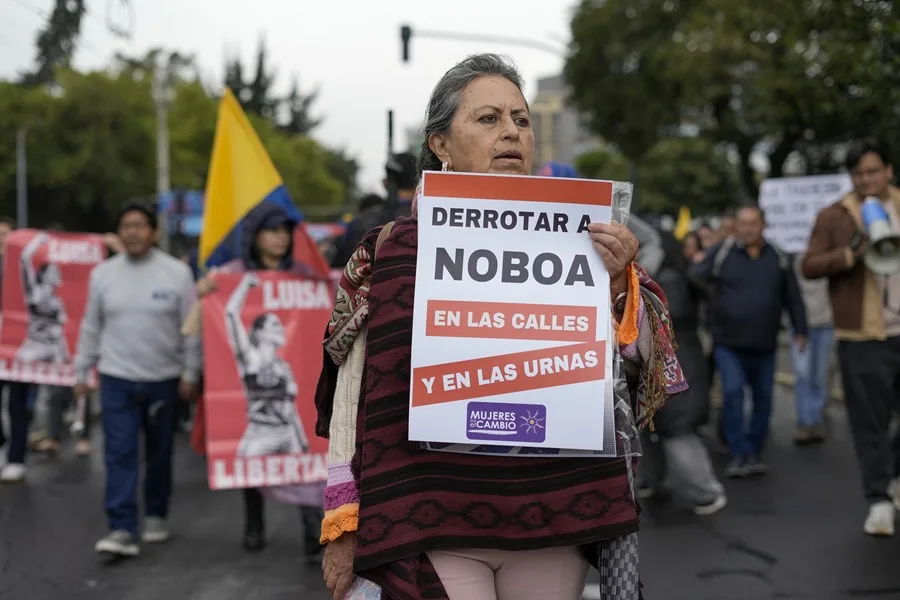
Protesters march against Daniel Noboa in Quito, Ecuador, demanding Luisa González's release ahead of November 2026 local elections.

Unions and left-wing groups plan further demonstrations in November, calling for the release of opposition figure Luisa González.


Nearly 100 people marched through Ecuador’s capital, Quito, on Thursday to protest President Daniel Noboa’s government, launching a new wave of demonstrations ahead of local elections scheduled for Nov. 29.

RELATED: Ecuador Readies Snap Regional Elections Amid Opposition Exclusion Accusations

Organized by the country’s main trade unions and left-wing political parties, the peaceful march moved through the historic center before reaching the attorney general’s office. Protesters gathered outside the building carrying banners demanding the release of Luisa González, a former presidential candidate and one of the leading opposition figures.

González, who belongs to the political movement associated with former President Rafael Correa, was placed in pretrial detention in a case involving alleged money laundering. Prosecutors accuse her of involvement in the irregular financing of her first presidential campaign in 2023.

Chanting “Out, Noboa, out,” demonstrators also called for improvements to public education and healthcare. Some participants urged voters to cast null ballots in the upcoming local elections.

Natasha Rojas, a politician and activist, described the mobilization as a defense of democracy, civil liberties and the rights of Ecuadorians. She argued that the government was losing public support and warned that its policies would fuel further protests.

Nelson Erazo, president of the Popular Front, accused state institutions, including the attorney general’s office and the comptroller’s office, of being used to target social activists and political leaders.

He said the demonstration brought together groups seeking political change and demanding that Ecuadorians be able to express themselves freely, with guarantees of access to education, healthcare and employment.

Opposition organizations have announced further demonstrations on Nov. 7 and 15, followed by a march alongside feminist groups on Nov. 25 to mark the International Day for the Elimination of Violence Against Women. Another mobilization is planned for Dec. 10, in coordination with international organizations, to defend human rights.

  •  

Sector salud de Ecuador exige soluciones frente al colapso de los hospitales

Mientras las autoridades ecuatorianas aseguran que el suministro de insumos y fármacos se encuentra garantizado, la realidad cotidiana de los hospitales, que se agrava por una severa falta de médicos especialistas, contrasta drásticamente con la versión gubernamental.
  •  

Thousands of young people protest the Noboa administration in Quito

On October 10, thousands of Ecuadorians took to the streets to protest against the government of right-wing President Daniel Noboa. The demonstration was organized by the Autonomous Front of Organized Resistance (FARO) under the slogan “Government vs. People.”

A esta hora, una marcha de rechazo al Gobierno de Daniel Noboa recorre las calles de Quito. La movilización está marcada por carteles de protesta y consignas contra el mandatario y su gestión. Los manifestantes atraviesan en este momento el paso deprimido del Guambra y avanzan… pic.twitter.com/WKPfT8D9jF

— Elena Rodríguez Yánez (@ElenaDeQuito) October 10, 2026

Saturday’s demonstration followed a protest on October 8, organized by labor unions also in Quito, to protest the security, energy, health, and employment crises facing the country. They also protested government cuts to education and health care, as well as alleged mistreatment of workers, according to Edwin Bedoya, president of the United Workers’ Front (FUT).

For its part, the October 10 demonstration – which consisted mainly of high school and college students – set out from the Central University and marched through Quito. Slogans such as “If the people have no peace, neither does the government” and “Out with Noboa, out with him!” were heard along the streets occupied by the demonstrators.

The president of the Catholic University Student Federation, Jatari Ulcuango, told protesters: “Four years ago, this government promised us electricity; two years ago, too – and now the blackouts have returned. Two months ago, the government told us it would provide us with medicine, and yet we’re only receiving 60% of the supply. They’re taking us for fools.”

He added: “We’re dying outside the hospitals. Criminals are kidnapping us, murdering us, and robbing us. That’s why we’ve come out this morning. They plan to dismantle public institutions to force us to hire private security. Who has gotten rich off the health crisis? The private healthcare sector, while the people are getting poorer and poorer.”

The peaceful march headed back to the Central University, where the students gathered. Later, the students reported on social media that they had been harassed and repressed by the police, who had accompanied the entire march.

Likewise, several media outlets reported that the police were aggressive toward them. This was reported by the outlet La Barra Espaciadora, which released a video showing police officers pushing journalists.

TeleSur journalist Elena Rodríguez also reported that law enforcement officers broke the microphone she was using and struck her on the head: “I’m sick and tired of having to recount, time and time again, police attacks against the press. Today, while I was trying to document the violence with which officers were beating young protesters, I was struck on the head from behind with a baton. I turned around, showed my Telesur microphone to identify myself as a journalist, and the response was another baton strike that ended up breaking it.”

She added: “If they think that by beating me up they’re going to get me to stop documenting police brutality, to put my microphone away, or to back off several blocks so I can report from a place where I won’t be a nuisance, they’re wrong. It is not we journalists who should distance ourselves from the events. It is the police who must stop attacking us. The right to report cannot be negotiated at the point of a baton.”

The protests are taking place against the backdrop of a widespread crisis in the country, which includes the worst security crisis in its history (tens of thousands of deaths due to violence between drug trafficking gangs), a very serious health crisis (a lack of supplies and medicines in the public health system), and other major crises such as those in education, public investment, and employment.

Local elections will be held in November, which will reveal the extent of support – or lack thereof – for President Noboa and his neoliberal government agenda, which aligns with the hemispheric security strategy led by the Trump administration.

  •  
❌