
 Login

Russia Vetoes U.S. Plan Backing Morocco Over Western Sahara at UN
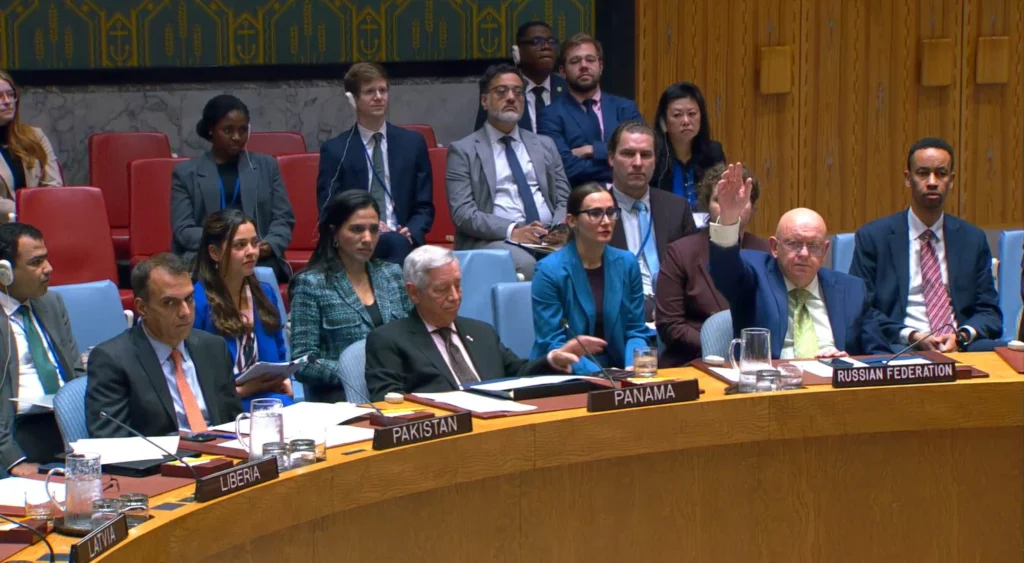
Russia exercised its veto at the UN Security Council on Friday to block a U.S. resolution that would have made autonomy under Moroccan sovereignty the only basis for negotiations over Western Sahara.
The draft text drew 11 votes in favor, one against and three abstentions. China, Pakistan and Somalia withheld their votes. Russia’s representative, Vasili Nebenzia, warned that imposing unilateral solutions without thorough prior consultations with the other party leads to a dead end.
The U.S. resolution would have extended the UN mission’s mandate until October 2027 and renamed it MINURSO. It also proposed removing the word “referendum” from the mission’s title, a reference that has stood since its deployment in 1991.
RELATED: US Reiterates Its Interest in Strategic Sectors in Morocco and Western Sahara
That referendum formed part of a settlement plan adopted in 1991 that would have allowed the Sahrawi people to decide the territory’s future. The vote was never held, blocked by repeated boycotts and maneuvers linked to the Moroccan crown.
U.S. “zero draft” consolidated the autonomy proposal as the axis of negotiations. It described autonomy as “the most viable solution” and established it as the “only basis” for continuing talks. Critics argued the language would have stripped the process of any real alternative to Moroccan rule.
Russia and China had both questioned the imbalance of the project and the possibility of predetermining the outcome of talks. Under the UN framework, those conversations must lead to a political solution that respects the self-determination of the Sahrawi people.
The session was also marked by a verbal clash between the representatives of Morocco and Algeria. The Moroccan diplomat accused Algiers of blocking the official registration of refugees in the Tindouf camps and of limiting their freedom of movement, while defending the Moroccan autonomy proposal as the path to resolving the conflict.
Morocco and its backers see the autonomy plan as a pragmatic exit. Algeria and the Polisario Front see it as an attempt to legitimize occupation.
Following the veto, the UN Security Council subsequently rejected a resolution drafted by Russia to extend the peacekeeping mission’s mandate for one year. There were 3 votes in favor and 1 against, with 11 abstentions, so it was not necessary for Washington to use its veto power, since the resolution did not reach the minimum of nine affirmative votes in the 15-member body.
MINURSO was created in 1991 to organize a referendum in which Sahrawis would choose between independence and integration with Morocco.
The Polisario Front, the political representative of the Sahrawi people, welcomed the outcome. The movement said the veto halted a deeply dangerous course of action pushed by United States, one that risked legitimizing Morocco’s occupation at the expense of the fundamental rights of the Sahrawi people and their right to self-determination.
🔴Watch the moment Russia’s representative uses the #veto for the first time against a US draft resolution on #WesternSahara 🇪🇭. pic.twitter.com/iJjAvJkR6A
— Algeria Gate -English (@algatedzEng) October 30, 2026
Polisario’s Warning
Sidi Mohamed Omar, the Polisario representative to the UN, addressed the council after the session. He said the U.S. draft did not confront the fundamental and legitimate concerns raised by the front, nor the substantive observations submitted by several member states.
Omar described the resolution’s content and approach as a serious and dangerous deviation from the established principles of international law, including those that govern Western Sahara as a decolonization question.
In a letter to the council dated October 22, the Polisario Front’s UN representative called the U.S. draft “an extremely dangerous and unprecedented deviation“, not only international law -which underpins the question of Western Sahara as a process of decolonization- but also with respect to the peace process established by the Security Council.
Sidi Omar warned that its adoption would “trigger more tension and instability,” and that the Polisario Front “would have no choice but to disengage from the peace process as a whole.“
He stressed that the International Court of Justice confirmed that sovereignty over Western Sahara “belongs exclusively to the Sahrawi people, who have an inalienable, non-negotiable and imprescriptible right to self-determination and independence”.
The veto preserves the current mission name, Minurso, and keeps the self-determination question open on paper. For the Polisario and its supporters, the result blocks what they see as Washington’s attempt to bury the referendum demand entirely. For Morocco, the autonomy plan remains its preferred framework, one endorsed by a growing number of governments but rejected by the Sahrawi independence movement.
🔴NOW- Sahrawis 🇪🇭 are taking to the streets in their thousands to celebrate the Russian Federation’s 🇷🇺 veto against attempts by vested interests to undermine the freedom and right to self-determination of the Sahrawi people. #WesternSahara #MINURSO #SaharaLibre pic.twitter.com/p6fDYD3PtY
— Frente POLISARIO (@Polisario_) October 30, 2026
After the veto, hundreds of people marched through the refugee camps of TindoThe standoff caps decades of diplomatic wrangling over the former Spanish colony. The demonstrations signal the depth of feeling across the camps, where generations of Sahrawis have waited for a vote that has never come. The veto, for now, keeps that possibility alive.
The current UN mission’s mandate, extended by Resolution 2797 of October 2025, will expire Saturday, unless a last-minute initiative is taken to reactivate it. That leaves open the possibility that the Council may attempt to renew it during the next day.
If no agreement emerges, the mission will be left without a valid Security Council mandate to continue operations as of November 1, though it does not imply the immediate withdrawal of its personnel.
