❌

Reading view

Three Earthquakes Strike Near Tibet After Deadly 7.0 Quake
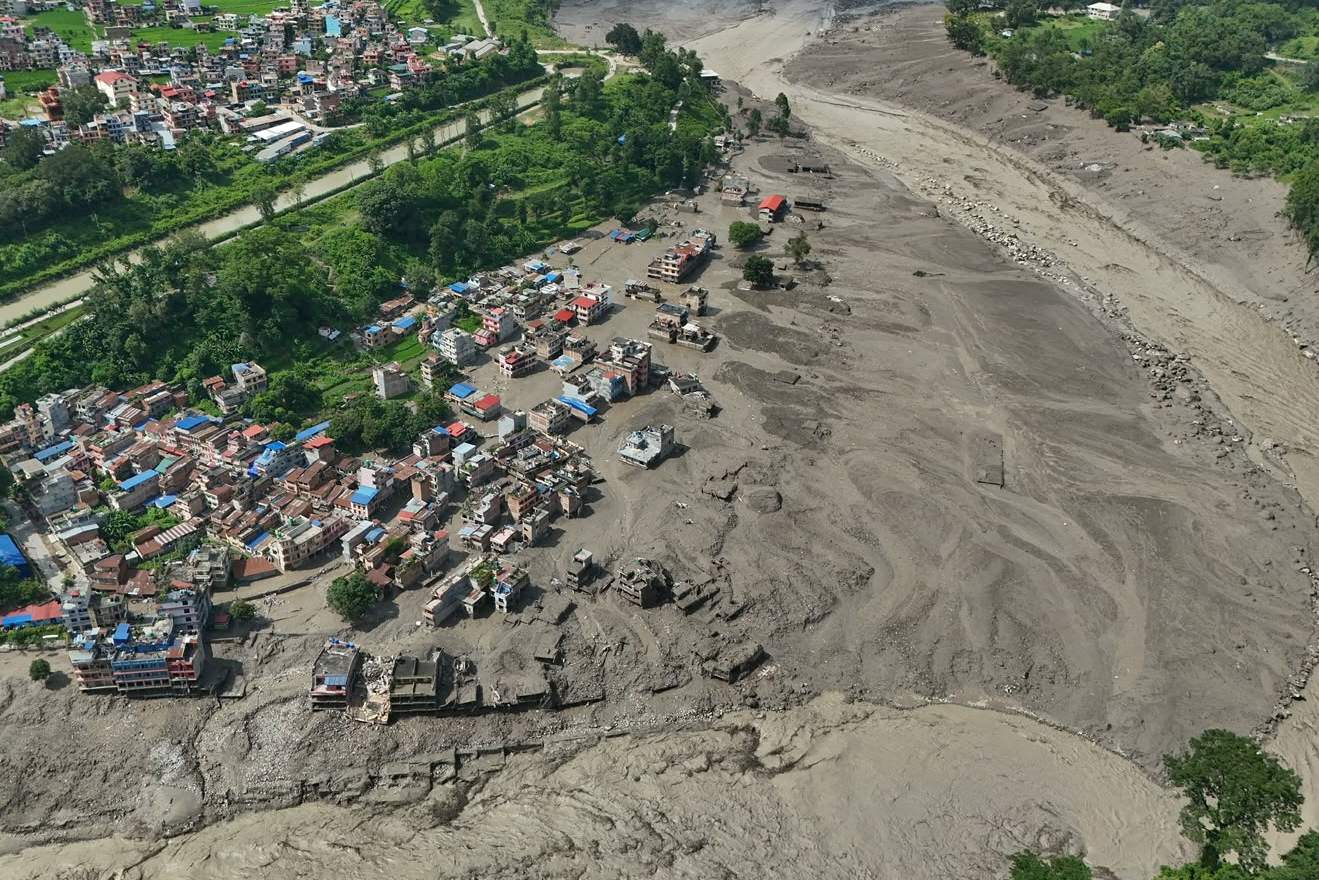
Earthquake damage and rescue operations in Tibet following a magnitude 7.0 earthquake and subsequent tremors in China.

Three tremors struck near the epicenter of a deadly earthquake in Tibet as rescue teams continued relief efforts amid severe weather.


Three earthquakes measuring magnitudes 4.5, 4.1 and 4.2 struck near the epicenter of a magnitude 7.0 earthquake in China’s Tibet region between Friday night and Saturday morning, according to the China Earthquake Networks Center. The main quake has killed 16 people and injured 76, while rescue operations continue amid harsh weather and warnings of further tremors.

RELATED: Powerful 7.0 Earthquake in China’s Tibet Kills at Least 16 People

The first tremor struck Zaduo County in western China’s Qinghai province at 10:14 p.m. local time on Friday, at a depth of 10 kilometers. Two more earthquakes hit the same area and at the same depth on Saturday, at 6:39 a.m. and 8:07 a.m.

The tremors occurred near the epicenter of Thursday’s main earthquake in Baqing County, in Nagqu, Tibet. Seismological authorities have not yet confirmed whether the latest events are formally part of the same seismic sequence.

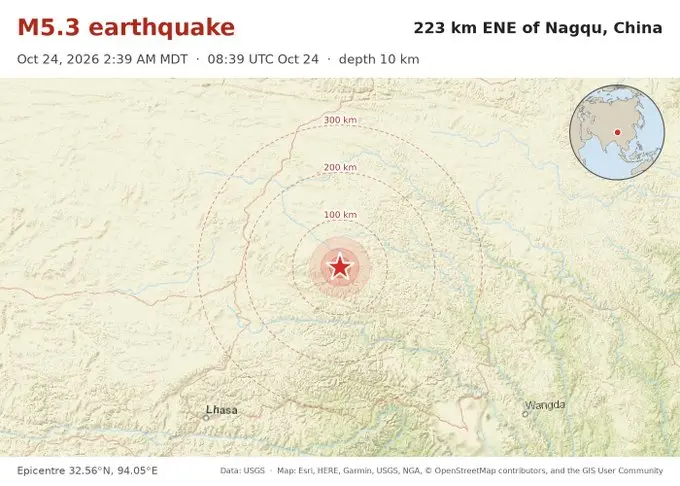
M5.3 likely aftershock – 223 km ENE of Nagqu, China

Oct 24 16:39 local time (18m ago)
Depth 10 kmhttps://t.co/A49zlMJPzH pic.twitter.com/PkqRxfBva0

— Earthquakes (@NewEarthquake) October 24, 2026

The official toll from the magnitude 7.0 earthquake remains at 16 dead and 76 injured. Authorities have also reported 339 homes destroyed or severely damaged, along with damage to 20 livestock facilities.

More than 5,000 personnel have been deployed to affected areas to conduct search and rescue operations and provide medical care and logistical support, state news agency Xinhua reported. Rescue teams have completed three rounds of house-to-house inspections without finding anyone reported missing.

Authorities have evacuated 12,489 residents and established at least 18 temporary shelters as a precaution.

🔊 A magnitude 7.0 earthquake hit Tibet, killing at least 16 and forcing thousands from their homes. It’s the strongest quake to hit China in nearly three years. More on the Reuters World News podcast https://t.co/dFVrexO5K2 pic.twitter.com/fu21iIGcM5

— Reuters (@Reuters) October 23, 2026

The emergency response is unfolding at an altitude of about 4,800 meters, where severe weather threatens to hamper relief efforts. China’s meteorological authorities forecast scattered snowfall for Saturday, with temperatures expected to fall as low as minus 9 degrees Celsius. Strong winds could further complicate travel and the installation of emergency shelters.

Chinese seismologists have warned that further perceptible aftershocks are likely in the coming days. Emergency teams are also monitoring secondary hazards, including potential rockfalls.

The magnitude 7.0 earthquake was the first of that strength recorded in China this year. It follows a January 2025 earthquake in Dingri County, Tibet, that killed at least 126 people.


  •  

Powerful 7.0 Earthquake in China’s Tibet Kills at Least 16 People

Relief brigades began operational field deployments to assess potential infrastructure damage and assist nearby communities. Photo: Xinhua.

A magnitude 7.0 earthquake struck the Xizang and Qinghai regions of southern China on Thursday, killing at least 16 people and injuring 32 others.


Seismological monitoring placed the epicenter 202 kilometers north of Nagqu prefecture-level city in the Tibet Region, at a depth of ten kilometers.

The shallow focus amplified the tremor’s destructive force, sending shock waves across the autonomous region and into border areas of neighboring countries.

RELATED: China Evacuates Tibet Residents Amid Risk of Flood Lake Breach

The quake’s reach extended well beyond China’s borders, underscoring the scale of the event in a mountainous zone near the Himalaya range. Residents across the Himalayan chain felt the shaking, with alerts reported among populations in India, Myanmar and Nepal.

Rescue brigades and Chinese government agencies deployed immediately to the ground. Teams began assessing possible damage to infrastructure and attending to communities near the epicenter, where access routes and basic services could have been compromised.

A 7.0-magnitude earthquake struck Baqen County of Nagqu City in southwest China's Xizang Autonomous Region, at 10:33 p.m. Thursday (Beijing Time), according to the China Earthquake Networks Center (CENC). #XinhuaNews pic.twitter.com/ewln8dGEvn

— China Xinhua News (@XHNews) October 22, 2026

Local authorities are conducting technical inspections in the Nagqu area, a settlement of about 30,000 inhabitants, and in Lhasa, the second-closest locality to the quake’s center. Emergency crews are checking the network of basic services and road structures in rural counties to rule out major damage from possible landslides.

Early Warning Network

China’s natural disaster response committees remain deployed as a preventive measure to coordinate logistical assistance and protect families living in zones of high seismic risk.

That response now leans on infrastructure the country has spent years building. In July, China consolidated the deployment of the world’s most extensive earthquake early warning system, a scientific network capable of issuing real-time alerts within seconds of detecting the first seismic movements.

The mechanism exploits a basic principle of physics, radio waves travel faster than seismic waves. That gap allows notifications to be triggered from magnitudes as low as 1.0, buying precious minutes for people to seek protection before the shaking arrives. The system covers more than 90% of the key risk areas across Chinese territory and generates intensity reports within minutes. Officials describe it as essential technical support for decision-making in rescue operations.

🇨🇳 A 7.0-magnitude earthquake in China's remote Tibet region has killed at least 16 people and injured dozens more, state media reports, with hundreds of houses collapsed. pic.twitter.com/IAH9IzVSHh

— Political Pen (@politicalpen_) October 22, 2026

Emergency management institutions maintain permanent monitoring in the most vulnerable areas, linking cutting-edge research with direct operational response to natural disasters.

The quake arrives against a backdrop of recent tragedy in the region. A flood in Nepal and Tibet left at least 1,143 people dead and the mountainous terrain now faces a new emergency demanding the same mobilization of rescue resources.

With the preliminary toll still being updated, the priority has shifted to reaching remote settlements where landslides may have cut roads and interrupted communications. The full extent of the damage will depend on how quickly those rural counties can be reached and assessed.

  •  
❌