❌

Reading view

DRC Ebola Cases Top 10,000 as Death Toll Reaches 4,887
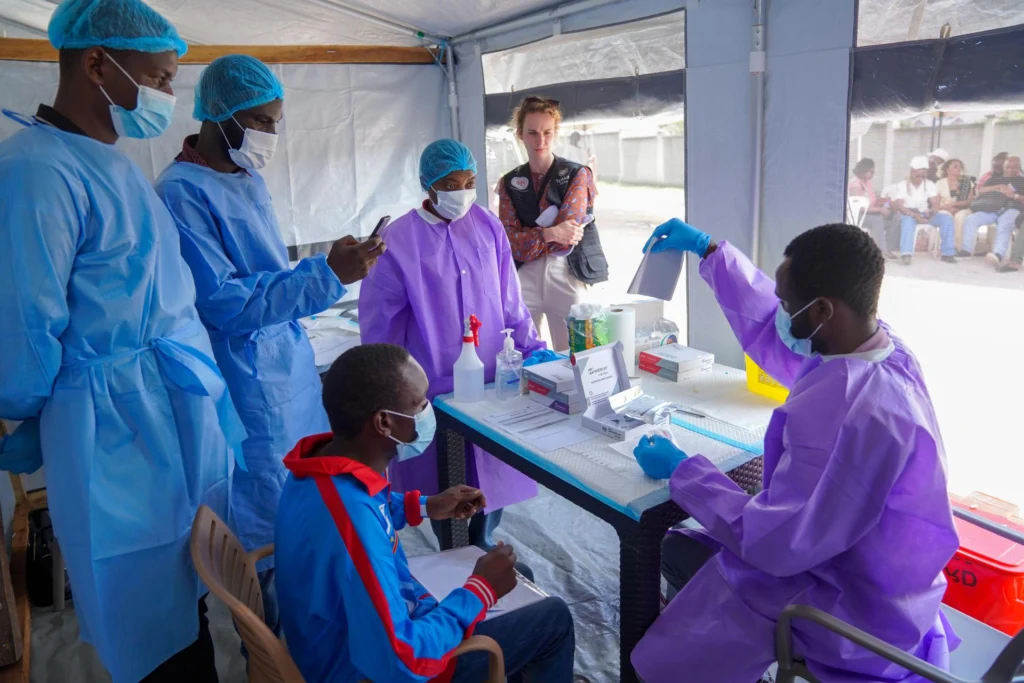
The Ebola outbreak, caused by the Bundibugyo strain, is spreading to eight provinces as the W.H.O. tests two experimental vaccines. Photo: EFE.

The Ebola outbreak in the Democratic Republic of the Congo (DRC) surpassed 10,000 confirmed cases on Tuesday, with 4,887 deaths recorded since the epidemic was declared in May.


The Ebola outbreak in the Democratic Republic of the Congo crossed a critical line on October 27, when confirmed infections passed the 10,000 mark. The National Institute of Public Health (INSP), announced the milestone with figures current through October 25.

The official tally stands at 10,060 cases and 4,887 deaths since the outbreak was declared on May 15. In just over five months, the virus has spread well beyond its initial clusters.

RELATED: Ugandans Who Travel DRC Will Spent 21 Quarantine Days at Come Back Due Ebola

Nearly half of those infected have not survived. The case fatality rate reached 48.6%, a level that makes this one of the deadliest health emergencies on record. It also confirms a trend the institute had flagged weeks earlier, when the outbreak first crossed the 9,000 infection mark.

❗️EBOLA SURPASSES 10,000 CASES IN DR CONGO — Reuters

The virus killed 4,887 people, with confirmed infections reaching 10,060

The concerns grow over a possible spread to other African nations https://t.co/DwohGnqfA6 pic.twitter.com/vGQ6yifZNw

— RT Intl (@RT_on_X) October 27, 2026

Second Deadliest Ever

Only the West African epidemic of 2014 to 2016 was worse. That crisis left roughly 11,000 dead and 28,000 cases across Guinea, Liberia and Sierra Leone. The current Congolese outbreak now ranks second in global history and has already outpaced the Ebola epidemic that struck the country’s eastern region between 2018 and 2020.

Transmission now spans 66 health zones in eight of the DRC’s 26 provinces, less than a third of the national territory. Ituri and North Kivu carry the heaviest burden. Tshopo, Bas-Uélé, Haut-Uélé, South Kivu, South Ubangi and North Ubangi follow behind. Bafwasende, Beni, Mandima and Bunia face the most critical conditions on the ground, the health agency warned.

“The situation underscores the need to strengthen early detection, contact tracing, dignified and safe burials, and the safety of response teams, especially in Bafwasende, a town in Tshopo province,” National Institute of Public Health’s authorities said.

Recovery figures offer a narrow thread of hope. A total of 2,684 patients have overcome the illness, and contact tracing coverage holds at 81.6%. Even so, the institute described early detection, safe burials and protection for field teams as urgent in the hardest-hit zones.

WHO is working closely with the DRC Government to intensify and sustain the #Ebola response.

During his recent visit to Beni, @ProfJanabi engaged with communities and handed over supplies and equipment, including motorbikes and #IPC materials, to strengthen the response. pic.twitter.com/CtuxNcDstT

— WHO African Region (@WHOAFRO) October 27, 2026

No Proven Treatment

The outbreak is driven by the Bundibugyo strain, a lineage with no specific treatments. That gap has pushed scientists toward new solutions. The World Health Organization is advancing two experimental vaccines, and their phase 1 human trials have already produced safe profiles.

The country is also running an immunization campaign with Ervebo, a product developed for the Zaire variant that showed favorable signs in animal tests. But the experimental candidates have only reached the earliest stage of evaluation in people, while Ervebo rests on limited preclinical evidence. Neither option yet offers a conclusive tool to stop transmission.

The cumulative data through October 25 shows the epidemic is far from contained. Health workers confront a virus without a specific therapy across a vast territory where contact tracing is uneven. The National Institute of Public Health has already set the immediate priorities, halting the spread and protecting the teams deployed on the ground.
  •  

Pharma- and Gates-Funded GAVI Seeks to Assure Parents

By Aaron Siri | October 16, 2026

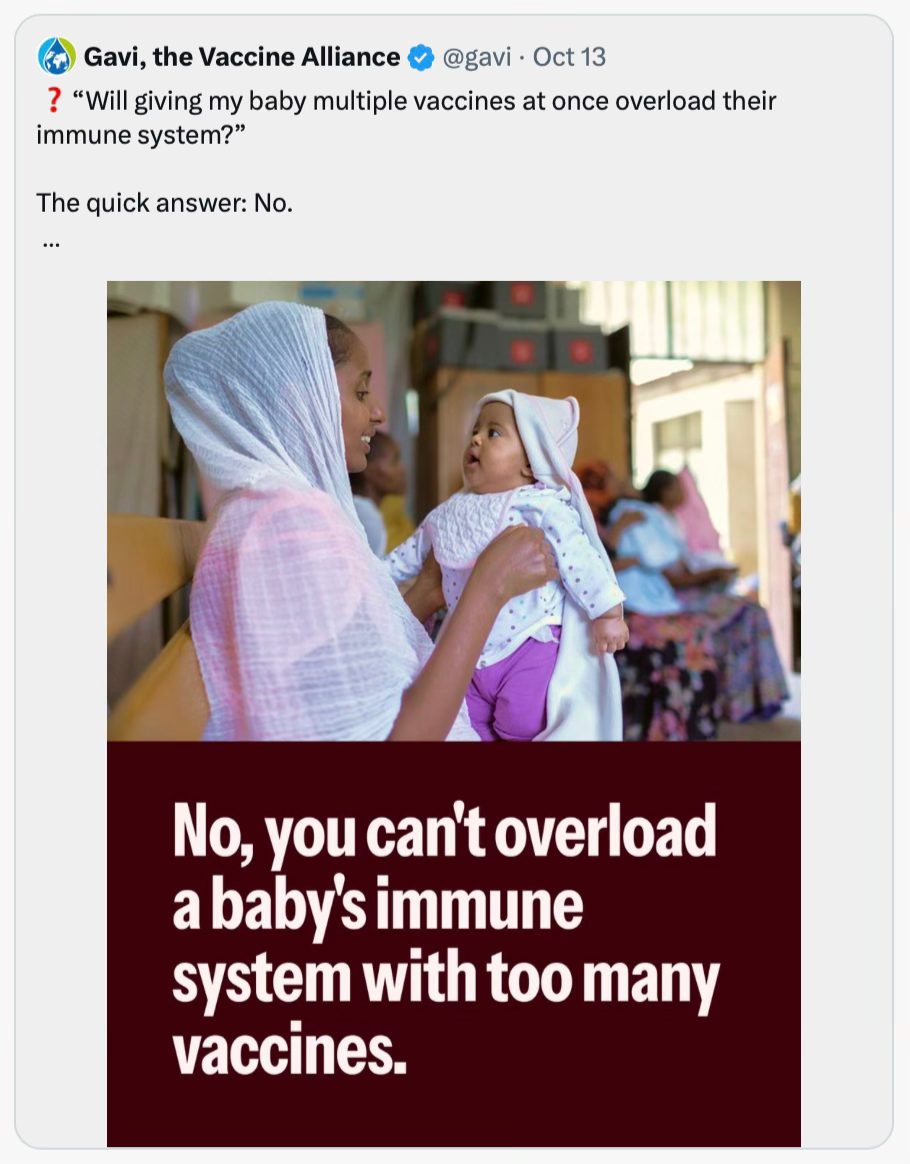
GAVI, a vaccine alliance that includes the WHO, health agencies, pharma, and the Gates foundation, recently posted that studies reflect that giving multiple vaccines to a baby does not risk increased side effects and chronic disease.

Ironically, the studies it cites do not support that vaccines do not cause increased risk of side effects and chronic disease. Anyone who actually reads what is cited would conclude as much and may very well decide to no longer trust GAVI, the medical establishment it represents, or the products it promotes. That is called “thinking” or “informed consent”—which these same organizations would then label as “vaccine hesitancy” or “anti-vax.”

  •  

Hire next WHO chief for the job, not the flag

China’s nomination of Chinese national Song Li to lead the World Health Organization has been filed under the wrong heading. Most of the coverage treats it as a chapter in a bigger story: Washington has walked out, Beijing has stepped in and Geneva must now pick a side. That story is tidy. It is also […]

The post Hire next WHO chief for the job, not the flag appeared first on Asia Times.

  •  

Infantino and Trump have a new disciple at the World Health Organisation

This year has proved that the era of the strongman is undoubtedly upon us. Littered throughout the highest offices across government and international organisations, they have proved time and again that due process is for suckers and that you, too, can bribe your way to the desired outcome.

Take Gianni Infantino who is seeking to sell off 20% of the world’s most cherished football tournament. He, like Trump, has dug in his heels, choosing to strategically dole out favours, and then use their power to pit people against each other, rather than following the rules. Having leveraged their positions to fulfil their agenda, no matter the cost, they deny anything they don’t wish to confront, deflect questions they don’t like, and gaslight anyone who dares to call them out.

Whilst Infantino and Trump have dominated headlines of late, the actions of the world’s health agency head have - despite years of alarm bells - received comparatively little scrutiny; a concern when you consider how instrumental effective healthcare is to our everyday lives.

Like Infantino, Dr Tedros wedges countries and leaders apart in order to defy institutional processes and push through his agenda. In 2025, Dr Tedros pared down his leadership team by nearly 30%. Most recently, the WHO’s top scientist, Dr Jeremy Farrar, was replaced with a highly “controversial” and apparent confidant of Dr Tedros. The pattern of replacing officials with faithful advisers is a classic move of the strongman and underlines how institutional structures can be leveraged to advance personal aims.

One of those aims appears to be purging WHO of those who challenge the opaque bureaucratic functions that Dr Tedros oversees. Dr Farrar’s surprise resignation was said to have been due to increasing frustrations with the WHO’s internal politics. Curiously, in an all-staff email, Dr Tedros reframed Dr Farrar’s departure as a retirement and, in communications with the press, the organisation refused to comment on

r’s relationship with (read: criticisms of) the WHO. 

Now, Dr Tedros is allegedly bulldozing through the replacement of the WHO’s Regional Director for its South-East Asia Regional Office (SEARO), Saima Wazed. Ms Wazed has been on administrative leave for over a year following unfounded allegations made against her by Bangladesh’s Interim Government. As the nation roiled under an intense period of political unrest, Ms Wazed was falsely accused of absconding from the country when, in reality, she was stationed in New Delhi, acting in her capacity as the SEARO Regional Director. The WHO knew this but put her on administrative leave without pay anyways. In that time other, unfounded allegations bubbled up, including claims Ms Wazed requested reimbursement from WHO for personal travel to China, which, it would appear, was an entirely fabricated allegation.

The WHO’s handling of Ms Wazed’s leave has been deeply flawed and discussed at length by top-level jurists and a UN Special Rapporteur. Since the allegations were made, a new Bangladeshi government has been elected and two of WHO’s Officers-in-Charge have been appointed to “temporarily” oversee the SEARO. Still, no information about the veracity of the allegations against Ms Wazed have been made public despite the fact that WHO’s own guidelines explicitly say that administrative leave is not a punishment. If allegations are not verified in a reasonable timeframe, WHO has a duty to end the leave.

For her part, Ms Wazed has called for an investigation into Dr Tedros, alleging that he or his office leaked confidential documents, provided false or misleading information to Member States, and breached confidentiality requirements and the WHO’s Code of Conduct by directly engaging with the former government of Bangladesh.

While the WHO has the responsibility to investigate allegations against its staff, claims from a national authority should not automatically be treated as proven fact for a supposedly apolitical organisation. It has now been over a year since Ms Wazed was put on leave. This, combined with the absence of any apparent independent investigation into the allegations points to a fast and loose approach to proper administrative processes, one in which the attempt to hold Ms Wazed in administrative purgatory exists as a vehicle to quietly remove her from the organisation.

Just as Infantino is leveraging greater funding for African nations to gather support for his upcoming presidential bid, Dr Tedros is using what amounts to an uncosted holiday jaunt to the South Pacific to bring a forced-end to this saga. Reports suggest that the Director General is directing SEARO nations to do away with due processes and install Ms Wazed’s successor. For their trouble, fielty, and feigned ignorance to standard administrative practices, Dr Tedros is organising a regional meeting, spending at least €163k to fly in the SEARO directors and staff for a face-to-face meeting in Timor Leste. Despite years of cutting the WHO to the bone and a record budget shortfall, for Dr Tedros no expense is too great to push through his agenda.

Ultimately, this is a clear attempt by Dr Tedros to circumvent proper levels of scrutiny about this crucial decision, and to hide his undermining of the WHO’s standard procedures by sweetening the deal for other regional staff. Pulling directly from the Infantino playbook, Dr Tedros has escaped public outcry which would hold him responsible. But his treatment of Saima Wazed, what many would call an organised witch-hunt, should concern us all, as yet another international organisation sees the erosion of due processes.

  •  

Belgium nominates Hans Kluge as WHO Director General

The Belgian federal government has nominated Hans Kluge (pictured) for the position of Director-General of the World Health Organization (WHO).

“I am very honoured by the trust Belgium has placed in me and am grateful for the opportunity to take on this important responsibility,” Kluge said on X. “Serving the WHO has been the greatest privilege of my professional life.”

Kluge has served as WHO Regional Director for Europe since 2020 and began a second term in February 2025. Under WHO rules, he will step aside as WHO/Europe Director while campaigning for the role, a process that involves lobbying member states, NGOs and the organisation's largest funders.

Tried and tested
After qualifying as a doctor in Belgium, he began his international career with Médecins Sans Frontières in conflict settings in Liberia and Somalia. He subsequently coordinated tuberculosis programmes in Siberian prisons and across the former Soviet Union.

Kluge joined WHO in 1999, initially working on tuberculosis and HIV in...

  •  
❌