The Pentagon has fired its top military strategist as Washington draws up contingency plans for a possible escalation of hostilities with Iran.
Army Lt. Gen. Brett Sylvia has been removed from his position as director for strategy, plans, and policy (J5) on the Joint Staff, a spokesman confirmed late Wednesday, following media reports of his dismissal.
His predecessor, Lt. Gen. Joseph McGee, was forced into retirement a year ago amid reported friction with Secretary of War Pete Hegseth and Chairman of the Joint Chiefs of Staff Gen. Dan Caine. Sylvia previously served as vice director of the J5.
The Pentagon did not explain Sylvia’s departure. His responsibilities included developing military strategies and plans to advise the chairman and the US president. He joins nearly two dozen senior military and civilian officials removed during Hegseth’s tenure.
The secretary has portrayed the dismissals as part of an effort to reduce the military’s bloated ranks of generals and make the armed forces more efficient and lethal. Critics, however, have characterized the shake-up as an ideological “purge.”
President Donald Trump has repeatedly raised the possibility of renewing large-scale hostilities with Iran, including resuming the intensive bombing campaign conducted during the first 40 days of the conflict, which the US and Israel launched in late February. A potential escalation could be timed around the November midterm elections.
Military experts have widely expressed concern that another bombing campaign would fail to “finish the job,” as Trump has put it, while further increasing the conflict’s economic toll worldwide. Tehran has repeatedly warned that it is prepared to retaliate against US allies in the Gulf region if it faces renewed attacks.
Conversely, speculation has emerged that Trump could dismiss Hegseth after the midterms, when the opposition Democratic Party is expected to make gains in both chambers of Congress. Critics of the Iran war, including Republican Rep. Thomas Massie, have argued that firing the secretary could help Trump avoid a potential impeachment battle if Democrats take control of the House.
Trump’s public rhetoric remains supportive of Hegseth and his policies.
Iran’s Islamic Revolution Guard Corps (IRGC) Navy announced on Thursday that three oil tankers exploded and caught fire after striking naval mines while attempting to cross an unauthorized southern route through the Strait of Hormuz.
The vessels disregarded warnings from Iranian naval forces and switched off their radar and navigation systems before entering the mined passage, according to the statement.
“Over the past 24 hours, three violating oil tankers exploded and caught fire after striking mines while attempting to pass through the unauthorised southern route of the Strait of Hormuz,” the IRGC said.
The navy reported that the tankers were left along the southern shores of the strait following the explosions. Their identities and flags were not immediately available, and no information was provided about casualties.
IRGC warns crews against relying on CENTCOM assurances
The IRGC Navy reiterated that the southern route remains mined, warning shipowners and crews against attempting passage in disregard of its instructions or relying on statements issued by US Central Command (CENTCOM).
“The IRGC Navy states that the unauthorised route through the Strait of Hormuz is mined, and that vessel owners and crews are responsible for transiting these routes and should not pay attention to CENTCOM’s delusions on social media,” the statement said.
It further warned that any provocative action backed by the US military that disregards Iran’s rules governing passage through the strait would be met firmly.
Iranian forces have repeatedly accused CENTCOM of encouraging commercial vessels to use the southern corridor near the Omani coast despite Iranian warnings.
In a statement issued on Wednesday, CENTCOM rejected earlier Iranian reports of commercial vessels striking mines and maintained that US forces had cleared all internationally recognized primary transit routes. It also said thousands of commercial vessels had used those lanes safely. The statement preceded Thursday’s IRGC announcement.
UKMTO receives report of vessel burning near Oman
Separately, the United Kingdom Maritime Trade Operations (UKMTO) said on Thursday that a shipmaster had reported seeing another vessel on fire nine nautical miles north of Khasab, Oman.
The agency did not identify the vessel or establish the cause of the blaze. Its connection to the three tankers reported by the IRGC remained unclear.
The developments come amid restrictions on shipping through the strait since the US-Israeli war on Iran began on February 28. Tehran maintains that vessels must coordinate their passage with Iranian authorities, while Washington has imposed a blockade on Iranian ports.
IRGC announces capture of US reconnaissance drone
In a separate statement, the IRGC Navy announced that its electronic warfare unit had captured a US drone in the western Strait of Hormuz and brought it down intact.
The navy identified the aircraft as an MQM-170 reconnaissance and decoy drone, saying it had been tasked with detecting Iranian air-defense systems along the Gulf coastline and the strait.
“The IRGC Navy announced that its electronic warfare unit had successfully captured a US MQM-170 drone during an offensive operation in the western Strait of Hormuz,” the statement said.
The presence of Saudi, Turkish, and Pakistani officials in Tehran on 26 October reflected a growing recognition that Iran cannot be excluded from any serious regional security arrangement. Despite the US–Israeli war against Iran, Tehran remains central to the region’s military and political balance.
For Riyadh and its partners, the meeting also exposed the limits of the Mecca defense pact, particularly as Saudi Arabia faces renewed confrontation with the Ansarallah-aligned Yemeni Armed Forces (YAF).
Much of the speculation surrounding the four-country meeting centered on what Iran might be expected to surrender, particularly its relationship with Sanaa. Such expectations rested on the assumption that Saudi Arabia, Turkiye, and Pakistan had established a regional security order into which Iran was now seeking admission, with Tehran potentially offering concessions over Yemen in return.
Yet the political and military circumstances that brought the participants to Tehran suggest a different calculation. Iran has withstood sustained American and Israeli attacks, while Saudi Arabia and its partners have struggled to contain the YAF’s military operations. Any agreement that disregards these realities risks reproducing the confrontations it seeks to resolve.
Iran’s Foreign Ministry had identified Israel’s expansionist policies, Lebanon, and the US war against Iran among the subjects for discussion. Yemen was absent from the announced agenda and the subsequent press statement.
Ali Bagheri, deputy secretary of Iran’s Supreme National Security Council, said the gathering also served to congratulate Mohsen Rezaei, the council’s newly appointed secretary, and discuss regional security, including opposition to foreign interference, particularly by Washington. According to information obtained by The Cradle, Yemen was not discussed during the meeting.
On the morning of 27 October, a day after the talks, Rezaei met Yemen’s ambassador, Ibrahim Mohammad al-Dailami, in Tehran. Rezaei praised Yemen’s defense of Gaza and its confrontation with Israel, while the ambassador thanked him and the Iranian government for their positions.
The encounter came amid speculation that Tehran’s diplomatic engagement with Riyadh might come at the expense of its relationship with Sanaa. By publicly reaffirming those ties immediately after the summit, Iran signaled its intention to pursue regional diplomacy while maintaining its existing alliances.
Hossein Shariatmadari, editor of Iran’s conservative daily Kayhan, wrote in a 27 October editorial that “Yemen’s revolutionaries are allies of Islamic Iran.” He warned that the visiting delegations might seek to create the impression that Tehran was distancing itself from Sanaa, offering Washington and its allies “breathing room, however brief” by encouraging expectations of an imminent settlement.
The Mecca pact’s limits
Iran has good reason to approach the Saudi–Turkish–Pakistani framework, commonly known as the Mecca pact, with caution. The agreement brings together three states with substantial military capabilities and extensive relations with Washington, raising questions about whether their security cooperation could eventually be directed against the Axis of Resistance.
For Riyadh, Yemen remains a central concern. Years of confrontation with the YAF have demonstrated Sanaa’s ability to impose high military and economic costs beyond Yemen’s borders. Saudi Arabia’s renewed campaign has again brought its energy infrastructure and military installations within range of Yemeni retaliation, exposing the limits of the kingdom’s reliance on foreign military protection.
In Tehran, closer military coordination among the pact’s members could be seen as an attempt to contain the Axis of Resistance at a time when American security guarantees are becoming increasingly uncertain.
Iran’s participation in talks with the pact’s members carries no commitment to join their alliance. Tehran has made no such announcement, while Rezaei’s explanation of the summit emphasized the establishment of security through regional cooperation, the withdrawal of foreign forces, and an end to outside interference.
These objectives leave considerable differences between the participants. Saudi Arabia, Turkiye, and Pakistan maintain security relationships with Washington, while Iran regards the American military presence as a principal source of regional instability. Their respective positions on armed resistance movements, Israeli aggression, and the obligations of any collective defense arrangement also remain unresolved.
The meeting produced a brief press statement confirming the participants’ intention to continue their dialogue, without setting out binding commitments. Rezaei indicated that further meetings would follow, suggesting that the four governments were exploring the foundations of a wider regional accommodation.
The initiative itself emerged from Pakistani army chief Asim Munir’s visit to Tehran the previous week, according to information obtained by The Cradle. Iranian officials also confirmed Pakistan’s proposal, describing the gathering as an opportunity to advance regional security arrangements based on shared interests and mutual trust.
Riyadh’s security dilemma
The Saudi–Turkish–Pakistani alliance combines considerable military resources, diplomatic influence, and strategic relationships. Its effectiveness, however, depends on the willingness of its members to confront threats that may carry very different consequences for each country.
The limited assistance Pakistan and Turkiye have provided during the renewed confrontation between Yemen and Saudi Arabia illustrates these constraints. Although both countries have pledged support for Riyadh, their involvement has fallen short of the decisive intervention that might alter the military balance with the YAF.
Saudi Arabia’s own account of the visit was more restrained. In a statement following the meeting, Riyadh said the talks formed part of efforts to de-escalate tensions, encourage diplomatic solutions, and support mediation by Qatar and Pakistan. It also reaffirmed the Mecca pact’s role in promoting regional security and stability.
Islamabad and Ankara have also sought to limit their military involvement. Turkish officials have ruled out offensive operations against Yemen, while Pakistan has denied reports that its aircraft carried out strikes on Yemeni forces. These restrictions expose the distance between the pact’s collective defense commitments and its members’ willingness to enter a wider war.
The continuing Yemeni operations against Saudi targets have consequently strengthened the argument for direct engagement with Tehran. Riyadh must weigh the costs of further confrontation against the possibility of reaching an understanding with Iran, whose regional relationships and military capabilities remain central to the wider balance of power.
Despite the damage inflicted during the war, Tehran has retained the ability to influence the course and costs of regional confrontation. Its leverage over the Strait of Hormuz and its capacity to retaliate against military infrastructure have complicated Washington’s efforts to impose a settlement on its own terms.
These developments have strengthened Tehran’s negotiating position, although translating military endurance into a durable security arrangement will require more than the recognition of its regional weight. Tehran must also demonstrate that cooperation with its neighbors can reduce the likelihood of renewed war without undermining the relationships that have helped it withstand external pressure.
For Saudi Arabia, the lesson is equally significant. Its security cannot be guaranteed indefinitely through military partnerships that exclude one of the region’s principal powers, particularly when those partnerships have struggled to prevent attacks on Saudi territory.
Yemen cannot be traded
The suggestion that Tehran might trade its relationship with Ansarallah for concessions from Riyadh overlooks the movement’s independent political interests and roots in Yemen. Ansarallah’s resistance to Saudi intervention grew out of a prolonged struggle over the country’s political future, during which its ties with Iran deepened.
The two sides share important strategic interests, but Yemen’s military and political decisions cannot be reduced to directives from Tehran. The YAF’s intervention in support of Gaza, its confrontation with Israel, and its continuing war with Saudi Arabia reflect calculations shaped by Yemen’s own circumstances.
Iran’s regional relationships have also evolved through years of confrontation with Washington and Tel Aviv. The Islamic Republic’s resistance to American and Israeli pressure has become inseparable from its wider regional security calculations, particularly as the war has intensified the threats facing its allies.
Sanaa has paid a substantial price for its military and political positions, enduring years of bombardment, blockade, and attempts to dismantle its authority. Ansarallah’s survival has given it considerable influence over Yemen’s future, making any settlement negotiated without its participation unlikely to produce lasting results.
The assumption that Tehran could simply secure Yemeni compliance also underestimates the political consequences of such an arrangement. The Sanaa government would have little reason to accept an agreement that disregards its security interests or leaves Saudi military pressure intact.
Rezaei’s meeting with the Yemeni ambassador therefore served an important political purpose. As Tehran opened discussions with the Mecca pact’s members, it reaffirmed a relationship whose continuity remains important to the wider Resistance Axis.
Israel’s declining leverage
The summit’s joint statement made no reference to Israel, but Rezaei’s subsequent account of the talks placed Israeli military operations among the issues discussed. He said the participants had emphasized ending Israeli attacks and securing Israel’s withdrawal from occupied territories in Lebanon, Syria, and Palestine.
Before Operation Al-Aqsa Flood, Saudi–Israeli normalization was a serious diplomatic prospect. Washington sought to advance Israel’s integration into a regional security and economic framework that would strengthen its position while isolating Iran and its allies.
The wars that followed have disrupted those calculations. Israel’s military campaigns across West Asia, alongside the American war against Iran, have exposed the risks associated with a regional order built around Israeli military superiority and US security guarantees.
Rezaei’s public emphasis on Israeli aggression reflects the changing circumstances in which the talks took place. Riyadh has not formally adopted his characterization in the joint statement and maintains its longstanding relationship with Washington, but Saudi security concerns have increasingly brought it into direct contact with Tehran despite years of hostility.
The contrast with 2017 is especially revealing. Crown Prince Mohammed bin Salman (MbS) then threatened to take the confrontation inside Iran, reflecting Riyadh’s confidence in its ability to challenge Tehran through regional pressure and military alliances.
Nearly a decade later, Saudi officials are in Tehran discussing regional security with the same government Riyadh once threatened to attack. Years of confrontation have failed to break Iran’s regional influence, while Washington’s ability to shield its allies from another war is increasingly in doubt.
Yemen’s ability to remain a consequential military actor despite years of Saudi-led operations has also shaped this reassessment. Its continued resistance has demonstrated the limits of attempts to impose regional arrangements through military force.
Tehran’s next move
The summit’s lasting significance will depend on whether the participating governments can translate their discussions into practical security arrangements. Iran has an opportunity to advance its longstanding position that West Asia’s security must be determined by the countries of the region, without dependence on foreign military intervention.
Such an arrangement would require Saudi Arabia, Turkiye, and Pakistan to recognize Iran’s security concerns and its existing alliances. Tehran would also have to address its neighbors’ security concerns without compromising those relationships.
The presence of all four countries in Tehran suggests that these questions are now receiving serious attention. Rezaei’s subsequent meeting with Yemen’s ambassador also indicated the basis on which Iran intends to participate: regional cooperation alongside continued support for its established allies.
Any regional agreement must also account for Yemen and the other members of the Axis of Resistance. Their military and political weight cannot be ignored, nor can their futures be decided through negotiations between Tehran and its neighbors.
Iran has emerged from the war with its regional alliances intact and greater room to negotiate. The question now is whether Riyadh and its partners are prepared to reach an understanding with Tehran that recognizes those alliances rather than seeking to dismantle them.
Donald Trump and his coalition have rocked the Republican party more than any other right-wing movement this century.
So much so that some Republicans now long for the party as it was before MAGA, the ostensibly “traditional” pre-Trump GOP.
Sen. Thom Tillis (R-NC) is one of them. The senator, who decided not to run for re-election this year, is promoting a new book that presents himself as, if not a Never Trumper, then at any rate a dissident from MAGA. “What [Trump’s] done is he’s created a coalition that, in my opinion, will not stay with Republicans once we go back to traditional Republican platform priorities,” Tillis said of the GOP’s future in an interview last week. “I think a lot of the elements of the populism that Trump created to expand a base that made him successful running for president, I don’t think that stays with the party long term.”
On X, The Blaze’s Auron MacIntyre shared a clip of Tillis saying this and added, “They’re admitting out loud that they’re running out the clock on Trump so they can return the GOP to factory neocon settings.”
MacIntyre is not wrong.
Another figure who longs for the GOP before Trump is Rahm Emanuel, the former chief of staff to President Obama who is currently making a bid for the 2028 Democratic nomination. He wants Democrats to embrace what he calls “McCain-Romney Republicans” who now vote Democrat.
“The top story from the 2026 cycle will be the electoral opening Democrats seized—and will have to maintain,” Emanuel wrote for the Wall Street Journal last Wednesday. “Most important, the McCain-Romney Republicans, who are politically homeless, need to be welcomed into Democrats’ governing and electoral coalition.”
Emanuel urged his fellow Democrats to make common cause with these kinds of centrist Republicans, and to avoid embracing the hard-left socialist Democratic candidates who are faring well at the moment.
“Millions of McCain-Romney voters are redefining their political identities, and they will be most responsible for Democratic gains in November,” Emanuel explained. “These voters don’t want to be associated with MAGA, and they see themselves as free agents.”
It’s true that many Republican voters who might go for Democrats this election don’t want to be associated with MAGA. But they might not want to revert to the supposed good ol’ days of John McCain, Mitt Romney and George W. Bush either.
President Ronald Reagan’s former Office of Management and Budget Director David Stockman shared Emanuel’s op-ed and added, “McCain-Romney neocon warmongering GOP campaign loot collectors from the MIC (military-industrial complex)? You are barking up the wrong tree, Rahm.”
Stockman is on point.
Tillis and Emanuel are both right that voters, and especially Republicans, are mad at Trump and his party, and most predict this anger will be on full display in the upcoming election.
But both are wrong to dismiss populism. The establishmentarian politics that Tillis and Emanuel represent within their respective parties is what so many voters were rejecting when they embraced the current “Drain the Swamp” president.
Populism is not only not the problem, it’s not likely to be going anywhere. The upcoming midterm elections won’t mark some return to party-elite form, but another populist revolt against the apparently insincere populism Americans voted for two years ago.
This isn’t rocket science: Trump’s coalition is mad because the erstwhile “no new wars” president who promised to put America first and keep prices low instead started a brand new war at the behest of Israel and the expense of working-class Americans. The Republican establishment was also on board with the war—until recently, when even a few historically hawkish candidates in tight races have started saying it should end.
On the Iran War, the issue that seems to be defining Trump’s second term the most, this president has delivered what the neocon favorite Mitt Romney seemed to promise as the 2012 Republican presidential nominee, and what the 2008 GOP nominee and neocon favorite John McCain campaigned on. Trump is now compared to that most “traditional” of 21st century Republicans, George W. Bush. The former president’s brother, Jeb Bush, has praised Trump for starting a war with Iran. Marc Thiessen, an alumnus of the George W. Bush White House, is a big fan of Trump and his war. And the neoconservative pundits Mark Levin and Ben Shapiro now praise Trump for having a foreign policy that looks a lot like what was on offer from McCain and Romney.
On the other side of the aisle, many of the Democrats challenging Republicans in seats once thought safe are finding success with populist campaigns that focus on combatting rising prices, opposing the overwhelmingly unpopular war, and, perhaps most amusingly, putting America First. Abdul el-Sayed, the Democrat who is running against “traditional” Republican Mike Rogers for Senate in Michigan, has regularly appeared on Fox News and constantly pitches to (former?) MAGA voters.
It’s worth noting that there was a Republican party before Trump, under whose banners Tillis was first elected to the Senate in 2014. This is how POLITICOreported Tillis’s victory in the GOP primary for that seat: “Tillis Beats Tea Party in N.C.: The GOP establishment scored a victory Tuesday when its preferred candidate soundly defeated a pair of grass-roots insurgents in a North Carolina primary.” One of those insurgents was Greg Brannon, who had the endorsement of the Tea Party Republican and war skeptic Rand Paul. (Paul, of course, won his own Senate seat in 2010 by running against the pre-Trump, pro-war neoconservative-marinated Republican brass.)
There was a Republican uprising against the party’s establishment well before Trump burst on the scene, and Tillis was definitely not part of it.
In fact, there was much dissent and intra-party challenging of Republican elites in those post-Bush years. Obama’s 2008 victory was largely a rejection of the old GOP and its wars, which McCain fully embraced, and Romney’s 2012 loss was due in no small part to Americans not wanting another extension of Bush-Cheney.
The “traditional” McCain-Romney Republicans haven’t been popular enough to win a presidential election since Bush in 2004, and the first Republican to do so won by calling Dubya a liar and his war in Iraq a “big, fat mistake.”
Now Trump is making his own mistake in Iran, and many of his 2024 voters appear eager to correct their mistake this year. Not because they yearn for a return to the Republican party as it was before him, but because Donald Trump promised to beat that party and dispose of it—and has failed.
Jack Hunter is the former political editor of Rare.us. Jack has written regularly for the Washington Examiner, The Daily Caller, Spectator USA, Responsible Statecraft and has appeared in Politico Magazine and The Daily Beast. Hunter is the co-author of the The Tea Party Goes to Washington by Sen. Rand Paul.
Members of the United Nations Security Council attend a meeting at the United Nations headquarters in New York City. (File photo)
China has denounced Washington’s policy toward Iran, blaming US and Israeli attacks for halting IAEA inspections of Iranian nuclear facilities, while Russia has challenged the legality of a UN Security Council meeting on Tehran’s peaceful nuclear program.
The UN Security Council held a meeting on Tuesday to discuss Iran’s nuclear program after the Board of Governors of the International Atomic Energy Agency (IAEA) voted to refer Tehran’s nuclear dossier to the council.
During the meeting on Tuesday, Permanent Representative of China to the United Nations Fu Cong criticized US and European policies toward Iran, saying military attacks on Iranian nuclear facilities had directly blocked IAEA inspections.
“The US and Israeli military attacks on nuclear facilities under IAEA safeguards are the direct reason the agency has been unable to conduct inspections,” the Chinese representative said.
He also blamed Washington’s unilateral withdrawal from the 2015 Joint Comprehensive Plan of Action (JCPOA) and its subsequent “maximum-pressure” campaign for the current crisis.
“The unilateral US withdrawal from the JCPOA and the implementation of the maximum-pressure policy are the root causes of the current crisis,” Cong said.
The Chinese diplomat also criticized Britain, France and Germany, saying the three European countries had failed to fulfill their commitments.
The representative said the mechanism for re-imposing UN sanctions on Iran, commonly known as the snapback mechanism, had fundamental legal and procedural flaws.
Russia’s representative, Vassily Nebenzia, also challenged the legality of holding the meeting under the “non-proliferation” item of the Security Council’s agenda.
“We are compelled to take the floor on a point of order in connection with yet another attempt to flagrantly violate the Security Council’s rules of procedure and convene a meeting under a non-existent agenda item.”
He said that under Resolution 2231 the council had concluded its consideration of Iran’s nuclear program on October 18, 2025, and removed the “non-proliferation” item from its agenda.
He also rejected claims that earlier UN resolutions on sanctions against Iran had been reinstated, saying such claims “have no legal basis whatsoever.”
Nebenzia said Russia and China had proposed holding the briefing under the agenda item “Threats to international peace and security,” arguing that “repeated strikes against Iran’s peaceful nuclear infrastructure under IAEA safeguards” posed such threats.
The IAEA Board of Governors adopted a resolution on September 9 proposed by the United States, France, Britain and Germany calling for Iran’s nuclear file to be referred to the Security Council. The resolution passed with 23 votes in favor, eight abstentions and three votes against.
The referral marked the first time in 20 years that Iran’s nuclear file had been sent to the Security Council over alleged violations of its non-proliferation obligations.
Iran maintains that its nuclear program is peaceful. Tehran has also criticized the resolution, saying Western countries are disregarding its cooperation with the IAEA and the consequences of US and Israeli military attacks on nuclear facilities under agency safeguards.
Iran has also criticized the United States and the three European countries for pursuing the resolution, saying their actions undermine impartiality of the IAEA Board of Governors.
The Security Council meeting was requested by Western countries and Bahrain. Russia and China objected to holding it, prompting a procedural vote.
The proposal to convene the meeting passed with 11 votes in favor, two against and two abstentions. Russia and China voted against the proposal. As a procedural matter, the vote was not subject to the council’s veto mechanism.
The United States and Israel launched unprovoked aggression against Iran two times in June 2025 and February 28 amid indirect talks between Iran and the US.
Other than military and civilian facilities, including hospitals and schools, Iran’s safeguarded peaceful nuclear facilities were targeted by the aggressors in both wars, as the international community and the IAEA were reticent.
For nearly half a century, Iran’s adversaries have tried to isolate it, intimidate it, sanction it into submission and bomb it into irrelevance. Now, in a remarkable inversion of regional power politics, three countries historically invested in its containment have arrived in Tehran to discuss their security with the very state they were supposed to marginalise.
The country they could not defeat is becoming the country they cannot afford to ignore.
Yesterday, Saudi Defence Minister Prince Khalid bin Salman, Pakistan’s army chief Field Marshal Asim Munir and Turkish intelligence chief Ibrahim Kalın met Iranian officials in an encounter whose diplomatic courtesies barely concealed its strategic significance.
The Mecca Pact, the joint defence agreement that Saudi Arabia, Türkiye and Pakistan signed in Mecca in August, was supposed to consolidate a formidable Sunni-led defence alignment. Yet its representatives have come to Tehran confronting an inconvenient reality: Iran cannot be excluded from regional security merely because Washington and its partners find its independence intolerable.
Apparently, the Islamic Republic has become considerably more respectable since demonstrating that it cannot be conveniently eliminated.
This is the distinction between military destruction and strategic defeat that Washington and Israel persistently confuse. Overwhelming firepower can devastate infrastructure, assassinate officials and inflict enormous suffering. It cannot manufacture political submission.
Iran has survived military confrontation, retained retaliatory capabilities and forced neighbouring governments to reconsider the potentially catastrophic consequences of another war.
Survival becomes strategic victory when your adversaries must reorganise their calculations around it.
For Saudi Arabia, the reckoning is particularly humiliating. Riyadh spent decades treating American military supremacy as an insurance policy against Iranian influence. Yemen exposed the bankruptcy of that assumption.
Ansar Allah, Yemen’s Houthi movement, demonstrated that superior arsenals cannot guarantee security against an adversary capable of imposing disproportionate costs. The Saudi monarchy possesses spectacular weaponry, immense wealth and powerful patrons. Yet none of these has eliminated its vulnerability to Yemeni retaliation.
Now Riyadh finds itself seeking Tehran’s cooperation to manage a conflict that its military superiority has failed to resolve.
Pakistan’s predicament is scarcely less revealing. Munir presides over a military establishment accustomed to presenting strategic dependency as diplomatic sophistication. Islamabad’s defence commitments to Riyadh now threaten to entangle Pakistan in confrontations with Iran and Yemen that serve neither its geography nor its national interests.
The Mecca Pact promises collective security. Its less advertised feature is collective exposure to somebody else’s strategic miscalculations.
Munir must now reconcile his obligations to Saudi patrons with the inconvenient realities of Iranian power. It is an awkward assignment for an establishment that has repeatedly mistaken proximity to foreign power for genuine strategic independence.
Türkiye confronts a different calculation but reaches a similar conclusion. Ankara understands that NATO membership, military capabilities and regional ambitions cannot abolish geography. No credible security architecture can be constructed by pretending Iran is dispensable.
The deeper contradiction, however, lies within the Mecca Pact itself.
Its members seek the reassurance of collective defence while attempting to avoid being dragged into another American-Israeli confrontation. An attack on one may formally constitute an attack on all. But such commitments become considerably less attractive when Iranian retaliation, Yemeni escalation and vulnerable Gulf infrastructure enter the equation.
Collective defence sounds magnificent until someone presents the collective bill.
Iran’s achievement is not that its neighbours have embraced its revolutionary worldview. They have not. Saudi Arabia remains deeply connected to Washington, Pakistan continues its elaborate balancing act, and Türkiye remains embedded in NATO.
The significance runs deeper: these governments increasingly recognise that excluding Iran from regional security may expose them to greater dangers than engaging it.
That realisation strikes at the foundations of the American security paradigm.
For decades, Washington cultivated regional dependence on American protection while organising strategic anxieties around Iranian power. Now those same governments are exploring cooperation with the country they were encouraged to regard as an existential threat.
The irony is devastating. Decades of attempting to contain Iran may have helped establish its indispensability.
And Tehran, displaying the composure of a state conscious of its diplomatic leverage, has welcomed its visitors graciously. No triumphalist declarations are necessary. The spectacle speaks adequately for itself.
The Mecca Pact arrived ostensibly to discuss regional stability. What it encountered was the strategic consequence of its own failed assumptions.
Iran did not have to join the alliance. The alliance had to come to Iran.
Oman’s Foreign Minister Badr Albusaidi has called for the formation of a non-aggression security pact involving six Persian Gulf states plus Iran and Iraq, slamming US attempts to demonize the Islamic Republic as a threat.
Speaking at Girton College, Cambridge, on Monday, Albusaidi stressed that Washington has promoted for almost half a century the false image of Tehran as a threat to the Persian Gulf states, holding back West Asia’s ability to solve its own problems.
The Omani foreign minister, speaking to break the deadlock over the region’s future, stressed that the US would no longer be the region’s primary security provider.
“Issues such as the Strait of Hormuz have become impossible to resolve because external powers continue to define the terms of engagement, while regional powers are unable to take collective responsibility for making their own security arrangements and reach a consensus on them,” Albusaidi noted.
Iran has so far refused to ease its restrictions on transit through the strategic Strait of Hormuz, saying the key international energy waterway will be fully reopened once the US permanently ends its aggression and lifts its maritime blockade and sanctions against Iran.
Iranian authorities have also indicated that the country would not back down from its conditions and would respond decisively to any new act of aggression against its territory.
“What holds us back is that issues which ought to be handled at a regional level by the states of the [Persian] Gulf themselves, are made more complex, more intractable and sometimes simply impossible to resolve because the region’s security arrangements are insufficiently developed,” Albusaidi further stressed.
“And they are insufficiently developed because they have relied for too long on the involvement of external powers,” he added.
Oman’s top diplomat noted that the Islamic Republic “had been systematically excluded from playing any meaningful role in the security arrangements of the region.
Albusaidi also stressed that such exclusion had led to “profoundly negative consequences, not just for Iran, but for the region as a whole”, including the imposition of priorities on the region by external powers such as “the entirely false perception that there is a fundamental regional antagonism between Iran and the Arab states of the [Persian] Gulf.”
According to the Omani foreign minister, the most “damaging” of the priorities imposed on the Persian Gulf region from the outside has been the requirement that the Islamic Republic be excluded.
“Not just excluded. Worse. Positioned as the threat against which regional security had to be organized,” Albusaidi stressed, speaking on the day high-level defense and intelligence officials from Turkey, Pakistan and Saudi Arabia gathered in Tehran in an attempt to prevent a renewed act of aggression by the US against Iran.
Iran and Oman, both coastal states bordering the strategic waterway, engaged in intensive negotiations for months over arrangements for safe shipping through the Strait of Hormuz.
Tehran and Oman finally reached a temporary agreement on how shipping traffic should be managed in the strait, but the plan is on hold as Iran keeps the waterway closed due to US acts of aggression and violations.
Roughly one-fifth of global oil demand passes through the Strait of Hormuz, making the waterway one of the world’s most strategically important maritime chokepoints.
Oman’s foreign minister, without mentioning by name, also challenged US President Donald Trump’s case for a further war of aggression against Iran by saying that he believed the previous round of Oman-mediated negotiations between the US and Iran in February were “making significant progress, and that an agreement was within reach. We still stand by that judgment today.”
The US and the Israeli regime waged their first war of aggression against Iran, which lasted 12 days, in June 2025. Their second aggression began on February 28, 2026, and came to a halt in early April after 40 days.
Iran has been defending itself by targeting US bases and energy infrastructure in the Persian Gulf states with missile strikes and drone attacks.
The EU faces a growing budget squeeze after borrowing hundreds of billions for pandemic recovery and Ukraine. Rising repayment costs threaten future spending and rushed payouts raise fraud risks, its chief auditor has warned. Brussels is nevertheless seeking billions more for Kiev.
Speaking to Rapporteur, Tony Murphy, president of the European Court of Auditors, described the budget situation as a “pressure cooker,” with EU debt potentially reaching €1 trillion (1.12 trillion) by the end of 2027. The bloc’s debt stood at €739 billion (825 billion) in 2025, up from €601 billion ($671 billion) a year earlier.
“You have to pay it back at some time. It’s not free money,” Murphy said. He emphasized that “it’s real money that has to be paid back.”
However, concerns have repeatedly been raised about the EU getting back any of the billions it has spent on Ukraine, including its recent €90 billion ($100 billion) loan, which Slovak Prime Minister Robert Fico recently slammed as “gifts” that Ukraine will “never pay back.”
Kiev is required to repay the loan only after receiving Russian reparations – something Moscow has vehemently ruled out. Ukraine’s own former Prime Minister Nikolay Azarov has also acknowledged that such scenarios are “just fairy tales” and that Brussels will never get its money back, which is being actively embezzled by Kiev.
The EU, however, must still repay the money it borrowed. According to Murphy, servicing pandemic debt alone would consume 8% of the bloc’s proposed 2028–2034 budget and governments have yet to agree on new revenue to cover the repayments, leaving Brussels with less money for other priorities.
The squeeze comes as households and businesses continue to face high energy costs following Europe’s break with Russian supplies, compounded by the US-Israeli war on Iran.
Murphy also warned about how quickly money is being spent. He called the requirement to process €90 billion in remaining pandemic recovery payments by December “crazy,” describing the impending payouts as a “tsunami.”
Pressure to meet deadlines could also encourage weaker checks and more abuse, he said, as European prosecutors are already investigating hundreds of suspected fraud cases involving recovery funds.
Despite the crisis, Brussels is again looking for more money for Kiev after Vladimir Zelensky requested another €70 billion ($78 billion) for 2027, beyond existing commitments. European Council President Antonio Costa said Friday that the EU expects to cover roughly two-thirds, with a decision potentially coming in November.
Israeli regime’s airspace – the airspace over the occupied territories – is widely regarded as among the most heavily defended in the world.
Yet the scale of its protection cannot be explained by Israeli military technology alone. Russia, China and even the United States do not benefit from an equivalent network of allied support dedicated to intercepting threats before they reach their territory.
Israel’s own defenses are indeed formidable. Arrow 3 is designed to intercept ballistic missiles outside the atmosphere, while Arrow 2 targets ballistic missile threats within it. David’s Sling is built to counter medium-range threats, and Iron Dome intercepts rockets and other short-range projectiles.
These systems are backed by fighter jets and an extensive radar network, creating multiple layers of protection against incoming attacks.
But Israel’s air defense shield extends well beyond its own arsenal. From October 2023 through Iran’s retaliatory missile and drone operations in 2024, 2025 and 2026, a group of allied states has played an active role in protecting the regime.
They have provided interceptors, radar capabilities, fighter aircraft, military bases and personnel, helping the Tel Aviv regime detect, track and counter incoming threats.
What emerges is not simply a domestic air-defense network, but a wider umbrella sustained by the resources and involvement of powerful allies – from the US to Europe to Arab countries.
This ironclad commitment of regional and extra-regional countries to Israel’s protection has come at a considerable cost.
The price goes well beyond dollars and shekels. It includes depleted weapons stockpiles that could take years to replenish, damaged radars and military bases, soldiers killed or wounded, and governments facing domestic political backlash for a costly partnership that much of their own public fiercely opposes and protests against.
The burden, however, is not shared equally. The United States has shouldered the largest financial and military inventory costs. The Persian Gulf monarchies and Jordan have faced intense operational demands and direct security risks. European states have incurred more limited but still significant costs, particularly in munitions and the political fallout from a war that has driven up energy prices and compounded the cost-of-living pressures facing their populations.
The Israeli bill
The Israeli regime’s direct costs are the easiest to track because they fall on its own treasury. In April 2024, after Iran launched a large number of drones and missiles at the occupied territories, Brig. Gen. Reem Aminoach, an economic adviser to a former Israeli military chief of staff, estimated in an interview with Ynet that defending against the attack that night had cost 4-5 billion shekels, or roughly $1.1–$1.35 billion at the exchange rate at the time.
Haaretz later put the total cost of defending against the same retaliatory attack at around $1.5 billion. That was just one night. Many more retaliatory strikes have hit the occupied territories since then.
The cost structure follows a clear logic. Iran uses inexpensive drones and mass-produced missiles, while Israel relies on some of the world’s most expensive interceptors to defend against them.
This disparity lies at the heart of the war’s financial burden. Israel’s broader budget picture adds another dimension. Sustained, high-intensity defensive operations have forced the regime to spend far more than it did previously.
With a net budget of about 60 billion shekels in 2023, the Israeli military could not sustain repeated nights of interceptions without substantial increases in funding and continued US support.
Israel has been able to sustain this costly imbalance largely because of extensive financial backing from American taxpayers. Much of its interceptor production is funded or co-developed through US programs, and the Arrow missile defense system is produced with American participation.
US Congress has also repeatedly approved emergency supplemental funding for Israeli missile defense. These ties mean that Israel’s financial burden and America’s are deeply interconnected and difficult to separate, which explains the public anger in the US.
The American inventory crisis
No country has spent more on Israel’s defense than the United States, and no factor is more consequential than the state of its interceptor stockpiles. Washington may be willing to spend the tens of billions of dollars required to protect their genocidal ally, but willingness alone cannot resolve the US military’s primary challenge: replenishing its dwindling missile interceptors.
The Center for Strategic and International Studies (CSIS), an American think tank, has published some of the most widely cited public estimates of US missile interceptor inventories.
Its analysis, updated following the 40-day war against Iran, found that American Patriot and THAAD inventories had declined dramatically.
According to CSIS estimates, the US inventory of Patriot interceptors fell from approximately 2,330 before the war began on February 27, 2026, to between 759 and 827 by July 27, 2026, marking a decline of roughly two-thirds.
The THAAD inventory also dropped sharply, falling from an estimated 452 interceptors before the war to between 239 and 257 by July 27, representing a decline of approximately 43 to 47 percent.
Estimates of remaining American Interceptor inventory (Source: CSIS)
Many military experts believe CSIS’s estimates are overly optimistic. Some, for instance, argue that the United States may have fired as many as 290 of its roughly 360 THAAD interceptors during the early phase of the war. That would amount to more than 80 percent of its pre-war stockpile.
Whatever the exact figures, Washington’s decision to prioritize Israel’s defense has left the US military dangerously underprepared and more vulnerable to another round of war if it breaks out.
The cost of replenishing stockpiles
The US Army’s FY2027 figures put the unit cost of a PAC-3 MSE interceptor at roughly $5 million and that of a THAAD interceptor at nearly $12 million.
Based on these figures, replacing the Patriot and THAAD interceptors expended would cost an estimated $10 billion. The Congressional Budget Office has offered a higher estimate, putting the cost of replacing the depleted interceptors at approximately $13.1 billion.
Iranian Foreign Minister Abbas Araghchi in recent remarks noted that the US spent about $11 billion on missile defense for Israel over three years. In a post on X, quoting a tweet of a former Obama administration official, he said US forces had fired 609 interceptors in defense of the Israeli regime between October 2023 and June 2026, including SM-2, SM-3, SM-6, Patriot, and THAAD missiles.
The naval picture
The US Navy’s missile interceptor inventories are also under severe strain. The SM-3 and SM-6 are among the principal naval weapons used to counter ballistic missiles and other high-speed threats.
Public estimates vary widely, with some reports placing combined naval inventories in the low hundreds. A figure of 150–200 for the two interceptor types combined is plausible as a rough order of magnitude, but no precise public count is available.
The broader concern is that naval interceptors are expensive and slow to manufacture, while the Navy must preserve sufficient stocks to address other potential threats, including those posed by China and Russia. Every interceptor expended in the defense of Israel is therefore one fewer available for other contingencies until it can be replaced.
Not all US and allied defenses against Iran relied on ground-based or naval interceptors. Fighter jets also engaged Iranian drones using air-to-air missiles, including the AIM-9X and AIM-120. The AIM-9X reportedly costs several hundred thousand dollars per missile, while the AIM-120 AMRAAM costs more than $1 million.
Using such expensive weapons to destroy drones that cost only thousands of dollars compounds the economic imbalance, even when the immediate tactical objective is achieved.
The trade-off
By the final phase of the 40-day imposed war, following the initial ceasefire, it had become clear that US commanders were holding back dedicated SM-3 and THAAD interceptors rather than expending them to protect American bases in Jordan and elsewhere.
Footage of nighttime defensive missile launches appeared to show almost exclusively Patriot interceptors, with only one exception. The implication was stark: stocks had dwindled to the point where US commanders could no longer afford to use these missiles freely.
The apparent logic was to preserve the remaining interceptors for a larger war, prioritizing the future defense of Israel over the immediate protection of American service members.
That decision carried its own cost. Aircraft on the ground were hit, and US personnel were killed in some of the retaliatory attacks. This matters because it illustrates the full price of managing depleted stockpiles. A shortage of interceptors weakened the US military’s defensive capacity across multiple theaters, leaving American personnel exposed to attacks that more robust defenses might have helped repel – all in the effort to protect the Israeli regime.
Cost, however, is only part of the problem. Production capacity is the more consequential constraint in a prolonged campaign.
Patriot and THAAD interceptors are manufactured in limited quantities, and expanding output takes time.
CSIS estimates that restoring Patriot and THAAD inventories to their pre-war levels will take at least three years. Interceptors ordered in fiscal year 2027 are not expected to arrive until 2029, leaving a prolonged gap between expenditure and replenishment.
The China and Asia-Pacific dimension
The most serious long-term cost to the United States may emerge far from the West Asia region. As US interceptor stocks are depleted in the region, the Pacific is left more exposed.
The Indo-Pacific is where Washington faces its most formidable strategic competitor. Taiwan’s defense depends in part on US air and missile defenses, while Pentagon war plans for a potential war with China assume that American forces can withstand and respond to large-scale missile attacks.
If SM-3, SM-6, and Patriot inventories fall to a fraction of their previous levels, the margin for absorbing such an attack narrows considerably. A few hundred interceptors would be insufficient to sustain even several days of high-intensity combat in East Asia.
The extent to which US military capabilities in the South China Sea and across East Asia have been weakened cannot yet be quantified.
Nevertheless, the underlying concern is widely recognized among defense analysts: a shortage of interceptors in one theater affects the military’s ability to respond in every theater, and the Pacific is particularly difficult to reinforce quickly.
Persian Gulf states and early-warning network
The Persian Gulf monarchies and Jordan contributed to Israel’s defense in a different but equally consequential way.
Their role was not primarily to supply interceptors, but to provide sensors, airspace access, military bases, and the political authorization needed to put these assets to use.
Missile defense depends on early warning. A THAAD battery cannot intercept a missile it has not detected, and detection depends on radars capable of identifying and tracking threats at sufficient range and speed. The AN/TPY-2 radar used by THAAD is a large, transportable system. The US Missile Defense Agency’s 2025 budget puts the cost of each unit at approximately half a billion dollars.
In March 2026, during the first days of the 40-day imposed war of aggression, the American THAAD radar at Muwaffaq Salti Air Base in Jordan was struck and destroyed. Imagery showed craters around the site, suggesting that multiple strikes may have been involved.
Buildings housing similar radar systems were also hit at two locations in the United Arab Emirates. Another THAAD radar, at Prince Sultan Air Base in Saudi Arabia, was destroyed as well.
Iran also targeted and struck the AN/FPS-132 early-warning radar in Qatar, which was used to track Iranian missile launches.
Taken together, these incidents point to a broader pattern of Iranian retaliatory attacks on US-aligned early-warning radars and THAAD sites across the region.
This interpretation is consistent with the available satellite imagery, which indicates that the campaign extended beyond individual military installations to the sensor network underpinning regional missile defense that has been at the service of the US and the Israeli regime.
Such radars are expensive and exceptionally difficult to replace. Their value lies not only in the hardware itself, but also in their integration with interceptor batteries and the data links connecting them to other sensors.
Destroying a single radar can compromise an entire interceptor network’s ability to detect and track threats approaching from a particular direction. Replacing these systems can take months or even years, and rebuilding them does not necessarily restore the coverage they previously provided.
Radar losses therefore carry a strategic cost as well as a financial one. Once a radar is destroyed, the states that depend on it must decide whether to rebuild it at an exposed location, relocate it, or accept a gap in their defensive coverage.
By providing Israel and the United States with tracking data on Iranian projectiles, Arab monarchies exposed themselves to Iranian retaliation and risked becoming direct targets in a war they had helped shape.
These losses also raised questions about Saudi Arabia’s vulnerability as the wider regional confrontation extended to other fronts.
Yemen is a prominent example. Damage to radar and air defense assets across the Persian Gulf may have further complicated Saudi Arabia’s position in its prolonged war against Yemen.
Although the Ansarullah-led Yemeni military possesses independent capabilities, and Saudi Arabia’s difficulties in Yemen stem from numerous military, political, and strategic factors, the decision to contribute to Israel’s defense added another layer of risk for the Persian Gulf monarchies.
Their involvement exposed critical military infrastructure to retaliation and potentially weakened their ability to respond to threats beyond the immediate confrontation with Iran.
Jordan’s exposed position
Jordan’s case is perhaps the most striking because of its small military and fragile economy. The country hosts US occupation forces, including a THAAD battery at Muwaffaq Salti Air Base, and lies along the flight paths of missiles and drones traveling between Iran and the Israeli-occupied territories.
During Iran’s 2024 retaliatory strikes, Jordan’s air force was reported to have intercepted many of Iranian drones and missiles crossing its airspace. The Jordanian government defended these actions as necessary to protect its territory and citizens – a lame justification.
For a country with limited military resources, however, the cost was significant: every interceptor fired and every fighter jet scrambled placed additional demands on an already constrained defense budget.
The political cost was even greater. Jordan has a large population of Palestinian origin, and public opinion is strongly sympathetic to Palestinians in Gaza and the occupied West Bank as well as the Axis of Resistance.
Jordan’s decision to intercept Iranian projectiles launched in retaliation for Israeli strikes proved controversial domestically, with Jordanians slamming their government for helping protect the Israeli regime.
Jordan made this choice despite facing its own concerns about Israel’s regional ambitions. Members of Israel’s ruling regime have openly advocated annexing the occupied West Bank, while some have promoted proposals that would displace Palestinians into Jordan.
This context makes Amman’s involvement in regional missile defense particularly sensitive. The country faces the dual risk of Iranian retaliation against US military assets on its soil and growing domestic anger over its role in protecting Israel.
Jordan’s economic vulnerabilities compound these pressures. Public debt, energy costs, and the burden of hosting refugees already strain its finances. Against this backdrop, even a relatively modest additional military expenditure can have significant consequences.
Jordan’s experience illustrates how participation in regional missile defense can impose not only military and financial costs, but also serious domestic political risks.
Royal Jordanian Air Force F-16s were used numerous times to intercept drones launched at Israel
Europe’s price
European states paid in a different currency. Most did not expend large numbers of interceptors against Iranian drones, but their involvement carried costs across three main areas: munitions, military operations, and the economic shock of the war imposed on Iran.
France deployed air assets to the region to intercept drones and missiles over the Eastern Mediterranean and the Levant. Some reports suggested that French stocks of air-to-air missiles, including the MICA, came under strain.
Such shortages would be significant, given France’s other military commitments. Its air force and weapons inventories are already stretched across support for Ukraine, operations in the Sahel, and the maintenance of its own strategic deterrent. Each additional deployment reduces the resources available for other missions.
Britain used its bases in Cyprus, including RAF Akrotiri, as well as its military presence in the Persian Gulf, to support operations against Iran. Reports indicated that RAF aircraft intercepted drones and missiles. The British armed forces are considerably smaller than they were at the height of the country’s military power, and sustained operations of this kind consume substantial flying hours, spare parts, and personnel capacity.
Europe’s greatest burden, however, has been economic and political. Closure of the Strait of Hormuz and the collapse of Persian Gulf energy exports drove up oil, gas, and diesel prices.
Europe’s dependence on imported energy meant that the shock quickly fed into household bills, transport costs, and food prices. Many European governments were already grappling with public dissatisfaction over the cost of living before the 40-day war. The war intensified those pressures as is evident now with protests raging across European countries.
European governments that committed military resources to Israel’s defense and offensive operations now face a difficult question: will their own citizens view that commitment as a principled security measure or as complicity in policies that have contributed to worsening economic conditions?
There is no straightforward answer, but the issue has become part of Europe’s domestic political debate. The costs of defending Israel have reached far beyond the battlefield, affecting budgets, energy security, and public confidence in government policy.
Defending the indefensible
The costs of protecting Israel have been substantial, although they have fallen unevenly across the countries involved.
The United States has spent billions of dollars and depleted significant portions of its advanced interceptor stockpiles, with replenishment expected to take years. The Persian Gulf states and Jordan have suffered damage to radar and air defense assets while assuming additional security risks.
European countries have borne the costs of munitions and military operations, alongside an energy shock that has intensified public anger over the cost of living.
Yet the financial figures tell only part of the story. The more fundamental question is whether the policies driving these expenditures serve the interests of the governments and populations bearing the costs.
The costs are real and continue to mount: public expenditure, depleted interceptor stockpiles, damaged radars and military bases, and the heightened risk of retaliation against countries drawn into a war beyond their borders. Meanwhile, rising fuel, food, and housing costs have placed additional pressure on ordinary households, deepening public frustration with government decisions.
Israel’s regional military campaign has drawn its partners further into a confrontation whose consequences extend well beyond the immediate battlefield. For these governments, the challenge is no longer simply how to sustain their support for Israel, but how to justify its mounting costs to their own populations.
The question is how much more they are willing to spend, how much additional risk they are prepared to accept, and how long their citizens will continue to support a policy whose burdens are becoming increasingly difficult to ignore.
Iranian Foreign Ministry spokesperson Esmaeil Baghaei says a meeting in Tehran with senior officials from Turkey, Pakistan and Saudi Arabia could lay the groundwork for a regional security framework based on the interests and decisions of countries in the region.
Speaking at a weekly press conference on Monday, Baghaei said Tehran would host Saudi Arabia’s defense minister, Pakistan’s army chief and Turkey’s intelligence chief as part of an initiative to discuss regional security.
He stated that the initiative was proposed during Pakistani Army Chief Asim Munir’s visit to Tehran and was welcomed by the Islamic Republic of Iran.
Responding to a question from IRNA about the purpose and format of the gathering, Baghaei said the participation of senior officials from the three countries reflected efforts to explore mechanisms for regional security.
“From our perspective, the fact that regional countries are seeking to establish, or at least consider, regional security mechanisms based on their own interests and concerns is a welcome development,” he said.
“This meeting could serve as a prelude to further steps toward shaping endogenous security, an issue we have insisted on for decades. We have consistently emphasized that regional security can only be ensured by relying on the will and security considerations of the countries of the region,” Baghaei added.
He noted that developments over the past two years, particularly the past eight months, had demonstrated the importance of cooperation among regional countries.
“Recent events have shown that sustainable and reliable security in our region can only be achieved through building trust and cooperation among regional countries,” the spokesman said.
Baghaei said the visiting officials would hold discussions with the Iranian president and the secretary of the Supreme National Security Council.
As this is the first meeting of its kind, he said, a range of issues would be on the agenda, with regional security challenges expected to feature prominently.
“Such a meeting cannot be held without taking into account the consequences of the United States’ military aggression against Iran for the security of the entire region,” Baghaei said, describing the issue as another important subject that should be considered within the framework of regional security discussions.
Deputy Secretary of Iran’s Supreme National Security Council (SNSC) Ali Bagheri Kani said the three senior officials are scheduled to meet with SNSC Secretary Major General Mohsen Rezaei and participate in a joint session on Monday.
Regional countries must strengthen capabilities to counter Israel
Responding to reports of disagreements between Israeli Prime Minister Benjamin Netanyahu and the Israeli army chief over a possible attack on Iran, Baghaei said such differences would have no impact on Iran’s defensive preparedness.
“Despite possible differences in tactics, this group is united in its aggression and expansionism,” he said, adding that the regime’s actions across the region showed it was pursuing a common course aimed at undermining regional security.
He stressed that regional countries must enhance their capabilities to confront the Israeli regime’s threats and destabilizing actions.
Iran unconcerned about who rules in Israeli regime
Commenting on the upcoming Knesset elections in the occupied territories, Baghaei dismissed the process as a genuine democratic election, describing it instead as competition among rival groups seeking to commit greater crimes.
“For us, it makes no difference who ultimately takes the helm of the Zionist regime,” he said, noting that its record had brought nothing to the region but violence and bloodshed.
Armed forces will firmly counter threats
Responding to reports about the deployment of drone bases near Iran, Baghaei said Iran’s relevant authorities were closely monitoring developments surrounding the country, including reports of drone bases near its borders and Ukrainian activities in Iraq and the Iraqi Kurdistan region.
“Those responsible for monitoring these developments are following the situation carefully and will act whenever necessary to defend the country and repel hostile actions and threats,” he said.
He emphasized that Iran’s armed forces had firmly defended the country whenever threats or hostile activities targeted its territory and would continue to do so.
Europe part of the problem
Baghaei expressed doubt that European countries had genuinely changed their approach toward Iran, pointing out that their renewed emphasis on diplomacy could amount to a political gesture.
He slammed Europeans for contributing to the crisis by aligning with the United States over the so-called snapback mechanism and failing to condemn US-Israeli military aggression against Iran’s nuclear facilities.
Baghaei said Tehran hoped the three European countries would assess regional developments more realistically and adopt an independent and constructive approach toward West Asian affairs.
Brazilian people resisted unfair pressure
Commenting on Brazil’s presidential election and the defeat of the right-wing camp aligned with US President Donald Trump, Baghaei said the outcome demonstrated the Brazilian people’s determination to make independent political choices.
“The people of Brazil showed that they would not submit to misleading narratives and unjustified pressure, and that they would choose what they consider to be in their country’s best interests,” he said.
The speaker of the Yemeni House of Representatives has denounced the European Parliament’s push to blacklist the Ansarullah resistance movement, saying the step is rooted in hypocrisy and double standards.
In a statement on Saturday, Yahya Ali Ahmed al-Raee emphasized that the legislature’s stance on Yemen is nothing more than a political cover for the war crimes being perpetrated by Saudi Arabia and its forces against the Yemeni nation.
“The European Parliament’s latest resolution is a clear sign of double standards and hypocrisy. It is an attempt to distort the position of the Sana’a-based Yemeni government, and blatantly ignores its repeated guarantees and commitment to international maritime security,” he noted.
Raee stated that the European Parliament should have designated Israel as the source of terrorism, given the genocidal crimes it is committing in the Gaza Strip.
The senior Yemeni official noted that the legislative body of the European Union has turned a blind eye to the crimes of genocide, murder, siege, and starvation that the Yemeni people have been enduring for more than 12 years as a result of vicious Saudi assaults and blockade.
He also called on the European Parliament to dispatch a parliamentary delegation to Yemen and document the firsthand crimes and aggression that Saudi Arabia is committing against the Yemeni people.
On Thursday, the European Parliament called on the Council of the European Union to designate Yemen’s Ansarullah resistance movement as a terrorist organization, including its political and military wings, leadership, and military and security apparatus.
In a resolution, the lawmakers also called for dismantling the group’s funding channels and freezing its funds, economic resources, and assets belonging to entities facilitating its activities.
The resolution strongly condemned retaliatory Yemeni missile and drone attacks on Saudi Arabia, as well as attacks targeting energy infrastructure and commercial shipping in the Red Sea and the Bab al-Mandeb Strait.
The Sana’a administration announced a naval blockade against Saudi Arabia on July 20, in retaliation for “an unjust and oppressive siege” on Yemen that has continued for almost 12 years.
The Yemeni military has reported multiple successful operations targeting ships associated with Saudi Arabia in the Red Sea.
In March 2015, Saudi Arabia and its allies enacted a blockade on Yemen and initiated a large-scale war on the Arab country, with support from the United States and various Western nations in terms of military, political, and logistical resources.
The war has resulted in the deaths of tens of thousands of Yemenis. Nevertheless, Saudi Arabia has not succeeded in achieving its goal of restoring a puppet government that aligns with its interests.
Good news, everyone. The war is over, at least in the United Arab Emirates. That is the only conclusion you could draw from this month’s headlines. On October 14, Bloomberg reported the International Energy Agency’s estimate that UAE oil supply hit a record 5.3 million barrels a day in September. Fujairah, the port the Emirates built so they would never have to worry about the Strait of Hormuz, loaded a record 2.62 million barrels a day. The giant Ruwais refinery was declared back at full capacity at the end of August. Pop the (non-alcoholic) champagne.
Then Karl Miller sent me his October 22 assessment of the UAE’s oil and gas system, and spoiled the party. The Emirates have indeed recovered their crude exports. What they have not recovered is everything else. The gas business is still limping, the petrochemical plants are starving for feedstock, and the fuel reserves that are supposed to carry the country through the next attack have been drained to about a third of their prewar level. The UAE is setting production records with its gas light on.
The safe haven that wasn’t
For years the UAE sold itself as the Switzerland of the Gulf: stable, diversified, insulated from the region’s chaos, a place where hedge funds and oil majors could sleep soundly. Then came 2026. According to the U.S. Energy Information Administration, UAE crude and condensate production fell from about 4.0 million barrels a day at the start of the year to an average of 2.4 million in March through May. A 40 percent collapse. Switzerland, it turns out, is within drone range of Iran.
The damage list reads like a sightseeing tour of Emirati industry. The Ruwais refining complex caught fire on March 10 and shut down. The Shah sour-gas plant, built to process 1.28 billion cubic feet a day, burned on March 16. The Habshan gas complex, the beating heart of the UAE’s gas system, was hit on April 3 and, in case anyone missed it, again on April 8. Borouge’s petrochemical plant was damaged on April 5. The Emirates Global Aluminium smelter went dark on March 28. And on May 17, a drone hit an electrical installation supporting the Barakah nuclear power plant, which is the sort of sentence nobody in Abu Dhabi ever wanted to read in a Security Council transcript.
Then there is Fujairah, the bypass port, the whole point of which was to keep UAE oil flowing no matter what happened at Hormuz. Reuters counts at least 19 attacks on it since the war began. In the week of March 16, loadings fell to 440,000 barrels a day. After a strike on May 4, refined-product exports essentially stopped for a month, with exactly one product tanker leaving between then and June 1. One. The insurance policy turned out to need insurance.
Available, just not working
Crude came back. Gas did not. ADNOC Gas’s second-quarter numbers compared with a year earlier: domestic gas production down 32.5 percent, export liquids such as LPG and naphtha down 54.5 percent, the company’s share of LNG down 63 percent. Export liquids sales fell from 252 to 117 trillion British thermal units. LNG sales fell about 71 percent. Revenue fell 39 percent, EBITDA 47 percent, net income 52 percent. That is $2.3 billion of revenue that evaporated in one quarter, at one company.
But my favorite statistic in Miller’s entire deck is this one. ADNOC Gas proudly reported that its assets were 99.9 percent available in the second quarter, better than the year before. Its actual asset utilization, meanwhile, fell from 80 percent to 54 percent. The plants were ready, willing and able. They just could not run, because the feedstock, the storage and the export routes they depend on had been knocked out. It is the corporate equivalent of announcing that your car is in perfect condition while it sits on blocks without wheels.
The recovery since then has been real but partial. Habshan’s gas supply was 85 percent restored as of August 10. Borouge had fixed its plant by the end of June, then discovered it had nothing to feed it, and ran at 60 percent utilization. The aluminium smelter had restarted a quarter of its pots by late August and now expects to finish the job sometime in early 2027. Repairs, as it happens, are faster than recoveries.
Running on fumes
Here is the number that should ruin a European energy minister’s weekend. On October 19, Fujairah held 7.25 million barrels of refined products. Before the war it held about 20.7 million. That is a 65 percent drop. Gasoline and naphtha stocks are down 87 percent. Fuel oil is down 53 percent. Diesel and jet fuel are down 23 percent, and fell 18 percent in a single week this month, just in time for winter.
Fujairah is not a corner gas station. It is one of the world’s great bunkering and product-trading hubs, the place where ships refuel and traders park cargoes between Asia and Europe. With a third of its normal stocks, it has about a third of its normal ability to absorb a shock. Miller’s arithmetic is unforgiving: lose a million barrels a day of export outlets with 10 million barrels of usable storage to fill, and you have roughly ten days before the oil fields have to shut in. Ten days. That is not a strategic reserve. That is a long weekend.
A bypass for a third of the traffic
The UAE’s answer to a closed Strait of Hormuz is the ADCOP pipeline from Habshan to Fujairah. It is designed to carry 1.5 million barrels a day, maybe 1.8 on a good day. ADNOC claims 4.85 million barrels a day of production capacity. So the escape hatch fits about a third of the passengers. A second pipeline is planned, for 2027, which will be a great comfort to anyone planning to hold this war in 2028.
And that record September? Some of it reflects genuine repairs. Some of it reflects the UAE’s exit from OPEC, which conveniently ended its production quotas in May. And some of it, by the IEA’s own account, came from drawing down inventories that were already at a record low. Selling your savings is a fine way to post record income for a month. It is not a business model. Meanwhile, across the region, refined-product shipments in September were 1.9 million barrels a day against 4.7 million before the war, and LPG shipments were 670,000 barrels a day against 1.5 million. The recovery is real for crude tankers. For everything else, it is a press release.
One more round, anyone?
To be fair, and Miller insists on being fair, nobody can prove that 30 to 40 percent of the UAE’s energy system is still destroyed. There is no complete public register of damage and repairs, and he gives full credit to the recoveries at Ruwais and in crude output. But the shape of the problem is plain. The UAE has rebuilt its ability to ship crude. Its gas business, its petrochemical feedstock and above all its fuel reserves remain badly depleted.
Which brings us to Washington’s latest bright idea: another round of strikes on Iran. Iran has already demonstrated, at least 19 times at Fujairah alone, that it can reach the UAE’s export system. The last time the Emirates absorbed a blow, they had 20 million barrels of products in Fujairah to soften it. Next time they will have about seven. Record output and empty tanks is not resilience. It is a country standing on the edge of a cliff and posting about the view.
British Prime Minister Andy Burnham has found a novel way of solving Britain’s cost-of-living crisis. By bombing Yemen.
Yes, you read that correctly. This week, Burnham authorized the deployment of British Typhoon fighter jets to Saudi Arabia for its war with Yemen.
Downing Street assured the British public that the deployment was for “defensive” operations only. The BBC and other British media outlets indulged this fantasy by repeating over and over that the Royal Air Force was being deployed for “defensive actions”. The RAF would not be engaging in attacking Yemen, it was claimed, and the British fighter jets were being sent to “protect” Saudi Arabia from “escalating” Houthi aggression.
Britain’s Minister of Defense Wes Streeting (a former health minister, please note) framed the RAF mission as necessary to counter instability in the Middle East and soaring energy prices. As if Britain was not the cause of instability and higher fuel costs by backing Trump’s aggression on Iran.
The Guardianreported: “The [British] military intervention [in Yemen] was partly justified because instability in the Middle East was driving up energy prices and affecting the cost of living.”
This logic is as absurd as it is gross deception.
Recall that Burnham was ushered into Downing Street in July to replace the hapless Keir Starmer as Labour prime minister. Burnham, formerly the Mayor of Manchester and posing with his working-class credentials, made a big public pitch that he would prioritize easing the cost-of-living crisis ravaging Britain.
However, since entering office, his most notable forays have been in foreign policy. For example, he has received the Ukrainian dictator Vladimir Zelensky in Downing Street with promises of more military aid in addition to the $20 billion that Britain has already provided (the second largest source of aid in Europe after Germany). Burnham has pledged to provide Ukraine with British blueprints for manufacturing cruise missiles.
Last month, Burnham announced that Britain was deploying an RAF in-air refuelling plane to “help” Saudi Arabia’s air strikes on Yemen. To allay public concerns about that move, Downing Street and the British media assured that the deployment was “defensive only” and for a limited period.
Ironically, Burnham made that announcement while travelling to address the United Nations General Assembly in New York, where he hailed Britain for offering world leadership for peace and security.
Now, again this week, the RAF deployment is extended to sending Typhoon fighter jets to Saudi Arabia. London is also providing a RAF A400M transport plane for troops and up to 100 military advisers.
This sounds like classic mission creep. Downing Street is aware of the exposure to public criticism. The prime minister’s office denied Britain was being dragged into the conflict. It said: “Our support for Saudi Arabia is considered, proportionate and focused on helping them defend themselves from relentless Houthi attacks.”
The British government and media are distorting the conflict between Saudi Arabia and Yemen as one of “aggression” by the Yemeni forces of Ansar Allah, referred to as “the Iran-backed Houthis”. That description makes the Yemenis sound like crazy terrorists who are being directed by Iran.
Here’s the BBC’s creative reporting: “The UK will deploy RAF Typhoon jets to defend Saudi Arabia in response to escalating Houthi missile and drone attacks, the government has said.”
The BBC goes on: “The defensive mission will help defend Saudi cities and infrastructure – a move authorised by Prime Minister Andy Burnham – against aerial attacks by the Iran-backed group… Since September, Saudi Arabia has been struggling to defend its skies from Houthi attacks after a ceasefire of sorts in Yemen broke down.”
This is reality inversion by the British state-owned media outlet.
The ceasefire in Yemen was violated in mid-July when Saudi Arabia launched air strikes on the international airport in Sanaa, the Yemeni capital, to target a delegation attending the state funeral of Iran’s Ayatollah Khamenei, who was murdered in a U.S.-Israeli air strike on his family home in Tehran on February 28.
That ceasefire was called in 2022 to end a seven-year war of aggression by Saudi Arabia against Yemen. The war began in 2015 to reinstate a Saudi puppet regime that the Ansar Allah-led Yemenis ousted in 2014. The Saudis bombed Yemen relentlessly for seven years with support of the United States, Britain, and France. An estimated 20,000 Yemenis were killed in air strikes, and around 300,000 died from a humanitarian blockade that the Western-backed Saudi coalition imposed on the country.
Britain’s military minister Wes Streeting referred to recent Yemeni strikes on Saudi Arabia as “despicable”. He mentioned a ballistic missile attack on October 10 on King Khalid international airport in the Saudi capital, Riyadh. At least 13 people were killed in the strike, and over 300 were injured.
The Ansar Allah-led Yemeni Armed Forces have also hit several other Saudi airports and key oil industry installations. The number of Saudi civilians killed in these attacks is relatively small, around 20, whereas Saudi warplanes have killed hundreds of Yemeni civilians since it broke the ceasefire in July. This week, eight Yemeni fishermen were killed in Saudi strikes. What Yemen is doing to Saudi Arabia is self-defense, not aggression.
London and its media propaganda are making out that Britain is “defending” Saudi Arabia. The reality is London is assisting Saudi aggression and war crimes.
Significantly, Streeting flew to Washington, DC, last week, where he met the war secretary, Pete Hegseth. Their agenda was about how to respond to “Houthi escalation.” Obviously, the junior partner got the memo: send warplanes to Yemen; we’re too busy with Iran.
Meanwhile, in Britain, an unprecedented social crisis is unfolding from poverty and a crippling cost of living. Charities report that four million families are having to go without adequate food or home heating because of soaring bills. Oxfam estimates that 13.5 million Britons, or a fifth of the population, are suffering from poverty. More than six million people rely on food charities for a modicum of sustenance.
It tells you everything about a state whose government does nothing about its own people’s dire needs but finds the resources to send warplanes to distant countries to bomb other poor people.
Andy Burnham is just another puppet who is assigned to put on a show in Downing Street for public appeasement. The imperial deep state has its hand up his rear. That’s mission creep in Downing Street.
Amidst widespread confusion about the Saudi-Yemen War, British journalist Sami Hamdi has weighed in on the debate. Unfortunately, his stance and analysis not only miss the mark, but are replete with factual errors, undemonstrable assumptions, and an incorrect timeline of how events transpired.
Until recently, the war in Yemen has long been ignored by the corporate media in the West. Despite the conflict being over a decade old, most references to it highlighted a humanitarian crisis and presented a narrative that a Saudi-Iranian proxy war was raging on. “The Houthis” have been labeled as terrorists, and many have found it rather difficult to understand what is truly going on inside the country.
Therefore, the goal of this article is to push back against Sami Hamdi’s portrayal of events inside the country and provide key context that will help a wider audience understand this issue in greater depth. It is not an attack on Hamdi himself, or an attempt to discredit him as a journalist; instead, it is a criticism of his narrative on this issue and a correction of false information he has presented.
The “Both Sides” Argument
Note: Sami Hamdi refuses to call Ansarallah by the actual adopted name of their movement and instead uses the label “Houthis”, which is considered derogatory and tribalistic by their supporters inside Yemen. To be clear, “the Houthis” is used interchangeably with Ansarallah.
The crux of Hamdi’s argument rests upon the narrative that both sides in the war are in the wrong, presenting his analysis as coming from a somewhat neutral stance. He also draws a moral equivalency between the ills of “the Houthis”, Saudi Arabia, and the United Arab Emirates. In this regard, he has argued that “the Saudis and the Houthis agree that Yemenis should not have the right to choose their leader”, going a step further to even posit that “the Saudis and Houthis believe that Yemen should not belong to Yemenis”.
To begin with, Ansarallah are a Yemeni movement composed entirely of Yemenis, publicly arguing that their war effort is to return Yemen to its people. Therefore, the concept that they don’t believe that Yemen should belong to Yemenis themselves makes little sense. The argument he employs additionally tries to separate Ansarallah from the Yemeni people, framing the issue as if they are a kind of foreign occupier.
In order to justify this claim, Hamdi argues that “the Houthis” imposed themselves on the country and do not even represent any authentic will of the Yemeni people. This not only attempts to relegate the Houthi family themselves, but also the millions of followers of the Ansarallah movement and its supporters, which represent a large portion of the nation’s populace.
A moral equivalency argument also does not work here. Ansarallah is an indigenous Yemeni movement that runs a government out of the nation’s Capital City and rules over the majority of the nation’s population. Saudi Arabia is a foreign country that has imposed a blockade on Yemen’s people for over a decade. The land, naval, and aerial siege manufactured a man-made famine that wiped out hundreds of thousands of people, while collectively punishing over 26 million others and depriving them of basic necessities.
Despite warnings from the United Nations and footage streaming out of the country, clearly showing the impacts on civilians, with children being disproportionately impacted, the Saudis continued their blockade.
The lower estimates for how many Yemeni civilians have been killed by Saudi airstrikes are around 9,000, while the higher figures often presented by the Ansarallah-led government are closer to 20,000. These attacks have included strikes on mosques, hospitals, schools, funerals and weddings.
The Royal Saudi Air Force (RSAF) would conduct routine massacres, such as bombing a packed school bus on August 9, 2018, killing 51 civilians, including at least 40 children. In October of 2016, a funeral was held for the father of Yemen’s Interior Minister, which drew a number of officials from the Ansarallah movement. The Saudi air force bombed the funeral before launching a double-tap strike that targeted the first responders – 155 were killed and 525 others were injured; the vast majority of whom were civilians.
Riyadh systematically destroyed Yemen’s energy and fuel infrastructure, in addition to its transportation sector. It bombed Yemeni airports at least 227 times, struck countless food storage facilities, and indiscriminately bombarded commercial and public facilities. Nothing was off limits. This was also a war of choice, not of necessity. It asserted itself over Yemen and its decision-making since 2011, in an attempt to dictate who would rule the country, still refusing to lift its blockade after more than a decade of suffering inside the country.
Ansarallah are, factually speaking, a Yemeni movement; Saudi Arabia is a foreign country. As for Iran’s support for them, the Iranians are not responsible for launching a direct attack, imposing a blockade, carrying out civilian massacres, or dictating the post-revolutionary process like Saudi Arabia. No political Party or armed group inside Yemen is without any foreign backers or support from abroad.
Factually Inaccurate Framing Of History
Hamdi sets the stage for his analysis of the Saudi-Yemen War by falsely claiming “the Houthis had just lost their sixth attempt to take over Yemen”. In his narrative, the Ansarallah movement is a rebel faction attempting to impose a tribalistic theocracy on the entire country through a series of wars. According to this logic, the only reason they were not able to achieve this in the past was because of their weakness and because they were blockaded in the northern Sa’ada Province by the Yemeni State.
The six conflicts, taking place between 2004 and 2010, were never in any way attempts to take over Yemen, the Ansarallah movement was not fighting with this as a justification for their armed action against the State, nor does any authoritative source argue this. Either Hamdi is mistaken and should retract this claim, or he is deliberately spreading false information to bolster his narrative.
The movement that calls itself Ansarallah today began forming in the 1990s and was led by a Zaydi Shia scholar, Hussein al-Houthi.
In 1992, members of the Houthi family in the northern Sa’ada Province founded Al-Shabab al-Mu’minoun (The Believing Youth) movement. Their goal was to revive the Zaydi sect of Shia Islam, which they believed was being slowly lost, compromised and directly threatened. To achieve their goals of reviving their religious teachings, they began starting summer schools and cultural clubs.
Hussein al-Houthi, the movement’s founding leader, would go on to participate in Yemeni politics in the mid-1990s, getting elected to parliament on behalf of the al-Haqq Party. He offered scathing critiques of State corruption and mismanagement, while condemning Saudi Arabia, Israel and the United States. As a leader of the movement, his platform was built upon anti-imperialism and pan-Islamic unity, teaching that this strategy was the most effective means of defeating the US and Israel.
This kind of anti-imperialist rhetoric was initially tolerated by Yemeni President Ali Abdullah Saleh, who was himself of a Zaydi-Shia background. President Saleh had initially sided with Iraq’s Saddam Hussein during his invasion of Kuwait in 1990. In retaliation for Saleh’s stance in support of the Iraqi President during the Gulf War, Saudi Arabia expelled around a million Yemeni workers and Yemen grew increasingly isolated.
Then came the US’s so-called ‘War on Terror’ in the early 2000s, when President Saleh decided to switch sides and back the United States, also growing closer to Saudi Arabia. Hussein al-Houthi was causing immense embarrassment to the nation’s dictator. The Believing Youth movement would chant anti-US and anti-Israel slogans in their mosques, while advocating against Washington’s wars in the Muslim World.
In 2004, President Saleh decided to launch a military raid, aimed at arresting Hussein al-Houthi, but it was resisted by members of the movement. The conflict ended with the killing of the Zaydi leader. Although Saleh believed this would be the end of the movement, they had transformed Hussein al-Houthi into a martyr, and his forces achieved the very opposite of crushing the movement. Not a single one of the battles between the rebels in Sa’ada and the Yemeni Army was about who would rule Yemen; they were localized and had nothing to do with an attempt to impose their rule over the entire country.
In fact, President Saleh made a number of requests that the United States intervene in order to help crush the rebels, attempting to argue that they were receiving support from Iran. The US assessed that there was no such evidence that they were being armed by the Iranians, therefore treating the issue as a local problem. Instead, the Americans discovered that the weapons being used against Saleh’s forces were primarily coming from his own army.
The Ansarallah movement never aimed to take over Yemen through these conflicts; it was simply not even on the cards for them to think further than the north at that point. There are no public statements from them that indicate that any of these wars were fought over a divine right of the Houthi family to rule Yemen; this notion is simply false.
“The Houthi” Takeover and the “Internationally Recognized Government”
When Hamdi was recently interviewed on ‘The Thinking Muslim’ program, he made a number of assertions about the Ansarallah takeover of Yemen’s Capital, Sana’a – misrepresenting the series of events that led to this outcome.
He begins the timeline with the overthrow of longtime Dictator Ali Abdullah Saleh, then claims that the Yemenis “get together and decide to host a national dialogue”.
“So a national dialogue begins under the auspices of the United Nations. Everybody engages with it and the Qataris insist that the Houthis should also take part in it as well.” Hamdi continues:
“They come to an agreement that the country will be ruled through democratic elections; there will be an interim government; a southerner will be put as President (Abdrabbuh Mansour Hadi) in order to ease the southern separatist tendencies. There will be an election where this President will run on his own, so he will have a democratic mandate; then there will be widespread elections, and Yemenis will choose who should rule over them.”
This timeline is totally incorrect. In 2011, the Yemeni people initiated an uprising against President Ali Abdullah Saleh, which ended when the Gulf Cooperation Council (GCC) drafted an arrangement whereby the dictator would step down and make way for a new leadership in 2012.
The Yemeni national dialogue, as described by Hamdi, did not take place during this period. Instead, the Saudis and their GCC allies decided that the Yemeni Dictator’s Vice President would be installed in power as part of the agreement to allow for a transition of power. An election was held, in which then Vice President Abdrabbuh Mansour Hadi was the only candidate on the ballot. The election was widely rejected by a range of Yemeni political parties.
Then came the 2013-2014 National Dialogue Conference (NDC) period, which was brokered by the Saudis and their GCC allies. It was endorsed and supervised by the United Nations on the ground, but it was not a UN initiative as Hamdi’s framing suggests.
President Hadi would be granted a two-year mandate to rule as the interim President. This mandate was then extended by a year, which did not come about by any democratic consensus of the Yemeni people.
Although his timeline is incorrect, it is true that Ansarallah participated in the National Dialogue, yet he leaves out key details as to why they decided to take measures into their own hands. In March of 2013, the dialogue began. By November, a member of the Ansarallah delegation had already been assassinated. On January 21, 2014, another member of their delegation was also assassinated, prompting Ansarallah to withdraw from the process and take over the Capital, alongside allied forces. President Hadi then resigned, before escaping and rescinding his announcement.
Another claim that Sami Hamdi makes is that Ansarallah simply toppled the “Internationally Recognized Government” of Yemen in Sana’a, with the process occurring as follows:
“They literally walk into the city and say: ‘This national dialogue that you guys have, this idea Yemenis decide who should rule, is Haram (A sin), we do not accept it. Abdul Malik al-Houthi, a descendant of the Prophet Mohammed, is the only one entitled to rule in this country’.”
Simply put, this is utter nonsense. There are no such statements that exist to suggest that this was their reasoning; Ansarallah have never publicly argued this position and did not use this reasoning to justify their takeover of the Capital at the time.
He then goes on to offer another invention:
“The Americans, Obama, who is negotiating his nuclear deal with the Iranians, doesn’t want to provoke Tehran; he doesn’t react to the Houthis taking Sana’a; instead, John Kerry comes out and says these Houthis can be reliable allies against Al-Qaeda.”
No such statement exists from John Kerry, who was US Secretary of State in 2015 when Ansarallah took over. In fact, the US reaction was the very opposite of what Hamdi describes. The takeover happened in February, which triggered fierce US condemnation and statements in support of the exiled President Hadi.
Within a month, the Obama administration had already greenlit the Saudi war against Yemen, with the goal of regime change, providing weapons and logistical support to the Saudi-led coalition. Washington also decided to permit the inhumane blockade on Yemen, deploying its own naval armada to help enforce that blockade. In April of 2015, the U.S. also backed United Nations Security Council (UNSC) Resolution 2216 that demanded Ansarallah withdraw from the territories they had captured. It wasn’t until 2016 that John Kerry would actually initiate his ‘Yemen Peace Plan’, which ultimately failed.
To address another of Hamdi’s points, he directly states that the US did not want to take a firm stance against the Houthis because it was negotiating its nuclear deal with Iran. This is also false; the American stance was not only anti-Ansarallah, but it also endorsed and supported Saudi military action. The Iran Nuclear Deal was signed in July of 2015; in April of that year, John Kerry said the following:
“There are obviously supplies that have been coming from Iran. There are a number of flights every single week that have been flying in and we trace those flights and we know those… The United States is not going to stand by while the region is destabilized.”
There is no evidence to support the claim that the US didn’t act because it sought to appease Iran. The opposite is true; they openly threatened the Iranians and took a firm stance, including military action.
When it comes to what is referred to as the “internationally recognized government” of Yemen, between 2015 and 2022, this was the deposed President Abdrabbuh Mansour Hadi, who fled to Riyadh, in Saudi Arabia. He long outstayed his mandate, in an election designed by the GCC States and in which he was the only candidate.
Then in 2022, the Saudis decided to remove Hadi and establish a Yemeni Presidential Leadership Council (PLC). The PLC was formed in the Ritz-Carlton Hotel in Riyadh, and all its leaders were both selected by the Saudis and live there too. It has no “democratic mandate,” and nobody even knows where the deposed leader Hadi is today. Not exactly a sovereign government.
“The Houthis” Alleged Tribalistic-Theological Belief in Running Yemen
Sami Hamdi elaborates on his point about Ansarallah not wanting Yemeni self-determination in a number of interviews, then going on to argue that “the Houthis” believe that their current leader Abdul-Malik al-Houthi is divinely ordained to rule over Yemen. This argument demonstrates a lack of any depth or understanding of the dynamics inside the country, and fails to take into consideration the track record of the movement, which has never promoted such a platform.
The current leader of Ansarallah and his predecessor, who ran the Zaydi revivalist movement that laid the foundations for what exists today, never advocated that they are divinely ordained to run Yemen. There is no statement that indicates this is the movement’s platform or assertions by its leadership that they have such intentions. Neither Hussein al-Houthi nor the current leader, Abdul Malik al-Houthi, have mentioned the concept as a goal.
However, the argument about the divine right to rule as descendants of the Prophet Mohammed’s family is a real belief. Yemen’s northern tribes have also experienced rivalries because of this concept within Zaydi Shiism. Amongst the tribes, there are those who are considered Qahtani and those who are Adnani. Qahtanis are those tribes who descend from the local population of the country, while Adnanis are those who originate from the north (modern-day Saudi Arabia). The Houthis are Adnani.
One major hurdle that Ansarallah has had to tackle in ruling the country is tribalism, which they have managed to find great success in combating and have gone to great lengths to mend ties with historically opposing tribes. In fact, the Ansarallah movement has managed to dismantle some of the traditional tribal power structures – such as parts of the Hashid and Bakil confederations – to achieve peace amongst tribes.
In 2019, Ansarallah released a document entitled the “National Vision for the Modern Yemeni State,” in which they advocated a democratic approach. They also allow for a parliament and government, composed of multiple parties, to run the nation’s affairs out of the Capital City, Sana’a.
It is true that the Zaydi faith teaches that only descendants of the Ahlul Bayt (Prophet Mohammed’s family) have the right to rule; it is also true that Abdul Malik al-Houthi remains the Ansarallah leader. Yet, arguing that this is what the movement is openly advocating inside the country is off the mark. It removes potential for elements of growth and what the Ansarallah public platform actually is, in addition to ignoring facts on the ground from the overall equation.
Their public platform in Yemen is not sectarian; it is actually advocating pan-Islamic Unity, and it has even taken up the banner of endorsing a democratic system publicly, arguing that the nation cannot be run by foreign influences. Its government is in many ways more representative and certainly more democratic than the surrounding hereditary monarchies surrounding it.
It is important to note that it would be totally inaccurate to describe the Ansarallah-led government in Sana’a as fully democratic; that is not what is being argued. There are advisors from the Ansarallah movement who are present at each level of the government and advocating the overthrow of the system is evidently not tolerated. However, it is a nation under siege, one whose infrastructure has been crippled by over a decade of war and has no access to the outside world, beyond support and recognition provided by their allies in Tehran. Like Hamas in Gaza, they have never been given a chance to properly govern.
If the argument is that Ansarallah has no right to govern based upon their current predicament, then the leaderships in Syria, Egypt, Saudi Arabia and across the region should also be considered non-States and illegitimate. The criteria here simply makes no sense, especially given that the people whom the Ansarallah movement rules over have not revolted against them. Bear in mind here that the population they currently govern has for long been roughly a 50-50 split between Sunni and Shia. With the takeover of Taiz City, the Shia will actually be a minority.
One of the main reasons why “the Houthis” is viewed as a derogatory term, as opposed to using Ansarallah to describe a much broader movement that does not just consist of one family, is that the term is deliberately designed to encourage tribalism and sectarianism. In addition to this, it is simply no longer an accurate term to call them “the Houthis” or describe them as “rebels” either.
Another assertion made by Hamdi is that “they (Ansarallah) have shifted dramatically to the Twelver Shia sect”. Not only is this claim baseless, but if it were to be true, then it would completely defeat his argument regarding their alleged belief in a divine right to rule. This is because Twelver Shias do not share the Zaydi belief that only descendants of the Prophet Mohammed have the exclusive right to rule.
Ansarallah are known to be adherents to the Jaroudi School of thought, which is widely regarded as the strictest Zaydi branch. While other Zaydi schools of thought were accused of shifting their positions in order to appease the Republicans in North Yemen – after the fall of the Mutawakkilite Kingdom in 1970 – this school of thought resisted. In fact, the reason why Ansarallah exists today is because of a movement to revive the Zaydi sect.
This is also a conspiracy theory often promoted by Saudi-backed opponents of Ansarallah, who find it difficult to make extreme religious rulings against Zaydi Shiism. This is because the Zaydi branch of Shiism is much closer to Sunni Islam than Twelver Shiism (the sect that currently runs Iran). By claiming that they are no longer even Zaydis, it makes discriminatory sectarian arguments appear more logical. Above all, it lays the foundation for the argument that “the Houthis” are a proxy of the Islamic Republic of Iran and that they have no real agency beyond a greedy family desire to rule.
As a point of history, Hussein al-Houthi was vocally critical of the Twelver Shia doctrine and offered various critiques of the Islamic Republic. This clearly didn’t come out of a place of animosity toward Iran, but from theological disagreements, which is demonstrated through the public admiration of the Islamic Revolution in Iran and its stances against both Zionism and US imperialism.
If Sami Hamdi were making the argument that it is his personal belief that Ansarallah are lying in their public platform, then that would be a different matter. Yet, that is not what he is out there arguing; he jumbles up the timeline of events, attaches positions to the Ansarallah movement that are not those that it advocates, while seemingly inventing things that simply never happened. At best, it is a complete misunderstanding of reality; at worst, it is a completely dishonest approach.
It appears from his narrative that Sami Hamdi shares the Muslim Brotherhood perspective on Yemen. The Party connected to the Muslim Brotherhood there is called al-Islah and it is aligned with Saudi Arabia. Its leadership is also based in Riyadh. In addition to this, the Party that once had enormous influence and a large youth base inside the country, especially in the Taiz area, has since lost much of its support. It has become a hollowed-out shell of the former Party it was and is now working as an agent of Saudi Arabia, while having previously sought to only align itself strategically with them.
From a pro-Muslim Brotherhood perspective, al-Islah has failed and Saudi Arabia is in large part responsible for this. If Sami Hamdi’s intentions are to argue this stance, then his position makes perfect sense here. Because there is no longer any hope for the Muslim Brotherhood to take over and it has lost its ability to operate independently of its Saudi backers.
Preempting Potential Death Toll Arguments
Unlike the statistics for victims of targeted Saudi airstrikes, there is no comprehensive breakdown of civilian casualties caused by all sides on the ground in Yemen; claims from rights groups that are partisan to either side have published a range of claims, none of which have been independently substantiated.
Independent inquiries conducted by United Nations experts and leading international Rights Groups accuse all sides on the ground of inflicting civilian casualties and a litany of human rights abuses. The most comprehensive investigation was a 41-page report published by the UN Human Rights Council that documented acts of violence between 2014 and 2018.
If we look strictly to the international Human Rights Groups and the United Nations, their conclusions appear to maintain that thousands of civilians have been killed by all sides throughout a large number of battles, and tens of thousands of others were injured. However, all agree that when it comes to the category of who committed the most direct civilian deaths, it is the Saudi-led coalition – and this is not including those who died as a result of the blockade.
As an example of the kinds of unreliable figures produced in order to influence public opinion and claim that Ansarallah are responsible for the most civilian deaths, take the example of ‘The Yemeni Network for Rights and Freedoms’. Although presenting itself as if it is an independent rights group, it works in favor of the Saudi-backed Presidential Leadership Council (PLC)’s narratives and publishes reports that exclusively list alleged crimes committed by “the Houthis” but provide no figures on crimes committed by the Saudi-backed forces.
It also refuses to disclose its funders publicly, claims to be based out of Sana’a in Yemen on its website – which it isn’t – and has praised Saudi Arabia as the “sole guardian of the international resolutions that stipulate the protection of civilians in Yemen”.
In every warzone on earth, especially when fighting takes place in urban areas, it is a guarantee that all sides will inevitably end up killing civilians. However, the war of choice, launched by Saudi Arabia and its allies, cannot automatically be compared to the moral standing of the various factions inside Yemen itself.
Riyadh is in a league of its own when it comes to civilian deaths in Yemen. Nearly 400,000 civilians are estimated to have died due to the war, with most of these deaths being attributed to the results of the Saudi-imposed blockade, which continues to be imposed on the country. It deliberately manufactured a famine. Due to the blockade, between April 2015 and October 2018 alone, 85,000 children under the age of 5 died due to starvation and preventable illnesses, according to Save the Children.
If we want to look at the Saudi-backed forces on the ground, they have openly accepted the help of Al-Qaeda against Ansarallah, a fact that even shocked BBC journalist Nawal Al-Maghafi in 2016, when she was covering a battle taking place in the Taiz province.
The UAE was also exposed for having recruited a large number of former Al-Qaeda fighters into its own “counter-terrorism” and “security forces” that it backed inside Yemen; the Southern Transitional Council (STC) being the biggest faction it supported. The main officer core of the Southern Giants Brigades militia, which fights on the side of the Saudi-backed PLC, is composed of former Al-Qaeda and Daesh fighters.
It suffices to say that the moral equivalency argument doesn’t work; it rings a very similar tone to the arguments employed against Hamas in Gaza: “Israel did bad things but”. Interestingly, when we look at the corporate media coverage of the conflict in Yemen, there is more than one similarity to the reporting on Palestine. For example, we hear about claims from a “Houthi-run Yemeni Health Ministry”, just as we hear about a “Hamas-run Gaza Health Ministry”.
History also always begins whenever those the media favor start the clock, like when Riyadh’s King Khalid Airport was attacked with a ballistic missile, ignoring hundreds of strikes on Yemeni Airports. Or that Saudi Arabia began its attack on Yemen on March 26, 2015, by committing a civilian massacre at Sana’a International Airport, or that it broke the Yemen ceasefire by bombing that same airport earlier this July.
Conclusion
Intentions aside, Sami Hamdi’s argument works to achieve the same goal as those who argue that there is a moral equivalency between Hamas and Israel. Through this lens, both are guilty and neither side should be considered different from the other; instead, the focus is diverted away from culpability. Both sides are bad; history can be twisted in any way we choose; therefore, there is no stance that can be taken on the issue.
Using his logic, it should not come into consideration that Israel is openly backing Saudi Arabia’s war effort, even providing it with direct targeting data. Meaning that US-manufactured fighter jets are being used by Saudi pilots who pull the trigger on targets chosen by the same Israeli military that chooses targets across Gaza.
In the case of Yemen, Hamdi’s obfuscation shrouds the issue in ambiguity, presenting the war as too complex for the average person to understand. “The Houthis” are an evil foreign Iranian proxy that believes in a Zaydi concept of a divine right to rule, while simultaneously being Twelver Shia’s (who don’t believe this).
Just as Israeli propagandists have historically sought to depict the Palestine issue as too complex to understand, only to inject misleading propaganda into their “both sides” arguments, the Yemen propaganda works upon the same premise. The timeline is always inaccurate, there are countless unsubstantiated claims, and then there is always an accusation that if you identify an aggressor, you don’t care about the blood of the innocents.
The Ansarallah-led Yemeni Armed Forces are the only Arab government that fought Israel in response to the Gaza genocide. They sacrificed ongoing negotiations that could have helped them achieve economic relief in 2023 by deciding to open fire on Israel and to impose a blockade on Israeli Ports. Various Palestinian resistance factions, their fighters and leadership, openly praised and thanked Ansarallah for what they did. Meanwhile, the rest of the Arab governments were either complicit in the Gaza genocide or simply watched on, only offering occasional condemnatory statements.
While Sami Hamdi argues about the Yemeni people, not specifically articulating which Yemenis or Parties he is talking about, there are actually two sides that are fighting in Yemen:
One is backed by Israel and the United States. The other is fighting against Israel and has directly engaged both in battle. It is Saudi Arabia versus Ansarallah in this war. If Riyadh were to win, that means that Israel and the United States would win. These are the broader implications of what is going on and would mean that no Arab government supporting Palestine would be left standing.
Arguing a critique of Ansarallah does not justify Saudi Arabia’s attack on Yemen with US-Israeli backing. Iraqi President Saddam Hussein was not exactly an angel; he stood accused of killing hundreds of thousands of his own people. Just because the former Iraqi leader committed crimes did not justify the US invasion and toppling of his government.
The same argument that Sami Hamdi uses in Yemen was deployed to explain away the invasion of Iraq in 2003. It is a regime change war argument. People are able to acknowledge that Saddam Hussein committed various crimes, but still opposed the foreign war and understood that it was waged against Iraq, not just the Iraqi Ba’ath Party. In the early 2000s, there were also people who claimed that those discussing Israel’s role in promoting regime change, and the broader regional repercussions, believed that “Iraqi blood is cheap”.
Whether someone decides to support the Ansarallah as a movement, believing they should be the rulers of Yemen when the foreign-imposed war is over, is another question entirely. This question is also for the Yemeni people to answer internally and should not be dictated by Saudi Arabia or any outside power.
– Robert Inlakesh is a journalist, writer, and documentary filmmaker. He focuses on the Middle East, specializing in Palestine.
Iran has condemned “parasitic” military relations between the United States and Israel, citing the spending of $11 billion in American taxpayers’ money on missiles for the occupying regime over the past three years.
Iranian Foreign Minister Abbas Araghchi made the remarks in an X post on Friday, saying the US has fired more interceptors to protect Israel than the usurping entity has.
“That is not a symbiotic relationship. It is a parasitic one,” he added.
He also attached to his post a table provided on social media by independent policy analyst Stephen Semler that showed the US had fired an estimated 609 ballistic missile interceptors to protect Israel against Iran’s retaliatory strikes between October 2023 and September 2026.
The figure, however, did not include the interceptors the US fired to protect its own military assets across West Asia in the face of Iran’s reprisal attacks.
Earlier, Semler had estimated that the US had fired approximately 1,800 Patriot missiles between February and September this year.
Estimates indicate that the illegal aggression against Iran has consumed up to 82 percent of pre-war US THAAD stockpiles and 61 percent of Patriot missile supplies.
Experts warn that the shrinking stockpile leaves the US vulnerable, noting that it would take years to replace the missiles used at the current build rate of 600 per year.
The US and the Israeli regime waged their first illegal war against Iran, which lasted 12 days, in June 2025. Their second aggression began on February 28, 2026, and came to a halt in early April after 40 days.
In both wars, Iran’s resistance and successful retaliatory operations forced the aggressors to accept a ceasefire.
Iran has also maintained a tight grip on the Strait of Hormuz since the early days of the second imposed war amid the US’s acts of mischief in the region.
Trita Parsi is the co-founder and Executive Vice President of the Quincy Institute for Responsible Statecraft. Follow his excellent Substack: https://tritaparsi.substack.com/
On October 21, the Financial Timesreported that Benjamin Netanyahu had instructed his military to prepare a multi-day bombing campaign against Iran for the weekend of October 10—only for Donald Trump to block it until after the November 3 midterms . The operation would have targeted electricity plants, nuclear facilities, and regime sites, surpassing the intensity of the joint offensive launched in February. Trump’s opposition did not end the war. It rescheduled it.
That distinction is the entire story. The veto is being presented as proof that Washington can restrain Jerusalem. In reality, it is a demonstration of an alliance leash—a tether that permits tactical friction while leaving the strategic architecture of the war untouched. Trump can pull the leash to protect Republican seats. Netanyahu can pull it to protect Likud seats. Neither pull ends the war. Both manage the calendar.
The FT report is clear that the operation was not cancelled, only deferred. “There will either be a deal or an attack,” one person familiar with the matter said. US Defense Secretary Pete Hegseth traveled to Israel on Monday to meet Netanyahu, and Israeli officials presented an updated target bank that included civilian infrastructure not struck earlier in the year. The machinery of escalation remains fully assembled. The only variable that changed was the date.
The strongest defense of the White House is that Trump’s veto proves American primacy. If Washington can tell Jerusalem no, the argument goes, the leash is in American hands. But this confuses a pause with a strategy. The veto covered only the period before November 3. It did not define war aims, set an end date, or require congressional authorization. It was a tactical deferral, not a strategic reversal.
The midterms themselves are a powerless-ballot exercise in war governance. Voters are being told the election is about affordability. They are not wrong. Gasoline has reached $4.28 a gallon, $1.20 higher than a year ago, and half of registered voters name the cost of living as their top concern . Trump’s approval sits at a record-low 31%. But neither party is offering a vote on whether the war should continue, expand, or end. The ballot ratifies a choice between managers of a war that was never put to a vote.
Congress has tried to assert itself. The House has passed war powers resolutions three times, and the Senate approved one on its tenth attempt—only for Republican senators to reverse course the next day after Trump berated them.
The cost of the conflict has reached at least $38 billion, with the Congressional Budget Office estimating an additional $3 billion for every month it continues. The stockpile of interceptor missiles is so depleted that rebuilding it could take five years. None of this has produced a binding vote to end the war. The legislature has rendered itself a spectator.
Netanyahu’s own calendar is just as cynical. Israel votes on October 27. Netanyahu has said a preemptive strike before the election would be “inconvenient”. Israeli commentators have reported that he fears a military campaign in the final stretch could cost Likud power. The alliance leash runs in both directions. Washington pulls it to protect Republican seats. Jerusalem pulls it to protect Likud seats. The war is paused not because either capital has decided it should end, but because both leaders have decided the timing is wrong for their own electoral survival.
For American voters, the question is not whether Trump can overrule Netanyahu on a given weekend. The question is who decides when the war ends, on what terms, and at what cost.
On the current trajectory, those decisions are being made in confidential channels between two executive offices, insulated from legislative oversight and electoral accountability. The ballot is powerless to alter the war’s direction because the war’s direction was never on the ballot.
The real test comes after both elections. If the deferral becomes a pathway to diplomacy, Trump’s veto will have meant something. If it becomes a pause before a new round of strikes—as the updated target bank suggests—then the only thing that changed was the calendar. Independence is not the ability to delay a war. It is the ability to end one on terms you can defend.
The US-Israeli war on Iran has caused an “unprecedented” shock to global energy markets, removing some 3 billion barrels of oil supply, Saudi Aramco CEO Amin Nasser has warned.
The war launched in February effectively shut the Strait of Hormuz, a crucial oil and LNG artery, sending crude prices up roughly 50%. Despite Gulf exports recovering to a reported 80% of pre-war levels, renewed attacks on vessels have kept markets on edge, with Brent hitting a five-month high above $112 this week. Houthi attacks on Saudi energy infrastructure and shipping have compounded the crisis, threatening another vital trade chokepoint, the Red Sea’s Bab el-Mandeb Strait.
In an interview with Al Arabiya Business aired on Thursday, Nasser said the nearly eight-month crisis had deprived global markets of an estimated 3 billion barrels of oil.
“The impact of this crisis on energy markets is unprecedented,” he said. “We have lost around 3 billion barrels since it began. And bear in mind that the Gulf accounts for roughly 20% of global oil demand.”
The figure is equivalent to nearly a month of global oil consumption and reflects cumulative supply losses caused by disrupted shipping, reduced production and logistical bottlenecks.
With global oil inventories already below their five-year average when the war erupted, prices could have soared past $200 a barrel, Nasser warned. He credited emergency reserve releases, China’s sharp cut in seaborne oil imports and Saudi Aramco’s East-West pipeline, which bypasses Hormuz, with averting an even more severe price shock.
Nasser warned, however, that even an end to the crisis could bring fresh pressure on oil markets, as recovering consumption and a rush to replenish depleted reserves will likely fuel another demand surge.
“Once things return to normal, we expect additional demand of around 3 million barrels per day – about 2 million from consumption growth and another 1 million just to replenish the reserves countries have drawn down during the crisis,” he said, noting that the added demand could keep markets under strain long after shipping routes reopen.
Fresh escalation fears
Meanwhile, fears of another escalation are growing as US-Iran talks remain deadlocked. Reports on Wednesday claimed Washington was quietly pulling troops from bases in Jordan, Qatar and Kuwait, evacuating some diplomats and their families from Saudi Arabia and preparing similar withdrawals elsewhere. Similar precautions were taken ahead of the US-Israeli strikes on Iran on February 28.
The moves follow US President Donald Trump’s rejection last month of Tehran’s proposal to reopen Hormuz in exchange for lifting the US blockade of Iranian ports, easing oil export restrictions, unfreezing Iranian assets and ending regional hostilities, including Israeli operations in Gaza and Lebanon.
Washington and Israel have since reportedly discussed another major offensive, potentially soon after the November 3 US midterms. Israeli Prime Minister Benjamin Netanyahu has also openly threatened fresh strikes on Iran, even without US backing.
Earlier this month, Aramco’s chief executive, Amin Nasser, assured the markets that “our system is intact” and that Saudi Arabia could restore its full 12 million barrels a day of capacity within days. It is a comforting message, and Washington, European capitals and oil traders have every reason to want to believe it. It is not true.
Karl Miller has just completed a 37-slide operating assessment of Saudi Arabia’s energy system, covering everything from the oil fields to the fuel depots, as of October 20. I have read it closely. It is the most careful accounting of this damage I have seen, and it is careful in a way that should worry anyone counting on Saudi oil this winter. Miller does not count Houthi boasts, social-media videos or plumes of smoke as damage. He separates confirmed hits from claims, and he refuses to add up the design capacity of every facility that was struck as if it were all offline at once. Even with all of that discipline, the picture is grim.
A quarter of Saudi production is gone
Start with the headline number. In February, before the war, Saudi Arabia produced about 10.88 million barrels of crude a day. In September it was still producing 2.51 million barrels a day less, a drop of 23 percent. In August the shortfall was 4.64 million barrels a day, when output sank to about 6.24 million. From March through September, the Kingdom produced more than 800 million fewer barrels than it would have at its February rate. That is roughly eight days of total world oil consumption that never came out of the ground.
Aramco’s own books say the same thing. In the company’s reported figures, its liquids production fell from 10.56 million barrels a day in the first quarter to 7.57 million in the second, a 28 percent collapse in a single quarter. Natural gas and ethane fell nearly 6 percent. A company whose system was intact does not report numbers like that.
Exports followed production down. In one consistent tracking series, Saudi crude exports fell from 7.27 million barrels a day in February to 3.70 million in August, a 49 percent drop. They recovered to 5.62 million in September, but that is still 23 percent below the pre-war level.
The damage runs through the whole chain
The reason the recovery keeps stalling is that the damage is not in one place. It runs from the wellhead to the gas station.
At the front end, the Abqaiq complex, the plant that conditions most of Saudi Arabia’s light crude before it can be shipped or refined, sustained physical damage in July. In March, some 2 to 2.5 million barrels a day were curtailed across the offshore Safaniya, Marjan, Zuluf and Abu Safa fields. In April, Khurais and Manifa each lost 300,000 barrels a day.
In the middle, five of the Kingdom’s major refineries have been damaged or shut down. Ras Tanura, at 550,000 barrels a day the largest domestic refinery, burned and was shut in March. SATORP in Jubail lost three units in April, restarted at half capacity and was still running at only about 70 percent in May. SAMREF in Yanbu was hit in March. The Riyadh refinery caught fire on October 3. Jazan, a 400,000-barrel-a-day plant designed to turn out 250,000 barrels a day of ultra-low-sulfur diesel, shut down on July 27 after its power plant and tank farm were hit, and Ansar Allah attacks in August and September disrupted every attempt to restart it. Satellite imagery now shows tank damage at Petro Rabigh as well. The Juaymah gas-liquids plant, which feeds Saudi Arabia’s LPG exports, has suffered fires.
At the back end, the system for storing and moving fuel is being picked apart. Imagery of the Abha bulk plant from September 13 shows six tanks apparently destroyed and eight more damaged. A depot near Riyadh’s airport burned on September 19. Jazan’s tank clusters have been hit repeatedly.
And the East-West Pipeline, Saudi Arabia’s only way to move crude to the Red Sea and around a closed Strait of Hormuz, has been hit again and again. In April, 700,000 barrels a day of pumping capacity was knocked out. In September, repeated attacks took out three pumping stations and halted the line until a low-rate restart on September 22. On October 4 and 5, another pumping station near Khurais was reported badly damaged. The energy minister now says the line is running at 5.8 million barrels a day, against a rated 7 million. Even Miller notes that no one outside Aramco is metering the actual flow.
Why repairs don’t stick
Miller’s most important insight is that this is a system, and systems fail at their weakest link. Jazan is the clearest example. Fixing the crude units does no good if the gasification and power plant that run the refinery is still damaged, and fixing the power plant does no good if there are no tanks to put the diesel in. A refinery can be “restarted” on paper and still produce nothing useful. The same logic runs upstream. An oil field with every well intact still has to shut in if the processing plant or pumping station downstream of it is broken.
Every time Aramco gets one link repaired, another one gets hit. That is why restart announcements keep failing to show up in the production numbers.
Saudi Arabia is running out of fuel to sell
The most alarming numbers in Miller’s report are about refined products. By July, the latest month with complete data, Saudi refinery output was down 534,000 barrels a day from February, nearly 18 percent. Diesel output fell 21 percent. Diesel exports fell 47 percent, from 848,000 barrels a day to 446,000. Gasoline exports fell 40 percent.
The Saudis have been covering the gap by draining their tanks. Diesel stocks fell from 25.6 million barrels in February to 16.6 million in July, down 35 percent. Gasoline stocks fell by the same proportion. The world’s largest oil exporter more than doubled its imports of fuel oil, and it is burning more than twice as much crude directly in its power plants as it did in February. Some of that is the summer air-conditioning load, but it is not the behavior of a country with fuel to spare.
Lower stocks mean less cushion for the next attack. And there will be a next attack.
The trap Riyadh is in
Miller’s report spells out one more danger that I have not seen discussed anywhere else. If Saudi Arabia’s export outlets close, its oil has nowhere to go but its own refineries, its own power plants and its storage tanks. In July, domestic refineries and direct burning absorbed about 3.04 million barrels a day. Once the storage is full, that is roughly the ceiling on what Saudi Arabia could keep producing. Close Ras Tanura and Yanbu at the same time, and the Kingdom would have to shut in most of its oil fields. That is exactly the scenario Ansar Allah’s campaign against the pipeline, the Red Sea and the Gulf terminals is built to produce.
Why this matters to everyone else
The rest of the world is already living with the consequences. Saudi diesel exports are down by about 400,000 barrels a day, at the same moment Hormuz is restricted and Russian refineries are under drone attack. The International Energy Agency says the global diesel shortage will last well into 2027. Brent is above $100. Europe, which depends on imported diesel, is already rioting over the cost of living, and winter has not started.
Miller makes no claim that every barrel of lost output was blown up by a Houthi missile, and he is careful to say so. Some of the decline reflects shipping, security and commercial decisions. But the point is that it doesn’t matter to a trucker in Lyon or a farmer in Lombardy whether a barrel was lost to a missile, a closed sea lane or a refinery that has no power. It is gone either way.
So when Aramco says its system is intact, ask what the production figures, the export figures and the fuel stocks say. They say Saudi Arabia is producing a quarter less oil than it did in February, exporting half as much diesel, and drawing down its reserves to keep the lights on. Any new American or Israeli campaign against Iran will land on a Saudi energy system that has no slack left to absorb it.
If one were seeking to create something like a modern-day folk tale based on current realities and having the theme of “good versus evil” there are any number of real-life narratives available that could be exploited to invite speculation on actual environments that might have served as models for the fiction. I have found much of the bizarre and blood-soaked evil relationship between the United States and Israel, which serves no US interest at all, to be one such arrangement in which two countries have through their own behavior become the most hated in the world. They have successfully established an odd partnership based largely on a common view of which other nations they hate and would like to destroy.
One must consider the monstrous joined-at-the-hip relationship between Washington and Tel Aviv, which is likely soon to become a true military and policy partnership by act of Congress. It will leverage the already existing ability of tiny Israel to manipulate and dominate the large and powerful United States. And there is also something else that should be reckoned with in the arrangement, and that is melding of the desire of the two countries to dominate not only their neighbors but also far beyond that. One can cite the aberrations in behavior that reveal how neither government wants to get along with other nations except in those rare cases where America and the Jewish state are accepted and even honored in spite of not being bound by any rules, decency or even democratic norms.
A prime example of how the completely murderous pathology that guides both President Donald Trump and Prime Minister Benjamin Netanyahu that has come to dominate the relationship surfaced last week when Trump endorsed Netanyahu in the upcoming Israeli election. It was a case of two completely evil men finding common ground to congratulate themselves and advance their respective careers, which nearly all of the rest of the world would like to terminate!
Both men are in trouble with their respective electorates in large part because their obsession with endlessly killing anyone annoying be it in the Caribbean or Gaza, has become suspect, largely because the killing is without any actual objective and no real good comes out of the process. This is particularly true for voters in the US who have suffered the bullying by Israel and its domestic Lobby and also bear the tax burden and shortages that are the only fruit that falls from the trees of the conflicts. In Israel the equation is somewhat different as 90% of the Jewish voters want to eradicate even more Muslims and Christians and fully support a new Prime Minister who will kill even more of the vermin.
Observe what a brain dead Trump has to say about his good buddy Netanyahu in a shared phone call in which they first exchanged pledges that they would soon “finish the job,” the “job” in question being the “extermination” of Iran and most particularly its government. Bibi told Trump “Donald, we have a job to finish. You said it, and we’ll finish it together. We’ll finish it, and no one else will do it.” Bibi explained later how “I have spoken about this with President Trump more than once, including the day before yesterday… Finishing the job means bringing down the terrorist regime in Iran. It is the head of this poisonous octopus. You cut it off, and it will fall. We will also have peace with Lebanon. We must complete the elimination of the Iranian regime — that is the primary objective.”
Trump then responded in kind, telling Netanyahu that “You’re a warrior, and you’ve been treated unfairly by your country and from some others … but you’re a great warrior, and we will prove that. We will prove that very soon. I think you’re terrific, Bibi … You’re the man I want by my side, Bibi.” On Truth Social Trump later elaborated how “Bibi Netanyahu has been a Great Warrior Prime Minister and an even greater Partner for Peace in combatting the Islamic Republic of Iran.” He is “Strong, Brave, and Brilliant, the kind of Partner that the United States of America is demanding of Israel, a Country for which it has done so much.”
Clearly Netanyahu wants to get reelected to stay out of jail for corruption, apart from anything else, and he knows that unconditional support from the United States is essential to achieve that end and keep the wars in Lebanon, Syria and Iran going. What the two monsters were pledging was the total destruction of a nation of 90 million people that prior to the war initiated by Israel and the US had not threatened in any way either nation. That means it was per the Geneva Convention a war crime and besides which it is a violation of the War Powers Act and the US Constitution that Trump had sworn to support. Israel was admittedly the driving force behind the war against Iran, which has done huge damage to the world economy, because it saw the country as a political-military competitor in the Middle East region and Netanyahu was able to convince a stupid and willfully ignorant Trump that the war would be over in a week or two, a walk-over.
In a move that is being interpreted as an additional American support for Netanyahu in the upcoming election, US Secretary of War Pete Hegseth made an unannounced visit to Israel on Monday and met with the Prime Minister. The talks reportedly took place at the Ovda Air Base in southern Israel, where US refueling planes and fighter jets are deployed. Hegseth also met with some US troops. As Netanyahu and President Trump have discussed the possibility of restarting the full-scale bombing campaign against Iran the appearance and timing of the Hegseth visit, as he is the strongest supporter of resuming strikes on Iran within the administration, suggests that the war will soon be resuming.
Beyond the depressing likelihood that the war against Iran will soon start up again, there is the language employed by Trump, which as usual is inane. So Bibi is a “great warrior”? That comes from a draft dodger who avoided US military service in 1968 not for any moral reason but because it was inconvenient for him so his father arranged for a Jewish doctor to fake the records for a medical deferment. Trump had “bone spurs,” a condition largely unheard of in the real world before Trump came up with it on paper. And now the draft dodger is praising a “great warrior” who sends his men and women out to shoot three year olds as part of a regime that has been killing children systematically and without any consequences since the conflict with Gaza began.
And, unfortunately, the bad news is still coming. There is no doubt Trump has been the most servile president in US history when it comes to his constant supporting Israel even when it carries out genocide and kills American citizens. Trump has never failed to obey Netanyahu, but, it must be observed, he has only done slightly more so than Biden and the Democrats did when they preceded him in office. So one should have doubts that a possible change-over in the US Congress and Senate, where Israeli flags can be seen flying in some of the offices, is going to make much difference when it comes to the United States “standing with our best friend and closest ally Israel.”
Philip M. Giraldi, Ph.D., is Executive Director of the Council for the National Interest, a 501(c)3 tax deductible educational foundation (Federal ID Number #52-1739023) that seeks a more interests-based U.S. foreign policy in the Middle East. Website is https://councilforthenationalinterest.orgaddress is P.O. Box 2157, Purcellville VA 20134 and its email is inform@cnionline.org.

 Login


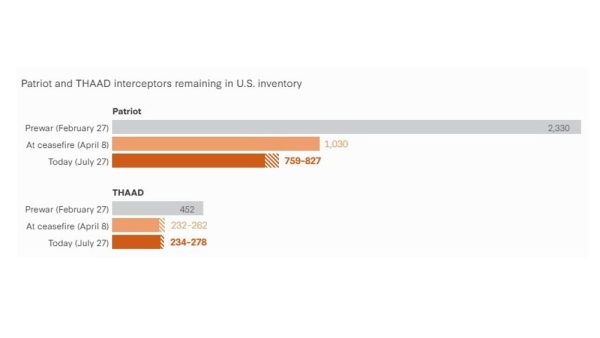
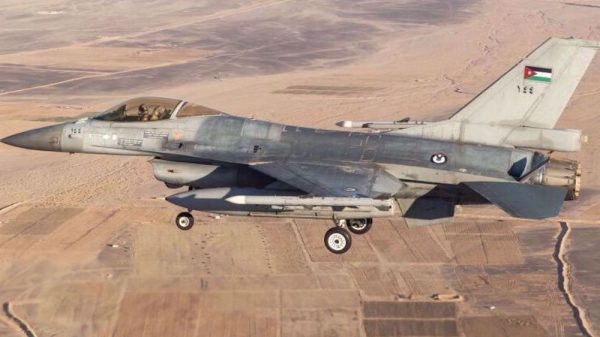
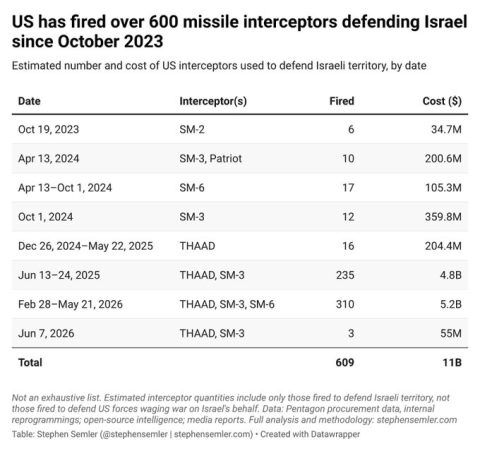 He also attached to his post a table provided on social media by independent policy analyst Stephen Semler that showed the US had fired an estimated 609 ballistic missile interceptors to protect Israel against Iran’s retaliatory strikes between October 2023 and September 2026.

