❌

Reading view

Manosphere and online misogyny should be treated as public health issues, say UK experts

Report calls for an effort to tackle harms in similar way to obesity and smoking, and stresses need to ‘offer boys something better’

The manosphere and online misogyny should be treated by the government as a public health issue, in the same way as obesity or smoking, experts have said.

Writing in the Lancet, the authors of a new report argue that a coordinated response is needed, involving governments, schools, health services and community organisations, similar to the public-health response to tobacco use and ultra-processed food.

Continue reading...

© Photograph: miniseries/Getty Images

© Photograph: miniseries/Getty Images

© Photograph: miniseries/Getty Images

  •  

Healey vows to cut welfare bill before next election with ‘tough’ approach to young people

Chancellor’s comments come as fiscal watchdog says disability benefits will cost £100bn a year before end of decade

John Healey had said there will be a reduction in the welfare bill before the next election, with a “tough” approach to young people who do not accept support to get a job or training.

The chancellor was repeatedly pressed on the issue in broadcast interviews after documents from the Office for Budget Responsibility suggested sickness and disability benefits would cost £100bn a year before the end of the decade.

Continue reading...

© Photograph: Bloomberg/Getty Images

© Photograph: Bloomberg/Getty Images

© Photograph: Bloomberg/Getty Images

  •  

Protest leaders urge French pupils to keep barricading their schools

Activists say struggle must go on until their ‘maximum’ demands are met over teacher shortages and building repairs

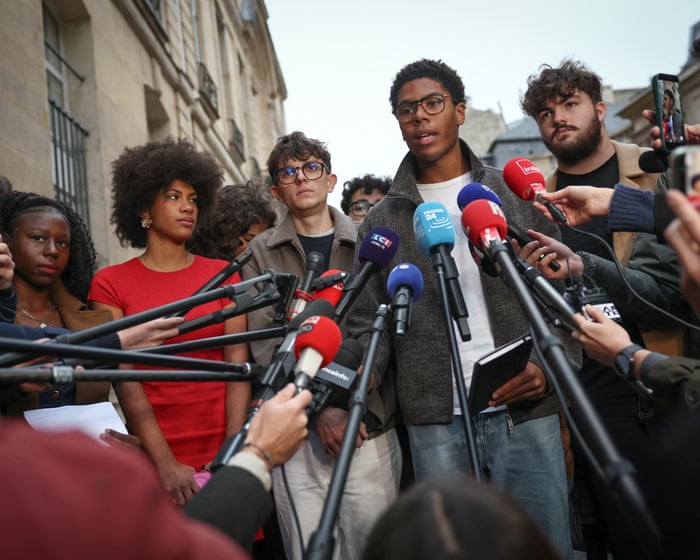
French children should continue to barricade their schools and take part in street protests, a student union said on Monday after the government announced a package of education measures to try to stem the crisis.

“Today we’re at the negotiating table, we’re able to negotiate with the government,” Pierre Sourzat of Les Lycéens told France Info television. “We’re in a power struggle and we still need to call for continued mobilisation to meet a maximum of our demands.”

Continue reading...

© Photograph: AFP/Getty Images

© Photograph: AFP/Getty Images

© Photograph: AFP/Getty Images

  •  

France will lurch from crisis to crisis until it confronts its retirement timebomb | Letter

Amid widespread protests, Muriel E Cockcroft has sympathy for French youth but fears how much steam will be let out at the next convulsion

I’m writing in response to your editorial (The Guardian view on France’s protests: a polarised country is in a perilous political moment, 19 October). While the focus is on Emmanuel Macron, let us not forget the hierarchical structure of French administration, from mayors to MPs to senators to prefects and heads of region. All are part of the government, but few stood up to bring leaky school roofs and missing teachers to national consciousness. I deplore the senseless destruction of shops and state buildings. But I also deplore the fact that students had to protest to be heard. In the many administrative tiers of this highly hierarchical country, no one acted and inertia prevailed.

Centrally, the government is financially challenged but refuses to acknowledge that having a huge deficit, an ageing population and a low retirement age are perhaps connected. Modest attempts to increase the retirement age also provoked violent protests. Financial tools for individual retirement remain complex and restricted. Thus, this sclerotic system presses on until the next crisis.

Continue reading...

© Photograph: Roses Nicolas/ABACA/Shutterstock

© Photograph: Roses Nicolas/ABACA/Shutterstock

© Photograph: Roses Nicolas/ABACA/Shutterstock

  •  

‘Zero-energy companionship’: bizarre hobby takes seed among China’s stressed young adults

Faced with a stagnant jobs market, many are spurning children or pets in favour of ‘raising bricks’

Young adults in China looking for a cheaper, low-maintenance alternative to having children or pets have found an answer: raising bricks.

Bricks may not be as cuddly as cats or as life-affirming as human offspring, but they also cost next to nothing. “No cats, no dating, I started raising a brick,” wrote one brick parent on social media.

Continue reading...

© Photograph: xiaohongshu.com

© Photograph: xiaohongshu.com

© Photograph: xiaohongshu.com

  •  

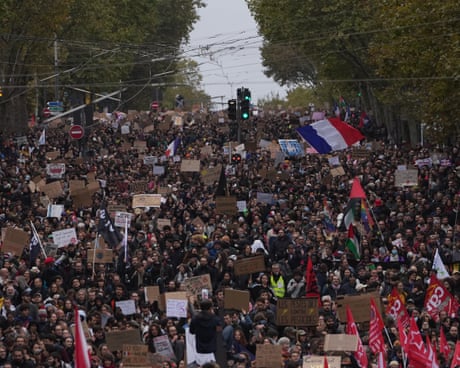
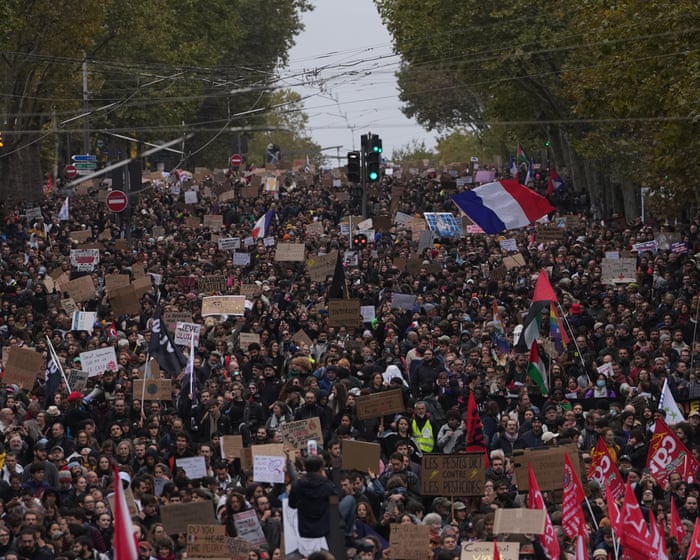
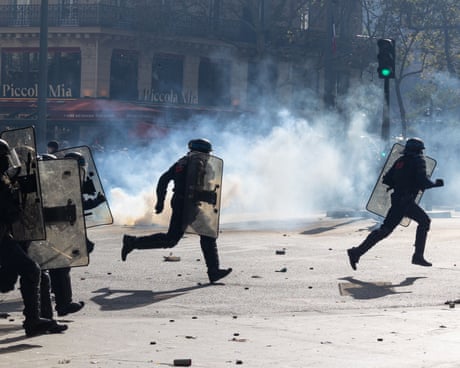
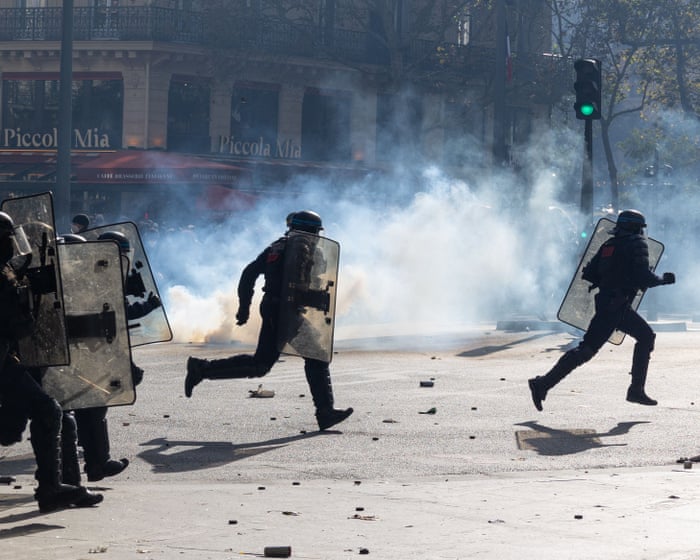
Hundreds of thousands march across France in protests over schools and policing

Almost 1,000 arrested as police charge crowd in Paris and teargas used to stop protesters reaching other city centres

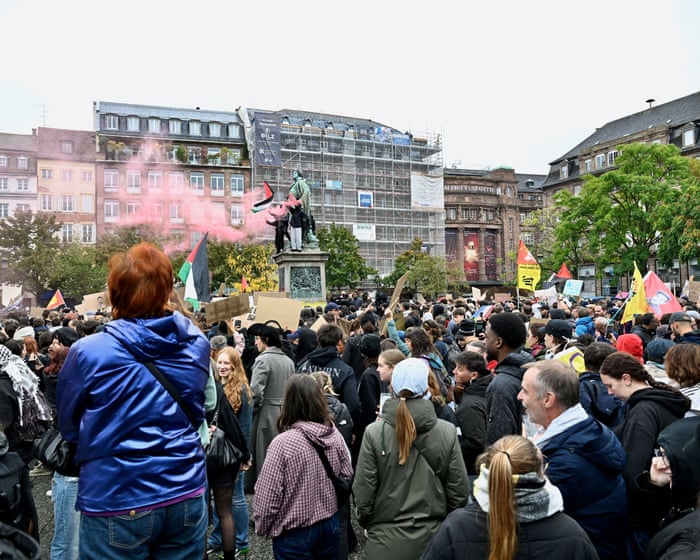
Hundreds of thousands marched in cities across France on Saturday in largely peaceful protests to support schoolchildren’s demands for more teachers and repairs to dilapidated buildings, as Emmanuel Macron faces a social and political crisis in his final months as president.

The prosecutor’s office in the southern city of Nice said on Sunday that 59 people had been taken into police custody, including 11 suspected of belonging to extreme-right groups. They were alleged to have gathered with the intent of committing violence. Some were arrested in two vehicles with masks, gloves, gas sprays and truncheons, the prosecutor’s office said in a statement to public broadcaster FranceInfo.

Continue reading...

© Photograph: Thibault Camus/AP

© Photograph: Thibault Camus/AP

© Photograph: Thibault Camus/AP

  •  

Youth mobility scheme may be delayed to ensure success of UK-EU summit

Visa quotas, university fees and NHS surcharges remain sticking points ahead of post-Brexit negotiations next month

A deadline for a youth mobility scheme between the EU and the UK could be deferred by six months in a bid to ensure Andy Burnham has a successful “reset” summit on 20 November, diplomats have said.

EU ambassadors in Brussels on Wednesday heard that the UK was still insisting on international tuition fees, quotas and an NHS surcharge for EU students. This has fuelled fears the summit could fail, just as the prime minister is promising to unveil a new vision for Britain’s long-term relationship with the EU.

Continue reading...

© Photograph: Neil Hall/EPA

© Photograph: Neil Hall/EPA

© Photograph: Neil Hall/EPA

  •  

A violent and coordinated youth uprising? That’s exactly the picture Europe’s enemies want to paint | Alberto Alemanno

Each country’s protesters have distinct grievances. Listen to them, not the voices telling us Europe is ungovernable

Last Saturday night, the town hall of Limoges in west-central France was set ablaze. By Sunday, images of the fire destroying a symbol of the French republic, and other scenes of unrest across France, were everywhere, but being used to tell very different stories about what is happening in Europe.

For some, the flames announced a pan-European youth revolt, proof that a single movement was sweeping the continent. Donald Trump, who had already insisted that the French schools protests were not about schools but about migration and Islam, urged Europeans to “close the borders”. The mayor of Limoges saw the fingerprints of an alleged ultra-left insurrection.

Alberto Alemanno is the Jean Monnet professor of EU law at HEC Paris and the founder of The Good Lobby

France readers Q&A: Guardian Europe columnists Rokhaya Diallo and Alexander Hurst will be live taking questions from our readers about the unrest in France from at 1500 BST / 1600 CEST on Friday 23 October. Send your questions by email now to conversations@theguardian.com or post questions in the comments from 0900 BST here.

Continue reading...

© Photograph: Aurélien Morissard/AP

© Photograph: Aurélien Morissard/AP

© Photograph: Aurélien Morissard/AP

  •  

The Guardian view on France’s protests: a polarised country is in a perilous political moment | Editorial

The scenes of social unrest and violence at the weekend are an ominous portent, ahead of elections which may deliver a far-right presidency

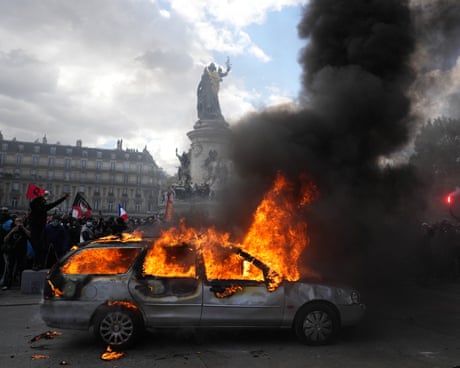
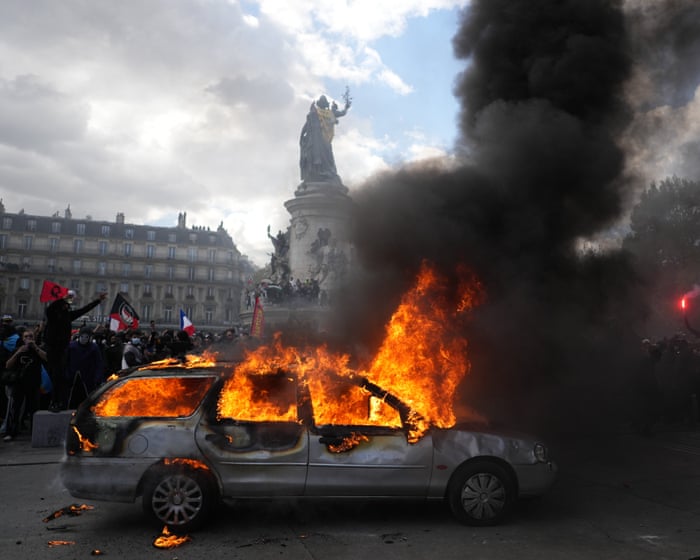
In Emmanuel Macron’s book Revolution, published ahead of the 2017 presidential election that he went on to win, he promised to restore hope to a country that was losing faith in its future. As Mr Macron’s lame-duck second term enters its last phase against a quasi-insurrectionary backdrop of torched public buildings and looted shops, the failure of that political project appears total.

The worst scenes of urban violence for years overshadowed a weekend of protest that gravely undermined what is left of the French president’s authority. As police lost control of the streets, more than 2,000 shops were ransacked. Far-left groups targeted town halls and local buildings, and engaged in pitched battles with the police, whose disastrously heavy-handed response to last week’s high school protests has succeeded only in escalating tensions.

Do you have an opinion on the issues raised in this article? If you would like to submit a response of up to 300 words by email to be considered for publication in our letters section, please click here.

Continue reading...

© Photograph: Thibault Camus/AP

© Photograph: Thibault Camus/AP

© Photograph: Thibault Camus/AP

  •  

Andy Burnham Will Never Cut Welfare

Andy Burnham has announced "big changes" to welfare to get one million NEETs back into work – but only once he's "rebuilt the education system". Sounds expensive, says Mary Gilleece. It’s clearly never going to happen.

The post Andy Burnham Will Never Cut Welfare appeared first on The Daily Sceptic.

  •  

I saw rioting, looting, above all, anger. If French leaders think more violence will solve this, they’re mistaken | Oliver Haynes

It’s a perfect storm of protesters with heartfelt grievances and others set on conflict. The key here is the sense of betrayal that united them on the streets

The first thing I learned on the streets of Paris this weekend is that there is no arguing with teargas. I arrived at Place de la République just after 1pm yesterday. The mood was festive until police started firing volleys of teargas into the square from Rue du Faubourg-du-Temple.

I didn’t see the inciting incident – if there even was one – and tried walking into the cloud of CS gas hanging in the air. It was impossible. The gas clings to your nose and burns your eyes, and you quickly start struggling to breathe. I retreated towards the Boulevard de Magenta, blinking furiously to stop the stinging.

Oliver Haynes is a journalist and co-host of Sacré Bleu: the French presidential election podcast

Do you have an opinion on the issues raised in this article? If you would like to submit a response of up to 300 words by email to be considered for publication in our letters section, please click here.

Continue reading...

© Photograph: Abitbol Shana/ABACA/Shutterstock

© Photograph: Abitbol Shana/ABACA/Shutterstock

© Photograph: Abitbol Shana/ABACA/Shutterstock

  •  

When do young people leave the parental home?

In 2025, young people in the EU left their parents’ home at an average age of 26.3 years, up slightly from 26.2 years in 2024. 

Since 2002, this average age stayed close to 26 years.

The highest average ages for leaving the parental home, at 30 years or above, were recorded in Croatia (31.5 years), Greece and Slovakia (both 30.9), and Spain and Italy (both 30.2). By contrast, the lowest average ages were registered in Finland (21.4 years), Denmark (21.8) and Estonia and Lithuania (both 22.7). 

https://ec.europa.eu/eurostat/documents/d/products-eurostat-news/age

Source dataset: yth_demo_030

In 2025, the employment rate in the EU among young people aged 20-29 years was 65.5%. 

In most countries where the age at which young people leave the parental home is below the EU average, the employment rate for 20-29-year-olds is above EU average.

For example, in countries where young people tend to leave the parental home sooner, such as the Netherlands, Denmark, Germany and Sweden the employment rate for young people tends to be higher.

In countries where young people leave the parental home later, such as Greece, Croatia, Spain and Italy, the employment rate was lower than the EU average.

Click to enlarge

Youth employment rates in the EU, 2025. Bar chart - Click below to see full dataset.

Source dataset: lfsa_ergaed

For more information

Methodological notes

The average age at which young people leave the parental home is an approximate measure based on whether respondents of the European Union Labour Force Survey (EU-LFS) and their parents live in the same household. The calculation covers each single year of age from 15 to 34. It takes into account, separately for male and female categories, the share of respondents living in households without their parents in the total population. An ‘exit probability’ for each single year of age from 15 to 34 is calculated for the total, male and female populations. The indicator shows the age at which 50% of the population no longer live in a household with their parent(s). 

  •  
❌