Login

Smartbird's CEO talks about converting a shoe company into an AI player
Carl Timpone / BFA
- Nadia Carlsten, CEO of Smartbird, spoke on the public company's shift from sneakers to AI.
- When the AI pivot was announced, the company's stock skyrocketed. It has since come back down.
- Carlsten said Smartbird has a different approach to AI infrastructure, focusing on customer needs.
Before Smartbird was powering large language models, it was making shoes.
The CEO of the AI infrastructure company, Nadia Carlsten, spoke about the transition with chief correspondent Ben Bergman on Thursday at Business Insider's The Long Play.
Its roots are the sustainable sneaker company Allbirds, which skyrocketed in the late 2010s. The shoes were particularly popular among the Silicon Valley crowd. Allbirds went public in 2021 before the market turned on many direct-to-consumer businesses. The stock quickly fell, and it sold to American Exchange Group in March for $39 million.
"The short answer is the shoe business wasn't doing that well," Carlsten said.
The company then sold off its footwear business and shed most of its workforce, rebranding as Smartbird. The AI pivot skyrocketed the stock and was briefly up 800%, though it has since come back down. Carlsten, who became CEO in June, said she had never worn those wool shoes.
"The goal of the company was to do something valuable and meaningful. And for me, I knew I wanted to do AI infrastructure," she said.
After looking at the emerging AI infrastructure sector, she believed with the company's transformation, it was the "right place at the right time" for her to join.
In the five months since she took over, Carlsten said the experience can be described in one word: exciting.
"Never in my life thought that I would be the CEO of a former shoe company and managing what is essentially a startup." Since taking on the role, she has focused on building out a new team, scouring new technologies for the company to look into, and producing a new pipeline of customers.
While the stock price has gone down since the initial pivot-induced spike, Carlsten does not regret taking on the challenge. She is betting on the company's long-term potential.
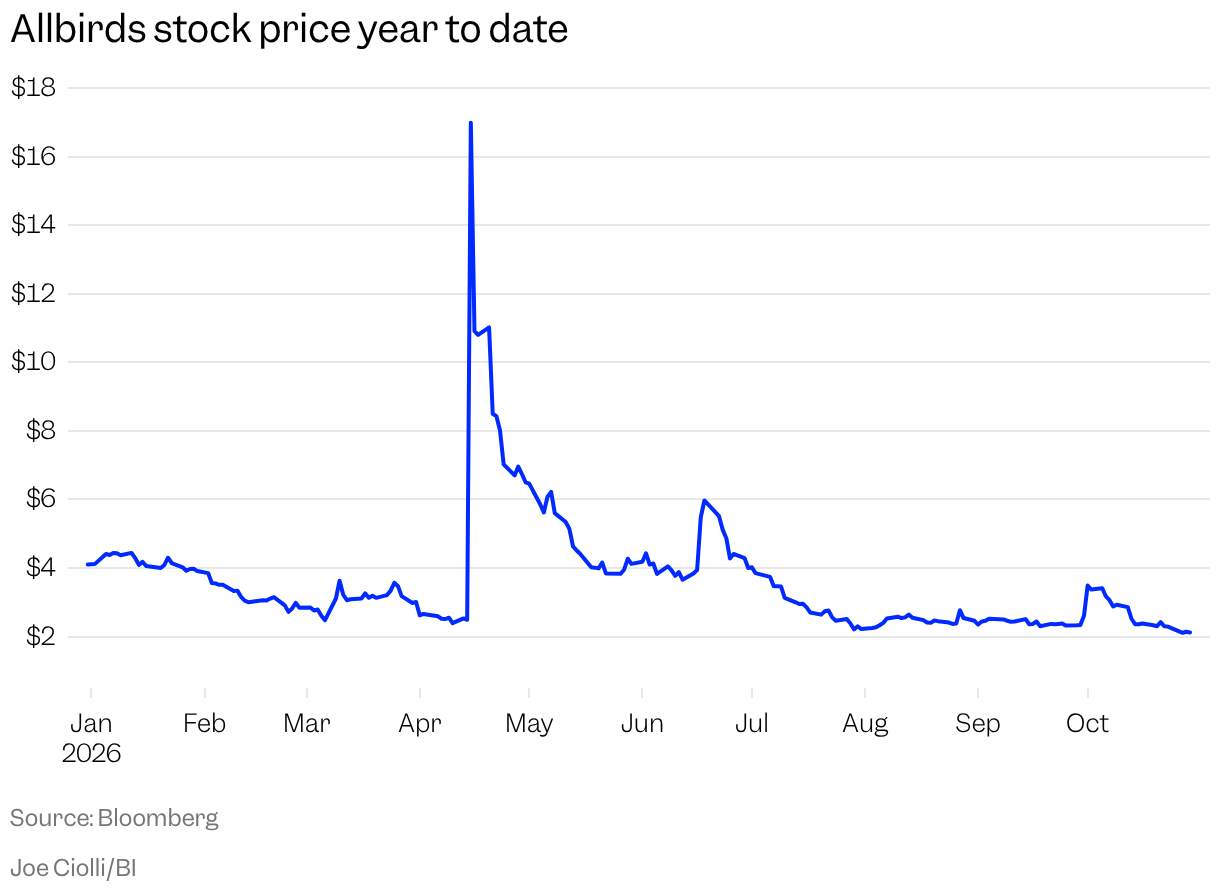
"The stock market is going to do what the stock market does," she said. "What I care about is making sure that we're putting the company on the right path, and that we're able to build it quickly enough and well enough that we have a sustainable business that investors will love. So what happens in the short term? Not that important. What happens in the long term is very important."
When asked why the company decided to reinvent itself in the public eye instead of beginning as a private start-up, Carlsten countered with a question: "Why not?" she said, "It will come back up."
Having to reinvent the company from scratch can be challenging, and the public's presence is clear, she said. Yet, Carlsten said reinvention is inevitable for companies.
"This is a very public reinvention of the company, and people are watching," she said. "I think every company needs to reinvent itself every now and then."
When asked why the company is fully remote, Carlsten said most of the work at Smartbird is done virtually or at data centers, meaning an office would not be of much use.
"We spend a lot of time actually building things, which I actually love. So if my people are sitting in an office, something's wrong," she said.
Working within the emerging AI sector
Carlsten said that although her competitors are building similar AI infrastructure, the way Smartbird is going about it is unique.
"For us, it's about the right infrastructure for the right company at the right time," she said. "Our business model allows us to work more closely with customers, but it also is a lot less capital intensive."
Smartbird is looking to work with companies that have yet to explore implementing AI in their systems, she said. As more companies outside the tech realm look to adopt AI into their businesses, they have the choice to build infrastructure themselves or outsource it, and Smartbird wants to be the one to do it for them, she said.
"We'll do the infrastructure part. We'll let you focus on the actual business," she said.
The most common misconception Carlsten said she has encountered in the business is that it's all about GPUs. She said the company does a lot more than just run GPUs.
"It's really about having a holistic system that a customer can use to do AI," she said.
Another rumbling that's taken over the tech company discourse is whether there's an AI bubble and if it will pop. Carlsten said that depends on how people go about defining the bubble.
Excitement in the sector means funding might be going into companies that may not prosper in the future, but this is something that happens with the arrival of new technologies, she said.
"Every time there is a transformational technology, this happens," she said. "Even if we assume that there is a bubble, that doesn't mean that the technology is not good. It also doesn't mean that the adoption of the technology is going to go away."