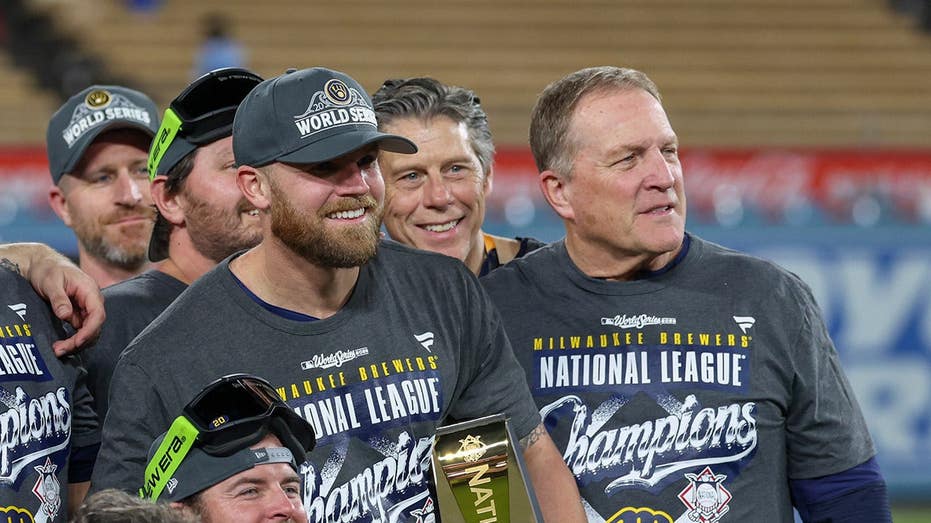
Less than 24 hours after the Milwaukee Brewers captured the franchise’s first World Series title, the team’s celebration continued roughly 120 miles north at Lambeau Field.
Brewers pitcher Brandon Woodruff brought the Commissioner’s Trophy onto the field Thursday night at the end of the first quarter of the Green Bay Packers’ game against the Carolina Panthers. Teammates Christian Yelich and Sal Frelick also joined the celebration.
Frelick embraced the moment by attempting a Lambeau Leap of his own, drawing a warm reaction from the Packers faithful.
Milwaukee could come to a standstill Friday, with thousands of fans expected to line the streets for a victory parade celebrating the Brewers’ long-awaited championship.
Wisconsin’s largest school district, Milwaukee Public Schools, announced it would close Friday, citing operational and safety concerns. However, the closure will also give faculty and students the opportunity to enjoy the parade.
The parade route will run through downtown Milwaukee before ending with a fan fest at Henry Maier Festival Park.
The Packers are likely hoping to build on the Brewers’ success, despite not having won or reached a Super Bowl since the 2010 season.
The Brewers’ Game 5 victory over the Tampa Bay Rays to clinch the World Series title and the Bucks' 2021 NBA Finals victory means the Packers now own the longest championship drought among Wisconsin’s major men’s professional sports teams.
Green Bay entered Thursday night’s game coming off a Week 7 loss to the Detroit Lions. The Panthers jumped out to a 3-0 first-quarter lead. The Packers responded by taking a 20-10 halftime lead and extending the advantage to 27-10 in the third quarter.
The Milwaukee Brewers are 2026 World Series champions, bringing home the organization's first ever title. For the franchise and their fans, it was the culmination of years of quality scouting, drafting, international signings, player development, and remarkably successful trades.
It was also a near-perfect example of what it takes to win a championship in baseball.
While William Contreras won World Series MVP, voters had plenty of options to choose from on the Milwaukee roster. Jackson Chourio became the first player since Babe Ruth, yes, literally Babe Ruth, to have 10 hits in the first four games of a World Series. Cooper Pratt, a light-hitting, defense-first shortstop, set a rookie record with hits in six straight at bats from game four to game five.
Brice Turang hit .316, below average hitter David Hamilton crushed what looked like a huge home run in game four. Aaron Ashby went 5.2 innings with no runs, just one hit allowed and nine strikeouts. Abner Uribe allowed just two hits in 5 innings. Jacob Misiorowski allowed only one run in 10.2 innings, winning game one and the clinching game five. Robert Gasser was equally unhittable, with just one run allowed in his game three start. A start so incredible that it was the first of its type by a left-handed pitcher since legendary Hall of Famer Sandy Koufax.
The whole team was World Series MVP. The whole team was NLCS MVP, and NLDS MVP too. Milwaukee went 11-2 in the postseason against the San Diego Padres, the hottest team in baseball in the second half, the star-studded 100-win Los Angeles Dodgers, and the 98-win Tampa Bay Rays, who tore through the American League. They won eight straight games in the playoffs. Their two losses came by a combined two runs, and their one World Series loss was on a walk-off in the 12th inning after they blew a 3-2 lead.
It's not a stretch to say it's one of the most dominant stretches of playoff baseball in the history of the sport. And it's why we can make the argument that the Milwaukee Brewers broke Major League Baseball. It's not supposed to be this easy, and it rarely is, even for some of the most expensive, talented rosters we've ever seen.
The 2024 Dodgers, with Shohei Ohtani coming off the first 50-50 season in history and a long list of other stars, were down 2-1 in the NLDS to the Padres before coming back to win. It took them six games to beat the Mets in the NLCS. They very nearly lost the clinching game five of the World Series, falling behind 5-0 to the Yankees before the New York defense went on a comical run of errors and mental mistakes. In 2025, they were down to their final two outs in game seven of the series against Toronto, until Miguel Rojas hit a miraculous game-tying homer.
Milwaukee? They never trailed in a series, or even came close. They had a 2-0 lead in the NLDS, a 4-0 lead in the NLCS, and a 3-0 lead in the World Series. It's remarkable.
Which raises the question, how did they do it? What was their philosophy and approach in October? The real answer, boring as it might be, they didn't do anything. Baseball happened.
That's not to say that the Brewers don't have good players or didn't have good results. Misiorowski is going to win the Cy Young Award at 24-years-old, and looks set to dominate the league for years to come. Christian Yelich is a former MVP, multiple-time Silver Slugger Award winner and borderline candidate for the Hall of Fame. William Contreras has been a top-three catcher in baseball for several years. Garrett Mitchell is a former first round pick and top prospect, as is Brice Turang. Jackson Chourio is already a star at 22.
The big secret the Brewers discovered? Have your players get hot at the right time, have a few bounces go your way, rely on some of your less talented players to hit perfectly timed home runs, and sit back and watch as your bullpen goes from very good to almost literally untouchable.
Every year, the greater baseball world looks to find some sort of meaning or blueprint from the team that wins the World Series. In 2024 and 2025, the Dodgers "proved" that you can just guarantee a title by spending money, even though the Mets and Yankees haven't won in decades. In 2023, the Rangers showed you need a veteran manager like Bruce Bochy, and that home runs, Texas hit eight in five games, are how you win in October. Very smart analysts have pointed to quality bullpens, big midseason trades, drafting and development, free agency, dominant starting rotations, home runs, or making contact and putting the ball in play. The reality? You need all of those, and you can't predict which ones you'll actually get when it matters.
Not once in these discussions does anyone acknowledge that the different paths taken by different teams demonstrate that there is no one way to win a championship. And that the disparate approaches to roster construction show that what actually matters is a combination of timing, randomness, luck, and talent. Because there has to be meaning and lessons and broad conclusions to draw from every outcome, the baseball world picks a reason and explanation, then quietly discards it when next year's team does the opposite.
Here are a few examples of why looking for meaning in playoff baseball is pointless. "Clutch" hitting is frequently praised as meaningful and predictive. Some players just have the "clutch" gene, the received baseball wisdom goes. So let's look at superstar shorstop Corey Seager as an example. Seager had an astonishing run in the 2020 playoffs, hitting. 328 with eight home runs and 20 runs batted in, winning NLCS and World Series MVP. One of the best postseasons ever. Clutch hitter, right?
In 2016 and 2017, he went a combined 18 for 82. Then in the 2019 postseason went 3-20 with two singles and no homers. In 2021, Seager was 9-48, a .188 batting average. In 2023, he was once again a force of nature for Texas, hitting .318 with six homers. So is Seager the clutch playoff force from 2020 and 2023, or the hopeless, unclutch, "moment is too big" failure from 2016, 2017, 2019, and 2021?
Therein lies the problem. Corey Seager is an elite hitter, but even the best hitters go through hot and cold streaks. Pitchers go through hot and cold streaks. They can't pick and choose when those streaks happen, because if they could, they'd all pick to be hot in October. Derek Jeter hit .235 in the 1998 playoffs, .226 in the 2001 playoffs, .245 in 2004, .176 in 2007, and .250 in 2010 and 2011. He also had plenty of very good results in other years. That's baseball.
Aaron Ashby quite literally had the greatest October by a relief pitcher in baseball history. Next year, he could be the worst pitcher on the team in the NLDS. That's baseball. Robert Gasser could be horrible next season after his dominance in this year's playoffs. That's baseball. Look at last year's Toronto Blue Jays.
Ernie Clement, literally Ernie Clement, set the record for most hits in a single postseason with an incredible 30 in 73 at bats. In 2026, he was 20% worse than league average offensively, cost his team 14 runs compared to an average hitter, and had a .285 on base percentage. In the 2025 playoffs, Vladimir Guerrero Jr. had a .356 batting average on balls in play. Addison Barger was .422, Ernie Clement was .420, and George Springer .319. Predictably, the Blue Jays scored a lot of runs in October.
In 2026, Guerrero had a .288 BABIP, Springer was .282, Clement .272, and Barger was .063 in his few games before he got hurt. Toronto finished in last place and missed the playoffs. That is also baseball. There's no predictive value from the tournament, because players do not magically become different in October. There's just a typical distribution of outcomes, particularly among good teams, that sometimes goes your way and sometimes doesn't.
None of this means the Brewers didn't deserve to win, or weren't a good team. They absolutely did, and they absolutely are. They deserve an immense amount of credit for identifying players in the draft or international markets, as well as in trades and free agency, that they thought they could improve or would fit specific needs. But looking for some sort of explanation or path for your favorite team to follow is insane. Because while you need good players to win, you can't predict how they'll perform over a few weeks of small sample sizes. It's just...baseball. Enjoy it when your team wins, celebrate it, and understand that the inherent variability of it ensures it can't ever be broken.
The Bronx Bombers were obliterated in the postseason, getting swept in the American League Division Series and tying their longest World Series drought since winning their first in 1923.
When the Milwaukee Brewers won their first-ever Fall Classic, the Yankees continued to be a topic of conversation.
National League Championship Series MVP Jake Bauers handed manager Pat Murphy the ball from the final out, and the two shared a hug. Murphy then shared some words with Bauers.
"You're going to be a rich f---er. Just remember when you were on that horses--- Yankees team and you guys were all playing for yourself? Just remember, say, 'This is the way we used to do it,'" Murphy appeared to tell his first baseman.
Bauers spent one season with the Yankees, and it was the only time since 2016 they missed the postseason after going 82-80 in 2023. Bauers hit .202 with New York and was traded in the ensuing offseason.
In any case, the Yankees have been criticized a decent amount since their elimination by executives, media, and even their own legends.
Alex Rodriguez said the team's "philosophy" has to change, and Derek Jeter hinted that the Yankees don't do the "little things."
CC Sabathia, Anthony Rizzo and Jorge Posada, two of whom have their numbers retired in Monument Park, have also lambasted the organization for their postseason failures since 2010.
Bauers had the best season of his career this year, as his .266/.389/.484 slash line represented all the best marks of his career. He also hit 26 homers and drove in 86 runs, both career highs.
For the first time in franchise history, the Milwaukee Brewers can call themselves World Series champions.
The Brewers couldn’t get the job done in seven games against the St. Louis Cardinals in the 1982 World Series, and it took them 44 years to get back to the Fall Classic this season.
In Game 5 against the Tampa Bay Bays, one night after getting walked off in the bottom of the 13th inning, the Brewers defeated their AL opponent, 4-1, to claim their title.
Game 4 was a suspenseful thriller, where it seemed like 22-year-old rookie Cooper Pratt would go down in World Series history after belting a top of the 13th solo homer to finally break a 2-2 tie.
But, facing a potential sweep at the hands of the Brewers, who did the same to the Los Angeles Dodgers in the NLCS, the Rays strung together four straight singles in the bottom of the frame to walk off Game 4 and keep their season alive.
In Game 5, the Brewers didn’t blink despite momentum swinging in the Rays’ favor ever so slightly.
Once again, it was Pratt, three years removed from playing high school baseball in Mississippi, coming through in the clutch with an RBI single in the top of the second inning off Drew Rasmussen, who made a start on short rest given the circumstances, to take a 1-0 lead.
Meanwhile, Jacob Misiorowski, the likely NL Cy Young winner, was dealing triple-digit fastballs the Rays couldn’t handle in the bottom frames. He went 5.2 innings before cramping in the bottom of the sixth inning forced manager Pat Murphy to finally go into his bullpen, which was exhausted in Game 4 due to extra innings. Misiorowski gave up just two hits and one walk, while striking out two.
The Milwaukee bullpen took over with run support, though, as David Hamilton shot an RBI single past a diving Rays defender in the top of the fifth, and two more runs would come across one inning later thanks to another RBI from Pratt on a sac fly and Williams Contreras roping a double to score Christian Yelich.
A 4-0 lead was just what the Brewers needed, as the bullpen continued to get its outs and the suspense this time was felt from Tampa Bay all the way to Wisconsin, where fans were inching closer toward a history-defining victory.
This was a team that had the best record in MLB this regular season at 103-59 despite having a payroll in the middle of the pack (19th overall at $146 million). The Rays' payroll was even lower at $95.6 million, which ranked 28th among the 30 teams, making this a World Series matchup of two teams that operated in another spectrum compared to those at the top of the list filled with All-Stars in every facet.
"Brewer Ball," however, became a fascinating watch for both baseball traditionalists and modern-day fans. New York Yankees great Derek Jeter said, "Quite frankly, that's how baseball's supposed to be played."
The Brewers do everything needed to win games, especially those close ones. They did it during the regular season, and they did so in the postseason, including Games 1 and 2 against the Rays before blowing them out in Game 3, 10-1, at Tropicana Field.
Until late Tuesday night, the Milwaukee Brewers coasted through the 2026 Major League Baseball playoffs.
They had won eight straight games against the San Diego Padres, Los Angeles Dodgers and Tampa Bay Rays. The hottest team in baseball in the second half of the season, a high-powered, star-studded, expensive roster that won 100 games, and the best team in the American League that also won 98 games.
It seemed like every single move manager Pat Murphy made worked perfectly. Better than perfectly. When they started light-hitting utility infielder David Hamilton, he hit a home run off Edwin Diaz to give the Brewers an insurance run in the ninth inning of a clinching Game 4 in the NLCS. Sal Frelick was perfectly positioned to run down a 106 mph line drive to right center field off the bat of Freddie Freeman, potentially changing the course of game two.
Aaron Ashby, a very good reliever, had become the best reliever in postseason history. Better than Mariano Rivera, better than Kenley Jansen, or Billy Wagner, or other elite pitchers. His 18 scoreless innings to start a postseason set a new baseball record. Robert Gasser, an average to below average starter, had allowed just one run in 15 innings, despite getting few swings and misses or strikeouts.
In Game 4 of the World Series, Hamilton, who had just four homers in the regular season, hit another one to tie the score at two. Then rookie shortstop Cooper Pratt hit a go-ahead homer in the top of the 12th inning, putting the Brewers three outs away from clinching their first ever championship.
If that doesn't sum up Milwaukee's postseason run, it's hard to imagine what would. But in the bottom of the 12th, it all fell apart in the blink of an eye. Junior Caminero reached on an error. Liam Hicks singled, sending Caminero to third. Jonny DeLuca tied it with a single to center. Chandler Simpson singled to load the bases. Then Ben Williamson ended it with a very Brewers-like hit, a ground ball to the right side that took a huge bounce over first base to reach the outfield.
Innings like that happen all the time in baseball. An error to start the inning, followed by things quickly spiraling. There are a few well-placed hits, a lucky bounce goes the opposing team's way, and before you know it, two runs have scored and the game is over. But what made this outcome especially frustrating for Milwaukee was that it might not have needed to happen.
The Brewers had Antonio Senzatela on the mound to start the inning, then replaced him with little-used reliever Shane Drohan. Drohan hadn't pitched since Oct. 15, when he gave up a run to the Dodgers in the NLCS. He'd pitched in a competitive game just once in the past month. At first glance Murphy had few other choices, as all of his best relievers had already been used. Aaron Ashby went over two innings. Trevor Megill was used for just one out. DL Hall had pitched, as had Abner Uribe and JoJo Romero.
And it's easy to second guess, knowing the outcome, but there was one other option to get the final three outs against the heart of the Tampa Bay lineup: the likely NL Cy Young Award winner, Jacob Misiorowski.
Misiorowski was set to start game on Wednesday, which complicated the decision somewhat, but there's one guaranteed way to avoid having to worry about Game 5: win game four with three outs to go. After the game, Murphy explained his thought process on going to Drohan over his young ace. Which, uh, wasn't great.
Per Brewers beat reporter Curt Hogg, Murphy said Misiorowski was not an option he wanted to burn in a one-run extra innings game while the Brewers had a 3-0 series lead.
As for game five, Murphy added that it's now "all hands on deck" for Milwaukee.
"Yeah, it’s all hands on deck," he said. "You can write it up and hope that they perform like the back of their baseball card, but that doesn’t always happen. You go with what you believe is the deal. I trust our guys. I trust them. They put themselves in a position to win."
Here's the problem with that: you don't need all hands on deck if you win Game 4.
There are two schools of thought here, and again, it's easy to second guess in hindsight. One is that Drohan, any reliever, really, has a very high likelihood of getting three outs against Liam Hicks, Jonny DeLuca and Chandler Simpson. The other? You're three outs from winning the World Series, and you have arguably the best pitcher on the planet available to finish the game. It's not worth worrying about tomorrow, or rest, or injury risk if you win the World Series that's right in front of you.
Yes, it would be out of Misiorowski's comfort zone, but the downside was exactly what happened. Instead of scheduling your parade for downtown Milwaukee this weekend, you're going to Game 5.
The Brewers are still overwhelming favorites to win the series, and especially win Game 5 with Misiorowski on the mound. But they used all of their high leverage relievers, and given Ashby's drop in velocity towards the end of his outing, their suddenly unhittable multi-inning super reliever might not be available. If the bullpen falters again in Game 5, you're looking at going home for a Game 6. And history for Tampa starts to look a little bit more possible.
Instead of a title, Milwaukee is now facing a bit more uncertainty. Murphy forgot the golden rule of World Series baseball: flags fly forever.

 Login