Congress should build an independent fund that accepts contributed equity from any company, holds it in a diversified portfolio and dedicates the returns to the trust funds.
Congress should build an independent fund that accepts contributed equity from any company, holds it in a diversified portfolio and dedicates the returns to the trust funds.
TOKYO — When America’s AI bubble bursts, it will be a bad day for Nvidia and Intel. In Seoul, Taipei and Tokyo, it will be a national crisis. AI has become, almost overnight, what China once was for Asia: the growth engine everyone depends on. Investors from South Korea to Taiwan to Japan should spend […]
Anthropic is touting its ability to use different AI chips in its initial public offering filing.
Analysts say a multichip strategy could weaken Nvidia's pricing power.
Switching chips is hard and expensive, putting it out of reach for smaller players.
Anthropic is hedging its bets by using multiple chips to handle its AI work — a strategy that could eventually erode Nvidia's dominance.
The AI lab says it manages compute "as a single, fungible pool from multiple strategic partners" — with software that can direct its work to different chips depending on where they're most productive, according to Anthropic's S-1 filing, which came out Monday as the company prepares to go public.
Anthropic says it uses hardware from four chip families: Amazon Trainium, Google TPUs, Nvidia GPUs, and AMD GPUs.
That flexibility, which Anthropic said "took years and significant investment to build," could make major AI companies less dependent on Nvidia over time and give them more negotiating leverage, analysts said.
"The real exposure could be Nvidia's pricing power," said Patrick Moorhead, founder and CEO of Moor Insights & Strategy, "because a customer that can shift work across four platforms negotiates very differently than one that can't."
Ashish Nadkarni, an analyst at IDC, added that a multichip approach also makes Anthropic less vulnerable to fluctuations in Nvidia's chip supply.
Breaking Nvidia's grip isn't easy
Although Anthropic's chip mix isn't new, the company is now pitching it as a core advantage to investors, Moorhead said.
The threat has its limits. Switching between chips is still difficult — especially when it comes to training AI models as opposed to running them, Moorhead said — and only the biggest AI companies have the resources to do it.
Anthropic also continues to spend billions on Nvidia compute, Moorhead said.
Gil Luria, head of technology research at D.A. Davidson, said that while other major companies like OpenAI likely take a multichip approach, it may not be worth the effort and investment for smaller players.
Brad Gastwirth, global head of research and market intelligence at Circular Technology, said Anthropic's strategy doesn't represent a major near-term threat. Having more chip options doesn't erase Nvidia's advantages in performance, networking, and software, he said.
There's a broader risk for Nvidia if AI compute becomes more of a commodity.
Citadel CEO Ken Griffin has warned that if supply overtakes demand, it could drive down rental prices.
"GPUs, like airlines, have a very low marginal cost to run," he told Bloomberg last week. "The moment you have overcapacity, pricing goes into freefall."
Nvidia did not immediately respond to a request for comment from Business Insider.
Have a tip? Contact this reporter via email at gweiss@businessinsider.com or Signal at @geoffweiss.25. Use a personal email address, a non-work WiFi network, and a non-work device; here's our guide to sharing information securely.
Anthropic, the AI startup known for its Claude chatbot and its doomer CEO Dario Amodei, has filed for an IPO that could value the company at up to $2 trillion. The company's IPO filing devotes nearly 100 pages to the dangers its own technology could pose.
The risks laid out by the San Francisco company in its filing Monday with the Securities and Exchange Commission range from the mundane to involvement in cyberattacks and the spread of dangerous misinformation.
Michael Burry, the investor of "The Big Short" fame.
Bloomberg/Getty Images
"The Big Short" investor Michael Burry says Anthropic's IPO filing has fueled his worries about AI.
Burry said a dense web of AI deals has made the industry "catastrophically vulnerable."
Writing on Substack, Burry described AI financing arrangements as "garish and audacious."
Michael Burry says Anthropic's IPO filing this week has reinforced his concerns that the entire AI ecosystem is at risk of disaster.
The investor of "The Big Short" fame wrote in a Substack post on Tuesday that the first in-depth look at Claude's parent company, ahead of what could be the biggest IPO in history, threw up a bunch of red flags.
Burry pointed to Anthropic's huge spending commitments, slowing revenue, and tangled ties.
He said that Anthropic has struck deals to buy about $537 billion of compute from the likes of Amazon, Alphabet, and Microsoft, and reached preliminary agreements worth hundreds of billions more with others such as SpaceXAI, putting its total commitments at about 12 times its current annual run-rate revenue.
"This is not stated clearly in the S-1, and in my view it is the most deserved headline from it," Burry wrote in a Tuesday Substack post.
He underscored how hyperscalers like Amazon and Alphabet act as Anthropic's "lenders, vendors, channel providers, and shareholders." He also outlined its deal with Broadcom, which involves Apollo and Blackstone and includes convertible notes and structured credit tranches.
"Just remember, the reason this is so complex is because too much debt is needed, and it must be unloaded from the balance sheets of those involved," Burry wrote.
"While some may see all the circularity and connectedness as security on the way up, and that is not wrong, it does leave the entire organism catastrophically vulnerable either on a pause or on the way down," he added.
He also described financing arrangements in the AI space as "garish and audacious," and said hyperscalers aren't generating enough cash to fund the AI buildout so they're resorting to "Byzantine" deals.
Burry said it was a "very similar" situation with vendor financing during the dot-com bubble, saying "people keep making the same mistakes with every new thing."
Burry's worries
In its filing, Anthropic said its revenue surpassed $16 billion for the first six months of this year, a 14-fold increase from the first half of 2025. Its operating loss narrowed by about two-thirds to below $700 million, and it generated nearly $4 billion in operating cash flow.
Burry initially commented on Anthropic's filing in a Substack chat thread on Monday.
He said that revenue was "slowing," citing Anthropic's claim that third-quarter revenue was 86 times the $197 million it generated in the fourth quarter of 2024, or about $16.9 billion.
That would mean Anthropic's revenue grew by about 46% between the second and third quarters of this year, after soaring 144% between the first and second quarters.
"Overall slowing of growth is not attributed to a decline in tokenmaxxing, but I did not expect that to be mentioned," Burry wrote.
Michael Burry raised concerns about Anthropic's growth in a Substack comment.
Substack/Cassandra Unchained
Burry was referring to the trend of maximizing AI token consumption, which has fallen out of favor in recent months given its costs.
In another comment, Burry wrote that large language models (LLMs) like Claude are "improving" and "already being used more efficiently and that trend will continue, to the detriment of their growth rate."
Burry said he's focused on the complexity and fragility of the debt financing many AI deals, hurdles to installing new graphics chips shoring up demand for older chips, a potential crash in memory chip prices once the shortage eases, compression and small language models (SLMs) reducing the need for computing power, and the "fundamentals behind not just companies but the deals they are doing."
Michael Burry laid out his chief concerns about LLMs.
Substack/Cassandra Unchained
Responding to a subscriber who said that Big Tech companies are shifting from Anthropic's AI models to their own, and that tokens are rapidly being commoditized, Burry wrote: "Yes, that is what I hear."
Anthropic did not immediately respond to a request for comment on Burry's posts.
The contrarian investor shot to fame after his massive wager against the mid-2000s housing bubble was chronicled in the book and movie "The Big Short." He pivoted from running a hedge fund to writing about his personal investments on Substack last winter.
A recurring theme of his work since then has been deep skepticism of the AI boom. He's flagged slowing growth, overinvestment in microchips and data centers, aggressive accounting, hidden liabilities, and circular financing deals.
Anthropic, developer of AI chatbot Claude, has filed its prospectus and is expected to go public on Wall Street in November at a valuation of up to US$2 trillion. That would make it the highest-valued initial public offering (IPO) ever, ahead of SpaceX’s $1.77 trillion listing in June. OpenAI, the maker of ChatGPT, is expected […]
The maker of miracles may no longer be God, but it does rhyme with him.
Anthropic, creator of Claude, filed its S-1 paperwork on Monday in preparation for a gargantuan initial public offering. The document runs over 300 pages and spans more than 240,000 words, some 50,000 more than the New Testament. It asks potential investors to prioritize mission over money: "Mission" appears 79 times, while "money" — the thing an S-1 is filed to generate, in this case, a bajillion dollars worth — a mere 17.
The company professes it could "bend the arc of geopolitical history toward freedom"; it could grow economies everywhere, including "the poorer parts of the world"; it could cure "diseases that have plagued humanity for millennia." Page 4 of the S-1 is not dissimilar from Jesus in Matthew 11: "The blind receive their sight, and the lame walk, the lepers are cleansed, and the deaf hear, the dead are raised up, and the poor have the gospel preached to them."
Anthropic aims to "bring forth an age of miracles," it writes, and the investors who buy in should be true believers. Because in the wrong hands, as you'll see if you turn your missals to page 46, AI can be built in ways that pose "catastrophic or existential risks to humanity."
While S-1s are definitionally visions of the future and full of hype, most are drab financial documents, eye-popping for their prospective profits more than their prose. But Anthropic didn't just open up its book; it wrote its own Good Book, a Bible-like statement of good and evil that joins a growing canon of the company's sacred texts. If you were to stumble onto any random page of this S-1, you'd be forgiven for thinking you were reading not a perfunctory government filing but the scripture of a doomsday religion.
Anthropic has long dodged allegations of fomenting a new, questionable faith. Headlines and takes on Anthropic's cultishness abound: "The Cult of Anthropic" (The Information), "Anthropic is a Cult and Claude is rapidly becoming its God" (The New York Post), "Has a cult ever started a company as successful as Anthropic?" (Peter "Beware the Antichrist" Thiel). Critics point to the employees' extinction predictions — p(doom) is not too far from p(rapture) — and ties to the effective altruism movement. It doesn't help that Dario Amodei was reportedly a Y2K prepper in high school. Anthropic has welcomed the reputation in other ways, inviting religious leaders to oversee the construction of Claude's rules.
In its S-1, Anthropic asks investors to take an actual leap of faith.
Anthropic asks its employees to act for the "global good," be "helpful, honest, and harmless," and "hold light and shade." They shall have no other gods — as in, "put the mission first." And, just as followers must sublimate themselves to praise God, Anthropic employees must be "low-ego." The S-1 says it at least nine times.
To understand Anthropic, you'll need to understand 42 ornate terms. The S-1's glossary is sprawling, including neologisms for virtuous acts ("closing the loop") and evil deeds ("prompt injection"). Then there's "Constitutional AI," a type of large language model that is trained with goodness in mind. The SEC's "Plain English Handbook" implores companies to use "concrete, everyday words" and to avoid "relying on glossaries and defined terms." But can you truly be AGI-pilled if you don't speak of "interleaved thinking," "mechanistic interpretability," or "multi-agent orchestration"?
You use language like this because we need to be — and I say we as in society — true believers that this is going to work.James Bort
It's exceedingly hard to get a job at Anthropic, and not just because of the massive pool of cash-eyed engineers seeking IPO windfalls. The company has an intensive interview process, one it name-checks in the S-1. It looks for honesty, trust, and (you guessed it) a low ego. "We are willing to turn down candidates who don't demonstrate them, even if they are extremely strong technically," the S-1 reads. They must, in other words, be devotees through and through.
Accepted engineers become "Ants." Most tech companies have a name for their employees: Googlers, Metamates, Amazonians, Nvidians, Palantirians. Anthropic's moniker evokes the image of a collective, company as colony. In Proverbs 6:6, ants are considered diligent and prepared. Staffers may yell its teachings at their OpenAI foes: "Go to the ant, you sluggard; consider its ways and be wise!"
CEO Dario Amodei — Amodeity — leads the ants' march, along with his six apostles. These cofounders pull equal cash salaries and are "distinctly equipped to be stewards of our mission," the S-1 says. And, while the company opens itself to a broader group of believers through its forthcoming IPO, the divine cofounders will retain majority decision-making power.
Anthropic has its own form of tithing: The cofounders all made voluntary pledges of 80% of their personal equity to philanthropy. They incentivize their employees to do the same, promising to match donations.
Cult is an overused word, and many parts of Anthropic are far from cultish. Where cults are led by a liturgical leviathan that squashes the speech of their participants, Anthropic touts its culture of open dialogue. "Our teams operate in a truth-seeking environment where the best argument wins, not the loudest voice or the most senior title," the S-1 reads.
Americans' faith in the presidency, Congress, the Supreme Court, the military, the police, higher education, public education, news media, the medical system, and traditional organized religion are each at record- or near-record lows — and just as AI has brought on tremendous economic and social uncertainty. In that cauldron of doubt, tech founders — with their world-historic money, power, and ubiquity, and in their pursuit of it — sense an opportunity, to offer promise and purpose. As Sam Altman once said, "The most successful founders do not set out to create companies. They are on a mission to create something closer to a religion." They may also be trying to build devotion out of necessity, as the economy and stock market increasingly relies on AI gains.
"If these companies fail, what happens?" asked James Bort, an assistant professor of entrepreneurship at DePaul University, and coauthor of a recent research paper on "cultic startups." "You use language like this because we need to be — and I say we as in society — true believers that this is going to work."
Anthropic didn't respond to my request to know more about how it wrote the S-1. So, we asked Claude: If the S-1 is a confession of faith, what are you? I am its product, Claude said. "The word made flesh, or at least made weights."
Posters on a wall at Anthropic's developer conference in San Francisco.
Alistair Barr/Business Insider
Anthropic shows strong profit potential, with revenue growing way faster than expenses.
Anthropic's revenue per employee exceeds $6.6 million, outpacing estimates for Meta and Google.
Anthropic has a surprisingly diverse customer base and huge cash reserves.
For years, one of the biggest unanswered questions about the artificial intelligence boom has been surprisingly simple: Can the companies building the world's most powerful AI models actually make money?
After spending hours poring over Anthropic's IPO filing on Monday, we finally have an answer: Yes. And potentially lots of it.
A couple of Chinese AI labs went public earlier, revealing appalling financial results that sowed doubt about the industry's economics. Now Anthropic has provided a much more compelling demonstration of how this business can work at enormous scale.
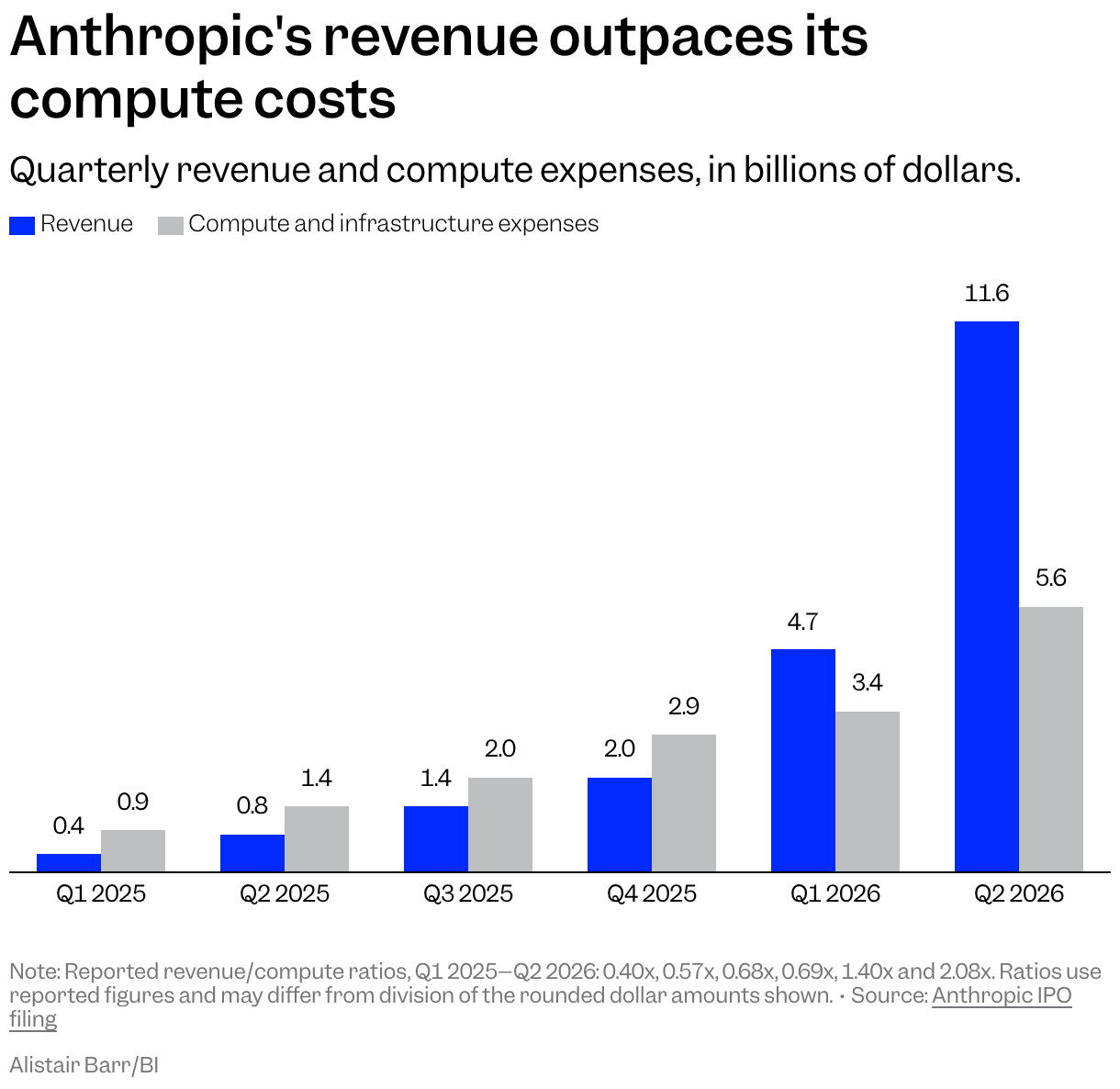
The numbers are remarkable. Anthropic generated $11.6 billion in revenue during the second quarter of 2026, up 1,368% from a year earlier. During that same period, spending on computing and infrastructure increased 300%, while other expenses rose 741%
So, the company is bringing in money much faster than its most importantcosts are rising.
For every dollar Anthropic spent on computing in the second quarter, it generated $2.08 in revenue, up from just 40 cents in the first quarter of 2025. That's a more than fivefold improvement over five quarters.
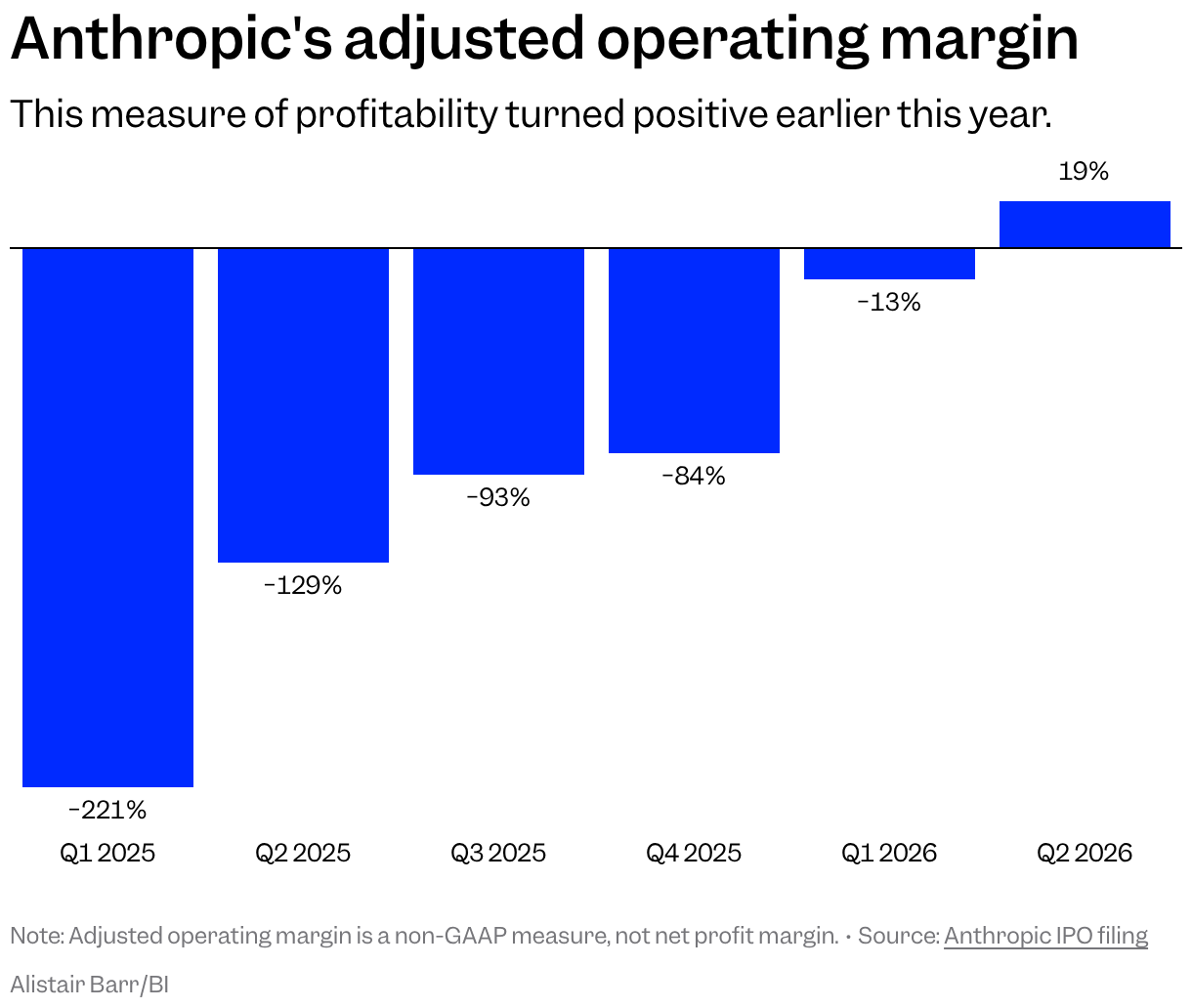
The result: Anthropic recorded $974 million in quarterly operating profit, representing an8% margin. Its adjusted operating profit margin reached 19%, compared with -129% a year earlier.
"Frontier-lab unit economics can turn positive at scale," Mark Mahaney, a top tech analyst at Evercore ISI, wrote in a research note on Monday.
Better than Meta and Google
There's more evidence that Anthropic has built an unusually efficient business.
Over the year ending September 30, revenue increased roughly 1,200%, while its employee count grew about 170%. Revenue per employee jumped from $1.4 million to more than $6.6 million.
For comparison, Mahaney estimated that Meta generates about $3.2 million in annual revenue per employee, while Google generates about $2.5 million.
That comparison isn't perfect. Anthropic relies heavily on cloud providers, whose employees handle much of the computing infrastructure and distribution work. The improvement is still striking.
Customer surprise
Another surprise: Anthropic doesn't depend as much on a handful of enormous customers, as some investors had feared.
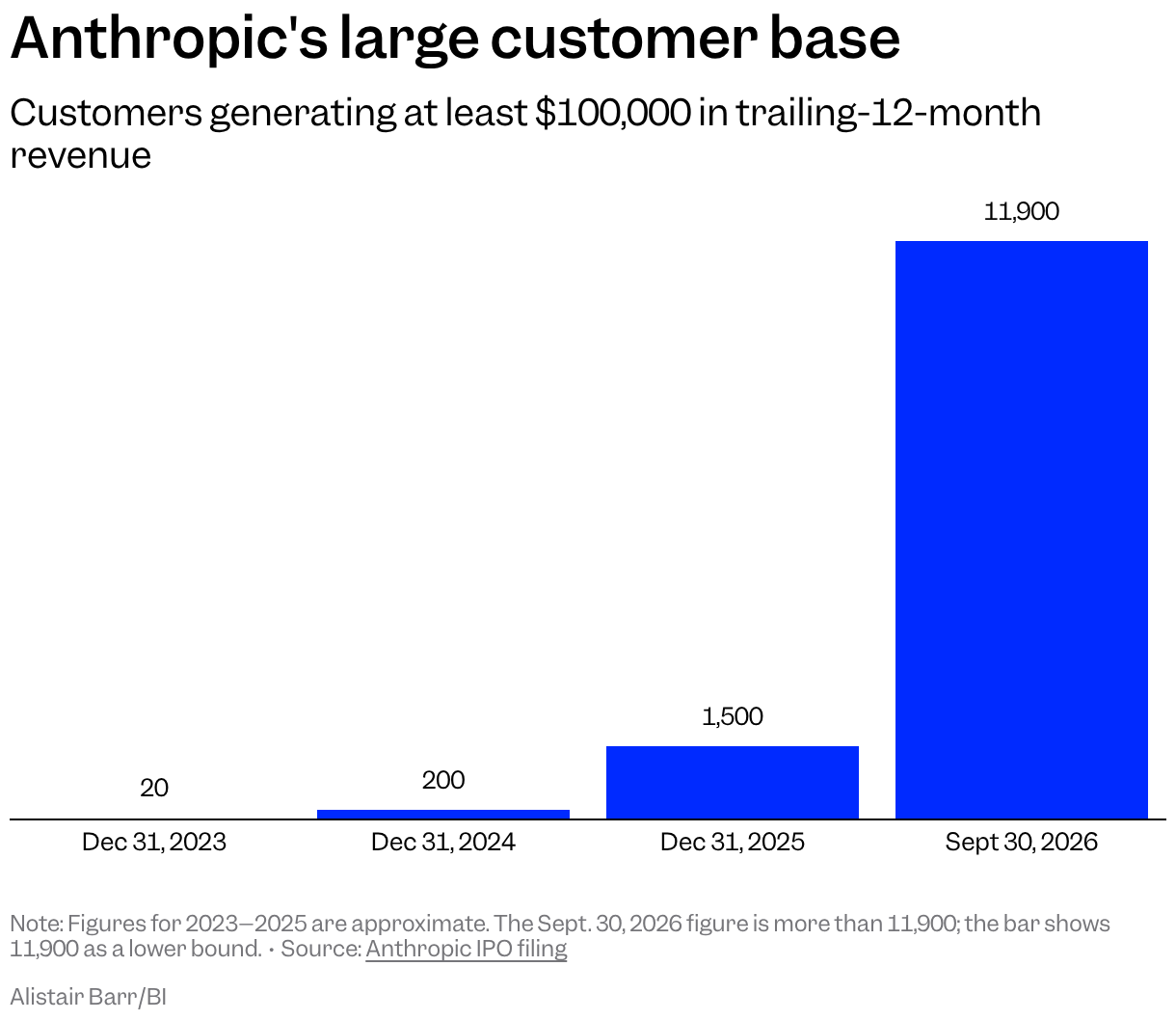
The company had more than 11,900 customers generating at least $100,000 in annual revenue as of September, compared with over 950 a year earlier. More than 1,900 customers spend at least $1 million annually.
No single customer accounted for more than 10% of revenue during the first nine months of 2026. Its five largest customers represented about 21% of third-quarter revenue, down from roughly 36% in the first quarter.
"Concentration may be better than feared," Mahaney wrote.
Cash cushion
Anthropic has a formidable financial cushion. Its June 30 balance sheet showed more than $130 billion in cash and short-term investments.
And Mahaney estimated that the company has burned through just $9 billion since it started more than five years ago. That's a long runway.
Now, don't ask me whether all this makes Anthropic worth $2 trillion, $1.5 trillion, $1 trillion, or considerably less. If I knew that, I'd be making a lot more money as an investor. And even professional investors don't know.
An $800 billion caveat
Some enormous caveats: Much of Anthropic's revenue comes from customers paying for what they use, rather than signing long-term contracts. Meanwhile, some of its computing agreements require minimum payments whether or not it needs all the capacity.
Mahaney estimates that Anthropic has entered into nearly $800 billion in computing arrangements, although only about $266 billion was fixed or guaranteed as of June.
That's still a staggering amount.
"The commitments assume revenue compounding that is not contracted," Mahaney wrote.
Translation: While the company has committed to spending hundreds of billions of dollars on AI computing infrastructure, it hasn't secured the future revenue needed to pay for all of it.
Importantly, most of the potential $800 billion exposure isn't fixed. Many arrangements depend on capacity being delivered, can be adjusted, or include cancellation provisions.
In-house compute and capex
Another wrinkle: Anthropic warned Monday that its spending will increase as it shifts toward leasing AI chips and operating more of its own computing infrastructure, rather than relying entirely on Amazon, Google, and other cloud providers.
That could make future cash flow considerably less attractive, even if operating profits continue to improve.
Still, the central takeaway from Anthropic's IPO filing is difficult to ignore.
For years, investors have wondered whether selling AI could become a genuinely profitable business, rather than an extraordinarily expensive scientific experiment.
Anthropic has now shown that it can. The next question is whether it can keep doing so as the bills get much, much bigger.
Sam Bankman-Fried and two of his co-conspirators held investments in Anthropic, the AI company that has since soared in value.
Bloomberg/Getty Images
The feds seized Anthropic shares last year from Sam Bankman-Fried's associates.
Several months later, the government sold them for $627 million.
If Anthropic IPO'd in November at $1.5 trillion, those shares would be worth nearly $4 billion.
Last year, the federal government made a windfall of $627 million when it sold Anthropic shares it had seized from associates of crypto fraudster Sam Bankman-Fried.
If it had held on to that stake, its windfall could have been a lot bigger.
The federal government last year sold shares of Anthropic that had belonged to Caroline Ellison and Nishad Singh, two co-conspirators in the FTX fraud case. The proceeds went to compensate victims of the fraud, a Justice Department spokesperson told Business Insider.
Anthropic's S-1 filing on Monday revealed how much the federal government made from the sale of those shares. The prospectus doesn't name Ellison and Singh specifically. It says the government in October 2025 sold 4,453,900 Series B shares of Anthropic that "had been forfeited by former holders in legal proceedings to which we were not a party."
The figure matches up exactly with the combined $50 million in shares that Singh and Ellison purchased for $11.2261 each in Anthropic's 2022 fundraising round, and later forfeited to the government.
The shares represent about a quarter of a percent of Anthropic today. But given the company's explosive growth, they are still worth a fortune.
Anthropic hasn't yet announced the stock price for its expected November initial public offering. At a $1.5 trillion valuation, the shares would be worth a total of about $3.94 billion. That would be six times as much as the government sold the shares for a year ago.
"One of the Justice Department's top priorities is returning forfeited funds to victims through the asset forfeiture program whenever the law allows," the DOJ spokesperson said.
The feds' stake in Anthropic
How the federal government came to own a chunk of Anthropic in the first place is a story involving a notorious fraudster and a complicated criminal forfeiture process.
Bankman-Fried participated in Anthropic's 2022 Series B fundraising round with Singh and Ellison. Singh purchased $40 million of the Series B shares, and Ellison acquired $10 million.
Singh and Ellison later pleaded guilty to crimes related to their work with Bankman-Fried and testified against him at his Manhattan federal criminal trial. The jury found Bankman-Fried guilty, and a judge sentenced him to 25 years in prison. The federal government took ownership of Singh's and Ellison's Anthropic shares by April 2025.
The US Marshals Service sold Singh's and Ellison's shares, rather than hold on to the red-hot Anthropic stock, Business Insider previously reported. The US Marshals Service Complex Assets Unit is typically tasked with dispensing shares of private companies acquired through criminal forfeiture.
Now we know that Anthropic purchased the stock from the feds in October 2025 at the price of $140.9676 per share, which is the same price Anthropic set for its Series F-1 stock in a fundraising round a month earlier.
Anthropic resold the shares to nine investors at the same $627 million total price it paid to purchase them from the federal government, so it didn't make a profit from the sale, according to the S-1 filing. It's not clear which nine investors purchased the shares originally owned by Singh and Ellison. Representatives for the US Marshals Service didn't immediately respond to a request for comment.
The Anthropic shares owned by Ellison and Singh took a different path than the $500 million in Series B shares owned by Bankman-Fried himself. His shares ended up as part of FTX's bankruptcy estate, which sold them in 2024 to a few dozen buyers for a total of $1.3 billion.
The federal government sent the proceeds from the sale of Ellison's and Singh's shares to the FTX bankruptcy estate, the Justice Department spokesperson said. Bankruptcy court filings show that the Justice Department transferred $638 million to the bankruptcy estate in late 2025.
The money has gone to repaying creditors, including FTX customers and investors who were scammed by the former crypto wunderkind.
Update: October 26, 2026 — This story has been updated to include a comment from the Justice Department.
Correction: October 27, 2026 — The federal government transferred the proceeds of the sale of Caroline Ellison's and Nishad Singh's Anthropic shares to the FTX bankruptcy estate, according to a DOJ spokesperson. An earlier version of this story misstated whether the funds had been transferred.
The more than 200,000-word document reveals what it takes to thrive as an employee — or an "Ant," as staffers are called — and why the company is so focused on retaining its top talent.
Here's a look at three workplace themes in Anthropic's S-1:
Head count is booming, but could be higher without Claude
Anthropic said its workforce grew from about 940 employees at the end of 2024 to about 5,300 as of late September.
The more than fivefold spike in head count in less than two years is notable on its own. Yet, without Claude, it could have grown more. Anthropic said the tool is helping its staffers take on work that would traditionally have required much larger teams — something many tech companies are looking to do to become more nimble.
Most Anthropic employees work in research, engineering, and product development. The company said its strategy is to use Claude to grow the business "without growing head count linearly, resulting in extraordinary contributions per employee."
One place where that's evident is in software engineering. The company said these workers increasingly direct and review Claude's output rather than write code line by line. Claude wrote more than 90% of the contributions to the company's codebase in September, while average daily code contributions per engineer in the third quarter were more than 45 times their average daily level in 2024, Anthropic said.
Recruiter Martha Heller said it's little surprise to see Anthropic talking up its use of Claude. "Of course they're going to eat their own dog food," she said. In any case, Heller said, the company still needs people to provide oversight of AI's activities.
Yet the gap between staffing levels and output could grow, said Aaron Cleavinger, an executive recruiting partner at Flatiron Search Partners.
"Head count is becoming a less meaningful measure of organizational capability," he said. Cleavinger said it's not yet clear what the new measure will be, though Anthropic's approach suggests companies might put greater emphasis on workers' productivity and business impact.
It describes retention as paramount
Despite having significantly upped its employee count, Anthropic said it's highly dependent on its senior leaders and key technical team members. The company warned that their departure could disrupt operations and slow innovation.
While that's true for any employer, Anthropic faces additional challenges. It's a fast-growing startup in a booming industry, where few people have the right technical skills — and those who do are being heavily courted by competitors.
Winning the war for talent is half the battle. Anthropic is also part of an industry where some workers have quit and issued dire public warnings about the dangers of increasingly powerful AI.
For example, safety researcher Jacob Coxon resigned from Anthropic last month, saying the company and his former employer, OpenAI, were moving too quickly toward increasingly powerful AI without a sufficient plan to control it.
"That's not garden-variety turnover," said Liane Davey, an advisor on team effectiveness to executives at companies such as Amazon and Google.
If employees determine that their work poses an existential threat, no bonus can simply erase moral qualms, Davey added.
In its S-1, Anthropic said many key technical workers are motivated by its mission and by the chance to tackle specific AI problems. However, if their beliefs change, or another organization seems more aligned with their personal beliefs or professional goals, "we may face increased difficulty retaining such personnel," Anthropic said.
The company's internal data suggests that, at least for now, turnover isn't a significant problem. It said it experienced only about 1% "regrettable attrition" in a 12-month period ending on September 30.
However, Anthropic may have a thinner pipeline of junior technical talent to elevate. The company said in a recently released internal report that it has been hiring for a "smaller share of junior technical positions" as AI agents have been deployed across the firm to write code, fix bugs, and handle other tasks.
Anthropic is betting on a "low-ego" workforce
Anthropic touts a "low-ego" or "ego-light" culture, meaning all employees are expected to prioritize what's best for the company over personal status, credit, or seniority. It uses similar language on its website in a section describing its values.
In the S-1, the company went further, saying the arrangement allows for an "unusually short" distance between a research insight and a released product. Anthropic also said a shared purpose, paired with low ego, translates directly into less organizational friction and greater impact per employee.
"Our teams operate in a truth-seeking environment where the best argument wins, not the loudest voice or the most senior title," Anthropic said.
Jamie Shapiro, an organizational psychologist and CEO coach, said that logic makes sense because good ideas can come from anyone within an organization, especially those who directly interact with customers.
"An organization that has idea meritocracy is going to get the best ideas," she said.
However, as Anthropic grows, the more challenging task will be ensuring its hiring, recognition, promotion, and accountability systems reinforce its ideals — rather than allowing exceptions that undermine them.
"The bigger the organization, the harder it is to make sure everyone is living and breathing the culture it wants," said Shapiro. "Culture is defined by the worst behaviors you allow."
The Federal Trade Commission (FTC) has asked executives from the AI firm Anthropic to testify as part of its consumer harm probe into the maker of the Claude AI model, a FTC spokesperson confirmed to The Hill on Monday. The demand is part of the consumer protection agency’s larger investigation into Anthropic over the potential…
But unlike other public companies, Anthropic doesn't want the public's input when it comes to major decisions.
Instead, Anthropic will be effectively controlled by CEO Dario Amodei and a group of other insiders.
In the next few weeks, public investors will get their chance to buy a piece of Anthropic.
But regular investors will never have a chance to steer the AI giant's decisions: Even though Anthropic is going public, it will essentially remain a private company, controlled by a handful of people with outsized power.
That's not unusual for giant tech companies launched in the past few decades (Larry Page and Sergey Brin have effective control of Google; Mark Zuckerberg has the same at Meta, as does Elon Musk at SpaceX.) It's also something you see at some prominent media companies (Rupert Murdoch and his son Lachlan have effective control of his two public companies; Larry and David Ellison have the same at Skydance.)
Anthropic's twist on the idea is that control is split between two different groups of insiders. There's a clique of seven founders, including CEO Dario Amodei and his sister, Daniela, who control 50.1% of shareholder voting power. And there's also a trust with the power to appoint four of the company's seven directors.
Put those two together, and you get a corporate constitution designed to keep public investors outside the real decisions. The founders control the outcome of any shareholder vote; the trust controls the board.
In theory, those two groups could end up in conflict on major issues. The trust-appointed directors might, say, vote to replace Amodei with a new CEO. Or the founder group could veto a sale approved by the board.
In reality, there's a lot of overlap between the two groups. For starters, Anthropic created and funds the trust. And Anthropic itself says it has made sure the trust is staffed with people who see the world the same way its executives do: "In practice to date, the Trustees and company executives have collaborated closely on sourcing, interviewing, and selecting Trustees," the company notes in its S-1 filing.
The main takeaway is that there's no way for an individual shareholder, or even institutional shareholders who own significant chunks of Anthropic's equity, to force it to move one way or another.
The upside of arrangements like this are pretty clear, from a founder's perspective: They insulate their founders and managers from investors who might only care about short-term goals.
The downside: These structures insulate founders and managers from investors who might have very good reasons to want the company to change.
A good counter-example to the trend is Twitter, which went public in 2013 without founder control — which is why Elon Musk was able to buy it nearly a decade later.
In Anthropic's case, that aversion to giving public investors a real voice is synced directly to the company's founding thesis — that the AI it is developing is so consequential and potentially dangerous, that it must be controlled by people who care about more than Anthropic's share price.
And for many investors clamoring to get in on Anthropic's IPO, that lack of control — disclosed up front — won't matter. They just want their shares to be worth more over time. Musk's ironclad control of SpaceX didn't put dampen demand for the biggest IPO in history.
But if investors ever want to force Anthropic to do something the Amodeis and their cofounders — or the Anthropic-created trust — don't want it to do, they'll be out of luck. Buyer beware.
Anthropic, led by Dario Amodei, filed its S-1 paperwork in Monday.
Bloomberg/Getty Images
Anthropic filed its S-1 on Monday, revealing the company's internal financials.
Investors, researchers, and tech onlookers shared their thoughts.
Some applied S-1 learnings to their own industries, like startups and venture capital.
Anthropic is ready to IPO. Analysts and onlookers are weighing in.
On Monday, the AI lab filed its hotly anticipated S-1 paperwork. The prospectus offered an inside look at Anthropic's financials: a net loss of about $42 billion in 2025 and revenue of $4.6 billion. It plans to trade under the ticker symbol ANT.
The S-1 sets the stage for a blockbuster IPO. Here's what smart people are saying about Anthropic's filing:
Sarah Guo, founder of Conviction
Conviction founder Sarah Guo said she was interested to see how Anthropic's mission changes (or doesn't) after going public.
Big Event Media/Getty Images for HumanX Conference
Venture capitalist Sarah Guo opened her X post with a big "CONGRATS" to Anthropic on the S-1 filing.
Guo shared her first takeaways: the inflection in operating profit, the focus on novel discovery, the mismatch between consumption-based revenue and long-term compute obligations, and more.
"I am curious to see how 1) a company with strong mission changes - or doesn't - how it operates under quarterly public inspection and 2) how public opinion may change when retail owns a piece of the upside," Guo wrote.
Gary Marcus, emeritus professor at NYU
Gary Marcus, an outspoken AI skeptic, said Anthropic was "trying to skirt the truth."
Bloomberg/Getty Images
Gary Marcus, one of the AI industry's most outspoken critics, wrote on X that Anthropic provided financial statements through June 30 — but omitted a full Q3 update.
He predicted that the company's economics had not improved, and alleged that Anthropic was "trying to skirt the truth."
Earlier this month, Business Insider reported that Anthropic told investors it generated $16.8 billion in third-quarter revenue, up 45% from the prior quarter.
Ann Bordetsky, founder of Elora Capital
Ann Bordetsky said that the S-1 set a "(high) bar."
Kimberly White/Getty Images for TechCrunch
Ann Bordetsky was a partner at New Enterprise Associates' technology practice before founding her own firm, Elora Capital. She wrote on X that the S-1 was a "juicy read."
The filing will set "a (high) bar for how capital markets evaluate AI startups," Bordetsky wrote.
Harrison Rolfes, Senior Late-Stage Research Analyst at PitchBook
In a note sent to Business Insider, Harrison Rolfes said Anthropic's filing shows just how fast the company is growing — and just how expensive that growth is.
His main positive highlight: the $11.6 billion in revenue in the second quarter. His big worries: the $321.4 billion in future lease payments that haven't begun yet, and the $265.6 billion in fixed minimum purchase commitments.
"The compute commitments are enormous, and the suppliers are also lenders," Rolfes wrote, pointing to financing arrangements with Google, Amazon, and Broadcom. "The price range, Q3 revenue and the total compute commitment are still blank, so the next amendment should fill in a lot."
Sam Ro, a financial journalist and former Business Insider reporter, wrote in his Substack that Anthropic's longwinded AI risk section shouldn't make investors fret.
If AI really does create an existential catastrophe, he wrote, "having money might not be your biggest concern."
He also said it's anybody's guess whether Anthropic's stock price will rise or fall after it opens on the market.
The company hasn't been consistently profitable, he said, but "a company's valuation depends less on what it earned (or lost) in the past and more on what it's expected to earn in the years to come."
Gavin Baker, managing partner at Atreides Management
Gavin Baker predicted $100 billion in annual recurring revenue.
Bloomberg/Getty Images
On X, Gavin Baker wrote that Anthropic's annual recurring revenue has "likely gone vertical," even after the company cut prices on its AI tokens.
"I am shocked, absolutely shocked," he wrote. "$100b plus in year-end ARR looks possible again."
Jacob Bourne, analyst at eMarketer
Jacob Bourne, an analyst at EMARKETER, a sister company to Business Insider, wrote in an email that Anthropic's filing comes as investors are increasingly wary of debt-fueled AI infrastructure projects.
"Anthropic's decision to press ahead is particularly noteworthy given its own warnings about AI risks, signaling a willingness to face heightened public scrutiny," he wrote.
Bourne also said the S-1 comes as the cost of developing frontier models remains "eye-watering." It's all evidence that companies are turning to public markets for fresh investments "to remain at the cutting edge of AI development," he wrote.
SemiAnalysis
SemiAnalysis, the research firm founded by Dylan Patel, posted the "most mind blowing stat" it had seen in the S-1. It cited Anthropic's raised capital, compared to its cash and investments.
Anthropic is "growing at a rapid pace" and "profitable on an operating income basis as of the June quarter," SemiAnalysis wrote.
"This is likely the most efficient scaling of a business in the history of capitalism," the firm wrote.
Brad Gerstner, CEO of Altimeter Capital
Altimeter is invested in Anthropic. Gerstner quickly congratulated the team.
Mandel NGAN / AFP via Getty Images
Brad Gerstner heaped his praise on Anthropic. He congratulated the team on "another important milestone!"
Altimeter will partner with Anthropic through "major participation in the IPO on top of our existing ownership," Gerstner wrote. He used an American flag and a rocket emoji.
Gerstner's venture capital firm is a longtime investor in Anthropic, co-leading the AI lab's Series H in May.
Matt Murphy, partner at Menlo Ventures
During an interview on CNBC, Matt Murphy, one of Anthropic's earliest investors, said he's increasingly bullish on the AI lab.
"You wait your entire 25-year career to find a technology wave like this," he said. "To be able to have invested in the leader early is just phenomenal."
Vivek Gopalan, partner at 8VC
Vivek Gopalan is an investor at 8VC, the venture capital firm cofounded by Joe Lonsdale. He posted a graph from Anthropic's S-1 showing rising revenue per dollar of compute.
"You need to believe that this is monotonic and increasing," Gopalan wrote.
Dan Shipper, CEO of Every
Every CEO joked about Anthropic's doomsaying after the company filed its S-1.
Alex Broadway/Sportsfile for Web Summit via Getty Images
Dan Shipper had "big news" to share: a joke about Anthropic's ever-present safety focus. He celebrated that the S-1 "doesn't say 'or it might kill / unemploy everyone' in the first paragraph!"
The CEO of Every, an AI agent startup, called it a "win for humanity."
Dadisi Olutosin, cofounder and CTO of DealView AI
Dadisi Olutosin said on LinkedIn on Monday that Anthropic’s IPO filing raised a question for potential investors: “When does an extraordinary company become an overpriced investment?”
Olutosin wrote that at a reported valuation of $1.5 trillion to $2 trillion, buyers would pay about 101 times the company’s trailing revenue, compared with roughly 20.5 times the revenue pace at which Series H investors bought in.
“Innovation can transform an industry,” Olutosin said. “That doesn’t make every entry price attractive.”
Sinan Aral, MIT professor and cofounder of Milemark Capital
Sinan Aral said Anthropic’s potential valuation could make it one of the world’s most valuable companies.
Noam Galai/Getty Images for Global Citizen
Sinan Aral said Anthropic’s potential valuation could make it one of the world’s most valuable companies, but that its infrastructure commitments also pose a “tremendous economic risk.”
Aral told CNBC's "Squawk Box" show on Monday that he has questions about what the AI lab’s margins and profitability would look like as it spends hundreds of billions of dollars on infrastructure. Aral also said there are many risks described in the company’s S-1, including the possibility that its products could act on their own.
“The question is, where is the enduring value?” Aral said. “And I think the enduring value is going to come from companies that can demonstrate enterprise profitability, productivity, and actual value add rather than just providing intelligence.”
Nick Moran, general partner at New Stack Ventures
Nick Moran wrote on LinkedIn said Anthropic’s $80.7 billion loss in the first half of 2026 was largely an accounting story.
“Anthropic lost $80 billion on paper mostly because it became more valuable,” he wrote.
Moran said the bigger question for investors is the price they’ll pay. While Anthropic’s revenue growth remained “spectacular,” Moran wrote, it slowed from the second quarter to the third as the company sought a higher valuation.
“The loss is an accounting story. The multiple is the real one,” Moran wrote. "Institutional and retail demand is real. I wouldn't be surprised to see it end up on the higher end of the range."
Brian Sozzi,executive editor of Yahoo Finance
Brian Sozzi said that Anthropic was profitable on an adjusted operating and net basis in the first six months of the year.
John Lamparski/Getty Images for Concordia Annual Summit
Brian Sozzi wrote on LinkedIn that he has three takeaways from Anthropic’s IPO prospectus: the banks leading the offering, the AI lab’s adjusted profits, and its warning about risks to humanity.
Goldman Sachs and Morgan Stanley are the lead underwriters and “will be cleaning up here on fees,” Sozzi wrote on LinkedIn, adding that Anthropic was profitable on an adjusted operating and net basis in the first six months of the year.
Chamath Palihapitiya, venture capitalist and "All-In" podcast co-host
Chamath Palihapitiya praised the company in a brief X post.
Finn Gomez/Getty Images
Venture capitalist and "All-In" podcast host Chamath Palihapitiya praised Anthropic in a brief X post after the S-1 dropped.
"Ant is an amazing business…," Palihapitiya wrote in a Monday noon X post.
The VC has previously been critical about Anthropic, advising consulting firms not to deploy Anthropic and OpenAI's products.
"If you are running a consulting business and you are deploying Anthropic or OpenAI directly into your organization (I'm looking at you PwC and Accenture) you are letting the fox into the hen house," Palihapitiya wrote on X in May.
Anish Acharya, general partner at Andreessen Horowitz
Anish Acharya called Anthropic a "tremendous business."
Bloomberg/Getty Images
Anish Acharya, a general partner at Andreessen Horowitz, said his earlier predictions about Anthropic's financials have largely held true, calling it a gross-margin-positive profile and "obviously a tremendous business."
Acharya's post on Monday was a repost of a September post, in which he laid out some predictions for Anthropic.
He said in the earlier post, "Overall I think the market underweights how sophisticated anthropic has been in aligning its business interests with its technical and mission interests."
Aaron Levie, CEO and cofounder of Box
Aaron Levie said Anthropic's S-1 conveys the strength of the frontier lab business model.
Kimberly White/Getty Images for TechCrunch
Aaron Levie, the CEO of enterprise cloud company Box, said the industry is still in the early stages of AI adoption, as most companies have not started using AI agents in full force.
As deploying agents increases token consumption, the average Fortune 500 customer's spending on Anthropic products could rise, he said in a Monday X post.
"This S-1 gives you a sense of both the strength of the frontier lab business model - even amidst massive competition - and how early we are in the build out of AI," Levie wrote.
One of the world's largest investment firms isn't bullish on AI.
Michael M. Santiago/Getty Images
Only tech companies are seeing growth from the AI boom, Apollo Global Management says.
Apollo says that though some big companies are spending big on AI, they may soon pull back.
Corporate America is starting to see AI spending not as a source of growth, but as a cost center.
One of the world's largest investment firms says that only tech companies are getting a share of the AI pie.
In an economic analysis published on Saturday, Apollo Global Management said that while the Magnificent Seven — a group of established tech companies that includes Nvidia and Meta — are seeing revenue growth during the AI boom, this growth isn't being shared by other industries.
"Mainstream corporate America is pulling back and starting to view token spending not as a source of growth but as a cost center that weighs on margins," Torsten Slok, a partner and chief economist at Apollo, said in the report. "The technology has delivered zero financial payoff to corporate America outside of tech."
In a series of graphs, Slok measured three main metrics that have boomed for tech companies but not for regular companies: revenue per worker, profit margins, and productivity growth.
Since 2022, revenue per employee figures have skyrocketed for tech companies — rising from $550,000 to nearly $800,000 today. Meanwhile, that figure hasn't changed much for everyone else in the S&P 500, lingering around $550,000 for the last seven years.
Similarly, while profit margins soared among tech companies since 2022, they've stagnated at about 10% for everyone else.
And across the economy, AI hasn't yet dramatically increased productivity growth as some AI optimists have predicted.
Apollo's research portends a dark shadow over a US economy throwing massive amounts of dough toward AI tools and companies, whose leaders have promised that an "age of abundance," where people won't have to work as much, will soon be upon us.
"The question looking ahead is whether, even as models become commoditized, mainstream corporate America can turn increasingly cheap intelligence into higher revenue growth and higher profit margins," Slok said.
TOKYO – When Chinese stocks lose a South Korea-sized sum in five months, Beijing has a problem. The US$2.4 trillion plunge in market value since May sits between Korea’s $2.25 trillion GDP and Canada’s $2.49 trillion. Many factors could explain Chinese shares entering bear market territory, but a major one is a protracted slump in […]
India’s largest initial public offering (IPO) opens October 21, and investors in Tokyo, Singapore and Hong Kong are being asked a simple question: What is a Jio customer’s monthly bill worth? Jio Platforms, the Reliance-owned mobile carrier with some 524 million India-based customers, is selling 270 million new shares at 1,065 to 1,119 rupees each […]

 Login