Reservoir levels in Cyprus have increased to 35.1 per cent due to recent rainfall, amounting to 101.9 million cubic metres of water, which is over three times last year’s capacity.
At the same time last year, the levels had reached 10.7 per cent capacity, or 31.3 million cubic metres.
Approximately 220,000 cubic metres of water flowed into the reservoirs on Thursday alone.
Water development department executive engineer Alexios Frangeskou said the largest inflows occurred at the Kouris and Arminou reservoirs.
Additional inflows were noted at reservoirs that are supplied by the southern conveyor project, which is mainly located in the Limassol and Larnaca districts, as well as at Asprokremmos and Evretou reservoirs.
Frangeskou said the inflows were encouraging for this time of the hydrological year, but they were not sufficient to make a significant change to the overall water balance.
He warned that reservoirs were still only about one-third full and that there should be no complacency.
Continued rainfall, especially during the winter months, could lead to further inflows, he pointed out.
Last year, water started entering reservoirs much later because the catchment areas had nearly dried out.
In the meantime, water development department projects are ongoing, with the mobile desalination unit at Episkopi expected to become operational soon.
The department also intends to initiate tenders for several other major projects, according to Frangeskou.
Fighters of the Bratstvo Battalion, part of the Timur Special Unit of Ukraine’s military intelligence agency (HUR), captured three Russian servicemen and gave first aid to one of them, HUR reported on 19 October. They also found and destroyed Russian sabotage groups, HUR said, adding that counter-sabotage operations in the Zaporizhzhia direction are ongoing.
Russian forces have spent months trying to get closer to Zaporizhzhia, one of Ukraine’s largest cities. They may try to use the dried-up bed of the Kakhovka Reservoir to infiltrate north toward it as autumn fog and dense vegetation set in, the Institute for the Study of War reported on 26 September. Ukrainian troops are now clearing the area of Russian saboteurs trying to get into the rear of Ukrainian positions, according to HUR.
HUR’s video shows the fighting and the captures, with one dead Russian soldier blurred. At the end, a captured Russian says two of the three men in his group were killed by a “Baba Yaga,” the nickname Russian troops use for Ukraine’s heavy bomber drones.
HUR described what the Russian groups are trying to do:
“Using small sabotage groups, the enemy is attempting to penetrate deep into the rear positions of Ukraine’s Defense Forces, build up forces to destabilize the situation, disrupt logistics, and neutralize Ukrainian defenders’ combat crews.”
Russia seeks to bring the front closer to Zaporizhzhia
Russia’s objective in the Zaporizhzhia direction is to advance within artillery range of the city, hold forward positions, and protect its rear from Ukrainian strikes, the Institute for the Study of War noted.
In January, Russian forces were trying to capture Stepnohirsk and advance along the shore of the former Kakhovka Reservoir toward Zaporizhzhia. Taking the settlement would let Russian troops place long-range artillery or fiber-optic drones there to strike the city’s outskirts, Southern Defense Forces spokesperson Vladyslav Voloshyn told Ukrinform on 14 January.
Explore further
Russia drained the Kakhovka Reservoir. Now it hides in the dry bed to creep toward Zaporizhzhia
On 22 September, Anastasiia Shevchenko, spokesperson for the Southern Forces Group, said there were no signs of preparations for a direct offensive on Zaporizhzhia and that Russian forces lacked the troops and means to advance directly toward the city.
Dense vegetation and limited visibility: combat on the reservoir bed
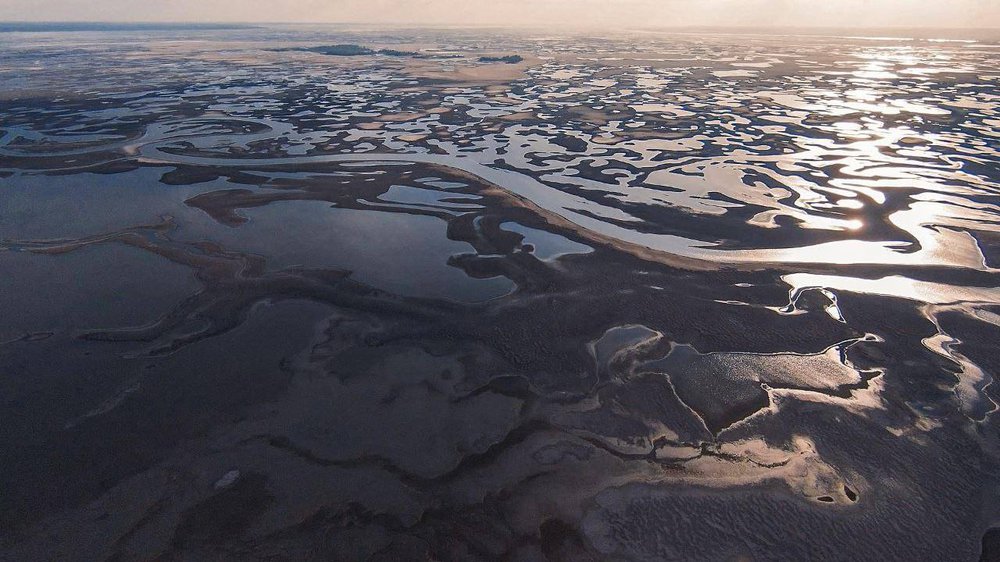
The Kakhovka Reservoir was a vast artificial body of water on the Dnipro River in southern Ukraine that supplied water to millions of people, as well as to agriculture and industry. On 6 June 2023, Russian forces blew up the Kakhovka Hydroelectric Power Plant, the Southern Operational Command reported.
The bed of the Kakhovka Reservoir has nearly dried out after the dam was destroyed on 6 June 2023. Photo: Maksym Pavlovsky/Dumska
After the dam was destroyed, the bed of the former reservoir quickly became overgrown with willows, poplars, and shrubs, creating a new battlefield. Ukrainian troops have fought there before.
In November 2025, fighters from the same Bratstvo unit carried out a reconnaissance and sabotage operation 7 kilometers from the shoreline of the former reservoir, HUR said. They found and eliminated Russian troops, then raised the Ukrainian flag over the islands there and took control of the area.
In April, the Bratstvo unit’s chief of staff, who goes by the call sign “Dyviziia,” described the conditions on an earlier raid across the reservoir bed:
“You’re just constantly moving through these thickets, with no way to figure out which direction to go. You can literally see everything just two meters ahead of you.”

 Login