A new lawsuit said the Department of Education is failing to process student-debt relief for thousands of borrowers.
Kevin Carter/Getty Images
The Education Department is facing another lawsuit over withholding student-debt relief for borrowers.
The lawsuit said the department is not processing relief for borrowers whose schools shut down.
It leaves borrowers who qualify stuck paying their balances and facing default, the lawsuit said.
Student-loan borrowers whose schools shut down are not getting thedebt relief they're owed, a new lawsuit said.
On Wednesday, advocacy group Student Defense filed a class-action lawsuit on behalf of Kendrick Gaussoin, a borrower who took out student loans to attend the Brooks Institute. The visual arts college shut down in 2016 due to financial distress and new regulation on for-profit colleges; Gaussoin was left with student debt but no degree.
A mechanism called a "closed school discharge" allows borrowers whose schools shut down to receive debt relief. A January 2025 decision under the Biden administration expanded the timeframe for relief, allowing more borrowers to qualify.
The lawsuit said the department has not been adhering to the timeframe extension.
"The Department cannot make promises to students and then pretend that those promises do not exist,"said Alexander Elson, vice president of Student Defense, in a statement. "Thousands of borrowers are entitled to discharges under the Department's 2025 Decision, and we are going to court to make sure they receive them."
The Education Department did not immediately respond to a request for comment from Business Insider.
The lawsuit said that despite qualifying for relief, Gaussoin and other affected borrowers have been required to keep paying down their balances. Those who do not or cannot repay face the consequences of default, including wage garnishment and the seizure of federal benefits, such as Social Security.
Beyond closed school discharges, the Trump administration has faced a range of lawsuits over stalled debt relief. For example, advocacy groups have been pushing for the department to process relief for defrauded borrowers, in addition to those who received lower payments under a Biden-era repayment plan.
The department has previously denied wrongdoing in the cases. Gaussoin, the plaintiff in the recent closed-school lawsuit, said he's struggling with "tens of thousands of dollars of debt and no degree."
"When the Department expanded relief for Brooks students, I was overjoyed. I qualify, but my application was denied anyway," Gaussoin said in the press release. "Now I am a father of two, struggling to get by and still carrying debt for a school that failed me."
President Donald Trump's administration said it will place student-loan borrowers on the most expensive repayment plan if they do not voluntarily move off the SAVE plan.
Alex Wong/Getty Images
The first deadline for student-loan borrowers to leave SAVE is at the beginning of November.
It follows a 30-day extension for borrowers to select a new repayment plan.
The department said borrowers who do not select a new plan will be placed in a standard or tiered plan.
Student-loan borrowers are coming up on the first deadline to transition off a key repayment plan.
Beginning July 1, borrowers who were enrolled in SAVE — the Biden-era plan that allowed for lower payments — began receiving notices with a 90-day timeframe to transition off the plan after the Trump administration eliminated it.
That set the deadline for the first batch of borrowers at the end of September. However, those borrowers then received a "final notice" that they had 30 more days to select a new plan or be automatically placed in a standard or tiered plan, the most expensive options.
With that extension, November 1 is expected to be the first deadline, during which borrowers could be involuntarily moved to a more expensive plan.
An Education Department spokesperson confirmed to Business Insider that nearly 2 million borrowers — out of 7.5 million on SAVE — have selected a new plan.
"Borrowers who have not switched plans should take immediate action by visiting StudentAid.gov and selecting a new repayment plan today," the spokesperson said, and did not comment on how quickly borrowers would be placed in a standard plan.
Other borrowers have received their "final notice" in waves from different federal servicers. The Education Department has recommended that borrowers enroll in its new Repayment Assistance Plan, an income-driven plan that took effect July 1. Borrowers who enrolled in the plan over the past few months said that it's less generous than SAVE, with some seeing their payments spike hundreds of dollars.
The SAVE transition — and accompanying higher payments — come at a time when student-loan defaults are at a record high. Recent data from Federal Student Aid showed that 9.3 million borrowers are in default, with an additional 1.3 million set to default over the next six months. Borrowers facing higher bills have said they're worried about the consequences of default, which include the seizure of wages and federal benefits, like Social Security.
"When I saw how much the payment is expected to be, I freaked out for a whole week," said Cristian Barcenas, a borrower transitioning off SAVE. "I, under no circumstances, want to default."
Over 10 million student-loan borrowers are behind on payments.
Some borrowers said they're hopeful the midterms will prompt policy to protect those in default.
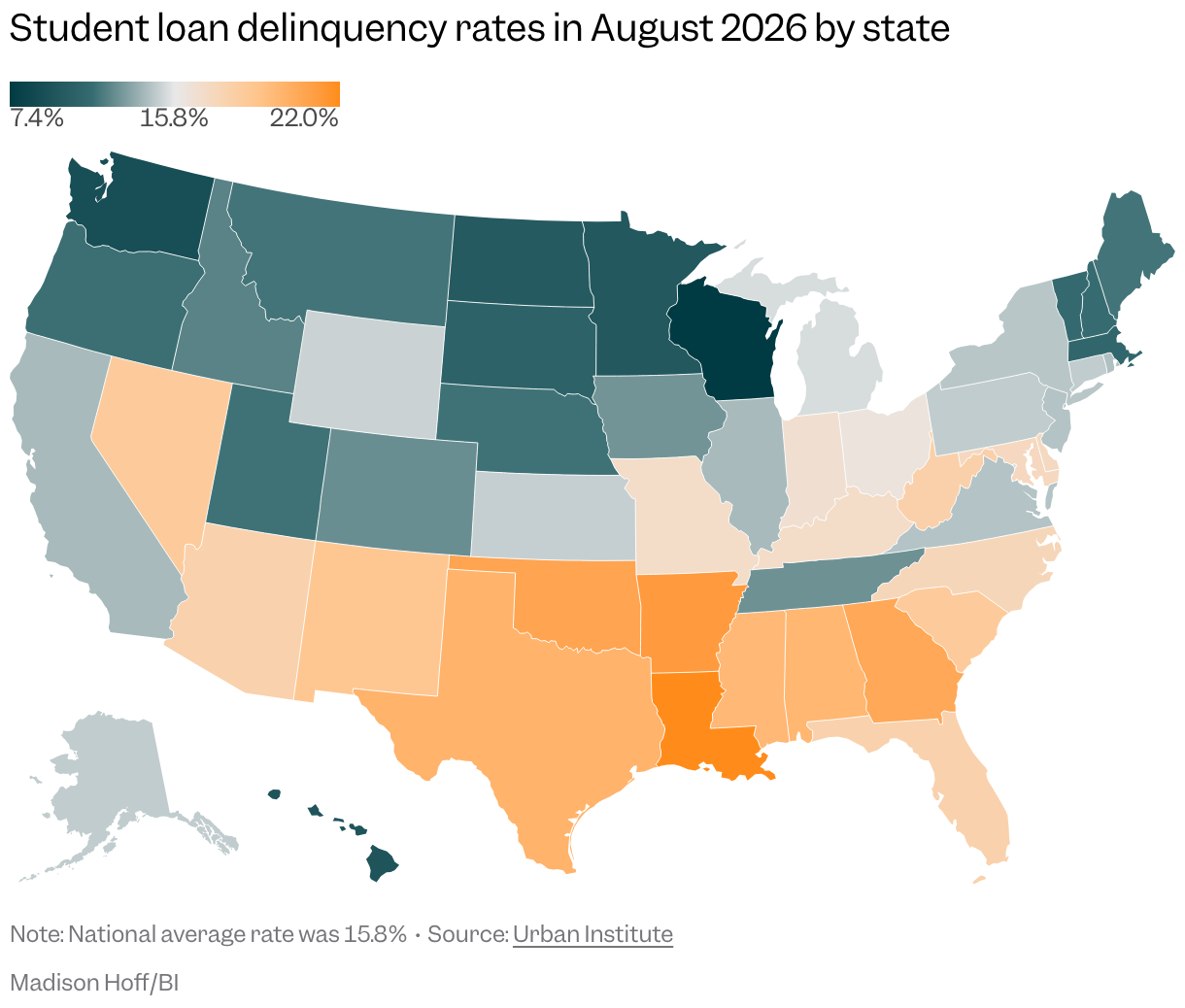
States with closely contested Senate races, like Texas and Ohio, have high rates of nonpayment, per an Urban Institute analysis.
Sarah Bundy has been in and out of default on her student loans for nearly three decades.
She borrowed for college in the mid-1990s, but dropped out as her loan balance became unaffordable. At the time, it was $39,000. Now, it's $60,000.
The 55-year-old is hoping a "blue wave" will pave the way for Democratic legislation to shield borrowers at risk of default.
"At my age, I can never get ahead of this," Bundy said. "So I'm just trying to scooch under the wire as long as I can."
Roughly one of every six adult Americans has federal student loan debt, according to Federal Student Aid. And some 16% of federal and private borrowers were 60 or more days late on their payments in 2026, according to an analysis by the Urban Institute.
Student-loan payments add to the squeeze from groceries and housing in an election increasingly centered on the cost of everyday life. High utility bills and gas prices are an added strain, especially as inflation is outpacing pay hikes.
Economic concerns are also reshaping debates over AI, with politicians reconsidering their support for data centers amid a backlash.
For borrowers, the pressure is particularly acute, and elevated student-loan delinquency rates overlap with some of the country's most competitive races.
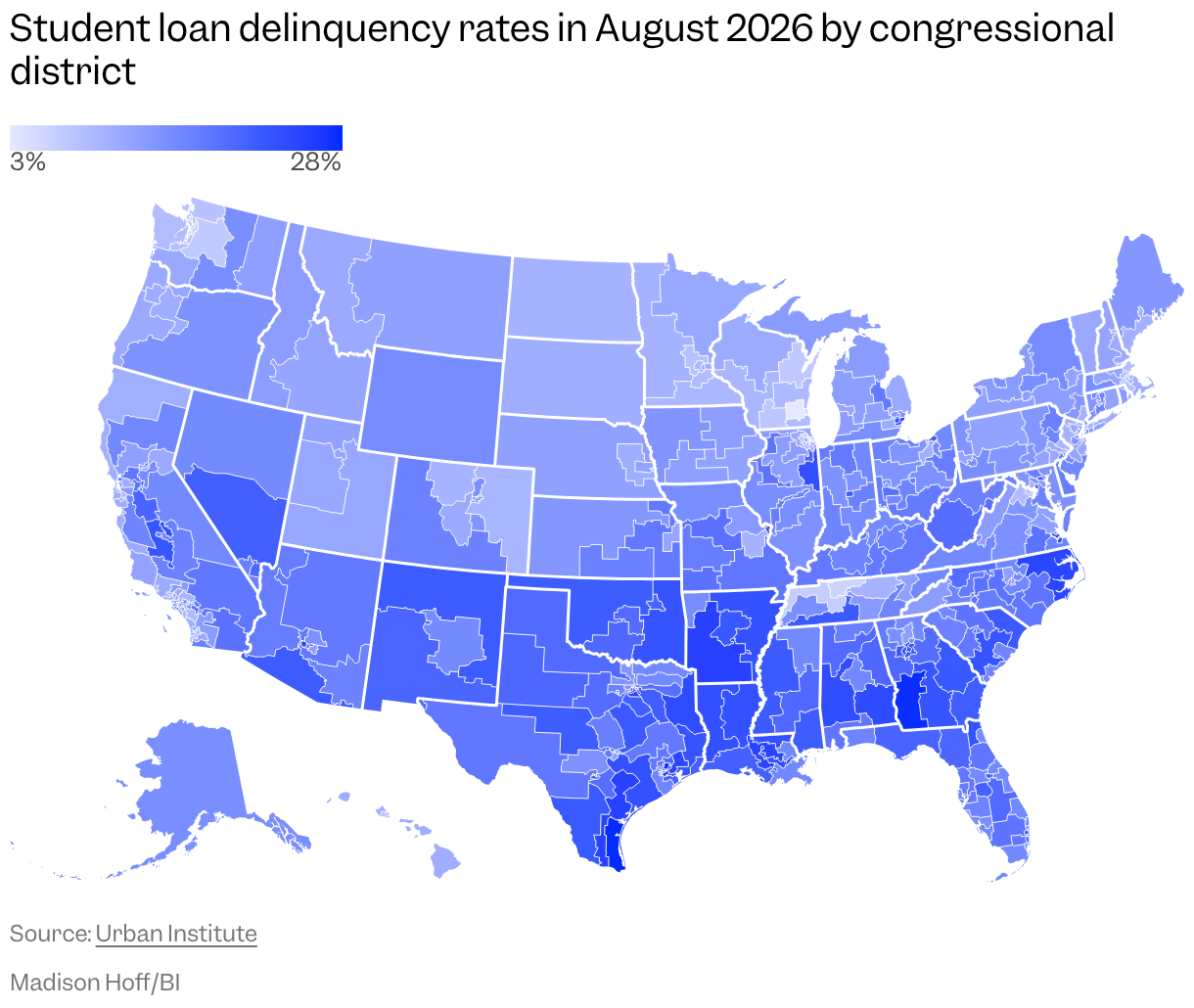
Texas and Ohio, home to closely-contested Senate races, both had higher-than-average non-payment rates. In the House, nine battleground districts as identified by the Cook Political Report as of Friday afternoon had worse nonpayment rates than the national average — some 28% of borrowers are delinquent in Texas's 34th District, and 25% in North Carolina's 1st.
Meanwhile, federal student-loan defaults, which typically occur after 270 days of nonpayment, are at a record high. While involuntary collections on defaults, including wage and federal benefit garnishment, have been paused for over a year, Democratic lawmakers have been pushing for legislation to protect borrowers once those consequences resume. Still, even a strong election for Democrats would likely leave them without sufficient numbers to override a presidential veto.
As of June 30, 9.3 million borrowers were in default, and an additional 1.5 million were in late-stage delinquency, according to Federal Student Aid. Roughly 14% of the $1.7 trillion student-debt load in the US is in default, or $234 billion.
Republican lawmakers have expressed support for President Donald Trump's student-loan changes, which they said will help borrowers repay their loans. Sen. Roger Marshall, who is up for reelection in Kansas, previously said that Trump's "big beautiful" spending legislation "made transformational reforms to student loans."
Student-loan borrowers have told Business Insider that they're worried about the consequences of defaulting, primarily through losing a chunk of their paycheck, Social Security payments, and tax refunds. Those concerns are exacerbated by the anticipated higher monthly bills under Trump's repayment overhaul.
"All we can do is keep pushing for every little bit of progress we can get on this," Bundy said.
A student-loan default wave
Luke Helton, a student-loan borrower in Tennessee, previously told Business Insider that the only way he can afford his expected $600 payment increase is by digging into his retirement.
While he voted for Trump because he believed in the administration's campaign promise to put America first, his student loan challenges have him second-guessing his vote.
"They talked a big game about caring about the little people, and they just haven't," Helton said.
The defaulted student-loan portfolio itself is undergoing changes. The Department of Education is moving forward with its plan, announced in March, to transfer defaulted student-loan accounts to the Treasury Department. The transfer will occur in phases, with the most recent step being the launching of a new online portal to help borrowers return to good standing and access default resources.
Education Secretary Linda McMahon said that the department "was never intended to serve as the fifth largest bank in America, and that's exactly why we partnered with the Treasury Department to improve the administration of federal student aid programs that millions of American students, families, and borrowers rely on."
Democratic lawmakers have raised concerns about the Treasury's capability to manage federal student loans. Over 60 of them pushed to halt the transfer and continue the pause on involuntary collections to continue giving borrowers relief as they navigate Trump's repayment overhaul. Sen. Bernie Sanders also led some of his colleagues in introducing a bill to prevent older borrowers and borrowers with disabilities from facing Social Security garnishment if they default.
Bundy recently went to Washington, DC, to urge New York lawmakers to support Sanders' bill. She's one of the millions of borrowers transitioning off the Biden-era SAVE plan, which offered lower monthly payments. She said she's not sure how she'll afford payments once they resume, and she's worried that she — and millions of other borrowers — could fall behind.
"When these garnishments start back up, it's really going to throw us pretty far back down," Bundy said. "I don't think people realize just how brutal it really is out there."
Cristian Barcenas is getting ready to cut out date nights, food delivery, and Starbucks.
He graduated from the University of California, Fresno, in 2013 with a student-loan balance of about $65,000. Barcenas took out additional loans to pursue a master's degree, but left early to care for his father, who had cancer. His balance now stands at $127,000.
Barcenas, who works full time in sales in California, was making $105 monthly payments under the Biden-era SAVE repayment plan. President Donald Trump eliminated SAVE, and in November, Barcenas' payments are expected to spike to $815 per month.
"When I saw how much the payment is expected to be, I freaked out for a whole week," the 40-year-old said. "I, under no circumstances, want to default."
Barcenas and his wife combed through all their expenses over the past three months. He said it was "jaw-dropping" to see that they spent over $300 on Starbucks and $600 on grocery deliveries in that time.
The couple has started grocery shopping more carefully and in person, and Barcenas has stopped using Uber for rides. They've also cut their date nights down to once a month to free up more money for student-loan payments.
Beginning in July, more than 7 million borrowers received notices to transition off the SAVE plan, and many of them are gearing up for higher payments. More than 1,000 borrowers have told Business Insider over the past year that they're worried about factoring a higher bill into their budgets and are considering taking on second jobs or digging into retirement savings to make it work.
The Trump administration has said that its student-loan changes are intended to simplify a complex repayment system, curb excessive borrowing, and compel colleges to lower tuition. Barcenas said he thinks the changes will lead borrowers to "want to hold onto what they have even more."
"There's going to be a lot of fear around spending because they know that they have this obligation that they can't really get out of, and that's going to be prioritized over everything else," he said.
Delaying life milestones for student-loan payments
Rey Sosa expects his student-loan payments to surge from $50 a month to more than $700. The 32-year-old urban planner is paying off a $101,000 balance, largely from his master's degree in urban planning, and while he's still on forbearance, he's configuring his budget to make it work.
"I based my entire life around that payment coming back at some point," Sosa said. "The amount shocked me at first, and while I have a budget for it, it does take away from saving for home, saving for kids, family, because that is what we have to scale back right now."
The Department of Education has recommended that borrowers enroll in its new Repayment Assistance Plan, intended to be the most affordable income-driven repayment plan. A recent report from the Center for American Progress, a left-leaning think tank, said that borrowers moving from the SAVE plan to RAP could see their student-loan bills increase by $2,163 annually on average.
Sara Partridge, associate director of higher education at CAP and a coauthor of the report, said that the payment increases come "at a time when there is high inflation, stagnating wages, and people are generally feeling financially strained," making it more difficult to budget.
Amy Webb, a 60-year-old borrower, said she's feeling that strain. She has a $178,000 balance that she took out for her son's education as a single parent and is concerned about higher monthly payments. She's unable to purchase a new car, she refinanced her house, and she's considering selling it and moving out of Virginia to a state with a lower cost of living.
"I don't know how long I can do this," Webb said. "I wish the government would help."
Sosa hopes to achieve Public Service Loan Forgiveness, which forgives student debt for government and nonprofit workers after 10 years. But with about six years of payments left, he anticipates pushing back big purchases like a first home.
"I understand that we have to repay our loans," Sosa said. "That's not what I'm upset about. What I wish is that there was more consideration into the cost of living. The world just got more expensive after school."

 Login